Cinema Troisi
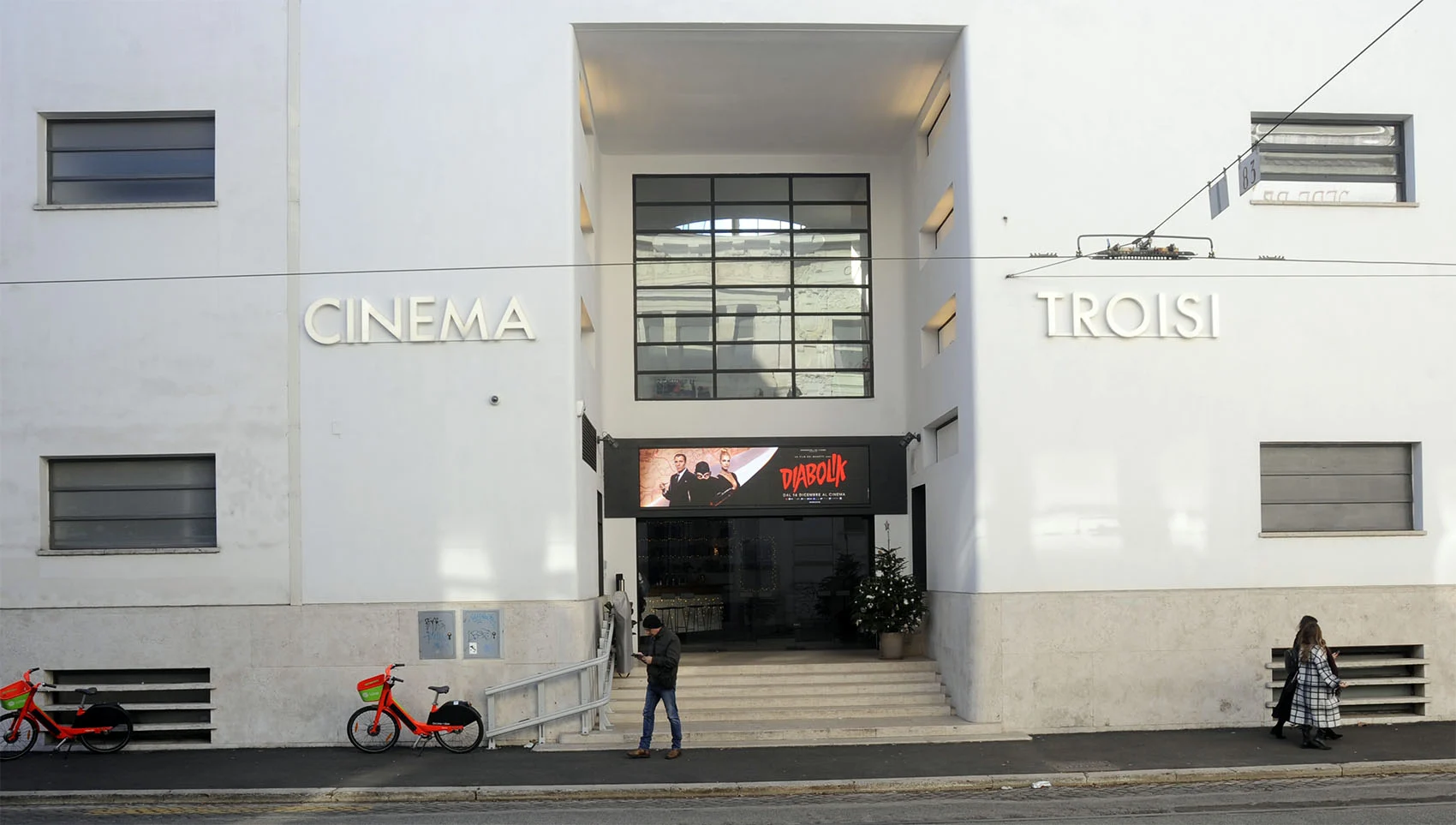
Cinema Troisi is at Via Girolamo Induno 1, in Trastevere, and it is open: it is run by the Fondazione Piccolo America, that is the kids of Cinema America, in a theater owned by Roma Capitale. The full ticket costs eight euros, the reduced one five for those under 25 or over 65, and you buy it online on Liveticket or at the box office. The study room is free and the operator declares it open at every hour, every day of the year.
The theater reopened on September 21, 2021 after eight years of darkness, with the Palme d'Or winner Titane in a national preview. Since then it has become the most discussed single-screen cinema in Rome, for two reasons that have little to do with cinema in the strict sense: the terrace full of students at midnight and the management model, a municipal property entrusted through a tender to a group born from an occupation and turned into a foundation.
The practical information comes from the cinema's website, the ticketing platform and the Roma Capitale tourist portal, as of September 28, 2026. Prices, series and study room rules change with the season and with announced work on the building: before planning an evening or a day of study, check the official website or write to the operator at info@cinematroisi.it.
Where it is and what you find inside
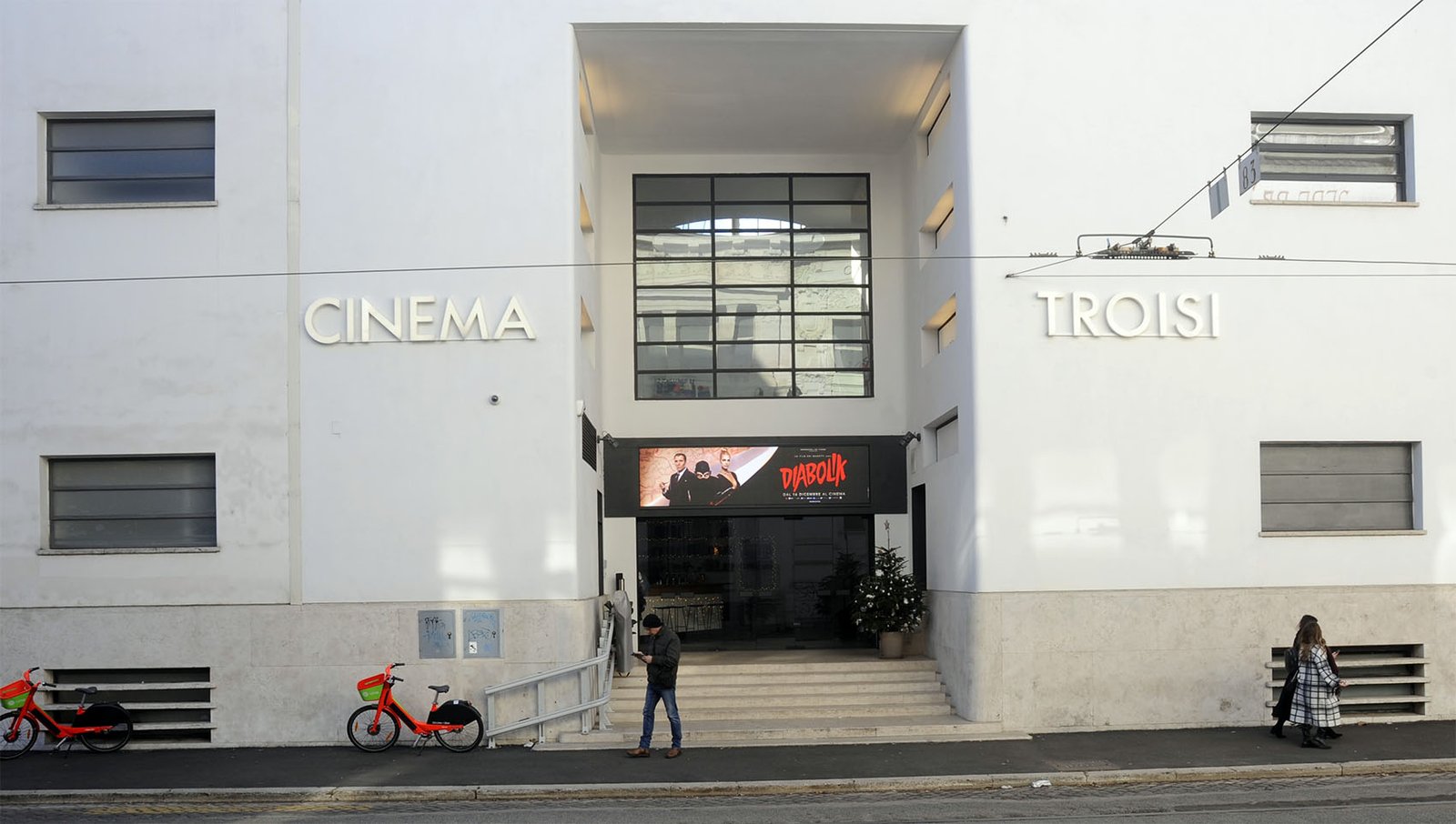
Via Girolamo Induno is a side street of Viale di Trastevere, the part of the district that faces Porta Portese and the river, far from the photographed alleys of Piazza di Santa Maria in Trastevere. The cinema occupies a wing of the former Casa della GIL designed by Luigi Moretti, the same Rationalist complex that on the Largo Ascianghi side now houses the WeGil. From the outside you recognize the curved line of the building mass, more than a sign.
Inside there are four distinct spaces. The movie theater, with 298 amaranth-colored seats plus two places reserved for people with disabilities, according to the operator's data. The foyer with the bar, called Troisi Caffè. The terrace, bright, used as an extension of the study room. And the study room itself, which has become the busiest part of the whole complex, to the point that many kids in the neighborhood know the Troisi for that and not for the films.
The technical equipment is that of a serious first-run theater, not of a film club carved out of a cellar. The operator lists a Barco 4K projector, a 13-meter Harkness screen and a Dolby 7.1 surround sound system, with accessibility features for people with motor disabilities and for the visually impaired. The seats were made to measure. For anyone who frequented Rome's old parish theaters, the difference is felt at the first reel, or rather the first digital file.
There is also a multipurpose space for exhibitions and events, which the website calls Spazio Mostre, and a small video library set up in the foyer. Don't expect a cinema museum, though: the historic photographs and materials on the theater's earlier life are few. The Troisi tells its own story more on the website than on the walls, and this is a limit the group could fix with little effort, given how much it has to tell.
A curiosity about Cinema Troisi
The hall existed before being a cinema. In the Casa della GIL designed by Moretti that space was born as a conference hall and theater, intended for the rallies and activities of the youth organized by the regime. Only after the war did it become a parish screening room, with the name of the street: Cinema Induno. The neighborhood audience knew it that way, and many elderly people in Trastevere still call it by that name.
The Cinema Induno had a precise reputation. It was a popular theater, with tickets at a reduced price compared with the first-run houses in the center, the place where you caught up with films released months earlier. The current operator also tells that the building appears in a 1952 film, Buongiorno, elefante!, behind Vittorio De Sica. It's an architectural cameo, nothing more, but it says how much this facade was part of the daily landscape of postwar Rome.
The naming after Massimo Troisi comes much later, in 1997, when the management passed to the Cecchi Gori group, which renovated the theater and dedicated it to the Neapolitan actor who had died three years earlier. It's a dedication few in Rome question, and yet it is curious: Troisi had no particular ties to Trastevere. It was a choice of distribution and affection for a beloved face, not a tribute to a Roman biography.
The name stayed even after the failure of that management and after the closure, and the kids who reopened the theater kept it without argument. It worked. In a city where closed cinemas become supermarkets or arcades, a person's name on the facade helped make the theater seen as something to defend, not as an empty commercial space to convert.
Something nobody tells you about Cinema Troisi
The Troisi doesn't belong to Piccolo America. It belongs to Roma Capitale, which assigned it through a tender, and the foundation pays rent. According to the account published by the operator, the contract signed on January 25, 2018 lasts 12 years with a fee of 2,800 euros a month. It's a detail no celebratory article puts up front, and it is instead the heart of the matter: this is an experiment in managing a public asset with a written expiration date.
The tender was called Patrimonio Comune and the group won it in 2016. Between the win and the opening five years passed: administrative appeals, structural checks, the search for funds, the construction site, and in the middle the pandemic. Anyone looking at today's Troisi sees the result, not the obstacle course. Those who work in culture in Rome know that five years to reopen a municipal theater is, paradoxically, almost fast.
The second detail that stays in the shadows is the cost of the works. The operator gives about a million and a half euros in total, covered in large part by the Ministry of Culture with 1,041,554 euros, by the Lazio Region with 100,000 euros, then by SIAE, BNL and the association's own resources. The story of kids saving a cinema is true, but it is also a story of well-spent public funding, and it should be told in full.
The third concerns the study room. It's told as a gift to the neighborhood kids, and it is, but it is also the piece of the project that made everything else sustainable: constant presence, a technology sponsor, national visibility. A theater that lives only in the evening, in a district with very high rents, struggles. A theater that never closes and always has someone inside becomes an outpost, and an outpost is harder to challenge.
Hours, tickets and subscriptions
The cinema's ticket page gives eight euros for the full price and five euros for the reduced one, reserved for those under 25 or over 65. The reduced ticket is bought only at the box office, not online. The operator doesn't publish on the website a fixed box office schedule separate from the shows: the subscriptions page declares the box office open every day, holidays included. Screening times change every week and are found in the grid on the website.
Tickets are really bought in two places. The first is the box office on Via Induno, the only one that sells reduced tickets and subscriptions. The second is the official sales page on Liveticket, which the cinema's website lists as the online channel and which opens directly from the titles showing on the Cinema Troisi Tickets page. No other resellers are listed by the operator, so be wary of anyone offering packages with entry included.
The standard subscription costs 45 euros for 10 entries, is valid for 12 months from activation and is personal. The operator writes that it covers new releases, retrospectives and events with guests and debates. With the subscription you reserve only one ticket per show, and the reservation is made at the box office, not online. There is also a subscription that can be bought with state culture vouchers, like the teacher card, which the sales page reports.
For anyone who wants to give it as a gift from a distance, the website explains that you can buy online and then pick up at the box office by showing the receipt. On the sales platform there is also a formula called CINEMINI, designed for families with children. The operator doesn't publish refund conditions on the tickets page: if you have doubts about a date change or a canceled event, ask by email before buying, not after.
A note on special summer rates. In August 2026 the foundation turned the theater into a climate shelter with the Allerta Fresco initiative, inspired by the Ciné-clim of Paris: 35 films at 13:30 every day, from the 1st to the 31st of the month, free for under 25s, over 65s, pregnant women and people with disabilities, at a reduced price for everyone else. The website will say if the initiative returns in coming years.
The study room open day and night
The study room is free and open to everyone, with no membership card, no reservation and no ID. The rules published by the operator say that seats are taken in order of arrival and that the space is open every day, at every hour. It was presented in 2021 as the first study room in Italy open 24 hours a day all year round, and at the end-of-September 2026 check the website still declares it so.
The numbers, according to the operator's pages, are these: 45 indoor workstations with ergonomic seating and a total of 80 counting the terrace. On the surface area the operator's sources don't agree, because a page from 2021 speaks of 150 square meters and a 2025 announcement of 120. The workstations have electrical outlets, network connections and USB ports, the wireless network is declared at one gigabit, and there are 10 laptops on free loan.
The rules are few and clear. No eating inside, only on the terrace. The phone has to be kept silent, even without vibration. Video and music only with headphones, and at low volume anyway. Group discussions are held outside, on the terrace, always without disturbing. The workstation must be left clean. They are library rules, applied by a community of students that generally enforces them on its own, with a look more than a sign.
In April 2025 the foundation announced a very substantial expansion: from 120 to 670 square meters, in rooms adjacent to the terrace, with a collaboration announced with the Biblioteche di Roma. Other sources speak of 200 more seats. The operator wrote that the work would last a few months. The operator gives no progress status on the study room page, so ask before counting on those seats.
The contrarian view is precisely about the terrace. On social media it passes as a Trastevere rooftop where you cool off with a view, and some people arrive with a spritz in hand and a group of friends. That's a mistake. That terrace is an open-air study room, with kids preparing private law exams at two in the morning, and treating it like a bar is rude. For an aperitivo, Trastevere offers a hundred better places.
My advice for visiting Cinema Troisi
Go to a screening with a guest, not just any. The value of the Troisi compared with a multiplex is the theater full of people who stay seated after the end credits to listen to the director or the actor answering questions. The operator lists more than 700 guests who have passed through here. The meetings are announced on the website and on the cinema's social channels, usually a few days in advance, and sell out quickly.
Buy online if you can pay the full price, and show up early anyway. There is only one theater, the seats are fewer than 300, and on evenings with guests or previews the audience arrives early to pick a row. Those entitled to the reduced price have to go through the box office, and the advice counts double: on crowded evenings the line at the box office mixes with the comings and goings of the bar and the study room.
If you're traveling and don't speak Italian, aim for screenings in the original version with subtitles, which the program marks with the code VOS next to the title. At the end-of-September 2026 check the schedule counted several in the same week. For a tourist it is the simplest way to see how Roman kids spend their evening, without having to understand a dubbed film. Check the code before buying, because the same titles can also run dubbed.
If you want to see the study room and the terrace without disturbing, go by day, in mid-morning, come in through the foyer, have a coffee at the bar and look. Don't take a workstation to snap a photo and don't shoot video among the tables. The people studying in there spend whole days before an exam, and a noisy visitor spoils the work of 30 people. The bar is the right place to observe without intruding.
Last piece of advice, a practical one: Sunday morning. The schedule for the 2026-2027 season announces a Disney retrospective on Sunday at 11:00 and one dedicated to Nicolas Winding Refn on Saturday at the same time. They are events meant for very different audiences, families on one side and cinephiles on the other, and they give an idea of the cinema's line: popular and auteur in the same week, without separating the two worlds.
The program and the original language
The Troisi works as a first-run theater with a strong auteur component. In the grid, new releases, previews, retrospectives and original versions live side by side. In the 2026-2027 season the schedule announces, among other things, titles in the original version such as The Dreamers and We're All Going to the World's Fair, and the screening of episodes of the series Un Prophète in the original. Titles change from week to week, so the source is always the grid on the website.
The series are the backbone of the cinema's identity. The archive published by the operator lists retrospectives dedicated to Rohmer, Tarkovsky, Kieślowski, Hitchcock, Kubrick, Pasolini, Bresson, Miyazaki, Lynch, Sorrentino, Almodóvar, Fellini, Spielberg, Truffaut, Woody Allen and Joachim Trier, as well as three editions of FR*CINEMA dedicated to French cinema. There have also been more playful series, from Halloween marathons to nights with the Universal monsters, and a tribute to Shinji Sōmai.
The code VOS indicates the original version subtitled in Italian. For someone studying a language it's a good exercise, for a foreigner it's a way of going to the movies in Rome without dubbing, which remains the rule in Italian multiplexes. The operator doesn't publish a fixed day dedicated to the original language: the code appears next to individual shows, and you have to read the grid carefully, time by time.
Anyone coming from the summer open-air scene will find a direct continuity. The group that runs the theater organizes Il Cinema in Piazza in summer, and in 2026 the 12th edition ran from May 28 to July 12 across Piazza San Cosimato, the Parco della Cervelletta and Monte Ciocci, with free entry, films at 21:15 and subtitled original versions. For the complete picture of outdoor screenings there is our page on the summer open-air cinemas of Rome.
Another well-known fact, yet rarely cited
The Troisi won a Biglietto d'Oro in 2022 as the single-screen cinema with the most spectators in Italy, with over 60,000 admissions in its first year of activity according to the available account. Everyone who follows cinema in Rome knows it, but the context is rarely cited: that year Italian theaters were coming out of the pandemic with disastrous numbers. A neighborhood single-screen cinema that fills its seats in that season is a case study, not an anecdote.
The second well-known and little-cited fact is that the theater, before this management, was shut down by an eviction. According to the operator's account, on March 6, 2015 Roma Capitale carried out the forced eviction against the company that had held the theater in its last phase, linked to the circuit of theaters of the producer Massimo Ferrero. The cinema had been closed since 2013. The reopening of 2021 thus closes a story that began in a courtroom, not at a party.
Third fact: the theater you see is not a modern reconstruction inside an old shell. The operator writes that during the construction work the original 1933 Carrara marble floors, the bas-reliefs and the original stained-glass window were restored, under the supervision of the Soprintendenza. The systems, instead, were demolished and rebuilt from scratch. The work bears the signature of the architects Raffaella Moscaggiuri and Claudia Tombini.
The fourth fact concerns the most militant part of the project. The association was born from the experience of a collective of students from the center, active since 2011, who were looking for cultural spaces alternative to nightlife and to the tourist consumption of the district. That collective occupied Cinema America in November 2012. The Troisi is the institutional answer to that season: the same faces, with a contract instead of an occupation.
The right photo to take at Cinema Troisi
You take the right photo inside the theater, before the lights go down, from the highest row toward the screen. The amaranth seats in orderly rows, the huge white screen and the light walls give back the image of the movie theater as it's remembered, the one in Tornatore's films. Shoot when the theater is half empty: full it is anonymous, empty it is sad, half full it tells the waiting.
The second is on the terrace, in the evening, with discretion and without recognizable people in the foreground. The lamps on the tables, the open laptops and the Trastevere sky in the background give an image that says more than any article about what this place has become. Ask permission if you frame anyone. The people studying here did not choose to become part of your travel story.
The third is outside, and concerns the architecture. The volume of the former Casa della GIL reads better from Largo Ascianghi, on the WeGil side, where Moretti's tower and white surfaces show the Roman Rationalism of the 1930s. Stand on the other side of the street, in the early morning, when raking light draws the edges and traffic hasn't yet filled the sidewalk with scooters.
Avoid the photo of the sign taken with flash in the evening. It's the one everyone takes, it comes out flat, and the sign in itself has nothing historic. Better a photo of the foyer, with the bar counter and the posters, which tells the daily life of the theater. If you want a keepsake with the actor's name, photograph the ticket printed at the box office: it takes little space and says it all.
How to get there
The operator lists as useful surface lines the 8, the 3, reactivated from September 7, 2026 only on part of its route, the H, the 44, the 75, the 115 and the night line N3. Tram 8 is the most convenient link for those coming from the historic center, because it runs down Viale di Trastevere and stops a few minutes on foot from the theater. The closest metro station, according to the operator, is Piramide on Line B, from which it's best to continue by bus or on foot across the river.
By train the reference is Trastevere station, which the operator puts at about 10 minutes on foot, or a few minutes with lines 8, 3 and H. It's the right choice for those arriving from outside the city on regional trains. For evenings that end late, remember that daytime runs thin out and the night service remains: check the times on the transport company's website before going out.
By bicycle the website suggests the Lungotevere bike paths up to the height of Porta Portese, from where the theater is three minutes away. By car the situation is that of all Trastevere: the operator refers to car sharing and to street parking in nearby streets, and in the evening looking for a spot in that area is an exercise in patience. Before driving into the district check the hours of the City's electronic gates.
From the Troisi the rest of the district is walkable. In 10 minutes you reach Porta Portese and the church of San Francesco a Ripa, in a quarter of an hour the Basilica of Santa Cecilia and the San Cosimato cloisters, the square where in summer the group sets up the free screen. Across the river you reach Testaccio in about 20 minutes.
Some important events that happened here in history
In 1933 the Opera Nazionale Balilla entrusts the young Luigi Moretti with the design of the Casa della Gioventù Italiana del Littorio of Trastevere. The building is inaugurated in 1937, according to the Ministry's entry on the Art Bonus platform and the WeGil website. The cinema's website writes instead that the structure was completed in 1933: the sources don't agree, and the best-documented version is that of the project started in 1933 and the opening four years later.
In the 1950s the GIL's conference hall and theater becomes the Cinema Induno, a neighborhood parish theater, with cheap tickets and a loyal audience. It's the season when movies in Rome are a daily habit and every district has its second- and third-run houses. In 1952 the facade appears in the background of a scene of Buongiorno, elefante!, with Vittorio De Sica.
In 1975, with the abolition of the body that had inherited its ownership, the main building of the former GIL passes to the Lazio Region and enters a long phase of abandonment. Via Induno theater follows a different road: today it is recorded as owned by Roma Capitale, and not by the Region. In 1997 the management passes to Cecchi Gori, who renovates the cinema and names it after Massimo Troisi.
After the failure of the circuit tied to that management, the theater passes to a company linked to the Massimo Ferrero circuit and closes for good in 2013. On March 6, 2015 Roma Capitale proceeds with the eviction. In 2016 Piccolo America wins the Patrimonio Comune tender, on January 25, 2018 it signs the contract, and after the construction work and the pandemic the theater reopens on September 21, 2021 with Titane, followed on September 30 by No Time to Die.
On December 7, 2017, a few months before the contract was signed for the theater, the Lazio Region reopens the main building of the former GIL as WeGil, after more than 40 years of abandonment. On December 12, 2022 the Piccolo America association becomes a Third Sector foundation. In April 2025 the expansion of the study room is announced. Three dates that tell how an entire block of Trastevere became public again in less than 10 years.
Who has passed through Cinema Troisi
The guest list published by the operator exceeds 700 people, and just scrolling through it is enough to grasp the weight the theater has gained in a few years. Among the directors are Francis Ford Coppola, Paolo Sorrentino, Luc Besson, Michel Gondry, Darren Aronofsky, Spike Lee, Gus Van Sant, Sally Potter, Gaspar Noé, Emir Kusturica, M. Night Shyamalan, Damien Chazelle, Ken Loach and Luca Guadagnino. The website does not give the dates of the individual meetings.
Among the actors the same list includes Isabella Rossellini, Mark Ruffalo, Willem Dafoe, Edward Norton, Austin Butler, Paola Cortellesi, Riccardo Scamarcio, Viggo Mortensen, Tony Leung Chiu-wai, Léa Seydoux and Rosario Dawson. For a single-screen cinema of 300 seats on a side street of Viale di Trastevere it's a collection of names many festivals would envy, and it is the result of years of relationships built with the summer open-air screenings.
Some of those names come from the group's summer open-air screenings, which preceded the theater by several years. On the presentation page the operator recalls that Il Cinema in Piazza has brought to Rome, among others, Asghar Farhadi, Paul Schrader, Ken Loach and Wim Wenders. The Troisi inherited that network of contacts and turned it into a program of meetings that during the winter continues what happens outdoors in summer.
Before them, this hall saw the GIL members, with the uniforms and rallies that Moretti's building was created to host. Then the neighborhood families of the Cinema Induno, who paid little and saw films months late. Then the audience of the Cecchi Gori management. Three very different audiences in the same space, and no plaque remembering them all together. It would be a simple and useful addition.
Massimo Troisi, to whom the theater is dedicated, never came in here alive with this name over the door: the naming dates from 1997, three years after his death. It's right to say so, because many visitors imagine a biographical link that isn't there. There is instead a link of audience: Troisi's films, starting with those shot in Naples, had devoted audiences in Rome, and the theater keeps their memory alive with its program.
Then there are the unknowns, who are the real audience of the Troisi. The students who spend the night in the study room, the neighborhood pensioners at the afternoon screenings, the matinée families, the foreign cinephiles looking for the original version. The group that runs the theater was born precisely from the conviction that a cultural space in a tourist district must serve first of all those who live there.
Piccolo America, from occupation to foundation
The group that runs the Troisi comes from far back. According to the operator's presentation page, the association was born in September 2014 from the experience of a movement of students from the center of Rome active since 2011. In November 2012 those kids occupy Cinema America, a closed theater in Trastevere slated for demolition. The occupation lasts almost two years and ends with eviction, but the building obtains a cultural protection order.
After the eviction the association obtains on free loan a former bakery next to the closed cinema and begins to bring cinema outdoors. In 2014 Il Cinema in Piazza is born, in Piazza San Cosimato, and from 2018 the open-air screenings multiply in other neighborhoods. The group also carries on the screenings called Schermi Pirata, with images projected on walls and monuments of the city. It is from this work that the credibility later spent on the Troisi comes.
Cinema America, the building from which the group took its name, is another theater, on another street of the district, and should not be confused with the Troisi. It is one of the most frequent mistakes I hear from visitors: they arrive at Via Induno convinced they're entering the cinema of the occupation. The Troisi is the group's institutional seat, obtained through a public tender, not the place of the protest.
On December 12, 2022 the association turns into a Third Sector Foundation. The operator explains the choice with the need to align the legal form with the growth of its activities and with a national perspective. Translated from statutory language: more staff, more spaces, more funders, and the need for a structure able to hold multi-year public contracts like the one for Via Induno theater.
Luigi Moretti's building and the WeGil
The Troisi is part of a complex that is one of the fundamental texts of Rationalist architecture in Rome. The Casa della GIL of Trastevere was designed by Luigi Moretti for the political, military and sports education of young people, with gyms, health spaces and meeting rooms. The project was exhibited as early as 1933 and became a model for similar buildings in other cities. The most famous part is the helical staircase of the main building.
Anyone who wants to see Moretti's architecture has to enter from the Largo Ascianghi side, in the WeGil, the cultural space of the Lazio Region opened in December 2017. The WeGil website gives opening every day from 10 to 19 at Largo Ascianghi 5. The ownership is different from that of the theater: the building belongs to the Region, the cinema to Roma Capitale, and the two managements are not connected.
From the cinema, of the original architecture you see the restored marble floors, the surfaces of the hall and the recovered stained-glass window. You don't see the helical staircase, you don't see the gyms, you don't see the tower from the inside. If your interest is architectural, the right sequence is WeGil first and Troisi after, perhaps with an evening film to close the day inside the same building from another entrance.
Moretti is an architect who also worked for a long time after the war, and his name remains tied to Roman Rationalism more than to anything else. His political biography, tied to the regime in the 1930s, is part of the story of this building and shouldn't be removed. A cinema run by a group born in an occupation inside an architecture of the regime is an overlap that happens often in Rome, and is worth noticing.
When it's closed and what not to expect
The movie theater follows the program, so it is closed when there are no shows, while the study room is declared always open. The operator doesn't publish a weekly rest day for the cinema. In recent years the theater has worked in summer too, with initiatives like Allerta Fresco in August 2026, while the group ran the open-air screenings. For the end-of-year holidays it's best to look at the grid, because hours change.
Don't expect a guided tour. The Troisi doesn't organize visits of the building and doesn't sell entry to see the theater without a film. To get into the theater you need a ticket for a screening. The foyer, the bar and the study room are freely accessible, according to the room's rules. Anyone arriving hoping for a route on Moretti's architecture has to go to the WeGil, which has its own opening hours.
Don't expect a kitchen either. Troisi Caffè is a bar inspired by cinema, open every day according to the operator, good for a coffee, a drink or an aperitivo before the film. The precise hours and the price list are not published. To have dinner you go out and walk: the area offers many possibilities, and I talk about it in the next section with a few warnings about the traps of the district.
On accessibility the operator declares that all spaces, terrace included, are free of architectural barriers, and the theater has two places reserved for people with disabilities. For visually impaired people the theater was designed with specific features, which the operator mentions without detailing. If you have particular needs, write beforehand to info@cinematroisi.it and ask for confirmation for the show you are interested in.
Eating in the area
Trastevere is the district where in Rome you eat worst in proportion to the number of restaurants, and also one of the few where you can still eat very well. The difference is made by the street you choose and the signs you know how to read. The area of Via Induno and Viale di Trastevere is less touristy than the heart of the district, and that helps, but you only have to cross the avenue to find the menus in five languages again.
First sign: the buttadentro, the street barker. A kid at the door who stops you, shows you the menu and promises you a table right away works for a place that lives on passing trade. Romans don't go to them for a simple reason: a place with regular customers has no need to stop anyone. The same goes for places with the laminated photo menu, designed for people who don't know the dishes and won't come back.
Second sign: the woman rolling out pasta dough in the window or on the sidewalk. It's a scene staged for passersby, not a clue to quality. Fresh pasta made well is prepared in the kitchen, in the morning, away from dust and scooters. When you find it on display at the entrance, what's working is the visual lure, and the final bill usually proves it.
Third sign: the kitchen open without a break from 11:00 in the morning to midnight. A real trattoria has a pause between lunch and dinner, because the people cooking need to rest and prepare. If the place serves carbonara at four in the afternoon, it is working with preparations kept ready. It's not a moral judgment: it's a matter of how a kitchen works, and a Roman understands it without thinking.
Fourth sign, typical of Trastevere's squares: the price that changes according to the customer. Places with tables in front of churches and monuments often have items with no price, fish by undeclared weight, and sometimes a menu inside that differs from the one displayed outside. Ask the price of what you order before ordering it. If the waiter gets irritated, you already have the answer you needed.
The criterion is to look at who is sitting. If at nine on a Tuesday evening there are neighborhood families, people greeting each other by name and a waiter who speaks Roman dialect, you're in the right place. After a film at the Troisi the cinema audience scatters into exactly those trattorias, and following it is a method that works. So you don't have to go by trial and error, there is our list of the places where we eat.
What to combine in a day
A day built around the Troisi starts in the morning in the district and ends with the evening film. Start from the Basilica of Santa Maria in Trastevere, continue toward the Basilica of San Crisogono and the church of Sant'Agata, then the Museo di Roma in Trastevere. For general orientation there is our guide to what to see in Trastevere.
The afternoon can climb higher. From the district you reach the Janiculum passing by San Pietro in Montorio and the Acqua Paola Fountain, or you choose the greenery of Villa Sciarra, a few minutes' climb from Via Induno. Those with more time go all the way to Villa Doria Pamphilj. The return to the cinema is all downhill.
On the river side the classic pairing is with the Villa Farnesina, the Galleria Corsini and the Botanical Garden, three visits on the same street. From there you cross Ponte Sisto toward the center, or go down to the Tiber Island, where in summer the Isola del Cinema operates.
Those who travel for cinema can build a themed itinerary. The Casa del Cinema at Villa Borghese has an archive program, the MIAC tells the history of Italian audiovisual, and the Cinecittà studios are the industrial chapter of the same story. In the same area as the Troisi the Nuovo Sacher also operates, the district's other single-screen cinema, tied to Nanni Moretti.
Those who prefer theater find the big halls of the center a tram ride away: the Teatro Argentina, the Teatro Valle and the Teatro Eliseo, each with its own history and its own schedule. Tram 8 links Viale di Trastevere to the historic center, and makes a double program convenient: a film in the afternoon on Via Induno, a show in the evening across the river, or the reverse on matinée days.
For those who study in Rome, the Troisi is not the only possibility. The Biblioteca Nazionale Centrale and the Biblioteca Casanatense offer reading rooms with different hours and rules, suited to research on historical collections. The Troisi remains unbeatable for hours, but if you need old books or periodicals, a library is something else, and Via Induno space doesn't replace it.
Those who want to stay on the south side can finish across the river. The Pyramid of Cestius is near the Line B metro stop given by the operator, the Ex Mattatoio hosts exhibitions and events, the Monte dei Cocci and the Nuovo Mercato Testaccio tell of another working-class district. Farther on, the street art of Ostiense deserves a walk.
Frequently asked questions
How much does a ticket to Cinema Troisi cost?
According to the cinema's ticket page, the full price is eight euros and the reduced price five euros, reserved for those under 25 or over 65. The reduced ticket is bought only at the box office at Via Girolamo Induno 1, while the full price can also be bought online on the official Liveticket page. The conditions for special events and previews should be checked show by show.
Is the Cinema Troisi study room really open at night?
Yes, according to the operator the study room is open 24 hours a day, every day of the year, free of charge and without reservation. Seats are taken in order of arrival: 45 indoors and others on the terrace, for a declared total of 80. In April 2025 a major expansion was announced, whose progress should be asked about directly to the operator.
Who runs Cinema Troisi?
It is run by the Fondazione Piccolo America, born as an association in 2014 from the group of kids who in 2012 had occupied Cinema America. The theater is owned by Roma Capitale and was assigned through the Patrimonio Comune tender won in 2016. The contract, signed in January 2018, has a term of 12 years according to the operator's account.
Is there a subscription?
Yes. The standard subscription costs €45 for 10 entries, is valid for 12 months from activation and is personal. It covers new releases, retrospectives and events with guests. With the subscription you book one ticket per screening, at the box office. The sales page also lists a version that can be bought with state cultural vouchers, such as the teacher card, and the CINEMINI package for families.
Are there films in the original language at Cinema Troisi?
Yes, the schedule marks with the abbreviation VOS the films shown in the original version with Italian subtitles. There is no fixed day set aside for them: the abbreviation appears next to individual screenings in the weekly grid published on the website. At the check at the end of September 2026 the schedule included several titles in the original language in the same week, along with dubbed films and retrospectives.
Can you go up to the terrace even if you're not studying?
The terrace is part of the study room spaces and follows its rules: silence, phones with the ringer off, group discussions at a low volume. The rules allow eating only there. It isn't meant as a panoramic terrace for aperitifs, and anyone who uses it that way disturbs the people who are studying. For a coffee or a drink, the right place is the Troisi Caffè in the foyer.
How do you get to Cinema Troisi by public transport?
The operator lists lines 8, 3, H, 44, 75, 115 and the night line N3. Tram 8 along Viale di Trastevere is the most convenient connection from the center. Trastevere railway station is about 10 minutes away on foot, and the nearest metro station is Piramide on line B. By bike you follow the Lungotevere bike path as far as Porta Portese.
Are Cinema Troisi and Cinema America the same theater?
No. Cinema America is the Trastevere theater occupied in 2012 by the young people who later founded Piccolo America, and from which the group took its name. The Troisi is a different theater, the former Cinema Induno at Via Girolamo Induno 1, assigned to the group through a city tender and reopened on September 21, 2021 after a restoration that lasted years.
Who wrote this page
This page comes from the editorial team of Tour Leader Pro, the Rome-based outfit that designs itineraries, visits and cultural events across Rome and Lazio. The prices, study room rules and schedule reported here come from the official sources cited in the text, as of the date given at the top. Since this is a working theater, with series that change every week and works announced on the building, check them again before you head out. Tell us what you find changed.
Building an evening in Trastevere for a group, or even just for yourself, means fitting together film times, lines at the box office for reduced tickets, trattorias that close the kitchen early, trams that thin out in the evening and a neighborhood where tourist traps are around every corner. If you're facing this kind of puzzle, on Tour Leader Pro you'll find working materials designed for people who guide groups and for people who organize on their own.
For the big picture, meaning regional trains and seasonal timetables, airports, moving between one province and another and destinations in Lazio outside the center of Rome, from the Castelli to the volcanic lakes of the north, down to the Tyrrhenian coast and the villages of the interior, a useful resource for putting together a multi-day itinerary is Italy Planner.