Nuovo Cinema Sacher
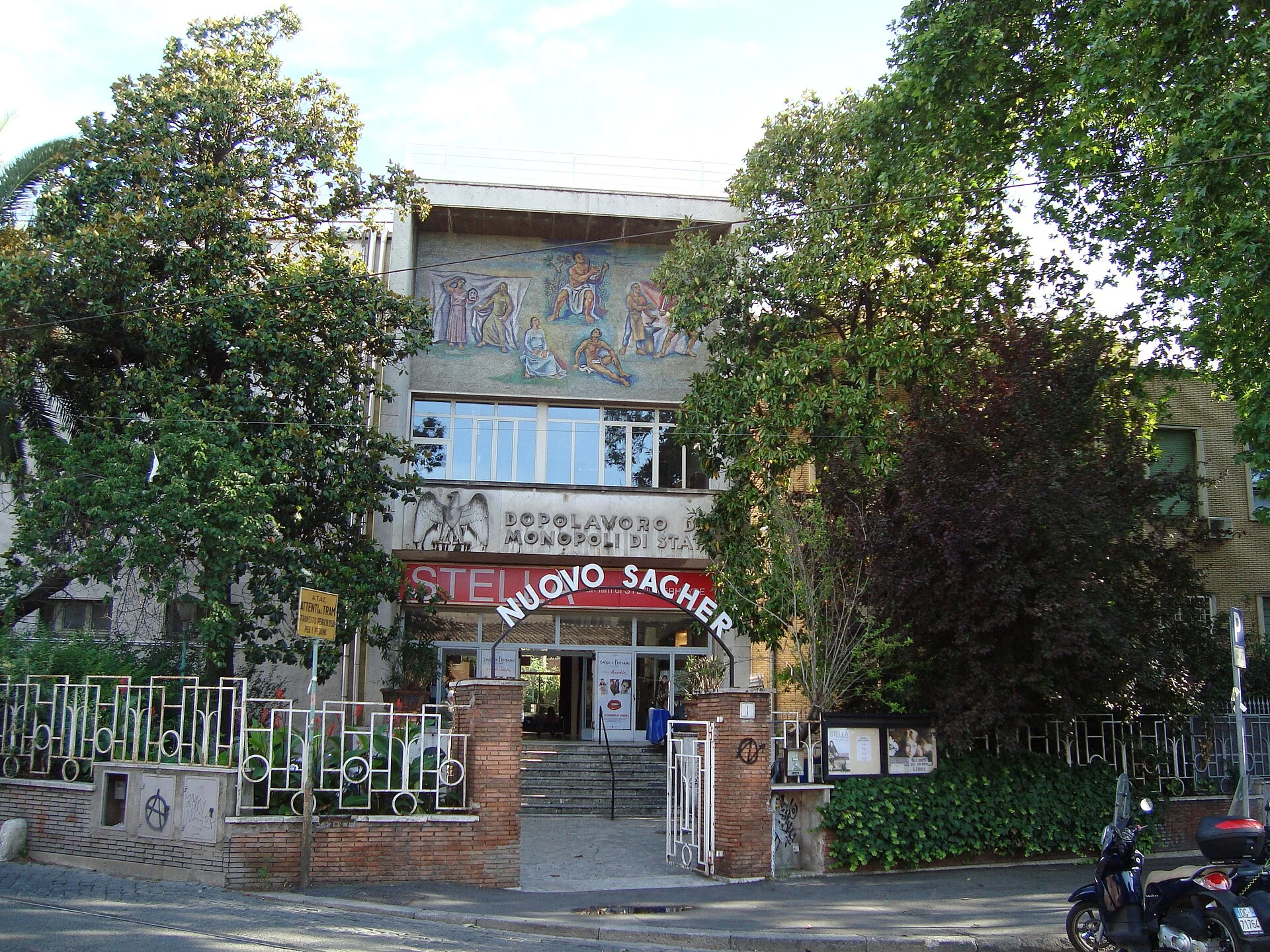
The Nuovo Cinema Sacher is at Largo Ascianghi 1, in Trastevere, a few meters from Viale di Trastevere, and it is a working single-screen cinema run by Sacher Film, the company of Nanni Moretti and Angelo Barbagallo. The city's listings portals, at the end of September 2026, show four screenings a day between 16:00 and 21:30, with a ticket at €8 in the afternoon and €9 in the evening. There is no need to book: you buy at the box office or online from the cinema's website.
The draw is twofold and should be said right away. On one side there is the hall, a Rationalist building of the 1930s that began as the dopolavoro of the State Monopolies, with a mosaic on the facade that almost nobody looks at. On the other there is the name of Moretti, who since November 1991 has made this place the most recognizable arthouse cinema in Rome, with a summer arena and a series of first features titled Bimbi Belli.
The practical information reported here comes from a check made on September 28, 2026 of the city's listings portals and the other sources cited in the text. The cinema's official website publishes the address, the telephone number and the link to buy online, but not the price list: before you leave the house, call the box office at 06 5818116 and have them confirm title, time and price, because the program changes from week to week and often from day to day.
Where it is and what the hall is like
Largo Ascianghi is a small widening on the side of Trastevere that faces the river and Porta Portese, east of Viale di Trastevere. It is not the part of the neighborhood that ends up on postcards: no alleys with ivy, no little tables on the cobblestones, just early 20th-century buildings and neighborhood traffic. For those coming from the area of Santa Maria in Trastevere it is about a 10-minute walk, and you feel the change in tone.
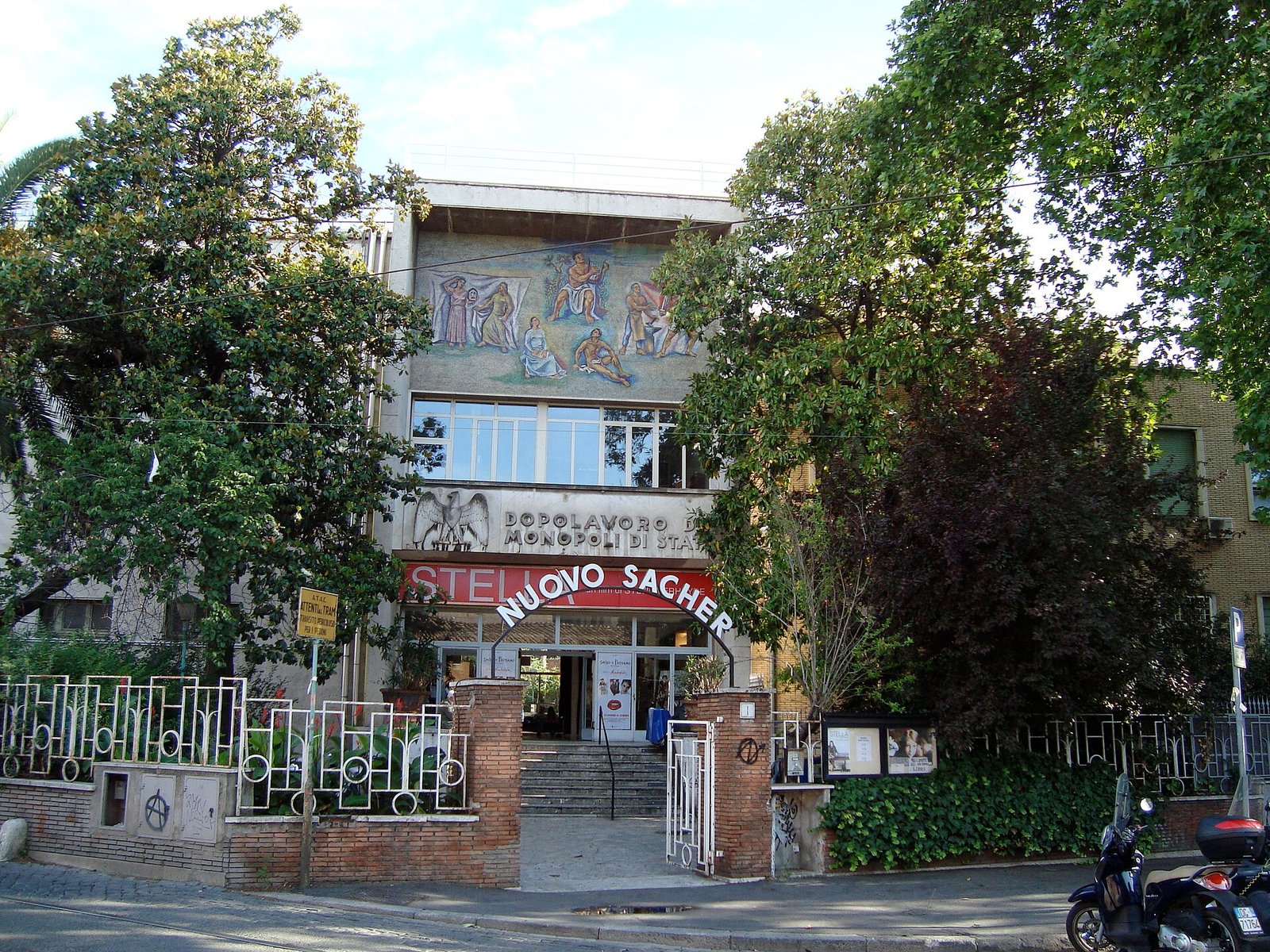
The building is a compact block clad in travertine, with the facade marked by three rows of small windows and a balcony on the first floor. It was designed by the architect Ettore Rossi and built between 1936 and 1938 for the dopolavoro of the employees of the Administration of the State Monopolies. Anyone with a trained eye immediately recognizes the grammar of Roman Rationalism: clean volumes, pale stone, symmetry, no concession to superfluous decoration.
Inside there is a single hall. The sources do not agree on the number of seats: the encyclopedia and the historical entries speak of 362 seats, the most widely used listings portal gives 314, and the difference may depend on a refitting. In any case it is a large hall by the standards of a Roman arthouse cinema, with a gallery of ample proportions and a screen that dominates the stalls without being a multiplex mega-screen.
Next to the hall there is an inside bar, and at the back opens the summer arena, built in the shape of an amphitheater, which in summer takes the place of the hall for evening screenings. From the outside the arena can't be seen and many passersby don't even know it exists. It is one of the few outdoor spaces for cinema in Rome that is not set up from scratch every year in a park or a piazza.
Management is by Sacher Film, the company founded by Nanni Moretti and Angelo Barbagallo in the mid-1980s, which bought the hall in 1991. This means something specific for the visitor: the program is not decided by a national circuit and does not follow the logic of releases on 500 prints. It is chosen by a production and distribution house with a declared taste, and that taste shows in every title.
To get your bearings it is enough to remember that the largo opens on the side of Viale di Trastevere facing the Tiber, in the stretch between Piazza Mastai and the Porta Portese area. From the avenue you enter a network of residential streets, quieter and less lit than the neighborhood's piazzas. Those coming from Porta Portese instead walk up from the market side, and after a few hundred meters find the travertine facade in front of them.
A curiosity about the Nuovo Cinema Sacher
The name comes from a cake. The Sachertorte, invented in Vienna in 1832 by the young pastry chef Franz Sacher for the table of Prince Metternich, is the chocolate dessert with a thin layer of apricot jam that Moretti turned into a trademark. The link comes from a scene in Bianca, the 1984 film, in which the protagonist Michele Apicella makes the Viennese cake into a small personal fetish.
From that scene Moretti drew an entire corporate identity. First the production company, Sacher Film, then a prize, then a short film festival, then a distribution company and finally the hall. On the founding date of the company the sources do not agree, between 1986 and 1987, while the distribution company of the same name dates to 1997. The constant is the dessert, used as a recognizable signature.
The cinema, before 1991, was simply called Nuovo, or in full Cinema Teatro Arena Nuovo. Moretti did not erase the old sign, he lengthened it: Nuovo Sacher. It is a choice that carries weight in Rome, because the name of a neighborhood cinema is collective memory, and those who went to the Nuovo in the 1970s for second-run films kept recognizing it. The name Nuovo Cinema Sacher is the form used by the hall's official domain.
That an Austrian cake gives its name to the most Roman cinema in Rome is the kind of contradiction that Trastevere locals like. In the neighborhood almost everyone calls the place the Sacher, and that's it. There is no associated pastry shop and the Sachertorte at the bar is not an official ritual of the hall: if someone offers it to you as a tradition of the cinema, they are building an anecdote, not reporting a fact.
The prize came before the hall. In 1989 Moretti established the Premio Sacher for the best film of the season, two years before buying the cinema in Largo Ascianghi. When the hall became his, the prize found a home, and for years the award ceremony took place in the summer arena. It is one of the few honors in Italian cinema that bears the name of a dessert and not that of a city.
Something nobody tells you about the Nuovo Cinema Sacher
The facade still carries the mark of the regime that built it. On the first-floor balcony an imperial eagle and the inscription DOPOLAVORO DEI MONOPOLI DI STATO remain, and above the first-floor windows there is a large mosaic attributed to Angelo Canevari, the same artist who worked on the mosaics of the Foro Italico. The subject described by the historical entries is Orpheus the singer, surrounded by figures representing the arts, industry and war.
Thousands of people come in every year to see auteur films, often with political ideas very far from those of 1938, and they pass under an eagle and an Orpheus from the Ventennio without lifting their heads. It is not a paradox to be solved. It is the normal condition of half of Rome, where the public architecture of the 1930s was reused without being removed, and here the reuse worked out better than elsewhere.
The dopolavoro was not a cinema. It was a recreational club for the workers and employees of the Monopolies, and the historical entries recall gyms in the basement. The tobacco factory in Piazza Mastai, a little farther north in the same neighborhood, employed hundreds of people, and the dopolavoro in Largo Ascianghi was its leisure-time annex. The cinema came later, in stages.
During the Second World War the building sheltered displaced people, like many large public buildings in the city. In the postwar period it hosted variety shows with screenings, and in the 1960s it became a cinema in every respect, part of the second-run circuit. The hall that people go to today for previews was for a long time the place where you caught up with films that had come out months earlier in the first-run theaters of the center.
The restoration that gave the hall its current look dates to 1992 and is attributed to the architect Giuseppe Ciorra. The approach was conservative for the shell and functional for the interior: the travertine and the mosaic stayed where they were, the hall was adapted for quality screenings. Those who enter expecting a historic interior with stucco and velvet find instead a sober, almost austere environment, consistent with the building.
What you see in the hall
The program's line has been declared for years: international films selected at the major festivals, works by independent or emerging directors, Italian auteur cinema and a share of titles in the original language with subtitles. A film can stay on the bill for weeks, sometimes for months, if the audience responds. In 2023 Il sol dell'avvenire, Moretti's latest film released that season, stayed in the hall from April 20 for 10 consecutive weeks.
The single screen forces one choice at a time, and that is the point. At the end of September 2026 the portals list a single title on the program with four daily screenings. There aren't five films to choose from at the last minute in front of the box office: there is the one the hall decided to show. For many Romans that is exactly the reason to go, and for those coming from elsewhere it must be taken into account.
Alongside the ordinary program the hall builds themed series. The best known are the ones in the original version: in January and February 2022 the Due settimane originali, with three or four strictly subtitled films a day at €7 full price and €5 reduced, then the Undici giorni originali between March and April of the same year, and several times the Saldi originali. In spring the hall also hosted the Rendez-Vous del cinema francese.
There is an idea about the original version that circulates and is worth correcting. Many websites and much word of mouth speak of a fixed weekly day devoted to films in the original language. The fact of a fixed day is not published in the sources that can be consulted: the hall offers titles in the original within dedicated series or for single films, like Anatomy of a Fall in 2023. If you are interested in the original version, look at the program week by week.
Screenings with a discussion are another part of the place's identity. Directors presenting the film before it starts, meetings afterward, previews for the public. In May 2025, during a retrospective devoted to his films, Moretti personally presented Ecce bombo in front of a full house, on a Sunday afternoon. These are events announced with little notice on the hall's channels, and the seats run out the same evening.
My advice for visiting the Nuovo Cinema Sacher
Go to an afternoon show on a weekday, not on Saturday night. The 16:00 or 17:50 show costs one euro less according to the price lists published by the portals, the hall is quieter and you come out with daylight still left to take a short walk toward the river. On Saturday night, with a title that draws a crowd, the line in front of the box office reaches the largo and the bar becomes a bottleneck.
Arrive a quarter of an hour early and look at the facade before going in. It is the moment when the mosaic and the eagle read best, with the light still catching them, and after the film it will be dark. Those who rush in at the last minute don't notice the building, and lose half of the reason why a hall in Trastevere deserves a page of its own.
If you are interested in a meeting with a director, don't leave it to chance. Evenings with a guest are announced on the website and on the cinema's social channels, usually with a few days' notice. Call the box office at 06 5818116 to find out if the ticket can be bought in advance, because for those evenings the difference between who gets in and who stays outside is made by the arrival time.
Don't plan the evening hoping to run into Moretti. He is the operator, but his presence in the hall is neither announced nor guaranteed, and the stories of those who saw him at the box office or at the back of the stalls belong to the neighborhood's folklore more than to the program. When he is presenting, it is announced as an event. The rest of the days the Sacher is a cinema, and should be taken as such.
For those who come from outside Rome and have only one evening, the advice is to choose the Sacher only if the title on the bill really interests you. The hall is not a monument to visit without a film, and there is no guided tour. Going in to see a film you wouldn't have chosen elsewhere, just to be able to talk about it, is the surest way to come out disappointed from the city's best-loved cinema.
Hours, tickets and how to buy
The program for the end of September 2026 reported by the city portals has four screenings a day, at 16:00, 17:50, 19:40 and 21:30, with a single title. The price listed is €8 for the two afternoon screenings and €9 for the evening ones. Reduced fares and discount days are not published in the sources that can be consulted: the operator communicates them at the box office and by phone.
The official channel for buying is twofold: the cinema's box office at Largo Ascianghi 1 and online sales from the Nuovo Cinema Sacher website. There is no resale network that sells the hall's tickets exclusively and there are no tourist packages that include admission. Anyone offering you a marked-up ticket for Moretti's cinema is selling you a seat that costs less than €10 at the box office.
Hours change over the course of the year. During the summer season the activity moves to the arena with evening screenings, and during the series the films per day may be three or four, different from one another. There is no fixed schedule published once and for all: what counts is the program of the week, which the hall publishes on its website and which the city portals pick up a few hours later.
For groups, schools and private screenings the hall does not publish dedicated fares or rental conditions. Those who need to bring a class or a party must call the box office and ask. With organized groups, a single-screen cinema that programs a single title will hardly manage to reserve a whole screening in the evening, while the morning is another story and needs to be arranged well in advance.
On accessibility the operator gives, in the sources that can be consulted, no overall statement on wheelchair entry, reserved seats and equipped restrooms. The building dates from the 1930s, with a gallery and level differences between the entrance and the stalls that need to be checked beforehand. Those with specific needs should call the box office and ask precisely which route is practicable, both for the hall and for the summer arena.
Another well-known fact, yet rarely mentioned
The Sacher made the history of auteur cinema in Rome also with long runs, the kind no commercial exhibitor would have allowed himself. The example every enthusiast cites is Edgar Reitz's Heimat 2, the German saga divided into 13 episodes, screened with a weekly appointment for the whole length of the series. A regular audience that returns every week at the same time for months is something no platform manages to build today.
The second fact is the prize. Since 1989 Moretti has awarded the Sacher d'oro to the films and performers he considers the best of the season, and for years the ceremony was held in the arena in Largo Ascianghi. In July 1996 the awards covered the 1994-1995 and 1995-1996 seasons: among feature films, L'amore molesto by Mario Martone was honored, and among the performers honored were Michel Piccoli, Iaia Forte and Fabrizio Bentivoglio.
The third fact concerns short films. The Sacher Festival was a short film competition with three days of screenings in the arena, closed on Friday night with the awards ceremony. In 1996 the Sacher d'oro for short film went in part to Silhouette by Matteo Garrone. The director who almost 30 years later would return to that same hall with Io capitano had one of his first public recognitions here.
Lined up, this path tells how the Sacher really works: a hall that does not just show what comes out, but selects, awards and then programs. The short film festival today no longer has documented regular editions, while Bimbi Belli, since 2002, has taken over its legacy for first features. Those who know only the summer arena see the final part of a 30-year story.
The summer arena and Bimbi Belli
In summer the hall closes and the arena opens, usually from the end of June. In 2022 the arena opened on June 25, in 2023 on June 29. Screenings are held in the evening, starting around 21:30 in the published programs. The arena's ordinary program largely replays the best titles of the season just ended, with a few previews and a few revivals of classics.
Inside the arena Bimbi Belli takes place, the series of debuts in Italian cinema that began in 2002. The selection is curated by Moretti, who after each screening leads the discussion with the director. A jury of spectators finally awards the prizes for best film, best actress, best actor and best discussion. The last prize, the one for the discussion, is the house signature.
The series has not been held every year. In 2020 and 2021 the pandemic stopped it, and in 2022 it returned with the 15th edition: 11 first features screened between June 30 and July 22. In 2023 the evenings ran from July 8 to 20, at 21:30, with the final awards evening. For 2026 the dates should be checked on the hall's channels.
To see a Bimbi Belli film you need to move early. The evenings with Moretti on stage draw an audience that goes well beyond fans of first features, and the arena fills up. Those who arrive at 21:20 for the 21:30 show risk finding the best seats already taken or, on the peak evenings, being left outside. A seat cushion is never a bad idea.
The Sacher's arena is part of the broader circuit of outdoor cinema in the city, which we cover on the page about the summer arenas of Rome. Compared with the Isola del Cinema on the Tiber Island, more touristy and noisier, here the audience is from the neighborhood and silence in the stalls is respected. Compared with the free arenas, you pay for the ticket and choose the film, not the evening.
The right photo to take at the Nuovo Cinema Sacher
The photo is the facade, vertical, from the opposite side of the largo. Stand far enough back to take in the whole height of the front, from the sidewalk to the cornice, and frame the mosaic in the center. Horizontally the travertine block becomes a pale wall without character, vertically you can read the rhythm of the three rows of windows and the mosaic becomes the focal point.
The second shot is the detail of the balcony, with the eagle and the dopolavoro inscription. You need a slight zoom or a step forward, and the result is an image that tells the story of the building better than any caption. Take it in late afternoon light, when the stone takes on a warm tone and the incised letters stand out through shadow.
The third is the line, and I say it with a bit of irony. An evening of Bimbi Belli, with the queue spilling onto the largo and people talking about the film they still know nothing about, is the most honest photograph of the Sacher. Always ask permission if someone is in the foreground: the Roman arthouse audience does not like ending up on social media without being warned.
Inside the hall, during the screening, no photographs and no lit screens. It is not a published rule, it is a norm of civility that at the Sacher is enforced by the other spectators even before the staff. If you want an image of the stalls, take it before the lights go down, from the back, without flash. The white screen with the hall filling up has a beauty of its own.
How to get there
The most convenient public transport is Tram 8, which connects Casaletto and Piazza Venezia via Viale di Trastevere. According to the transport company the line has been reactivated along its whole route after a period of work on the network, with the morning and evening runs restored as well. From the stops on the avenue in the nearest stretch you reach Largo Ascianghi in a few minutes on foot.
On foot from the historic center you cross the Tiber on Ponte Garibaldi and go down along Viale di Trastevere, or you pass through the Ghetto and the Tiber Island and enter the neighborhood from the San Francesco a Ripa side. From Campo de' Fiori it is an easy 20 minutes, from the Testaccio area a little more across the bridge toward Porta Portese.
By car the area is difficult. Trastevere is in large part a ZTL in the evening hours and the paid on-street parking spots are few and contested, especially on weekends and on the Sundays of the Porta Portese market. Those coming from outside Rome do better to leave the car in a parking garage outside the neighborhood and arrive by tram, also because after 23:00, at the end of the last show, looking for the car is the worst part of the evening.
At the end of the last show, which with a film of normal length finishes after 23:00, it is best to check the night runs in advance on the transport company's channels. The evening tram does not have the same frequencies as the daytime, and navigation apps sometimes show runs that are no longer active. In company, walking back toward the center through the neighborhood is a pleasant stroll, on the main, lit streets.
Some important events that happened here in history
Between 1936 and 1938 the dopolavoro of the State Monopolies was built to a design by Ettore Rossi. The construction site falls in the years when Rome filled up with Rationalist public buildings, from neighborhood post offices to the Case del Balilla. Canevari's mosaic and the eagle on the balcony give the building the official language of that season. A regional popularizing source gives the architect's name as Ercole Rossi, while the other historical entries agree on Ettore.
During the war the building takes in displaced people. In the postwar period it hosts variety shows and screenings, then in the 1960s it becomes the Cinema Teatro Arena Nuovo, a second-run hall frequented by the neighborhood. For 30 years it is a popular cinema, the kind where people smoked in the stalls and you would watch the film even from the middle, walking in whenever it happened. Toward the end of the 1980s the hall closes.
In October 1991 Sacher Film buys the hall, which had been closed for a couple of years, with the declared aim of relaunching it with auteur films. The inauguration of the new management is on November 1, 1991, and the first film on the program is Riff-Raff by Ken Loach. In 1992 the restoration overseen by Giuseppe Ciorra is completed. The name becomes Nuovo Sacher, and the hall enters the cultural geography of the city.
The first decade of the new management is that of the Sacher Festival of short films and the Sacher d'oro prizes in the arena. In 1996 the short Silhouette by Matteo Garrone and the film L'amore molesto by Mario Martone are honored. In the same decade the hall screens Il ladro di bambini by Gianni Amelio and, a few years later, I cento passi by Marco Tullio Giordana, two titles that the hall supported for a long time.
In 2002 Bimbi Belli is born. In 2020 and 2021 the pandemic stops the series, and in January 2022 the hall responds to the scarcity of new releases with the Due settimane originali, presented as a form of resistance by cinemas. In 2023 Il sol dell'avvenire stays on the program for 10 weeks. In May 2025 a retrospective of Moretti's films fills the hall, with the director personally presenting Ecce bombo.
Who has passed through the Nuovo Cinema Sacher
Nanni Moretti, naturally, who is at once owner, programmer and public face of the hall. Director of Ecce bombo, Bianca, Caro diario, La stanza del figlio, he made the Sacher the physical place of his idea of cinema: a hall that chooses, that presents, that discusses. His introductions before the films, when they happen, are long and rambling, and the audience considers them part of the show.
Angelo Barbagallo, the producer who founded Sacher Film with Moretti and who bought the hall with him in 1991. He is the name least known to the general public and the one that in the sources appears next to Moretti in all the founding documents. Without the production and management side, a single-title hall with auteur programming would not have survived the crises of the last 30 years.
Agnès Varda, who presented Visages, villages in the hall, the film shot with the artist JR. For the Sacher audience it was one of the most remembered evenings, with the French director, nearly 90, talking about her cinema in front of a Roman audience. Her presence says a lot about the relationship between the hall and European cinema, French cinema in particular, which has always had a privileged place here.
Matteo Garrone, honored in 1996 at the Sacher Festival for the short Silhouette, and almost 30 years later on the bill with Io capitano, programmed by the hall since September 2023. Mario Martone, with L'amore molesto honored as best film of the 1994-1995 season. Gianni Amelio and Marco Tullio Giordana, with films that the Sacher kept on its screen for a long time. It is a generation of Italian directors that grew up also in front of this screen.
Ettore Rossi, the building's architect, and Angelo Canevari, the author of the mosaic with Orpheus. Giuseppe Ciorra, who signed the 1992 restoration. And then the nameless names: the Monopolies workers who frequented the dopolavoro, the displaced people of the war, the second-run audience of the 1970s. A neighborhood hall is made above all of them, even when the sign carries the signature of a famous director.
And finally the Bimbi Belli, that is, the debut directors who since 2002 have gone up on the arena stage next to Moretti to discuss their first work with the audience. Many of them have built careers, others have not. For all of them it has been one of the rare occasions, in Italian cinema, to hear a paying audience discuss their film for an hour, out loud, without filters.
The Sacher and the other cinemas in the area
A few hundred meters from the Sacher, on the other side of the block of the former Casa della GIL, is the Cinema Troisi, the hall reopened by the young people of the Piccolo Cinema America, with a different formula: more titles a day, a vocation as a study room and a place for youth gathering. The two cinemas don't compete, they complement each other. Those who live in the area frequent both, and choosing the Sacher or the Troisi is a matter of film, not of belonging.
Those who want to broaden their view of cinema in Rome have other fixed points. The Casa del Cinema at Villa Borghese programs retrospectives and meetings that are free or low-priced, the Cinecittà studios tell the industrial part of the story, the MIAC inside Cinecittà lines up a century of moving images. The Sacher remains the hall, that is, the place where the film is seen.
On the site you also find the entries for the big stages of the center, which share audience and habits with the Sacher. The Teatro Argentina, the Teatro Valle and the Teatro Eliseo have been, at different times, places of cultural debate as well as of performance. The audience that goes to the Sacher in the evening is often the same one that goes to the theater on Sunday afternoon.
In Trastevere there is also the Teatro Belli, a small drama theater in Piazza di Sant'Apollonia, for those who want to stay in the neighborhood and change language. It is a theater of intimate size, with a program of contemporary playwriting. Combining a film at the Sacher and a show at the Belli in one weekend is a form of cultural tourism that almost no guide proposes, and that works.
When to go during the year
The hall's full season runs from autumn to spring. It is the period of the major releases after the late-summer festivals, of previews with directors and of series in the original version, which in recent years have been concentrated between January and April. If you come to Rome between October and March and have a free evening, it is the moment when the Sacher best shows its identity as a hall that chooses.
Spring brings the series devoted to European cinema, like the Rendez-Vous del cinema francese, and often the release of an important Italian title that stays on the bill for weeks. May and June are months of transition: the hall keeps programming, but the audience starts thinking about the arena. For those interested in films in the original language, it is the period when it is worth checking the program more often.
Summer is the season of the arena, which in recent years has opened between the end of June and the beginning of July, with outdoor evening screenings. July is the month of Bimbi Belli, when the series is held. Those arriving in Rome in August should check on the hall's website if the arena is still operating in those weeks, because the length of the summer season changes from year to year.
The worst days to go are the Sunday mornings of the Porta Portese market for those arriving by car, and the evenings when a much-awaited film opens for those who haven't bought the ticket in advance. The best are weekday evenings in November and February, with a little-known European title and a hall half full of attentive viewers.
What not to expect
A contrarian view: the Sacher's summer arena is overrated as a visitor experience. For those who live in Rome it is a ritual, but for those coming from elsewhere it mostly offers films already released during the season, in a courtyard setting that has nothing spectacular about it. The real Sacher is the winter hall, with a difficult title and an attentive audience. The only summer exception worth the trip is Bimbi Belli.
Don't expect a cinema to visit. There are no guided tours, there is no museum of the hall, there is no path through the history of Moretti or Sacher Film. Without a ticket for a screening you don't get in, and the staff has other things to do than show the gallery to someone who only wants to look around. The hall is experienced by watching a film, and that's it.
Don't expect systematic dubbing or systematic original version. The hall chooses case by case, and a foreign tourist who doesn't speak Italian may find themselves in front of an Italian film without English subtitles. Before buying the ticket, check the language of the title on the program. Films in the original are marked in the program with the wording of the subtitled version.
Don't expect the services of a multiplex. The inside bar is small, there is no food offering in the hall, there are no reclining seats or reserved numbered seating according to the sources that can be consulted. In summer, when the hall closes for the arena, those looking for air conditioning have to go elsewhere. It is a no-frills cinema, and those who frequent it choose it for this too.
Eating in the area
Trastevere is the neighborhood of Rome with the most traps for those eating out, and the stretch between Santa Maria in Trastevere and the river concentrates a good share of them. The Largo Ascianghi area is quieter, but those who dine before the film tend to move toward the central piazzas of the neighborhood, and that is where you need open eyes. The signs are always the same, and learning to read them is useful across the whole city.
First sign: photographs of the dishes on the displayed menu. A place that shows you the image of cacio e pepe is talking to someone who doesn't know what it is, and Romans do know. Laminated menus in five languages, with the dishes photographed under yellow light, are the sign of a kitchen designed for an audience that won't come back. Nobody in the neighborhood eats in a place like that.
Second sign: the lady rolling out the pasta sheet in the window or on the sidewalk. It is theater, not a guarantee of quality. Well-made fresh pasta is prepared in the kitchen, in the morning, away from the street. When you find it staged in front of the entrance, what you are looking at is a lure for the passerby, built to stop you. The bill, in the end, also takes the show into account.
Third sign: the person at the door inviting you in, menu in hand. A place that has to get customers by stopping them on the street has no regular customers, and regular customers are the only guarantee that exists. The same goes for kitchens open without interruption from morning to late at night. A real kitchen has a break, because the crew needs to rest and prepare the next service.
Fourth sign, frequent in piazzas with a view: the price adapted to the customer. Items without a price on the menu, vague formulas like fish of the day, different price lists between the outside tables and the inside room. Always ask the price before ordering, and if the answer is vague, get up. It isn't distrust, it's the habit of someone who lives in a city with millions of visitors a year.
The criterion is to look at who is sitting and in what language they order. If at eight on a Tuesday evening there are families from the neighborhood, people in work overalls and elderly folks speaking Romanesco, you've found it. So you don't have to go by trial and error, I keep our list of the places where we eat updated, with no sponsors, and I change it when the places change.
What to combine before or after the film
The afternoon before the show pairs well with the southern part of the neighborhood. The church of San Francesco a Ripa, with Bernini's Blessed Ludovica Albertoni, is a few minutes' walk away, and a little farther on is Santa Maria dell'Orto. Higher up, the basilica of Santa Cecilia with its intimate courtyard closes a circuit that lasts a couple of hours at an unhurried pace.
Those who prefer the central part of the neighborhood start from the piazza of Santa Maria in Trastevere and the basilica with the mosaics of the apse, pass by the basilica of San Crisogono on Viale di Trastevere and the church of Sant'Agata, then go down toward Largo Ascianghi. The Museo di Roma in Trastevere completes the picture of the neighborhood's life. Our guide to Trastevere lines everything up.
On Sunday morning the natural route is the Porta Portese market, which stretches up to the edge of the largo, followed by the cloisters of San Cosimato and a climb toward Villa Sciarra, the garden that almost no tourist knows. Then in the afternoon, the 16:00 show at the Sacher. It is a Roman Sunday in the full sense, without a single monument with a ticket office.
For those with good legs, the climb to the Janiculum passes by San Pietro in Montorio with the Tempietto del Bramante and arrives at the Acqua Paola Fountain, with the view over the whole city. Going down you pass next to Villa Farnesina and the Botanical Garden, and you arrive at the Sacher for the evening show.
On the other side of the river, a quarter of an hour on foot away, is Testaccio, with the Monte dei Cocci, the Nuovo Mercato and the Ex Mattatoio, and a little farther the Pyramid of Cestius. Those coming from the Aventine go down toward the Tiber and cross it at Porta Portese: it is the most beautiful way to arrive at the cinema.
Frequently asked questions
Is the Nuovo Cinema Sacher open?
Yes. At the end of September 2026 the city's listings portals show the hall in operation, with one title on the bill and four screenings a day between 16:00 and 21:30. The program changes every week and in summer the activity moves to the open-air arena. For confirmation of title and time, the reference is the cinema's box office, at 06 5818116, or the official website.
How much does the ticket cost?
According to the price lists published by the listings portals at the end of September 2026, the ticket costs €8 for the afternoon screenings at 16:00 and 17:50 and €9 for those at 19:40 and 21:30. Reductions and any discount days are not published in the sources that can be consulted and should be asked about at the box office. For special series the hall has applied different prices in the past.
Why is it called Sacher?
The name comes from the Sachertorte, the Viennese chocolate cake, which Nanni Moretti made famous in a scene of the 1984 film Bianca. From there Moretti named his production company, the annual prize, the short film festival and finally the hall Sacher, which before 1991 was called Nuovo. The hall's name adds the two together: Nuovo Sacher.
Are there films in the original language?
Yes, but not with a published fixed rule. The hall offers titles in subtitled original version within dedicated series, like the Due settimane originali of 2022, or for individually chosen films. The fact of a fixed weekly day for the original version is not published in the sources that can be consulted. Check the week's program, where the films in the original are marked.
What is Bimbi Belli?
It is the summer series of first features in Italian cinema that Nanni Moretti has organized in the arena of the Nuovo Sacher since 2002. Moretti selects the films and leads the discussions with the directors after each screening. A jury of spectators awards the prizes for best film, actress, actor and discussion. It is usually held in July, but not every year.
Do you run into Nanni Moretti at the cinema?
Sometimes, but it should not be taken for granted. Moretti personally presents some screenings, especially in the series devoted to his films, and leads the Bimbi Belli discussions in the arena. These evenings are announced as events. On ordinary days his presence is not announced and not guaranteed, and planning the evening in the hope of meeting him almost always ends in disappointment.
How do you get there by public transport?
The most convenient connection is Tram 8, which runs between Casaletto and Piazza Venezia along Viale di Trastevere: from the stops on the avenue you reach Largo Ascianghi in a few minutes on foot. From the historic center you can also walk, crossing Ponte Garibaldi. By car the area is difficult because of the ZTL and the scarcity of parking, especially on the Sunday of the Porta Portese market.
Is the cinema wheelchair accessible?
The operator gives, in the sources that can be consulted, no complete statement on the accessibility of the hall, the arena and the restrooms. The building dates from the 1930s and has a gallery and some level differences. Those who use a wheelchair or have specific needs should call the box office at 06 5818116 before buying the ticket and have the practicable route described to them, both in winter and in summer.
Who wrote this page
This page comes from the editorial team of Tour Leader Pro, the Rome-based outfit that designs itineraries, visits and cultural events across Rome and Lazio. The hours, prices and purchase arrangements reported here come from the sources cited in the text, as of the date given at the start: a cinema changes its program every week, so always check again before you go out. Tell us what you find changed.
Putting together an evening in Trastevere means fitting together the schedule of a single-screen cinema, the timing of an evening tram, dinners booked before the show and the market Sundays that block the neighborhood, for yourself or for a party of 40 people. Anyone facing this kind of puzzle will find on Tour Leader Pro working materials designed for those who guide and for those who organize on their own.
For the wider picture, meaning regional trains and seasonal timetables, rentals, airports, travel between one province and another and destinations in Lazio outside the center of Rome, from the Castelli to the volcanic lakes of the north to the Tyrrhenian coast and the villages of the interior, a useful resource for putting together a multi-day itinerary is Italy Planner.