Teatro Quirino Vittorio Gassman
In short. The Teatro Quirino Vittorio Gassman is located at Via delle Vergini 7, in the Trevi district, a short walk from the Trevi Fountain and the rear facade of Palazzo Poli, in a stretch of Rome where the density of history per square meter…
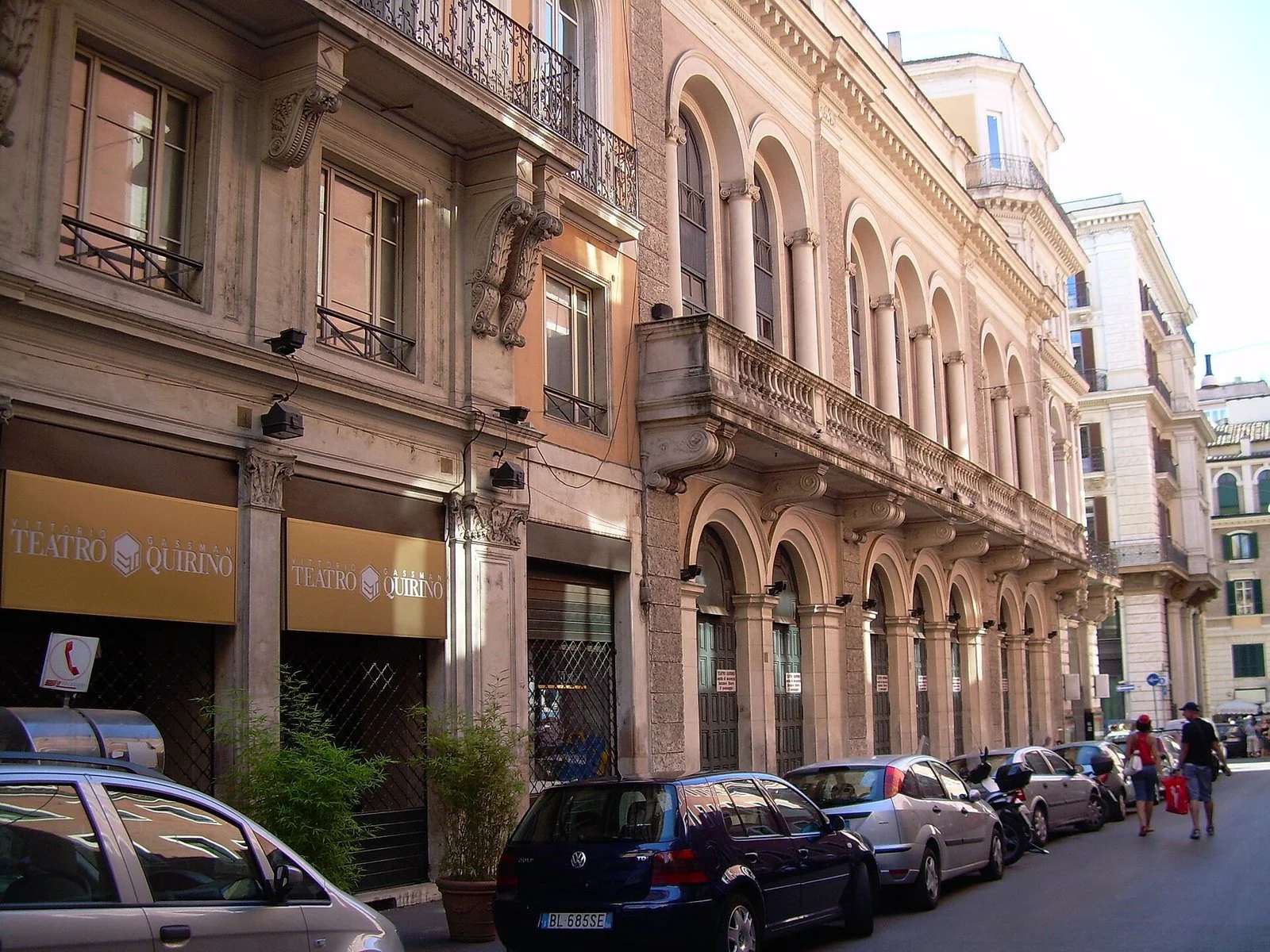
The Teatro Quirino Vittorio Gassman is located at Via delle Vergini 7, in the Trevi district, a short walk from the Trevi Fountain and the rear facade of Palazzo Poli, in a stretch of Rome where the density of history per square meter is among the highest in the entire city center. It's one of the oldest dramatic theaters still active in Rome, opened in 1871 at the wish of Prince Maffeo Barberini Colonna di Sciarra, and since 2004 it has carried the name of Vittorio Gassman, who first stepped onto that stage in 1945 and came back to it throughout his life. Anyone walking from the Trevi Fountain toward Piazza Colonna, along the little streets of the district, passes in front of it almost without noticing: yet inside that building a substantial part of the history of twentieth-century Italian drama was written. On the pages dedicated to the Trevi Fountain, to Palazzo Poli and to the nearby Galleria Sciarra you'll find the other chapters of this same corner of Rome, which Prince Sciarra helped design almost entirely between the nineteenth and twentieth centuries.
Where the Teatro Quirino Vittorio Gassman Is and How to Get There
The Teatro Quirino Vittorio Gassman occupies an entire block between Via delle Vergini and Via del Corso, with the main entrance at number 7 on Via delle Vergini and at one time with access also from the great commercial axis of Via del Corso, about a hundred meters from the Trevi Fountain. It's an address that sums up the Trevi district well: narrow streets of late Renaissance layout set among the cardinals' and noble palaces that, from the sixteenth century on, made this area one of the densest and richest neighborhoods of Rome.
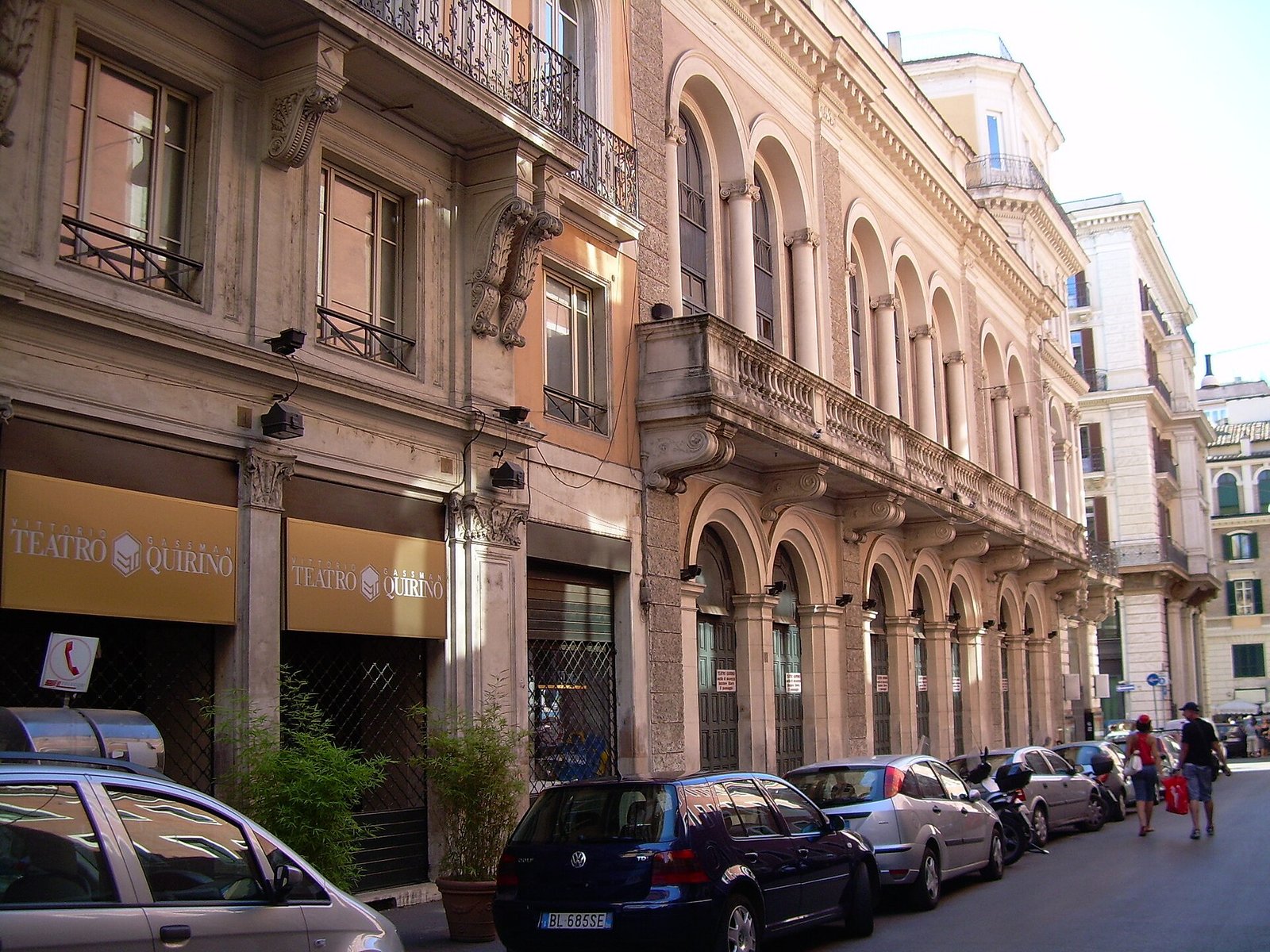
On Foot from the Historic Center
The simplest way to get to the theater remains the walk. From Piazza di Trevi it takes just three or four minutes on foot going up toward Via delle Muratte or Via di San Vincenzo to find yourself in front of the entrance. From Piazza Colonna, with its Antonine column and Palazzo Chigi, the distance is just as short following Via del Corso and taking the side streets toward the east. It's a route you do among historic shops, noble palaces and Baroque churches, without needing any means of transport, and it's probably the best way to arrive at a show in the right spirit, after crossing one of the densest neighborhoods of history in all of Rome.
By Subway and Bus
The nearest subway stop is Barberini, on line A, from which you go down toward the Trevi district in about 10 minutes on foot along Via del Tritone. Alternatively you can get off at Spagna and go down along Via del Tritone or Via Due Macelli until you reach Via delle Vergini. Many surface bus lines run on Via del Tritone and Via del Corso, with stops a few hundred meters from the theater. Given the density of private traffic in the area, anyone arriving from outside Rome does well to consider public transport as the main option, leaving the car in one of the paid parking lots of the central area.
Why It's Not Worth Coming by Car
The Trevi district is almost entirely within the limited traffic zone of the historic center of Rome, active in the evening time slots when the shows are held. Anyone arriving by car has to deal with electronic gates, parking rates among the highest in the city and a road layout of narrow one-way streets, designed for carriages and not for modern compact cars. The advice is simple: arrive on foot or by subway, enjoy the evening walk through the district and leave the car outside the limited traffic zone.
The Trevi District, Setting of the Theater
The Trevi district is one of the oldest historic districts of Rome, located between the Quirinal, Via del Corso and the Pincio hill, and it's the one that carries the proper name of the great Baroque fountain found there. Since the sixteenth century it was one of the areas favored by the Roman nobility for building their palaces, thanks to its closeness both to the hill of temporal power, the Quirinal, and to the commercial axis of Via del Corso. Walking today along the narrow streets of the district, among seventeenth-century facades and the signs of craft shops that have survived the decades, means moving through an urban fabric that has stayed surprisingly intact despite the proximity to one of the most visited tourist attractions in the world. The Teatro Quirino, with its sober facade on Via delle Vergini, fits into this fabric as one of the few properly nineteenth-century buildings in the neighborhood, among much older buildings.
Show Times and Time to Get There
Dramatic shows in the historic theaters of Rome normally begin at 21:00, with afternoon matinees on holidays that generally start between 17:00 and 18:00. Considering that the Trevi district is awkward to cross quickly on foot because of the narrow streets, often crowded with tourists until late in the evening, it's good to allow a safety margin of at least 20 minutes over the theoretical travel time shown by maps, especially in the summer months and on high tourist season days, when the Trevi Fountain alone can noticeably slow the pace of anyone walking past it.
The History of the Teatro Quirino Vittorio Gassman, from 1871 to Today
The Teatro Quirino was born in 1871, at the wish of Prince Maffeo Barberini Colonna di Sciarra, one of the most enterprising nobles of post-unification Rome, publisher of the daily La Tribuna and later the patron of the nearby Galleria Sciarra. The project answers a concrete need of the Rome of those years, newly become capital of the Kingdom of Italy: the area east of Via del Corso, densely populated, had no popular entertainment venue comparable to those rising elsewhere in the city, and Prince Sciarra decided to fill that gap on his own property, right next to the Trevi Fountain.
A Wooden Theater, Built in Very Little Time
The first construction was entirely of wood, designed by the architect Giulio De Angelis with the collaboration of Francesco Marra. Local tradition, handed down by several Roman theater sources, holds that the original structure was raised very quickly: a lightning construction site, typical of the nineteenth-century popular theaters designed for operetta and farces, genres that then drew a middle-class audience looking for light entertainment more than for great drama. The chosen name, Quirino, recalls the Quirinal hill and the archaic deity Quirinus, one of the names by which the Romans called their founder Romulus after his apotheosis: a learned reference to the very origins of the city, consistent with the taste for the antique that pervaded building in Umbertine Rome.
The 1882 Reconstruction in Masonry and the 1898 Works
In 1882 the wooden structure was replaced by a masonry building, again signed by Giulio De Angelis: a horseshoe-shaped hall, with two tiers of boxes, better suited to a growing middle-class audience and a more ambitious program. In 1898 a new intervention, attributed to Belloli and Moraldi, enriched the interiors with drapery, velvet and gilded stucco, in the eclectic taste typical of the Roman Belle Époque. It was in these years straddling the nineteenth and twentieth centuries that the theater began to host, alongside the farces, opera seasons too: in June 1899 the maestro Antonino Palminteri conducted works by Giuseppe Verdi and Giacomo Puccini there, among them I Lombardi alla prima crociata and Manon Lescaut, with results that the chronicles of the time call excellent.
Piacentini's Remodeling and the Opening to the Twentieth Century
The most important architectural leap came in 1914, when the architect Marcello Piacentini, who would become one of the central figures of the urban planning and architecture of the regime in the following years, signed a radical renovation. Piacentini abandoned the eclectic nineteenth-century taste in favor of a more geometric and modern language, Secessionist in stamp, adding a third tier of boxes. The theater reopened with an opera season conducted by the maestro Pietro Mascagni, one of the most celebrated Italian composers of the time: on its stage, among other works, the first performance of the operetta Sì, by Mascagni himself, was presented.
The Hall We See Today: The 1954 and 1955 Remodeling
The configuration the public finds today comes from a second intervention by Marcello Piacentini, carried out between 1954 and 1955. On this occasion the old tiers of boxes were almost entirely eliminated and replaced by cantilevered tiers of seating, a more modern solution and better for the visibility of the stage. The theater reopened on October 13, 1955 with a hall that, in that configuration, had 990 seats. Today, after the necessary adjustments to the safety rules for entertainment venues, the capacity is 850 seats, distributed among the orchestra, two tiers of balcony and the gallery.
From the ETI to Private Management
For much of the second half of the twentieth century the Teatro Quirino was run by the ETI, the Ente Teatrale Italiano, which handled its programming from 1946 until the body was dissolved in 2009. After a transition period, from 2014 management passed to a group of private operators in the sector, who created the company Quirino Srl, still responsible for the programming, with artistic direction entrusted to Guglielmo Ferro and administration to Rosario Coppolino. It is in this more recent phase that the theater consolidated its identity as the home of great Italian drama, alternating twentieth-century classics, new productions and series dedicated to comedy.
The ETI and the System of Italian Public Theaters
Understanding what the ETI was helps to frame the central decades of the Quirino's history, a period in which the theater was run not by a single impresario but by a public body with responsibility for several halls in different Italian cities. The Ente Teatrale Italiano was born as a public body tasked with supporting and coordinating theatrical activity in different Italian cities, directly managing some of the most prestigious halls in the country. For the Quirino it meant more than 60 years of stable programming, with touring companies, in-house productions and a program designed for a national audience and not only a Roman one. The dissolution of the body in 2009, decided as part of a broader reorganization of public spending on culture, opened a phase of uncertainty for several historic Italian theaters, not only the Quirino, and in several cases led precisely to a shift toward forms of private or mixed management, as happened in Rome for other historic halls of the center too.
Prince Sciarra and His Rome
Maffeo Barberini Colonna di Sciarra, born in 1850 and died in 1925, descended from one of the branches of the powerful Barberini family, itself related to the Colonna. He was a deputy in the Parliament of the Kingdom of Italy and, above all, one of the main publishers of Umbertine Rome: he owned the daily La Tribuna and hosted in his Galleria Sciarra the editorial office of the magazine Cronaca Bizantina, directed for a time by Gabriele D'Annunzio. The Teatro Quirino, built when the prince was a little over 20, was probably one of his first big real estate and cultural investments in that area of the city, years before the better-known Galleria Sciarra, built between 1885 and 1888, again to a design by Giulio De Angelis, the same architect as the theater. Rome was becoming the capital of the Kingdom in exactly those years, and the Roman nobility, Prince Sciarra among the first, invested in buildings able to mark the new face of the city.
Why the Theater Carries the Name of Vittorio Gassman
The Teatro Quirino Vittorio Gassman owes its double name to a decision made in 2004, when the name of the actor from Genoa, who had died four years earlier, in 2000, was added to the historic designation of Teatro Quirino. It was not a generic tribute: Gassman had trod that very stage since 1945, at the start of his career, and had returned to it several times in the following decades, working with directors like Luchino Visconti and Giorgio Squarzina in some of the most remembered productions of postwar Italian drama.
The 2004 Ceremony
The dedication ceremony, in 2004, saw the participation of the then mayor of Rome Walter Veltroni, of the Minister for Cultural Heritage and Activities Giuliano Urbani, of the president of the ETI Domenico Galdieri and of the president of the INPS Gianpaolo Sassi, the body that at the time owned the building. Among the promoters of the initiative was the journalist Maurizio Costanzo, who supported the project from its earliest phases. Also present at the ceremony was Diletta D'Andrea, the actor's partner in the last years of his life, who commented on the choice by speaking of Gassman's symbolic return to the place where he had built his art. The initiative fit into a season in which Rome was dedicating theatrical and film spaces to other great figures of twentieth-century Italian entertainment, from Alberto Sordi to Marcello Mastroianni, acknowledging a cultural debt that the city felt it had to settle publicly.
Who Vittorio Gassman Was for Italian Theater
Vittorio Gassman is considered, together with very few others, the actor who brought the great tradition of tragedy and classical drama to a mass audience in Italy, without ever abandoning the theater to chase only the movies, which nonetheless gave him international fame. His deep voice and his ability to move from the tragic register to the lively one within the span of a single evening remained a reference for generations of later actors. Naming a historic theater in the center of Rome after him, and not a new space, had a precise meaning: acknowledging that his art had been formed on exactly those stages, among the wings of halls like this one.
A Very Young Debut, in 1945
In 1945 Vittorio Gassman was a little over 20 and was still at the beginning of a career that would take him, within a few years, to become one of the most important names of the Italian scene. Stepping onto the stage of the Quirino at that moment, just after the war, in a Rome that was slowly resuming its cultural life, meant measuring himself against a demanding audience in one of the most prominent dramatic theaters of the capital. It was the start of a bond that would last for the rest of his career, made of periodic returns to that stage even when his movie fame by then had him working on sets all over Italy and abroad. Between the Roman theater and the movie set, Gassman never definitively chose one of the two worlds, and this double loyalty is perhaps the deepest reason why, when it came to choosing whom to name a historic hall of the capital after, the name of the Quirino appeared to the promoters of the initiative as the most natural choice.
Other Tributes to Gassman in the City
The naming of the Teatro Quirino was not the only tribute Rome has reserved for Vittorio Gassman: a stretch of the riverside road along the Tiber now carries his name, as a testimony to how much the city recognized him as one of its reference cultural figures of the twentieth century. The fact that the theater kept its historic name, Quirino, simply adding the actor's to it, distinguishes this case from other, sharper namings: here the memory of the nineteenth-century hall and that of the great twentieth-century performer live together in the same name, with neither erasing the other.
Prince Sciarra, the Galleria and the Daily La Tribuna
To truly understand the Teatro Quirino it helps to widen the view to everything Prince Maffeo Barberini Colonna di Sciarra built in the same corner of Rome between the 1870s and the end of the century. The theater was not an isolated project but part of a broader strategy of cultural and real estate investment that would lastingly mark the Trevi district and the neighboring areas.
A Publisher Turned to Building
Maffeo Barberini Colonna di Sciarra was first of all a publisher: he owned the daily La Tribuna, one of the politically most relevant newspapers of Umbertine Rome, read in parliamentary circles and in the new administration of the capital. His activity as a building patron, of which the Teatro Quirino and the Galleria Sciarra remain the best-known testimonies, came from the same entrepreneurial logic that guided his newspaper: intercepting the needs of a city in very rapid transformation, a capital for only a few years, and turning them into projects able to generate income and prestige together.
The Galleria Sciarra and Cronaca Bizantina
Built between 1885 and 1888, again to a design by Giulio De Angelis, the architect who more than a decade earlier had signed the Teatro Quirino, the Galleria Sciarra is today famous above all for the cycle of Liberty-style frescoes that decorates its covered courtyard, dedicated to the exaltation of woman in her different virtues. Less known, but just as significant, is its original function: to host not only homes and offices but also the editorial office of the literary magazine Cronaca Bizantina, directed for a time by Gabriele D'Annunzio, then a young and already much-discussed figure of the Italian cultural scene. Prince Sciarra, to put it another way, did not limit himself to building buildings: he also built the places where culture and information were made in the Rome of the late nineteenth century, and the theater that today also carries the name of Vittorio Gassman was one of the first pieces of that design.
Two Buildings, a Single Urban Vision
Lining up the dates helps to read the operation better: in 1871 the prince opened the Teatro Quirino, still very young. In the 1880s he consolidated the masonry building. In the mid-1880s he started the construction of the Galleria Sciarra. In a little more than 20 years, a single man and a single architect, Giulio De Angelis, redrew a significant portion of the Trevi district, leaving two buildings that have passed through more than a century of the city's history almost unchanged, in their function if not always in their appearance. Walking today from Via delle Vergini to the Galleria Sciarra means retracing, without knowing it, the itinerary of a single late nineteenth-century entrepreneurial project.
A Curiosity About the Teatro Quirino Vittorio Gassman
The name of the theater has nothing to do, as some imagine while strolling nearby, with the neighboring Palazzo del Quirinale: the choice instead refers to the god Quirinus, one of the oldest deities of the Roman pantheon, identified by tradition with Romulus after his apotheosis. Both the Quirinal hill and the theater take their name from the same archaic figure, but by different routes and without a direct link between the two places, a few hundred meters from each other.
There is also an architectural detail that ties the Teatro Quirino to another very well-known place in the same district: the Galleria Sciarra, the famous Liberty-style frescoed gallery a few steps from Piazza Colonna. Both buildings were commissioned by the same patron, Prince Maffeo Barberini Colonna di Sciarra, and designed by the same architect, Giulio De Angelis, even if more than a decade apart. Anyone who visits the theater and then moves on to the Galleria Sciarra is in fact following the thread of a single urban project wanted by one man, who left more than one mark in this corner of Rome.
Something Nobody Tells You About the Teatro Quirino Vittorio Gassman
The hall we see in person today, with its continuous tiers of seating and without the nineteenth-century tiers of boxes, is not at all the original: it's the result of at least three radical remodelings in less than a century, in 1882, in 1914 and finally in 1954-1955. Very few historic theaters in the center of Rome have changed skin so many times while staying active, never closing for long periods or moving their activity elsewhere. What today looks like a twentieth-century theater, sober and functional, carries within it the layers of a nineteenth-century building designed for a completely different audience and taste.
The Little-Told Link with Opera
Another aspect that escapes anyone who knows the Quirino only as a contemporary dramatic theater is its long operatic past. Between the end of the nineteenth century and the early twentieth, before its identity consolidated around drama, the theater hosted opera seasons conducted by maestros of the caliber of Antonino Palminteri and Pietro Mascagni, the latter on the occasion of the 1914 reopening. Today that operatic vocation has disappeared from the program, but it remains a little-known chapter of its history, which also explains why the acoustics of the hall were designed, from the start, for the sung voice even before the spoken one.
A Theater That Changed Genre Several Times
Retracing the programming of its 150 years of life, it's striking how many times the Quirino changed skin, not only in architecture but also in the genres offered. Born for popular farces and operettas aimed at a middle-class audience looking for entertainment, passed through a thoroughly respectable operatic phase straddling the nineteenth and twentieth centuries, the theater found only in the second postwar period, with its entry into the orbit of the ETI and the great drama performers of the time, the vocation that characterizes it still today. Few occasional visitors, walking in to see a contemporary comedy, imagine that in the same space the arias of Puccini and Verdi once resounded.
The Advice I Give You for Visiting the Teatro Quirino Vittorio Gassman
The most useful advice, for anyone who lands in Rome without having planned an evening at the theater in time, is to check the program before booking a dinner in the Trevi district: the Quirino is a few steps from the Trevi Fountain, and it often happens that someone visiting the fountain in the evening discovers only by chance, passing in front of the lit entrance on Via delle Vergini, that a show is in progress. Booking in advance, even just a few days, lets you choose your seat and avoid last-minute lines at the box office, especially on weekends in the main season, which runs roughly from October to May. Anyone visiting Rome in a different period, between June and September, has to allow for the theater following a summer break like most of the city's dramatic halls, so it's worth checking in advance if the season has already started.
Before and After the Show
The theater's foyer hosts a bistro and a bookstore space, designed for those who want to arrive a little early or stay after the show for a glass of wine without leaving the district. It's a very Roman habit, turning the evening at the theater into a small ritual that begins before the curtain opens: a walk to the Trevi Fountain in the late afternoon, a stop at the theater's bistro, then the show. For anyone organizing a stay in Rome with several theaters and several days on the agenda, the itineraries and practical guides of ItalyPlanner help fit evening shows, visits to the monuments of the historic center and walking travel times together as well as possible, which in the Trevi district are always shorter than they look on the map.
A practical detail worth keeping in mind: in the Quirino's foyer the bookstore also offers play texts and nonfiction dedicated to the history of the Italian stage, a small added value for anyone who, after seeing a show, wants to learn more about the author or director just seen without waiting to get home. It's a service that few other historic theaters in the center of Rome offer with the same continuity, and it helps make the evening at the Quirino a cultural experience broader than the theatrical performance alone.
Accessibility and Services
The theater has spaces accessible to people with motor disabilities and accessible restrooms, a detail that can't be taken for granted in a historic building in the center of Rome remodeled several times over a century and a half. Anyone who needs specific information on reserved seats or on barrier-free access routes does well to contact the box office directly before the evening, so as to arrange the most convenient entrance. It's worth remembering that, since it's a building born in the nineteenth century and remodeled several times, some internal routes remain less easy than in a theater built from scratch with contemporary criteria: talking in advance with the house staff avoids surprises on the night of the show.
Another Well-Known Fact, Yet Rarely Cited
It's known to Roman theater enthusiasts, but rarely pointed out to occasional visitors, that the Teatro Quirino was, for three editions between 2016 and 2020, one of the places nominated in the I Luoghi del Cuore census promoted by the FAI, the Fondo Ambiente Italiano, which every two years invites citizens to vote for the cultural and landscape assets to be protected. Its repeated presence in that census tells well how rooted the theater is in Roman collective memory: not a simple container of shows, but an asset that citizens themselves perceive as part of their own heritage to defend.
The FAI census, it should be remembered, doesn't concern only large isolated monuments like a fountain or an archaeological area: it also involves buildings still fully in use, like theaters and libraries, precisely to underline that the protection of Italian cultural heritage also comes through care for places that continue to live out their original function. For the Quirino, a theater active without interruption for more than a century and a half, the repeated nomination in three different editions also had a symbolic value: that of a theater Romans don't perceive as a museum relic but as a place still fully part of the cultural life of the city.
A Theater Wanted by a Publisher, Not by an Impresario
It's worth remembering that Prince Maffeo Barberini Colonna di Sciarra, the patron of 1871, was not a theatrical impresario by profession but a publisher, owner of the daily La Tribuna and later host, in his Galleria Sciarra, of the editorial office of the literary magazine Cronaca Bizantina directed by Gabriele D'Annunzio. The theater was therefore born as one of the many cultural investments of a man who, in the Rome that had just become a capital, was trying to build a small empire of print, entertainment and prestigious real estate: the profile of a lay and entrepreneurial patron, typical of the noble Roman bourgeoisie of the late nineteenth century, more than a theater lover in the strict sense.
This profile also helps explain another less-told aspect of the story: the choice to entrust both the theater and, more than a decade later, the Galleria Sciarra to the same architect, Giulio De Angelis, was not accidental. A patron with a coherent urban project in mind prefers to work with trusted professionals already tested, and De Angelis, after the success of the Quirino, was by then the natural name to turn to for another prestigious operation in the same quadrant of the city.
The Right Photo to Take at the Teatro Quirino Vittorio Gassman
The most effective photo isn't taken inside the hall, where filming during shows is not allowed out of respect for the artists and the audience, but outside, at the entrance on Via delle Vergini, in the evening, when the theater's signs are lit and the posters of the current season fill the foyer windows. It's the image that best conveys the contrast typical of the Trevi district: a nineteenth-century theater facade set among even older buildings, on a narrow street that by day goes almost unnoticed and in the evening comes alive with the comings and goings of people entering and leaving the shows.
The Detail to Look For
Anyone with an eye for architectural details can look, on the facade and in the atrium, for the overlapping traces of the different twentieth-century remodelings: the more sober geometric lines wanted by Piacentini still coexist, in some places, with some older decorative traces. It's a small exercise in reading historical layers, the same you can do a few blocks farther on, in front of the Liberty facade of the Galleria Sciarra, signed by the same architect at a different moment of his career.
The Right Light and the Right Time
The best light for photographing the facade of the Teatro Quirino is that of early afternoon, when the sun directly lights Via delle Vergini without the deep shadows that in the evening hours darken much of the street, which is very narrow compared with the height of the buildings that flank it. For those instead looking for the most theatrical atmosphere, with the lights on and the audience coming in, the right moment is the half hour before the show begins, when the entrance comes alive and the contrast between the dark street and the lit foyer conveys well the sense of a theater still fully alive in the heart of the ancient city.
Some Important Events That Happened Here in History
In June 1899 the Teatro Quirino hosted an opera season conducted by the maestro Antonino Palminteri, with the performance, among others, of Giuseppe Verdi's I Lombardi alla prima crociata and Giacomo Puccini's Manon Lescaut, received at the time with very favorable reviews by Roman theater reporting. It was one of the moments in which the theater, still in its nineteenth-century configuration, established itself as a reference hall for opera in Umbertine Rome, before its main vocation shifted decidedly toward drama over the course of the twentieth century.
The 1914 Reopening with Pietro Mascagni
A second key moment came in 1914, when the renovation signed by Marcello Piacentini ended with a reopening entrusted to the maestro Pietro Mascagni, who conducted an opera season including the first performance of his own operetta Sì. It was a notable debut for the theatrical Rome of the time, able to draw audience and press to a building that was coming back renewed in appearance and artistic ambition.
The fact that Pietro Mascagni was the one to inaugurate the renewed hall, a composer already famous across Europe since his Cavalleria rusticana had conquered the international opera houses, says a lot about the level the Quirino aspired to in that phase and about the prestige the theater had by then acquired in the panorama of Roman entertainment. Not just any theater of the capital, but a hall able to attract one of the most important names of the Italian music of the time for its reopening, at a moment when Piacentini was already establishing himself as one of the most discussed and innovative architects of his generation, even before the great urban planning commissions that would make him famous in the years of the regime.
From the Postwar Period to the New Hall of 1955
In the second postwar period the theater entered the orbit of the ETI, which would guide its programming for more than 60 years, and went through the deepest remodeling of its history, concluded on October 13, 1955 with the inauguration of the modern tiered hall that, with some later adjustments, is substantially the one the public still attends today. It is in this phase, between the 1940s and the following decades, that the theater becomes one of the habitual stages of Vittorio Gassman, up to the naming of 2004 that consecrated its link with the actor.
Who Has Passed Through the Teatro Quirino Vittorio Gassman
Among the names that theater reporting stably associates with the Quirino are Ferruccio Benini, popular performer of dialect comedy and of the farces of the late nineteenth century, and Ettore Petrolini, the great Roman showman who brought to this and other Roman stages his corrosive comedy and his most celebrated characters. During the twentieth century the theater also hosted Eduardo De Filippo, a Neapolitan author and performer among the most important of the Italian scene, and Giorgio Strehler, one of the directors who most renewed the language of theatrical direction in the second postwar period.
Vittorio Gassman, from Debut to Name on the Sign
On this same stage Vittorio Gassman debuted in 1945 and returned to it several times in the following decades, in productions directed by directors like Luchino Visconti, a key figure of Italian theater and film of the twentieth century, and Giorgio Squarzina, among the protagonists of Italian theatrical direction in the second postwar period. It was precisely this link, built over half a century of career, that motivated the 2004 choice to add his name to the theater's historic one: not a tribute dropped from above, but the recognition of a relationship already written in the history of the hall.
Ettore Petrolini and Roman Comedy
Among the historic presences at the Quirino, that of Ettore Petrolini deserves a chapter of its own. A Roman actor and author, Petrolini was the great showman of dialect comedy in the first half of the twentieth century, able to fill the theaters of the capital with characters that became proverbial in Roman popular culture. His presence on stages like that of the Quirino tells of a season in which Italian drama was not yet rigidly divided between high and popular registers, and in which the same hall could host, in different seasons, both great tragedy and the most explosive farce.
Eduardo De Filippo and Neapolitan Comedy
Eduardo De Filippo too, an author, director and performer among the most important of Italian twentieth-century theater, trod the stage of the Quirino, bringing to Rome his Neapolitan dramaturgy, able to cross regional borders and become the heritage of the whole national theater. The presence of an author so tied to Naples in a theater in the center of Rome confirms the Quirino's vocation to host, over the decades, the most significant voices of the Italian scene regardless of their geographic origin.
The Program and How an Evening at the Quirino Works
The season of the Teatro Quirino Vittorio Gassman is dedicated almost entirely to drama, with a program that alternates great classics of Italian and European theater, new productions and comedies of broad popular appeal, entrusted to companies and performers of national standing. The artistic direction, run by Guglielmo Ferro, builds each year a calendar that covers the months from October to May continuously, with runs that generally last from one to several weeks for each title.
What to Expect from a Season at the Quirino
The program of the Teatro Quirino Vittorio Gassman steadily aims at a balance between classic texts of the Italian and European repertoire and new contemporary productions, often entrusted to companies that also tour other Italian theaters during the same season. It's a formula common to many historic dramatic halls in the center of Rome, designed to attract both the habitual Roman audience and visitors who plan an evening at the theater as part of a longer stay in the city. Anyone arriving without knowing the program in advance will do well to consult the theater's official site before the trip, since the titles on the program change from season to season and the dates of individual performances are confirmed a few months ahead.
The Hall Seen from Inside
Anyone entering the Quirino's hall for the first time immediately notices the compact, enveloping layout typical of Italian-style theaters renewed in the twentieth century: orchestra, two tiers of balcony and gallery arranged so as to guarantee a close view of the stage from almost every sector, without the long distances typical of the great nineteenth-century opera houses. It's a characteristic that comes directly from Piacentini's remodeling of the 1950s, designed to favor the intimacy of listening to the spoken word over the scenic spectacle of big opera productions, consistent with the hall's by now dramatic vocation.
Tickets and Booking
The theater's box office can be reached by phone at 06 6794585 and by email at biglietteria@teatroquirino.it, as well as through the usual online sales channels for theater tickets. For the most anticipated shows of the season, especially those with performers very well known to the general public, it's best to book with a fair amount of notice: the historic halls of the center of Rome, with their 800-plus seats, fill up faster than you'd imagine, especially on weekends.
The Bistro and Bookstore in the Foyer
The Quirino's foyer, spacious and preceded by the coat check and box office, has for some years hosted a bistro with a small wine list and a bookstore space dedicated to theater and culture, designed to accompany the audience before and after the show. It's a model that several historic Italian halls have adopted in recent years, turning the theater into a place to enjoy for the whole evening and not just for the two hours of the show. Anyone organizing a multi-day itinerary in Rome centered on theater, music and the evening life of the historic center will find in the in-depth pieces from TourLeaderPro useful indications on how to move among the city's different historic halls without sacrificing the other stops of the day.
What to See Around the Teatro Quirino Vittorio Gassman
The Trevi district, where the theater is located, is one of the densest neighborhoods in monuments of the entire historic center of Rome, and an evening at the theater easily lends itself to being accompanied by a walk among its main attractions, all reachable on foot in a few minutes.
The Trevi Fountain and Palazzo Poli
A few steps from the theater is the Trevi Fountain, the most famous monumental fountain in Rome, set against the facade of Palazzo Poli. It's the most obvious stop, but also the one that best lends itself to an evening visit before a show: the fountain lit up at night, with the crowd tending to thin out after dinner, offers an atmosphere very different from the crowded one of the middle hours of the day.
The Galleria Sciarra and Via del Corso
Walking west you reach in a few minutes the Galleria Sciarra, the nineteenth-century pedestrian passage entirely frescoed in Liberty style, wanted by the same patron as the theater. From there, in a few steps, you reach Via del Corso, the commercial and historic axis that crosses the center of Rome from Piazza del Popolo to Piazza Venezia, and Piazza Colonna, dominated by the spiral column dedicated to Marcus Aurelius and by the historic seat of Palazzo Chigi.
Other Historic Theaters to Pair
Anyone who wants to build a small itinerary dedicated to the historic theaters of central Rome can pair the Quirino with other halls not far away, each with its own identity and its own season: the Teatro Sistina, historic home of the Italian musical, the Teatro Sala Umberto, and farther away the Teatro Brancaccio and the Teatro Ambra Jovinelli, as well as of course the Rome Opera House for those looking for opera and ballet instead of drama.
An Evening Walk in the Trevi District
For anyone with time before or after the show, the Trevi district lends itself to a walk that joins several centuries of Roman history in a very small space. Starting from the theater you can reach Piazza di Trevi in a few minutes, admire the fountain, climb toward the Quirinal along streets less traveled by mass tourism, or go down toward Via del Tritone and Piazza Barberini area. It's a neighborhood that suits slow discovery on foot better than a rigid itinerary: precisely the absence of major roads, which so complicates vehicle traffic, is what makes the Trevi district one of the most pleasant to cross on foot on an autumn or spring evening, before going into the theater.
Where to Eat Something Before the Show
The Trevi district, because of its very central position and the enormous tourist flow tied to the fountain, offers a very high density of places within a few blocks of the theater, from traditional trattorias to more modern bars designed for a quick dinner before a show, with an offering that has expanded in recent years precisely to answer the constant flow of visitors headed to the fountain. Anyone with little time between dinner and the start of the performance will do well to choose a place as close as possible to Via delle Vergini, since distances on the map, in a maze of little streets like these, don't always match real walking times, especially when the streets are crowded with tourists headed to the Trevi Fountain.
Frequently Asked Questions About the Teatro Quirino Vittorio Gassman
Where Exactly Is the Teatro Quirino Vittorio Gassman?
The Teatro Quirino Vittorio Gassman is at Via delle Vergini 7, in the Trevi district of Rome, a few minutes on foot from the Trevi Fountain and Piazza Colonna. It's easily reached on foot from the historic center or by getting off at the Barberini stop on subway line A and continuing along Via del Tritone.
Why Is the Theater Also Called Vittorio Gassman?
The Teatro Quirino Vittorio Gassman has carried the double name since 2004, when it was named after the actor Vittorio Gassman, who died in 2000, who had debuted on this same stage in 1945 and had returned to it several times, working with directors like Luchino Visconti and Giorgio Squarzina. The ceremony saw the participation of the mayor of Rome Walter Veltroni and the Minister of Culture Giuliano Urbani.
How Many Seats Does the Hall of the Teatro Quirino Have?
The hall of the Teatro Quirino Vittorio Gassman today has 850 seats, distributed among the orchestra, two tiers of balcony and the gallery. The figure is lower than the 990 seats of the 1954 and 1955 remodeling, following the later adjustments to safety rules for entertainment venues.
When Was the Teatro Quirino Built?
The Teatro Quirino Vittorio Gassman was built in 1871 at the wish of Prince Maffeo Barberini Colonna di Sciarra, a Roman publisher and entrepreneur who a little later also commissioned the nearby Galleria Sciarra. The original building, entirely of wood, was then rebuilt in masonry in 1882 and subsequently renovated radically in 1914 by Marcello Piacentini and again in 1954 and 1955, by the same architect, up to the configuration the public still attends today.
Who Runs the Teatro Quirino Today?
Since 2014 the Teatro Quirino Vittorio Gassman has been run by a group of private operators in the theater sector, united in the company Quirino Srl, with artistic direction entrusted to Guglielmo Ferro. Previously, from 1946 to 2009, management had been entrusted to the ETI, the Ente Teatrale Italiano.
What Kind of Shows Can You See at the Teatro Quirino?
The Teatro Quirino Vittorio Gassman is dedicated mainly to drama, with a season that alternates great classics of Italian and European theater, new productions and comedies of popular appeal, often staged by companies and performers of national standing. The season generally covers the months from October to May, with runs of varying length for each title on the program, and updated details should always be checked on the theater's official site before organizing the evening.
How Do You Book Tickets for the Teatro Quirino?
Tickets for the Teatro Quirino Vittorio Gassman are booked through the theater's box office, reachable by phone at 06 6794585 or by email at biglietteria@teatroquirino.it, as well as through the usual online sales channels for theatrical shows. For shows with very well-known performers it's best to book a few days in advance.
Is the Teatro Quirino Accessible to People with Disabilities?
Yes, the Teatro Quirino Vittorio Gassman has spaces accessible to people with motor disabilities and accessible restrooms inside the building. Anyone with specific needs does well to contact the theater's box office in advance to arrange the most convenient seat and access route, a precaution especially useful in a historic building where the internal routes are not always as straightforward as in a recently built hall.
How Far Is the Teatro Quirino from the Trevi Fountain?
The Teatro Quirino Vittorio Gassman is a few minutes on foot from the Trevi Fountain, a little over a hundred meters along the little streets of the Trevi district. It's one of the shortest distances between a historic theater and a symbol monument that you can find in the center of Rome, so much so that the two stops naturally lend themselves to being paired in the same evening, before or after the show.