San Carlo ai Catinari
In short. San Carlo ai Catinari is the big Baroque church that closes off the east side of Piazza Benedetto Cairoli, halfway between Campo de’ Fiori and the Jewish Ghetto of Rome, in that stretch of the historic center that thousands of people…
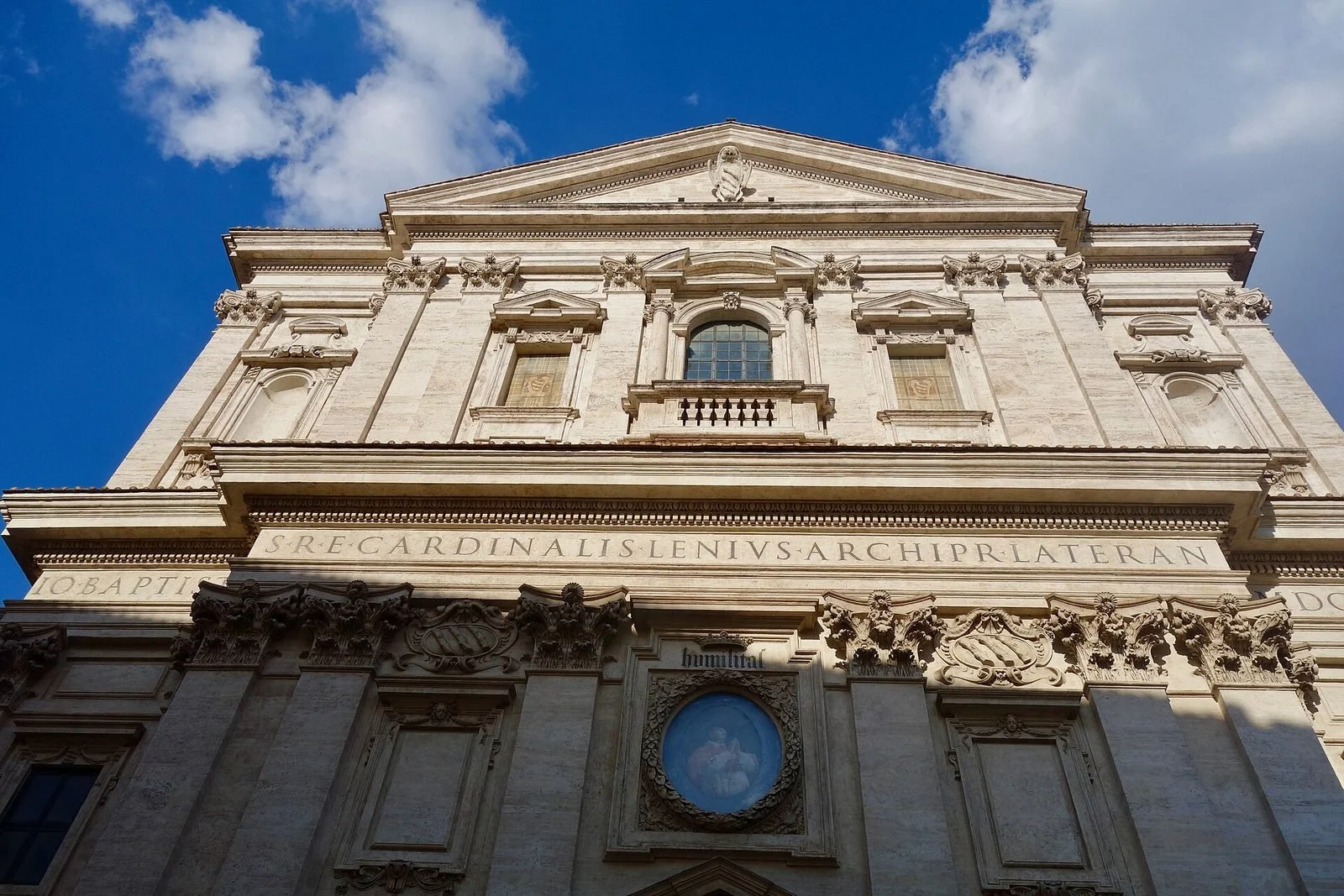
San Carlo ai Catinari is the big Baroque church that closes off the east side of Piazza Benedetto Cairoli, halfway between Campo de’ Fiori and the Jewish Ghetto of Rome, in that stretch of the historic center that thousands of people cross every day going from Via Arenula to Via dei Giubbonari without ever looking up. The full name is Santi Biagio e Carlo ai Catinari. The dedication to the Armenian bishop Blaise comes from the medieval church that occupied the area, and the one to Charles Borromeo from the Barnabites, the Clerics Regular of St. Paul, who obtained the complex from Pope Gregory XIII in 1575 and still run the church today. The nickname “ai Catinari” comes instead from the workshops of the basin makers that stood in this quarter. Inside there is one of the widest domes built in Rome in the 1600s and the four pendentives frescoed by Domenichino with the Cardinal Virtues, which remain the main reason to go in. The point that no guidebook puts first, though, is another one: the church has been unusable since 2016 because of the damage from the central Italy earthquakes, services have been moved to a chapel of the convent, and since October 2021 a restoration site has been open that as of spring 2024 was not yet finished. Anyone reading this page to plan a visit has to start from there.
Where San Carlo ai Catinari is and how to get there
The address that appears on the rectory's documents is Piazza Benedetto Cairoli 117, 00186 Roma, while some city databases record the same street number on Via dei Giubbonari. The two indications describe the same block, because the church occupies the corner between the piazza, Via di Monte della Farina and the start of Via dei Giubbonari. On the administrative district, the sources differ in a minor but real way: Wikipedia and Roma Segreta assign it to the rione Sant’Eustachio, other directories place it on the border with Regola and Parione. It's not a nitpicker's question: if you look up an address on a map and a different rione from the expected one appears, this is the reason.
On foot from the landmarks of the center
From Campo de’ Fiori it's three or four minutes walking the whole length of Via dei Giubbonari, which is pedestrian in practice and very crowded in the afternoon. From Largo di Torre Argentina it takes five minutes going down Via di Torre Argentina and turning onto Via Arenula. From the Portico of Octavia and the heart of the Ghetto, the trip is seven or eight minutes along Via dei Falegnami and Piazza Costaguti, and it's the most interesting of the three because it crosses the web of alleys on which all the trade-based street names of this quarter rest. From Piazza Navona the walk is just under 10 minutes, cutting across Corso Vittorio Emanuele II at Sant’Andrea della Valle.
By public transport
The most convenient line is tram 8, which runs along Via Arenula connecting Trastevere to Piazza Venezia: the useful stop is the one on Via Arenula, about 100 meters from the church. On Corso Vittorio Emanuele II run the bus lines that cross the historic center from east to west, including the 46, the 62 and the 64, with stops two or three minutes' walk away. There's no metro: none of Rome's three lines touches this stretch of the historic center, and the nearest stations are far enough away that the tram or the bus is quicker. Lines and routes change often because of construction and detours, so check on the day through the official channels of Rome's public transport. For an overview of tickets, validity and connections, see our page on getting around Rome.
The current state: a closed church and a long construction site
The information published by the rectory indicates that the church of Santi Biagio e Carlo ai Catinari has been unusable since 2016, after the damage caused by the shocks of the central Italy earthquakes, and that Masses have been moved to a chapel inside the convent, at the same street number on Piazza Benedetto Cairoli. It's not a temporary closure of a few weeks: it has lasted for years and it's the most important operational fact on this page.
The site opened in 2021
The Barnabite order documented the start of the work on October 11, 2021, beginning from the lower church and with the coordination of an architecture firm commissioned for the project. Directories specialized in Roman churches reported a figure of around 3.3 million euros for the work and a completion expected in May 2024, noting however that at that date the work was not finished. As of the date of writing, we know of no official announcement of reopening for worship of the main church. Check before you go, because on a site of this duration the state of things can change from one month to the next.
What it means in practice for those who arrive
It means that Soria's facade can always be seen, because it's on a public street, but that the interior may be inaccessible, only partly accessible or accessible with scaffolding up. It also means that the dome, the reason you come in here, may be covered: dome restorations are done with internal scaffolding that cuts off the view of the pendentives for months. Anyone who arrives hoping for Domenichino and finds Innocenti tubing has wasted half a morning. The only defense is a phone call or a message to the rectory a few days ahead.
Why it's called “ai Catinari”
The epithet “ai Catinari” comes from the workshops of the basin makers, that is, of terracotta and ceramic vessels for kitchen and toilet use, who worked in the streets around the church. It's a trade designation, of which you find dozens in the center of Rome, and it served to tell this church apart from the others dedicated to the same saint in the city, starting with San Carlo alle Quattro Fontane, which is a different church, much smaller and by a completely different author.
A city named after trades
You only have to look at the street signs of the quarter to understand the criterion: Via dei Giubbonari after the sellers of jerkins, Via dei Chiavari after the makers of keys and locks, Via dei Baullari after the makers of trunks, Via dei Cappellari, Via dei Balestrari, Via dei Pettinari, Via dei Falegnami, Largo dei Librari. They aren't decorative names: they record a real productive topography, that of the trade districts that occupied the bend of the Tiber between the Capitoline and Castel Sant’Angelo. The catinari were part of this network, and the church took its nickname from the street like all the others. Anyone walking from Campo de’ Fiori toward the Ghetto passes four or five of these names in 10 minutes.
San Biagio dell’Anello, the church that was there before
On the site there was a medieval church dedicated to St. Blaise, documented from at least 1186 and tied to a small charitable complex. Its traditional name was San Biagio dell’Anello, because of a relic kept there. When in 1575 Pope Gregory XIII assigned the complex to the Barnabites, the order found itself with a building too small for its needs and with an expansion project that would take almost half a century. The old church was demolished in 1617, with the new construction already under way, and the dedication to St. Blaise was kept in the official title next to the one to Charles Borromeo. That's why the building has two names and people use only one.
A curiosity about San Carlo ai Catinari
From 1685 to 1848, the Accademia di Santa Cecilia, the Roman musical institution from which the current Accademia Nazionale descends, had its seat here. It's not a footnote detail: for over a century and a half the city's musical life, the rehearsals, the exams of the choirmasters and the celebrations for the patron saint of musicians passed through this block between Via Arenula and Via dei Giubbonari.
Why here
The coincidence is not accidental. In the church there is a chapel dedicated to St. Cecilia, decorated between 1692 and 1700 by Antonio Gherardi, who was both its architect and its painter. The presence of the chapel and the presence of the Academy fed each other: a community of musicians that had a place of worship of its own, and a place of worship that became a point of reference for that community. The chapel is one of the most singular spaces of late Roman Baroque, with stucco treated as drapery and a play of light designed to arrive from above.
The motto on the facade
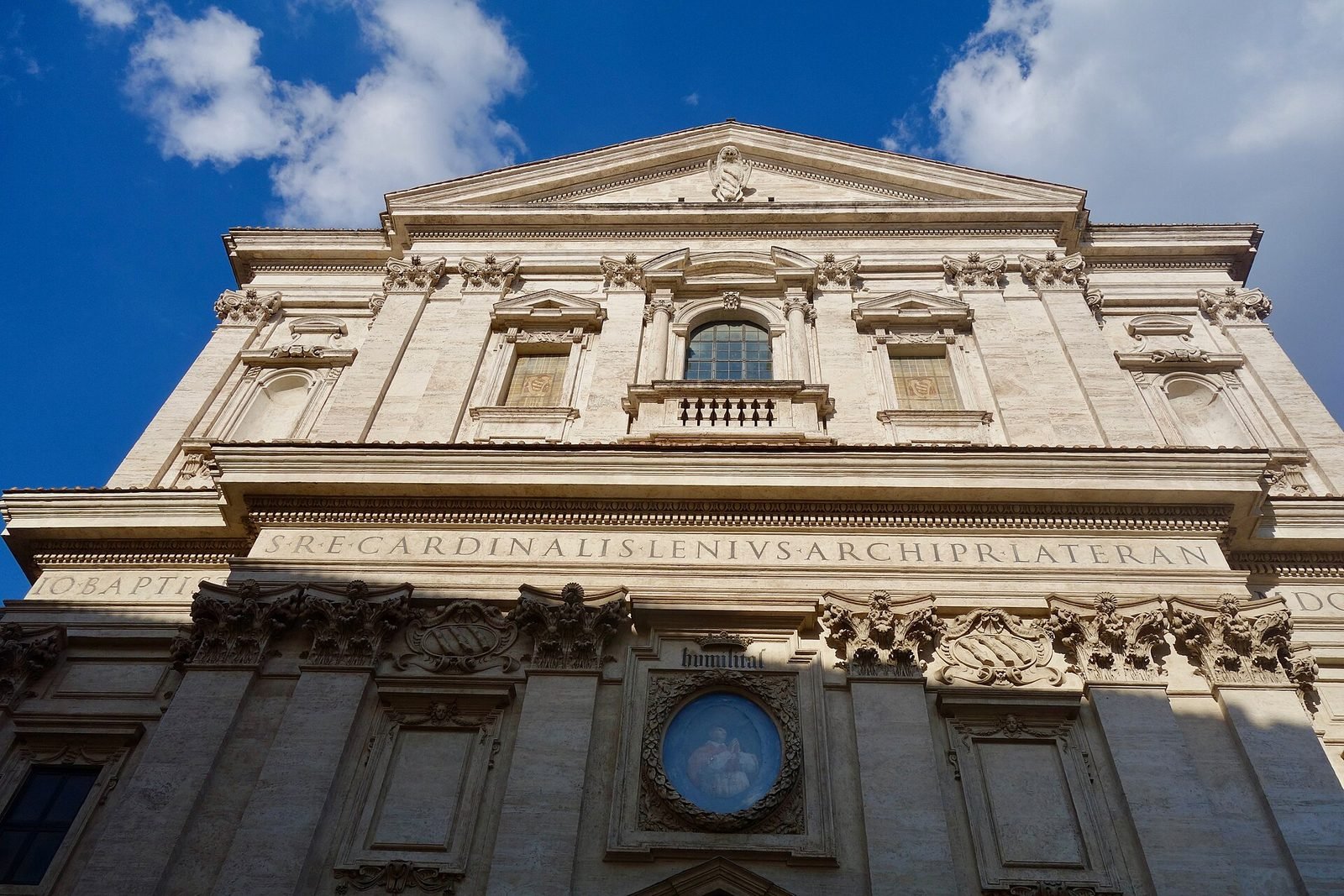
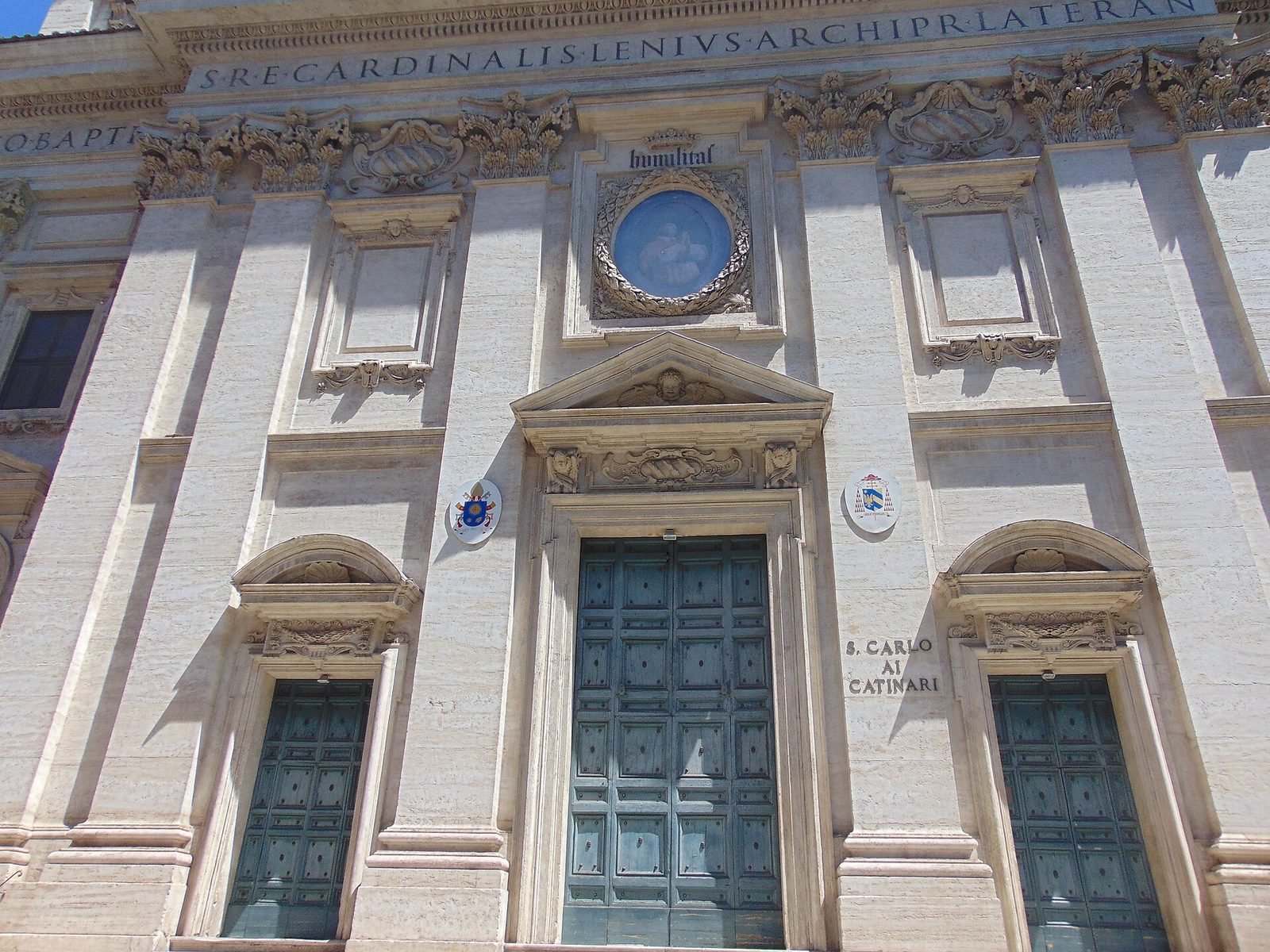
Above the central portal, an image of St. Charles Borromeo in prayer is accompanied by the inscription HUMILITAS in Gothic letters. It's the motto of the Borromeo family, and anyone who recognizes it can have fun finding it again across half of northern Italy, on the islands of Lake Maggiore as on the facades of Milan. In Rome this is one of the few chances to see it displayed on the facade of a large church. Looking at it costs 10 seconds and doesn't require the church to be open.
A church almost nobody goes in to see
The judgment we feel able to give is blunt: San Carlo ai Catinari is, relative to the quality of what it contains, one of the least visited churches in the historic center of Rome. The reason isn't its value, it's its position. It sits on a pure through-traffic axis, between two poles that absorb all the attention, with a facade that closes off a street instead of opening onto a monumental piazza. Anyone walking along the Giubbonari is going somewhere, not visiting. And so they walk straight past.
The 1600s building site: Rosato Rosati, Soria, Marucelli
The current church was designed by Rosato Rosati, an architect from the Marche trained in the late 1500s, and built over a period that the sources place between 1611 or 1612 and 1620 for the structural part. The divergence between the two start dates is real and worth reporting: some directories give 1611 as the start of the work, others specify February 26, 1612 as the laying of the first stone. The completion of the building took more than a century in any case, because the consecration came only in 1722.
Rosato Rosati and the Greek-cross plan
The plan is an elongated Greek cross, with a short nave and a crossing dominated by the dome. It's a solution that in early 1600s Rome was not a given: the churches of the new orders often relied on long naves and deep side chapels, designed for preaching. Rosati instead concentrated everything on the central volume, and calibrated the elevation so that the gaze of anyone entering ends up inevitably high. The dome was the gamble of the project, and it appears completed by 1620. For a chronological point of comparison, you can find it in the dome of Sant’Andrea della Valle, an almost contemporary building site 400 meters away.
The facade by Giovanni Battista Soria
The travertine facade is the work of Giovanni Battista Soria. On the dates the sources waver between 1635-1638 and 1636-1638, and the difference depends on how you count the start of the site relative to the approval of the project. It is arranged in two orders separated by a continuous entablature, with eight Corinthian pilasters and a slightly projecting central body, three portals of which the middle one is wider, an arched window above the entrance and rectangular windows on the sides. Soria often worked from models drawn from late 1500s architecture, and here the result is a sober facade, built to hold up to the perspective of a narrow street more than to astonish from afar. Anyone who knows the repertoire of Roman facades will gladly compare it with those collected in our route on Baroque Rome.
Something nobody tells you about San Carlo ai Catinari
Under the floor of the church there are rooms from the Roman imperial age, documented by the groups that deal with urban underground sites: service structures belonging to a large building of the first two centuries AD and, above all, a nymphaeum belonging to an upper-class residence of the 3rd century, with a mosaic decoration on the vault that is reported as rare.
A nymphaeum with a mosaic on the vault
Wall and vault mosaics are much less common than floor ones, because they survive less well and because they required a wealthy patron. Finding one largely legible under a Baroque church in the center says two things: that the area was occupied by high-level homes in the imperial age, and that the 1600s foundations incorporated it instead of destroying it. It's the same dynamic that makes almost all Roman churches layered, from the Basilica of San Clemente on down.
The dome and Domenichino's pendentives
The dome of San Carlo ai Catinari, completed by 1620 to a design by Rosato Rosati, is one of the widest built in Rome before the contemporary age, and its four pendentives were frescoed by Domenichino between 1627 and 1630 with the four Cardinal Virtues: Prudence, Justice, Fortitude and Temperance. These two facts are the reason the church deserves a detour, and they have to be told with the cautions that follow.
The disputed ranking
On the exact position of the dome in the ranking the sources don't agree, and it would be wrong to choose the most convenient version. The Italian encyclopedia entry calls it the fourth in Rome for size after those of the Pantheon, St. Peter's in the Vatican and Sant’Andrea della Valle, specifying that the comparison concerns buildings before the contemporary era and that two 1900s churches have since surpassed it. A directory specialized in Roman churches instead lists it as the third in the historic center, after St. Peter's and Sant’Andrea della Valle, excluding the Pantheon from the count because it's a building of ancient origin. The two statements are compatible with each other: the criterion changes, not the substance. What remains is that we're talking about one of the largest domes in the city.
The measurements we don't report
We can't find a diameter figure that is consistent and verifiable among the sources consulted, so we don't give any. The popularizing sheets in circulation report different numbers without citing the survey they come from. On an architectural element of this importance, we prefer a declared absence to an invented figure.
The drum, the cap and a second divergence
On the partition of the dome too, the descriptions don't coincide. One descriptive tradition speaks of a tall drum pierced by 12 arched windows and a cap divided into 12 segments by ribs, with blind oculi. Another describes a 16-sided plan with 16 oculi. The discrepancy probably arises from the fact that different elements are being counted, drum windows on one side and cap partitions or oculi on the other. If you go in and want to settle the doubt, you can count from below. It's an exercise that takes two minutes and forces you to really look at the dome, instead of just photographing it.
The four Cardinal Virtues and the problem of Fortitude
The frescoes of the pendentives are late works by Domenichino, made when the painter already had the major Roman cycles behind him. On one of the four, Fortitude, a specialized directory reports completion by Francesco Cozza. We haven't found confirmation of this in all the sources consulted, and we report it as a divergence: if the church is open and there's an information panel or a guide from the rectory, it's the right question to ask on the spot.
How to look at the pendentives, in practice
The pendentives are the four spherical triangles that connect the arch of the crossing vault to the circle of the drum. They're high up, in a zone of half-light, and from the ground they're hard to see unless you stand in the right position. There are four practical tips. First: stand under the crossing, exactly in the center, and look at one at a time instead of turning quickly. Second: go in the middle hours of the day, when light enters from the drum windows and lights the connections from behind. Third: bring small binoculars, because the faces and the drapery stay illegible to the naked eye. Fourth: allow a good 10 minutes of neck tilted back, which is a lot and which almost nobody spends.
Lightning, cannon fire and earthquakes
The dome has a well-documented history of damage. Local chronicles recall that it was struck several times by lightning and that it took the blows of French artillery fired from the Janiculum during the siege of the Roman Republic in 1849. This damage was the basis of the general restorations ordered by Pius IX around 1860. In 1915 the dome was restored again for earthquake damage. And in 2016 the central Italy earthquakes led to the declaration of unusability that closed the church. Four centuries of seismic and wartime history concentrated on a single structural element.
My advice for visiting San Carlo ai Catinari
There's only one practical piece of advice and it comes before all the others: phone or write to the rectory a few days ahead, because with a site open since 2021 the state of access can change without warning and without announcements. Entry to the church, when the church is open, is free: there's no ticket office, no online booking, no fee. Anyone offering a paid ticket to enter this church is selling something else.
The hours vary, and we don't invent them
The opening hours of San Carlo ai Catinari are not stable and we know of no official, published and updated calendar for the main church. The rectory's information concerns the services in the convent chapel, with weekday Masses in the morning and a Sunday Mass in late morning, plus summer variations. Older directories report morning and afternoon opening windows that we can't treat as current. The practical rule: Roman churches of this kind almost all close for a few hours in the early afternoon, and no opening is guaranteed on holidays. Asking is quicker than hoping.
If you find it open, in what order to look at it
A route that works in 20 minutes is this. Walk in and stop right away, without advancing, to take the measure of the volume: the Greek-cross plan can only be read from the entrance. Then go to the center of the crossing and give the first 10 minutes to the dome and the four pendentives, before neck fatigue makes everything tiring. Then the head of the church: the high altar and the apse semi-dome. Then the side chapels, with a longer stop at the one of St. Cecilia. The sacristy, when accessible, has to be asked for explicitly. Anyone who reverses the order and starts from the chapels reaches the dome already fed up, and the dome is the reason they came.
Accessibility and comfort
The main entrance on Piazza Benedetto Cairoli has a few steps, like almost all Roman churches of this size. We have no updated official information on ramps or alternative routes, and with the site under way any earlier indication has to be rechecked. Inside there are no public restrooms, and within a two-minute walk there are no free ones: plan ahead. In winter the church is cold, like all unheated churches in the center. In summer it's one of the few cool spaces in the area, and it's one more practical reason to go in during the early afternoon in July.
If you find it closed: the plan B we recommend
Finding it closed here isn't a lost day, because within 500 meters there are at least five churches that open more regularly. In order of distance: San Paolo alla Regola, Santissima Trinità dei Pellegrini, Santa Maria dell’Orazione e Morte on Via Giulia, Sant’Andrea della Valle on Corso Vittorio and Santa Maria in Campitelli toward the Ghetto. The first three are as little visited as San Carlo. The fourth has a dome that allows a direct comparison with Rosati's. The fifth is a work of architecture by Carlo Rainaldi that is worth the trip by itself.
The works inside the church, and which attributions hold up
San Carlo ai Catinari holds a set of 1600s paintings signed by some of the greatest names of Roman Baroque painting: Pietro da Cortona, Giovanni Lanfranco, Andrea Sacchi, Mattia Preti, Giacinto Brandi, besides the Domenichino of the pendentives. It's exactly the kind of church where popularizing guides mix up the attributions, because the big names are many and the chapels are many. Here we separate what the sources report consistently from what needs to be checked on the spot.
The high altar and Pietro da Cortona
The altarpiece of the high altar depicts St. Charles Borromeo carrying the Holy Nail in procession and is attributed unanimously to Pietro da Cortona, dated 1667. It's a precise and historically identifiable subject: the Milan procession of 1576, during the plague, in which the archbishop carried the relic of the Nail of the Cross. The painting tells that moment, not a generic devotional scene. The architecture of the altar that frames it is attributed to Martino Longhi the Younger. If you want to follow Pietro da Cortona in the city, you'll find his decorative masterpiece a few minutes from here, and the route is laid out on our page on Baroque Rome.
Giovanni Lanfranco, twice
Lanfranco appears in two places. In the apse semi-dome with the apotheosis of St. Charles Borromeo welcomed into heaven, a fresco dated 1646. And as the author of an Annunciation attributed to 1624, tied in the descriptions to the Costaguti chapel. The two works are 20 years apart and show two different moments of the painter's career, who in between had worked in Naples. Not all the sheets distinguish the two presences, and you sometimes read descriptions that merge them into one.
The chapel of St. Cecilia by Antonio Gherardi
The chapel of St. Cecilia, made between 1692 and 1700, is the work of Antonio Gherardi as architect and as painter: the canvas with St. Cecilia and the musician angels is his, and so is the invention of the space. Specialist descriptions consider it one of the most elaborate exercises of late Roman Baroque, with stucco worked in imitation of drapery and a lower elliptical vault pierced by an oculus, beyond which figures of musician angels appear. Antonio Gherardi also signs in Rome the chapel of St. Teresa of Avila in the basilica of Santa Maria in Trastevere, built on the same idea of a scenographic opening toward the top: anyone who has seen one of the two recognizes the other right away. It's the piece we recommend looking at right after the pendentives.
The other attributions, and how to treat them
In the chapels and the sacristy the sources point to a martyrdom of St. Blaise attributed to Giacinto Brandi dated 1678, frescoes with stories of St. Charles attributed to Mattia Preti and his brother Gregorio, a death of St. Anne by Andrea Sacchi, a canvas with Persian martyrs attributed to Giovanni Francesco Romanelli, a Madonna of Divine Providence linked to the name of Scipione Pulzone and dated 1594, a 1400s triptych with the Madonna and Child, a bronze crucifix attributed to Alessandro Algardi and a painting by the Cavalier d’Arpino dated 1589. Some sheets add the name of Guido Reni. These attributions don't all have the same degree of solidity: some are consolidated in the literature, others circulate in guides without references. We report them so the reader knows what to look for, and we recommend treating them as indicative until you read a caption in the church or a catalog entry.
Another well-known fact that is rarely mentioned
San Carlo ai Catinari is no longer a parish: the parish of the same name was suppressed on September 14, 2020, and the church became a rectory dependent on the parish of San Lorenzo in Damaso, the one based in the Palazzo della Cancelleria. It's a public fact, reported by the rectory itself and by diocesan sources, and it changes in a concrete way how the place works.
What difference it makes for visitors
A parish has opening obligations and a daily flow of faithful that keep it alive, a rectory does not. It means tighter hours, less staff on site, less presence. It also means that information is found on the rectory's channels and not on those of a structured parish. When a Roman church goes from parish to rectory, accessibility usually gets worse. Here it happened four years after the declaration of unusability, and the two facts are clearly connected.
The cardinal title and the deaconry
On the ecclesiastical side, the church has a rather eventful history of titles. The cardinal title of San Carlo ai Catinari was established and then suppressed in 1627, with transfer to Santi Ambrogio e Carlo al Corso. The deaconry of Santi Biagio e Carlo ai Catinari was established on December 2, 1959 by John XXIII. These are details of interest to those who follow cardinal appointments, and they explain why searching for the church's name turns up lists of titular cardinals that seem to have nothing to do with the neighborhood.
The right photo to take at San Carlo ai Catinari
The photograph that does this church the most justice is Soria's facade shot from the start of Via dei Giubbonari, in the late afternoon, when the raking sun from the west hits the travertine and brings out the pilasters and the entablature. It's the only framing in which the building can be read whole without heavy distortion, because the street works as a perspective corridor and the piazza gives the room to step back that you need.
From outside: three framings that work
The first is the frontal one from the Giubbonari, described above. The second is from the opposite corner of Piazza Benedetto Cairoli, with the piazza's trees in the foreground as a natural frame and the facade in the background. It holds up well even at noon, when flat light kills the relief. The third is the detail of the central portal with the image of St. Charles and the inscription HUMILITAS, which you get with a short telephoto or the phone's zoom and which gives back the only truly identifying element of the facade.
Some important events that happened here in history
The chronology of San Carlo ai Catinari covers eight and a half centuries, from 1186, the first mention of the medieval church, to the restoration site opened in 2021. What follows is the list of the steps documented by the sources consulted, with the warning that on some dates the directories diverge and that the divergences are flagged.
The 1600s, the century of the building site
The site of the new church starts between 1611 and 1612, depending on the source. By 1620 the structure and the dome are complete. In 1617 the medieval church is demolished and the dedication shifts to Charles Borromeo, canonized seven years earlier. In 1627 the bequest of Cardinal Giovanni Battista Leni restarts the work, and between 1627 and 1630 Domenichino frescoes the pendentives. Between 1635 and 1638, with the sources wavering on the starting year, Giovanni Battista Soria builds the facade. In 1642 Paolo Marucelli adds the apse, which Lanfranco will fresco in 1646. In 1667 Pietro da Cortona delivers the altarpiece of the high altar, and between 1692 and 1700 Antonio Gherardi creates the chapel of St. Cecilia.
The 1900s and the last 20 years
In 1915 the dome is restored for earthquake damage. On December 2, 1959 John XXIII establishes the deaconry. In 1995 the organ is restored. In 2016 the central Italy earthquakes lead to the declaration of unusability. On September 14, 2020 the parish is suppressed and the church becomes a rectory. On October 11, 2021 the restoration site opens, which as of spring 2024 did not appear to be finished. It's a sequence that says a lot about how the maintenance of Roman religious heritage works: big, widely spaced interventions, with decades of waiting in between.
Who passed through San Carlo ai Catinari
Through San Carlo ai Catinari have passed, as designers or as executors, some of the names that define the Roman 1600s: Rosato Rosati, Giovanni Battista Soria, Paolo Marucelli, Martino Longhi the Younger, Domenichino, Giovanni Lanfranco, Pietro da Cortona, Andrea Sacchi, Mattia Preti, Antonio Gherardi. They're the same names you meet walking the historic center from Piazza Navona to the Capitoline.
Charles Borromeo, who was never here
It's worth clarifying right away to avoid misunderstandings: Charles Borromeo, who died in 1584, never set foot in this church, which was built almost 30 years after his death and named for him after the canonization of 1610. The link is devotional, not biographical. The same goes for Antonio Maria Zaccaria, founder of the Barnabites, who died in 1539: his presence here is that of a saint of the order, celebrated with his canonization in 1897, not that of a resident of the convent.
The painters, and what they were doing in those years
Domenichino arrives at the pendentives in 1627, in a late phase of his Roman career, after the cycles that had established him as one of the protagonists of Bolognese classicism transplanted to Rome. Lanfranco, his historic rival precisely on the terrain of domes, returns here in 1646 after the Neapolitan experience. Pietro da Cortona in 1667 is in the last stretch of his activity, when he has already given the city his major decorative machines. Three generations, or nearly, layered in the same building over a span of 40 years. If you want to follow the thread of Roman 1600s painting from one church to another, you'll find the richest route in our itinerary on Caravaggio in Rome for the previous generation and in the one on Bernini in Rome for the contemporary sculpture.
The surrounding quarter: between Campo de’ Fiori and the Ghetto
San Carlo ai Catinari sits exactly on the line that separates two zones of the historic center with opposite characters: to the west the web of trades around Campo de’ Fiori, to the east the Ghetto. In between runs Via Arenula, which is a 1800s cut and you can tell: wide street, Umbertine buildings, traffic. Understanding this geography is useful, because it explains why the church is so little visited despite tens of thousands of passersby a day 100 meters away.
Toward Campo de’ Fiori
Via dei Giubbonari is the busiest shopping street of the quarter and leads in four minutes to the market square. From there on opens the web of alleys that reaches Via Giulia, with Santa Maria dell’Orazione e Morte, Sant’Eligio degli Orefici and the Basilica of San Giovanni Battista dei Fiorentini. Toward Corso Vittorio you find the Palazzo della Cancelleria, the Museo Barracco and the Museo di Roma at Palazzo Braschi.
Toward the Ghetto
On the other side, along Via dei Falegnami, in a few minutes you reach Piazza Mattei with the Turtle Fountain, and from there the Portico of Octavia, Santa Maria in Campitelli, the Jewish Museum of Rome and the little San Gregorio della Divina Pietà. Continuing you reach the Theater of Marcellus, San Nicola in Carcere and the bridges to Tiber Island, that is Ponte Fabricio and Ponte Cestio.
Toward Corso Vittorio and the Pantheon
Going up Via di Torre Argentina you meet Largo di Torre Argentina with the sacred area, the cat sanctuary, the Church of the Gesù and, farther up, the Basilica of Santa Maria sopra Minerva and Sant’Ignazio di Loyola. Toward the west, beyond Corso Vittorio, are San Luigi dei Francesi with the Contarelli Chapel, Sant’Ivo alla Sapienza and Sant’Agnese in Agone. Within a kilometer of Piazza Cairoli is concentrated the best that Roman Baroque produced, and anyone with half a day would do well to build the route in this quarter instead of crossing the city.
The verdict, no beating around the bush
Among the churches of this stretch of the center, San Carlo ai Catinari is the one with the best ratio between the quality of what it contains and the number of visitors. Sant’Andrea della Valle and the Gesù are busier and more crowded. San Luigi dei Francesi in high season has a line that discourages. Here, when the church is open, you walk in and you're alone. The price of this quiet is the uncertainty about opening, and with the site open the price has gone up quite a bit.
Eating in the area without falling into a trap
The zone between Campo de’ Fiori and the Ghetto is one of the most exposed in Rome to passing tourism, and as a result one of the fullest of places built to intercept people who walk without knowing where they're going. We don't name restaurants, either positively or negatively: a list goes stale in a few months and teaches nothing. We give the criteria instead, which stay valid when the signs change.
The five signals we recognize in the field
The first is the lady rolling out fresh pasta in the window or on a little table on the street: it's an advertising lure, not a sign of the cooking. The second is the menu with photographs of the dishes, in whatever language it's written: it's for people who don't have to read, that is, people who won't come back. The third is the tout on the doorstep inviting you to sit: a place with customers doesn't need to stop passersby. The fourth is the continuous schedule from morning to night, with no kitchen break: a real kitchen stops between services. The fifth is a position in front of a famous monument, where it happens that the price adjusts to the tourist in front, with unpriced items on the menu or different price lists inside and outside.
The chains of the center
In the historic center, places with repeated signs have multiplied, with the same menu in several parts of the city and the line with a numbered ticket at the entrance. We don't name them and we don't recommend them. The observation that matters is another one: Romans don't go there. A business that lives exclusively on tourist flow has no reason to keep quality high, because the customer it loses wouldn't come back anyway.
The simplest criterion of all
Look at who's sitting at the tables and in what language they order. If at 2 in the afternoon on a Tuesday the place is full of people speaking Italian and ordering without looking at the menu, you've found a place that works for the neighborhood. If instead the tables are occupied only by people with backpacks and a map, the bill will tell. This criterion applies two steps from San Carlo ai Catinari as anywhere else in the city, and requires neither apps nor rankings.
The list we use ourselves
For those who want to start from a selection already made, there is Daniele Dezi's personal list on Google Maps, curated and unsponsored: no place pays to be on it and none is removed on request. For a broader discussion of how to choose where to eat in the city, and which neighborhoods are worth working, see our page on where to eat in Rome.
How to fit the visit into an itinerary
San Carlo ai Catinari works as a stop within a route, not as the destination of a trip of its own: the visit lasts half an hour and opening isn't guaranteed, so building a morning around it is imprudent. Below are three layouts we've checked on foot and that hold up even if the church turns out to be closed.
A Baroque half day, all on foot
Start from Sant’Andrea della Valle, go down Via dei Chiavari to San Carlo ai Catinari, then Via dei Giubbonari toward Campo de’ Fiori and Via Giulia, and return via Ponte Sisto if you want to finish in Trastevere, where the first church you meet is the Basilica of San Crisogono. It's three and a half hours with stops, four if you go into all the churches.
With kids, and when it rains
With small children the church holds for 10 minutes, no more: you go in, look at the dome, go out. It works better paired with Tiber Island and the bridges, where there's room to walk. If it rains, the tour is still doable because the distances are very short and the churches are indoors, but keep in mind that in bad weather the hours get shorter and some doors close earlier. In summer, with the strong heat of the early afternoon, the quarter between Piazza Cairoli and the Ghetto is one of the few in the center where you almost always walk in the shade: the alleys are narrow and the buildings tall.
Frequently asked questions about San Carlo ai Catinari
How much does it cost to enter San Carlo ai Catinari?
Admission to San Carlo ai Catinari is free, as in almost all the churches of worship in Rome: there's no ticket office, no online booking and no official fee. Any offerings are voluntary. Anyone who finds paid offers online for just a visit to this church is buying an accompaniment service, not an access ticket.
What are the opening hours of San Carlo ai Catinari?
The hours of San Carlo ai Catinari vary and we know of no stable, updated official calendar for the main church, which has been declared unusable since 2016. Services are held in a chapel of the convent, with weekday Masses in the morning and a Sunday Mass in late morning subject to summer variations. Before going, contact the rectory at Piazza Benedetto Cairoli 117 and ask for confirmation.
Is San Carlo ai Catinari open or closed for restoration?
San Carlo ai Catinari appears closed to the public since 2016, when the central Italy earthquakes made it unusable, and since October 2021 it has been the object of a restoration site whose completion, planned for 2024, had not been reached as of spring of that year. The current state of the work should be checked directly with the rectory or on the channels of the Barnabite order before planning the visit.
Where is San Carlo ai Catinari and how do you get there?
San Carlo ai Catinari is at Piazza Benedetto Cairoli 117, between Via Arenula and Via dei Giubbonari, halfway between Campo de’ Fiori and the Ghetto. You get there by tram 8 along Via Arenula, or by the buses that run along Corso Vittorio Emanuele II, including the 46, the 62 and the 64. The metro doesn't serve this stretch of the historic center. On foot it's four minutes from Campo de’ Fiori.
Why is the church called “ai Catinari”?
The name of San Carlo ai Catinari comes from the workshops of the basin makers, terracotta and ceramic vessels, who worked in the streets around the church. It's the same criterion that gave its name to Via dei Giubbonari, Via dei Chiavari, Via dei Baullari and Via dei Falegnami: a trade-based street naming that in the historic center of Rome records the productive geography of the artisan districts between Campo de’ Fiori and the Tiber.
Who painted the pendentives of the dome of San Carlo ai Catinari?
The four pendentives of the dome of San Carlo ai Catinari were frescoed by Domenichino between 1627 and 1630 with the four Cardinal Virtues: Prudence, Justice, Fortitude and Temperance. They're late works by the painter. A specialized directory reports that Fortitude was supposedly completed by Francesco Cozza, news that isn't confirmed in all the sources and that should be checked on the spot or in a scholarly catalog.
How big is the dome of San Carlo ai Catinari?
The dome of San Carlo ai Catinari, completed by 1620 to a design by Rosato Rosati, is one of the widest built in Rome before the contemporary age: some sources list it as the fourth in the city after the Pantheon, St. Peter's and Sant’Andrea della Valle, others as the third in the historic center excluding the Pantheon. We don't report a diameter figure because the sources consulted don't agree.
How long does it take to visit San Carlo ai Catinari?
To visit San Carlo ai Catinari, 20 minutes is enough, which become 30 or 35 looking carefully at the dome, the pendentives by Domenichino and the chapel of St. Cecilia by Antonio Gherardi. It's a dense but not vast church, with no museum route and no successive rooms. Anyone who wants to spend time on the pendentives alone can reach 40 minutes, binoculars in hand.
Who wrote this page
This page is curated by the editorial team of Tour Leader Pro, the Rome-based project office that designs and coordinates visits, itineraries and cultural events in Rome and Lazio. The hours, fares and access conditions given here were checked on the official sources named in the text as of the publication date. Before you leave, it's worth checking them again, because they change often. If you find outdated information, let us know.
If you're building an itinerary in the historic center of Rome crossing this stop with the churches of Corso Vittorio, the web of Campo de’ Fiori and the Ghetto, you'll find planning tools, group management and visit coordination at Tour Leader Pro, which has followed Rome's cultural programming and the logistics of walking routes in the center for years.
For the broader picture, that is, travel between Italian cities, rail and airport connections, travel times and the organization of a trip that includes Rome along with other destinations in Lazio and the rest of the country, a useful resource is Italy Planner.