Santi Vincenzo e Anastasio a Trevi
In short. The church of Santi Vincenzo e Anastasio a Trevi occupies the north side of piazza di Trevi, directly facing the Trevi Fountain, and every day it ends up in tens of thousands of photographs without almost anyone looking up to work out what it is.
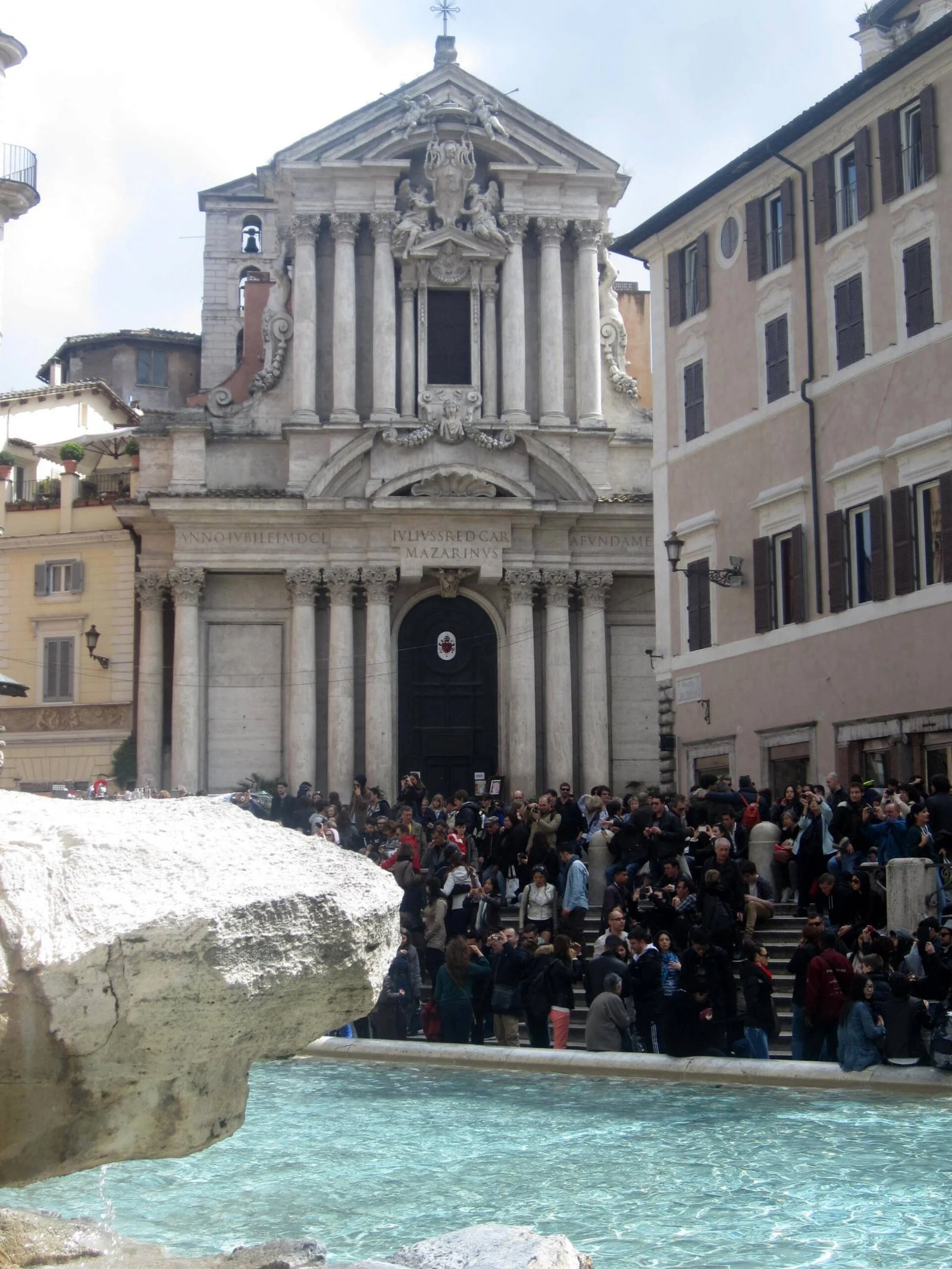
The church of Santi Vincenzo e Anastasio a Trevi occupies the north side of piazza di Trevi, directly facing the Trevi Fountain, and every day it ends up in tens of thousands of photographs without almost anyone looking up to work out what it is. It is one of the most built-up facades of Roman Baroque, designed by Martino Longhi the Younger between 1646 and 1650 at the wish of Cardinal Giulio Mazzarino, and it is also, above all, the place where for more than three centuries the precordia of the popes were deposited: heart and viscera removed during embalming and kept in urns in a room behind the high altar. No other church in Rome has this. The reason is simple and is written in the topography: this was the parish church of the Quirinal Palace, that is, of the residence of the pontiffs, and when a pope died at the Quirinal his precordia stayed in his parish. The lines that follow explain how the facade is made and why it deserves the five minutes almost nobody gives it, what the precordia really are and how many popes are documented on the plaque, how to read that list, and how to organize a visit to a church that has no fixed hours published in any stable way and that stands in the most crowded spot of central Rome.
This page and the one on the Trevi Fountain: the difference in one line
The page on the Trevi Fountain tells the story of Nicola Salvi's monument of water and the square as urban spectacle. This page tells the story of the church on the other side of the same square, with its 17th-century facade and the history of the papal precordia, which have no relation to the fountain. Anyone looking for information on coins, restorations, limited access and the fountain's hours will find it all there. Anyone wondering what that building with columns is, the one that shows up on the right edge of every shot, is in the right place here.
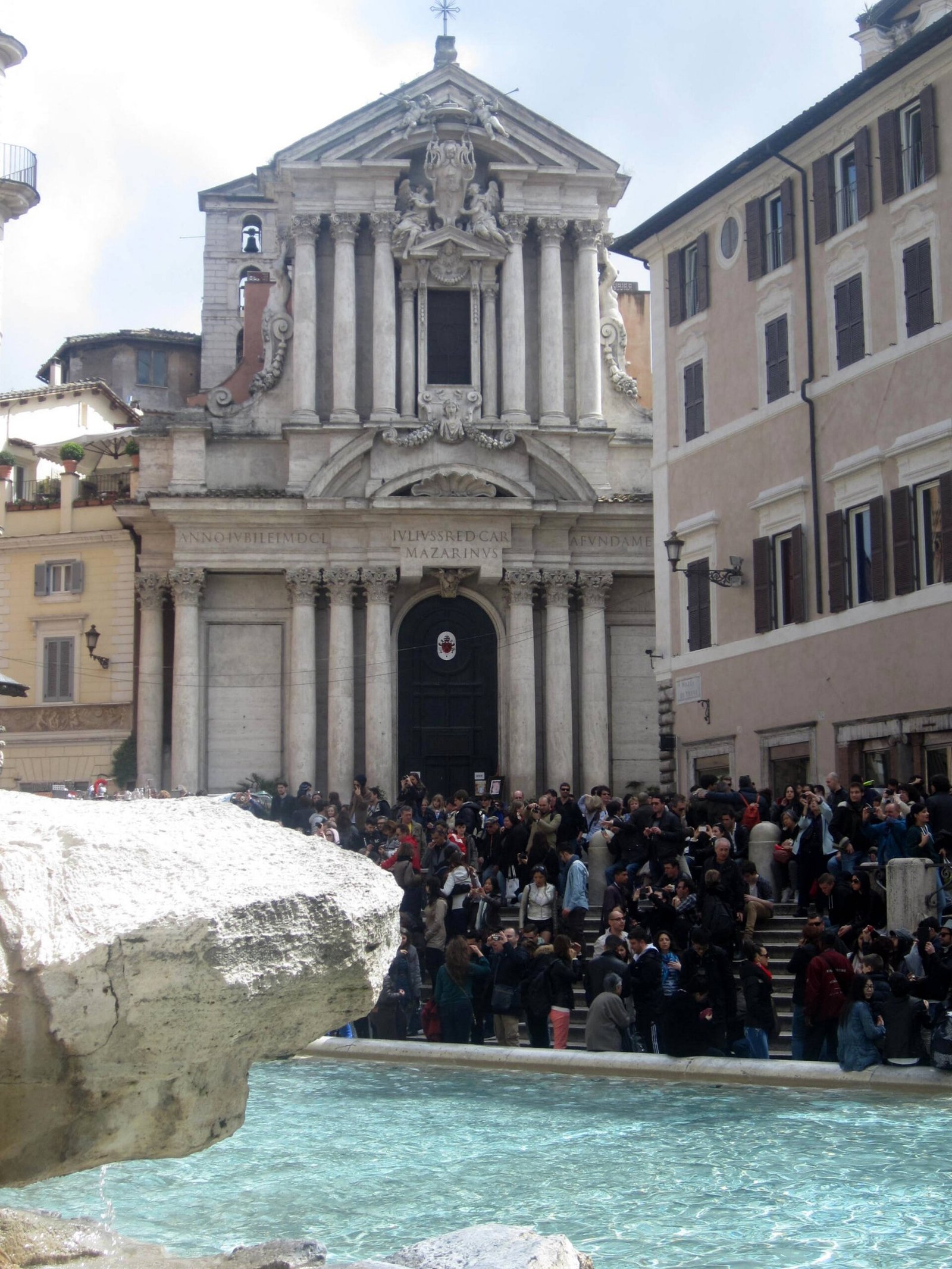
One clarification is also worth making, to avoid a common mix-up: Rome has two churches dedicated to Saints Vincent and Anastasius, and they are not the same thing. This one is the urban church, on piazza di Trevi. The other is the Cistercian abbey church outside the center, inside the complex of the Abbey of Tre Fontane, in the EUR Laurentina area. The double dedication has a common origin, which we explain further on, but the two buildings are about seven kilometers apart and belong to two different stories.
Where Santi Vincenzo e Anastasio a Trevi is and how to get there
The church faces piazza di Trevi, in the Trevi rione, at the corner with via di San Vincenzo and a few meters from the mouth of vicolo dei Modelli. Less than 30 meters of paving separate it from the fountain's basin. The handiest reference for getting your bearings is not an address but a direction: with your back to the fountain, the church is the building with columns in front of you, slightly to the left of the square's axis.
On foot, and how long it really takes
From piazza di Spagna it is a walk of just under 10 minutes via via dei Due Macelli and via del Tritone. From the Pantheon it takes eight, via via delle Muratte. From piazza Venezia seven or eight, going up via del Corso to largo Chigi and then turning right. From piazza Colonna it is five. These are real walking times, not theoretical ones: in the middle hours of the day the final stretch, between via delle Muratte and the square, moves at procession pace, and anyone arriving with a group should allow a few extra minutes to regroup.
By metro and bus
The nearest metro stop is Barberini, on line A, from which you walk down via del Tritone in seven or eight minutes. The second option is Spagna, also line A, with a slightly longer walk. If you come by bus, get off along via del Tritone or at largo Chigi, where the lines crossing the center from east to west converge, and finish on foot in three or four minutes. There is no stop in front of the church and there can't be one: piazza di Trevi is closed to private traffic and public transport doesn't enter the web of alleys around it.
Where it's best to arrive from, and where not
Here is a practical judgment worth more than a map. Anyone arriving from the classic direction, that is, from via delle Muratte coming from via del Corso, enters the square at the point of maximum congestion and has the fountain in their face and the church at their back: they end up not seeing it at all. It is better to arrive from via della Stamperia or from via di San Vincenzo, that is, from the upper side: you come out practically next to the facade, you see it at an angle first, and only then do you go down toward the basin. It is the same route as the crowd's, in the opposite direction, and it costs 200 meters more.
Hours and entry: what we know and what needs checking
Entry to the church is free of charge: there is no ticket office, no booking, no paid circuit. Opening hours, on the other hand, vary and do not appear to be published in a stable, reliable form: they change with the seasons, with staff availability and with the liturgical calendar, and the information circulating on third-party sites is often years out of date. For this reason we do not give a time slot here: it would be an invented figure. Before heading out, check the notice posted on the door, the indications of the Vicariate of Rome for the churches of the diocese, or phone the rectory. Rule of thumb: the churches of Rome's historic center tend to open early in the morning and close for several hours in the afternoon, and piazza di Trevi is no exception. If you have only one attempt, spend it in the morning.
One thing needs saying right away, to spare you disappointment. The urns with the precordia are not on display and cannot be visited. The room that holds them is behind the high altar and is not part of the route open to visitors. What you see, and it is already a lot, is the plaque with the list of the pontiffs. Anyone who arrives expecting a visitable crypt with cases in view will leave empty-handed, and we prefer to say so beforehand.
The facade by Martino Longhi the Younger, and why it is worth a stop
The facade of Santi Vincenzo e Anastasio a Trevi was built between 1646 and 1650 to a design by Martino Longhi the Younger, and it is the element that makes it worth stopping even if the church is closed. It is one of the most built-up facades of the Roman 17th century, and the word built-up should be taken literally: while most churches of the same period solve the front with barely raised pilasters and a few columns attached to the wall, here the columns are free, that is, detached from the wall, and they are grouped so as to create a real thickness between themselves and the wall. The result is that the facade is not a drawing laid on a surface but an architectural body with its own depth, into which the light enters, turns and produces shadows that change shape over the course of the day.
What free columns mean in concrete terms
An engaged column is sunk into the masonry by half or two thirds: it marks the rhythm and does not bear weight, and it stays a graphic element. A free column, by contrast, is a whole shaft that stands away from the wall and carries a portion of entablature that in turn projects. Here Longhi arranges them in close groups, with the columns side by side and overlapping to the point that, looking at the facade at a slant from the sides of the square, you see the shafts line up like the pipes of an organ. From the front the effect is different: the columns press together at the center and thin out at the sides, and the front seems to push toward the viewer.
The exact number of columns is one of the facts on which the literature does not agree, because it depends on how you count the paired shafts and the return half-columns: you find different counts depending on the author. Anyone who wants to know how many there are should count them in person, starting from the bottom and keeping the two orders separate. The figure that matters, anyway, is not the number: it is that they are free, and that in 1650 this was an expensive and technically demanding choice that few patrons could afford.
The two stacked orders
The facade rises on two superimposed levels, following the usual scheme of Roman churches with a single nave and lower sides. The lower order is the richest: it holds the portal and the greater number of columns, and carries a strongly projecting entablature. The upper order, narrower, repeats the motif of free columns on a reduced scale and joins the sides with scrolls. The correspondence between the two orders is not a simple repetition: the upper level takes up the rhythm of the lower one but compresses it, so that the eye, rising, perceives an acceleration. It is a device Roman Baroque uses often, but rarely this clearly.
The pediment and the crowning
The crowning is the part that surprises most anyone whose eye is used to Renaissance facades. The pediment is not a full, continuous triangle: it is broken and doubled, with elements that overlap and interrupt each other, so that the profile against the sky looks lively instead of sharp. Seen from below, from the fountain's basin, the crowning reads badly because perspective flattens everything. Seen from the opposite side of the square, from via della Stamperia, you understand how it is made.
The female bust and a popular tradition
In the upper part of the facade there is a female bust, and for centuries an explanation has circulated about it that Romans like to repeat: it would be the portrait of Maria Mancini, niece of Cardinal Mazzarino, who commissioned the building. It must be said clearly that this is popular tradition and not a documented fact: there is no contract, no payment note and no contemporary source that attests it, and the chronology makes it problematic. The story is old and part of the folklore of the square, and for that reason we report it. We do not present it as history.
Who Martino Longhi the Younger was
Martino Longhi the Younger (around 1602, 1660) is the third architect of a Lombard dynasty active in Rome for three generations: his grandfather Martino the Elder and his father Onorio had already worked in the city on major building sites. The Younger belongs to the generation that measured itself against Bernini and Borromini without having their critical fortune, and for exactly that reason the Trevi facade is a precious document: it shows what a professional of the highest level, who did not go down in history as a genius, could do in the full 17th century. Anyone who wants to place it in context will find a broader route in the itinerary on Baroque Rome, and in the pages on Bernini in Rome and Borromini in Rome, which cover the two names this architecture is in dialogue with.
How to look at the facade, in practice
Three positions, in order of usefulness. The first is the corner between via della Stamperia and the square: from there you see the whole front, you read the stacking of the two orders and you can take photos without heads in the foreground. The second is right up against the portal, looking up: from this distance the columns line up in perspective and you understand how detached they are from the wall. The third is the right side of the square, looking diagonally: it is the position that best gives the thickness. If you have five minutes, split them like this: two, two and one. If you have only one, take the first.
Cardinal Mazzarino, the patron who wasn't there
The 17th-century reconstruction of the church was financed by Giulio Mazzarino, a cardinal Roman by birth and first minister of France, who tied his name to this building while governing Paris. It is a detail that explains a lot about the facade: an absent patron, extremely powerful and eager to leave a mark on the city he came from, had every reason to ask for a front that could be seen from afar and that looked like no other.
Why this church
The Mazzarino family had ties to the rione, and the cardinal kept Roman interests all his life, which he managed through agents and relatives. The choice to intervene on a small, old church wedged between alleys, at a point that in the 17th century was not yet the monumental square we know, has a precise logic: here the church had an institutional function that no other had at that moment, the parish function tied to the apostolic palace of the Quirinal. Financing its reconstruction meant putting his own name next to that of the papacy in a permanent way.
Before the 17th century: Sant'Anastasio in Trivio
The church of Santi Vincenzo e Anastasio a Trevi was not born in the 17th century: the 17th century clothes it. The building is documented in medieval sources under the name Sant'Anastasio in Trivio, and appears in the catalogs of Roman churches compiled between the 12th and 14th centuries, among them the one associated with Cencio Camerario and datable to the end of the 12th century. Scholarly sources propose an earlier foundation, between the 8th and 11th centuries, but these are reconstructions without direct documents: on this point the literature diverges.
What Trivio means, and where the name Trevi comes from
The place name Trevi, which gives its name to the rione, the square, the fountain and the church, almost certainly derives from the Latin trivium, that is, the crossing of three roads. The explanation is old and widely accepted, even if not every scholar considers it definitive: alternative hypotheses circulate that link the name to a corruption of other topographical terms. What is certain is the order of events, and it has to be said because almost everyone reverses it: the name existed before the fountain. The church was called in Trivio when the monumental fountain was not even imagined. It is the fountain that took its name from the place, not the other way around.
The two saints: a Roman from Spain and a Persian
The double dedication brings together two martyrs very far apart in era and geography. Vincent of Saragossa was a Spanish deacon martyred at the beginning of the 4th century during the Diocletian persecution, and he is one of the most venerated saints of Western Christian antiquity. Anastasius the Persian was a soldier of the Sasanian army who converted to Christianity and was martyred in Persia in the 7th century. His relics, according to tradition, reached Rome and were placed in the monastery of the Aquae Salviae, that is, the complex we know today as the Abbey of Tre Fontane. From there the pair of patrons spread to other Roman churches, and this is the reason the same dedication appears in two distant places in the city.
The Trevi rione before the square
To understand the building you have to imagine what this corner was before the 18th century. There was no open square as we see it: there was an irregular open space fed by a much more modest water display, the terminus of the ancient aqueduct of the Aqua Virgo, and around it a dense fabric of houses and shops. Nicola Salvi's great scenography, set against the side of Palazzo Poli, arrives in the 18th century and turns the open space into a theater. The church facade, which had been born to dominate a small space, suddenly found itself serving as the reverse shot to a gigantic monument. From that moment it lost the match and never recovered: this is why nobody looks at it today.
A curiosity about Santi Vincenzo e Anastasio a Trevi
The church of Santi Vincenzo e Anastasio a Trevi is, in all likelihood, the most photographed religious building in Italy without ever being the subject of the photograph. It appears, cropped or whole, in an enormous share of the shots taken of the Trevi Fountain, because it occupies the backdrop opposite the water display and no wide-angle lens manages to leave it out. Anyone who has photographed the fountain from the left has its facade in their archive, and almost nobody knows they have it.
The precordia of the popes: what they are, why they are here, how many there are
In the church of Santi Vincenzo e Anastasio a Trevi are kept the precordia of a series of pontiffs who died between the end of the 16th century and the beginning of the 20th, placed in urns set in a room carved out behind the high altar. It is a documented fact, not a legend, and it is the only case of its kind in Rome. We treat it as it should be treated: as a historical practice tied to the medicine and court ceremonial of the modern age, not as a curiosity for a thrill.
What the precordia are
Precordia is the term the sources use for the heart and viscera, that is, the internal organs removed during the treatment of the body after death. In the modern age, preserving the body of a public figure posed a concrete problem: between death and burial days could pass, with the body on display, inspections, solemn funerals and transfers. To slow decomposition, the body was eviscerated and treated with balsamic substances. The removed organs were not thrown away: they were part of a person's body and received their own burial, in a separate container and in a place set by custom.
It was not a practice reserved for popes nor invented in Rome. Separate burial of the heart is documented across modern Europe for sovereigns, princes and high prelates, often for a further reason: it allowed the physical memory of a person to be split among several places, the body in one church and the heart in another, multiplying the points where people could pray for him. In Rome the custom was grafted onto a precise parish structure, and this is where this church comes into play.
Why here: the parish of the Quirinal Palace
The reason is administrative and is written in the ecclesiastical geography of Rome. From the late 16th century the Quirinal Palace became the habitual residence of the popes, who moved there above all in the hot months and ended up living there permanently. A palace, however large and however much a pontiff lives in it, falls within the territory of a parish. The parish responsible for the apostolic palace of the Quirinal was that of Santi Vincenzo e Anastasio a Trevi.
Everything else follows from this responsibility. When a pope died at the Quirinal, the body was taken to St. Peter's for the funeral and burial, but the precordia stayed in the parish church, following the general rule that gave the parish of death the separated parts of the body. There is nothing esoteric: it is parish law applied to a very particular case. The smallest and least known church in the area found itself keeping, through administrative inertia, a series of papal burials that no other has.
From Sixtus V to Leo XIII: how many popes, really
The figure you read most often is 22 popes, from Sixtus V, who died in 1590, to Leo XIII, who died in 1903. It is the number given by most guides and popular signage, and we give it as the reference figure. It must be said clearly, though, that the sources do not agree: you find counts of 22, of 23 and, in some treatments, of 25, and the difference is not a typo.
There are three reasons for the divergence, and understanding them is more useful than the number. The first: between the death of Sixtus V and that of Leo XIII there were many more than 22 pontiffs, so the list is not continuous and has gaps. The second: some of those gaps have a documented explanation, because not all the popes died in Rome or at the Quirinal. The best-known case is Pius VI, who died in 1799 in Valence, France, a prisoner after being deported: the story of his funeral followed a completely different path. The third: the very way of counting changes depending on if you consider the list engraved on the plaque, the list of the containers actually present, or the list reconstructed by scholars on the basis of the registers.
Our position, then, is this. 22 is the number to use if you want one, because it is the most widespread and the closest to what you read on the spot. Anyone who cites it as an absolute figure is simplifying. Anyone who needs a certain figure has to go and read the plaque and count the lines, which is exactly what we advise whoever walks in to do.
The plaque: where it is and how to read it
The list of the pontiffs is engraved on a marble plaque placed inside the church, in the presbytery area, near the room that holds the urns. The text is in Latin and follows the logic of modern-age commemorative inscriptions: an introductory formula declaring what is kept and by whose will, and then the list of names.
To read it without knowing Latin, three keys are enough. The first is the word praecordia, which appears in the introductory formula and means precisely heart and viscera. The second is the structure of the names: each line carries the papal name in Latin, the ordinal numeral and sometimes the year or length of the pontificate, so Sixtus V, Urbanus VII, Gregorius XIV and so on, in chronological order from top to bottom. The third is the abbreviation P. M., which stands for Pontifex Maximus and accompanies the names. Anyone who runs down the list from top to bottom covers three centuries of papal history in a minute, from the Rome of the Counter-Reformation to that of the late 19th century.
A practical tip: the plaque is legible to the naked eye but the interior lighting is low, and marble with flush-cut letters doesn't help. Anyone who really wants to read the names should bring glasses and stand to the side of the light coming in, so that the engraving picks up shadow. Photographing it with flash is counterproductive: it flattens the letters and makes them unreadable in the shot.
Why the practice stopped with Pius X
The series ends with Leo XIII, who died in 1903. His successor, Pius X, who died in 1914, ordered that his own body not be eviscerated, and with that order the custom ended. There was no general decree abolishing the practice forever: there was a personal wish expressed in a will, which his successors followed, turning it in effect into a new custom. Since then the pontiffs have no longer left precordia in this church, and the plaque's list is a closed list.
One more detail should be added, which explains something otherwise strange. After 1870 the Quirinal ceased to be a pontifical residence and became a royal palace, then a presidential one. And yet two popes who died after that date, Pius IX and Leo XIII, appear in the series. The reason is that the custom, once consolidated, outlived the loss of its administrative basis: the precordia continued to be brought to the church that had always received them, even when the tie to the palace no longer existed. It is a case of a tradition that survives its own cause, and it is not rare in the history of institutions.
What you see today, and what you don't
Let's say it plainly, because it is the question everyone asks. The urns are not visible and the room that holds them is not part of the open route. Whoever enters sees the church, the high altar and the plaque with the list. They do not see containers, they do not see remains, they do not see anything on display. Anyone looking for an ossuary-crypt experience should go elsewhere, for example to the Museo dei Frati Cappuccini, which is a different place in nature and in purpose. There is nothing to look at here in that sense, and the value of the visit is entirely historical and documentary.
How to tell it to those who come with us
This is the part where we bring in the craft. In guiding work it often happens that the public arrives at this subject expecting the macabre, because that is how much of the content in circulation presents it. The right answer is to bring it back to its context: an ordinary medical and ceremonial practice for the time, applied to men who were also heads of state, with a parish legal logic behind it. Put that way it stops being a thrilling anecdote and becomes what it is, a window on how the modern age treated the bodies of the powerful. Anyone visiting with children or teenagers can explain it in exactly these terms, without sugarcoating and without piling on.
One thing nobody tells you about Santi Vincenzo e Anastasio a Trevi
The facade of Santi Vincenzo e Anastasio a Trevi was never meant to be seen from where everybody looks at it. It was designed in the 1640s, when in front of it there was a narrow, irregular space: the architect calculated the projections, the depth of the columns and the strength of the crowning for an observer arriving at an angle from the alleys, a few meters away, with his neck bent back. The open square that lets you see it head-on from 25 meters arrives 80 years later, with the fountain's building site. That distance, which seems an advantage, is actually the wrong point of view: from far away the projections flatten and the play of shadows for which the facade was built is almost entirely lost.
The test takes 10 steps
Anyone who wants to check it in person should do something simple. Stand in the middle of the square, look at the facade and memorize the image. Then walk toward the portal counting the steps, stop two meters from the stairs and look up again. The columns that from far away looked like a decorative motif become cylinders with a real shadow behind them, the entablature juts out over your head and the crowning opens up. It is the same architecture seen as it was meant to be seen. It costs 10 steps and completely changes your judgment of the building.
The interior: what to expect
The interior of Santi Vincenzo e Anastasio a Trevi has a single nave with side chapels, following the Counter-Reformation scheme that becomes standard in Rome between the 16th and 17th centuries: a single hall, clearly visible and audible from every point, designed for preaching more than for a processional route. The space is compact and the visit, in itself, lasts a few minutes.
The real dimensions and the time needed
It has to be said without rhetoric: whoever walks in finds a space much smaller than the facade leads you to expect. The front promises a monumental church, the interior is that of a neighborhood parish. This gap between exterior and interior is typical of buildings financed to cut a figure in a crowded urban setting, and you should allow for it before going in so as not to be let down. 10 minutes are enough to go around everything at ease, 15 if you want to read the plaque line by line.
High altar and presbytery area
Attention concentrates on the high altar area, behind which opens the room with the urns. It is the part to look at most slowly, because it holds the one thing that makes this church different from all the others. The painted decoration of the apse and chapels belongs mostly to the 17th and 18th centuries, with later interventions: the specific attributions of individual paintings vary from one source to another and we prefer not to give unverified ones. The rules of every active church apply: shoulders and knees covered, quiet voices, no photos during services, groups kept compact at the back and explanations given outside, on the churchyard.
The advice I give you for visiting Santi Vincenzo e Anastasio a Trevi
The practical advice for visiting Santi Vincenzo e Anastasio a Trevi is only one and concerns the time: arrive between 7 and 9 in the morning, when the square is passable, the light hits the facade and the churches of the center have their most reliable opening window. Any other choice of time worsens at least one of the three variables.
The plan we recommend, in order
First: arrive from via della Stamperia, not from via delle Muratte, to see the facade before the crowd. Second: look at the front from far away for 30 seconds and then move up to the steps, as explained above. Third: go in, if it is open, and head straight for the presbytery and the plaque. Fourth: go out, cross the square and look at the church from the fountain's parapet, which is the only point from which you grasp the relationship of scale between the two monuments. Fifth: continue toward the Vicus Caprarius, which is a few meters away and completes the story about water. All this takes a good 40 minutes and is worth much more than a five-minute stop in front of the basin.
If you find it closed
It happens often, and it is not a lost day. The facade is the main reason to stop and it can always be seen. Anyone left outside can use the time for the two neighboring places that tell the same water story: the Vicus Caprarius, a few steps away, and the Istituto Centrale per la Grafica, which occupies Palazzo Poli itself, the building the fountain is set against. Five minutes away there are also the Galleria Sciarra and the Galleria Alberto Sordi, both with free access.
Eating and drinking around piazza di Trevi: how to choose
Piazza di Trevi is the spot in Rome with the highest concentration of places that live off tourist foot traffic, and for this reason we don't name any restaurant, any pizzeria, any bar here: a list of signs goes out of date in a few months and helps nobody. We give the criteria instead, which stay valid even 10 years from now and work in any other area of Rome.
The five signs that point to a trap
The first is the lady rolling fresh pasta in the window or right on the sidewalk. It is an advertising lure, not a sign of a real kitchen: whoever really makes pasta does it in the back, not in front of passersby. The second is the menu with photographs of the dishes, often laminated and translated into six languages: it is made for people who don't have to come back. The third is the staffer at the door who invites you to sit down and chases after passersby. A place that has to stop people in the street has a customer problem. The fourth is continuous hours from morning to the dead of night with no kitchen break: a real kitchen has shifts, rests and a brigade that doesn't work 16 hours. The fifth is the location itself, that is, the table with a direct view of the famous monument, where the price tends to be calculated on the tourist in front of you and not on the dish. In these cases you may find items with no price on the menu or different price lists between the indoor room and the outdoor tables, and it is something you have the right to ask about before ordering.
The phenomenon of the center's chains
Around the square, places have multiplied with the same sign repeated at several points in the center, an identical menu from one address to the next and queues run with numbered tickets. We don't name them. The fact to keep in mind is simple and observable by anyone: Romans don't go there. They are formats built for a very high-turnover flow of passersby, and anyone who looks for the city's cooking in those places is looking in the wrong spot.
The simplest criterion, and the one we use
Look at who is sitting and in what language they order. If you hear Italian at the tables and someone orders without looking at the menu, the place has a regular clientele. If instead the room is made up entirely of people with backpacks and a map, the place lives off passing trade and has no reason to care about what it serves. It is a check you do in 10 seconds from the door, before sitting down.
Anyone who wants concrete rather than generic indications can consult Daniele Dezi's personal list on Google Maps, a curated, non-sponsored collection of places he has tried in person in Rome. None of the places on it pays to be there, and that is the only guarantee that counts.
Another well-known fact, yet rarely cited
The church of Santi Vincenzo e Anastasio a Trevi stands above and next to one of the oldest hydraulic hubs still working in Rome, the terminus of the Aqua Virgo aqueduct, inaugurated in 19 BC by Marcus Vipsanius Agrippa and never entirely abandoned in the 20 centuries since. It is a fact known to enthusiasts and cited in every serious text on the subject, and it still stays outside the story you hear in the square, where all the attention goes to the 18th-century marble.
Where you can touch it
A few meters from the church, below street level, you can visit the Vicus Caprarius, a residential complex of the imperial age brought to light during building works and now open to the public, where you see the water of the Aqua Virgo still flowing. It is the natural complement to a visit to the square and costs a few euros for a ticket, with hours to check on the complex's site because they change seasonally.
The right photo to take at Santi Vincenzo e Anastasio a Trevi
The right photo at Santi Vincenzo e Anastasio a Trevi is taken from the basin's parapet, vertically, with the whole facade and a piece of sky above the crowning: it is the only framing that gives the stacking of the two orders and the broken profile of the pediment. You need a moderately wide-angle lens and you need to arrive early, because from 10 onward the parapet is continuously occupied.
The light, hour by hour
The facade faces south and gets direct sun in the middle hours, when however the contrast is harsh and the shadows of the columns become black holes. The best light is that of early morning and late afternoon, raking, which sculpts the projections without burning the light parts. In the evening the square's artificial lighting is set for the fountain and leaves the church in half-darkness: night photos of this front almost always come out underexposed.
Two alternative framings
The first is the detail of the free columns shot from below, leaning your back against the portal and pointing upward: you get a perspective of shafts that explains better than any description what it means to detach a column from the wall. The second is the reverse shot, that is, the church photographed at an angle with the fountain blurred in the foreground: it is the image that tells the relationship between the two monuments and that almost nobody takes. Both work better vertically.
Some important events that happened here in history
The chronology of Santi Vincenzo e Anastasio a Trevi centers on four verifiable moments: the appearance of the building in medieval sources under the name Sant'Anastasio in Trivio, the 17th-century reconstruction with the facade by Martino Longhi the Younger completed in 1650, the long series of papal precordia depositions between 1590 and 1903, and the closing of that series after the death of Pius X in 1914.
The 17th century and Mazzarino's building site
Between the 1640s and 1650 the church is rebuilt with the financing of Cardinal Giulio Mazzarino and receives the facade we see. The end of the works coincides with the Holy Year 1650, and this explains the haste with which the work was completed.
The 18th century and the arrival of the fountain
The building site of the Trevi Fountain, begun to a design by Nicola Salvi in 1732 and concluded in 1762, completely transforms the space in front of the church. From that moment the building stops being the main front of the open space and becomes the backdrop of the monument facing it.
The 19th century, 1870 and the end of a role
With the taking of Rome in 1870 the Quirinal Palace passes to the royal house and ceases to be a papal residence. The parish function tied to the apostolic palace loses its object, but the custom of the precordia continues for two more pontificates, up to Leo XIII.
Who passed through Santi Vincenzo e Anastasio a Trevi
Some of the central names of modern Rome have passed through this church, in the literal sense or through the papers: Cardinal Giulio Mazzarino as patron of the building, the architect Martino Longhi the Younger as author of the facade, and 22 or so pontiffs whose physical memory stayed here after their bodies had been taken elsewhere.
The popes on the list
The series opens with Sixtus V, the pope who between 1585 and 1590 rewrote Rome's urban planning with straight roads and obelisks, and who made the Quirinal a stable papal residence. It closes with Leo XIII, who died in 1903 after a pontificate of 25 years. In between are the names that built Baroque Rome, among them Urban VIII and Alexander VII, patrons of much of what you visit today in the center.
The architects and the context
Martino Longhi the Younger works in the same years in which Bernini and Borromini compete for the city's main building sites. Anyone who wants to see the comparison on the ground can line up, in a 20-minute walk, this facade, the church of Sant'Andrea al Quirinale and that of San Carlo alle Quattro Fontane, which are a few hundred meters from each other and show three different solutions to the same problem.
How to fit it into a half-day itinerary
Santi Vincenzo e Anastasio a Trevi works as a stop within a route, not as a single destination: the useful stop lasts between 10 and 20 minutes. The combination we recommend starts from piazza di Spagna, goes down via del Tritone touching the Triton Fountain and Palazzo Barberini, reaches piazza di Trevi for the church and the fountain, goes down to the Vicus Caprarius and continues toward piazza Colonna, the Column of Marcus Aurelius and the Pantheon. It is three hours at an easy pace.
The variant toward the Quirinal
Anyone who wants to follow the thread of the precordia should instead climb toward the hill: from the square it is 10 minutes to the Quirinal Obelisk and the esplanade in front of the Quirinal Palace, with the Scuderie del Quirinale on the opposite side and the church of San Silvestro al Quirinale a little farther on. It is the route the funeral processions took, and it is the clearest way to understand the link between the palace and the parish.
The variant toward the Corso
In the opposite direction, in five minutes you reach via del Corso with Santa Maria in via Lata, San Marcello al Corso and Palazzo Doria Pamphilj, and from there the Basilica of Santi XII Apostoli, the Galleria Colonna and piazza Venezia. Anyone with more time can add the Church of Sant'Ignazio di Loyola and the Basilica of Santa Maria sopra Minerva.
Frequently asked questions about Santi Vincenzo e Anastasio a Trevi
How much does it cost to enter the church of Santi Vincenzo e Anastasio a Trevi?
Entry to the church of Santi Vincenzo e Anastasio a Trevi is free of charge, with no ticket and no booking. There is no ticket office and no paid circuit is active. As in all active churches in Rome there may be a box for voluntary offerings, which is optional. Any guided visits organized by third parties carry a cost that covers the service, not the access.
What are the opening hours of Santi Vincenzo e Anastasio a Trevi?
The hours of Santi Vincenzo e Anastasio a Trevi vary and do not appear to be published in a stable form, so we don't give them, to avoid spreading false information. Before going, check the notice posted on the door, the information from the Vicariate of Rome, or phone the rectory. As a rule of thumb, the churches of the historic center open early in the morning and close for several hours in the afternoon.
Where exactly is the church of Santi Vincenzo e Anastasio a Trevi?
The church of Santi Vincenzo e Anastasio a Trevi faces piazza di Trevi, across from the Trevi Fountain, at the corner with via di San Vincenzo, in the Trevi rione. The nearest metro stop is Barberini on line A, seven or eight minutes on foot along via del Tritone. The square is pedestrian and no bus arrives in front of the church.
Is it true that the hearts of the popes are kept in the Trevi church?
Yes, the church of Santi Vincenzo e Anastasio a Trevi keeps the precordia, that is, heart and viscera, of a series of pontiffs who died between 1590 and 1903, placed in urns in a room behind the high altar. The reason is that this was the parish church of the Quirinal Palace, residence of the popes. The practice ended with Pius X, who died in 1914.
How many popes have their precordia in the church of Santi Vincenzo e Anastasio a Trevi?
The most cited number for Santi Vincenzo e Anastasio a Trevi is 22 popes, from Sixtus V to Leo XIII, but the sources do not agree and you also find counts of 23 or 25. The difference depends on the gaps in the series, on how the urns are counted against the engraved names, and on the fact that some popes died far from Rome. It is best to read the plaque on the spot.
Can you see the urns with the popes' precordia?
No, the urns of Santi Vincenzo e Anastasio a Trevi are not on display to the public and the room that holds them, behind the high altar, is not part of the visiting route. What you see is the marble plaque with the Latin list of the pontiffs. Anyone who enters expecting cases or visible remains will be disappointed: the value of the visit is historical and documentary.
Who designed the facade of the church of Santi Vincenzo e Anastasio a Trevi?
The facade of Santi Vincenzo e Anastasio a Trevi was designed by Martino Longhi the Younger and built between 1646 and 1650, financed by Cardinal Giulio Mazzarino. It is built on two superimposed orders with free columns, that is, detached from the wall and grouped, which give it real depth. It is considered one of the most theatrical facades of Roman Baroque.
How long does it take to visit the church and can you take photos?
For Santi Vincenzo e Anastasio a Trevi, 10 or 15 minutes inside are enough, plus five outside to look at the facade up close and from afar. You can take photos without flash and without a tripod, as long as a service is not under way. Flash photos of the pontiffs' plaque come out unreadable: better a long exposure with natural light.
Is the church accessible to people with mobility difficulties and suitable for children?
Access to Santi Vincenzo e Anastasio a Trevi is by a few steps on the square front, so independent entry in a wheelchair can be difficult: it is best to ask on the spot. The interior is on a single level, short to walk through and free of significant internal barriers. For children the visit is suitable and lasts a few minutes, and the subject of the precordia can be explained in historical terms without forcing it.
Who wrote this page
This page is edited by the team at Tour Leader Pro, the Rome project office that designs and coordinates visits, itineraries and cultural events in Rome and Lazio. Hours, fares and access conditions given here are checked on the publication date against the official sources named in the text: it is best to double-check them before leaving, because they change often. If you find an outdated detail, let us know.
Anyone building an itinerary in central Rome that ties together the square, the Quirinal hill and the stretch of via del Corso, and who needs to fit variable church hours around fixed museum openings, can find planning tools and operational support on Tour Leader Pro, which works on these routes all year.
For a wider picture of getting around Italy, of the connections between Rome and the rest of Lazio and of planning a trip that doesn't end at the historic center, a good reference resource is Italy Planner.