The 22 Rioni of Rome
In short. Rome has 22 rioni, numbered from R. I to R. XXII, and they cover only the historic center: 15 square kilometers and a little over 100,000 residents.
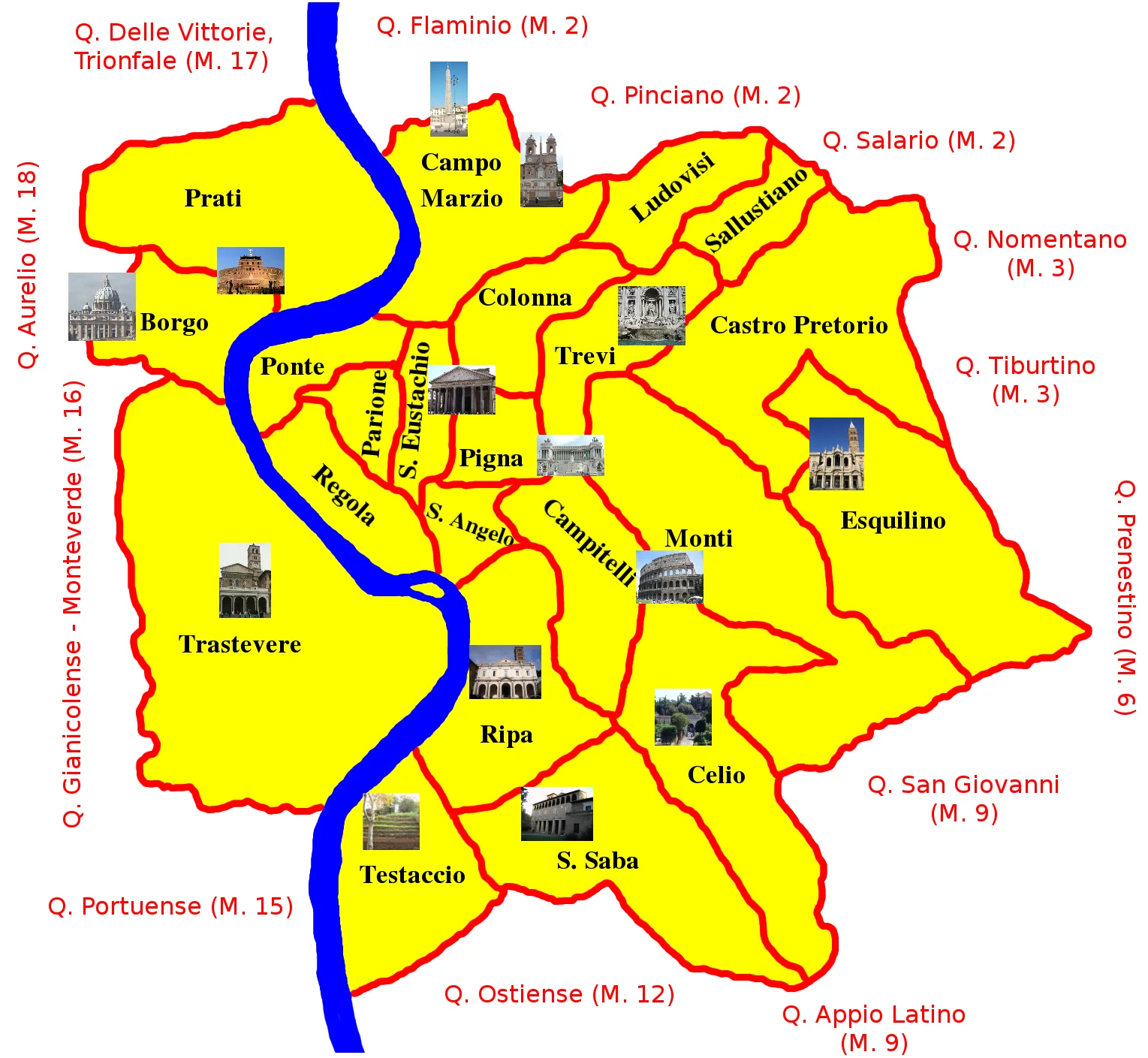
Rome has 22 rioni, numbered from R. I to R. XXII, and they cover only the historic center: 15 square kilometers and a little over 100,000 residents. The quartiere is something else, it came later and lies outside. Whoever confuses the two words is reading the wrong map. This page lines up the 22 rioni with the official numbering, the coat of arms of each and the thing that makes the walk worthwhile, and closes with the boundary that almost no Roman can recite by heart.
The question always comes up at the same point, in front of a white street sign with block lettering and a Roman numeral above it. That sign tells you which rione you are in. Nobody looks at it. Data and references on this page were checked on September 28, 2026 against the sources listed at the end of each chapter.
What a rione is and why it is not a quartiere
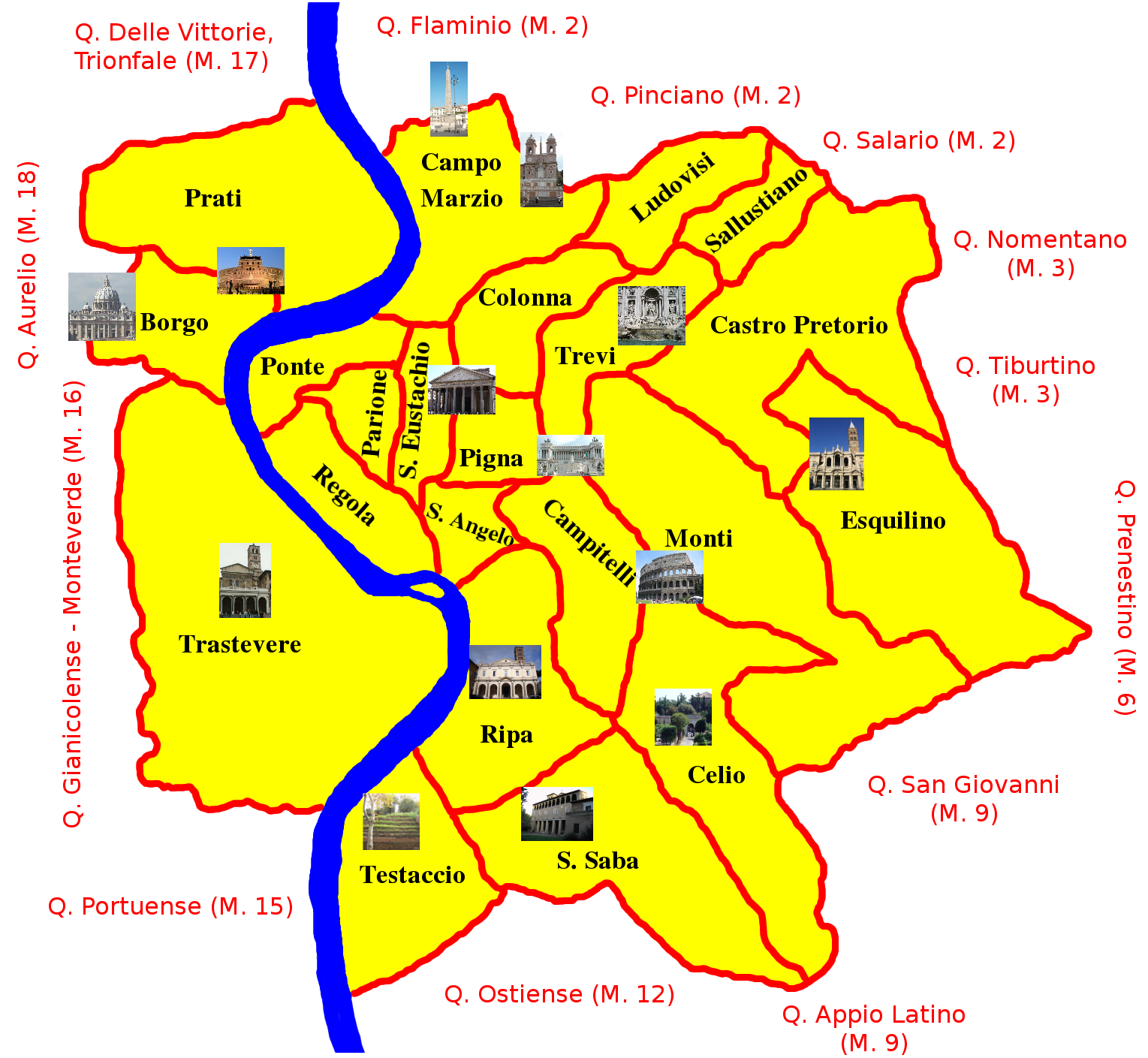
Rione comes from the vulgar Latin regione(m), passed through medieval Romanesco, and indicates the first level of the toponymic subdivision of Rome. The rioni are inside the walls, with a single exception. The quartieri, marked with the abbreviation Q. and also numbered, were instead born from the early 1900s outside the city walls, to house a city that was growing at a pace nobody had foreseen. Two different systems, two different eras.
The practical difference shows on the street signs. In the historic center the marble sign carries the name of the street and below it, in small type, the name of the rione with the Roman numeral. Outside the walls you find the abbreviation of the quartiere. Roman street naming still uses both systems for house numbers and for the registry, even though administratively what counts today are the Municipi: all 22 rioni fall within Municipio I.
A clarification that is needed, because it confuses many people. The rione has no mayor, no budget, and elects no one. It is a toponymic and historical division, survived as an identity and as an address. The caporione, the figure who commanded each rione from the late Middle Ages, was abolished by the municipal reform of Pius IX with the motu proprio of October 1, 1847. Since then the rione has been memory, not power.
From 14 Augustan regiones to 13 medieval rioni
Rome has always divided itself into zones. Servius Tullius, in the sixth century BC, made four of them inside the pomerium: Suburana, Esquilina, Collina, Palatina. Augustus got to 14 regiones, all on the left bank of the Tiber except Transtiberim, that is, today's Trastevere. With the fall of the Western Empire and the drop in population that grid frayed and disappeared.
Around the 12th century a division into 12 parts re-formed, not by decree but by common use. In the 1200s the boundaries became official and the rioni rose to 13, with the addition of Trastevere. The term appears for the first time in the Catalogo di Torino, from the early 1300s, which lists entries such as Regio Montium et Biberate or Regio Pontis et Stortichiarioram. The names are already recognizable: Monti, Ponte, Pigna, Ripa.
In the Renaissance precision was needed. The city was repopulating, new streets and fountains were being opened, and vague boundaries were no longer enough. One of the criteria adopted to draw them was the equal division of the population, not of the surface area: that is why peripheral and half-empty rioni like Monti, Campitelli or Ripa turn out enormous, while those in the bend of the Tiber, packed with houses, are tiny. Sant'Angelo still measures 13.5 hectares today.
Borgo 14th, Esquilino 15th, and then seven in one go
In 1586 Sixtus V added the 14th rione in the area of St. Peter's: Borgo. From there the balance held for almost three centuries, helped by modest population growth. The French interludes of 1798 and the Napoleonic age reorganized everything into 12 rioni first and into eight Giustizie later, merging the smallest into the largest, but the traditional layout returned right afterward.
Rome as capital changed the proportions. Immigration from the rest of Italy and the building of the machinery of a State made construction explode inside and outside the walls. In 1874 the rioni became 15 with the creation of the Esquiline Hill, carved out of Monti, which until then ran from the Forum to Porta Maggiore and was the largest rione in the city.
The real leap came in 1921. After the 30 years of expansion between 1890 and 1920, the Associazione fra i Romani pointed out to the Administration the advisability of creating new rioni and new quartieri. The Giunta Municipale answered with resolution number 20 of August 20, 1921, which created seven rioni in one go, from XVI to XXII, and assigned each a coat of arms with a written blazon. Ludovisi, Sallustiano, Castro Pretorio, Celio, Testaccio, San Saba, Prati.
On the same occasion the first 14 old rioni were given the epithet Vetere, to distinguish them from the Esquilino post 1870 and from the last seven. That is why on the oldest maps you read Monti Vetere or Ripa Vetere. It never caught on in speech: nobody in Rome has ever called their own rione Vetere, and the formula stayed in official documents.
The 22 rioni in order, from the first to the 22nd
Below is the list in the official numbering, with the coat of arms as recorded by Carlo Pietrangeli in his 1953 study for the journal Capitolium, and with the thing that makes it worth going in. Where the sources diverge I flag it at the exact point, without rounding off. The surface areas and residents come from the Annuario Statistico di Roma Capitale.
R. I Monti
Monti bears three green mounts on a field of silver, that is, white, and remains the largest rione of the center with about 165 hectares. The thing to see is Michelangelo's Moses in San Pietro in Vincoli, which almost nobody reaches from the Borgia stairway the way you should. Under the Colle Oppio opens the Domus Aurea. The ancient Subura corresponds to today's Via Leonina and Via Madonna dei Monti.
The inhabitants are called monticiani and in the Middle Ages they spoke a slightly different Romanesco from the others, so strong was the identity of the rione. The brawls with the Trasteverini in the 1300s were frequent and serious. Whoever wants to understand the rione from the inside, and not from the shop window of Via del Boschetto, will find a dedicated guide in the page on Monti. Metro B, Cavour stop.
R. II Trevi
The coat of arms of Trevi is three bare white swords placed in bend on a red field. The rione takes its name from the trivium in front of the Trevi Fountain, where three streets converged, and not from the three swords, which came later. Here you also find the Quirinal Palace, residence of the popes first and of the kings afterward, today the seat of the Presidency of the Republic.
The Trevi Fountain looks best at 7 in the morning, when the square is almost empty and the light hits the facade of Palazzo Poli edge-on. At 11 it's a funnel. It's best to get there early and then climb toward Via della Dataria, which nobody walks and which gives the sense of the difference in height between the basin and the hill.
R. III Colonna
Colonna has as its coat of arms a white column on a red field, alluding to the Aurelian Column. It is the rione of the Column of Marcus Aurelius, erected in the middle of Piazza Colonna in front of Palazzo Chigi. At 26.89 hectares it is one of the smallest rioni, and yet inside it are Montecitorio, the Corso and half of Italian political journalism.
The thing to do here is not the square, which is a backdrop. It's to go into Via dei Bergamaschi or Via di Pietra, where 11 columns of the Temple of Hadrian remain, built into the wall of the Stock Exchange. 15 meters tall, fluted, in Proconnesian marble. You walk past them and don't see them because you're looking at your phone.
R. IV Campo Marzio
Campo Marzio bears a silver crescent on a blue field, a very ancient symbol of disputed origin. The rione holds together the Mausoleum of Augustus, the Ara Pacis and Piazza di Spagna. On the ancient plan it corresponded to the military training ground outside the pomerium, flat and subject to the floods of the Tiber.
The stretch I recommend is the spine of alleys between Via della Scrofa and Via dei Portoghesi, with the Torre della Scimmia sticking out above the roofs. You walk it in five minutes and there is almost nobody. Metro A, Spagna stop, exit onto Via dei Due Macelli and then down on foot toward the river.
R. V Ponte
Ponte has as its coat of arms the Ponte Sant'Angelo in white on a red field, and the name comes from exactly there. The rione occupies the bend of the Tiber facing Castel Sant'Angelo and includes Via Giulia and Via dei Banchi Vecchi, the axis of the Florentine bankers of the 1500s. Ponte Sant'Angelo with Bernini's angels is the gateway to the rione.
Keep in mind that the capital executions took place here, in Piazza di Ponte, in front of the start of the bridge. The hanged were left on display. The memory of that place is written in the plaques of the confraternity that assisted the condemned, on the side of the church on Via Giulia. Nobody tells you while you photograph the angels.
R. VI Parione
Parione bears a red hippogriff on a white field according to Pietrangeli's blazon, while the Roman vulgate and many modern reproductions speak of a griffin: the two versions coexist and both should be stated. The rione hosts Piazza Navona, which follows the outline of Domitian's stadium, and the fabric of artisan workshops between Via del Governo Vecchio and Via dei Coronari.
The name derives from a large ancient wall, a paries, which medieval Romans saw emerging in the area. Piazza Navona at 9 in the evening in August is a market of charcoal portraits. At 7 in the morning in November it is still a piazza. The difference is all there and no photograph gives it back to you.
R. VII Regola
Regola has a golden stag on a blue field. The name comes from arenula, the fine sand that the Tiber deposited on the bank before the embankment walls, and it is the same word that survives in Via Arenula. The rione reaches as far as Campo de' Fiori and includes the stretch of Via Giulia with the Fontana del Mascherone.
Regola was a working-class rione, like Sant'Angelo and Ripa, and the guilds marked its street names: Via dei Balestrari, Via dei Giubbonari, Via dei Cappellari. The last one remains one of the few streets in the center where people still work behind the windows instead of selling magnets. Go in the morning, around 10, when the shutters are up.
R. VIII Sant'Eustachio
The coat of arms is a golden stag's head on a red field. Between the antlers Pietrangeli describes the bust of Christ, while in Giovan Battista Falda's map there is a cross instead: the divergence is old and neither version has erased the other. The legend is that of the conversion of Saint Eustace, who saw the stag with the crucifix between its antlers. The basilica of Sant'Eustachio still carries the stag's head on its bell tower.
With less than 17 hectares it is the second smallest rione after Sant'Angelo, and yet it contains Borromini's Sapienza, Palazzo Madama and a piece of Corso del Rinascimento. In 1925 a variant to the master plan imposed setting back the facade of Palazzo Madama on Via della Dogana Vecchia: 20 meters planned, 16 carried out, works from 1926 to 1930.
R. IX Pigna
Pigna bears a golden pine cone on a red field, in memory of the great ancient bronze pine cone that stood in the area and that today is in the courtyard of the same name in the Vatican Museums. The rione contains the Pantheon and Santa Maria sopra Minerva, the only Gothic church in the center of Rome.
The most curious detail is in Via del Piè di Marmo, where a colossal marble foot, a little under a meter and a half tall, sticks out at the corner. It belonged to a statue from the Egyptian sanctuary of the Iseum Campense. It has been there since the 1500s and nobody looks at it because it is half a meter off the ground.
R. X Campitelli
Campitelli has as its coat of arms a black dragon's head on a white field, and the choice comes from the legend of the dragon that infested the Forum and that Pope Sylvester I is said to have driven out. Inside the rione are the Capitoline Hill, the Roman Forum, the Palatine and Santa Maria in Aracoeli with its 124 steps.
Campitelli is the least inhabited rione of all: about 500 residents on 60 hectares, because almost the whole surface is archaeological area. The Palazzo Senatorio and the Aracoeli remain the only surviving evidence of the medieval buildings of the rione. Everything else is ancient or from the 1800s and 1900s.
R. XI Sant'Angelo
Sant'Angelo is the smallest rione of Rome, a little over 13 hectares. The coat of arms shows an angel on a red ground with a palm branch in the left hand. In another version the angel holds the sword and the scales, and an even earlier version simply showed a silver fish on a red field. Three documented variants, all to be kept.
The scales don't allude to justice but to the weighing of fish: Rome's fish market stood here, at the Portico d'Ottavia, for more than 1,300 years. On the wall remains the copy of the marble slab that set the maximum length of fish to be sold whole: the heads of the longer ones went to the Conservatori, who made soup from them. The original is in the Capitoline Museums.
R. XII Ripa
Ripa bears a white ship's wheel on a red field, in memory of the river port of Ripa Grande. Until 1921 it was vast, from the valley of the Velabrum to the slopes of the Capitoline Hill and as far as Porta San Sebastiano. Today it includes the Circus Maximus, the Aventine with Santa Sabina, and Santa Maria in Cosmedin with the Mouth of Truth under the portico.
The line for the Bocca della Verità lasts between 20 and 40 minutes in the warm months and is for a three-second photograph. Inside the church, free and with no line, there is one of the best Cosmatesque floors in Rome and a crypt dug into the podium of an ancient temple. Pick one: in our judgment the second.
R. XIII Trastevere
Trastevere has a golden lion's head on a red field. Baracconi, a Roman scholar of the 1800s, tells that from 1100 to 1414 a live lion was kept at the foot of the Capitoline Hill. After a boy was torn apart the beast was put down, and the carcass was given to the head of the Ripa rione, who buried it in a garden of his across the Tiber. Hence the Trastevere caput leonis.
The same source maintains that Trastevere separated from Ripa only in the later 1700s, while the Catalogo di Torino lists Regio Transtiberim already in the early 1300s as an autonomous rione: the two reconstructions don't match and both should be reported. In the rione you find Santa Maria in Trastevere, Santa Cecilia and the Janiculum.
R. XIV Borgo
Borgo depicts a crouching lion in front of three mounts topped by a star: these are the emblems of Sixtus V, the pope who in 1586 raised it to 14th rione. In a first version the lion protected a chest, an allusion to the 3 million gold scudi stockpiled in Castel Sant'Angelo, with the motto Vigilat sacri thesauri custos.
The streets here are not called vie but borghi, with the exception of Via della Conciliazione. The Passetto cuts the rione in two and still today separates two worlds: to the north the working-class fabric of the borghiciani, to the south Vatican offices and souvenir shops all the way to St. Peter's Basilica.
R. XV Esquilino
The coat of arms of the Esquilino is split: in the first part silver with a tree in natural colors, in the second silver with a mount of three peaks in green. Created in 1874 by separation from Monti, it is today the most populous rione, with over 21,000 residents, and the most multiethnic of the city. The Nuovo Mercato Esquilino on Via Filippo Turati is the place where Rome buys its spices.
The name would derive from esquiliae, the suburbs: the territory has always been a border zone, first outside the Servian Walls, then inside the Aurelian ones but always peripheral. Here stood the Gardens of Maecenas, and in 1874 the so-called Auditorium of Maecenas re-emerged, the only remnant of a complex demolished to make the land buildable.
R. XVI Ludovisi
Ludovisi bears the coat of arms of the Boncompagni Ludovisi family: gules with three bands or drawn back in the chief and a dragon or cut off at the point. It was born in 1921 by separation of the northeastern area of Colonna. It is the rione of Via Veneto, built on the ruins of Villa Ludovisi, sold and parceled out after 1885 in one of the most debated building speculations of Umbertine Rome.
Very little remains of the original park. The Casino dell'Aurora, with the only known mural painting by Caravaggio, is at Via Lombardia 46 and is not open to the public continuously: visits depend on occasional arrangements and on legal matters. Whoever promises you guaranteed entry is selling you something they don't control.
R. XVII Sallustiano
Sallustiano has a refined coat of arms: azure with the mirror of Venus Erycina or, alluding to the temple that stood in the Gardens of Sallust. Created in 1921 by separation from the northeastern area of Trevi, it takes its name from the great residence that the historian Sallust had built in the valley between the Quirinal and the Pincio.
A substantial piece of the Gardens remains visible in Piazza Sallustio, seven meters below the current street level, behind a railing. You see it from above without paying anything and almost nobody stops. The difference in height gives the measure of how much Rome has risen: seven meters in 20 centuries, all of it fill.
R. XVIII Castro Pretorio
Castro Pretorio bears gules with the emblem of the Praetorians or. Here the 1921 resolution described the coat of arms without depicting it, and the image most widespread today shows a generic legionary standard with the eagle: historically wrong, because the Praetorian standard carried the scorpion, the zodiac sign of Tiberius, and the eagle belonged only to the legions, which did not reside inside the Urbs.
The rione, carved out of Monti, contains the Castra Praetoria, Termini Station and Palazzo Massimo alle Terme, where the frescoes of the Villa of Livia are. Metro A and B, Termini stop. On its territory there is also the Biblioteca Nazionale Centrale, at Viale Castro Pretorio 105.
R. XIX Celio
Celio has the most singular coat of arms of the 22: argent with an African's head sable, covered with the spoils of an elephant and crowned with ears of wheat or. It refers to the legionaries of Scipio Africanus and to the marble bust of an African found in the area, which gave its name to the Vicus Capitis Africae. The bust is in the Capitoline Museums.
Carved out in 1921 from the southeastern portion of Campitelli, the rione includes San Clemente with its three levels, the Case Romane del Celio under Santi Giovanni e Paolo, Santo Stefano Rotondo and Villa Celimontana. On its territory, between Via Latina and Via Appia Antica, is also the Tomb of the Scipios.
R. XX Testaccio
Testaccio has the most direct coat of arms of all: gules with an amphora or. The amphora is that of Monte dei Cocci, an artificial hill 35 meters high made from the fragments of about 53,000 olive oil amphorae unloaded from the Emporium between the first and third centuries. The rione was born in 1921 by separation of the southwestern area of Ripa.
The Nuovo Mercato di Testaccio, on Via Beniamino Franklin, opened in 2012 and stands over the remains of a paved Roman road left on view. The page on Testaccio goes into detail on the former Slaughterhouse and the working-class quarter. Metro B, Piramide stop.
R. XXI San Saba
San Saba bears azure with a silver lunar crescent in chief and the bow of Diana at the point, alluding to Diana Aventina. On the metal of the bow the sources diverge: the text of the resolution of August 20, 1921 gives it as gold, while other heraldic sheets report it as silver. The rione was also indicated in the resolution as Sub Aventino.
Called Piccolo Aventino, it is a rione of public housing from the 1920s, low and orderly, almost a garden city inside the walls. The church of San Saba in Piazza Gian Lorenzo Bernini keeps a portico with ancient fragments built into the walls and a Cosmatesque floor. At 6 in the evening nobody is here and you hear the traffic of the Baths of Caracalla in the distance.
R. XXII Prati
Prati closes the series with azure with the mausoleum of Hadrian argent, that is, Castel Sant'Angelo, which however falls in Borgo and not in Prati. Officially established on August 20, 1921, it is the only one of the 22 rioni to lie entirely outside the circuit of walls formed by the Aurelian Walls, the Janiculum Walls and the Leonine Walls.
It was born as an administrative and residential area for the officials of the Kingdom of Italy, and the street names say so: streets dedicated to figures of republican and imperial Rome and to heroes of the Risorgimento, with Piazza Risorgimento at the center. The main street was named in 1911 after Cola di Rienzo. The page on Prati and Borgo goes deeper into the relationship between the two. Metro A, Lepanto and Ottaviano stops.
A curiosity about the 22 rioni of Rome
The coats of arms of the rioni are not medieval. Seven out of 22 were invented at a desk on August 20, 1921 by a resolution of the Giunta, which wrote their heraldic blazon in technical language and assigned them to rioni born that very day. The other 15 are older, but their written and systematic codification is the work of the 1800s and 1900s, not of the 1300s.
The consequence shows around Rome. The coats of arms you find on the neighborhood drinking fountains, on the plaques and on the banners of associations don't go back to the Catalogo di Torino: they are reconstructions, sometimes faithful to 1600s maps like Falda's, sometimes reinterpreted. The case of Castro Pretorio, with the eagle in place of the scorpion, is the most glaring and keeps circulating.
One curious detail. The 1921 resolution described the coats of arms in words and did not draw them. Every later draftsman therefore interpreted those lines as he wished, with results that differ from one publication to the next. Compare two reproductions of the coat of arms of Sallustiano and you will see two mirrors of Venus that don't look alike.
Something nobody tells you about the 22 rioni of Rome
The boundaries of the rioni were fixed precisely in 1743 under Benedict XIV, and that grid held until the 1900s. Then the demolitions of the Fascist period wiped out entire blocks and made those boundaries unusable, and it was decided to redraw them. Sant'Angelo, the smallest rione, grew on that occasion.
It absorbed marginal but significant parts of its neighbors Campitelli and Ripa. The result is that the church of Santa Maria in Campitelli today does not fall in the Campitelli rione: it falls in Sant'Angelo. Same thing for San Gregorio della Divina Pietà, on the Lungotevere in front of the Tiber Island. The name says one thing, the map says another.
Borgo also lost pieces. In the 1930s extensive demolitions affected the northwestern part of the rione, between Via di Porta Angelica and Via del Mascherino, and were officially undertaken to better define the boundary between Italy and the new Vatican City State. The Spina that separated the two central borghi instead fell for Via della Conciliazione, with the works closed in 1950.
The boundary that almost no Roman can name
Ask a Roman which rione Santa Maria Maggiore is in. They will answer Esquilino, because the basilica is on the Esquiline Hill and because Termini Station is right nearby. The correct answer is more uncomfortable: the basilica of Santa Maria Maggiore falls between the Monti rione and the Esquilino rione, that is, the boundary runs through the complex.
The reason lies in the 1874 separation. The Esquilino was cut out of a gigantic Monti following street axes that already existed, not ecclesiastical properties, and the line runs along Via Cavour and Piazza dell'Esquilino. The side of the basilica and the apse thus end up in two different places. No tourist source explains it because it ruins the simple sheet.
The second boundary that throws everyone is that of the Colosseum. Piazza del Colosseo is a boundary line between three rioni at once: Monti to the northeast, Campitelli to the west along Via dei Fori Imperiali and Via di San Gregorio, Celio to the south. You are photographing yourself at an administrative trivium and you don't know it.
Third case, the most refined. The Celio rione includes the Tomb of the Scipios between Via Latina and Via Appia Antica, well beyond the hill it takes its name from, because in 1921 they assigned it the whole southeastern portion of Campitelli as far as the walls. The name of a rione describes the starting point, not the final extent.
The advice I give you for visiting the 22 rioni of Rome
Don't try to do them all. 22 rioni in one trip means 22 hurried crossings and zero memory. The rule is simple: three rioni a day, chosen next to each other, and only one paid entrance per rione. The rest you do by walking and looking at the street signs.
There are four combinations that work best. Monti with Esquilino and Castro Pretorio for the Rome of the 1800s and the hills. Parione with Sant'Eustachio and Pigna for the Renaissance on foot. Ripa with Testaccio and San Saba for the river and work. Borgo with Prati to understand how a papal city becomes a secular capital in 30 years.
Look for the rione plaques. They are in white marble, carry the name of the street and below it the name of the rione with the Roman numeral, and they change when you change rione. Crossing Via Arenula from north to south means passing from Sant'Eustachio to Regola: if you look at the walls you notice, if you look at your phone you don't.
When to go and what to expect
The historic center is good to walk from October to March, with short days but squares you can breathe in. From mid-June to the end of August the paving gives back heat until 8 in the evening and distances double in perception. If you come in summer move everything to before 10 in the morning and after 18:00, and use the churches as cool breaks.
The churches of the center almost all close for the midday break, usually between 12:30 and 15:30, with variations from case to case. Hours should be rechecked the day before on the websites of the individual basilicas or parishes: they change in Lent, in Advent and during extraordinary celebrations. Information verified on September 28, 2026.
Another well-known fact, yet rarely cited
The population of the rioni has collapsed. The 22 rioni together count about 112,000 residents out of almost 2,800,000 inhabitants of Rome: the historic center houses less than 5 percent of the city. Campitelli has a little over 500, Colonna fewer than 2,000, Trevi a little over 2,000.
The figure explains many things that visitors notice without knowing how to interpret them. The neighborhood shops gone, the schools merged, the parishes with few weekday Masses, the street doors with no intercoms but with key lockboxes. In the central rioni the apartments are in large part short-term rentals and offices, and the ordinary residential market has moved out.
There are two exceptions and they are worth naming. Esquilino, with over 21,000 residents, and Trastevere, with almost 13,000, remain truly lived-in rioni, with a density above 13,000 inhabitants per square kilometer in the first case. Prati, despite being outside the walls, counts over 14,000 and is second in population.
The coats of arms: who decided them and when
The reference study on the rione coats of arms is by Carlo Pietrangeli, published in 1953 in the journal Capitolium under the title Insegne e stemmi dei rioni di Roma. The blazons reported on this page come from there, and it is the source that later encyclopedias and armorials cite. Before Pietrangeli the subject was scattered among old maps and local traditions.
The 1600s maps, and in particular the one by Giovan Battista Falda, are the oldest visual source for many old coats of arms. But Falda drew what he saw or what he was told, and in some cases his version diverges from the one later canonized: the bust of Christ between the antlers of the stag of Sant'Eustachio becomes a cross, to name one.
Whoever wants to check in person has a free and little-used route. The Archivio Storico Capitolino, at Piazza dell'Orologio 4, holds the municipal documentation, including that of the Giunta resolutions. Access to the study room requires registration and should be verified beforehand on the institutional website, because hours and procedures change. Situation checked on September 28, 2026.
The right photo to take of the 22 rioni of Rome
The photograph that tells this page is not a piazza. It is a marble street sign with the name of the rione and the Roman numeral underneath, taken up close with a piece of wall around it. You find them everywhere in the center, and the most beautiful ones are on Via dei Coronari, on Via Giulia and around the Portico d'Ottavia.
The second photo to take home is a boundary. Stand at a spot where two signs of different rioni are visible in the same frame: it happens at the corners of Via Arenula, on Via Cavour at the height of Piazza dell'Esquilino, and in Piazza del Colosseo. One photograph and you have the concept of rione explained without words.
For the overall view of the rioni, climb the Janiculum at sunset from Piazzale Garibaldi, or the terrace of the Vittoriano if you agree to pay for the elevator. From above the difference between the dense fabric of the rioni in the bend and the regular grid of Prati becomes obvious in three seconds. Best light between 18:00 and 19:00 in spring.
Some important events that happened here in history
In 1586 Sixtus V establishes Borgo as the 14th rione, closing an arrangement that holds until 1874. In 1743 Benedict XIV fixes the rione boundaries precisely, and that delimitation remains the reference until the demolitions of the 1900s. These are the two dates every discussion of the rioni must keep in mind.
In 1798, during the French occupation, the Roman Republic tries to rationalize everything into 12 rioni with new names: Terme, Suburra, Quirinale, Pincio, Marte, Bruto, Pompeo, Flaminio, Pantheon, Campidoglio, Gianicolo, Vaticano. Shortly afterward Napoleonic Rome reduces them to eight divisions called Giustizie. The merit of the French was to impose the name of the zone on all the street signs: for the first time the boundaries stopped being ambiguous.
On October 1, 1847 Pius IX, with the motu proprio on the municipal structure and organization, abolishes the office of Priore dei Caporioni. He was the head of the Monti rione, who together with the three Conservatori formed the Magistrato Romano and came from the city nobility, unlike the other caporioni. With that act the rione ends as an institution of government.
1874 brings the Esquilino and August 20, 1921 brings the last seven rioni with resolution number 20 of the Giunta Municipale. Between the two dates lies the most violent transformation Rome has undergone since the Renaissance: Tiber embankment walls, demolitions, Umbertine quarters. The new rioni are the attempt to put things in order afterward, not before.
Who has passed through the 22 rioni of Rome
Giuseppe Baracconi publishes I rioni di Roma in 1889 and remains the most cited narrative source on rione traditions, including the story of the lion of the Capitoline Hill killed in 1414. His pages should be read as a testimony of the 1800s, not as an archival document: he mixes records, oral memories and reconstructions, and in some places his dates don't hold up against the Catalogo di Torino.
Carlo Pietrangeli, art historian and later director general of the Vatican Museums, is the author of the 1953 study on the coats of arms and of a long series of rione guides. Tommaso di Carpegna Falconieri reconstructed the first attestations of the rione names in the Middle Ages in a contribution to the Strenna dei Romanisti of 2014, and it is the most solid work on the 1300s phase.
Among recent residents, Borgo holds the most cited case: Cardinal Joseph Ratzinger lived in Borgo Pio for more than 20 years before his election. After the conclave the borghiciani hung a banner in Romanesco on the facade of Santa Maria in Traspontina: greetings to the Borgo Pope, our parishioner. It is rione identity that still works.
A contrarian position on the rioni
I'll say something Rome doesn't like: rione identity, as it is told today, is largely a recent reconstruction. The rivalry between monticiani and Trasteverini is documented in the 1300s, fine, but the rione associations with banners, the festivals and the historical costume parades are phenomena of the 1800s and 1900s, often born together with the tourism they say they fight.
A practical consequence follows for those who travel. Choosing where to sleep or where to eat by rione is almost useless, because inside a rione of 30 hectares there live side by side streets emptied by short-term rentals and streets still lived in. The boundary that counts today is at the level of the block, not of the rione: 200 meters change everything.
And a second one, even less popular. Trastevere is sold as the authentic rione par excellence, but it is the one where commercial replacement arrived first and went deepest. If you are looking for the Rome that lives, Esquilino and San Saba, which nobody proposes to you, work better. Pay the ticket for beauty elsewhere and for daily life here.
How to get around the rioni
The 22 rioni can be crossed on foot: from Piazza del Popolo to Piazza Venezia it is a little over a kilometer and a half along the Corso, 20 minutes at a normal pace. The historic center is largely a Zona a Traffico Limitato, with electronic gates active in time bands that change between weekdays and weekends and that must be checked before entering by car.
The useful metro stops are few and this always surprises. Line A: Flaminio, Spagna, Barberini, Repubblica, Termini, Vittorio Emanuele, Manzoni, San Giovanni, and Ottaviano and Lepanto for Prati. Line B: Colosseo, Cavour, Circo Massimo, Piramide, Termini, Castro Pretorio. The heart of the rioni in the bend of the Tiber, that is Ponte, Parione, Regola, Sant'Eustachio and Pigna, has no metro stop at all.
For that area you need the surface buses along Corso Vittorio Emanuele II and tram 8, which links Piazza Venezia to Trastevere and continues toward Casaletto. Atac lines and routes change fairly often because of construction sites and detours: check the route the same day on the operator's official app. Check carried out on September 28, 2026.
Eating nearby
Crossing 22 rioni you pass hundreds of signs and most of them, on the busiest streets, work on passing trade and not on return customers. The signals are always the same and you recognize them in three seconds. A menu displayed with photographs of the dishes: it means the place addresses people who can't read the language and will never come back.
The lady rolling out the pasta sheet in the window or in front of the door is a staged lure, period. No serious kitchen puts pasta-making on the sidewalk at rush hour: it serves to stop the flow, not to tell you how people eat inside. Same goes for whoever stops you at the threshold and invites you to sit. In a place where Romans eat, nobody chases you.
Then look at the hours. A place open without interruption from morning to the middle of the night, with no break at all between lunch and dinner, has no kitchen that reorganizes between the two services: it has a line that reheats. Real kitchens close in the afternoon and reopen around 19:30, and that break is the most reliable signal there is.
On prices the rule is blunt. In the places facing the most visited monuments the price list adapts to the customer: items with no price shown, inflated cover charges, fish sold by weight without telling you the weight, and different rates between the indoor room and the outdoor tables. Ask for the itemized bill before ordering and check that the price list displayed outside matches the one they bring you.
The chains with a repeated sign that you find replicated in every central rione deserve a word without snobbery. They work as tourist attractions: they are predictable, they have a standardized product, often a photogenic line, and they serve the function of reassuring those who are afraid of getting it wrong. Romans don't go, and not out of superiority: they go where it costs less and you eat like at home. They are two different markets living on the same street.
The criterion, which almost never fails, is only one: look at who is sitting and in what language they order. If at 13:30 there are tables of people speaking Italian among themselves and ordering without opening the menu, you are in the right place. If there are only suitcases and backpacks, change street. Distances in the center are short, 300 meters is enough.
Whoever wants a reasoned starting point can look at the list of places collected by Daniele here: the selection on Google Maps. It is a personal list, not a ranking, and should be used as such: always check closing days and hours, because in the central rioni they change even within a season.
Frequently asked questions
Exactly how many rioni does Rome have?
Rome has 22 rioni, numbered from R. I Monti to R. XXII Prati. Together they cover about 15.47 square kilometers and host a little over 112,000 residents according to the data of the Annuario Statistico di Roma Capitale. All 22 now fall within Municipio I. The number has been stable since August 20, 1921 and has not changed since.
What is the difference between a rione and a quartiere in Rome?
The rione indicates a zone of the historic center and belongs to a toponymic tradition that goes back to the Middle Ages, with a root in vulgar Latin regione(m). The quartiere, marked with the abbreviation Q., was born in the 1900s for the urbanized areas outside the walls. Prati is the only rione entirely outside the circuit of walls, and for that reason it remains a special case in the distinction.
When was the Prati rione created and why is it the 22nd?
Prati was officially established on August 20, 1921 with resolution number 20 of the Giunta Municipale, together with six other rioni. It is the 22nd because the resolution listed the new rioni in an order that placed it last, after Ludovisi, Sallustiano, Castro Pretorio, Celio, Testaccio and San Saba. The area had already been urbanized for decades: the date of 1921 concerns the status of rione, not the birth of the quarter.
Which is the smallest rione and which the largest?
Sant'Angelo is the smallest with about 13.76 hectares, a little less than a seventh of a square kilometer, and fewer than 1,000 residents. The largest is Monti, with about 165 hectares. The least inhabited is Campitelli, with a little over 500 residents, because almost all its territory is archaeological area between the Capitoline Hill, the Roman Forum and the Palatine.
Which rione is the Colosseum in?
Piazza del Colosseo is a boundary line between three rioni: Monti to the northeast, Campitelli to the west along Via dei Fori Imperiali and Via di San Gregorio, Celio to the south. The amphitheater is therefore at the point where the three boundaries meet, and depending on the source consulted it is attributed to one or the other. It is the case that generates the most confusion among all the rione boundaries.
Are the coats of arms of the rioni old?
Seven coats of arms out of 22 were established on August 20, 1921 with the same resolution that created those rioni. The other 15 have older roots, documented in the 1600s maps like the one by Giovan Battista Falda, but their systematic heraldic codification is recent: the reference study is by Carlo Pietrangeli, published in 1953 in the journal Capitolium.
Did the rione boundaries change in the 1900s?
Yes, and significantly. In 1874 the Esquilino was carved out of Monti. In 1921 Ludovisi was born from Colonna, Sallustiano from Trevi, Castro Pretorio from Monti, Celio from the southeastern portion of Campitelli, Testaccio and San Saba from the vast Ripa rione. After the demolitions of the Fascist era the limits set in 1743 by Benedict XIV were modified, and Sant'Angelo expanded by incorporating parts of Campitelli and Ripa.
Can you visit all the rioni in one day?
Technically yes, because the overall perimeter is contained and walkable, but the result is nil. Three adjacent rioni in a day, with a single paid entrance each, is the pace that holds up without exhausting the walker. Crossing 22 rioni in a rush means collecting street signs and remembering nothing the next day.
Do the caporioni still exist?
No, not as an institution. The office of Priore dei Caporioni, which belonged to the head of the Monti rione and which together with the three Conservatori formed the Magistrato Romano, was abolished by Pius IX with the motu proprio of October 1, 1847 on the municipal structure and organization. Today there are private rione associations and historical reenactment groups, which have no administrative function.
Who wrote this page
This page is edited by the team at Tour Leader Pro, the Roman project office that designs and coordinates visits, itineraries and cultural events in Rome and Lazio. Resident figures, surface areas, establishment dates and blazons reported here come from the sources cited in the text and were checked at the date indicated: before leaving it's worth rechecking hours and access conditions, which change often. If you find an outdated figure, let us know.
If you have to build an itinerary among the rioni knowing that churches close at midday, that access to underground complexes is booked weeks in advance, that the Zona a Traffico Limitato changes time band on weekends and that a kilometer on the flat is not the same as a kilometer on the Aventine, for yourself or for a group, you will find planning tools at Tour Leader Pro, which gathers materials designed for those who lead visits and for those who organize on their own.
For the overall picture on trains, rentals, airports and destinations in Lazio beyond the center of Rome, from the Castelli to the lakes to the coast, a useful resource is Italy Planner.