Rione Ponte: What to See
In short. Rione Ponte, the fifth of the 22 historic rioni of Rome, occupies the bend of the Tiber in front of Castel Sant'Angelo and is visited on foot, for free, at any hour: it is made of public streets and squares, from Via dei Coronari to Via…
Rione Ponte, the fifth of the 22 historic rioni of Rome, occupies the bend of the Tiber in front of Castel Sant'Angelo and is visited on foot, for free, at any hour: it is made of public streets and squares, from Via dei Coronari to Via dei Banchi Vecchi, from the northern stretch of Via Giulia to Piazza di Ponte Sant'Angelo. You pay only inside the museums. Palazzo Altemps is included in the Museo Nazionale Romano ticket, €15 for three sites, and the Museo Napoleonico costs €7.50 full fare.
The name comes from Ponte Sant'Angelo, the ancient Pons Aelius that Emperor Hadrian wanted to connect the city to his mausoleum, and the rione's coat of arms shows a bridge on a red field, according to the Roma Capitale tourism portal. Pilgrims headed for St. Peter's passed through here, the popes' banks and mint were based here, and here in the 16th century prelates, merchants and courtesans built houses and palazzi. The same portal calls it the rione richest in Renaissance and Baroque evidence in the city.
Data checked on September 29, 2026 on the Roma Capitale tourism portal, on the hours and tickets page of the Museo Nazionale Romano, on the Museo Napoleonico website and on the other sources cited in the text. The rione's churches do not publish a common schedule: each has different rectors, confraternities or communities, and Mass times change with the seasons. For extraordinary closures of the municipal museums and for general information the reference is 060608, the Roma Capitale contact center.
At a glance: address, hours, ticket
- Where: rione V of the historic center, in the bend of the Tiber between the Lungotevere Marzio, Tor di Nona, degli Altoviti and dei Fiorentini, opposite Castel Sant'Angelo.
- Operator: streets and squares of Roma Capitale, churches entrusted to different rectors, confraternities and communities, Palazzo Altemps run by the State, Museo Napoleonico by the city.
- How to enter: the rione is toured on foot, without a ticket and without a booking, at any hour.
- Prices: Palazzo Altemps with the Museo Nazionale Romano ticket, €15 for three sites and valid for one week. Museo Napoleonico €7.50, free for residents of Rome and the metropolitan area.
- Hours: Palazzo Altemps Tuesday to Sunday 9:30 to 19:00, ticket office until 18:00. Museo Napoleonico Tuesday to Sunday 10:00 to 18:00, last entry 17:15.
- How to get there: no metro stop inside the rione, bus lines to be checked on the ATAC website or at 060608.
- Accessibility: alleys of cobblestones and narrow sidewalks, Palazzo Altemps listed as accessible by the Roma Capitale tourism portal.
Where it is and what you really see
Ponte is the rione enclosed by the bend of the Tiber facing the Vatican. To the north and west it is bounded by the river, with the Lungotevere Marzio, Tor di Nona, degli Altoviti and dei Fiorentini. To the south it borders Parione along a broken line of streets, including Via del Governo Vecchio, Via dei Filippini and Via della Pace. With Regola the boundary runs along Via dei Banchi Vecchi and Via delle Carceri, with Sant'Eustachio along Piazza di Sant'Agostino, with Campo Marzio along Via del Cancello.
What do you see, walking? A network of long, straight streets, rare in medieval Rome, and between one and the next a tangle of alleys. Via dei Coronari, Via dei Banchi Nuovi and Vecchi, the northern stretch of Via Giulia. Small squares, born at crossroads: Piazza dell'Orologio, Piazza Lancellotti, Piazza di San Salvatore in Lauro, Piazza Fiammetta. Then the facades of the 16th-century palazzi, the churches of the communities that lived here and the river, which you reach in a few minutes from any point.
The rione has no dominant monument like the Pantheon or the Trevi Fountain, and this sets it apart from its neighbors. Whoever crosses it finds mostly lived-in houses, shops, offices, private doorways and churches often closed outside service hours. The places you can visit at fixed hours are few: Palazzo Altemps, the Museo Napoleonico, the Chiostro del Bramante with its exhibitions. The rest you look at from the street, raising your eyes to the facades.
The boundary easiest to get wrong is the one with Parione. Piazza Navona, Palazzo Braschi and the Chiesa Nuova do not belong to Ponte, even though they are a few minutes' walk away. Santa Maria della Pace and its cloister do, on the other hand, and so do Sant'Apollinare and Palazzo Altemps at the eastern end. Across the river is Castel Sant'Angelo, and the bridge itself, according to the Roma Capitale tourism portal, has been part of Rione Borgo since the 16th century.
Whoever arrives for the first time should think of the rione as a quadrilateral to cross diagonally. From Piazza di Ponte Sant'Angelo you enter by Via del Banco di Santo Spirito, take Via dei Coronari east as far as Tor Sanguigna, go down toward Santa Maria della Pace and return to the river by Via dei Banchi Nuovi and Via dei Banchi Vecchi. In two hours, at a slow pace and with a few stops, you touch almost everything that matters.
A curiosity about Rione Ponte
The most obvious curiosity is in the coat of arms. The rione takes its name from the bridge and draws it on a red field, but the bridge no longer belongs to it. According to the Roma Capitale tourism portal, until the 16th century the bridge was part of Ponte, then Pope Sixtus V established Rione Borgo and included it in the new district. Since then Rione Ponte has kept in its symbol a monument that, on paper, lies outside its boundaries.
The second detail concerns the name of Via dei Coronari. The coronari were the sellers of rosary beads, little holy pictures and other sacred objects, also called paternostrari. They kept shop along the street because pilgrims headed for St. Peter's basilica passed through here, according to the English Wikipedia entry on the street. The religious trade left its name to the street, even though today few rosaries are seen in the windows.
Third curiosity: along Via dei Coronari, in the stretch toward the river, there is a marble sacred shrine called the Immagine di Ponte. It dates from around 1523, was designed by Antonio da Sangallo the Younger and frames a painting by Perin del Vaga, according to the Wikipedia entries on the street. The sources do not agree on the subject: the Italian entry speaks of a Coronation of the Virgin, the English one of a Madonna. It is a piece of Renaissance art exposed to the street, without a ticket.
The last curiosity is a closed doorway. Palazzo Lancellotti, designed by Francesco Capriani da Volterra and completed by Carlo Maderno, has an entrance on Piazza di San Simeone that has stayed closed since 1870, according to the Wikipedia entry on Via dei Coronari. The family barred it as a sign of loyalty to the pope when Rome became capital of the Kingdom of Italy. Whoever passes through the square still sees that shut door, a political gesture that has lasted more than a century and a half.
Something nobody tells you about Rione Ponte
In our judgment Via dei Coronari is overrated as the street of antiques dealers. From the 1950s the junk dealers' shops had become antique shops, and the street was one of the three centers of the Roman art trade along with Via Giulia and Via del Babuino. Since the 2000s, according to the English Wikipedia entry, many of those shops have been replaced by pizzerias, gelaterie and souvenir shops. Whoever arrives looking for the antiques street described by the old guidebooks is often disappointed.
The value of the street remains intact, but lies elsewhere: in the straight line of its layout, in the facades, in Sangallo's shrine, in the little squares that open to the side. And the minor streets, often ignored, give more. Via dei Banchi Vecchi, Via di Monte Giordano, Via di Tor di Nona and the alleys between Via dei Coronari and the river have fewer shops aimed at tourists and better preserve the look of the rione before the demolitions of the late 19th century.
Second thing rarely said: most of the rione's churches have no visiting hours, only the times of services. The Roma Capitale tourism portal, for Santa Maria della Pace, refers to the church's contacts for Mass times and visiting arrangements. Whoever plans the day around a particular church must phone first. Showing up in the early afternoon without checking means, very often, finding the door closed.
Third thing: Monte Giordano, the small rise where the Orsini fortress stood, is private property. Palazzo Taverna, which occupies its summit, passed in 1688 to the Gabrielli marquises and in 1888 to Count Rinaldo Taverna, according to the Wikipedia entry on Monte Giordano, and in the 20th century to the Gallarati Scotti family. The courtyard is not a public place. You look at the entrance from Via di Monte Giordano, without going in and without photographing those who live or work there.
From the Pons Aelius to the embankment walls: how has the rione changed?
In Roman times the area was part of the ninth Augustan region, the Circus Flaminius, in the Campus Martius, according to the Wikipedia entries on the rione. Emperor Hadrian had the Pons Aelius built to connect the city to his mausoleum, today's Castel Sant'Angelo. The sources do not agree on the year: the Roma Capitale tourism portal gives AD 136 on the bridge's page and 134 on the rione's. Farther downstream there was another bridge, called the Neronian.
In the Middle Ages the population concentrated near the Tiber, which gave water and work. The rione became a hub of the pilgrimage to St. Peter's, full of inns, osterie and shops of sacred objects, according to the English Wikipedia entry. The boundaries of the rioni became official in 1300, when there were 13, according to the Italian entry on the rioni of Rome. In 1586 Pope Sixtus V added Borgo, detaching from the rione the part beyond the river.
The Renaissance changed the layout of the streets. Pope Sixtus IV had Via dei Coronari leveled and paved. In 1504 Julius II began a monetary reform and entrusted Bramante with adapting a building as the papal mint, and around 1508 he had Via Giulia opened, to a design by the same Bramante. Rich families, bankers and cardinals built palazzi, and the rione became one of the most sought-after residential neighborhoods of the city, according to the English Wikipedia entry.
After 1870 came the Tiber embankment walls, built to stop the floods. The little streets that went down to the river disappeared to make room for the Lungotevere, and with them the Apollo theater, demolished in 1888. The construction of Ponte Umberto I made it necessary to open Via Zanardelli, which also changed the facade of Palazzo Primoli. In the inner parts of the rione, the English Wikipedia entry observes, the older look can still be read.
My advice for visiting Rione Ponte
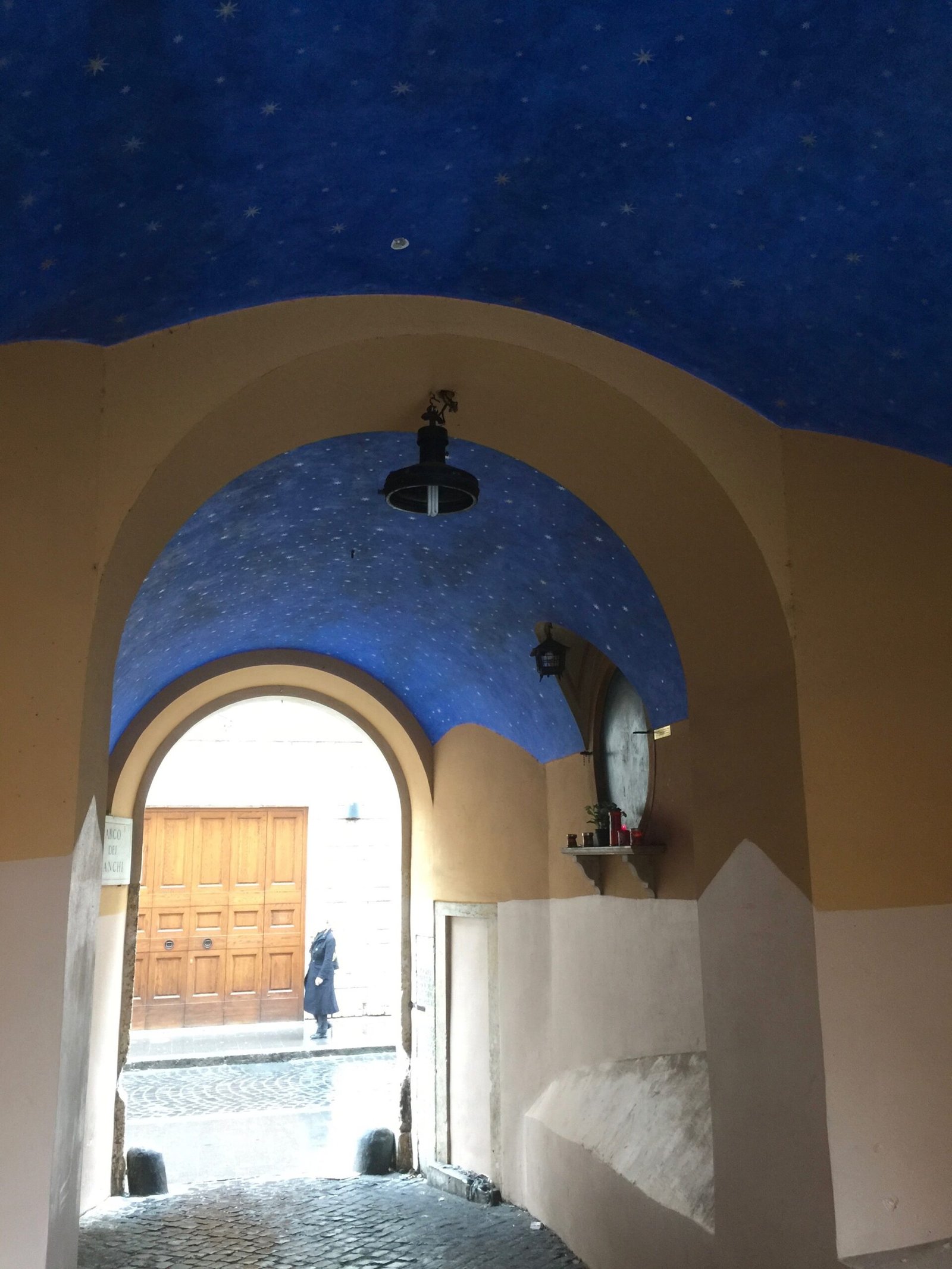
Start from Piazza di Ponte Sant'Angelo, with the bridge and the castle behind you. Take Via del Banco di Santo Spirito, stop in front of Santi Celso e Giuliano and look for the Arco dei Banchi with the plaque of the 1277 flood. Then Via dei Banchi Nuovi to Piazza dell'Orologio, a stretch of Via del Governo Vecchio, and from Via della Pace the little square of Santa Maria della Pace. From there Sant'Apollinare and Palazzo Altemps are a few minutes away.
The return should be made along Via dei Coronari, from Tor Sanguigna westward, with a detour into Piazza di San Salvatore in Lauro and one toward Via di Tor di Nona. Finish on the Lungotevere, looking at the castle from the other bank. A second, separate walk is worth it along the northern part of Via Giulia, from San Giovanni dei Fiorentini southward: it is a different stroll, quieter, which continues into Rione Regola.
Choose the time well. Via dei Coronari fills up on weekends, and Saturday afternoon is the worst moment to photograph facades or read plaques. On weekday mornings the light enters the straight streets better and foot traffic is lighter. For the churches the rule is to phone first: the rione has many sacred buildings and almost none publishes a visiting time separate from services.
Study beforehand, because on site the panels are few. It helps to know where the Immagine di Ponte shrine, the 1277 plaque, the closed doorway of Palazzo Lancellotti and the facade by Pietro da Cortona are. And remember that the rione is lived in: in the alleys the voice echoes, the doorways are private, in the evening many windows are open. Walking in silence and without blocking entrances is the simplest form of respect.
How much does it cost and what do you pay for?
The streets, squares and Lungotevere of the rione are public and free. The churches are free to enter during the opening hours set by whoever runs them. You pay to enter the two museums of the rione with fixed hours, Palazzo Altemps and the Museo Napoleonico, and for the exhibitions at the Chiostro del Bramante, which have their own ticket and hours to check on the operator's channel before going. These are the fares published by the two museums.
| Place | Hours | Full ticket |
|---|---|---|
| Palazzo Altemps | Tuesday to Sunday 9:30 to 19:00, ticket office until 18:00 | €15, valid for one week also for the Baths of Diocletian and Palazzo Massimo |
| Museo Napoleonico | Tuesday to Sunday 10:00 to 18:00, last entry 17:15 | €7.50, reduced €6 |
For Palazzo Altemps the official channel is the hours and tickets page of the Museo Nazionale Romano. The ticket is bought on the Musei Italiani portal, with the app or at the kiosks at the entrance, with electronic payment only and chip cards. The reduced fare costs €2 for citizens of the European Union between 18 and 25, admission is free on the first Sunday of the month, and during temporary exhibitions €3 to €5 may be added.
For the Museo Napoleonico the channel is the museum's tickets and audio guides page. Admission is free for residents of Rome and the metropolitan area with an ID document and for MIC card holders, in addition to the categories provided for by the municipal fare schedule. The audio guide costs €4, in Italian, English and French. Documents proving eligibility for discounts and free entry must be shown at access control.
There is no paid product dedicated to the rione to report, and to walk in the rione no ticket is needed. Whoever wants a guided reading of the places will find proposals from the institutions: the Capitoline Superintendency, for example, has organized educational itineraries in the past among the palazzi of Parione and Ponte as far as Palazzo Altemps. For future calendars the reference remains 060608 and the Superintendency's website.
Another well-known fact, yet rarely cited
That Via dei Banchi takes its name from banks, many guess. Few know that the palazzo at the crossing of Via dei Banchi Vecchi and Via dei Banchi Nuovi began as the popes' mint. According to the Wikipedia entry on the Palazzo del Banco di Santo Spirito, in 1504 Julius II entrusted Bramante with adapting a building to mint papal coins. A few years later Leo X commissioned Antonio da Sangallo the Younger for the facade, completed in 1524.
That facade, slightly concave, anticipates forms that would become typical of the Baroque, according to the same entry. In 1605 Pope Paul V founded the Banco di Santo Spirito, with capital guaranteed by the assets of the Santo Spirito hospital, and in 1666 the hospital bought the former mint to make it the bank's seat. Since then the building has always had a banking function, and even today it houses a counter on the ground floor. Few palazzi in Rome have changed trade so little in five centuries.
A few steps away, under the Arco dei Banchi, between Via del Banco di Santo Spirito and Via Paola, is the oldest plaque marking a flood of the Tiber. The Latin text, transcribed by the geoitaliani site, records that the river reached this point on November 7, 1277, while the papal seat was vacant, and that it soon withdrew muddy. The plaque was originally under the portico of the church of Santi Celso e Giuliano, rebuilt several times precisely because of flooding.
The right photo to take in Rione Ponte
The photo that tells the rione is that of Ponte Sant'Angelo with the angels and the castle, taken from the Lungotevere Tor di Nona or from the start of the bridge in Piazza di Ponte Sant'Angelo. The best light comes in late afternoon, when the sun goes down behind the castle, or early in the morning, with the bridge still empty. The 10 statues of angels, designed by Bernini from 1668 according to the tourism portal, also work well in detail with a telephoto lens.
The second image is the facade of Santa Maria della Pace, with Pietro da Cortona's semicircular porch. The little square is small and trapezoidal, and to get the whole facade you need a wide-angle lens or the patience to find the right spot on the opposite side. It works vertically, with the soft light of a cloudy day or of morning. At midday in summer the shadows of the porch become too harsh and erase the paired columns.
Third choice: the straight perspective of Via dei Coronari, at dawn or on a weekday morning, with the facades lining up toward Tor Sanguigna. Then the details: the Immagine di Ponte shrine, the 1277 plaque under the Arco dei Banchi, the closed doorway of Palazzo Lancellotti. People should be left out of the frame or shot with their consent, and the windows and doorways of lived-in houses are not subjects to photograph up close.
Whoever wants a wide image can look at the rione from the other bank. From the Borgo and Prati side you see the dome of San Giovanni dei Fiorentini, raised by Carlo Maderno in 1614, and the line of palazzi above the embankment walls. It is the photo that best explains the geography of the rione, enclosed by the bend of the river. In winter, with the low sun, the colors of the facades on the Lungotevere become warmer and the river reflects better.
How do you get there from central Rome?
The rione has no metro stations. The bus lines that run along the Lungotevere and Corso Vittorio Emanuele II change with roadworks and seasonal schedules, and no open official source publishes an updated list of them for the rione. For the route of the day it's best to use the planner on the ATAC website or call 060608, giving Piazza di Ponte Sant'Angelo or Piazza di Sant'Apollinare as the destination.
On foot is the natural way to arrive. From Piazza Navona you leave to the north and in a few minutes you are in front of Palazzo Altemps and Sant'Apollinare. From Campo de' Fiori you go up by Via dei Cappellari or by Via Giulia. From St. Peter's you walk down Via della Conciliazione, pass in front of Castel Sant'Angelo and cross Ponte Sant'Angelo, which is pedestrian, arriving straight into Piazza di Ponte.
By car the rione is not a good idea. It is inside the limited traffic zone of the historic center, with gates and hours set by Roma Capitale, and the inner streets are narrow and often reserved for residents. The Lungotevere are busy at rush hour. Whoever arrives from outside Rome does better to leave the car far from the center and continue by public transport, checking the lines on the ATAC website the same day.
Some important events that happened here in history
In AD 134 or 136, the sources do not agree, Hadrian had the Pons Aelius built. On November 7, 1277 the Tiber reached the present Arco dei Banchi, as the plaque recalls. In the Holy Year 1450, according to the Roma Capitale tourism portal, an accident caused by the white mule carrying Pope Nicholas V made the bridge's parapets give way, and dozens of people drowned in the river.
In 1477 Girolamo Riario commissioned from Melozzo da Forlì the palazzo that would become Palazzo Altemps, for his wedding to Caterina Sforza. In 1482 Sixtus IV wanted Santa Maria della Pace. Between 1500 and 1504 Bramante built the cloister for Cardinal Oliviero Carafa. In 1504 Julius II's mint was born, around 1508 Via Giulia. In 1514 Raphael painted the Sibyls in the Chigi chapel, in 1523 the Immagine di Ponte shrine was erected.
On September 11, 1599 Beatrice Cenci was executed near Castel Sant'Angelo, according to the Wikipedia entry dedicated to her. In 1614 Carlo Maderno closed San Giovanni dei Fiorentini with the dome. Between 1656 and 1667 Pietro da Cortona rebuilt Santa Maria della Pace for Alexander VII. From 1668 the bridge received Bernini's angels. In 1670 the former Tor di Nona prison became a theater, and in 1690, according to the Wikipedia entry on the palazzo, the Arcadia was born at Palazzo Altemps.
Between 1733 and 1735 Carlo De Dominicis rebuilt Santi Celso e Giuliano, between 1742 and 1748 Ferdinando Fuga remade Sant'Apollinare. Under Benedict XIV the boundary plaques of the rioni were walled in, in 1744 or around 1748: the sources do not agree. In 1853 and 1859 the Apollo theater hosted the premieres of Verdi's Il Trovatore and Un ballo in maschera. After 1870 came the embankment walls, in 1888 the theater was demolished, in 1997 Palazzo Altemps opened as a museum.
Who passed through Rione Ponte
The first names are those of travelers. The Roma Capitale tourism portal recalls an old inn of the rione that probably hosted Dante and certainly Rabelais, Montaigne, Gogol and Goethe. For Dante the level is that of tradition, for the others that indicated by the source. The rione lived on hospitality: pilgrims, merchants, ambassadors and artists found beds, stables, money changers and shops here before crossing the bridge toward St. Peter's.
Then the artists who lived here. The same portal cites Benvenuto Cellini, Francesco Borromini and Carlo Maderno among the rione's residents. Borromini and Maderno are buried in San Giovanni dei Fiorentini, according to the Wikipedia entry on the basilica. Bramante worked on the mint, the cloister of the Pace and Via Giulia, Antonio da Sangallo the Younger on the mint's facade and the Ponte shrine, Raphael on the Sibyls. On the site you also find the itinerary Borromini in Rome.
The theater brought other names. Christina of Sweden asked Pope Clement IX for an Orsini building to make into a theater, and Carlo Fontana adapted the former Tor di Nona prison, according to the Wikipedia entry on the Teatro Tordinona. In 1670 Tiberio Fiorilli acted there, then premieres by Alessandro Stradella were staged there. In the 19th century, under the name of Apollo theater and with a facade by Giuseppe Valadier, it hosted the premieres of two operas by Giuseppe Verdi.
Finally the names tied to houses. Fiammetta, the Florentine courtesan remembered by tradition as the lover of Cesare Borgia, to whom tradition attributes a 15th-century house near Via dei Coronari. Girolamo Riario and Caterina Sforza, first patrons of Palazzo Altemps. Cardinal Marco Sittico Altemps, who bought it in 1568. Count Giuseppe Primoli, who left the city the palazzo and the Napoleonic collections, and the scholar Mario Praz, who lived in the same building.
Coronari, Banchi, Giulia and Governo Vecchio: what changes from one street to the next?
Via dei Coronari is about 500 meters long and runs from east to west between Largo di Tor Sanguigna and Piazza dei Coronari, according to the English Wikipedia entry. Already in Roman times it was part of a rectilinear axis, today conventionally called Via Recta. Sixtus IV had it leveled and paved, and rich owners built houses decorated with graffiti. It is the pilgrimage street, and its character reads better in the less crowded stretches, toward the west.
Via dei Banchi Nuovi and Via dei Banchi Vecchi take their name from the stalls of the money changers and bankers who worked here, next to the mint. They meet in front of the Palazzo del Banco di Santo Spirito, which according to the Wikipedia entry was the corner building at the junction of the two streets. Via dei Banchi Vecchi marks in part the boundary with Regola. They are streets less photographed than Via dei Coronari, with 16th-century facades and neighborhood shops.
Via Giulia, opened around 1508 at the wish of Julius II to a design by Bramante, runs for about a kilometer between Piazza San Vincenzo Pallotti, in front of Ponte Sisto, and Piazza dell'Oro, crossing Rioni Regola and Ponte. The northern stretch belongs to Ponte and begins at San Giovanni dei Fiorentini, with Palazzo Sacchetti among the palazzi listed for the rione. The tourism portal describes it as a great artery laid out in the medieval labyrinth.
Via del Governo Vecchio is a boundary street. The Roma Capitale tourism portal and the Wikipedia entry list it among the streets that separate Ponte from Parione, so one side belongs to one rione and the other to the neighbor. It connects Piazza dell'Orologio to the Pasquino area, among low houses, shops and small palazzi. Whoever walks it is walking exactly on the line that divides the two rioni, with the feeling of always being downtown without a monument in front of you.
Which churches of the rione can you visit?
Santa Maria della Pace is at Via Arco della Pace 5, phone 06 68804038, and the Roma Capitale tourism portal refers to these contacts for Mass times and visiting arrangements. Sixtus IV wanted it in 1482, after, according to tradition, an image of the Virgin had bled in this place. Inside, in the Chigi chapel, Raphael painted in 1514 the Sibyls and angels for the banker Agostino Chigi. Next to it is Bramante's cloister, today a venue for exhibitions.
San Salvatore in Lauro, in the square of the same name, owes its name, according to tradition, to a grove of laurels. The current church has a late 16th-century look, attributed to Ottaviano Mascherino, with the facade built between 1857 and 1862. Since 1668 it has belonged to the Pio Sodalizio dei Piceni and is the national church of the people of the Marche in Rome. In the refectory is kept the funerary monument of Pope Eugene IV, by Isaia da Pisa, from the old basilica of St. Peter.
Sant'Apollinare, between Piazza Navona and Palazzo Altemps, was founded according to the Liber pontificalis by Pope Hadrian I around 780 and rebuilt by Ferdinando Fuga for Benedict XIV between 1742 and 1748. In the portico is a 15th-century image of the Madonna between Saints Peter and Paul. Since 1992 the complex has been granted to the Prelature of Opus Dei, which installed the Pontifical University of the Holy Cross there, according to the Wikipedia entry on the basilica.
Toward the river are the two churches most tied to the bridge and the banks. Santi Celso e Giuliano, consecrated according to the Wikipedia entry in 432 and rebuilt between 1733 and 1735, has an elliptical plan and an onion-shaped bell tower rare in Rome, and since 2019 has been entrusted to the Institute of Christ the King Sovereign Priest, which celebrates Mass in the old rite. San Giovanni dei Fiorentini, at the start of Via Giulia, was the national church of the Florentines.
Along Via Giulia and in the nearby streets are other sacred buildings that belong to the rione: San Biagio degli Armeni, Santa Maria del Suffragio and the Oratorio del Gonfalone, no longer used for worship. In the rione is also Santa Maria dell'Anima. For each, the hours must be asked of whoever runs it, because they change with services, concerts and the communities' celebrations.
Palazzi, museums and towers: where do you get in and where not?
Palazzo Altemps, in Piazza di Sant'Apollinare, is the seat of the Museo Nazionale Romano within the rione. Built from 1477 for Girolamo Riario, passed in 1511 to Cardinal Francesco Soderini and in 1568 to Cardinal Marco Sittico Altemps, it was acquired by the State in 1982 and opened as a museum in 1997, according to the Wikipedia entry. It holds sculptures from the Altemps, Boncompagni Ludovisi and Mattei collections, including the Ludovisi Throne, the Dying Gaul and Ludovisi Ares.
Palazzo Primoli, on the Lungotevere in front of Ponte Umberto I, houses two city museums. The Museo Napoleonico, at Piazza di Ponte Umberto I 1, occupies the ground floor and displays the collections left to the city in 1927 by Count Giuseppe Primoli, a descendant of the Bonapartes on his mother's side. On the third floor is the Mario Praz Museum, in the apartment where the scholar lived, with its own hours and visiting arrangements.
Many palazzi of the rione are private or house offices and are seen only from outside. Palazzo Taverna on Monte Giordano, Palazzo Lancellotti, Palazzo Sacchetti, Palazzo Alberini, Palazzo Gambirasi, Palazzo Cesi Gaddi. The Roma Capitale tourism portal points out Palazzo Milesi, from the 16th century, with facades decorated with mythological stories and figures of virtue. The surviving medieval towers, like Tor Sanguigna and the Torre della Scimmia, are incorporated into lived-in buildings and are not visited.
The theater has a long and troubled history. The present Teatro Tordinona, on Via degli Acquasparta, was rebuilt in the 1930s, was for a period called Teatro Pirandello and today has three halls, according to the Wikipedia entry. It descends from the theater opened in 1670 in the former Tor di Nona prison, demolished in 1697 by order of Innocent XII, rebuilt in 1733, destroyed by fire in 1781, reopened in 1795 as the Apollo theater and torn down in 1888.
Ghosts and legends of the rione: what is documented and what is not?
What the documents say: on September 11, 1599 Beatrice Cenci was executed near Castel Sant'Angelo, after Pope Clement VIII rejected the requests for pardon. The Wikipedia entry recalls that the day was very sultry and that some spectators died of the heat. She was buried in San Pietro in Montorio, under an unnamed slab. On the site you find the page on San Pietro in Montorio, on the Janiculum.
What tradition says: on the night of September 11, the anniversary of the execution, Beatrice's figure appears at the place of the beheading holding her severed head in her hand. It is a popular belief, and the Wikipedia entry reports it as such. No document confirms it, and it is right to treat it as a tale. Whoever is interested in the theme will find other places and other stories on the page about the ghosts of Rome.
Then the legends tied to sacred places and to the heights of the rione. Santa Maria della Pace was born, according to tradition, from the blood shed by an image of the Virgin. The image of the Madonna in the portico of Sant'Apollinare, covered in 1494 at the passage of Charles VIII's troops, is said to have reappeared on February 13, 1647 because of an earthquake. And Monte Giordano is said to be cited by Dante in Canto 18 of the Inferno: the Wikipedia entry presents this too as a hypothesis, not as a fact.
When is it closed and what not to expect?
The rione's streets never close. The museums do: Palazzo Altemps on Monday, with the ticket office stopping sales at 18:00, the Museo Napoleonico on Monday, May 1 and December 25, with reduced hours on December 24 and 31, from 10:00 to 14:00, according to the museum's website. For notices of extraordinary closures of the municipal museums it's best to check the notices section of the site or call 060608.
The churches follow their own hours, often tied to services, and may stay closed for weddings, restorations or celebrations. The Chiostro del Bramante works by exhibitions, and between one exhibition and the next it may be closed. On flood days or weather alerts the Tiber quays may be off limits, and the Lungotevere remains in any case passable from the top of the embankment walls. For events and demonstrations that close individual streets, the notices of Roma Capitale apply.
What not to expect? A museum rione with a single ticket: it doesn't exist. Castel Sant'Angelo with the same ticket as Palazzo Altemps: it is a State monument with a separate entrance, across the bridge. The antiques street of the guidebooks of 30 years ago: largely gone. Piazza Navona inside the rione: it belongs to Parione. Nor absolute silence in the evening, because the alleys around Via dei Coronari and Piazza del Fico are busy until late, especially on weekends and summer evenings.
Eating in the area
The rione is right downtown, between Piazza Navona and St. Peter's, and the tourist pressure is strong, especially around Via dei Coronari, Piazza di Ponte Sant'Angelo and the streets leading to Navona. Here the traps are frequent. The signs can be recognized: the barker on the sidewalk, the menu with photographs of the dishes in four languages, items without prices, one menu outside and another inside, a kitchen open continuously without a break.
Other typical downtown signs: the person rolling out pasta in the window as a show for passersby, tables in front of a monument with prices adapted to the customer, dishes of the day that never change. Romans avoid these places because quality depends on passing trade and not on regular customers. It isn't snobbery: whoever eats in the same neighborhood every week looks for short menus, written prices and cooking that follows the seasons.
The practical rule is to move a few streets away from the points of heaviest foot traffic and look for places frequented by people who work in the neighborhood on their lunch break, with a handwritten menu or one printed every day and clear prices. In the rione's inner streets and toward Regola the choice improves. For carefully selected addresses there is the list of addresses on Google Maps, useful for organizing the day among Ponte, Parione and Via Giulia.
What to combine in a day
The most natural pairing is Parione, to the south. Piazza Navona with the Fountain of the Four Rivers and Sant'Agnese in Agone, the underground areas of the Stadium of Domitian, the Museo di Roma at Palazzo Braschi and the Oratorio dei Filippini, whose clock tower looks onto the square of the same name, on the boundary with Ponte. Farther south the Palazzo della Cancelleria with San Lorenzo in Damaso.
To the south, along Via Giulia, you enter Regola, told in the page Rione Regola: What to See. On the way you find the Hungarian Academy at Palazzo Falconieri and Santo Spirito dei Napoletani, then Piazza Farnese and Ponte Sisto, from which you pass into Trastevere. On the site you also find the page Trastevere: What to See.
To the west, beyond Ponte Sant'Angelo, are Castel Sant'Angelo and then St. Peter's Basilica, the destination of the pilgrims who for centuries crossed the rione. To the north, beyond Ponte Umberto I, the Palazzaccio. To the east, just outside the boundary, the Biblioteca Angelica in Piazza di Sant'Agostino, Palazzo Madama and the Pantheon, in Rione Sant'Eustachio and surroundings.
Whoever wants to build a tour of several rioni will find on the site the pages Rione Sant'Angelo: What to See, Rione Trevi: What to See, Rione Ripa: What to See and Rione Monti: What to See. For cross-cutting themes there are Raphael in Rome, Bernini in Rome, Baroque Rome and the Bosco Parrasio of the Arcadia, heir to the academy founded at Palazzo Altemps.
Frequently asked questions
Where is Rione Ponte and what are its boundaries?
Rione Ponte, Rione V of Rome, occupies the bend of the Tiber opposite Castel Sant'Angelo. To the north and west it is closed by the river, with the Lungotevere Marzio, Tor di Nona, degli Altoviti and dei Fiorentini. To the south it borders Parione along streets like Via del Governo Vecchio and Via della Pace, Regola on Via dei Banchi Vecchi and Via delle Carceri, and to the east Sant'Eustachio and Campo Marzio.
Is Piazza Navona part of Rione Ponte?
No. Piazza Navona belongs to Rione Parione, like Palazzo Braschi and the Chiesa Nuova. The boundary passes a little to the north, along streets like Via di Tor Millina, Via di Santa Maria dell'Anima and Via della Pace, according to the Roma Capitale tourism portal. Belonging to Ponte instead are Santa Maria della Pace with the Chiostro del Bramante, Sant'Apollinare and Palazzo Altemps, a few minutes' walk from the square.
Does Ponte Sant'Angelo belong to Rione Ponte?
Not anymore. The rione takes its name from the bridge and shows it on its coat of arms, on a red field, but according to the Roma Capitale tourism portal it was Pope Sixtus V, in the 16th century, who established Rione Borgo, including the bridge in it. What remains in Rione Ponte is Piazza di Ponte Sant'Angelo, on the left bank, from which you cross on foot toward Castel Sant'Angelo and St. Peter's.
How much does it cost to visit Rione Ponte?
Walking in the rione is free, at any hour. You pay for the museums: Palazzo Altemps is included in the Museo Nazionale Romano ticket of €15, valid for one week also for the Baths of Diocletian and Palazzo Massimo, with free admission on the first Sunday of the month. The Museo Napoleonico costs €7.50 full fare, €6 reduced, and is free for residents of Rome and the metropolitan area.
What are the main things to see in Rione Ponte?
Via dei Coronari with the Immagine di Ponte shrine, Santa Maria della Pace with Raphael's Sibyls and the Chiostro del Bramante, Palazzo Altemps with the sculptures of the Museo Nazionale Romano, Sant'Apollinare, the Palazzo del Banco di Santo Spirito and the 1277 plaque under the Arco dei Banchi, San Giovanni dei Fiorentini and the northern stretch of Via Giulia, the Museo Napoleonico at Palazzo Primoli.
Is Via del Governo Vecchio in Rione Ponte?
It is a boundary street. The Roma Capitale tourism portal and the Wikipedia entry on the rione list it among the streets that separate Ponte from Parione, so one side of the street belongs to Ponte and the other to the neighboring rione. It is easily walked on a tour between Piazza dell'Orologio, Santa Maria della Pace and Piazza Navona, and is worth it for the facades and the neighborhood shops.
Are the churches of Rione Ponte always open?
No. The rione's churches do not publish a common visiting schedule and generally follow the times of services, which change with the seasons. For Santa Maria della Pace the Roma Capitale tourism portal says to contact the church, by phone at 06 68804038. Before organizing a visit aimed at an altar, a fresco or a funerary monument it's always best to phone.
How do you get to Rione Ponte by public transport?
There are no metro stations in the rione. The bus lines serving the Lungotevere and Corso Vittorio Emanuele II should be checked the same day with the route planner on the ATAC website or by calling 060608. From Piazza Navona, from Campo de' Fiori and from St. Peter's, passing over Ponte Sant'Angelo, it's an easy walk.
Who wrote this and from which sources
The text comes from the editorial team of Tour Leader Pro, the Rome-based outfit that designs itineraries, tours and cultural events between Rome and Lazio. Fares, hours and access arrangements reported here come from the official sources cited in the text as of the date given at the opening: for the rione, the authorities are the Roma Capitale tourism portal, the Museo Nazionale Romano and the Museo Napoleonico. Tell us what you find changed.
Organizing a day in Rione Ponte, for yourself or for a group, means working on the fit of the pieces: the free Sunday at Palazzo Altemps, the Monday closing of the museums, the church hours to ask for by phone, the narrow alleys where a large group blocks the way. For those who plan outings of this kind, a useful resource for people who organize group trips is Tour Leader Pro, with tools designed to coordinate tours and itineraries.
Rione Ponte is also a gateway to the other Romes of the historic center, from the Renaissance rioni to Trastevere, from Borgo and St. Peter's to the hills outside the city. Putting together the rioni, the State and municipal museums and perhaps a day in the Castelli or at Tivoli takes a few days and a bit of planning, and a useful resource for putting together a multi-day itinerary is Italy Planner.