Santa Maria del Suffragio
In short. Santa Maria del Suffragio is at Via Giulia 59/a, in the Ponte district, and you can walk in freely, with no ticket and no reservation.
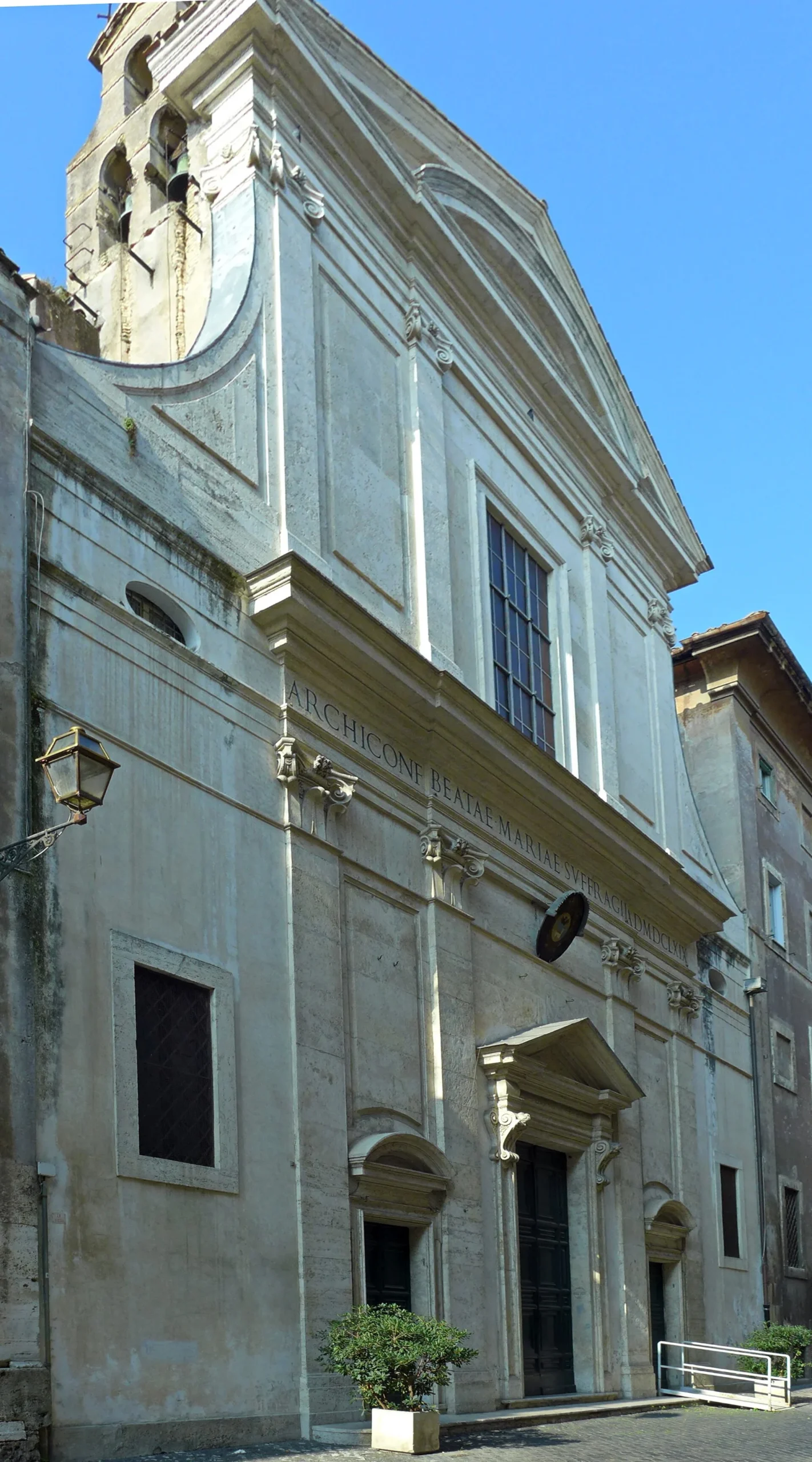
Santa Maria del Suffragio is at Via Giulia 59/a, in the Ponte district, and you can walk in freely, with no ticket and no reservation. The listing published by the Ministry of Tourism portal gives afternoon opening only: from 16:00 to 19:00 Monday through Saturday, from 16:00 to 18:00 on Sunday. It's the church built in the 17th century by the Arciconfraternita del Suffragio, with the travertine facade by Carlo Rainaldi.
The name explains the purpose. Suffrage is the prayer offered for the dead, and the confraternity, founded in 1592, existed to pray and to have Masses celebrated for the souls in Purgatory. It is not the church on Lungotevere Prati with the small museum of fire imprints, which many people confuse with this one. Here there are no relics of the afterlife, there is a high altar dedicated to the souls in Purgatory and the tomb of a 20th-century blessed.
The practical information given here comes from the check of September 29, 2026 on the Italia.it portal, on the Turismo Roma page, on the listing of the National Office for the Pastoral Care of Tourism of the Episcopal Conference and on the Jubilee site. None of these sources publishes a phone number or a Mass schedule, and Turismo Roma itself refers you to direct contact with the church. The hours of Rome's small churches change often: stop by the door first.
Where it is and what you really see
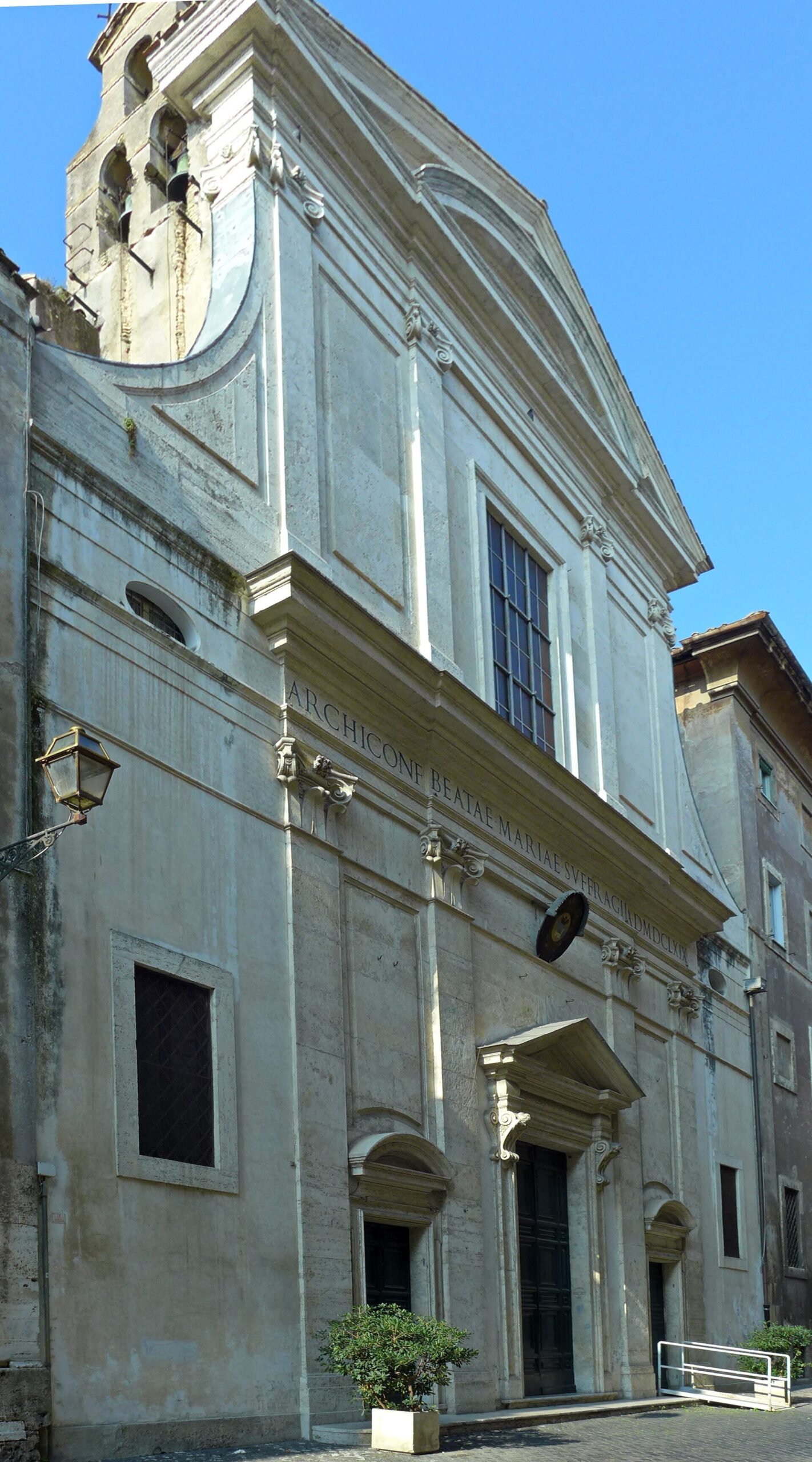
The church occupies the central stretch of Via Giulia, at the corner with Via del Gonfalone, the street that leads to the Oratorio del Gonfalone. We're in the Ponte district, on the side of the street that faces the Tiber. The official street number is 59/a, and the ministry portal points out how the travertine facade stands out from the plainer buildings around it. If you arrive on foot from Ponte Sisto, you see it before you realize it's a church.
From outside you take it all in at once: two superimposed orders, four pilasters per order, three portals below and a large window in the center of the upper level. No bell tower visible from the street, no flight of steps, no space in front to step back. The church is squeezed into the street line like all the buildings on Via Giulia, and that shapes how it has to be looked at. Up close you see the travertine, from far away you hardly see anything.
Inside you find a single-nave hall with side chapels, covered by a barrel vault with lunettes. The first impression is dominated by the 19th-century vault with the Coronation of the Virgin by Cesare Mariani and, at the far end, by the choir frescoed by Giovanni Battista Beinaschi. The Episcopal Conference listing says the building has no Baroque features and looks very simple in structure. It's a harsh judgment but an honest one.
What you don't see: the confraternity's oratory with the two canvases of the cycle of Daniel and of Lazarus, which the sources mention but for which the operator gives no visiting arrangements, the service rooms, the archives. The real route is the nave, the side chapels, the high altar and the two tombs of the priests buried here. Allow 20 minutes if you look at a relaxed pace, 40 if you stop at every altar.
The church is small compared with the big buildings of the area. To the north is the Basilica of San Giovanni dei Fiorentini, to the south the national and confraternity churches that line the street all the way to Ponte Sisto. The Suffragio doesn't compete with any of them on size. It competes on coherence: it's a church born for a single purpose, and that purpose can still be read on the altar.
A curiosity about Santa Maria del Suffragio
The church is built inside a palace that never existed. When Julius II opened the street that bears his name, he entrusted Bramante with the project for a large Palazzo dei Tribunali, meant to concentrate papal justice in a single building. Work started and stopped. In 1607 the confraternity bought a portion of that unfinished area, and half a century later the church rose there.
This gives a different meaning to a walk along the street. The stretch between Via del Gonfalone and the church of San Biagio degli Armeni was meant for a single monumental building, and what you see today is the sum of buildings that divided up a failed project among themselves. At the base of some buildings along the stretch there are still large blocks of rusticated stone that local tradition attributes precisely to Bramante's building site.
The most curious coincidence concerns nearby San Biagio. It's the same church, now Armenian, that the sources call San Biagio della Pagnotta, and the Suffragio confraternity was born there in 1592. When it needed a home of its own it didn't go far: it moved a few dozen meters along the same street. Anyone who leaves the Suffragio and walks north passes the cradle of the confraternity without knowing it.
The name of the nearby church deserves an explanation, even though the sources don't agree on its origins. Local tradition links the pagnotta (the loaf) to the distribution of blessed bread on the saint's feast day, the saint who protects the throat. Specific documents on this custom are not cited in the institutional listings consulted, so take it for what it is: a neighborhood tale, plausible, repeated for centuries.
What suffrage means, and why this is not the church of the museum
In Catholic doctrine, suffrage is the help the living bring to the dead through prayer, Masses and works of charity, so that the souls in Purgatory reach the vision of God sooner. Suffrage confraternities multiplied between the 16th and 17th centuries all over Italy. Their job was to organize this help on a continuous basis, with lists of deceased members and Masses celebrated in turn.
The misunderstanding comes from the name. Rome also has the church of the Sacro Cuore di Gesù in Prati, at Lungotevere Prati 12, known as the little Duomo of Milan for its late 19th-century Gothic. There the official Turismo Roma page places the Museum of the Souls in Purgatory, born after a fire in the Rosary chapel on November 15, 1897. It's a different church, in a different neighborhood, on the other bank.
The Prati collection, founded by the French missionary Victor Jouet, keeps cloths, cassocks and small tablets with alleged fire imprints left by the dead who asked for prayers. If you're looking for those display cases, go to the Piccolo Duomo and Museum of the Souls in Purgatory, not to Via Giulia. There is no object of that kind here, and asking the custodian where the museum is is the quickest way to get a funny look.
Let's put the three levels in order. The documents say that a Roman confraternity of 1592 prayed for the souls in Purgatory and that two popes approved it. Tradition says that this church was for three centuries one of the city's reference points for Masses in suffrage. The legend of the fire imprints belongs to the church in Prati, and even there it should be read as devotion, not as proof.
Something nobody tells you about Santa Maria del Suffragio
The church is not a hurried youthful project by Rainaldi, as you sometimes read. Work began in 1662, the structure was complete in 1669, the interior decoration was finished in 1685. 23 years for a church of this size is a long time, and it tells of a confraternity that paid in installments, with the donations of its members and with the bequest of Marquis Bartolomeo Ruspoli, cited by all the institutional sources.
The bequest of a great name of the Roman nobility says a lot about the kind of confraternity. The Suffragio was not a poor neighborhood association. It gathered people who could afford to leave large sums to secure prayers after death, and the church was also the material guarantee of those prayers. When you look at the chapels with their family patronages, you are looking at suffrage contracts turned into marble and paint.
The second detail nobody points out is the link with a confraternity of Vico Equense. According to the encyclopedia entry and the Episcopal Conference listing, the church is aggregated to the Venerabile Arciconfraternita dell'Assunta e Monte dei Morti of that town on the Sorrento coast. Aggregation was a widespread mechanism: a provincial confraternity tied itself to a Roman one to share its indulgences and its prestige.
Third detail, more technical: the confraternity did not build its identity from scratch. It was born at another church, it obtained recognition from Clement VIII in 1594 and the title of archconfraternity from Paul V in 1620. Only afterward, having grown in numbers, did it give itself an independent home. The path is the same as dozens of Roman associations, and it's the key to understanding why Via Giulia is full of small churches.
A Roman confraternity of the 17th century was an association of laypeople, with statutes approved by the church authority, elected offices, a common fund and a seat. Members paid a fee and committed to taking part in the services and works of the association. In exchange, at death, they received the prayers and Masses of their fellow members. In the case of the Suffragio this was the very reason for the group's existence, not a side benefit.
The church served to guarantee that those Masses were really celebrated, in a place of their own and on a calendar of their own. The family chapels, like those of the Petrosini and the Mazzetti di Pietralata, were the way a well-off family tied its name to an altar and to a cycle of celebrations for its dead. The patronage carried obligations of maintenance and endowment, as well as prestige.
The title of archconfraternity, obtained in 1620, was not a mere honor. It allowed the Roman association to aggregate other confraternities to itself, even distant ones, which shared its indulgences and practices. That's the mechanism that explains the link with Vico Equense. Rome thus became the center of a network of devotion that reached as far as the provinces of the Kingdom of Naples, and the church on Via Giulia was its reference point.
The facade by Carlo Rainaldi
Carlo Rainaldi is the Roman architect the general public knows less than his famous contemporaries. Yet his hand is found in places everyone photographs: the facade of Sant'Andrea della Valle, the church of Santa Maria in Campitelli, the twin churches of Piazza del Popolo, the initial project for Sant'Agnese in Agone later passed to Borromini. The Suffragio is one of his minor works, and for that very reason it's easier to understand.
Here Rainaldi works on a narrow street, with no square in front and with a confraternity budget. The solution is a two-order facade that doesn't look for the theatrical effect of Borromini's curves. The pilasters mark out the surface, the three portals distribute the entrance, the large window brings light to the nave. It's architecture that works edge-on, for someone walking along the street, more than head-on.
To grasp the difference in language, it's worth making a comparison a few minutes' walk away. The church of Gesù e Maria al Corso is another Rainaldi work, with an interior much richer in marbles and family monuments. The Suffragio stays sober because its patrons wanted a place of prayer for the dead, not a portrait gallery. The difference is deliberate.
On the facade, the verdict is clear. Whoever dismisses it as minor looks at it by the standard of Borromini and his theater of curved lines, but a facade on Via Giulia has to be measured against the street. Rainaldi understood that the street is walked at an angle and designed a front that holds up to an oblique gaze. Few architects of his time had the same discipline.
My advice for visiting Santa Maria del Suffragio
Come between 16:00 and 17:00 on a weekday, that is, in the first hour of the published opening. At that hour Via Giulia is almost empty, the sun has turned and hits the facade at a slant, and inside the church the light from the large window lights up Mariani's vault without any need for spotlights. Later, especially in autumn and winter, the interior gets dark and you see little.
Don't come in the morning hoping to find it open. The institutional sources publish only the afternoon slot, and whoever arrives at 10 finds the door closed. It's the most common mistake of people who build an itinerary on Via Giulia starting from the hours of the big basilicas. If you want to see more churches on the street in the same day, do the ones that open early in the morning and leave the Suffragio for the afternoon.
Bring a flashlight or your phone with the light on, and use it discreetly. The side chapels are deep and poorly lit, and some details, like the 12 wooden reliquaries of the Chapel of the Crucifix, can only be read up close. Avoid the light during services, and if someone is praying in front of a chapel, wait. This remains a church for people who pray for their dead.
Read the church starting from the high altar, not from the entrance. The meaning of the whole building is in the altarpiece of the souls in Purgatory by Giuseppe Ghezzi, which the ministry listing dates to 1672. Once you've understood that painting, the side chapels become variations on the same theme: death, intercession, consolation. Starting from the door shows you a sequence of disconnected altars.
Last tip, which holds for all the small churches of the center. Leave an offering in the box if you stay a long time. Entry is free, no ticket is required, but the electric light, the cleaning and the afternoon custody cost money, and the operator doesn't publish other forms of support. A euro or two won't change your day and they keep the door open.
How to get in: hours, entry and Masses
Entry is free of charge, there is no ticket and you don't book. According to the listing on the Italia.it portal the church opens from 16:00 to 19:00 Monday through Saturday and from 16:00 to 18:00 on Sunday. The Turismo Roma page publishes no hours and refers you to direct contact with the church for Masses and visiting conditions.
The Mass schedule is not published on any of the institutional pages consulted. The operator gives no website of its own, no phone number or email address. For anyone who wants to attend a celebration, the surest way is to stop by during opening hours and read the notices posted on the door or ask whoever looks after the church. The same goes for baptisms, weddings and Masses in suffrage on request.
During the 2025 Jubilee the church was included in the list of jubilee churches of the official route, and the Jubilee site still makes available a downloadable information booklet in Italian. Anyone arriving with a group of pilgrims will find it useful for the historical part. It contains no up-to-date hours, so it doesn't replace checking on the spot.
There are no paid guided tours published, no products for sale on ticketing platforms, and nobody can sell you priority access. If you find a Via Giulia tour that includes the Suffragio, you're paying for the guide, not for the entry. For an organized group the common-sense rule applies: give advance notice by showing up during opening hours and don't walk in 30 strong during a Mass.
Another well-known fact, yet rarely cited
Buried in the Suffragio is Blessed Luigi Novarese, a priest from Piedmont who died in 1984 and was beatified on May 11, 2013. Novarese founded the Centro Volontari della Sofferenza, an association that overturned the way of thinking about the sick inside the Church: no longer only an object of care, but an active part of religious life. The ministry portal and the Episcopal Conference listing both cite his tomb as the church's main point of reference today.
Beside him rests Monsignor Alfonso Carinci, who was secretary of the Congregation of Rites, the curia office that in his time also followed the causes of beatification. Two 20th-century priests buried in a 17th-century church dedicated to the souls of the dead: the coherence with the building's original vocation is no accident, and anyone who comes on a group visit with sick people or volunteers feels it immediately.
For those who know Novarese's work, the Suffragio is first of all his church, more than Rainaldi's church. On the days linked to his memory you're likely to find groups in prayer. If you happen to come on one of those days, you find the church full and the atmosphere of a shrine more than of a monument. Accept it, and come back another afternoon to look at the paintings.
The other well-known and rarely cited fact concerns confession. In the third chapel on the left is kept the confessional where, according to the encyclopedia entry and the Episcopal Conference listing, Saint Vincent Pallotti heard confessions, the 19th-century Roman priest who founded the Pallottines. A dark wooden piece of furniture, nothing spectacular. For Roman believers it's one of the most important objects in the church.
The interior, chapel by chapel
The vault of the nave carries the Coronation of the Virgin painted by Cesare Mariani as part of the 1868 works, when the architect Tito Armellini worked on the building. It's a 19th-century painting inside a 17th-century church, and it shows: colder colors, a more academic drawing. It's not a flaw, it's the history of the building. Roman churches are layers, and whoever looks for an intact 17th century here ends up disappointed.
The choir is the most successful part. Giovanni Battista Beinaschi, a Piedmontese painter active between Rome and Naples, frescoed the Eternal Father in glory and the Assumption, and the ministry portal places a Glory of the Virgin in the apse vault around 1675. Below is Giuseppe Ghezzi's altarpiece of 1672 with the souls in Purgatory. Look at the two things together: below, the souls waiting, above, the glory that awaits them.
On the right side, the second chapel was designed by Rainaldi and is dedicated to Santa Maria Consolatrice degli Afflitti, with the historic patronage of the Petrosini family. The third right chapel keeps two paintings by Giuseppe Bartolomeo Chiari, the Birth of Mary and the Adoration of the Magi, according to the English encyclopedia entry. Chiari was a pupil of Carlo Maratta, and his soft painting is recognizable from far away.
The third chapel on the left is the Chapel of the Crucifix, patronage of the Mazzetti di Pietralata. The large wooden crucifix is 18th-century, by an undocumented author, and is surrounded by 12 wooden reliquaries. The vault is frescoed with episodes of the Passion. Here the sources don't agree on the attribution of the original paintings: some give them to Giovanni Lanfranco, but the painter died in 1647, before the church existed.
The Italian encyclopedia entry adds that the paintings once attributed to Lanfranco are said to be kept today at the Vicariate of Rome, and that in their place the family had its own marble funerary monuments put. If the report is correct, these are canvases brought from another location, not frescoes made for the chapel. Ask the custodian, but don't expect a definitive answer.
The right photo to take at Santa Maria del Suffragio
You take the photo from outside, at an angle. Stand on the opposite side of Via Giulia about 20 meters farther south, toward Ponte Sisto, and shoot the facade diagonally, letting the vanishing line of the street come in. It's the framing Rainaldi designed the front for: the pilasters pick up shadow and relief, the large window stands out, the street gives depth. The head-on photo, with the street so narrow, doesn't work.
The right light is early afternoon, when the sun runs down the axis of the street and the travertine turns warm. On gray days the facade flattens into the color of the neighboring houses and loses everything. In vertical it works better than in horizontal, because the height of the two orders is the thing to show, and because in horizontal you only get parked cars and dumpsters.
Inside, the best image is the nave from the entrance toward the choir, with Mariani's vault at the top and Ghezzi's altarpiece at the far end. Keep the phone low, at chest height, so you don't distort the lines of the vault. No flash, which flattens the frescoes and bothers people who are praying. If a service is going on, don't take photos and come back later.
A note on respect. Novarese's tomb is a place of prayer for sick people and the people who accompany them. Don't photograph people in front of the tomb and don't take selfies with the sepulcher behind you. If you want a memento, photograph the slab when the space is free. The same respect applies that you would ask for in front of the tomb of one of your own relatives.
How to get there
On foot is the best way, and Via Giulia should be walked in full. From Campo de' Fiori you cross Piazza Farnese, go down toward the river and walk back up the street to the north as far as number 59/a. From Castel Sant'Angelo you cross Ponte Sant'Angelo and enter the street from the San Giovanni dei Fiorentini side, then continue south.
From Trastevere you cross Ponte Sisto and take Via Giulia from the bottom, from the Palazzo Farnese side. It's the route I recommend most, because it lets you meet the street in its least busy stretch and brings you to the church after the oldest confraternity buildings. Allow a quarter of an hour of easy walking from the bridge, stopping to look.
By public transportation there is no stop in front of the church. The surface lines run on Corso Vittorio Emanuele and on the Lungotevere, a few minutes' walk away. Routes often change because of works and detours, so it's best to check the route on Rome's official mobility information service before leaving. The metro doesn't serve this part of the historic center.
By car, forget it. Via Giulia is inside the limited traffic zone of the historic center, the street parking is for residents and there are checks. Whoever comes from outside Rome is better off leaving the car in a park-and-ride near a metro station and walking in for the last stretch. A taxi makes sense only for people who have difficulty walking.
Some important events that happened here in history
In the early 16th century Julius II opens the straight street that bears his name and entrusts Bramante with the Palazzo dei Tribunali. The project wanted to concentrate the papal courts along the river, in a neighborhood of Florentine bankers and merchants. Work stops. The open area remains, the street remains, and for a century the city fills the gaps with churches, palaces and confraternity seats.
In 1592 the Suffragio confraternity is born at San Biagio della Pagnotta, with the aim of praying for the dead. In 1594 Clement VIII approves it, in 1620 Paul V raises it to archconfraternity. In the meantime, in 1607, the association buys the portion of the Tribunali area on which the church will rise. Between purchase and construction more than 50 years pass, a normal span for a confraternity's finances.
In 1662 the confraternity entrusts the project to Carlo Rainaldi. In 1669 the building is complete, in 1672 Giuseppe Ghezzi delivers the altarpiece of the high altar with the souls in Purgatory, around 1675 Beinaschi works in the choir, and in 1685 the interior decoration is closed. In a little over 20 years the church takes the form that, in its main lines, we still see.
In 1868, two years before the end of the temporal power of the popes, the building is reworked by the architect Tito Armellini and Cesare Mariani paints the Coronation of the Virgin on the vault. It's one of the last papal interventions on the churches of the street. After 1870, with the construction of the Tiber embankment walls, Via Giulia changes its relationship with the river, and the churches that previously had gardens toward the water find themselves facing the Lungotevere.
In the 20th century the church receives the burial of Monsignor Alfonso Carinci and then that of Luigi Novarese, who died in 1984. On May 11, 2013 Novarese is proclaimed blessed, and the Suffragio becomes a pilgrimage destination. In 2025 the church appears in the list of jubilee churches of the official Jubilee route, with a dedicated information booklet published on the Holy See's website.
Who passed through Santa Maria del Suffragio
Carlo Rainaldi, first of all. A Roman architect, son of an architect, he worked for half a century in the same streets where Bernini and Borromini worked, and had the bad luck of always being compared with them. The Suffragio is one of the sites where he worked alone, without the weight of a more celebrated colleague. If you want to understand his language without interference, this facade is a good start.
Marquis Bartolomeo Ruspoli, the benefactor whose bequest made the construction possible. The institutional sources all cite him, and his presence links the church to one of the families that marked the Rome of the 17th and 18th centuries. Of his personal relationship with the confraternity no published details are known. The fact remains: without that money, the church would have arrived much later.
Saint Vincent Pallotti, who according to the tradition reported by the sources heard confessions here, in the confessional kept in the Chapel of the Crucifix. Pallotti was one of the most present figures in the religious life of 19th-century Rome, with particular attention to the poor and the artisans of the districts near the river. His passage links the Suffragio to popular devotion more than to art history.
Blessed Luigi Novarese, who rests here. Born in Piedmont, a boy who survived a long illness, a priest in Rome, founder of the Centro Volontari della Sofferenza and of the Silenziosi Operai della Croce. His choice to put the sick person at the center of pastoral action anticipated many later reflections. His tomb brings to the church an audience that no tourist guide foresees.
Then there are the confraternity members, anonymous to almost all of us. For three centuries merchants, artisans, nobles and clerics of the area enrolled in the Suffragio to secure prayers after death and to pray in turn for others. Their lists, the registers of Masses and the spending decisions are the real engine of the church. They are the ones who chose Rainaldi, Ghezzi and Beinaschi.
The street around the church
Via Giulia is one of the most successful straight streets of Renaissance Rome, and the Suffragio has to be read inside the street, not in isolation. In the stretch around the church, noble palaces, confraternity seats and public buildings alternate, with no shops or display windows. It's a street that formed through successive additions on a project left half done, and this explains why the facades have such different heights, materials and styles.
On the same street, a short distance away, you come to the large building of the Carceri Nuove, commissioned by Innocent X in the mid-17th century as a model prison. The presence of a prison a few meters from a church dedicated to the souls of the dead is not a narrative coincidence to force, but it says something about the street: the papal justice that Julius II wanted to gather here ended up arriving, in another form.
Toward the south the street leads to Palazzo Farnese, to the arch that spans the roadway and to the Mascherone fountain, as far as Ponte Sisto. It's the most photographed stretch. Whoever arrives from that side sees the Suffragio as one stop among many, and often walks straight past because the door is closed in the morning. The advice is to reverse the route: the south stretch in the morning, the central stretch with the open church in the afternoon.
A practical warning about traffic. Via Giulia is not pedestrian, even if it seems so. Residents' cars, service vans, scooters and bicycles go by, and the sidewalks are narrow or missing in several places. With children or with a large group it's best to walk in single file on one side and not stop in the middle of the roadway for photos. The facade of the Suffragio can be seen well from the opposite side too, under cover.
Two churches of the dead on the same street
Via Giulia has two churches dedicated to the dead a few hundred meters from each other. Toward Palazzo Farnese is Santa Maria dell'Orazione e Morte, seat of the confraternity that collected and buried the dead abandoned in the countryside and in the river. Here is the Suffragio, which prayed for the souls. They are two different answers to the same problem: the first took care of the bodies, the second of the souls.
Here, instead, is the contrarian position. The Orazione e Morte takes all the visitors' attention for its facade with skulls and for the story of the underground cemetery, and it's visited as a macabre stop. It's a wrong reading, which reduces to a curiosity a story of concrete charity. The Suffragio, without skulls and without effects, tells better what 17th-century Rome thought about death.
The reason is simple. A suffrage confraternity organizes the relationship between the living and the dead as a mutual and continuous obligation, to be honored every day, and the church is the machine of that relationship. You don't need exposed bones to understand it, the Ghezzi altarpiece with the souls waiting is enough. If you want theatrical macabre, you have the Capuchin crypt, which at least says so openly.
Do both in the same afternoon, in the right order. First the Orazione e Morte, for the bodies, then the Suffragio, for the souls. Add, if you have time, the Capuchin church on Via Veneto and the Verano Cemetery for the 19th-century relationship with death. It's a thematic itinerary that few people do and that explains Rome better than many Baroque routes.
When it's closed and what not to expect
The church is closed all morning, according to the only time slot published by the ministry portal. No summer, holiday or restoration closures are published, and for days like Christmas, Easter or November 2 the operator gives no variations. November 2, the day of the commemoration of the dead, is however the date when a suffrage church makes the most sense: whoever wants to go on that day should check beforehand.
Don't expect services. There is no ticket office, no audio guides, no explanatory panels in several languages, no bookshop. Restrooms are not provided for visitors. The church is a place of worship open to the public, not a museum, and its staff are there for custody. The whole reading of the building comes from you, from a guide you bring with you or from a good book.
On accessibility the operator publishes no information. The entrance from the street has to be checked on the spot by people who use a wheelchair, and the Turismo Roma listing refers to the Roma Accessibile section of the same portal. The operator indicates no dedicated routes. For the side chapels, with their altar steps, it's best to ask the custodian at the time of the visit.
If you find the door closed during opening hours, don't insist and don't knock. In churches entrusted to few custodians it happens that opening is skipped because of illness, a private service or an unforeseen event, and nobody announces it online. Come back another afternoon or continue toward the other churches of the street. It's the price of a place that lives on volunteering and offerings, not on tickets.
Eating in the area
Via Giulia is a street of palaces and churches, with little dining. The area for real eating is between Campo de' Fiori, Via dei Banchi Vecchi and the streets toward Piazza Navona, and there the difference between a serious place and a trap shows, if you know where to look. Being in the historic center is no guarantee. On the contrary, it raises the percentage of places designed for people passing through once.
First sign: the menu with photos of the dishes, maybe in five languages and laminated. A place that has to show you the picture of the cacio e pepe is cooking for people who have never eaten it. Second sign: the lady rolling fresh pasta in the window or on the sidewalk. It's theater. Well-made pasta is prepared in the kitchen in the morning, away from the dust and the eyes of passersby.
Third sign: the barker at the door, the one who stops you with the menu in hand. A restaurant that has to get its customers from the street has no regular customers, and regular customers are the only guarantee there is. Fourth: the kitchen open without a break from 11:00 to midnight. A real kitchen crew stops between lunch and dinner to rest and prepare, and that pause shows in the dish.
Fifth sign, typical of monumental squares: the price that adapts to the customer. Items with no price on the menu, fish by weight without saying how much it costs per 100 grams, different price lists between the indoor room and the outside tables. Always ask the price before ordering. Romans don't frequent these places, and not out of snobbery: they simply know the bill doesn't match what arrives on the plate.
The criterion stays the same: look at who is sitting there and in what language they order, at two in the afternoon on a weekday. If there are office workers, artisans and families from the district, you're in the right place. So you don't have to go by trial and error, I keep updated our list of the places where we eat, with no sponsorships, which changes when the places change.
What to combine in a day
The natural combination is the whole of Via Giulia, from bottom to top. Start from Santissima Trinità dei Pellegrini and from San Paolo alla Regola, cross toward Galleria Spada, then enter the street and touch Sant'Eligio degli Orefici, Santo Spirito dei Napoletani and the Suffragio. Finish at San Giovanni dei Fiorentini, at the north end of the street.
On the side of Via di Monserrato, parallel to Via Giulia, are Santa Maria in Monserrato, the Spanish national church, and San Girolamo della Carità with the Spada chapel. In Piazza Farnese is Santa Brigida. They are all small churches with irregular hours: plan the day knowing you won't find them all open together, and give priority to the ones with the narrowest time slot.
Toward the north, beyond San Giovanni dei Fiorentini, the route continues into the Banchi area with Santi Celso e Giuliano, closed for restoration at the time of the check, and then toward Santa Maria della Pace, Piazza Navona and the Chiesa Nuova with the Oratorio dei Filippini. Whoever prefers civic art finds the Palazzo della Cancelleria and the Museo Barracco on the Corso.
If you want to cross the river you have two good exits. From Ponte Sisto you enter Trastevere and climb toward the Villa Farnesina and the Janiculum, for the sunset. For a tour of the Baroque churches of the big names, the Baroque Rome itinerary puts the Suffragio in perspective and shows how much Rainaldi weighed in the city of his time.
Frequently asked questions
How much does it cost to enter Santa Maria del Suffragio?
Entry to Santa Maria del Suffragio is free of charge, with no ticket and no reservation. You go in during the opening hours published by the Ministry of Tourism portal, that is, from 16:00 to 19:00 Monday through Saturday and from 16:00 to 18:00 on Sunday. An offering in the box is welcome but not required. There are no official paid guided tours.
Where exactly is the church?
The church is at Via Giulia 59/a, in the Ponte district, at the corner with Via del Gonfalone. You reach it on foot in a few minutes from Campo de' Fiori, from Ponte Sisto or from Castel Sant'Angelo. It has no bus stop in front and the street is in the limited traffic zone of the historic center, so a car is not a good idea.
Is it the church of the Museum of the Souls in Purgatory?
No. The Museum of the Souls in Purgatory is in the church of the Sacro Cuore di Gesù in Prati, at Lungotevere Prati 12, on the other side of the Tiber. The church on Via Giulia carries the name of suffrage for the souls because it was built by an archconfraternity dedicated to that prayer, but it keeps no collection of objects tied to the afterlife.
Who designed Santa Maria del Suffragio?
The design is by Carlo Rainaldi, who received it from the archconfraternity in 1662. The structure was complete in 1669 and the interior decoration was finished in 1685. In 1868 the architect Tito Armellini worked on the building and Cesare Mariani painted the vault with the Coronation of the Virgin. The two-order travertine facade has stayed Rainaldi's.
Who is buried in the church?
In the church rests Blessed Luigi Novarese, a priest and founder of the Centro Volontari della Sofferenza, who died in 1984 and was beatified on May 11, 2013. Next to his tomb is that of Monsignor Alfonso Carinci, who was secretary of the Congregation of Rites. Novarese's tomb is a place of prayer for the sick, volunteers and their companions.
What time are the Masses?
The Mass schedule is not published on the institutional pages consulted, and Turismo Roma refers you to direct contact with the church. The operator gives no phone number or email address. The most reliable way is to stop by during the afternoon opening, read the notices posted on the door and ask whoever looks after the church about the week's celebrations.
What works of art are inside?
The main ones are the high altar altarpiece with the souls in Purgatory by Giuseppe Ghezzi, from 1672, the choir frescoes by Giovanni Battista Beinaschi, the vault by Cesare Mariani, the paintings by Giuseppe Bartolomeo Chiari in the third right chapel and the 18th-century wooden crucifix with 12 reliquaries in the Chapel of the Crucifix, where the confessional of Saint Vincent Pallotti is also kept.
How much time does the visit take?
For the nave, the side chapels, the high altar and the tombs, 20 minutes at an easy pace is enough, 40 if you want to read every painting. It's best to fit it into a walk along the whole of Via Giulia, which with the other churches and palaces of the street fills an afternoon nicely, bearing in mind that the Suffragio opens only from 16:00.
Can you visit with an organized group?
Yes, entry is free for groups too, but no source publishes a booking procedure or a maximum number of people. It's best to show up during opening hours, avoid services, speak in a low voice and not stop in front of Novarese's tomb if people are praying. Do the longer explanation outside, in the street, before going in.
Who wrote this page
The page comes from the editorial team of Tour Leader Pro, the Rome-based company that designs itineraries, tours and cultural events across Rome and Lazio. The hours and access arrangements reported here come from the official sources referred to in the text on the date given at the start. The small churches of the center change hours without notice: check again on the spot and tell us what you find changed.
Lining up a walk along Via Giulia means fitting together churches that open only in the morning with others that open only in the afternoon, confraternities that publish no contact details, services that close the chapels and groups that can't enter during Masses. Whoever faces this kind of puzzle, for themselves or for a group of 40 people, will find on Tour Leader Pro working materials designed for those who accompany groups.
For the big picture, that is regional trains and seasonal schedules, airports, transfers between one city and another and Italian destinations outside the center of Rome, from the Castelli to the volcanic lakes of the north to the Tyrrhenian coast and the villages of the interior, a useful resource for putting together a multi-day itinerary is Italy Planner.