Santo Spirito dei Napoletani
In short. Santo Spirito dei Napoletani is at Via Giulia 34, in the Regola district, and it opens mainly for services: the national tourism portal lists opening Monday to Saturday between 18:30 and 19:30 and on Sunday between 11:00 and 12:00.
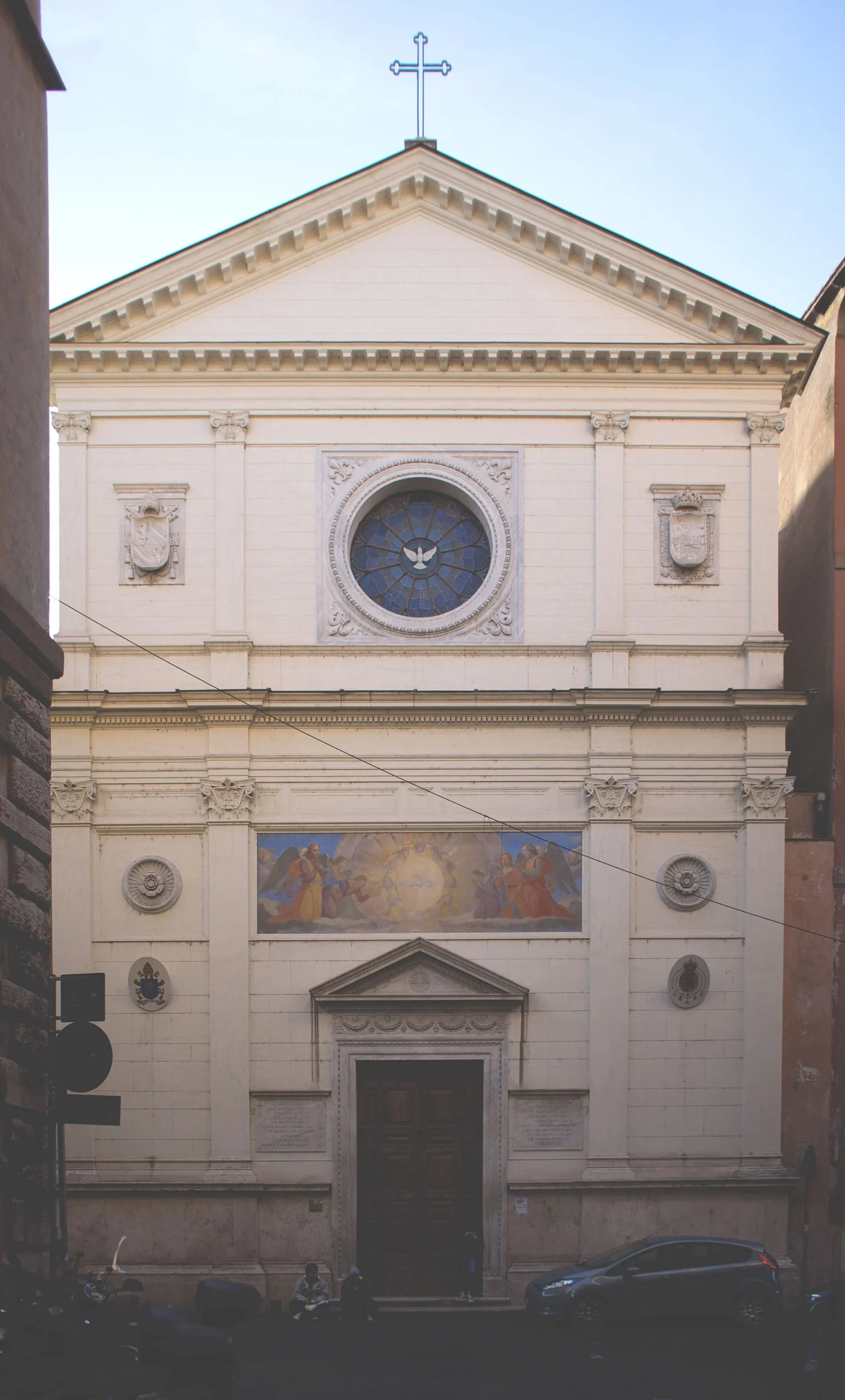
Santo Spirito dei Napoletani is at Via Giulia 34, in the Regola district, and it opens mainly for services: the national tourism portal lists opening Monday to Saturday between 18:30 and 19:30 and on Sunday between 11:00 and 12:00. Entry is free, there is no ticket. The church is a rectoral church (rettoria) entrusted to the Rome Section of the Equestrian Order of the Holy Sepulchre of Jerusalem, and the phone number published by Roma Capitale is 06 69886217.
For almost three centuries it was the national church of the Neapolitans in Rome, then of the Kingdom of the Two Sicilies, and for 50 years it held the remains of the last king of Naples, the queen and their daughter. Inside there is a Luca Giordano, a funerary monument sculpted by Domenico Guidi, a 15th-century fresco from the circle of Antoniazzo Romano. And there is the memory of a rector who became a saint, Vincenzo Pallotti, who worked here for 12 years.
The practical information corresponds to the check of September 28, 2026 on the Roma Capitale tourism portal, on the national portal Italia.it, on the Episcopal Conference pages devoted to Jubilee churches and on the other sources cited in the text. The hours of a rettoria change with the seasons, with holidays and with the availability of the priests: before crossing Rome just to see it, phone and ask what time the door will really be open.
Where It Is and What You Actually See
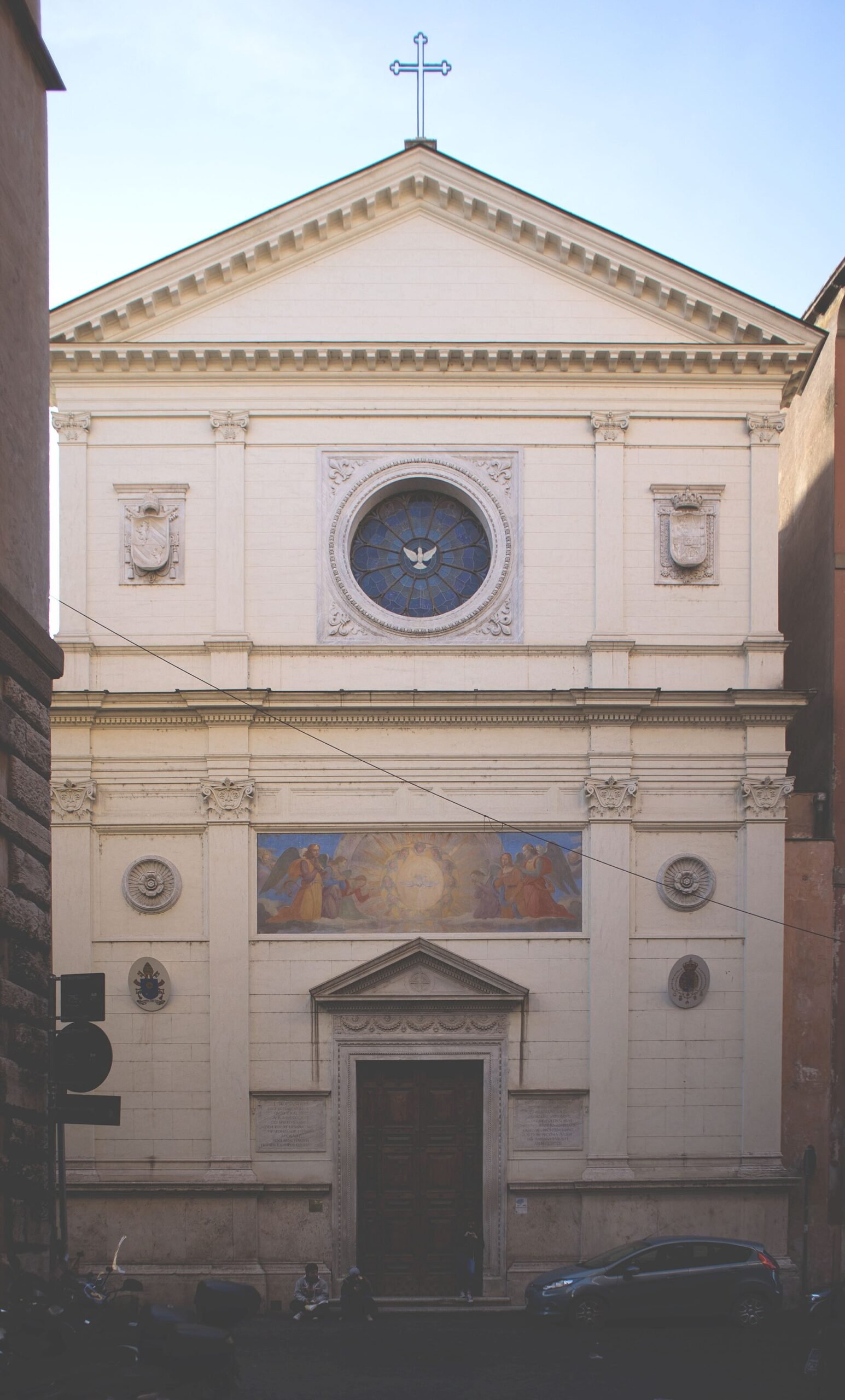
The church is in the southern stretch of Via Giulia, a few meters from Sant’Eligio degli Orefici, with its back facing the Tiber. The front is narrow within the street wall and can’t be seen from afar. If you start from the Farnese Arch and head north, you meet it almost by surprise, just before the Carceri Nuove, after leaving Ponte Sisto and Piazza Farnese behind you.
The facade you see is 19th century. Antonio Cipolla rebuilt it around 1853 in neo-Renaissance forms, with portal and rose window, and in the same project redid the choir loft and the apse. If you expect the Baroque of Via Giulia you’ll be thrown off: the front is clean, drawn, almost schoolbook. It’s the language of the Kingdom of the Two Sicilies in its last years, which in Rome wanted to present itself as orderly and respectable, not theatrical.
Inside the layout is that of the Counter-Reformation: a single nave, shallow side chapels, the high altar under a small dome. The dimensions are modest and in five minutes you have the whole. The good part comes when you stop at the individual chapels, because each altar tells a piece of Neapolitan history: San Gennaro, Saint Francis of Paola, Saint Thomas Aquinas, all saints of the Kingdom, set side by side like an identity card.
On the inner facade wall is the organ built by Pietro Pantanella in 1881, with 847 pipes and 25 stops according to the church’s encyclopedia entry. In the nave there is a large contemporary crucifix by Antonio Nocera, placed in 2005, and the stained glass is modern. It’s not a church frozen in a single era. It’s a building that has changed skin three times in four centuries, and the seams show.
How to Get In: Hours, Masses and Contacts
Entry is free and there is no ticket, neither official nor resold. The church is not a museum and has no tourist visiting hours separate from those of the services. The Italia.it portal lists opening Monday to Saturday from 18:30 to 19:30 and on Sunday from 11:00 to 12:00. In practice you go in shortly before Mass and stay until the rector or the sacristan closes.
On the Sunday time the sources disagree. The apps that collect Mass times report the holiday service at 10:30 and the weekday ones at 18:30, while the national portal speaks of opening from 11:00. The rettoria’s official information is not published on any page that can be consulted, and the church’s website did not respond on the days of the check. The safe channel remains the phone number given by Roma Capitale, 06 69886217.
Masses are celebrated in the Roman rite and in Italian. If you are looking for Mass in the old form in the area you need to go to Santissima Trinità dei Pellegrini, a five-minute walk away, which is Rome’s personal parish devoted to that rite. Here there is no published calendar of Latin celebrations, and whoever says otherwise often confuses the two churches, which are a few hundred meters apart.
The rector named in the accounts of the San Gennaro celebrations of 2018 and 2023 is Monsignor Maurizio Piscolla, with Monsignor Adriano Frugoni as vice rector. For group visits, for photos of the interior with equipment or to find out if a chapel is accessible, the contact has to be asked for by phone. An official email address for the rettoria does not appear to be published in the institutional sources consulted.
A Curiosity About Santo Spirito dei Napoletani
The name changes depending on who writes it. The city portal and the Episcopal Conference say Santo Spirito dei Napoletani, the encyclopedia and the national portal say Spirito Santo dei Napoletani, the accounts of the chivalric orders add Real Chiesa. The dedication is the same, the word order changes. The practical result is that if you search your phone for only one of the two forms you lose half the available information.
There is also the opposite risk. In Rome there is Santo Spirito in Sassia, the hospital church in Borgo, a kilometer and a half as the crow flies, on the other side of the river. Two churches of the Holy Spirit, two different districts, two different stories. More than one cab driver will take you to Sassia if you say only Santo Spirito, and the navigator does the same.
Before the Neapolitans there was a small church here dedicated to Saint Aurea, the martyr of Ostia, with a small women’s monastery attached, and in the 14th century the dedication widened to Saint Eusterio. In 1572 the building was in very bad condition and was entrusted to the confraternity of the Neapolitans, who tore it down and built from scratch. Of the old sanctuary nothing visible remains, except the memory in old guidebooks.
One last oddity concerns the classification. International ecclesiastical directories today list the church as a rettoria and as the regional church of Campania, that is, as a reference point for people from Campania in Rome, no longer for a Kingdom. It’s a silent demotion: from the church of a nation with ambassadors and kings to the church of an Italian region. No plaque says so, but the difference tells a century and a half of history.
One Thing Nobody Tells You About Santo Spirito dei Napoletani
The church was closed for about 30 years in the 20th century, and on the dates the sources disagree. One account speaks of closure from 1934 to 1986, another of 30 years of closure before reopening for worship at Christmas 1986, due to water infiltration. The first version has an evident problem: from 1934 itself the church receives the remains of the Bourbons. A church closed to worship that serves as a royal tomb is possible, but it has to be explained.
The most coherent reconstruction is this. The remains arrive in 1934, the church is used less and less, the damp from the Tiber and the infiltration from the roof do the rest, and from the 1950s the door stays shut. In 1980 Monsignor Natalino Zagotto is named rector, and starts the structural consolidation with the architect Giuseppe D’Emilio. In 1984 the sovereigns leave for Naples, in 1986 the church reopens. A two-year gap that says a lot.
The most interesting detail is another. The church you see today is in good condition also thanks to private funding: the 2018 accounts cite the Fondazione Terzo Pilastro Internazionale among those who supported the recent restorations. It’s a frequent situation for Rome’s national churches, which have lost the State they referred to and live off benefactors, chivalric orders and confraternities. When the support ends, the door closes.
The current management also tells this passage. The church, born for a confraternity of Neapolitan laymen, is today entrusted to a pontifical chivalric order based in Rome, and the link with Naples passes mostly through the September celebrations and the dynastic orders of the House of Bourbon. It’s not a judgment, it’s an observation: the church survives because someone looks after it, and it is no longer the community that built it.
Inside the Church, Chapel by Chapel
The most important piece is the Martyrdom of San Gennaro by Luca Giordano, the fastest Neapolitan painter of his century, nicknamed Fa Presto. The canvas is in one of the side chapels, which the sources place differently, and it brings the patron saint of Naples to Via Giulia. It’s not the best Giordano you’ll see in your life, but it is the only reason many art historians cross this threshold.
Then there is the funerary monument of Cardinal Giovanni Battista De Luca, sculpted by Domenico Guidi in 1683. De Luca was a jurist born in Venosa, therefore a subject of the Kingdom, author of a work on law that the courts used for generations. Guidi works in the wake of Bernini and it shows: a lively bust, agitated drapery, a taste for gesture that in so sober a church strikes you immediately.
In the second chapel on the left is preserved a detached fresco of the Madonna and Child, from the 15th century, attributed to the workshop of Antoniazzo Romano and indicated by some sources as the Madonna del fulmine. The origin of that name is not explained in the sources consulted. It is the oldest object in the church and probably the only one to survive the demolition of 1572, although on this point no published document exists.
The tour is completed by the Miracle of Saint Francis of Paola by Bonaventura Lamberti, the Miracle of Saint Thomas Aquinas by Domenico Maria Muratori and, at the high altar, the Holy Trinity among Angels and Saints by Giuseppe Passeri, from the early 18th century. People often speak also of Corrado Giaquinto and Sebastiano Conca, painters tied to the Neapolitan world, but in the institutional entries consulted their names do not appear, and so it’s better not to put them in a list.
A note on the light. The chapels are dark and the canvases are dark, as almost always in Roman churches that have no coin-operated lighting. In winter evening openings the Giordano is hard to read, because outside it’s already night and the interior lighting is designed for the liturgy, not for painting. If you really care about the canvas, Sunday morning is the only time when natural light helps.
The decoration devoted to the Holy Spirit in glory, tied to the 19th-century project, bears the name of Pietro Gagliardi, a Roman painter who worked in many of the city’s churches in the mid-19th century. It is correct, somewhat cold painting, very far from Giordano’s energy. Set beside the Baroque canvases, it makes clear how much taste had changed between 1700 and 1850, and how much the Kingdom wanted to look sober.
My Advice for Visiting Santo Spirito dei Napoletani
Go on September 19 or the nearest Sunday. It’s the feast of San Gennaro, and for some years the church has celebrated it with a solemn Mass, the veneration of a relic of the saint donated by the abbot of the Cappella del Tesoro of the Naples Cathedral and the presence of the chivalric orders tied to the House of Bourbon. It’s the only day of the year when the church becomes truly Neapolitan again, with people and not only paintings.
On other days, arrive 10 minutes before the evening Mass and stay at the back. Going in once the celebration has started to look at the chapels is a discourtesy that Romans notice, and that in a small church is noticed even more. If you don’t want to attend Mass, wait for the end: often the priest or whoever closes is willing to give you a few minutes for the Giordano and for the De Luca monument.
Don’t plan the visit as a single stop. Santo Spirito dei Napoletani makes sense inside a walk along Via Giulia, which is a street of national churches and confraternities: the Florentines at one end, the Neapolitans and the goldsmiths in the middle, the Sienese and the Armenians along the way. 10 minutes here, 10 at Santa Maria dell’Orazione e Morte, then onward. The sense is in the sequence, not in the single door.
One last thing: the phone first of all. A rettoria doesn’t have a secretariat that answers at all hours, and if you find it busy or no one answers, try at a time close to the celebrations. Ask three precise things: what time the door opens, if there are private celebrations or weddings that day, if any work is under way that closes a chapel. Three questions, a one-minute call, a visit saved.
If you travel with a group, give notice beforehand. A small church with 30 people inside during a weekday Mass of 20 worshippers becomes a nuisance for everyone, and the rector has every right to ask you to wait outside. With a call in advance, instead, it often happens that someone makes themselves available to explain the Giordano or the history of the Bourbons in a few minutes after the celebration.
Another Well-Known Fact, Yet Rarely Cited
The Neapolitans in Rome were not few and were not poor. In the 16th century the Kingdom of Naples was the largest state on the peninsula, tied to the Spanish crown, and its Roman nation counted merchants, bankers, curia lawyers, prelates. The confraternity born in 1572 served them, but also the pilgrims who came up from the South toward the tombs of the apostles and the basilicas, and who often arrived without means.
That is why the church is right here. Via Giulia, opened by Julius II in the early 16th century, was the street of the nations and the confraternities, close to the river port and the banks. The Florentines had taken the head of the street with their basilica, the Spanish were two blocks away in Santa Maria in Monserrato. The Neapolitans settled in the middle, between the two great rivals of Italian politics of the time.
The second little-cited fact is the closeness to Palazzo Farnese. The palace passed by inheritance to the Bourbons of Naples, through Elisabeth Farnese, and after 1861 it was the Roman residence of Francis II in exile. The deposed Neapolitan court lived 300 meters from this church. For almost 10 years the nation’s church had a king without a kingdom a few steps away, and in 1870 his baby daughter was buried here.
The Neapolitan Nation in Rome
In the Rome of the popes the word nation did not mean a State in the modern sense, but a community of people with the same origin, a language or dialect, a common sovereign and interests to defend. Each nation organized itself around a confraternity and a church. The confraternity collected dues, assisted sick or struggling compatriots, paid for funerals and held the feasts of the patron saint.
For the Neapolitans, according to the national tourism portal, the main task was to offer support to the pilgrims who came from the regions of the South to pray at the tombs of the martyrs and in the basilicas. The journey from Naples to Rome, in the 16th century, lasted days, and whoever arrived tired and without money found in Via Giulia someone who spoke their language. This practical function explains the choice of a street close to the river and the ports.
The confraternity grew into an archconfraternity, that is, the head of other linked associations, and the church became the Kingdom’s official reference point. After the Unification of Italy that role empties out: the Kingdom no longer exists, the Neapolitan nation in Rome blends into the Italian one, and the church loses its political reason. What remains is devotion, the feasts, and a building to maintain.
If you want to understand how these communities lived you can compare Santo Spirito with the Oratorio del Gonfalone, seat of a Roman confraternity with one of the finest fresco cycles of the 16th century, or with the Ghetto, where the same associative logic applied to the Roman Jews shut inside the enclosure. Two different ways, opposite in rights and freedom, of living together in the same city.
Vincenzo Pallotti, Rector in Via Giulia
In 1834 the rettoria was entrusted to a 39-year-old Roman priest, Vincenzo Pallotti. According to the Pallottine family’s account, he found a poor, neglected church, with worship reduced to a minimum. He renewed furnishings and vestments, established regular celebrations, preached every week, organized triduums and novenas. In 1837, after his father’s death, he left the family home and moved into the rectory next to the church.
From here came some of his most lasting initiatives. In 1836 he organized the first solemn octave of the Epiphany, a week of celebrations in the different rites of the Eastern and Latin Churches that later, according to Pallottine tradition, moved to Sant’Andrea della Valle. In 1838 the Pia Casa di Carità for poor girls was born. In the years of the cholera his priests assisted the sick of the district.
From June 6, 1839, every Thursday afternoon, Pallotti held in this church the conferences for the clergy of Rome, spiritual formation meetings for the city’s priests. It’s one of the things he was proudest of, and it says a lot about the role of this rettoria: not a neighborhood church, but a place where Roman priests came to question themselves. In the same year he also launched the month of May for clergy.
In 1846 the Pallottine community left Via Giulia and moved to San Salvatore in Onda, in Via dei Pettinari, where the saint’s body rests today, canonized in 1963. Whoever follows Pallotti’s traces in Rome has to hold the two places together: here the years of most intense work, there the house and the tomb. They are 10 minutes apart on foot, passing through Piazza dei Pellegrini.
Via Giulia years are also those of his most important foundation. In 1835, a year after taking the rettoria, Pallotti started the Union of the Catholic Apostolate, the idea that laypeople too should feel responsible for the life of the Church. An idea that seems obvious today and that then sounded almost suspect. The workshop of that thought, for 12 years, was this small national church of a foreign kingdom.
The Right Photo at Santo Spirito dei Napoletani
The good photo is taken from outside, and it’s the vertical one along Via Giulia. Stand a few meters farther north on the opposite sidewalk and take the facade at an angle, with the street running off toward the Farnese Arch in the background. The frontal view, squeezed between the buildings, doesn’t frame well. At an angle, instead, the 19th-century facade enters the sequence of the street, and that is its urban meaning.
The right moment is early morning in summer or late afternoon in winter, when the raking light enters Via Giulia sideways and draws the cornices. At noon the street is all in shadow on one side and burned out on the other. If you want the Farnese Arch with its climbing plants, the best season is late spring, when the green is full and not yet dried by the July heat.
Inside, if you are allowed to take photos outside the celebrations, the most effective shot is from the back of the nave toward the high altar, with the side chapels leading the eye. No flash on the canvases, out of respect and because the reflection on the varnish ruins the photo. The De Luca monument looks good at three quarters, with the bust coming out of the shadow. Always ask first: it’s a church open for worship.
Avoid photographing people at prayer, and during Mass the phone goes in your pocket. It seems obvious and it isn’t, I see it happen constantly in the churches of Via Giulia, where groups come in with the guide talking and the priest at the altar. The photo of the facade at sunset is worth more than 10 shots stolen in the half-light at the San Gennaro chapel.
If you have time, the second photo I recommend is not of the church, but from the church. Coming out, look south: with a medium focal length Via Giulia compresses, and the Farnese Arch with its greenery appears like a stage backdrop at the end of the street. It’s an image that tells the relationship between the church and the palace of the Bourbons in exile better than any caption, and it works in any light.
The National Churches of Via Giulia and Around
Via Giulia is the street in Rome with the highest density of churches tied to out-of-town communities. At the end toward the Vatican is the Basilica of San Giovanni Battista dei Fiorentini. Along the street you find San Biagio degli Armeni, then Santo Spirito dei Napoletani, Sant’Eligio of the goldsmiths’ guild. Each church was a spiritual consulate, with hospice, common fund and burials.
The system continues outside Via Giulia. The Spanish have Santa Maria in Monserrato, the French San Luigi dei Francesi, the Germans Santa Maria dell’Anima, the Lorrainers San Nicola. The Sicilians, who felt distinct from the Kingdom of Naples, had their church, Santa Maria Odigitria, on the other side of the center.
The comparison with the Greeks of Sant’Atanasio or the Croats of San Girolamo helps you understand one thing: national churches survive well when the community still exists. Where the nation has dissolved, like the Neapolitan one after 1861, the church becomes a monument entrusted to someone else. Santo Spirito is a textbook case of this transformation.
Here comes the contrarian position. Santo Spirito dei Napoletani is still described today as the pantheon of the Bourbons, and some guides present it that way to groups. It’s a wrong definition. The sovereigns were here 50 years and since 1984 they have rested at Santa Chiara, in Naples. Whoever goes in looking for the royal tombs finds a plaque and an emptiness. The real reason to go in is the history of the Neapolitan nation in Rome, not a crypt that is no longer there.
Some Important Events That Happened Here
In 1572 the confraternity of the Neapolitans receives the old church of Sant’Aurea and demolishes it. The new church dedicated to the Holy Spirit is inaugurated in 1574. On the designer the sources disagree: some indicate Domenico Fontana, the architect of Sixtus V, others Ottaviano Mascherino, the Bolognese who worked on the Quirinal. The national catalog of cultural heritage dates the building between 1619 and 1853, a sign of a very long construction.
In the early 18th century Carlo Fontana intervenes with a deep transformation of the interior, and some sources add a second 18th-century intervention by Nicolò Forti. This is the moment when the church receives a good part of the canvases you see today. In the same period the Kingdom of Naples passes from the Spanish Habsburgs to the Austrian Habsburgs and then, in 1734, to the Bourbons: the church changes sovereign without changing nation.
From 1834 to 1846 the rettoria belongs to Vincenzo Pallotti, with the conferences for the clergy, the octave of the Epiphany, the works for the poor of the district. In 1853 Antonio Cipolla rebuilds the facade and redoes the interior. It’s the last great expense of the Kingdom of the Two Sicilies for its Roman church. Seven years later comes the Expedition of the 1,000, and in 1861 Gaeta capitulates.
In 1870 Princess Maria Cristina Pia is buried here, daughter of Francis II and Maria Sofia, born at Palazzo Farnese and dead at three months. In 1934 the remains of her parents arrive: Francis II, who died at Arco in 1894, and Maria Sofia, who died in Munich in 1925. The church becomes the tomb of the dynasty in exile. In 1984 the three bodies are moved to the Basilica of Santa Chiara in Naples.
Then the closure, the works begun in 1980 and the reopening for worship at Christmas 1986. 1881 had already brought the Pantanella organ, 2005 brings Antonio Nocera’s crucifix. In September 2018 the San Gennaro feast sees the presence of the head of the Royal House of the Two Sicilies, who for the first time in his role wears the collar of the dynastic order here. The church’s Neapolitan story, in ceremonial form, continues.
Who Passed Through Santo Spirito dei Napoletani
Vincenzo Pallotti, first of all. A Roman, born in 1795 and died in 1850, founder of the Union of the Catholic Apostolate, canonized in 1963. Here he spent his most productive years, between confessional, pulpit and works of charity. His name is tied above all to San Salvatore in Onda, but whoever wants to understand how he worked has to start from this church, where he found little and left a living community.
Francis II of Bourbon, last king of the Two Sicilies, who came to the throne in 1859 and was deposed in 1861. In Rome he lived at Palazzo Farnese until 1870, then the exile continued in France, in Bavaria and finally in Trentino. He is a figure that official history dismissed quickly. In this church he prayed as a king in exile, buried a daughter and after his death rested for 50 years.
Maria Sofia of Bavaria, his wife, sister of Empress Elisabeth of Austria. She was the queen of the siege of Gaeta, the one European newspapers described on the bastions under cannon fire. She lived on more than 60 years after the fall of the Kingdom, until 1925, and was the most tenacious figure of the Bourbon exile. Her remains passed through here before returning to Naples in 1984.
Cardinal Giovanni Battista De Luca, a jurist from Venosa, one of the great lawyers of 17th-century Rome, author of an encyclopedic work on law written partly in Italian to be understood outside the courtrooms too. He wanted to be buried in the church of his nation. Domenico Guidi’s monument is his best-known portrait, and is worth the trip for those who love Roman sculpture of the late 17th century.
Luca Giordano, who in Rome had studied as a young man the great masters of the 16th and early 17th centuries and who is present here with his San Gennaro. And with him a crowd of 19th-century Roman priests, on Thursday afternoons, who came to hear Pallotti. Then the knights of the Holy Sepulchre and of the Constantinian order, who keep the church open today. None of these passages, taken alone, is enough to explain the place.
Antonio Cipolla, the architect of the 1853 facade. He worked for the Neapolitans in the last years of the Kingdom and later designed the seat of the Cassa di Risparmio di Roma on Via del Corso, the palace that today bears his name. Here you see his beginning: a measured, workmanlike facade, in the neo-Renaissance language that late-19th-century Rome would later use for banks and palaces.
Via Giulia, the Street Around the Church
Via Giulia was born in the early 16th century at the will of Julius II, with Bramante as urban planner, and is one of the first straight roads of modern Rome: about a kilometer straight, parallel to the Tiber, from the bridge toward the Vatican to the Ponte Sisto area. The pope wanted to make it the axis of government palaces and courts. The grand project was left half done, and the street filled with noble palaces, churches and confraternities.
Today the street is quiet, residential, with antique dealers and stately doorways, and little traffic. The Carceri Nuove, a few street numbers from the church, recall the period when papal justice had its detention seat here. Farther south is the Fontana del Mascherone, and then the Farnese Arch covered in climbing plants, remnant of a project that was meant to connect the palace to the villa on the other side of the river.
On Via Giulia the judgment is clear. It is sold as the most elegant street in Rome, and walked in a hurry it disappoints, because it is long, straight and made of closed facades. It has to be read as a street of institutions: every doorway was a nation, a court, a confraternity. With this key the walk changes, and a church like Santo Spirito becomes a sensible stop instead of one closed door among many.
To complete the picture of the district, a short distance away you’ll find Santa Maria in Vallicella, which tells the story of lower Rome between the 16th and 17th centuries with the Chiesa Nuova, and the Tiber Island, where the Jews and Christians of Rome crossed paths for centuries between hospital and synagogues. For something bigger there’s Castel Sant'Angelo a quarter of an hour on foot along the river.
How to Get There
On foot, which is the right way. From Campo de’ Fiori you pass through Piazza Farnese, take Via dei Farnesi or Via del Mascherone and come out on Via Giulia at the arch: it’s five minutes. From Piazza Navona you go down by Via del Pellegrino or Via dei Banchi Vecchi and arrive in a good quarter of an hour, with no climbs.
From Trastevere you cross Ponte Sisto, turn left along the river and climb back up to Via Giulia in a few minutes. It’s the most beautiful route, especially in the evening, with the dome of Saint Peter’s at the end of the Lungotevere. From Largo Argentina, where trams and many bus lines pass, it’s a 10-minute walk through the Ghetto or Campo de’ Fiori.
The buses that run along Corso Vittorio Emanuele and the Lungotevere stop a few minutes from the church, but Via Giulia is not served directly. Check lines and stops on the Rome transport company’s website the same day, because detours for works in the historic center are frequent. By car it makes no sense: the area is a limited traffic zone, parking for non-residents practically doesn’t exist and the street is narrow.
If you arrive by bike you find the bike path along the Tiber, down on the embankments, with the access ramps near Ponte Sisto. Via Giulia has a sampietrini cobblestone surface that tests thin wheels. The church has no bike racks: lock your bike to the street poles, without blocking the palace doorways, which are still inhabited and have driveways.
If you arrive from Termini station you can take the metro to a stop in the center and continue on foot, or choose a bus headed toward Corso Vittorio Emanuele: lines and stops change often because of works, and the advice is to check them on the Rome transport company’s website before leaving. In any case the last stretch is done on foot, and it’s worth doing it slowly.
When It’s Closed and What Not to Expect
The church is closed for most of the day. If you pass by in mid-morning or early afternoon on a weekday you’ll find the door barred, and there’s no bell for visitors. This is the normal functioning of a rettoria in the historic center, not a failure of service. The churches of Rome open all day are the basilicas and the big parishes, not the national churches.
Don’t expect panels, audio guides, a bookshop or a visiting route. There are no public restrooms and no reception staff. You have to bring the information on the works yourself, or ask politely of whoever is present after Mass. In the national churches of Via Giulia it’s like this almost everywhere, and those who come with museum expectations leave unfairly disappointed.
Don’t expect the Bourbon tombs either. Since 1984 the remains have been in Naples, and what remains in the church is memory, not burial. On accessibility there is no public statement from the rettoria. If you use a wheelchair you have to call first and ask if the entrance from Via Giulia has steps, if there is an alternative access and if someone can help at the door.
During weddings and private celebrations a visit is not possible, and in the churches of Via Giulia Saturday weddings between May and October are not rare. August is a risky month for all Roman rettorias, with reduced or suspended hours for the clergy’s vacations. On this too the information is not published, and the phone call remains the only reliable tool.
Eating in the Area
Via Giulia area is quiet, but five minutes away is Campo de’ Fiori, and there the traps abound. The first signal is the menu with photographs of the dishes, laminated and translated into six languages. A kitchen that has to show you the picture of the carbonara speaks to someone who doesn’t know it, and that customer rarely comes back. For the place passing trade counts, not habit, and the dish reflects it.
Second signal: the lady rolling out the pasta sheet in the window, in front of passersby. It’s a scene, not a guarantee. Serious fresh pasta is made in the kitchen early in the morning, not in front of the street between the smog and the tour groups. Third signal: the barker at the door with the menu in hand. A place that has to stop people on the sidewalk doesn’t have a regular clientele filling it.
Fourth signal: the kitchen open without a break from 11:00 in the morning to midnight. A real kitchen crew stops between lunch and dinner to rest and prepare, and a place that never closes often heats up ready-made dishes. Fifth: items with no price, fresh fish by weight, specials of the day given by word of mouth. Always ask for the figure before ordering, especially at the tables in front of monuments.
Sixth signal, the sneakiest: the menu displayed outside differs from the one they bring to your table, with higher prices or missing dishes. It happens in the most trodden squares and you only find out at the bill. Romans don’t frequent these places not out of snobbery, but because they recognize them at a glance and know that 300 meters away, on a side street, you eat better and spend less.
The criterion is to look at who is sitting. If at lunch, on a weekday, you find office workers, craftsmen from the district and families speaking Romanesco, you’re in the right place. If there are only tables with open guidebooks, it’s not a moral judgment, it’s information. To avoid trial and error you can use our list of the places where we eat.
What to Combine in a Day
The natural route is Via Giulia from one end to the other. Start from the Basilica dei Fiorentini, go down toward San Biagio degli Armeni, pass in front of the Carceri Nuove, arrive here, then Sant’Eligio and Santa Maria dell’Orazione e Morte with its crypt. Barely a kilometer, an hour and a half done properly, five centuries of confraternities.
From the Farnese Arch you come out on Piazza Farnese, and a few steps away is the Galleria Spada with Borromini’s perspective. Farther on are the Trinità dei Pellegrini, San Paolo alla Regola and Santa Maria in Monticelli, three churches of the Regola district that almost no one visits and that tell the story of the neighborhood better than any guidebook.
For the Pallottine route you go to San Salvatore in Onda, where the saint rests, and finish at Sant’Andrea della Valle, tied to the octave of the Epiphany. Toward the north, Santa Maria in Monserrato and San Girolamo della Carità are a few minutes away, and a little farther is the Palazzo della Cancelleria.
If you prefer to cross the river go to Villa Farnesina, which is almost opposite, on the other bank, and then climb toward the Janiculum and San Pietro in Montorio with Bramante’s Tempietto. Or stay in Trastevere for the evening. For the wide picture of Baroque churches there’s the Baroque Rome itinerary.
If the theme that interests you is foreign communities in Rome, devote a morning to the national churches of the center: San Luigi dei Francesi with the Caravaggios, Santa Maria dell’Anima, Sant’Atanasio dei Greci and Santa Maria Odigitria dei Siciliani. Together with the Neapolitans of Via Giulia they make a portrait of cosmopolitan Rome that guidebooks tell little about.
If you still have legs in the afternoon you can head up toward Piazza Navona passing through Santa Maria della Pace and the Chiostro del Bramante, then the Oratorio dei Filippini with the Chiesa Nuova, and stop in front of Pasquino to read the latest satire posted. It’s a one-hour loop that holds together the Rome of the popes, that of the confraternities and the one that spoke ill of both.
Frequently Asked Questions
How much does it cost to enter Santo Spirito dei Napoletani?
Entry is free and costs nothing, as in all churches open for worship in Rome. There is no ticket, neither official nor resold by third parties, and there are no paid guided tours organized by the rettoria. If someone offers you a ticket for this church they are selling a guide service, not access. A free offering in the box is welcome but not required.
What are the opening hours?
The national portal Italia.it lists opening Monday to Saturday from 18:30 to 19:30 and on Sunday from 11:00 to 12:00, matching the celebrations. The apps that collect Mass times report the holiday Mass at 10:30. The sources don’t agree, so before going it’s best to phone the number published by Roma Capitale, 06 69886217.
Who runs the church today?
The church is a rettoria of the Diocese of Rome entrusted to the Rome Section of the Equestrian Order of the Holy Sepulchre of Jerusalem. In the accounts of the 2018 and 2023 celebrations the rector named is Monsignor Maurizio Piscolla. Historically it belonged to the confraternity of the Spirito Santo dei Napoletani, founded in the 16th century for the community of the Kingdom of Naples living in Rome.
Are the tombs of the Bourbon kings still here?
No. Francis II, Queen Maria Sofia and their daughter Maria Cristina Pia were buried in this church, the little girl from 1870 and the sovereigns from 1934, but in 1984 the three bodies were moved to the Basilica of Santa Chiara in Naples, where the dynasty’s tombs are. In Via Giulia the memory of that half century remains, not the burials.
Is Mass celebrated here in Latin?
The sources consulted mention Masses in the Roman rite, and no calendar of celebrations in the ancient form appears to be published for this church. Anyone looking for the traditional Mass in the area will find Santissima Trinità dei Pellegrini, a few minutes away on foot, a personal parish dedicated to that rite. For special celebrations, such as the feast of San Gennaro, it's best to ask the rectory directly.
What does Saint Vincent Pallotti have to do with this church?
Pallotti was rector of Santo Spirito dei Napoletani from 1834 to 1846. Here he renewed worship, organized the first Epiphany octave in 1836 and, from June 1839, held conferences for the Roman clergy every Thursday. In 1846 his community moved to San Salvatore in Onda, where his body is kept today.
What are the main works of art?
The Martyrdom of San Gennaro by Luca Giordano, the funerary monument of Cardinal Giovanni Battista De Luca sculpted by Domenico Guidi in 1683, a 15th-century fresco of the Madonna and Child attributed to the workshop of Antoniazzo Romano, and canvases by Bonaventura Lamberti, Domenico Maria Muratori and Giuseppe Passeri. On the inner facade is the Pantanella organ of 1881, and in the nave the crucifix by Antonio Nocera.
Is it the same church as Santo Spirito in Sassia?
No, they are two different churches, far from each other. Santo Spirito in Sassia is in Borgo, near the Vatican, next to the old hospital of the same name. Santo Spirito dei Napoletani is at Via Giulia 34, in the Regola district, on the other side of the Tiber. When you take a taxi or set your navigation app, always specify dei Napoletani or Via Giulia.
Why is it also called Spirito Santo dei Napoletani?
The dedication is to the Holy Spirit, and the sources use both forms of the name, Santo Spirito and Spirito Santo, with no fixed rule. The Roma Capitale portal and the Italian Bishops' Conference use Santo Spirito dei Napoletani, while the national tourism portal and the chronicles of the chivalric orders use Spirito Santo. It is the same church at Via Giulia 34.
Who wrote this page
The page comes from the editorial team of Tour Leader Pro, the Rome-based company that designs itineraries, visits and cultural events in Rome and Lazio. The hours, contacts and access details given here come from the official sources cited in the text, as of the date indicated at the top. Since this is a rectory open for services, check them again before you leave. Tell us what you find changed.
Lining up a morning among the churches of Via Giulia means fitting together doors that open for only half an hour, Saturday weddings that close the naves, rectors reachable only by phone and hours that change with feast days, for yourself or for a group of 40 people. If you're facing this kind of puzzle, on Tour Leader Pro you'll find working materials designed for those who guide and for those who organize on their own.
For the bigger picture, meaning regional trains and seasonal schedules, airports, travel between cities and Italian destinations outside the center of Rome, from Naples and the Campania that this church represented to the villages of Lazio and the coast, a useful resource for putting together a multi-day itinerary is Italy Planner.