Santa Maria in Monticelli
In short. Santa Maria in Monticelli is at Via di Santa Maria in Monticelli 28, in the Regola rione, on a side street off Via Arenula on the Tiber side.
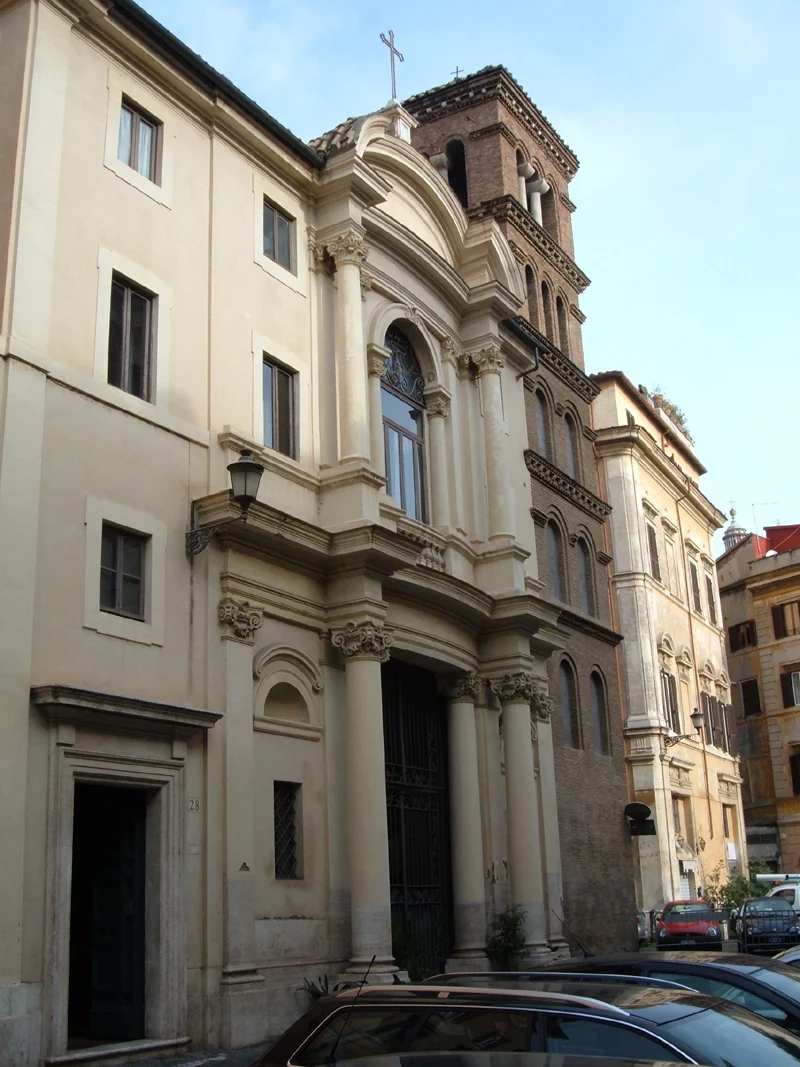
Santa Maria in Monticelli is at Via di Santa Maria in Monticelli 28, in the Regola rione, on a side street off Via Arenula on the Tiber side. It is a rectory church entrusted to the Doctrinarian Fathers, the Congregation of Christian Doctrine, who keep their generalate in the adjoining convent. Admission is free, there is no ticket and nothing to book. You go in during the hours it is open for worship, which the operator does not publish on any page you can consult: call 06 68802292.
The reason to come all the way here comes down to three points. The Romanesque brick bell tower of the 12th century, one of the least photographed in the center, the fragment of apse mosaic with the face of Christ, which dates from the same period, and the medieval wooden Crucifix in the second chapel on the left. Everything else is an 18th-century church redone in the 19th century, dignified, silent, visited almost only by the neighborhood.
The hours, Masses and contacts given in these lines correspond to the check of September 28, 2026 on the sources cited later in the text: the tourist portal of Roma Capitale, the Vatican press, the diocesan and liturgical directories, the news published by the congregation. Rectory churches change hours with the seasons, with the summer vacations of the religious and with the order's feast days. Before crossing half the city on purpose, a phone call to the church's number saves you a closed door.
Where it is and what you see
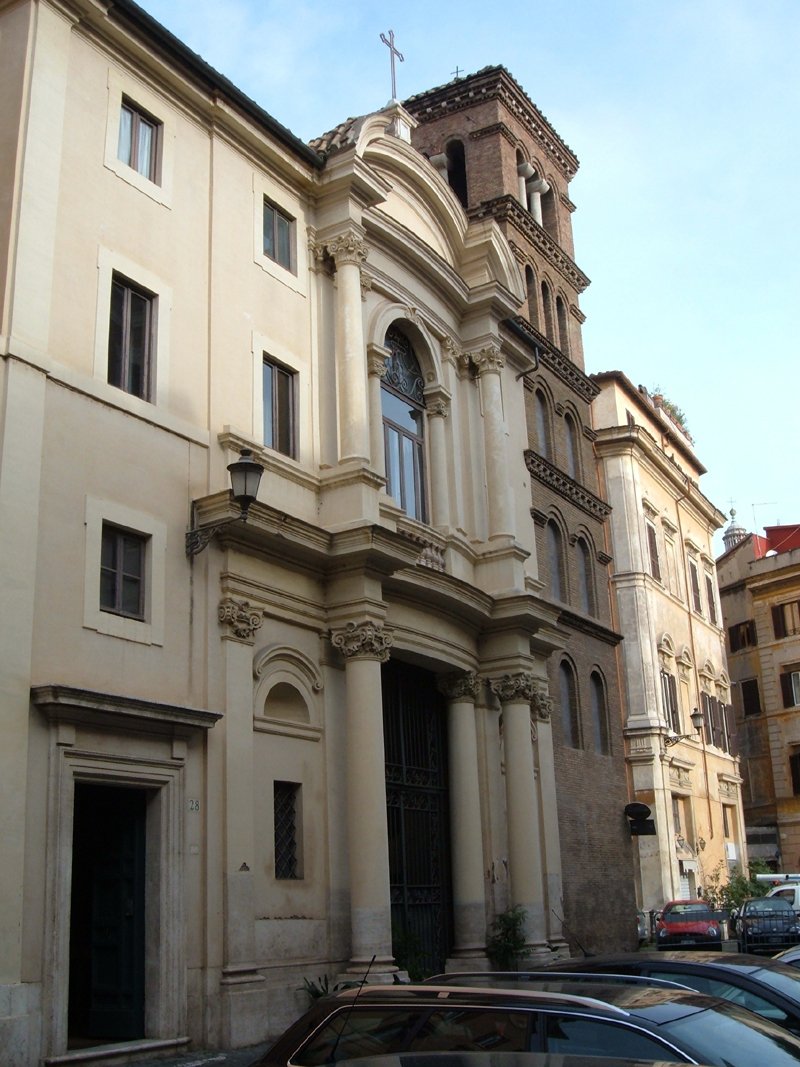
The Regola is the rione that looks onto the river between Campo de' Fiori and the Jewish Ghetto, and takes its name from the Arenula, the sand the Tiber left on its banks at every flood. Via di Santa Maria in Monticelli is a short, narrow street, a passage between Via Arenula and the more interior streets of the rione. The church has no square in front and you discover it almost suddenly, with the facade squeezed between the buildings.
The facade is that of the 18th-century remodeling: two superimposed orders, columns that project from the line of the wall, a measured Baroque language that is hard to read on a street this narrow. Behind it, the buildings of the Doctrinarians' convent take up the block. The medieval bell tower, which originally rose at the end of the right aisle, today appears cut off from the church by those very 18th-century constructions, and has to be looked for above the rooftops.
Inside, the plan is still the medieval one, with three aisles on pillars, six side chapels and one chapel next to the presbytery. The decoration you see, however, is almost all 19th-century: the lunettes of the nave with six heroines of the Old Testament, among them Esther, Judith and Deborah, painted by Carlo Ruspi, the evangelists in the entrance bay and in the presbytery, the gilded frames, the marbles of the high altar. It is a medieval church dressed as a church of Pius IX.
On the organ loft, as you enter, look up toward the inner facade. There is a large monochrome fresco with Saint Cecilia and a host of musician angels, designed by Tommaso Minardi and executed by his pupil Cesare Mariani, the same one who signs the two side lunettes with Moses and Jacob's dream. Minardi was the theorist of Roman purism, and this wall is one of the few places where you see his taste applied to a neighborhood church.
The high altar carries the Presentation of Mary at the Temple by Alfredo Bea, because this is the church's dedication. On the sides Ruspi painted Saints Peter and Paul, and beneath them appear the coats of arms of Clement XI and Pius IX. They are the two signatures of the two great building campaigns, the 18th-century one and the 19th-century one, placed side by side on the altar. Anyone looking for the Middle Ages has to look higher up, at the half-dome of the apse.
A curiosity about Santa Maria in Monticelli
In the chapel to the right of the presbytery an image of Christ the Nazarene is venerated which, according to what the guides to Roman churches report, arrived in Rome in 1681 from Meknes, in Morocco. How a devotional image ended up going from a city of the Moroccan sultanate to a side street off Via Arenula is a tale that intertwines with the history of Christian prisoners and ransoms, and the published documents do not clarify the steps.
A second tale is grafted onto that canvas. According to local tradition, in 1854 the faithful saw the eyes of the Nazarene move, and since then the image has had a cult of its own, distinct from that of the titular Madonna. It is a story of 19th-century devotion, of the kind found in quite a few Roman churches in those same years. Record it for what it is: an episode of popular faith, not a fact documented by an investigation.
The chapel was redone in 1900 with Neo-Byzantine style frescoes by Eugenio Cisterna: the evangelists, the apostles under the arcades, gold backgrounds that imitate ancient mosaics. Here is also kept a 15th-century tomb slab with the figure of the deceased carved in relief, one of the few traces left of the church before the 18th century. It is a corner almost everyone skips, and which tells three different centuries by itself.
Hours, Masses and how to get in
Admission is free, as in every church open for worship, and the operator is the community of the Doctrinarian Fathers. The information on hours, however, is not published on any official page you can consult. The liturgical directories report a morning opening, from 7 until around noon, and an afternoon one, from 15:30 to 19:30, with a weekday Mass at 7. One directory alone lists continuous opening from 7 to 19:30. The sources don't agree, so take these hours as indicative.
On festive Masses the sources disagree even more sharply. All give the Saturday vigil Mass at 19. For Sunday one directory lists 10, another 19. On Thursday afternoon there is Eucharistic adoration, with a different time depending on the source. The only way to settle the doubt is the church's phone, 06 68802292, the number the tourist portal of Roma Capitale gives for asking about Mass times and conditions of visit.
There is no ticket and no sales channel, neither official nor affiliate: the church has no ticket office, has no paid guided tours on the calendar and does not appear on the portals for tourist activities. Anyone who offers you a paid entry to Santa Maria in Monticelli is selling you a walk in the rione with a stop in a church open to everyone. The free visit, during opening hours, remains free and without reservation.
During Thursday adoration the community asks for silence and no photographs, and it is a request to respect to the letter: in a church of this size even a single flash shot is heard throughout the nave. During Masses you don't wander through the chapels. Church dress, shoulders covered, no bulky backpacks in the side aisles, which are narrow and have shallow chapels.
Two independent sources, an international directory of Roman churches and a tourist portal, report the church closed in the month of August. The operator does not state the summer closing period on any page you can consult, and the information should be confirmed by phone before planning a visit in midsummer. From September to July, morning and afternoon opening on weekdays is the indication on which the sources agree most.
One thing nobody tells you about Santa Maria in Monticelli
The church you enter is shorter than the medieval one. In the building campaign of the early 18th century the architect Matteo Sassi cut off the first two bays of the nave and side aisles and replaced them with a portico and an entrance bay, flanked by the new wings of the convent. The result is a building that lost its front part and gained a Baroque facade. No plaque explains it.
This cut explains a couple of things that would otherwise remain strange. The first is the position of the bell tower, which once stood at the end of the right aisle and ended up separated from the church by the convent buildings. The second is the proportion of the interior, a bit squat for a three-aisle basilica: a piece is missing. Anyone who knows the medieval basilicas of Rome notices it by eye as soon as they cross the threshold.
The work was commissioned by Clement XI, pope from 1700 to 1721, and began around 1710. The sources give the structure as finished in 1716 and the finishing touches completed by 1720. Alongside Sassi, who was then over 60, the guides name Giuseppe Sardi: some attribute to him the design of the facade, others an assistant's role. Here too the sources disagree, and the difference in attribution doesn't change what you see.
There is a second detail that almost no one notices. The Flagellation attributed to Antonio Carracci, in the second chapel on the right, was not seen for more than a century: it was covered by an 18th-century lining and reemerged only during the restorations of 1860. The 18th century, in Rome, covered without too many scruples whatever it no longer liked. The 19th century, in this case, had the more respectful hand, though repainting everything else.
The name Monticelli: documents, tradition, legend
Let's start with what the documents say. The biography of Pope Paschal II in the Liber Pontificalis records an intervention on this church in 1101. In 1264 a bull of Urban IV calls it Sancta Maria in Monticellis Arenulae de Urbe, that is, Santa Maria in the Monticelli of the Arenula, in the city. The name therefore exists since at least the 13th century and is tied to the river's sand. What exactly those monticelli were, however, no document says.
Then there is tradition, the one the guides and institutional entries repeat. The church was supposedly built on a small rise in the ground, a monticello indeed, chosen to put it out of reach of the Tiber's floods, which in this low area came often and with force. It is a sensible explanation and consistent with the geography of the Regola, but it remains a deduction from the name, not a written record.
A variant of the same tradition thinks of the mounds of ancient rubble that covered the area, small rises formed by the remains of collapsed Roman buildings, on which the medieval neighborhood was built. An English guide to Rome's churches instead proposes a completely different hypothesis: that Monticelli derives from a personal name. Three explanations, none proven. The tradition of the rise against floods is the most widespread, not for that reason the best proven.
Finally the legend, or at least the least solid part of the tale. Some popularizing sites trace the church back to the 6th or 7th century and place it on top of a temple of Neptune designed by Hermodorus of Salamis. There is no published evidence linking this church to that temple, and the more careful historical sources admit that before 1101 nothing is known. Nice to tell, impossible to verify.
The advice I give you for visiting Santa Maria in Monticelli
Come early in the morning, between 8 and 10, after the weekday Mass. It is the hour when the church is open, empty and lit by the light coming in from the high windows of the nave. In the afternoon it is open, but toward evening the rosary and vespers arrive, and going around the chapels while the community prays is not a nice thing to do. The morning leaves you all the time and no embarrassment.
Bring a small pair of binoculars or use your phone's zoom. The mosaic fragment with the face of Christ is high up, in the half-dome of the apse, and is hard to read from the nave. Seen enlarged it becomes something else: the tesserae, the frontal gaze, the drawing of the face that belongs to 12th-century Rome. It is the oldest object you will see in the church, and deserves those two extra minutes of attention.
Don't stop at the central nave. The best things are in the side chapels, and some are poorly lit: the Flagellation of the second chapel on the right, the Crucifix of the second on the left, the Madonna with Saints by Sebastiano Conca in the third on the left. Make the full circuit counterclockwise, starting from the right, and keep the presbytery with the apse for last. The route takes 20 well-spent minutes.
Pair the visit with that of San Paolo alla Regola, which is a few minutes on foot in the inner streets of the rione, and the Santissima Trinità dei Pellegrini. They are three churches different in period and character, and together they tell the Regola better than any organized tour. Anyone with only an hour in the area lines them up and discovers a piece of the city that groups cross without looking.
The Romanesque bell tower
The bell tower is the best-preserved part of the medieval church and dates to the 12th century, consistent with the reconsecration of 1143. It is of red brick, with string-course cornices supported by small brackets, and closes with a pyramid roof. Today it has five floors. Originally there were seven: in the time of Paul V, pope from 1605 to 1621, the two upper ones were dismantled because the tower had stability problems, an intervention that saved the rest.
The design rises by stages, as in many Roman bell towers of that century. The first floor has simple arched openings, the upper floors become lighter and more elaborate, and the belfry at the top opens on each side with three lights separated by stone colonnettes and brick pillars. Anyone who has in mind the bell tower of Santa Maria in Cosmedin recognizes the same family, on a smaller scale and with fewer floors.
Here comes the opposing view. Everyone who comes to this church asks about the Crucifix attributed to Cavallini, and almost no one looks up toward the tower. In our judgment this is the opposite of the right mistake. The bell tower is a medieval work intact in form, secure in its dating and visible from outside at any hour, even with the church closed. The attribution of the Crucifix, instead, is debated. If you have time for only one thing, look at the tower.
The apse mosaic and the Crucifix
Of the medieval apse mosaic only one fragment survives: the head of the Redeemer, dated to the 12th century. The historical guides connect it with the works of Paschal II and the consecration at the start of the century, others relate it to that of 1143. Everything around it is 19th-century: a vine shoot that grows from a vase and winds around the cross, designed to frame the fragment and give meaning to the empty half-dome.
Look at it knowing what you are looking at. It is an isolated face, without the body, without the scene that was meant to complete it, and precisely for this reason you can see the hand well: the sharp outline, the large eyes, the fixity that 12th-century Rome shared with the apses of Santa Maria in Trastevere and of other major churches. A fragment is not a cycle, but it is original material, and little of it remains here.
The painted wooden Crucifix is in the second chapel on the left. On the dating the sources disagree: some give it to the 13th century, some to the 14th, and one guide also reports a dating to the 11th century that it itself considers unlikely. The most repeated attribution is to Pietro Cavallini, the Roman painter of the mosaics of Santa Maria in Trastevere and of the Last Judgment in Santa Cecilia.
That attribution should be taken with a grain of salt. Cavallini is the great name of Roman painting between the 13th and 14th centuries, and a crucifix of that era in a church of the Regola easily ends up under his name. The more cautious entries write attributed, and they do well. A documented comparison with the painter's certain works is not published in any accessible source. It remains a medieval work of good quality, which doesn't need a famous name to be worth the stop.
On the altar of the same chapel there is a crowned icon of the Madonna, called Madonna in Monticelli, venerated as Help of Christians. And a tradition is tied to the Crucifix: Saint Bridget of Sweden, who lived in Rome for many years in the 14th century, supposedly prayed several times before this cross. The guides to Roman churches report it as handed-down lore. As for a document attesting it, none among those published.
The chapels, one by one
The first chapel on the right is called the Gethsemane chapel. The altarpiece is attributed to Edoardo Vicinelli, a painter of the early 18th century, and on the back wall the guides point out an Assumption dated 1630 and referred to Andrea Sacchi. There is also a wooden statue of Saint Anthony of Padua, of the kind that in Roman neighborhoods always has a candle lit in front of it. It is the chapel most visited by the people of the rione, more for Saint Anthony than for the paintings.
The second on the right is that of the frescoed Flagellation, attributed to Antonio Carracci, nephew of Annibale, and rediscovered in 1860. In the same chapel are a 19th-century tabernacle with the Mystic Lamb and the vault frescoes by Carlo Ruspi, damaged by damp. The third on the right is dedicated to Saint Ninfa: the altarpiece by Giovanni Battista Puccetti shows the saint refusing to sacrifice to the gods, and an anonymous 18th-century painting reunites her with the other martyrs of Palermo.
Those martyrs are a story apart. Between 1185 and 1187 Pope Urban III had the relics attributed to Ninfa, Mamilianus, Eustatius and Quodvultdeus moved here from Porto. Later the remains of Mamilianus were identified with those of a Sicilian bishop, and the group took the collective name of martyrs of Palermo. The relics are cited by all the historical sources as one of the reasons for the church's medieval importance.
On the left side, the first chapel has another Flagellation, on canvas, attributed to Jean-Baptiste van Loo, a French painter active in Rome, though some guides give it to Puccetti. On the altar there is a statue of Saint Roch. The second is the chapel of the Crucifix. The third is dedicated to Saint John the Baptist, with an altarpiece by Puccetti and above all the Madonna and Child with Saints by Sebastiano Conca, in which Saint Francis shows the stigmata.
Conca's painting is the most important canvas in the church, and the painter from Gaeta was in those years one of the most sought-after names in Rome. You find him also in major churches, but here you look at him up close and without a crowd. Taken together, the chapels tell well what a neighborhood church was in the 18th century: a set of altars entrusted to different devotions, paid for by families and confraternities, with painters of good level.
Another well-known fact, yet rarely cited
Goffredo Mameli, the author of the Song of the Italians, was first buried here. He died on July 6, 1849 at age 21, in the hospital of the Trinità dei Pellegrini, from the consequences of a leg wound suffered on the Janiculum in the defense of the Roman Republic. The tourist portal of Roma Capitale recalls Santa Maria in Monticelli as his first burial, and so does the reconstruction published by the Grande Oriente d'Italia.
The proximity explains the choice. The Pellegrini hospital was the institution of the confraternity tied to the church of the Trinità dei Pellegrini, a few minutes from here, and during the siege of 1849 it took in the wounded from the fighting on the Janiculum. Whoever died in those wards ended up in the nearest church that could take them in. No plaque inside Santa Maria in Monticelli recalls that passage today, and it is an absence that strikes you.
From here Mameli's body made a long journey. The Grande Oriente reconstruction indicates a transfer to the crypt of the church of the Stigmata, then to the Verano after 1870, and in 1941 the final placement in the Janiculum Ossuary Mausoleum. The English-language encyclopedia instead gives the Verano as the first burial. The sources disagree on the intermediate steps, but agree on the final point, the Janiculum.
Anyone who wants to follow the thread of the Roman Republic finds the full story at the Museum of the Roman Republic and Garibaldian Memory, inside Porta San Pancrazio, and can then climb toward San Pietro in Montorio. These are the places where Mameli fought and where he rests today. Starting from this church of the Regola, where he was buried first, gives the itinerary a beginning that almost no one knows.
The right photo to take at Santa Maria in Monticelli
The right photo is the one of the bell tower, and it is taken from outside. Look for a spot in the surrounding streets from which the tower emerges above the convent rooftops, hold the camera vertical and leave a bit of sky above the pyramid roof. The red brick looks its best in late-afternoon light, when the low sun warms the color and brings out the relief of the cornices and brackets.
Inside, the photo worth taking is the apse mosaic fragment, taken with the zoom from the front row of pews. Frame only the face and a bit of the 19th-century vine shoot around it, so the relationship between the original and the frame is clear. No flash: it isn't needed, it disturbs, and it flattens the tesserae. Steady the phone on the back of the pew and shoot calmly, outside service hours.
Avoid the frontal photo of the facade from the street. The street is too narrow, you have to stand against the opposite wall and the result is a facade cut off, crooked, with parked cars in front. If you want the facade, take it at an angle, from one end of the street, and accept not getting all of it. Sassi's Baroque works better askew than head-on, like many Roman facades built on medieval streets.
A note of respect. During Thursday adoration the community expressly asks not to photograph, and during Mass the same common sense applies. The side chapels are often used by people praying, and a lens pointed at them is not acceptable. In a neighborhood church like this one the rule is simple: first look at who is there, then decide if it is the moment to shoot.
How to get there
On foot is the best way, because the church is in the heart of the historic center and all the main destinations around are reachable in a few minutes. From Largo Argentina you go down Via Arenula toward the river and turn right into the side street. From Campo de' Fiori you cross the inner streets of the Regola. From Trastevere you cross the Tiber on Ponte Sisto and walk back up for a few minutes.
By public transport the reference is tram 8, which runs along Via Arenula and connects the center with Trastevere. ATAC lists the line as reactivated along the whole route since September 21, after the works on the electrical substation and on the tracks of the historic network. No metro station is near, and anyone arriving from the metro must allow for a stretch on foot or a change. Before leaving, check the status of the service on the ATAC site.
By car it's not worthwhile. The Regola is inside the limited traffic zone of the historic center, parking spots are few and reserved for residents, and the streets around the church are narrow and often blocked by delivery vans. Anyone arriving from outside Rome does better to leave the car in a park-and-ride lot and continue by public transport. The visit lasts half an hour, a parking spot would complicate it.
For people with mobility difficulties, access to the rione is level, but the cobblestones of the narrow streets are uneven and the sidewalks almost absent. The operator does not say if the church entrance has steps or a ramp, and an accessibility statement does not appear to be published. Anyone moving in a wheelchair would do well to ask by phone before the visit, at the number given above, to find out which door is most convenient.
Some important events that happened here in history
1101 is the first sure date: the biography of Paschal II records an intervention by the pope on this church, which the historical sources read as restoration or new consecration. A foundation ex novo so late, in an area inhabited for centuries, seems unlikely, and scholars posit an earlier building of which, however, no proof remains. 1143 brings the reconsecration by Innocent II, recalled by a plaque still preserved inside.
A second consecration a few decades after the first suggests a major restoration or serious damage, perhaps a fire, but the plaque doesn't give the reason. In the same years the bell tower is built. Between 1185 and 1187 the relics of the martyrs arrive from Porto, and the church becomes a parish of weight, with a college of priests. In the 16th century the scholar Pompeo Ugonio still noted a Cosmatesque choir dated 1227, now lost.
In 1264 the bull of Urban IV fixes the name Sancta Maria in Monticellis Arenulae. Between 1605 and 1621, under Paul V, the bell tower loses two floors. From 1710 Clement XI launches the great remodeling entrusted to Matteo Sassi, finished in its structures in 1716. In 1725 the church passes to the Fathers of Christian Doctrine, who make it the seat of their order. Further works follow under Benedict XIII, in the years immediately after.
1849 is the year of the Roman Republic and of Mameli's burial. In 1860, under Pius IX, Francesco Azzurri directs the restorations that give the church its present look, with the rediscovery of Carracci's Flagellation and the decoration by Ruspi and Mariani. In 1900 the chapel of the Nazarene is redone in Neo-Byzantine style. In 1906 the old parish is suppressed, and the church remains with the Doctrinarians as a rectory and generalate.
The last relevant event is recent. In the spring of 2022, in view of the canonization of the Doctrinarians' founder, Cesare de Bus, the church and the generalate hosted the multimedia exhibition Hereditas de Bus, opened on April 22 and open to the public from May 14. The next day, May 15, 2022, Pope Francis proclaimed the founder a saint. It is the first time in decades that this church has made the news.
Who has passed through Santa Maria in Monticelli
Paschal II, pope from 1099 to 1118, the first name tied with certainty to the church. And Innocent II, born Gregorio Papareschi, from Trastevere, who reconsecrated it in 1143: the same pontiff who rebuilt Santa Maria in Trastevere. Two popes of the 12th century who put their hand to this church say a lot about its weight in the Middle Ages, when the Regola was a populous district of artisans and river boatmen.
Saint Bridget of Sweden, if you give credit to the tradition of the Crucifix. Bridget lived in Rome for over 20 years in the 14th century, in a house overlooking Piazza Farnese, a few minutes from here, and went around the churches of the rione. That she stopped to pray before this cross is plausible by geography and habit. It is tradition, not document, and should be told as such even when it is so likely.
Clement XI, Giovanni Francesco Albani, the pope of the remodeling, whose coat of arms is still on the high altar. Matteo Sassi, an architect already old when he worked here, and Giuseppe Sardi. Then Sebastiano Conca, Jean-Baptiste van Loo, Giovanni Battista Puccetti, with their altarpieces. In the 19th century Francesco Azzurri, Carlo Ruspi, Tommaso Minardi and Cesare Mariani. A list of names that in a church of this size says how alive Roman patronage still was.
Goffredo Mameli, dead at 21 in 1849, who came here from the Pellegrini hospital for his first burial. It is the best-known passage and the least remembered on site. And with him, ideally, all the volunteers of the Roman Republic who died in those same days in those wards. The church keeps no plaques or signs of that period, and it is a gap that a small informational plaque would fill without effort.
The Doctrinarian Fathers, here since 1725 without interruption, and their founder Cesare de Bus, who did not live in Rome but whose memory is kept here, with an altar dedicated to him in a prominent position in the presbytery. For almost three centuries the life of the church has been the life of their community, and the choice to celebrate the 2022 canonization here confirms it.
The Doctrinarian Fathers and Saint Cesare de Bus
The Congregation of the Fathers of Christian Doctrine was born in Provence in 1592. The founder, Cesare de Bus, was born in Cavaillon in February 1544 and died in Avignon in 1607. After a youth as a soldier and man of the world, he devoted himself to catechesis with a method that the Vatican press describes as accessible, understandable catechesis, close to life. The order's name comes from there: teaching Christian doctrine.
Paul VI proclaimed him blessed on April 27, 1975, Pope Francis a saint on May 15, 2022. The Doctrinarians arrived at Santa Maria in Monticelli in 1725 and since then have made it the seat of the general curia, that is, the governing center of the congregation. The generalate is listed at number 29 of the street, next to the church, according to what Vatican News reported in 2022 for the exhibition on the founder.
This presence changes the way the church is lived. It is not a parish with its oratory and neighborhood activities, because the old parish was suppressed in 1906. It is a rectory run by a religious community, with regular liturgies, confessions during opening hours and the order's feast days. The liturgical feast of Saint Cesare de Bus is celebrated in this church, as reported by the news published by the congregation.
For the visitor, the practical consequence is only one: the hours follow the life of the community. There are days when the church closes earlier, periods when the fathers are busy elsewhere, internal feasts that change the schedule. This is why the phone remains the right channel. Compared with a large basilica with custodial staff, here the one who answers is someone who lives and prays in the house next door.
When it is closed and what not to expect
The church closes in the middle of the day, between late morning and early afternoon, according to almost all the directories consulted. Two sources list it closed for the whole month of August. The operator does not state extraordinary closures on the web, which can depend on retreats, chapters of the order, works. Showing up at 13 on a summer day is the surest way to find the door barred and a deserted street.
Don't expect tourist services. There are no explanatory panels in the chapels, no audio guide, no bookshop, no staff to welcome visitors. The lights of the side chapels are not always on, and some works can be seen only in semi-darkness. It is a church to visit on your own, with some information prepared beforehand, and the lines collected here serve exactly that.
Don't expect the medieval church that the name and the bell tower promise, either. Anyone arriving hoping for a Romanesque interior with 12th-century frescoes finds an 18th- and 19th-century setting, with a single fragment of original mosaic high up. It is a surprise that disappoints those who don't know it and instead interests those who arrive prepared, because here the Middle Ages have to be sought among the layers, they don't show themselves.
Finally, don't expect the rione to be empty. Via Arenula is one of the busiest streets of the center, with the tram and continuous traffic toward the Tiber. As soon as you turn the corner the noise drops, but doesn't disappear. The real quiet is inside the church, and the contrast between the street and the silent nave is one of the best sensations of the visit.
Eating nearby
The Regola borders two of the most trodden areas of Rome for people looking for food, Campo de' Fiori and the Ghetto, and this has precise consequences. Next to serious places frequented by Romans there are places built for tourist traffic, and sometimes they are on the same sidewalk. Telling them apart is possible, with a few signals that anyone living here recognizes at a glance, without needing reviews.
The first signal is the menu with photographs of the dishes, maybe laminated and translated into five languages. A place that has to show you the picture of a cacio e pepe is talking to someone who has never seen one, and builds its kitchen on that audience. The second is the person at the door who stops you in the street to invite you to sit. A place with regular customers doesn't need to go fetch them from the sidewalk.
The third signal is the woman rolling out fresh pasta in the window or directly in the street. It is a scene that attracts, and it is designed for that. Well-made pasta is prepared in the kitchen, in the morning, away from car exhaust and dust. When the preparation becomes a show in front of the entrance, what works is the lure, and the bill usually takes it into account.
The fourth is the kitchen open without a break from morning to midnight. A real kitchen has a pause, because the people working there must prepare the evening service. The fifth concerns places set in front of the best-known monuments: there the price tends to adapt to the customer, with menu items without a price, fish of the day without a figure, and sometimes different price lists between the dining room and the outdoor tables.
Romans don't avoid these places out of snobbery. They avoid them because they know the ratio between what they pay and what they eat is worse, and because a kitchen built for people who pass by only once has no reason to improve. Anyone traveling with tired children and choosing convenience has their good reasons. It is enough to know what you are choosing, and always ask the price before ordering.
The criterion is to look at who is sitting. If at lunch, on a weekday, there are office workers, the rione's artisans and families speaking Romanesco, you are in the right place. If there are only visitors with backpacks and the waiter switches to English before hearing you speak, it is not a moral judgment, it is information. To avoid trial and error, here is our list of the places where we eat.
What to pair it with in a day
Santa Maria in Monticelli is a half-hour stop, and it fits well into a walk through the Regola and the area around it. The most natural route goes down toward the river: San Salvatore in Onda, another small medieval church of the rione entrusted to a religious community, then the Trinità dei Pellegrini and Via Giulia, with Santa Maria dell'Orazione e Morte and the Oratorio del Gonfalone.
Toward Campo de' Fiori you meet the Galleria Spada, with Borromini's perspective, and Piazza Farnese. A little farther are Santa Maria in Monserrato and San Girolamo della Carità. On the opposite side of Via Arenula is San Carlo ai Catinari, and going up you reach Sant'Andrea della Valle and the Museo Barracco.
Anyone who prefers the Jewish side crosses Via Arenula and enters the Ghetto: the Synagogue with the Jewish Museum, the Portico of Octavia, the Turtle Fountain, the Theater of Marcellus. From there Tiber Island can be reached on foot, crossing the Ponte Fabricio, the oldest Roman bridge still in use.
Toward the north, Largo Argentina with the sacred area and the cat sanctuary, the Crypta Balbi and the Church of the Gesù. Toward the south, beyond Ponte Sisto, Trastevere and the San Cosimato market, to pair in the morning. Anyone who loves small, little-known churches can continue the theme with Santo Stefano degli Abissini, though it is in the Vatican and has its own access rules.
One last pointer for anyone following the places of medieval Rome. After the Monticelli bell tower, the stop that completes the picture is San Lorenzo in Damaso, the basilica within whose parish territory the church now falls, and farther on San Nicola in Carcere, with the columns of ancient temples walled into its sides. They are short visits, which together give a clear idea of how the medieval city grew on top of the ancient one.
Frequently asked questions
Do you pay to enter Santa Maria in Monticelli?
No. Admission is free, as in every church open for worship, and there is no ticket or reservation. The church is a rectory run by the Doctrinarian Fathers, the Congregation of Christian Doctrine, who have their generalate in the adjoining convent. No paid guided tours organized by the operator are listed. You go in during opening hours, respecting the services in progress and the requests of the community.
What are the opening hours and the Mass times?
The operator does not publish the hours on any official page you can consult. The liturgical directories list a morning and afternoon opening and a weekday Mass at 7, with the Saturday vigil Mass at 19. On the time of the Sunday Mass the sources disagree. The channel to get the sure answer is the church's phone, 06 68802292, given by the tourist portal of Roma Capitale.
Where exactly is the church?
The address is Via di Santa Maria in Monticelli 28, postal code 00186, in the Regola rione. The street is a side street off Via Arenula on the Tiber side, between Campo de' Fiori and the Jewish Ghetto. The Doctrinarians' generalate is listed at number 29. On foot it is a few minutes from Largo Argentina, Piazza Farnese and Ponte Sisto, and tram 8 runs along Via Arenula.
What is medieval in the church?
The Romanesque brick bell tower of the 12th century, reduced from seven floors to five under Paul V, the apse mosaic fragment with the face of Christ, the three-aisle plan and a plaque recalling the reconsecration of 1143 by Innocent II. The wooden Crucifix of the second chapel on the left is medieval, with a debated dating. The rest of the building is the result of the remodelings of 1716 and 1860.
Is the Crucifix really by Pietro Cavallini?
It is the most widespread attribution, but the more cautious entries use the word attributed, and on the dating the sources swing between the 13th and 14th centuries. A documented comparison with the painter's certain works is not published in any accessible source. Tradition holds that Saint Bridget of Sweden prayed before this cross during her long stay in Rome in the 14th century, with no documents attesting it.
Why is the church called in Monticelli?
The name appears in a bull of Urban IV of 1264 in the form Sancta Maria in Monticellis Arenulae. Tradition explains it with a small rise in the ground on which the church was supposedly built to protect itself from the floods of the Tiber. Other hypotheses think of mounds of ancient rubble or of a personal name. None of the explanations is documented directly.
Is it true that Goffredo Mameli was buried here?
The tourist portal of Roma Capitale lists Santa Maria in Monticelli as Mameli's first burial place, he who died on July 6, 1849 at the hospital of the Trinità dei Pellegrini. A reconstruction published by the Grande Oriente d'Italia adds a stop in the crypt of the church of the Stigmata and then at the Verano. Since 1941 the remains have been in the Janiculum Ossuary Mausoleum. In the church there are no plaques recalling the fact.
Is the church open in August?
Two independent sources list it as closed for the whole month of August, while the operator does not state the summer closing period on the web. Anyone planning a visit in midsummer would do well to phone the church's number first. In the other months the sources agree on a weekday opening in the morning and late afternoon, with a break in the middle hours of the day.
Who wrote this page
The page comes from the editorial team of Tour Leader Pro, the Rome-based outfit that designs itineraries, visits and cultural events across Rome and Lazio. Hours, contacts and historical information given here come from the sources cited in the text, as of the date stated at the top. Since this is a rectory with hours tied to the life of the religious community, recheck them before setting out, and tell us what you find changed.
Lining up a morning in the Regola and the Ghetto means fitting together churches with short openings that differ from one another, services that block visits, museums with reservations, synagogues with entrance checks and narrow streets where a group of 40 people can't stop wherever it wants. Anyone facing this kind of puzzle, for themselves or for a group, will find on Tour Leader Pro working materials designed for those who guide and for those who organize on their own.
For the wide picture, that is regional trains and seasonal schedules, rentals, airports, transfers between one province and another and destinations in Lazio outside the center of Rome, from the Castelli to the volcanic lakes of the north, down to the Tyrrhenian coast and the villages of the interior, a useful resource for building a multi-day itinerary is Italy Planner.