San Girolamo della Carità
In short. San Girolamo della Carità is a church on Via di Monserrato, in the Regola rione, halfway between Campo de’ Fiori and the Tiber, and it contains what in our judgment is the strangest chapel in Rome: the Cappella Spada, a space with no…
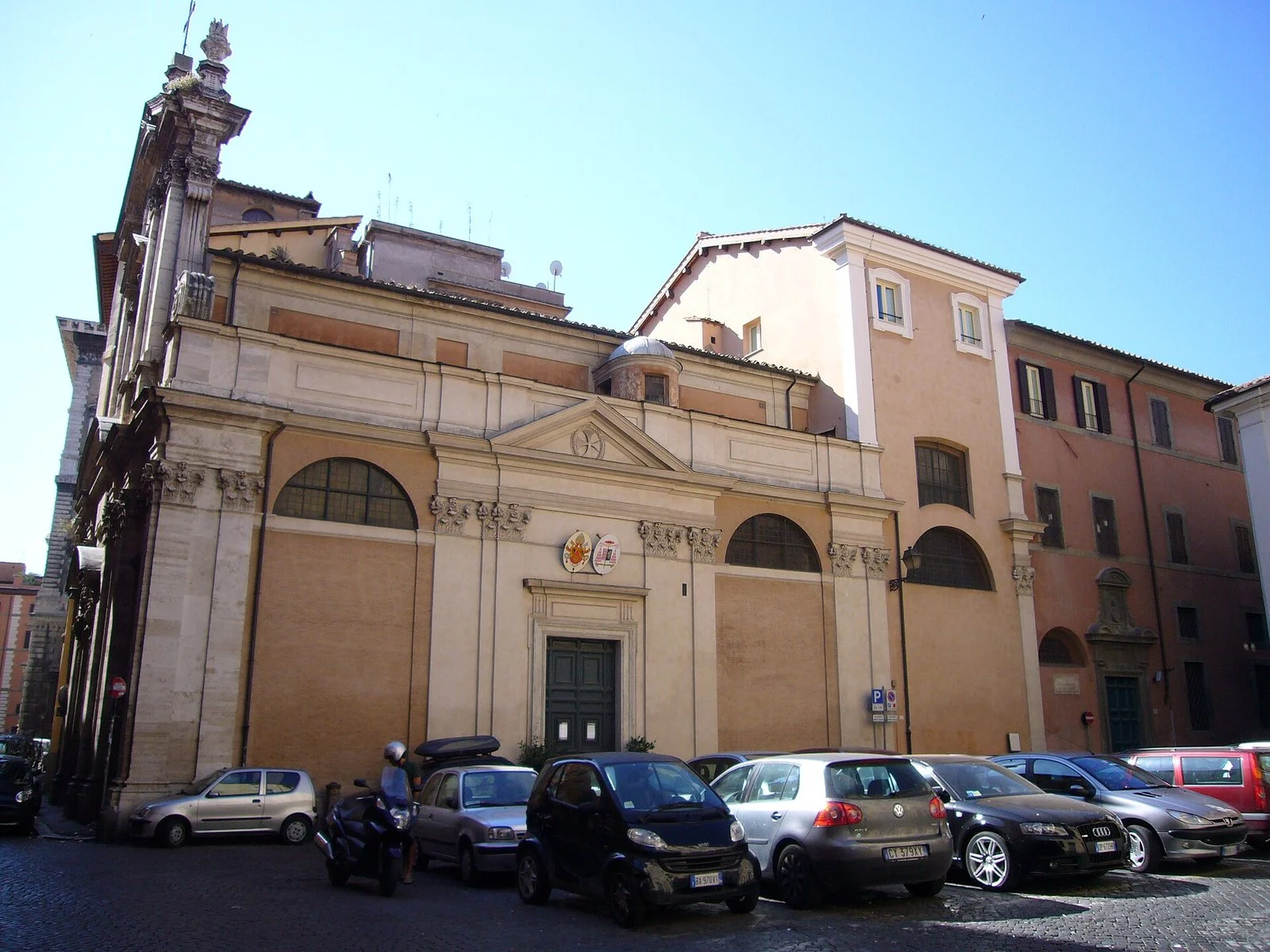
San Girolamo della Carità is a church on Via di Monserrato, in the Regola rione, halfway between Campo de’ Fiori and the Tiber, and it contains what in our judgment is the strangest chapel in Rome: the Cappella Spada, a space with no visible walls in which the balustrade is replaced by two polychrome marble angels holding a drape sculpted as if it were real cloth. The church is tied to Saint Philip Neri, who lived and heard confessions there for more than 30 years, from 1551 to 1583, before moving to the Vallicella. Entrance, when the church is open, is free. The problem is exactly that: the opening hours are among the most limited and most uncertain in the historic center, and anyone who arrives here without checking beforehand really risks finding the door closed. The lines that follow serve to understand what is inside, why that chapel matters so much in the history of Roman architecture, what remains of Philip Neri's passage, and how to organize the visit without making the trip for nothing.
Where San Girolamo della Carità Is and How to Get There
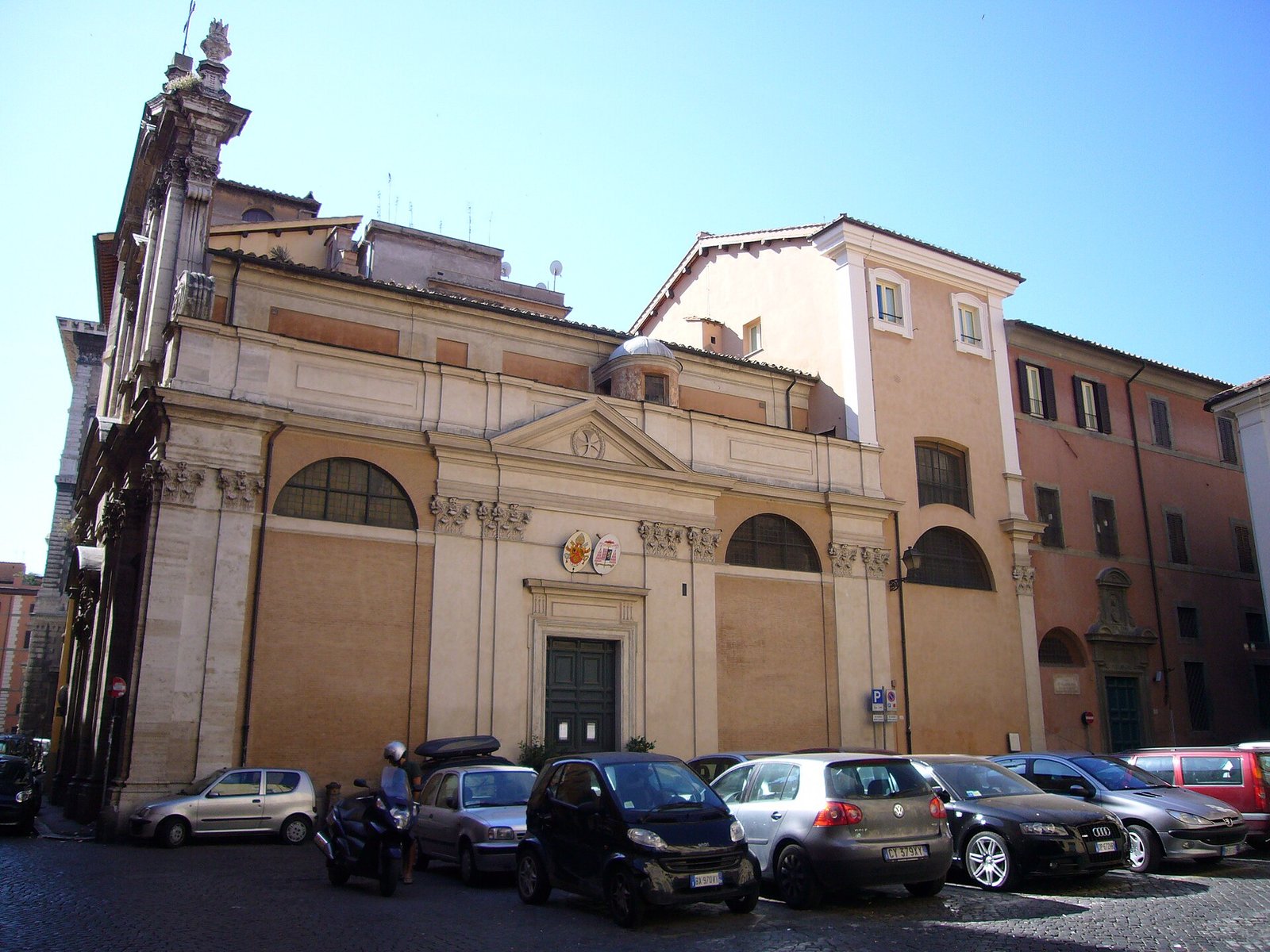
The church faces Via di Monserrato, at number 62A, in the rione VII Regola, a few dozen meters from the side of Santa Maria in Monserrato, the national church of the Spaniards. It is a narrow stretch of street, with 16th-century buildings closing the view on both sides and almost no signs: anyone passing absent-mindedly doesn't even notice there is a church there, because the facade has no forecourt, no staircase and lines up with the edge of the neighboring buildings.
The Regola Rione in a Few Words
The Regola rione takes its name from the arenula, the sand that the Tiber deposited along the bank before the 19th-century embankment walls. It is included roughly between Via Giulia, Via dei Pettinari, Via Arenula and the river front, and concentrates in a few hectares a density of churches and confraternities with few equals in the city: besides San Girolamo there are Santa Maria dell’Orazione e Morte with its hypogeum, Sant’Eligio degli Orefici designed on a Raphaelesque plan, Santissima Trinità dei Pellegrini and San Paolo alla Regola. Anyone who comes all the way here for a single church wastes half the afternoon.
On Foot from the Well-Known Points of the Center
From Campo de’ Fiori you get there in four or five minutes, by Via dei Cappellari or going down through Piazza Farnese. From Piazza Navona you need a good 10 minutes passing in front of the Cancelleria and crossing Corso Vittorio Emanuele II. From Ponte Sisto, and so from Trastevere, you go back up Via dei Pettinari in seven or eight minutes of easy walking. From the Ghetto and the Portico of Octavia it goes up to 15 minutes, all on the flat.
By Public Transport
There is no convenient metro stop: the underground network avoids this whole quadrant of the historic center. The most solid reference is Corso Vittorio Emanuele II, served by the lines connecting Termini and Piazza Venezia to the Vatican, including the 64 and the 40: you get off at Chiesa Nuova or Sant’Andrea della Valle and walk five or six minutes toward the river. Alternatively tram 8, which from Trastevere goes up Via Arenula to Largo di Torre Argentina, leaves you a little over 10 minutes on foot away. Routes and lines change often because of building works and detours: it's best to recheck the route on the public transport operator's website the same day, because Corso Vittorio is one of the arteries most subject to temporary changes. You don't come by car: the rione is inside the limited traffic zone, Via di Monserrato is one-way with parking reserved for residents and there are no public car parks nearby.
Hours, Opening and Entrance: The Part That Really Matters
San Girolamo della Carità is one of the hardest churches in central Rome to find open, and this is the most important operational fact of the whole page. It is not a parish with continuous hours posted on the door and it is not a museum with a ticket office. Access depends on the celebrations and on the availability of whoever officiates, and it can vary from one month to the next.
We Don't Publish Hours, and There Is a Reason
On this page you won't find a table with days and time slots. It would be the most convenient thing to write and the easiest to get wrong. The hours circulating on generalist sites about this church often turn out to be out of line with each other and with the reality of the door, and publishing one would mean sending someone to Rome with information already expired. There are two sensible channels: the list of churches and celebration times kept by the Vicariate of Rome, and direct contact with the rector or with the community that officiates the church. A third channel, less obvious, is the notice posted on the door, which usually gives the updated masses. It counts as a scouting visit if you are already in the area.
Entrance Is Free
When the church is open you go in without a ticket and without a reservation. It is a place of worship, not a museum site, and there is no ticket of any kind. Nobody will ask you for money at the entrance. If someone does so outside the door, they have nothing to do with the church. Being free is one of the strongest arguments in favor of the visit: within 300 meters there are venues that charge a ticket for much less than what you see in here.
Explicit Warning: Those Who Go at Random Risk Finding It Closed
We write it without beating around the bush because it is the number one reason for failed visits in this corner of Rome. Showing up on Via di Monserrato without checking anything, counting on the fact that a church is usually open, is the best way to stare at a wooden door and turn back. It happens very often, even to people who know the city well. The opening windows are narrow and don't cover the whole day. The strategy we recommend: check in advance, arrive at a certain opening, and build around the visit a backup round in the rione that holds up even in the worst case.
The Cappella Spada: The Reason This Church Should Be Seen
The Cappella Spada, in the left aisle of San Girolamo della Carità, is a funerary chapel built around the middle of the 1600s for the Spada family, and it is one of the most anomalous spaces of Roman Baroque architecture. In place of the usual marble balustrade there are two nearly life-size angels, kneeling, holding a drape of polychrome marble stretched between them like a sheet of real cloth. Walls and floor are covered with marble inlays that simulate a funeral canopy laid over the space. Whoever sees it once doesn't forget it, and almost nobody in the city knows it exists.
The Idea: A Room Pretending to Be a Cloth Pavilion
The concept is as simple as it is radical. A normal Baroque funerary chapel is architecture: pilasters, cornices, pediments, niches, a recognizable order that organizes the wall. Here the architectural order almost completely disappears. The walls aren't read as walls articulated by members, they are read as hanging cloths. The design of the inlays follows a course that imitates the folds and turns of a fabric, and the eye, on entering, has trouble understanding where the covering ends and the structure begins. It is a chapel conceived as the inside of a tent, or rather of a monumental catafalque, of the kind that were set up in churches for solemn funerals and taken down after a few days. Here the ephemeral catafalque has been made permanent, translated into hard stone.
This also explains the materials: polychrome marbles with strong contrast, with jaspers and breccias that on polishing give depth and an almost textile quality. It was not a decorative whim. In the funerary language of 1600s Rome the drape and the canopy were precise signs, indicating honor paid to the deceased and at the same time the precariousness of life, and fixing them in marble meant making that gesture definitive. The chapel says one single thing, and says it with a consistency that has few equivalents in Rome.
The Two Angels and the Drape: The Showpiece
The angels strike everyone, even those with no interest in architecture. They are two kneeling figures at the sides of the chapel opening, in white marble, each holding one edge of a drape made of colored marble. The drape falls with heavy folds, has a worked border, swells slightly in the center. It is sculpted with attention to the physical behavior of the fabric, to the weight, the fall, the tension between the two points of grip, which is the real test of authorship. From afar, with the right light, some of the visitors stay convinced for a few seconds that they are looking at real cloth.
Replacing the balustrade with this sculptural group is the move that makes the chapel unique. A balustrade divides the space of the chapel from that of the faithful, and it is fixed furnishing. Here the separation becomes a narrative gesture, performed by two figures who are stretching a cloth right at that moment. The threshold comes alive. It is an invention that belongs to Roman Baroque in its most experimental phase, the one in which the boundary between architecture, sculpture and funerary staging is crossed continually. The floor takes part too: it is worked in inlays and hosts the family funerary memorials as part of the overall design, not as inserts added afterward. Whoever enters looks up and to the side and misses this level. It's worth giving it a minute before leaving.
The Attribution to Borromini, and Why It Is Disputed
Clarity is needed here, because on this point guides are often approximate. The Cappella Spada is commonly attributed to Francesco Borromini, and that is how it is cited in the great majority of popular texts. The attribution has serious grounds, but it is not a documented fact in the same way as Borromini's authorship of Sant’Ivo alla Sapienza or of San Carlo alle Quattro Fontane. We state it openly: anyone who tells this chapel as a sure work of Borromini is simplifying.
There are three positions in the field. The first assigns Borromini the overall conception of the space, and the strongest argument is the very close relationship with Virgilio Spada, the Oratorian who was his patron and defender on the most important building sites of his career, together with the nature of the invention, very close to his way of thinking about space. The second attributes execution and in part invention to the sculptors who physically worked on site: the names that recur are those of Antonio Giorgetti, trained in Bernini's circle, and of Cosimo Fancelli, and in this reading the angels would be their work, possibly on an idea supplied by Borromini. The third stresses the weight of the patron: Virgilio Spada was not a passive patron but a man with technical skills and ideas of his own on architecture.
The three readings are not necessarily alternatives. A Roman building site of the 1600s worked by layering of contributions, and distinguishing the idea from the execution is often impossible without signed drawings. The most honest formula is this: a chapel referred to Borromini, with sculptural execution from Bernini's circle and a patron who put in something of his own. Whoever is looking for a flat answer will be disappointed, but a flat answer does not exist.
How to Look at It: Three Minutes of Method
The chapel is appreciated in a precise order, and whoever looks at it all at once catches less than half. First step: stop in the nave, at three or four meters, and look only at the drape, ignoring the angels, to register the rendering of the fabric before the eye is captured by the figures. Second: move closer from the side, not head-on, to see how the drape behaves in depth. Third: raise your gaze to the walls and follow the design of the inlays, looking for the point where the simulation of the fabric is most convincing. It is three minutes and it changes the quality of what you take home. A note on light, because it matters quite a bit: natural lighting is modest and on overcast days the polychrome marbles flatten. If you can choose, a sunny day and a midday time slot do justice to the polished surfaces much more than a late winter afternoon.
The Cappella Antamoro: The Second Surprise
On the opposite side of the church is the Cappella Antamoro, dedicated to Saint Philip Neri, which scholars refer to Filippo Juvarra and which houses a statue of the saint sculpted by Pierre Legros the Younger in the early 1700s. For Juvarra, future architect of the Savoy court and author of the Basilica of Superga, it is a work of his formative Roman period, and one of the very few testimonies of his work in the papal capital.
Saint Philip Neri Here: 30 Years in These Rooms
Philip Neri lived and worked at San Girolamo della Carità from 1551, the year of his ordination as a priest, until 1583, when he moved to the Vallicella: more than 30 years, the longest period he spent in a single place in Rome, and the one in which the experience of the Oratory took shape. It is the fact on which the church bases much of its identity.
The Chronology, with the Uncertainties Stated
Philip Neri, a Florentine, arrived in Rome around the mid-1530s, very young, and spent some years there as a layman, looking after boys and the sick. In 1548 he contributed to the birth of the confraternity that would give rise to Santissima Trinità dei Pellegrini, the institution for welcoming pilgrims and convalescents. He was ordained a priest in May 1551 and from that moment went to live at San Girolamo della Carità, where his confessor resided.
Some elements must be taken with caution. The year of arrival in Rome varies in the sources between 1533 and 1534 depending on the biographers, and not all the testimonies on the lay period have the same documentary value: a large part of the account derives from the canonization trials, collected decades after the events and with the evident aim of building a profile of sainthood. The date of the ordination and that of the move to the Vallicella are instead solid and agreed upon, and the length of the stay, a little over 32 years, is derived from these two.
What Went On in Here
The practice that made Philip Neri famous was the confessional, and at San Girolamo he spent the largest part of his days there. Around confession a group of people formed, laypeople and clerics, who began to gather in the rooms above the church to pray, read spiritual texts, discuss and sing. These meetings, informal and open, are the origin of the Oratory: the name derives from the room in which they were held. From here also started the visit to the seven churches, the urban pilgrimage on foot that connected the great Roman basilicas.
The Move to the Vallicella
In 1575 Pope Gregory XIII formally recognized the Congregation of the Oratory and assigned it the church of Santa Maria in Vallicella, which Romans call Chiesa Nuova. Philip, however, stayed at San Girolamo for years more, and the Oratorian sources tell that he agreed to move only in 1583, when the pope's will became explicit. After 30 years a person does not willingly leave his own room, not even if he is a saint. At the Vallicella today you find the Madonna della Vallicella, Rubens's motorized painting, which depends directly on the devotion born in these years.
The History of the Building, from the Middle Ages to the 1600s
The present church is the result of a 17th-century reconstruction that replaced a much older building, documented in the Middle Ages with the title of San Girolamo in the same area of the Regola rione. Local tradition links the site to the house of the Roman matron Paula, who according to the devotional account would have hosted Saint Jerome during his Roman stay in the 4th century.
Paula's House: Tradition, Not Document
It must be said precisely, because it is the kind of news that circulates as established fact. Jerome, the translator of the Bible into Latin, did indeed stay in Rome in the 380s as secretary to Pope Damasus, and had documented relations with a group of matrons of the Christian aristocracy, including Paula. That Paula's house stood exactly here is instead a medieval devotional tradition, not an archaeological fact: no excavation has produced proof in this direction. We tell it as popular tradition, which is what it is.
The Compagnia della Carità and the Second Name
The full name arises in the 1500s, when the building was entrusted to the confraternity of the Carità, a Roman charitable institution that dealt in particular with the poor and prisoners. The Roman confraternities of the 1500s were real welfare machines, with budgets, properties, hospitals and fundraising systems, and their presence explains the density of churches in this quadrant. A short distance away, the Oratorio del Gonfalone preserves intact the frescoed hall of another of these institutions, and San Giovanni Decollato documents the work of the confraternity that assisted those condemned to death.
The 17th-Century Reconstruction and the Facade
The church was rebuilt in its present form during the 1600s, with a single-nave interior and side chapels, according to the Counter-Reformation scheme that in Rome had found its model in the Gesù and that is found, with variations, in Sant’Andrea della Valle. On the authorship of the facade the sources don't agree: part of the studies refers it to Carlo Rainaldi, another to Domenico Castelli, involved in the works on the building. We report both attributions because both circulate in the literature and neither can be taken as definitive.
The Domenichino That Is No Longer Here
The most famous altarpiece ever painted for this church is no longer in this church: the Last Communion of Saint Jerome by Domenichino, made in the second decade of the 1600s for San Girolamo della Carità, is today kept in the Vatican Pinacoteca. It is a fact that surprises anyone who comes in here looking for the painting. The painting followed the fate of many leading Roman works between the 1700s and 1800s: requisitioned in the Napoleonic period and taken to France, it returned to Rome after 1815 with the restitutions that followed the Congress of Vienna, and from then on was assigned to the papal collections instead of to the church of origin. The precise dates of the transfers vary slightly in the different reconstructions.
Why It Mattered So Much
For two centuries it was one of the most discussed paintings in Rome, at the center of a controversy over originality with respect to a precedent by Agostino Carracci, and the academic criticism of the following centuries repeatedly named it among the greatest paintings of modern painting. It was the kind of work that foreign artists on a study trip came to copy, and its presence made San Girolamo della Carità a fixed stop on the artistic routes of the Grand Tour. Today the church has lost that role, while venues like San Luigi dei Francesi keep it, where the three canvases by Caravaggio draw daily lines. Whoever follows the painter's tracks will find the full picture on the page about Caravaggio in Rome.
San Girolamo della Carità and the Galleria Spada: Two Different Things
The Cappella Spada of San Girolamo della Carità and the Galleria Spada are two distinct places, a few hundred meters from each other, and they are confused constantly. The difference affects the planning of the day.
What the Galleria Spada Is
The Galleria Spada is the 17th-century picture collection kept at Palazzo Spada, in Piazza Capo di Ferro, and is a state museum with a ticket office, published hours and closing days. In the same palace is the celebrated perspective gallery in which a shortened colonnade produces the illusion of a depth much greater than the real one.
What the Cappella Spada Is
The Cappella Spada is instead a funerary chapel inside a church, visited free of charge when the church is open, and has nothing museum-like about it. The link between the two places is a family one: the same house commissioned both undertakings in the 1600s, and the role of Virgilio Spada as patron and interlocutor of the architects holds the story together. They remain two separate visits, with opposite logics. The order we recommend is museum first, church after: the gallery has certain hours and should be hooked to those, while the church fits in at the end with more flexibility.
A Curiosity About San Girolamo della Carità
The marble drape of the Cappella Spada is an optical trick made not with paint but with stone, and this places it in a very narrow family of solutions. In 1600s Rome illusionism was a widespread specialty: vaults were painted that broke through the ceiling, colonnades were built that seemed twice as long, false domes were made on flat surfaces. Almost always the illusion was entrusted to painting, which is the cheapest medium and the easiest to correct. Doing it with polychrome marbles means working with a rigid, expensive material that does not forgive mistakes and that once cut cannot be changed.
Why Sculpting a Fabric Is a Technical Test
The difficulty of drapery is not the shape of the folds, it is the weight. A real fabric falls according to physical rules that the human eye knows very well, even without being able to describe them: cloth is taut where it is held, gathers where it rests, and a heavy drape behaves differently from a light veil. A sculptor who gets the weight wrong produces drapery that looks like cardboard, and the viewer notices at once even without understanding why. Here the weight is right, and the fact that it passes the test after three and a half centuries is a technical judgment, not a generic compliment. Whoever has an interest in this line will find material in the pages on Bernini in Rome and on Borromini in Rome: the Cappella Spada sits exactly between the two poles.
Something Nobody Tells You About San Girolamo della Carità
This church is the place where the Oratory was born, and this is almost never told that way. The current narrative links the Oratory to the Vallicella and to the great Borromini complex alongside it, because it is there that the institution consolidated and left a visible urban imprint. But the experience that generated all of it took shape here, in rooms of ordinary size above a church on Via di Monserrato, over more than 30 years.
A Birth Without Architecture
The interesting part is that the Oratory is born without a building designed for it. There was no hall, there was no chapel designed for the purpose, there was no patron who had made a new space available. There were rooms taken as they were, and a practice that filled them. Only later, with the papal recognition and the move to the Vallicella, would the experience produce its own architecture, with the great oratory designed by Borromini and the facade with its moving lines that is one of the manifestos of Roman Baroque. First the practice, then the building.
My Advice for Visiting San Girolamo della Carità
The main advice is worth more than all the others put together: check the opening before setting out, and build in any case a backup route in the rione that holds up if the door is closed. Anyone who organizes this way can't lose the afternoon, and in the best case sees the Cappella Spada without having given up anything.
The Backup Route That Works
Within five minutes on foot there are enough things to fill two hours without ever passing through the same street twice. Santa Maria in Monserrato is a few steps away, the Spanish national church, with important works and a history that crosses that of the Borgias. Santa Maria dell’Orazione e Morte, on Via Giulia, preserves the hypogeum of the confraternity that gave burial to abandoned corpses. San Giovanni dei Fiorentini closes Via Giulia to the north and holds the tomb of Borromini. Sant’Eligio degli Orefici, tiny and tied to the name of Raphael, also requires an opening check. San Lorenzo in Damaso, incorporated into the Cancelleria, has instead longer hours and holds up well as a safe alternative.
Time Slot, Clothing, Behavior
If you can choose, late morning is the best slot: the light comes in better, the early morning celebrations are over and you stay close enough to lunchtime to hook the next stop without dead time. Late afternoon in winter is the worst slot, because the interior gets dark and the polychrome marbles lose their rendering. Appropriate clothing is needed, shoulders and knees covered, phone on silent and low voices: the space is small and reverberates, and six people talking at normal volume make the visit impossible for everyone else. If a celebration is in progress, the rule is not to go in to look. You wait outside.
Another Well-Known Fact, Yet Rarely Cited
The Regola rione is the quadrant of Rome with the highest concentration of surviving confraternity seats, and this fact, known to anyone who deals with Roman history, almost never appears in the tourist descriptions of the area, which concentrate on the facades of the palaces. Yet it explains the very shape of the rione better than any other element.
How It Reads Today on the Ground
The legacy is seen by walking. The small, narrow churches, wedged between buildings with no square in front, are almost always confraternity seats: they didn't need a forecourt because they didn't serve a neighborhood, they served a group. The oratories, rectangular rooms with benches along the walls and an altar at the end, were for meetings and not for solemn masses. The coats of arms recurring on the portals indicate the trade or the nation of belonging. Alongside the trade confraternities were the national churches of the resident foreign communities, and within a few minutes from here you find the Spanish one, the Florentines', the French one and Sant’Antonio dei Portoghesi. It is a diplomatic map disguised as a religious map.
The Right Photo to Take at San Girolamo della Carità
The photo that counts is that of the drape of the Cappella Spada taken from three quarters and not head-on, with the shooting point slightly lower than the line of the cloth. It is the framing that best renders the depth of the folds and the trick of the material, and that makes the tension between the two angels evident. A head-on shot flattens the relief and turns the drape into a flat, colored surface: the sensation of real cloth, which in person strikes everyone, disappears in the photograph.
The Other Two Framings We Recommend
The first is the detail of a single hand of the angel at the point where it grips the fabric: it is the place where the quality of the execution is best seen, because the cloth yields under the fingers. The second is the wall of inlays framed up close and without architectural references, so that whoever looks at the photo doesn't immediately understand the scale. On the outside there is almost nothing to photograph: the facade is compressed by the narrow street and allows no stepping back, and it is one of the reasons the church goes unnoticed. Amateur photography without flash is usually allowed, but the decision belongs to whoever looks after the church and should be asked in the absence of signs.
Some Important Events That Happened Here in History
The facts that make San Girolamo della Carità historically relevant are concentrated in two moments: the second half of the 1500s, with the formation of the Oratory around Philip Neri, and the middle of the 1600s, with the building site of the Cappella Spada. Between the two there is a direct thread, and it passes through the Congregation of the Oratory.
1575 and 1583: Recognition and Departure
The papal recognition of the Congregation of the Oratory by Gregory XIII, in 1575, and the assignment of the Vallicella mark the passage from informal experience to institution. San Girolamo remains for eight more years Philip's residence, in a double-center condition that the Oratorian sources record with some embarrassment, until the move of 1583. The saint would be canonized in 1622 together with Ignatius of Loyola, Francis Xavier and Teresa of Avila, in one of the most celebrated ceremonies of 1600s Rome.
Mid-1600s: The Building Site of the Cappella Spada
The construction of the Cappella Spada, placed by scholars around the 1650s and 1660s, coincides with the most mature phase of Roman Baroque and with the moment when Virgilio Spada was among the most influential figures in the city's architectural commissions, in direct relationship with Borromini and with the papacy of Innocent X. The exact dates of start and completion vary depending on the reconstructions, and on this we prefer to give a range instead of a flat date. Juvarra's intervention in the Cappella Antamoro, in the early 1700s, is the last great artistic episode of the building.
Who Has Passed Through San Girolamo della Carità
Through this church have passed, in a little over a century and a half, some of the figures who defined the religious and artistic face of Rome between the 1500s and 1700s, and this historical weight, disproportionate to the present fame, is the fact that makes the building interesting.
Philip Neri and Virgilio Spada
Philip Neri, Florentine by birth and Roman by adoption, left in the city an imprint measured in institutions that survived for centuries, and his three decades here are the period in which that imprint takes shape. Virgilio Spada, an Oratorian, brother of Cardinal Bernardino Spada and almoner of Innocent X, is instead the figure who links this church to Palazzo Spada, to the Vallicella and to the Borromini building sites: he was not an architect by profession but had real technical skills, and to him is largely due the protection Borromini enjoyed in the most difficult phases of his career.
Francesco Borromini
If he was the one who designed the Cappella Spada, or contributed to it more indirectly, the name of Borromini remains tied to this church by a bond that no study questions in substance, even when it discusses the details. Whoever wants to follow his work around the city can start from the page on Borromini in Rome and continue with San Carlo alle Quattro Fontane, his most experimental building site.
Antonio Giorgetti, Cosimo Fancelli, Juvarra, Legros, Domenichino
The two sculptors whose names recur in the reconstructions of the chapel's building site belong to Bernini's circle, the workshop that in those years supplied Rome with almost all its monumental sculpture. Giorgetti is also known for one of the angel statues of Ponte Sant’Angelo, the cycle coordinated by Bernini. To these are added Filippo Juvarra, who shortly afterward would become architect to the King of Sardinia, Pierre Legros, the Frenchman author of some of the most effective devotional sculptures of the period, and Domenichino, author of the altarpiece now in the Vatican. For a church of this size it is an out-of-scale list.
Eating in the Area: How to Choose, Without Getting Ripped Off
We are halfway between Campo de’ Fiori and Via Giulia, that is, in one of the most exposed areas of the historic center, and the risk of eating badly while paying a lot here is concrete and daily. On this page we don't name places, as an editorial choice: a list of signs ages in a few months and helps nobody. We give the criteria, which stay valid over the years.
The Trap Signals, the Real Ones
There are clues that almost always work in the field, and they must be read all together. The lady rolling out fresh pasta in the window or directly in the street is an advertising lure, not an indicator of kitchen quality: in real kitchens pasta is rolled inside, not in front of passersby. The menu with photographs of the dishes is the single most reliable signal, and it has no exceptions worth noting: it means the place is aimed at people who don't read Italian and will never come back. The person at the entrance inviting you to sit, the barker, indicates that the place needs to stop passersby because it has no clientele of its own. An establishment open from morning to night with no kitchen break doesn't have a brigade that prepares: it has a kitchen that reheats. Places set in front of famous monuments deserve double suspicion, because in many cases the price adapts to the tourist in front of them: items with no price indicated, different price lists inside and out, cover charges and service fees that appear only on the bill.
The Chains of the Center
In the historic center establishments have multiplied with the same sign repeated a few hundred meters apart, identical menu at all locations and lines managed with a ticket number. They are a commercial phenomenon that responds to tourist flow and real estate income, not to the demand of residents. The observation we make, without naming names, is the simplest: Romans don't go there. Whoever comes to Rome for a few days and eats there goes home having eaten what they could have eaten in any other European city.
The Simplest Criterion of All
Look at who is sitting and in what language they order. If at the tables there are people speaking Italian with the local accent, and if someone orders without looking at the menu, the place has a regular clientele. If instead all the occupied tables speak different languages and have a backpack resting on the chair, the place lives on passing trade and behaves accordingly. It is a check you do in 10 seconds from the street and it works better than any online score.
Two Practical Notes on Hours
Serious Roman kitchens have a break between lunch and dinner, usually between roughly 15:00 and 19:00: an establishment serving hot dishes at 17:00 on the dot is reheating something prepared hours before. And on weekends, in this area, without a reservation you find little after 20:30. For a broader picture of how to eat in the city there is the page where to eat in Rome. Those who prefer a personal reference can consult Daniele Dezi's personal list on Google Maps, a curated and unsponsored collection.
A Half-Day Itinerary Around the Church
San Girolamo della Carità is at its best within a walking route in the Regola rione and the southern Campo Marzio, which can be covered in three hours without hurry and without ever taking a vehicle. This is the sequence we use most often, adaptable depending on what turns out to be open.
The Complete Round, Stop by Stop
After the stop on Via di Monserrato and the descent to Via Giulia, the return toward the center passes through Campo de’ Fiori, and from there through San Lorenzo in Damaso inside the Palazzo della Cancelleria and through the Museo Barracco, which is small and visited in half an hour. Those with energy left continue to Pasquino and Piazza Navona, with the Fountain of the Four Rivers and, under the square, the remains of the Stadium of Domitian. Those who stay on the theme of the churches of the Campo Marzio can finish at Sant’Agostino or at the Minerva.
Accessibility and Visiting with Children
On the accessibility of San Girolamo della Carità we don't publish data that we have not been able to confirm: Roman historic churches have very different situations from one another, and wrong information on this point does real harm to those who organize. The general rule, valid for the whole rione, is that the entrances of these buildings almost always have one or more steps and that the doors are heavy.
What to Ask Beforehand
For those moving with a wheelchair or with mobility difficulties we recommend three precise questions at the time of the phone check of the opening: how many steps there are at the entrance, if an alternative access exists, and if the interior has level changes between nave and chapels. The sidewalks of Via di Monserrato also matter, narrow or absent, and the sampietrini paving: the axis of Via Giulia is more regular.
With Children
The visit is short and this is its main advantage with children: you go in, you look at the chapel of the angels with the cloth, you go out. The marble drape works well as an object of attention even for those who are six or seven years old, because the question of real cloth or stone is immediate and verifiable by eye. The practical advice is to give a task before going in, for example finding the point where the angel's hand presses the fabric. Watch the count of stops: three churches in a row are the limit beyond which nobody has fun anymore.
Frequently Asked Questions About San Girolamo della Carità
How much does it cost to enter San Girolamo della Carità?
Entrance to San Girolamo della Carità, on Via di Monserrato, is free of charge. It is a church and not a museum site, so there is no ticket or paid reservation of any kind. The constraint is not economic but one of opening, because the hours are reduced and not always published in a stable way. Anyone who wants to visit it must check beforehand with the Vicariate of Rome or directly with whoever officiates the church.
What are the hours of San Girolamo della Carità?
The hours of San Girolamo della Carità are limited and variable, and it is one of the Roman churches hardest to find open. For this reason we don't publish an hours table here, which would have a high chance of turning out to be out of date. The references to check before leaving are the list of celebrations kept by the Vicariate of Rome, direct contact with the rector and the notice posted on the door on Via di Monserrato.
How do you get to San Girolamo della Carità by public transport?
San Girolamo della Carità is on Via di Monserrato, in the Regola rione, and has no metro stop nearby. You get there by getting off the buses that run along Corso Vittorio Emanuele II, including the 64 and the 40, and walking five or six minutes toward the river. Alternatively tram 8 leaves you at Largo di Torre Argentina, a little over 10 minutes on foot away. Routes and lines change often because of building works, so it's best to recheck on the same day.
What is the Cappella Spada of San Girolamo della Carità?
The Cappella Spada of San Girolamo della Carità is a 17th-century funerary chapel in which the balustrade is replaced by two marble angels holding a drape sculpted as if it were real fabric, while walls and floor are covered with marble inlays that simulate a funeral canopy. It is commonly attributed to Francesco Borromini, but the attribution is disputed: some scholars assign the execution to Antonio Giorgetti or to Cosimo Fancelli.
Is the Cappella Spada really by Borromini?
The attribution of the Cappella Spada to Francesco Borromini is the most widespread but is not certain, and should be reported as a strong hypothesis rather than an established fact. The arguments in favor are the very close relationship between Borromini and the patron Virgilio Spada and the nature of the spatial invention. Other readings assign the sculptural execution to Antonio Giorgetti or to Cosimo Fancelli, both trained in Bernini's circle, and highlight the design contribution of Virgilio Spada himself.
What is the difference between the Cappella Spada and the Galleria Spada?
The Cappella Spada is inside the church of San Girolamo della Carità, on Via di Monserrato, and is visited free of charge when the church is open. The Galleria Spada is instead a state museum housed in Palazzo Spada, in Piazza Capo di Ferro, with a ticket, published hours and the well-known colonnaded perspective gallery. They are two distinct places a few hundred meters apart, linked only by the name of the commissioning family.
Did Saint Philip Neri really live at San Girolamo della Carità?
Saint Philip Neri lived at San Girolamo della Carità from 1551, the year of his ordination as a priest, until 1583, when he moved to Santa Maria in Vallicella: more than 30 years, the longest period spent in a single place in Rome. In the rooms above the church took shape the spiritual meetings from which the Congregation of the Oratory was born, recognized by Gregory XIII in 1575.
How long does it take to visit San Girolamo della Carità?
To visit San Girolamo della Carità 20 minutes is enough for those who look carefully at the Cappella Spada, the Cappella Antamoro and the nave, and 10 minutes for those who go in only for the chapel of the angels. Considering the approach on foot and the possibility of having to wait for an opening, however, we recommend reserving an hour and a half in the schedule and filling it with the nearby churches of the Regola rione.
Can you take photographs inside San Girolamo della Carità?
Inside San Girolamo della Carità amateur photography without flash is normally tolerated, as in most Roman churches, but the decision belongs to whoever has the church in their custody and should be asked in the absence of signs. A tripod requires a specific permit and filming for commercial use a formal authorization. During celebrations you do not photograph in any case.
Who Wrote This Page
This page is maintained by the editorial team of Tour Leader Pro, the Rome-based project office that designs and coordinates visits, itineraries and cultural events in Rome and Lazio. The hours, fares and access conditions given here were checked on the publication date against the official sources named in the text. It's best to recheck them before you go, because they change often. If you find outdated information, let us know.
Anyone building an itinerary in the historic center that includes the minor churches of the Regola rione, and wants to cross it with extraordinary openings and with free-admission days at museums, such as those collected on the page about free museums, will find planning tools and operational support at Tour Leader Pro, which follows the scheduling of visits and itineraries in Rome and Lazio, including for groups with particular access needs.
For those arriving from outside Italy who need to fit Rome into a longer trip, with travel between regions, travel times and the choice of bases, an overall picture of transport and Italian destinations is available at Italy Planner, which covers planning on a national scale while pages like this one stay focused on Roman detail, from the Tiber Island to the churches of the Regola rione.