San Lorenzo in Damaso
In short. San Lorenzo in Damaso is an early Christian basilica that you can't see from the outside.
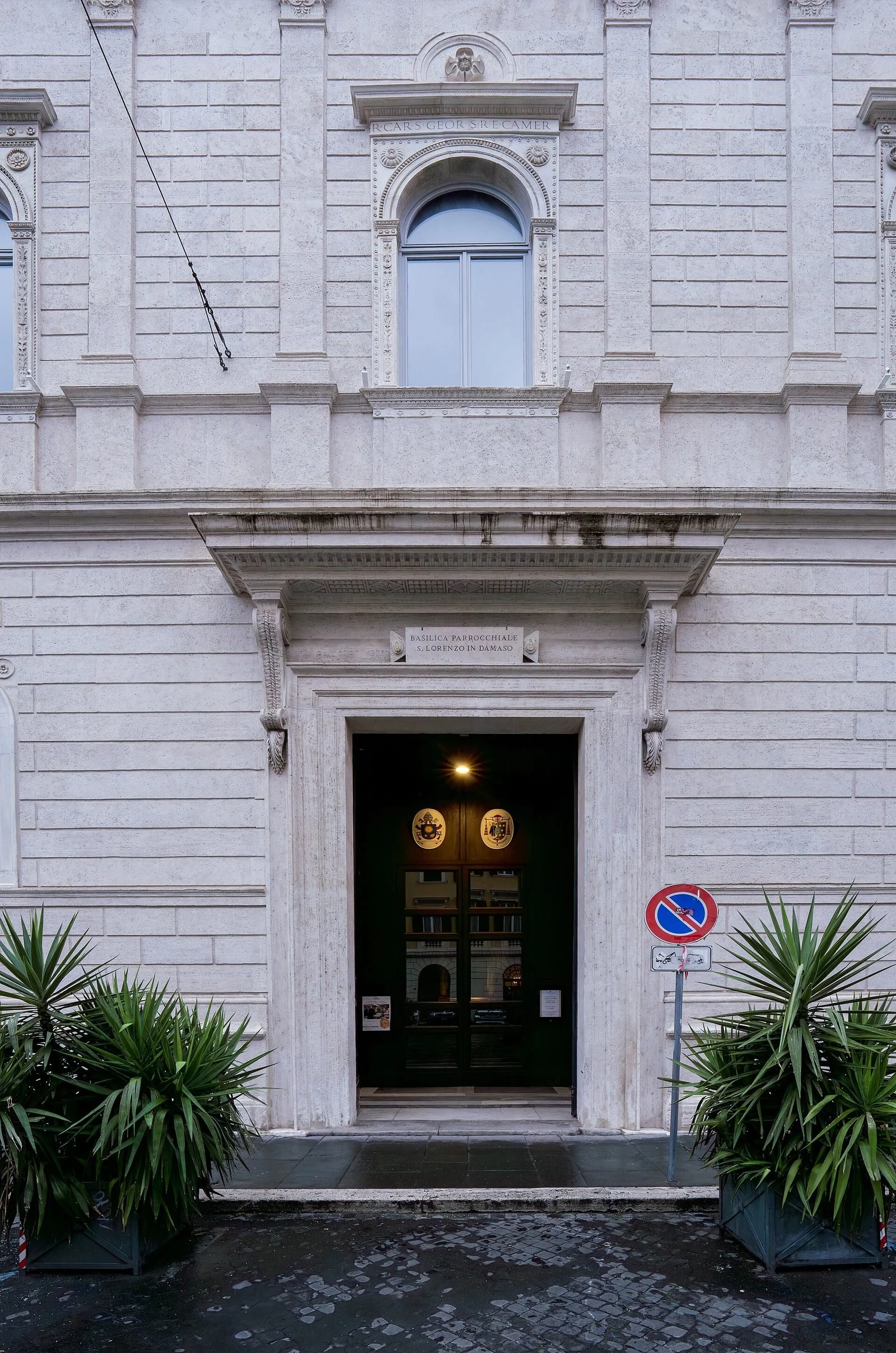
San Lorenzo in Damaso is an early Christian basilica that you can't see from the outside. Anyone walking along Corso Vittorio Emanuele II or coming out of Campo de’ Fiori passes in front of the travertine bulk of the Palazzo della Cancelleria and sees a Renaissance palace, period. Inside that palace, though, there is a titular church founded by Pope Damasus I around 380, an active parish of the Diocese of Rome, with free entry and a door that almost nobody recognizes as a church door. It is one of the few cases in the city where a very ancient place of worship was literally swallowed up by a civil construction site and has stayed inside it for 500 years. The practical question people ask when they get here is always the same, so let's answer it right away: you enter at number 1 Piazza della Cancelleria, on the right side of the facade, not through the monumental main portal of the palace. The lines that follow explain what you see once inside, what remains of Damasus's basilica, why the church is extraterritorial land of the Holy See, and which details on hours and access you should check before heading out.

Where San Lorenzo in Damaso is and which entrance to use
The basilica's address is Piazza della Cancelleria 1, in the Parione district, inside the perimeter of the Palazzo della Cancelleria, between Corso Vittorio Emanuele II to the north and Campo de’ Fiori to the south. The parish gives two different postal addresses for the same building: Piazza della Cancelleria 1, 00186 Roma, and Palazzo della Cancelleria, 00120 Città del Vaticano. That second postal code, 00120, is the ZIP code of Vatican City State, and it tells you the legal status of the building better than any explanation could.
The mistake almost everyone makes at the portal
The big portal in the middle of the facade on Piazza della Cancelleria is the entrance to the palace, not the church, and it leads to the Bramante courtyard. That is a different access, with different rules, different checks and no guarantee of being open. The door of the basilica is farther to the right as you face the facade, at number 1, and it is a marble portal attributed to Jacopo Barozzi da Vignola. People who arrive convinced they have to go through the monumental portal get stopped by the guards and often leave thinking the church is closed. It isn't. It's just behind another door, 20 meters away.
The second entrance on Corso Vittorio
There is also an access on the Corso Vittorio Emanuele II side, on the northern flank of the complex. It's not the one we recommend to first-time visitors, because it isn't always in use and because the front on Corso Vittorio is a 19th-century street backdrop, opened when the road was cut through between 1876 and 1886, tearing up the medieval fabric of Parione. If the portal on Piazza della Cancelleria turns out to be closed, it's worth trying from there. Under normal conditions, the main entrance remains the first one.
By public transport
The useful stop is Corso Vittorio Emanuele II at Largo di Torre Argentina, served by the surface lines that cross the historic center from east to west. From Largo di Torre Argentina it's a five-minute walk west along Corso Vittorio, passing the bulk of Sant’Andrea della Valle on your left. You can't get there directly by metro: Line A has its nearest stops at Barberini or Spagna, both a good 20 minutes away on foot, and Line B doesn't serve this area. If you're coming from Termini, it's quicker to take a surface bus that stops on Corso Vittorio, or to walk from Largo di Torre Argentina after taking the tram.
On foot, which is the right way
From Piazza Navona it's eight minutes, going through the alley that leads to Pasquino and then crossing Corso Vittorio. From Campo de’ Fiori it's a bit under three minutes, going up Via del Pellegrino or entering Piazza della Cancelleria from the short side. From the Pantheon it's 12 minutes, from the Capitoline Hill a little under 20. If you're coming from Trastevere, you cross Ponte Sisto and go up Via dei Pettinari and Via del Pellegrino: a quarter of an hour, all inside the historic fabric.
Hours, free entry and what to check before you go
Entry to San Lorenzo in Damaso is free: there is no ticket office, no reservation, no fee. The hours published by the parish show it open on weekdays from 10:00 to 12:30 and from 16:00 to 19:00, and on holidays from 10:00 to 12:00. We suggest treating these hours as indicative and not binding, for a specific reason that we explain below.
Why the hours of this church are more flexible than others
San Lorenzo in Damaso is a working parish inside an extraterritorial building that houses offices and tribunals of the Holy See. This means opening depends on three overlapping calendars: the liturgical one, the one for the custody of the palace, and the one for the events the Cancelleria hosts from time to time in the courtyard and the halls. When the palace holds an exhibition or a ceremony, the flows and the checks change. The time slots given by the parish are the best reference available, but a call to 06 698 87 521 or a message to info@sanlorenzoindamaso.it settles the doubt in two minutes, especially in July and August, when the parish suspends some of the celebrations.
Mass times
Masses in the basilica are reported as celebrated on weekdays at 18:30, with the holiday vigil at the same time and the holiday Mass at 11:00. The parish territory includes other churches, each with its own calendar, and in summer some celebrations are suspended. During Mass you can of course come in, but you don't walk around the church and you don't take photos: if you're coming to look at the architecture, make sure you show up outside services.
Accessibility
The access through the portal on Piazza della Cancelleria has a small step up from street level, and the interior hall is on a single level with no significant interior stairs up to the presbytery, which is raised. We are not aware of any official accessibility sheet being published with the measurements of the thresholds: if you use a wheelchair and want a reliable figure before leaving, ask the parish directly, they do answer. The rest of the palace, including any descents to the archaeological area, follows different rules and shouldn't be assumed to be accessible.
The extraterritoriality of the Holy See and what it really means
The Palazzo della Cancelleria, and with it the basilica of San Lorenzo in Damaso that occupies its right wing, enjoys the extraterritoriality of the Holy See under the Lateran Pacts of 1929. In practical terms: you are walking on Italian territory, but the building is removed from the ordinary jurisdiction of the Italian state and answers to the Holy See.
The concrete consequences for visitors
The first is that security is handled by the Vatican Gendarmerie and not by Italian law enforcement. The second is that access to the parts of the palace other than the church may require an ID and a stricter check than you find in a civic museum. The third, the one that surprises the most, is that the basilica is not part of the openings coordinated by the Capitoline Superintendency or of the state museum circuits: it doesn't appear in the museum nights, doesn't take part in the free Sundays, and isn't included in the combined tickets. People who look for it in the city calendars don't find it, and conclude it is closed. It is open, it simply answers to another administration.
Pope Damasus's basilica: the 4th-century titulus
The foundation goes back to Pope Damasus I, elected in 366 and died in 384, who built the basilica around 380 in his own private residence, in the area of the archive of the Roman Church that he himself had organized. The Damasian title appears in the records of the Roman synod of 499 called by Pope Symmachus, where it is registered as titulus Damasi: it is one of the oldest attestations among the titular churches of Rome.
Who Damasus I was, in two useful lines
Damasus was the pope who reorganized the memory of the Roman martyrs, had the catacombs repaired and made accessible, and had verse epigrams carved there in the famous lettering called Filocalian, after the calligrapher Furius Dionysius Filocalus. Anyone who has seen the Damasian slabs at the Catacombs of San Callisto or the Catacombs of Priscilla has already met his work without knowing it. He was also the pope who entrusted Jerome with the revision of the Latin biblical texts, the project from which the Vulgate would come.
How many churches of San Lorenzo there are in Rome, and why it causes confusion
Many, and the confusion is guaranteed. San Lorenzo fuori le Mura is the patriarchal basilica on Via Tiburtina, over the tomb of the martyr, in a neighborhood that bears the same name. San Lorenzo in Lucina is the titular church in Campo Marzio, near Via del Corso. San Lorenzo in Damaso is this one, inside the Cancelleria. They are three distinct buildings, in three different parts of the city, and anyone who types just “San Lorenzo” into a map almost always ends up at the wrong one. Then there are also San Lorenzo in Panisperna, San Lorenzo in Fonte and San Lorenzo in Miranda in the Roman Forum.
A curiosity about San Lorenzo in Damaso
Annibale Caro is buried in this basilica. He died in Rome in 1566 and was the man who translated Virgil's Aeneid into blank hendecasyllables, in the version that generations of Italian students have read at school. The funerary monument is the work of Giovanni Antonio Dosio. We point this out with a clarification that is worth more than the news itself: the claim keeps circulating with some insistence, even in popular materials, that Annibale Carracci, the Bolognese painter of the Farnese gallery, is buried here. He is not.
Where Annibale Carracci is really buried
Annibale Carracci died in Rome on July 15, 1609 and was buried in the Pantheon, next to Raphael, in line with a wish of his that the Roman art circles of the 17th century respected. The monument you see today in the rotunda is the result of a later arrangement, promoted in the late 17th century by the circle of Giovan Pietro Bellori and Carlo Maratti, who conceived the two burials as a single whole. The confusion between Annibale Caro and Annibale Carracci comes from the sameness of the first name and the similarity of the surnames, and it spread by copying. If someone tells you in front of the altar that the painter of the Farnese Gallery lies beneath, they are repeating a mistake.
Why this is not a pedant's detail
Because Annibale Caro rests in this church for a precise historical reason: he was secretary to the Farnese, and the Farnese had a long relationship with the Cancelleria and with this part of Rome, a few steps from the family palace. Cardinal Alessandro Farnese the Younger had an organ built for this basilica in 1533. Caro's burial here tells a geography of power and patronage that runs through the whole district, and that is easier to read by looking at the physical distance, four minutes on foot, between Piazza della Cancelleria and Piazza Farnese.
Riario's construction site and the demolition of the old basilica
Between 1489 and 1513 Cardinal Raffaele Riario, nephew of Pope Sixtus IV, had the Palazzo della Cancelleria built by tearing down the early Christian basilica that occupied the site. The church was not incorporated as an intact relic inside a new building: it was demolished and rebuilt elsewhere, in a different position and with a different orientation, inside the right wing of the palace. It's a distinction that changes everything and it's the reason why the interior you visit today has nothing late antique in plain view.
Who designed it, and why we don't know for certain
The architectural attribution of the complex is one of the open problems in the history of Roman Renaissance architecture. The names put forward by scholars for the palace and for the new basilica include Francesco di Giorgio Martini, Baccio Pontelli, Donato Bramante, Giuliano da Sangallo and Andrea Bregno. Part of the literature assigns to Bramante the work that gave the church its interior form, linking it to the courtyard construction. Other studies rule it out on chronological grounds, because Bramante arrives in Rome when the construction site is already under way. There is no consensus, and anyone who presents a single authorship as settled is oversimplifying.
The plan of the new church
The hall has three aisles divided by square pillars, preceded by a vestibule articulated in several bays that works as a filter between the street and the liturgical space. The central nave is vaulted, the presbytery is raised and closed by an apse that houses the large altarpiece. The dimensions are generous for a church squeezed inside a palace: the effect, on entering, is of a space much wider than the facade lets you imagine. This is the real coup de théâtre of the place, and it still works.
Something nobody tells you about San Lorenzo in Damaso
The basilica you visit today occupies a different spot from Damasus's. The 4th-century church lay more or less under the courtyard of the palace, with a different orientation, and its foundations were found right there during the excavation campaigns carried out starting in 1988. The floor that visitors to the Bramante courtyard walk on sits above the Damasian basilica, while the working church is beside it. This detail almost never appears in current descriptions, and without it the story of the place remains incomprehensible.
What the excavations gave back
The archaeological investigations brought to light the foundations of a large place of worship datable between the 4th and 5th centuries, with a transverse nave placed behind the apse, a rare plan solution that has drawn the attention of scholars of early Christian architecture. Roman structures predating the church also emerged, along with a burial area in use from the early Middle Ages until shortly before the construction of the palace. Some popular accounts also speak of a Mithraeum: the claim is not confirmed, as far as we know, by the reference scientific literature and we report it as a circulating hypothesis, not as an established finding.
The dates of the excavations: two versions
On the chronology of the campaigns the sources diverge, and the divergence is real, not apparent. Several popular information sheets give the period 1988-1991. The reference scientific publication, edited by the Vatican Museums and the Bibliotheca Hertziana and titled L’antica basilica di San Lorenzo in Damaso. Indagini archeologiche nel Palazzo della Cancelleria, edited by Christoph Luitpold Frommel and Massimo Pentiricci, gives the span 1988-1993 in its subtitle. The most likely explanation is that the actual excavation was concentrated in the first years and that the completion and documentation work continued until 1993. We report both dates because anyone who goes looking for the bibliography will find the second one.
Can you visit the excavations?
Not under ordinary conditions, and this is the point where it's best to be blunt rather than feed expectations. The archaeological area below the level of the palace is not part of the route of the parish church and has no stable public opening calendar that we have been able to verify. Guided visits dedicated to the church and its hidden parts are organized occasionally, offered by cultural associations and announced at short notice, but they are not a continuous service. Anyone who arrives at Piazza della Cancelleria hoping to go down under the basilica will almost certainly be left empty-handed. If you want to try, ask the parish in advance and keep an eye on the calendars of the cultural initiatives concerning the palace, including the exhibitions hosted in the Cancelleria complex, which sometimes open doors that are otherwise closed.
From the Napoleonic deconsecration to Valadier's restoration
In the early 19th century, during the French occupation, the basilica was deconsecrated and taken out of liturgical use. The Palazzo della Cancelleria was requisitioned and assigned to administrative functions of the new regime, and the church followed its fate, as happened to dozens of Roman religious buildings in those years.
The 1820 restoration
In 1820, by order of Pope Pius VII, the basilica was restored by Giuseppe Valadier, the architect who in the same years was working on the layout of Piazza del Popolo and the Pincio. The arrangement the hall has today is largely owed to Valadier: the neoclassical taste of the intervention can be read in the structural elements, the moldings and the treatment of the surfaces, and it explains why a church founded in the 4th century and rebuilt in the 15th has an interior with an air that many visitors find surprisingly 19th-century.
The work on the presbytery
Later in the 19th century the presbytery area was redone by Virginio Vespignani, the architect who in those same decades worked on many Roman churches, including San Lorenzo fuori le Mura and San Crisogono in Trastevere. The dates circulating for this work hover around 1868 and 1880 depending on the sources, and we have not found a single dating: we report it as falling in the last third of the century.
The 1944 fire and the 20th-century restorations
In 1944 a fire damaged the basilica and made a new restoration campaign necessary. It is the third great trauma in the history of the building, after the 15th-century demolition and the Napoleonic deconsecration, and it explains why part of the interior surfaces have a 20th-century look.
The advice I give you for visiting San Lorenzo in Damaso
The practical advice is one and it's worth more than all the others: arrive in a weekday afternoon slot, between 16:00 and 18:00, and not on Sunday morning. The holiday window is short, from 10:00 to 12:00, and it coincides with the 11:00 Mass, which leaves little room for looking. The weekday afternoon covers three hours, the church is almost always empty, and you can stand in front of the apse for 10 minutes without anyone passing by.
The verdict we feel we can give
San Lorenzo in Damaso is underrated, and for a structural reason: it has no facade. A church without a front of its own doesn't make it into photographs, doesn't make it onto covers and doesn't make it onto lists. At the same time, anyone who arrives expecting an early Christian basilica with mosaics and ancient columns will be disappointed, because there is nothing early Christian in plain view. The right way to visit it is to walk in knowing you are looking at a palimpsest: a Renaissance hall dressed by Valadier inside a palace that ate the church that stood here before. Seen like that it is amply worth the 20 minutes. Seen as a “4th-century basilica” it disappoints everyone.
What to look at, in order
Entering from the vestibule, turn around right away to look at the width of the hall compared with the door you came through: that's where you understand the relationship between church and palace. Then the apse altarpiece. Then the chapel with the 18th-century works on the right side. Then the Berninian cenotaph, mounted on the wall, which goes unnoticed by anyone who isn't looking for it. Finally the burial slabs, which in this church are an archive of names from the curial and literary Rome of the 16th and 17th centuries.

The works inside the basilica, and which attributions hold up
The painted and sculpted furnishings of San Lorenzo in Damaso cover a span from the 16th century to the early 19th, with a strong concentration in the Roman 17th and 18th centuries. We list what is documented solidly and point out where the literature is less firm.
The apse altarpiece by Federico Zuccari
In the apse there is a large oil painting by Federico Zuccari showing the Coronation of the Virgin and saints. It is the church's reference work and the first thing that catches the eye of anyone entering, because it closes off the perspective of the central nave. Federico Zuccari, from Sant’Angelo in Vado in the Marche, was one of the central figures of late 16th-century Roman painting, first prince of the Accademia di San Luca, and his work turns up in half of Rome, from the dome of Santa Maria del Fiore in Florence to the Vatican construction sites. Here he is in a late and restrained version, not among his freest efforts.
The Cavalier d’Arpino
Wall paintings by Giuseppe Cesari, known as the Cavalier d’Arpino, are also attributed to the church. He was the painter who dominated the Roman scene across the 16th and 17th centuries and in whose workshop Caravaggio passed through, very young and briefly. If you want to see the mature Caravaggio four minutes from here, you find him in the Contarelli Chapel at San Luigi dei Francesi, and eight minutes away in the Cerasi Chapel of Santa Maria del Popolo.
The Ruffo Chapel, Giaquinto and Conca
The Ruffo Chapel, built in the mid-18th century, preserves frescoes by Corrado Giaquinto and an altarpiece by Sebastiano Conca dated 1743 with the Madonna and Child, Saint Philip Neri and Saint Nicholas of Bari. Giaquinto and Conca are two names of the Roman Rococo of Neapolitan origin, and this chapel is one of the places where you see them side by side. If you follow the thread of Philip Neri through the city, you find it again a little farther along Corso Vittorio, at the Chiesa Nuova, where there is also the motorized Rubens painting, one of the most curious mechanisms in the historic center.
The cenotaph of Alessandro Valtrini
On the wall is the funerary monument of Alessandro Valtrini, chamberlain of Pope Urban VIII, attributed to Gian Lorenzo Bernini and dated around 1639. It's a small work compared with the scale of the church and goes unnoticed by anyone who isn't looking for it, but it belongs to the series of Berninian monuments with the winged skeleton holding the medallion, a formula Bernini worked out in these years and which would have an enormous success in European funerary sculpture. It's worth the stop more than the apse altarpiece, and that is our opinion, argued on the fact that there is a lot of Bernini in Rome but very little Bernini outside the crowded circuits.
The sculptures of Stefano Maderno
Statues by Stefano Maderno are attributed to the church. He was the Lombard sculptor active in Rome across the 16th and 17th centuries, author of the famous reclining Saint Cecilia found at Santa Cecilia in Trastevere. The sources indicate figures of Saint Charles Borromeo and Saint Francis Xavier here. The attributions of the minor sculptures in this church are not all equally solid: we report them as the current literature reports them, noting that we are not aware of a recent, systematic reexamination.
The burials
Besides Annibale Caro, the basilica holds the monument to Pellegrino Rossi, minister of Pius IX, assassinated in 1848 on the stairs of the Palazzo della Cancelleria, the work of Pietro Tenerani. It also holds the tomb of Cardinal Ludovico Scarampi Mezzarota, Patriarch of Aquileia, with a recumbent statue attributed to Paolo Taccone, and the monuments to Prince Camillo Massimo and his wife, attributed respectively to Filippo Gnaccarini and Pietro Tenerani. Under the high altar are kept the relics of Popes Damasus I and Eutychian.
Another well-known fact, yet rarely cited
San Lorenzo in Damaso is a cardinalatial title, that is, one of the churches of Rome formally assigned to cardinals as a sign of their bond with the clergy of the city, and it has been for more than 1,500 years, since the titulus Damasi attested in 499. The current titular cardinal is Antonio María Rouco Varela, archbishop emeritus of Madrid. The fact is known to those who follow ecclesiastical matters and ignored by everyone else, and it's worth understanding why it isn't a heraldic detail.
What a cardinalatial title really means
The College of Cardinals originates from the clergy of Rome. The cardinals, originally, were the priests who served the titular churches of the city and the deacons who administered its charitable works. When the college became international, the structure remained: every cardinal created receives a Roman church as a title, and through that title he formally becomes part of the clergy of Rome, which is the legal prerequisite for his taking part in the conclave. A bishop from Manila or Chicago is an elector of the pope because he is, on paper, a priest of a Roman parish.
Why this particular title matters
For two reasons. The first is its antiquity: very few Roman titles have a documentary chain going back to the 5th century. The second is that the title is historically tied to the office of vice-chancellor of the Holy Roman Church, the office that was based in this palace and that for centuries was one of the most powerful positions in the Curia. The cardinal vice-chancellor lived in the Cancelleria and held the title of San Lorenzo in Damaso: church, palace and office were one and the same. Rodrigo Borgia, before becoming Pope Alexander VI, held the vice-chancellorship for 35 years.
The right photo to take at San Lorenzo in Damaso
The photograph that really tells the story of this place isn't taken inside the church: it's taken outside, from the corner between Piazza della Cancelleria and Via del Pellegrino, framing the facade of the palace and the portal of the basilica in the same shot. It's the only way to make the viewer understand that that door is the entrance to a church and that the church sits inside that wall. A photo of the interior, taken on its own, could be of any Roman basilica reworked in the 19th century.
The light and the hour
The facade on Piazza della Cancelleria gets raking light in the late afternoon, when the low sun picks out the pilasters and the travertine cornices and brings back the relief of the composition. At noon the vertical light flattens everything and the travertine becomes a single flat surface. In winter the good window moves back by a couple of hours.
Inside the church
The interior is dark, and that is the first practical piece of information. The windows are few compared with the volume, and natural light is almost never enough. Shooting handheld without flash requires high sensitivity and a steady hand, and the results are what they are. Flash, as in all the churches of Rome, is to be avoided out of respect and because it flattens. A tripod in a working parish is not used without asking: the answer depends on the moment and on who is there.
Some important events that happened here in history
The chronology of this place holds together late antiquity, the Renaissance and the Risorgimento within a radius of a few square meters. We put them in order.
Around 380: the Damasian foundation
Pope Damasus I builds the basilica next to his own residence, in connection with the archive of the Roman Church. It is one of the great foundations of the 4th century, the century in which Christianity goes from a tolerated cult to the religion of the empire and fills Rome with new buildings.
499: the synod of Pope Symmachus
The records of the Roman synod convened by Symmachus register the titulus Damasi and the priests who serve it. It is the document that anchors the church to written history and that makes San Lorenzo in Damaso one of the Roman titular churches with the longest chronology.
1489-1513: the Cancelleria construction site
Raffaele Riario tears down the old basilica and builds the palace, rebuilding the church in the right wing. The construction site transforms the Parione district and produces one of the key buildings of the early Roman Renaissance. The materials come from the stripping of the ancient ruins in the area, starting with the Theater of Pompey.
1517: the cardinals' conspiracy
Raffaele Riario is implicated in the conspiracy against Pope Leo X, arrested, sentenced to an enormous fine and forced to hand the palace over to the Apostolic Camera. From that moment the Cancelleria becomes papal property, and that is the reason why today it is extraterritorial. A failed conspiracy five centuries ago explains the postal code 00120 on the parish's mail.
November 15, 1848: the assassination of Pellegrino Rossi
Pellegrino Rossi, head of the papal government, is stabbed to death on the stairs of the Palazzo della Cancelleria as he goes to the opening of the parliamentary session. It is one of the events that precipitate Pius IX's flight to Gaeta and the proclamation of the Roman Republic of 1849, the season that will end with the fighting on the Janiculum. Rossi's funerary monument is in this church, a few meters from the spot where he was killed.
1988-1993: the excavation campaigns
The archaeological investigations carried out in the palace bring to light the foundations of the Damasian basilica, earlier Roman structures and an early medieval burial area. The results go into the scientific publication edited by the Vatican Museums and the Bibliotheca Hertziana, which remains the essential reference for anyone studying the site.
Who passed through San Lorenzo in Damaso
The people who have passed through this place belong to very different categories: late antique popes, Renaissance cardinals, men of letters, architects and assassinated politicians. The list that follows is a selection of documented names, not a catalog.
Damasus I
The founder, pope from 366 to 384. He reorganized the memory of the martyrs, had epigrams carved in the catacombs and entrusted Jerome with the work on the Latin biblical texts. His relics are under the high altar, together with those of Eutychian.
Rodrigo Borgia
Vice-chancellor of the Holy Roman Church from 1457 to 1492, the year he was elected pope with the name Alexander VI. For 35 years the office tied to this church was his, and with it the control of the documentary machinery of the Curia. It was the period that built the economic fortune of the Borgia in Rome.
Raffaele Riario
Nephew of Sixtus IV, a cardinal at 17, patron of the palace and of the rebuilding of the basilica. He was also the cardinal who called the young Michelangelo to Rome after the episode of the fake Cupid. His career ended with the conspiracy of 1517 and the surrender of the palace.
Alessandro Farnese the Younger
Cardinal, collector and one of the most active patrons of 16th-century Rome, he had an organ built for this basilica in 1533. His name is tied to the family palace a couple of steps from here and to the construction of the Gesù, the mother church of the Jesuits, which lies 10 minutes farther east, toward Piazza del Gesù.
Annibale Caro
Secretary to the Farnese, poet and translator, died in 1566 and buried here. His version of the Aeneid in blank hendecasyllables was for centuries the way Italians read Virgil.
Gian Lorenzo Bernini
The monument to Alessandro Valtrini is attributed to him and dated around 1639. It's a sideline, little-visited Bernini, which makes it more interesting than many others.
Pellegrino Rossi
Jurist and economist, minister of Pius IX, assassinated in 1848 on the stairs of the palace. His funerary monument, by Pietro Tenerani, is inside the church.
The surrounding area: Parione, Campo de’ Fiori and Corso Vittorio
San Lorenzo in Damaso is in the Parione district, the fifth rione of Rome, a handkerchief of city between Piazza Navona, Campo de’ Fiori and the Tiber. It is one of the areas with the highest density of monuments in the historic center and at the same time one of the most trampled by passing tourism, which produces a precise combination: you walk among extraordinary things in the middle of a crowd that doesn't stop to look at them.
What is within five minutes on foot
The Museo Barracco, of ancient sculpture, is in the Farnesina ai Baullari, a little under a minute away. Pasquino, the talking statue, is on the other side of Corso Vittorio. Galleria Spada, with Borromini's perspective, is seven minutes away. Palazzo Braschi and Santa Maria della Pace are on the other side, toward Piazza Navona. Santa Maria in Monserrato, the Spanish national church, is five minutes away in the direction of Via Giulia, and the Oratorio del Gonfalone a little farther on. San Carlo ai Catinari is six minutes away toward Via Arenula, but it needs checking because it is affected by a long construction project.
The hinge on Corso Vittorio
Corso Vittorio Emanuele II, cut through at the end of the 19th century, split the district in two and left along its route a row of monumental fronts that almost nobody looks at because they are on a traffic road: Sant’Andrea della Valle, the Chiesa Nuova, Sant’Eustachio a little farther north, and the Tureen Fountain right in front of the Chiesa Nuova. Walking along Corso Vittorio with your head up completely changes your perception of this part of the city.
Toward the river and toward the Ghetto
Going down Via dei Pettinari you reach Ponte Sisto and, across it, Trastevere. Going east instead you enter the Ghetto, with the Portico of Octavia, the Synagogue and then the Tiber Island and the Theater of Marcellus. These are all trips of a quarter of an hour at most, and in this part of Rome walking is always faster than any vehicle.
Eating in the area without falling into a trap
The triangle between Campo de’ Fiori, Corso Vittorio and Piazza Navona is among the places in Rome most exposed to passing tourism, and as a result among the densest in places built to intercept people who walk without knowing where they're going. We don't name any signs, either good or bad: a list goes stale in a few months and teaches nothing. We give the criteria, which stay valid when the signs change.
The five signals we recognize in the field
The first is the lady rolling fresh pasta in the window or at a table on the street: it's an advertising lure, not a clue to the cooking. The second is the menu with photographs of the dishes, in whatever language it's written: it's for people who don't need to read, that is, people who won't come back. The third is the tout on the doorstep inviting you to sit down: a place with customers doesn't need to stop passersby. The fourth is non-stop hours from morning to night without a kitchen break: a real kitchen stops between services. The fifth is the position in front of a famous monument, where the price tends to adjust to the tourist in front of them, with items not priced on the menu or different price lists inside and outside.
The chains in the center
In the historic center, places with repeated signs have multiplied, with the same menu in several parts of the city and the queue with a ticket number at the entrance. We don't name them and we don't recommend them. The observation that matters is a different one: Romans don't go there. A business that lives exclusively on tourist flow has no reason to keep quality high, because the customer it loses wouldn't have come back anyway.
The simplest criterion of all
Look at who is sitting at the tables and what language they order in. If at 13:30 on a Tuesday the place is full of people speaking Italian and ordering without looking at the menu, you've found a place that works for the neighborhood. If the tables are occupied only by people with backpacks and an open map, the bill will tell the story. The criterion holds a couple of steps from San Lorenzo in Damaso as in any other part of the city, and it requires neither apps nor rankings.
The list we use
If you want to start from a selection that's already been made, there is Daniele Dezi's personal list on Google Maps, curated and not sponsored: no venue pays to be on it and none is removed on request. For a broader discussion of how to choose where to eat in the city, we refer you to our page on where to eat in Rome.
How to fit the visit into an itinerary
San Lorenzo in Damaso takes 25 minutes and has a limited opening window: building a whole morning around it is unwise, fitting it into a route is the right way to treat it. Three layouts that we have walked and that hold up even if the church turns out to be closed.
A Parione morning, two and a half hours
Start from Piazza Navona, go down toward Pasquino, cross Corso Vittorio, then San Lorenzo in Damaso and the facade of the Cancelleria, then the Museo Barracco and finish at Campo de’ Fiori. If you want to extend it, continue along Via dei Baullari to Piazza Farnese and the Galleria Spada.
A church afternoon, three hours
You start at 16:00, when San Lorenzo in Damaso reopens, and continue with Sant’Andrea della Valle, Sant’Ivo alla Sapienza if you happen on an opening, San Luigi dei Francesi for the Caravaggios and Sant’Agostino. It's a route that is all done within a kilometer.
With children, and when it rains
With small children this church holds up for 10 minutes: you go in, look at the apse, go out. It works better paired with an outdoor stop, like the Tiber Island or the cat sanctuary of Largo Argentina, which usually works better than any monument. If it rains the tour is still doable, because the distances are short and the churches are indoors, but in bad weather the hours get shorter and some doors close earlier.
Frequently asked questions about San Lorenzo in Damaso
How much does it cost to enter San Lorenzo in Damaso?
Entry to San Lorenzo in Damaso is free, as in almost all the churches of worship in Rome: there is no ticket office, no reservation and no fee at all. A visit to the Palazzo della Cancelleria is another matter and follows different rules, because the palace doesn't work as a museum with continuous hours. Anyone who finds paid offers online for the church alone is buying an accompaniment service, not an admission ticket.
What are the opening hours of San Lorenzo in Damaso?
The parish of San Lorenzo in Damaso gives opening on weekdays from 10:00 to 12:30 and from 16:00 to 19:00, and on holidays from 10:00 to 12:00. These hours are subject to change, because the church sits inside an extraterritorial building with its own activities and because in July and August the calendar thins out. Before going it's worth calling the parish number, 06 698 87 521.
Which entrance do you use for San Lorenzo in Damaso?
You enter San Lorenzo in Damaso at number 1 Piazza della Cancelleria, on the right side of the palace facade, through a marble portal attributed to Vignola. The monumental portal in the middle of the facade is the entrance to the palace and does not lead into the church. There is a second access on the Corso Vittorio Emanuele II side, not always in use.
Is San Lorenzo in Damaso the same thing as the Palazzo della Cancelleria?
San Lorenzo in Damaso is the basilica incorporated in the right wing of the Palazzo della Cancelleria, but the two have different access, hours and rules. The church is a parish open to the public with free entry. The palace houses offices and tribunals of the Holy See and can be visited only on particular occasions. For the architectural history of the palace, the Bramante courtyard and the travertine facade, we refer you to our dedicated page on the Palazzo della Cancelleria, which covers the civil building. This page covers the church.
Can you visit the excavations under San Lorenzo in Damaso?
The archaeological area with the foundations of Pope Damasus's early Christian basilica is not part of the ordinary route of San Lorenzo in Damaso and has no stable public opening calendar that we have been able to verify. The structures were investigated starting in 1988 under the courtyard of the palace. Guided visits are offered occasionally by cultural associations, announced at short notice: if you're interested, ask the parish.
Is it true that Annibale Carracci is buried at San Lorenzo in Damaso?
No: the person buried at San Lorenzo in Damaso is Annibale Caro, the man of letters and translator of the Aeneid who died in 1566, with a monument by Giovanni Antonio Dosio. Annibale Carracci, the Bolognese painter of the Farnese gallery, died in 1609 and is buried in the Pantheon next to Raphael. The confusion comes from the sameness of the first name and the similarity of the surnames, and it is repeated in many popular information sheets.
Why is San Lorenzo in Damaso extraterritorial?
San Lorenzo in Damaso enjoys the extraterritoriality of the Holy See because it is incorporated in the Palazzo della Cancelleria, which the Lateran Pacts of 1929 recognized as an extraterritorial property. The practical consequence is that security is Vatican security, that the basilica is not part of the Italian museum circuits or the free municipal openings, and that the parish's mail also uses the Vatican postal code 00120.
How much time do you need to visit San Lorenzo in Damaso?
To visit San Lorenzo in Damaso 25 minutes is enough, half an hour if you stop to read the burial slabs and look for Alessandro Valtrini's Berninian cenotaph on the wall. The hall is large but quick to take in, there are five or six works to look at calmly and there is no marked route. If you fit it into an itinerary, treat it as a stop, not as the goal of a morning.
Is San Lorenzo in Damaso suitable for children?
San Lorenzo in Damaso holds up for about 10 minutes with small children, because it is a dark church, with no educational route, no panels and nothing to touch. It works as a short stop within a walk that includes open spaces, for example Campo de’ Fiori or the Tiber Island. During religious services it's better to put the visit off, because you don't walk around the church and you don't take photos.
Who wrote this page
This page is maintained by the editorial team of Tour Leader Pro, the Rome-based project office that designs and coordinates visits, itineraries and cultural events in Rome and Lazio. The hours, fares and access conditions given here were checked on the official sources named in the text as of the publication date: it's worth rechecking them before you leave, because they change often. If you find an out-of-date detail, let us know.
If you are building an itinerary in the historic center of Rome by combining this stop with the other stops in Parione, the Ghetto and along the Tiber, you'll find planning tools and operational support at Tour Leader Pro, which works on the design of visits and cultural routes in Rome and Lazio.
For a wider picture of transport, travel times between Italian cities and destinations in Lazio outside Rome, a good planning resource is Italy Planner, especially useful to those who fit this stop into a longer trip and have to fit together trains, distances and available days.