Santo Stefano degli Abissini
In short. Santo Stefano degli Abissini is inside Vatican City, in Largo Santo Stefano degli Abissini, behind the apse of Saint Peter's Basilica, and cannot be visited freely.
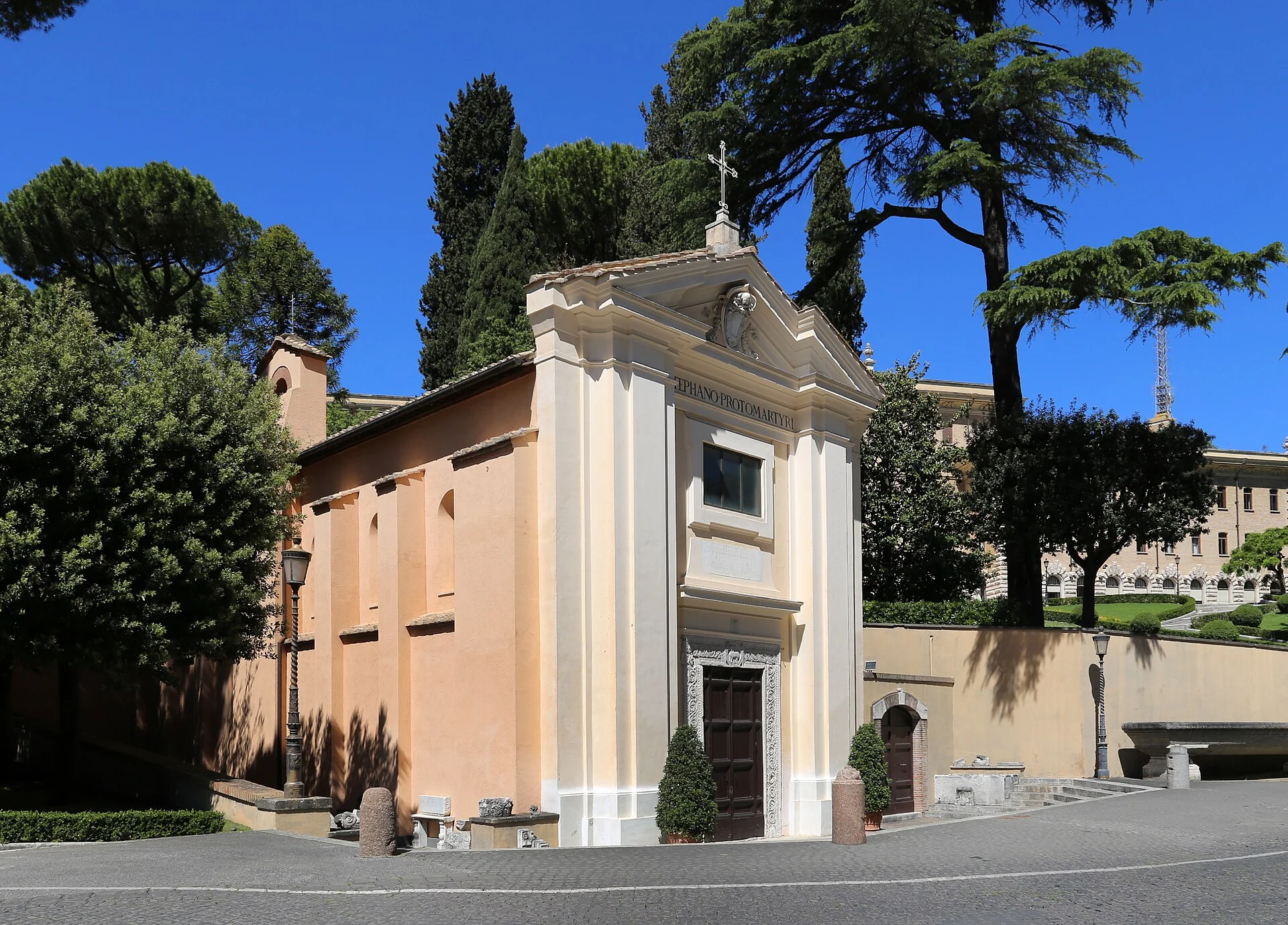
Santo Stefano degli Abissini is inside Vatican City, in Largo Santo Stefano degli Abissini, behind the apse of Saint Peter's Basilica, and cannot be visited freely. The church is entrusted to the Fabric of Saint Peter, has no regular liturgical service, no opening hours and no ticket, and is opened for authorized weddings and for the celebrations of the Ethiopian and Eritrean community. Anyone entering the Vatican on a guided visit of the Gardens can at most see it from outside.
It is considered the oldest church surviving inside the Vatican walls. A monastery of Saint Stephen already exists in 732, when a synod of Gregory III names it, and tradition attributes its foundation to Leo the Great. In 1481 Sixtus IV grants it to the pilgrims and monks who had come from Ethiopia, and since then the name has remained tied to them. Here rests the monk Tasfa Seyon, who in Rome printed the first New Testament in the Ge'ez language.
The practical information given here comes, as of September 28, 2026, from the websites of the Holy See, the Vatican Museums, Vatican News and the Vatican press cited further on. The rules for access to Vatican City State, the itineraries of the Gardens and the rates of the visits change without much notice: before organizing anything around this church, write or phone the official channels of the Vatican Museums and have them confirm what you will really see.
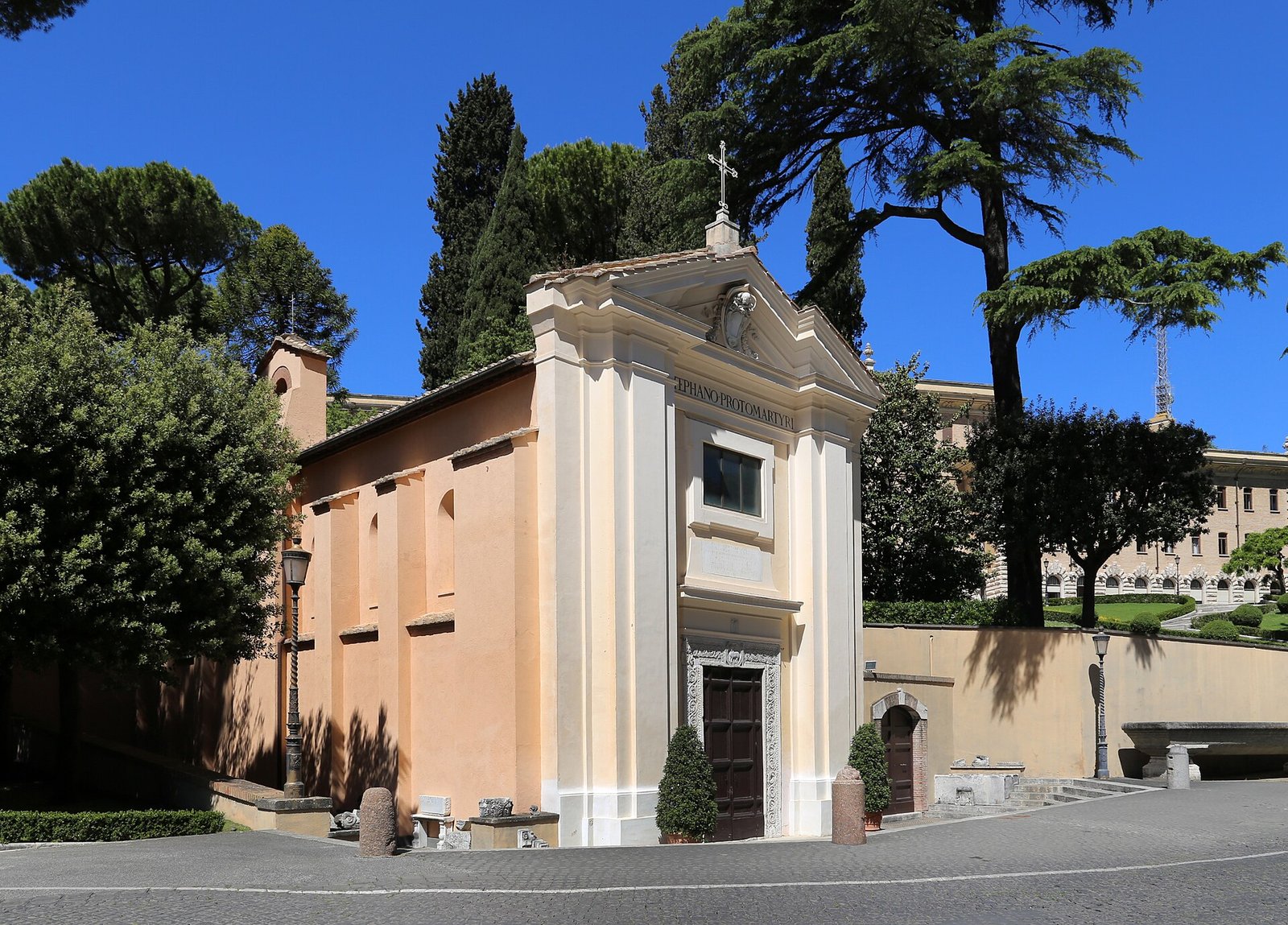
Where it is and what you actually see
The church occupies a small tree-lined lawn behind the Michelangelesque apse of Saint Peter's, in the sector of Vatican City that the public does not cross. It is lower than the surrounding street level, enclosed on its sides by retaining walls, and from far away it looks almost sunk into the ground. It is not an optical effect: the floor corresponds to an ancient walking level, closer to the necropolis than to that of the present gardens.
From outside you see a late Baroque facade of a single order, with paired pilasters, a triangular pediment bearing in stucco the coat of arms of Clement XI and the dedication to Saint Stephen the Protomartyr. At the center, set into the 1700s front, is the piece that matters: a marble portal of the 12th century decorated with scrolling vines, with the Lamb and the cross carved on the architrave. It is the most legible medieval element of the complex, and the only one you take in without going inside.
The interior, according to the descriptions published by L'Osservatore Romano and by scholars of Roman churches, is a single hall with exposed trusses, divided by a large transverse arch supported by cipollino columns. Along the walls remain seven ancient reused columns, some in fluted Lesbian marble. The presbytery is raised above a semi-annular confessio, and the high altar bears a painting of the stoning of the protomartyr by an uncertain author.
On either side of the presbytery open two chapels closed by gates. The one on the right is dedicated to Pope Saint Silverius, with an 18th-century altarpiece by Biagio Puccini and a marble bust of Clement XI. The one on the left is dedicated to the Madonna and holds a 15th-century fresco of the Virgin and Child. On the left walls, slabs with inscriptions in Ethiopic and Arabic were gathered during the restorations of the 1930s.
Under the floor, the restorations of the 1930s opened three crypts. In the right one, according to specialist descriptions, remain the remains of a square entrance portico of the 4th century with four columns at the corners, reworked before being absorbed into the church of the 9th century as a side access. The central one holds fragments of walls of the 7th and 8th centuries, too scant to be interpreted. The third, on the left, contains the row of Roman mausolea we speak of further on.
What you don't see: almost everything, for anyone with no reason to enter the State. The ordinary visitor to the Vatican Museums doesn't pass through here, anyone entering Saint Peter's Square and the basilica doesn't see the church, and the crypts under the floor, with the Roman mausolea, are not part of any public route. If someone sells you the interior visit of Santo Stefano as a tourist package, ask in writing who authorized it.
How you get in, and when you don't
The short answer is that you don't get in. The church is inside a State with guarded gates, and to pass them you need a recognized reason: an audience, an office, a guided visit sold by the Museums, an invitation. L'Osservatore Romano in 2009 and ACI Stampa in 2020 describe the same situation: no regular liturgical service, weddings and liturgies of the Ethiopian community on particular occasions. The information has not changed in the later sources consulted.
The only legal way for an ordinary visitor to approach the sector is a visit to the Vatican Gardens. The Museums sell tickets exclusively on their website, and the information sheet for the open bus tour published by the Museums lists €37 full price and €23 reduced, about 45 minutes, no stops with getting off, Monday to Saturday according to the Vatican calendar. The route, the operator warns, may change for unforeseen activities of the Holy See.
Where you really buy: on the official channel of the Vatican Museums, on the Gardens page, which refers to the online ticket office. There is no ticket for Santo Stefano degli Abissini, neither official nor sold by third parties, and no product on the booking platforms concerns this church as such. Anyone offering a dedicated entry is selling something the operator doesn't offer. For questions, the Museums publish the number 06 69883145 and the address info.musei@scv.va.
A clarification on the role of the Fabric of Saint Peter. It is the body that looks after and maintains the basilica and connected buildings, and the Ethiopians' church depends on it, as L'Osservatore Romano and the specialist profiles recall. For Santo Stefano no visit service open to the public and no calendar of openings is published. Anyone writing to the Fabric's offices looking for a ticket will not find a tourist booking channel, because that channel does not exist.
The official map of the barrier-free route of the Gardens, distributed by the Museums, marks the Pontifical Ethiopian College among the points of the park, next to the Governorate and Vatican Radio. The church does not appear by name. This means the guide may pass through the area, but no public document guarantees a stop in front of the facade. Ask before you buy: the answer changes from one tour to another.
Special cases remain. Guests at a wedding celebrated here enter with a permit for entry into the State, to be presented at the gates. Scholars with research reasons must apply well in advance to the competent offices of the Holy See, starting with the Fabric of Saint Peter. For the Ethiopian community's liturgies, access goes through the College. None of these channels is a tourist visit, and it's best not to treat them as such.
A curiosity about Santo Stefano degli Abissini
In the biography of Leo III contained in the Liber Pontificalis the church has a name nobody uses anymore: monasterium S. Stephani qui appellatur cata Galla patricia, the monastery of Saint Stephen called at Galla the patrician. That cata is Greek, and says that the Latin of early medieval Rome, around Saint Peter's, lived side by side with the language of the Eastern monks. The Ethiopians' church is born, in short, in a neighborhood already used to foreigners.
Who was Galla? Here we have to separate the levels. The document says only that the monastery was indicated by her name. Tradition identifies her with the noble Galla, daughter of the consul Symmachus, who widowed very young retired near Saint Peter's and whose death Gregory the Great tells in the Dialogues. Legend adds visions and miracles around her bed. The link between that Galla and this church is plausible, not proven.
Second curiosity, less literary. The right chapel is dedicated to Pope Saint Silverius, pontiff in the 6th century, deposed and dead in exile on the Pontine Islands. Specialist descriptions point out that it is the only dedication to Silverius among the churches of Rome. An almost forgotten pope, who has an altar only here, in a building almost no one can enter: Roman memory often works this way.
The third curiosity is the calendar. The Latin Church celebrates Saint Stephen on December 26, the Ethiopian calendar remembers him on January 9, and the College's feast follows the Ethiopian date, as ACI Stampa reports in January 2020. Anyone looking at the holy card and the Roman calendar risks getting the day wrong. Anyone who wants to know when the community celebrates must ask the College, not the calendar of the Vicariate.
One thing nobody tells you about Santo Stefano degli Abissini
The church rests on a row of pagan tombs. Under the left nave, according to the descriptions of the restorations of the early 1930s, five Roman mausolea of the 1st and 2nd centuries are preserved, decapitated and filled with earth when the platform of the church was built in the 9th century. It is the same fabric of burials that you can visit, by reservation with the Excavations Office, in the Vatican necropolis under Saint Peter's. The Vatican, under the grass, is an ancient cemetery.
The most surprising detail is under the high altar. The altar table rests on a Roman funerary cippus with the inscription dedicated to the gods Manes and to Marcus Junius Sabinianus by his brothers. A pagan tombstone holds up the altar of a Christian church dedicated to the first martyr. Reuse was normal in medieval Rome, but few examples are so direct, and very few are found a few dozen meters from the tomb of Peter.
In the confessio, the narrow semicircular corridor under the presbytery, one of the niches for lamps is topped by an architrave with the inscription Temp Domni Leonis Quarti, in the time of the lord Leo IV. It is the signature of a pope of the mid-9th century, the same who had the walls of the Leonine City built. More than any tradition about Leo the Great, that incised line says when the present church took shape.
Last thing, very practical: the crypts flood. The technical descriptions point out insufficient drainage, and the building's low level relative to the gardens explains the rest. It is one of the reasons why the underground rooms were never turned into a visiting route. Anyone imagining going down to see the mausolea as in the basilica's excavations should know that here that option does not exist.
Ethiopians in Rome, from the hospice to the College
The Ethiopian presence in Rome is older than Sixtus IV's grant. The rector of the Pontifical Ethiopian College, interviewed by L'Osservatore Romano in August 2009, recalled Abyssinian pilgrims documented in the city since 1351 and Ethiopian religious present at the Council of Florence. They came from the Holy Land, spoke Ge'ez and Amharic, and in Rome sought a foothold near the apostle's tomb. They found it here.
In November 1481, according to Vatican sources, Sixtus IV receives a group of Ethiopian envoys and grants them the church of Santo Stefano, then called Maggiore, with the attached houses. Other reconstructions date the grant to 1479. The sources don't agree on the exact year, they agree on the meaning: from that moment the building becomes the Ethiopians' home in Rome, and the people call it Santo Stefano of the Moors, of the Indians, then of the Abyssinians.
For centuries the complex works as a hospice for pilgrims and monks. In 1513 the Psalter in the Ge'ez language is printed in Rome, between 1548 and 1549 the New Testament edited by Tasfa Seyon comes out. Rome becomes the first European center of Ethiopian studies, and this small group of houses behind Saint Peter's is its laboratory. It is a story that art history textbooks don't tell, because it leaves no frescoes.
In 1919 Benedict XV turns the hospice into a college for students coming from Ethiopia. In 1929 the first stone of the new building in the Gardens is laid, in 1930 Pius XI inaugurates it as a pontifical seminary. Since 1980 the College welcomes priests studying at the pontifical universities, and since 2003 its management has been entrusted to the Lazarists. The church has remained where it was, a few steps from the College building, as a sign of a continuity of five centuries.
Today the College hosts Ethiopian and Eritrean clergy, celebrates in the Alexandrian rite in the Ge'ez language and, according to ACI Stampa, runs a monthly Mass broadcast by Vatican Radio on the first Sunday of the month. The resident priests provide pastoral service in the church of San Tommaso in Parione, the Roman reference point for the Ethiopian and Eritrean Catholic communities. It is there, and not at Santo Stefano, that you meet the Ge'ez liturgy as a worshipper.
The advice I give you for visiting Santo Stefano degli Abissini
Don't organize your day around this church. If your interest is the building, the only concrete opportunity is a visit to the Gardens, and even there a stop is not guaranteed. If your interest is the Ethiopian community, go to San Tommaso in Parione, near Piazza Navona, and ask at the parish for the times of the celebrations in the Ge'ez rite. The information is not published on the pages consulted.
If you book the Gardens, choose the walking visit instead of the open bus. The bus, say the Museums' rules, doesn't allow you to get off during the tour, and from a moving vehicle a sunken church between retaining walls is hard to see. At the time of purchase ask the Museums' service if the day's itinerary touches the sector of the Ethiopian College, and have them put it in writing.
Prepare beforehand. On site nobody will explain the portal, the mausolea under the floor or the story of Tasfa Seyon, because the Gardens guide has a long route and a hundred things to tell. Arrive knowing what to look for: the facade with the coat of arms of Clement XI, the Lamb on the architrave, the sunken lawn. Five minutes of reading turn a distracted glance into a recognition.
Dress as you would for the basilica. The Gardens' rules forbid sleeveless clothing, low necklines, shorts and miniskirts, and the check at the entrance applies them. The open bus tour is not accessible to those using a wheelchair and doesn't admit children under six, while for people with disabilities the Museums have a dedicated route in the Gardens, with a published map. Ask in advance which is suitable for you.
One last note for those marrying or invited to a wedding here. Organization goes through the competent Vatican offices, not event agencies, and entry into the State requires a permit. Bring a valid ID, arrive at the gates well ahead of time and don't count on wandering the Gardens after the ceremony: the permit is valid for the church, not for the rest of the State.
The Romanesque portal and the transformations of the building
The portal is from the mid-12th century, according to the profile published by L'Osservatore Romano in July 2009, and belongs to the reconstruction wanted by Alexander III in 1159. Jambs and architrave are worked with vine shoots that wind into regular scrolls, and in the center of the architrave the Lamb holds the cross. It is a Roman Romanesque vocabulary, sober, by local marble workers, the same found in the portals of so many medieval churches of the city.
In 1706 Clement XI has the church restored by the architect Antonio Valeri, but restores it by reducing it. The plaque on the facade recalls that the pope repaired the building constructed by Leo the Great with its monastery and then granted to the Ethiopians, and also rebuilt the houses and garden next to it. The apse of the larger medieval church was left outside the new perimeter, and the side aisles disappeared.
The second decisive building campaign is of the 20th century. Between 1927 and 1928, and then between 1931 and 1933, Gustavo Giovannoni frees the ancient columns from the masonry, digs out the confessio, opens the crypts and brings back to light what the 1700s had hidden. The modern baldachin, in colored marbles, bears the inscription of Pius XI's restoration of 1932. In 2008, the specialist profiles report, a new restoration of the facade was completed.
Anyone who manages to get in should note two details. The large transverse arch that divides the hall is not on the axis of the nave but slightly shifted to the left, a remnant of an older layout that the 1700s building site did not straighten. And under the altar, in the wall that closes the confessio, fragments of marble plutei of the 9th century are walled in, the slabs that enclosed the medieval presbytery. They are the pieces closest, by date, to the inscription of Leo IV.
The church we see, then, is a palimpsest: an 18th-century box inside which a 20th-century restorer has reassembled medieval fragments. The columns are ancient, the 9th-century plutei under the altar are authentic, the confessio is Leonine, the portal Romanesque. The whole, however, is a modern reading. Asking how much Giovannoni reassembled and how much he supplemented is legitimate, and the attentive visitor does well to ask the question in front of every column.
Another well-known fact, yet rarely cited
If this was Santo Stefano Maggiore, there was a lesser one. Next to the basilica stood another church dedicated to the saint, later assigned to the Hungarians and called Santo Stefano degli Ungheresi, tied to the hospice for Hungarian pilgrims wanted by King Stephen. In the 1770s Pius VI expropriated it and had it demolished to build the new sacristy of Saint Peter's, paying compensation to the Germanic Hungarian College.
The columns of the demolished church, according to the sources, were reused in that very sacristy. It is a coincidence that gives pause: two churches of Saint Stephen, two foreign communities, two opposite fates. The Hungarians lost theirs, the Ethiopians kept their own. Anyone who wants to find another link between the protomartyr and the Hungarians in Rome can climb the Caelian Hill to Santo Stefano Rotondo, entrusted for centuries to the Germanic and Hungarian college.
The second well-known and rarely cited fact concerns the very meaning of the term Abyssinians. Today the name sounds dated, and in Italian it carries the memory of the colonial war of the 1930s. The church keeps it because it is a historic name, older than that war by four centuries. Anyone hearing it for the first time and wincing should know that it was used by the Romans of the 1400s to indicate the pilgrims who came from the Ethiopian highlands.
Third fact. In 1929, with the birth of Vatican City State, the church and the College find themselves inside the borders of the new State, and ACI Stampa recalls that Pius XI granted citizenship to the members of the College that year. Few foreign communities in Rome have had such a close tie to the Holy See. The nearby Santo Spirito in Sassia also comes from a community of pilgrims, the Saxons, but remains outside the Vatican walls.
The right photo to take at Santo Stefano degli Abissini
The photo that counts is the portal. If the Gardens visit stops in front of the church, stand on the axis of the facade, from the highest level of the lawn, and tighten on the architrave with the Lamb. The 12th-century marble, set into the 18th-century plaster, tells the building's story by itself: two eras in the same frame, with no need for a caption. You need a medium focal length, not the wide-angle.
The second frame is an overall one and makes use of the difference in level. From the top of the retaining walls the church appears lower than the ground, and this is the most interesting visual fact of the place. Include the edge of the lawn and a tree as a frame, leave the facade at a third of the image. If the angle allows it and the light is good, the apse of Saint Peter's behind gives the measure of the closeness.
From above you can do something else, legally and without special permits. Anyone climbing the dome of Saint Peter's looks down on the sector of the Gardens behind the apse, where the church, the Ethiopian College and the Governorate are. Recognizing the gabled roof of Santo Stefano requires knowing where to look, and a telephoto lens. It's a photo to look for, more than to find, but it gives the geography of the place better than any map.
Two rules to respect. On the open bus tour selfie sticks are forbidden, and anyway you don't get off the vehicle. In the Gardens photograph what the guide shows you, without leaving the group to look for angles: security notices right away. And if you come across a ceremony in progress, a wedding or a liturgy, don't photograph the people. It is a community at prayer, not a backdrop.
Some important events that happened here in history
Between the 1st and 2nd centuries, mausolea are built on the Vatican hill along the roads rising from the circus of Caligula and Nero. Five of these tombs will end up under the church. The tradition reported by Clement XI's plaque attributes the foundation to Leo the Great, pope in the mid-5th century, but the specialist descriptions judge the date too early and think of a foundation by Eastern monks between the 7th and 8th centuries.
In 732 the monastery of Saint Stephen appears in a synod of Gregory III, and it is the first sure document. Between the end of the 8th and the beginning of the 9th century Leo III intervenes on the building, and the Liber Pontificalis names it with the reference to Galla the patrician. In the mid-9th century Leo IV builds the layout from which the present church derives, as the inscription in the confessio says. In 1159 Alexander III has it rebuilt.
In November 1481 Sixtus IV grants the church to the Ethiopians. The group of envoys arrives in Rome accompanied by a Franciscan from Imola, and the news is recalled both by L'Osservatore Romano and by Vatican News. From that moment the building takes the names of the community, and in 1513 the Psalter in Ge'ez comes out in Rome. In 1548 and 1549 the New Testament edited by Tasfa Seyon is printed.
In 1706 Clement XI has the church restored and reduced, entrusting the building site to Antonio Valeri. In 1919 Benedict XV turns the hospice into a college for Ethiopian students. On May 31, 1929 the first stone of the new building in the Gardens is laid, in the presence of 12 cardinals, and in 1930 Pius XI inaugurates the Pontifical Ethiopian College. Meanwhile Gustavo Giovannoni restores the church in two campaigns, up to 1933.
Since 1980 the College hosts priests instead of seminarians, in 2003 it passes to the Lazarists. On January 12, 2020, for the centenary, the church hosts the Divine Liturgy in the Alexandrian Ge'ez rite presided over by Cardinal Leonardo Sandri, then prefect of the Congregation for the Eastern Churches, with the metropolitans of Ethiopia and Eritrea. The day before, Pope Francis had received the College community in audience.
Who passed through Santo Stefano degli Abissini
Tasfa Seyon, a monk from Shewa, known in Rome as Peter the Ethiopian. He arrives in the city in the mid-1530s, after a pilgrimage to the Holy Land, becomes the leader of the community of Santo Stefano, advises Paul III, works with Cardinal Marcello Cervini, the future Marcellus II, and edits the first printed edition of the New Testament in Ge'ez. He dies in Rome, the sources not agreeing between 1552 and 1553, and is buried in this church.
A sentence of his remains that Pope Francis read in his address to the College of January 11, 2020, taken from documents edited by the scholar Renato Lefevre: “I myself am Ethiopian, a pilgrim from place to place.” The text goes on to say that only in Rome had he found peace of soul and body. It is one of the rare first-person voices of an African foreigner in the Rome of the 1500s, and deserves more attention than it receives.
Sixtus IV, born Francesco della Rovere, the pope who gave his name to the Sistine Chapel, receives the Ethiopian envoys in 1481 and grants them the church. He is the same pontiff who in those years renews the city's bridges and streets. Welcoming an African community next to the basilica, in our judgment, fit a precise design: to show Rome as the center of a Christendom that reached all the way to the Ethiopian highlands, beyond Egypt and the Red Sea.
Paschal I, before becoming pope in 817, was head of the monastery of Saint Stephen near Saint Peter's, according to his official biography. He is the pope who left Rome the mosaics of Santa Prassede, of Santa Maria in Domnica and of Santa Cecilia in Trastevere. Anyone who wants to understand what an abbot of this monastery could do once on the throne should go see those apses.
Clement XI, born Giovanni Francesco Albani, pope from 1700 to 1721, left here his coat of arms, a marble bust and the plaque that fixes the official version of the church's history. Gustavo Giovannoni, Roman architect and urban planner, theorist of restoration, signed the present face of the interior. They are two opposite ways of intervening on the past, two centuries apart, in the same small building.
In 2006 the church hosted the wedding of Lord Nicholas Windsor, a member of the British royal family converted to Catholicism, according to the accounts of the time. On January 12, 2020 Cardinal Leonardo Sandri, Cardinal Berhaneyesus Souraphiel, metropolitan of Addis Ababa, and Archbishop Menghesteab Tesfamariam, metropolitan of Asmara, celebrated there. And before all of them, five centuries of pilgrims whose names we don't know, who slept here, prayed and were buried.
Legends and mistakes in circulation
Descriptions copied from one another circulate online about this church, and some are wrong. The most widespread claims that the building stands on the remains of a temple of Vesta converted by Leo the Great. No published archaeological source confirms it: under the church there are funerary mausolea, not a temple, and the cult of Vesta in Rome had its seat in the Roman Forum. It is a legend, and should be treated as such.
Second recurring claim: Leo III's church was supposedly round, with 20 Corinthian columns. Here too the documentation of the restorations tells of a hall with aisles and an apse, later reduced to a single nave in the 1700s. The confusion probably comes from the same name as Santo Stefano Rotondo on the Caelian Hill, which really is round. Same saint, other church, other story.
Third: the church is called in some profiles a parish of Vatican City. It is not. The State's parish is another, and Santo Stefano degli Abissini depends on the Fabric of Saint Peter, as the Vatican sources recall. Fourth, the most insidious for the visitor: several online guides promise that the church is part of the Gardens tour. The operator doesn't say so, the official map doesn't name it, and the itinerary is declared variable.
You also read that Santo Stefano is the national church of Ethiopia in Rome. The formula is convenient but imprecise. The church is tied to the Pontifical Ethiopian College and to the Catholic community of the Ge'ez rite, which includes Ethiopians and Eritreans, while the Orthodox faithful of the two Churches have their own seats and calendars in the city. Calling it a national church overlays a political category on a more complicated ecclesial reality, with two States in between and a history of recent conflicts.
The position, without beating around the bush, is that the label of oldest church in the Vatican is used badly. It is true in the sense that the Romanesque portal, ancient columns and a 9th-century confessio survive here. It becomes misleading when it serves to sell a visit: what you see from outside is a facade of 1706, and what is ancient inside is a recomposition of the 1930s. The true antiquity of the place is the community, not the walls.
Where to meet the Ethiopian liturgy in Rome
Anyone who wants to attend a celebration in the Ge'ez rite should not try to get into the Vatican. The pastoral reference given by L'Osservatore Romano and ACI Stampa for the Ethiopian and Eritrean Catholics of Rome is San Tommaso in Parione, in the Parione rione, between Piazza Navona and Campo de' Fiori. The times are not published in the sources consulted and change with the seasons: ask the church or the College before setting out.
The rite is the Alexandrian one, derived from the ancient liturgy of Saint Mark, celebrated in the liturgical language Ge'ez. Anyone who has never seen it should prepare for a long celebration, with almost continuous singing and an assembly participation very different from that of a Latin Mass. Go in quietly, sit at the back, follow what the others do. You don't need to understand the language to understand what is happening.
The monthly Mass broadcast by Vatican Radio, according to ACI Stampa in 2020, is celebrated on the first Sunday of the month. It can also be followed from a distance, and it's the simplest way to hear the liturgy of the community that keeps Santo Stefano. For the Roman public the most heartfelt occasion remains the saint's feast in the Ethiopian calendar, January 9, which the College celebrates with its guests.
In the same city there are also Ethiopian and Eritrean communities of Orthodox tradition, with their own churches and times, distinct from the Catholic one that refers to the College. They are not the same thing and should not be confused. Anyone interested in the Christian East in Rome can pair this experience with the Russian Orthodox church of Santa Caterina, built in the park of Villa Abamelek, the Russian ambassador's residence, a short distance from the Vatican walls.
How to get to the area
Getting near the church is easy, getting into it is not. For the Gardens visits the starting point is the entrance of the Vatican Museums in Viale Vaticano. The Museums indicate metro line A, direction Battistini, with stops Ottaviano or Cipro, bus 49 with a stop on the square in front of the Museums, lines 32, 81 and 982 with a stop in Piazza del Risorgimento, and lines 492 and 990 on Via Leone IV.
Tram 19 has its terminus in Piazza del Risorgimento, but at the end of September 2026 the line was replaced by buses because of works: check the state of the service before counting on it. From the square the Museums' entrance is reached on foot along the walls. For Saint Peter's Square and the basilica you move toward Via di Porta Angelica and the colonnade, or from the Tiber embankment passing by Castel Sant'Angelo and Ponte Sant'Angelo. From here the church is not visible: it stays behind the apse, beyond the walls.
By car it makes no sense. The area of Borgo and Prati is squeezed between limited traffic zones, gates and full parking, and on days of audiences or celebrations in the square the traffic layout changes hour by hour. Anyone staying in the center arrives on foot in half an hour. Anyone coming from outside Rome leaves the car far away and uses the metro, which remains the most predictable means.
A note on the hours of the Gardens visits: they are held Monday to Saturday according to the Vatican calendar, which provides for closures on religious holidays and for events of the Holy See. The calendar of opening days is published by the Museums, and it's a good idea to check it before fixing the date. An extraordinary closure cancels the visit with nothing you can do to recover it the same day.
Eating in the area
The area between Saint Peter's, Borgo and the Museums is one of the hardest in Rome to eat well in, and the reason is simple: millions of people passing through, few who return. The streets leading to the colonnade and the Museums' entrance are full of places working on a customer they will never see again. It's not a matter of snobbery, it's a matter of economic incentives.
The first sign is menus with photographs of the dishes, often translated into five languages and laminated. A place that has to show you the picture of an amatriciana is addressing people who don't know what it is, and cooks accordingly. The second sign is the person at the door who stops you on the sidewalk to invite you to sit: a place with regular customers doesn't need to go and get them from the street.
Third sign, the woman rolling out the pasta sheet in the window or outdoors. It's scenery for passersby, not a guarantee: well-made fresh pasta is prepared in the morning, in the kitchen. Fourth, places open continuously from breakfast to night, with no break between lunch and dinner. A serious kitchen has a rhythm, a crew that rests and prepares. Continuous service usually means reheated ready-made dishes.
The fifth sign concerns the places set in front of monuments and on the routes of groups: items with no price, vague formulas like fish of the day, different price lists between the outside tables and the indoor room. Always ask the price before ordering and check that the displayed menu is the one they bring to your table. They are trivial precautions, but they avoid the most common bill surprise in the area.
A good alternative, for those who want to put together a lunch without sitting down, is the Mercato Trionfale, a few minutes on foot from the Museums, frequented by people who live in Prati. There you understand what the neighborhood really eats. The criterion remains this: look at who is sitting, in what language they order, if the waiter calls them by name.
To avoid trial and error, I keep up to date a selection of addresses we really go to, in Rome and the surroundings, with no sponsorships: our list of the places where we eat. It changes when the places change. Inside the State, along the route of the Gardens, you don't eat, and the open bus rules forbid consuming food during the tour.
What to combine in a day
The natural combination is a Gardens visit paired with the basilica and the excavations. The Vatican necropolis shows live what under Santo Stefano remains buried, and the Sistine Chapel completes the Museums tour. The Vatican obelisk, in the square, comes from the same circus beside which the mausolea stood. Anyone who knows the connections sees a single hill, not separate monuments.
Outside the walls, Prati and Borgo offer the rest of the story of foreign pilgrims. Santo Spirito in Sassia comes from the schola of the Saxons, the Passetto di Borgo follows the line of the Leonine walls, and the Auditorium Conciliazione closes Via della Conciliazione. They are stops different from one another, united by the same geography.
Those following the thread of national churches in Rome can continue with Santa Maria dell'Anima, the church of the Germans, San Luigi dei Francesi and the Basilica of San Giovanni dei Fiorentini. The thread of the Christian East leads instead to Santa Maria in Cosmedin, church of the Greeks, to San Giorgio in Velabro and to Santa Maria Antiqua, with its early medieval frescoes.
Those who like little churches that rarely open find in Rome other parallel stories. Santa Maria in Monticelli and San Salvatore in Onda are between Via Arenula and the Tiber, the oratory of San Giovanni in Oleo opens rarely next to Porta Latina. To end the day with a view of the dome and the Gardens, climb the Janiculum passing by Sant'Onofrio.
Those who stay on the theme of ancient burials, after the Vatican necropolis, find in the catacombs of Rome the natural sequel to the story begun under Santo Stefano. The catacombs of San Sebastiano, on the Appian Way, preserve pagan mausolea absorbed into a Christian complex, exactly as here. The difference is that there you can go in, with hours and ticket published by the operator, and see what in the Vatican stays closed under the floor.
Frequently asked questions
Can you visit Santo Stefano degli Abissini?
No, not with a free visit. The church is inside Vatican City, behind the apse of Saint Peter's, is entrusted to the Fabric of Saint Peter and has no opening hours or ticket. It is opened for authorized weddings and for liturgies of the Ethiopian community. The ordinary visitor can only hope to see it from outside during a guided visit of the Vatican Gardens.
Does the Vatican Gardens visit pass in front of the church?
It is not guaranteed. The official map distributed by the Vatican Museums marks the Pontifical Ethiopian College, a few steps from the church, but doesn't name Santo Stefano, and the operator warns that the itinerary may change for activities of the Holy See. Before buying, ask the Museums, at 06 69883145 or info.musei@scv.va, if the day's route touches that sector.
How much does the Gardens open bus tour cost?
The information sheet published by the Vatican Museums lists €37 full price and €23 reduced, for about 45 minutes of touring without stops to get off. The tour runs Monday to Saturday according to the Vatican calendar, does not admit children under six and is not wheelchair accessible. Booking is online only, on the Museums' website.
Can you attend a Mass in the Ge'ez rite?
Not at Santo Stefano, where there is no regular liturgical service. The Ethiopian and Eritrean Catholic community of Rome refers to the church of San Tommaso in Parione, where the priests of the Ethiopian College serve. The times of the celebrations are not published in the sources consulted and should be asked directly at the church. Vatican Radio broadcasts a monthly Mass in Ge'ez.
Why is it considered the oldest church in the Vatican?
Because the monastery of Santo Stefano is documented as early as 732 and the building preserves medieval parts: a confessio with an inscription of Leo IV from the 9th century, ancient reused columns, early medieval plutei and the Romanesque portal of the 12th century. Tradition attributes the foundation to Leo the Great, in the 5th century, but the archaeological sources judge that date too early.
Who is buried in the church?
The best-known figure is Tasfa Seyon, an Ethiopian monk known in Rome as Pietro l'Etiope, editor of the first printed edition of the New Testament in Ge'ez, who died in Rome in 1552 or 1553 depending on the source. Pope Francis recalled him as buried here in his 2020 address to the College. Beneath the nave are also preserved Roman mausoleums of the 1st and 2nd centuries.
Why is it called degli Abissini?
Abyssinians was the name Europeans used for the inhabitants of the Ethiopian highlands. From 1481, when Sixtus IV granted the church to the pilgrims and monks who came from Ethiopia, the Roman people called it Santo Stefano dei Mori, degli Indiani and finally degli Abissini. Before that it was called Santo Stefano Maggiore, to distinguish it from another church of the saint next to the basilica.
Can you get married at Santo Stefano degli Abissini?
The church hosts weddings, as reported by the Osservatore Romano and the Vatican press, and this is its most frequent use. The procedures, requirements and authorizations are not published publicly and go through the competent Vatican offices, starting with the Fabbrica di San Pietro. Guests enter the State with entry permits checked at the gates.
When is the feast of Santo Stefano celebrated for the Ethiopian community?
The community of the Ethiopian College celebrates the saint on January 9, a date of the Ethiopian calendar, while the Roman calendar remembers him on December 26. In January 2020 the celebrations of the College's centenary took place over three days, with the pope's audience on the 11th and the liturgy in the church on the 12th, presided over by Cardinal Sandri. The dates for later years should be asked of the College.
Who wrote this page
The page comes from the editorial team of Tour Leader Pro, the Rome-based outfit that designs itineraries, visits and cultural events across Rome and Lazio. The access arrangements, the Gardens fares and the news about the Ethiopian community reported here come from the official sources cited in the text, as of the date given at the start. The rules of the Vatican City State change: check them again before you leave and tell us what you find different.
Putting together a day in the Vatican means fitting together Museum time slots that sell out, gates with their own rules, closures tied to the Holy See's calendar, groups that must stay compact and places that you can barely glimpse from the outside, for yourself or for a party of 40 people. Anyone facing this kind of puzzle will find on Tour Leader Pro working materials designed for those who guide and for those who organize on their own.
For the wider picture, meaning regional trains and seasonal timetables, airports, travel between one province and another and destinations in Lazio outside the center of Rome, from the Castelli to the volcanic lakes of the north to the Tyrrhenian coast and the villages of the interior, a useful resource for putting together a multi-day itinerary is Italy Planner.