Vatican Necropolis and Scavi di San Pietro
In short. There is only one way to book the necropolis under St. Peter's Basilica: the request form on the website of the Fabbrica di San Pietro.

There is only one way to book the necropolis under St. Peter's Basilica: the request form on the website of the Fabbrica di San Pietro. No resellers, no agencies, no ticket office on site. The ticket costs €20 full price and €14 reduced for young people from 10 to 17 years old. You enter in groups of 12 people at most, accompanied by a guide authorized by the Fabbrica, and children under 10 years old don't get in at all. Photographs are forbidden along the whole route, with no exceptions. This page explains how booking really works today, how long you wait, what you see down there, and above all how to tell the Scavi from the Vatican Grottoes, which are two different places, at two different levels, with two completely different access rules. It's the misunderstanding that ruins more visits than any other.
Scavi and Vatican Grottoes: two different places under the same basilica
Under the floor of St. Peter's Basilica there are two levels one on top of the other, and almost nobody knows it before arriving. The first level, three meters below the current floor, is the Vatican Grottoes: the gap between the 4th-century Constantinian basilica and the Renaissance one built on top of it. The second level, 5 to 12 meters farther down, is the Roman necropolis: the street of pagan and Christian tombs on which Constantine planted his basilica.
The Vatican Grottoes are free. You enter from the basilica, without booking, every day from 9:00 to 18:00 according to what the Fabbrica di San Pietro publishes, and you find yourself in front of the tombs of the popes: 21 pontiffs, among them Paul VI, John Paul I, Pius XI and Pius XII. The niche that hosted John XXIII and then John Paul II now holds Benedict XVI, buried there in January 2023 after the bodies of his predecessors had been moved up into the basilica following their canonizations. You don't book, you don't pay, you don't ask anyone.
The Scavi are something else. You pay, you book months ahead, you enter in a group of 12, with a mandatory guide, in an environment at 98 percent humidity, and you don't take photos. The confusion comes from the fact that at both levels people talk about the tomb of Peter: in the Grottoes you see the back of the Confessio and the wall that closes the sepulcher, in the Scavi you reach the real structure, the so-called Trophy of Gaius, from below and from behind. Whoever books the Scavi thinking of the tombs of the popes is thrown off. Whoever goes down into the Grottoes thinking they'll see the necropolis sees none of it.
The third source of misunderstandings is the necropolis of via Triumphalis, under the Vatican motor pool, which has its own entrance on piazza del Risorgimento and depends on the Vatican Museums, not on the Fabbrica. They are three distinct sites, three distinct managers, three distinct booking channels. I talk about it in detail further on, because it's the best fallback for anyone who can't get into the Scavi.
A simple scheme to keep in mind
Vatican Grottoes: free, inside the basilica, no booking, tombs of the popes, three meters below the floor. Scavi or Vatican necropolis: paid, separate entrance from via Paolo VI, booking mandatory well in advance, Roman tombs of the 1st and 2nd century and the sepulcher of Peter, up to 12 meters below. Necropolis of via Triumphalis: paid, entrance from piazza del Risorgimento, booking through the Vatican Museums, tombs of ordinary people, no link to Peter.
How you really book the Vatican necropolis today
The old address scavi.va now redirects to the basilica's website, and this is the first trap for anyone who read a printed guide a few years ago. Requests go through the booking form published on basilicasanpietro.va, in the section devoted to the Necropolis. The historic email of the Excavations Office is no longer the entry channel: the address the Fabbrica publishes today is for changing or correcting a booking that is already open, and it is visiteguidate@fsp.va. Writing there to book from scratch almost always gets you sent back to the form.
The procedure has two steps, and the second is the one that catches people. Once you fill in the form, a first email arrives with the summary: date, time, language, protocol number. Careful, that is not the final confirmation. Then a second email arrives with the link for payment by credit card, and only that payment closes the file. Whoever reads the first email as a ticket and shows up without having paid doesn't get in. Payment is by card only: there is no cash, bank transfer or payment at the counter.
On how far ahead to book, the Fabbrica doesn't publish a number. The site says booking is mandatory because of limited availability, and availability is truly limited: we're talking about roughly 250 visitors a day in total, divided into groups of 12 that leave 15 minutes apart. Do the math and you realize the daily offering is ridiculous compared with the numbers of St. Peter's Square. With groups you think in months, not weeks, and for the less requested languages even more. Anyone arriving in Rome in three days who wants the Scavi won't get them.
What to write in the form
Indicate a wide range of dates and more than one acceptable language, if you speak them. Groups are formed by language, so asking for a single fixed date in Japanese cuts the chances to almost zero, while asking for a whole week in Italian or English raises them quite a bit. The languages the Fabbrica declares are Italian, English, Spanish, French, German, Portuguese, Dutch, Polish, Hungarian and Japanese, and the booking system lists others as well, including Italian Sign Language.
The ticket is not refundable. The Fabbrica says so plainly, so the date you ask for has to be a date you can count on. For the same reason it's best not to squeeze the Scavi into the day of arrival or departure: a flight delay eats a ticket you waited three months for. School groups can book, but there are no group discounts, and this throws off schools arriving from abroad who are used to other rates.
What doesn't work
No online reseller can sell you entry to the Scavi as an instant ticket. The offers you find around are almost always packages that include the basilica, the dome or the Museums, and the necropolis, when it appears, is a promise conditional on the availability of the Fabbrica. If someone guarantees you the Scavi for the day after tomorrow, either they have a booking already made in their name or they are selling something else. The same goes for the stalls around Vatican City: they sell the Museums, not the necropolis.
What it costs, who can enter, what you can't do
€20 full price, €14 reduced from 10 to 17 years old: these are the rates published by the basilica's booking system as of September 28, 2026. The price includes the authorized guide, who is not just any escort but staff authorized by the Fabbrica di San Pietro, and the visit lasts about an hour. Compared with other Roman underground sites the ratio between price and content holds up well, considering that the rate includes an hour of explanation and not a flyer.
The age limit is rigid: under 10 years old you don't get in, and it's not a recommendation but a ban. Anyone traveling with small children has to arrange for someone to keep them outside, because the Excavations Office has no childcare service. The necropolis is not accessible to people with mobility difficulties: there are steps at the entrance and the exit and the route runs over uneven ancient paving, so the Fabbrica explicitly declares it inaccessible.
The declared humidity is around 98 percent. It's not a detail to ignore: it means heavy air, fogged eyeglasses, a feeling of cool even in August and then sticky heat as soon as you come back up. Anyone who suffers from claustrophobia would do well to skip it, because the corridors between the mausoleums are narrow and in some stretches you proceed in single file. Dressing in layers is the obvious advice, but it works.
The rules that make visitors angry
Photos and videos are forbidden everywhere, for conservation reasons, and the ban is enforced. The story of the phone on silent doesn't count: the guides stop anyone who takes out a screen. Whoever wants images of the necropolis has to resign themselves to buying the Fabbrica's official volume or looking up published reproductions, because there is no legal way to take home a shot of your own.
Backpacks and large bags don't get in, and it's best to arrive with free hands. Clothing must respect the rule of Vatican places of worship, shoulders covered and legs covered at least to the knee, men and women alike. Food and drinks stay outside, with the sole concession of a small water bottle in the warm months. Restrooms are found before the entrance and at the exit, not inside.
Punctuality here is not a courtesy. You have to show up at the Excavations Office at least 10 minutes before the indicated time, and arriving late most likely means losing your slot, because the next group leaves 15 minutes later and there are no free places to slip into. Considering that the ticket isn't refunded, a quarter of an hour of distraction costs €20 and three months of waiting.
Where the Excavations Office is and how to get there
The Excavations Office can be reached only from the via Paolo VI entrance, under the left colonnade as you face the basilica, the same gate as the Paul VI Audience Hall. This is the information the Fabbrica publishes today, and it matters because for decades the reference was the Arco delle Campane, on the left side of St. Peter's Square, and a great many guides still give that one. If you have an old set of directions in hand, ignore it and go to via Paolo VI.
The gate doesn't look like a tourist entrance. There's the Gendarmerie, there's the Swiss Guard, there's a checkpoint, and you have to say you're going to the Scavi by showing the booking summary. Nobody will send you away if you get the wrong door, but they'll make you walk around the colonnade, and with the line in St. Peter's Square that detour can cost 20 minutes. Arrive with half an hour to spare the first time.
By subway
The useful stop is Ottaviano, on line A, and from there it's about 10 minutes on foot along via Ottaviano to piazza del Risorgimento and then into the colonnade. The next stop, Cipro, serves the entrance of the Vatican Museums and isn't convenient for the Scavi. Coming from Termini you take line A toward Battistini and don't have to change. For the full picture of tickets, validity and apps there's the page on how to get around Rome.
By bus
The most direct line is the 64, which connects Termini to San Pietro station by way of largo di Porta Cavalleggeri, a short walk from via Paolo VI. It is also the line most worked by pickpockets in the city, and that has to be said plainly. The 40 Express follows a similar route with fewer stops and arrives at piazza Pia, on the other side of Castel Sant'Angelo. Surface routes in Rome change often because of construction and closures, so check the same day on the transit company's app.
On foot, which is almost always better
From piazza Navona to the via Paolo VI entrance it's barely 20 minutes by way of ponte Sant'Angelo and via della Conciliazione. It's a walk worth more than any vehicle, because it makes you understand the geography of the Borgo and because with the traffic of the Vatican quadrant the bus is no faster than your legs. If you want to stretch it by 10 minutes, step into Santo Spirito in Sassia, which opens at odd hours and is almost always empty. The district around it is covered in the page on Prati and Borgo.
A curiosity about the Vatican Necropolis and Scavi di San Pietro
The necropolis was found by mistake, in 1939, while the burial of Pius XI in the Grottoes was being prepared. The workers digging the burial niche broke through a floor and found themselves facing ancient structures that nobody expected at that depth. Pius XII, just elected, decided to go to the bottom of it and launched a regular archaeological campaign that would last until 1949, in the middle of a world war, under a basilica that meanwhile kept operating normally.
The direction was entrusted to Monsignor Ludwig Kaas, administrator of the Fabbrica, who was not an archaeologist, alongside real scholars like Bruno Maria Apollonj Ghetti and the Jesuit Antonio Ferrua. Kaas walked around the site at night, alone, worried that human bones would be handled without respect. This nighttime habit, apparently harmless, would produce one of the most discussed scientific messes of the 20th century, and I talk about it in the chapter on the tomb.
The work was carried out in absurd conditions. The water table is high, the water had to be pumped away continuously, the spaces under Michelangelo's foundations were minimal and every removal had to be done without upsetting the structural balance of the basilica above. For years the matter stayed confidential: the news reached the public only in 1950, with a radio announcement by Pius XII during the Holy Year.
What you really see under the basilica
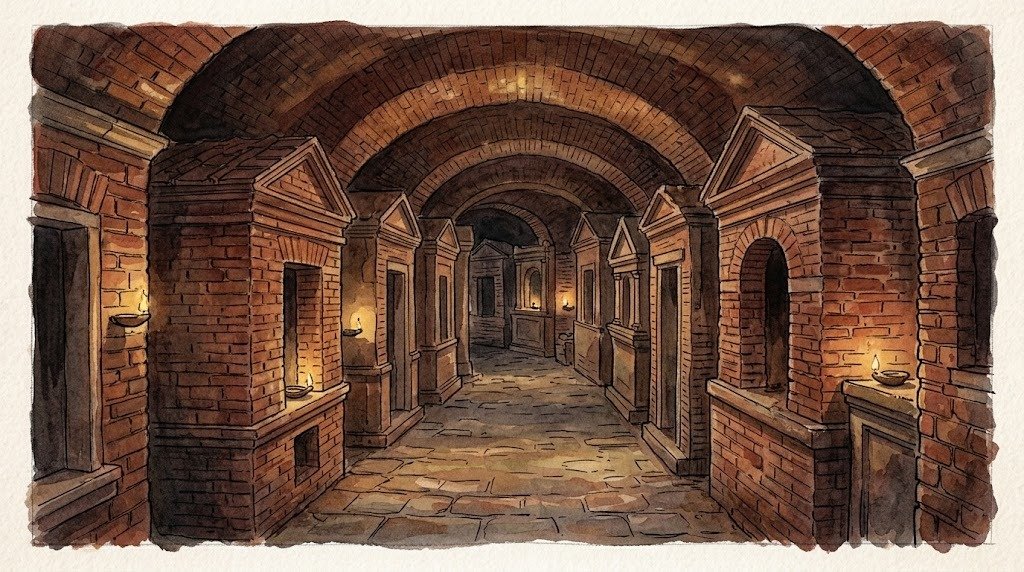
Under St. Peter's there is no crypt, there is a street. The necropolis is a Roman burial street with mausoleums lined up on both sides, as you see at Ostia Antica or along the Appian Way Regional Park, except that this one was sealed and filled with earth in the 4th century and nobody has touched it since. About 22 mausoleums have been excavated, along a stretch of street of about 30 meters, at a depth that varies between 5 and 12 meters.
Preservation is the real reason the ticket is worth the price. Constantine, having to build the basilica on the side of a hill, cut off the upper part of the tombs and filled the rest with packed earth, creating a platform. The result is that plaster, mosaics, stucco and inscriptions stayed buried in a stable environment for 1,600 years. You walk among walls that still have their original color, something that happens much more rarely in the catacombs of Rome.
The mausoleums are identified by letters, and some have names that are now in common use. The mausoleum of the Valerii has figured stucco on the walls. The one of the Iulii, the famous M, carries on its vault a mosaic interpreted as Christ as the Sun guiding the quadriga, one of the oldest documents of Christian iconography in a funerary setting. The mausoleum of the Egyptians has decorations in the Isiac taste. Cremations and inhumations, pagans and Christians, live side by side in the same street and sometimes in the same family.
Field P and the Trophy of Gaius
The end point of the route is an open area called Field P, where instead of mausoleums there are simple burials in the earth. Here stands an aedicula structure set against a wall plastered in red, the red wall, with two small columns and a niche. It is the monument that archaeologists identify with the Trophy of Gaius, the memorial that at the end of the 2nd century a Roman presbyter named Gaius described as the sign of Peter's burial on the Vatican hill.
Next to the red wall runs a perpendicular wall covered in graffiti, called wall g. It is a wall papered with invocations carved by pilgrims between the 3rd and 4th century, with the names of Christ, Mary and Peter repeated in monograms and abbreviations. That wall is the most solid archaeological proof we have of a cult practiced at that exact spot long before Constantine, regardless of what was really underneath.
Constantine absorbed the aedicula inside a marble structure and planted the axis of his basilica on top of it, shifting the level and sacrificing construction logic just to make the altar coincide with that point. This is the most powerful architectural fact of the visit: an emperor who twists an enormous project to respect a tomb. Over that vertical line later came the Renaissance Confessio, Bernini's baldachin and the dome.
One thing nobody tells you about the Vatican Necropolis and Scavi di San Pietro
The Scavi are hard to see. The necropolis is very narrow, the group of 12 people in single file covers almost the whole field of view, and whoever stays at the back often looks at the back of the person ahead while the guide talks. The mausoleums open onto tight openings and in many cases you don't go in, you peek. Nobody tells you beforehand.
The second thing you don't read anywhere concerns the order of arrival. Whoever gets to the front of the group at the start stays there for the whole hour, because the route is one-way and nobody swaps places. So showing up 10 minutes early isn't just to avoid losing your slot: it's to be in the first three. It's a small detail that completely changes the quality of the visit.
Third thing: you exit into the Vatican Grottoes. The route doesn't bring you back to the starting point, it comes out at the upper level, and this means that whoever has already visited the Grottoes sees them again, while whoever hasn't seen them gets them as a gift at the end. Knowing this, you build the morning differently, and above all you don't waste time doing them first.
The tomb of Peter: what is established and what is debated
Three different claims have to be separated, because they are usually kneaded into one. First claim: under the altar of St. Peter's there was, already at the end of the 2nd century, a monument venerated as the tomb of the apostle. This is documented by archaeology and by the sources, the Trophy of Gaius exists, the pilgrims' graffiti exist, and Constantine built around that point. On this the academic debate is essentially closed.
Second claim: in that monument there really was the body of Peter, who died in Rome under Nero. Here we leave archaeology and enter the history of traditions. That Peter died in Rome is supported by ancient sources and accepted by the majority of scholars, including non-Catholic ones, but the step from the memory of a cult to the physical presence of the body can't be proven with the tools of excavation. It is a plausible reconstruction, not a measured fact.
Third claim, the most contested: the bones displayed today as relics of Peter are his. Here the matter is complicated and worth telling in full, because in the necropolis the guide sums it up in two minutes and almost everyone leaves convinced it's a settled question.
The story of the box
Around 1941 the workers found human bones inside a marble-lined niche carved into the thickness of wall g. Monsignor Kaas, on his night rounds, had those bones removed by a worker of the Fabbrica, Giovanni Segoni, and had them put in a wooden box left in a storeroom of the Grottoes. All this happened without a record, without photographic documentation, without the archaeologists of the campaign being informed at the time.
The box stayed in storage for more than 10 years. In 1953 the epigraphist Margherita Guarducci, studying the graffiti, had Segoni tell her the story and got the contents recovered and analyzed. From that moment on the reconstruction rests on a late oral testimony: the chain of custody of the evidence, the one that in any serious investigation establishes what comes from where, was already broken.
Guarducci also read, on a plaster fragment of wall g, the Greek sequence that she interpreted as Petros eni, Peter is here. The anthropological analysis was entrusted to Venerando Correnti, who worked between 1956 and 1965 and described a sturdy male individual, around 60 or 70 years old, about 1.65 meters tall, with traces of gold thread and purple cloth. On June 26, 1968 Paul VI publicly announced that the relics of the apostle had been convincingly identified.
The objections, which exist and are serious
Antonio Ferrua, one of the four archaeologists of the original campaign, became Guarducci's harshest critic and the polemic lasted decades in the scholarly journals. On the epigraphic side, Ferrua and others argued that the fragment was too damaged to support that reading and that alternatives could be proposed, among them a formula of peace. On the logical side they asked why the most important relics of Christendom would have ended up in a small, irregular and architecturally secondary niche instead of a monumental reliquary.
Then there's the technical problem that is simplest to grasp: neither radiocarbon dating nor DNA or isotope analysis has ever been performed on those bones. Correnti's data say the individual was compatible with the traditional profile of Peter, not that he was Peter. Compatible and identified are two different words, and in everyday communication they become one.
Even the Vatican's language is more cautious than people think. On the reliquary given by Pope Francis to Patriarch Bartholomew the Latin putantur appears, meaning thought to be, not asserted. It's a nuance worth more than many pages: the Holy See distinguishes between what tradition believes and what science proves, and doesn't claim to have closed the question.
How to tell it
I say we are certain of the cult, reasonably sure of Peter's Roman death, and honestly uncertain about the bones. It's not a skeptical position, it's the position the sources allow. Whoever comes out of faith isn't diminished by it, because the value of that place doesn't depend on a lab test, and whoever comes out of historical curiosity appreciates being treated like an adult. The version without doubts is the one that does the most harm to both.
The advice I give you for visiting the Vatican Necropolis and Scavi di San Pietro
Book for early morning, and not for an aesthetic reason. The first shift at 9:00 finds the environment less saturated with residual humidity and above all finds via Paolo VI still clear, while from 11:00 on the square is a funnel and the checkpoint at the entrance slows down. On Saturday it closes at 12:30, so the offering is halved: if you can choose, aim for a Tuesday or a Wednesday.
When booking, ask for the addition of the guided visit of the basilica, which the Fabbrica grants only on specific request at the time of booking. It costs extra, but it solves the practical problem of coming out of the Grottoes and finding yourself inside St. Peter's Basilica with nobody explaining what you just saw from below. The continuity between necropolis, Confessio and baldachin is understood only if someone shows it to you in sequence.
Don't squeeze the Vatican Museums into the same midday. I know the temptation is strong because they are 400 meters away, but coming out of the necropolis with 98 percent humidity on you and getting in the Sistine Chapel line is the best way to remember nothing of either. The Scavi deserve a morning that ends calmly.
What to bring
Few things in hand, closed shoes with a non-slip sole, a light sweatshirt even in summer. The ancient paving is uneven and damp in some stretches. Leave the tripod, the camera and any idea of filming at home: they don't enter the picture and will only get you arguing with the staff. Bring instead the booking protocol number, printed or on the screen, because they ask for it at the gate.
If you have knee or balance problems, think seriously about it. There's no elevator, no alternative route and you can't leave halfway: once you start you go all the way to the end. Whoever doesn't feel up to it finds in the free Vatican Grottoes a much more comfortable version of the same sacred vertical line, with the steps reduced to a minimum.
The position not everyone likes
The Scavi are overrated as an experience and underrated as a document. Put like that it sounds like a paradox, but it's exactly what I think after doing them many times. Whoever arrives after months of waiting imagines a grand descent, and finds instead a narrow corridor, little light, an hour in single file and no chance to stop and look calmly at what strikes them. As a physical visit it is claustrophobic and rushed.
Whoever goes knowing what they're looking at comes out with something few other places in Rome give: the material perception of how a cult becomes a city. You see a street of ordinary tombs, with ordinary people, and you see how on top of one of them the building is raised that will organize the West for 1,600 years. This is why it's worth the wait, and not the archaeological marvels in themselves.
So the unpopular position is twofold. To those looking for the big visual hit I say that the mosaic of the quadriga is better understood from a reproduction than in person, and that if you only have two hours in Rome you're quicker going down into San Clemente, where the three levels can be walked without booking and are seen much better. To those who are really interested in history I say book right away, even a year ahead, because there is no substitute.
Another well-known fact, yet rarely cited
Everyone knows that Constantine's basilica was built on a necropolis. Almost nobody dwells on how transgressive that act was. Roman law protected burials very strictly: violating a tomb was a serious crime, and tombs were res religiosae, removed from trade and ordinary property. Constantine didn't build next to a cemetery, he built on top of it, cutting the structures and burying under earth private property that was still legally protected.
The second detail that is rarely cited concerns topography. The ager Vaticanus was considered by the Romans a poor-quality zone: damp ground, unhealthy air, terrible wine according to Martial, and across the river from the real city. They put the circus of Caligula and Nero there, they buried people there, they didn't live there. The basilica was therefore born in a despised periphery, exactly like Saint Paul Outside the Walls and the other great cemetery basilicas.
Third element little remembered: the Vatican necropolis was not Christian. It was a normal burial street, with a pagan majority, in which Christian burials appear gradually and live alongside the others without any separation. The same thing happens in the necropolis of via Portuense and in many other suburban funerary areas, and it dismantles the idea of hidden Christian communities separate from the rest of the city.
The right photo to take at the Vatican Necropolis and Scavi di San Pietro
The right photo at the Scavi doesn't exist, because photography is forbidden and the ban is enforced. This is the honest answer and it's best to put it first, so nobody arrives with the idea of stealing a shot. Whoever tries gets stopped, and in the worst cases the group loses precious minutes while the guide argues. The necropolis is to be looked at with your eyes and that's it, which is also why people who come out remember it better than many other places.
The photograph you can take, and that almost nobody takes, is the one of the exit. You come out in the Vatican Grottoes, where filming is limited anyway, and then you go back up into the basilica: the spot to look for is the one where the baldachin, the Confessio with its lamps and the dome line up. From there, looking down, you frame the exact vertical line under which you have just walked. It's a photo that means nothing without the visit and after the visit means everything.
Outside, the photograph to take home is the colonnade of via Paolo VI early in the morning, with raking light and no crowd. Whoever wants the whole view goes up on the bridge and uses ponte Sant'Angelo or the parapet toward Castel Sant'Angelo, where the dome stands out better than from inside the square. The Vatican obelisk in the center helps the composition more than you'd think.
A common framing mistake
Inside St. Peter's Square the dome disappears. It is the famous effect caused by Maderno's facade, too wide and too far forward, which hides it as you approach. Whoever wants the whole dome has to stay far away, and the spots that work are via della Conciliazione at the height of piazza Pia, the Janiculum and the lungotevere opposite. Whoever stands under the obelisk photographs a facade and nothing more.
Some important events that took place here in history
The first event is the construction of the circus of Caligula, completed by Nero, on the southern flank of this hill. Tradition places there the martyrdom of Peter during the Neronian persecution, and in that circus stood the obelisk that Sixtus V had moved to the center of the square in 1586, the only Roman obelisk that has always remained standing. The closeness between the place of execution and the burial area explains the logic of the cult much better than any theological discourse.
The second is the construction of the Constantinian basilica, begun in the years after 320 and carried on for decades. It is the intervention that closes the necropolis and preserves it, and it is also the moment when the area stops being a suburban cemetery and becomes the religious center of an empire that is converting. The building site required enormous excavation cuts on the side of the hill and equally enormous fill on the side toward the river.
The third is the demolition of the old basilica and the construction of the current one, between 1506 and 1626. A good century and more in which the Constantinian building is torn down piece by piece, the intermediate level of the Grottoes is created with its rubble materials and its papal tombs, and the dome is raised above. The passage from Bramante to Michelangelo, and then Maderno's facade and Bernini's colonnade, build the landscape you see today.
The fourth is the excavation campaign of 1939 to 1949, carried out under the bombs and under secrecy. The fifth is Pius XII's radio announcement in 1950, which declared the tomb of the Prince of the Apostles found during the Holy Year. The sixth is Paul VI's declaration of June 26, 1968 on the relics, which opened the most heated phase of the scientific polemic instead of closing it.
The 20th century and tourism
The regulated opening of the Scavi to the public is a relatively recent and cautious fact. It was never conceived as an attraction: the Fabbrica di San Pietro keeps the numbers low for conservation reasons, and the limits that seem severe today are the ones that saved the plaster. The switch to booking entirely online, with the old Scavi domain redirecting to the basilica's website, is the most important practical novelty of recent years.
Who has passed through the Vatican Necropolis and Scavi di San Pietro
Pius XII is the pope who wanted the excavation and followed its progress personally, even announcing its outcome on the radio in 1950. His tomb in the Vatican Grottoes is aligned exactly behind the Confessio, a choice that is anything but random. Whoever comes out of the Scavi passes in front of it almost without noticing, and it is one of the most eloquent topographical coincidences in the whole complex.
Margherita Guarducci is the figure who marked the later history of the site. An epigraphist of the strict school, the first woman to hold that role in a closed environment, she led the study of the graffiti and insisted that the contents of the box be re-examined. Her conclusions are debated, while her work on wall g has remained a reference point even for those who don't share the identification of the bones.
Antonio Ferrua represents the other side. A Jesuit, a leading Christian archaeologist, he also worked on many of the catacombs of Domitilla and on the Christian inscriptions of Rome, and he contested Guarducci's reconstruction point by point. The clash between the two is one of the harshest chapters of Italian archaeology of the 20th century, and whoever knows it listens to the guide's explanation with a different ear.
Ludwig Kaas deserves a mention of his own. A German priest and politician, former leader of the Zentrum, who arrived in Rome after the rise of Nazism and became administrator of the Fabbrica, he is the unwitting protagonist of the mess of the box. His night rounds came from a sincere respect for human remains and produced the documentary gap that still today makes it impossible to close the question.
Then everyone else passed through: the 3rd-century pilgrims who carved their names on wall g, the workers of the Fabbrica who dug under the bombs, and the popes who remained in the Grottoes above. John Paul II was buried there until 2011, before the transfer into the basilica, and in the same niche Benedict XVI rests today.
The third Vatican necropolis, the one on via Triumphalis
Whoever can't get into the Scavi has a serious alternative, and almost nobody knows it. Under the Vatican motor pool runs another necropolis, the one on via Triumphalis, identified between 1956 and 1958 during work for an underground parking lot and expanded with the excavation of the Santa Rosa sector in 2003. It depends on the Vatican Museums and not on the Fabbrica di San Pietro, so booking goes through the Museums' website.
Since November 2023 there has been a dedicated entrance, the Porta di Santa Rosa, which opens directly onto piazza del Risorgimento. Guided visits are held on limited days of the week and the availability, though not generous, is much more accessible than that of the Scavi. The depth is similar, the environment too, and for those who want to understand what a Roman necropolis was like the archaeological information is even better.
What changes is the social content. Those are the tombs of ordinary people, from the 1st century BC to the 2nd century AD: slaves, freedmen, artisans, with cinerary urns, amphorae used as containers, essential inscriptions and a few marble mausoleums of those who had risen a step. Later landslides sealed everything, preserving it. Whoever comes to Rome to understand everyday Roman life, and not for Peter, finds it more instructive than the necropolis under the basilica.
The other Roman descents, if the Scavi stay closed
Rome offers a quantity of accessible underground sites that makes giving up less dramatic. The columbarium of Pomponius Hylas and the Tomb of the Scipios show two different ways of burying: the second is booked through the municipal service, the first has been closed since August 1, 2024 for PNRR works. The hypogeum of via Dino Compagni has a funerary painting few people know. The general picture is collected in the page on underground Rome.
On the Christian front the Catacombs of San Callisto, the Catacombs of San Sebastiano and the Catacombs of Priscilla have their own ticket offices and are visited without biblical waits. The Catacombs of Santa Tecla and the Catacombs of Commodilla instead open only on request to the Pontifical Commission for Sacred Archaeology, with a per-group fee.
For the secular side there are the Roman houses of the Celio, the Vicus Caprarius under the Trevi area, the Stadium of Domitian under piazza Navona, the underground basilica of Porta Maggiore, the mithraeum of Santa Prisca and the Auditorium of Maecenas. Whoever wants visible stratigraphy has Crypta Balbi, which explains 15 centuries in a single block.
How to build the morning around the Scavi
The classic mistake is stacking too many things. The Scavi last an hour, the exit into the Grottoes and the climb back to the basilica take another, and by then three hours have already passed since the appointment. Adding the dome, the Museums and maybe Castel Sant'Angelo in the same block means running and remembering little. Two big places in a Roman day are already a lot.
If you want to extend it sensibly, the right direction is the Borgo. Leaving via Paolo VI you can walk up toward via della Conciliazione, detour into the surviving lanes of Borgo Pio, which still have a narrow-street layout, and then arrive at ponte Sant'Angelo. It's 20 minutes at a slow pace and it tells you what that neighborhood was like before the demolitions of the 1930s, which erased the Spina di Borgo.
Whoever still has energy climbs the Janiculum from via del Gianicolo, a 20-minute climb that pays back with the widest view over the city and the noon cannon shot. From up there you see the relationship between the dome and the rest of Rome, which you can't grasp from the square. Alternatively you move to the Vatican Gardens, which however have their own booking and channel.
For those who want to stay on the Peter theme there are two stops that fit well together. San Pietro in Vincoli keeps the chains of the apostle's prison tradition, as well as the Moses, and San Pietro in Montorio on the Janiculum marks the spot that a late tradition, archaeologically unfounded, indicated as the place of martyrdom. St. John Lateran also enters the discussion, because tradition places there the skulls of the two apostles.
Eating in the area without getting fleeced
The quadrant around the Vatican is among the most treacherous in Rome for finding something to eat, and the reason is arithmetic: millions of people a year, all short on time, all at the same hour. Where demand is guaranteed, quality stops being a commercial argument. Via della Conciliazione and the first side streets that open onto it are the zone where this effect is strongest, and whoever sits down there for convenience pays for that convenience twice.
The signs to recognize are always the same. The menu with photographs of the dishes is the first: no place frequented by Romans needs to show you what a carbonara looks like. The second is the person on the doorstep inviting you in, maybe in three languages, because a restaurant that has to stop you on the street has a customer problem and doesn't solve it in the kitchen. The third is the window with the lady rolling out pasta on the sidewalk: it's a staged lure, set up for the photo, not a clue to what will then arrive on the plate.
The fourth sign concerns hours. A kitchen that never closes, from morning to night without a break, isn't serving dishes made to order, it's reheating. Real Roman restaurants have an afternoon gap because the kitchen crew rests and preps. The fifth sign is the ambiguous price list: items without a price, fish and meat by weight without a clear indication, different prices between the menu displayed outside and the one they bring to the table. In places facing famous monuments this practice is frequent and hard to argue against, because when the bill arrives you've been seated for an hour.
Then there are the repeated signs, the ones you find identical in five different points of the center with the same decor and the same menu. They work as a tourist attraction, with their recognizable look and their fast service, and there is nothing scandalous in sitting down. It's simply that Romans don't go, and so they aren't the place where you'll understand what is eaten in Rome. I say it without an air of superiority: they are services designed for a passing public, and it's right to know what you're buying.
The criterion that works everywhere is only one: look at who's seated and in what language they order. If at 14:00 the room speaks Italian and there are people who work in the neighborhood, the place holds up. If it speaks only English and the tables empty and fill every 40 minutes, you're in a flow machine. In the Vatican quadrant this means moving away from the colonnade by five or 10 minutes on foot, toward upper Prati or toward the parts of Borgo that don't face the Conciliazione.
One last operational recommendation, valid above all for those coming out of the Scavi on a morning shift. The necropolis often ends between 11:00 and noon, that is before the Roman lunch hour, and sitting down at 11:40 almost automatically means ending up in a place that serves at any hour. Better to walk a bit, look at the windows of a bakery and wait for 13:00. The updated addresses are in the Google Maps list I keep open, and it's more useful than any list written here, because places change management and printed lists age badly.
Frequently asked questions
Are the Scavi and the Vatican Grottoes the same thing?
No, and this is the most widespread misunderstanding. The Vatican Grottoes are at the intermediate level, three meters below the floor of the basilica, house the tombs of the popes, are free and don't require booking. The Scavi are the Roman necropolis much farther down, cost €20, require booking well in advance and admit 12 people per shift with a mandatory guide.
How do you book the Vatican necropolis today?
Through the request form published by the Fabbrica di San Pietro on the site basilicasanpietro.va, in the section devoted to the Necropolis. The old domain scavi.va now redirects there. After the request a first summary email arrives with the protocol number and then a second email with the payment link: only payment by credit card finalizes the booking.
How much does the ticket cost?
€20 full price and €14 reduced for young people between 10 and 17 years old, according to what the basilica's booking system publishes as of September 28, 2026. The price includes the guide authorized by the Fabbrica di San Pietro. The ticket is not refundable and is valid for a single visit in a specific time slot.
How far ahead do you have to write?
The Fabbrica doesn't publish an official minimum lead time, it only states that booking is mandatory because of limited availability. With about 250 entries a day in groups of 12, in practice it's best to think in months and not weeks, especially for the less requested languages and for high-season periods. Indicating a wide range of dates raises the chances quite a bit.
Can children enter?
Only from 10 years old. Below that threshold access is forbidden without exceptions, and there is no childcare service at the Excavations Office. School groups can book, but the Fabbrica applies no group discounts, so every participant pays the full or the reduced rate according to age.
Can you take photographs?
No. Photos and videos are forbidden in the whole necropolis for conservation reasons, and the ban is enforced by the guides. Not even the phone is allowed as a recording device. Whoever wants images has to turn to the official publications of the Fabbrica di San Pietro.
In which languages is the visit held?
The Fabbrica declares Italian, English, Spanish, French, German, Portuguese, Dutch, Polish, Hungarian and Japanese, and the booking system lists other languages as well, including Italian Sign Language. Groups are formed by language, so availability changes a lot depending on which one you ask for. There are no audio guides dedicated to the necropolis.
Is the visit accessible to people with mobility difficulties?
No. The Fabbrica explicitly declares that the necropolis is not accessible to people with motor disabilities, because there are steps at the entrance and the exit and the route runs over uneven ancient paving. The humidity of around 98 percent and the narrow spaces make the visit inadvisable also for those who suffer from claustrophobia or have breathing problems.
Is it true that the tomb of St. Peter is down there?
Under the altar there is a monument that at the end of the 2nd century was already venerated as the burial of the apostle, and this is archaeologically established. That the monument really contained the body is a plausible reconstruction but not provable by excavation. The identification of the bones now displayed remains contested by some of the scholars, and no radiocarbon dating or DNA analysis has ever been done on the relics.
Who wrote this page
The editorial team that maintains this page is that of Tour Leader Pro, the Roman project office that designs itineraries, visits and cultural events in Rome and Lazio. Rates, hours and access conditions reported here are checked as of the publication date against the official sources cited in the text, and they change with a frequency that surprises anyone who doesn't work in this trade. It's always best to recheck them before leaving, and if you find a figure that no longer adds up, let us know.
Anyone who has to fit into a program limited access, request forms that answer after months, groups with rigid maximum numbers and walking distances that look short on paper, for themselves or for 20 people, will find planning tools on Tour Leader Pro, which gathers materials designed both for those who lead visits for a living and for those who organize on their own.
For the wider picture, the one that concerns trains, rentals, airports and destinations in Lazio outside the center of Rome, from the lakes to the Castelli and the coast, a resource that works is Italy Planner.