Columbarium of Pomponio Hylas
In short. The Columbarium of Pomponio Hylas is an underground burial chamber of the 1st century AD located at Via di Porta Latina 10, inside the Parco degli Scipioni, and as of September 28, 2026 it can't be visited: the Sovrintendenza Capitolina…
The Columbarium of Pomponio Hylas is an underground burial chamber of the 1st century AD located at Via di Porta Latina 10, inside the Parco degli Scipioni, and as of September 28, 2026 it can't be visited: the Sovrintendenza Capitolina ai Beni Culturali ordered its temporary closure to the public starting August 1, 2024, for the work planned under the PNRR. Anyone looking for information on reservations and hours has to start from this fact, because it's the fact that changes everything.
When it is open, this is one of the Roman sites with mandatory reservation and the lowest number of places of all: seven people per visit. Seven. Compare that with the 25 of the Casa dei Cavalieri di Rodi or the Museo del Teatro Argentina and you get a sense of the scale we're talking about. The page that follows lays out what you see down there, how access worked before the closure and what makes sense to do now instead.
How to visit the Columbarium of Pomponio Hylas today: the real state of access
The official page of the Sovrintendenza Capitolina dedicated to the monument carries, at the top of the information and reservations section, a single, blunt sentence: starting August 1, 2024, the site is temporarily closed to the public for the start of the work planned under the PNRR. The sentence is still there on September 28, 2026. No reopening date is given.
Where to buy tickets. The Columbarium of Pomponio Hylas is one of the monuments of the territory of the Sovrintendenza Capitolina: the official page is on sovraintendenzaroma.it and you book at 060608, every day from 9 to 19. Small groups, quarterly calendar, ticket paid in cash on site and cancellation within 72 hours. No booking platform sells it. Checked September 28, 2026.
A useful cross-check comes from the service notice on access and reservations for the Monumenti del Territorio, updated by the Sovrintendenza on September 24, 2026. That notice lists the sites open to the public one by one, from the Tomb of the Scipios to the Mausoleo Monte del Grano, from the Republican Tombs of Via Statilia to the Ninfeo degli Annibaldi. The Columbarium of Pomponio Hylas is not on that list.
Anyone who reads around that you just call 060608 and book is reading an old page. The number 060608 is real, it works every day from 9:00 to 19:00 and it's the right channel for the monuments of the Capitoline territory, but for this monument there is nothing to book today. Agencies and associations that keep advertising special openings here should be called and checked before you pay for anything.
How entry worked before the closure
The mechanism was the one common to the Monumenti del Territorio, with one extra restriction. Entry was allowed only to accompanied groups, with their own guide, for a maximum of seven people per visit. The reservation had to be made at 060608. For individual visitors there were individual visits on dates set by a quarterly calendar published by the Sovrintendenza, always with a reservation, and it wasn't unusual for those dates to sell out within a few days.
The general rules for associations remain those published in the notice: five appointments per quarter for each guide or association, two on weekends and three on weekdays. Reservations open on the first working day of the preceding quarter. There is a minimum purchase of five tickets, to be paid in cash on site, and cancellation at least 72 hours in advance, otherwise you pay for five full tickets. Anyone who organizes groups knows these lines by heart.
Published fares
The fares given by the Sovrintendenza for the Columbarium are four euros full price and three euros reduced. Entry is free for residents of Rome and the Metropolitan City, showing a valid document that proves residency, and free for MIC Card holders. The guided visit is not included in the ticket cost: you have to organize it on your own. Payment is in cash on site, not by card.
Four euros for a painted and stuccoed burial chamber from the Julio-Claudian period is an amount not worth commenting on. The real cost of this visit has never been the ticket: it's the time spent finding a date, putting together the minimum number of people and fitting a fixed appointment into a Roman day. That cost weighs far more than four euros.
Where the Columbarium of Pomponio Hylas is and how to get there
The address is Via di Porta Latina 10, rione XIX Caelian Hill, and the entrance is from inside the Parco degli Scipioni. The coordinates given by the Turismo Roma portal are 41.876568 north and 12.502077 east. The monument stood on a side road of the ancient Via Latina, just outside the urban line, in that strip of suburbium that from the 3rd century BC onward filled up with tombs along the consular roads.
A clarification on the street number, because sources differ. The Sovrintendenza Capitolina and the Turismo Roma portal give Via di Porta Latina 10. Some private online directories give number 14. The number to use for getting your bearings is the institutional one, that is, 10, but in practice the real reference is the gate of the Parco degli Scipioni: if you've arrived in front of the park, you've arrived.
Bus and metro
The Parco Archeologico dell'Appia Antica, which manages the nearby basilica at Via di Porta Latina 17, gives three surface lines for that address: the 218 with stop Cameria, the 360 with stop Latina and the 714 with stop Terme Caracalla. The reference metro is Line A, stop San Giovanni. We're a few tens of meters from the Columbarium, so these connections also apply to the Parco degli Scipioni.
None of these options drops the visitor in front of the gate. From the Latina stop you walk, from Cameria you walk, from San Giovanni you walk quite a bit, at least 20 minutes downhill through a quiet urban fabric with no shade. It's a part of Rome where distance on paper is deceiving: it all seems close together and yet between one city gate and the next there are always eight or 10 minutes at a normal pace.
Anyone who doesn't know the Roman transport system would do well to read first the guide on how to get around Rome by metro, bus, tram and tickets, because in this quadrant bus frequency is what it is and a 20-minute wait at the stop is business as usual, especially on Sundays.
The stairs, and who can't do them
Access to the burial chamber is by a narrow and very steep staircase of 25 steps. The fact is written in black and white in the visit sheets published by the Sovrintendenza and should be taken seriously. There is no alternative route, no elevator, no ramp. Anyone with mobility problems, balance difficulties or who suffers in tight spaces won't be going in here.
This needs to be said beforehand and not in front of the gate. In the list of the monuments of the territory the Sovrintendenza explicitly flags which sites are accessible to people with disabilities, for example the Mausoleo Monte del Grano or the Trofei di Mario: the Columbarium of Pomponio Hylas has never been among them. Anyone accompanying a mixed group must plan an alternative above ground for those who stay outside, and the Parco degli Scipioni itself is the most convenient one.
What a columbarium is and why there are so many in Rome
A columbarium is a collective burial chamber with walls hollowed into niches, in which the cinerary ollae were placed, that is, the terracotta vessels holding the ashes of the dead. The name comes from the resemblance to dovecotes, the buildings with niches for pigeons. The formula spread in Rome between the late Republican period and the 1st century AD, when cremation was the dominant funerary practice.
The reason for that spread is social before it is architectural. An individual tomb cost money, and those who couldn't afford one bought a niche inside a collective structure, often run by a funerary association or built by the master for his own freedmen and slaves. For this reason in Roman columbaria you read hundreds of names of freedmen, who are the class that fills the funerary inscriptions of the early empire.
This explains why around the southern gates of Rome columbaria are found in clusters. Outside Porta Latina and Porta San Sebastiano ran two great consular roads, Via Latina and Via Appia, and Roman law forbade burials inside the pomerium. The city of the dead therefore lined up along the outgoing roads, exactly where tourists headed for the catacombs pass today.
The other Roman columbaria
The closest direct comparisons are the columbaria of Vigna Codini, not far away, along Via di Porta San Sebastiano, on private property and not visitable today for safety reasons, as the Parco archeologico dell'Appia Antica indicates (see the page on the columbaria of Vigna Codini). Then there are the Republican tombs of Via Statilia and the tomb of Largo Talamo, both in the circuit of the Monumenti del Territorio. The necropolis of Via Ostiense shows the same logic on the other side of the city.
The Columbarium of Pomponio Hylas stands apart from all of these for a precise reason: the preservation of the decoration. In the other cases you read the structure, the niches, some inscriptions. Here the paintings, the stuccoes, the mosaic and the color survive, to an extent that has few equals in the Roman landscape. That, and not the rarity of the reservation, is the real reason the place matters.
The 1831 discovery and the man who found it
The columbarium was discovered in 1831 and the discovery is owed to Campana, a collector and director of the Monte di Pietà of Rome. On the name the sources don't agree on the form: the Sovrintendenza Capitolina writes marchese Pietro Campana, the Italian encyclopedia entry records Giampietro Campana, marchese di Cavelli from 1849. It is the same person, one of the protagonists of 19th-century Roman collecting.
Campana entered the Monte di Pietà as an assistant precisely in 1831 and became its director general in 1833. In those same years he was expanding a collection that would become one of the largest 19th-century collections of Greek and Roman antiquities, fed both by the antiquities market and by excavation permits. The columbarium on Via Latina falls within that season of excavations carried out by private individuals under papal license.
The story ends badly, and it's worth telling because it explains the dispersal of half of ancient Rome across European museums. Campana was arrested in November 1857 and convicted of embezzling the public funds he administered. 20 years in prison, commuted to exile. The collection was seized by the Papal State, cataloged in 1858 and sold: pieces ended up at the Louvre, the Hermitage, the Victoria and Albert, the Metropolitan.
The Columbarium of Pomponio Hylas, for once, did not follow that path. Being a monument dug into the ground and not a transportable object, it stayed where it was, with its paintings attached to the walls. It is one of the few things linked to Campana that in Rome can still be seen in the place where they were found, and this detail, for anyone who studies the history of Roman excavations, is not secondary.
The glass-paste mosaic and the names that give the monument its title
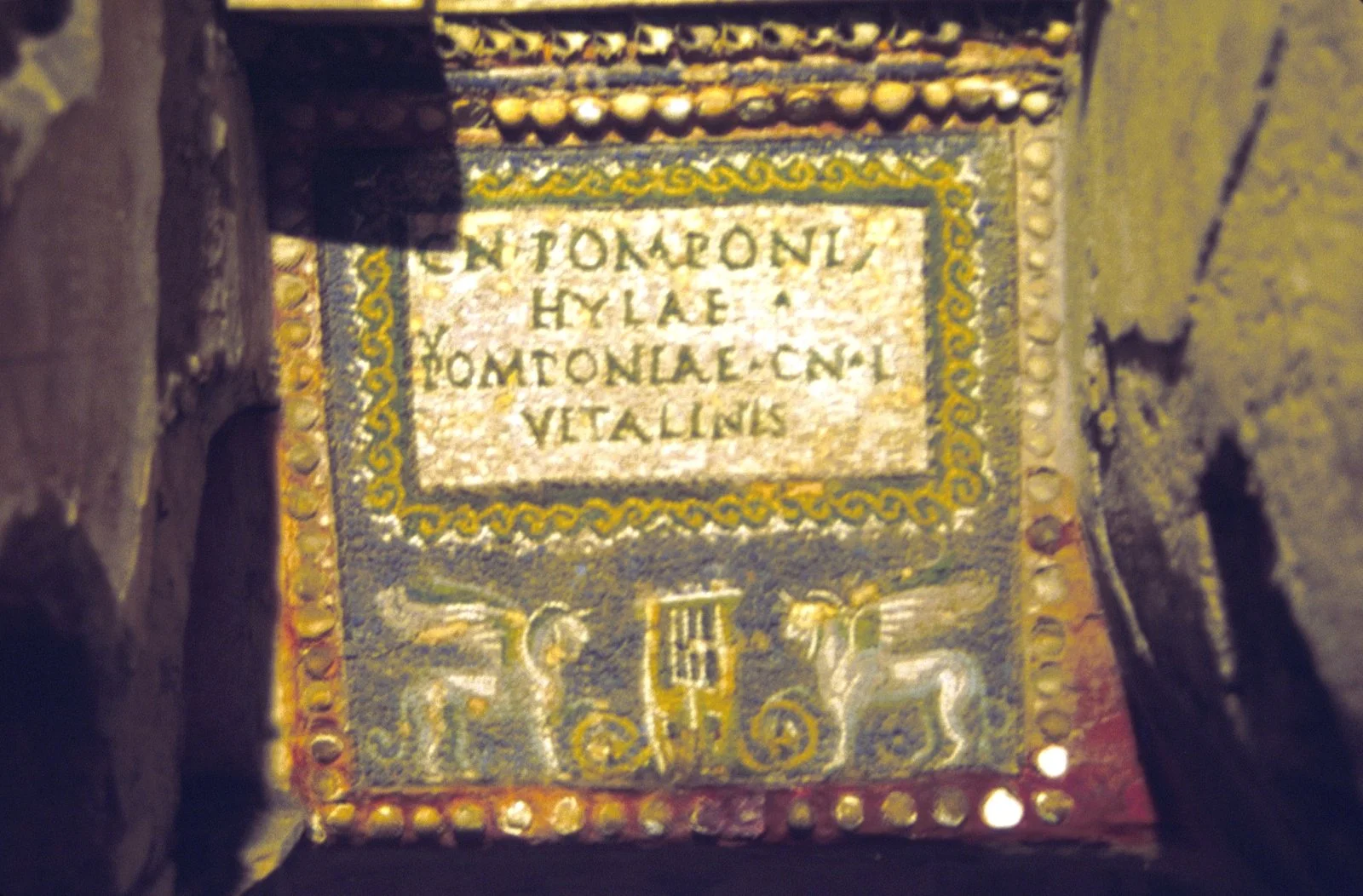
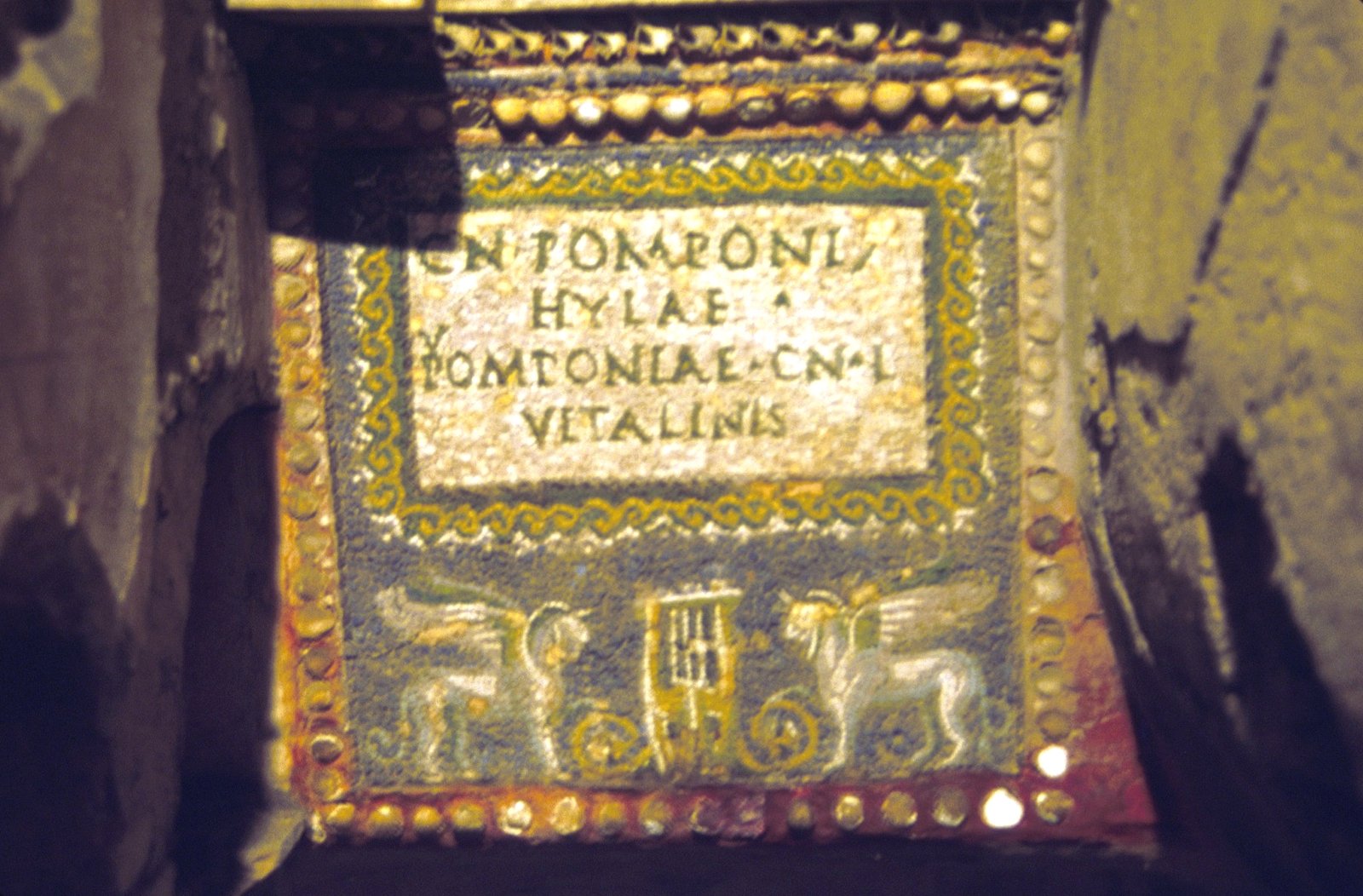
Above the staircase leading into the burial chamber there is a tablet in glass-paste mosaic, and that is where the monument's name comes from. The panel is decorated with two griffins facing each other and carries the funerary inscription of the freedman Pomponius Hylas. The text, recorded in the Corpus Inscriptionum Latinarum under number 5552 of volume 6, names Gnaeus Pomponio Hylas and Pomponia Vitalinis, freedwoman of Gnaeus.
Over the name of Pomponia the mosaic carries a V, an abbreviation of vivit. It means that the woman was still alive when the panel was made, a common practice in Roman funerary inscriptions made in advance. It's the kind of detail that in a 60-minute visit gets told in 30 seconds and that then stays in visitors' heads longer than everything else, because it makes the monument suddenly human.
The dating of the mosaic is later than the construction of the tomb. The Sovrintendenza places the panel in the Flavian period, between 69 and 96 AD, together with some changes to the decorative apparatus. The monument's name, therefore, comes from a later owner who bought the tomb and personalized it, not from whoever had it built. This explains some inconsistencies among the names you read in there.
Glass paste, not marble tesserae
The choice of glass paste in place of marble deserves a note. Colored glass in an underground space, lit by oil lamps, returns the light differently from stone: it sparkles in points instead of reflecting flatly. A funerary tablet in glass paste placed above the stairs was the first thing the ancient visitor saw when going down, flame in hand, and it worked as a luminous sign.
Granius Nestor and Vinileia Hedone: the two who were there first
In the central aedicula of the back wall two figures are painted, and under them a marble tablet carries two names: Granius Nestor and Vinileia Hedone. The Sovrintendenza Capitolina indicates them as the probable founders of the tomb. They, not Pomponio Hylas, have the place of honor in the chamber, that is, the center of the wall you face when going down the stairs.
The current reading is that Pomponio Hylas acquired the tomb at a later time, for himself and his wife, and added his own mosaic at the entrance. The monument thus bears the name of a buyer and keeps at its center the portraits of the builders. In the Roman logic of the tomb as a patrimonial asset, which is sold and inherited, this is not strange at all.
The chronology of construction comes from other inscriptions in the chamber. Two niches in particular are referred to a freedman of Tiberius and a freedman of Claudia Octavia, daughter of Claudius and Messalina: hence the range between 14 and 54 AD that appears in the literature. The Sovrintendenza gives a slightly narrower interval, between the principate of Tiberius and that of Claudius, that is, 14 to 51 AD.
The use of the tomb continues well beyond that. After the Flavian phase of the mosaic, the institutional sources reach the Antonine period, between 138 and 161 AD. That means this room received burials for about a century and a half, across four imperial dynasties, changing owners and decorations like an apartment that passes from hand to hand.
The paintings, the stuccoes and the question of Orpheus
The burial chamber is rectangular, covered by a finely decorated vault with plant motifs. At the center of the walls the niches for the ollae are contained in small architectural structures in the shape of an aedicula, with little columns and a pediment, decorated with paintings and stuccoes. These are not holes in a row as in the poorer columbaria: each niche has its own painted architectural frame, like a house in miniature.
The figurative apparatus is the reason this monument has been studied for almost two centuries. Frescoes and stuccoes of very high quality make up a symbolic program that, in the reading of the Sovrintendenza Capitolina, alludes to the different destinies of the soul in the afterlife and is largely centered on the figure of Orpheus, singer and also founder of cults and mysteries, taken as a symbol of immortality.
Here the descriptions diverge and it's worth saying so. Some non-institutional sheets read the same repertoire in a Dionysian key rather than an Orphic one, and draw from it the image of a cultured patronage celebrating, through myth, its love of literature. The two readings don't entirely exclude each other, because Orphism and Dionysism share imagery, but the source to cite first remains that of the Sovrintendenza.
The comparison with Pompeian painting
A recurring reference in the bibliography is the classification of Pompeian painting styles, and in particular the third style, the one with monochrome grounds, slender aediculae and figured panels at the center. Anyone who knows the walls of Pompeii and Herculaneum recognizes the same vocabulary here, applied to a funerary setting instead of a domestic one. The relationship between the house of the living and the house of the dead, in 1st-century Rome, was conceived exactly this way.
For anyone who wants to see Roman painting of that level without waiting for the reopening, the reference in the city is the frescoes section at Palazzo Massimo alle Terme, with the reconstructed rooms of the Villa of Livia and the Farnesina. For late antique funerary painting, instead, the obligatory comparison is the Hypogeum of Via Dino Compagni, not far from here on the same Via Latina.
A curiosity about the Columbarium of Pomponio Hylas
The monument bears the name of the wrong person, or at least of the less relevant owner. Pomponio Hylas bought a tomb already built at least a generation earlier, put a mosaic with his own name over the entrance and took the title for the centuries that followed. The founders, Granius Nestor and Vinileia Hedone, have their portraits at the center of the back wall and don't appear in the monument's title.
It happens because 19th-century archaeology christened monuments after the first legible element at the entrance. The mosaic was above the stairs, it was showy, it was intact, and the name stuck. If the criterion had been chronological, today it would be called the columbarium of Granius Nestor, and nobody would look for it on the internet under that name.
There is a second aspect that amuses Romans. Hylas and Vitalinis are freedmen's names, that is, names of former slaves who were freed: the first of Greek origin, the second Latin with that ending in -is that recurs often in the inscriptions. The most refined monument of this strip of suburbium thus belongs to people who started from the lowest rung of the Roman social ladder and bought themselves a decorated eternity.
Something nobody tells you about the Columbarium of Pomponio Hylas
The real constraint has never been the reservation: it's the microclimate. A hypogeal chamber with original 1st-century paintings and stuccoes can bear only a very limited number of bodies at the same time, because every person who goes down brings heat, humidity and carbon dioxide. Seven visitors per turn is not a bureaucratic whim, it's the threshold the environment tolerates without the painted surfaces suffering.
From this follows a consequence that visitors rarely take into account. In an environment like this, the visit lasts 60 minutes as per the official sheet, but the time actually spent underground is much less, because part of the time goes above ground with the introduction. Anyone expecting an hour in front of the frescoes is left off balance.
The second fact nobody tells concerns the light. Down there there is no natural lighting and the colors are seen as the artificial system renders them, which is set low precisely for conservation reasons. The photographs circulating online, with blazing reds and deep blues, are almost all shots taken with professional lighting during photographic campaigns. In person it is more muted.
Third thing: the site is inside a public park. This means the monument's hours and the park's hours are two different things, that the park gate follows the dawn to dusk rhythm and that a visit booked on a day of bad weather, with the park ground soaked, still involves a stretch outdoors on gravel and packed earth. Proper shoes, not sandals.
My advice for visiting the Columbarium of Pomponio Hylas
The practical advice, today, is not to organize anything around this monument. Until the Sovrintendenza puts the Columbarium back on the list of open sites, building a day on a hope of opening is wasted time. An alternative is the Tomb of the Scipios, which is 500 meters away, is open and admits up to 12 people per visit.
When it reopens, the method for getting in will be the usual one and it's worth learning now. You call 060608 on the first working day of the quarter before the one you want to go in, you take the first available date and you accept the time that comes up. Whoever calls in the middle of the quarter finds the calendar sold out and then writes online that the site can't be visited, which is not accurate: it can, with three months' notice.
For groups it's worth working out the bill beforehand. Five tickets minimum at four euros make a 20-euro threshold, but residents of Rome and the Metropolitan City get in free with their ID card, and MIC Card holders too. A group made up only of Romans, in theory, doesn't pay. In practice the five-ticket threshold has to be agreed by phone, because the two rules overlap badly.
What to bring
Cash, because the ticket is not paid by card. A document that proves residency, if you're aiming for free entry. A small flashlight, no, because it isn't allowed: the light is that of the system and nobody wants beams of light aimed at the plaster. Closed shoes with a sole that grips, for the 25 steep steps. And a sweatshirt even in July, because underground the temperature drops.
On timing, the best window is early morning or late afternoon on a weekday. This part of the Caelian Hill at midday in summer is hard going, with no shade and no bar within reach. Anyone accompanying a group of older people must plan one more stop than expected and must say clearly, when booking, who will not do the stairs.
Another well-known fact, yet rarely cited
The Parco degli Scipioni comes from a town-planning operation of the 1920s, not from a preexisting archaeological area. Between 1926 and 1929 the Comune di Roma, which had already acquired the area of the Tomb of the Scipios, carried out a campaign of excavations, restorations and landscaping to open the site to the public, and built the park in the area behind, toward Via Latina.
The design of the garden is by Raffaele de Vico, completed in 1931, with three paths that cross and a central avenue that absorbs the slope of the ground. About 16,000 square meters, with pines, cypresses, holm oaks, oleanders, laurels and myrtles, an equipped playground for children and bocce courts. It is a neighborhood park in every respect, not a fenced archaeological area.
The consequence is that the Columbarium of Pomponio Hylas sits inside a public garden frequented by people walking dogs and people playing bocce. The most delicate ancient monument of the quadrant is a few meters from a swing. This coexistence, which in Rome seems obvious, in any other European city would be a matter of debate.
It's worth adding that the park is open from dawn to dusk and access is free. Even with the Columbarium closed, the Parco degli Scipioni remains visitable and remains one of the quietest places inside the Aurelian Walls, with the advantage of being practically empty on any day of the year.
The right photo to take at the Columbarium of Pomponio Hylas
The photo that counts, when it can be taken again, is the one from the bottom of the stairs looking up, with the griffin mosaic above your head and the stairwell cutting the light. It's the only frame that conveys the relationship between the descent and the announcement of the name, that is, the way the monument was designed to be seen by someone entering with an oil lamp.
The second useful frame is the central aedicula of the back wall with the two painted figures and the marble tablet below. You need a lens that holds the space tight without distorting, so a moderate wide angle, and you need to give up flash. Flash is forbidden and would flatten the stuccoes anyway, which can only be read in the raking light of the system.
Third shot, the one nobody takes: the vault. The plant motifs on the ceiling are the least photographed part and among the best preserved. From below, with the camera braced against your chest and elbows tucked in, you can hold a long exposure without a tripod. A tripod with seven people in a room like this doesn't get opened, and no custodian would allow it.
Outside, the honest photo is the park gate with the Sovrintendenza sign. It documents the closure, which is the current information, and in a few years it will be the only image with a legible date. Anyone who keeps a travel archive takes these photos: they're worth more than another badly shot fresco.
A contrarian position: the myth of underground Rome by reservation
I'll say something unpopular. The category of underground places visitable only by reservation has become, over the last 10 years, a marketing product before being an archaeological category, and the Columbarium of Pomponio Hylas is its clearest example. The difficulty of access is told as an added value, when it is simply a limit of conservation and staffing.
The result is an inflation of expectations. Someone who enters after a three-month wait a room of a few square meters, with low light, expects an experience proportionate to the effort made to get there, and almost always ends up disappointed. Not because the monument is modest, which in fact is extraordinary in quality, but because no space of that size can bear the weight of an expectation built up over months.
In our judgment the Columbarium should be visited last and not first. First you look at the accessible columbaria, then the catacombs, then the mithraea, and only when your eye has learned to read a niche and an aedicula do you go down here, where the quality of the decoration becomes evident. Conversely, as the first stop of an underground route, it is wasted.
I'll add a corollary that some won't like. The general page on what you can actually visit under Rome lists dozens of sites, and most of those open without reservation, from the Basilica of San Clemente to the Roman houses of the Caelian Hill, give an ordinary visitor much more than a seven-place chamber does. Scarcity is not a criterion of quality.
Some important events that took place here in history
The construction of the tomb falls between the principate of Tiberius and that of Claudius, according to the Sovrintendenza Capitolina between 14 and 51 AD. It is the moment when the southern suburbium of Rome fills with burials of freedmen tied to the imperial household, and two niches in the chamber carry precisely the memory of a freedman of Tiberius and a freedman of Claudia Octavia.
In the Flavian period, between 69 and 96 AD, the tomb passes to Pomponio Hylas. The mosaic with the griffins above the stairs and some changes to the decorative apparatus date from that phase. It is a change of ownership documented by the decoration itself, which is rare: most Roman tombs change hands without leaving a visual trace.
Use continues until the Antonine period, between 138 and 161 AD. After that date cremation gradually gives way to inhumation throughout the Roman world, columbaria stop being built and the existing ones fill up or are abandoned. The silence that follows lasts about 16 centuries.
In 1831 the columbarium is found intact during the excavations carried out by Campana. The adjective intact should be taken literally: the chamber had not been violated, the decoration was in place, the ollae were in the niches. For 19th-century Roman archaeology it's a stroke of luck that rarely happens.
Between 1926 and 1929 the Comune di Roma landscapes the whole area, excavates and restores the nearby Tomb of the Scipios and creates the public park that still contains the columbarium's entrance today. In 1931 Raffaele de Vico completes the design of the garden. The monument thus enters the municipal circuit and begins its long life as a site with limited visits.
On August 1, 2024 the site is closed to the public for the start of the work planned under the PNRR. It is the latest fact in order of time and the one that determines the current situation. At the check of September 28, 2026 the closure is still in effect and the Sovrintendenza has not published a reopening date.
Who has passed through the Columbarium of Pomponio Hylas
The first names are those carved and painted in there. Granius Nestor and Vinileia Hedone, who had the tomb built and whose portraits are at the center of the back wall. Gnaeus Pomponio Hylas and Pomponia Vitalinis, who bought it and put the mosaic in. Then dozens of others, freedmen and slaves, whose names are read on the tablets of the individual niches.
The most important modern name is that of Campana, who found it in 1831 and who within 20 years would become one of the most controversial collectors in Europe. His legal case of 1857 and the dispersal of his collection among the Louvre, the Hermitage, the Victoria and Albert and the Metropolitan shaped the way Roman archaeology ended up in the museums of the continent.
On the scholarly side, the columbarium appears in the international archaeological bibliography from the 19th century on and continues to appear in the 20th. Among the titles cited by the encyclopedic sources are the lectures of Eugénie Strong on apotheosis and the afterlife and the pictorial dictionary of ancient Rome by Ernest Nash, published in London in 1962. The inscription is recorded in the Corpus Inscriptionum Latinarum.
In the present, the list is shorter than you'd think. With seven people per visit and a quarterly calendar, the number of annual visitors is in the order of a few hundred. Those who come are mostly archaeologists, licensed guides with small groups, students from university courses and enthusiasts of underground Rome who follow the Sovrintendenza's calendars with the same attention others give to concerts.
What to see nearby, which here is the big part
The concentration of monuments in this stretch of Rome is out of proportion and amply makes up for the closure of the columbarium. At 500 meters, along Via di Porta San Sebastiano, is the Tomb of the Scipios, open and bookable, with its galleries dug into the tuff and the story of the family of Scipio Barbatus.
Continuing south you reach Porta San Sebastiano, the most monumental gate of the Aurelian Walls, which houses the Museum of the Walls and lets you walk along a stretch of the sentry walkway. It's one of the few opportunities in Rome to be physically inside the thickness of the walls, and it costs little.
Staying on Via di Porta Latina, a few steps from the park, is the basilica of San Giovanni a Porta Latina, with its cycle of medieval frescoes and the well in the forecourt. Next to it stands the Renaissance oratory of San Giovanni in Oleo. Both are free and open at normal hours, which in this quadrant is a rarity.
Going up toward the Caelian Hill and the Aventine the choice widens. The Baths of Caracalla are a 10-minute walk away and remain the most imposing archaeological area of the zone. A little farther are Santa Balbina all'Aventino, Santi Nereo e Achilleo and San Sisto Vecchio, three churches that almost no tourist opens.
On the Caelian Hill proper are concentrated Santi Giovanni e Paolo on the Caelian Hill with the Roman houses beneath it, Santo Stefano Rotondo and Villa Celimontana. Farther north the Basilica of San Giovanni in Laterano closes the picture, which is also the convenient terminus of metro Line A.
Toward the Aventine remain San Saba, Santa Sabina and the mithraeum under Santa Prisca, the latter with the same limited-access logic as the columbarium. Going down further you reach the Circus Maximus, the Pyramid of Cestius and Monte dei Cocci.
If the funerary theme interests you
Anyone who comes here for the theme of Roman burials has a natural itinerary ahead going south. From the park you take Via Appia and meet Domine Quo Vadis, the Catacombs of San Callisto, the Catacombs of San Sebastiano with the basilica of the same name and the Catacombs of Domitilla.
Farther on the Appia Antica offers the Mausoleum of Cecilia Metella and the Villa of the Quintilii, inside the perimeter of the Appia Antica Park. Anyone who wants a general overview will find useful the page on the catacombs of Rome, which explains which are open, which by reservation and which closed for years.
Finally there are the non-Christian underground sites, which are the family the columbarium really belongs to. The underground basilica of Porta Maggiore, the Barberini Mithraeum, the Ninfeo degli Annibaldi and the Domus Aurea make up, together with this one, the Rome that lies below walking level.
For materials detached from their contexts, the two museums to keep in mind are the Crypta Balbi, which tells the story of urban stratification better than any visitable excavation, and the Centrale Montemartini, where many municipal funerary sculptures are displayed among the turbines. The Museo della Via Ostiense completes the picture on the consular roads.
Eating around Porta Latina without getting ripped off
Here the problem is different from the Historic Center. Around the Parco degli Scipioni there is almost nothing: it is a quiet residential area, with few businesses, and to eat you have to move toward San Giovanni, toward Appio Latino or toward the Caelian Hill. The risk is not the trap downstairs, it is finding yourself with hungry customers and no alternative within a 10-minute walk.
We don't name venues, by choice and always have. A list of names gets old within a season, changes management, changes cuisine, and whoever reads it a year later ends up holding false information. The criteria, instead, remain valid, and they hold equally in Rome, in Florence and anywhere there is a monument with a line in front.
The signals you can read from outside
The menu with photographs of the dishes is the first. A place that has to show the image of the carbonara is talking to someone who will never come back, and so has no reason to take care of the dish. The second signal is the woman rolling out fresh pasta in the window or directly on the sidewalk: it's a stage lure designed for passersby, not a sign of cooking, and in recent years it has multiplied.
The third signal is the person at the entrance inviting you to sit. A place that has to stop people in the street has a problem with regular customers, and the problem then shows in the plate. The fourth is the nonstop schedule from morning to night with no kitchen break, which doesn't hold with a real kitchen: a brigade that works seriously stops, cleans and starts again.
The fifth concerns position. Places set in front of the most photographed monuments tend to adjust the price to the customer in front of them, and the ways are two: items with no price on the menu, or different price lists between the inside room and the outside tables. In this area the phenomenon concentrates around San Giovanni, where tourist flow is strong and continuous.
The chains with a repeated sign
In the center of Rome places with the same sign in several points of the city have multiplied, the same menu and the line with a number ticket at the door. We don't name them, and not out of snobbery: they work as tourist attractions, exactly like a carousel, and as such they have a legitimate audience. The observable fact is that Romans don't go there, and the average bill is higher than that of a neighborhood kitchen.
Anyone arriving here from San Giovanni crosses exactly that strip. It's enough to go down the inner streets, move away from the perimeter of the basilica by three or four blocks, and the price changes along with the clientele. You don't need to go far: you need to leave the radius of the line.
The single criterion
You look at who is seated and in what language they order. At half past one on a Tuesday, if the tables hold office workers, craftsmen and neighborhood people speaking Roman, the place holds up. If there are only backpacks, maps and conversations in English, you walk another five minutes. It's the fastest criterion there is and it almost never gets it wrong, in any Italian city.
For anyone who wants a concrete reference instead of an abstract rule, there is the personal list of Daniele Dezi on Google Maps: a collection curated over time, not sponsored, built on places tried in person. It is not a ranking and it is not advertising. Anyone who prefers to think in terms of neighborhoods and time slots will also find material on the page about the markets of Rome, which for a quick lunch are often the best answer.
Frequently asked questions about the Columbarium of Pomponio Hylas
Can the Columbarium of Pomponio Hylas be visited now?
No. The Sovrintendenza Capitolina states on the monument's official page that since August 1, 2024 the site has been temporarily closed to the public for the start of the work planned under the PNRR. At the check of September 28, 2026 that notice is still published and the Columbarium does not appear in the list of open Monumenti del Territorio, updated by the Sovrintendenza on September 24, 2026. No reopening date appears to have been published.
How do you book a visit to the Columbarium of Pomponio Hylas?
The official channel is the 060608 contact center of Roma Capitale, active every day from 9:00 to 19:00. When the site is open, entry is allowed to accompanied groups with their own guide, for a maximum of seven people per visit, and to individual visitors according to a quarterly calendar published by the Sovrintendenza. Today, with the monument closed, there is no active reservation to make.
How much does the ticket cost?
The fares published by the Sovrintendenza Capitolina are four euros full price and three euros reduced. Entry is free for residents of Rome and the Metropolitan City who show a valid document, and for MIC Card holders. The guided visit is not included in the price and must be organized on your own. Payment is in cash on site.
Where exactly is the Columbarium of Pomponio Hylas?
The address given by the institutional sources is Via di Porta Latina 10, in rione XIX Caelian Hill, with access from inside the Parco degli Scipioni. Some non-institutional directories give number 14: the source to follow is that of the Sovrintendenza Capitolina and the Turismo Roma portal. The practical reference for getting your bearings remains the gate of the Parco degli Scipioni.
Which buses arrive near the Columbarium of Pomponio Hylas?
For the same stretch of Via di Porta Latina the Parco Archeologico dell'Appia Antica gives lines 218 with stop Cameria, 360 with stop Latina and 714 with stop Terme Caracalla, as well as metro Line A stop San Giovanni. From all these stops you still need a walk of at least five or 10 minutes, and from San Giovanni much more.
Is the Columbarium of Pomponio Hylas accessible to people with mobility difficulties?
No. The Sovrintendenza's visit sheets specify that the site is underground and is reached by a narrow, very steep staircase of 25 steps. There are no alternative routes, elevators or ramps. The monument does not appear among the sites that the Sovrintendenza flags as accessible to people with disabilities in the list of the Monumenti del Territorio.
What period is the Columbarium of Pomponio Hylas from?
The construction of the tomb falls between the principate of Tiberius and that of Claudius, according to the Sovrintendenza Capitolina between 14 and 51 AD. Use continues in the Flavian period, between 69 and 96 AD, when the mosaic of Pomponius Hylas and some changes to the decoration are dated, and reaches the Antonine period, between 138 and 161 AD.
Who were Pomponio Hylas and Pomponia Vitalinis?
They were a freedman and his partner, also a freedwoman. The mosaic inscription above the stairs, recorded in the Corpus Inscriptionum Latinarum under number 5552 of volume 6, names Gnaeus Pomponio Hylas and Pomponia Vitalinis, freedwoman of Gnaeus, with a V over her name indicating she was still alive when the panel was made. They bought an already existing tomb.
Who built the tomb, then?
The two figures painted in the central aedicula of the back wall are indicated by the Sovrintendenza Capitolina as the probable founders of the tomb, and their names are read on the marble tablet below: Granius Nestor and Vinileia Hedone. Pomponio Hylas came later, in the Flavian period, buying the tomb and adding the mosaic that today gives the monument its name.
What do you see inside, exactly?
A rectangular chamber with a vault decorated with plant motifs and, at the center of the walls, niches for the cinerary ollae enclosed in small aediculae with little columns and a pediment, painted and stuccoed. The figurative apparatus, of very high quality, alludes to the destinies of the soul in the afterlife and is largely centered on the figure of Orpheus. Above the access stairs is the glass-paste mosaic with the griffins.
Who wrote this page
This page is curated by the editorial team of Tour Leader Pro, the Roman project office that designs and coordinates visits, itineraries and cultural events in Rome and Lazio. Fares, hours and access conditions given here are checked as of the publication date against the official sources cited in the text, in particular the website of the Sovrintendenza Capitolina ai Beni Culturali. On a monument closed for work, this information changes without notice: recheck before you set out, and if you find outdated information, let us know.
Lining up a Roman day when sites have closed numbers, quarterly calendars, reservations to open a quarter in advance and walking distances that look short on paper takes a method, and the method is built with the right tools. Anyone who accompanies groups or organizes on their own will find on Tour Leader Pro working materials designed for exactly this kind of juggling, including cases where a monument on the program turns out to be closed at the last minute.
For the wider scale, that is, trains, rentals, airports and destinations in Lazio beyond the center of Rome, from the Castelli to the lakes to the coast, the reference we recommend is Italy Planner, where travel planning is treated in a practical and up-to-date way.