Auditorium of Maecenas
In short. The Auditorium of Maecenas is at Largo Leopardi 14, on the edge of Via Merulana, in the Esquilino rione, across from the Teatro Brancaccio: a semi-underground apsed hall, covered today by a modern canopy, which surfaces in the middle of…
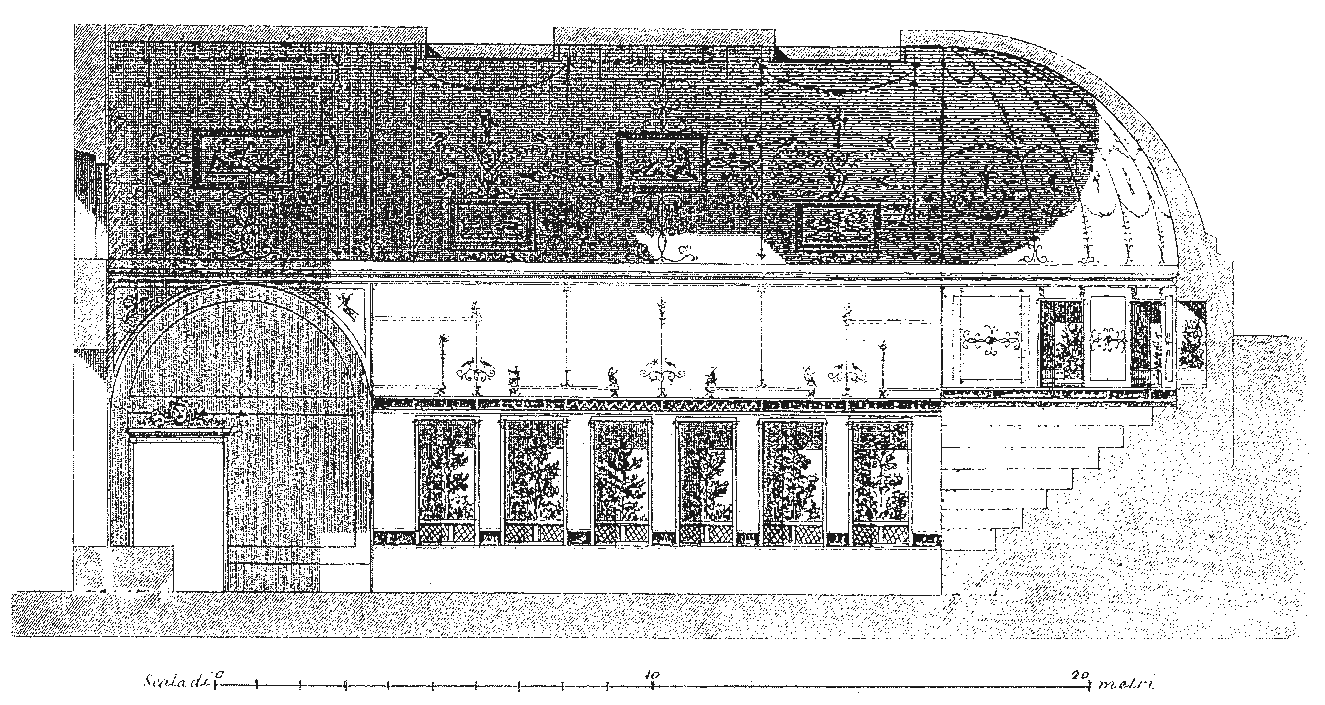
The Auditorium of Maecenas is at Largo Leopardi 14, on the edge of Via Merulana, in the Esquilino rione, across from the Teatro Brancaccio: a semi-underground apsed hall, covered today by a modern canopy, which surfaces in the middle of a small fenced garden among the Umbertine buildings. The Vittorio Emanuele stop of Metro line A is five minutes on foot, Termini a quarter of an hour, the Manzoni station of the same line A a little farther along Via Merulana. The monument belongs to the circuit of the territorial monuments of the Capitoline Superintendency: the visit has always been by reservation at the number 060608, open every day from 9.00 to 19.00, with groups of 30 people at most and the guide provided by cultural associations, to be arranged separately. The rate indicated by the Superintendency is €9.50 full price and €5.00 reduced, with free entry for residents of Roma Capitale and the Metropolitan City with ID and for holders of the MIC Card. Since August 1, 2024 access has been suspended: the monument is included among the sites financed by the PNRR, with restoration of the frescoes, consolidation of the structures, a new ventilated roof and a reception building with ticket office and elevator. Before planning a visit it's best to call 060608 or consult the page of the Capitoline Superintendency. This guide is part of the collection dedicated to the museums of Rome.
On this monument our conviction is precise: it's the place that explains better than any other how private luxury worked in the Rome of Augustus, and nobody visits it. Everyone passes over it, literally, walking along Via Merulana toward Santa Maria Maggiore or toward San Giovanni, and doesn't notice that below the sidewalk level there is a hall painted with fake gardens, with water that ran down a marble stairway, where Horace and Virgil in all likelihood dined. The name it carries is wrong. The hall is not an auditorium. But the name has stuck to it since 1874 and by now is part of its story, so we may as well tell it in full: the discovery, the misunderstanding, the correction, and what remains to be seen.
What the Auditorium of Maecenas really is
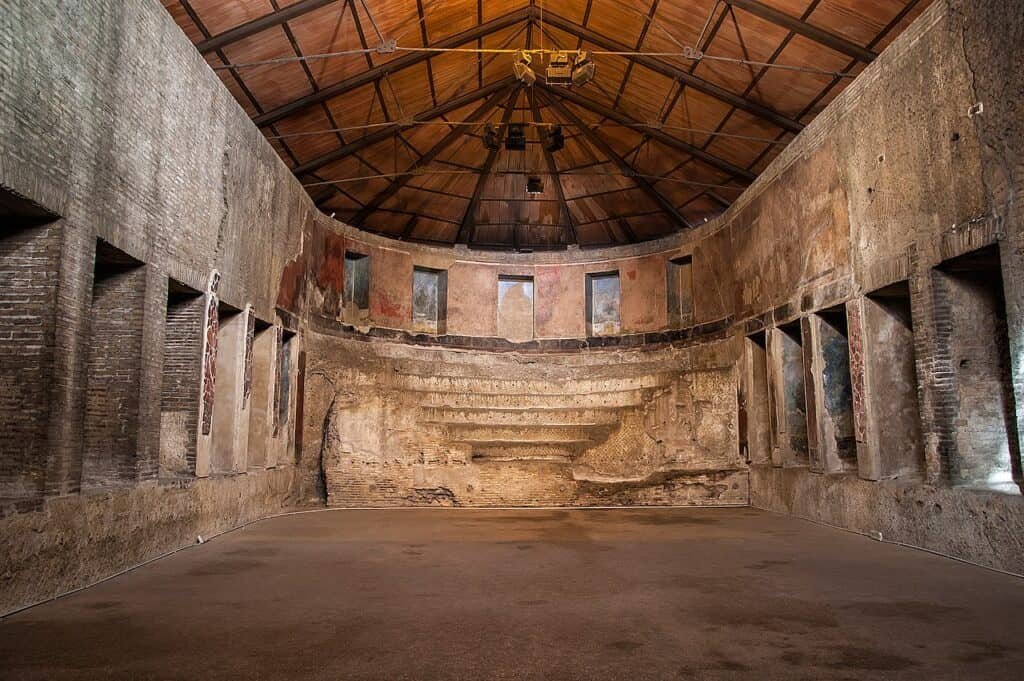
Let's start with the point that generates the most confusion. The building we now call the Auditorium of Maecenas is a large rectangular hall, dug into the ground for a good part of its height, closed on one of the short sides by a semicircular apse. Inside the apse runs a stairway of seven concentric steps, narrow, steep, originally faced with cipollino marble. In the 1800s that stairway was read as a small theater cavea, and from there the name was born: if there are steps, the discoverers reasoned, people sat on them. If they sat in a semicircle, they listened to someone. If they listened to someone in Maecenas's villa, they listened to the poets. The reasoning was elegant and wrong.
Where to buy tickets. The Auditorium of Maecenas is one of the territorial monuments managed by the Capitoline Superintendency: official page on sovraintendenzaroma.it and reservation at 060608, with openings by calendar and entry for small groups. No booking platform sells it. Checked on September 28, 2026.
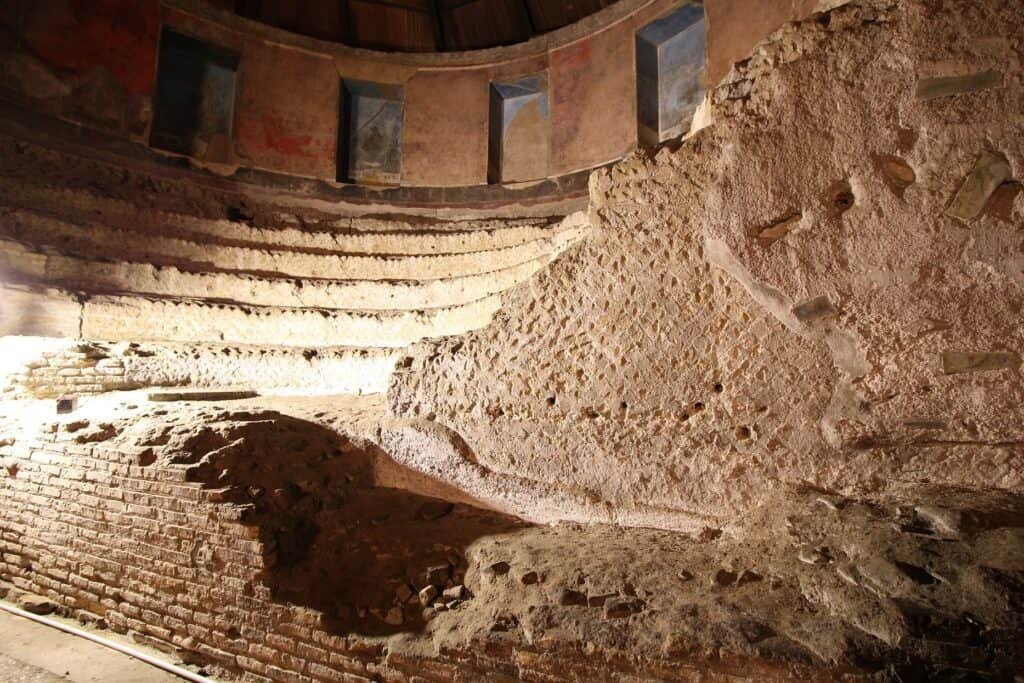
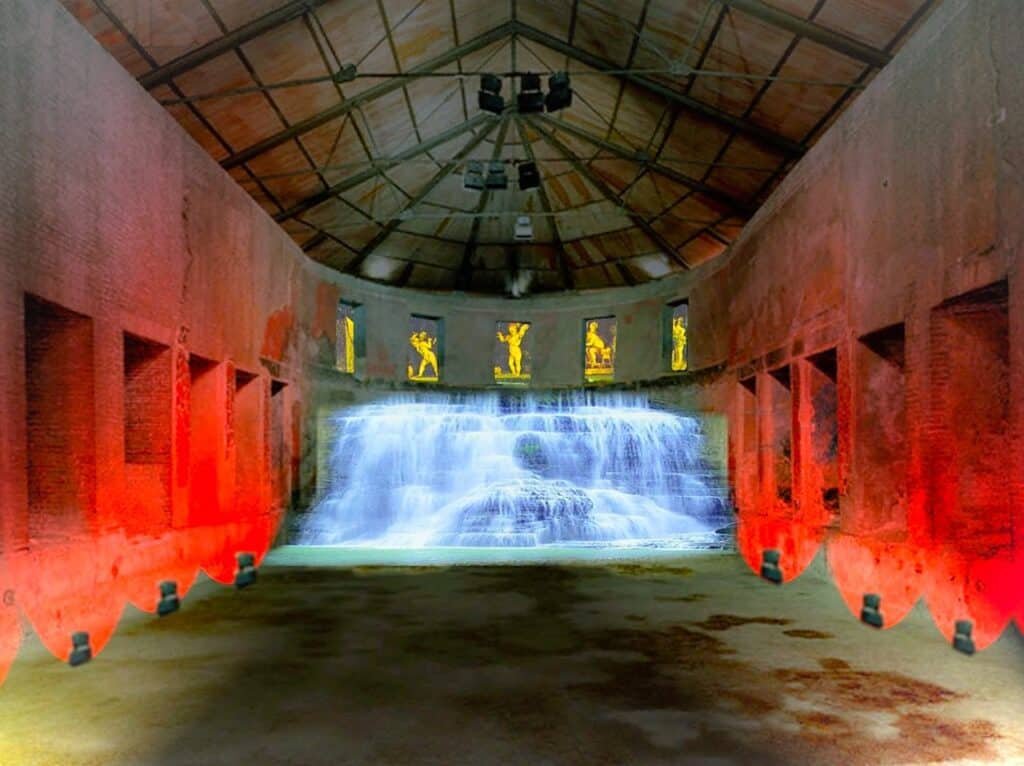
The steps are too narrow for a person to sit on them stably, and above all from the highest step came the mouths of some pipes, later blocked, that poured water into the hall. The Capitoline Superintendency, in the page dedicated to the monument, now speaks of a monumental nymphaeum and links the identification to the discovery of a lead pipe and of the holes made in the stairway. The stairway, in short, was not a cavea: it was a cascade. The water ran down step by step, the cipollino marble multiplied its greenish reflections, and around it, according to the most accredited reconstruction, vases of flowers were arranged. Add the semi-underground level, which in a Roman summer is worth more than any air conditioning, and you get the real function of the hall: a summer triclinium, a place where people dined reclining in the cool, amid painted gardens and running water.
This doesn't entirely erase the literary hypothesis. A hall of that kind, inside the property of the man who held together the most important group of poets in the history of Rome, was also the place where people read aloud, because in Augustan Rome public reading happened exactly that way, after dinner, before a few chosen guests. The opposition between auditorium and nymphaeum, if you look at it with ancient eyes instead of catalog eyes, dismantles itself: it was a convivial space, and in Roman conviviality of that level poetry was part of the menu.
Where the Auditorium of Maecenas is and how to get there
Largo Leopardi is a tree-lined widening that opens on the eastern side of Via Merulana, just before the intersection with Via Mecenate and Via Foscolo. Whoever arrives from Piazza Vittorio Emanuele II reaches it in four or five minutes, whoever arrives from Santa Maria Maggiore in seven or eight going down along the Merulana. The enclosure is visible from the street: you see the low canopy, you glimpse the cut in the ground, and under normal conditions the gate stays closed except on visit days.
By subway to the Auditorium of Maecenas
The simplest solution is line A, Vittorio Emanuele stop. You exit onto Piazza Vittorio, take Via Leopardi or cut along the gardens, and in a few minutes you're in front of the enclosure. The same line A serves the Manzoni stop, a bit farther but convenient for those arriving from San Giovanni. From line B, the useful stop is Cavour, with a quarter-hour walk through Monti and Via dello Statuto: a longer route, but a beautiful one, because you arrive at the Esquilino from above and understand the slope of the hill.
On foot from Termini to the Auditorium of Maecenas
Whoever is staying around the station arrives on foot in a good quarter of an hour, passing through Piazza Vittorio. Dispassionate advice: do it by day and take the time to cross the gardens of Piazza Vittorio, where the remains of the so-called Trofeo di Mario are, the great monumental fountain of the Severan age, and the Porta Alchemica, the only magic gate of Rome to have survived. The stretch of road between Piazza Vittorio and Largo Leopardi is exactly the stretch in which, under your feet, the agger of the Servian Walls ran.
By car and by taxi
Arriving by car is not advised: the Esquilino rione has scarce parking and Via Merulana is a through road with reserved lanes. A taxi can drop you directly in Largo Leopardi. Whoever has trouble walking should keep in mind that the monument, in its historic configuration, is reached by going down a ramp and was not accessible to people with motor disabilities: the restoration project under way includes an elevator, and the situation will need to be verified at reopening.
Gaius Cilnius Maecenas, the man who gives the Auditorium of Maecenas its name
The name of the monument comes from a man who never wanted a public office. Gaius Cilnius Maecenas, born in Arezzo on April 13, 68 BC, proud of his descent from the princely Etruscan house of the Cilnii, was the civil collaborator closest to Octavian in the decisive years that led from civil war to the principate. He was not consul, not praetor, did not obtain the senate: he formally remained a knight, a private citizen, and precisely for this reason he could do things a magistrate could not, from the diplomatic negotiations with Antony to the management of Rome when Octavian was away.
His posthumous fortune is curious and worth telling, because it is the most famous case of a proper name becoming a common noun. Today in Italian a mecenate is someone who funds the arts. In English, French and Spanish there are direct equivalents of the same coinage. But Maecenas did not fund artists out of charity. He built consensus. The new regime needed a narrative, and the narrative was written by Virgil with the Georgics and the Aeneid, Horace with the Odes, Propertius with the Roman elegies. Calling him a protector of letters is true and insufficient: he was the most skillful culture minister Rome ever had, with the advantage of having no ministry, salary or obligation to report.
The ancient sources paint him as a man of refined tastes and soft conduct, a lover of luxury, gems, light clothing, choice food. Seneca, a century later, mocked his contorted writing style and dissolute life. Yet the same Seneca recognized that without him Latin literature would have been something else. Dead in 8 BC, Maecenas left his goods to Augustus, and with them the villa on the Esquilino of which the Auditorium is the only space still readable.
Maecenas and Augustus, a 30-year relationship
Suetonius tells that Augustus, when he fell ill, often slept in Maecenas's house. It's a detail read in passing that in fact says a lot: the Esquilino, after the reclamation, was considered healthy, airy, high above the city, and Maecenas's house offered the most powerful man in the world a private refuge a quarter of an hour from the Palatine. The relationship between the two cooled in the last years, and ancient tradition attributes it in part to a private matter involving Terentia, Maecenas's wife. But the political substance held to the end: the property passed to the princeps and became imperial patrimony.
The Circle of Maecenas: what it really was
In school textbooks the Circle of Maecenas is a kind of literary club with membership cards. The reality was more fluid and more interesting. It was a network of personal relationships, founded on Roman amicitia, which carried precise mutual obligations: the poet received economic security, protection, sometimes a property in the country, and in exchange offered his work and his presence. Horace received the villa in the Sabine hills, the one of the fields and the spring of Bandusia. Virgil, who had lost his father's lands in the confiscations of 41 BC, found in that network the possibility of writing without worrying about tomorrow. Propertius entered the group later and with some resistance, defending his right to write love elegies instead of war poems.
On the order of magnitude it's best to be honest: there is no ancient source describing a meeting of the circle inside this hall. We know that the hall belonged to the Horti Maecenatis, we know it was a convivial space of the highest level, we know those poets frequented the house. The rest is reasonable inference, and should be called inference.
The Horti of Maecenas on the Esquilino
To understand the Auditorium you have to understand what the Roman horti were. They were not vegetable gardens in the modern sense, nor simple gardens: they were large luxury suburban properties, with pavilions, porticoes, terraces, pools, libraries, sculpture collections, groves, aviaries, bath spaces. A country villa planted right against the city, designed for life on display and cultured leisure. Rome had a whole crown of them along the eastern edge, on the Esquilino, the Pincio, the Aventine: Horti Lamiani, Horti Lolliani, Horti of Sallust, Horti of Lucullus. Those of Maecenas were among the first and set the model.
How far the Horti Maecenatis reached
The exact extent remains disputed. Research places the core in the area between present-day Piazza Vittorio Emanuele II and Largo Leopardi, with the eastern boundary toward the Horti Lamiani. Scholars debate if the property extended on both sides of the Servian agger, and the discovery of mass graves north of the Porta Esquilina suggests a greater extent than was hypothesized a century ago. We have no fence, no boundary markers of the property: we have a series of rooms, mosaics, pipes and sculptures that surfaced between 1874 and the early 1900s, which draw a patch a few hectares wide.
The reclamation of the Esquiline burial ground
This is the point at which the story of the Auditorium of Maecenas stops being a story of luxury and becomes a social story. Before the horti, the area outside the Porta Esquilina was the necropolis of the poor of Rome. Not monumental tombs: pits. The puticuli, wells into which were thrown the corpses of slaves, the destitute, the executed, together with the city's refuse. Rodolfo Lanciani, who directed the supervision of the 19th-century excavations, described the discovery in pages that are still read with some discomfort, among heaped bones and saturated ground.
Between about 42 and 35 BC, the area was reclaimed with a landfill of enormous proportions: six or eight meters of earth brought in over the burial ground and over the ditch of the Servian Walls. On top of that mattress of earth the gardens were born. It's an operation we would today call urban regeneration and that then needed an act of authority: the senatorial ban on cremating in the open within a radius of two miles of the city, datable to 38 BC, goes in the same direction. The memory of the place was not entirely erased: in one sector Attic funerary stelae were relocated, as a cultured quotation of a past of burials.
Horace and the verse that certifies the reclamation
The most famous testimony is Horace's, in the eighth satire of the first book, the one in which the speaker is a statue of Priapus planted in the garden. The wooden god tells the place as it was, a common field where bodies were thrown, and as it has become: nunc licet Esquiliis habitare salubris, now one can live on the healthy Esquilino, and stroll on the sunny agger. These are verses of affectionate propaganda, written by a poet who owed much to Maecenas's property, and they must be read with that filter. But the archaeological data confirms them: under the gardens there really were bones.
The water of the horti
A villa like this doesn't hold without water. The Esquilino was the best-served hill of Rome: the main pipes arrived from the east, the Aqua Marcia and the Aqua Iulia passed nearby, and the Aqua Claudia would arrive shortly after along the route that today is seen monumentalized at Porta Maggiore. A nymphaeum with a cascading stairway, 16 or 17 fountain mouths in the niches and painted pools on the walls presupposes a continuous flow and a drainage system. The lead pipe found in the excavation is the link of proof that shifted the interpretation of the monument.
The other horti of the Esquilino and where the sculptures ended up
The Horti of Maecenas were not alone. The eastern edge of Rome, between the 1st century BC and the 1st century AD, was covered with large green properties belonging to the richest families of the city, and the Esquilino hosted the greatest concentration of them. To the east bordered the Horti Lamiani, the property of the family of the Aelii Lamiae, later also passed to the imperial patrimony, whose remains emerged in the area between present-day Piazza Dante and Via Ariosto. A little farther were the Horti Lolliani, and to the north, beyond the Quirinal, the famous Horti of Sallust. A continuous belt of private parks, terraces, nymphaea and collections, which surrounded the built city like a crown.
A heritage scattered in the 19th-century excavations
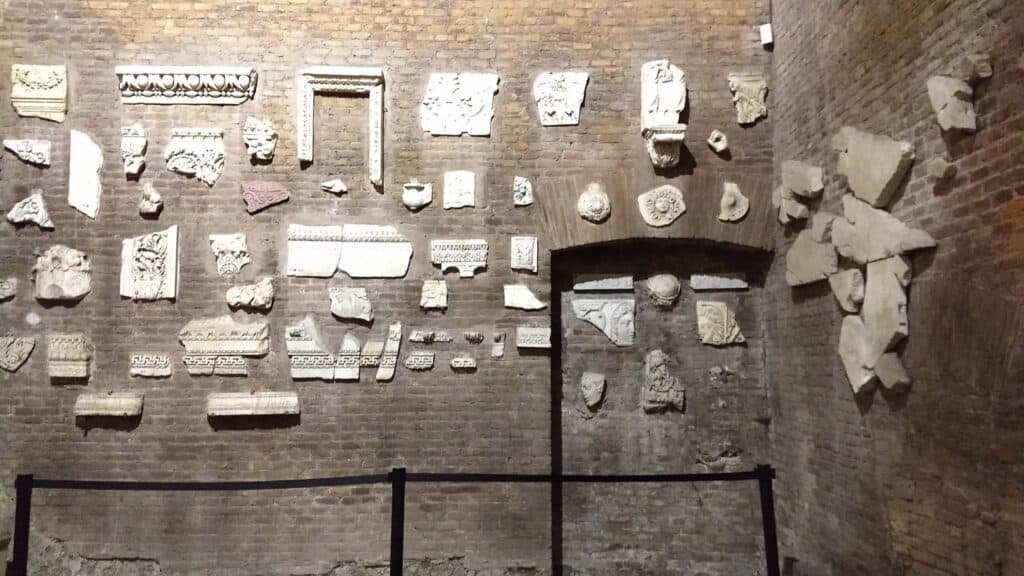
All this world re-emerged at the same moment and in the same conditions: between 1874 and the end of the century, under the bulldozers of the capital city. The documentation was what they managed to do, often in a hurry, and the material took different paths. A substantial part of the sculptures of the Horti of Maecenas is today in the rooms dedicated to the Palazzo dei Conservatori. Another group, coming from the area of the Horti Lamiani between Piazza Dante and Via Ariosto, is exhibited at the Centrale Montemartini, in the Boiler Room: small sculptures of deities from the early imperial age and a large marble fountain basin, decorated with acanthus scrolls and vine tendrils, datable to the second half of the 1st century BC.
One detail unites almost all these pieces and it is the most instructive: they were found in fragments, because in late antiquity they had been broken and walled in as rubble in the buildings of the area. Heads served to fill walls. Whoever looks today at those recomposed sculptures looks at the result of two successive destructions, the late antique one and the 19th-century building one, and of a patient recovery effort that is still going on.
Why it's worth putting the pieces together
The practical consequence for the visitor is that the Horti of Maecenas are a scattered monument: the architecture in Largo Leopardi, the sculpture on the Capitoline, other material at the Ostiense, the topography in Lanciani's maps. None of the four things, alone, gives back the whole. The proposal, for whoever has a full day and wants to understand the Rome of private gardens, is this sequence: morning on the Capitoline with the rooms of the Horti, a quick lunch on the Esquilino, afternoon in Largo Leopardi and, if time remains, the Centrale Montemartini the next day. It costs little, there's no line at any of the three stops, and at the end you have in your head a map that no general guide provides.
The discovery of the Auditorium of Maecenas in 1874
Rome became the capital in 1871 and the Esquilino was the first great work site of the new city. A neighborhood was needed for the employees of the ministries, and it was built on paper on the plateau between Termini and Santa Maria Maggiore, with the axis of Via Carlo Alberto, the arcaded piazza named for Vittorio Emanuele II and the regular grid of streets dedicated to poets: Via Leopardi, Via Foscolo, Via Machiavelli, Via Ariosto, Via Alfieri, Via Mecenate. It was a ferocious subdivision, which in a few years erased vineyards, 17th-century villas and farmhouses, and which in doing so cut like a cake the richest archaeological subsoil in the city.
In 1874, opening the work sites between Via Merulana and the new Via Leopardi, the excavations intercepted a large buried hall with the stepped apse. It was immediately clear that it was a luxury space, and just as immediately it was connected with Maecenas's villa: the location of the Horti Maecenatis in that sector of the Esquilino was already known thanks to the passage in Horace, and the equation between find and owner appeared immediate. The hall was cleared, documented with drawings and watercolors, and left open to the air in the middle of the new urbanization, as was done at the time with monuments that couldn't be demolished but that nobody quite knew how to conserve.
Rodolfo Lanciani and the documentation of the excavations
The name tied to that season is that of Rodolfo Lanciani, archaeologist and topographer, author of the Forma Urbis Romae, the great archaeological map of Rome in 46 sheets that still today remains the starting tool for anyone studying the city's subsoil. Lanciani documented the Esquilino excavations from 1874 onward, with intense work especially between 1876 and 1880, and to him we owe the descriptions of the mass graves, the fill layers and the sculptures recovered from the late antique walls. It's worth saying: much of what we know about the Horti of Maecenas we know because one man, in the middle of a building site that waited for nobody, took notes.
Why the monument is called Auditorium
The name was born at the very moment of discovery, because of the stairway, and consolidated in the late 19th-century press because it was irresistible: the hall of the readings of Virgil and Horace made a better title than the hall of fountains. The fact that the identification was later abandoned by research has not shifted current usage by a millimeter. On maps, in place names, on signage and on the monument's official page the name remains Auditorium of Maecenas, with the clarification that it is a nymphaeum. It's one of the many Roman cases in which the error of a 19th-century archaeologist became linguistic heritage: the same happens with the Temple of Vesta at the Forum Boarium, which was dedicated to Hercules, or with the Basilica of Maxentius, begun by Maxentius but finished by Constantine.
The architecture of the Auditorium of Maecenas, space by space
The monument is made of a single large space, but that space has a lot of details that are worth reading one by one, because each tells a function.
The hall of the Auditorium of Maecenas: measurements and proportions
The hall is rectangular, with the apse on one of the short sides. On the measurements the sources don't entirely agree: about 24 meters long by a width between 10.60 and 13 meters, depending on if you measure inside the space or include the wall thicknesses and niches. In practical terms: a hall as long as a tennis court and a little more than half as wide, originally tall under the barrel vault that covered it. The front part, toward the entrance, is wider than the back part, where the niches reduce the net span.
The level is the most important fact and the easiest to forget. The hall was semi-underground on purpose. It isn't a basement floor made out of necessity: it's a choice of environmental comfort, the same one that in Rome produces cryptoporticoes, artificial grottoes, hypogeal nymphaea. Below ground level, with running water and thick walls, in August it's 10 degrees cooler. A long lunch, in a city where summer has always been very harsh, was held down there.
The apsed stairway of the Auditorium of Maecenas
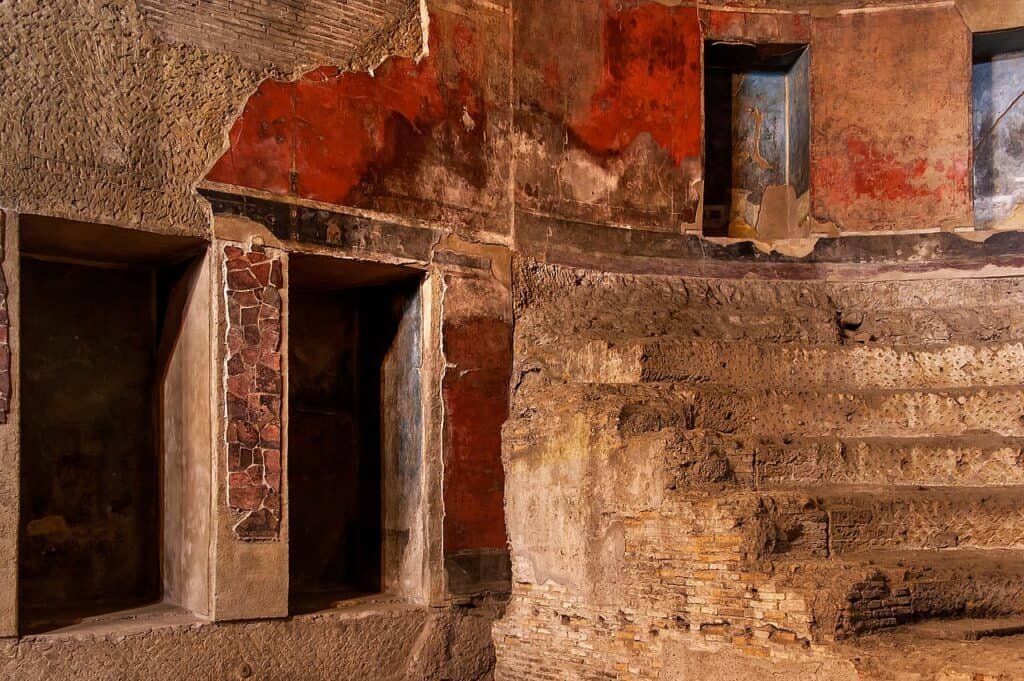
The apse contains seven concentric steps, narrow, originally faced with cipollino marble, the stone veined in green and white that came from Euboea and that the Romans appreciated precisely for the watery effect of its veining. Above the highest step opened the mouths of the pipes. The water ran down in a sheet over the steps, the cipollino made it look deeper than it was, and the sound filled the hall. Whoever has seen a Renaissance water-stair nymphaeum knows what effect we're talking about: that type was born here, and in the 1500s it was taken up consciously looking at the ancient models.
The niches of the Auditorium of Maecenas and the fake windows
The long walls of the hall have six rectangular niches per side, to which are added five niches carved in the curved wall of the apse, above the stairway. 17 niches in all, all frescoed inside. Their decorative function is clear: they were painted as windows open onto gardens, with trees, balustrades, pools, fountains and birds, so that whoever looked from the center of the hall had the impression of a series of openings onto a park. Some probably housed water jets or statuettes. For most of them, research leans toward a scenographic function.
The access ramp of the Auditorium of Maecenas
The hall was reached, in antiquity as today, by a double descending ramp, paved in opus spicatum, the herringbone brickwork. Today only the last stretch is preserved, but it's enough to understand the mechanism: the guest went down, the sound of the water grew, the temperature dropped, and the hall opened suddenly with its luminous apse at the far end. It was staging. Whoever designed that entrance knew exactly what effect they wanted.
The floors of the Auditorium of Maecenas
The original floor was a mosaic of very fine white tesserae, bordered by red bands painted in encaustic, that is with pigment bound with wax and fixed with heat: a refined technique, rare in floors, which tells the level of the patron. In a later phase that mosaic was covered by a marble floor, probably in polychrome opus sectile. Two superimposed floors mean two seasons of taste: the first Augustan, sober and luminous. The second richer, in line with mature imperial taste.
The masonry and the building phases
Masonry technique is the chronometer of Roman archaeology, and here it works well. The first phase is in small-module opus reticulatum, with Grotta Oscura tuff and Aniene tuff: a technique of the full 1st century BC, which places the construction between the end of the Republic and the beginning of the principate, around 30 BC. The second phase corresponds to the repainting of the late Augustan or Tiberian age, which research links to Tiberius's stay in the villa after his return from Rhodes, in 2 AD. A third phase, of the Neronian age, is represented by a brick wall resting on the lower part of the stairway, which changes the layout of the apse.
The roof of the Auditorium of Maecenas, yesterday and today
In antiquity the hall was closed by a barrel vault. Today it is protected by a modern canopy, mounted to shelter the frescoes from rain, and the restoration project under way includes rebuilding the roof with a system of trusses consolidated by iron bracing, a ventilated covering with wooden panels and recovered roof tiles. The difference between vault and canopy is not only aesthetic: the vault was part of the climate system of the space, closed the volume and preserved the coolness. The hall you see today is thermally and acoustically something else compared to the one where people dined.
The frescoes of the Auditorium of Maecenas
The painted decoration is the reason this monument truly matters, beyond the famous name. It is one of the few complexes of garden painting of the Augustan-Tiberian age preserved in Rome inside the building for which it was made.
The Pompeian third style
The decoration belongs to the third style of Roman painting, the one that abandons the fake perspective architecture of the second style and returns to the flat wall, treated as an ornamental backdrop, with fields of full color, thin frames, plant candelabra, small pictures set in like hung panels. It is the style of the early imperial age, elegant and controlled, very suited to the taste of a patron who wanted to show refinement without ostentation.
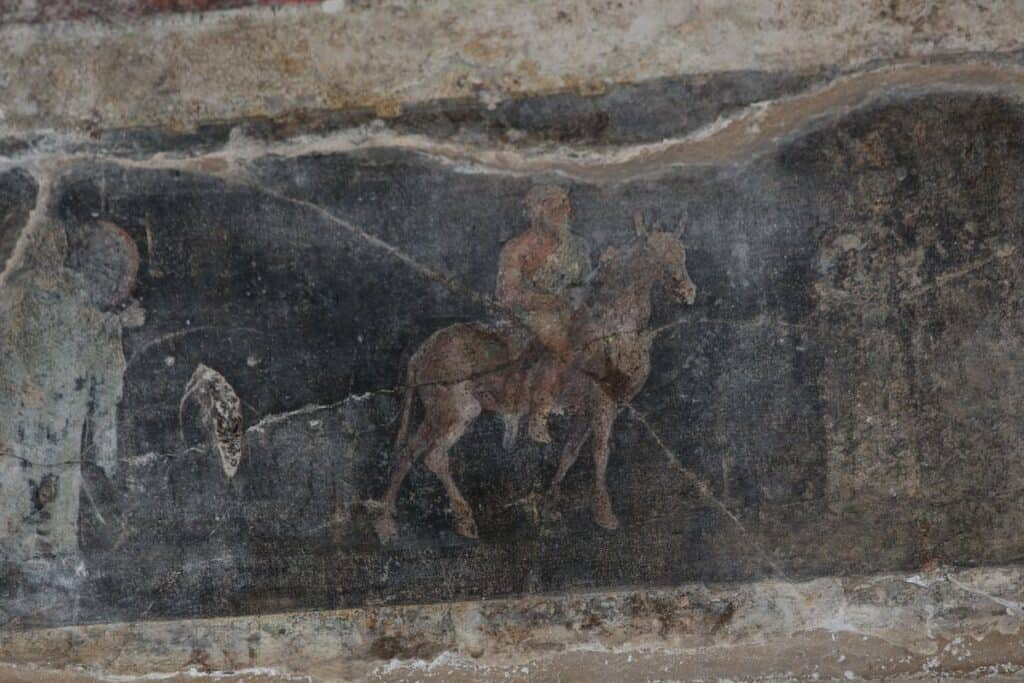
In the Auditorium the walls show a marble dado, fields of cinnabar red, the most expensive pigment of the ancient palette, made from Spanish cinnabar and paid for by weight, candelabra with peacocks facing each other in heraldic position, and above a continuous frieze on a black ground.
The Dionysiac frieze on a black ground
The frieze runs above the niches and is the most narrative part of the whole: Dionysiac scenes, processions of maenads and satyrs with thyrsi, alternating with miniature gardens. The black ground was a precise choice: it absorbs light and makes the pale little figures stand out as if suspended. In a space lit by oil lamps and by the reflections of the water, that black must have looked like pure depth. The Dionysiac theme, in a banquet hall, is not neutral decoration: it is the declaration of the space's function.
The painted gardens in the niches
Inside the niches the painter repeated a recurring scheme: a tree in the center, beyond a marble balustrade that has a recess in the middle, and in that recess a fountain or a vase. The trees are populated by a notable number of birds, in flight and perched on branches. In the upper thicknesses run floral elements. It is a painted garden inside a nymphaeum that stood inside a real garden: a game of boxes that the Romans loved enormously and that here is taken to the extreme. Whoever dined in that hall looked at the same time at the real water of the stairway and the painted water of the pools in the niches.
The comparison with the Villa of Livia at Prima Porta
The obligatory term of comparison is the celebrated underground room of the Villa of Livia at Prima Porta, with its continuous-wall painted garden, today reconstructed in the rooms of Palazzo Massimo alle Terme. The two decorations belong to the same world, the same idea of a hypogeal space cooled and painted from nature, and are chronologically close, end of the 1st century BC. The difference is in the syntax: at Prima Porta the garden invades the whole wall and cancels the boundary of the space. Here the garden stays framed inside the niches, like a series of pictures. Whoever truly wants to understand the Auditorium of Maecenas should first visit Palazzo Massimo: you come back to Largo Leopardi with different eyes.
What remains and what we know from the drawings
It must be said clearly: the painting is preserved in a fragmentary way. A century and a half of exposure to the open air, in a semi-underground space in the middle of a dense neighborhood, has done what you'd expect. A good part of what we know of the decoration derives from the reconstructive drawings made and published after the 1874 excavation, when photographic documentation of color did not yet exist. The restoration planned by the work site under way concerns precisely the frescoes and stuccoes, together with the ventilation and environmental stabilization systems: the conservation of the painting is the main reason for the intervention.
The Greek epigrams painted on the plaster of the Auditorium of Maecenas
There is a detail, in this monument, that always produces the same silence. On the outer plaster of the apse were found, painted, some verses of a Greek epigram attributed to Callimachus, the Alexandrian poet of the 3rd century BC, acknowledged master of short, learned poetry. The verses allude to the effects of wine and love.
Let's pause a moment on what this means. It means that someone, in a banquet hall of Augustan Rome, had Greek verses written on the wall, and not just any verses: verses by Callimachus, the author whom the poets of the Circle of Maecenas considered their absolute model. Propertius called himself the Roman Callimachus. Horace shared his ideal of polished, short, learned poetry, against the long poem. Finding Callimachus painted on the wall of that hall is like finding, in a house of musicians, a Bach score hanging in the kitchen: it says who frequented those rooms and what was on their minds.
On this point it's best to be precise about the degree of certainty. The discovery of the verses and their attribution to Callimachus are reported by the scientific page of the Capitoline Superintendency. The direct link with a public reading inside the hall is an inference, however reasonable. The cultural substance, though, does not change: those verses are proof that the space belonged to a bilingual world, where Greek was the language of high culture and a cultured guest had to be able to read them without translation.
Why an epigram on wine and love
The choice of theme is not accidental. The symposium epigram, the short composition that accompanies drinking in company, is a very ancient Greek genre, and the Romans adopted it along with the way of sitting at table. Writing verses on wine and love on the wall of a triclinium amounts to declaring the destination of the space and, at the same time, staging a refinement: here you don't just drink, here you drink quoting Callimachus.
Auditorium or nymphaeum? The scientific discussion on the Auditorium of Maecenas
The question that gives this chapter its title is the most interesting one you can ask in front of the monument, and the honest answer is that the discussion remains open, with a majority but not unanimous consensus. It's worth setting out the arguments on both sides, because it's a good exercise in method.
The arguments for the auditorium
The first argument is morphological: a semicircular stairway inside a rectangular hall recalls the shape of the cavea, and halls for auditions did truly exist in the ancient world, from the Greek ekklesiasteria to the covered odea. The second is contextual: the property belonged to the man around whom the literary life of Rome revolved, and the recitatio, the public reading of a work before a chosen audience, was a social institution in full expansion precisely in the Augustan age. The third is the painted Greek epigram, which documents a cultured use of the space. None of these arguments is absurd, and this explains why the 19th-century hypothesis held for so long.
The arguments for the nymphaeum
On the opposite front weigh material facts that are hard to get around. The steps are too narrow and too steep to sit on: whoever tries slips forward. From the upper step came mouths of pipes, later blocked, and in the stairway holes for the passage of water have been recognized. A lead pipe was found. The cipollino facing, a stone you choose when you want it wet, goes in the same direction, and the semi-underground level with walls painted as a garden completes the picture of a space designed for coolness and for water. On this basis the Capitoline Superintendency today defines the monument a monumental nymphaeum, with the function of a summer triclinium.
The position I hold in front of a group
Our opinion is that the opposition is badly framed and the child of a modern cataloguing mentality. The Romans did not build single-function buildings. A dining hall for show was the place where people ate, discussed, listened to music, read verses and closed deals. Calling it a nymphaeum describes the technical layout. Calling it a summer triclinium describes the everyday use. Calling it an auditorium describes one of the things that happened there. If I had to write the sign, I would write nymphaeum-triclinium, and next to it I would put the story of the wrong name, because that story teaches more than a correct definition.
The nymphaeum in the Roman villa and the place of the Auditorium of Maecenas
To appreciate this hall you need a notion that textbooks cover in two lines: what a nymphaeum was and why the Romans built hundreds of them. The word comes from Greek and originally indicated a place consecrated to the nymphs, that is, a spring, a grotto with water, a sacred natural space. In the Roman world the definition turns into an architectural type: a monumental space organized around water, with basins, small cascades, niches, statues and decoration in mosaic or painting.
Grotto, hall, scenography
In the villas of the late Republic the nymphaeum began as an artificial grotto, often carved out of the rock or built and then lined with pumice, shells and rustic mosaic to imitate a natural cavity. Then the model became urban: the grotto becomes a hall, the spring becomes a hydraulic system, the fake natural becomes openly declared architecture. The Auditorium of Maecenas belongs to this second moment and is an early example of it, and of the highest level: it doesn't imitate a grotto, it is a regular hall with the water built into the design.
The convivial function is the key point. In the luxury Roman house, summer dinner was eaten in cool rooms, ideally with running water in sight and within earshot, because the sound of water was considered part of the comfort exactly like shade. Hence the combination you find here: a sunken level, a wet stepped seating, niches with water effects, walls painted as a garden. A layout that the first century AD would replicate everywhere, from the villas of Baia and Sperlonga to the urban domus with the small nymphaeum in the peristyle.
This hall's place in the history of architecture
Our opinion is that the Auditorium of Maecenas is underrated precisely as a document of architecture. It is not the largest nymphaeum, it is not the best preserved, it has no statues in situ. But it is one of the very few where you can read the structure, the hydraulic system, the painted decoration and the social context together, and above all it can be dated precisely to a decisive moment, the one when Roman private luxury stops imitating Greece and invents a grammar of its own. 50 years later, the Domus Aurea will bring that grammar to the scale of a palace. Here you see it being born in a room 25 meters long.
The Servian Walls under the Auditorium of Maecenas
On Via Leopardi side the hall overlaps the so-called Servian Walls, destroying a stretch of them. On the eastern side you can recognize blocks of yellow tuff belonging to the ancient circuit, incorporated into the structure. They are among the least known and most instructive remnants of that circuit.
A clarification about the name, because it causes misunderstandings. The walls that tradition attributes to King Servius Tullius, the sixth king of Rome, in the sixth century BC, are in reality, in the form we see today, a construction of the fourth century BC, after the Gallic sack of 390, made of squared blocks of Grotta Oscura tuff laid in alternating courses. On the eastern side, where the flat ground offered no natural defense, the circuit was reinforced by an agger, an enormous embankment preceded by a deep ditch. That agger ran right here, between Piazza Vittorio and Largo Leopardi.
Building the horti meant filling the ditch, leveling part of the agger and leaning the buildings against the old wall face. It is a gesture that in the first century BC scandalized no one: the Republican walls had lost every military function at least a century earlier, Rome was growing well beyond their perimeter, and the big landowners behaved accordingly. Anyone looking for the Servian Walls in the city today finds them in the preserved stretches at Termini, in front of the station and inside the station itself, on the Aventine, on Via Carducci, and in these blocks incorporated into the Auditorium. They should not be confused with the Aurelian Walls, which are five centuries later, built of brick, and enclose an area four times larger.
What you see today at the Auditorium of Maecenas
Whoever enters finds a single bare space, with the stepped apse at the back and the niches along the walls. There is no museum route, there are no display cases, there are no multimedia reconstructions. There is the hall, its shape, what remains of the floors and the fragments of painting. It is a monument for people who know how to look, or for people who come with someone who explains.
The visiting sequence at the Auditorium of Maecenas
You go down the ramp and reach the bottom of the hall. The first look goes to the stepped seating, and it's worth lining up on the axis to understand the geometry of the apse and to imagine the sheet of water. Then you look at the long walls, counting the niches: six per side, with the traces of the painted plaster. Above the niches you look for the band of the black frieze. In the apse, the five upper niches. On the floor you look for the fragments of the white mosaic and of the later marble covering. Finally, on the side toward Via Leopardi, the tuff blocks of the ancient walls.
How much time you need for the Auditorium of Maecenas
The standard guided visit organized by the Superintendency lasted one hour. On your own, without explanation, you run out of hall in a quarter of an hour: it is small and has no displays. It's best to count on a full hour with a guide, and to combine it with something else the same morning, because the Esquiline within a 10-minute walk offers material for a whole day.
How to visit the Auditorium of Maecenas
The access rules are those of the Capitoline Superintendency's territorial monuments, and they are worth describing precisely because they differ from those of a normal museum.
Booking at 060608
The only channel is the contact center 060608, open every day from 9:00 to 19:00. Groups and cultural associations book their own appointment. Individual visitors join the scheduled openings according to a calendar that the Superintendency publishes by quarter. The capacity limit is 30 people per turn. For groups the regulations set a maximum number of appointments per quarter and a minimum number of tickets to pay for on site. The guided visit, when offered, is run by cultural associations and has to be arranged with them: the monument ticket and the guide's fee are two separate things.
Tickets for the Auditorium of Maecenas and the MIC card
The rate listed for this monument is €9.50 full price and €5.00 reduced, higher than the ordinary rate for the territorial monuments, which stops at €4.00 and €3.00. Residents of Roma Capitale and of the Metropolitan City get in free with a valid ID. Holders of the MIC card also get in free. It is the card that costs €5.00, lasts 12 months and is for people who live or are domiciled in the Metropolitan City of Rome and for students of the universities of the area. Anyone in one of these categories who plans more than one visit in the civic system is getting a bargain: five euros cover a whole year across the Capitoline Museums, the Centrale Montemartini and minor monuments like this one. Payment on site is in cash.
The construction site and the reopening
Since August 1, 2024 the monument has been among the sites temporarily closed to the public for the works planned under the PNRR. The project, drawn up for the Capitoline Superintendency, includes selective archaeological excavation, structural reinforcement with new iron bracing, rebuilding of the ventilated roof, conservation restoration of the frescoes and stuccoes, ventilation and environmental stabilization systems, and a new service building with a reception area, bookshop and an elevator for accessibility. A reopening date has not yet been set: anyone who wants to visit should call 060608 and ask about the state of the construction site.
Accessibility of the Auditorium of Maecenas
In its historical configuration the monument was not accessible to people with motor disabilities: you go down to the level by a ramp and there was no lift system. The restoration project expressly includes an elevator inside the new reception building, so the situation should change. Anyone with specific needs should check when booking, without taking the previous picture for granted.
What the day costs and how to save
The math is simple and worth doing. Monument ticket at full price, €9.50. Guide's fee, variable depending on the association. If you're a resident, the monument is free and only the guide remains. If you're not a resident but you're planning a long stay, the MIC card doesn't apply to you because it is reserved for residents, people domiciled and students of the area. In that case the saving is built differently, by concentrating the free monuments of the Esquiline, that is, the basilicas, in the same day and paying only the entrance here. A morning among Santa Maria Maggiore, Santa Prassede, the gardens of Piazza Vittorio and this nymphaeum costs the price of a single ticket.
A curiosity about the Auditorium of Maecenas
The curiosity I like best concerns the last known owner of the Horti of Maecenas, and he is not an emperor. Near the monument they found fistulae aquariae, the lead pipes that in Roman building bore the stamped name of the owner of the property, and on those fistulae appears the name of Marcus Cornelius Fronto, who lived from about 100 to 166 AD. Fronto was not a general or a prince: he was the most famous professor of rhetoric of his time, the man who taught Latin eloquence to Marcus Aurelius and Lucius Verus, and whose correspondence with the pupil who became emperor is one of the most intimate documents that antiquity has left us.
Let's stop on the short circuit. The garden born to host the group of poets who invented Augustan literature, which passed through the hands of Augustus, Tiberius and Nero, belongs in the second century to a professor of letters. The property that had been the cultural instrument of power ends up with the man who educates power. No ancient source tells this passage as an exemplary story, and it's likely that Fronto simply bought a nice property with his earnings, which were considerable. But for anyone who looks at the topography of Rome as a succession of overlapping destinies, that lead fistula with a name engraved on it is worth a whole chapter.
There is a second reason the curiosity deserves attention: fistulae are one of the most reliable tools Roman archaeology has for attributing a property. A mosaic doesn't say who paid for it, a statue may have been bought secondhand, a wall doesn't talk. A stamped pipe, instead, is an administrative document: the engraved name served the concessionaire of the public water and the office that collected the fees. In a trade made of hypotheses, a signed pipe is almost a receipt.
Something nobody tells you about the Auditorium of Maecenas
The sculptures of the Horti of Maecenas are not here, and almost nobody knows it. Whoever visits the monument in Largo Leopardi sees a bare architectural space and leaves convinced they have seen everything. In reality the better half of the find is three kilometers away, in the Palazzo dei Conservatori, where the Capitoline Museums keep the Rooms of the Horti of Maecenas. They are rooms that most visitors cross at a brisk pace, heading for the She-Wolf or the Galata, and that instead contain the sculptural repertoire of this villa.
What is inside, briefly. A fountain in the shape of a drinking horn, a marble rhyton signed by the Greek artist Pontios, from the early Augustan age: a piece of extreme refinement, which tells how Maecenas's collecting worked, since he bought Greek works and had Greek masters work in Rome. A statue of Marsyas, a Roman copy of a Hellenistic original of the second century BC, in pavonazzetto marble, where the reddish veining of the stone is used to render the flayed flesh of the satyr punished by Apollo: one of the boldest cases of expressive use of material in all ancient sculpture. A head of an Amazon from an original of the fifth century BC. A dog in rare mottled Egyptian marble, probably of Alexandrian production. A group of Muses, with Melpomene and Calliope. A fighting Hercules from an original of the late fourth century BC. A herm of Menander.
The detail that closes the circle is the most melancholy: many of these works were found in fragments, reused as building material inside late antique walls. The villa of the poets, a few centuries later, was a stone quarry. If I had to organize a day on this theme, I would do the Capitoline rooms first and then Largo Leopardi, not the other way around: you arrive in front of the empty hall knowing what filled it.
The advice I give you for visiting the Auditorium of Maecenas
First piece of advice, the most practical: don't show up at the gate hoping it's open. This monument has never had continuous hours, the visit has always gone through booking at 060608, and at this stage access is suspended because of the construction site. Calling costs two minutes and saves you a wasted trip.
Second piece of advice: go with someone who can tell its story, or arrive prepared. It is a space that doesn't explain itself. There are no educational panels worthy of the name, there is no route, there is no exhibit. Whoever arrives without knowing what to look at sees a brick room with some steps at the back and is disappointed. Whoever knows that those steps were a waterfall over cipollino marble and that the niches were fake windows onto painted gardens sees a different monument.
Third piece of advice, on season and time. The hall is semi-underground and covered by a shelter: that means little natural light and constant humidity. The best moment is late morning on a clear day between April and June or between September and October, when the light enters the enclosure without being overhead. July and August in this neighborhood are tough and the hall, as cool as it is, doesn't make up for the heat of the walk to get there. Avoid days of pounding rain: the space is protected but not closed.
Fourth piece of advice, about method: combine it. On its own, this monument is worth half an hour. Placed in a morning that includes Santa Prassede with its ninth-century mosaics, the basilica of Santa Maria Maggiore and a stroll through the gardens of Piazza Vittorio, it becomes the ancient part of a route that covers 2,000 years in one square kilometer. A tried and tested proposal: Palazzo Massimo for garden painting, then the Esquiline on foot, with the Auditorium at the end of the morning.
Another well-known fact, yet rarely mentioned
Everybody knows that the word "mecenate" (patron) comes from the name of Maecenas, and we use it for anyone who funds the arts. What is rarely mentioned is that the shift from proper name to common noun is ancient, not modern: already in the first century AD the Latin poets used that name as a synonym for protector of letters, and both Martial and Juvenal evoke it in that sense, with the air of someone complaining that there are no more Maecenases around. The word then passed through medieval Latin and entered all the European languages of culture.
The second element rarely mentioned concerns the man. Maecenas was not only the funder of the poets: he was Octavian's civil deputy. In the periods when the future Augustus was away from Rome on military campaigns, the administration of the city and of Italy passed in fact through his hands, without his holding any magistracy. He remained a knight by choice, and the choice was political: a man without office is not subject to the checks, the time limits and the collegiality that the Republican constitution imposed on magistrates. In a regime that presented itself as a restoration of the Republic, figures exactly like this were needed.
Third element: the Etruscan origins. Maecenas descended from the nobility of Arezzo, from the Cilnii, and was proud of it to the point that Horace opens the first book of the Odes by greeting him as a descendant of ancient kings. In a Roman aristocracy obsessed with ancestors, Etruscan origin was a title, not a flaw. And the villa on the Esquiline, with its Eastern-style gardens, its Greek collections and its architecture of water, was the way that title was staged before the city.
The right photo to take at the Auditorium of Maecenas
There is only one right photo and it has to be built with patience: the central axis of the hall, from the back toward the apse, with the stepped seating in the center of the frame and the niches running off to the sides in symmetrical perspective. It is the only viewpoint that gives back the geometry of the space and that makes you understand why in the 19th century someone thought of a theater. Get low, at the level of the ancient floor, and leave room at the top: the emptiness above the steps tells of the vault that is no longer there.
On the technical side you need three precautions. The first is a moderate wide angle, around 24 millimeters equivalent: wider than that, the apse distorts and the curve looks like a parabola. The second is exposure: the space is dark and the shelter creates harsh contrasts between the shaded areas and the bands of light coming in from the sides, so expose for the shadows and recover the highlights in post-production, or bracket your shots. The third is flash: forget it. On a frescoed surface flash is banned in almost all the sites run by the Superintendency and in any case it flattens the plaster, which instead lives on raking light.
The second photo I recommend is not inside, it's outside. From the sidewalk of Largo Leopardi, through the fence, you frame the cut in the ground with the low shelter and, behind it, the Umbertine buildings of Via Merulana. It is the image that explains better than any text what happened to this piece of the city: an Augustan hall left at the bottom of an urban pit, surrounded by a neighborhood built 80 years ago on top of it. In the light of late afternoon, when the sun passes between the buildings, the contrast between the ancient brick and the 19th-century plaster becomes the photograph.
Third option, for those with time: the detail. A single niche, with what remains of the painted plaster, shot up close in natural light. It's not a spectacular photo but it is the only one that documents the scientific reason for the monument. Always ask the guide or the staff if filming is allowed that day: the rules on monuments with accompanied visits can change depending on the restoration works underway.
Some important events that happened here in history
This piece of the Esquiline has a dense chronology, and it's worth going through it by fixed points.
Fourth century BC. The wall circuit of tuff blocks called Servian is built, in the form we know, with the agger and the ditch right in this sector, the most vulnerable of the city because it lacked natural defenses.
Republican age. The area outside the Esquiline Gate works as a cemetery for the poor and as an urban dump. The boundary stones found in the area, among them those that mention the praetor Lucius Sentius, document measures of delimitation and bans on dumping: the sign that the hygiene problem was serious and recognized.
Between 42 and 35 BC. Maecenas promotes the reclamation: a colossal fill buries pits, bones and the ditch under meters of earth. In 38 BC a measure bans open-air cremation within two miles of the city. On the reclaimed area the Horti Maecenatis are born.
Around 30 BC. The hall we now call the Auditorium of Maecenas is built, in opus reticulatum, leaning against the Republican walls, with the apsed stepped seating and the first white mosaic floor.
8 BC. Maecenas dies. The property passes to Augustus and becomes imperial patrimony. Suetonius recalls that Augustus, when ill, gladly slept in that house.
2 AD. Tiberius returns to Rome from his retreat on Rhodes and lives in the villa. Research links to this phase the repainting in the third style, with the gardens in the niches and the Dionysiac frieze on a black ground.
64 AD. Rome burns. Suetonius tells that Nero watched the fire from a tower of the Horti of Maecenas, the turris Maecenatiana. The exact location of the tower remains debated and does not coincide with this hall, but the fact puts the horti at the center of the most dramatic scene of imperial history. Nero was already connecting the gardens to the Palatine through the Domus Transitoria, and after the fire the whole eastern area of the city enters the project of the Domus Aurea.
Neronian age. A brick wall leaning against the base of the steps changes the layout of the apse: it is the third building phase recognized in the hall.
Second century AD. The horti turn out to belong to Marcus Cornelius Fronto, teacher of Marcus Aurelius, as documented by the fistulae aquariae stamped with his name found near the monument.
Late antiquity. The sculptures of the villa are smashed and reused as building material in the walls of the area. It is the ordinary end of the great suburban Roman estates.
1874. The earthworks for the new Esquilino neighborhood intercept the hall. The monument is excavated, drawn, christened Auditorium and preserved as an archaeological island in the middle of the lot development.
August 1, 2024. The monument closes temporarily to the public for the works funded by the PNRR: restoration of the frescoes, reinforcement, new roof, reception and elevator.
Who has passed through the Auditorium of Maecenas
Gaius Cilnius Maecenas. The host. Between 30 and 8 BC this hall was his summer reception room, the place where he received at table the men he was turning into the classics of the Latin language.
Augustus. Suetonius, in the life of the prince, reports that when he fell ill he often slept in the house of Maecenas on the Esquiline. A man who had the Palatine at his disposal chose this hill to feel better: it is the best ancient certification of the reclamation.
Horace. The relationship is documented beyond any doubt: Horace was introduced to Maecenas by Virgil and Varius in the 30s of the first century BC, as he himself tells in a satire, received from him the villa in the Sabine country, dedicated the books of the Odes to him and accompanied his life to the end, dying in that same year 8 BC. That he frequented the house on the Esquiline is beyond question. That he read his verses in this very hall is a plausible hypothesis, not a documented fact.
Virgil. The Georgics are dedicated to Maecenas and ancient tradition has it that Virgil read passages of them in front of Augustus. The place of that reading is not handed down. His presence in the house on the Esquiline belongs to the same category of plausibility as the Horatian hypothesis.
Propertius. He entered the group in the 20s of the first century BC and dedicated to Maecenas compositions in which he claims his right to write elegies instead of epic poems. In his elegies appears the image of the patron who prefers the shade of an oak and falling water: an image that in front of these steps takes on a completely different weight.
Tiberius. Back from Rhodes in 2 AD, he lived in the villa, by then imperial. The repainting of the hall in the third style is linked to his stay.
Nero. The Horti of Maecenas were part of the system of imperial properties that he connected to the Palatine with the Domus Transitoria, and from a tower of these gardens, according to Suetonius, he watched Rome burn in 64.
Marcus Cornelius Fronto. Owner in the second century, as attested by the stamped pipes. His letters to Marcus Aurelius often speak of gardens, health and rest: reading them knowing where he lived adds a layer to the text.
Rodolfo Lanciani. The great topographer of Rome followed and documented the earthworks of the Esquiline from 1874, and without his work we would know almost nothing of that archaeological quarter. He was not a guest of the nymphaeum, but he is the last name that deserves to appear in this list: he is the reason the list exists.
The Esquilino neighborhood around the Auditorium of Maecenas
The monument can't be understood without the neighborhood that grew up around it, and the neighborhood deserves a walk of its own.
Piazza Vittorio Emanuele II
The largest porticoed square in Rome, designed in the 1870s on a Turin model, occupies the heart of the area that belonged to the Horti. In the central gardens two significant ancient presences survive: the remains of the great monumental fountain of the Severan age improperly known as the Trophies of Marius, and the Alchemical Gate, the 17th-century gate covered in hermetic symbols that comes from Villa Palombara, the only survivor of Rome's magic gates. Between the two monuments there is a gap of 1,700 years and 50 meters of lawn.
Via Merulana and Palazzo Merulana
Via Merulana was opened at the end of the 16th century at the will of Gregory XIII and completed under Sixtus V, as a straight axis between Santa Maria Maggiore and San Giovanni in Laterano, within the great urban reform that linked the jubilee basilicas to each other. The name comes from a family that in the Middle Ages owned the land. In the Umbertine age the street was widened and rebuilt. Today, a few hundred meters from the Auditorium, it hosts Palazzo Merulana, home of the Cerasi collection, with Italian painting and sculpture of the 20th century: one of the rare places where the contemporary Esquiline tells its story as a neighborhood of culture, and not only as a traffic junction.
Teatro Brancaccio and Palazzo Brancaccio
Across from Largo Leopardi, on the other side of Via Merulana, stand the Teatro Brancaccio and the Palazzo Brancaccio, a large late 19th-century residence facing the street, with its park and the rooms that host exhibitions and events. The topographical coincidence is remarkable: it was precisely in the earthworks for the Politeama Brancaccio, in 1914, that other spaces linked to the Horti emerged. The neighborhood kept giving up pieces of the villa for decades every time foundations were dug.
The market and the Esquilino of today
A short walk away, on Via Principe Amedeo, the Nuovo Mercato Esquilino is the most international market in the city, heir to the old open-air market of Piazza Vittorio. Whoever visits the Auditorium in the morning can finish the tour in there: it is the best way to understand that the Esquilino is not a museum neighborhood, but a living, inhabited, multilingual piece of the city, which wears a quantity of fragments of antiquity without turning them into a showcase.
From the Park of Villa Aldobrandini to the Auditorium of Maecenas: the idea of horti
A quarter of an hour's walk from Largo Leopardi, past the ridge of Monti, at Via Mazzarino 11, the Park of Villa Aldobrandini opens, a hanging garden raised above Via Nazionale, which survived the 19th-century demolitions that opened the thoroughfare. Free entry, open from 7:00 until sunset when there are no works underway: in recent years the park and its pavilions have been affected by restoration work, so it's best to check before going up.
What does it have to do with the Auditorium of Maecenas? It has to do with it as an experience. Villa Aldobrandini began in 1566 on Monte Magnanapoli, passed in 1600 to Clement VIII and from him to Cardinal Pietro Aldobrandini, who between 1601 and 1602 transformed it and filled it with ancient sculptures. It is a powerful family's garden built on an urban hill, with a view, century-old trees, terraces and collections: the same formula as the Roman horti, proposed again 1,500 years later by the same social patrons, that is, the families who governed the city. Anyone who wants a physical idea of how people lived in the Horti of Maecenas, without relying only on imagination, goes up there one October afternoon and observes the relationship between the high garden and the low city. The mental mechanism is the same.
What to see near the Auditorium of Maecenas
10 minutes on foot, in this quadrant, are worth a collection of monuments that elsewhere would fill an entire region.
The basilicas of the Esquiline
Santa Maria Maggiore, seven minutes away, keeps the cycle of fifth-century mosaics along the nave and on the triumphal arch, one of the most important early Christian complexes in the world. Santa Prassede, behind the apse of the major basilica, holds the Chapel of San Zeno, entirely covered in ninth-century mosaics: a small, golden, dazzling space, which the Romans called the garden of paradise. Both have free entry.
The underground Rome of the quadrant
Whoever has developed a taste for underground spaces finds within 20 minutes the Underground Basilica of Porta Maggiore, a Neopythagorean hall of the first century AD with white stuccoes, and the Domus Aurea on the Oppian Hill, which is the supreme document of Neronian megalomania. They are three different levels of the same phenomenon: the private and underground Rome of the first century, which built itself cool, painted rooms below the level of the city.
The museums of the civic system
To close the theme of the Horti, the Capitoline Museums with the Rooms of the Horti of Maecenas in the Palazzo dei Conservatori, and for anyone with energy left the Centrale Montemartini, where the sculptures from the 19th-century excavations live alongside the machines of the old power plant. Anyone who wants to stay with ancient painting should find half a day for Palazzo Massimo alle Terme.
When to go to the Auditorium of Maecenas and how much time you need
The short answer: half an hour for the hall, an hour with the guide, half a day if you fit it into the Esquiline tour. The long answer needs a couple of words on season and time of day.
The openings of this kind of monument are concentrated on weekends and on scheduled events, so the choice of date depends more on the Superintendency's calendar than on your preferences. That said, spring and autumn remain the best periods: the light enters the enclosure low, the neighborhood is livable, and the walk to get there is not an endurance test. In winter the space is cold and damp, and anyone sensitive to drafts will notice. In the height of summer, if an opening comes up, go first thing in the morning.
The Auditorium of Maecenas with children
Honesty first: it is not a place for small children. There are no activities, there are no reconstructions, and the only physically interesting thing for a child, the stepped seating, can't be walked on. With kids from 10 years up, on the other hand, it works well, on one condition: that someone tells the right story. The right story is the one about the water that ran down the marble steps and the painted windows that made the room look like a garden. If a kid leaves here having understood that the Romans built themselves air conditioning with water and earth, the visit has worked.
For a family-friendly day, the best pairing is with the Domus Aurea, which has dedicated routes and viewers, or with the gardens of Piazza Vittorio, where kids can run. And if the group is mixed, keep the hall for last and very short.
Quick questions about the Auditorium of Maecenas
Where exactly is the Auditorium of Maecenas?
At Largo Leopardi 14, on the eastern side of Via Merulana, Rione XV Esquilino, across from the Teatro Brancaccio. The enclosure is visible from the street.
Is the Auditorium of Maecenas open?
Since August 1, 2024 access has been suspended for the restoration work funded by the PNRR. A reopening date has not yet been set: for up-to-date information, call 060608.
How do you book a visit to the Auditorium of Maecenas?
With a phone call to 060608, open every day from 9:00 to 19:00. Groups and associations set their own appointment, individuals sign up for the openings scheduled on the calendar.
How much does a ticket to the Auditorium of Maecenas cost?
The rate listed for this monument is €9.50 full price and €5.00 reduced, higher than the ordinary rate for the territorial monuments, which is €4.00 and €3.00. Payment is on site in cash.
Can you get in for free?
Yes for residents of Roma Capitale and of the Metropolitan City with a valid ID, and for holders of the MIC card. The MIC card costs €5.00, lasts 12 months and is reserved for people who live or are domiciled in the Metropolitan City of Rome and for students of the universities of the area.
How long does the visit to the Auditorium of Maecenas last?
The accompanied visit lasts about an hour. Without explanation you walk through the hall in a quarter of an hour, because there are no exhibition displays.
How many people can enter together?
30 at most per turn. In some events the number was reduced to 25.
Is the Auditorium of Maecenas wheelchair accessible?
In its historical configuration the monument was not accessible to people with motor disabilities, because you go down to it by a ramp. The restoration project underway includes an elevator in the new reception building. Anyone with specific needs should state them when booking.
Can you take photographs at the Auditorium of Maecenas?
Amateur shooting without flash is generally allowed in the sites of the Capitoline Superintendency, but conditions can vary when restoration is underway: ask the staff for confirmation the same day.
Why is it called Auditorium if it isn't an auditorium?
Because in 1874, at the moment of discovery, the apsed stepped seating was interpreted as a small cavea for poetry recitals. Later research recognized in the steps a fountain and in the building a nymphaeum functioning as a summer triclinium, but the name had by then entered common use.
What is a nymphaeum?
A monumental space dedicated to water, originally consecrated to the nymphs, which in the Roman villa becomes a cool salon with fountains, basins, water effects and decoration in mosaic or painting. It was used for eating, for receiving guests and for passing the hot hours.
What were the Horti of Maecenas?
A large luxury estate on the Esquiline, with gardens, pavilions, porticoes, bath rooms and sculpture collections, created by Gaius Cilnius Maecenas around 30 BC on top of the reclaimed ancient necropolis. After 8 BC it became imperial property.
What remains of the Horti of Maecenas besides this hall?
On the surface almost nothing. What remains are the sculptures recovered in the 19th-century excavations, now in the Rooms of the Horti of Maecenas at the Palazzo dei Conservatori, and a quantity of fragments, mosaics and pipes that came to light at different times between Piazza Vittorio and Via Merulana.
Did Virgil and Horace really recite here?
No ancient source says so. We know that they frequented the house of Maecenas on the Esquiline and that this hall belonged to that property: the hypothesis is plausible and should be presented as such, not as an established fact.
What are the Greek verses found in the hall?
Fragments of an epigram attributed to Callimachus, painted on the exterior plaster of the apse, which allude to the effects of wine and love. They are one of the strongest proofs of the convivial and learned purpose of the space.
Why is the Auditorium of Maecenas below street level?
For two overlapping reasons. In antiquity it was semi-underground on purpose, for reasons of thermal comfort. On top of that, the level of the modern neighborhood rose further, because the Esquiline was raised with enormous fills of earth, first in the Roman age and then with the 19th-century lot development.
Can you still see the frescoes of the Auditorium of Maecenas?
You see fragments. The decoration is preserved piecemeal and a large part of what we know comes from the reconstruction drawings published after the 1874 excavation. The restoration underway concerns precisely the painting and the stuccoes.
What is the relationship with the Servian Walls?
The hall leans against the Republican circuit and destroys a stretch of it on Via Leopardi side. On the eastern side, blocks of yellow tuff of the ancient circuit remain visible, incorporated into the structure.
What is the difference between the Auditorium of Maecenas and the Domus Aurea?
They are two different worlds one kilometer apart. This is a private hall of the Augustan age, of domestic size, inside a family garden. The Domus Aurea is an imperial palace of the Neronian age, spread over dozens of hectares, with a scenographic layout on an urban scale. What they share is the idea of a covered, cool, painted space.
Is it a good idea to combine it with other visits?
Yes, and it is the right way to plan it. Santa Maria Maggiore, Santa Prassede, the gardens of Piazza Vittorio with the Alchemical Gate and the Trophies of Marius, Palazzo Merulana and the Esquilino market are all within a 10-minute walk.
Is there a coat check or a bookshop?
In the historical configuration, no: the monument had no public services. The restoration project includes a reception building with ticket office and bookshop.
Is it suitable in case of rain?
Only partly. The space is protected by a shelter but it is not a closed building, and the access route is outdoors. With heavy rain it's better to postpone.
How do you get to the Auditorium of Maecenas by public transport?
The most convenient stop is Vittorio Emanuele on metro line A, a five-minute walk. On the same line A you can also get off at Manzoni. From Termini it is a good quarter of an hour on foot. Via Merulana is served by surface lines: the stops are along the street, a few dozen meters from the enclosure.
Can you see something from the outside, with the gate closed?
Yes. From the sidewalk of Largo Leopardi the fence lets you see the cut in the ground, the shelter and part of the structure. It is not a visit, but for anyone passing through Via Merulana it is worth a five-minute stop, especially in afternoon light.
What is the Servian agger?
The embankment that reinforced the Servian Walls on the eastern side of the city, where there were no natural defenses: an imposing raised bank of earth preceded by a ditch, which ran between the present Piazza Vittorio and Largo Leopardi. When the horti were built, the ditch was filled and the agger partly leveled.
Why do we say horti and not gardens?
Because horti, in Latin, indicates a precise category: the large luxury estate just outside the walls, with gardens, pavilions, porticoes, baths, libraries and collections. Translating it as garden makes you think of a flower bed and loses the scale of the phenomenon, which was that of a private park of several hectares.
How big is the hall?
About 24 meters long with a width that the sources give as between 10.5 and 13 meters, depending on how it is measured. The apse occupies one of the short sides, with seven concentric steps.
Who runs the Auditorium of Maecenas, the State or the City?
The City: it belongs to the circuit of territorial monuments of the Capitoline Superintendency for Cultural Heritage, which takes care of its protection, its enhancement and the calendar of openings. Bookings go through the contact center 060608.
Are there other remains of the Horti visible in the area?
On the surface, little or nothing legible: the 19th-century lot development buried almost everything under the buildings. What remains are the fragments kept in the civic museums and the traces documented in the excavations, including those of 1914 during the works for the Politeama Brancaccio.
Is the Auditorium of Maecenas worth the trip if I have little time in Rome?
If you have two or three days and don't know the city, no: first come the Colosseum, the Pantheon, the Vatican Museums and the Capitoline Museums. If instead you're coming back to Rome for the third or fourth time and you're interested in private Rome, ancient painting or the history of the horti, then yes, and for me it is worth more than many crowded museums.
The last word on the Auditorium of Maecenas
Whoever arrives here, be it a student of archaeology or a traveler who has already seen the Forum three times, usually reacts in the same way: first disappointment, then silence, then questions. Disappointment because you enter a bare room at the bottom of an urban pit. Silence when you start to read the hall, the steps wet with cipollino, the fake windows onto painted gardens, the Greek verses written on the wall. Questions, because at that point you understand you are in one of the very few rooms in Rome where the daily life of the Latin classics stops being a chapter of an anthology and becomes a floor, a wall, a temperature.
The final advice: don't treat it as a box to tick. Wait for it to reopen, book an accompanied visit, get there after having seen the garden painting at Palazzo Massimo and after having stopped for half an hour in front of the sculptures of the Horti on the Capitoline. Then go down that ramp. The difference between those who visit Rome and those who understand it almost always goes through places like this one, which appear on no cover.
Article written by the editorial team of TourLeaderPro, contact them for Private/Corporate/V.I.P. Tours and Experiences.
Planning a trip to Rome? The English guides to visiting the city are on ItalyPlanner.com.