Oratorio di San Giovanni in Oleo
In short. The Oratorio di San Giovanni in Oleo is closed to the public: it has no opening hours, no ticket office and no custodian on site.
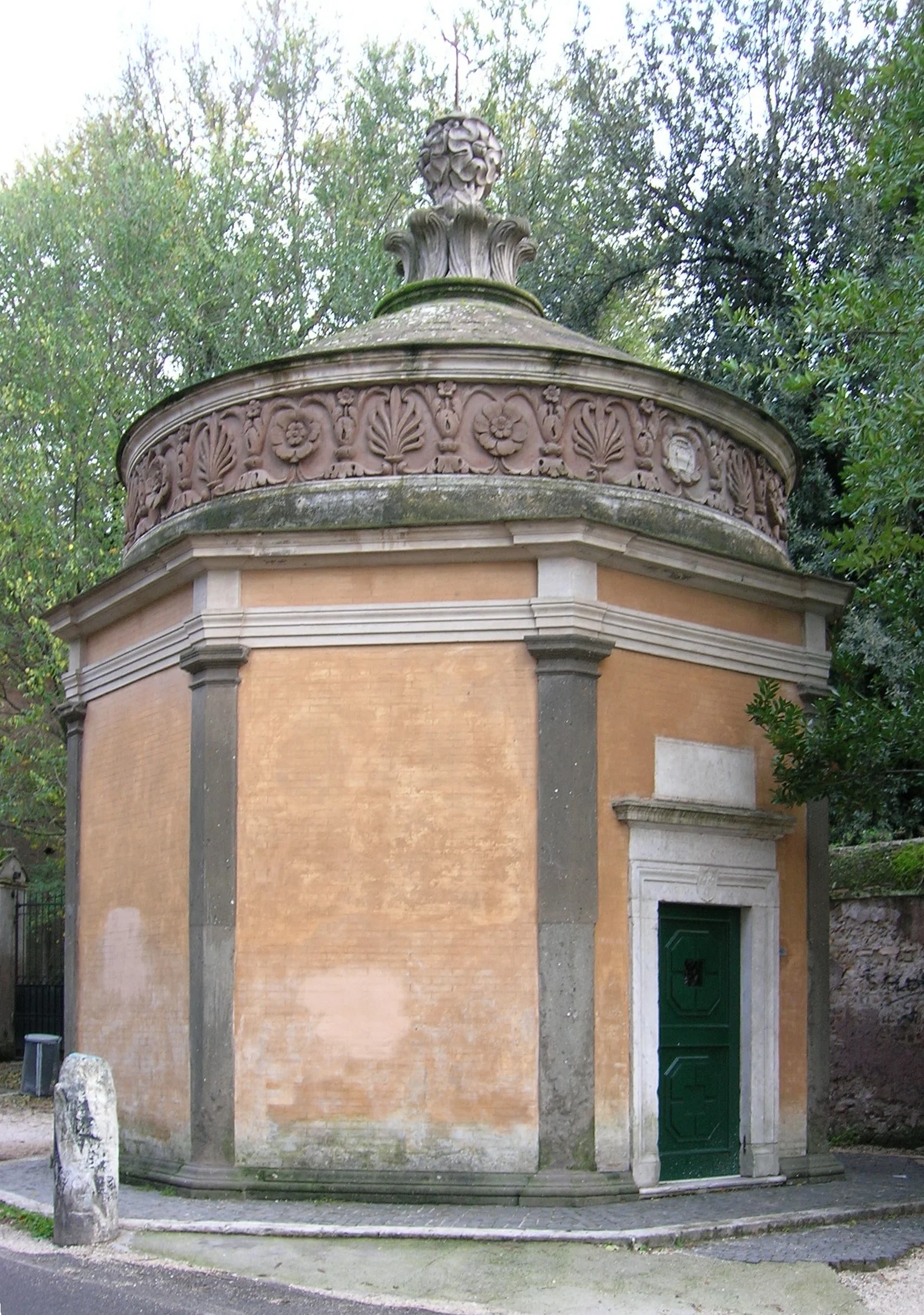
The Oratorio di San Giovanni in Oleo is closed to the public: it has no opening hours, no ticket office and no custodian on site. It stands on Via di Porta Latina, a few meters from the gate in the Aurelian Walls, and depends on the nearby church of San Giovanni a Porta Latina, at Via di Porta Latina 17, entrusted to the Rosminian Fathers. The Rome city tourism portal lists it as visitable only on request, to be addressed to that church.
From outside you can see it whenever you like, for free, at any hour: it's a small octagonal temple in brick and travertine, with a stucco crown that no other building in Rome has the like of. Inside there is a single room with a cycle of frescoes on the failed martyrdom of the apostle John. It's a 10-minute monument, but one that tells 15 centuries of the city's history.
The practical information given here corresponds to the check of September 28, 2026 on the Rome city tourism portal, on the pages of the associations that have organized special openings and on the Catholic press cited further on. The oratory's openings do not follow a public calendar and depend on the availability of the rectory. Before crossing the city with the idea of going in, stop by the sacristy or ask the Rosminians a few days ahead.
Where it is and what you see from outside
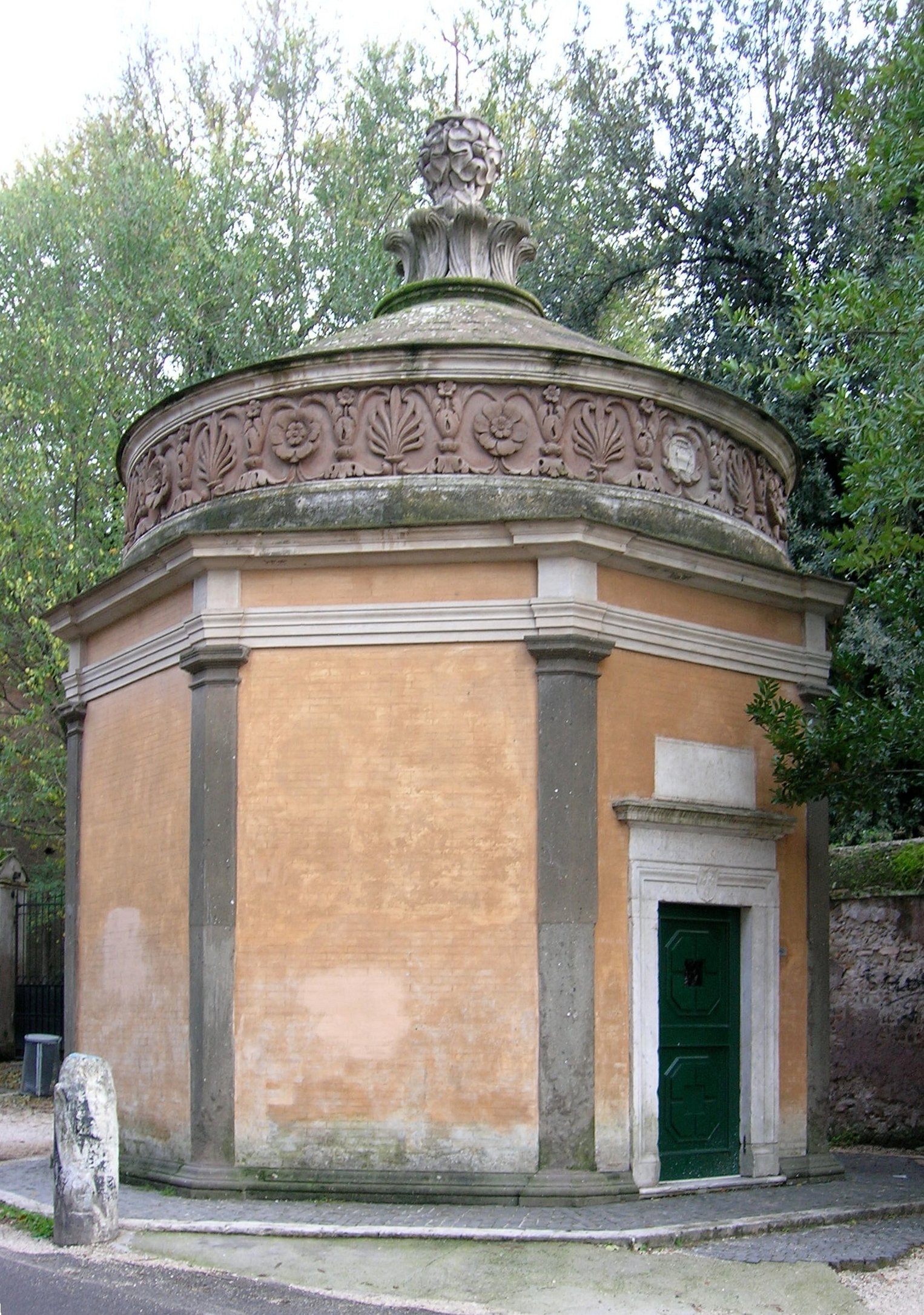
Via di Porta Latina is the street that branches off to the left from Via di Porta San Sebastiano, at the fork you reach shortly after the Baths of Caracalla, and runs between garden and villa walls up to the Aurelian Walls. The last stretch is the most beautiful: paving stones, trees, little traffic. The oratory appears when the gate is already in view, about 100 meters from the basilica of San Giovanni a Porta Latina.
The Rome city tourism portal gives the address as Via di Porta Latina 77, while the mother church is number 17. Don't worry about the numbering, which is confusing on this street: the little temple is recognizable from afar by its shape. It's an octagon, with brick walls, pilasters at the corners, a simple entablature, and above it a narrower circular drum that carries a conical roof topped by a globe and a cross.
The lower part is Renaissance, the upper part is Baroque, and the dividing line is visible to the naked eye. Under the cornice runs the frieze that Borromini had added in 1658, with roses and palms modeled in stucco, a motif repeated all the way around. The spire you see at the top is a copy: the original was taken down in 1967 and moved under the portico of the neighboring basilica, where you can look at it up close.
On the lintel of one of the doors you can read a motto in French, Au plaisir de Dieu, meaning as it pleases God. It's the signature of the French prelate Benoît Adam, who paid for the 1509 reconstruction, and according to encyclopedic sources the coat of arms on the door is his too. An inscription in French on a Roman oratory is a rarity, and it says a lot about the cosmopolitan Rome of Julius II, where foreign prelates built to leave their name.
There is little around. On one side the gate with its two semicircular towers, on the other the wall of the basilica garden and the Rosminian college complex. No shops, no bars, few benches. It's one of the quietest streets inside the walls, and that is the main reason to come here: a stretch of ancient Rome that the modern city has left almost intact, without putting anything on top of it.
How to get in: requests, keys and special openings
The key belongs to the rectory of San Giovanni a Porta Latina, which is the reference Roma Capitale gives for every visit. The right channel is to present yourself in the sacristy while the basilica is open, or to write through the contacts published on the basilica's website, explaining who you are, how many of you there are and when you would like to go in. The operator does not publish fees or time slots for the oratory. There is no online booking and no ticket.
There is no sales channel, and entry on request does not involve a ticket. The institutional reference remains the page of the Rome city tourism portal, which refers you to the mother church. Be wary of anyone selling you priority access to the little temple: it doesn't exist. When you pay for something, you pay for a guide from an association that has obtained a permit, and it's money spent on the storytelling, not on the door.
Special openings exist and are the simplest way in. On May 17, 2025, for example, the Sinopie association brought a group into the little temple thanks to a special permit, combining the visit with the basilica: meet in front of the church, €15 with guide, earphones and offering. Associations of art historians and guides organize similar visits a few times a year. Keep an eye on their calendars in spring.
You often read that the oratory opens on May 6, the feast of Saint John before the Latin Gate. The rectory does not publish this in any page you can consult, so it shouldn't be taken as certain. If you want to try that date, ask in the sacristy in the preceding weeks if a celebration or an opening is planned, and at what time. Going in blind on May 6 means risking a closed gate.
Keep one thing in mind: the rectory is a religious community, not a tourist office. Those who ask politely, for a small group and with a few days' margin, usually get a hearing. Those who show up 10 strong without warning on a Sunday between one Mass and the next do not. Only a few people go in at a time, the space is a single octagonal room, and every opening requires someone from the community to stay there with you.
The mother church: San Giovanni a Porta Latina
The oratory can't be understood without the basilica it belongs to. San Giovanni a Porta Latina is one of the best-preserved medieval churches in Rome, and the sources trace its origin to the end of the fifth century, with Pope Gelasius I. It was rebuilt in the early Middle Ages and renovated at the end of the 12th century under Celestine III. Three aisles on ancient columns of different marbles, a portico with five arches, a multi-story bell tower with triple-light windows.
The main piece is the cycle of frescoes: 46 scenes from the Old and New Testament, dated to the end of the 12th century, rediscovered in 1905 in the attic above the presbytery and restored several times since. According to the Catholic press, it is also the only church in Rome with a polygonal apse, a solution typical of Constantinople between the fifth and sixth century. Details that alone are worth the walk out here.
In the forecourt there is a medieval well between two ancient columns, with a Latin inscription. The sources don't agree on the date, which wavers between the 8th and the 9th century. The forecourt, with the well and the bell tower, is the most peaceful image of the whole neighborhood, and on a weekday morning you may find yourself alone. It's also the space you enter from to ask about the oratory, in the sacristy.
The basilica is entrusted to the Rosminians, who live in the complex next door, and every year, on the Saturday before Palm Sunday, it is one of the Roman Lenten stations. Opening hours and Mass times are managed by the rectory and can change with the seasons and with services. Before coming on purpose, check the basilica's website or ask in person: this holds for the church and even more for the oratory.
A curiosity about the Oratorio di San Giovanni in Oleo
The name carries with it a feast that the Roman calendar has erased. On May 6 the Church celebrated Saint John before the Latin Gate, in Latin ante Portam Latinam, that is, the day the apostle is said to have come out unharmed from the boiling oil. It was an entirely Roman feast, tied to this exact place. With the reform of the rubrics in the early 1960s it was removed from the general calendar and survives only as a commemoration in the old rite.
But the feast emigrated, and in Venice it still lives. The Scuola Grande di San Giovanni Evangelista, one of the old Venetian confraternities, celebrates the observance on May 6 under the name of San Giovanni in Oleo, with a commemoration open to the public at its own seat. The name of the little temple at Porta Latina has become the name of a feast in another city, which has kept it better than Rome.
The paradox is plain. In Rome, where the tradition began and where the oratory marks the exact spot indicated by devotion, May 6 passes almost unnoticed and the little temple mostly stays closed. In Venice, which has no geographic link to the episode, the confraternity has made it the patron's day. It often happens with Roman devotions: they start from a place, travel with the orders and confraternities, and take root better elsewhere.
One last detail on the name. In Oleo is church Latin, not Italian: it means in the oil, and indicates the place of the immersion, not a holy oil or a relic. In documents and guides you find oratory, little temple, chapel and church of San Giovanni in Oleo used interchangeably. They are all correct. Oratory is the most precise term, because it was never a parish and never had a clergy of its own.
One thing nobody tells you about the Oratorio di San Giovanni in Oleo
The oldest source doesn't say where. Tertullian, the African Christian writer, around the year 200 lists the glories of the Church of Rome in the De praescriptione haereticorum, and in chapter 36 he writes that in Rome the apostle John was plunged into burning oil without suffering anything and then banished to an island. Rome, then. But of Porta Latina, of a street, of a neighborhood, there is no trace in the text.
The Latin text is short and worth reading in full, because it is the basis of everything: ubi apostolus Ioannes posteaquam in oleum igneum demersus nihil passus est, in insulam relegatur. Where the apostle John, after being plunged into burning oil and suffering no harm, is banished to an island. A single sentence, inside a list that puts together the death of Peter and that of Paul. Everything else was built afterward.
Then there is a calendar problem that the guides skip. The tradition places the episode under Domitian, around 92 or 95 AD. The Aurelian Walls were built between 271 and 275, and with them the gate. In the first century, then, Porta Latina did not exist: there was Via Latina leaving the city, and that's all. The name of the place comes almost two centuries after the event it is meant to recall.
This doesn't make the tradition false, it locates it. Whoever chose this spot did so at a time when the gate already existed, probably when a place of worship dedicated to the evangelist formed around the neighboring basilica, between the fifth and sixth century. The name ante Portam Latinam describes the geography of the person writing, not that of Domitian. It is a clue to the dating of the devotion, not of the event.
If you tell it to a group, the reaction is almost always the same: disappointment, then curiosity. Because the question shifts from it happened here to why right here. And the answer leads to the basilica next door, to the walls, to Via Latina that left toward the Alban Hills. A place of worship arises where there is a community that keeps it alive, and here that community was there.
The boiling oil: documents, tradition, legend
It's worth separating the levels, because on this episode everything gets mixed. First level, the documents: Tertullian, around 200, states that the immersion in oil took place in Rome and that John came out unharmed before the exile on an island. It is a text written about a century after the events, by an author writing in Carthage who uses the episode in a polemic against heretics. It is old, but it is not a record.
Alongside Tertullian, the second text that circulates is by Jerome, who between the fourth and fifth century takes up the episode and adds a detail: the apostle is said to have come out of the vessel purer and more vigorous than when he went in. Here too we are looking at a real text, but more than three centuries after the events, and the addition already has the flavor of an edifying tale. Later sources copy Tertullian and Jerome, without adding proof.
Second level, the tradition: the placing of the event before Porta Latina, the date of May 6, the presence of Domitian, the year 92 or 95, the idea that the little temple stands on a smaller, older place of worship, a martyrion attested by church sources around the fifth century. These are data transmitted by Roman liturgy and devotion, consistent with each other, but none of these elements appears in the oldest source.
Third level, the legend: the terrified crowd demanding the apostle's exile, the age of 80 or more, the cauldron before the emperor in person, the miraculous rejuvenation, the medieval tales of the Legenda Aurea of Iacopo da Varazze that turn the episode into a theatrical scene. Even the idea that the little temple rests on a reused pagan mausoleum is more local tradition than excavation data: the Roma Capitale portal writes it in the conditional.
For those who come here, the distinction has a practical consequence. The frescoes by Lazzaro Baldi inside the oratory illustrate the third level, not the first: the emperor, the cauldron, the executioners. They are 17th-century images of a medieval tale set in the first century. Look at them knowing that, and they will tell you much more about 17th-century Rome than about the apostle, that is, about how the Counter-Reformation told martyrs to the faithful.
The most honest way to stand before this little temple is to accept all three levels without confusing them. An ancient text places an episode in Rome. A community, centuries later, fixes it at a precise point near a gate. A cardinal and an architect, centuries later still, build a monument over it. None of the three steps is a fake. They are three different ways of remembering.
The advice I give you for visiting the Oratorio di San Giovanni in Oleo
Go into the basilica first and then look at the little temple. San Giovanni a Porta Latina has a 12th-century cycle of frescoes with 46 scenes from the Old and New Testament, a portico on ancient columns, a medieval well in the forecourt and, under the portico, Borromini's original spire. Given the context, the oratory stops being an isolated curiosity and becomes the missing piece of a story you already have in your head.
If you want to get inside the oratory, there is only one piece of advice: latch on to an organized opening. The associations that obtain the permit usually do so in spring, and between April and June the chances are higher. A private request for two people is possible but not guaranteed, and depends on the community's commitments. A group of about 20 people with a guide has much better odds of getting a date.
If you come only for the exterior, you're wrong to look at it in a hurry. Walk all the way around it: the eight sides are not identical, because one of the doors faces the garden, and the relation between the low Renaissance volume and the Baroque drum changes depending on the side. Stop on the side of the gate in the walls and look up at the frieze. Count the roses, if you have the patience. You'll understand the rule of the design.
Bring a small pair of binoculars or use your phone's zoom. The frieze of roses and palms is several meters up and with the naked eye it reads as a generic decorative band. Enlarged, it shows a nervous modeling, with palm leaves crossing and roses open in different ways, typical of Borromini's hand. It's the detail that sets this crown apart from just any restoration, and it should be looked at up close.
Finally, go around under the portico of the basilica to see the original spire on the ground. It's the only way to have a piece of Borromini within reach outside a museum. The one on top of the little temple is a plaster cast from 1967. Compare the two: the copy is faithful in form, but the surface of the original, worn by three centuries of rain, tells the time that the copy does not have.
What Borromini really did
In 1658 Cardinal Francesco Paolucci, from Forlì, raised in the circle of the Oratory of Saint Philip Neri, entrusted Francesco Borromini with the restoration of the little temple, which he wanted to turn into a family chapel. It was the pontificate of Alexander VII Chigi. Borromini was working in those years on the most demanding sites of his career, and this is a minor commission: a crown, not a building. It should be judged for what it is.
The work, according to the Roma Capitale portal, concerns the roof. Borromini places on the octagonal body a drum with a tall stucco frieze, raises a conical roof and closes it with a bundle of leaves on which rests a globe decorated with roses. The roses are a heraldic tribute to the Paolucci. The palms refer to martyrdom. Inside, the sources also attribute to him the modification of the dome.
Here is the editorial team's position, contrary to almost all the guides: San Giovanni in Oleo is sold as a work by Borromini, but of Borromini there is a frieze and a roof here, and the spire you see from below is a cast. Whoever crosses the city to see Borromini should go to San Carlo alle Quattro Fontane or to Sant'Ivo alla Sapienza. You come here for the place, not for the architect.
That said, the frieze is worth it. It's an exercise by Borromini on a domestic scale, and it contains his obsessions in miniature: decoration that follows the geometry instead of covering it, the heraldic symbol turned into ornament, the crown that closes the volume like a hat. Whoever knows the bell tower of Sant'Andrea delle Fratte recognizes the same idea of a sculpted top.
To place the work within the rest of the architect's output, the itinerary Borromini in Rome lines up the major works, from the Oratorio dei Filippini, an environment Cardinal Paolucci knew well, to the perspective of Galleria Spada, up to Sant'Agnese in Agone. Porta Latina is a footnote to that route, nice to know.
Another well-known fact, yet rarely cited
Nobody knows for certain who designed the 1509 building. Tradition assigned it to Bramante, who in those years was working for Julius II. More recent studies, reported by the Roma Capitale portal and by Catholic encyclopedias, propose Antonio da Sangallo the Younger or Baldassarre Peruzzi. Three names for an octagon a few meters across: it's a sign of how little the building site is documented, and of how easily things get attributed to the greats.
The most natural comparison is with the Tempietto del Bramante at San Pietro in Montorio, built in the same years on the traditional site of Peter's crucifixion. Two small centrally planned buildings, two apostolic martyrs, two patrons tied to the papal court. But the Tempietto at Montorio is a manifesto of architecture, while this octagon is a utility building, sober, almost anonymous. The attribution to Bramante probably comes from that parallel.
For the name of Peruzzi, whoever wants an idea of his language should go to Villa Farnesina, which is his documented masterpiece. For Bramante, besides Montorio, there is the Chiostro del Bramante next to Santa Maria della Pace. Set side by side, these buildings make clear why the octagon at Porta Latina can't manage to become an authored work.
The octagonal plan, then, is not a random choice. In Rome the octagon is the shape of baptisteries and of places commemorating martyrs, and the closest model, even geographically, is the Lateran Baptistery, next to St. John Lateran. Whoever built in 1509 knew that a centrally planned building on a site of martyrdom spoke a language the Romans understood at once.
Porta Latina and the name of the place
The gate you see behind the oratory is one of the openings in the Aurelian Walls, the circuit of about 19 kilometers that Emperor Aurelian had built in haste between 271 and 275 to defend Rome from Germanic raids. At the end of the fifth century the system counted 18 main gates and five posterns. Via Latina left from here toward the southeast, in the direction of the Alban Hills and the Sacco Valley.
As it is today, the gate is the result of several interventions. It has a single arch in irregular travertine blocks, a row of windows above the arch on the outer side, stone battlements, and two semicircular brick towers rebuilt almost entirely, probably in the sixth century. The walls and gates were reinforced around 401 under Emperor Honorius. Whoever arrives from inside the city sees the less defended side, lower and simpler.
Look at the keystones, which almost everyone ignores. On the inner side there is a cross inscribed in a circle, on the outer one the monogram of Christ between the alpha and the omega. They are Christian symbols carved on a military gate. They are often attributed to Belisarius's restorations in the sixth century, but according to the reconstruction reported by the encyclopedias the attribution is wrong and they should be referred to Honorius's works. In any case they tell of an already Christian city.
Porta Latina and the oratory are part of the same scene, and that is what makes the place different from the other openings in the walls. At Porta San Paolo there is the Pyramid of Cestius, at Porta Pia the memory of the breach of 1870, at Porta San Sebastiano the museum. Here there is a place of worship born around a tale of martyrdom. Every gate in Rome has a different story, and this is the quietest.
The right photo to take at the Oratorio di San Giovanni in Oleo
The right photo puts together the little temple and the gate. Move away about 30 meters along Via di Porta Latina, toward the inside of the city, and look for the spot where the cone of the oratory overlaps the semicircular towers of the gate in the background. In portrait orientation, with the little temple at a third of the frame. It's the image that explains the name of the place without needing a caption.
The second photo is a detail: Borromini's frieze with the zoom, filling the whole frame with the roses and palms. It works better under an overcast sky or in the shade, because the pale stucco in full sun burns out and loses its relief. A gray winter day, here, gives better results than a July morning. Avoid flash even from far away, it's of no use and flattens the modeling.
The third is under the basilica portico: the original spire resting on the ground, photographed from above or at three-quarters, with the ancient columns of the portico in the background. It's a strange image, a piece of roof out of place, and for that very reason it stays in the mind. Ask first if photography is allowed, because it is a place of worship and during services silence must be respected.
Avoid the close frontal photo with the phone from the sidewalk. Up close the octagon distorts, the drum disappears, and you get a brick wall with a closed door. If you go in during an opening, the light inside is poor and the frescoes are high up: raise the sensitivity instead of looking for the flash, and take the cycle from the center of the room by turning on the spot.
Some important events that happened here in history
Around the year 200 Tertullian writes that the apostle John was plunged into oil in Rome. Between 271 and 275 Emperor Aurelian builds the walls that still enclose the city today, with 18 main gates, and Via Latina gets its gate. In the early fifth century, under Honorius, the walls and gates are reinforced. The gate you see today bears the marks of that work.
Between the fifth and sixth century the nearby place of worship arises: church sources place a first martyrion on the spot indicated by tradition and the basilica of San Giovanni a Porta Latina is attested already at the end of the fifth century. In 1191, under Pope Celestine III, the renovation of the basilica is completed, with the bell tower and the cycle of frescoes. The little temple you see does not yet exist in its present form.
In 1509, under Julius II, the French prelate Benoît Adam has the oratory rebuilt on an octagonal plan and leaves us his motto on the door. In 1658 Cardinal Francesco Paolucci entrusts Borromini with the restoration of the roof. A few years later Lazzaro Baldi frescoes the interior with the stories of Saint John. The sources don't agree on the date of the frescoes: some give 1658, others 1661.
At the end of the 17th century Cardinal Stefano Agostini has further changes carried out, and in the 18th century, under Clement XI, the interior is rearranged again. Here too the sources don't agree on the year, which wavers between 1716 and 1719. These are maintenance works that did not change the face of the building, but they explain why the frescoes you see are not exactly those of the 17th century.
In the 20th century the Rosminians arrive, the religious of the Institute of Charity founded by Antonio Rosmini, who take over the care of the basilica and the complex. On the date too the sources don't agree: some give 1937 and some 1940. In 1940 and 1941 the basilica is restored to bring the medieval structures back to light. The oratory remains a dependency of the mother church.
In 1967, during a restoration, Borromini's original spire is taken down and replaced by a plaster copy. The original ends up under the basilica portico. Since then the little temple has not changed. Openings remain rare and dependent on special permits: one of the most recent documented is the one organized by the Sinopie association on May 17, 2025, with a guided visit to the basilica and the little temple.
Who has passed through the Oratorio di San Giovanni in Oleo
John the Evangelist, according to tradition. Son of Zebedee, brother of James, one of the 12, the attributed author of the fourth Gospel and of the Apocalypse, which would have been written precisely during the exile on Patmos that followed the trial of the oil. His presence in Rome rests on the passage in Tertullian and on nothing else contemporary. He is the most important figure of the place, and also the one we know least about.
Domitian, emperor from 81 to 96, to whom Christian tradition assigns the persecution in which the episode falls. Tertullian does not name him in the passage on the oil. The link with Domitian comes from the chronology constructed afterward, which ties the exile on Patmos to the last years of his reign. For those who tell the story of the place, it's best to present him for what he is: the sovereign of the tradition, not the protagonist of a chronicle.
Benoît Adam, a French prelate at the court of Julius II, who paid for the 1509 reconstruction and signed the building with his motto, Au plaisir de Dieu. Little is known of him outside this commission, and perhaps that is precisely the point: a second-tier churchman who secures a place in the city's memory with a small building, put in the right spot, with a phrase in his own language.
Francesco Borromini, who worked here on commission from Cardinal Francesco Paolucci, from Forlì, born in 1581 and died in 1661, trained in the Oratorian circle of Cesare Baronio. Paolucci wanted a family chapel, Borromini gave him a crown with the roses of his coat of arms. The patron died a few years after the work. The architect six years later. Neither left his best work here.
Lazzaro Baldi, a painter who was a pupil of Pietro da Cortona, who painted the stories of Saint John inside, including the scene of the immersion in boiling oil. He was a solid and prolific painter of the Cortona workshop, much in demand for cycles in Roman churches. In the narrow space of the octagon his narrative is necessarily compressed, and the scenes are read by turning on the spot, one wall after another.
The architect Paolo Marconi, to whom the sources attribute the 1967 restoration with the replacement of the spire. Then the Rosminians, keepers of the complex since the 20th century, who still hold the key today. And finally Tertullian, who wrote in Carthage and who with a single line gave rise to everything you see on this street.
How to get there
The nicest way is on foot from the Baths of Caracalla: take Via di Porta San Sebastiano, reach the fork with Via di Porta Latina and take the left-hand street up to the gate. It's about 20 minutes of easy walking, between boundary walls and trees, on paving that is uneven in places. Comfortable shoes, not light sandals.
If you're coming from the Circus Maximus, add a quarter of an hour skirting Caracalla. If you're coming from San Giovanni in Laterano, you can go down along the walls toward the south and enter from the Porta Latina side, but the route is less pleasant because it follows busy roads. The ATAC surface lines that run through the area often change route: check the route on the ATAC website the same day.
By car it's not worth it. Via di Porta Latina is narrow, parking is scarce and taken by residents, and looking for a space right up against the walls wastes more time than it saves. By bicycle, on the other hand, it works well, and lets you link the oratory to the Appian Way Regional Park via Porta San Sebastiano, which is a few minutes away.
A warning that holds for the whole area: between Porta Latina and Porta San Sebastiano the sidewalks are narrow or absent, and cars go fast even on streets that look like country lanes. With children or with a group, keep to the inner side and walk in single file. The route is beautiful precisely because the city has built nothing here, but for the same reason it hasn't built the services either.
When it's closed and what not to expect
The oratory is closed almost all the time. There is no fixed opening day, no seasonal schedule, no custodian at the gate. The normal state is the barred door, and whoever arrives without arrangements sees only the exterior. It's not a lack of care: it's a small place of worship with no regular services, run by a religious community that has other priorities and that opens when asked with good reason.
Don't expect panels, audio guides or services. On site the information is reduced to a minimum, and everything that is known about the little temple you have to bring yourself or have a guide tell you. There are no public restrooms, no drinking fountain next to it, and the nearest places for refreshments are along the busy streets outside the walls or toward Caracalla.
The basilica next door also has its own hours, tied to services and to the life of the community, and the Saturday before Palm Sunday is a Lenten station, with a flow of worshippers. At those times tourist visits are suspended. Respect for services holds for the oratory too: if you find the door open for a celebration, go in quietly or wait outside.
On accessibility the data are not published in detail. The road surface around is irregular paving and the interior space of the oratory is small. The Roma Capitale portal refers to the accessibility section of its own website for general information. If you move in a wheelchair, ask the rectory directly when you make the visit request, to find out what can be reached.
Eating in the area
Between Porta Latina and Caracalla you don't eat: the area is made of walls, gardens, villas and religious institutions. To find a kitchen you have to go out through the walls toward the residential neighborhoods or head back toward the Celio, the Circus Maximus and San Saba. It's good news, because the street stays quiet, but you should factor it in if you're organizing a half day with children or with a group.
The real risk is in the tourist passing-trade zones along the route toward the center. Be wary of menus with photographs of the dishes, of places with a person at the door inviting you in, of kitchens open nonstop from morning to night. A serious kitchen has a crew that stops, prepares and starts again: those who are always open are serving a public that will not come back.
The lady rolling out the sfoglia in the window or on the sidewalk is a show, not a guarantee. Well-made fresh pasta is prepared in the morning, in the kitchen, away from the dust. And watch out for places in front of the big monuments: items with no price, fish of the day by weight with no figure, different menus between the tables outside and the dining room inside. Ask the price before ordering, always, without embarrassment.
Romans don't go there not out of snobbery, but because they know the alternative 10 minutes away on foot. The rule is simple: look at who is sitting there and in what language they order. If at lunch there are office workers, laborers and local families, you're in the right place. If there are only backpacks and the waiter speaks to you in English at first glance, that's information, not a judgment.
So you don't have to go by trial and error, I keep up to date a map of addresses we really go to, in Rome and the surrounding area, with no sponsorships: our list of the places where we eat. From the Porta Latina area it's best to look at the spots toward the Celio and toward San Giovanni. Book for lunch on weekdays, and remember that many neighborhood places close one day a week.
What to combine it with in a day
The first pairing is a few meters away. The Colombarium of Pomponius Hylas, a Roman tomb with niches for urns, is right inside the gate, within the Parco degli Scipioni, where you also find the Tomb of the Scipios. The visiting arrangements are different for each site, so check them on their respective pages: if you can match the dates, you have a whole morning on the theme of remembering the dead.
The second is the neighboring gate. From Porta Latina to Porta San Sebastiano is a few minutes, and there, inside the gate itself, is the Museum of the Walls. It's the best way to understand the history of the Aurelian Walls and then come back to look at Porta Latina with different eyes. The comparison between the two gates says a lot about the late antique city.
Outside the gate the Appia begins. If you have a whole day you can continue toward the Church of Domine Quo Vadis, which is another place where tradition locates an apostolic episode, then toward the Catacombs of San Callisto and San Sebastiano fuori le Mura. Further to the side opens the Caffarella Park, excellent for an outdoor break.
Inside the walls, staying on the theme of ancient churches, a few minutes away are San Cesareo de Appia and the Santi Nereo e Achilleo, two ancient churches of the same area, and going north San Sisto Vecchio. If you prefer the Celio, you find Santo Stefano Rotondo, another central plan, and Villa Celimontana.
For a day devoted entirely to central plans, pairing with the Mausoleum of Santa Costanza on Via Nomentana is instructive, even if far away. If you want an overall picture of the neighborhood, there's the page on the Celian Hill, useful for linking Porta Latina to the Roman houses and the basilicas of the hill. In one morning three or four stops go well, no more.
Frequently asked questions
Is the Oratorio di San Giovanni in Oleo open to the public?
No, as a rule it is closed. It has no published opening hours and is visited only on request to the rectory of San Giovanni a Porta Latina, at Via di Porta Latina 17, or during special openings organized by cultural associations with a special permit. The exterior, on the other hand, can be seen freely at any hour, from the street, at no cost and with no booking.
Who has the keys to the oratory?
The keys belong to the rectory of San Giovanni a Porta Latina, entrusted to the Rosminian Fathers of the Institute of Charity. The Rome city tourism portal names that very church as the reference for every visit. The request is made in the sacristy while the basilica is open, or through the contacts published by the basilica itself, a few days ahead.
Do you pay to enter?
For a visit on request there is no ticket and the operator does not publish fees. In special openings organized by associations you pay for the guide: at the May 17, 2025 opening, for example, the fee was €15, including guided visit, earphones and an offering to the church. No portal sells tickets for the oratory.
Is it true that the oratory opens on May 6?
May 6 was the feast of Saint John before the Latin Gate, tied to this place, and you often read that on that day the oratory is opened. The rectory does not publish this in any page you can consult. If you want to try that date, ask in the sacristy in the preceding weeks if a celebration or an opening is planned, and at what time.
Was Saint John really plunged into boiling oil here?
The oldest source, Tertullian around the year 200, says the episode took place in Rome, without naming the place. The placement before Porta Latina is a later tradition, fixed when the gate already existed. The details on Domitian's presence and on the apostle's rejuvenation belong to medieval legend, also collected in the Legenda Aurea.
Is the oratory the work of Bramante or Borromini?
Of neither in full. The 1509 reconstruction was traditionally attributed to Bramante, while more recent studies propose Antonio da Sangallo the Younger or Baldassarre Peruzzi. Borromini in 1658 redid the roof, with the frieze of roses and palms and the conical roof. The spire on top today is a copy from 1967.
Where is Borromini's original spire?
The original spire, taken down during the 1967 restoration, is kept under the portico of the basilica of San Giovanni a Porta Latina, a few steps from the oratory. You see it while the church is open. On top of the little temple there is a plaster reproduction. It's one of the rare cases in which an element by Borromini can be observed up close.
What do you see inside?
A single octagonal room with a cycle of frescoes on the stories of Saint John the Evangelist, attributed to Lazzaro Baldi, a pupil of Pietro da Cortona, including the scene of the immersion in boiling oil. The sources don't agree on the date, between 1658 and 1661, and the interior was touched up in the 18th century. The interior visit lasts a few minutes.
How much time do you need to see the oratory and the area?
For the exterior of the oratory 10 minutes is enough, for the neighboring basilica with the medieval frescoes and Borromini's spire under the portico a good half hour. If you add the walk from Caracalla, Porta Latina and the exterior of the Parco degli Scipioni (the Colombarium of Pomponius Hylas is closed for PNRR works), count on an unhurried morning, without rushing, with the stops needed to read the details.
Who wrote this page
The page comes from the editorial team of Tour Leader Pro, the Roman outfit that designs itineraries, visits and cultural events across Rome and Lazio. The access arrangements given here come from the official sources and from the pages of the associations cited in the text as of the date indicated at the top. For a place that opens on request, the rule remains to ask the rectory first. Tell us what you find changed.
Putting together a morning among Porta Latina, the Appia and the Celio means fitting together places that open only by reservation, rectories with hours tied to services, stretches of road with no sidewalk and special openings announced with little notice, for yourself or for a group of 40 people. If you're facing this kind of puzzle, Tour Leader Pro has working materials designed for those who guide and for those who organize on their own.
For the wider picture, meaning regional trains and seasonal timetables, rentals, airports, transfers between provinces and Lazio destinations outside central Rome, from the Castelli to the volcanic lakes of the north, the Tyrrhenian coast and the villages of the interior, a useful resource for putting together a multi-day itinerary is Italy Planner.