Sant’Andrea delle Fratte
In short. At Sant’Andrea delle Fratte, on either side of the high altar, there are two marble angels that Gian Lorenzo Bernini sculpted with his own hand between 1667 and 1669 for the parapet of Ponte Sant’Angelo: the Angel with the Crown of…
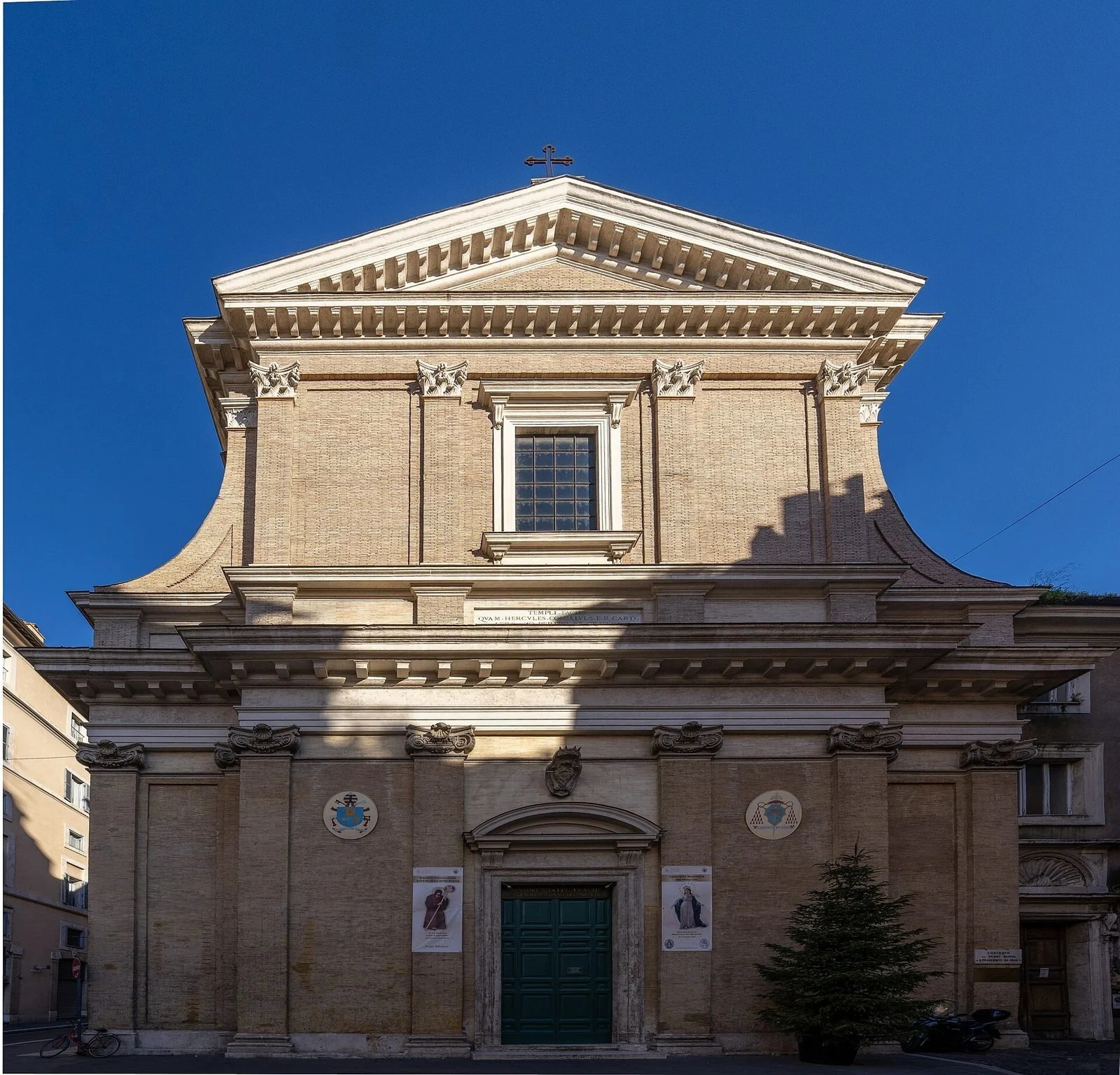
At Sant’Andrea delle Fratte, on either side of the high altar, there are two marble angels that Gian Lorenzo Bernini sculpted with his own hand between 1667 and 1669 for the parapet of Ponte Sant’Angelo: the Angel with the Crown of Thorns and the Angel with the Scroll, the one holding the titulus with the inscription INRI. They never reached the bridge. Clement IX, who had commissioned the whole series of 10 angels with the symbols of the Passion, judged the two Bernini autographs too precious to stay exposed to the rain and wind of the Tiber, and had them replaced with two copies. The copies are still there, on the bridge, photographed every day by thousands of people who believe them to be originals. The originals are here, in a parish church between Piazza di Spagna and the Trevi Fountain, free admission, almost always empty. That is the reason the seven-minute detour from the Trinità dei Monti staircase is worth it. The lines that follow tell what you see inside and outside: the two angels and their story, the bell tower and the apse by Francesco Borromini, the apparition of 1842 that made the church a shrine, the tomb of Angelica Kauffmann, and how to organize the visit.
The page on Ponte Sant’Angelo tells the bridge: its Roman history, the baroque remaking, the 10 statues as a whole and how you walk today from Castel Sant’Angelo toward the center. This page tells the church where the two marbles removed from the bridge ended up. Whoever wants to understand the story in full reads both. The comparison between the copy outdoors and the original indoors takes half an hour of walking.
Where Sant’Andrea delle Fratte is and how to get there
The basilica has its entrance at Via di Sant’Andrea delle Fratte 1, in the Colonna district, in a triangle of streets between Via del Tritone, Via dei Due Macelli and Via Capo le Case. From the Barcaccia fountain, at the foot of the staircase, it is a little over 300 meters on foot. From the Trevi Fountain it is about 600 meters, slightly uphill. The paradox is this: the church sits at the most trodden point in Rome and nobody goes in, because the flow passes 40 meters farther on without turning the corner.
By metro
Line A has two stops at almost the same distance. Spagna is the most convenient for those coming from the north of the center: exit onto Piazza di Spagna, then Via dei Due Macelli and left onto Via di Sant’Andrea delle Fratte. Barberini serves those coming from the Quirinale or from Termini station: you go down Via del Tritone and take Via Capo le Case. In both cases the walk stays under seven minutes. Those with walking difficulties should keep in mind that the Spagna stop has a long tunnel with moving walkways toward the Pincio, while the exit toward the square is more direct.
The two Bernini angels: the originals are here, the copies are on the bridge
The two angels kept on either side of the presbytery of Sant’Andrea delle Fratte are the only two of the Ponte Sant’Angelo series sculpted personally by Gian Lorenzo Bernini, and they never reached the parapet they were made for. The rest of the series, 10 angels with the symbols of the Passion, was carried out between 1668 and 1669 by the sculptors of the workshop and by artists close to the master: Antonio Raggi, Lazzaro Morelli, Cosimo Fancelli, Paolo Naldini, Girolamo Lucenti, Ercole Ferrata, Antonio Giorgetti, Domenico Guidi. Bernini was nearly 70 and the pope had entrusted him with the direction of the whole program. With his own hand he worked two blocks: the Angel with the Crown of Thorns and the Angel with the Scroll.
What they hold in their hands, and how to recognize them
The Angel with the Crown of Thorns holds the circle of brambles between its hands, tilted toward the viewer, and has its face turned three-quarters upward. The Angel with the Scroll holds the tablet with the inscription INRI, the inscription that according to the Gospels was fixed on the cross, and in the English-language critical tradition it is known as Angel with the Superscription. Both have the billowing, swollen drapery that is Bernini's late signature, and both are designed to be seen from below and in foreshortening: hence the tilted heads and the turned legs, a pose that looks unnatural up close and works at a height of three meters.
The decision of Clement IX
The sources agree on the central fact: Pope Clement IX, of the Rospigliosi family, considered the two autograph marbles too beautiful to be left outdoors on the bridge, and ordered that they be replaced by copies. On the exact motive the versions differ in nuance. Some sources speak of a purely conservation reason, the fear of the river's dampness and of bad weather. Others report that the pope wanted to keep them for himself, for his own personal pleasure. The two readings do not exclude each other and neither has a document that settles it definitively. Here we report both.
Who made the copies you see on the bridge today
On the copies of the parapet the sources split. The prevailing critical tradition attributes the copy of the Angel with the Crown of Thorns to Paolo Naldini and that of the Angel with the Scroll to Giulio Cartari, both collaborators of the Bernini workshop. Other, more cautious Italian sources speak generically of workshop copies without naming names. Whoever goes onto the bridge today is therefore looking at two 17th-century replicas by excellent hands, not two modern casts. It is a difference that matters, because the copies too are more than 300 years old and their deterioration tells exactly what Clement IX feared.
How they came to this church
Removed from the bridge site, the two originals stayed in the Bernini house. The heirs kept them in the family palace, not far away, for some 60 years, and in the end donated them to the neighborhood church. On the date the sources do not agree: the Italian encyclopedia entries and the district's information sheets give 1729, the parish website 1731. Since then the two marbles have not moved, and they have gone from being two statues meant for a public parapet to being two altar sculptures, seen in a closed architecture and in a light that Bernini had not foreseen.
The verdict, without beating around the bush
Among all the free-entry churches in the center of Rome, this one has the highest ratio between the quality of what you see and the number of people who go in. Two late Bernini autographs, three meters away, no ticket, no line and no barriers. A few meters from here you pay 15 or 20 euros for things of comparable level. The reason nobody is here is banal: the facade promises nothing and the church does not appear on prepackaged itineraries. Whoever looks for Bernini in Rome and stops at Santa Maria della Vittoria and the Fountain of the Four Rivers misses the least crowded and latest piece. The complete itinerary of his works in the city is collected on the page Bernini in Rome.
Borromini's bell tower and apse: look at them from Via Capo le Case
Francesco Borromini worked at Sant’Andrea delle Fratte starting in 1653, and what he left us is three things: the apse, the drum of the dome and the bell tower. None of the three can be seen well from inside the church, and none of the three can be seen well from the entrance street. They are seen from outside, from the side, from the end of Via Capo le Case, and that is why almost all visitors leave the church without having looked at them.
The bell tower: two orders, the herms of Janus and the cross of Saint Andrew
The bell tower rises on two superimposed orders of different plan, with the passage from the square to the moving shape that is Borromini's favorite game. The capitals of the second order are herms of two-faced Janus, double heads looking in two directions, and higher up run torch-bearing angels. The spire is crowned by a decussate cross, the X-shaped cross that is the symbol of Saint Andrew and that here closes the whole architectural discourse vertically. There is no other bell tower in Rome with this sequence of elements, and the distance from any ordinary baroque bell tower is the same as the one between the facade of San Carlo alle Quattro Fontane and any ordinary church facade.
The tiburio left in brick
The dome was never finished. The tiburio, the drum that wraps the cap, has remained in exposed brick, without cladding and without the lantern that was supposed to close it. Around it, four diagonal buttresses spiral upward, drawing an X in plan, once again the cross of Saint Andrew, this time translated into load-bearing structure. The effect is a bare, aggressive volume that looks like a full-scale model left half done. The contrast with the bell tower, white and finished down to the last detail, is the most memorable thing in the whole complex. Whoever loves Borromini finds here, unfinished, a piece of reasoning that elsewhere is covered by marble.
Where to look from, step by step
You leave the church, turn right and go back up Via di Sant’Andrea delle Fratte as far as Via Capo le Case. Once at the crossing you turn around and look up: bell tower and tiburio enter the frame together, superimposed, with the dark mass of the brick serving as a backdrop to the light vertical of the tower. Stepping back 20 or 30 meters the two volumes separate and the structure of the buttresses reads better. The Anglo-Saxon guides who know the area indicate Via Capo le Case itself as the best point. From the little square in front of the door you see almost nothing.
Why Borromini stopped
The building site stopped for the most prosaic reason: the patron's money ran out. The reconstruction was financed by the marquis Ottavio del Bufalo and dragged on for over a century with continual interruptions. After Borromini's death in 1667 the completion passed to Mattia de Rossi, a pupil of Bernini. The church where the two Bernini angels now rest was finished by a pupil of Bernini on top of an architecture by Borromini. On the end dates of Borromini's works the sources diverge between 1655 and 1667. The sure datum is the start in 1653. The complete itinerary of Borromini's architecture in the city is on the page Borromini in Rome.
A note of popular tradition about the bell tower
In the district the nickname of dancing bell tower has circulated for generations, tied to the belief that the tower sways when the bells ring in full peal. It is an oral tradition also reported in some historical information sheets of the district, and as such it should be taken: there is no public structural study that confirms or denies it. We report it because it is part of the way Romans have told the story of this building, not as a technical datum.
The history: from the fratte to the Scots, from the Scots to the Minims
The name Sant’Andrea delle Fratte comes from the vegetation: fratte, in old Romanesco and in regional Italian, means scrub, brushwood, thick hedge. The term goes back ultimately to the Byzantine Greek for hedge. When the church was first documented it was really at the edge of the built-up area, in a zone of vegetable gardens and scrub between the Campo Marzio and the slopes of the Pincio.
The facade: a bequest and a disputed date
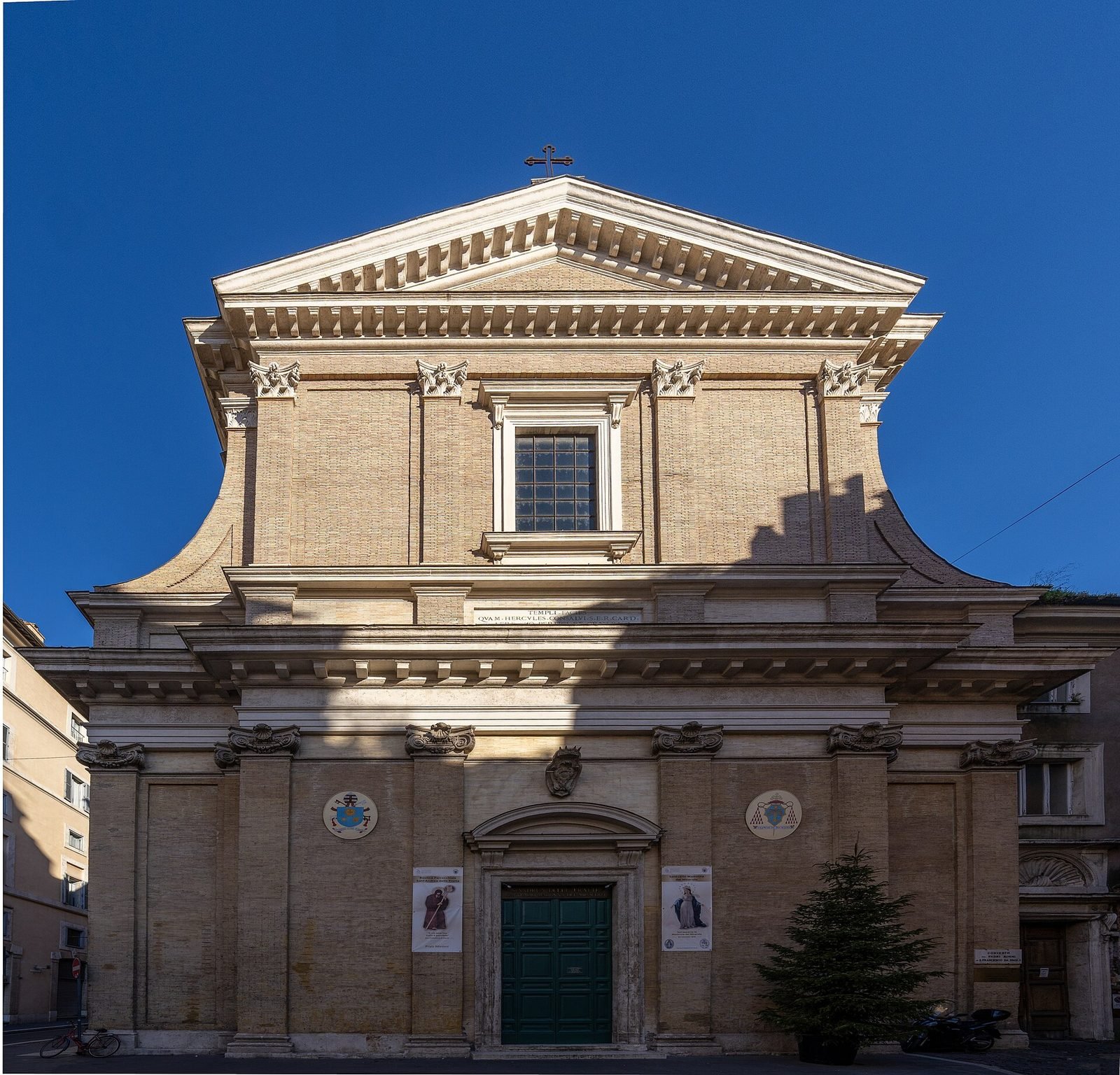
The facade was made by Pasquale Belli thanks to the bequest of Cardinal Ercole Consalvi, the secretary of state of Pius VII, the man who had negotiated with Napoleon and then guided the Holy See at the Congress of Vienna. On the date the sources diverge: the historical information sheets of the district give 1826, the year of the bequest, while the Italian encyclopedia entry reports 1862. Whoever looks at the facade, in any case, is looking at a 19th-century neo-Renaissance cladding applied to a baroque church. It is the reason why from the street you suspect nothing of what is behind it.
A curiosity about Sant’Andrea delle Fratte
The most solid curiosity of Sant’Andrea delle Fratte is that inside the same building, 20 meters from each other, live together the works of the two architects who most detested each other in 17th-century Rome: two autograph sculptures by Gian Lorenzo Bernini on the high altar, and the apse, the drum and the bell tower by Francesco Borromini all around. It was not a choice of patronage. It was a coincidence built by time, because the marbles arrived 60 years after the architecture had been raised.
Two enemies under the same roof
The rivalry between the two is documented: they fought over commissions, took building sites from each other, accused each other of technical incompetence. Borromini died in 1667, the year in which Bernini began to sculpt the two angels, and when the heirs donated the marbles to this church neither of the two had been alive for more than 60 years. Today whoever goes in sees Bernini lit in the center and Borromini all around, above the head and outside the windows.
The cross of Saint Andrew as a hidden signature
The X of the cross of Saint Andrew, the gibbet on which according to tradition the apostle was put to death, is repeated by Borromini at different scales: as a decussate cross on the spire of the bell tower, and in plan in the X arrangement of the four buttresses of the tiburio. It is an iconographic signature inside the load-bearing structure, not applied on top as decoration. Whoever knows Sant’Andrea al Quirinale, which is a different church and by Bernini, finds the same titular saint again and an opposite formal solution.
One thing nobody tells you about Sant’Andrea delle Fratte
Beneath the church of Sant’Andrea delle Fratte is preserved a putridarium, that is a provisional funerary room with niches and drainage seats where the bodies of the religious were left to decompose before the bones passed to final burial. According to the sources that deal with Roman underground spaces it is the only surviving example in Rome. The descriptions speak of about 15 niches carved in the wall, with perforated seats.
What it was and why it was done
The putridarium, also called a drainer, was a practice widespread in several religious orders between the 17th and 19th centuries, above all in the South. The body was seated on a perforated seat and left there for months. The bones were then collected, washed and placed in an ossuary. The sense was practical, to save space, and at the same time ascetic. In a church 100 meters from the staircase of Piazza di Spagna, under the feet of passersby, it is a presence that no sign points out.
Not visitable on request
Let it be clear: access to the underground spaces is not part of the ordinary visit and cannot be booked at a ticket office, because there is no ticket office. Any openings depend on specific initiatives and on the permission of the religious community. Whoever is interested should inquire directly at the parish, without expecting a yes. We report the existence of the room because it is documented, not because it is a stop on offer.
The apparition of 1842 and the chapel of the Madonna of the Miracle
On January 20, 1842, according to the devotional tradition recognized by the Catholic Church, Alphonse Marie Ratisbonne, a young man from a Jewish family of Strasbourg, who had entered this church almost by chance while an acquaintance took care of an errand, had a vision of the Virgin and converted to Catholicism. The episode is the reason Sant’Andrea delle Fratte is today also the shrine of the Madonna of the Miracle.
How this story should be presented
A fact of this kind is told for what it is: a devotional episode documented in the history of the church, the object of an ecclesiastical recognition, not a historical fact ascertained with the tools of historiography. The distinction is not a watering down. The papers of the diocesan trial, the testimonies of Ratisbonne and of those present, the recognition by the Church: all of this is history. The content of the experience belongs to an order of things that historical research can neither confirm nor deny. We write it without irony and without propaganda, because it is the correct position and because it is the one that serves the reader.
Who Ratisbonne was
Alphonse Ratisbonne came from a family of Alsatian bankers. After January 1842 he was baptized and became a priest, and together with his brother Théodore, also a convert, he founded the congregation of Notre-Dame de Sion, dedicated to education and later to dialogue between Christians and Jews. He spent much of his life in the Holy Land.
A date that doesn't add up
Almost all the sources give January 20, 1842. Some historical information sheets of the district report instead January 30. The official date in the liturgical memory and in the parish documentation is January 20, and it is the one we consider reliable, but the divergence exists and should be pointed out.
The chapel today
The chapel that recalls the episode is on the left side of the nave and was rearranged in 1950 to a design by Marcello Piacentini, the architect who had signed a large part of Roman urban planning of the ventennio. It is a 20th-century intervention inside a baroque context, and it shows. On the walls pile up silver ex-votos, hearts and tablets, left by those who came to give thanks. It is the most alive part of the church and the one where people really stop to pray. Whoever visits in silence notices it right away.
The first Mass of Maximilian Kolbe
On April 29, 1918, in this church, Maximilian Maria Kolbe celebrated his first Mass, ordained a priest the day before. Kolbe died at Auschwitz in 1941, after offering himself in place of another prisoner, and was proclaimed a saint in 1982. The Marian devotion tied to the episode of 1842 was a precise reference for him. A plaque recalls him.
The advice I give you for visiting Sant’Andrea delle Fratte
The practical advice is just one and counts more than all the others: come early in the morning, before 10, and do not come between 1 and 4 in the afternoon, because in that window the church is normally closed. Entry is free and there is no ticket, but it is a working parish, not a museum, and the hours follow the liturgical life.
The hours, and why we don't trust any written schedule
The parish publishes a seasonal schedule in two blocks, morning and late afternoon, with closing in the middle hours of the day and different hours in the summer months. It is the typical setup of the parish churches of the center. We don't report the hours minute by minute here: they change for special services, weddings, funerals and Jubilee periods, and a page that freezes them is wrong within a few months. Before setting out it is best to check the parish website or call the basilica's number, 06 6793191. If the visit is tied to a single day, a phone call the same morning is worth more than any table.
The visiting order we recommend
First the outside loop from Via Capo le Case, for the bell tower and the tiburio, which in the morning light look their best. Then you go in and head straight to the presbytery, without stopping at the chapels, because the best concentration comes in the first minutes and the two angels deserve it. After the angels you go back unhurried: chapel of the Madonna of the Miracle, the canvases of the side chapels, the funerary monuments, the slab of Angelica Kauffmann near the entrance. The cloister, if accessible, at the end. On the way out, a look at the 19th-century facade, which after seeing Borromini reads in a completely different way.
Inside the church: plan, chapels and works
Sant’Andrea delle Fratte has a Latin cross plan, a single nave, a transept and a deep apse, with chapels open along the sides of the nave. On the exact number of chapels the sources do not coincide: some count three per side along the nave, others reach eight in total including those of the transept. The discrepancy depends on how the spaces of the transept are counted, not on an error.
The main chapels
On the left side you meet the chapels of the Madonna, of the Most Holy Crucifix, of the Madonna of the Miracle and of Saint Joseph. On the right those of Saint John the Baptist, of Saint Michael the Archangel, of Saint Francis de Sales and Saint Jeanne de Valois, of Blessed Gaspare de Bono and Saint Nicholas of Longobardi. The titles betray the order that officiates there: Minim saints and blesseds, little known outside the order.
The funerary monuments
Among the sepulchral monuments, those of Cardinal Carlo Leopoldo Calcagnini, from 1746, and of Cardinal Pier Luigi Carafa, the work of Pietro Bracci, placed around 1759, stand out. Bracci is the sculptor of the Oceanus of the Trevi Fountain. Whoever has just seen the fountain finds here, at minimal scale and in a completely different register, the same hand.
Another well-known fact, yet rarely cited
The fact known to insiders and ignored by almost all visitors is that the facade of Sant’Andrea delle Fratte, the one you see from the street, is a 19th-century cladding that has nothing to do with the 17th-century architecture of the building and that in fact hides Borromini from passersby. The bell tower and the dome, that is the parts of greatest interest, remain invisible from the entrance.
Why it is a problem, not a curiosity
A facade, in Roman baroque architecture, is an announcement: it declares to the street what is inside and prepares whoever arrives. Here the announcement is missing, and the practical consequence is that thousands of people pass every day 20 meters from the most original bell tower of the Roman 17th century without noticing. Just stand at the corner and count how many heads look up. Few.
An unfinished work worth more than the finished one
The position we hold is this: the bare-brick tiburio of Sant’Andrea delle Fratte is worth, for whoever wants to understand how Borromini reasoned, more than quite a few completed and clad domes. Without plaster and without marble you can read the structure, the play of the buttresses, the way the thrusts are discharged. It is architecture in section, free, for anyone who looks up from Via Capo le Case. And it is the reason this building appears in every serious manual of baroque architecture.
The right photo to take at Sant’Andrea delle Fratte
The right photo at Sant’Andrea delle Fratte is not taken inside the church. It is taken from Via Capo le Case, in reverse shot, framing together Borromini's white bell tower and the brick mass of the unfinished tiburio. It is the only image that conveys why this building matters, and nobody shoots it.
The exact spot and the hour
You go back up Via di Sant’Andrea delle Fratte to the crossing with Via Capo le Case, turn around and step back 20 or 30 meters. From there the two volumes enter the vertical frame without the need for an extreme wide angle. The best time is late morning in winter, when the low sun lights up the brick and leaves the bell tower in full light. In summer, at midday, the contrast collapses and the photo goes flat.
The photo of the angels, in practice
The two marbles are up high and the natural light comes from the drum: that means strong contrast, highlights on the shoulders and deep shadows in the drapery. It is best to wait until the artificial lighting of the presbytery is on, or come back at a different hour. The best crop is not the full figure but the bust with the hands and the object of the Passion: the crown of thorns in one case, the scroll in the other. That detail tells the story in a single image.
The comparison worth a series
Whoever photographs seriously should do something almost nobody does: shoot the original here and then go to Ponte Sant’Angelo, 20 minutes on foot or a few bus stops, and shoot the corresponding copy on the parapet. Two images side by side of the same figure, one indoors and one beaten by three and a half centuries of weather on the Tiber. It is the best story in images that this tale allows, and it is built in one morning with just a phone.
Some important events that happened here in history
The chronology of Sant’Andrea delle Fratte rests on a handful of verifiable dates that cover eight centuries: the first documentary mention in 1192, the assignment to the Minims in 1585, the start of the baroque building site in 1604, Borromini's intervention from 1653, the arrival of the two Bernini angels in 1729, the Ratisbonne episode of January 20, 1842, the first Mass of Maximilian Kolbe on April 29, 1918, the elevation to minor basilica in 1942.
1585: Sixtus V and the Minims
The assignment to the Minims of Saint Francis of Paola by Sixtus V is the step that determines the next four centuries. Sixtus V is the pope who in five years redesigned the road axis of Rome, opening the straight streets that connect the basilicas and planting the obelisks at the crossings. The Quirinale obelisk and the work at Piazza del Popolo belong to that season. This church ends up inside that urban reorganization.
1653: Borromini arrives
Francesco Borromini takes over the building and designs the apse, drum and bell tower. These are the years in which he also works at Sant’Agnese in Agone, in Piazza Navona, and in which his rivalry with Bernini is at its peak. Here the building site stops before completion, leaving the dome and the lantern unfinished.
1729: the angels enter the church
Bernini's heirs donate the two originals to the parish. The prevailing date in the sources is 1729, while the basilica's website gives 1731. From that moment the church changes rank in the judgment of art historians, while remaining a neighborhood parish in common perception.
Who passed through Sant’Andrea delle Fratte
Through Sant’Andrea delle Fratte have passed, in different ways, Gian Lorenzo Bernini and Francesco Borromini, the painter Angelica Kauffmann who has been buried there since 1807, the Russian painter Orest Kiprensky who died in Rome in 1836, Alphonse Ratisbonne in 1842 and Maximilian Kolbe in 1918. It is a short and uneven list, and for that very reason credible: it is not a list of celebrities stuck onto a monument.
Angelica Kauffmann
Angelica Kauffmann, born in 1741 and dead in Rome on November 5, 1807, was one of the most successful women painters in Europe in the later 18th century, a founding member of the Royal Academy in London and portraitist of half the European aristocracy traveling in Italy. She is buried here next to her husband Antonio Zucchi, and the chronicles of the time tell of a solemn funeral organized in the circle of Antonio Canova. The slab is on the left side, toward the entrance, and goes unnoticed by almost everyone. Whoever is interested in the Rome of foreign artists between the 18th and 19th centuries finds the context in the Casa di Goethe and in the Studio and House of Antonio Canova.
The detail the sources report
According to the English-language sources that deal with the church, Kauffmann chose this burial instead of a cenotaph in the Pantheon, where other artists rest. We have not found direct documentary confirmation of that choice and we report it as those sources report it. The certain fact is the burial together with Zucchi in this church and the date of death, November 5, 1807.
Orest Kiprensky
The Russian portraitist Orest Kiprensky, author of the famous portrait of Pushkin, died in Rome in 1836 and was buried in this church. He is one of the signs of the colony of foreign artists who in the 19th century lived between Via Margutta, Via del Babuino and the streets around Piazza di Spagna.
Bernini and Borromini
Borromini worked here as an architect, from 1653. Bernini never set foot here while alive for building-site reasons, but his family lived a short distance away and it was his heirs who brought the two marbles here. The presence of the two hands in a single building is rare and, in this form, unique. Whoever wants to follow their traces in the city has two ready-made itineraries: Bernini in Rome and Borromini in Rome.

Eating in the area without falling into a trap
Sant’Andrea delle Fratte is in one of the most exposed areas of Rome for anyone looking for something to eat. The triangle between Piazza di Spagna, Via del Tritone and the Trevi Fountain concentrates the greatest tourist traffic in the city, and where so many people pass who will never come back, quality is not rewarded by the market. Here we name no place, by choice. A list of signs gets old in a few months, and teaching how to choose lasts much longer.
The criterion that always works
Before sitting down you look inside: who is sitting at the tables and what language they order in. If at noon on a Tuesday there are Roman office workers ordering in Italian, talking among themselves, the place holds up. If instead there are only people with a camera around their neck ordering by pointing at the photos on the menu, you walk on. Nothing else is needed, and it works even 20 meters from a famous monument.
The five signs of a trap
You recognize them from the sidewalk, before going in. The first: the lady rolling out fresh pasta in the window or directly in the street. It is a scenographic lure built for passersby, not a clue to a kitchen. In Roman homes fresh pasta is not made in a shop window. The second: the menu with photographs of the dishes, often laminated and translated into six languages. It is for those who don't understand the menu and won't come back, and the prices reflect it. The third: the tout at the entrance, the one who invites you to sit down while you walk. A kitchen that has customers has no need to stop people in the street. The fourth: the place open from morning to night without ever closing the kitchen. A real kitchen has a cycle, it stops between lunch and dinner, tidies up and starts again. The fifth: the places set in front of famous monuments, which often adapt the price to the customer in front of them, with items unpriced on the menu and different price lists inside and outside.
The chains in the center
Within a few minutes there are places belonging to recognizable chains, with the same sign repeated at several points of the city, the same menu and often the line with a numbered ticket. We don't name names because there is no need. What is needed is the factual observation: Romans don't go to those places, and you can verify it in three minutes by looking at who is in line. It is a model built on tourist traffic, and it has little to say to whoever wants to eat the way people eat in the city.
Where it pays to move
The rule is simple: moving three or four blocks away from the monument lowers the price and raises the quality more than any review. Going up toward Via Capo le Case and the Quirinale, or going down into the streets behind Piazza Colonna, you enter an office zone where at lunch people eat for work, and where the bill and the level change. Five minutes of walking are worth, on average, 10 euros a head and a better meal.
Daniele Dezi's list
For those who want a personal reference and not an algorithm, there is the personal list of Daniele Dezi on Google Maps. It is a curated collection, built over time in the field, not sponsored and with no agreements with the places it contains. It should be taken for what it is, the judgment of a person who works in Rome every day, and not as an official ranking.
What to see around Sant’Andrea delle Fratte
Within 10 minutes on foot of Sant’Andrea delle Fratte there are Piazza di Spagna with the Barcaccia, Trinità dei Monti, the Trevi Fountain, Via del Corso and Piazza Colonna. It is the densest concentration of things to see in the whole north of the center of Rome. The church works well as the first or last stop of this loop, because it is the only one you enter without a line.
Toward Piazza di Spagna and the Pincio
Three minutes on foot and you reach the Barcaccia Fountain, at the foot of the staircase. At the top are Trinità dei Monti and the access to the Pincio, with the Pincio obelisk and the terrace over the city. Onto the square faces the Keats-Shelley House, the house museum of the English Romantic poets. A little farther up, Villa Medici opens to the public with guided visits.
Toward Trevi and the Quirinale
10 minutes toward the southeast lead to the Trevi Fountain, and from there you climb to the Quirinale Palace, the Quirinale obelisk and the Scuderie del Quirinale. On the same climb you find Sant’Andrea al Quirinale, by Bernini, and San Carlo alle Quattro Fontane, by Borromini, less than 100 meters from each other. It is the direct comparison between the two, and after seeing Sant’Andrea delle Fratte it takes on a whole other meaning. Nearby is also San Silvestro al Quirinale.
Toward Barberini
Going up Via Capo le Case and crossing Via del Tritone you reach in a few minutes the Triton Fountain and Palazzo Barberini, which houses the National Gallery of Ancient Art. Under the palace is the Barberini Mithraeum, visitable only by booking. A little farther, Santa Maria della Vittoria holds Bernini's Ecstasy of Saint Teresa, which is the natural term of comparison for the two angels.
Toward the Corso and the Campo Marzio
Going down onto Via del Corso you meet San Silvestro in Capite, the Galleria Alberto Sordi, Piazza Colonna with the Column of Marcus Aurelius, the basilica of Santa Maria in Via Lata and San Marcello al Corso. Not far away, the basilica of San Lorenzo in Lucina and the Church of Sant’Ignazio di Loyola with Pozzo's fake dome. Toward the river are the Ara Pacis and the Mausoleum of Augustus.
Toward Piazza del Popolo
A quarter of an hour on foot along Via del Babuino leads to Piazza del Popolo, with Santa Maria del Popolo and the two Caravaggios of the Cerasi chapel, the twin churches and the Porta del Popolo. On the same line you find the Atelier Canova Tadolini and the Antico Caffè Greco.
Toward the Tiber and the bridge of the angels
Whoever wants to close the circle on the story of the two marbles should cross the center to Ponte Sant’Angelo and Castel Sant'Angelo. It is about 35 minutes on foot passing through the Campo Marzio, or less by public transport. The neighborhood around is told on the page Prati and Borgo. Along the way you meet the basilica of Santa Maria sopra Minerva, Santa Maria della Pace, Sant’Agnese in Agone with the Fountain of the Four Rivers, and the basilica of San Giovanni dei Fiorentini.
Two thematic itineraries
Whoever wants to build a day around a name instead of a neighborhood has two routes already laid out: Caravaggio in Rome and Michelangelo in Rome. For the 17th century there remain the two already cited, Bernini in Rome and Borromini in Rome, which intertwine exactly in this church. Whoever still has time can add the Galleria Sciarra, a stone's throw from Trevi, and the Galleria Colonna, open on very few days.
Accessibility and practical notes
Sant’Andrea delle Fratte is a working parish church, with no ticket office, no luggage storage and no services for visitors. Whoever arrives has to behave as in a neighborhood church, not as in a museum. There are no audio guides or explanatory panels in several languages.
Access for those with mobility difficulties
We have no direct and up-to-date check on the presence of steps at the entrance and on any ramps. The information does not appear to be published clearly on the official channels. Whoever moves in a wheelchair or has mobility difficulties should phone the parish first at 06 6793191 and ask about the accessible entrance. We prefer to say it this way rather than report a datum we could not check.
Periods to avoid and good periods
Avoid the middle hours of any day, when the church is normally closed, and the days of the big celebrations. Prefer weekday mornings in November, January and February, when the center is less crowded and the low light works well on the brick of the tiburio. On November 30, the feast of Saint Andrew, and on January 20, the anniversary of the 1842 episode, the church has a special liturgical program. Whoever wants to see the life of the community should come then, whoever wants to look at the sculptures calmly should choose another day.
Frequently asked questions about Sant’Andrea delle Fratte
How much does it cost to enter Sant’Andrea delle Fratte?
Entry to Sant’Andrea delle Fratte is free, as in almost all the parish churches of Rome. There is no ticket office, no booking and no surcharge to see the two Bernini angels or the chapel of the Madonna of the Miracle. The only possible expenses are the voluntary offering and the coins for the timed lighting of some chapels, which it is best to have in your pocket.
How long does it take to visit Sant’Andrea delle Fratte?
To visit Sant’Andrea delle Fratte 25 minutes are enough, covering the two Bernini angels, the presbytery, the chapel of the apparition and the slab of Angelica Kauffmann. Adding the outside loop from Via Capo le Case to look at Borromini's bell tower and tiburio, it comes to 40 minutes.
What are the hours of Sant’Andrea delle Fratte?
Sant’Andrea delle Fratte follows variable parish hours, opening in the morning, closing in the middle hours of the day and reopening in the late afternoon, with different blocks in the summer months. The hours change for celebrations, weddings and funerals, so it makes no sense to trust a fixed table. It is best to check the parish website or call the basilica's number, 06 6793191, on the day of the visit.
Where are the original Bernini angels from Ponte Sant’Angelo?
The two original angels sculpted by Gian Lorenzo Bernini with his own hand for Ponte Sant’Angelo are inside the church of Sant’Andrea delle Fratte, on either side of the high altar, and they are the Angel with the Crown of Thorns and the Angel with the Scroll. Clement IX judged them too precious to stay outdoors and had them replaced with copies, which are the ones still visible today on the parapet of the bridge. The originals arrived in the church in 1729, donated by Bernini's heirs.
How do you get to Sant’Andrea delle Fratte by metro?
Sant’Andrea delle Fratte is reached by metro line A, getting off at Spagna or at Barberini. From both stops it is under seven minutes on foot. From Spagna you take Via dei Due Macelli and turn onto Via di Sant’Andrea delle Fratte. From Barberini you go down Via del Tritone and take Via Capo le Case. The address is Via di Sant’Andrea delle Fratte 1, Colonna district.
Can you take photographs inside Sant’Andrea delle Fratte?
Inside Sant’Andrea delle Fratte photographs without flash and without a tripod are normally tolerated, as in most Roman parish churches, provided that no service is in progress and no sign says otherwise. Flash is to be excluded always, on the marbles and on the canvases. A tripod requires permission. If the staff ask you to stop, you stop.
Why is Sant’Andrea delle Fratte called the shrine of the Madonna of the Miracle?
Sant’Andrea delle Fratte is called the shrine of the Madonna of the Miracle because of the episode of January 20, 1842, when according to the devotional tradition recognized by the Catholic Church Alphonse Ratisbonne, a young man from a Jewish family of Strasbourg, had a vision of the Virgin here and converted. The chapel that recalls it is on the left side of the nave and was rearranged in 1950 to a design by Marcello Piacentini.
Who is buried at Sant’Andrea delle Fratte?
At Sant’Andrea delle Fratte lies the painter Angelica Kauffmann, who died in Rome on November 5, 1807, next to her husband Antonio Zucchi. Also resting in the church are the Russian portraitist Orest Kiprensky, who died in 1836, and some cardinals of the 17th and 18th centuries, among them Carlo Leopoldo Calcagnini and Pier Luigi Carafa, whose funerary monument is the work of Pietro Bracci. Beneath the church is preserved a putridarium, not visitable.
Is Sant’Andrea delle Fratte the same church as Sant’Andrea al Quirinale?
No, Sant’Andrea delle Fratte and Sant’Andrea al Quirinale are two different churches about a kilometer apart. Sant’Andrea al Quirinale is the oval-plan church designed by Gian Lorenzo Bernini for the Jesuits on Via del Quirinale. Sant’Andrea delle Fratte is the parish of the Minims between Piazza di Spagna and Trevi, with Borromini's apse and bell tower and the two Bernini angels at the high altar. The titular, the apostle Andrew, is the only thing they have in common.
Who wrote this page
This page is edited by the editorial team of Tour Leader Pro, the Roman project office that designs and coordinates visits, itineraries and cultural events in Rome and Lazio. Hours, fares and access conditions reported here are checked at the date of publication against the official sources indicated in the text. Before leaving it is best to check them again, because they change often. If you find outdated information, let us know.
Whoever is building an itinerary in the center of Rome around the Tridente and the Baroque, crossing this church with the other stops of Piazza di Spagna, the Quirinale and the Campo Marzio, will find planning tools and operational support at Tour Leader Pro, which works on groups, accompanied visits and cultural projects in Rome and Lazio.
For a broader picture on getting around Italy, on connections between Rome and the rest of the country and on building a multi-day trip that holds different cities together, a good reference resource is Italy Planner.