Passetto di Borgo
In short. The Passetto di Borgo is the walled corridor, roughly 800 meters long, that connects the Vatican Apostolic Palace to Castel Sant’Angelo by running over the wall of the Leonine City, among the streets of the Borgo district.
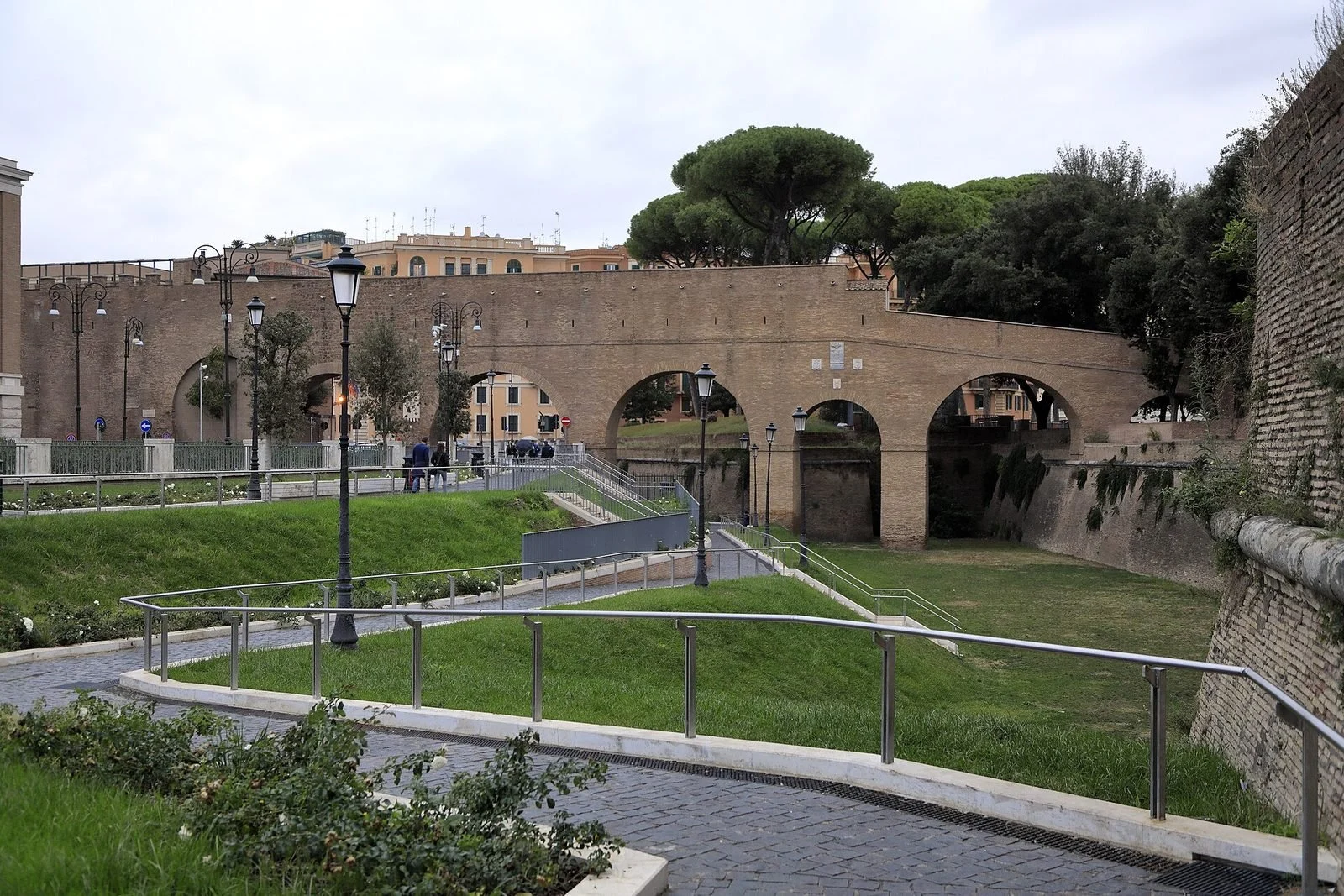
The Passetto di Borgo is the walled corridor, roughly 800 meters long, that connects the Vatican Apostolic Palace to Castel Sant'Angelo by running over the wall of the Leonine City, among the streets of the Borgo district. Romans have always called it something else, the Corridore, and one of the two streets that run beside it still bears that name. It served one purpose only: to let the pope reach the fortress on the Tiber without going down into the street. In its documented history it was used for that purpose twice, in 1494 and on May 6, 1527, and both times were enough to earn it a lasting place in the history of Rome and, much later, in popular fiction. Today it can be visited only intermittently, in limited numbers, with openings that depend on the programs of Castel Sant'Angelo and not on a stable calendar: anyone who wants to go in must check availability before setting out, because there is no fixed schedule to take for granted. From the outside, on the other hand, it can be seen very well and for free, and on this page we explain from where.
Where the Passetto di Borgo is and how to get there
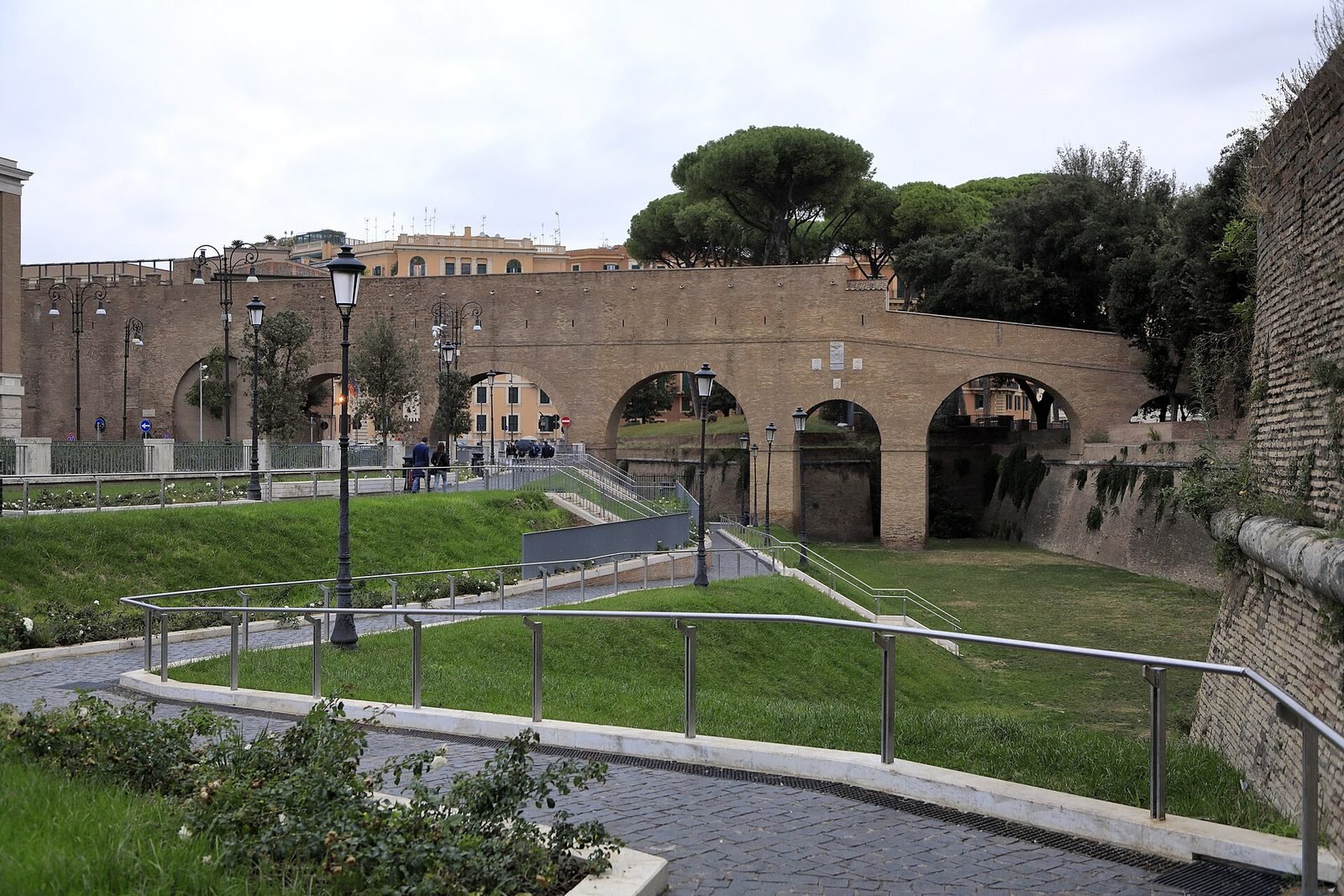
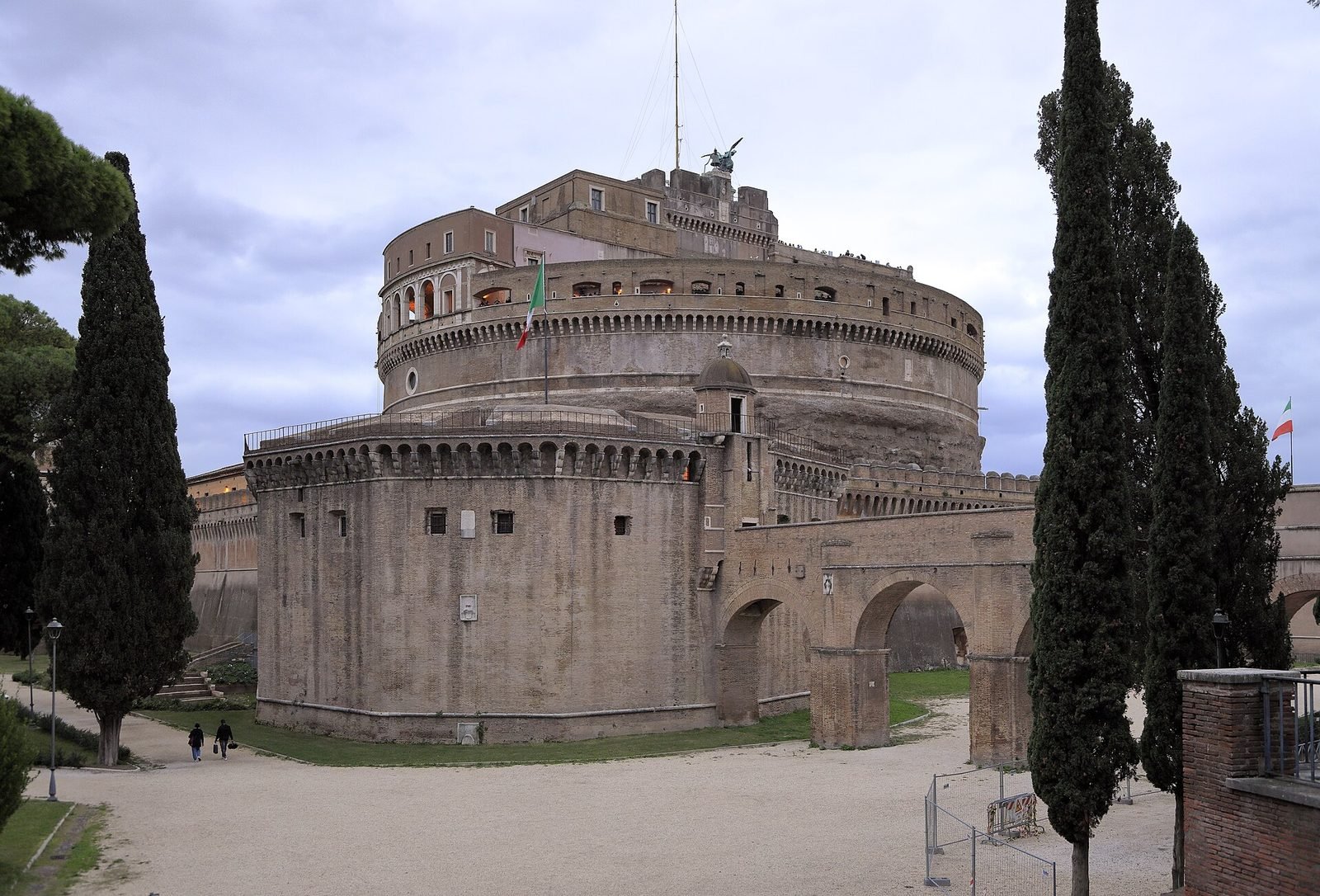
The Passetto di Borgo crosses the Borgo district from east to west, from the bastion of Castel Sant'Angelo, whose entrance opens at Lungotevere Castello 50, to the Vatican walls right next to the Apostolic Palace, the building that also houses the Sistine Chapel and that overlooks the Vatican Gardens. Anyone looking for the monument with a map in hand risks not finding it, because it has no square in front and no street-level portal: it is a wall, and like all walls you meet it by walking alongside it. The two streets to take are called Borgo Sant’Angelo and Via dei Corridori, and they run one on each side.
On foot, from the historic center
From Piazza Navona you get there in about 20 minutes: you head toward the Tiber, cross on Ponte Sant’Angelo with the angels designed by Bernini on either side, and find yourself directly beneath the castle. From there the Passetto begins on the right as you face the massive structure. From the Pantheon the time is more or less the same, from Campo de’ Fiori add five minutes going by Via dei Banchi Vecchi and Corso Vittorio Emanuele II. Anyone coming instead from Piazza San Pietro walks the opposite route, and in that case it is best to leave Via della Conciliazione and slip into Borgo Pio, which is parallel and much more interesting to walk.
By public transport
The nearest metro stops are Ottaviano and Lepanto, both on line A, 10 or 12 minutes' walk from the Vatican side of the corridor. On the castle side several surface lines arrive that terminate or pass through Piazza Pia and along the Lungotevere, among them historically the 40 and 62 from Termini station and the 23 and 280 along the river. Roman lines change route with some frequency because of construction work and detours, so the number should be rechecked the same day on the transport company's app: the stop, on the other hand, stays the same. Anyone coming from outside Rome by train and getting off at Termini will find metro line A on the underground level of the station, direction Battistini.
By car it is a problem. The Borgo district is largely limited-traffic, street parking spaces are few and paid, and the private parking lots in the area have hourly rates that become heavy on weekends. Anyone arriving by car from outside the city is better off leaving it in one of the line A park-and-ride lots and completing the trip by metro.
Three landmarks so you don't take the wrong street
The first landmark is the dome of San Pietro, with the Vatican obelisk in front of it: from the end of Borgo Sant’Angelo the dome can be seen almost entirely and points west. The second is the cylindrical bulk of Castel Sant'Angelo, which closes off the east. The third is the wall itself: tall, continuous, crowned with battlements, with a row of arched buttresses that span the portals. Once you have spotted that, you just follow it. Anyone who finds themselves on Via della Conciliazione without seeing any wall has taken the wrong side: the Passetto runs farther north, behind the row of buildings.
What the Passetto di Borgo is: a wall with a road inside
The Passetto di Borgo is a covered walkway built over a stretch of the city wall that protects the Vatican, the so-called Leonine City. The structure has two superimposed levels: below the rampart, thick and continuous, and above the walkable corridor, sheltered, which lets you go from one end to the other without ever touching the ground. Anyone who walks it is walking inside a wall. This is the reason the monument escapes those who look for it: it has no facade, it has no plan recognizable from above, it can only be read edge-on.
The length, and why the figures vary
The most widespread measure is 800 meters. Some sources write 830, others stick to a rounded estimate of about 800, still others speak generically of just under a kilometer. The reason for the discrepancy is that the walkable stretch and the walled stretch do not coincide, and that the western end, toward the Apostolic Palace, joins a system of towers and bastions where deciding where the corridor ends and the palace begins is a matter of convention. On this page we keep the cautious figure of about 800 meters, noting that a measurement to the meter does not exist in the popular literature.
The Leonine City, the wall the Passetto walks on
The Leonine City is the fortified enclosure that Pope Leo IV had built around the basilica of Saint Peter and the settlement that had grown up around it, in a construction project the sources place between 848 and 852. The reason was concrete and dramatic: in 846 a Saracen fleet had come up from the sea to the gates of Rome and had sacked the basilicas outside the city, including Saint Peter's, which lay outside the Aurelian walls and was therefore unprotected. The papacy reacted by building a wall.
846: the sack that changed the topography of Rome
The blow of 846 was not a skirmish. The raids reached the Vatican basilica and the basilica of Saint Paul, both outside the perimeter of the Aurelian Walls, and carried off whatever there was to carry off. The walled city, the one centered on the Capitoline Hill and the Roman Forum, held out. The Vatican did not. From that moment the protection of the apostle's tomb became a problem of military engineering, and the result is the enclosure we know.
The 1277 of Nicholas III and the dates to handle with caution
The date that the popular literature repeats most consistently is 1277, and it attributes the construction of the corridor to Pope Nicholas III, born Giovanni Gaetano Orsini, elected on November 25, 1277 after a long vacancy of the see and dead in 1280. Here the first problem arises: if the election falls at the end of November, 1277 can indicate at most the decision to start the works, not their execution. The date does coincide, in any case, with the start of the great Vatican construction project that this pope set in motion, including the enlargement of the Apostolic Palace that permanently moved the papal residence from the Lateran to the Vatican. The coherence of the picture is strong, and for this reason the date has taken hold.
What holds up and what doesn't
What holds up is that Nicholas III promoted a Vatican building program of great scope and that the link between palace and fortress fits the logic of that program. Less solid is the idea that in 1277 the corridor was built from scratch and completed: what the sources allow us to say with reasonable certainty is that in those years work was begun on the Leonine route to make it walkable, in a process that continued with later interventions for over two centuries. Anyone who writes 1277 as the birth date of a finished structure is oversimplifying.
The divergences among the sources
On this point the divergences exist and have to be stated. Some reconstructions backdate a first link to earlier interventions, others push the actual completion later, still others attribute the decisive transformation to the 15th century. The difference is not academic: it changes the way you look at the wall, because in one case you are looking at a 13th-century structure that was reworked and in the other at a Renaissance structure resting on older remains. The reading that convinces scholars most today is the second, with the 13th-century core acknowledged but not prevailing. When we give a date on this page, we also say how solid it is.
Alexander VI Borgia and the construction project of 1492-1494
The second intervention that the literature consistently attributes to the Passetto di Borgo is that of Alexander VI, the Valencian pope Rodrigo Borgia, elected in August 1492 and dead in 1503. The dates most often read for the works are 1492-1494, that is, the first two years of the pontificate, and this has a precise political logic: Alexander VI knew that the descent of a French army into Italy was a matter of months, and he put himself in a position to withstand a siege in Castel Sant'Angelo.
What was really done
The Borgia intervention is described as a structural reinforcement: consolidation of the masonry, covering of the walkway in the uncovered stretches, insertion or reorganization of the loopholes, securing of the connections at the two ends, with work on the castle's defenses that continued afterward as well. In essence the corridor goes from a usable service route to a reliable emergency route. The swallowtail merlon that is still visible in some stretches belongs to this phase of rebuilding the crowning.
The conflicting dates, stated openly
Here the sources do not agree, and it would be wrong to hide it. The range 1492-1494 is the most repeated in Italian popular writing. Other reconstructions place the bulk of the Borgia works later, between the end of the 15th century and the Jubilee of 1500, when Alexander VI took in hand the whole Borgo area including the new street that took its name from him, Via Alessandrina, later vanished in the 20th century under Via della Conciliazione. It is not unusual for a construction project of that size to cover both periods, with a first phase of urgency and a second Jubilee phase. Anyone who reads a flat date, from whichever side it comes, is reading a simplification: on this page we keep 1492-1494 as the period of the emergency reinforcement and note that Borgia interventions continued until the Jubilee.
A curiosity about the Passetto di Borgo
The curiosity worth putting first is about language: the official name of the monument is the one Romans use least. In the city the corridor has always been called er Corridore, and the street that runs beside it on the southern side is still called Via dei Corridori for just that reason. The term Passetto, a diminutive of passo, established itself in written and tourist use, and ended up prevailing on maps. In another area of Rome there is incidentally the Passetto del Biscione, which is something completely different, a covered passage between Via di Grotta Pinta and Piazza del Biscione with a Marian shrine: it happens regularly that the two get confused by people searching online, and it is worth keeping them distinct.
A place-name system that tells the story
The Borgo district preserves in its street names the memory of everything that has happened here: Borgo Pio from the pope who opened it, Borgo Vittorio, Borgo Angelico, Via dei Corridori from the corridor, Borgo Sant’Angelo from the fortress. It is a grid of names that reads like a chronological index, and walking through it with this key in hand changes the walk quite a lot. Anyone who wants an overall reading of the district will find it on our page on Prati e Borgo, which covers the neighborhood as a whole while this one stays focused on the corridor.
1494: the first escape, the one almost nobody remembers
The first documented occasion on which the Passetto di Borgo was used for what it had been built for dates to December 1494, when the army of Charles VIII of France entered Rome on its way to the conquest of the Kingdom of Naples. Alexander VI took refuge in Castel Sant’Angelo by way of the corridor. There was no massacre, no general sack: there was a negotiation, long and unpleasant for the pope, which ended with an agreement in January 1495.
What happened in those days
The French troops quartered themselves in the city. The pope shut himself in the fortress. The negotiations took place at a distance and then in person, with Alexander VI managing to avoid the worst: no deposition, no council convened against him, the formal recognition of the army's passage and the handing over of some hostages, among them the brother of the Ottoman sultan whom the pope held in Rome as a diplomatic pawn. The corridor had worked: it had bought the pope the time and the minimal position of strength to negotiate.
Something nobody tells you about the Passetto di Borgo
What usually nobody says is that the Passetto di Borgo is not a secret passage, and never was. A wall several meters high and 800 long, with battlements on top, crossing an inhabited district and spanning the streets with arches visible to everyone, is the least secret object imaginable. Everyone in Rome knew what it was and where it led. The advantage it offered was different: it guaranteed a protected, elevated route, out of reach of a crowd in the street and of an armed band, not invisibility.
The difference between private and secret
In the language of the papal court there was a precise notion of privacy, that of the secret rooms and secret courtyards, which indicated limited access and not concealment. The corridor belonged to that category: locked, guarded, reserved for very few, but perfectly well known. Tales of apparitions linked to 1527 also circulate about the corridor, which belong to the Roman popular tradition collected in our page on the ghosts of Rome and not to the historical documentation. The modern vulgate of the hidden tunnel is a recent overlay, fed by fiction and film, and does not correspond to how the structure was conceived and used in the Renaissance.
How many times it was really used
The documented papal escapes along the corridor are two, that of 1494 and that of 1527. For a work built and maintained for centuries it is a very low rate of use, and this feeds a reasonable question: was it worth the expense? The historical answer is yes, because the value of emergency infrastructure is not measured by the frequency of use but by what would have happened without it. In 1527 the pope who flees along that corridor is the difference between a very serious crisis and the end of the Roman papacy.
May 6, 1527: the Sack of Rome and the flight of Clement VII
On May 6, 1527 the imperial army of Charles V, made up of German Landsknechts, Spanish infantry and Italian mercenaries, attacked the walls of Rome on the Janiculum and Borgo front and broke through them in the early morning. Pope Clement VII, born Giulio de’ Medici, was in the Vatican and reached Castel Sant’Angelo along the Passetto di Borgo as the defense gave way. It is the escape that made the corridor famous, and it should be told for what the sources allow us to say, adding nothing to it.
How things had come to that day
The imperial army had arrived under Rome in terrible condition, without pay for months, without supplies and by then out of the control of its commanders. The Duke of Bourbon, Charles III, who led it, had no concrete ability to stop it: the soldiers wanted Rome because Rome was rich. The city, for its part, was almost defenseless. The city militias were few and poorly armed, the professional soldiers even fewer, and the walls in several stretches were old and not adapted to 16th-century artillery.
The attack and the death of the Duke of Bourbon
The assault began with the early morning fog, which favored the attackers by hiding movement under the walls. During that phase the Duke of Bourbon was struck and killed while directing the attack in the sector between the Janiculum Hill and Borgo, just below the hill where San Pietro in Montorio stands. His death, instead of stopping the army, left it without the only command that still counted for anything, and from that moment no one had enough authority to hold the troops back.
The Swiss Guard on the forecourt of Saint Peter's
The defense of the pope fell to the Pontifical Swiss Guard, the corps established by Julius II in 1506, which fought in retreat as far as the open space in front of the Vatican basilica. The corps's tradition, which every May 6 celebrates that very day by swearing in new recruits, reports that of the 189 men on duty 147 fell, and that the survivors managed to escort Clement VII to the corridor. The figure is the one the Guard itself hands down and that all reconstructions take up: no contemporary register offers independent verification, so it should be read as a firm traditional datum and not as an archival count.
What exactly the pope did
Clement VII was in the Vatican when the news of the breach arrived. He was led to the Passetto and walked the corridor toward the castle with his retinue, a group that the sources describe as made up of cardinals, relatives and curia officials, in a number that varies depending on the account. The gate of the fortress was closed behind the last of them. From that moment the pope remained besieged inside Castel Sant’Angelo for months, while the city below was sacked with a systematic thoroughness that observers of the time describe as methodical.
The cloak of Paolo Giovio
The most quoted episode of that run is told by the historian and bishop Paolo Giovio, who was present. In his version, while the group was crossing the uncovered stretch of the walkway, Giovio threw his own purple cloak over the pope's shoulders to cover his white robe, which from below would have been a recognizable target for the arquebusiers. The detail is plausible and consistent with the situation, but it must be kept in mind that Giovio tells an event in which he himself is the discreet hero, and that he writes years later. We report it as direct testimony from an interested party, not as neutral chronicle.
Benvenuto Cellini, an interested witness
The second famous source is the Vita of Benvenuto Cellini, the Florentine goldsmith who was in Rome in 1527 and who in his autobiographical account assigns himself a notable role in the defense of the castle: he claims to have fired the arquebus shot that killed the Duke of Bourbon and then to have looked after the fortress's artillery. The Vita is a literary masterpiece and a poor historical source when it speaks of its author. Cellini writes decades later, systematically gives himself the credit for events he witnesses, and the killing of Bourbon is contested from him by at least other contemporary versions. Anyone who visits the castle and hears Cellini's shot told as an established fact is listening to a tradition, not a document.
How long the siege lasted
The troops spread first into Trastevere and then, once past Ponte Sisto, into the rest of the city. Clement VII stayed shut in the fortress for about seven months, until his escape toward Orvieto in December 1527, in disguise, after negotiating the surrender and the payment of a ransom. The sack lasted weeks in its most violent phase and months in the following one, and estimates of the victims vary enormously depending on the sources, from a few thousand to tens of thousands, with no reliable count existing. Rome lost a very high share of its population through deaths, flight and deportations, and the date conventionally marks the end of the Roman Renaissance: the generation that had worked in the city in the preceding decades, that of Raphael and Michelangelo, scattered or stopped working here.
How to visit the Passetto di Borgo today: intermittent openings and limited numbers
The Passetto di Borgo has no continuous opening to the public: it can be visited only on special openings or seasonal programs run in connection with Castel Sant’Angelo, almost always as a guided visit, with capped groups and mandatory reservation. There is no fixed schedule to report, and anyone who publishes one as if it were stable is giving fragile information. The only correct procedure is to check the museum's official calendar in the weeks before the trip.
Where you enter
Access to the corridor, when it is open, is from inside the Castel Sant’Angelo complex, whose entrance is at Lungotevere Castello 50. There is no ticket office dedicated to the Passetto on the street, nor an independent door on Borgo Sant’Angelo: you enter the museum, reach the point where the walkway joins on, and walk the stretch made fit for use, which on many openings does not coincide with the full length of the corridor. This too should be asked at booking, because it changes the duration and the sense of the visit quite a lot.
Why the openings are discontinuous
The reasons are three, all concrete. The first is safety: the corridor is narrow, has only one way out in each direction and a very low instantaneous capacity, which requires small, spaced-out groups. The second is conservation: the walkway is an ancient structure subject to monitoring and periodic interventions, and the construction work closes stretches for even long periods. The third is jurisdiction: the corridor crosses the border between the jurisdiction of the Italian State and that of the Holy See, which makes every opening the result of an agreement and not of a unilateral decision.
Where to check before leaving
The two sources to check are the official website of the Castel Sant’Angelo museum, which publishes the notices about special openings and the booking channels, and the museum's telephone ticket office for last-minute confirmations. For the Vatican side, the reference is the Vatican Museums, which manage the access from the Apostolic Palace side. We advise against booking on resale portals that promise the Passetto as an included stop: if the opening is not on the calendar, that promise cannot be kept, and the refund becomes the traveler's problem.
My advice for visiting the Passetto di Borgo
There is only one piece of practical advice, and it is worth more than any other: don't build the trip around getting into the Passetto. The openings are few, the places sell out, the dates shift. Anyone who arrives in Rome having promised someone to enter the pope's corridor has a very good chance of being disappointed, and the disappointment poisons the rest of the day. The strategy that works is the reverse: you plan the visit to Castel Sant’Angelo, you check if by chance the Passetto is open on those days, and if it is you count it as a gain.
Book well in advance, and ask what you will walk
When an opening is announced, the places sell out quickly because capacity is reduced for safety reasons. It is worth setting up alerts on the official channels weeks ahead. At booking it is wise to ask explicitly two things: which stretch of the corridor is included and if the visit is guided or free. Two openings with the same name can be very different experiences.
The time of day
If you can choose, the first part of the morning is the best for the whole area: the Borgo district, with the complex of Santo Spirito in Sassia on the river front, starts to fill up around 10 and from 11 on the stretch between Piazza San Pietro and the castle becomes a continuous flow. Entering Castel Sant’Angelo at opening time means having the upper walkways almost empty and the terrace free, and from there the Passetto can be read from above along its whole length, which is not possible from below. Avoid Wednesday morning, when the pope's general audience fills Borgo and changes the security checks, and Sunday at noon for the Angelus.
What to bring
Closed shoes with a gripping sole, because the surface is uneven. No bulky backpacks, because the passage is narrow and the checks at the museum entrance limit them. A flashlight is not needed and is generally not allowed. For the Vatican basilica, if you continue there, covered shoulders and knees: the dress check at the entrance of San Pietro is real and allows no exceptions, and going back to change costs an hour.
Seeing the Passetto from outside, without a ticket
The Passetto di Borgo can be seen in its entirety from the outside, for free, by walking along the two streets that flank it: Borgo Sant’Angelo on the north side and Via dei Corridori on the south side. It is the reason the monument remains accessible even when it is closed, and for many travelers it is the only way they will meet it. The complete walk from Castel Sant’Angelo to the Vatican walls takes just under a quarter of an hour at an easy pace, and is one of the few free things in this area along with those collected on our page on Roma gratis.
Borgo Sant’Angelo, the shaded side
Borgo Sant’Angelo runs hard against the wall on the northern flank, and is the street to walk to see the masonry up close: you walk with the corridor beside you, high above your head, and pass under the arches that span the side streets toward Borgo Pio. Being exposed to the north, this face stays in shade for much of the day: the light is flat and uniform, excellent for reading the masonry and the differences in building phase, less good for a high-contrast photograph.
Via dei Corridori, the sunlit side
On the southern flank the street that runs alongside the corridor bears the Roman-dialect name of the monument, Via dei Corridori, and receives sun for a good part of the day. From here the wall reads as a compact lit front, and the battlemented crown stands out better against the sky. Anyone short on time who wants only one walk should go out along one side and come back along the other: it is 15 minutes more and you see two different monuments.
The best spot, in concrete terms
The shooting point we recommend is at the start of Borgo Sant’Angelo on the castle side, in the first 30 or 40 meters after the junction with the bastion. From there, putting yourself against the wall on the opposite side of the roadway and looking west, you frame the corridor fleeing in perspective with the dome of Saint Peter's closing off the far end. It is the only framing in which the two ends of the story, the fortress behind you and the basilica ahead, sit in the same frame. The street is narrow and it is hard to keep the whole wall in the field: you need a moderate wide angle or a step back against the portal opposite.
Another well-known fact, yet rarely mentioned
The well-known and rarely cited fact is that the Passetto di Borgo has been for centuries an administrative boundary as well as a passage, and still is. The wall marks at several points the line between Italian territory and that of the Vatican City defined by the Lateran Pacts of 1929, with a special regime for the corridor itself. It is the technical reason why a visit does not depend on a single administration and why the openings require coordination between different bodies.
The mutilated district
The second rarely cited element concerns what around the wall is no longer there. Until the 1930s the corridor emerged onto a very dense fabric of alleys, and between the Tiber and the basilica ran two parallel streets separated by a long, narrow block, the so-called spina di Borgo. Between 1936 and 1950 that block was demolished to open Via della Conciliazione. The Passetto survived because it ran farther north, outside the gutted strip, but lost the urban context for which it had been conceived: today it is read in isolation, whereas for four centuries it was a line inside a continuous fabric.
September 1870, the last time the wall counts
The Leonine wall performed its last function as a military boundary in September 1870. After the breach of Porta Pia, on September 20, the Italian troops stopped in front of the wall of the Leonine City, which remained for a few hours the last unoccupied perimeter of Rome. The entry into the district took place in the days immediately following, for reasons of public order, and reconstructions diverge on the arrangements and on the requests that preceded it. From that moment the Passetto ceases to be a possible escape route and becomes a historical structure. The pope would no longer have needed it: the fortress on the Tiber was now on the other side of a border.
The Passetto in popular fiction, and the geography that doesn't add up
A good part of the Passetto di Borgo's international fame comes from a hugely successful novel published in 2000 and the film made from it in 2009, where the corridor appears as an escape route in a fictional story set between the Vatican and central Rome. The result is that for a quarter of a century many visitors have arrived in Borgo looking for a place they got to know in an invented story, and are thrown by what they find.
What doesn't match
The novelistic geography does not coincide with the real one on at least three points. The corridor runs at height above a wall, in the middle of the houses, and has nothing to do with underground Rome. It cannot be walked freely, neither at night nor from the outside: the ends are closed and guarded, and there are no side service entrances open onto the street. And it does not connect the places it connects in the fiction: it leads from the Apostolic Palace to the fortress on the Tiber, period, with no branches toward the churches of the historic center.
How to treat it on a visit
The advice we give to those who arrive with that reference in mind is to reverse the order: the true story of 1527 is more interesting than the invented one, and has the advantage of having happened. Anyone who wants to follow a fantasy route anyway will find our page on Rome at night useful for understanding what in the city is really visitable after sunset, which is much less than the movies lead you to believe.
The right photo to take at the Passetto di Borgo
The photograph that does justice to the Passetto di Borgo is taken from the ground, on Borgo Sant’Angelo, in the initial stretch next to the bastion of Castel Sant’Angelo, with the camera held low and the framing pointed west, toward the dome of Saint Peter's. The wall enters diagonally on the right, the arches of the buttresses mark the depth, and the dome closes off the end of the street. You need a moderate wide angle, around 24 millimeters on full frame, and the patience to wait for a gap between the parked cars.
The hour and the light
The street runs in an east-west direction and stays narrow, so direct light reaches it little. Late afternoon works best, because the low sun in the west lights the dome at the end and leaves the wall in soft shadow, giving the photo a depth that is not there at noon. The white sky of overcast days should be avoided: without separation between wall and sky the crenellation disappears.
The second framing, from above
Anyone entering Castel Sant’Angelo should find the upper terrace and look toward the Vatican: from there the corridor reads as a continuous line crossing the rooftops of the district up to the walls, and it is the only point in the city from which its length can be understood. It is a photograph that explains the monument better than any caption, and it is only taken with the museum ticket in hand. The same terrace is the place from which you frame Ponte Sant’Angelo with the statues in a row.
Some important events that happened here in history
The history of the Passetto di Borgo comes down to a handful of dates, and almost all concern moments when the papacy found itself in danger inside its own city. We list them in order, distinguishing established facts from traditional attributions.
1277: the intervention of Nicholas III
The historiographical tradition attributes to this year the transformation of the wall stretch into a walkable corridor, within the framework of the great Vatican construction project of Nicholas III. The date is conventional and indicates a start, not a completion.
1492-1494: the Borgia reinforcement
Alexander VI consolidates and covers the walkway in anticipation of the French descent. Some sources move part of the works toward the Jubilee of 1500, and the contradiction should be flagged rather than resolved by authority.
December 1494: the flight before Charles VIII
Alexander VI reaches Castel Sant’Angelo along the corridor while the French army enters Rome. It is the first documented use of the Passetto as an escape route, and it ends with a negotiation the following January.
May 6, 1527: the Sack of Rome
Clement VII walks the corridor toward the fortress as the defense gives way and the Swiss Guard is annihilated in front of the basilica. He remains besieged for about seven months and leaves Rome in December of the same year.
2000: the Jubilee restoration
On the occasion of the Jubilee the corridor is restored and made partially visitable, starting the season of special openings that continues intermittently to this day. The exact dates of the individual later restoration campaigns are not reported here because they vary depending on the sources.
Who passed through the Passetto di Borgo
The list of people who have walked the Passetto di Borgo is by definition short, because the corridor was locked and reserved for very few. Those of whom we have certain knowledge or a consolidated tradition are these.
Nicholas III Orsini
The pope to whom the transformation of the wall into a corridor is attributed, elected at the end of 1277 and dead in 1280, is the same one who permanently moves the papal residence to the Vatican and starts the enlargement of the Apostolic Palace.
Alexander VI Borgia
He walked it in December 1494 and had ordered its reinforcement a few months or a few years earlier. He is the only pope to whom both the construction project and the use can be attributed with certainty.
Clement VII de’ Medici
On May 6, 1527 he walked it with his retinue as Borgo was being broken through. His flight is the episode that fixed the Passetto in European memory, and the cousin of Leo X then paid the political bill for the Sack for the rest of his pontificate.
Paolo Giovio
Historian, physician and bishop, he was in the group that accompanied Clement VII and tells of having covered his white robe with his own cloak. The testimony is direct but interested, and should be read as such.
Benvenuto Cellini
The Florentine goldsmith was in Rome that day and in the Vita assigns himself a leading role in the defense of the castle. There is no way to verify much of what he tells, and the shot that killed the Duke of Bourbon is contested from him by other versions.
The Pontifical Swiss Guard
The corps founded by Julius II in 1506 escorted the pope to the mouth of the corridor, losing, according to the unit's tradition, 147 men out of 189. Every May 6 the recruits take their oath in memory of that day.
Eating in Borgo without falling into traps
Borgo is one of the areas of Rome most exposed to passing tourism, with an enormous flow concentrated between Piazza San Pietro and the castle and a very short average stay. This combination produces restaurants of very uneven quality, and it is worth knowing how to recognize them. We don't name places, by choice: a list of signs ages in a few months. We give the criteria, which last.
The five signals that should make you change street
The first is the lady rolling out fresh pasta in the window or right on the sidewalk: it is a staged scene meant to stop the passerby, not a sign of a kitchen. The second is the menu with photographs of the dishes, which exists to be understood by those who don't read the language and not to describe what is in the kitchen. The third is the person at the entrance inviting you to sit: a place that has to stop people in the street has a customer problem. The fourth is nonstop hours from morning to late at night with no break: a real kitchen stops, because it has shifts and prep. The fifth is the location, that is, tables placed in front of the famous monument, here as at the Trevi Fountain or at Piazza di Spagna, where the price adapts to the tourist in front of you, with items not priced on the menu and different price lists inside and outside.
The chains in the center
Within a few minutes of the Vatican several restaurant chains operate with the same sign repeated at several points in the city, identical menus and a line with a numbered ticket. We don't name them and we don't recommend them. One observation is enough: Romans don't eat there. They are structures built on flow, not on repeat customers, and anyone with only one hour in Rome will do better to spend it elsewhere anyway.
The criterion that always works
Before sitting down, look at who is sitting and in what language they order. If at the tables there are people who speak Italian and order without looking at the menu, the place holds up. If there are only tables of foreigners with the camera set beside the plate, you walk another five minutes. In Borgo five minutes really is enough: moving away toward the north, past Borgo Pio and into Prati, the ratio between price and plate changes sharply.
Daniele Dezi's list
For those who want a concrete reference instead of a generic list, there is a personal collection on Google Maps curated by Daniele Dezi, not sponsored and updated in the field: the personal list of Daniele Dezi on Google Maps. They are places chosen because you eat well there, with no commercial agreements with anyone.
Frequently asked questions about the Passetto di Borgo
Can the Passetto di Borgo be visited?
The Passetto di Borgo can be visited only during special or seasonal openings run in connection with Castel Sant’Angelo, with capped groups and mandatory reservation. There is no continuous opening or stable schedule: the calendar must be checked on the museum's official website in the weeks before. Anyone who arrives in Rome without having booked in an opening period will hardly manage to get in.
How much does the ticket for the Passetto di Borgo cost?
The Passetto di Borgo has no fixed fare stably published, because the price depends on the individual opening and the type of visit, almost always guided and tied to the Castel Sant’Angelo ticket. Any figure reported outside the official channels should be considered indicative. The only reliable source is the museum's ticket office at the time of booking.
How long is the Passetto di Borgo?
The Passetto di Borgo measures roughly 800 meters between the Vatican Apostolic Palace and Castel Sant’Angelo. Some sources indicate 830 meters, others limit themselves to a rounded estimate, because the point where the corridor joins the palace on one side and the bastion on the other is a convention and not a clear boundary. The stretch made walkable on the openings is generally shorter than the whole length.
How do you get to the Passetto di Borgo by public transport?
You get to the Passetto di Borgo by getting off at the Ottaviano or Lepanto stops of metro line A, 10 or 12 minutes on foot, or by the surface lines that serve Piazza Pia and the Lungotevere next to Castel Sant’Angelo, whose entrance is at Lungotevere Castello 50. Roman bus routes change often because of construction work, so the line number should be checked the same day.
Can you see the Passetto di Borgo without a ticket?
The Passetto di Borgo can be seen for free from the outside by walking Borgo Sant’Angelo on the north side and Via dei Corridori on the south side, the two streets that flank it along its whole length. The walk from Castel Sant’Angelo to the Vatican walls takes just under a quarter of an hour and lets you pass under the arches that span the side streets. From the inside, instead, you need the museum ticket.
Is the Passetto di Borgo accessible to people with mobility difficulties?
The Passetto di Borgo is not accessible to people with mobility difficulties: it is reached by narrow stairs, the floor is uneven and in some stretches the height forces you to lower your head, with no elevators or alternative routes. Those who suffer from claustrophobia should also consider it before booking, because the corridor is long and has no intermediate exits. The rest of Castel Sant’Angelo is partly accessible.
Who built the Passetto di Borgo and when?
The Passetto di Borgo is attributed by the historiographical tradition to Pope Nicholas III in 1277, on a stretch of the Leonine walls built by Leo IV between 848 and 852, and was then reinforced by Alexander VI Borgia in the years 1492-1494. The sources do not agree on the precise dates of the Borgia construction projects, which some reconstructions move toward the Jubilee of 1500: it is a layered structure, not a work born in a single year.
Did the pope really escape through the Passetto di Borgo?
Yes, the Passetto di Borgo was used for a pope's escape twice: by Alexander VI in December 1494, on the arrival of Charles VIII of France, and by Clement VII on May 6, 1527, during the Sack of Rome, while the Swiss Guard was being annihilated in front of the Vatican basilica. They are the only two documented uses of the corridor as an escape route in over seven centuries.
Who wrote this page
This page is curated by the editorial team of Tour Leader Pro, the Roman project office that designs and coordinates visits, itineraries and cultural events in Rome and Lazio. The hours, fares and access conditions reported here are verified as of the publication date against the official sources indicated in the text: it is worth rechecking them before leaving, because they change often. If you find an out-of-date piece of information, let us know.
Anyone building a Roman itinerary around this area, combining the Passetto with Castel Sant’Angelo, the Vatican Museums and the other stops of the district, will find planning tools and operational assistance at Tour Leader Pro, which works on Rome and Lazio with groups and clients who need certain timing and not improvisation.
For those instead putting together a wider trip, with moves between cities, trains and stops outside Lazio, a useful resource is Italy Planner, which reasons on a national scale and helps you understand how many days each leg really takes before fitting in visits like this one.