Raphael in Rome: Where to See His Works
In short. Raphael Sanzio arrives in Rome at the end of 1508, is 25 years old and has never worked for a pope.
Raphael Sanzio arrives in Rome at the end of 1508, is 25 years old and has never worked for a pope. He dies in the same city on April 6, 1520, at the age of 37, and is buried in the Pantheon. In between are 12 years that left Rome much more than the Vatican Stanze: a frescoed loggia on the Tiber, a centrally planned funerary chapel, two prophets and four sibyls in neighborhood churches, three altarpieces, two portraits in two different museums and a tiny church designed by his own hand. Many of these works, however, are not entirely by his hand: after 1515 Raphael runs an enterprise with dozens of collaborators, and telling the autograph work from the workshop execution is the difference between looking at a masterpiece and looking at the idea of one. These pages line up what you can see today, where, with what hours updated to the publication date, what is certain and what scholars still debate, and which works everyone associates with Rome that are not here.
Raphael's 12 Roman years: 1508-1520
Raphael works in Rome for exactly 12 years, from the autumn of 1508 to his death in April 1520, and goes from court painter to superintendent of the entire papal artistic enterprise, including the building of St. Peter's. It is a career that takes place almost entirely within a radius of three kilometers.
Who calls him and why
Born in Urbino in 1483 and trained between the Marche, Umbria and Florence, Raphael arrives in Rome called, according to the traditional account going back to Giorgio Vasari, by his fellow countryman Donato Bramante, Julius II's trusted architect. The pope has a new apartment fitted out for himself on the upper floor of the Apostolic Palace and summons a team of established painters. Within a few months he dismisses almost all of them and entrusts the whole apartment to the youngest of the company. The Rome Raphael finds is a construction site: Bramante has demolished the old Constantinian basilica, Michelangelo has begun the vault of the Sistine Chapel, Via Giulia and Via della Lungara are opening.
The Vatican Stanze and the School of Athens
Raphael's Stanze are four rooms of the Vatican Apostolic Palace, frescoed between 1508 and 1524, and can be visited only within the route of the Vatican Museums, in the final part of the itinerary that leads to the Sistine Chapel. There is no separate ticket for the Stanze alone and you don't enter from the basilica: the entrance is the one on Viale Vaticano.
Stanza della Segnatura: where Raphael is almost entirely autograph
The Stanza della Segnatura, painted between 1508 and 1511, was probably Julius II's private library and is the room in which the master's hand is recognizable most continuously: four walls for the four categories of knowledge, theology with the Disputation of the Sacrament, philosophy with the School of Athens, poetry with Parnassus, law with the Virtues. The School of Athens, painted around 1509-1511, places about 50 philosophers inside an imaginary architecture with a coffered barrel vault that many scholars link to Bramante's design for St. Peter's. The identifications of the individual figures are well-established hypotheses, not documentary certainties: critics recognize with broad agreement Bramante in the guise of Euclid, bent over the slate, and a self-portrait of Raphael on the right, in a dark cap. The figure of the thinker leaning on the block of marble in the center, traditionally identified with Heraclitus and with the features of Michelangelo, is a later addition: it is missing from the preparatory cartoon preserved in Milan and was painted on plaster laid at a second moment, probably after Raphael had seen the vault of the Sistine.
Heliodorus and the Fire in the Borgo: the workshop takes over
In the Stanza di Eliodoro, painted between 1511 and 1514, Raphael's painting changes pace: the color darkens, light becomes the protagonist, the subjects are episodes of divine intervention on behalf of the Church, and the Liberation of St. Peter from Prison is a night scene with three different light sources in the same scene. In the Stanza dell'Incendio di Borgo, executed between 1514 and 1517 for Leo X, the relationship reverses: Raphael supplies the drawings and the direction, the actual execution is in large part by Giulio Romano, Giovan Francesco Penni and the other assistants. Whoever looks carefully notices an uneven quality among the figures: it is the first visible effect of the shift from painter to head of an enterprise. The district of the fresco, destroyed by the fire of 847 and saved by the blessing of Leo IV, is the same one you cross when arriving at the Museums, and can be walked by following the itinerary of Prati and Borgo.
Sala di Costantino: the restoration that changed the cards
The Sala di Costantino, the largest of the four, was the subject of a restoration lasting from March 2015 to December 2024, whose results the Vatican Museums presented on March 27, 2025. The work established a fact that overturns the traditional reading: two allegorical figures, Iustitia and Comitas, are not frescoes but oil paintings directly on the wall, on a preparation of rosin applied hot, and are by Raphael's hand. The project had been opened in October 1519 and the nails found in the walls document the intention to paint the whole room with that technique. After April 1520 Giulio Romano and Penni completed the rest in fresco. The vault was painted much later by Tommaso Laureti. In the same room live together Raphael's last finished work and the proof that his workshop could carry on without him.
Hours, tickets and crowding
The Vatican Museums are open Monday to Saturday from 8:00 to 20:00, with last entry at 18:00, and on the last Sunday of every month from 9:00 to 14:00, last entry at 12:30, with free admission. Online booking on the official portal is in fact necessary in high season: fares and any booking fee should be read on the official website, which also warns of the risk of portals with similar names and inflated prices. The free Sunday cannot be booked and involves very long lines even before opening: for seeing the Stanze at leisure it is the worst day of the year. The Stanze are also near the end of the mandatory route, and whoever enters at opening reaches them after at least an hour of walking.
The tapestries for the Sistine Chapel
The tapestries with the Acts of the Apostles, woven in Brussels from Raphael's cartoons, are the least known Roman work of the group and the most expensive the painter ever produced: Leo X entrusts him with the cartoons in 1515 for the lower band of the walls of the Sistine Chapel on major liturgical occasions.
Where the cartoons are and where the tapestries are
Raphael drew the cartoons at full scale between 1515 and 1516. The weaving took place in the Brussels workshop of Pieter van Aelst and the first display in the Sistine dates to December 1519, when Raphael was still alive. Seven of the original cartoons survive and are today at the Victoria and Albert Museum in London, not in Rome. The tapestries belong to the Vatican collections and are displayed in the Galleria degli Arazzi or, on exceptional occasions, in the Sistine itself: it's best to check on the Museums' website which pieces are on display, because the rotation depends on the conservation condition of the textiles.
Photography in the Sistine Chapel
In the Sistine Chapel photography is forbidden in any form, even without flash, and so is video recording: the ban is enforced by the room staff and applies also to those who pass through only to reach the exit toward the basilica. In Raphael's Stanze photography without flash and without a tripod is normally allowed, but the rules should be read at the entrance. The extraordinary maintenance of the Last Judgment concluded on March 28, 2026: anyone visiting the chapel today finds it without scaffolding. For the other great project of those years we refer you to the page on Michelangelo in Rome.
The Madonna of Foligno and the Transfiguration
The Vatican Pinacoteca devotes an entire room to Raphael, Room VIII, with three large altarpieces and the tapestries: it is the place in Rome where you see the master's painting on panel and canvas, while the Stanze show the fresco. It is included in the Vatican Museums ticket but occupies a separate building, on the opposite side from the Stanze: those short on time have to decide in advance, because you don't come across it by chance. Next to the two Roman altarpieces it holds the youthful Coronation of the Virgin, painted around 1502-1504 for Perugia.
Madonna of Foligno
The Madonna of Foligno, painted around 1511-1512, was commissioned by Sigismondo de' Conti, secretary to Julius II, as an ex-voto for having escaped an event that the sources describe as the fall of a flaming body onto his house, and was placed on the high altar of Santa Maria in Aracoeli, on the Capitoline Hill. In 1565 a descendant of the patron had it moved to Foligno, hence the name. This altarpiece too passed through Paris in the Napoleonic era and then returned to the Vatican. The landscape with the rainbow and the city struck by lightning is one of the passages where critics have most debated the involvement of assistants.
Transfiguration: the last work, finished by the pupils
The Transfiguration is Raphael's last painting, begun in 1518 and left unfinished at his death. The commission dates to the end of 1516 and comes from Cardinal Giulio de' Medici, the future Clement VII, who intended the panel of 405 by 278 centimeters for the cathedral of Narbonne in France, paired with a Resurrection of Lazarus entrusted to Sebastiano del Piombo: a contest between two workshops, wanted by the patron. Vasari tells that it was displayed next to Raphael's bier, a report from a 16th-century source. The lower part, with the group of the apostles and the possessed boy, was completed by the pupils, and critics generally assign the completion to Giulio Romano. The panel never left for Narbonne: it was placed in the church of San Pietro in Montorio, on the Janiculum, where it stayed until the French requisition of the late 18th century, and after returning to Italy following the Congress of Vienna it entered the Vatican. In St. Peter's you see a mosaic reproduction of it. At San Pietro in Montorio, next to the Tempietto del Bramante, the altar that housed it for almost three centuries remains.
The Vatican Loggias and the open construction site until 2031
The Loggia of Raphael, frescoed between 1517 and 1519 for Leo X on the second floor of the Apostolic Palace, is not part of the ordinary route of the Vatican Museums and cannot be visited with the normal ticket: it is a working space of the Secretariat of State, crossed every day by those who work in the Vatican.
What is painted there and who painted it
The 13 bays contain 52 panels with biblical scenes, known as Raphael's Bible, and a decoration of grotesques and stuccoes inspired by the paintings of the Domus Aurea, rediscovered a few decades earlier and visited by the painters of the time by lowering themselves into the buried rooms. The invention and the drawings are Raphael's. The execution is the workshop's, and the sources indicate Giovanni da Udine for the grotesques and stuccoes, Giulio Romano and Perin del Vaga for the figured scenes.
The restoration presented in June 2026
In June 2026 the Vatican Museums presented the project for the full restoration of the Loggia, planned over five years of work and so with completion expected around 2031. The work is financed by an international program involving the Patrons of the Arts in the Vatican Museums, the World Monuments Fund and the Stephen A. Schwarzman Foundation, and is preceded by a pilot project carried out between 2019 and 2024 on one bay. The management has stated its intention to consider special openings during the works, with priority for scholars and restoration schools: anyone planning a visit in the coming years should treat the Loggias as not accessible, because there is no public calendar to count on.
Villa Farnesina: the Galatea and the Loggia of Psyche
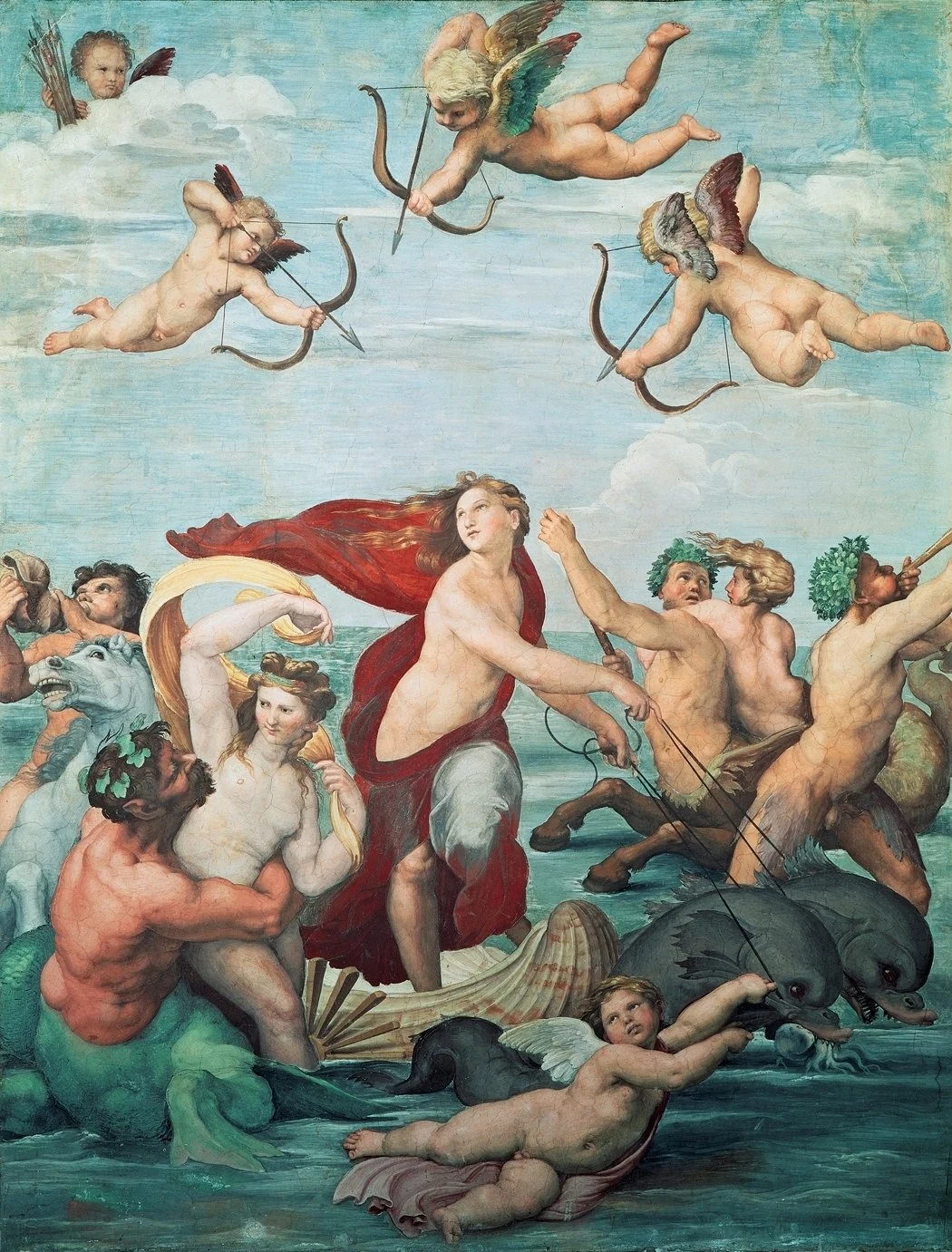
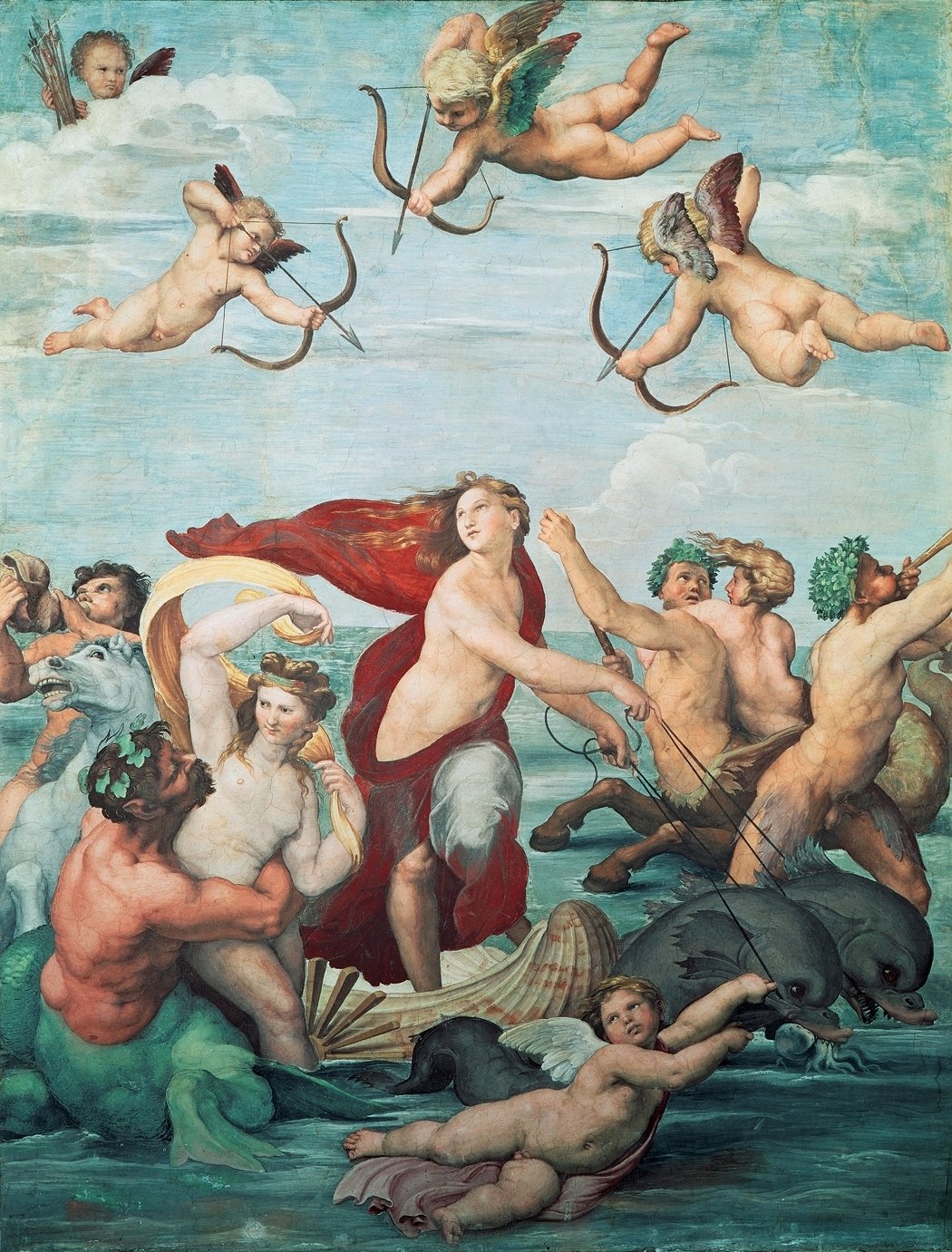
The Villa Farnesina, on Via della Lungara in Trastevere, preserves the only entirely autograph Roman fresco by Raphael outside the Vatican, the Triumph of Galatea, and a loggia designed by him but painted by the workshop. It was built between 1506 and 1510 to a design by Baldassarre Peruzzi for the Sienese banker Agostino Chigi, who financed Julius II and Leo X and was the richest private patron in Rome.
The Triumph of Galatea
The Triumph of Galatea, painted around 1512, shows the nymph on a shell chariot drawn by dolphins, among tritons, nereids and cupids. It is considered autograph by critics and is one of the very few places in Rome where you can look at Raphael without having to ask how much is by assistants. In the same loggia the Polyphemus and the lunettes are by Sebastiano del Piombo, while the vault with the astrological themes that make up Agostino Chigi's horoscope is by Peruzzi: four artists in a single room, and this is why this room reads badly in reproductions and well in person.
The Loggia of Cupid and Psyche
The Loggia of Cupid and Psyche, executed around 1517-1518, occupies the villa's original entrance room, open to the garden and closed with glass windows at a later time. The ceiling simulates a pergola through which the sky is seen, with two fake central tapestries, the Council of the Gods and the Wedding of Cupid and Psyche, and spandrels with scenes from Apuleius's fable. The festoons of fruit, flowers and vegetables are by Giovanni da Udine and are among the first European examples of precise botanical painting: dozens of species have been identified there, some just arrived from the Americas. The figured part is based on drawings by Raphael, but the execution is by his collaborators, first of all Giulio Romano, with Penni and Raffaellino del Colle. In the rest of the villa the Sala delle Prospettive and the Sala del Fregio are by Peruzzi and Agostino Chigi's bedroom, with the Wedding of Alexander and Roxana, is by Sodoma: attributing everything to Raphael means erasing three artists out of four.
Hours, tickets and how to get there
As of the publication date, Villa Farnesina is open Monday to Saturday from 9:00 to 14:00, with last entry at 13:15, closed on Sunday except the second Sunday of every month, when it is open from 9:00 to 17:00 with last entry at 16:15. The full ticket costs 12 euros and the reduced one 10 euros. Admission is free for children under 10, for licensed guides and for visitors with disabilities with a companion. Flash and video recording are not allowed. You get there by buses 23 and 280, stop on Via della Lungara, or on foot from Campo de' Fiori across Ponte Sisto. The morning schedule is the real constraint: the Farnesina doesn't fit into the afternoon of any itinerary and should be put first. Next to the villa is the Botanical Garden.
The Chigi Chapel in Santa Maria del Popolo
The Chigi Chapel, in the basilica of Santa Maria del Popolo, is the only building designed by Raphael that you can see finished in Rome, and the clearest example of a work of his completed by others over the course of 140 years. The commission comes from Agostino Chigi, patron of the Farnesina too, and the work opens in 1513-1514.
The architecture and the dome mosaics
Raphael designs a centrally planned chapel covered by a dome, with the two pyramid-shaped tombs of the Chigi brothers set against the walls, and supplies the cartoons for the dome mosaics, made in 1516 by the Venetian master Luigi de Pace: in the center God as creator of the firmament, around it the personifications of the Sun, the Moon and the planets, each with an angel. It is an astrological program inside a Christian funerary chapel, and it should be kept in mind that the same patron had had his horoscope painted on the ceiling of his house.
The statues: Lorenzetto, Raffaello da Montelupo, Bernini
Of the four corner niches, the Jonah emerging from the whale was sculpted by Lorenzetto around 1520 to a design by Raphael. The Elijah was finished by Raffaello da Montelupo around 1540. The Daniel and the Lion and the Habakkuk and the Angel are instead by Gian Lorenzo Bernini, executed between 1655 and 1661 when Cardinal Fabio Chigi, a descendant of Agostino who had become pope as Alexander VII, entrusted him with the completion of the family chapel. The altarpiece with the Birth of the Virgin was begun by Sebastiano del Piombo and finished by Francesco Salviati. Anyone who wants to follow the 17th-century thread will find it in the pages on Bernini in Rome and on Baroque Rome.
How to visit, and what else is in the same church
Santa Maria del Popolo is a parish church open for worship, with free admission and hours tied to the liturgical calendar: it's best to check them with the parish, because the midday closure and the services reduce the useful window. The Chigi Chapel is the second on the left side of the nave and is protected by a gate: you view it from outside. In the left transept the Cerasi Chapel holds two canvases by Caravaggio, the Crucifixion of St. Peter and the Conversion of St. Paul, with an altarpiece by Annibale Carracci in the center. For the complete route we refer you to the page on Caravaggio in Rome. The basilica looks onto Piazza del Popolo, next to the Porta del Popolo, and is served by the Flaminio station of subway Line A.
The Sibyls in Santa Maria della Pace
The four Sibyls frescoed by Raphael around 1514-1515 above the arch of the first chapel on the right of Santa Maria della Pace occupy a band more than six meters wide and were commissioned, once again, by Agostino Chigi. The sibyls receive from angels the scrolls with the prophecies of the coming of Christ. The prophets of the upper band are generally assigned to Timoteo Viti, a native of Urbino from Raphael's circle. The fresco answers the sibyls painted by Michelangelo on the vault of the Sistine a few years earlier: the same theme, but the group is linked together and the tone is that of a conversation, not of a vision.
How to really see them
Santa Maria della Pace has very limited opening hours that are not always published: showing up without checking means almost certainly finding the door closed. There is, however, a second way, more reliable: the Sibyls can also be seen from inside the Chiostro del Bramante, the 16th-century cloister attached to the church and today a venue for exhibitions, from a first-floor room overlooking the nave, next to the cafe. It is the closest viewing point on the fresco, because you look at it almost at eye level. The conditions of access to that room depend on the ticket for the current exhibition and on the cloister's rules, and should be checked on its official website. The church is a few steps from Piazza Navona.
The Prophet Isaiah in Sant'Agostino
Raphael's Prophet Isaiah is on the third pillar of the left nave of the Basilica of Sant'Agostino in Campo Marzio, measures about 250 by 155 centimeters and was painted between 1511 and 1512 for the apostolic protonotary Johann Goritz, italianized as Giovanni Coricio. It is Raphael's easiest Roman fresco to see and at the same time the most neglected.
The duel with Michelangelo
Above the figure runs a dedication in Greek from the patron to St. Anne, the Virgin and Christ. The prophet holds a scroll with a verse of Isaiah in Hebrew, from chapter 26, which invites the opening of the gates so that the people who believe may enter. The powerful posture and the rotation of the body on the seat recall the prophets of the Sistine vault, which Michelangelo had only recently unveiled. Vasari tells that Goritz, finding the price excessive, turned to Michelangelo himself, who replied that the knee alone was worth the sum asked: an anecdote from a 16th-century source, not an accounting document. The fresco underwent repainting, removed in a 20th-century restoration.
What else is in the same church
Beneath the fresco is the sculptural group of the Madonna and Child with St. Anne by Andrea Sansovino, part of the same program wanted by Goritz. In the first chapel on the left is Caravaggio's Madonna of the Pilgrims: in 20 meters of nave you cross the mature Renaissance and the beginning of 17th-century naturalism. Admission is free, but the hours follow the services and should be checked with the parish. The nearby Church of San Luigi dei Francesi completes the round.
The Fornarina at Palazzo Barberini
The Fornarina is kept at the Gallerie Nazionali di Arte Antica in Palazzo Barberini, on Via delle Quattro Fontane, and is one of the two portraits by Raphael that can be seen in Rome: datable around 1518-1520, it shows a young woman in half-length, with a transparent veil and a bracelet on her left arm in which the signature RAPHAEL VRBINAS can be read.
Who the woman in the portrait is
The identification with Margherita Luti, the daughter of a Trastevere baker and the painter's lover, is a tradition that took hold between the 17th and 18th centuries, not a fact documented by sources contemporary with Raphael. The nickname itself appears late. Scholars debate if it is a private portrait, an allegory of love or an idealized figure, and they debate the extent of later interventions: diagnostic investigations have detected repainting, including the one that hides a ring on the finger of the left hand. Telling the story of the lover as an established fact means simplifying a matter that is still open.
Hours and visit
Palazzo Barberini is open Tuesday to Sunday from 10:00 to 19:00 and closed on Monday. The ticket office is run on the museum's official circuit, and on the first Sunday of the month admission is free. The ticket is generally combined with the Galleria Corsini, on Via della Lungara almost across from Villa Farnesina: the conditions and validity of the joint ticket should be checked at the time of purchase, because they have changed several times. In the same palace you can see Pietro da Cortona's ceiling and Borromini's helical staircase. A short distance away is the Barberini Mithraeum, which can be visited only by reservation.
The Deposition at the Galleria Borghese
The Deposition of Christ, also known as the Baglioni Altarpiece, is kept at the Galleria Borghese and is a work of 1507, before Raphael's move to Rome: it was painted for the Baglioni chapel in San Francesco al Prato in Perugia, commissioned by Atalanta Baglioni in memory of her son, killed in a family feud. It arrived in the capital in 1608, taken at night from the Perugian church at the wish of Cardinal Scipione Borghese. The episode provoked protests and was settled with a papal donation and the delivery of copies.
The other Raphael in the same gallery
In the same gallery is the Lady with a Unicorn, a portrait datable around 1505-1506, also earlier than the Roman years, recognized as Raphael's only in the 20th century after a restoration removed the additions that had turned it into a St. Catherine. They are two Umbrian-Florentine works that came to Rome through collecting: calling them Roman works by Raphael is a widespread mistake.
Reservation mandatory, really
The Galleria Borghese is open Tuesday to Sunday from 9:00 to 19:00, with last entry at 17:45, and is closed on December 25 and January 1. Reservation is mandatory for all tickets, including free ones: you enter in hourly slots of 180 people and the visit lasts about two hours. As of the publication date the full ticket costs 16 euros, reduced to 11 euros for the last slot, while the 18-25 age group pays 2 euros and those under 18 enter free. A booking fee of 2 euros is added to every ticket. Whoever shows up at the ticket window without a reservation, on weekends and in high season, does not get in. The gallery is inside Villa Borghese, about 20 minutes on foot from Piazza di Spagna, climbing up from Trinità dei Monti.
Raphael the architect: St. Peter's, Sant'Eligio, Villa Madama
On August 1, 1514, a few months after Bramante's death on March 11 of the same year, Leo X appoints Raphael architect of the Fabbrica di San Pietro. From that moment until his death the painter is also the pope's chief architect, and this part of his Roman activity is the one that is seen worst today, because it was in large part demolished, replaced or never finished. For the Basilica of St. Peter he worked out a design that transformed Bramante's Greek-cross plan into a Latin cross, lengthening the nave toward the square. It was not carried out: the building passed to Antonio da Sangallo the Younger, then to Michelangelo, who returned to the central plan, and finally to Carlo Maderno, and nothing visible remains of the Raphaelesque phase.
Sant'Eligio degli Orefici
The Church of Sant'Eligio degli Orefici, on Via di Sant'Eligio a few meters from Via Giulia, is instead a building designed by Raphael and built: a tiny Greek-cross church with a dome, commissioned by the Università degli Orefici e Argentieri, the guild of Roman goldsmiths, and begun in the second decade of the 16th century. The facade is a later reworking and the dome was rebuilt after a collapse, but the interior preserves the original idea: a bright hall of almost geometric proportions. The church still belongs to the guild and has no tourist hours: you enter on the occasion of services, special openings or organized visits, and this should be checked in advance.
Villa Madama
Villa Madama, on the slopes of Monte Mario, is the project for a suburban villa in the antique manner that Raphael worked out for Cardinal Giulio de' Medici, drawing on the letters of Pliny the Younger. Construction began around 1518, stopped at Raphael's death, was resumed by Antonio da Sangallo the Younger with Giulio Romano and Peruzzi on the decorations and Giovanni da Udine on the stuccoes, and was devastated in the Sack of 1527: only a part of the original plan was built. The villa has belonged since 1941 to the Ministry of Foreign Affairs, is a representative seat of the State and is not open to tourist visits for organizational and security reasons. Exceptional openings have occurred in the past, but there is no calendar to count on.
The letter to Leo X and the vanished palaces
Palazzo Branconio dell'Aquila, in Borgo, was demolished in the 17th century to open the colonnade of St. Peter's Square, while Palazzo Vidoni Caffarelli, near Sant'Andrea della Valle, is attributed to him in its 16th-century part but has been so reworked that reading the original is a matter for specialists. What remains instead is the letter to Leo X on the antiquities of Rome, written with the collaboration of Baldassarre Castiglione: Raphael, appointed in 1515 also head of antiquities, proposes in it to survey and draw the ruins systematically and denounces the destruction of ancient monuments to make lime from them. A program that resembles what you see today in the Capitoline Museums and at Palazzo Massimo alle Terme.
The workshop, the pupils and the way they worked
Between 1515 and 1520 Raphael's workshop is the largest artistic enterprise in Europe and counts dozens of collaborators, with a structure that no painter had tried before: the master supplies invention, drawings and cartoons, the others execute, often on parallel projects.
Giulio Romano and Giovan Francesco Penni
Giulio Pippi, called Giulio Romano, born in Rome around 1499, is the main collaborator and the true artistic heir: his is the hand recognizable in the Stanza dell'Incendio di Borgo, in the Loggia of Psyche at the Farnesina, in the lower part of the Transfiguration and in the completion of the Sala di Costantino. In 1524 he leaves Rome for Mantua, where he builds and frescoes Palazzo Te. His style stands out for a more marked musculature, a colder color and a theatricality that is not in Raphael. Giovan Francesco Penni, a Florentine, nicknamed il Fattore for the organizational role he had inside the workshop, is the second heir: his task was to translate the master's drawings into working cartoons, and this makes his contribution hard to isolate, because he works precisely so as not to be recognized.
Perin del Vaga, Giovanni da Udine and the others
Pietro Buonaccorsi, called Perin del Vaga, works on the Vatican Loggias and is the one of the three with the longest Roman career: after the Sack of 1527 he moves to Genoa and then returns to Rome, where he decorates the apartments of Paul III in Castel Sant'Angelo, today visitable on the museum route. Giovanni da Udine, from Friuli, is the specialist in grotesques and stuccoes: the plant decorations of the Loggias and the festoons of the Loggia of Psyche are his. Also gravitating around the core are Raffaellino del Colle, Polidoro da Caravaggio, Lorenzetto for sculpture and the engraver Marcantonio Raimondi, who translates the master's inventions into prints and spreads them across Europe. The Sack of 1527 scatters the workshop across the peninsula, and with it the Raphaelesque language.
What is autograph and what is not
The most useful question in front of a work by Raphael in Rome is not if it is beautiful, but how much of it is by his hand: the answer changes from room to room and sometimes from figure to figure. What follows is the picture according to the reading now prevailing among scholars, with the warning that on individual passages positions remain different.
Predominantly autograph
The Stanza della Segnatura with the School of Athens, the Stanza di Eliodoro with assistants in some parts, the Triumph of Galatea at the Farnesina, the Prophet Isaiah in Sant'Agostino, the Sibyls in Santa Maria della Pace, the Fornarina at Palazzo Barberini and the two oil allegories in the Sala di Costantino recognized by the restoration concluded in 2024. Among the paintings on panel and canvas, the Deposition and the Lady with a Unicorn at the Galleria Borghese, earlier than the Roman years, and in large part the Madonna of Foligno.
Raphael's design, workshop execution
The Stanza dell'Incendio di Borgo, the Loggia of Cupid and Psyche, the Vatican Loggias, the mosaics of the Chigi Chapel executed by Luigi de Pace, Lorenzetto's Jonah, the lower part of the Transfiguration and the tapestries of the Sistine, which are Flemish weavings after Raphaelesque cartoons. In these cases the work is Raphael's in the sense in which a building belongs to the architect who designed it.
Disputed attribution
The Portrait of Andrea Navagero and Agostino Beazzano, a double portrait of 1516 kept at Palazzo Doria Pamphilj, on Via del Corso a short walk from Palazzo Venezia, remains debated: it belonged to Pietro Bembo, tradition assigns it to Raphael, but part of 19th-century criticism held it to be a Venetian copy and others have proposed that it was left unfinished and concluded by the pupils. Also debated is the St. Luke Painting the Virgin of the Accademia Nazionale di San Luca, traditionally attributed to Raphael but put in doubt already in the 19th century, with recent diagnostic investigations without a definitive outcome. A work with a disputed attribution is not a fake: it is a work on which research has not closed.
The works that are not in Rome
Several very famous works by Raphael are commonly associated with Rome but are found elsewhere, and it's best to know this before looking for them. The most frequent case is the Portrait of Baldassarre Castiglione, oil on canvas of 82 by 67 centimeters painted around 1514-1515 and kept at the Louvre Museum in Paris: it was executed in Rome, while Castiglione was staying there on an embassy, but it did not remain there, because it passed to Mantua until 1609, then onto the art market through the Netherlands and Madrid, then to Cardinal Mazarin and finally to the French royal collections. Likewise the seven surviving cartoons for the Sistine tapestries are at the Victoria and Albert Museum in London, the Sistine Madonna is in Dresden, the Madonna of the Goldfinch in the Uffizi, the Veiled Woman at Palazzo Pitti, the Marriage of the Virgin at the Brera. It is a geography upside down compared with what you expect, and it is the reason a Roman itinerary on Raphael is built on places and not on the list of the most reproduced works.
April 6, 1520 and the tomb at the Pantheon
Raphael dies in Rome on April 6, 1520, at the age of 37, after an illness of a few days that contemporary sources describe as an acute fever. According to Vasari it was also his birthday, a plausible report but not a certain one, given that the date of birth oscillates between March 28 and April 6, 1483. He was buried, by testamentary wish, in the Pantheon.
Where exactly the tomb is
The sepulcher occupies the third aedicule on the left side as you enter, under an altar with a statue of the Madonna known as the Madonna del Sasso, sculpted by Lorenzetto on commission from Raphael himself. The two-line Latin epitaph is by Pietro Bembo: it says that here lies that Raphael by whom, in life, nature feared being conquered and at whose death feared dying. Beside it is buried Maria Bibbiena, niece of Cardinal Bernardo Dovizi, to whom Raphael had been betrothed and who died before him. In 1833 an official inspection, conducted because there were doubts that the remains were still there, found the skeleton and reassembled it in an ancient sarcophagus donated by Gregory XVI, where it still rests.
Visiting the Pantheon today
The Pantheon is open every day from 9:00 to 19:00, with last entry at 18:30, and since 2023 admission is paid: as of the publication date the full ticket costs 7 euros, the 18-25 age group pays 2 euros and those under 18 enter free. Booking is optional and there is no priority lane: you enter in order of arrival, and the line gets longer in mid-morning. It is a church in use, so the dress rules for places of worship apply.
Two itineraries, the light and the getting around
Seeing all of Raphael in Rome in one day is not realistic, because the Vatican Museums alone take up half a day and Villa Farnesina closes at 14:00: you need two days, or a conscious choice.
One day only: the forced choice
Anyone with only one day has to decide between the Vatican and the city. With the Vatican: entrance to the Museums at opening with a reservation, route to the Stanze and the Sistine, detour to the Pinacoteca for Room VIII, exit toward Borgo. It easily takes five hours, and in the afternoon at most Santa Maria del Popolo remains, with Line A from Ottaviano to Flaminio. Without the Vatican the best sequence is Villa Farnesina at opening, then Sant'Agostino, Santa Maria della Pace or the Chiostro del Bramante, the Pantheon and finally Santa Maria del Popolo.
Two days: the complete version
First day all Vatican: Museums, Stanze, Pinacoteca, Sistine, and in the afternoon St. Peter's Basilica with the mosaic of the Transfiguration, with the optional climb to San Pietro in Montorio and the Tempietto on the Janiculum. Second day in the city: Villa Farnesina at 9:00, Ponte Sisto, Sant'Agostino and Santa Maria della Pace, the Pantheon for the tomb, and in the afternoon your choice between the Galleria Borghese with a booked slot and Palazzo Barberini, which lie in opposite directions and are hard to combine in the same half-day. If time is short, the least rewarding stops are those where the work cannot be seen: the Loggias are under restoration until 2031 and Villa Madama cannot be visited.
The light inside the churches
Frescoes in churches are best viewed in the middle hours of the day, when natural light enters through the high windows, while at the end of the afternoon many naves become too dark to make out details. The Sibyls of Santa Maria della Pace and the Isaiah of Sant'Agostino are high up and backlit: it's best to get there between 11:00 and 15:00. The best season is the one when churches stay open longer and museums are not saturated, generally the second half of autumn and the end of winter.
Getting around between stops
The stops in the Campo Marzio are done on foot, under 10 minutes from one another. You reach the Vatican with Line A to Ottaviano or on foot from Piazza Navona passing by Castel Sant'Angelo, and for Villa Borghese and Palazzo Barberini Line A is still the best choice. On tickets and travel passes we refer you to the page on getting around Rome, and for the area in which to stay overnight to the one on where to stay in Rome. The Vatican Museums, Galleria Borghese, Palazzo Barberini and the Pantheon have accessible routes, to be checked in advance. The smaller churches are more problematic, often with steps.
Eating along the route without making mistakes
The Vatican, Campo Marzio and Lungara are areas with a high density of places meant for passing tourism, and the simplest criterion remains to look at who is sitting at the tables and in what language they order. We don't name businesses, because a list of names goes out of date in a few months. The signs to avoid can be recognized from the street: the lady rolling out fresh pasta in the window, a scenographic lure and not a sign of real cooking. The menu with photographs of the dishes. The tout who invites you to sit as you walk by. The place open from morning to night without ever closing the kitchen. The tables facing the most photographed monuments, where unpriced items and different price lists between the dining room and the outdoor seating push up the bill in proportion to how much the customer looks like a passerby. Places with a repeated sign should also be taken for what they are, the same menu at several points in the city and a line managed with a ticket number: Romans, simply, don't go there. For a broader picture we refer you to the pages on where to eat in Rome and on Rome's markets. Those who prefer a declared selection can consult Daniele Dezi's personal list on Google Maps, curated and not sponsored.
Frequently asked questions about Raphael in Rome
Where can you see Raphael's works in Rome?
Raphael's works in Rome can be seen in six main places: the Vatican Museums, with the Stanze and the Pinacoteca, Villa Farnesina in Trastevere, Santa Maria del Popolo with the Chigi Chapel, Santa Maria della Pace with the Sibyls, the basilica of Sant'Agostino with the Prophet Isaiah, and the two museums that keep paintings on panel and canvas, Palazzo Barberini with the Fornarina and the Galleria Borghese with the Deposition. The tomb is at the Pantheon.
How much does it cost to see Raphael's Stanze?
Raphael's Stanze can be visited only with the Vatican Museums ticket, which includes the whole route to the Sistine Chapel, because there is no separate entrance. Fares and any booking fee should be read on the official portal, which warns of the existence of sites with similar names and higher prices. On the last Sunday of every month admission is free, with reduced hours from 9:00 to 14:00 and very long lines.
Is the Portrait of Baldassarre Castiglione in Rome?
No, Raphael's Portrait of Baldassarre Castiglione is not in Rome but at the Louvre Museum in Paris. The painting, an oil on canvas of 82 by 67 centimeters made around 1514-1515, was executed in Rome during a diplomatic stay of Castiglione's, but left Italy already in the 17th century, passing through Mantua, the Netherlands and Madrid, before entering the French royal collections.
Which of Raphael's works in Rome are entirely by his hand?
Among Raphael's works in Rome, those considered predominantly autograph are the Stanza della Segnatura with the School of Athens, the Triumph of Galatea at Villa Farnesina, the Prophet Isaiah in Sant'Agostino, the Sibyls in Santa Maria della Pace and the Fornarina at Palazzo Barberini. The Loggia of Cupid and Psyche, the Stanza dell'Incendio di Borgo and the Vatican Loggias are to his design but executed by the workshop, above all by Giulio Romano and Giovan Francesco Penni.
Can you visit Raphael's Loggias in the Vatican?
Raphael's Loggias are not part of the ordinary route of the Vatican Museums and since 2026 are affected by a full restoration, presented in June of that year and planned over five years of work, so until about 2031. It is also a service space of the Secretariat of State. The management of the Museums has announced the possibility of special openings during the works, with priority for scholars and restorers.
How much time do you need for a Raphael itinerary in Rome?
For a complete Raphael itinerary in Rome you need two full days, because the Vatican Museums alone take at least four or five hours and Villa Farnesina closes at 14:00 Monday to Saturday. In a single day you have to choose between the Vatican hub and the city one, which includes the Farnesina, Sant'Agostino, Santa Maria della Pace, the Pantheon and Santa Maria del Popolo, stops reachable on foot except the first.
Can you photograph Raphael's tomb at the Pantheon?
Yes, at the Pantheon photography without flash is allowed and Raphael's tomb, in the third aedicule on the left side, can be photographed freely. In the Sistine Chapel, on the other hand, photography is forbidden in any form, even without flash, and the ban also covers video recording. At Villa Farnesina flash and video recording are forbidden, while in the Vatican Stanze photography without flash is normally allowed.
Where is Raphael's Deposition and why is it in Rome?
Raphael's Deposition, also known as the Baglioni Altarpiece, is in the Galleria Borghese in Rome, inside Villa Borghese. It was painted in 1507 for a chapel of the church of San Francesco al Prato in Perugia and arrived in Rome in 1608, taken from the Umbrian church at the wish of Cardinal Scipione Borghese. The visit requires a mandatory reservation with an hourly slot, even for free tickets.
Is the Chigi Chapel by Raphael or by Bernini?
The Chigi Chapel in Santa Maria del Popolo was designed by Raphael around 1513-1514 for the banker Agostino Chigi: the architecture, the funerary pyramids and the cartoons for the dome mosaics, executed by Luigi de Pace in 1516, are his. Gian Lorenzo Bernini completed it over a century later, between 1652 and 1661, for Pope Alexander VII, adding the statues of Daniel and Habakkuk.
Who wrote this page
This page is edited by the team of Tour Leader Pro, the Rome-based project office that designs and coordinates visits, itineraries and cultural events in Rome and Lazio. Hours, fares and access conditions given here are verified as of the publication date against the official sources indicated in the text. Before setting out it's best to check them again, because they change often. If you find outdated information, let us know.
Anyone building a Roman itinerary around a single artist, combining museums with mandatory reservations and churches with reduced hours, will find planning tools and organizational support on Tour Leader Pro, which regularly works on routes of this kind in Rome and Lazio.
For a broader picture on travel within Italy, on connections between Rome and the other art cities tied to Raphael, from Urbino to Perugia to Florence, and on planning a trip that doesn't end in the capital, Italy Planner is a good resource.