Russian Orthodox Church of Saint Catherine
In short. The Russian Orthodox Church of Saint Catherine, dedicated to Saint Catherine of Alexandria, martyr, is at Via del Lago Terrione 77, inside the park of Villa Abamelek, the residence of the ambassador of the Russian Federation, behind Via…
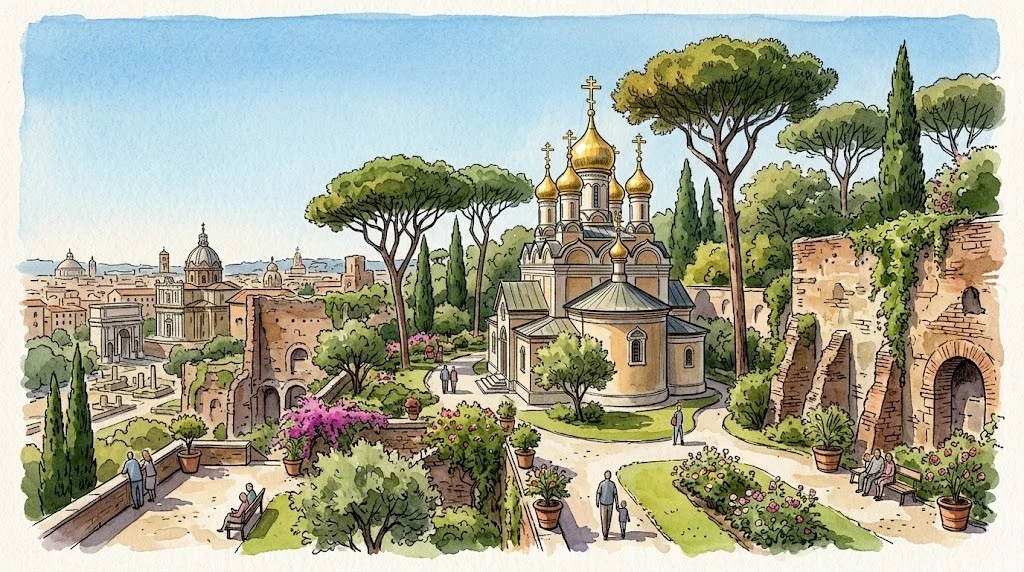
The Russian Orthodox Church of Saint Catherine, dedicated to Saint Catherine of Alexandria, martyr, is at Via del Lago Terrione 77, inside the park of Villa Abamelek, the residence of the ambassador of the Russian Federation, behind Via Gregorio VII, between Porta Cavalleggeri and the Fornaci. It's a parish of the Moscow Patriarchate, not a museum: you go in without a ticket and without paying anything, on the days when services are held, that is Wednesday, Thursday, Saturday and Sunday.
The building is recent. The cornerstone dates from January 14, 2001, the solemn consecration from May 24, 2009, and the design is signed by the Moscow architect Andrej Obolenskij. The idea of a large Russian church in Rome, however, is more than a century old: the fundraising began in 1898, Tsar Nicholas II contributed his share, and war and revolution blew everything up. This long wait is the key to reading the place.
The practical information given here was checked on September 28, 2026 on the parish website, on the tourism portal of Roma Capitale and on the other sources cited further on. The service calendar is published in Russian and shifts with the feasts of the Orthodox calendar, which don't coincide with the Catholic ones: before you set out write or phone the parish and have them confirm the time for the day you've chosen.
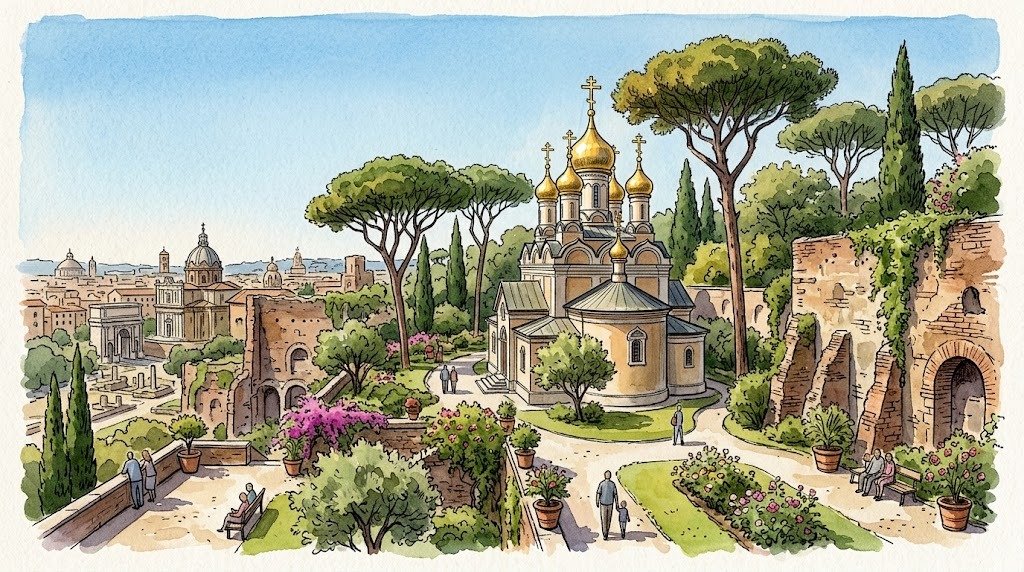
Where it is and what you really see
Via del Lago Terrione is a side street of the Aurelio neighborhood, behind Via Gregorio VII, in the area Romans still call the Fornaci for the old brick factories. Above it rises the slope of the Janiculum, which inside Villa Abamelek reaches toward Porta San Pancrazio. The greenery of Villa Doria Pamphilj is a little farther on, beyond Via Aurelia Antica, where the main gate of the diplomatic villa opens.
From outside you see a white, compact volume, 29 meters high, closed off by aqua-green roofs and gilded onion domes. The Italian encyclopedia entry gives 698 square meters of surface area and just over 5,000 cubic meters of volume: parish church dimensions, not cathedral. The light stone cladding, which Russian-language guides describe as travertine, is the Roman concession of an openly Moscow project, designed and built by Russian workers.
Inside there are two spaces, one above the other. On the upper floor is the church of Saint Catherine, with the carved marble iconostasis designed by the icon painter Aleksandr Soldatov, frescoes in the lower register, royal doors in carved and gilded wood. Below, on the basement level, is the lower church dedicated to Saints Constantine and Helena, with a majolica iconostasis that the Russian encyclopedia entry gives as a gift from craftsmen of the Urals.
What you don't see: the rest of Villa Abamelek. The 27-hectare park, the little palace, the small theater called the Casino delle Muse and the ambassador's residence stay beyond the fence and are not part of the visit. The church has access for worshippers from Via del Lago Terrione, and all you see of the villa from there is trees, walls and a few roofs. Anyone who arrives hoping for a walk in the park goes back disappointed.
How to get in, when services are held and how much it costs
The church is a stauropegic parish, that is, it depends directly on the Patriarch of Moscow and not on a local diocese. The official website gives services on Wednesday, Thursday, Saturday and Sunday, in addition to the great feasts, and publishes the weekly calendar on a dedicated page, in Russian. Entry costs nothing. The church opens for celebrations, and outside those times the operator gives no tourist visiting hours.
Where you really buy entry: nowhere, because there is nothing to buy. No ticket, no presale, no guided tour sold online by the parish. The official channel is the website of the parish of Saint Catherine, with the service calendar and news. If someone offers you a paid private access to the Russian church, they're selling you a sidewalk and a door that opens free to anyone on liturgy days.
For contacts the tourism portal of Roma Capitale, on turismoroma.it, gives the phone 06 39375477 and the email address s_caterina_roma@rambler.ru, and advises contacting the church directly for hours and visiting conditions. Other sites give a different number and the sources don't agree. The practical advice is to write in Italian or English, in short sentences, and wait a few days for the answer.
The liturgy is celebrated according to the Slavic Byzantine rite, with the chants in Church Slavonic. The parish website states that every Sunday in the lower church a service is held in Moldovan, for the community that comes from Moldova. The parish serves Russian, Ukrainian, Moldovan, Bulgarian and Romanian worshippers, and on Sunday morning the churchyard is a small geography of Eastern Europe living in Rome. The website also mentions a parish school and talks after the liturgy.
On dress the operator gives no published rule. The custom of Russian churches wants women with their heads covered and wearing a skirt, men bareheaded, shoulders and legs covered for everyone. A 2023 visit account reports that tourists are not made to wear the headscarf, but it's still best to have a light scarf in your backpack. It costs nothing and spares the embarrassment of being the only uncovered head in front of the iconostasis during the chant.
Allow for the timing. The Russian Sunday liturgy normally lasts between an hour and a half and two hours, and worshippers come and go even after the service has begun, so nobody is scandalized if you arrive or leave quietly. There are none of the pauses for sitting that punctuate the Catholic Mass. If you're traveling with small children or with people who can't stand for long, choose a short stay and discuss it in the churchyard once you're out.
A curiosity about the Russian Orthodox Church of Saint Catherine
The church lives by a different calendar from that of the city that hosts it. The Russian Orthodox Church still follows the Julian calendar for fixed feasts, and today there are 13 days of difference between the two systems. So the feast of Saint Catherine, which Catholics celebrate on November 25, here falls on December 7 of our calendar, and Christmas is celebrated on January 7. Next to the Vatican, liturgical time runs on another track.
The dates of the construction tell it better than any explanation. The lower church of Saints Constantine and Helena was consecrated on December 7, 2007, that is, precisely on Saint Catherine's day according to the Julian calendar. And the cornerstone, laid on January 14, 2001, falls on the Julian January 1, the New Year that in Russia many still celebrate as the Old New Year. Coincidences that are not coincidences, for those who know Orthodox custom.
There is a Roman irony in all this. The reform that took 10 days from October 1582 was dated at Tusculum by Gregory XIII, and the villa that tradition ties to the signing is Villa Mondragone, in the Castelli. Four and a half centuries later, under the Janiculum, a community that never accepted that reform for its own feasts built its Roman church, with the dome of Saint Peter's in the background.
For the visitor the consequence is concrete. Orthodox Easter almost never coincides with the Catholic one, Holy Week has its own rhythms and hours, and the fast days are different. If you want to attend a great feast, check the date on the parish calendar and not on the one hanging in your kitchen. Anyone who arrives on December 25 expecting the Christmas Mass finds a church in the middle of Orthodox Advent.
One thing nobody tells you about the Russian Orthodox Church of Saint Catherine
It isn't the historic Russian church of Rome. That one still exists and is dedicated to Saint Nicholas the Wonderworker. According to the reconstruction published by the portal of the Russians in Italy, Tsar Alexander I signed the decree of establishment on October 6, 1803, the church was built only in 1823 and then moved several times among Roman palaces, until 1931, when it moved to the palace of M. A. Černyševa on Via Palestro, where it was consecrated on April 10, 1932.
The one on Via Palestro is a church carved out inside a palace, without the scenic presence of a freestanding building. There the Russian community of 20th-century Rome took shape, there passed the emigration after the revolution, and there is the historical continuity. Saint Catherine is a building from 2009, built on diplomatic ground, with an evident representative role. They're two different things, and confusing them loses precisely the most interesting part of the story.
The position against the grain is this: calling Saint Catherine the most beautiful Russian church in Rome, as quite a few blogs do, is a wrong compliment. As architecture it's a correct project without surprises, a traditional Russian-style church redone with modern materials. The real reason to go is the living liturgy, with the choir, the candles and people standing for two hours. Without the service it remains a nice new building.
I add a warning. You'll often read that the church copies a precise model from ancient Russia, a regional school or a famous building. The parish's pages and the encyclopedia entries speak only of Russian style and don't indicate a prototype. Anyone who gives you as certain a derivation from a single city or a single medieval church is doing architectural history by eye. They may be right, but no official source declares it.
111 years between the idea and the consecration
The parish website starts the story from the archimandrite Kliment Vernikovskij, rector of the Russian embassy church between 1897 and 1902. It was he who convinced the ecclesiastical and civil authorities that Russia needed in Rome a church worthy of its weight, not a rented chapel. In 1898 the fundraising began, and in 1900 Tsar Nicholas II officially authorized it and donated 10,000 rubles.
Grand dukes, aristocratic families and even Siberian merchants contributed. In 1913 Nicholas II extended the collection to the whole empire, in 1915 a plot was bought on the bank of the Tiber, and in 1916 the fund reached about 265,000 lire. Then the story stopped. The portal of the Russians in Italy ties the abandonment to the death of Prince Abamelek-Lazarev, in 1916, and to the revolutionary events of 1917. The plot on the river never saw a construction site.
For 70 years the idea lay buried. Patriarch Alexy II took it up again in 1990, with his blessing, and in October 1999 the embassy of the Russian Federation presented the formal request. In May 2000 the project reached the city, and by then the solution for the land was already clear: build inside Villa Abamelek, property of the Russian State, avoiding buying an area in the city and dealing with the planning restrictions of the historic center.
The administrative path was not short. The Italian encyclopedia entry recalls that on December 20, 2001 the Region approved a law on places of worship of diplomatic missions, that the building permit arrived in June 2002 and that works began in 2003, in May according to the same entry, in summer according to the parish website. In the meantime, from 2004, a dedicated association was raising money for the construction site.
The 2009 consecration closed a circle opened in 1898, and closed it in a way the old archimandrite would not have imagined: not on the bank of the Tiber, in the heart of the city, but inside the park of a diplomatic villa, in sight of the Vatican. The fact remains that between the first fundraising and the inaugural liturgy 111 years passed. Few religious buildings in Rome have had so long a gestation.
My advice for visiting the Russian Orthodox Church of Saint Catherine
Go on Sunday morning, during the Divine Liturgy, and arrive half an hour before the start given on the parish calendar. It's the moment when the church makes sense: choir, incense, candles, worshippers coming in, crossing themselves, kissing the icons and staying on their feet. A visit to an empty church shows you a nice interior. A visit during the service shows you a community, and that is what you don't find anywhere else in Rome with this intensity.
Stand at the back, to the side, and leave the center of the nave free. In Russian churches there are no rows of pews like in Catholic churches, and the movement of worshippers toward the icons and the candle stands is continuous. Don't cross in front of the royal doors, don't turn your back to the altar while the priest censes, don't talk. If you want to light a candle, an offering is usually left at the counter near the entrance: nobody will ask you to be Orthodox.
Listen to the bells. They were cast in 2006 in the ZIL plants in Moscow and tuned by the master bell ringer I. V. Konovalov, according to the Russian encyclopedia entry. They ring for Sunday and feast-day services, with the Russian percussion technique that has nothing to do with the concert of Roman bells. Anyone who arrives 10 minutes before the liturgy hears them from the square, and it's a sound that truly surprises in Rome.
Always check the week's calendar, even with an automatic translator. Movable feasts, fast days and the bishop's celebrations change the time, and a festive liturgy can last much longer than a Sunday one. If a date interests you for a specific reason, for example Orthodox Easter or the patronal feast of December 7, write to the parish a few weeks ahead and ask for the exact start time.
The last piece of advice concerns afterward. When the liturgy ends, many worshippers stay in the churchyard to talk, and the older ones are often happy to explain an icon to someone who asks respectfully. It's the best way to understand what you've seen. Then walk up to the Janiculum: the church and the terrace above Rome make a coherent morning, and at 11:30 the light on the city is still good.
If you can't on Sunday morning, there is a less crowded alternative. In the Russian tradition on Saturday evening the vigil that prepares Sunday is celebrated, with sung vespers, and the parish website lists Saturday among the service days. Check the calendar to see if and at what time it is scheduled. The light of the candles in the almost dark church, with the choir singing the evening psalms, is worth the trip here by itself.
Another well-known fact, yet rarely cited
The villa that hosts the church has a long and little-told Roman history. At the end of the 16th century the area was the Ginetti vineyard, in 1695 it appears as the property of the Genoese banker Paolo Girolamo Torre, and in 1722 the family ceded it for debts to the Hospital of Santo Spirito, the one tied to the church of Santo Spirito in Sassia. In 1734 it was bought by Monsignor Giuseppe Maria Feroni, who brought in the architect Alessandro Galilei.
Then a series of changes of hands that reads like a list of the Roman nobility: the Torlonia, the Valentini, the Giraud, and in 1854 the Doria Pamphilj, the same family as the Palazzo Doria Pamphilj on the Corso, followed in 1863 by the Ricasoli. In 1907 it was bought by Prince Semën Abamelek-Lazarev, who with the architect Vincenzo Moraldi transformed the park and buildings and enlarged the property by buying neighboring vineyards and farmhouses. The name comes from him.
Abamelek-Lazarev, born in Moscow in 1857 into a family of Armenian origin, was a patron and an amateur archeologist of serious level: in 1881 he discovered at Palmyra the great slab with the customs tariff in Greek and Aramaic. In 1897 he married Marija Demidova. He died in 1916 in Kislovodsk and left the villa to the Imperial Academy of Fine Arts of Saint Petersburg, but the revolution made the transfer impossible.
The widow lived until 1955. The property passed to the Soviet State with a postwar Italian legislative decree, which the English encyclopedia entry dates to 1947 with the number 385, while the prince's biography speaks of 1948: the sources don't agree on the year. Since then the villa has been the residence of ambassadors, first Soviet and then Russian. In the park, ancient remains have been found that the same entry attributes to barracks of Nero's guard.
Villa Abamelek has no regular openings to the public. A neighborhood page notes that in the past it could be visited only by reservation at the embassy or on the occasion of cultural events by invitation, and today the operator gives no visit calendar. It is one of the invisible Roman villas, like the diplomatic residences of the Janiculum and the Esquiline: you know they're there, you see their walls, and the garden remains a hypothesis behind the gate.
The lowered hill: documents, tradition, legend
The most told story about the church concerns its height. What the written sources say: the Russian encyclopedia entry reports that the ground under the building was lowered, and a 2022 article on Orthodox Rome speaks of an excavation of about 10 meters in the hillside. The first designs, according to the same Russian entry, called for domes that would have exceeded in height that of the Vatican basilica. These are the published data, without a city document to substantiate them.
What tradition says: that in Rome no building may be taller than the dome of Saint Peter's. It's a very widespread belief, which Romans have repeated for generations and which guides like to cite in front of the buildings of EUR or the suburban skyscrapers. More than a written rule it's a habit of planning prudence, and the Russian church stands on the flank of a hill that looks precisely toward the Basilica of Saint Peter.
What is legend: that the Vatican imposed the digging on the Russians, or that the negotiation over height was a diplomatic tug-of-war between the Catholic Church and the Patriarchate. The available sources don't document it. The simplest explanation is also the most probable: a project placed on a slope visible from half the city, within a protected landscape context, had to stay under certain heights to get the go-ahead.
The result is seen by going to the spot. The church doesn't dominate the landscape, it leans against the hill, and the golden domes peek out among the park's trees more than they soar. From afar, from the streets around Monte del Gallo, you see them appear and disappear among the roofs. It's a discreet presence, and in our judgment it's the project's greatest merit: a foreign church that doesn't raise its voice.
The right photo to take at the Russian Orthodox Church of Saint Catherine
The right photo is taken from outside and from afar. A Roman photographer who recounted discovering the church notes that the golden domes can be seen from Via di Monte del Gallo and from the side streets around Via Gregorio VII. From there, with a medium telephoto lens, you capture the domes against the sky with the park's greenery below: it's the image that makes you understand you're in Rome and not in Moscow, because around them there are pines and tile roofs.
Up close, on the forecourt, look for the mosaic of Saint Catherine above the entrance, made in 2010 by Evgenij Kljucharev according to the census of Russian churches. Frame it vertically with the portal below, leaving out the fence and the signs. The contrast between the white of the stone, the aqua green of the roofs and the gold of the domes works better under a hazy sky, because full sun burns the white and flattens the green.
Inside, the operator gives no rules on photographs. The rule is simple: during the liturgy none, neither photos nor raised phones, and before shooting in an empty church you ask whoever is on duty. The shot worth asking for is the whole iconostasis from the back of the nave, with the royal doors in the center. No flash on the icons and frescoes, for respect and for the result.
Avoid photographing gates, fences and cameras of the diplomatic perimeter. Besides being ugly, in a perimeter bordering an embassy residence it can attract the attention of security staff, and it isn't worth it. If you want an overall image, move away and use the trees as a frame: the church tells itself better half hidden than photographed head-on like any other building.
What to look at inside
The iconostasis is the wall that separates the nave from the sanctuary, and in the Russian tradition it's a book of images to be read in order. Here it is carved marble, with frescoes in the lower register and icons in the upper registers, according to Aleksandr Soldatov's design. In the center are the royal doors, through which only the clergy pass. To the right of the doors you normally find the icon of Christ, to the left that of the Mother of God.
Raise your eyes toward the apse, above the iconostasis. In the semi-dome the census of Russian churches notes the image of the Mother of God of the Sign, the Virgin with raised arms and the Child in a medallion on her chest, one of the oldest iconographic types in Russia. The interior decoration, according to the parish website, began in 2012 and is the work of Russian artists. It's recent work, executed according to traditional canons.
The church holds relics that for Orthodox worshippers are the main reason for the visit. The Russian pilgrimage portal lists a fragment of the Cross, relics of Saint Catherine and Saint Helena the empress, and an icon with relics of Blessed Matrona of Moscow, a saint much loved in Russia. You'll see people stopping in front of the reliquaries, crossing themselves, kissing the glass. Look without getting in the way: for them that is the center of the morning.
Don't forget the lower church of Saints Constantine and Helena, consecrated in 2007 and dedicated to the imperial couple who for Orthodox believers are the model of the relationship between faith and power. It's more intimate, with the majolica iconostasis, and on Sunday it hosts the liturgy in Moldovan. Ask if it's open: sometimes it's worth more than the upper church, precisely because it's more intimate and less photographed.
A few notes for those entering an Orthodox church for the first time. The choir usually sings from one side, near the iconostasis, and there is no organ: in the Russian tradition liturgical music is voice alone. Icons are not decoration but objects of veneration, and for this reason worshippers kiss them and light candles in front of the ones they are most attached to. The deacon and the priest go in and out through the side doors and the central ones according to the moment of the rite.
How to get there
By train the most convenient solution is to get off at the Roma San Pietro station, served by regional trains, and from there reach Via del Lago Terrione on foot through the area of Via Gregorio VII. The Russian pilgrimage portal also gives bus 64 from Termini to Saint Peter's and Metro A to Ottaviano, solutions that however leave you on the opposite side of the Vatican and require a longer walk.
By car the same portal suggests arriving from the Clivio di Monte del Gallo. Parking is the real problem: the side streets off Via Gregorio VII are full residential streets, and on Sunday morning, with the liturgy, the worshippers' cars are added. The person who recounted their visit discovered the church precisely while circling in search of a spot. If you can, leave the car and use the train or public transit.
On foot from the colonnade of Saint Peter's Square you leave through Porta Cavalleggeri and head toward the Fornaci: it's an urban walk with no particular charm, among traffic and narrow sidewalks, but short. If you have a free afternoon you can do the route in reverse, coming down from the Janiculum through the neighborhood's sloping streets, and arrive at the church for vespers.
To get your bearings in the area before leaving, our guide to Prati and Borgo covers the northern side of the Vatican, while the one on Trastevere takes you south, on the other side of the Janiculum. The church lies exactly between the two worlds, in a residential neighborhood that tourists almost always cross without looking, headed elsewhere.
Some important events that happened here in history
On January 14, 2001, inside Villa Abamelek, Archbishop Innokentij blessed the cornerstone in the presence of the foreign ministers Igor Ivanov and Lamberto Dini. It was the first time that a Russian Orthodox place of worship of this size was authorized in Rome, and the ceremony had an evident diplomatic weight. The land was Russian, the permit Italian, the blessing from Patriarch Alexy II: three levels of authority for a single stone.
2006 was the year the building took visible shape. On March 31 the domes and crosses were blessed, in May the bells went up, and on May 19 Metropolitan Kirill, then head of the Patriarchate's external relations and later patriarch, celebrated the minor consecration, with the mayor of Moscow among the guests. From October 8, 2006, according to the parish website, the Sunday liturgy has been celebrated regularly.
On December 7, 2007 the same Metropolitan Kirill consecrated the lower church of Saints Constantine and Helena. On May 24, 2009 came the great consecration, celebrated according to the parish website and the Russian encyclopedia entry by Metropolitan Valentin of Orenburg, with the presence of Svetlana Medvedeva, wife of the then Russian president. The Italian entry and the tourism portal of Rome instead give May 23, 2009 as the date of the inauguration.
After the consecration the work continued inside. In 2010 the mosaic of Saint Catherine was placed at the entrance, and from 2012 the painted decoration of the walls began. These are less visible but decisive steps: an Orthodox church is considered complete when images cover the space, not when the roof is finished. Those who went in during the first years saw a much barer church than today's.
On December 16, 2024, according to the account of an Italian-Arab association that took part, the 15 years since the consecration were remembered with an evening at the ambassador's residence, in the presence of Metropolitan Nestor of Korsun' and Cardinal Claudio Gugerotti, prefect of the Vatican dicastery for the Eastern Churches. A detail that says a lot: the relations between this church and the Holy See, a few steps away, have also been built in public.
Who has passed through the Russian Orthodox Church of Saint Catherine
The archimandrite Kliment Vernikovskij never saw this church, but without him it wouldn't exist. Rector of the embassy chapel at the end of the 19th century, he understood that a great Orthodox power could not stay a tenant in the capital of Catholicism. He opened the fundraising, involved the court, prepared the political ground. His project was shipwrecked by war, but the idea stayed written down, and it is the one that was taken up a century later.
Semën Abamelek-Lazarev, the prince who gave the villa its name, is the other illustrious absentee. Archeologist at Palmyra, collector, patron, he died in 1916 without seeing either the church or the end of the empire. By a trick of history, the villa he wanted to leave to the Academy of Fine Arts of his city ended up with the State that had abolished that imperial Academy.
Patriarch Alexy II blessed the resumption of the project starting in 1990 and donated to the church an icon that visit accounts cite among the most venerated objects. Metropolitan Kirill, now patriarch, celebrated two consecrations here between 2006 and 2007. Metropolitan Valentin presided over the solemn rite of 2009. They are names that for an Orthodox worshipper count as much as the titular cardinals of a basilica do for a Catholic.
Andrej Obolenskij is the architect, director of the Moscow Patriarchate's center for religious construction. Aleksandr Soldatov designed the iconostasis, Evgenij Kljucharev signed the entrance mosaic, the master bell ringer I. V. Konovalov tuned the bells. It's an entirely Russian team, and it shows: the church has nothing Italian in its language, not even a stylistic compromise, except for the cladding stone and the surrounding landscape.
Igor Ivanov and Lamberto Dini, the foreign ministers of Russia and Italy present at the 2001 cornerstone, represent the diplomatic part of the story. Without an agreement between the two governments, a place of worship inside a foreign state property would never have gotten the permit, and the regional law approved at the end of that same year should be read in this light too. A cornerstone, in this case, was at once a religious act and an act of foreign policy.
And then the parish. The Centro Astalli, which deals with refugees and lists it among the city's places of worship, gives Father Ambrogio Matsegora as contact and describes a community made up mostly of Russian, Ukrainian, Moldovan and Bulgarian worshippers, to whom other sources add the Romanians. Families who arrived recently and elderly emigrants of decades gather here. On Sunday morning they are the real protagonists of this place.
When is it closed and what not to expect
On Monday, Tuesday and Friday the parish website gives no ordinary services, except feasts and particular anniversaries, and on those days the operator gives no openings for visitors. On the other days too the church opens around the celebrations, not with continuous museum hours. Showing up at three in the afternoon on a Tuesday almost always means finding the gate closed and nobody to ask.
Don't expect tourist services. The operator doesn't publish visiting materials in Italian, there are no audio guides or routes, and the website is only in Russian. Everything you understand you understand by looking, reading beforehand or asking a worshipper. On accessibility for wheelchair users the operator gives no information: with a two-level building and a sloping forecourt, it's best to write first and ask which entrance to use.
Remember that the church is in a diplomatic area. Bring an ID, don't go in with bulky backpacks if you can avoid it, and calmly accept any requests from the staff. The operator gives no particular access restrictions for visitors, but the security of an embassy residence can change from one day to the next, and the parish is the only contact who can tell you how it works that week.
Don't expect a neutral place either. It's a living church, with worshippers praying, children running, elderly women lighting candles and a choir singing. Anyone who goes in with a tourist's attitude in a museum feels out of place in 30 seconds. Anyone who goes in as you go into a village church during Mass, in silence and at the back, is welcomed without problems and often with curiosity.
Two moments of the year change the picture completely. Orthodox Christmas, the night between January 6 and 7 of our calendar, and above all Easter, which in Russian practice is celebrated at night with a procession around the church and the greeting Christ is risen repeated by the priest. On those occasions the community arrives en masse, and non-believers must allow for crowds, waits and longer checks. Ask the parish if it's appropriate to take part.
Eating in the area
The church is in a border zone between the residential Aurelio neighborhood and the Vatican tourist circuit, and the difference at the table is enormous. Toward Via Gregorio VII and the Fornaci you eat as the neighborhood's office workers and families eat. Toward the colonnade and Borgo you enter the most beaten zone of Rome, where part of the dining lives on customers who will never come back.
The first sign to recognize is menus with photographs of the dishes, laminated and translated into six languages. A place that needs to show you the picture of the carbonara is speaking to someone who doesn't know what it is. The second is the person at the door who stops you and invites you to sit: a place that has to get customers on the sidewalk has no regular customers, and regular customers are the only guarantee there is.
The third sign is the lady rolling out pasta in the window, under the eyes of passersby. It's stage setting, not a hint of quality: good fresh pasta is made in the kitchen, in the morning, away from street dust. The fourth is places open at all hours without a break, from breakfast to midnight. A real kitchen has a crew that rests and prepares, and therefore hours with a pause.
Around the big monuments there is also the trap of the price adapted to the customer. Menu items without prices, fish of the day without a per-kilo figure, different price lists between the outside tables and the room inside, cover charge and service added together without saying so. Always ask the price before ordering and check the bill. It's not distrust, it's the normal prudence that Romans also use when they sit down in a new place.
Why Romans don't eat at the places in front of the monuments is not snobbery. It's that those places aren't designed for them: high prices, standard cooking, a hurry to free the table. The rule is to look at who's sitting there. If at two in the afternoon you see office workers, laborers and families speaking Roman dialect, you've found it. To avoid trial and error, here is our list of the places where we eat.
What to combine in a day
The natural pairing is the Janiculum. From the church, walk up toward San Pietro in Montorio and the Tempietto del Bramante, pass the Acqua Paola Fountain and reach the Porta San Pancrazio area with the Museo della Repubblica Romana. A little farther on you'll find the Basilica of San Pancrazio and the Janiculum Ossuary Mausoleum.
If you prefer green space, there are two options nearby. Villa Pamphilj, the largest public park in the city, borders the world of the diplomatic villas and you can wander it for hours. Villa Sciarra is smaller and more secluded. Heading down toward Trastevere there are the Botanical Garden, Palazzo Corsini and, on the other side of the hill, Sant'Onofrio al Gianicolo.
If you came for St. Peter's, the Russian church is a one-hour detour that changes the tone of the day. After the Vatican Museums and the Sistine Chapel, or after the Vatican Necropolis, seeing an Orthodox liturgy a few hundred meters away helps you understand what the two Churches split over in 1054. Finish in Borgo, with the Passetto and Castel Sant'Angelo.
There is also an itinerary of Rome's faiths that starts from here. The Synagogue of the Tempio Maggiore, the Great Mosque, the Anglican church of All Saints, the Waldensian Church and the Non-Catholic Cemetery tell the story of the Rome of minorities. Outside the city, the Synagogue of Ostia Antica and the Greek Abbey of San Nilo, of the Byzantine rite, complete the picture.
For the evening, if you still have energy, the Russian church pairs well with a night at the theater downtown. The Teatro Argentina is less than half an hour away, and after a morning of Slavic liturgical chant, moving on to Italian prose theater in an 18th-century playhouse is a contrast that works. Or go back up the Janiculum at sunset: the terrace above the city remains the best way to end a day on this side of the Tiber.
Frequently Asked Questions
Can you enter the Russian church of Santa Caterina freely?
Yes, on the days and at the times of the services, which the parish website lists as Wednesday, Thursday, Saturday and Sunday, besides the major feast days. Admission is free and there is no booking. Outside the services the operator doesn't give any visiting hours, so it's best to write to or call the parish to find out when the church is open in the week you're interested in.
How much does it cost to visit the church?
Nothing. The church is a parish of the Patriarchate of Moscow and it doesn't sell tickets, doesn't run paid guided tours published online and has no bookshop. At the candle counter by the entrance you leave a free offering if you want to light a candle. Be wary of anyone offering a paid entrance: there is no channel of this kind run by the parish.
How should you dress?
The operator doesn't give any written dress code. The custom in Russian Orthodox churches is a covered head and a skirt for women, an uncovered head for men, and covered shoulders and knees for everyone. A visit report from 2023 says that tourists are not required to wear a headscarf. Bringing a light scarf remains the simplest choice and the most respectful toward those who are praying.
Can you visit Villa Abamelek?
No, not with regular opening hours. Villa Abamelek is the residence of the ambassador of the Russian Federation and the 27-hectare park is not open to the public. In the past, visits by booking at the embassy or tied to cultural events by invitation have been reported, but today the operator doesn't list any calendar. The church has its own separate access from Via del Lago Terrione.
What language is the service in?
The liturgy follows the Slavic Byzantine rite, with chants in Church Slavonic, the liturgical language of the Russian Church. The parish website says that every Sunday, in the lower church of Saints Constantine and Helen, the service is celebrated in Moldovan. Homilies and announcements are generally in Russian. It is not a service designed for tourists, but anyone who attends in silence is welcome.
Can you take photographs?
The operator doesn't give any written rules on photographs. During the liturgy it's good practice not to take pictures and not to hold your phone up. When the church is empty, ask whoever is on duty before shooting and don't use flash on the icons. From outside, the best view of the golden domes is from Via di Monte del Gallo and the streets around Via Gregorio VII.
When was the church built?
The first stone was blessed on January 14, 2001, work began in 2003 and the solemn consecration was on May 24, 2009 according to the parish website, while other sources give May 23 as the day of the inauguration. The idea, however, goes back to 1898, when a fundraising effort authorized by Tsar Nicholas II began and was interrupted by war and revolution.
How do you get there by public transport?
The nearest station is Roma San Pietro, served by regional trains, from which you reach Via del Lago Terrione on foot through Via Gregorio VII area. The Russian pilgrimage portal also lists bus 64 from Termini to St. Peter's and Metro Line A to Ottaviano, which however require a longer walk. Check routes and schedules on the transit authority's website.
Who Wrote This Page
This page comes from the editorial team of Tour Leader Pro, the Rome-based organization that designs itineraries, visits and cultural events across Rome and Lazio. The service days, contacts and access details given here come from the official sources cited in the text, as of the date indicated at the beginning. Since this is a parish with its own liturgical calendar, check them again before you go and let us know what you find changed.
Putting together a day between the Vatican, the Janiculum and an Orthodox liturgy means fitting together schedules that don't depend on a museum, feasts that follow a different calendar, security checks and transport that slows down on Sundays, for yourself or for a group of 40 people. Anyone facing this kind of puzzle will find at Tour Leader Pro working materials designed for those who guide and for those who organize on their own.
For the bigger picture, meaning regional trains and seasonal schedules, rentals, airports, travel between provinces and destinations in Lazio outside central Rome, from the Castelli to the volcanic lakes of the north to the Tyrrhenian coast and the villages of the interior, a useful resource for putting together a multi-day itinerary is Italy Planner.