Basilica of San Pancrazio
In short. The Basilica of San Pancrazio stands in Piazza di San Pancrazio, on the Janiculum, just past the gate that took its name from the saint and right up against the boundary wall of Villa Doria Pamphilj.
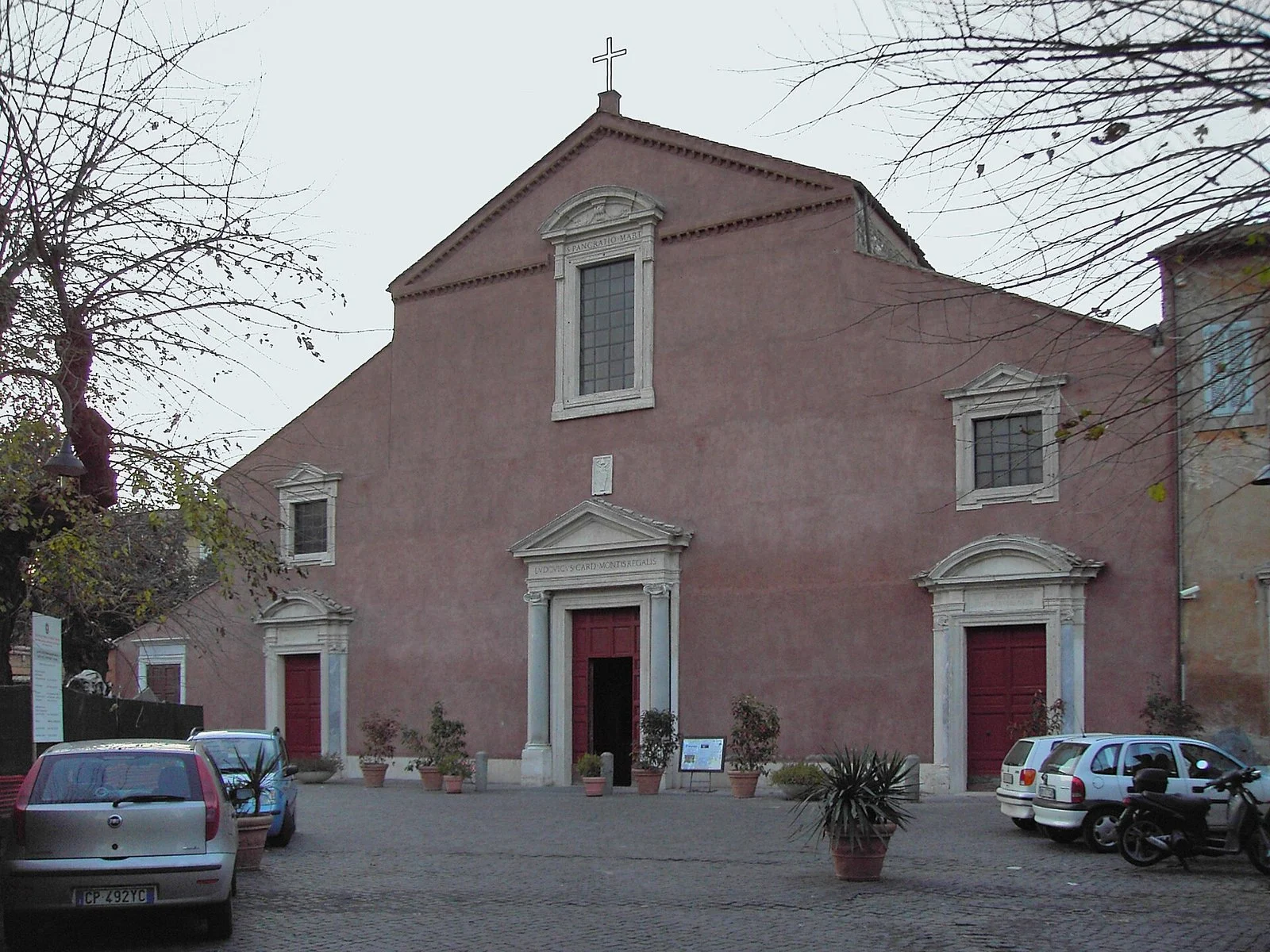
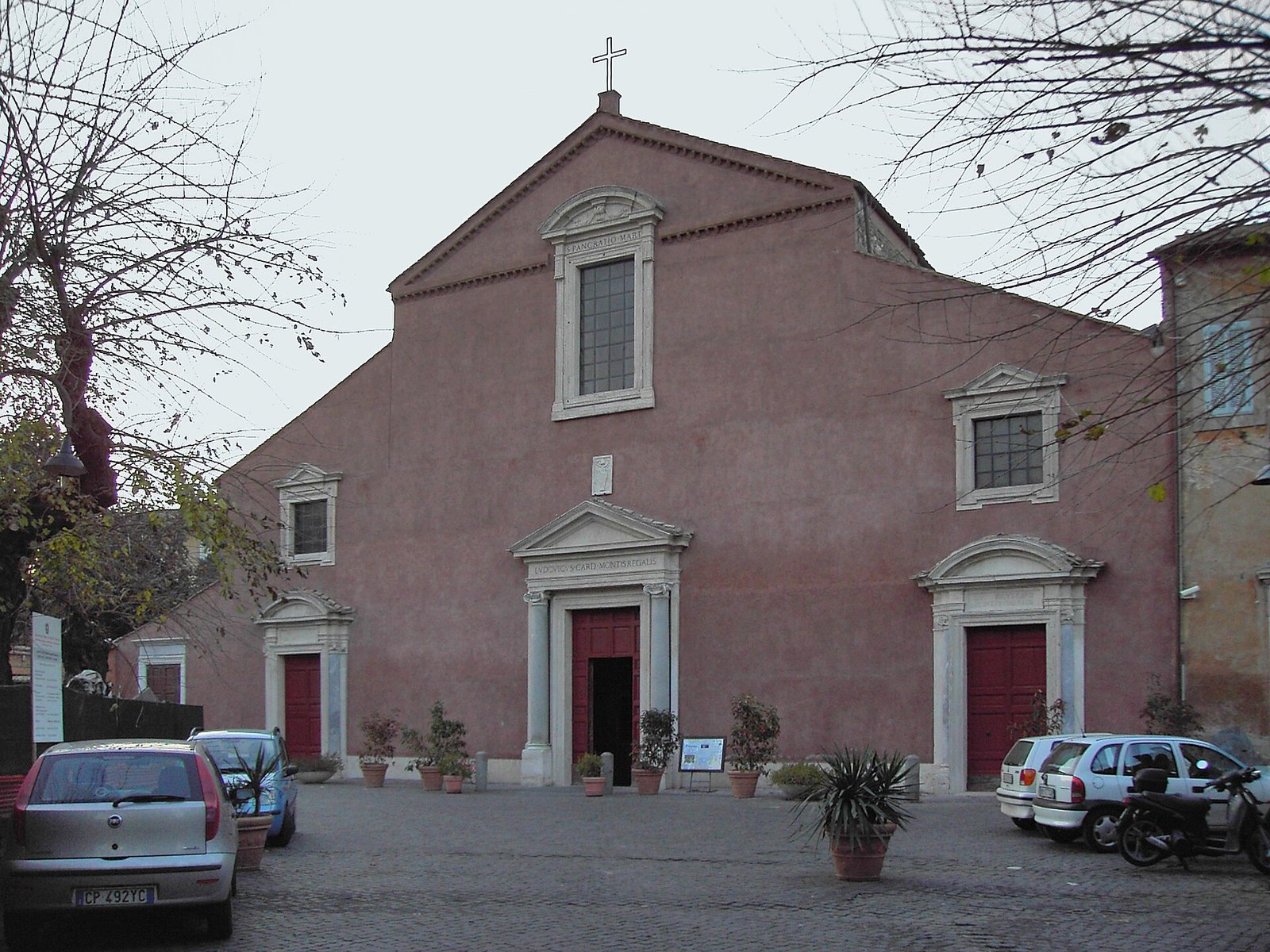
The Basilica of San Pancrazio stands in Piazza di San Pancrazio, on the Janiculum, just past the gate that took its name from the saint and right up against the boundary wall of Villa Doria Pamphilj. It is one of the oldest Roman churches by foundation and among the least visited in proportion to what it holds: beneath the floor runs a catacomb that you can really visit, with a guide and on a limited number of days, and around the building passes the line on which in 1849 the end of the Roman Republic was decided. Anyone who arrives here expecting the traffic of a basilica in the center instead finds a silent forecourt, a pinkish facade of the early 17th century, and a door that during closing hours stays shut with nobody to ask. Below you'll find what can be seen, what can't, what the sources say and where they contradict each other, with hours and contact details taken from the sites that publish them.
Where San Pancrazio is and how to get there
The address is Piazza di San Pancrazio 5, in the Gianicolense district, right up against the boundary with Monteverde Vecchio. The urban landmark is Piazzale Aurelio, the open space that gathers the traffic just outside Porta San Pancrazio, from which you take Via di San Pancrazio and arrive in two or three minutes on foot. Anyone thinking in terms of monuments can use a simpler reference: the basilica is the first important building you meet leaving the Janiculum heading west, with the monumental entrance of Villa Doria Pamphilj a few dozen meters away.
The metro is no use
There is no useful metro stop for San Pancrazio, and it's worth knowing before you leave. The nearest line A runs on the other side of the Tiber and the other side of the hill, with Ottaviano and Cipro in the Vatican quadrant: from there you'd still need a bus or a long uphill walk. Anyone who looks for San Pancrazio on a metro map and concludes that it's an impossible place to reach gets the reasoning slightly wrong and the conclusion very wrong, because surface transport works better than underground here.
By bus
The surface lines indicated by the official page of the Pontifical Commission for Sacred Archaeology for reaching the catacomb are the 44, the 44F, the 870, the 871, and the night 19N. To these is added the 115, a circular line that leaves from Via Paola, behind Corso Vittorio Emanuele II, crosses the river, climbs Via del Gianicolo, passes Piazzale Giuseppe Garibaldi and the panoramic promenade, touches Piazzale Aurelio, and turns onto Via di San Pancrazio. The 115 is the line that suits anyone coming from the historic center on foot and wanting to save the climb.
The 44 climbs from Trastevere through Monteverde and links the area with the riverfront, where tram 8 passes: anyone coming from Largo Argentina can get off at Trastevere and change. Roman line routes change often because of roadworks and detours, and no printed guide stands up to checking on the day itself on the transport company's app. The general picture on tickets, validity, and connections is on our page about how to get around Rome.
On foot, and how far you really walk
From the center of Trastevere, for example from Piazza Santa Maria, the climb to San Pancrazio takes between 20 and 25 real minutes, with an elevation gain that makes itself felt in the upper part of Via Garibaldi. The classic route passes in front of the Acqua Paola Fountain, the one Romans call the Fontanone, continues along the Janiculum promenade and comes out at Porta San Pancrazio, from which 300 meters on the flat remain. It's a walk that pays off, because it crosses the highest viewpoint of the old city.
From Saint Peter's Square the count is different and longer: a good 40 minutes going by Via Aurelia Antica, with stretches on busy road and uneven sidewalks. From Termini it makes no sense to try on foot. Anyone with little time and many stops should do the calculation beforehand: the distance as the crow flies from the Pantheon is two and a half kilometers, but the Tiber and the hill double the time.
By car, bike, taxi
The area is outside the limited traffic zone of the historic center and parking around the square is possible, with blue-line spaces and some free stretches in the side streets of Monteverde Vecchio. On weekday mornings spaces are scarce because the neighborhood is residential and the residents' cars stay put. By bicycle the climb from Trastevere is demanding and has to be tackled with the right gear or with pedal assist, while the descent back requires brakes in order, because Via Garibaldi is narrow and busy: our honest assessment of Roman cycling routes is on the page about Rome by bike. By taxi from the center you spend little and save half an hour.
What you really see inside San Pancrazio
The layout you walk through today is that of the 17th century superimposed on a structure of the 7th century, and the two can be read simultaneously if you know where to look. The basilica of Pope Honorius I had three naves with ancient colonnades. The 17th-century intervention closed the arcades and replaced them with massive pillars. The result is a wide and bright church, without the Baroque theatricality of the center and without the intact early Christian austerity of other Roman titular churches: a middle path that has to be looked at knowing what it's made of.
The facade and the entrance portico
The facade dates to the campaign begun in 1606 by Cardinal Ludovico de Torres and continued by his nephew Cosimo. It is plastered in pale pink with white marble details and opens three doors. A fourth door, on the left side, gives access to the catacomb. The central portal is flanked by two Ionic columns of gray granite, reused, taken from the building of the 7th century, and surmounted by a pediment with the de Torres coat of arms. On the arch of the outer enclosure a very worn fresco of the Crucifixion remains.
The wooden ceiling, the piece almost nobody looks at
The coffered ceiling of the central nave bears the date 1609 and was restored in 1909. At the center appears San Pancrazio, at the sides the coats of arms of Pope Paul V Borghese and of the de Torres family, with a heraldic play on towers that repeats the patrons' surname. The work stopped abruptly with the death of Cardinal Ludovico, in 1609, and some coffers were left without paint: anyone who raises their head and looks carefully sees the difference between the finished parts and those left half done.
The presbytery, the ciborium, and the apse
The frescoes on the walls of the presbytery are attributed to Antonio Tempesta, a Florentine painter active in Rome between the end of the 16th century and 1630, and show pairs of saints. The apse semi-dome, on the other hand, is 20th-century: the Christ in majesty with San Pancrazio and other saints on a field of lilies was painted in 1959 by Luigi Ciotti and replaced an anonymous 17th-century decoration, a choice that was criticized at the time and that today is noticed at once for the difference in register. The baldachin above the high altar is also from 1959, assembled reusing ancient porphyry columns.
The side chapels
In the chapel of the Blessed Sacrament, on the left, there is an altarpiece with Saint Teresa of Avila attributed to Palma il Giovane, that is Jacopo Negretti, and a Baroque baptismal font. The font was not born here: it comes from the parish of Santi Celso e Giuliano and in it Eugenio Pacelli, the future Pius XII, was baptized in 1876. In the chapel of the Crucifix, on the right, eight modern panels tell episodes from the life and miracles of the saint, while the 19th-century altar wall shows clear signs of water infiltration.
The reliquary and the column with the inscription
The saint's relic is kept in a 16th-century reliquary bust, held in a glass cabinet in the right nave and brought to the altar only on May 12, the feast day. Not far away an ancient capital bears an inscription declaring that it marks the exact place of the beheading. Specialist literature considers it a devotional invention of the 17th century, designed for pilgrims: marble dulls blades and nobody would choose a capital as a chopping block. It's a historical fake displayed in plain sight, and it's worth more than many authentic pieces as a lesson in how pilgrimage worked.
The bell tower and the museum in the sacristy
The bell tower is a 17th-century turret in plastered brick that emerges from the convent wing, with two stages above the roofline, a large arched opening on each side, and a small lead dome above the tile covering. The sacristy functions as a small archaeological museum: Greek and Latin inscriptions recovered from the catacomb and fixed to the walls, fragments of sarcophagi, capitals, funerary cippi, and materials from the excavations. The museum pages describing this collection indicate hours of 09:00 to 12:00 and 16:30 to 19:00 and free access by prior arrangement.
The catacombs of San Pancrazio: you can visit them, but on a limited number of days
The short answer is yes, the catacomb of San Pancrazio can be visited, and it is one of the seven Christian cemeteries of Rome that the Pontifical Commission for Sacred Archaeology lists as open to the public with regular hours. It's a clarification that is useful, because of the 26 Roman catacombs recorded by the same commission most are accessible only on motivated request or closed altogether, and anyone who generalizes is wrong in one direction or the other. We put the comparison with the overall picture on the page about the catacombs of Rome.
Days, hours, and closures
The hours published by the pontifical commission indicate Tuesday and Thursday from 09:30 to 12:00, Wednesday from 09:30 to 12:00 and from 16:30 to 18:00, with the possibility of booking on other days. The ordinary closure covers Friday, Saturday, Sunday, and Monday, and Christmas, January 1, Easter, and the month of August are added. A second source, the English-language page devoted to Roman churches, describes guided visits for groups of a maximum of 20 people with departures at 09:30, 10:30, and 11:30 from Tuesday to Thursday and two afternoon shifts on Wednesday.
The two descriptions don't coincide to the minute and the difference mainly concerns Thursday afternoon and the shift structure. We report both because both come from serious sources, and the practical behavior that follows is only one: call first. The contact given by the pontifical commission is 06 44208069, with the basilica's voicemail box. The convent of the Discalced Carmelites instead publishes the number 06 5810458. The numbers also diverge, which says how much direct verification is worth.
What you see below
The visit is short, and anyone arriving with San Callisto in mind is thrown off. The galleries have largely collapsed or are interrupted, the walkable route covers a fraction of the ancient cemetery, and the spaces are narrow. What you see, though, is firsthand: cubicula of the late 3rd century, the cubiculum of Botrys with the inscription defining the deceased as christianós, the cubiculum known as that of Santa Felicola with decoration in red bands and marine elements, ships and fish, and a space venerated in the Middle Ages as the tomb of Santa Sofia with her daughters Fede, Speranza, and Carità.
The cemetery of Ottavilla and the four sectors
The underground complex is also known as the cemetery of Ottavilla, from the name of the matron who according to tradition buried the martyr's body. Archaeological reconstructions distinguish four regions, marked by letters, with different accesses: two open inside the basilica, one extends under the convent on two levels, one is reached from outside. One of the two internal entrances, the one that leads to the sector called Ottavilla, according to Italian popularizing pages remains reserved for scholars of Christian archaeology and is not part of the visiting route.
The dates, and why they matter
The oldest nuclei go back to the end of the 3rd century, that is right around the years in which tradition places the martyrdom, and were born as private hypogea later absorbed into the community cemetery. The greatest expansion is of the 4th century, documented by the Constantinian Christograms of the third region, and burials continue until the start of the 6th. Above the underground level the excavations of the 1930s brought to light a Roman road, mausoleums, and burials in the ground, with a pagan necropolis active already from the 1st century BC.
If the catacomb is closed
The Roman alternatives with wider opening are to the south, on Via Appia and Via Ardeatina: the Catacombs of San Callisto, the Catacombs of San Sebastiano, and the Catacombs of Domitilla, all with ticket offices and structured routes. To the north are the Catacombs of Priscilla. Anyone looking instead for something similar to San Pancrazio in small size and limited visiting regime should look at the Catacombs of Commodilla and the Catacombs of Santa Tecla, both in the San Paolo quadrant.
San Pancrazio: how much we really know
The biography that circulates everywhere is precise and orderly: a Phrygian boy from a well-off family, orphaned, brought to Rome by his uncle Dionysius, converted together with him, beheaded on Via Aurelia on May 12, 304 at the age of 14 under Diocletian. The problem is that this biography comes from a passio, that is a hagiographic tale, and that the oldest passio seems to have been composed after the construction of the basilica, so at least two centuries after the events it tells. The distance is the point to keep in mind.
Where the tale doesn't hold up
Two inconsistencies are known and are found in the current literature. The first concerns the emperor: the passio has Pancras appear before Diocletian in Rome, but Diocletian did not return to Rome from 286 until 303, and in any case the scene of the personal confrontation is a recurring topos of late passiones. The second concerns the pope: some versions place the martyrdom under the pontificate of Cornelius, who reigned between 251 and 253, that is half a century before the traditional date of 304. The two things don't fit together.
What remains solid
What remains is the cult, which is documented early and solidly. The tomb venerated on Via Aurelia exists, the basilica that Pope Symmachus builds there between 498 and 514 is a building fact, and by the middle of the 6th century the saint's name has already replaced the ancient one of the city gate: the Porta Aurelia of the Aurelian Walls becomes Porta San Pancrazio. A martyr without a cult does not produce a papal basilica and does not rename a city gate. The name and the very young age are instead elements of the tradition, not verifiable biographical data.
Why there is a station in London with this name
Gregory the Great gave impetus to the cult and the mission that in 596 he sent to England with Augustine, later bishop of Canterbury, carried relics of Pancras with it. Hence the chain of English dedications, among them the church of St Pancras Old Church in London, one of the oldest places of Christian worship in the country, and consequently the district and the railway station that bear that name. The boy buried on the Aurelia gave his name to a Eurostar terminal, and it's the kind of short circuit that happens often in Rome.
A curiosity about San Pancrazio
The saint's bones are no longer there, and the basilica says so without beating around the bush. The urn that held them was forced open twice 50 years apart, in 1798 by the French soldiers of the first occupation and in 1849 during the siege of Rome, and in neither case was the content recovered. The relics venerated here today come from the Basilica of San Giovanni in Laterano, where a part had been brought centuries earlier, and were transferred to San Pancrazio by order of Paul VI in 1973.
A shrine that lost its saint
A basilica is born to guard a body, and all of San Pancrazio's architecture is built around that task. Pope Honorius I, in the 7th century, rebuilt the building from scratch with the sole purpose of bringing the tomb exactly under the high altar, adding a transept and a semi-annular crypt, that is a curved corridor that allowed pilgrims to walk around the tomb without obstructing the liturgy. That device, tried before only at San Pietro, worked here for 11 centuries and then lost its center.
One thing nobody tells you about San Pancrazio
The sources don't agree on who devastated the basilica in 1849, and the divergence follows precisely the nationality and orientation of whoever writes. Italian reconstructions speak of French troops who smashed the marble tombs of the de Torres cardinals into pieces for firewood and fuel, and who desecrated the urn of porphyry and peperino, scattering the bones. An English-language page devoted to Roman churches instead attributes to the Garibaldian defenders blasphemous inscriptions, caricatures, and obscene drawings on the inner walls, as well as the new opening of the tomb.
Why both versions probably contain some truth
The basilica found itself inside the combat zone for two months, and changed hands. On April 30, 1849 the battle took place right in this sector, with the French army repulsed and forced to withdraw. On June 3 the French conquered Villa Doria Pamphilj and Villa Corsini, reaching right up against the Janiculum walls. A large, walled building in a dominant position, between two armies alternating for weeks, gets occupied, used as shelter, stripped of whatever burns, and filled with writing by whoever sleeps inside.
How we behave
We are not able to attribute the damage to one side only and we don't do so. We report that the basilica suffered serious devastation during the siege of 1849, that the 17th-century funerary monuments were destroyed, that the martyr's tomb was forced and the relics scattered without recovery, and that the two historiographic traditions indicate different culprits. Anyone who tells the episode as a clean fact, with one guilty party and one innocent, is writing a more convenient version than the one the sources allow.
The Napoleonic precedent
The looting of 1798, on the other hand, is documented in agreement. During the first French occupation the valuable furnishings vanished, the polychrome marbles, the Cosmatesque ambos that Abbot Ugo had had made in 1244 together with a paschal candelabrum, and the baldachin of the high altar with its porphyry columns. Of those columns only two came back after 1815. The medieval ambos have never been found, and their loss is the reason why of the 13th-century San Pancrazio practically nothing visible remains today.
The advice I give you for visiting San Pancrazio
Organize the day around the catacomb and not around the church, because the church is open in wide time slots and the catacomb isn't. In practice this means choosing a Tuesday, Wednesday, or Thursday morning, calling a few days beforehand to confirm the shift, showing up 15 minutes early, and allowing for the fact that the group has a cap of 20 people. Anyone who arrives on a Friday or on the weekend finds the basilica and nothing more, and it isn't the same visit.
The church's hours
The sources available for the opening of the basilica indicate on weekdays 09:00 to 12:00 and 16:00 to 19:00, with evening extension in the months from July to September, and on Sundays and solemnities 08:00 to 13:00 and 16:00 to 20:00. Weekday Masses are at 07:30, 09:00, and 18:00. On Sunday the shifts published by the city page are 09:00, 10:30, 12:00, and 18:00, while other sources indicate 08:30, 10:30, 12:00, 17:30, and 18:00. The divergence is the usual one of churches run by religious communities, where the calendar changes with the seasons and the sites don't update in parallel.
The official site doesn't respond
The internet address of the parish, the one that appears on all the institutional pages, currently returns an error and shows no content. What remain are the secretariat's mailbox published by the pontifical commission and the two telephone numbers, that of the secretariat and that of the Carmelite convent. Anyone planning well in advance should write an email and call, without trusting a single contact channel.
August, and why to avoid it
The catacomb closes for all of August, and the religious community reduces activities like all Roman communities. Anyone whose trip is stuck in that month should consider that only the basilica remains visitable during ordinary hours and the underground does not, and consider shifting the stop to one of the Appia catacombs, which work in August. The same warning applies to January 1, Easter, and Christmas.
How much time to allow
For the basilica alone 25 minutes is enough, 30 if you look at the ceiling at leisure and look for the capital with the inscription. With the catacomb you reach an hour and 15 minutes. Adding Villa Doria Pamphilj next door, which alone requires at least an hour and a half for a sensible loop, takes up a full half day. Anyone who also fits in the Janiculum promenade and the Fontanone can close out the day: from here you get back to the center comfortably only on foot or by bus.
1849 on the Janiculum: what happened exactly around here
This piece of the city is the most important urban battlefield of the Italian Risorgimento, and the basilica is a direct witness because it stands outside the walls, that is on the side from which the French came. The Roman Republic proclaimed in February 1849 had its strategic weak point precisely on the Janiculum: whoever holds the hill dominates the city, and the noble villas outside the gate were the positions from which the hill is attacked.
April 30, 1849
The first French assault, led by General Oudinot, was repulsed. The republican troops commanded by Giuseppe Garibaldi counterattacked and forced the French to fall back toward Civitavecchia. It was a full victory, obtained also thanks to the inexperience of the attackers on the uneven terrain of the villas, and it's the reason why the Roman resistance lasted two months instead of two days.
June 3, 1849
After weeks of truce and the arrival of reinforcements, the attack restarted at three in the morning on June 3. The French occupied Villa Doria Pamphilj and then Villa Corsini, the casino known as the Quattro Venti, which dominated the road to Porta San Pancrazio. The Romans counterattacked all day, in waves, against a position that was a trap: an isolated building at the top of an uphill avenue, with no cover. It was the bloodiest day of the siege and the day on which many of the best cadres of the defense died.
June, the bombardment, and the end
From June 13 to 30 the French bombarded the city and opened breaches in the Janiculum walls. Villa del Vascello, held by Giacomo Medici, resisted until reduced to a heap of rubble. In the last night, between June 29 and 30, the final attack overran the positions around Villa Spada. On July 2 Garibaldi left Rome with about 4,000 men and the French occupied the city. Among the fallen of those weeks are Luciano Manara, Angelo Masina, Emilio Morosini, Andrea Aguyar, and Goffredo Mameli, who died of his wounds on July 6.
The places of memory a step away
Porta San Pancrazio, destroyed by French cannons, was rebuilt in 1854 by Virginio Vespignani at the will of Pius IX and is today the seat of the Museum of the Roman Republic and of Garibaldian Memory. A little farther on, inside the park, is the Janiculum Ossuary Mausoleum, which holds the remains of those who fell in the defense of Rome. On the hill, along the promenade, the sequence of busts of the Garibaldians accompanies the route as far as Piazzale Giuseppe Garibaldi.
Another well-known fact, yet rarely cited
The basilica is entrusted to the Discalced Carmelites, and this appears on all the pages, but the start date changes from source to source and nobody explains why. Pope Alexander VII handed the church to the Order in 1662, according to the most widespread historical reconstructions, which also report the immediate campaign of Baroque stuccoes in the side aisles between 1662 and 1665. The site of the Carmelite province of central Italy instead indicates 1909 as the year of the community's presence in this convent.
The most likely explanation
The two dates don't exclude each other and probably describe different things: the 17th-century entrusting of the church to the Order and the settling of the present community in the convent after the post-unification suppressions, which between 1870 and the end of the 19th century emptied dozens of Roman religious houses. The restoration of the roof and ceiling recorded in 1909 strengthens the hypothesis of a resumption precisely in those years. We write it as a hypothesis consistent with the data, not as an established fact, because none of the sources we consulted states it in these terms.
The Teresianum next door
On the side of the complex stands the Pontifical Theological Faculty Teresianum, the academic institution of the Discalced Carmelites, founded in 1935 by decree of the Sacred Congregation of Seminaries and Studies and moved here to a new seat inaugurated in April 1955. In 1963 John XXIII conferred on it the title of Pontifical Theological Faculty, and since 1968 access has been open also to those who don't belong to the Order. Anyone passing through Piazza San Pancrazio during class hours sees students from half the world, and understands that the place is not just a neighborhood parish.
The communities that succeeded one another
Before the Carmelites the complex hosted a chain of different communities. Gregory the Great established a monastery here around 594, entrusting it to monks. From 1061 a Benedictine community of Cluniac obedience is documented, seventh among the 11 Roman Benedictine abbeys. From 1255 Cistercian nuns settled here, who changed the dedication to Santa Maria e San Pancrazio and stayed until 1438. The Augustinian canons of Sant'Ambrogio followed, dependent on their Roman house, until the 16th century. The cardinalate title was established by Leo X on July 6, 1517.
The right photo to take at San Pancrazio
The photograph that works here is not the frontal facade, which is flat and not very distinctive, but the three-quarter framing from the left, with the gray granite Ionic portal in the foreground and the turret of the bell tower poking out behind on the right. The good moment is late afternoon, when the sun comes from the west and lights up the pinkish plaster of the facade. In the middle hours the flat light flattens everything and the pink becomes a characterless beige.
The detail few people shoot
Inside, the best subject is the wooden ceiling of 1609 shot from below, exactly under the center of the nave, with the camera resting on the floor or held steady against a pillar. You need high sensitivity or a long exposure, because the nave is dark and a tripod is generally not allowed. Anyone who manages to hold the camera stable gets an image that no tourist archive has, because everyone photographs the apse and nobody raises their head.
The rules, which here change between above and below
In the basilica photography without flash and without a tripod is normally tolerated outside services, as in almost all Roman churches, and has to be suspended at the first request. In the catacomb the rules are stricter: the Pontifical Commission for Sacred Archaeology limits shooting in the underground cemeteries for reasons of conservation and the decision rests with the guide accompanying the group. You ask before shooting, not after, and if the answer is no you don't insist.
Outside, the more interesting photograph is another
200 meters farther on, inside Villa Doria Pamphilj, the Arco dei Quattro Venti closes the perspective on the point where Villa Corsini stood, razed in 1849. The monument was built after Prince Andrea V Doria Pamphilj acquired the Corsini property in 1856, reusing materials from the destroyed villa. Photographing it backlit at the end of the day, with the uphill avenue in the foreground, gives back exactly the perspective the Garibaldians had in front of them on June 3.
Some important events that happened here in history
The history of San Pancrazio is long, discontinuous and marked by two military traumas 50 years apart. What follows is the skeleton of dates found in multiple sources, with an explicit note of the points on which the sources disagree with each other.
May 12, 304: the martyrdom according to tradition
The traditional date of the martyrdom is May 12, 304, under Diocletian, and it remains the saint's liturgical feast day. The burial in the cemetery later called Ottavilla, on Via Aurelia, is the act that starts everything else. The chronological inconsistencies of the passio are covered above and take nothing away from the antiquity of the cult, which is attested independently of the hagiographic account.
498 to 514: the basilica of Pope Symmachus
Pope Symmachus has the basilica built over the tomb, with a hospice for pilgrims and an attached bath complex, following a model found in other suburban Roman shrines. The building probably has three naves. It is in this period that the saint's first passio is put in writing.
Around 594: the monastery of Gregory the Great
Gregory the Great adds a monastery to the basilica, dedicated to Saint Victor, to ensure the regularity of the services. The sources diverge on the identity of the first monks: tradition speaks of Benedictines from the 6th century on, while the most recent research considers this attribution unhistorical and dates the first documented Benedictine community to 1061.
625 to 638: the reconstruction by Honorius I
Pope Honorius I rebuilds the basilica from the foundations to place the tomb under the high altar, adds the transept and the semi-annular crypt, reuses ancient columns of gray granite and has the silver baldachin made. This is the phase that gave the building its plan, still readable under the 17th-century skin.
1255 to 1438: the Cistercians
Alexander IV assigns the complex to a newly formed community of Cistercian nuns, who stay almost two centuries and add a Marian dedication to the original one. In this phase, or shortly after, the basilica is reduced to a single nave by walling up the arcades. The exact date of this transformation remains disputed.
1606 to 1609: the de Torres building project
Cardinal Ludovico de Torres opens up the walled-up side aisles, redoes the roofs, builds the current facade, has the wooden ceilings made and moves the relics from the crypt to the high altar. He dies in 1609, leaving the work unfinished. His nephew Cosimo continues it in the following years.
1662: the Discalced Carmelites
Alexander VII entrusts the basilica to the Order of Discalced Carmelites, who immediately start the stucco decoration of the side aisles, eight large reliefs made between 1662 and 1665. The Carmelite presence continues, with a probable interruption during the 19th-century suppressions, to this day.
1798 and 1849: the two sackings
The first French occupation strips the church of marbles and furnishings and desecrates the tomb. 50 years later, during the siege of the Roman Republic, the building is on the front line, suffers structural damage, loses the tombs of the de Torres cardinals and sees the martyr's relics scattered for good.
The 1900s: excavations, parish, restorations
In 1909 the roof is rebuilt and the ceiling restored. In 1924 the catacomb is the object of investigation and consolidation. On April 12, 1931, Pius XI makes the church a parish with the bull Pastorale munus, because the surrounding neighborhood has filled with residents. In 1934 a general restoration redoes the floor and the archaeological excavations identify the necropolis of the 1st century. In 1959 the new baldachin and the apse frescoes arrive. On April 22, 1979, John Paul II visits the parish.
Who passed through San Pancrazio
The list of people tied to this place brings together late antique popes, Counter-Reformation cardinals and 19th-century soldiers, a combination not found in many Roman churches and one that depends entirely on the building's position, outside the walls and on top of a strategic hill.
Pope Symmachus and Pope Honorius I
The two building popes are the figures without whom the place would not exist. Symmachus, pontiff between 498 and 514, turns a venerated tomb into a basilica with services for pilgrims. Honorius I, between 625 and 638, redoes everything from scratch for a precise liturgical reason, bringing the body under the altar, and in that gesture lies the difference between a commemorative church and a shrine.
Gregory the Great
Gregory the Great establishes a monastery here and above all relaunches the cult of the saint on a European scale, sending relics of Pancras with Augustine's mission to England in 596. The consequences of that choice can still be seen today in London place names.
Cardinal Ludovico de Torres
A prelate of Spanish origin, archbishop of Monreale, he is the patron who gives the basilica its current form starting in 1606, together with his nephew Cosimo. His coat of arms with the towers runs across the whole ceiling of the nave, in a visual play on words on his surname. His marble tombs, destroyed in 1849, were the most important piece lost on that occasion.
Giuseppe Garibaldi and the defenders of 1849
Garibaldi did not enter this church to pray, but he fought for two months a few hundred meters from here, and the geography of the siege revolves around this stretch of road. With him were Giacomo Medici at the Vascello, Luciano Manara with the Lombard bersaglieri, Angelo Masina with the lancers, Emilio Dandolo, Emilio Morosini, Andrea Aguyar, Goffredo Mameli. Anyone who visits the basilica and then the museum inside the gate finds the same names in a different order.
Villa Doria Pamphilj next door, and the Janiculum behind
The basilica borders Rome's largest public park, and this completely changes how to organize the visit. Villa Doria Pamphilj extends over 181 hectares between Gianicolense and Monteverde, with six entrances, and opens from 7 in the morning to sunset. The entrance closest to the church is the one on Via di San Pancrazio, a few steps from the square.
What is inside the park
The historic core is the villa built for the Pamphilj family during the pontificate of Innocent X, between 1644 and 1655, with the Casino del Bel Respiro and the main fountains made for Cardinal Camillo Pamphilj, involving artists of the caliber of Alessandro Algardi. The acquisition of the Corsini property in 1856 completed the current extent and led to the construction of the Arco dei Quattro Venti. The park passed to the City with the expropriations begun in 1939 and was opened to the public in phases, up to the complete opening of May 1971.
The cut of Via Leone XIII
The road opened for the 1960 Olympics divides the park into two parts: the eastern portion with the historic buildings and formal gardens, the western one with the more natural landscape, the meadows and the long paths. Whoever enters from Via di San Pancrazio finds themselves in the historic part. Whoever is looking for running, lawn and dogs should move west, where the space is of a different kind.
The Janiculum, which is something else again
The Janiculum proper begins inside the walls, on the opposite side of the gate: the panoramic promenade, the noon cannon, the square with the equestrian monument to Garibaldi, the busts of the defenders of 1849 along the avenue. On the same ridge are Sant'Onofrio al Gianicolo, where Torquato Tasso died, San Pietro in Montorio with the Tempietto del Bramante in the courtyard, and the Acqua Paola Fountain. They are all less than a kilometer from the basilica, downhill on the way there and uphill on the way back.
What to see around: Monteverde, the hill, Trastevere
The area around San Pancrazio divides into three bands with different characters: the residential neighborhood of Monteverde behind, the ridge of the Janiculum ahead, and the descent toward Trastevere after. Whoever plans the day by choosing two of the three gets a sensible itinerary, whoever tries all three ends up walking a lot and looking little.
Toward Monteverde and the greenery
Besides Villa Doria Pamphilj, the area keeps a smaller, very well kept historic park, Villa Sciarra, with fountains, aviaries and a late 19th-century layout, halfway up between the Janiculum and Monteverde. Whoever has children in tow finds in these two parks the best solution of the day, much more than in the churches: our page on Rome with kids lines up the options by age group.
Going down to Trastevere
The descent leads into the most trodden district of Rome, and it is worth knowing beforehand what you are looking for. Santa Maria in Trastevere with the apse mosaics, the basilica of Santa Cecilia with the Last Judgment by Pietro Cavallini in the nuns' choir, the basilica of San Crisogono with the early Christian church under the floor, the church of San Francesco a Ripa with Bernini's Blessed Ludovica Albertoni, the church of Santa Maria della Scala with its old pharmacy. The cloisters of San Cosimato remain the least visited piece of the district. The overall picture is on the page about Trastevere.
Museums and gardens of the lower area
At the foot of the hill, on the river side, are the Botanical Garden, which occupies the garden of Palazzo Corsini and climbs the slope of the Janiculum, the Villa Farnesina with the frescoes of Raphael and his workshop, and the Museo di Roma in Trastevere. From there you cross the river on Ponte Sisto and you are in the historic center in 5 minutes.
If the day is still long
Whoever still has time and wants to stay on the thread of the suburban shrines can go south to the basilica of San Paolo fuori le Mura, which shares with San Pancrazio the logic of the great churches built over a tomb outside the walls. For free-admission days and the calendar of special openings, our pages on free museums in Rome and on free Rome are useful. In summer the hill and the parks host evening events that are part of the Estate Romana program.
Accessibility: what to expect
The basilica is reached from the square without significant changes in level, and the main entrance has a few steps, manageable with assistance. The problem is below: the catacomb is visited by going down a narrow staircase, with uneven paving, low ceilings and tight passages, and there is no alternative route. Whoever uses a wheelchair or has significant mobility difficulties should consider the underground not passable and concentrate on the church and the museum in the sacristy.
Even for those who walk well, the underground visit requires an honest assessment: the spaces are narrow, the air is still and the temperature stays constant at around 15 degrees all year. Whoever suffers from claustrophobia should find out beforehand and not at the end of a gallery. Villa Doria Pamphilj next door, on the other hand, can be walked on wide avenues, largely asphalted. The general picture of the city is on our page about accessible Rome.
Eating in the area: Janiculum and Monteverde
Around the basilica the offering is very small, and this needs to be said before anyone sets out counting on stopping there. Piazza San Pancrazio is a road junction between a villa wall, a convent and a theological faculty: there is no commercial fabric, there are no shops, and the few businesses along Via di San Pancrazio and Piazzale Aurelio serve mostly people passing through. Real dining begins going down, inside Monteverde Vecchio and Monteverde Nuovo, where the neighborhood is residential and the places work on regular customers.
Monteverde works, and it knows why
Monteverde is one of the Roman quadrants where neighborhood cooking holds up best, for a simple reason of economics: tourists don't get there, so whoever opens has to convince the people who live 200 meters away and come back every week. The trattorias here have short menus, change dishes with the season and close in the afternoon. The price range is lower than the center for the same quality, and booking on Friday and Saturday night is really needed.
The signals that count on the ridge, not in Monteverde
On the Janiculum and around the Fontanone, where the tour buses pass and the weddings stop, the signals that apply to all Roman scenic zones count instead. The menu with photographs of the dishes. The lady rolling out fresh pasta in the window or on the sidewalk, which is a staged lure for people passing by and not a clue to how they cook inside. The person at the door inviting you to sit and reciting the dishes of the day in 4 languages. The kitchen open without a break from morning to night, which means no crew organized around defined services. And the places set in front of the view, which adjust the bill to the customer in front of them: items without a price on the menu, different price lists between the table inside and the one outside, cover charge and service that appear only at the end.
The repeated-sign chains
In the center of Rome, and by now also in the lower part of Trastevere, a dining style with a repeated sign has taken hold: the same menu in several points of the city, the line with the ticket number, the cacio e pepe served inside the wheel of cheese. It works very well as a tourist attraction, with long lines and enthusiastic reviews, and Romans don't go there. There is no snobbery in this, it is that this model sells a standardized, replicable experience, while people who live in the city look for the place that changes with the season. Going up toward Monteverde that kind of offering almost entirely disappears, and it is a good indicator of where the real neighborhood begins.
The criterion, just one
Look at who is sitting and in what language they order. If the tables hold people who speak Italian and don't open the menu because they already know what to get, the place holds up. If the room is made only of backpacks and maps, keep walking. Whoever wants an already filtered reference can consult Daniele Dezi's personal list on Google Maps, a curated and unsponsored collection. The full reasoning is on the page about where to eat in Rome, and for the historic signs there is the one on historic cafes and shops of Rome.
Frequently asked questions about San Pancrazio
Can you visit the catacombs of San Pancrazio?
The catacombs of San Pancrazio can be visited, with a guide and on limited days. The Pontifical Commission for Sacred Archaeology lists them among the Roman Christian cemeteries open to the public and indicates Tuesday and Thursday 09:30 to 12:00, Wednesday 09:30 to 12:00 and 16:30 to 18:00, with other days by reservation. The closure covers Friday to Monday, the month of August, Christmas, January 1 and Easter. Calling beforehand remains essential.
How much does it cost to enter the basilica of San Pancrazio?
Entrance to the basilica of San Pancrazio is free, as in all Roman churches open for worship, and there is no ticket office. The visit to the catacomb also appears to be free according to the sources consulted, with an offering requested for charitable purposes. If you find an entrance price published online, it is a package sold by a third-party operator that includes accompaniment and booking.
What are the opening hours of the basilica of San Pancrazio?
The hours reported by the sources for the basilica of San Pancrazio indicate, on weekdays, 09:00 to 12:00 and 16:00 to 19:00, with later closing in the summer months, and on Sunday 08:00 to 13:00 and 16:00 to 20:00. The sources don't agree to the minute and the parish's official website is not responding at the moment: before leaving it is best to call 06 44208069 or 06 5810458 for the Carmelite convent.
How do you get to San Pancrazio without the subway?
To get to San Pancrazio there is no useful subway stop and you use surface transport. The lines indicated by the official listing are 44, 44F, 870, 871 and the night line 19N. The circular 115 connects the historic center passing through the Janiculum and Piazzale Aurelio. On foot from Piazza Santa Maria in Trastevere it takes 20 or 25 minutes uphill along Via Garibaldi.
Did San Pancrazio really die at 14?
The age of 14 attributed to Saint Pancras comes from the passio, a hagiographic account put in writing probably after the construction of the basilica, that is at least 2 centuries after the events. The same account contains recognized chronological inconsistencies, such as the presence of Diocletian in Rome and the reference to a pope of the 3rd century. The ancient cult is certain, the biographical details are not.
What happened to the basilica of San Pancrazio in 1849?
In 1849 the basilica of San Pancrazio found itself inside the zone of fighting between the French army and the defenders of the Roman Republic, who played out the siege here between April 30 and June 30. The building suffered structural damage, the tombs of the de Torres cardinals were destroyed and the martyr's tomb was forced open with the final dispersal of the relics. The sources assign responsibility to different parties.
Where are the relics of Saint Pancras today?
The relics now kept in the basilica come from San Giovanni in Laterano and were moved there by order of Paul VI in 1973. They are kept in a 16th-century reliquary bust, held in a glass cabinet in the right nave and brought to the high altar only on May 12, the day of the liturgical feast. The original bones were scattered between 1798 and 1849.
How much time does it take to visit San Pancrazio?
For the basilica of San Pancrazio alone, 25 or 30 minutes is enough. Adding the guided visit to the catacomb brings it to about an hour and a quarter. Whoever continues into Villa Doria Pamphilj, which borders the church, must allow at least an hour and a half more and thus ends up occupying a full half day, return to the center included.
Can San Pancrazio be combined with Villa Doria Pamphilj?
The pairing of San Pancrazio and Villa Doria Pamphilj is the most sensible in the area, because the park entrance on Via di San Pancrazio is a few steps from the basilica's square. The park opens from 7 in the morning to sunset and extends over 181 hectares, so it is best to decide beforehand whether to stay in the historic part to the east or move to the natural one west of Via Leone XIII.
Who wrote this page
The editorial team that maintains this page is that of Tour Leader Pro, a Rome-based project office that designs and coordinates guided visits, itineraries and cultural events in Rome and Lazio. The hours, contacts and access conditions reported here were checked at the date of publication against the sources indicated in the text, which in more than one point diverge from each other: before leaving it is best to check them again, because they change often and without notice. Reports of outdated data are welcome.
Building a Roman itinerary means making things fit together: discretionary openings, churches run by religious communities and not by tourist bodies, catacombs open 3 mornings a week with a month of summer closure, distances that look short on paper and double when uphill. Whoever takes on this work on their own or for a group finds planning materials on Tour Leader Pro, designed both for those who accompany and for those who organize alone.
For the wider picture, meaning trains, rentals, airports and destinations in Lazio beyond central Rome, from the Castelli to the lakes to the coast, a useful resource is Italy Planner.