Synagogue of Ostia Antica
In short. The Synagogue of Ostia Antica is inside the Archaeological Park of Ostia Antica, an institute of the Ministry of Culture with its entrance at Viale dei Romagnoli 717, and it has no ticket of its own: you enter with the park ticket, €18…
The Synagogue of Ostia Antica is inside the Archaeological Park of Ostia Antica, an institute of the Ministry of Culture with its entrance at Viale dei Romagnoli 717, and it has no ticket of its own: you enter with the park ticket, €18 full price, €2 reduced for European citizens between 18 and 25, free under 18 and on the first Sunday of the month. You buy it at the ticket office, on the Musei Italiani app or on the portal indicated by the park.
The building is the oldest and most debated remnant of the Jewish presence in the western Mediterranean in the Roman age. It lies at the far end of the site, outside the Porta Marina, along Via Severiana, where the beach used to be. It was discovered in 1961 during work on the road to Fiumicino airport, and that road still passes today a few dozen meters from the raised columns of the hall.
Hours, rates and sales channels reported here come from the official pages of the park and of the ticketing concessionaire as of September 28, 2026. The park changes its hours four times a year, closes on Monday and has restoration projects under way on the synagogue itself: before leaving, check on the park's website or ask by phone if the Porta Marina area is open on the day you've decided to go.
Where it is and what you really see
Anyone entering from the main entrance on Viale dei Romagnoli finds themselves at the eastern end of the ancient city, on the side of the Porta Romana. The synagogue is at the opposite end. To get there you walk the whole Decumanus, pass the theater, the Forum, the baths, exit through the Porta Marina and continue south beyond the Baths of Porta Marina. Sources place it about 200 meters outside the walls, in Region IV, block XVII.
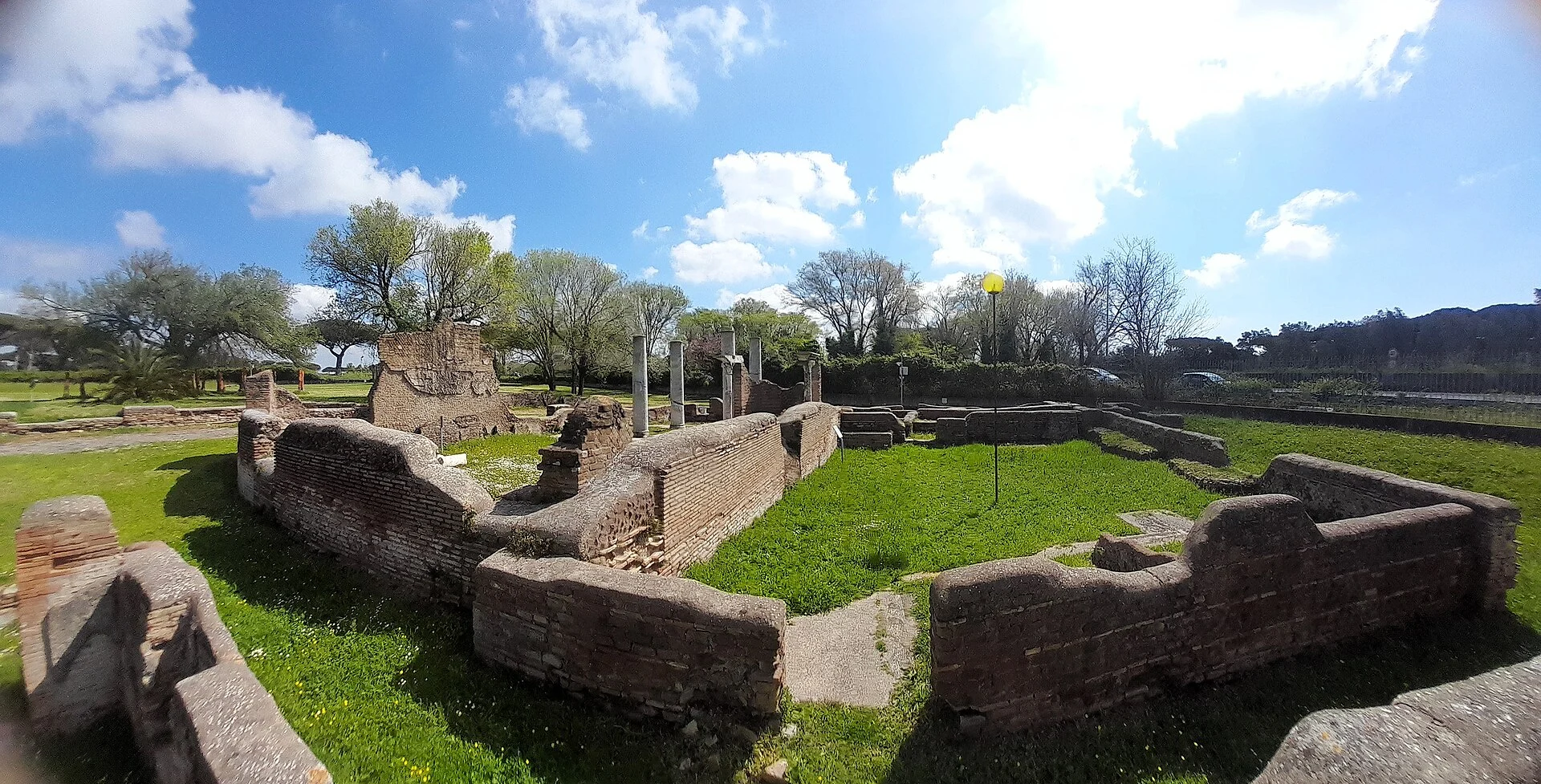
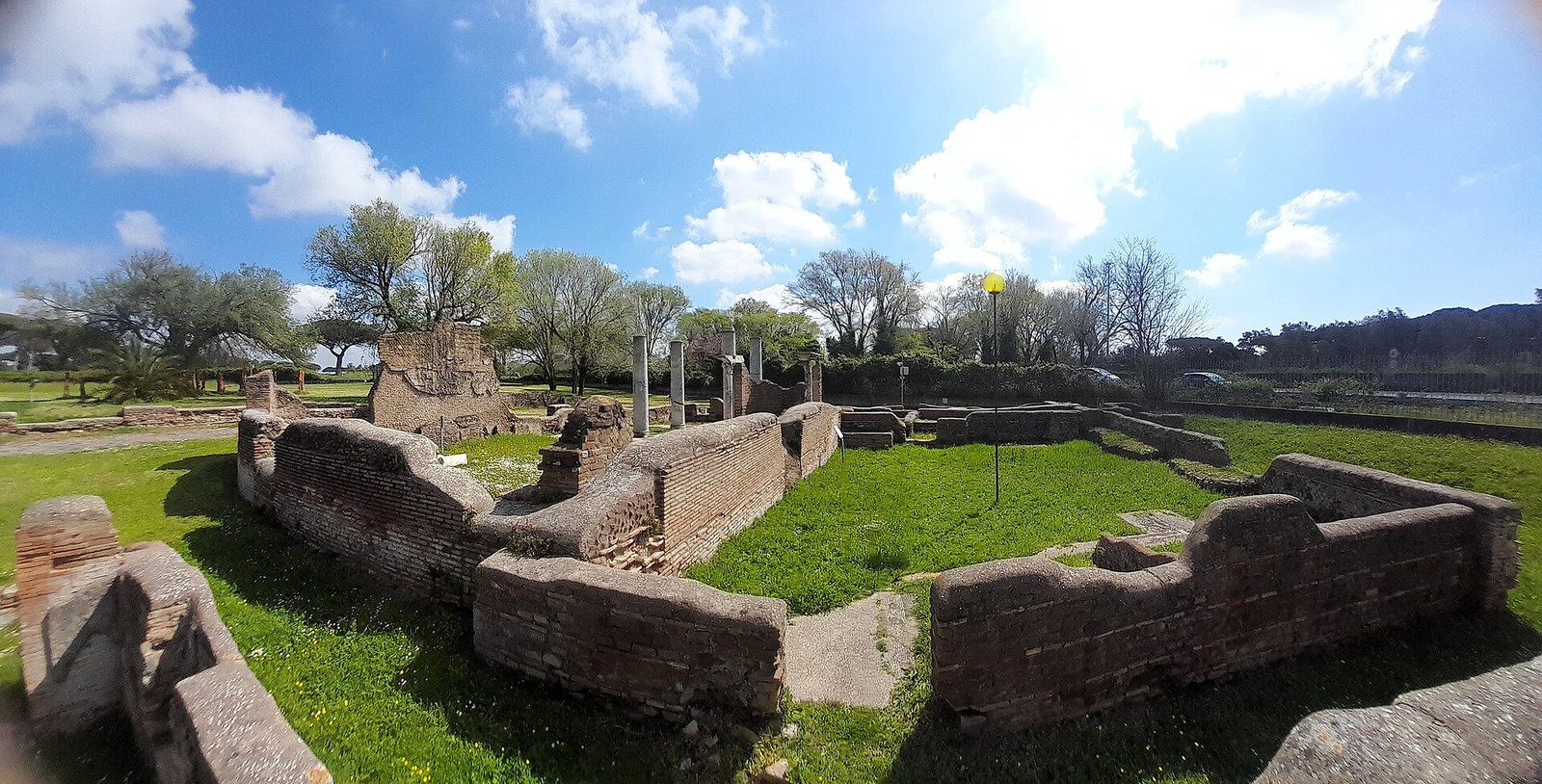
What you see on the spot is a readable plan, not a standing building. There are the low walls of the rooms, the floors partly preserved, the thresholds, and above all the four marble columns with Corinthian capitals that mark the monumental entrance to the prayer hall, raised after the excavation. They are the visual reference for the whole area and you see them from afar, sticking up among the pines and the low vegetation.
The main hall has a slightly curved back wall and measures, according to the most widespread explanatory sheets, about 25 meters by 12 and a half. Near the entrance to the hall rises the base of the aedicula that held the Torah scrolls, with the access steps. At the back you can make out the podium from which the sacred text was read. The entire complex exceeds 800 square meters.
Beside the hall are the service rooms, and they are the part that interests those who guide groups most. A kitchen with an oven and buried containers, which the excavators connected to the preparation of unleavened bread, a vestibule with a marble wellhead, a basin for ablutions, a room with benches along the walls that could serve as a dining hall or to host those arriving from the port.
What you don't see: the original decoration in place. The carved brackets with Jewish symbols and the most famous inscription are not left to the elements, and the explanatory sheets report that copies are on site. There is no roof, no reconstruction, no multimedia panels. Anyone arriving expecting a monument like the Synagogue of Rome on the Lungotevere finds a field of ruins with an enormous history inside.
A curiosity about the Synagogue of Ostia Antica
The synagogue was found thanks to an airport. In the early 1960s Rome needed to connect the new Fiumicino airport to the city, and the route of the new road ran right up against the southwestern edge of the Ostia excavations. The preliminary surveys of that building site brought walls, columns and floors to light. In May 1961 the systematic excavation began under the direction of the superintendent Maria Floriani Squarciapino.
The identification came within a few weeks. According to the published accounts of the discovery, in June 1961 architectural elements carved with a seven-branched candelabrum, a ram's horn, a bundle of branches and a citron came to light. Those four symbols leave no room for doubt: the candelabrum is the menorah, the horn is the shofar, the bundle is the lulav with the etrog of the Feast of Tabernacles. The building was a synagogue.
The paradox is that the infrastructure that revealed the synagogue is the same one that disturbs it today. The airport road runs a very short distance away, the noise of traffic reaches the hall, and the airport's traffic can be felt in the sky too. The park bans drones precisely because of the proximity to the airport. Standing in front of the Torah ark with the roar of a plane in the distance is an experience that no guide accounts for.
There is a second, lesser-known curiosity, tied to the calendar of remembrance. For over 20 years the synagogue has hosted the initiative Arte in Memoria, which brings works by contemporary artists among the ruins on the occasion of Holocaust Remembrance Day. In 2021 a conference celebrated together the 60 years since the discovery and the 20 years of activity. An ancient place of worship used as a space to remember the Shoah, a few kilometers from the Ghetto of Rome.
One thing nobody tells you about the Synagogue of Ostia Antica
The phrase you find everywhere, oldest synagogue in Europe, should be taken with a grain of salt. English-language popular sources repeat it without reservation. The more careful Italian sources write something else: the oldest in western Europe, or one of the oldest of the diaspora. The difference isn't pedantry. On the Greek island of Delos there is a building identified as a synagogue and dated to the 1st century BC.
Delos is in Greece, therefore in Europe. If the identification of Delos holds, and in the specialist literature it is widely accepted, Ostia's European record falls. The western record remains, which is already a great deal: no other synagogue of the Roman age in Italy, France or Spain has such a long sequence and such a readable building. It's a solid achievement and doesn't need to be inflated.
The second point nobody explains concerns the word oldest. At Ostia too, the date of the synagogue's birth is a matter of debate. Its excavator dated it to the second half of the 1st century AD, with a major rebuilding in the 4th. Later studies have argued that the building began as a structure of another kind and became a synagogue only later. If the second hypothesis is right, the synagogue is less ancient than the sign says.
A contrarian position: the Ostia synagogue is sold as a record, and the record is the most fragile part of the story. The real reason to come all this way is another. It is one of the very few places in the world where you can see, in plan, how a Jewish community of the diaspora in the imperial age functioned: where it prayed, where it baked bread, where it washed, where it welcomed those arriving from the sea.
Third point. Most visitors to Ostia don't get there. They stop at the theater, the Piazzale delle Corporazioni, maybe the Capitolium, and head back tired. The synagogue requires going all the way to the end and leaving the walls, and this cuts out almost all the organized groups with two hours on the clock. On autumn weekdays you can find yourself alone among those columns, something impossible in the center of the site.
The phases of the building and the dating debate
The reconstruction proposed by Maria Floriani Squarciapino in the 1960s is the most cited. A first synagogue built in the second half of the 1st century AD, in the years after the construction of the port commissioned by the emperor Claudius, then expansions between the 2nd and 3rd centuries, and a major rebuilding in the 4th, with the monumental aedicula for the Torah and the mosaic and colored-marble floors. A stable community for three or four centuries.
In the last years of the 1900s the American scholar L. Michael White re-examined structures and masonry and proposed a different reading. According to him the 1st-century core was a residential or collegial type of building, transformed into a synagogue only in the Severan age, between the end of the 2nd century and the 3rd. Other scholars, among them the Swede Anders Runesson, have instead defended synagogue use from the beginning. The debate is not closed and the sources don't agree.
Between 2001 and 2021 a research group from the University of Texas conducted six excavation campaigns with 44 new test pits, identifying three paving levels that connect the synagogue to Via Severiana. The picture that emerges, according to the summary published for the 60th anniversary, moves some phases lower: transformation into a synagogue around the mid-3rd century, expansion in the 4th, perhaps after an earthquake, and a final renewal in the 5th century.
A coin of the emperor Maxentius, found in the layers tied to the late modifications, gives a point after which to place those works. It's the kind of clue archaeologists love, because it can't be argued with: the structures that seal it can't be older than the coin. From there it follows that the building was still maintained and renovated when in Rome Christianity had already become the religion favored by the empire.
For the visitor the substance is simple. Whatever the date of birth, this building functioned as a synagogue from at least the 3rd to the 5th century, that is, for a longer time than the history of many monuments of the Roman Forum. A Jewish community prayed here while Ostia passed from prosperity to decline, and kept renewing its place of worship when the city around it was emptying.
My advice for visiting the Synagogue of Ostia Antica
Do the tour in reverse. The temptation is to follow the Decumanus slowly, stopping everywhere, and reach the synagogue at the end, tired and with the ticket office closing. Go there first, walking briskly along the Decumanus for about 20 minutes, and then work your way back toward the entrance, visiting the rest with a clear head. The morning light on the columns is better, and outside the walls there is almost nobody.
Bring water and a hat, even at the end of September. The stretch outside Porta Marina is exposed, with little shade, and the distance from the entrance makes itself felt on the way back. Closed shoes: the paving of the Decumanus is irregular, and around the synagogue the ground is sandy and uneven. Seating is scarce and you shouldn't take drinking fountains for granted along the whole route, especially in the outlying part of the site.
Before going in, read up on two things about the symbols. Menorah, shofar, lulav and etrog refer to the worship of the Temple of Jerusalem and to the festival of Sukkot, and they are the same ones you find in the Jewish catacombs of Rome. Anyone who recognizes these four objects before arriving will spot them at once on the copy of the bracket and understand the building in one go. Anyone who doesn't know them sees a fragment of decorated marble.
Get your bearings with the hall. The sources describe the monumental entrance facing southeast, that is, roughly in the direction of Jerusalem, and this is the first clue that it was a place of prayer. Stand between the columns with your back to the ancient sea and look toward the interior: you understand how the faithful entered and where the ark stood. It's a five-minute exercise that is worth more than any panel.
If you have time, return to the entrance by way of the Museo Ostiense, which the park opens from 9:30 with last entry earlier than the archaeological area. According to the explanatory sheets, some original elements of the synagogue are kept there. The park devotes a specific sheet to the bracket with the menorah, but doesn't clearly say where the original is displayed: ask at the ticket office before you begin, so you can organize your route.
Hours and tickets
The synagogue follows the park's hours. From April 1 to September 30 the area opens from 8:30 to 19:00, from October 1 to 24 until 18:30, from October 25 to the end of February until 16:30, in March until 17:15. Last entry and ticket office closing an hour earlier. The park is closed on Monday, on December 25 and on January 1. On the first Sunday of the month admission is free.
The official channel is the one indicated by the Archaeological Park of Ostia Antica, which points to the online ticket office of the concessionaire CoopCulture, as well as the on-site ticket desk and the Musei Italiani app. Anyone who prefers a reseller with free cancellation will find on GetYourGuide an entry ticket to the Ostia Antica area, with optional paid extras.
The official rates are €18 full price and €2 reduced for citizens of the European Union between 18 and 25. Free entry applies to those under 18, to people with disabilities and one companion and to the other categories provided by state rules, as well as the first Sunday of the month and some national dates such as April 25, June 2 and November 4. The full ticket is valid for eight days.
Those eight days are the thing almost nobody takes advantage of. The ticket covers all the sites and museums of the park: besides the archaeological area of Ostia, the Castle of Julius II with its village, the Imperial Ports of Claudius and Trajan, the Museum of Roman Ships at Fiumicino, the Necropolis of Portus at Isola Sacra and the complex of the basilica of Sant'Ippolito. With €18 you can put together two whole days.
For information the park publishes the number 06 39967950, which is also that of the ticketing call center, active every day, and the Musei Italiani service at 06 87570182 with the address info@museiitaliani.it. For the synagogue there is no regular guided tour on the calendar: special visits are announced by the park on specific occasions, especially around Holocaust Remembrance Day at the end of January, and must be looked up case by case.
Another well-known fact, yet rarely cited
The synagogue was on the beach. Everyone knows it, few think about it. When it was built, the coastline ran a short distance from the building, and Via Severiana running beside it was the coastal road that connected Ostia to the settlements along the sea. Today the sea is several kilometers to the west, pushed back by centuries of Tiber sediment, and to grasp it you have to imagine the waves where the pines are.
Why a synagogue outside the walls and near the water? Scholars' explanations go in two directions. The first is practical: the space outside the walls was available and cheaper. The second is religious: some researchers, among them Runesson, link the position to the search for a pure place, far from the city's pagan sanctuaries and near the water needed for the rites. The two readings don't exclude each other.
Via Severiana bears the name of Septimius Severus, the same emperor as the Arch of Septimius Severus in the Forum. It's the same age in which, according to White's reading, the building would have become a synagogue. Coincidence or not, the synagogue and the road grew together, and the three floor levels identified by the American excavations show how the access was raised several times to follow the level of the road.
Last rarely cited fact. Ostia was the port of Rome, and the port meant people from all over the Mediterranean: merchants, sailors, slaves, freedmen. The Jews of Ostia were part of this mobile population, they spoke Greek, bore Latin names, and wrote their dedications in both languages. A funerary inscription of the 1st century found in 2009 along Via Ostiense recalls a family of Iudaei. The community is older than any dating of the building.
The Mindis Faustos inscription and the other texts
The synagogue's most famous written document is a marble slab with a dedication in Greek that opens with a Latin formula, pro salute Aug, that is, for the health of the Augustus, the reigning emperor. The text recalls a certain Mindis Faustos, who with his family built and made at his own expense and placed the ark for the holy law. Mindis Faustos is the Greek form of the name, which in English-language sources you also find as Mindius Faustus.
The dating of the inscription ranges between the second half of the 2nd century and the beginning of the 3rd, according to the different sheets. The most interesting detail is where it was found: reused as flooring material, with the inscribed face turned downward. The sources don't agree on the precise room, among the vestibule, the inner hall and the oven room. It means in any case that Mindis Faustos's ark was replaced by a new, more monumental one.
The formula for the emperor's health strikes anyone who has in mind the Jewish wars and the Arch of Titus, with the menorah carried in triumph after the destruction of the Temple. At Ostia, a few generations later, a Jew of the port dedicates a sacred furnishing invoking the emperor's well-being. It's a formula of loyalty common to all Roman society, and it says a lot about the community's integration in the life of the port.
Beside Mindis Faustos's dedication there are other texts, found outside the building. A funerary epigraph recalls Plotius Fortunatus archisynagogus, that is, head of the synagogue, buried by his children and his wife: it was found in the late 1960s during agricultural work in the Pianabella area, south of the city, and published by Floriani Squarciapino in 1970. Another inscription found at Castel Porziano names a gerusiarch, Caius Iulius Iustus.
Taken together, these texts show an organized community, with specific offices, able to finance marble furnishings and dedicate them in public. The most widespread sheets estimate a few hundred people, but it is an estimate, not a fact. Anyone who wants to see how the same community buried its dead in Rome will find a direct comparison in the Jewish Catacombs of Vigna Randanini on the Appian Way.
The right photo to take at the Synagogue of Ostia Antica
The photo is the one of the four columns of the propylaeum taken from below, from inside the hall, with the sky above and the Corinthian capitals standing out. Vertical frame, normal or slightly wide-angle lens, you crouched at the level of the threshold. The columns are the only vertical element of the area and give the scale of everything else. Without them the synagogue, in a photograph, becomes a floor with little walls.
The right light is the morning light, for two reasons. The first is that the columns get the sun from the side and the capitals take on relief. The second is practical: arriving first, as I suggest, you have the area free and don't have to wait for a group to move. On a summer afternoon the light is flat and the white marble blows out the highlights. In winter, with the low sun, the afternoon becomes useful again.
The second image is the detail of the bracket with the menorah, the shofar, the lulav and the etrog. Get close and fill the frame, with raking light bringing out the bas-relief. Even though there's a copy on site, the subject is the one that makes the synagogue recognizable. Anyone photographing the original at the Museo Ostiense, if it's on display, has to deal with glass and reflections: stand at an angle and rest the lens against the glass.
A third shot tells the story of the discovery. From the south side of the area, putting the synagogue's walls in the foreground and the fence with the airport road in the background, you have in a single shot the reason why this building re-emerged in 1961. It isn't a beautiful photo in the postcard sense. It is a true photo, and in travel stories it works better than the columns alone.
A note on prohibitions. The park bans drones because of the proximity of the airport, and anyone who thought of filming the plan from above has to give up. For amateur photos and videos without bulky equipment no particular restrictions appear in the archaeological area. For tripods, sets and professional shoots consult the access regulations published by the park, which also govern dogs on leash, food and behavior in the excavation areas.
How to get there from Rome
The natural means is the Roma-Lido train, now called Metromare, which leaves from Porta San Paolo station next to the Piramide stop of the Metro B and goes as far as Cristoforo Colombo, on the coast. The right stop is Ostia Antica. From the station to the park entrance you walk following the signs for the excavations. You travel with the integrated ticket of the Metrebus system, the same as for Rome's buses and metro.
The line has been managed by Cotral and Astral since 2022. In 2026 the operator reports nighttime infrastructure renewal works: Monday to Friday the rail service ends with the last departures from the terminals around 22:30, then replacement buses take over with dedicated stops, including Ostia Antica. For a daytime visit nothing changes, but check the notices on the Cotral site or at the toll-free number 800 174 471 before leaving.
Leaving from Porta San Paolo takes you past two stops that tie in well with the theme. The Porta San Paolo and the Pyramid of Cestius are right next to it, and the Via Ostiense Museum inside the gate tells the story of precisely the road that connected Rome to its port. A quarter of an hour before the train spent there gives meaning to the whole trip.
By car you leave Rome along Via del Mare or Via Ostiense and follow the signs for the excavations. The park provides an unguarded parking lot open from 7:30 to 19:30, with separate spaces for those with a disabled parking permit. Anyone arriving from Fiumicino or the airport has only a few kilometers, and the guide to connections from the airports to central Rome helps you build the stop.
By bicycle the route makes sense only for those used to Roman traffic, because the access roads are busy and the cycle paths aren't continuous. A smart solution for those staying on the coast is to start from Ostia Lido with the train in the opposite direction: it's a few stops, and the visit to the excavations combines with an afternoon at the beach, something many Romans really do in summer.
Some important events that happened here in history
Mid-1st century AD. The emperor Claudius starts the construction of a new port north of the mouth of the Tiber, and Ostia becomes the center of a port system that supplies Rome with grain and goods. It is in this context that, according to Floriani Squarciapino's reconstruction, the synagogue's first building is born. Claudius's port, later expanded by Trajan, you can see today with the same park ticket.
Between the end of the 2nd and the beginning of the 3rd century Mindis Faustos donates an ark for the scrolls of the Law and dedicates it for the health of the emperor. In the Severan age Via Severiana defines the street front of the area, and according to some scholars the building takes on the function of a synagogue in this phase. In the same decades Ostia is still a rich, crowded city, full of building sites.
4th century. The building is expanded and renovated, perhaps after an earthquake: new bent entrance, new rooms with benches, floors in colored marble and mosaic, and above all the monumental aedicula for the Torah with the decorated brackets. Mindis Faustos's old dedication ends up reused in the floor. It is the phase you see today, the most readable, the one that gave the building its final plan.
5th century. The American research points to a final renewal of the ark. Then the building falls into ruin, like much of Ostia, with the depopulation of the city and the silting up of the coast. The site is covered by sand and vegetation and disappears for 15 centuries, to the point that no 1800s excavation or one from the first half of the 1900s had intercepted it, despite the great campaigns that brought the rest of the city to light.
May and June 1961. The work on the Fiumicino airport road brings the remains to light, Maria Floriani Squarciapino directs the excavation and identifies the building thanks to the carved Jewish symbols. From the early 2000s the synagogue hosts Arte in Memoria. In 2021 the 60th anniversary of the discovery is celebrated with a conference. On May 6, 2026 the Foundation for Jewish Cultural Heritage in Italy announces funding from the Ministry of Culture for the restoration of the synagogue.
On that last point it's best to be precise. The news was given by the Foundation's president, Dario Disegni, during the Council meeting in Rome, and the reports give neither the amount nor the schedule of the works. The operator doesn't yet indicate construction dates. That's why I insist on the advice to phone before the visit: a restoration announced in 2026 can turn into temporary fencing in exactly the months you want to go.
Who has passed through the Synagogue of Ostia Antica
Mindis Faustos, first of all, because he is the only worshipper whose name we know tied to a specific act inside the building. A man with a mixed name, Greek and Latin, who had enough money to pay for a sacred furnishing and enough sense of social standing to put on it a formula of loyalty to the emperor. We know nothing else about him. He is the perfect portrait of a Jew of the port of Rome.
Plotius Fortunatus, head of the synagogue, and his family: the children, among them Plotius Ampliatus, and the wife Ofilia, who dedicated the epitaph to him. It isn't certain that he led this very synagogue, but no others are known at Ostia, and the connection is usually made. An archisynagogus with a Roman name, buried in a necropolis outside the city, like all the inhabitants of the port.
Caius Iulius Iustus, gerusiarch, that is, member of the council of the community's elders, recalled in an inscription found in the area of Castel Porziano, today inside the Tenuta di Castelporziano. He too bears three names as a Roman citizen. Together with Plotius Fortunatus he shows that the community had a governing structure similar to that of the synagogues of Rome documented in the catacombs.
Maria Floriani Squarciapino, archaeologist and superintendent, who in 1961 directed the excavation, identified the building and proposed the first reading of it. She was the first to argue that Ostia had a synagogue of the 1st century, and her reconstruction, debated and corrected over time, remains the starting point of every study. Without her speed, on a road building site with tight deadlines, the building could have been sacrificed.
L. Michael White and the University of Texas group, who for 20 years reopened the excavation with targeted test pits, and Anders Runesson, who defended the early dating. The debate among them is the reason the Ostia synagogue appears in all the textbooks on the history of ancient Judaism: few buildings have received so much attention over a question of centuries. Anyone who visits the area walks inside a discussion that is still open.
Finally the contemporary artists of Arte in Memoria, who for over 20 years have brought installations among the ruins for Holocaust Remembrance Day, and the public that follows them. The association is based at the Centro Ebraico Italiano Il Pitigliani in Rome. It's a modern, respectful use of an ancient place, which holds together the two ends of Rome's Jewish history, from the imperial diaspora to the deportation of the 1900s.
The Jews of ancient Rome: where to continue the story
The synagogue of Ostia is the oldest visible chapter of a story that in Rome can be read in about 10 places. The natural next step is the Arch of Titus in the Forum, with the relief of the menorah carried in triumph in 71 AD. Then the Jewish catacombs of the Appian Way, which show the same symbols as the Ostia bracket painted and carved on the tombs of the Roman community.
For the present day, head to the Jewish Ghetto, between the Portico of Octavia and the Theater of Marcellus, with the Synagogue of Rome, the Tempio Maggiore, and the Jewish Museum of Rome inside it. Comparing the two synagogues, the one at Ostia and the monumental one on the Lungotevere from the early 1900s, spans almost two millennia of uninterrupted presence.
If you want the 20th-century chapter, you'll find the overview in the places of memory in Rome and at the Casa della Memoria e della Storia. It's the same thread that Arte in Memoria brings every year among the ruins of Ostia. For anyone who leads school groups, this sequence of three stops works better than any classroom lesson, and it fits in two days.
For the context of foreign cults in the port of Rome, Ostia offers a direct comparison: the city preserves many mithraea, places of worship of the Persian god Mithras. In Rome you find the same phenomenon at the Mithraeum of the Circus Maximus and at Santa Prisca. Jews, followers of Mithras, Christians and worshippers of the traditional gods lived in the same neighborhoods, often in the same blocks.
When it's closed and what not to expect
The synagogue is closed when the park is closed: every Monday, December 25 and January 1. Beyond that, the area can be shut off for works, for greenery maintenance or for safety reasons, and since it sits at the edge of the site it's among the first areas to be fenced off. The operator doesn't publish a calendar of partial closures for the Porta Marina area, which is why a phone call beforehand remains the most useful advice.
Don't expect full accessibility. The park marks wheelchair routes from the ticket office to the Museo Ostiense and the Piazzale delle Corporazioni, with accessible restrooms, but the synagogue is farther on, outside the walls, on sandy and uneven ground. If you use a wheelchair or have trouble walking, ask the park when you book if the stretch to Porta Marina is passable and with what kind of assistance.
Don't expect services near the synagogue. Cafes, bookshop, restrooms and refreshment points are in the central area of the park, a good distance away. The official information lists no audio guides dedicated specifically to the synagogue, and the panels on site are minimal. The best educational material is the park's own, with the navigable panel sheets published on the website, to read before you leave.
Don't expect religious services. It's a state archaeological site, not an active place of worship, and the Jewish community of Rome celebrates elsewhere. That said, behave as you would in a sacred place: no sitting on the aedicula of the ark, no picnics on the walls, no objects left as souvenirs. It sounds obvious, but an hour on site in spring is enough to see that it isn't.
Eating nearby
The place to eat after the dig is the borgo of Ostia Antica, the small walled village around the Castle of Julius II, a few minutes on foot from the park entrance. It has a cluster of trattorias in a few streets and a mixed crowd, made up of Roman families on weekends and passing groups. This very mix calls for care, because next to serious kitchens there are places built for people leaving the dig tired.
First sign: the menu with photos of the dishes, laminated and translated into five languages. A place that has to show you a picture of the carbonara is talking to someone who has never seen one, and builds its kitchen around a public that won't come back. Second sign: the person at the door who stops you and invites you in. Someone with regular customers doesn't need to find them on the sidewalk, and Romans know this well.
Third sign: the woman rolling out fresh pasta in the window or right out on the street. It's a scene staged to stop passersby, not a sign of quality. Fresh pasta done well is made in the morning in the kitchen, away from the dust. Fourth sign: places open without a break from morning to night. A real kitchen has hours, a crew that rests and preps, and a menu that changes with the season.
Fifth sign, typical of places in front of monuments: the price that adapts to the customer. Items with no price, fish of the day with no figure per kilo, different menus between the outside tables and the inside room. Always ask the price before ordering, especially for fish, which on the Roman coast is the item where the surprises concentrate. It isn't distrust of the people who work there, it's simply how Romans order too.
The criterion is to look at who is seated. If at lunch on a weekday there are office workers, laborers and local families speaking Romanesco, you're in the right place. If there are only tables of visitors with backpacks and the waiter switches to English at first glance, it isn't a moral judgment, it's information about the kind of kitchen waiting for you. Inside the dig, besides, refreshment points are few.
So you don't have to proceed by trial and error among the borgo, Ostia Lido and the coast, we keep a list of addresses we really go to, in Rome and the surrounding area, with no sponsorships and updated when places change: our list of the places where we eat. On the coast it's always best to call first, because many kitchens change hours between high and low season and some close one day a week.
What to combine in a day
The most obvious combination is the right one: synagogue and dig of Ostia Antica in the morning, lunch in the borgo, Castle of Julius II in the early afternoon with the same ticket. Anyone with energy left can finish with a walk in the Pineta di Castel Fusano, which lies on the road toward the sea and is the green lung of the Roman coast.
The second day, if you use the eight days of validity of the ticket, should go to the Portus side. The Imperial Ports of Claudius and Trajan and the Isola Sacra necropolis tell the other half of the story of the port of Rome. The necropolis, with the family tombs of merchants and craftsmen, is the perfect complement to the synagogue: it shows how the people who attended it lived and died.
For nature lovers, the coast offers the Roman Coast Reserve and, farther south, the dunes of Capocotta. In summer the combination of dig in the morning and sea in the afternoon is what Roman families really do. In autumn the Decima Malafede Reserve is a good alternative for a walk on the way back to Rome.
If you're returning to the city by train, you can get off halfway and finish in Ostiense, between the Basilica of Saint Paul Outside the Walls, the Centrale Montemartini with its ancient statues among industrial machinery and the street art of the neighborhood. A day that runs from the ancient port to industrial Rome, along the same road.
To round out the picture of ancient Rome, the Palazzo Massimo alle Terme and the Crypta Balbi of the Museo Nazionale Romano hold materials that help you understand the daily life of the communities of the Urbe. If you prefer modern Rome, at the end of the day you can finish at the Teatro Argentina, which faces the Sacred Area of Largo Argentina, a spot that holds ruins and the season's program together.
Frequently asked questions
Do I need a separate ticket for the Synagogue of Ostia Antica?
No, the synagogue is inside the Archaeological Park of Ostia Antica and you visit it with the park ticket: €18 full price, €2 reduced for European citizens between 18 and 25, free for under 18s and for everyone on the first Sunday of the month. The full ticket is valid for eight days and also includes the park's other sites.
Where is the synagogue inside the dig?
It's at the southwestern edge of the archaeological area, outside the Porta Marina, about 200 meters from the walls along Via Severiana, beyond the Terme di Porta Marina. From the main entrance at Viale dei Romagnoli 717 you reach it by walking the whole Decumanus, a walk of about 20 minutes at a brisk pace, longer if you stop along the way.
Is it really the oldest synagogue in Europe?
The claim needs to be scaled back. The more careful Italian sources call it the oldest in western Europe or one of the oldest of the diaspora, because on the Greek island of Delos there is a building identified as a synagogue and dated to the first century BC. Moreover, the date of origin of the Ostia synagogue is debated, between the first century and the third depending on the scholar.
When was the synagogue discovered?
It was discovered in 1961 during works for the construction of the road connecting Rome to Fiumicino airport. The excavation was directed by the superintendent Maria Floriani Squarciapino, who identified the building as a synagogue thanks to the elements carved with the menorah, the shofar, the lulav and the etrog. In the following years the area was investigated again by a team from the University of Texas.
What does the inscription of Mindis Faustos say?
It's a dedication in Greek that opens with the Latin formula pro salute Aug, that is, for the health of the emperor. It records that Mindis Faustos, with his family, built at his own expense and placed the ark for the holy law, that is, the container of the Torah scrolls. It's dated between the end of the second and the beginning of the third century and was later reused in a floor.
What are the opening hours?
The synagogue follows the park's hours: from 8:30 to 19:00 from April 1 to September 30, until 18:30 from October 1 to 24, until 16:30 from October 25 to the end of February, until 17:15 in March. Last entry is one hour before closing. The park stays closed on Monday, December 25 and January 1.
How do I get there by public transport?
Take the Metromare train, the former Roma-Lido, from Porta San Paolo station, next to the Piramide stop on Metro B, and get off at the Ostia Antica stop. From there you walk to the park entrance. The integrated Metrebus ticket is valid. In 2026, on weekdays the evening runs after 22:30 are replaced by buses because of works.
Is the synagogue wheelchair accessible?
The park marks accessible routes from the ticket office to the Museo Ostiense and the Piazzale delle Corporazioni, but the synagogue is farther on, outside the walls, on sandy and uneven ground. The operator doesn't publish a specific accessibility statement for this area, so it's best to contact the park before the visit to find out if the route is passable and with what assistance.
Who wrote this page
This page comes from the editorial team of Tour Leader Pro, the Rome-based outfit that designs itineraries, visits and cultural events between Rome and Lazio. Fares, hours and sales channels reported here come from the official sources of the park and the concessionaire as of the date given at the top. Since it's a state site with seasonal hours and announced restorations, recheck them before you leave. Tell us what you find changed.
Lining up a day between Ostia and the coast means fitting together hours that change four times a year, a ticket valid for eight days across sites far from each other, a train with evening works and an area like the synagogue that takes time and legs, for yourself or for a group of 40 people. Anyone facing this kind of puzzle will find on Tour Leader Pro working materials designed for those who guide and for those who organize on their own.
For the wider picture, meaning regional trains and seasonal timetables, rentals, airports, transfers between provinces and destinations in Lazio outside central Rome, from the Roman coast to the volcanic lakes of the north and the villages of the interior, a useful resource for building a multi-day itinerary is Italy Planner.