Necropolis of Porto at Isola Sacra
In short. The Necropolis of Porto at Isola Sacra is the cemetery of the common people of Portus.
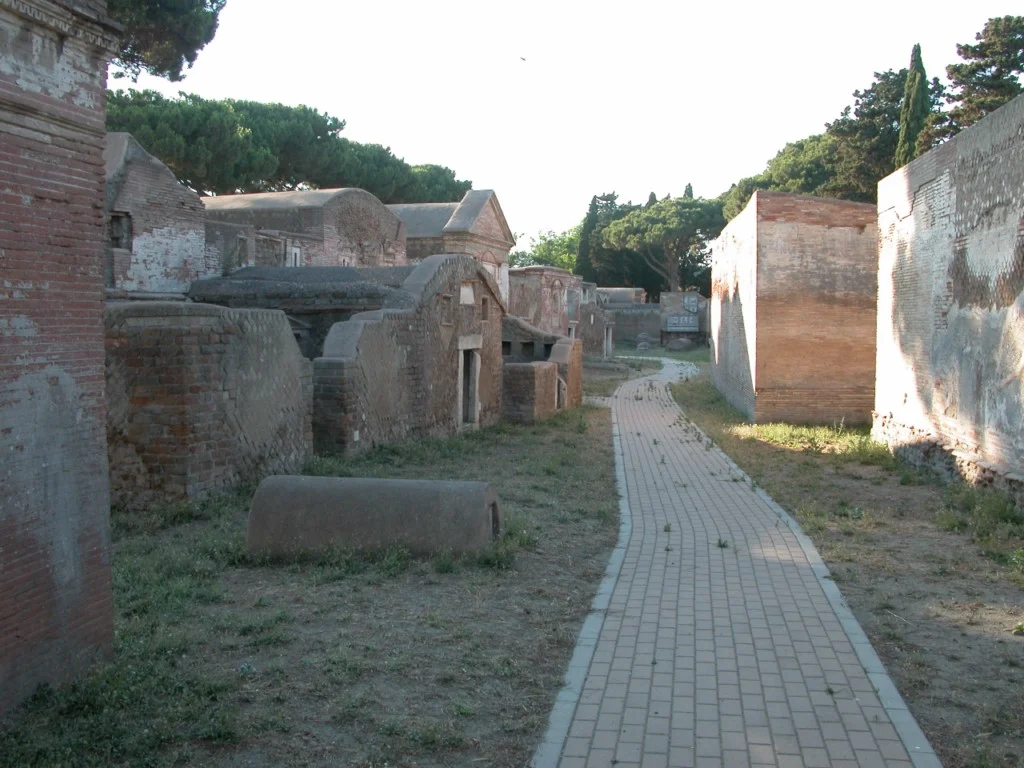
The Necropolis of Porto at Isola Sacra is the cemetery of the common people of Portus. It is at Via Monte Spinoncia 52 in Fiumicino, opens Tuesday to Sunday from 10.30 to 16.30 and costs 6 euros. You can go and come back from Rome in a day. There is no need to book, and that alone puts it in a different category from almost everything else in Roman archaeology.
No emperors are buried here. The people buried here are the porters, the grain merchants, the blacksmiths, the midwives and the doctors who kept the port of Rome running. Their tombs have brick facades, inscriptions with the name and, in some cases, the scene of the trade carved beside the name. It is the reason this place matters more than many monuments in the center.
Where the necropolis is and how you really get there
The address published by the Ostia Antica Archaeological Park is Via Monte Spinoncia 52, Fiumicino, postal code 00121. The same institutional page explains the route by road: you take Via dell'Aeroporto di Fiumicino as far as Via Cima Cristallo, then Via Pal Piccolo, and you arrive at the entrance. These are directions meant for drivers, and that already says a lot about how the Park imagines the typical visitor.
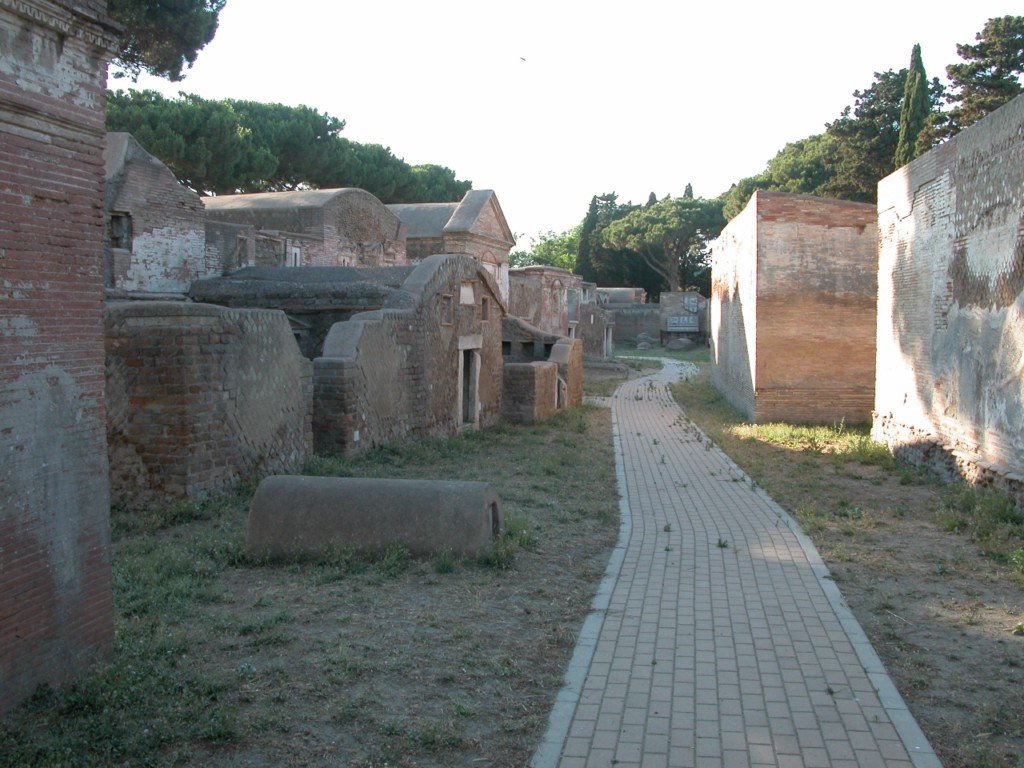
We are on Isola Sacra, the strip of land between the branch of the Tiber and the Fossa Traiana, which today we call the Fiumicino canal. On one side is Ostia, on the other Portus. In between, the island. The tombs line up along the course of Via Flavia Severiana, the road that connected the two centers, and that is why the necropolis has the elongated shape of an urban street and not of a field.
By public transportation, without kidding yourself
The right train is the FL1. You take it at Roma Tiburtina, Tuscolana, Ostiense or Trastevere and get off at Fiumicino Aeroporto, the terminus. From there Fiumicino's city transit is run by Trotta Bus Services on behalf of the municipality, and the line that serves the area is the 8, a loop, with a route Foce Micina, Aeroporto Leonardo Da Vinci, and back. The ticket costs 1.00 euro, 1.50 on board, valid for 90 minutes.
The stop you want on line 8 is "Via dell'Aeroporto di Fiumicino, fronte Parrocchia di Santa Maria degli Angeli". From there to the entrance of the necropolis you continue on foot along Via Cima Cristallo and Via Pal Piccolo: about 20 minutes of walking on residential neighborhood streets, with no tourist signage at all. The 8 departs about every half hour, from 5.30 to 23.00 according to the timetable published by the operator.
I'll say the uncomfortable part right away: no published city line stops in front of the gate. Loop lines 4, 5 and 6 go around Isola Sacra starting from the Foce Micina terminus, but their lists of stops do not name Via Monte Spinoncia, nor Via Cima Cristallo, nor Via Pal Piccolo. If you arrive by bus, you walk. If you don't want to walk, you take a taxi from the airport, which is a few kilometers away.
There is also the Ostia route. With the Roma Lido you get off at Lido Centro or at Ostia Antica, then cross the Scafa bridge toward the island. Fiumicino's line 5, loop 2 Isola Sacra, goes as far as Via Guido Calza at the intersection with Viale dei Romagnoli, that is, at Ostia Antica, and this lets you stitch the two visits together. The runs are sparse, though, 10 or 11 a day.
By car, which is the solution almost everyone chooses
By car you leave the Grande Raccordo Anulare toward Fiumicino, follow the highway to the airport and then Via dell'Aeroporto di Fiumicino toward Isola Sacra. The neighborhood is low houses and wide streets, and in most cases you park on the street without blue lines. From Ostia Antica it's a few minutes, crossing the Scafa bridge.
Hours, tickets and who runs the place
The site belongs to the Ostia Antica Archaeological Park, which is an autonomous institute of the Ministry of Culture based at Viale dei Romagnoli 717. It does not belong to the Municipality of Rome, it does not belong to the Sovrintendenza Capitolina and it does not belong to the territorial state Soprintendenza. Getting the wrong authority means calling the wrong number and getting wrong answers, which happens often.
The hours published as of September 28, 2026 are these: open Tuesday to Sunday, from 10.30 to 16.30, last entry at 16.00. Closed on Monday, on December 25 and on January 1. That is barely six hours a day, the narrowest window of all the Park's sites, and anyone who arrives at 16.05 stays outside, no discussion.
The ticket costs 6 euros full price and 2 euros reduced for European Union citizens between 18 and 25 years old. There is the Park's integrated ticket at 18 euros full price and 2 euros reduced, valid for eight consecutive calendar days, which opens all the archaeological and museum sites: the excavations of Ostia, the Museo Ostiense, the Museo delle Navi, the area of the imperial ports and this necropolis. If you plan to do two sites, buy it right away.
Every first Sunday of the month admission is free at all the Park's sites, each with its own hours, and in that case too no reservation is required. The information on free entry and reductions can be read on the Park's dedicated page. The ticket can also be bought from the Musei Italiani app. For information the Park gives the numbers 06 6583888 and 06 56358099 (switchboard).
How to book, and why the answer is that you don't
The Park writes a blunt sentence on the official page: no reservation is required. It applies to individuals and it applies to groups, with a clarification worth reading twice, namely that it is not possible to request access for groups on days other than the ordinary opening days. Translated: no special openings on request, no separate arrangements, no shortcuts.
Guided tours, those yes, go through a specific channel. The concessionaire is Coopculture, which organizes visits for individuals, groups and schools. Schools book at the number 848 082 408, or +39 06 39967200 from a mobile phone and from abroad, Monday to Friday from 9.00 to 17.00, writing to edu@coopculture.it. Groups call +39 06 39967450 or write to tour@coopculture.it.
On site the security staff offers orientation and welcome, which in ministerial language means that someone tells you where to go in and where to go out. It does not mean a guided tour is included. Whoever wants the explanation brings it from home, in the form of a licensed guide, a podcast or a good book read beforehand. The alternative is to walk among 200 tombs understanding little.
What the Necropolis of Porto is and why it looks like nothing else
The necropolis today is made up of more than 200 funerary buildings and was the southern limit of a much larger burial ground that formed on the island between the Tiber and the Fossa Traiana. It developed on both sides of Via Flavia between the end of the 1st and the 4th century AD, with the burials gradually crowding along the road until they filled every available space.
Most of the tombs consist of a square cell of one or two stories, to which an enclosure was often attached. The cells could have barrel vaults or flat terraces. The brick facades are livened up by triangular pediments and travertine elements. Anyone who knows Roman columbaria recognizes the logic, but here the scale is different: these are little houses, not niches in a wall.
On the facades you can read inscriptions in Latin and Greek. They give the name of the owner, the dimensions of the tomb, the testamentary provisions and the rules for use of the sepulcher. From these texts archaeologists have reconstructed the society of Portus: a middle class of merchants, freedmen, that is, emancipated slaves, and small entrepreneurs. Not aristocracy, not the urban plebs of Rome. A port bourgeoisie with the money for a tomb with its name on it.
The Greek next to the Latin is not a detail. Portus was a Mediterranean port of call and the people who worked there came from the East, from Egypt, from Africa. The bilingual inscriptions tell of a community of immigrants who had made enough of a fortune to buy themselves a piece of road and put their own name on it in two alphabets. Rome worked like that, and here you see it without mediation.
The difference from the other Roman cemeteries you can visit
Whoever has already seen the Tomb of the Scipios or the Columbarium of Pomponius Hylas has seen family monuments, closed, vertical, to be looked at from the inside. Here the relationship is reversed: you walk among the tombs as people walked then, in the open air, along a road, and the facades speak to the passerby. That was exactly their purpose.
The comparison with the catacombs is even sharper. At the Catacombs of Domitilla or the Catacombs of San Sebastiano you go underground, follow a guide, walk in single file. Here you are in the open air, alone, with the sun on your head and the noise of airplanes. They are two experiences that don't resemble each other, and whoever puts them in the same day notices right away.
The trade reliefs: what you see here and what you see at the Museo Ostiense
The reliefs with trade scenes are the reason this site is cited in every textbook of Roman social history. The activities the deceased carried out in life were depicted on carved slabs and bricks placed beside the inscriptions. The Archaeological Park names the midwife assisting at a birth, the surgeon in the act of operating, the blacksmith in his workshop and the grain merchant.
The Park defines these images as expressions of a popular art, and the definition holds. There is no idealization, no mythology, no deities accompanying the deceased. There is a woman seated on a stool pulling out a baby, a man cutting a patient's flesh, a millstone pushed by a mule. It is documentation, before it is decoration.
Where the originals are: the question nobody asks at the ticket office
Here something has to be said that changes how you plan the day. The most famous slabs, the one of the midwife and the one of the doctor her husband, and the one of the miller with the millstone, are kept in the Museo Ostiense, inside the excavations of Ostia Antica. The museum devotes Rooms 9 and 10 to the necropoleis of the area, and Room 9 concerns precisely the funerary contexts of the Necropolis of Porto.
On the facades of the tombs, at Isola Sacra, you see carved slabs and bricks, and popular sources report that the pieces displayed on site are casts, with the originals in the museum. The Park's institutional pages do not use the word cast and describe the reliefs as visible on the facades. The sources diverge on this precise point, and whoever comes to see a specific original does well to ask the staff before going in.
The practical consequence is simple. Whoever wants to see the midwife and the doctor must also plan for the Museo Ostiense, which has its own hours and a rule that trips up many visitors: the museum is always closed on the first Sunday of the month and on the other free-admission days scheduled by the Ministry, that is, April 25, June 2 and November 4. The free day is the day the museum doesn't open.
At the Museo Ostiense you also find the statue of Iulia Procula from Tomb 106 and the sarcophagus of the Muses. The museum's hours change with the season: opening at 9.30 from April 1 to October 24, at 10.30 from October 25 to March 31, with last entry that varies from 15.00 to 17.30 depending on the period. The excavations instead open at 8.30, closed on Monday and on December 25.
A curiosity about the Necropolis of Porto at Isola Sacra
In Tomb 43 there is a mosaic with an inscription in Greek: "Ode Pausilypos", which translates as "here every worry ceases". Three words on a floor, in a cemetery where almost all the other texts talk about square meters, burial rights and prohibitions. Someone, 2,000 years ago, decided that their piece of land should be defined this way and not as property.
The phrase circulates in the archaeological literature and is cited by the Archaeological Park itself on its page about the site. It deserves a pause because it shows the emotional register of a society we usually know through law and taxes. The owner of Tomb 43 did not want to record how much he had spent. He wanted to say that there, at last, there was nothing left to endure.
I'll add a fact that strikes those who work with groups. In many tombs there were wells for water and spaces for the funeral banquet, because the family came back to eat beside the dead person on set dates. The cemetery was a place you went to for lunch. The distance from our way of treating the dead is enormous, and explaining it out loud always works.
The tombs of the rich, those of the poor, and everything in between
In the necropolis there was also a poorer social layer, which buried its dead in the areas left free between one cell and the next. These are box tombs, alla cappuccina tombs with a gabled roof of tiles, burials in wooden chests, inside cut amphorae, or in the bare earth. These coexist with the monumental facades a few meters away.
This visible stratification is the most instructive thing about the site. In a modern cemetery social hierarchy is ordered by sections. Not here: the rich man builds the cell with the pediment, and the poor man slips his dead son under two tiles in the space left in front of the rich man's wall. Nobody separated the two. They lived side by side, and you can still see them next to each other.
The amphora burials strike visitors more than any inscription. A transport container, made to travel full of oil or wine, cut and reused as a coffin for a newborn or for a curled-up adult. In Rome's commercial port amphorae were the cheapest material there was, and they became coffins for those who couldn't afford anything else.
What is still preserved inside the cells
In some tombs stucco and fresco decorations are preserved, and others were paved with mosaic. They are not clean museum spaces: they are ancient interiors with plaster that survived by chance. Some cells housed many burials over several generations, inside real enclosures, and reading their sequence takes patience and a plan in hand.
The facade of Tomb 78, that of Titus Claudius Eutychus, is among the images the Park uses to tell the story of the site. The name says freedman of the imperial household, and the Greek cognomen says Eastern origin. A whole biography in three words carved on brick, which is more or less what you get from most of the inscriptions here.
Something nobody tells you about the Necropolis of Porto at Isola Sacra
Nobody warns you that you are under the takeoff route of Fiumicino. The planes pass low and often, and the noise drowns out the voice of whoever is explaining. For an accompanied group it is a serious problem: you have to stop, wait, resume. Anyone looking for contemplative silence in front of the tombs finds it in two-minute windows, between one takeoff and the next.
The second thing nobody says concerns shade. The site is open, with no cover, and in the summer opening hours the sun beats down from above. With the 10.30 to 16.30 schedule you visit exactly in the worst part of the day from June to August. There is no early morning alternative, because the gate opens late compared with all the Park's other sites.
The third concerns signage. The entrance opens in a residential neighborhood of small houses and warehouses, without the visual surroundings you expect from a state archaeological area. Those who use a navigation app arrive. Those who rely on road signs go around in circles. This remains one of the places where bus drivers call most often to ask for confirmation.
The fourth thing I say counting to 10: with six hours of opening a day and a position outside every circuit, the number of visitors stays low. Which, for those who go, is the best news possible. You walk among 200 Roman tombs without standing in line and without anyone in front of your lens.
2,000 skeletons, and what they really tell
The Park's Anthropology Service works on a skeletal sample that as a whole exceeds 2,000 individuals, recovered from the necropolis excavated in several campaigns starting from the first decades of the 20th century. It is one of the most studied anthropological complexes of the Roman world, and the reason is the quantity combined with the social variety of the burials.
From the bones you get sex, age at death, diet, the illnesses suffered. Observation of marks and deformations also allows you to guess the trade practiced in life. Translated: in this necropolis the trade can be read twice, once on the carved facade and once inside the skeleton, and the two readings can be compared with each other.
Both rituals are well represented, inhumation and cremation, with inhumation in tombs of variable type depending on the social class of the deceased, from the monumental cell to the pit with a wooden chest to the burial under tiles. The gradual shift from the pyre to inhumation that textbooks tell in the abstract is documented here inside a single cemetery.
This part of the story is not seen by visiting. The bones are in storage and in laboratories, not on the route. I say it because the scientific value of the site and its visual impact do not coincide: a large part of what makes Isola Sacra famous among specialists is material that the public will never meet at the gate.
The advice I give you for visiting the Necropolis of Porto at Isola Sacra
Go there first, not last. The 10.30 to 16.30 schedule is the tightest constraint of the day, so you leave Rome early, arrive at opening and give the necropolis a full hour and a half. Then you cross the bridge and go to Ostia Antica, which closes much later and handles the afternoon without problems.
If your interest is the trade reliefs, reverse the order: first the Museo Ostiense inside the excavations, to see the originals in Rooms 9 and 10, then the necropolis in the afternoon, by 16.00. In this order the open-air facades become readable, because you have already seen up close what those scenes represent.
Bring water, a hat and closed shoes. The ground is unpaved and uneven, the grass in spring is tall, and from May to October the mosquitoes of the wetland area work seriously. A real repellent changes the quality of the visit more than any audio guide. There is a restroom at the entrance, after that there is nothing for a kilometer.
Last piece of advice: download the numbered plan of the tombs beforehand. Without numbers, 200 funerary buildings become an indistinct succession of low brick walls after 20 minutes. With the numbers you build a route of 10 chosen tombs, and the visit has a shape instead of being a stroll.
Portus, the city of which this is the cemetery
The necropolis was the cemetery of Portus, the port system built by Claudius and expanded by Trajan to serve Rome when Ostia was no longer enough. Trajan's hexagonal basin is still there, north of the canal, inside the archaeological area of the imperial ports, which is part of the same Park and is included in the integrated 18 euro ticket.
Understanding the port helps understand the cemetery. Portus handled grain from Egypt and Africa, oil from Spain, wine, marble, animals for the games. It took an enormous human machine: unloaders, measurers, warehouse workers, caulkers, merchants, officials. Those people left their tombs here, and that is the reason trades are carved on the facades instead of Greek myths.
The Park notes that the viewpoint over Lake Trajan is temporarily closed. Anyone planning the visit to the imperial ports checks the notices before leaving, because that area has a long history of on-and-off openings and of access tied to enhancement calendars. The necropolis, by comparison, is the most predictable site of the group.
Then there is the Museo delle Navi, on Via Alessandro Guidoni, which keeps the shipwrecks found during the airport works. It opens Tuesday to Sunday from 10.00, closing at 16.00 from October 1 to March 31, and costs 6 euros full price and 2 reduced. From the airport a free shuttle goes there, and line 8 passes by.
Another well-known fact, yet rarely cited
That the necropolis was excavated by Guido Calza in the 1920s and 1930s everyone writes. What is cited less is the context: the tombs came out during the agricultural reclamation works on Isola Sacra, that is, while a marsh was being drained to make fields. Archaeology arrived after the bulldozer, as almost always.
The consequence is that the perimeter of the necropolis does not correspond to its ancient extent. What you visit is the southern limit of a much larger burial ground, formed over the whole island. The rest is under the houses, under the streets and under the fields of modern Isola Sacra, and every so often it resurfaces during building work.
The second rarely cited fact concerns names. The road the tombs line is called Via Flavia on some pages of the Park and Via Flavia Severiana on others, depending on the chronological phase considered. It is not a mistake: it is the same road named according to different building campaigns. Whoever reads two sources and finds two names is not reading about two roads.
The third: the name Isola Sacra does not derive from the necropolis. The island was formed when Trajan had the Fossa Traiana dug, that is, the Fiumicino canal, separating a portion of land between the new canal and the branch of the Tiber. An artificial creation, exactly like the hexagonal port, and the cemetery came after.
The basilica of Sant'Ippolito, which you can visit for free on Sundays
A short distance away, still on Isola Sacra, is the complex of the basilica of Sant'Ippolito, excavated starting in 1970 next to a Romanesque bell tower that had remained standing alone. Under the basilica, heated rooms have emerged, perhaps linked to a bath complex, and burials that were probably part of the great necropolis of Porto.
The early Christian basilica, with three aisles and a portico, was built at the end of the 4th century on an earlier apsed room perhaps already dedicated to the martyr Hippolytus, killed according to tradition in the 3rd century near the Fiumicino canal. It was destroyed in 455 during the sack by the Vandals, rebuilt, and then enriched by Pope Leo III with a ciborium.
In the presbytery area a strigilated sarcophagus was found with the bones of several people inside and the inscription above it "Hic requiescit beatus Ypolitus mar(tyr)". The church became the seat of the bishop of Porto in the 11th century, fell into ruin in the 15th century and was not rebuilt. In the adjoining Antiquarium, inaugurated for the Jubilee of 2000, the sarcophagus, the inscription and the reassembled ciborium are kept.
The complex opens for free every Sunday from June 1 to July 27 and from September 7 to December 14, from 11.00 to 14.30. These are windows tied to enhancement plans and they change from year to year, so check the Park's website before counting on it. Sant'Ippolito is the patron saint of Fiumicino, and on October 5 the opening has been extended in the past.
The right photo to take of the Necropolis of Porto at Isola Sacra
The photograph that works here is not the panorama. It is the frontal facade of a tomb with its carved brick next to the inscription, shot straight on, from a meter and a half away, with the sun at the side. You need raking light because the relief is low and with the sun overhead the scene flattens until it disappears.
The good moment is the first half hour after opening, so around 10.45, or the last hour before closing, between 15.00 and 16.00. In the middle band, between noon and 14.00, the shadows disappear and the slabs become unreadable in photographs even though they can still be made out with the naked eye.
The second photo I recommend is a side-on one: stand at the end of the route and shoot the row of facades in perspective, so that you see the succession of tombs along the ancient road. It is the only framing that conveys the idea of a city of the dead, the literal sense of the word necropolis.
The third, which almost nobody takes, is from below on an alla cappuccina burial, with the gabled tiles in the foreground and the monumental facade blurred behind. In a single frame there are the poverty and the wealth of the same community, a meter apart. It is worth more than 10 shots of the general panorama.
A small tripod is useful for reliefs in shadow. A drone is not: we are inside the Fiumicino airport zone, and the idea of flying anything here is to be ruled out from the start, even before the Ministry's rules on archaeological areas.
Some important events that happened here in history
The first event is the birth of the island itself. Trajan had the Fossa Traiana dug to connect the hexagonal basin to the Tiber and improve access to the port. That cut separated a strip of land from the mainland and created Isola Sacra. Without that feat of engineering there would have been no island, and without the island there would have been no necropolis.
The second is the start of burials along Via Flavia between the end of the 1st and the 2nd century, with the progressive crowding of the tombs until the space was saturated. It is a process, not a date, and it can be read in the horizontal stratigraphy of the site: the further forward in time you go, the more the tombs tighten and occupy the gaps.
The third, which concerns the Christian part of the island, is the Vandal sack of 455 AD, which destroyed the basilica of Sant'Ippolito. The later rebuilding and the intervention of Pope Leo III between 795 and 816, with the ciborium now reassembled in the Antiquarium, mark the long medieval tail of the island's life.
The fourth is the 11th century, when the church of Sant'Ippolito became the seat of the bishop of Porto. A diocese on a river island at the edge of the marsh says how much Portus still counted, centuries after its commercial decline. In the 15th century the church fell into ruin and the area went back to being marshy countryside until the 20th century.
The fifth is the agricultural reclamation of the 1920s, which brought the tombs back to light and opened the season of Guido Calza's excavations. The sixth, less dramatic but decisive, is the establishment of the Ostia Antica Archaeological Park as an autonomous institute of the Ministry, which placed Ostia, the imperial ports, the Museo delle Navi, Sant'Ippolito and this necropolis under a single management.
Who has passed through the Necropolis of Porto at Isola Sacra
The people who really count here are those buried, and of many we know the name thanks to the inscriptions. Titus Claudius Eutychus, owner of Tomb 78, bears the family name of the imperial house and a Greek cognomen: a freedman who came from the East and built himself a tomb with a decorated facade. His is among the images with which the Park tells the story of the site.
Iulia Procula comes from Tomb 106, and her statue is now in the Museo Ostiense. A woman of Portus of whom the name, the carved face and the burial context remain: three elements that are rarely kept together in Roman funerary archaeology. Whoever wants to see her has to go into the excavations of Ostia, not here.
Then there are the nameless, those identified by trade. The midwife shown assisting at a birth and the doctor whom the Park's sources indicate as her husband are the most cited couple of the necropolis, and they appear in any work on Roman medicine. The miller with the millstone pushed by the animal is the other image that circulates in all the textbooks.
Among archaeologists, the name that remains tied to the site is that of Guido Calza, who directed the excavations of the 1920s and 1930s and who at Ostia gave his name to a modern road, the one that now leads to Viale dei Romagnoli. After him generations of physical anthropologists have passed through, drawn by the sample of more than 2,000 individuals.
Do not expect, though, the big names of the Grand Tour. This site was discovered well into the 20th century, when the romantic journey to Italy had been over for a long time. No English poet wrote verses in front of these tombs, and no painter put them on canvas with cows in the foreground. It is 20th-century archaeology, with no literary mythology around it.
A contrarian position on this place
I'll say it plainly: if you have only one day and want to understand how people lived and worked in the Roman world, the Necropolis of Porto is worth more than the Colosseum. I know it sounds bad. But the Colosseum tells of the spectacle of the State, while here there are the names, the trades and the faces of the people who unloaded the grain.
There is then an even less popular aspect: most of the guided tours on sale for this site last an hour and a half and touch 10 tombs. That's few. With 200 funerary buildings available, an hour and a half is a taste, and the price of the 6 euro ticket would deserve twice the time.
Third contrarian position, and this one will displease the Park: the 10.30 to 16.30 schedule is the real limit of the site. Six hours a day in a place that requires raking light means handing visitors the worst hours. An opening at 8.30, as at the Ostia excavations, would change the quality of the visit without costing anyone a euro more.
The last concerns the comparison with the Etruscan necropoleis. Everybody sends tourists to the Banditaccia Necropolis in Cerveteri or to the Monterozzi in Tarquinia, and they do well, they are beautiful. But those are tombs of aristocrats. Here there are workers, and to understand the ancient economy workers serve better than princes.
What you don't see, and when it's closed
You don't see the bones. The anthropological sample of more than 2,000 individuals is in the storage rooms and laboratories of the Anthropology Service, not on the visiting route. You don't even see most of the ancient burial ground, because what you visit is only the southern limit, and the rest is under the modern settlement of Isola Sacra.
You don't see, in general, the originals of the most famous slabs. Midwife, doctor and miller are in the Museo Ostiense, inside the excavations of Ostia Antica, in rooms devoted to the necropoleis of the area. The sources diverge on how much of what you see on the facades is original and how much is cast, and the staff on duty is the right channel to ask.
There is no bookshop, no cafe, no luggage storage. There is no organized shade. There is no audio guide included in the ticket. Whoever arrives with a rolling suitcase from the airport, and it happens, should know there is nowhere to leave it. It is a bare archaeological area, run with the bare minimum.
Certain closures: every Monday, December 25 and January 1. The first Sunday of the month, instead, is open and free, and that is the moment when the place fills up more than usual, while still staying far from the crowds of Domenica al Museo in the center. Temporary closure notices can be read on the Park's website before leaving.
How it fits into a day starting from Rome
The day I recommend to those who don't drive is this: FL1 from Roma Tuscolana or Trastevere toward Fiumicino Aeroporto, arrival around 10.00, line 8 to the stop on Via dell'Aeroporto di Fiumicino, walk, entrance at opening. An hour and a half among the tombs, back to the stop, lunch in Fiumicino town or on the island, afternoon at the Museo delle Navi which is a stone's throw from the airport.
Those with a car do a different day and do it better: necropolis at opening, Scafa bridge, Ostia Antica for the afternoon with the Museo Ostiense for the originals of the reliefs, and back to Rome with the light. In summer you can end the day with a swim, but then it's better to bend toward Fregene or the Lido di Maccarese.
The archaeological variant instead takes two days and uses the integrated 18 euro ticket, valid eight days: first day the necropolis and the area of the imperial ports of Claudius and Trajan, second day the Ostia excavations and the Museo Ostiense at a calm pace. Whoever comes from outside Rome for port archaeology finds in this package the best ratio of cost to content in all of Lazio.
Whoever instead wants to hook the necropolis onto a coherent Roman itinerary lines it up with the Museo della Via Ostiense at Porta San Paolo and with the Pyramid of Cestius, that is, with the city gate from which the road to the sea started. They are three stops that tell the story of the same axis, from the center to the port.
The surroundings, between Fiumicino, Ostia and the rest of the coast
The Borgo of Ostia Antica is a few minutes from the Scafa bridge and is the most sensible stop after the necropolis: the castle of Julius II, papal houses of the 15th century, and a silence that doesn't exist on the island. In summer the Teatro Ostia Antica Festival brings performances inside the archaeological area.
In Fiumicino there is also the Da Vinci Sessantotto Village, which is the summer container of the area, useful for those who stay until evening. Those aiming instead at the northern coast have Santa Marinella and the Santa Severa Castle, which is the other great archaeological surprise of the Lazio coast.
On the southern front, beyond Ostia, there are Torvaianica and the Pontine coast. On the Etruscan front, an hour by car away, there are Tarquinia and its painted tombs. Whoever wants to stay on the Roman funerary theme, in the city, has the Parco degli Scipioni and the Necropolis of Via Portuense.
For those who widen the reasoning to the Appian Way and its landscape of tombs, the Appian Way Park with the Mausoleum of Caecilia Metella, Capo di Bove and the Villa of the Quintilii remains the obligatory term of comparison: there the road of the dead is that of the rich of Rome, here that of those who worked at the port.
Whoever prefers the museum to the stroll finds the general picture of ancient Rome at Palazzo Massimo alle Terme, urban stratigraphy at the Crypta Balbi and ancient sculpture inside a power plant at the Centrale Montemartini. For shipwrecks and navigation, the Museum of Roman Ships at Nemi is the natural complement to the one in Fiumicino.
Eating in the area
Fiumicino has a serious gastronomic reputation for fish, and for that very reason it is one of the areas of Lazio where you get fleeced most elegantly. The seafront and the dock concentrate signs that work on passing trade, and the passing trade here is made of people getting off a plane or arriving from Rome for the Sunday outing. Whoever arrives from the necropolis, hungry and with no alternative on foot, is exactly the customer an inflated bill is waiting for.
The signals worth reading before sitting down
The menu with photographs of the dishes is the first signal, and it applies in Fiumicino as in central Rome: whoever has to show the photo of the fish is talking to someone who doesn't read Italian and who will never come back. The lady rolling out fresh pasta in the window or on the sidewalk is a scenic lure, not a clue about the kitchen: it is theater put on the street to stop passersby.
The person at the entrance inviting you to sit is the second signal. In a place where you eat well the room is full and nobody has time to stand at the door. The third is continuous hours: a kitchen open from morning to night without a break means someone is reheating, because no kitchen crew holds up under 14 hours of real service.
The fourth signal is the price list. For fish the wording per kilo or price on request is much used, and that is the front door of the rip-off: if the cost isn't written, ask before, and also ask the exact weight of the portion. Be wary of places with two price lists, one in the window and a different one at the table, and of those facing the monument or the pier that adjust the price to the customer's face.
The chains in the center, and why Romans don't go to them
In the center of Rome there are restaurant chains with the same sign repeated at every corner, recognizable by the identical format and the uniformed staff. They work well and are clean, but they have to be understood for what they are: tourist attractions, not neighborhood restaurants. A Roman doesn't set foot in them, not out of snobbery, but because near home there is a place where he spends less and eats better. It's not a moral judgment, it's arithmetic.
The single criterion, which works both in Fiumicino and in the center, is this: look at who is sitting and in what language they order. If at the tables they speak Italian and there are people who work in the area, go in. If the background noise is made of five different languages and everyone has a backpack at their feet, walk another 200 meters.
On the coast the seasonal rule also applies: in Fiumicino good fish depends on the day's catch and on the days when the boats go out. When the sea has been rough for three days and the menu offers the exact same list as always, something doesn't add up. Asking what arrived today is not rude: it is the question Romans have always asked.
The list of places to eat, kept up to date by hand and without any exchanges with anyone, is here: Daniele's Google Maps list. It is for getting your bearings, not for booking in your place.
Accessibility, children, shoes and mosquitoes
The route is outdoors, on natural ground, with unpaved stretches, minimal differences in height but irregular surfaces. The Park does not publish a dedicated accessible route for this site, so anyone who uses a wheelchair or has mobility difficulties should phone the switchboard on 06 56358099 before leaving and ask explicitly what can be reached and in what condition the ground is after rain.
For children it works better than you'd think, on one condition: that someone tells the story. The trade scenes are figurative, readable, concrete, and an eight-year-old instantly understands the woman bringing a baby into the world and the man grinding grain. Without the story, instead, it becomes a field of low walls, and boredom arrives in 10 minutes.
Closed shoes, always. Tall grass in spring, packed earth in summer, mud in winter. From May to October mosquito repellent is really needed, because we are in a reclamation zone right next to the canal. Hat and water are mandatory in the hot months: the site offers no organized shade and the opening time slot coincides with the most exposed hours.
The minimum sensible time is an hour. The time I recommend is an hour and a half. Whoever has a numbered plan and a specific interest can easily spend two and a half hours, which is the maximum allowed by the opening window if you arrive late. For a school group also count the time of the forced pauses when planes pass.
Frequently asked questions about the Necropolis of Porto at Isola Sacra
How much does the ticket for the Necropolis of Porto at Isola Sacra cost?
The ticket for the Necropolis of Porto costs 6 euros full price and 2 euros reduced for European Union citizens between 18 and 25 years old, according to the rates published by the Ostia Antica Archaeological Park as of September 28, 2026. There is also the Park's integrated ticket at 18 euros, valid for eight consecutive calendar days, which includes all the archaeological and museum sites, from the excavations of Ostia to the Museo delle Navi.
Do you need to book to visit the necropolis?
Booking is not provided for, and the Park states this explicitly on the site's information page. It applies to groups too, who however cannot ask for access on days other than the ordinary opening days. Guided tours for individuals, groups and schools are instead organized by the concessionaire Coopculture, with dedicated numbers and email addresses for schools and for groups.
What are the opening hours and when is it closed?
The hours are Tuesday to Sunday, from 10.30 to 16.30, with last entry at 16.00. The site is closed on Monday, on December 25 and on January 1. It is the narrowest opening window of all the sites of the Ostia Antica Archaeological Park, so whoever plans a day with several stops puts the necropolis first and not last.
How do you get to the necropolis from Rome without a car?
You take the FL1 train to Fiumicino Aeroporto, then Fiumicino public transit's city line 8, a loop between the Foce Micina terminus and the airport, getting off at the stop on Via dell'Aeroporto di Fiumicino in front of the parish of Santa Maria degli Angeli. From there you walk along Via Cima Cristallo and Via Pal Piccolo to Via Monte Spinoncia 52. The city ticket costs 1.00 euro, 1.50 on board.
Are the trade reliefs seen on site or are they in the museum?
The most cited slabs, the one of the midwife with the doctor and the one of the miller, are kept in the Museo Ostiense inside the excavations of Ostia Antica, in the rooms devoted to the necropoleis of the area. On the facades of the tombs at Isola Sacra you see carved slabs and bricks with trade scenes. Some popular sources speak of casts on site, while the Park's pages do not use that term. It's best to ask the staff at the entrance.
How much time does the visit take?
An hour is the minimum to get an idea, an hour and a half is the right length for a reasoned route around 10 or so tombs, two and a half hours are for those with a numbered plan and a specific interest. The six-hour opening window does not allow stretching beyond that, and the last entry at 16.00 is applied without exceptions.
Is the necropolis suitable for children?
It works well with children from age seven up, as long as someone tells the story of the carved scenes: the midwife, the blacksmith, the grain merchant are concrete images that the little ones understand without mediation. The route is outdoors and on uneven ground, you need closed shoes, and in the hot months a hat, water and mosquito repellent. There are no permanent educational services on site.
Can you visit for free?
Every first Sunday of the month admission is free at all the sites of the Ostia Antica Archaeological Park, each according to its own hours, and in that case too no reservation is required. Careful with the Museo Ostiense, though, which is always closed on the first Sunday of the month and on the other free-admission days scheduled by the Ministry, that is, April 25, June 2 and November 4.
What is the difference between this necropolis and the one at Ostia Antica?
The necropolis along Via Ostiense, at the entrance of the Ostia excavations, belongs to the city of Ostia and is integrated into the urban archaeological route. The one on Isola Sacra instead served Portus, the imperial port, and is an independent site with its own ticket, its own hours and an entrance a few kilometers away, on the other side of the Scafa bridge, in the territory of the Municipality of Fiumicino.
Who wrote this page
The page is edited by the editorial team of Tour Leader Pro, the Rome-based outfit that designs and coordinates visits, itineraries and cultural events between Rome and Lazio. The hours, rates, addresses and contact channels reported here were checked against the official sources cited in the text as of September 28, 2026. Before setting out it's worth rechecking them, because the Park changes calendars and notices fairly often. If you find a detail that doesn't add up, let us know.
Building a day outside Rome with sites that open for six hours, early last entries, city transit of different municipalities that don't talk to each other and walking distances that look short on paper is work that requires method, for yourself or for a group. Those who lead visits and those who organize on their own will find planning tools, operational sheets and working materials on Tour Leader Pro.
For the overall picture of regional trains, airports, rentals, connections with the coast and destinations in Lazio outside the center of Rome, from the Castelli to the lakes to the Etruscan coast, the resource to consult is Italy Planner.