Fiumicino
In short. Fiumicino is a seaside town at the mouth of the Tiber, some 20 kilometers from the center of Rome, and the vast majority of people who say its name fly over it at 3,000 meters without knowing that someone lives below.
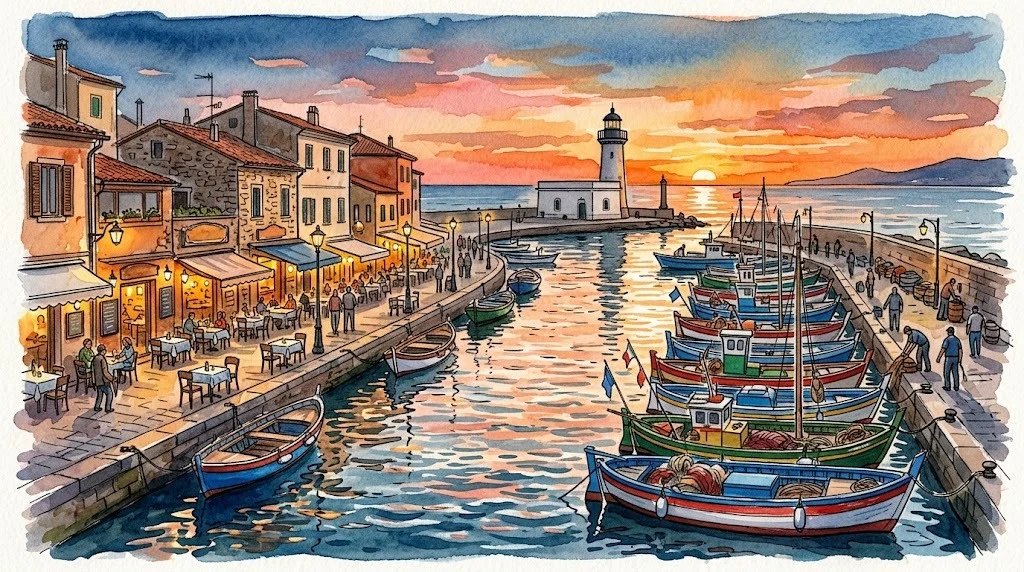
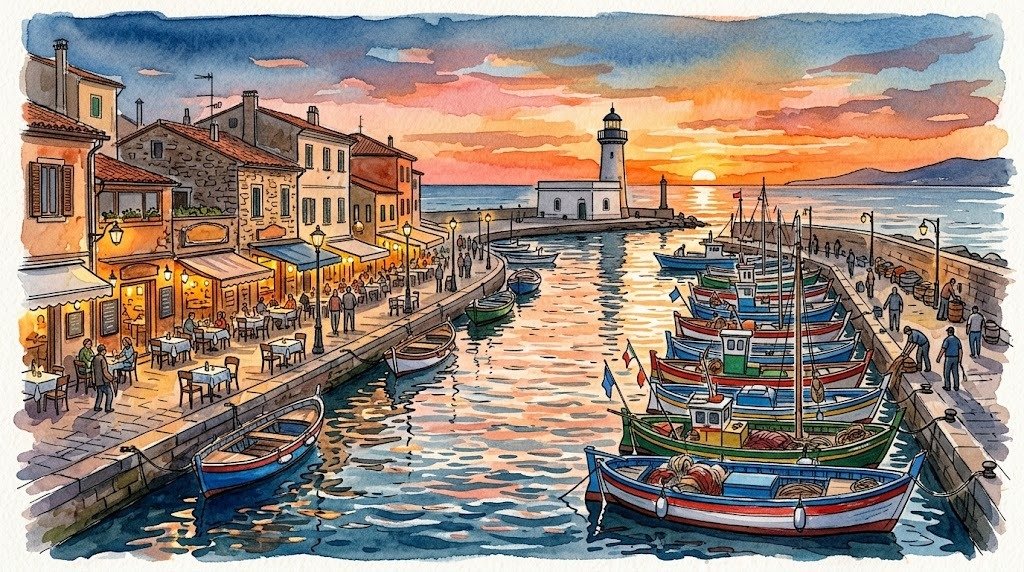
Where Fiumicino is and why almost nobody stops
Fiumicino is a seaside town at the mouth of the Tiber, some 20 kilometers from the center of Rome, and the vast majority of people who say its name fly over it at 3,000 meters without knowing that someone lives below. To the world the name means an airport. To the people who live there it means a quay, a canal, a fleet of fishing boats and a town hall.
The confusion has a precise geographic reason. Leonardo da Vinci airport sits in the municipal territory of Fiumicino, but it is a few kilometers of road from the town, and the two worlds almost never touch: people who land are channeled toward the railway or the highway and vanish in the direction of Rome. The town stays to one side, outside the cone of attention, with its square and its port.
If you land and have a five-hour layover, you can see the sea instead of the duty free. Nobody explains this option, and if you search for how to get into the city from the Rome airports you only find instructions for leaving fast. The full picture of the connections is on the page about how to get to the center from Rome's airports, which also helps you understand the opposite, that is, how to stay.
The town is low, modern, without a historic center in the sense tourists mean. If you arrive looking for medieval alleys, you'll be disappointed within 10 minutes. If you arrive looking for a working fishing port at the mouth of Italy's most famous river, you'll find exactly that, with the noise of diesel engines at six in the morning and polystyrene crates on the quay.
How to get there from Rome, with data checked on September 28, 2026
The FL1 regional railway is the backbone of the connection and ends at Fiumicino Aeroporto station. From Rome the line passes through Tiburtina, Ostiense, Trastevere and Ponte Galeria before ending at the airport. The train doesn't reach the town: it drops you at the terminal, and from there the last stretch to the canal port is covered by road or by taxi.
The last stretch by bus: what the official sources don't publish
The number of the city bus line that connects the airport terminal to the town is not published on any institutional page I could consult at the time of writing: the municipality's website returns an error on the mobility pages, and the regional intercity operator's search engine only works with a dynamic query. I won't make up a number. If you're going, ask at the terminal ticket office or at the info point, which keep the information up to date.
By car the natural route is the Roma Fiumicino highway, which empties onto the roundabouts above the town. Parking near the quay is a serious problem from June to September and on fine-weather weekends, when Romans come down to the sea for the day. If you arrive after 10 in the morning in August, you'll circle for 20 minutes, and that is a prediction, not a generic warning.
Cycling from Rome is possible but it has to be said in full. The route along the river is not continuous, and in some stretches you ride on roads open to heavy traffic headed for the warehouses. Whoever does it does it for sport, not for convenience. For a calmer river outing it's better to go up the Tiber, where the Nazzano Tevere Farfa nature reserve offers gentler banks.
The canal port, which is 2,000 years old and nobody says so
The canal that cuts Fiumicino in two is not a 19th-century work: it follows the course of the Fossa Traiana, the artificial canal dug in the imperial age to connect the harbor basin to the Tiber. River barges went up it as far as the city warehouses. Today fishing boats with radar and nets rolled up at the stern moor on the same water, and the continuity is literally before your eyes.
The imperial port system that canal belonged to was double, the basin of Claudius open to the sea and the hexagon dug inland under Trajan, and it is now a state archaeological area open to visitors: the page on the Imperial Ports of Claudius and Trajan explains what is left standing of one and what of the other, because the answer is very lopsided.
The strip of land between the canal and the main branch of the river is Isola Sacra, and it is not a tourist name: it was the cemetery area of the port city. If you want to understand how the people who worked on these quays lived and died, you'll find the material in the Necropolis of Porto at Isola Sacra, which is the most instructive thing in the area and the least visited.
On the canal quay, life starts early. The boats come back in the first hours, the catch is unloaded, sorted, weighed. Around nine the bulk is done and the smell remains. If you arrive at noon you see a quiet pier with the boats standing still and you think nothing happens: you arrived four hours late, and the difference between the two visits is total.
A curiosity about Fiumicino
The Roman ships preserved here were found while digging the foundations of the airport. In 1957 the works for Leonardo da Vinci cut into the ancient harbor basin, and five wooden wrecks came out from under the bulldozers. The airport that made the name Fiumicino famous around the world was born by destroying and at the same time revealing the port that had made Fiumicino important 2,000 years earlier.
The coincidence says something precise about the history of transport. The same point on the coast was chosen twice, 19 centuries apart, as the gateway for goods and people headed to Rome. Geography repeated its own decision: shallow water, flat ground, the right distance from the city.
The most curious detail concerns the type of vessels. Among the wrecks is a fishing boat with an internal fish tank, that is, a hull pierced to let seawater circulate and keep the catch alive until it was landed. The concept of fresh fish in Rome is a logistics problem solved with a technical solution, not a modern idea.
The Museo delle Navi: hours, cost and what you really see
The Museo delle Navi di Fiumicino is on Via Alessandro Guidoni and is open Tuesday to Sunday from 10:00 to 16:00, closed on Monday. The full ticket costs €6, the reduced ticket €2 for European Union citizens between 18 and 25, with the ordinary ministerial free admissions. Data checked on September 28, 2026 on the website of the Parco archeologico di Ostia antica and on the ticketing system.
The combined ticket, which almost nobody buys
There is a combined ticket at €18, reduced €2, valid for eight consecutive days on the sites of the Parco archeologico di Ostia antica. If you plan to see the excavations, the necropolis, the imperial ports and the ship museum on two separate days, you spend less by buying it right away. Every first Sunday of the month admission to state sites is free, with the crowds that follow.
What's inside
Inside there are five wrecks: three river transport boats, called caudicariae, which shuttled between the port and the city going up the river, a seagoing cargo ship, and the fishing boat with the fish tank. The display is on two levels, so you look at the hulls from above and from the ground. From above you understand the shape, from the ground you understand the size.
The collection is among the most important in the Mediterranean for Roman ships, and the natural comparison is with the ceremonial vessels of Nemi, which were something else entirely, floating palaces and not working craft: if you want the comparison, you'll find it at the Museo delle Navi Romane in Nemi, on the shores of Lake Nemi. Two opposite worlds.
How much time you need, honestly
One hour is more than enough for an attentive visit. If you go with the idea of spending the morning there, you'll be thrown by the small size, and the risk is walking out saying it wasn't worth the trip. The mistake is planning the museum as the only destination instead of as one piece of a day that includes the canal, Isola Sacra and the coast.
The switchboard of the Parco archeologico di Ostia antica answers every day from 9:00 to 17:30 at 06 5635801, and it is the quickest way to check for an extraordinary closure. The online ticket office is the one run by the Park's services concessionaire. Before you leave, a phone call settles it, because small museums close for maintenance with notices that don't always reach the mainstream channels.
The Park's official documentation is available on the website of the Parco archeologico di Ostia antica, which keeps pages for the individual sites with hours and notices. Tickets go through the concessionaire's ticketing system. These are the two sources the figures above are based on.
Something nobody tells you about Fiumicino
The sea in front of Fiumicino town is not the sea where people swim. The mouth of a river carries turbidity, debris and currents, and the real bathing coast begins further north, toward Focene and Fregene, or further south past the river mouth. If you book lodging at the canal port imagining the beach below your door, you are making a geography mistake that you pay for in kilometers.
The second thing nobody mentions is the wind. This stretch of coast is hit by the westerly in the afternoon almost all year, and that is why people sail and kite here, and why anyone looking for the flat sea of postcards is left puzzled. In the afternoon the water ripples, the sand flies and the beach umbrellas are closed.
The third is the airport and the noise. The takeoff and landing routes pass over parts of the municipal territory, and at certain hours that is the background sound. It doesn't ruin the day, but if you imagine a silent river mouth, change your mental picture. The landscape is an industrial and port landscape with a nature reserve inside it, and the coexistence is visible to the naked eye.
The WWF oasis of Macchiagrande: how access works
The Macchiagrande oasis is a protected area of 280 hectares that includes Mediterranean scrub behind the dunes, Mediterranean woodland, wetland woods by the Focene pond, canals, meadows and pine groves. Inaugurated in 1986, it has been part of the Litorale Romano State Nature Reserve since 1996, the year the reserve was established. It is the last piece of the Lazio coast that looks like what it was before the land reclamation and the lot subdivisions.
Entrance, hours and the booking worth making
The entrance is in southern Fregene, at the corner of Via di Castellammare and Via della Veneziana. The visitor center is open on Wednesday and Thursday from 9:00 to 12:00, and the published contacts are the landline 06 6685487 and the mobile 339 1588245. The entrance fee is not published on the official page of the association that runs it, so ask by phone.
If you show up at the gate on a Saturday afternoon convinced you'll find the visitor center open, you have the wrong day. The information verified on September 28, 2026 on the association's website concerns the opening of the visitor center, which does not necessarily coincide with the usability of the trails and with extraordinary openings for events or guided visits. A phone call before leaving is the difference between a successful morning and an hour of driving wasted.
What you see, season by season
On the dunes grow the pioneer species, sea daffodil and sea holly, while on the top and in the band behind the dunes there are cade juniper, Phoenician juniper, rosemary, mastic and myrtle. The woodland is made of holm oak, English oak, alder, laurel and poplars, and hosts wild orchids. In spring the orchid bloom is the best reason to come, and it is also the period with the fewest crowds.
The water birds include mallard, cormorant and herons, while among the raptors you can see marsh harrier, kestrel and osprey. Among the mammals there are porcupine, wild rabbit, fox, stone marten and harvest mouse. The symbol of the oasis is the Hermann's tortoise, which you see rarely and with patience. If you arrive with binoculars you leave happy, if you arrive without them you see a wood.
The useful comparison for understanding the value of this strip of coast is with the other wetlands of the Lazio coast, from the Tarquinia salt pans further north to the coastal lakes of the Circeo National Park to the south. Macchiagrande is the closest to Rome and the most threatened by urbanization, and that explains both its fragility and its importance.
The page dedicated to the area, with the detail of the habitats and species, is the one on Macchiagrande, WWF oasis. Practical information should always be rechecked on the website of the association that runs the oasis, which is the primary source for hours and contacts and the only one worth trusting.
My advice for visiting Fiumicino
Come early in the morning and on a weekday, ideally Tuesday or Wednesday, and build the day in this order: canal quay at seven, museum at the 10 o'clock opening, coast in the afternoon. It's the only sequence that gives you the town as it really works instead of as it looks to someone who happens by at the wrong hour.
The lesson of this place is about overlap. A working fishing port, a museum of naval archaeology, a protected dune and an airport runway within the same radius of 6 kilometers are not found anywhere else in Italy. Whoever visits only one of these things doesn't understand the place.
Clothing, which matters here
Bring closed shoes and a windbreaker even in May. The afternoon westerly changes the perceived temperature by several degrees, and on the sand behind the dunes open shoes fill up within 100 meters. If you arrive in sandals from the city you end up giving up the trail and staying in the parking lot, and at that point you might as well not have moved.
With children
The museum visit works well with kids from 8 years up, because the hulls are seen up close and the technical explanation is concrete. Below that age the risk is boredom. On the other hand the quay with the boats, the nets and the seagulls holds anyone's attention, and costs nothing. More structured alternatives for families exist along the coast, for example at Zoomarine in Torvaianica.
One day or two
If you have only one day, put together Fiumicino town and Isola Sacra, and skip the beaches. If you have two, add the northern coast and the excavations. The combination I advise against is the one that bundles Ostia Antica and Fiumicino into the same afternoon: the Ostia excavations alone take a full half day, and squeezing them means seeing them badly.
The beaches: Fregene, Focene and the rest of the coast
Fregene is the historic beach of well-off Romans, with the pine forest behind and the beach clubs that made the society news of the 1960s. Today the free stretch exists but you have to look for it, and the dark sand surprises anyone who arrives with the southern sea in mind. The full detail, with access and seasonality, is in the page on Fregene.
Focene is the stretch immediately to the south, closer to the airport and less built up toward the river mouth. Here the wind is a constant and sailing sports have a permanent presence. The beach is narrower and in some places erosion has eaten meters of shore, with breakwaters defending what is left. If you want clean water, move toward the border with Fregene.
How to get there without a car
The useful rail connection for the northern part of the coast is the line that serves Maccarese Fregene station, from which the beach is a few kilometers away and requires another vehicle. The station carries the name of two localities and is inside neither of them: it's a piece of information that spares disappointment to anyone planning the day by looking only at the train map.
The coast immediately upstream is Maccarese, with reclaimed countryside behind it and a different character, less social and more agricultural: the page on Lido di Maccarese helps you get oriented. Further north still begins the coast of Ladispoli, with the black volcanic sand that is its recognizable signature.
What is overrated, said plainly
The fashionable beach clubs of Fregene on an August weekend are the worst place on the Lazio coast for the ratio between what you pay and what you get. Island prices and a river-mouth sea. If you want to spend that kind of money, take the car and go an hour further north or south, where the water really changes color.
The honest comparison is with the coast south of Rome, where the Capocotta beach keeps an intact dune system thanks to the protection of the Castelporziano Estate, and where there is also the Capocotta naturist oasis for those who look for it. There the dune is protected by a presidential state property, and you can see it.
Another well-known fact, yet rarely cited
Rome is a sea city that behaves like a land city, and Fiumicino is the point where this contradiction becomes visible. The ancient annona brought grain to Rome by ship as far as the port and then by river as far as the warehouses, and without that system the city could not have counted a million inhabitants. Logistics came before greatness, it didn't follow it.
The archaeological residue of that traffic is the artificial hill of amphora shards piled up downstream, which you can still climb: the page on Monte dei Cocci tells how a 50-meter rise made only of broken containers takes shape. Those amphorae passed through here, on the barges that went up the Fossa Traiana.
The neighborhood that formed around that deposit long kept its annona vocation, and anyone who wants to understand the urban terminal of the chain can read the page on what to see in Testaccio, where the slaughterhouse and the Nuovo Mercato di Testaccio continue the same story of goods entering the city and being sorted.
The road that connected the port to the city still exists in the place name and in the route, and along its course burials of the imperial age have been found: the necropolis of Via Portuense is the funerary trace of that service road. Trade routes produce cemeteries along their margins, because burial was outside the walls and not inside.
The right photo to take in Fiumicino
The photograph that tells this place better than any other is taken on the canal quay shortly after dawn, with the moored fishing boats in the foreground and a plane climbing in the sky behind. Two transport systems separated by 2,000 years in the same frame. You need patience for the takeoff, and you need to get up early.
The second shot I recommend is the evening backlight on the river mouth, when the sun falls into the water and the profile of the pier shrinks to a line. The afternoon westerly often brings a salty haze that softens the outlines, and in that condition the exposure has to be stopped down so as not to burn the sky. If you shoot in automatic you get a white blotch.
Recurring technical mistakes
Light sand and reflecting water fool the light meter in both directions, overexposing the sea and underexposing faces. On the quay the problem is the opposite: the dark hulls and the nets absorb light. If you shoot with a phone, turn on manual compensation instead of trusting it, because the automatic mode gets these subjects wrong in a predictable way.
Inside the museum, photography requires attention to the rules of the Parco archeologico, which vary from site to site and may limit flash, tripods and commercial use. The prudent rule is to ask at the ticket office before starting. The hulls photograph badly from above and well from the side, because from the side you read the curve of the keel and from above you don't.
Some important events that happened here in history
The construction of the imperial port system is the event that created this piece of coast. The basin of Claudius was started in the middle of the 1st century AD and the inner hexagon was dug under Trajan at the beginning of the 2nd, with the Fossa Traiana closing the connection toward the river. From that moment on, Rome's annona traffic passed through here.
The progressive silting of the river mouth then pushed the coastline toward the sea over the centuries, leaving the ancient basins inland. That is why the archaeological area of the ports is now far from salt water: the port didn't move, the sea did. The river kept depositing, and geography did the rest.
1957 and the bulldozers
The digging of the foundations of the airport starting in 1957 cut into the ancient harbor basin and returned the five wrecks now on display. It is the episode that gave rise to the museum and one of the most significant naval finds in the Mediterranean. The chronicle of the building site and that of archaeology coincide in this case, and the museum is the result of a lucky accident.
The formal recognition of environmental protection for the coastal strip came much later, with the establishment of the Litorale Romano State Nature Reserve in 1996, which absorbed areas already looked after by volunteers, among them the oasis inaugurated 10 years earlier. Protection came after the concreting, not before, and it is the sore point of the whole Lazio coast.
Who has passed through Fiumicino
The emperors who wanted the port passed through for reasons of construction and propaganda. Claudius started the work against the opinion of those who thought it too expensive, Trajan completed it with the hexagonal basin in the same season in which he was transforming Rome with his forums, and the scale of the building sites of that era is well measured by comparing it with Hadrian's Villa in Tivoli, built a few years later.
Sailors, porters, caulkers and boatmen are the real protagonists of this place, and their tombs can be read at Isola Sacra, where the reliefs show trades instead of abstract virtues. A midwife at work, a knife grinder, a shop. It is the most direct documentation we have on the port working class of the empire, and it doesn't resemble the Rome of monuments at all.
In the 20th century the Romans on holiday passed through here, the ones who invented the weekend at the sea as a social institution, with Sunday trains and cabins rented by the season. The coast between Fregene and Ostia was the place of this collective habit, and the society news of the 1960s told it as if it were glamour. It was mostly sand and traffic.
Every year tens of millions of travelers pass through who see of Fiumicino only a terminal and the name on the ticket. It is the largest category and the least aware. If you have a six-hour layover and are reading this page, you are the minority that can do otherwise, and the canal quay is much closer than you imagine from the baggage belt.
The contrarian position: the museum is not the reason to come
What follows goes against local tourist promotion and also against some of the operators. The Museo delle Navi is well made, the wrecks are exceptional, the ticket costs little. And yet it is not the reason the trip from Rome is worth it, and whoever sells it as the main attraction sets up a disappointment for those who believe it.
The reason to come is the canal port at six in the morning, which has no ticket, no hours and appears on no list of things to do. A working fishing fleet 20 kilometers from a capital is a European rarity. The museum explains well a past that on the quay, with other means and other nets, is still happening before your eyes.
The practical consequence of this position is that it's better to go on the water first and indoors afterward, reversing the order that almost everyone recommends. If you have already seen the real boats, you enter the museum with a question in your head. If you enter the museum first, you leave with the information and without the question, and on the quay afterward you look at your phone.
The second part of the position concerns the oasis. Many treat it as the green backdrop of the beach day. It's the opposite: the dune with intact scrub is the rarest find of the area, because several Roman ports remain while only a few kilometers in all of unbuilt Lazio coast remain. The rarity lies in the dune system, not in the ruins.
What to see around, in order of distance
The first circle includes the archaeological area of the ports, the necropolis of Isola Sacra and the museum, all reachable within a few minutes by car of one another. The second circle goes down toward the excavations and the village: the village of Ostia Antica with its 15th-century castle is underrated and can be visited in a little under an hour.
Toward the north the coast offers a sequence of destinations that suit a second day. The Palo Odescalchi castle with its Bosco di Palo keeps a patch of lowland forest similar in character to Macchiagrande. Further on the Santa Severa castle looks straight onto the Santa Severa beach.
Going on you meet the Santa Marinella beach and then the commercial port of Civitavecchia, which is the modern heir of the function the imperial port performed here. The comparison between the two harbors, 2,000 years apart, is the most effective lesson in economic geography I know on the Lazio coast.
The Etruscan hinterland begins a few kilometers from the coast and changes register completely. Cerveteri with the Banditaccia necropolis and Tarquinia with its painted tombs tell of the centuries before Roman rule, when the sea was Etruscan and Rome counted for nothing.
Inland the volcanic landscape takes the place of the reclaimed plain, with Lake Bracciano and the town of Bracciano perched above it. It's the right itinerary for a day of bad weather, when the coast offers nothing and the villages on the crater do.
Toward the south the beach sequence continues past the river mouth with Torvaianica and reaches Anzio and Nettuno, where the coast changes nature and headlands appear. The distance from Fiumicino is however enough to discourage combining them in a single day, unless you want to spend the time inside the car.
Heading back toward Rome the thread of water continues inside the city, with the Tiber Island that marked the original ford and Castel Sant'Angelo that guards the upstream bend. If you want to close the circle, end the day in Trastevere, on the bank where the goods from the port were landed.
Accessibility, seasons and the things you don't see here
The town is flat and the quay can be walked without any change in level, which makes the walk along the canal practicable even for people with mobility difficulties or pushing a stroller. The museum is on two levels and the accessibility conditions should be checked directly with the Park's switchboard, because the availability of elevators in state sites changes with maintenance.
The oasis trails are on natural ground, sandy near the dune, and cannot be fully traveled in a wheelchair. No official information on the presence of an equipped path is published on the page of the managing association. If you have specific needs, call the contacts given above and ask before setting out.
The seasons, without rhetoric
From mid-June to the end of August the coast is congested and the humid heat of the river mouth is heavy. October and April are the best months by far: long light, moderate wind, an oasis you can visit without mosquitoes and empty beaches. In winter the town empties, many seasonal businesses close and what remains is the real part, which is also the least welcoming for those who arrive without a car.
The mosquito of the coastal strip deserves a serious warning in the warm months, especially toward the wetlands and at sunset. If you go to the oasis from May to September, bring repellent. It's the least elegant advice on the whole page and it's the one participants thank me for most, because no guidebook writes it.
What you don't see
Very little of the port of Claudius remains on the surface, because most of it lies under the runways and under the countryside. The hexagonal basin of Trajan is for the most part within private property, and the visitable state area runs along its edge without going around it. If you imagine walking around an ancient body of water, prepare for a different and more fragmentary reality.
The ancient coastline no longer exists where you look for it, and the structures that should face the sea now look onto cultivated fields. It takes a small mental effort to put the water back where it was, and it is the main work to do in this area. Without that operation the ruins stay piles of bricks without logic.
Eating in the area: the honest warning
A fishing port attracts good restaurants and predatory restaurants on the same street, and telling them apart by eye is possible with three or four signals. The first is the menu with photographs of the dishes displayed at the entrance: where the food has to be shown in pictures it means the customer isn't expected a second time. The photograph replaces reputation.
The second signal is the staging on the sidewalk, the woman rolling out pasta dough behind the window or in front of the door. It is a visual lure designed for passersby, not a sign of cooking. In places where you eat well the pasta is rolled inside, out of sight, because the work is done in the kitchen and not in the window.
The third signal is the person at the entrance who invites you to sit down while you walk. Whoever has a full restaurant doesn't send anyone into the street to recruit. The fourth is non-stop hours from morning to late at night with no break between services: a kitchen that never closes is a kitchen that reheats, because no brigade holds up through 14 hours of real service.
The fifth concerns prices and applies in particular on the promenade overlooking the canal and in panoramic positions. Where the list gives fish as "according to availability" without the price per kilo, the bill is decided by someone else after you have eaten. The list posted outside and the one handed to you at the table must match: if they differ, leave.
The chains with repeated signs that you meet in the center of Rome work as tourist attractions and not as places of cooking, and Romans don't go in. I don't say it out of snobbery: whoever sells to a passing public aims at table turnover speed, and the kitchen adapts to that goal. It's a legitimate business model, it simply doesn't concern people who want to eat well.
The one criterion that works everywhere, here too, is to look at who is sitting and in what language they order. A place with port workers, municipal employees and families speaking Roman dialect inside is a place that lives on regular customers. A place with only foreign customers with a rolling suitcase beside the chair lives off passing trade. Look inside before you enter.
To get oriented in Rome and the surroundings I keep a public list of checked addresses, updated when management or kitchen change: you can consult it here, Daniele's list on Google Maps. If you'd rather buy fish than eat it in a restaurant, you'll find the stall in the morning, and for the urban model of fish selling there is the page on the Pescheria.
Frequently asked questions about Fiumicino
Is the Museo delle Navi di Fiumicino open?
The Museo delle Navi appears to be open Tuesday to Sunday from 10:00 to 16:00, with a weekly closure on Monday, according to data checked on September 28, 2026 on the website of the Parco archeologico di Ostia antica and on the concessionaire's ticketing system. Extraordinary closures for maintenance happen in small museums: a call to the Park's switchboard, active every day from 9:00 to 17:30, clears it up before you leave.
How much does the Museo delle Navi ticket cost?
The full ticket costs €6 and the reduced ticket €2 for European Union citizens between 18 and 25, with the ordinary ministerial free admissions. There is a combined ticket at €18 valid for eight consecutive days on the sites of the Parco archeologico di Ostia antica, which suits those who also plan the excavations, the necropolis and the area of the ports. On the first Sunday of the month admission is free.
How do you get to Fiumicino town from Rome by public transport?
The FL1 regional railway line connects Rome to Leonardo da Vinci airport through Tiburtina, Ostiense, Trastevere and Ponte Galeria. From the airport terminal to the town you need another road vehicle. The number of the city bus line is not published on any institutional page that could be consulted at the time of writing, and the information has to be asked at the terminal ticket office or at the info point, which keep it current.
When is the WWF Macchiagrande oasis open?
The oasis visitor center appears to be open on Wednesday and Thursday from 9:00 to 12:00, according to the official page of the association that runs it, checked on September 28, 2026. The published contacts are the landline 06 6685487 and the mobile 339 1588245. The opening of the visitor center does not necessarily coincide with the usability of the trails and with extraordinary guided visits, so it's best to phone.
How much does it cost to enter the Macchiagrande oasis?
The entrance fee is not published on the official page of the oasis at the time of writing. Reporting a figure taken from third-party sites would be a gamble, because the rates of areas run by associations change with agreements and with the season. The correct way to find out is to call the published contacts, which answer during the opening hours of the visitor center.
Where exactly is the entrance to the oasis?
The entrance to the Macchiagrande oasis is in southern Fregene, at the corner of Via di Castellammare and Via della Veneziana. If you set the navigator only to the name of the protected area, you risk ending up at a service access closed to the public, because the 280 hectares border several roads. Set the intersection between the two streets and the problem doesn't arise.
What is the Fossa Traiana?
The Fossa Traiana is the artificial canal of the imperial age that connected the harbor basin to the course of the Tiber, allowing river barges to go up toward the urban warehouses. The canal that today crosses Fiumicino and hosts the fishing fleet follows its course and is still navigable. It is the longest continuity of use of a port infrastructure that you can see in Italy.
Can you swim at Fiumicino town?
The stretch of sea immediately in front of the river mouth is not the reference bathing coast, because the river carries turbidity and debris and the currents change the quality of the water. The equipped and free beaches are to the north toward Focene and Fregene, or further south past the river mouth. If you book at the canal port thinking of the beach below your door, you have the geography wrong.
Is it worth stopping in Fiumicino during an airport layover?
With at least five hours between flights the town is reachable and the canal quay repays the trip, as long as you leave a generous margin for the checks on the way back. With three hours the answer is no, without discussion. If you have carry-on luggage and no storage available, give up: dragging a rolling suitcase on the pier quickly becomes a punishment.
Who wrote this page
The editorial team that looks after this page is that of Tour Leader Pro, a Rome-based organization that designs and coordinates visits, itineraries and cultural events in Rome and Lazio. Hours, rates and access conditions given above were checked on the date indicated against the official sources cited in the text. Recheck them before you leave, because they change often and without notice. Reports of data that no longer match are welcome.
Building an itinerary on the coast means making state museum hours, openings of protected areas run by volunteers, road connections with fragmentary information and distances that look short on paper and are not by car in August all fit together. If you do it for yourself or for a group, you'll find the planning tools on Tour Leader Pro, which gathers materials designed for people who guide and for people who organize on their own.
For the big picture on regional trains, rentals, airport layovers and destinations in Lazio outside the center of Rome, from the coast to the volcanic lakes to the Etruscan hinterland, the resource to keep open alongside this one is Italy Planner, which works on the regional scale instead of on the single place.