Nettuno (RM)
In short. Nettuno is on the coast south of Rome, 60 kilometers from the capital, with the medieval village, Forte Sangallo and the sanctuary of Santa Maria Goretti gathered within a few hundred meters between the railway station and the sea.
Nettuno is on the coast south of Rome, 60 kilometers from the capital, with the medieval village, Forte Sangallo and the sanctuary of Santa Maria Goretti gathered within a few hundred meters between the railway station and the sea. From Rome by train: regional line FL8 from Roma Termini, terminus Nettuno, hourly service (more frequent at rush hour) and about 70 minutes of travel. From the station to the village you walk 300 meters, to the American Cemetery 10 minutes. By car: Via Pontina (SS148) to the Aprilia exit, then the Nettunense (SR207) to the sea, or Via Cristoforo Colombo and Via Pontina. An hour and a quarter without traffic, much more on summer weekends. Forte Sangallo, at Via Antonio Gramsci 5 (telephone 06 98889555), houses the Allied Landing Museum and the municipal Antiquarium and is closed on Monday. The ticket is a few euros and the time slots change with the season, so it's best to call or check the website of the Municipality of Nettuno before you leave. The Sicily-Rome American Cemetery, at Piazzale Kennedy 1, is open every day from 9:00 to 17:00 except December 25 and January 1, free admission. The Sanctuary of Our Lady of Graces and Santa Maria Goretti, at Piazza San Rocco 1 (telephone 06 98575828), has free entrance during the church's opening hours. Villa Borghese in Nettuno is private property and cannot be visited, except for extraordinary openings. Parking: paid on Lungomare Matteotti and in the streets around the station, free but rare in the station neighborhood on beach days. For a full day you need six hours. For the American Cemetery and the village alone, three are enough.
Nettuno (RM) is part of our itinerary on the Roman coast, the coast that runs from Ostia down to the border with Latina Province, and it is the twin sister of Anzio: two municipalities born from a single territory, with one railway station each, and a single Allied landing that divides their memory forever.
Why Nettuno (RM) is worth a visit
Nettuno is a municipality of about 48,000 inhabitants in the Metropolitan City of Rome Capital, on the border between the Agro Romano and the Agro Pontino, bathed by the Tyrrhenian Sea. Its economy lives on beach tourism, sport fishing, one of the largest marinas in Lazio and a sports tradition unusual for Italy, baseball, which here is not a barroom curiosity but a city identity, with 17 national championships. In summer the streets and squares of the center fill with people of every age, arrived from the nearby towns and from Rome: the beach by day, the waterfront in the evening, a very long promenade that runs from the harbor to the sanctuary. But the reason Nettuno deserves the visit is another one: in no other place on the Lazio coast do you go in a quarter of an hour from a 13th-century village surrounded by cylindrical towers to an American war cemetery, and from there to the little bed of a 12-year-old who died in 1902 and was canonized in 1950. Three centuries of the Papal State, a world war and a saint: Nettuno is a lesson in Italian history in pocket format.
Under the town run tunnels and galleries dug into the macco, the local Pliocene calcarenite. They served as a refuge against the Saracens in the Middle Ages and as shelter from the bombings in 1944, when the American VI Corps used the ones under Villa Borghese as the headquarters of the beachhead. The municipal territory is also a small mineralogical case: perrierite-(Ce), a rare-earth silicate of which Nettuno is the type locality, was first described here. These are details you rarely read in seaside brochures, and that tell better than any slogan how layered this strip of coast is.

How to get to Nettuno (RM) from Rome and where to leave the car
By train on the FL8
The railway is the most sensible way to reach Nettuno from Rome. Line FL8 leaves Roma Termini, stops at Torricola, Pomezia-Santa Palomba, Campoleone, Aprilia, Lavinio, Villa Claudia, Marechiaro, Anzio Colonia, Anzio and arrives at Nettuno, the terminus, in about 70 minutes. The stretch from Campoleone onward is single track, which explains the hourly service and some delays on strike or work days. The Albano-Anzio-Nettuno coastal railway was inaugurated on March 26, 1884, and the 19th-century station itself, with its square, marks the boundary between the modern town and the village. The old station bridge, which connected the center with the northern outskirts, has been closed since 2018 because it was declared unsafe. To cross the tracks, use the indicated passages. Practical tip: the regional ticket is bought at the station or with the app, and on July Sundays the return trains, between 18:00 and 20:00, are full down to the aisles. Anyone who wants a seat goes back earlier or has dinner in Nettuno and takes the last train.
By car and by bus
From Rome the fastest road is Via Pontina to Aprilia and then the Nettunense, which runs straight down to the sea. Via Cristoforo Colombo and Via Pontina are the classic alternative for those starting from the south quadrant. In normal conditions it takes a little over an hour, but on summer weekends Via Pontina between Castel Romano and Pomezia is a single line of cars and the time doubles. The Cotral service connects Nettuno with Rome (terminus Laurentina) and with the towns of the interior. Check the schedules on the company's website, because they change between the school period and the summer. For parking: blue lines on Lungomare Matteotti, on the riviera and in the streets around the station. The medieval village is pedestrian and has regulated access. On August Sundays you arrive before 9:00 or you give up the car, there is no middle way.
The medieval village of Nettuno (RM), place by place
The old part of Nettuno is a quadrilateral perched over the sea, closed by walls with cylindrical towers. The towers date to the 14th century, when Nettuno was under the lordship of the Orsini. The fortified core is however older, and municipal sources date its birth to the end of the 10th century as a bulwark against Saracen raids. In antiquity this spur would have been the oldest part of Antium, the only one to survive the destruction: a reasonable hypothesis, not an archaeological certainty. Many residents still live inside the walls, and among the paved lanes and small squares you find the palaces of feudal power and the mother church. In the evening the village is the center of the nightlife, with most of the pubs and venues. By day, between 10:00 and 12:00, it is almost empty and that is when it should be visited. The recommended route starts from the station (300 meters), enters through the main gate on Piazza Marconi and ends on the Cavone, the walkway along the walls that looks over the harbor.
Palazzo Baronale, formerly the Colonna palace
The entrance is on Piazza Marconi. It was the symbol of feudal power: the Colonna, who considered themselves descendants of the counts of Tusculum, held Nettuno from 1426 (from 1427 according to other sources, after the death of Rinaldo Orsini) until 1594, and Marcantonio Colonna, the victor of Lepanto, had it renovated in 1569. Passed to the Apostolic Chamber and then to the Borghese, who still owned it in the early 1900s, the palace is recognized by its tower. Under that tower, at least until 1870, the front half of a large Roman funerary cippus with a Latin inscription was kept, discussed in the 1870 Bullettino dell'Instituto di corrispondenza archeologica and in the Storia di Anzio, Satrico, Astura e Nettuno by Calcedonio Soffredini (1879). The interior cannot be visited. The facade, however, explains by itself how a coastal fief of the Papal State worked.
Palazzo Doria Pamphilj and the frescoes by Pier Francesco Mola
On the other side of the village, the palace that the people of Nettuno call Pamphilj-Doria began around 1600 as Casino Cesi and passed to the Pamphilj in 1648, in the years of the pontificate of Innocent X. Inside it keeps a cycle of frescoes by Pier Francesco Mola, the painter from Ticino who worked for the Pamphilj in Rome and Valmontone, in the rooms and especially in the ballroom. In 1697 the papal court of Innocent XII stayed there, the pope who shortly afterward would have the port of Anzio built. This building too later belonged to the Borghese. My plain opinion: it is the most underrated monument in Nettuno, because it isn't open regularly and nobody knows Mola is inside. If the Municipality announces an extraordinary opening, that is the reason to take the train.
The Collegiata of Saints John the Baptist and the Evangelist
The mother church of the village, of medieval origin, was completely rebuilt between 1738 and 1748 to a design by Carlo Marchionni, the architect who a few years later would design Villa Albani in Rome. Tradition says it rose over one of the two temples of the god Neptune, and there really is something Roman underneath: during the 1937 excavations, cippi of legionaries with inscriptions of the 12th Legion came to light under the steps. Deposited in the town hall of Nettunia Porto, they disappeared during the war. On the sides of the Collegiata stood the Oratory of the Carmine and the church of the Most Holy Sacrament, facing Palazzo Baronale. Here, on the first Saturday of May, the Madonna delle Grazie arrives in procession. In front of the facade, in Piazza San Giovanni, is the statue of Paolo Segneri.
The old fountain, the Cavone and the walls
In 1830, in the old fountain inside the village, an ancient walled-up conduit was found and, in its space, a lead basin with Latin letters. The conduit carried water from the countryside and was dated to at least the Roman period. From this comes the hypothesis, never proven, that on the site stood a temple to the god of the sea, erected by some wealthy devotee next to the oldest port. The Cavone is the walkway along the fortifications that overlooks the marina: the right place to understand the geography of Nettuno, with the riviera to the east and the fort to the west. Just outside the walls, toward the interior, Via Romana keeps the name of the ancient road that connected Lanuvium to Antium and that ended among the old walls of the village. A stretch of Via Lanuvium-Antium, also called Via Recta and identified by the scholar G. M. De Rossi, was brought to light in 2002 in the La Campana area, parallel to Via Selciatella. Via Santa Maria, finally, is the old road that leads from the station to Piazza Mazzini, where the Neptune Fountain flows.

Forte Sangallo in Nettuno (RM): the Landing Museum and the Antiquarium
Outside the walls, perched over the sea, Forte Sangallo was built between 1501 and 1503 at the will of Cesare Borgia and his father Alexander VI, who had confiscated the fief from the Colonna for their friendship with the French. The attribution to Antonio da Sangallo the Elder is the traditional and most widespread one. The Municipality's website writes Giuliano Giamberti, and the historian Diego Angeli assigned it to Baccio Pontelli. Take it as a fortress from the Sangallo workshop, and not as a signed work. It was built to defend from the sea a town that was then called the granary of Lazio: quadrangular plan of about 320 square meters, four blunted corner bastions, walls up to five meters thick, height between 18 and 25 meters, central keep later enlarged with new floors. After the Borgia the fort returned to the Colonna until 1594, then to the Apostolic Chamber, and in 1831 to the Borghese. On July 20, 1925 the Nettuno Convention between Italy and the Kingdom of Serbs, Croats and Slovenes was signed there.
The Allied Landing Museum
Today the fort belongs to the Municipality and houses, in the rooms around the arcaded courtyard, the Allied Landing Museum: documents, uniforms, helmets, period photographs, maps, accounts by war correspondents, reproductions of newspapers and war material recovered between Nettuno and Anzio after Operation Shingle of January 22, 1944. It's not a museum with big resources, and that is why it works: the cases are full of objects found in the fields, and the map room explains better than any book why a 30-kilometer beachhead stayed blocked for four months. Anyone who wants the larger version will find in Anzio the Anzio Landing Museum, in Villa Adele: the two museums complement each other, they don't replace each other.
The municipal Antiquarium
In the other rooms the Antiquarium collects archaeological, historical and artistic material from the Nettuno area, from the age of Antium to the 18th century, and the municipal library. There you understand how little has remained in town of the great sculptures that came out of this soil: the statue of Apollo now in the Vatican Museums, the Fighting Gladiator signed by Agasias of Ephesus and now in the Louvre, the Dying Gladiator in the Capitoline Museums, the statue of the god Neptune formerly in the Lateran Museum, the Cybele of Villa Doria Pamphilj. It was the explorations ordered by Julius II in agreement with the Colonna, at the beginning of the 16th century, that emptied Antium. The Antiquarium keeps what came after. The fort opens Tuesday to Sunday, closed on Monday. The full ticket costs a few euros, with discounts for students and over 65 and free admission for children and residents, but the hours given by unofficial sources don't match and the Municipality doesn't publish them in full: a phone call before leaving avoids finding the door closed, and I say that from experience.
The Sanctuary of Our Lady of Graces and Santa Maria Goretti in Nettuno (RM)
The sanctuary stands at the end of Lungomare Giacomo Matteotti, in Piazza San Rocco, on the coast, where there once was the small 16th-century church of the Annunziata, also called San Rocco, restored in 1718 and 1868. In 1914 a fire destroyed the throne of the statue of Our Lady of Graces, and the Passionist fathers, with the financial support of Pope Pius X, began construction of the present neo-Gothic basilica, completed in 1935. The Passionists are still its custodians. Paul VI raised it to minor basilica in August 1970. The building is on two levels: the upper church, dedicated to the Madonna and to Saints Sebastian and Rocco, and the lower crypt, where the remains of Maria Goretti have rested since 1929.
The statue of the Madonna delle Grazie
According to tradition, the wooden statue of the Madonna and Child landed at the mouth of the Loricina River in 1550. A sailing ship was carrying it from England to Naples, along with the statues of St. Roch and St. Sebastian, to save it from the destruction of images that followed the schism of Henry VIII. A storm pushed it to Nettuno and the statues stayed here. It's a story of tradition, not a document, but it explains the double dedication of the upper church. In the procession, on the first Saturday of May, a copy of the original comes out, to avoid its deterioration. The procession was established in 1661 by the bishop of Albano, initially on the first Sunday of May.
The crypt of St. Maria Goretti
Maria Goretti, born in Corinaldo in the Marche in 1890 and raised in the Pontine marshes, was wounded on July 5, 1902 by Alessandro Serenelli at the Conca farmstead, at Le Ferriere, then a hamlet of Nettuno. She died the next day, July 6, in the Fatebenefratelli hospital of Nettuno, and the funeral was held on July 8 in the Church of St. Barbara. Pius XII canonized her in 1950, in St. Peter's Square, in front of a crowd that the press of the time described as the largest ever seen at a canonization. The crypt, with the saint's urn, is the destination of a pilgrimage that fills Nettuno with buses in July. The advice I give to anyone who isn't a believer: go in anyway, in silence, and read the dates. 12 years. It's the most serious place in the city.
The other churches of Nettuno (RM)
The Church of St. Francis of Assisi and Andrea Sacchi's altarpiece
It's the oldest church in Nettuno, facing the fort, where in the 16th century the convent of the same name stood. Tradition has it founded by St. Francis himself on his journey to Gaeta in 1222, on the ruins of a pagan temple dedicated to the goddess Fortuna, of which traces reportedly remain. The Friars Minor ran it for eight centuries and left it in 1992. The interior has three aisles, with a marble floor. On the high altar is Andrea Sacchi's altarpiece with the Madonna of Loreto and Saints Joseph, Bartholomew, Roch and Francis. To the left of the entrance are two old frescoes, one with St. Anthony Abbot. They are 15th-century works attributed to two masters tied to Subiaco, the Master of the Caldora Chapel and the Master Petrus, and in the sacristy, together with two stories from the life of St. Francis, a fresco by Petrus shows the oldest known view of the Nettuno coast. Five of the six side altars were removed in 1990 and the church opens in practice only for the daily Mass: a closed masterpiece, which the people of Nettuno have been asking for years to return to the city.
St. Barbara, the Tent of Forgiveness and Divine Providence
The parish of St. Barbara Virgin and Martyr is the church where Maria Goretti's funeral took place on July 8, 1902. The same parish keeps the so-called Tent of Forgiveness, the room of the former Orsenigo hospital where the girl died on July 6, forgiving her killer. The hospital has a history of its own. Brother Orsenigo, its main promoter, died on July 15, 1904 and the sanatorium fell into crisis, surviving as the Casa della Salute. Father Benedetto Menni, founder of the Hospitaller Sisters of the Sacred Heart, continued to take people in, and in 1921 the building was sold to the Holy See, taking the name Casa della Divina Provvidenza, entrusted to the sisters of the Piccolo Cottolengo. In 1943 Pius XII decided to restore the hospital, but nothing came of it. In Piazza San Francesco a first-aid station was set up, where the Barberini outpatient clinic is today. In 1975-76 the municipality bought the building for schools, health offices and associations. Linked to this parish is also the church dedicated to the Madonna of Good Counsel, known as the Church of Divine Providence.
The neighborhood parishes
Nettuno grew by neighborhoods, and each neighborhood has its church: Sacred Heart of Jesus, St. Paul the Apostle, St. Lucy Virgin and Martyr, St. Peter Claver, the Exaltation of the Holy Cross, the Immaculate Conception, St. Mary of Quarto. The two most recent, Saints Anne and Joachim at Scacciapensieri and St. James in the neighborhood of the same name, are of modern post-conciliar architecture and host many communities of the Neocatechumenal Way. They aren't tourist destinations, but anyone who wants to understand Nettuno beyond the village should take at least a walk around Scacciapensieri: it's the real city, the one of 48,000 inhabitants.
Villa Borghese in Nettuno (RM), formerly Villa Bell'Aspetto
On the hill that overlooks the sea to the east of the village stands the villa that the people of Nettuno call Villa Borghese and that began as Villa Bell'Aspetto, or Villa Costaguti. It is part of the system of cardinals' villas on the coast, with Villa Adele, Villa Sarsina and Villa Albani in Anzio, all built by cardinals as official residences and for leisure. Cardinal Vincenzo Costaguti (1612-1660), of a rich family of Genoese bankers who settled in Rome at the end of the 16th century, had it built in 1647-1648. The Costaguti kept it until 1818, when they sold it for debts to Don Giovanni Torlonia. In 1832 Prince Camillo Borghese, husband of Paolina Bonaparte, bought the whole fief of Nettuno from the Papal States, and since then the villa has always belonged to the Borghese, who still own it. The park was designed around 1840, with an Italian garden, an orange garden, lavender, palms and woodland. Beneath the villa run the tunnels dug in the macco stone that in 1944 housed the command of the American VI Corps. In 1978 Steno Borghese donated four hectares to the city and the villa was declared a national monument.
The Villa Borghese Nature Reserve
Since 1999 (regional law 29/99) the area has been a provincial nature reserve, today belonging to the Metropolitan City: about 40 hectares with a maximum elevation at Colle Paradiso, 40.7 meters above sea level. The woodland is a holm oak grove with Aleppo pines and stone pines, English oaks and cork oaks of notable size, an understory of strawberry tree, rockrose and wild rose. Among the birds, besides blackbirds and greenfinches, you see swallows and bee-eaters in season, and at night little owls and scops owls. The point that no brochure says clearly: the reserve is entirely private property, walled, and not open to the public except by agreement with the owners or with the company that manages it. Beneath the villa and its park, according to scholars, stood the most important and populated part of ancient Antium, perhaps the acropolis. The ruins are plentiful, and mostly invisible.
Torre Astura and the natural areas around Nettuno (RM)
Torre Astura
Torre Astura lies seven kilometers south of the city, inside a military firing range of the Ministry of Defense. In 1193 the Frangipane built, over a Roman port still visible, a maritime fortress with a pentagonal tower surrounded by water and connected to the mainland by a bridge with brick arches. Astura was a landing place on Via Severiana. Cicero owned a villa there, and it was from here that in 43 BC he tried to escape from Mark Antony. In 1268 Conradin of Swabia, defeated at Tagliacozzo, sought refuge there and Giovanni Frangipane handed him over to Charles of Anjou, who had him beheaded in Naples. The tower is the site of one of the most famous betrayals in medieval Italy. It then passed to the Caetani, the Orsini and the Colonna, and in 1594 to the Apostolic Chamber. From the Borghese, in the 1970s, it went to the Comune of Nettuno. Cleopatra (1963), Brancaleone alle crociate, L'arcidiavolo, Pinocchio and The Life Aquatic with Steve Zissou were shot there. You can reach it only when the firing range is open, generally in summer, from the Acciarella provincial road toward Foce Verde, with a walk from the parking lot. Nearby, the pine forest and the Astura River.
The Foglino woods, the Campana and Cadolino
A short distance outside the municipality, toward the border with Latina Province, stretches the Foglino wood, 550 hectares of Mediterranean scrub and lowland forest: a remaining strip of the ancient forest that once ran from Circeo and from Terracina to Rome and Naples. Many plant species grow there and an abundant fauna lives there. Foragers go there for the summer porcino, Boletus aestivalis. In the hamlet of Cadolino an important cork oak grove survives. In the direction of Aprilia another large wood, the Campana, grows along the route of the ancient Roman road. Near Torre Astura, besides the pine forest, part of the Foglino survives, along with an area of hedges and low shrubs, army land, where wild boar, rabbits and mushrooms thrive precisely because nobody can enter. They are the forests of Circeo National Park in miniature, without the park.
The city parks and the Granieri pond
Among the urban parks the best known is Parco Loricina, dedicated to Giovanni Palatucci, which takes its name from the river of the same name that flows into the sea at Nettuno and is the home of the summer events. In the San Giacomo neighborhood the public park of Via Romana Antica has been restored. And the Granieri pond, an oasis of vegetation winding around the body of water, is usable again after years of neglect. These are places for residents more than tourists, but Parco Loricina on an August evening, with the stage set up, is the exact picture of how the people of Nettuno live their summer.
The marina, the seafront and the beaches of Nettuno (RM)
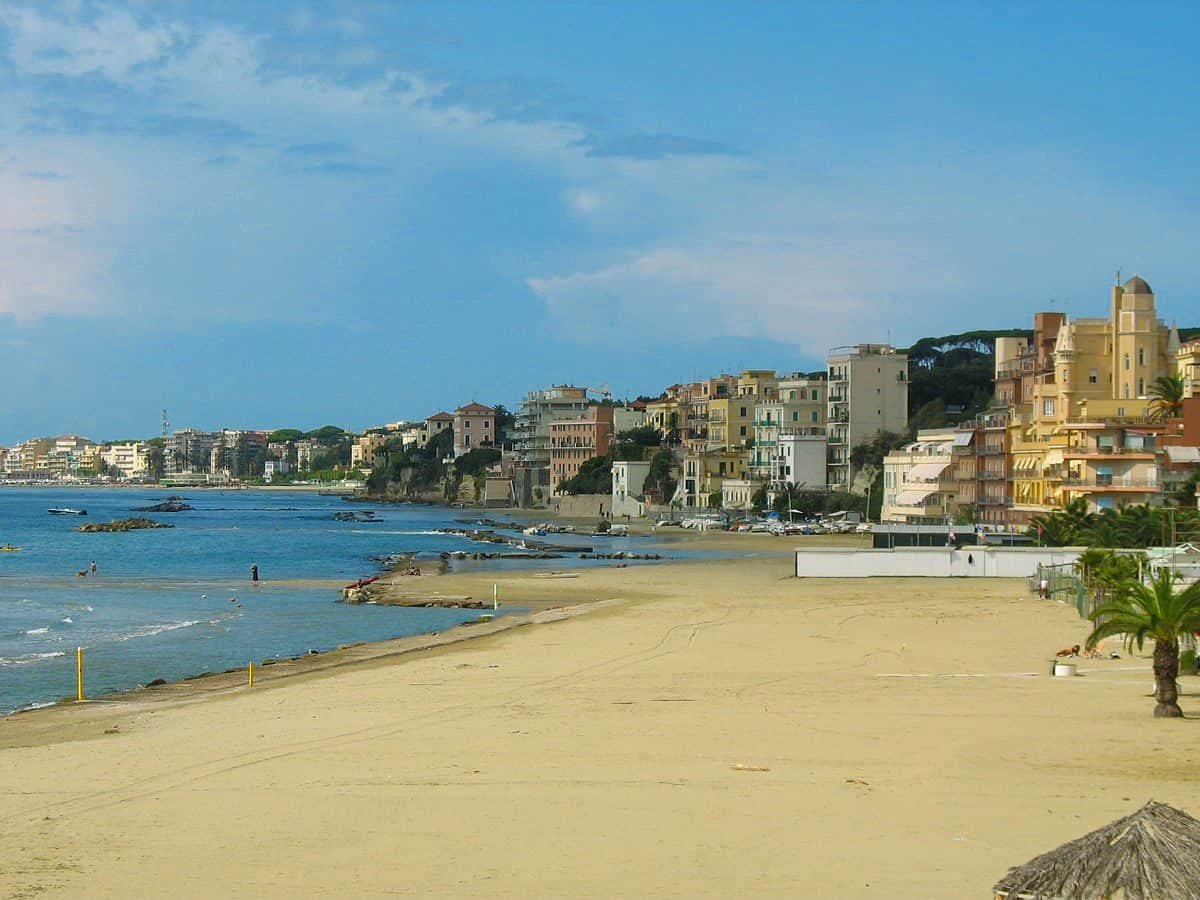
The Marina di Nettuno marina, between the village and the waterfront, was inaugurated in 1986: about 980 berths, 14 piers and about 3,000 meters of docks, regulated access. From the breakwater pier the view of the village and the fort is the best that exists from land. Lungomare Matteotti, Riviera Guido Egidi and the promenade to the sanctuary are the town's evening living room. Along the riviera is the Monument to Universal Peace, on Via Cristoforo Colombo the Monument to Peace, in Piazza Battisti the Monument to the Fallen. The beaches are sandy, wide to the east toward Foce Verde and narrower below the village. In July and August the beach clubs are crowded, and the free beach in front of the sanctuary is the choice of those who don't want to pay. The sea, for those coming from Rome, is better than at Ostia and worse than at the Circeo: an honest assessment from someone who knows all three. Anyone looking for high coast and coves continues toward Tor Caldara, the reserve between Anzio and Lavinio with its sulfur springs, or heads south toward the Lido di Latina.
The American Cemetery in Nettuno (RM)
The Sicily-Rome American Cemetery and Memorial covers 77 acres, about 31 hectares, at Piazzale Kennedy, a 10-minute walk from the station. 7,845 American war dead of the Italian campaign rest there, from the landing in Sicily to the liberation of Rome, and 3,095 names are engraved on the wall of the missing. The memorial includes a marble chapel, a peristyle and a map room with bronze reliefs of the operations in Sicily and in Italy. The white headstones are arranged in arcs around a long reflecting pool. Admission is free, it is open daily from 9:00 to 17:00 with closing only on December 25 and January 1, and the staff of the American Battle Monuments Commission will help anyone looking for a specific grave. Two presidents of the United States came to commemorate the fallen: George H. W. Bush in 1989, for Memorial Day, and Bill Clinton in 1994, for the 50th anniversary of the landing. Every year, on the last Monday of May, the Memorial Day ceremony brings together the embassy, officials and veterans here. Professional tip: go at 9:00 in the morning, before the heat and the groups, and leave through the gate on the Parco Loricina side.
The Campo della Memoria
On Via Rocca Priora, a much smaller military cemetery holds the fallen of the Italian Social Republic in the fighting that followed the 1944 landing: the Campo della Memoria. It's a controversial place and remains so. I mention it because it exists and because, together with the American cemetery and the British burials in Anzio, it completes the map of those who died on this coast between January and May 1944. A commemorative monument to the landing is also found inside the Nettuno woods, at the entrance that faces the military range.
Nettuno (RM), the baseball town
Baseball arrived in Nettuno with the American soldiers stationed in the area at the end of the Second World War: the soldiers played in the fields around the cemetery and the local boys watched them, then began to play. Among the pioneers was Alberto Fasano, who with his friend Giulio Zerella took a course for umpires and in 1945 founded Nettuno Baseball. From 1946 to 1949 the team, as Nettuno P.S., played softball, and the first official championship was in 1950. Since then Nettuno has won 17 national titles, an Italian record (1951-1954, 1956-1958, 1963-1965, 1971, 1973, 1990, 1993, 1996, 1998, 2001), seven European Champions Cups starting in 1965 and three CEB Cups. The Steno Borghese stadium, inaugurated in 1991 and renovated in 2019, has about 8,000 seats, is the largest in Italy for this sport and hosted the world final of September 2009. In May 2026 the city council recognized baseball as an intangible cultural asset of the town. Baseball-related tourism remains marginal in numbers, but it's the only case in Italy where a provincial town tells its story through an American sport. Whoever happens to be in Nettuno on a championship evening should make a detour to the stadium: admission costs little and the show in the stands is worth more than the game.
Traditions and festivals of Nettuno (RM)
The feast of Saint Anthony Abbot
It is celebrated on the Sunday closest to January 17, usually the second of the month. On Sunday morning the blessing of the animals takes place, attended by riders from the whole area, carts drawn by horses and donkeys and the pets of the people of Nettuno. Originally the blessing was preceded by a procession, a custom interrupted in recent years. The Confraternity of Saint Anthony Abbot, which organizes the feast, is also the most active keeper of the memory of the church of San Francesco.
The feast of the Madonna delle Grazie
The solemn procession of the first Saturday of May goes through the central streets of Nettuno. The statue, or rather its copy, is carried by the people of Nettuno from the sanctuary to the Collegiate Church of St. John, in the village, accompanied by all the confraternities of the city's parishes and by delegations from neighboring municipalities. The statue stays in the village for a few days and then returns to the sanctuary. It's the festival the people of Nettuno feel most, much more than Ferragosto. Anyone who wants to see the real city should come on the first Saturday of May, and take the train because the center is closed to cars.
The feasts of St. Maria Goretti
The saint is celebrated twice: in July, on the anniversary of her death, with celebrations at the sanctuary and the pilgrimage, and in May. In July 1902, on the day of the funeral, the road from St. Barbara to the cemetery was already full of people. Today, for July 6, the faithful arrive from the Marche, from the Agro Pontino and from abroad.
The history of Nettuno (RM): Latin-Volscian Antium
Nettuno's roots go back to ancient Antium, and it is its natural heir. Antium was founded by Latin peoples at the beginning of the first millennium BC and occupied by the Volsci, who had settled in the region at the beginning of the 5th century BC. A commercial and maritime center from the beginning, it plausibly dominated, already in pre-Roman times, a large part of the territory of present-day Nettuno. According to one school of scholars it extended from Capo d'Anzio to the area of the Loricina River, and in the highest part of the Nettuno coast, today Villa Borghese, the acropolis would have stood. Adjacent to the medieval village or to the mouth of the Loricina there must have stood a port belonging to an oppidum called Caenon, which since the Latin period served as a naval arsenal, a forum for the market and a depot for provisions. From there the piratical raids across the Mediterranean set out. A marble inscription, perhaps of the 2nd century AD, found near the village, mentions a spring, a forum for the herb and livestock market, grain depots and remains of the port of Nettuno. It seems to refer precisely to Cenone, port and emporium of the Antiates.
Antium, which in the Volscian period opposed Rome for a long time, was for a long time the capital of the Antiate Volsci, settled on the coast and distinct from the Ecetrani of the interior. The best-known episode, handed down by Livy and Plutarch, is that of the patrician Gnaeus Marcius Coriolanus. An exile among the Antiates, welcomed by the noble Attius Tullius, he agreed with him on the war against Rome. Both were elected leaders by the Volscian cities, and between 489 and 488 BC Coriolanus led the Volsci as far as the fourth mile of Via Latina, where the pleas of his mother Veturia and his wife Volumnia stopped him. Back in Antium, according to tradition he was killed as he was preparing to defend his conduct in the forum. In 484 BC, in the territory in front of the city, the Volsci inflicted a hard defeat on the legions of Lucius Aemilius Mamercinus, forced into a night flight. In 469 BC the Romans conquered and devastated Cenone. In 468 BC, after losing the battle of Antium, the Antiates surrendered and Rome placed a garrison there. The next year Rome founded a colony with Latin rights in the territory of Antium. In 459 BC, the Volsci having rebelled together with the same colonists, the city was besieged again, taken and plundered, and the leaders of the revolt killed. After further hostilities Antium was annexed to the Roman state, and in 338 BC, at the end of the Latin war, it became a Roman colony. The beaks of its ships were carried to the Forum to decorate the speakers' platform, which from then on was called, precisely, Rostra.
Nettuno (RM) in Roman times: villas, temples and roads
Antium hosted, among the most eminent Romans who built seaside villas there, Cicero and Maecenas, and it was above all the emperors of the Julio-Claudian dynasty who had frequent dealings with the city: Caligula and Nero were born there. Less than 10 years after Nero's death, on June 9, 68, Antium was however already almost entirely in ruins. At least in Roman times the most important part of the city was probably on the height now occupied by Villa Bell'Aspetto, and the city meant for the leisure of the nobles extended west and east as far as Astura, over the whole territory of the present-day Nettuno and Anzio, the two of them.
The villas of Cicero, Maecenas and Gaius Lucretius
Cicero had at Antium a villa with a famous library: back from exile, he reorganized the remains of his books there in a safe place, as he tells in the letters to Atticus. According to Pirro Ligorio, the 16th-century antiquarian, Maecenas had a villa near the Acque Caldane, today Tor Caldara, six miles from Antium, where he erected a statue to Augustus protector of the spring. Going from there southward, the six miles (about nine kilometers, the Roman mile measures about 1,480 meters) end at Nettuno, near today's Piazza Mazzini. Many nobles had their villas along the Loracina River, today Loricina, which flows east of the village, and many finds have been made in the surroundings. Livy gives to understand that the praetor Gaius Lucretius, around 170 BC (year 583 of Rome), owned a villa not far from the river, with an aqueduct. The quaestor Lucius Verazius Afer must have lived in the area called San Biagio.
The finds in the village
In the street that separates Soffredini house from the parish church, they found a paved surface, a stretch of flint floor that is well preserved, and a headless female statue of good style, damaged, 1.70 meters tall. In the same area, bases and capitals of mediocre workmanship, a gray column with spiral fluting, a fragment of a cippus with a Latin inscription, half of a large funerary cippus under the tower of the baronial palace and other plaques, two of them walled into the staircase of Soffredini house. The sources are the Bullettino dell'Instituto di corrispondenza archeologica of 1870, pages 14-16, and the Storia di Anzio, Satrico, Astura e Nettuno by Calcedonio Soffredini, 1879, pages 184-187. Almost nothing of all this is visible in the city today, and this is Nettuno's great limitation for anyone who loves archaeology: you read it, you don't see it.
The Temples of Antium Under Nettuno
Antium had many temples, and several stood in places that are now part of Nettuno. The famous temple of Fortuna, whose twin Fortunes Horace sang about, occupied according to many scholars the site of San Francesco Church, under which its remains would lie. A complex dedicated to Hercules was probably near Forte Sangallo, in the area of Villa Belvedere. Here in 1863 a statue of the god was found, whose leg had been found years earlier farther west. One of the two temples of the god Neptune was probably under San Giovanni Church, in the village. The marble inscription already mentioned also hints at a temple of Apollo, perhaps in the vicinity of the village. All hypotheses, and honestly they will stay that way until someone digs under the churches.
The Roads
Among the ancient roads that connected the colony of 338 BC with the rest of Lazio, the one that joined Lanuvium to Antium coincided, in its final stretch, with today's Via Romana, which ended between the walls of the village. The stretch that came to light again in 2002 at the Campana, with its paving stones, is the material proof of that route. Anyone who wants to understand the road system of the coast should continue toward Lanuvio, the starting city of that road.
Nettuno (RM) in the Medieval Era: From the Goths to the Colonna
At the beginning of the sixth century Antium was sacked and destroyed by the Goths of Vitiges, and historians agree in considering the castle of Nettuno the continuation of the ancient city. The Antiates who survived the raids, in which the Saracens also took part from the eighth-ninth century, abandoned the Neronian port and would have gathered, wholly or in part, immediately or much later, in a village on the site of a probable temple of Neptune. This is the origin of the medieval village. The historian Giuseppe Tomassetti defines Nettuno as the true inhabited center, heir and continuation of the ancient Antiates, and the map of Jodocus Hondius of 1627 reports NEPTUNIUM, olim Antium, that is Nettuno, once Antium. Leandro Alberti, in the Descrittione di tutta Italia of 1551, writes that the castle of Nettunio was built from the ruins of Antium, near the sea, or rather restored by the noble family of the Colonnesi, and that, having been rebuilt on the ruins of Antio, it was called Nettunium. Hondius adds that Volterrano holds that nothing of Antium remains, but that Nettuno was built on its remains. The inhabitants changed the name of the district, perhaps in honor of the god, but kept calling themselves Antiates. Today's Anzio, born from Nettuno between 1827 and 1857, in its turn feels itself heir of the ancient city, and the dispute between the two shores of the riviera has never ended.
Saracens, Popes and the Women with Thighs Like Columns
The feudal lords of Nettuno were at first the counts of Tusculum, then the monks of Grottaferrata and the Frangipane. In the ninth century the town suffered the Saracen invasion: the inhabitants fled toward the mountains and forests, and only after the troops of Pope Benedict VIII had decimated the Saracens, probably saving women and children, were the foundations laid of a new settlement. Tradition dates to this period the custom of the women of Nettuno dressing in the Saracen way, with a short skirt at the knee, for practicality or for coquetry, and the reputation of women with thighs like columns: a costume that survived until the 16th century and that ended up embarrassing a pope. The pontiff then drove out the counts of Tusculum and fortified the castle with towers and bastions, the present village. The last feudal lords, before the great families, were probably the Della Donna and the Maura. In 1427, after the death of Rinaldo Orsini, viceroy of the Abruzzi, Antonio Colonna became lord of Nettuno and Astura by concession of Pope Martin V, a Colonna himself. In this period many villas were built, and Torre Astura entered the family's holdings.
Nettuno (RM) in the Modern Era: Borgia, Colonna and the Apostolic Chamber
In the 16th century the fortunes of the fief reflect those of the Papal States, and the closeness to Rome explains why a small town of a few hundred inhabitants had such an expensive fort. Nettuno was a small center surrounded by walls and towers, with San Giovanni Church at the center. A little further on was Forte Sangallo, built between 1501 and 1503 for Pope Alexander VI and for his local representative, Count Coppolo, against raiders, corsairs and pirates. Opposite was the convent of San Francesco, and around it about 70 square kilometers of countryside. Many inhabitants arrived in that century from Abruzzo and the Naples area to grow wheat, harvest grapes, cut wood, make charcoal and fish. The economy assured the feudal lords considerable revenues: wheat, wine, barley, wood and charcoal, minerals, tanned hides, wool, shipped from the port of Astura toward Naples or Pisa. In 1501 the Borgias confiscated the fief from the Colonna and entrusted the fortress to Sangallo. The Colonna took it back in 1503, at the death of Alexander VI, and the new pope Julius II, their ally, ordered the exploration of the territory. The sculptures now in the Vatican, at the Louvre, on the Capitoline and at the Lateran came out of it.
Marcantonio Colonna, the English Madonna and the Scandalized Pope
In 1535 Marcantonio Colonna was born, feudal lord of Nettuno, who in 1571 commanded the papal galleys at Lepanto. His exploits can be admired today in the frescoes of the Galleria Colonna in Rome. In 1550, according to tradition, the wooden statue of the Madonna delle Grazie landed at the mouth of the Loricina. In 1575, the Jubilee year, Pope Gregory XIII, having noticed the glances of the pilgrims at the Saracen-style dresses of the girls of Nettuno, ordered them to wear longer clothes. The Apostolic Chamber paid for the alterations out of its own pocket, and threats had to be used to make them wear them. In 1594 Marcantonio Colonna, grandson of the victor of Lepanto, sold Nettuno, Astura and the adjoining lands to the Apostolic Chamber for 400,000 scudi, and Clement VIII informed the people of Nettuno of the purchase with a letter in which he promised to clear the forests and bring the land under cultivation to make it more prosperous. In the two years 1625-26 the Papal States restored the village and rebuilt the San Rocco bastion. In 1656 the plague killed more than 1,000 people of Nettuno and the Monte Frumentario was established to distribute wheat to the poor. In 1661 the bishop of Albano began the procession of the Madonna delle Grazie.
The Port of Anzio and the Separation of 1857
Between 1697 and 1700 Innocent XII had the new port of Anzio built, abandoning what remained of the Neronian port, and in 1700 he bought from Prince Giovanni Pamphilj the whole valley around the new port so that the people of Nettuno could build houses and trade there. But after the inauguration the beneficiaries were excluded from maritime activities. In 1827 the Comune di Nettuno e Porto d'Anzio was born, and the name of Antium emerged from oblivion. In 1856 the inhabitants of the port, the portodanzesi, asked for separation out of spite, Pius IX agreed and, effective January 1, 1857, established the Comune di Anzio, ceding to it about a third of the territory of Nettuno. In 1870 Nettuno followed the fate of the Papal States and was absorbed into the Kingdom of Italy.
Nettuno (RM) in the 20th Century: Maria Goretti, Malaria, Nettunia and the Landing
In 1900 electric power arrived in the streets of the center, extended in the following years to the outskirts. In 1901 the Minister of the Interior Giovanni Giolitti granted the Comune its own flag: a square cloth of light blue and sea-green silk, with the blue staff topped by the god Neptune. On July 6, 1902 Maria Goretti died. In the summer-autumn of 1903 Gabriele D'Annunzio was a guest of the Borghese family at Villa Bell'Aspetto and composed La figlia di Iorio there. The city was growing toward the east, with the reconstruction of the sanctuary at San Rocco and of the Town Hall on Via San Rocco, now Via Matteotti, a building that has long been in a state of decay. In 1910 the electric tramway to Anzio went into operation, replaced in 1939 by the trolleybus. Malaria was the most serious problem of Nettuno and the Pontine plain. In 1918 the School of Malariology directed by Bartolomeo Gosio was founded here, to train doctors, nurses and auxiliary staff in the fight against the disease. From 1901 to 1931 the population went from 4,707 to more than 9,000 inhabitants, many in the hamlets of Cretarossa, Armellino, Tre Cancelli, Valmontorio, Conca and Ferriere.
The Nettuno Convention and Nettunia
On July 20, 1925, in Forte Sangallo, Mussolini signed with the ministers of the Kingdom of Serbs, Croats and Slovenes the Nettuno Convention: a series of economic and legal agreements on the conditions of Italians in Dalmatia, on the relations between Zara and the Dalmatian hinterland and, given the annexation of Fiume to Italy, on the limits of territorial waters between Fiume and Sussak and on fishing zones. With a royal decree of 1934, once the province of Littoria was established, Nettuno ceded the hamlets of Acciarella, Conca and Le Ferriere, that is, almost the entire course of the Astura, to the comune of Littoria, today Latina. The farmstead where Maria Goretti had been wounded thus left the municipal territory. With a law of 1939 Nettuno and Anzio were united in a single comune, Nettunia, officially founded on January 24, 1940. The union lasted until 1945.
The landing of January 22, 1944
On the coasts of Nettunia, at dawn on January 22, 1944, the Anglo-American landing craft of Operation Shingle put General Lucas's VI Corps ashore: 36,000 men in the first 24 hours, almost without resistance. The beachhead, instead of heading for Rome, stopped, and Kesselring's Germans shut it in for four months in a pocket of 30 kilometers. Nettuno was bombed and the civilians evacuated, and the tunnels under the city and under Villa Borghese went back to serving as shelter and command post. Rome was liberated on June 4. The American dead rest in the Nettuno cemetery, the British in Anzio. The fort's museum tells the rest.
A curiosity about Nettuno (RM)
The best-known curiosity concerns the legs of the women of Nettuno and a pope. After the Saracen raids of the 9th century, the women of Nettuno adopted, out of practicality or coquetry, a Saracen-style dress, knee-length, so much so that they earned a reputation as women with thighs like columns. The costume survived for centuries and became a small local emblem. In 1575, a Holy Year, Pope Gregory XIII noticed the glances of pilgrims in transit to Rome and ordered the girls of Nettuno to lengthen their skirts. The Apostolic Chamber paid for the alterations to the dresses, and even so threats had to be used to make them wear them. It's a story told by local historiography and taken up by the learned chronicles of the 19th century, not a notarial deed. But it says a lot about a community of fishermen and farmers, used to sun and hard work, that until the 16th century had no intention at all of dressing the way they do in Rome. Anyone strolling today on Lungomare Matteotti in July will find that the pope's order had no lasting effect. There's a more serious sequel: that costume, and the language of the people of Nettuno, fed for centuries the belief in a Saracen origin of the population, which historians reject. It is much more likely that the short skirt was simply the work clothing of those who fished and hoed, and that the pilgrims of 1575 were seeing a coastal town for the first time.
Something nobody tells you about Nettuno (RM)
For four centuries Nettuno has claimed to have given birth to Andrea Sacchi, the great classicist painter of the 17th century, a pupil of Albani, author of the Divine Wisdom at Palazzo Barberini and of the Vision of St. Romuald now in the Vatican. The altarpiece of the Church of St. Francis, with the Madonna of Loreto and Saints Joseph, Bartholomew, Roch and Francis, was long read as the gift of the illustrious son to his native city. Modern studies have disproved the birth in Nettuno: Sacchi was born in Rome on November 30, 1599, and the Nettuno tradition remains a tradition. This takes nothing away from the altarpiece, which is authentic and remains the most important work of art kept in the city. It takes something away from the story, and indeed nobody updates it. Second thing nobody says: the church that keeps that altarpiece, together with the 15th-century frescoes of the Subiaco masters and the oldest view of the Nettuno coast, is in fact inaccessible outside Mass times, five of the six side altars were dismantled in 1990 and since 2012 the property has passed to the Fondo Edifici di Culto, taking it away from the municipality. A 17th-century painting ended up in Albano despite the opposition of the administration. Third thing: the Villa Borghese nature reserve, which appears in every list of things to see, is private and closed. In Nettuno, then, the three most cited treasures of art and nature are all behind closed doors, and no guide writes it. Anyone who arrives knowing it appreciates more what is open: the fort, the sanctuary, the cemetery, the village.
The advice I give you for visiting Nettuno (RM)
My advice is to choose the day before the place. Nettuno has two faces and they don't overlap: the beach town of July and August, with the seafront full until midnight and the village turned into a single venue, and the history town from October to May, when the fort, the cemetery and the sanctuary are visited in silence and the trains are half empty. If you come for the sea, know that Forte Sangallo closes on Monday and that on summer afternoons the Antiquarium may be closed without notice. If you come for history, choose a Saturday in spring, arrive on the 8:00 train and follow this order: American Cemetery at 9:00, when the sun is low on the gravestones, fort and museums in mid-morning, village between 11:00 and 12:00, lunch in the village or at the port, sanctuary and crypt in the early afternoon, a walk on the seafront to the riviera and back for the 17:00 train. Six hours, 15 kilometers on foot in total, no car. Anyone with an extra day can add Anzio, with Villa Adele and the landing museum, or Torre Astura if the firing range is open. For corporate groups and families who want a guide at their disposal for the whole day, TourLeaderPro organizes private and small-group experiences departing from Rome. For those coming from abroad, the English guide of ItalyPlanner on Nettuno is centered on the cemetery and the landing and is the right reading before leaving. Last warning, the most important: book Saturday lunch, and don't count on parking.
Another Well-Known Fact, Yet Rarely Cited
Everyone knows that Anzio and Nettuno are two comuni. Almost nobody remembers that Anzio is the daughter of Nettuno, and that the separation is only a century and a half old. Until 1857 there was a single comune, Nettuno, which from 1827 was called Comune di Nettuno e Porto d'Anzio. The port built by Innocent XII between 1697 and 1700 was a hamlet, populated by people of Nettuno for whom the pope had bought the valley around the basin so that they could build houses there. The inhabitants of the port, the portodanzesi, quarreled for decades with the main town. In 1856 they asked for separation, Pius IX agreed and from January 1, 1857 the Comune di Anzio was born, with about a third of the old territory of Nettuno. The wounds have not healed: in 1940 Fascism reunited the two cities by law in Nettunia, and in 1945 the merger was dissolved amid the celebrations of both. This past leaves a curious geography: the cardinal villas of Anzio and Villa Costaguti in Nettuno form a single 17th-century system of coastal residences, the railway of 1884 serves them with two stations a few minutes apart, and the American Cemetery that the whole world calls Anzio's is in Nettuno, 10 minutes from Nettuno station. The famous Anzio landing also took place, formally, in the comune of Nettunia. The rivalry survives in the festivals, in baseball and in names: anyone who wants to be kind to a person from Nettuno should not talk about the Anzio landing.
The Right Photo to Take in Nettuno (RM)
The photo of Nettuno is taken from the pier of the marina, the breakwater arm that starts from the village, in the light of late afternoon. From there the medieval village with its cylindrical towers, the keep of Forte Sangallo and the line of the seafront fit in a single frame, with the sun behind you and the sea in the foreground. You need a medium lens, a 35 or 50 millimeter on full frame, and a precise time: from 18:00 on in summer, from 15:30 in winter, when the stone of the fort takes on the color of honey. The second shot, for those looking for detail, is in the village: the Cavone, the walkway on the walls with the port below and the houses leaning against it, at noon, when the vertical light draws the shadows of the alleys. The third photograph is at the American Cemetery, and here there is a rule: you photograph the landscape of the white gravestones in concentric arcs toward the chapel, from the central avenue, with respect and without people posing. Anyone who wants the sanctuary should shoot it from Lungomare Matteotti, with the two neo-Gothic towers above the roofs. Anyone who reaches Torre Astura on the days it is open has the most photogenic subject of the whole Lazio coast: the pentagonal tower in the middle of the water with the arched bridge, best at dawn, when the firing range is still empty. One tip: the photo from the arriving train, with the sea appearing suddenly after Anzio, is the one visitors remember most, and it costs nothing.
Some Important Events That Happened Here in History
Coriolanus at Antium, Fifth Century BC
Exiled from Rome, Gnaeus Marcius Coriolanus was welcomed at Antium by Attius Tullius and led the Volsci to the gates of Rome in 489-488 BC. According to tradition he was killed in Antium itself, in the forum, while defending his conduct. Shakespeare made a tragedy of it, and the central scene, the meeting with his mother Veturia, is set a few miles from here.
The Surrender of Antium and the Rostra, 468 and 338 BC
In 468 BC the Antiates surrendered to Rome after the battle of Antium. In 338 BC, after the Latin war, Antium became a Roman colony and the rams of its ships were fixed to the platform in the Forum, which since then has been called the Rostra. Every time a ram is named, this coast is named.
The Betrayal of Conradin, 1268
After the defeat at Tagliacozzo, 16-year-old Conradin of Swabia took refuge at Torre Astura. Giovanni Frangipane handed him over to Charles of Anjou, who had him beheaded in Naples on October 29, 1268. With him the Swabian dynasty in Italy came to an end.
The Borgia Fortress, 1501-1503
Alexander VI and Cesare Borgia, having confiscated the fief from the Colonna, had Forte Sangallo built: one of the first Italian fortresses designed for artillery, with angular bastions. At the pope's death, in 1503, the Colonna took everything back.
The Arrival of the Madonna delle Grazie, 1550
According to tradition, a ship carrying from England to Naples the statues of the Madonna, of San Rocco and of San Sebastiano, saved from the destruction that followed the Anglican schism, was driven by a storm to the mouth of the Loricina. The Madonna stayed in Nettuno and since 1661 she has gone out in procession every May.
The Sale to the Apostolic Chamber, 1594
Marcantonio Colonna sold Nettuno, Astura and the adjoining lands to Clement VIII for 400,000 scudi. The fief became direct property of the Papal States and remained so until 1832, when Camillo Borghese bought it.
The Plague of 1656
The epidemic that struck Rome and Lazio killed more than 1,000 people of Nettuno, in a town that counted a few thousand. From it came the Monte Frumentario, the grain bank for the poor.
The Death of Maria Goretti, July 6, 1902
Wounded on July 5 at Le Ferriere, the 12-year-old girl died the next day in the hospital of Nettuno, after forgiving Alessandro Serenelli. Pius XII proclaimed her a saint in 1950, in St. Peter's Square.
The Nettuno Convention, July 20, 1925
In Forte Sangallo Mussolini and the Yugoslav ministers signed the agreements on Dalmatia, Zara, Fiume and territorial waters. The Yugoslav ratification was long in coming, and the name of Nettuno appeared in the newspapers of half of Europe.
The Landing, January 22, 1944
Operation Shingle put the American VI Corps ashore between Anzio and Nettuno. The beachhead withstood four months of German counteroffensives and opened the road to Rome, liberated on June 4. The 7,845 American fallen in the Nettuno cemetery are the toll of that spring.
The First Baseball Title, 1951
Six years after its founding, Nettuno won the first of its 17 Italian titles, opening a dominance that lasted until the 1960s and that no other city has matched.
Who Has Passed Through Nettuno (RM)
Cicero and Maecenas
Cicero had at Antium the villa with the library and at Astura the one from which, in December 43 BC, he tried to flee from Mark Antony before being caught and killed at Formia. Maecenas, according to Pirro Ligorio, had a villa at the Acque Caldane, Tor Caldara, with a statue of Augustus.
Caligula and Nero
Both born in Antium, the Julio-Claudian emperors made the city their seaside residence. Nero built the port and the villa there, and the decline of Antium began right after his death, in 68.
Conradin of Swabia and Giovanni Frangipane, 1268
The last of the Hohenstaufen and his betrayer met at Torre Astura. The handover to Charles of Anjou cost the boy his head and cost Frangipane, among the chroniclers, a reputation that still lasts.
Antonio da Sangallo the Elder and the Borgias, 1501
The Florentine architect, or in any case his workshop, built the fort for Alexander VI and Cesare Borgia, in the years when the Borgias were taking the fiefs of Lazio away from the Colonna.
Marcantonio Colonna, the Victor of Lepanto
Born in 1535, feudal lord of Nettuno, he commanded the papal galleys in 1571 and restored the baronial palace in 1569.
Paolo Segneri, Born in Nettuno in 1624
The greatest Italian sacred orator of the 17th century, a Jesuit, author of the Quaresimale, collaborator on the third edition of the Vocabolario della Crusca and friend of Francesco Redi, was born in Nettuno on March 21, 1624 and died in Rome on December 9, 1694. The city dedicated to him the statue in Piazza San Giovanni, the bust in Piazza Segneri in front of his birthplace and a piazza.
Innocent XII and the Papal Court, 1697
The pope who built the port of Anzio stayed with the court in Palazzo Pamphilj in Nettuno, among the frescoes by Mola.
Christina of Sweden
Among the illustrious guests of Villa Bell'Aspetto, according to the Comune di Nettuno, was Queen Christina of Sweden, who lived in Rome from 1655 to 1689.
Gabriele D'Annunzio, 1903
A guest of the Borghese family in the summer and autumn of 1903, D'Annunzio composed at Villa Bell'Aspetto La figlia di Iorio, the Abruzzese tragedy staged in Milan in March 1904.
Maria Goretti, 1902
She died in Nettuno, and in Nettuno she has rested since 1929. Her killer, Alessandro Serenelli, served a long sentence and ended his days in a Capuchin convent.
Bartolomeo Gosio, 1918
The Piedmontese bacteriologist, one of the founders of Italian public hygiene, directed the School of Malariology founded in Nettuno in 1918.
Mussolini and the Yugoslav Ministers, 1925
They signed the Nettuno Convention in the fort on July 20, 1925.
General Lucas and VI Corps, 1944
The American command of the beachhead operated in the tunnels under Villa Borghese. The soldiers who stayed in the area after the war taught baseball to the boys.
George H. W. Bush and Bill Clinton
Two American presidents have paid homage to the fallen of the Nettuno cemetery: Bush on Memorial Day in 1989, Clinton in 1994 for the 50th anniversary of the landing.
Elizabeth Taylor, Vittorio Gassman and Wes Anderson
The crews of Cleopatra in 1961-63, of Brancaleone at the Crusades and of The Life Aquatic with Steve Zissou worked at Torre Astura, which for the cinema remains one of the most used castles on the sea in Italy.
Nettuno (RM) with Children and in a Wheelchair
Nettuno is an easy city for families: the seafront is flat and wide, the beaches are sand with a seabed that slopes gently, Loricina Park has space to play and the marina is a walk among boats that children always like. The Landing Museum, with helmets and vehicles, interests children from seven or eight years up. The American Cemetery requires an explanation before going in, and it is worth giving it. The baseball stadium, on championship evenings, is a family outing at minimal cost. For those who move in a wheelchair: the seafront, port and cemetery (flat avenues) are accessible. The village has paved alleys and a few steps. The sanctuary has access to the upper church, while the crypt is reached by stairs, so it is best to ask the Passionists for the alternate entrance. The fort has an accessible courtyard, the upper floors less so. Station with underpass and elevators to be checked on site.
How Much a Day in Nettuno (RM) Costs and How to Save
Nettuno is one of the cheapest day trips you can make from Rome. The regional train costs a few euros each way. The cemetery, the sanctuary, the village, the seafront and the port are free. The fort with its two museums costs a ticket of a few euros, reduced for students and over 65s and free for children. The free beach exists and is central. The real expense is lunch, and here the choice is between the village, more expensive and more picturesque, and the trattorias of the modern city, where the people of Nettuno eat. Anyone arriving by car pays for blue-line parking and the fuel for the Pontina. The train always wins, even with four people. For a private guided tour from Rome with a tour leader, TourLeaderPro offers the tour escort service with daily rates published on the site.
What to Eat in Nettuno (RM)
The cooking of Nettuno is cooking of the sea and of the Agro Pontino: pesce azzurro, marinated anchovies and sardines, the octopus and potato tiella, fish soup with toasted bread, linguine with telline when fishing is allowed, and the raw shellfish of Friday. From the interior come the artichoke, the buffalo and the buffalo mozzarella of the Agro Pontino, the porchetta of the Castelli and the wine. Nettuno has its own DOC, shared with Anzio, whose white is based on Bellone, which they call Cacchione here, a native grape of the coast joined by Trebbiano Toscano. The red is Merlot and Sangiovese. The typical lunch, in a trattoria at the port or in the village, is an antipasto of raw seafood, a pasta with clams and a fried platter, with a glass of chilled Cacchione. Prices vary a lot between season and off season, and the menus on display should be read before sitting down. I don't name restaurants: they change management more often than city administrations.
What's Around Nettuno (RM)
Anzio can be reached by train in five minutes or on foot along the riviera in an hour: Villa Adele with the landing museum, the Neronian port, the imperial villa and the grottoes of Nero. Tor Caldara, with its sulfur springs and high coast, is halfway between Anzio and Lavinio. Torre Astura, seven kilometers to the south, when the firing range is open. Toward the interior, Ardea, the city of the Rutuli with the Manzù Museum, and the Castelli Romani with Castel Gandolfo, Genzano and Lanuvio. Toward the south, the lido of Latina, the Ninfa Garden and Sermoneta at the foot of the Lepini Mountains, the Circeo National Park with San Felice Circeo, and farther away Sperlonga and Gaeta. Anyone planning several days on the coast will find on ItalyPlanner the English guide to the best beaches in Lazio and the page on the Lazio region. For a multi-day itinerary with a guide, TourLeaderPro handles the organization of tours and experiences throughout Italy.
When to Go to Nettuno (RM) and When to Avoid It
The first Saturday of May for the procession of the Madonna delle Grazie, Memorial Day (last Monday of May) for the ceremony at the cemetery, early July for Santa Maria Goretti, the second Sunday of January for Sant'Antonio Abate. For the sea, June and September, with warm water and a beach with room to breathe. For history, from October to April. Avoid Sundays in July and August, when the Pontina is a parking lot and the village one big bar. Avoid Mondays too, because the fort is closed. Nettuno in winter, with the tramontana and the rough sea under the fort, is a city that few people know and that I recommend to anyone who loves empty seafronts.
Quick Questions About Nettuno (RM)
How far is Nettuno from Rome?
About 60 kilometers. By train on the FL8 from Roma Termini it takes about 70 minutes. By car a little over an hour outside of traffic.
How do you get to Nettuno (RM) by train?
On the regional FL8 line from Roma Termini, terminus Nettuno, with trains every hour and more frequent at rush hours. The station is 300 meters from the village and 10 minutes on foot from the American Cemetery.
How much does it cost to visit Forte Sangallo in Nettuno?
The full ticket costs a few euros, with reductions for students and over 65s and free admission for children and residents. The fort is closed on Monday. Updated hours and rates should be requested from the Comune di Nettuno (06 98889555).
Is the American Cemetery in Nettuno paid?
No, admission is free. It opens every day from 9:00 to 17:00, closed only on December 25 and January 1.
Where does Santa Maria Goretti rest?
In the crypt of the Sanctuary of Our Lady of Graces and Santa Maria Goretti, in Piazza San Rocco, at the end of Lungomare Matteotti, since 1929.
When does the procession of the Madonna delle Grazie take place in Nettuno?
On the first Saturday of May, from the sanctuary to the Collegiate Church of San Giovanni in the village. The tradition dates back to 1661.
How much time do you need to visit Nettuno (RM)?
Three hours for the cemetery and the village, six hours for the full day with the fort, sanctuary and seafront, a whole day if you add Anzio.
Can you visit Villa Borghese in Nettuno?
No, the villa and the nature reserve are private property, walled and closed to the public, except for extraordinary openings or arrangements with the owner.
Can you go to Torre Astura?
Only in the periods when the military firing range is open to the public, generally in summer, from the Acciarella provincial road toward Foce Verde, with a walk from the parking lot.
Is Nettuno (RM) suitable for children?
Yes: sand beaches with a shallow seabed, flat seafront, Loricina Park, marina and baseball stadium. The landing museum interests children from seven or eight years up.
Is Nettuno accessible in a wheelchair?
Seafront, port and cemetery yes. The village has paving and steps. The crypt of the sanctuary is reached by stairs and it is best to ask for the alternate entrance. The fort has an accessible courtyard.
Where do you park in Nettuno?
Blue-line parking on Lungomare Matteotti, on the riviera and around the station. The village is pedestrian. On summer weekends it is best to arrive before 9:00 or take the train.
What is the difference between Anzio and Nettuno?
They were a single comune until 1857. Anzio has the papal port, Nero's villa and the landing museum in Villa Adele. Nettuno has the intact medieval village, Forte Sangallo, the sanctuary of Maria Goretti and the American Cemetery.
Why is Nettuno famous for baseball?
American soldiers taught it to the boys after the war. The club founded in 1945 has won 17 scudetti, an Italian record, and the Steno Borghese stadium is the largest in Italy for this sport.
What can you see in the Landing Museum of Nettuno?
Uniforms, helmets, documents, photographs, maps, period newspapers and war material from Operation Shingle of January 22, 1944, in the rooms of Forte Sangallo.
What is the Nettuno Convention?
The set of agreements signed in Forte Sangallo on July 20, 1925 between Italy and the Kingdom of Serbs, Croats and Slovenes on Dalmatia, Zara, Fiume and territorial waters.
Can you take photos at the American Cemetery?
Yes, with respect: no posing on the gravestones, no drones, silence during ceremonies.
When is the best time to go to the beach in Nettuno?
June and September: warm water, free beaches and empty trains. July and August on weekdays.
What do you eat in Nettuno (RM)?
Pesce azzurro, telline, fried seafood and fish soup. From the Agro Pontino, artichokes and buffalo mozzarella. The local white wine is the Cacchione of the DOC Nettuno.
Is Nettuno on the site of ancient Antium?
Yes: the territory of ancient Antium included present-day Nettuno and Anzio, and historians consider the medieval village of Nettuno the direct continuation of the ancient city.
Who was Paolo Segneri?
A Jesuit born in Nettuno on March 21, 1624, the greatest Italian sacred orator of the 17th century. The statue in Piazza San Giovanni and the bust in front of his birthplace remember him.
Is the sanctuary of Nettuno a basilica?
Yes, Paul VI raised it to minor basilica in August 1970. It has been run by the Passionist fathers since 1914.
Nettuno is not sold with photographs: the village is small, the fort is severe, the sanctuary is neo-Gothic, the sea is that of the Roman coast. It is sold with stories, and this city has more stories than one afternoon can tell: Coriolanus, short skirts and Gregory XIII, the Madonna who came from England, the cippi of the legionaries lost in war, a painter who wasn't born here, a 12-year-old saint, a military operation that didn't end as it should have and an American game that became a city religion. My advice, plain: come on a spring day, by train, with a book on the landing in your pocket, and leave the beach to those who don't know what lies behind the seafront.
Article written by the editorial team of TourLeaderPro, contact them for Private/Corporate/V.I.P. Tours and Experiences.
Planning a trip to Rome? The English guides to visiting the city are on ItalyPlanner.com.