Anzio BeachHead Museum
In short. The Anzio BeachHead Museum, which in Italian is called Museo dello Sbarco di Anzio, is at Via di Villa Adele 2, 00042 Anzio (RM), inside the park of the 17th-century villa that also houses the Museo civico archeologico and some municipal offices.
The Anzio BeachHead Museum, which in Italian is called Museo dello Sbarco di Anzio, is at Via di Villa Adele 2, 00042 Anzio (RM), inside the park of the 17th-century villa that also houses the Museo civico archeologico and some municipal offices. Admission and booking are free: the booking form is on the museum's official site, sbarcodianzio.it, and it serves mostly to make sure someone is at the door when you arrive in a group. The museum is closed on Monday and Wednesday. On other days it opens from 10 to 13 and from 16 to 18, with summer hours from 10 to 13 and from 17 to 19 in July and August. Contacts: phone (+39) 349 455 6241, email info@sbarcodianzio.it. You get there by train on the FL8 regional line that runs from Roma Termini down to Nettuno: you get off at Anzio station and walk five minutes, on the flat, to the gate of Villa Adele. By car you leave the Pontina and follow signs for the center. Parking near the station, in summer, is a small feat. Management is entrusted to the association that wanted and built the museum: the Centro di ricerca e documentazione dello sbarco e della battaglia di Anzio, today a volunteer organization.
Anzio is reached in a little over an hour from central Rome, and anyone who plans the day well fits it together with the sea, the harbor and the archaeology: the Anzio page and the Nettuno page tell the rest of the coast, and the list of tourist attractions helps build the itinerary around it.
Where the Anzio BeachHead Museum is and how to really get there
Anzio is a seaside town a little over 50 kilometers as the crow flies south of Rome, and this geographic fact is not a tourist detail: in January 1944 it was exactly the reason the Allies chose it. The museum occupies a room on the floor of Villa Adele, close to the center and close to the railway, and it is so convenient that it is worth giving up the car.
By train to the Anzio BeachHead Museum
The FL8 regional line leaves from Roma Termini and ends at Nettuno. Anzio is the second-to-last stop. Leaving the station you head toward the center and in five minutes you are in front of the park gate: no hills, no dangerous crossings, a continuous sidewalk. Check the schedule on the Trenitalia site the day before, because on summer weekends the frequency changes and the trains are packed with beachgoers. My advice: take a train that gets you to Anzio around 10 in the morning, so you walk in when they open and have the rooms to yourself.
By car and on foot to the Anzio BeachHead Museum
Drivers arrive from Via Pontina or Via Nettunense and find the entrance to Villa Adele on Via di Villa Adele, which branches off the main road leading to the harbor. Parking inside the park is limited, and in the surrounding streets in summer it's a war of position. If you come from Rome for the day by car, keep in mind that the time you save over the train you lose entirely looking for a spot. On the other hand the car has a serious advantage: it lets you reach, in the same morning, the war cemeteries, which are outside the town and which complete the museum visit far better than any panel.
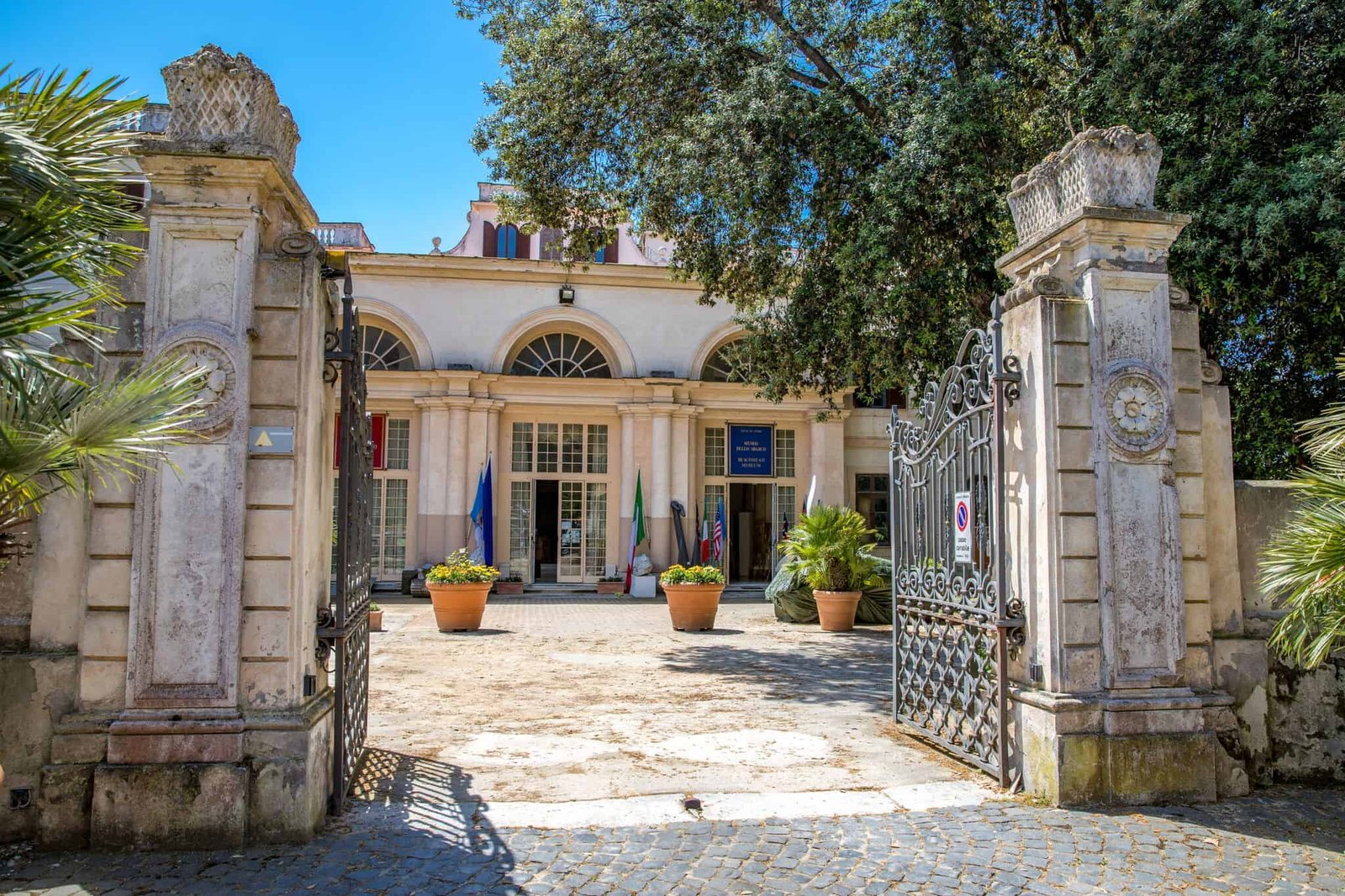
Villa Adele, home of the Anzio BeachHead Museum
Before looking at the display cases it is worth looking at the building. Villa Adele is a 17th-century villa, and the current reconstruction traces its layout back to the period when, in 1594, Pope Clement VIII commissioned Monsignor Bartolomeo Cesi to refound the town of Anzio, then reduced to very little. The property passed from family to family over three centuries, came to the Pamphilj by exchange in 1834, and on August 5, 1964 became the property of the Municipality of Anzio. The name comes from Adele, wife of Francesco Borghese: he had the Sala delle Conchiglie built here, a decorated room worth a stop of its own.
What the Villa Adele park houses today
Within the same grounds you find the municipal library, some offices, a children's play area, the Museo civico archeologico and the landing museum. It is a coexistence that works in the visitor's favor: with a single stop you cross 2,000 years, from Roman Antium to 1944. The Museo civico archeologico, opened in 2002, occupies the ground floor with nine rooms devoted to the development of ancient Antium, with grave goods from protohistoric burials, votive materials, underwater finds, figurative frescoes of the second century AD and the Neronian mosaic niche with the drunken Hercules. It has its own hours, generally Tuesday to Sunday 10:30-13 and 16-18 with Wednesday afternoon closed, and the phone number 06 98499427: it's best to check first, because the two museums are not open on the same days.
The announced move of the Anzio BeachHead Museum
The Municipality of Anzio has included in its public works program the move of the landing museum to larger spaces, still inside Villa Adele, in the rooms that housed the local police command. The display created in 1994 would be relocated to larger and more functional rooms. Before leaving, then, a phone call to the museum or a look at the official site avoids surprises about which entrance to use.
What you see in the Anzio BeachHead Museum, section by section
The museum was born on January 22, 1994, for the 50th anniversary of the landing, on the initiative of the members of the Centro di ricerca e documentazione. It is not a state museum with a research office behind it: it is a collection built piece by piece, largely with donations from the veterans' associations of the countries that fought here. The arrangement is by nationality, and this choice is its strength. Four sections: American, British, German, Italian. Whoever enters goes from one display case to the next and sees the same battle from four points of view, with four different uniforms and four different ways of telling the same hunger, the same cold, the same mud.
The American section of the Anzio BeachHead Museum
It is the richest, and that makes sense: the Americans at Anzio were the bulk of the VI Corps, and their veterans have been the most generous donors for decades. There are authentic uniforms, unit insignia, decorations, service records, battle plans, personal photographs. These are relics of the 3rd Infantry Division, of the men who landed on the beaches code-named X-Ray, of the paratroopers of the 509th battalion, of the Rangers. Anyone with even a little familiarity with American military heraldry spends a good half hour here recognizing the collar patches. Anyone without it should look at the photographs: the faces of those boys say more than any caption.
The British section of the Anzio BeachHead Museum
The British 1st Division landed at Peter Beach, northwest of Anzio, and in the British section you find its uniforms, its insignia, its documents. It is the part Italians look at most quickly and that instead deserves attention: the British component of the Anzio front paid a very high price on the plain toward Campoleone and around the Aprilia factory, the one that appears on Allied maps as the Factory. A clear opinion: if you have little time, this is the section in which to slow down, because it is the one the Italian imagination knows least about.
The German section of the Anzio BeachHead Museum
The German section is the main reason this museum is not a propaganda museum. Displaying the uniforms, insignia and documents of the enemy, obtained through veterans' associations as well, means affirming that war is told from all sides or it is not told at all. On the Anzio front the Germans were under the command of Field Marshal Albert Kesselring, and on the ground the 14th Army of Eberhard von Mackensen. They were the ones who blocked the beachhead for four months. The German display case, looked at after the American one, leaves a precise feeling: two very young armies, dressed differently, dead in the same ditch.
The Italian section of the Anzio BeachHead Museum
It is the shortest section and the most painful. The Italians, at Anzio and Nettuno, in January 1944 were above all civilians caught between two armies. Hundreds of residents were put on American ships and taken toward the south of the peninsula, away from homes that were collapsing in the meantime. The two towns came out of the battle almost razed to the ground. The Italian section gathers documents, photographs, minimal objects of that population, and it should be read as the key to the whole museum: the reason the display was conceived as a condemnation of war and not as a gallery of trophies.
Flags, period prints and military motor vehicles
Beyond the four sections the museum displays flags, collections of period prints and military motor vehicles, which also arrived by donation from foreign museums and associations. The collection grows year after year: anyone who comes back after a few seasons always finds something that wasn't there before. That is the advantage of museums made by associations, which live on personal relationships with veterans and their families, and also their limit, because growth depends on who knocks at the door.
Photo library, tape library, library and newspaper archive of the Anzio BeachHead Museum
Alongside the exhibition the research center keeps a photo library, a tape library with recorded testimonies, a library and a newspaper archive. It is the part invisible to the hurried visitor and the most valuable for anyone who studies: newspapers of the period, memoirs, recordings of the voices of veterans who are no longer with us. If you are working on a thesis, a documentary or the family history of a soldier who passed through here, write to the museum's address before showing up: consultation depends on the availability of the volunteers.
The finds that came from the bottom of the sea
Many of the objects on display don't come from English or American attics: they come from the sea in front of Anzio. On the seabed, at different depths, lie airplanes, warships and cargo ships, landing craft. Often they lie with their crews aboard, and for that reason they are in every respect war graves. The museum cites, among others, the British destroyer Janus, the cruiser Spartan and the hospital ship St. David. Casualty figures vary depending on the source and should be taken as estimates: for the Janus the museum indicates 158 men, while US Navy documentation counts 159 among officers and crew. For the Spartan the museum speaks of 46 dead and 42 wounded. For the St. David, of 57 men and two nurses, where American sources indicate about a hundred victims in all. Looking at a helmet corroded by salt, knowing where it comes from, changes the way you look at the sea of Anzio from the promenade half an hour later.
Operation Shingle told in front of the display cases of the Anzio BeachHead Museum
The museum can only be understood if you know the battle. It's worth arriving prepared, because the display favors objects over explanatory panels and takes for granted that the visitor already knows what it is about.
Why the Allies landed at Anzio
At the end of 1943 the Allied advance up the peninsula had run aground against the Gustav Line, the German fortified axis centered on Cassino. The idea of Operation Shingle was to outflank that line by sea, landing behind the Germans, about 30 kilometers from Rome, to force Kesselring to pull forces from the Cassino front and to open the road to the capital. Command of the Italian theater was in the hands of the British general Harold Alexander, the US Fifth Army was Mark Clark's, and the VI Corps that landed was under Major General John P. Lucas. Anyone who wants to see the other half of this story should find time for Cassino and the Abbazia di Montecassino: the two events explain each other.
January 22, 1944, hour by hour
The landing began at two in the morning on January 22, 1944. There were three beaches: X-Ray Red and X-Ray Green, a couple of miles below Nettuno, where the American 3rd Infantry Division came ashore. Yellow Beach, in front of Anzio, where the Rangers and the 509th Parachute Battalion landed. Peter Beach, about 10 kilometers to the northwest, for the British 1st Division. The naval force, Task Force 81 under the American Rear Admiral Frank J. Lowry, fielded among other units four cruisers, 28 destroyers and over 200 ships and landing craft. By midnight of the first day about 36,000 men and 3,200 vehicles were ashore, that is 90 percent of the planned assault load. And the surprise worked: losses on the first day were 13 dead, 97 wounded and 44 missing or captured, while the Germans captured numbered 227. The port of Anzio was taken almost intact.
The wildcat and the stranded whale
Then everything stopped. Lucas chose to consolidate the beachhead before launching toward the Alban Hills, and that choice is still the most debated question of the entire Italian campaign. Winston Churchill dismissed it with a sentence that every Anzio guide carries around: he had hoped to hurl a wildcat onto the shore, and instead he found himself with a stranded whale. At the end of January there were about 61,000 Allied men in the pocket against 71,000 Germans. At the end of March the VI Corps had reached 90,000 men, but the beachhead was still a beachhead.
Cisterna, January 30, 1944: Darby's Rangers
On January 30 the Rangers of Colonel William O. Darby, first and third battalions, attacked toward Cisterna, infiltrating at night. The official history of the United States Army records the figure in one chilling line: of the 767 men committed to the attack, only six returned. The others fell or were taken prisoner. There is no display case, in any museum, that stands up to that number. Keep it in mind when, in the American section, you come across a Ranger insignia.
The German offensive of February 1944
Between February 7 and the first days of March the Germans counterattacked with everything they had, with the greatest effort between February 16 and 20, when von Mackensen tried to split the beachhead in two along Via Anziate. It was the phase in which the front turned over: those who had landed became the besieged. On February 22 Lucas was relieved of command and replaced by Lucian Truscott. Anzio, in those weeks, was a town with no rear area: the port, the field hospitals, the depots were all under artillery fire.
From the beachhead to Rome
The breakthrough came only in the spring, when the general Allied offensive broke through the Gustav Line and the VI Corps finally came out of the pocket. Rome was liberated on June 4, 1944, more than four months after the landing that was supposed to have brought that date forward by weeks. The toll, according to Imperial War Museum estimates, is very heavy: the VI Corps had about 29,200 combat casualties, of which about 4,400 dead, 18,000 wounded and 6,800 missing or captured, plus about 37,000 non-combat casualties, that is illness, frostbite, nervous breakdowns. German losses are estimated at around 27,500 men, of which about 5,500 dead, 17,500 wounded and 4,500 captured. These are estimates, and as such they should be reported. But they are enough to explain why at Anzio there are three war cemeteries within a radius of a few kilometers.
A curiosity about Anzio BeachHead Museum - Museo dello Sbarco di Anzio
The real curiosity of this museum is not in a display case: it is in the idea that generated it. The Anzio BeachHead Museum was not born from a ministerial decree but from a group of people who, in the 1980s and 1990s, started writing letters to the museums and veterans' associations of all the countries that had fought here. Americans, British, Germans, Italians. They asked for uniforms, insignia, documents, photographs, and they got them. The museum opened on January 22, 1994, the day of the 50th anniversary of the landing, and since then the collection has never stopped growing by the same route: someone dies, the children open a trunk, and out of that trunk comes a piece of Anzio.
Then there is the curiosity tied to the container. The landing museum is housed in a villa born from a repopulation project wanted by a pope at the end of the 16th century, and it takes its name from the wife of a 19th-century Borghese. In the same villa that welcomes the relics of the most destructive war of the 20th century there is a Sala delle Conchiglie of decorative taste, and on the ground floor an archaeological collection that speaks of imperial Antium. The leap between the mosaic niche with the drunken Hercules and an American helmet fished up from the seabed is one of those that stay with you. Another detail almost nobody notices: the villa was private property until August 5, 1964, when it passed to the Municipality of Anzio. 20 years after the landing, the place that would keep the memory of the battle became public.
Something nobody tells you about Anzio BeachHead Museum - Museo dello Sbarco di Anzio
That admission is free, and booking is free too. No ticket, no cash desk, no line. Put like that it sounds like simply good news, but it is the most important piece of information you can give about this place, because it explains everything else: the museum runs on volunteer work, and its hours depend on who is there. The ODV acronym that accompanies the name of the Centro di ricerca e documentazione is not bureaucracy, it is the real structure of the institution. The practical advice, then, is simple: phone the museum's number before leaving, especially if you come from far away, if you are in a group or if you turn up on a bridge day. The booking form on the official site exists precisely for this, and filling it out takes two minutes.
The second thing nobody says concerns the closing days. Many guides repeat that the museum closes on Monday, like almost all Italian museums, and forget Wednesday. Anyone who plans the trip for midweek risks finding the park gate open, children playing in the garden, the library running and the museum door closed. It has happened to more than one group. Third thing, the most practical: Villa Adele houses two different museums with two different calendars, so the perfect day is the one when both are open, and the only way to know is to ask. Last note: the museum provides lockers for personal items and restrooms, and has a ramp for disabled access.
My advice for visiting Anzio BeachHead Museum - Museo dello Sbarco di Anzio
Get there at 10 in the morning on a Tuesday or a Thursday in the off season, by train from Roma Termini, and plan on a whole day in Anzio, not an hour and a half. The museum itself takes 40 minutes if you rush, an hour and a quarter if you read the captions and look at the photographs one by one. But visiting it alone, cut off from the area, is a waste. The recommended sequence is this: first the museum, to get the coordinates of the battle. Then the Museo civico archeologico on the ground floor if it is open, to understand what Anzio was before it became a beachhead. Then the harbor and the seaside promenade, looking at the stretch of coast where the men came ashore. In the afternoon, one of the war cemeteries.
Second recommendation, and here I am categorical: don't bring to this museum the attitude of a collector of war curiosities. The place was built by people who saw that war, with the declared intention of condemning it, and whoever works at the entrance desk senses it right away. Talk to the volunteers. They are the real audio guide of Anzio: many of them personally collected the testimonies kept in the tape library and can tell episodes that no panel reports. Third: if you are traveling with teenagers, prepare them beforehand with two dates, January 22 and June 4, the beginning and the end. Without those two handholds the display cases stay silent. Fourth: the date of January 22, every year, is a day of ceremonies in Anzio. It's the most intense time to come and the worst for a calm visit. You choose what interests you more.
Another well-known fact that is rarely mentioned
Many people know, at least by hearsay, that a German railway gun shelled the Anzio beachhead. What is rarely mentioned is its later story, which is instructive about how a myth is built. The Germans used two Krupp K5 railway guns in the area, christened Robert and Leopold. The Americans, who couldn't tell them apart from below and didn't know how many there were, called them Anzio Annie and Anzio Express, convinced for a while that they were facing only one. The two guns were captured and a single one was put back together, over 30 meters long, weighing 218 tons, with a barrel of over 20 meters and 116 tons. That gun remained for more than 65 years at the Ordnance Museum at Aberdeen Proving Ground, in Maryland, and in November 2010 it was transferred to Fort Lee, in Virginia, where it is on permanent display.
The rarely cited fact, then, is double. The first: one of the symbols of the Battle of Anzio is not in Anzio, it is in the United States, and on top of that it is a hybrid, a single piece born from two. The second, less picturesque and more important: those guns fired on a town full of field hospitals and depots, in a space so tight that on the beachhead there were no safe rear areas. The phrase the soldiers repeated at the time, and that the correspondents picked up, was that at Anzio no area was immune. It was not rhetoric: it was topography.
The right photo to take at Anzio BeachHead Museum - Museo dello Sbarco di Anzio
The best photograph is not the one of the display case. War museum display cases photographed with a phone always give the same result: reflections, the green of neon light, unreadable objects. Before shooting, in any case, ask the volunteers at the entrance desk how they handle photographs and groups: it is a collection made of private donations and the courtesy of asking is the minimum.
The right photo, for me, is only one: the facade of Villa Adele seen from the park avenue, with the trees entering the frame on the sides and the villa closing the perspective. It is the image that tells the one thing about this museum that you can't understand from the guides, namely that the relics of the landing are kept inside a 17th-century noble villa in the middle of a public garden where children play. Shoot it in the late afternoon, when the raking light hits the plaster, or at 10 in the morning in winter, when the shadow is still long and the park is empty.
The second photograph, the one I recommend taking after the visit and not before, is not shot at the museum. It is shot on the Anzio seafront, looking toward the stretch of coast where on the night of January 22, 1944 36,000 men came ashore. There is nothing to see: sand, umbrellas in summer, a few rocks. That is exactly the point. Put the two images in sequence, the villa and the ordinary beach, and you have told Anzio better than any caption.
Some important events that happened here in history
The first is obvious and is the very reason for the museum: the night between January 21 and 22, 1944, when the Allied fleet appeared off this coast and at two in the morning began landing men and vehicles on three beaches between Anzio and Nettuno. In the first 24 hours about 36,000 men and 3,200 vehicles came ashore, with very low losses. In the following weeks, along the front that ran from Torre Astura to Tor San Lorenzo di Ardea, over 100,000 men passed through in all. The town, which at that point was literally in the middle, was partly evacuated by sea: hundreds of residents were put aboard American ships and taken to the south of the peninsula.
The second event is the reversal of February 1944, when the Germans went on the counterattack and for weeks the beachhead risked being split in two. The third is January 30 at Cisterna, with Darby's Rangers almost wiped out. The fourth is February 22, with the removal of Lucas and the arrival of Truscott, one of the few cases in which the commander of an army corps is replaced in the middle of a battle. The fifth is June 4, 1944, the liberation of Rome, for which all of this had been planned.
Then there is a postwar event that concerns the town and not the battle, and it is right to remember it: on April 25, 2004 the President of the Republic Carlo Azeglio Ciampi presented the Municipality of Anzio with the Gold Medal of Civil Merit. It is not a matter of protocol. It is the formal recognition that what happened here in 1944 was not just a battle between armies, but the destruction of a civil community. The landing museum, with its Italian section, is the translation of that medal into objects.
Who has passed through Anzio BeachHead Museum - Museo dello Sbarco di Anzio
Through this villa, every January 22, pass the official delegations of the countries that fought on this plain, the mayors of the coast, the schoolchildren of the schools of Anzio, Nettuno, Aprilia and Latina, and above all the relatives of the fallen. They are the most important audience of this museum: grandchildren and great-grandchildren who arrive with a name, a serial number and a photograph, and who look for a match in the display cases or in the archives of the research center. For years the veterans themselves passed through too, American, British, German, and it was they, or their associations, who donated a large part of what is now on display.
Over the ground the museum tells about passed the whole Allied command in Italy: General Harold Alexander, Mark Clark of the Fifth Army, John P. Lucas who commanded the landing and paid for it with his career, Lucian Truscott who replaced him, Colonel William O. Darby with his Rangers, Rear Admiral Frank J. Lowry with his naval force. On the other side of the front, Field Marshal Albert Kesselring and General Eberhard von Mackensen. Ernie Pyle also passed through, the most widely read American war correspondent of his generation, who from the beachhead signed, among others, the column titled No Area is Immune, published on March 28, 1944: it told that at Anzio there was no place under cover.
And then there is a personal story that tied Anzio to a name in 20th-century music. On February 18, 1944, during the fighting on the beachhead, the British noncommissioned officer Eric Fletcher Waters fell. His son Roger was five months old and would become one of the founders of Pink Floyd. In 2014, for the 70th anniversary, Roger Waters came in person to Anzio and Aprilia: at the place of his father's death, on Via Pontoni in Aprilia, an obelisk with lines from one of his songs was unveiled, and the Municipality of Anzio granted him honorary citizenship. Anyone who visits the museum and then goes on to that monument closes a circle that lasts 70 years.
The war cemeteries around the Anzio BeachHead Museum
The museum visit remains incomplete without at least one of the three military cemeteries in the area. They are places of reflection, not attractions: you enter in silence, you don't have picnics, you don't shout.
Beach Head War Cemetery
North of Anzio, it is the larger of the two Commonwealth cemeteries in the area: it contains 2,313 burials, of which 291 are unidentified. It grew up around a casualty clearing post active during the battle, and the remains from small temporary cemeteries in the surrounding area were later concentrated there. Almost all the dead date from the period between January and June 1944. 69 Canadians also rest there, most of them belonging to the First Special Service Force, the mixed Canadian and American unit that fought right here.
Anzio War Cemetery
One kilometer north of the town, on Via del Cimitero, it holds 1,056 Commonwealth burials of the Second World War, of which 1,038 are identified. The ground was chosen very shortly after the landing, when the battle was still going on, and the first burials date from those same weeks. The design is by Louis de Soissons, the architect who designed a large part of the British war cemeteries in Italy.
Sicily-Rome American Cemetery in Nettuno
The American cemetery is in Nettuno, at Piazzale Kennedy 1, about a 10-minute walk from the Nettuno railway station, the terminus of the same line you took to reach Anzio. It extends over about 31 hectares and holds 7,845 burials of American servicemen. On the walls of the chapel are engraved 3,095 names of the missing. The visitor center, opened in May 2014, occupies about 2,500 square meters. It is open every day from 9 to 17 and is closed on December 25 and January 1. If you have only one day and have to choose, choose this one: the proportions of the field of crosses say by themselves what the numbers of the estimates can't. The Basilica of Neptune is a few minutes away and completes the tour of the old town.
What to see in Anzio after the Anzio BeachHead Museum
The port of Anzio, which in 1944 was taken almost intact and became the lung of the beachhead, is today a fishing and tourist harbor where you eat fish better than at many Roman addresses. The seaside promenade, the caves along the coast and the remains of the imperial villa on the sea tell the other Anzio, the ancient one, the same one that the archaeological museum of Villa Adele documents on the ground floor with its nine rooms. If you have a car, within half an hour you find Torvaianica and the beaches of the coast to the northwest.
Those who instead want to continue along the thread of 20th-century memory have, within an hour, some of the hardest and most important places in Lazio: the Museo storico della Liberazione di Roma on Via Tasso, the Ardeatine Caves Mausoleum, the Casa della Memoria e della Storia, the Jewish Museum of Rome. On the military and technical side there are the Museo storico della Fanteria and the Museo storico della Motorizzazione Militare. To the south, the Pontine Land Museum explains the land reclamation and the founding of the new towns that form the backdrop to the battle, while the Punta Rossa Batteries in the Circeo National Park show the coastal fortifications of the same war. Toward the hills, Velletri and the Castelli Romani were the never-reached objective of the January race.
The Anzio BeachHead Museum with children and school groups
It is a museum suited to kids from fifth grade up, and it becomes memorable in middle school. The uniforms, insignia, motor vehicles and flags work visually, and the modest size of the display avoids the fatigue that huge museums cause in children. Under 10 years old, instead, the risk is that the military object will be read as a toy: if you bring small children, devote the park and the archaeological part to them and leave the war display cases for another time.
For school groups the right channel is booking through the form on the official site or a phone call. The museum is run by volunteers, so a class that arrives without notice may find the door closed or the staff busy. A teaching suggestion that always works: assign each student, before entering, a nation among the four sections, and ask them to tell the battle from the point of view of that soldier. The museum, arranged by nationality, is built precisely for an exercise of this kind.
Accessibility and services of the Anzio BeachHead Museum
The museum declares a ramp for disabled access, lockers for storing personal items and restrooms. Villa Adele is accessible and the park is flat, which makes the route from the station to the museum manageable even for those with mobility difficulties or pushing a stroller. Anyone with specific needs should make a phone call beforehand anyway: in a facility run by volunteers, assistance to the individual visitor depends on who is there at that moment. Audio guides are listed among the available services, but here too it is best to ask for confirmation first.
When to go to the Anzio BeachHead Museum and when to avoid it
The best period runs from October to May, with the exception of the days around January 22, which are the most loaded with meaning and the least suited to a quiet visit. On those days Anzio fills with ceremonies, delegations, wreaths, bands, and the museum becomes the symbolic center of the town. If the atmosphere interests you, come then. If you want to look at the objects calmly, come two weeks later.
From July to mid-September the coast is besieged by beachgoers, the trains are full, parking is impossible to find and the museum's hours slide to the late afternoon, from 17 to 19. In that period the formula that works is the morning: museum at 10, harbor and a fish lunch, sea in the afternoon. Never the reverse: coming out of the water at five to rush to the museum is the best way to see nothing.
How much it costs to visit the Anzio BeachHead Museum
Zero. Admission to the museum and booking are free, as indicated by the official site. The real cost of the day is therefore all elsewhere: the round-trip regional train ticket from Roma Termini to Anzio, parking if any, lunch. Unrequested but useful advice: a free museum run by volunteers lives on donations and on memberships in the association. If the place was useful to you, leaving something is a sensible thing to do. Anyone who wants to visit the Museo civico archeologico on the ground floor as well will find a different layout and its own hours, and it is best to check them in advance.
Quick questions about Anzio BeachHead Museum
Where exactly is the Anzio BeachHead Museum?
At Via di Villa Adele 2, 00042 Anzio (RM), inside the Villa Adele park, a five-minute walk from the Anzio railway station.
How much is a ticket for the Anzio BeachHead Museum?
Nothing: admission is free, and booking is free too. There is no full-price and reduced ticket because there is no ticket.
What are the hours of the Anzio BeachHead Museum?
From September to June from 10 to 13 and from 16 to 18. In July and August from 10 to 13 and from 17 to 19. Closed on Monday and Wednesday. Hours may vary: the reference is the museum's official site.
Do you need to book to visit the Anzio BeachHead Museum?
It is not mandatory for the individual visitor, but it is strongly recommended for groups, school groups and for those coming from far away. On the official site there is a free booking form.
How long does the visit to the Anzio BeachHead Museum take?
Between 40 minutes and an hour and a quarter, depending on how long you stop at the photographs and documents. With the archaeological part on the ground floor it comes to two hours.
How do you get to the Anzio BeachHead Museum from Rome?
By regional train on the FL8 line from Roma Termini toward Nettuno, getting off at Anzio station. From there it is a five-minute walk. By car you arrive from the Pontina or the Nettunense.
Is the Anzio BeachHead Museum wheelchair accessible?
The museum lists among its services a ramp for disabled access, as well as lockers and restrooms. The park is flat. For special needs it is best to phone first.
Can you take photographs inside the Anzio BeachHead Museum?
Ask at the entrance desk: the collection is made up largely of private donations and the conditions are set by those in charge of the museum.
How many sections does the Anzio BeachHead Museum have?
Four, arranged by nationality: American, British, German and Italian. There are also flags, period prints, motor vehicles and the archives of the research center.
When was the Anzio BeachHead Museum opened?
On January 22, 1994, on the 50th anniversary of the landing, on the initiative of the members of the Centro di ricerca e documentazione sullo sbarco e la battaglia di Anzio.
Who runs the Anzio BeachHead Museum?
The Centro di ricerca e documentazione dello sbarco e della battaglia di Anzio, a volunteer organization. It is not a state museum.
What was Operation Shingle?
The code name of the Allied landing at Anzio and Nettuno on January 22, 1944, designed to outflank the Gustav Line by sea and open the road to Rome.
How many men landed at Anzio on January 22, 1944?
About 36,000 men with 3,200 vehicles by midnight of the first day, according to the official history of the United States Army. On the front, in the following weeks, over 100,000 men passed through in all.
What were the losses of the Battle of Anzio?
They are estimates. For the VI Corps, the figures are about 29,200 combat casualties, including about 4,400 dead, and about 37,000 non-combat casualties. German losses are estimated at around 27,500 men.
Why is the Anzio landing considered a half failure?
Because the surprise succeeded but the exploitation did not: the VI Corps consolidated the beachhead instead of heading straight for the Alban Hills, the Germans had time to tighten the encirclement and Rome was liberated only on June 4, 1944.
What was Anzio Annie?
The nickname the Americans gave to the German Krupp K5 railway guns that shelled the beachhead. Two were captured, Robert and Leopold, from which a single piece was put back together that is now on display in the United States.
Which war cemeteries can you visit near the Anzio BeachHead Museum?
The Beach Head War Cemetery and the Anzio War Cemetery, both Commonwealth, and the Sicily-Rome American Cemetery in Nettuno, with 7,845 burials and 3,095 names of the missing.
Is the Anzio BeachHead Museum suitable for children?
From fifth grade up it works very well. Under 10 years old it is best to favor the park and the archaeological section.
Is there anything else to see in the same building as the Anzio BeachHead Museum?
Yes: on the ground floor of Villa Adele is the Museo civico archeologico di Anzio, opened in 2002, with nine rooms on ancient Antium. It has its own calendar and hours.
Is there a cloakroom or luggage storage at the Anzio BeachHead Museum?
The museum lists lockers for storing personal items among its services. It is not luggage storage: suitcases and trolleys are better left elsewhere.
Do you wait in line at the Anzio BeachHead Museum?
Practically never, outside anniversary days. The problem is not the line: it is finding it open.
What is the difference between the Anzio BeachHead Museum and the archaeological museum of Anzio?
The first tells 1944, arranged by fighting nations, and is free. The second tells ancient Antium in nine rooms on the ground floor of the same villa. They are two distinct institutions with distinct hours.
There are museums you visit for the beauty of the objects. This one you visit for the opposite: because the objects are poor, dented, rusted by salt, and for that very reason they tell the truth. A field jacket, a spoon, a letter folded in four, a helmet pulled up from 20 meters deep. Anyone who arrives in Anzio with the idea of seeing a military museum leaves with something different in their pocket. The final advice is not to stop at the park gate: walk to the sea, sit on a low wall and look at that perfectly ordinary beach for 10 minutes. It is the piece of the display that the museum can't exhibit, and it is the one that stays.
Article written by the editorial team of TourLeaderPro, contact them for Private/Corporate/V.I.P. Tours and Experiences.
Planning a trip to Rome? The English guides to visiting the city are on ItalyPlanner.com.