Satrico – Ancient City of Satricum – Acropolis
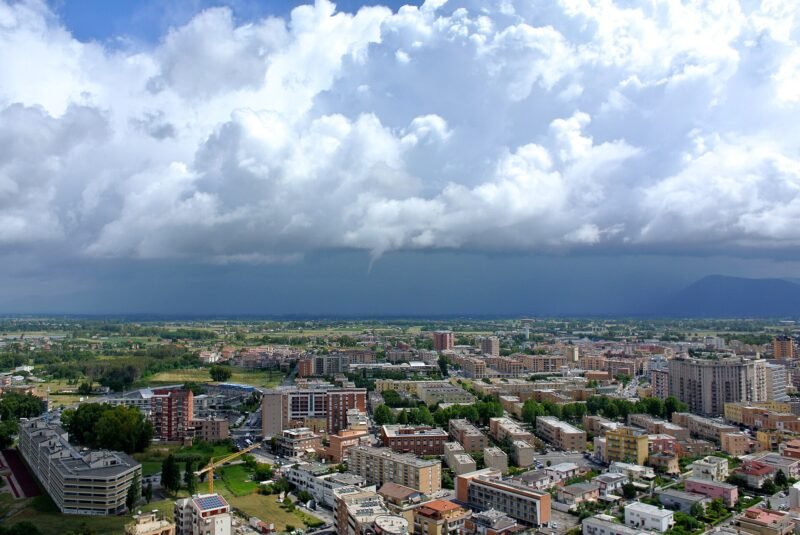
In short. The archaeological area of the ancient city of Satricum is at 101 Via Nettunense, in Borgo Le Ferriere, a hamlet of the municipality of Latina, about 60 kilometers south of Rome and about nine kilometers from the sea, on the right bank of the Astura river.

The archaeological area of the ancient city of Satricum is at 101 Via Nettunense, in Borgo Le Ferriere, a hamlet of the municipality of Latina, about 60 kilometers south of Rome and about nine kilometers from the sea, on the right bank of the Astura river. Access to the excavation area is free and unattended, with no continuous ticket-office hours: there's no cash desk, no turnstile, and the visit is organized around the openings of the permanent exhibition set up in the former factory of Borgo Le Ferriere and the open days promoted by the Municipality of Latina and local associations. Before leaving it's best to ask for confirmation from the Municipality of Latina or from the archaeological mission of the University of Amsterdam, which directs the excavation: openings change with the season and with the excavation campaign under way. You get there by car along the Nettunense, between Latina and Nettuno. Public transport to Borgo Le Ferriere is scarce and should be checked with the regional company before setting out. The ground is grassy and gently sloping, so closed shoes are needed. In summer there is no shade on the acropolis.
An honest warning, even before the history: Satrico is not a monumental site. There are no standing columns, no theater, no paved road to walk. There is a cultivated plateau, the edge of a cliff above a river, and under your feet one of the most important stratigraphies of ancient Lazio. Anyone who arrives expecting Ostia Antica leaves disappointed in 20 minutes. Anyone who arrives knowing what they are looking at spends half a day.

Where Satrico is and how to reach the ancient city of Satricum
Geography explains Satrico better than any chronicle. The site occupies a series of low rises on the right bank of the Astura, at the southern edge of Latium vetus, in that strip of land that the Romans called generically the Agro Pontino and that until the land reclamation of the 1930s was water, reeds and malaria. Nine kilometers separate the acropolis from the coast: enough not to be a seaside city, close enough to control whoever came up the river. And the river, for an Iron Age settlement, was a road.
Satrico by car
From Rome the simplest way is the Pontina up to Latina, then the Nettunense in the direction of Anzio: Borgo Le Ferriere appears as a line of low houses on the road, with the former factory recognizable by its industrial brick structure. Number 101 is the reference for the archaeological area. You park along the road or in the adjacent dirt lots. There is no dedicated parking lot with marked spaces. From Anzio and Nettuno the trip is a scant 20 minutes, and this is the smart way to fit Satrico into a day on the coast.
Satrico by public transport
The rail connection doesn't reach Borgo Le Ferriere. The useful station is Latina Scalo, on the Rome-Naples line via Formia, from which however you need an intercity bus with sparse frequencies, especially on weekends and in the summer months. The runs should be checked directly with the regional transport company: publishing a schedule here would mean handing the reader a datum destined to go stale in a week. The practical advice: for Satrico you rent a car or arrange a transfer, period.
When to go to the ancient city of Satricum
March, April, the first half of May, and then October. The plateau in spring is green and the line of the agger can be read in the ground much better than in August, when the sun flattens every difference in level and the stubble hides the cuts. Summer does have one advantage: from June the Dutch mission opens the dig, and seeing archaeologists at work inside a trench completely changes your perception of the place. In winter the ground turns muddy and the visit loses its point.

What you see today at the ancient city of Satricum
The ancient settlement was organized in two parts. The first is the acropolis proper, a rise of about four hectares defended by steep slopes on several sides: here stood the sanctuary, and here are concentrated the excavations that have yielded the most famous finds. The second is the plateau that extends to the west, a good 40 hectares, naturally protected on three sides and closed artificially on the fourth by an embankment. 40 hectares is a measure that says a lot: in the 6th century BC Satrico was a real city, of a size comparable to the great Latin centers, not a fortified village.
The acropolis of Satrico
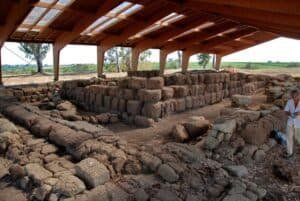
On the acropolis you walk among the foundations of the sanctuary, the consolidated excavation cuts and the information panels. The visible structures are in blocks of local tuff and limestone, often at foundation level: the upper courses have disappeared, reused over the centuries as building material for the farms of the area. The best view is had by standing on the eastern edge, where the ground drops toward the Astura: from there you understand why nobody ever needed to build walls on that side.
The plateau and the settlement of the ancient city of Satricum
The western plateau yielded the houses, the Iron Age huts and, among the residences of the Archaic age, the so-called House A, a high-status building that archaeologists have compared, for plan and proportions, to the Etruscan palaces of Acquarossa, in the Viterbo area. It is a comparison worth understanding: it means that in the Satrico of the 6th century BC lived someone who built as Etruscan princes built, and that the architectural model traveled along the same routes on which the Corinthian vases found in the votive deposits traveled.
The sacred way and the emporium of Satricum
The most recent campaigns of the University of Amsterdam have brought to light the course of the road that climbed to the temple of Mater Matuta and the commercial area connected to the sanctuary, what the publications call the emporium. It is the finding that has changed the reading of the site in recent years: the sanctuary was not an isolated enclosure above a cliff, it was the center of an economic system that traded goods among Etruscans, Latins and the Greek world of Campania. A place of worship that also worked as a market and as guaranteed neutral ground, as happened in many frontier sanctuaries of the ancient Mediterranean.

The sanctuary of Mater Matuta at Satrico
If Satrico counts for something in the history of scholarship, the credit goes almost entirely to its sanctuary. The place of worship on the acropolis shows a continuity of religious use that extends from the 8th century BC to at least the 1st century BC, when the duumvirs of Anzio carved a dedication to the temple. 800 years of uninterrupted worship on a site that in the meantime had been burned at least three times: this is the real anomaly of Satricum, and no guide explains it enough.
Who Mater Matuta was
Mater Matuta, the Propitious Mother, was in Roman religion the deity of the morning and the dawn, and by extension protector of birth, of people and of things that come to light. In Rome she had her temple in the area of the Forum Boarium, where the Matralia were celebrated. The attribution of the Satrico sanctuary to Mater Matuta rests on a stele of the late Republican age found in the area: it is an attribution documented by an inscription, not a deduction, and this makes it solid. What was venerated at that spot in the 8th century BC, when the cult begins, remains instead an open question: the Latin name of the goddess is the last layer of a much older devotion.
The hut sanctuary, from 750 to about 650 BC
The oldest phase of the cult has no temple. It has a hut, and under the hut a deep well that archaeologists identify with the mundus, the ritual pit that in the Italic tradition connects the world of the living with the underground one. It is the type of structure that tradition attributes to the founding of Rome, and finding one at Satrico dated to the 8th century BC means touching with your hand a religious practice that the Latin texts recount from afar, by hearsay, five or six centuries later.
The shrine, or Temple 0, from 650 to about 550 BC
The hut is succeeded by a shrine, a small temple on a rectangular plan of which the foundations remain. Scholars have not reached a definitive agreement on the question of one or two rooms. The precious fact is another: of the building there exists a terracotta model, an ancient votive model that gives back the look of the lost elevation. Terracotta models of this type number very few in Italy, and each is worth an entire excavation campaign, because it is the only way we have of knowing what a 7th-century BC roof was like. The shrine was linked to a votive deposit of enormous value for the chronology of the site.
The first temple, from 550 to about 480 BC
The first true temple measured about 17 meters by 27 and was divided into two rooms, following the scheme found in contemporary Etruscan and Roman temples. The roof was of wooden beams covered with terracotta roof tiles and antefixes. It lacked columns at the back, like Italic temples, but unlike them it did not rest on a raised podium. The terracotta decoration carried themes drawn from Greek mythology, including Perseus and Medusa: they are among the oldest depictions of that repertoire documented at an Italian archaeological site, and on their own would be enough to justify the trip to Le Ferriere. The life of this building was short, a little over 70 years.
The second temple, after 480 BC
The second temple is more ambitious: 21 meters by 34, a different orientation, a higher podium, columns on all four sides. The study of the architectural terracottas has made it possible to reconstruct a decorative program of urban level, with a Gigantomachy on the roof and depictions of deities, including Juno and Dionysus, Zeus and Hera. The antefixes, by contrast, took up the Italic repertoire: Harpies, Typhons, Sileni. It's worth pausing on this contrast, because it tells of a culture that imported Greek myths and mounted them on a local figurative grammar. The publications of the Dutch mission place the three temple buildings overall between 625 and 500-480 BC. The detailed chronologies of the individual phases vary from study to study and should be taken as orders of magnitude, not as archive dates.

The votive deposits of the acropolis of Satricum
Three votive deposits have been identified on the acropolis, that is, three deposits of sacred objects accumulated and then buried when the sanctuary was reorganized. Taken together they cover a span from the 8th to the 2nd century BC. Their value is twofold: on one side the quantity and quality of the finds, on the other the function of stratigraphic clock, because it is thanks to these deposits that the phases of the city's settlement have a chronology. For the 7th century BC it is one of the richest finds in Italy, excluding material of Greek origin.
Among the objects recovered are aryballoi, kotylai, that is, a particular type of cup, and oinochoai of the Archaic Corinthian type. There is also a vase of Etruscan bucchero with a dedication to a figure from Caere, and figurines cut out of sheet metal, of Latin manufacture. The Caere vase deserves a mental pause: it means that a citizen of Cerveteri, or someone acting for him, performed an act of worship in this sanctuary. The networks of relations of Archaic Italy passed through here.
The Archaic deposit
Identified inside the first temple, it contained materials datable between the 8th and the 6th century BC, of Italic and Etruscan origin. It is the deposit that documents the phase in which Satrico enters the Etruscan cultural orbit and begins to behave like a city.
The Republican deposit
Found in recent times by the Dutch excavations near the temple of Mater Matuta, it yielded over 2,000 finds. 2,000 objects in a single deposit tell of a sanctuary still very much alive in the Republican age, when the city as a political organism no longer existed.
The Hellenistic deposit
Discovered during the 19th-century excavations, it was originally a large cistern, converted into a votive deposit starting in the 3rd century BC. Many of the materials that come from it are on display at the National Etruscan Museum of Villa Giulia, in Rome, where the section devoted to Satricum is one of the most instructive in the whole museum and remains, in our judgment, the most neglected by visitors who rush to the Sarcophagus of the Spouses.
The Lapis Satricanus, the stone that touches the birth of the Republic
In 1977, while the Dutch mission led by Conrad Stibbe was dismantling the foundations of the last temple of Mater Matuta, a block of stone reused as building material came to light. It bore an inscribed text in Archaic Latin that reads, with the initial gap, thus: IEI STETERAI POPLIOSIO VALESIOSIO SUODALES MAMARTEI. The current translation runs: the companions of Publius Valerius set this up for Mars.
The dating oscillates between the end of the 6th and the beginning of the 5th century BC, that is, right around 500 BC. The name Poplios Valesios corresponds, in the Archaic form, to Publius Valerius. The temptation to identify him with Publius Valerius Publicola, the consul whom tradition places in the first year of the Roman Republic, is very strong and is advanced with caution by a substantial part of scholars. The identification remains a hypothesis, not a documented fact, and anyone who presents it as certainty does the reader a disservice.
The truly explosive term, however, is another: suodales. It does not mean friends. It indicates a group of armed followers bound by a sworn tie to a leader, a private warrior company acting outside the state framework, according to a reading that brings Archaic Latin society close to that of the Homeric poems. If the stone tells the truth, at the threshold of the 5th century BC an aristocrat named Publius Valerius moved between Rome and southern Lazio with his own armed band, and his band performed acts of worship to Mars in a sanctuary at Satrico. It is the epigraphic document that has most influenced the 20th-century debate on the origins of the Republic, and it comes from a field in Borgo Le Ferriere.
A clarification the visitor must keep in mind: the stone was found reused, that is, outside its original context. We don't know where the votive monument it was part of originally stood, and the caution of scholars on this point is obligatory. The current display location of the find should be checked with the body that looks after its conservation, because over the years the stone has been the object of temporary exhibitions.
The necropolises of the ancient city of Satricum
Ancient cities are known from their dead at least as much as from their temples, and Satrico is no exception: the two necropolises identified correspond to two peoples and two different eras, and compared they draw the history of the settlement better than any Livian chronicle.
The Volscian necropolis of Satricum
Identified in 1981 southwest of the acropolis, it yielded over 200 pit tombs datable between the 5th and the 4th century BC. They are inhumation burials, with grave goods made up mostly of pottery, accompanied by a notable quantity of material of Greek, Etruscan and Italic manufacture. 200 tombs over a span of two centuries describe a stable and articulated community, not a camp of occupiers.
The most important find to come out of this necropolis is tiny: a miniature axe found in 1983, inscribed with a short text in the Volscian language dated to the first half of the 5th century BC. The translation remains debated. Its historical weight, however, does not depend on the translation: the object shows that Volscian was a language distinct from Latin, with its own writing tradition. It is kept in the Archaeological Museum of Cassino. To understand who the Volscians were before getting to Satrico it is worth stopping by the Museo la Reggia dei Volsci.
The Latial, or Archaic, necropolis
It came to light during the first excavations of the late 19th century, northwest of the acropolis. The oldest tomb dates to the final phases of the Latial period II A, which pushes the funerary use of the site back to the 9th century BC. The burials belong to three types: chamber, pit and shaft. The grave goods include Corinthian-type vases, shields, spearheads and, above all, an object that keeps surprising anyone who hears it mentioned: a gold dental prosthesis. Prosthetic dentistry in Archaic Lazio, in a country tomb south of Rome. It is details like this that make Italian archaeology hard to sum up in a caption.
The agger and the defenses of Satrico
The course of the defensive embankment, the agger, has been reconstructed on the three sides facing north, west and south. The eastern side didn't need one, defended as it was by the cliff and by the course of the Astura. Outside ran a ditch, of which traces have been identified on the western slope, and between ditch and embankment a reinforcing wall had been erected. The whole reached five or six meters in height. The acropolis also had an independent defensive system on its southern side.
Five or six meters is the right measure for understanding what a war between Latin cities was: no siege engines, no towers, but an obstacle of earth and wood that an army of a few thousand men could overcome only by paying a high price. When you read in Livy that Satrico was taken and burned, you read of men who climbed over this embankment.

Satrico in the ancient sources, an enemy city of Rome
Satrico appears in the list of the 18 Latin cities that tradition attributes to the foundation of Silvius, son of Aeneas. It is a mythical genealogy, not a historical datum, and should be taken as such. It does, however, tell one true thing, namely that in antiquity Satrico was perceived as one of the oldest foundations in Lazio. Then the chronicle begins, and the chronicle is almost all military.
498 BC and the anti-Roman league
During the second consulship of Titus Larcius, after Rome had bent Fidenae, 29 allied cities, including Satrico, gathered with an anti-Roman purpose to decide how to continue the conflict and try to put Tarquin the Proud back on the throne. They were defeated in the battle of Lake Regillus, the episode that Roman tradition loads with every founding significance. Satrico is therefore an enemy of Rome from the first decade of the Republic.
489 BC and Coriolanus
Satrico was one of the cities attacked by the Volscians led by Gnaeus Marcius Coriolanus, the Roman patrician gone over to the enemy whom Shakespeare would make famous 22 centuries later. After taking Longula, the Volscians took Satrico too, sacked it and destroyed the temple on the acropolis. It is the first of the three great fires that mark the life of the city.
Between 393 and 386 BC, the rebellion and Furius Camillus
While the Romans were engaged against the Aequi, Velletri and Satrico rebelled. In 386 BC Marcus Furius Camillus, elected consular tribune, led the soldiers against Anzio, which had taken up arms again against Rome with the support of young Latin and Hernican exiles. The clash took place in the countryside around Satrico, against an army of Volscians, Latins and Hernici that outnumbered them. To this campaign refers the most famous episode of the Camillan repertoire, that of the standard thrown beyond the enemy ranks. Titus Livy tells it in the sixth book:
Having therefore sounded the charge, he got down from his horse and, taking the nearest standard-bearer by the hand, dragged him along toward the enemy shouting: forward the standard, soldier! When the men saw Camillus in person, by now unfit for hardship because of his advanced age, advance toward the enemy, they raised the war cry and threw themselves into the assault all together, each shouting on his own: follow the general! It is also told that Camillus ordered a standard to be thrown among the enemy lines, and that the front-rank men were urged to retrieve it.
The passage is Ab Urbe Condita, VI, 8. Livy writes four centuries after the events and his source is the annalistic tradition of the great families: the episode of the standard belongs to the Camillan legend, not to verifiable chronicle. The Romans nevertheless got the better of the pitched battle, and the Volscians managed to withdraw inside the walls of Satrico thanks to a thunderstorm that interrupted the fighting.
385 BC and the Roman colony
The following year the Roman Senate, the institutional ancestor of the one that today sits at Palazzo Madama, resolved to establish a colony at Satrico, sending 2,000 citizens there, each of whom was assigned two and a half iugera of land. Two and a half iugera correspond to a little over half a hectare: a subsistence plot, not a fortune. The colony lasted very briefly, because already in 384 BC Volscians and Praenestines reconquered the city. Rome once again turned to Furius Camillus, who won a hard-fought victory.
377 BC, the fire of the Latins
In 377 BC Rome had to face yet another Volscian offensive, this time with the Latins lined up beside the Volscians. Once the levy was organized, the army was divided into three corps: one to defend the city, one to guard the Roman countryside, the bulk sent to the front under the orders of Lucius Aemilius and Publius Valerius. The clash took place near Satrico and turned in favor of the Romans, despite the resistance of the Latins, who had learned battle techniques from the Romans. The Volscians withdrew to Anzio and negotiated surrender there, handing over the city and its countryside. The Latins, furious at the defection of their allies and determined to continue the war, set fire to Satrico. The city was destroyed. Only the temple of Mater Matuta was saved.
349 and 346 BC, the end
In 349 BC the Volscians of Anzio rebuilt Satrico and founded a colony there. In three years the city was entirely rebuilt. Rome, which could not tolerate the rebirth of a Volscian power half a day's march from its own territory, made war and won again. Satrico was set on fire a second time and, a second time, only the temple of Mater Matuta was spared. From that moment the settlement never recovered as a political organism, although it remained inhabited at least until the 3rd century BC, when the site took on a purely agricultural character. Pliny the Elder, in the 1st century, will list it among the vanished Latin cities.
The temple spared twice
This is the point on which I invite you to dwell, because it is the real meaning of the site. The armies that took Satrico in 377 and 346 BC razed it to the ground and left its sanctuary standing, not out of pity but out of religious fear: burning the temple of a deity of your own pantheon meant drawing its wrath upon yourself. The stratigraphy of the acropolis confirms what the sources tell, and that doesn't happen often.
Historical criticism: four faces of the same city
The cross-examination of the written sources and the excavation data leads scholars to distinguish four periods. The oldest, between the 10th and the 9th century BC, sees the site occupied by a population of Latin stock, organized in huts. The second, between the 7th and the 6th century BC, marks the formation of a true urban nucleus, and is attributable to Etruscan influence: it is the Satrico of the decorated temples, the bucchero and House A. The third, from the 5th to the 4th century BC, makes Satrico an important Volscian center, with its necropolis, its language and its distinct identity. The fourth, which leads to its disappearance, coincides with Roman control over the city and the territory.
Four peoples, one sanctuary. The continuity of worship runs through changes of master, sackings and destructions: whoever commanded at Satrico, offerings kept being brought to the acropolis. In the religious history of ancient Italy there are few cases as clear, and to understand them it's worth pairing a visit to Satrico with one to Lavinium, where the sanctuary of the 13 altars tells a parallel story.

The rediscovery of the ancient city of Satricum
For 20 centuries Satrico was a name in books and a wheat field in the plain. The story of its rediscovery is one of 19th-century erudition, of church landholdings and, in the end, of Dutch archaeology.
Antonio Nibby and the 1825 location
It was Antonio Nibby, the Roman topographer who gave a name to half the sites of Lazio, who recognized Satricum in what had become the Casale di Conca, inside the vast estate of the same name, owned by the Holy Office of Rome since at least 1713. In the account of his field explorations, carried out at the beginning of the 19th century, Nibby notes that near the farmhouse there operated ironworks powered by the Astura river. From those workshops comes the name of the present locality, Le Ferriere. An industrial place name on top of a Latin city: Lazio is full of these short circuits, but few are as sharp.
From the first surveys to the 19th-century excavations
The first surveys on the ground are due to H. Graillot, of the University of Bordeaux, in the 1880s. For systematic excavations one had to wait until 1896, with campaigns that continued until the end of the century and then, after an interruption ordered by the government, resumed under the direction of Felice Barnabei between 1907 and 1910. Many of the finds that came out of these campaigns were bought in 1903 by the National Etruscan Museum of Villa Giulia, where they still are. Other test digs followed in 1910, 1934 and 1958, without however giving the site a continuity of research.
1977 and the Dutch mission
The turning point comes with a rescue project coordinated by the Royal Netherlands Institute in Rome, started in 1977 under the direction of Conrad Stibbe. Since then the annual campaigns of excavation and study have never stopped, and since 1991 the scientific responsibility has been that of the University of Amsterdam, under the direction of Professor Marijke Gnade. In the summer of 2019 the excavations yielded the remains of a Roman-age villa and three human skeletons. The most recent investigations have concerned the sacred way and the exchange area connected to the sanctuary. Half a century of continuous work on the same site, carried out by a foreign university in a field of southern Lazio, is a circumstance that deserves to be known far more than it is.
The estate, the owners and the land reclamation
In 1873, in application of the law on the sale of church properties, the Conca estate was sold to Count Achille Gori Mazzoleni. In 1918 it passed to Duke Leone Caetani, the Islamicist and politician of the family that also owned Ninfa and Sermoneta, and a few years later to the Dominici family. In the early 1930s the Opera Nazionale Combattenti expropriated most of those lands by virtue of the land reclamation law: it is the season that created Latina, the rural villages and the present geography of the Pontine plain, and that is well told at the Pontine Land Museum.
Maria Goretti at Le Ferriere
In 1902, in a building at Le Ferriere, Maria Goretti was killed, aged 11, later proclaimed a martyr and saint by the Catholic Church. The house of the martyrdom is a few hundred meters from the archaeological area and is a pilgrimage destination: two very distant stories that share the same address. Whoever organizes the day will do well to know it in advance, because on days of devotional crowds the traffic in the village changes noticeably.
The archaeological museum park of Satricum
The administrative picture of the site has changed recently. The Municipality of Latina has moved forward with the establishment of an archaeological museum park of Satricum: the proposal, formalized with municipal resolution number 71 of May 8, 2026, obtained on May 28, 2026 the unanimous favorable opinion of the joint Culture and Urban Planning council committees, before moving on to the city council.
The perimeter of the park is not limited to the excavation area. It includes the permanent exhibition Satricum. Excavations and Archaeological Finds, set up in the former factory of Borgo Le Ferriere and scientifically curated by the University of Amsterdam. It includes the building of the former elementary school, intended for study groups, the former municipal delegation office and the antimalarial structure, planned as a visitor reception center, and the municipal Antiquarium of Borgo Sabotino. To these are added the agreements with the Roman villa, with the industrial archaeology complex and with the sanctuary of Santa Maria Goretti. The declared approach does not provide for new territorial constraints, but for agreements and synergies among the Lazio Region, private owners and church bodies. After approval, the selection of a scientific director is planned, with funding in the 2026-2028 programming.
What this means for those who visit: that in the coming years Satrico will go from a semi-abandoned excavation area to an organized museum system, and that practical information will change several times. The operational advice is simple: phone the Municipality of Latina or the association that handles the openings before getting in the car.
Where the finds of the ancient city of Satricum are
One of the reasons Satrico is less known than it deserves is that its masterpieces are elsewhere. The main core of the 19th-century material is at the National Etruscan Museum of Villa Giulia, in Rome, in Piazzale di Villa Giulia. There you find the architectural terracottas of the temples, which are the reason the sanctuary of Mater Matuta appears in all the manuals of Italic art. The miniature axe with the Volscian inscription is at the Archaeological Museum of Cassino. The exhibition of Borgo Le Ferriere, opened in 2014 in the former factory, gathers about 700 artifacts that reconstruct the story of the site from its origins to its decline, and is the necessary complement to the visit of the field: without that room, the acropolis remains a meadow with some stones.
In southern Lazio there are other museums that help place Satrico in its context: the Privernum archaeological park for the Romanization of the plain, the Archaeological Museum of Palestrina for the great sanctuary architecture of Lazio.
A curiosity about Satrico - Ancient City of Satricum - Acropolis
The curiosity is not about the temple, it is about a mouth. Among the grave goods of the Latial necropolis, the one discovered northwest of the acropolis during the late 19th-century campaigns, a gold dental prosthesis was recovered. A prosthesis. In a tomb of Archaic Lazio, in a settlement that at that time was little more than a village of huts above a river.
Gold dental prostheses are a very well-known chapter of Etruscan craftsmanship, and their presence in Latin contexts documents the passage of techniques and craftsmen along the same routes that carried bucchero and Corinthian vases. They were bands of sheet gold that held a replacement tooth in place, often taken from a human or animal tooth, anchored to the healthy neighboring teeth. They were not functional for chewing: they were prestige objects, and served to let a person of rank appear in public with a full set of teeth.
Which leads to an unromantic but true conclusion: in the Satrico of the centuries around 700 BC there existed a class that cared about its appearance, that could afford gold and that had access to a craftsman able to work it with millimeter precision inside a mouth. The stories about the origins of Rome tell of shepherds and huts. The funerary goods tell of patrons. When someone tells you that Lazio before Rome was a land of primitive villages, think of that prosthesis and smile.
There are other curiosities in the Satrico repertoire that deserve a line: the bucchero vase with a dedication to a figure from Caere, that is, proof of a personal relationship between a man of Caere and this sanctuary. The terracotta model of the shrine, which is an architectural model of the 7th century BC. And the Gigantomachy of the second temple, a decorative program that at Satrico allowed itself what in Rome, in those same decades, few allowed themselves.

Something nobody tells you about Satrico - Ancient City of Satricum - Acropolis
That the site, for much of the year, is a field. Nobody says it because it suits nobody to say it, and yet it is the most useful piece of information you can give to someone planning a day here. There's no ticket office open every day, no bookshop, no equipped route with panels every 20 meters and an audio guide to rent. There is an excavation area with consolidated structures, essential signage, and an exhibition in the former factory whose openings follow a calendar that has to be asked for in advance.
The second thing you almost never read: summer, in terms of the visit, is not the worst season despite the heat, because it's the period when the mission of the University of Amsterdam works in the field. Finding an open trench, with archaeologists sifting and cataloguing, is worth double an information panel. It isn't guaranteed, it depends on the year and on funding, but when it happens it changes the day. In July 2025, for example, the Municipality of Latina and the Acropoli Satricana association organized an evening at the temple of Mater Matuta with a visit to the dig led by Professor Gnade herself and a presentation of the park project: initiatives of this kind recur, and it's worth checking the Municipality's channels before choosing the date.
Third, little-known piece of information: the correct sequence of the visit is the reverse of instinct. Instinct says to go to the dig first and then to the museum. At Satrico the opposite works. Look first at the terracottas, the antefixes, the grave goods. Then go up to the acropolis. Only after seeing what came out of that ground does the ground become legible. Between the two orders the difference in attention is clear.
Fourth: the place has no services. No bar inside the area, no guaranteed restrooms on site, no vending machines. Water and a hat are brought from home. The village offers a few businesses, but with village hours, not city hours.
The advice I give for visiting Satrico - Ancient City of Satricum - Acropolis
Call ahead. It's banal and it's not banal: here the most common mistake is not dressing badly or arriving late, it's arriving on a day when the exhibition in the former factory is closed and finding yourself in front of a field with no key to read it. Ask the Municipality of Latina, which is in charge of the site, or the association that handles the openings, which days and hours of the week you plan to come, and ask if an accompanied visit is possible. With reasonable notice, it often is.
Second piece of advice: build the day around Satrico, don't reduce it to a 20-minute stop. The itinerary that works best, from experience, leaves Rome in the morning, arrives at Le Ferriere at 10:30, devotes an hour and a half to the exhibition and the acropolis, continues to the house of Santa Maria Goretti for the devotional and historical part of the village, has lunch in the area and ends the afternoon on the coast between Anzio and Nettuno, where the civic archaeological museum and the ruins of the imperial villa complete the picture of ancient coastal Lazio. Alternatively you head for Torre Astura, which is the mouth of the same river you see flowing under the acropolis.
Third: shoes. Closed shoes, with a lugged sole. The ground is grassy, sloping on the river side, and after rain it becomes slippery. Sandals and ballet flats are a real problem here, not a formal recommendation. I'll add, from spring experience, that tall grass means ticks: long pants and a check at the end of the day are good practice across the whole Pontine plain.
Frequently asked questions about Satrico, Ancient City of Satricum, Acropolis
Where exactly is Satrico?
Satrico, the ancient city of Satricum, is at 101 Via Nettunense, in Borgo Le Ferriere, a hamlet of the municipality of Latina, about nine kilometers from the sea along the course of the Astura river and about 60 kilometers south of Rome. The site occupies a series of low rises at the southern edge of Latium vetus.
Are Satrico and Satricum the same thing?
Yes, Satrico and Satricum indicate the same ancient Iron Age settlement, today in the Le Ferriere locality: Satricum is the Latin name, Satrico the Italianized form commonly used. The area includes the acropolis with the sanctuary of Mater Matuta and the residential plateau protected by an embankment.
How long does the visit to Satrico take?
Visiting the excavation area of Satrico takes about an hour if accompanied and unhurried, or barely 40 minutes on your own, to which you add another good hour for the archaeological exhibition in the former factory of Le Ferriere, which holds about 700 pieces. Adding the nearby house of Maria Goretti makes a full half day.
Do you need to book or call before going to Satrico?
It's best to call before going to Satrico, because the site has no ticket office open every day and no fixed equipped route: the excavation area and the exhibition in the former factory follow opening days and hours that have to be checked with the Municipality of Latina, which is in charge of the site, or with the association that handles the openings.
What is the Lapis Satricanus found at Satrico?
The Lapis Satricanus is a block of stone with an inscription in Archaic Latin that came to light in 1977 at Satrico, during the dismantling of the foundations of the last temple of Mater Matuta by the Dutch mission led by Conrad Stibbe. The text, which names the companions of a Publius Valerius, is considered one of the oldest testimonies tied to Archaic Rome.
Where are the finds from Satrico kept?
The most important finds discovered at Satrico are not on the site but elsewhere: the main core of the 19th-century material, including the architectural terracottas of the temples of the sanctuary of Mater Matuta, is kept at the National Etruscan Museum of Villa Giulia, in Rome, in Piazzale di Villa Giulia.
What is there to see around Satrico?
Around Satrico is the village of Le Ferriere, with the industrial archaeology complex of the former factory that houses the archaeological exhibition and the house where Maria Goretti was killed in 1902. Anyone who wants to extend the day can also link Anzio or Torre Astura, both in the southern Lazio area.
Fourth, and most important: bring some reading. Satrico doesn't explain itself. If you can't have a guide on site, arrive at least having read the pages on the sanctuary of Mater Matuta the day before. At sites with no installations, the difference between a memorable hour and a wasted hour is all in the preparation. To organize the day with a licensed professional you can contact the TourLeaderPro network, which operates in Rome and Lazio with authorized escorts and guides.
Another well-known fact that is rarely mentioned
That the temple of Mater Matuta was spared twice by the fires, everyone writes, and Livy writes it. Almost nobody, however, draws the consequence, which is the most interesting of the whole Satrico story: the destruction of an ancient city was a regulated act, not an outburst. Whoever burned Satrico in 377 BC and whoever burned it in 346 BC knew exactly where to stop.
The sanctuary was not touched because the deity who resided there was shared. Latins, Volscians and Romans belonged to a common religious system, with recognizable deities and mutually understandable rites. Setting fire to the temple of Mater Matuta would have meant committing a sacrilege against a goddess of their own pantheon, with the ritual and political consequences that entailed. War in Archaic Italy was fought within a shared sacred perimeter, and this perimeter was respected even when an entire city was razed to the ground.
There is a corollary that bears directly on how to read the site. The continuity of worship on the acropolis, from the 8th century BC to the dedication of the duumvirs of Anzio in the 1st century BC, is not proof that the place was peaceful. It is the opposite: it is proof that the sanctuary was so important that it survived three sackings, two total fires and four changes of population. A place of worship that withstands all this was, by every indication, a supra-civic point of reference, frequented also by people who did not live at Satrico.
The second well-known and little-exploited fact concerns the agger: 40 hectares of urban surface enclosed by an embankment place Satrico, by extent, among the largest centers of Latium vetus. In popular syntheses Satrico appears as a minor city. In the numbers, it is not.
The right photo to take at Satrico - Ancient City of Satricum - Acropolis
There is only one photograph that works, and it's not the one of the foundations. Stand on the eastern edge of the acropolis, with your back to the sanctuary area, and frame the drop toward the Astura keeping the ancient structures in the lower third of the frame. That photo tells the one thing the ruins alone cannot say, namely why an Iron Age community chose precisely this rise: the natural defense, the river, the plain open toward the sea.
Now technique: mid-morning in spring, or the last hour before sunset. Raking sun is indispensable, because at Satrico the volumes to photograph are minimal, the changes in level are gentle and noon erases them. With low light the course of the agger and the excavation cuts take shadow and become legible even in a photograph.
Lens: a moderate wide angle, around 24 or 28 millimeters equivalent, keeping the horizon high to give weight to the ground. The telephoto serves little here, except for one detail: the antefixes and terracottas on display in the former factory, which with a 50 millimeter lens and no flash give back much more than you'd expect. If the exhibition is open, ask if photographs are allowed and under what conditions. In rooms run by university missions the rules on materials under study may be stricter than elsewhere.
One photograph I advise against: the close-up of the generic stone block. You come away with dozens of images indistinguishable from one another, and a month later nobody will be able to say what they were looking at. Better two thought-out shots than 40 at random.
Some important events that happened here in history
The first event is the pitched battle of 386 BC fought in the countryside around the city, the one in which the Roman army led by Furius Camillus faced a coalition of Volscians, Latins and Hernici that outnumbered it, and broke it. The thunderstorm that interrupted the clash and let the Volscians fall back inside the walls of Satrico is one of those meteorological details that the annalistic tradition preserves because it served to explain an incomplete victory.
The second is the founding of the Roman colony in 385 BC: 2,000 citizens transferred here by the Senate, with two and a half iugera of land each. It is organized deportation, military garrison and land reform in a single gesture, and it is the model with which Rome built its hegemony over Italy even before having a fleet.
The third is the fire of 377 BC, set by the Latins in reprisal for the Volscian surrender at Anzio. A city destroyed by an ally, not by an enemy: the episode says a lot about the fragility of the anti-Roman coalitions of the 4th century BC, and explains better than any speech why Rome ended up prevailing.
The fourth is the definitive destruction of 346 BC, only three years after the Volscian rebuilding. Rome did not tolerate the rebirth of a Volscian center on that ridge, made war and closed the matter. From that moment Satrico leaves political history and remains a sanctuary in the middle of the fields.
The fifth event is not ancient: it is 1977, the year in which the Dutch mission found the Lapis Satricanus in the foundations of the temple. A discovery from the dig that changed the international debate on the origins of the Roman Republic, coming out of a work site in Borgo Le Ferriere and not from one of the great monumental sites. The sixth, and I cite it because it marks the life of the village, is the murder of Maria Goretti in 1902, which made Le Ferriere a place of national pilgrimage. The seventh is administrative but decisive for the future of the site: the establishment of the archaeological museum park, resolved by the Municipality of Latina in 2026.
Who has passed through Satrico - Ancient City of Satricum - Acropolis
Gnaeus Marcius Coriolanus, the Roman patrician gone over to the Volscians, who in 489 BC took the city, sacked it and destroyed its temple on the acropolis. Scholars discuss if Coriolanus is a historical figure or a construction of the annalistic tradition. Tradition in any case ties him to this place explicitly.
Marcus Furius Camillus, the dictator whom Roman historiography calls the second founder of Rome, who fought at least two campaigns at Satrico, in 386 and 384 BC, by then elderly and according to Livy still able to drag his standards on foot against the enemy. Lucius Aemilius and Publius Valerius, the Roman commanders of 377 BC. And, in the background, that Publius Valerius, perhaps the Publicola of the first years of the Republic, whose name appears carved on the stone found in the foundations of the temple: if the identification holds, the first Roman consul of tradition left a trace of himself not in Rome, but here.
Pliny the Elder did not pass through in person, but in the 1st century he listed Satrico among the Latin cities by then vanished: his is the first finding of the site's death. Titus Livy wrote its military pages, and his words remain the main source against which archaeologists check the stratigraphy.
Antonio Nibby, the topographer who in 1825 recognized Satricum in the Casale di Conca and gave a name back to that ground. H. Graillot, who carried out the first surveys there. Felice Barnabei, who directed the campaigns of the early 20th century. Conrad Stibbe, the Dutch archaeologist who in 1977 reopened the dig and found the Lapis Satricanus. Marijke Gnade, of the University of Amsterdam, who has directed the mission for decades and has personally led dig visits open to the public.
Among the owners of the land passed the Holy Office of Rome, Count Achille Gori Mazzoleni, Duke Leone Caetani, the Dominici family. And Maria Goretti, who lived and died at Le Ferriere, and who remains the best-known figure of this village in the world, much more than the Volscians who buried 200 of their own here.
What is around the ancient city of Satricum
Satrico alone doesn't fill a day, and anyone who treats it as the only destination goes home with the feeling of having traveled far for little. Treated instead as the first chapter of an itinerary in southern Lazio, it works very well.
The village of Le Ferriere
The village keeps the industrial archaeology complex of the former factory, which today houses the archaeological exhibition, and the house where Maria Goretti was killed in 1902, with the sanctuary connected to it. They are two readings of the same place 2,600 years apart, and lined up they hold together.
Anzio and Nettuno
In under half an hour you reach Anzio, the Antium of the Volscians and later the imperial villa of Nero, and Nettuno, with its medieval village and the American cemetery. Anzio is the obligatory historical complement to Satrico: when the sources speak of Volscians who withdraw to Anzio and negotiate surrender there, they are speaking of that coast.
Torre Astura and the coast
The Astura that flows under the acropolis reaches the sea a little farther south, where Torre Astura stands, with the remains of the Roman fish pond and the medieval tower on the water. It is one of the most intact stretches of coast in Lazio, and it ends well a day begun among votive terracottas.
The Circeo National Park
Farther south you enter the Circeo National Park, with the dunes, the coastal lakes and the promontory. For those with two days, the pairing of Pontine archaeology and coastal nature is the best way to get to know this part of Lazio.
Rome, an hour away by road
60 kilometers separate Le Ferriere from the capital. Anyone arriving from abroad who wants to fit Satrico into a stay in Rome will find a good overview in the English guides of ItalyPlanner on day trips out of town and in the page dedicated to things to do in Rome, useful for understanding what to sacrifice in the center to gain a day out in the countryside.
Visiting Satrico: duration, costs, accessibility
How long does the visit to Satrico take
An hour on the excavation area, if accompanied and unhurried. Barely 40 minutes on your own. Another good hour for the exhibition in the former factory, which has about 700 pieces and deserves attention. Adding the house of Maria Goretti makes a full half day. Anyone who also wants to link Anzio or Torre Astura should plan the whole day.
How much does it cost to visit the ancient city of Satricum
The archaeological area has no ordinary ticket office. For the exhibition and the accompanied visits, the cost conditions must be asked directly of the body that organizes them, because they vary with the type of opening and with the season. Reporting a fee here would mean handing over a number likely to be outdated.
Satricum with kids
It works above nine or 10 years old, and it works well if someone tells the story. A child in front of the foundations of a temple sees nothing. The same child, in front of an antefix with the head of a Silenus and a terracotta model of a temple, lights up. The rule is the same as ever: first the objects, then the ground. The field is open and has no safety barriers on the cliff side, so the little ones should be watched.
Accessibility of the archaeological area
The ground is natural, grassy and sloping. There are no continuous paved routes. A manual wheelchair on the acropolis meets serious difficulties, and when the ground is wet passability gets worse. The exhibition set up in the former factory, by contrast, is in a building, and the access conditions should be asked of the managing body. Anyone with specific needs should make a phone call before leaving: here more than elsewhere, a phone check ahead of time avoids a wasted day.
Guided visits and groups at Satricum
For school groups, associations and tour operators the visit is organized with advance notice, both with local organizations and with professional escorts. The logistical management of a day outside Rome with a large group requires its own vehicles, agreed rest stops and a backup plan in case the site is closed: these are services that a network like TourLeaderPro for tourist escort services handles as its trade, and for a request you go through the contact page.
Quick questions about Satrico - Ancient City of Satricum - Acropolis
Where exactly is Satrico
At 101 Via Nettunense, in Borgo Le Ferriere, a hamlet of the municipality of Latina, about nine kilometers from the sea along the course of the Astura river and about 60 kilometers south of Rome.
Are Satrico and Satricum the same thing
Yes. Satricum is the Latin name, Satrico the Italianized form. They indicate the same ancient settlement, today in the Le Ferriere locality.
Can you visit the ancient city of Satricum
Yes, the area is open to the public, but not with the logic of a museum open every day. The openings of the exhibition and the accompanied visits follow a calendar that has to be checked with the Municipality of Latina or with the association that handles them.
How much is the ticket for Satricum
There is no ordinary ticket for the excavation area. Any fees for accompanied visits and the exhibition must be asked of the organizing body before the visit.
Do you need to book to visit Satrico
For the field, no. For the exhibition and for an accompanied visit, yes, or at least it is strongly recommended. With groups, booking is indispensable.
How much time do you need to visit Satricum
From an hour and a half to half a day, depending on if you add the exhibition in the former factory and the house of Santa Maria Goretti.
How do you get to Satrico by public transport
The connection is weak: the useful station is Latina Scalo, then you need an intercity bus with sparse runs. The runs should be checked with the regional transport company. The car remains the realistic solution.
Is there parking at Satricum
There is no equipped parking lot with marked spaces. You park along the Nettunense and in the lots adjacent to the area.
What do you see at the acropolis of Satricum
The foundations of the sanctuary of Mater Matuta with its sequence of phases, the excavation cuts, the edge of the cliff toward the Astura and the landscape of the plateau where the 40-hectare settlement stood.
Where are the finds from Satricum kept
The main core, including the architectural terracottas of the temples, is at the National Etruscan Museum of Villa Giulia in Rome. The axe with the Volscian inscription is at the Archaeological Museum of Cassino. About 700 artifacts are on display at Borgo Le Ferriere.
What is the Lapis Satricanus
A block of stone with an inscription in Archaic Latin, found in 1977 reused in the foundations of the temple of Mater Matuta. The text cites the suodales of a Publius Valerius and a dedication to Mars, and is dated between the end of the 6th and the beginning of the 5th century BC.
Who was Mater Matuta
The Roman deity of the morning and the dawn, protector of birth, whose name means Propitious Mother. At Satrico the sanctuary on the acropolis was dedicated to her, according to an attribution founded on a stele of the late Republican age.
Who is digging at Satricum
The Dutch mission, started in 1977 by the Royal Netherlands Institute in Rome and directed since 1991 by the University of Amsterdam, under the scientific direction of Professor Marijke Gnade.
When was Satrico destroyed
Twice in 30 years: in 377 BC by the Latins and in 346 BC by the Romans, after the Volscian rebuilding of 349 BC. On both occasions only the temple of Mater Matuta was spared.
Who were the Volscians of Satricum
An Italic people with a language of their own, distinct from Latin, who controlled Satrico between the 5th and the 4th century BC and buried their dead there in the necropolis southwest of the acropolis, with over 200 pit tombs.
Can you take photographs at Satrico
On the archaeological field there are no apparent restrictions on amateur photography without a tripod. In the exhibition rooms the conditions must be asked of the staff, because materials under study may have stricter rules.
Is Satricum suitable for kids
From nine or 10 years old up, and on condition that someone tells the story. The rule applies to visit the exhibition first and then the excavation area. The ground has no protection on the cliff side.
Is the archaeological area of Satricum wheelchair accessible
The acropolis presents serious difficulties: natural ground, grassy, sloping and with no continuous paved routes. For the exhibition building the conditions must be checked with the managing body.
What is the difference between Satricum and the other Latin sites of southern Lazio
Satrico is a scientific excavation site, not an equipped monumental park. Compared with Lavinium or Privernum it offers less to see and much more to understand: its value is in the stratigraphy and the sanctuary, not in the elevation.
Is it worth going to Satrico
If you are interested in Italy before Rome, yes, without hesitation. If you are looking for spectacular ruins to photograph, no. It is one of the few destinations in Lazio where it's worth being brutally honest in advance.
What is the archaeological museum park of Satricum
The system resolved by the Municipality of Latina in 2026, which brings together the excavation area, the exhibition in the former factory, the former elementary school, the former municipal delegation office as a visitor center, the Antiquarium of Borgo Sabotino and the agreements with the Roman villa and the sanctuary of Santa Maria Goretti.
Can you combine Satricum with a day trip from Rome
Yes, and it's the best way to visit it. An hour's drive out, half a day on site, return with a stop on the coast. Anyone organizing a stay in Rome in English will find a useful starting point in ItalyPlanner's 3-day Rome itinerary, from which to carve out the day outside the city.
The verdict on Satrico
Anyone expecting an archaeological park is thrown off. Anyone who knows they're coming to see a dig site leaves enthusiastic. The site didn't make the difference. The preparation did. Satricum is one of the most important places in ancient Lazio and one of the least spectacular, and those two things sit together without contradiction. This is where the chronology of Italic temple architecture was measured, where a stone came out of the ground that changed the debate on the origins of the Roman Republic, where a sanctuary survived three lootings and four peoples. You won't find columns. You'll find one of the best-excavated stratigraphies in Italy and, in summer, archaeologists at work inside their trenches. If that's enough for you, go. If it isn't, go anyway, but after seeing the terracottas of Villa Giulia. You'll understand what you have under your feet, and the day will change sign.
Article written by the editorial team of TourLeaderPro, contact them for Private/Corporate/V.I.P. Tours and Experiences.
Planning a trip to Rome? The English guides to visiting the city are on ItalyPlanner.com.