Piana delle Orme Museum
In short. Piana delle Orme Museum is open every day, and individual visitors don't need to book: you show up, pay at the ticket desk and go in.
Piana delle Orme Museum is open every day, and individual visitors don't need to book: you show up, pay at the ticket desk and go in. The address is Strada Migliara 43 1/2, 29, 04100 Latina, in the Borgo Faiti area. The phone number is +39 0773 258708 and the email is pianadelleorme@gmail.com. A full ticket costs €13, the junior ticket for ages 6-14 is €9.50, and the over-65 ticket is €11. There is also a family rate, valid for a minimum of two adults and two children, which brings the adult ticket to €12 and the child's to €8. The price includes full entry to all the pavilions, with no extra charges for individual sections.
The hours change twice a year. From March 1 to October 31 the museum opens Monday to Friday from 9:00 to 17:00, with last entry at 15:00, and on Saturdays, Sundays and holidays from 9:00 to 19:00, with last entry at 17:00. From November 1 to February 28 the doors close an hour earlier: 9:00-16:00 on weekdays, with last entry at 14:00, and 9:00-18:00 on weekends and holidays, with last entry at 16:00. No weekly closing day is listed. Those last-entry times are the most important thing in this whole paragraph, and I'll come back to them later because that's where visits get ruined.
You get there almost only by car. Borgo Faiti sits at the crossing of Via Appia, the SS7, and the SS156 dei Monti Lepini, a few kilometers from the center of Latina. From Rome the natural route is the Pontina road as far as Latina, then the "migliare" roads that cut across the plain parallel to the Appia. The reference railway station is Latina Scalo, on the Rome-Naples line via Formia, but from the station to the museum you still need a road vehicle. If you travel without a car, work this out before you leave, not after. The on-site parking lot is large, the complex is surrounded by countryside, and there is no convenient pedestrian access from other towns.
To place it among the other attractions of the Pontine plain, the most logical itinerary combines the museum with the Museo della Terra Pontina in Latina and with the landing sites on the coast.
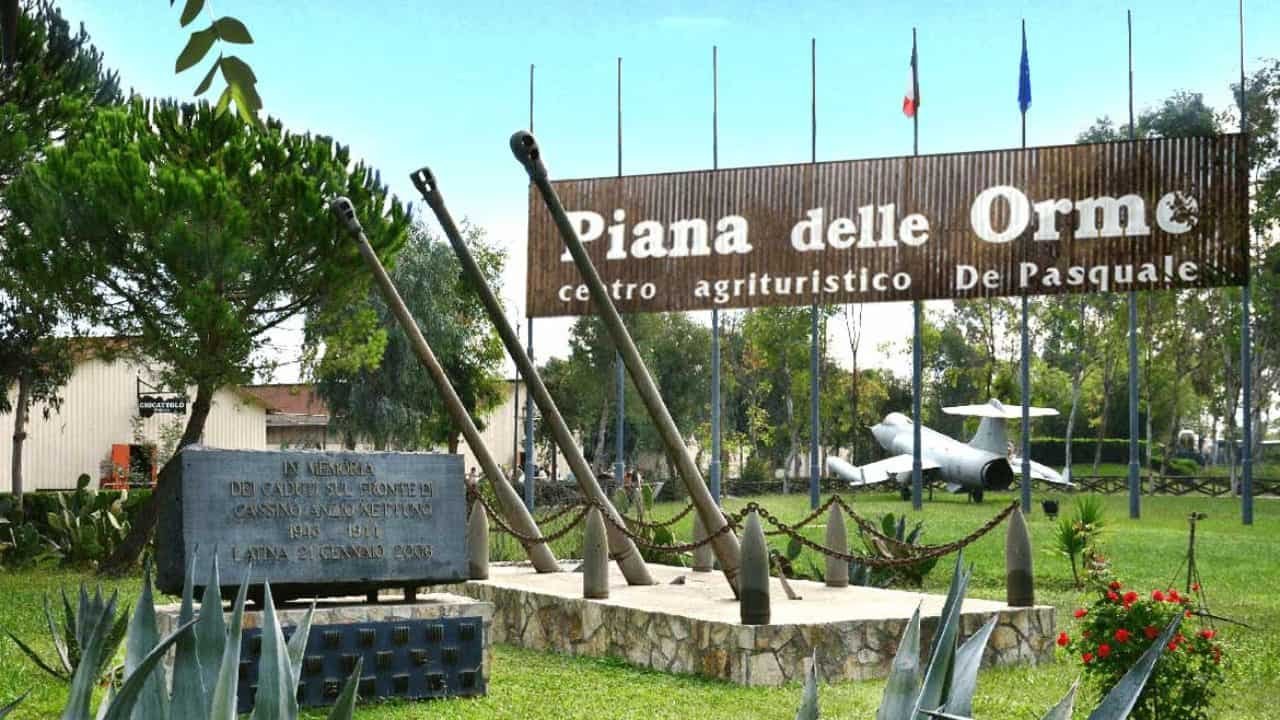
What Piana delle Orme Museum Really Is
Calling it a museum is correct but incomplete. The definition on the official site is a theme park built inside a farm stay, and it gets the idea across better: 30,000 square meters of exhibition space, 16 pavilions of 1,500 square meters each laid out in two parallel rows, plus the outdoor areas, the lawns, and the vehicles too big to fit indoors. The collection counts about 50,000 finds. That's not a brochure figure. It's the result of 30 years of purchases, swaps, recoveries and last-minute rescues carried out by one man alone.
That man was Mariano De Pasquale, born in 1938 and died in 2006, a flower-growing entrepreneur. The museum opened in 1997 as the permanent home of a private collection that had become unmanageable. It's privately run, and that needs saying right away because it changes the rules of the game: no free first Sunday of the month, no city cards, no state museum circuits. You buy the ticket here and it's good for here.
The layout has a declared geometry. With your back to the entrance, the right-hand row holds the war themes of World War II as it was fought in Italy and Lazio. The left-hand row holds agriculture, land reclamation and everyday life in peacetime. It's a narrative division, not just a logistical one: war and peace, each with its own row of sheds, separated by an avenue.
The exhibition language is the one-to-one-scale diorama. No display cases, no panels: life-size reconstructed settings, with mannequins, real objects, real soil, sound effects and lighting effects, and above all with no barriers between the visitor and the scene. You walk inside the reconstructions. If you're used to classic military museums, with rifles in glass cases and a typewritten label, here you're in another world. It's a choice that has an immediate effect on children and an ambiguous effect on adults, and I'll talk about that plainly further on.
How to Get to Piana delle Orme Museum and When to Go
The Pontine plain in August at two in the afternoon is a humid oven. The pavilions are covered but not all of them are air-conditioned to the same degree, and a large part of the day is spent walking outdoors between one shed and the next. The best period for a full visit runs from mid-September to the end of October and from March to May: long hours, good light for outdoor photos, a civilized temperature. In winter the visit is still excellent inside the pavilions, but you have to reckon with the 16:00 weekday closing and a 14:00 last entry that cuts the legs out from under anyone arriving from Rome after lunch.
My practical advice: leave Rome no later than 8:00, arrive for the opening, spend a full four hours visiting, eat lunch on site, and head back in the afternoon, with a possible detour toward Anzio or Sermoneta. On weekends the museum closes later and it's easier to breathe, but that's also when families and groups of enthusiasts show up. On spring weekdays you can end up walking through entire pavilions alone, which for certain sections is a completely different experience.
Hours, Rates and Tickets for Piana delle Orme Museum
Here's a recap of the numbers, because it's the information people look for first. Full ticket €13. Junior, ages 6 to 14, €9.50. Over 65, €11. Family rate starting from two adults and two children: €12 per adult, €8 per child. The official price list has no line for children under 6, so for them it's best to ask at the ticket desk when you buy, rather than assuming anything.
For school groups the museum publishes a separate and very detailed price list. The general route, available from September to June, lasts three and a half hours, costs €9 per student and includes the pavilions on the Pontine land reclamation, the farm vehicles, life in the fields, the vintage toys, the air and naval sector, the deportations, the war vehicles and the reconstructions of the battles of El Alamein, Cassino and Anzio. The guide is paid separately, €40 for a maximum of 35 people. The two thematic routes, the agricultural one and the war one, last two and a half hours, cost €6.50 per student and come with a guide at €30. Schools book by filling in the form that can be downloaded from the site or by phoning and writing to the secretary's office.
One detail worth reading twice: the museum itself, in its own teaching materials, puts the full route at three and a half hours with a guide who sets the pace. A single visitor, who stops where he likes and reads what he likes, takes longer. Anyone who arrives at 14:00 on a Tuesday in January has two hours. That's not enough.
Visiting Piana delle Orme Museum Pavilion by Pavilion
The route recommended by the museum starts with the toys and ends with the battles. It's an intelligent progression, because it takes the visitor from the private twentieth century to the collective twentieth century, from the tin toy to the sealed boxcar. Following it is the right choice. Here's what the pavilions contain, one by one.
Vintage Toys at Piana delle Orme Museum
You start here, and the choice disorients anyone who came expecting a military museum. The pavilion gathers toys from the late nineteenth century through the whole twentieth: toy cars, airplanes, ships, wind-up automata, dolls, model railways. The brands documented in the collection are the ones that make real collectors' hearts beat faster: Ingap, Corgi, Solido, Dinky Toys, Lima, Märklin, Schuco, Gama, Rivarossi. There are toy soldiers, scale models, and hand-built wooden boats.
The display plays on a fairy-tale register, with low lights and sets like the window of a shop from another era. Looked at closely, though, this pavilion is less innocent than it seems. The story of the Italian toy in the twentieth century is also the story of recycled tin, of autarky, of the war toy put in children's hands in the 1930s, of the switch to plastic during the boom. Anyone who walks through here reading the dates on the labels sees the same economic curve they'll see, an hour later, in the tractor pavilion.
The Two Pavilions on the Reclamation of the Pontine Marshes
This is the showpiece of the left-hand row, and probably the best part of the museum. Two entire pavilions, divided into many sections, reconstruct the phases of the great works of the 1930s: the hydraulic reclamation, the sanitary one, the agricultural one, the colonization of the Agro Pontino and the founding of the new towns.
The scenes are rebuilt with real water, reed beds, mannequins of workers with tools in their hands, pumping stations, and excavation machines. You move from the marsh environment before the reclamation, with the vegetation and fauna of the swamp, to the work sites, the first farmhouses, the rural school, and the farm handed over to the settler family with its stable and haystack. The visitor physically crosses from one landscape to the other.
These reconstructions work precisely because they don't explain: they show. The flip side is that the explanatory material is minimal, and you have to bring the historical context from home or ask a guide. Further on you'll find the numbers and the historiographical readings you need to read these two pavilions with your head and not just your eyes.
Vintage Farm Vehicles at Piana delle Orme Museum
Over 300 pieces, and here the word collection falls short. They range from steam portable engines, enormous machines that look like locomotives without rails, to petrol and hot-bulb tractors, up to the farm mechanization of the postwar period. There are threshing machines, plows, seed drills, and animal-drawn tools that lived side by side with the motorized ones for decades.
For a Roman audience used to marble, a shed full of tractors may look like something for enthusiasts only. Wrong. The history of Italian agricultural mechanization is the history of how 6 million people stopped working the land in 30 years, and those rusty machines are the causes, not the consequences. If you're short on time and have to sacrifice something, sacrifice something else.
Life in the Fields: Two Pavilions on Peasant Civilization
Two more pavilions, devoted to rural traditions and to the Italian regions, their landscapes, their products and their food specialties. The sections reconstruct the production of wine, oil, bread and cheese. There are inlaid carts, the wheelwright's workshop, the barber's shop, and a part devoted to emigration from the South.
It's the sector that works best with elderly visitors, who recognize the objects and start telling stories, and with children, who see them for the first time. A tip: if you're bringing a grandparent, bring them here and then keep quiet for 20 minutes. The best guided tour you'll hear in this museum isn't the museum's.
Deportation and Internment: The Hardest Pavilion
A total change of register. The pavilion is devoted to the Shoah and to the Italian Military Internees, the soldiers captured by the Germans after September 8, 1943 and deported to the camps of the Reich. The central reconstruction is a railway station with a period freight train standing at the platform.
Inside one wagon are kept household belongings that belonged to the Jews rounded up in the Rome ghetto. On the walls appear the names of the deportees, and a loudspeaker repeats them one after another. A second wagon holds mannequins in the striped uniforms of the concentration camps. There is no music and no commentary.
My position on this pavilion is clear: it works, but it's not for everyone and not at any age. With a fifth-grade class it has to be prepared beforehand and talked through afterward. With a child under six brought in just in passing, no. The museum places it in the war route for schools too, and the choice is consistent. The responsibility for how you go in, though, stays with whoever is accompanying the child.
From El Alamein to Messina and Salerno
The pavilion reconstructs Italy's entry into World War II on June 10, 1940, with Mussolini's recorded voice and the mobilization of the army, and continues with the North African campaigns and the Allied landings in Sicily and at Salerno. It's the necessary premise for everything else in the right-hand row: without El Alamein and without the Italian 1943, the Anzio and Cassino pavilions remain scenes without a cause.
The display alternates the diorama of action, with vehicles in marching order on the sand, with the reconstruction of a soldier's life: the tent, the ration, the letter home. It's a choice that tones down the rhetoric, and I think it's the right one.
The Anzio Landing Told at Piana delle Orme Museum
This is the pavilion that more than any other justifies the museum's geographic position. The Allied landing of January 22, 1944, code name Shingle, took place about 30 kilometers from here, and the beachhead that followed turned the newly reclaimed Agro Pontino into a flooded battlefield.
The reconstruction works on a double register, land and sea: the landing operations, the amphibious vehicles, the battle of the Rangers at Cisterna, and then the civilian flip side, the evacuations, the shelters, the families who return to the houses reclaimed 10 years earlier and find them destroyed. One section is devoted to the Curtiss P-40 fighter, the aircraft the museum presents as Skipper, the fighter that came from the sea.
If you have to choose a single pavilion in the war row, choose this one, and visit it after going through the reclamation. The order changes the meaning of what you see: the same plain, drained with great effort in 10 years, deliberately flooded again by the Germans as a defensive obstacle a few years later. If you want to complete the picture on the spot, you'll find the Museo dello Sbarco di Anzio a few kilometers away, and the military cemeteries between Anzio and Nettuno.
The Battle of Cassino
The bloodiest front fought in Italy. The pavilion retraces the months between January and May 1944 on the Gustav Line, the German defensive system that cut the peninsula from Gaeta to Ortona, hinged on Cassino and the Liri valley, and the bombing of Montecassino abbey on February 15, 1944, when Allied formations dropped hundreds of tons of bombs on the mountain.
The reconstruction also stages the condition of the civilian population, which is the part of that story that gets told least. Historians have argued about the four battles and the bombing for 80 years. Positions range from those who consider it a complete tactical error to those who, like the historian Eric Morris, maintain that the problem was not the bombing itself but the total lack of coordination between the air attack and the ground attack, which left the German paratroopers time to turn the rubble into an even more defensible position. The German general von Senger called it hardly comprehensible. If you want to see the place, you can go up to the Abbey of Montecassino, rebuilt where it was and as it was.
War Vehicles, Civilian Use of Surplus, and Telecommunications
One pavilion collects the military equipment of the battle theaters: transport vehicles, artillery, amphibious vehicles, engineer materials. Next to it are two sections that deserve more attention than they get. The first is devoted to the civilian use of war surplus, that is, to what Italians did, from 1945 on, with the trucks, jeeps, jerrycans, sheet metal and engines abandoned by the armies. Postwar Italy was also built by recycling the war, and in the Agro Pontino this is more visible than anywhere else. The second is a workshop on the history of telecommunications, with radios, transmission equipment and instruments covering a full century.
The Air and Naval Hub of Piana delle Orme Museum
A more recent section, devoted to air and naval vehicles, with materials tied to the Air Force and the Guardia di Finanza. Among the pieces documented as rare are a Lockheed PV-2 Harpoon maritime patrol aircraft, which the museum's sources identify as the only example in Europe, and the fast patrol boat V.4001 Drago.
The Outdoor Exhibits and the Flea Market
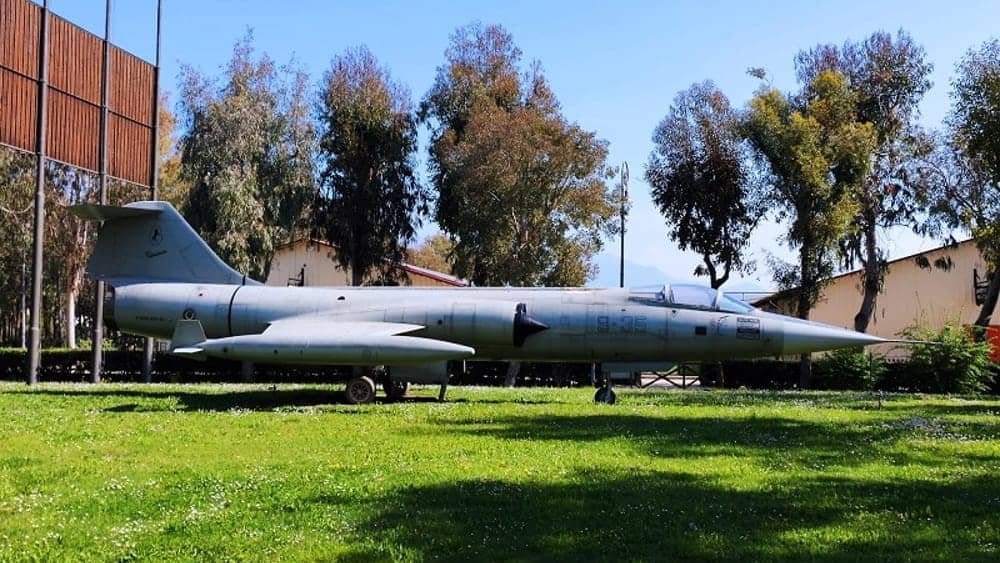
Outside the sheds sit the vehicles that wouldn't fit inside: aircraft like the C-119 twin-engine transport and the F-104 fighter, a locomotive with its tender, and other oversized pieces. It's the part children photograph most and the one that holds up best in late afternoon light.
The complex is rounded out by a permanent market of about 1,700 square meters, with military and civilian vintage items. It's not a souvenir shop. It's a vintage secondhand market, and if you collect anything you'd do well to stop by before getting back in the car.
The Pieces That Made Piana delle Orme Museum Famous
The Sherman DD Nicknamed Paperino
The museum's most famous exhibit is an American M4 Sherman tank in the DD version, Duplex Drive, meaning modified for flotation and amphibious landing: a tank that, with a perimeter canvas screen inflated and two propellers started, could reach the beach from the sea. About 690 were built between 1943 and 1944, and the survivors in the world are very few, three according to the museum's sources, one of which is this one.
Its story is an exemplary Italian affair. Spotted on the seabed of the Gulf of Salerno at a depth of 24 meters by divers from Salerno, it was brought back to the surface on the initiative and at the expense of Mariano De Pasquale, who financed the recovery and then the restoration: about 6,000 hours of work, with a complete disassembly of every component and advice from the Tank Museum in Bovington, England. On the exact dates of the discovery and the recovery the local accounts disagree, and it's best to take as good what the museum displays next to the piece.
Then came the legal part. The State claimed ownership of the vehicle as an item of historical and cultural interest, and a ruling of the Court of Rome ordered the museum to return it, without recognizing any reimbursement for the recovery and restoration. The affair closed in 2016 by administrative route: the Ministry of Cultural Heritage, also prompted by a petition backed by many Pontine municipalities, established that the tank, while remaining public property, could stay at Borgo Faiti, recognizing the museum's ability to guarantee its conservation, protection and public use. It's an interesting precedent, and the next time you hear that private museums don't do culture, think back to 6,000 hours in the workshop.
Skipper, the Fighter That Came from the Sea
The other piece worth the trip is a Curtiss P-40, model L, displayed in the condition in which it was recovered from the sea, with no cosmetic restoration. The international lists of surviving P-40s record the example kept at Piana delle Orme with serial number 42-10857. Local accounts link the plane to a ditching in 1944 off Capoportiere, on the Latina coast, and to a recovery at the end of the 1990s.
It's worth stopping in front of this wreck more than in front of a polished plane. A restored aircraft tells you how it was. An aircraft pulled up from the bottom tells you what happened. In order: the machine, the sea, 50 years, and a pilot who on that day either did or didn't have luck.
The Story Behind the Dioramas: The Reclamation of the Agro Pontino
Half of the museum can't be understood without this story, and it's best told with numbers and no adjectives.
For centuries the Pontine plain was a marshy, malarial area, with almost no permanent settlements. The attempts to drain it number in the dozens, from the Romans on, and the most substantial before the twentieth century is that of Pope Pius VI, with the Linea Pia dug starting in 1777. None of these efforts solved the problem for good, because the knot was not digging canals but maintaining them and mechanically lifting waters that lie below sea level.
The full-scale reclamation of the 1920s and 1930s tackles the problem on an industrial scale. In 1931 the government entrusts the undertaking to the Opera Nazionale Combattenti, led in the field by Valentino Orsolini Cencelli. The figures of that campaign, taken from the most recent journalistic reconstructions, give the order of magnitude: 18 large pumping stations, about 16,165 kilometers of canals built or reactivated, 1,360 kilometers of roads opened, 3,040 farmhouses built, 4,500 wells drilled, for a total of around 77,000 hectares reclaimed in the Agro Pontino. Most of the labor came from Veneto, Friuli and Emilia: whole families moved to a plain they didn't know, assigned a farm and a debt.
On top of this infrastructure the founded towns arise. Littoria, today Latina, saw the laying of its first stone on June 30, 1932 and its inauguration on December 18 of the same year. Sabaudia follows in 1934, Pontinia between 1934 and 1935, and then Aprilia and Pomezia. Around the towns lies the network of rural villages, and Borgo Faiti, where the museum stands, is one of them: built and inaugurated in 1933 by the Opera Nazionale Combattenti, and annexed to the municipality of Latina on May 2, 1935.
How the Reclamation Is Read Today: The Historiographical Readings
Precision is needed here, because this is material that in Italy is still argued about out loud. That the hydraulic work was carried out, that the canals still function, and that the plain is livable thanks to those works is a fact you can verify by walking out of the museum and looking around. That the operation was also an enormous propaganda machine is just as well documented: the new towns were inaugurated in front of film cameras, the rhetoric of land torn from the swamp accompanied every phase, and the regime credited its work with overall results that research has since scaled back.
The historian Francesco Filippi, for example, observes that half of the 4 million hectares announced by the propaganda came from projects begun in the liberal era, before Fascism, and that another 1,400,000 hectares remained on paper. The estimate of the land actually reclaimed by the regime is around 600,000 hectares nationwide. It's a correction of scale, not a denial of the Pontine work, which remains one of the most successful sites of the entire program.
The human cost has to be added, which the dioramas hint at and the statistics record: tens of thousands of workers employed in a malarial environment, with working and sanitary conditions we would call unacceptable today, and malaria truly eradicated only after the war, with the disinfestation campaigns. Anyone who visits the two reclamation pavilions with these elements in hand sees something different from someone who visits without them. The museum shows. The historical judgment you bring from home, and you should bring it.
Anzio and Cassino 1944: What Happened a Few Kilometers from Here
Operation Shingle began on January 22, 1944 on the coast between Anzio and Nettuno, with the aim of outflanking the Gustav Line and unblocking the Cassino front. The landing succeeded with almost complete tactical surprise, but the US VI Corps under General John Lucas chose to consolidate the beachhead instead of pushing inland right away. Kesselring's Germans had time to bring in reserves, and two months of ferocious fighting followed, with the battle of Cisterna and the German counteroffensive Fischfang in February.
For weeks the beachhead remained about 15 kilometers wide and about 10 deep, entirely under observation and fire from German artillery. Total losses in the first month run into the tens of thousands in dead, wounded, missing and prisoners on both sides. Churchill, who had been one of the promoters of the landing, coined the best-known quip: he had hoped to hurl a wildcat onto the beach and instead found himself with a stranded whale. Lucas was replaced by Truscott in February.
Rome fell only in June, after Operation Diadem in May, which coordinated the push from Cassino and the breakout from the beachhead. On the choices of General Mark Clark, more interested in being first into the capital than in closing the trap on the retreating Germans, the debate among historians is still open and rather severe.
For the inhabitants of the Agro Pontino the bill was double: the Germans deliberately flooded vast portions of the newly drained plain to slow the Allied advance, bringing malaria back to where it had just been beaten. The families who had arrived from Veneto 10 years earlier to take possession of a farm found themselves evacuated, and many farms went back under water. It's the chapter that holds the two rows of pavilions together, and it's the reason this museum, which at first glance looks like two different museums, is really only one.
A Curiosity About Piana delle Orme Museum
It all began with a payment in kind. Mariano De Pasquale, born in the province of Messina in 1938 and transplanted to the Agro Pontino as a flower-growing entrepreneur, was offered a World War II military jeep in exchange for a supply of flowers. He accepted. That vehicle, which ended up in a farm shed by chance and commercial convenience, was the first piece of what would become one of the largest and most heterogeneous private collections in Europe.
From there the collection grew for 30 years, by a criterion that wasn't the antique dealer's but the salvager's: not the beautiful piece, the piece that was about to be scrapped. Tractors headed for the foundry, carts left in a barn, military radios from a flea market, vehicles literally fished up from the bottom of the sea. By 1997 the collection had reached a size that made a museum arrangement inevitable, and Piana delle Orme was born.
The real curiosity, though, is another one and concerns the movies. The museum's vehicles are kept in working order, and for this reason international productions have rented them over and over. The collection's Sherman M4 tank appears in the final scene of Roberto Benigni's La vita è bella, released in 1997, and before that in Anthony Minghella's The English Patient. You see it again in Giuseppe Tornatore's Malèna. The piece that Italian visitors glance at absently is, for producers in half the world, a regular supplier.
Something Nobody Tells You About Piana delle Orme Museum
The order of the visit is not a detail, and it's the reason half the visitors leave here with the wrong impression.
Whoever walks in and heads straight for the tanks, because that's what they drove an hour for, visits a museum of military scrap iron: good, imposing, but flat. Whoever instead walks the left-hand row first, toys, reclamation, farm vehicles, life in the fields, and only afterward crosses the right-hand row, visits something else entirely: the story of a plain torn from the water in 10 years and flooded again by war in a few months, with the same families as protagonists in both halves. The layout in two parallel rows, war on the right and peace on the left, exists for exactly that reason. Almost nobody uses it the way it was designed.
There's a second element you hardly read anywhere: real time. In its own school materials the museum states three and a half hours for the general route led by a guide who keeps up the pace. A curious adult, alone, stays twice that long in the reclamation and deportation pavilions. Whoever arrives at 14:00 in winter, with last entry at 14:00 and closing at 16:00, loses two thirds of the collection without knowing it.
Third element, and it concerns your wallet: being a private facility, the museum doesn't take part in the state free-admission initiatives. No first Sunday of the month, no ministerial discounts. The only real lever is the family rate, which from two adults and two children noticeably lowers the bill.
My Advice for Visiting Piana delle Orme Museum
Arrive at opening, at 9:00, and bring your lunch.
That's not advice for penny-pinchers. It's the only way to do things in the right order without rushing. Four hours of pavilions in the morning, with a fresh head, are worth double four afternoon hours. And the museum has picnic equipment that few other places in the province can match: 60 tables, 16 wooden gazebos with benches, barbecue grills, a park with centuries-old trees and eucalyptus varieties that cast real shade. If you'd rather buy on the spot, there's a bar and sandwich service with hot made-to-order panini.
Second piece of advice, on substance: get a guide if you come in a group, and if you come alone do at least half an hour of reading beforehand on the Pontine reclamation. The explanatory material on the dioramas is minimal by exhibition choice. The pavilions show a lot and explain little. With the context in your head, the two reclamation sheds become the best piece of the whole museum. Without it, they remain scenery.
Third, on the seasons: avoid July and August in the early afternoon. This is reclaimed plain, the humidity is high and a large part of the movement happens outdoors. The ideal period runs from March to May and from mid-September to the end of October, with the long hours and the 19:00 closing on weekends and holidays.
Fourth, and take it as a flat opinion: if you have only one hour, don't come. This is not a museum you sample. Better to put it off to a day when you can stay until closing, maybe pairing the morning here with the afternoon on the coast, toward Lido di Latina or inside Circeo National Park.
Another Well-Known Fact, Yet Rarely Cited
The museum stands in a place with an ancient name and an illustrious citation, and almost none of the visitors know it.
Borgo Faiti is a founded town of the 1930s, inaugurated in 1933 by the Opera Nazionale Combattenti and annexed to the municipality of Latina on May 2, 1935. But the place name it carries comes from much farther back: the village arose near the locality of Foro Appio, and Foro Appio is the Roman Forum Appii, a post station on Via Appia about 40 miles from Rome, an embarkation point for the canal that crossed the marsh, a compulsory stopping place for anyone heading south. The ancient settlement was depopulated in the early Middle Ages and the locality regained substance only at the end of the 1700s, with the hydraulic works of Pius VI.
The illustrious citation is in the Acts of the Apostles: Paul of Tarsus, brought as a prisoner toward Rome along the Appia, stopped right at Forum Appii, where some brothers who had come from the capital set out to wait for him. It's one of the very few points of Lazio geography named explicitly in the New Testament.
So, summing up the stratigraphy: underneath is a Roman post station cited in the Acts. Above are the papal canals of the 1700s. Above that, the reclamation of the 1930s with its rural village. And inside a shed of that village, the memory of the war that swept everything away. Four eras in one square kilometer. The museum, unintentionally, is the last layer of this sequence.
The Right Photo to Take at Piana delle Orme Museum
The outdoor exhibits, in the last hour before closing.
Inside the pavilions photography is complicated: the light is low and theatrical by exhibition choice, the dioramas are designed to be walked through and not framed, and flash ruins everything, flattens the scenes and disturbs other visitors. If you want to take home something decent from the interiors, work with high sensitivity and a steady hand, and look for details instead of whole views: a mannequin's hands on a tool, the names on the wagon walls, the plate on a tractor.
Outside, the game is entirely different. The vehicles too big to fit indoors, the C-119 twin-engine transport, the F-104 fighter, the locomotive with its tender, sit in the full light of the plain, and in late afternoon, with the sun low, the metal profiles against the Pontine sky become the best frame of the day. The photo I recommend is the one from low down, almost level with the ground, with the nose of the aircraft cutting the frame on the diagonal and the countryside in the background. It says in one stroke what a military airplane is doing in the middle of the fields.
A warning about one area only. In the deportation and internment pavilion you photograph little and with judgment, or not at all. It's not a rule written on the door. It's good manners, and it applies in that wagon as in any other place of memory.
Some Important Events That Happened Here in History
The patch of plain on which the museum stands has a density of events out of proportion to its present look.
In antiquity, Forum Appii was one of the busiest post stations on Via Appia, with the traffic of goods and passengers heading down to Campania. The navigable canal that crossed the marsh started from here, and here, according to the Acts of the Apostles, Paul of Tarsus passed on his way to Rome under escort.
In 1777, under Pope Pius VI, work began on the Linea Pia, the last great pre-unification attempt to drain the Pontine Marshes. The canal still runs today alongside Via Appia, a short distance from the museum.
Between 1931 and 1935 the plain was redrawn by the full-scale reclamation: on June 30, 1932 the laying of the first stone of Littoria, on December 18 of the same year its inauguration, in 1933 the founding and inauguration of Borgo Faiti, in 1934 and 1935 Sabaudia and Pontinia. In a few years a nearly uninhabited territory filled up with farms, villages, roads and canals.
In 1944 all this became a war zone. After the Allied landing of January 22 at Anzio and Nettuno, the plain found itself right behind the beachhead. German forces deliberately flooded wide portions of the newly reclaimed Agro to hinder the advance, bringing water and malaria back to fields drained 10 years earlier, and the farming population was evacuated.
In 1997 the museum opens, collecting the materials of that sequence. In 2006 Mariano De Pasquale, the founder, dies. In 2016 the long dispute over the Sherman DD tank closes, with the ministerial decision that allows it to remain at Borgo Faiti while acknowledging its public ownership. They are events of different scale, but they say the same thing: here history is not a backdrop, it's the ground.
Who Has Passed Through Piana delle Orme Museum
The visitor who has left the most traces is the movies, and that's not a joke.
Because the collection's vehicles are kept in running order, over the years the museum has become a regular supplier for productions that need authentic and working war materiel. The collection's Sherman M4 tank appears in the closing scene of Roberto Benigni's La vita è bella, a 1997 film. The same vehicle was used in Anthony Minghella's The English Patient, in Giuseppe Tornatore's Malèna, and in other Italian productions including La guerra è finita and Lavorare con lentezza. The founder De Pasquale was the name producers turned to when they needed a military vehicle that could really move, and not a stage model.
Generations of school groups have passed through here, in the literal sense. The museum works with classes from preschool to university and has built on that three distinct teaching routes, with in-house guides and dedicated materials. For very many young people in southern Lazio, the first concrete image of deportation and of the reclamation is the one seen in these sheds.
Finally, the State has passed through, in the least predictable form. The dispute over the Sherman DD tank took the question all the way to the ministry, and in 2016 the Minister of Cultural Heritage Dario Franceschini signed the decision recognizing the museum's ability to guarantee protection, conservation and public use of the vehicle, leaving it at Borgo Faiti. It's not an illustrious visit, but it's the most concrete recognition a private Italian collection can receive.
Piana delle Orme Museum with Kids
It works, and works better than almost all Roman museums, for a technical reason: the absence of barriers. The one-to-one-scale dioramas can be walked through, the sound effects and animations keep attention alive, the objects are big and recognizable. The toy pavilion and the life-in-the-fields ones are ideal from age four up, and the tractors and outdoor vehicles work for any age.
The outdoor areas complete the picture: lawns, room to run, 60 tables and 16 gazebos where you can eat lunch in the shade. If you bring small children, do the math on time, though: there are 16 pavilions and the distances between one shed and the next add up. With a stroller and a three-year-old, half a day is the realistic maximum.
The section on deportation and internment deserves a conscious decision. The content is explicit, the names of the deportees are repeated by a loudspeaker, the wagons are rebuilt with authentic objects. With the youngest you can skip it without regret. With middle schoolers, prepared beforehand, it's one of the strongest educational experiences available in Lazio.
Piana delle Orme Museum for Schools
The educational offering is structured and has a public price list. The general route, available from September to June, lasts three and a half hours, covers the Pontine reclamation, the farm vehicles, life in the fields, the vintage toys, the air and naval sector, the deportations, the war vehicles and the three great reconstructed battles, and costs €9 per student, with a guide at €40 for a maximum of 35 participants.
Those with less time choose one of the two thematic routes, both of two and a half hours and at €6.50 per student, with a guide at €30. The agricultural sector includes the reclamation, farm vehicles, life in the fields, toys and the air and naval hub. The war sector includes deportations, the air and naval hub, war vehicles and battles. Booking is done by filling in the form that can be downloaded from the official site or by contacting the secretary's office by phone or email.
One observation: the general route in three and a half hours is a brisk pace. With a high school class it holds up. With a fifth-grade class it has to be negotiated with the guide beforehand, choosing what to go into in depth and what to just cross.
Services, Outdoor Areas and Accessibility at Piana delle Orme Museum
The complex includes a park with centuries-old trees and several varieties of eucalyptus, 60 picnic tables, 16 wooden gazebos with benches, barbecue grills and a large lawn that hosts events, exhibitions and games. The on-site food is handled by a bar and sandwich service with hot made-to-order panini, meat, vegetables and cold cuts. The permanent vintage market takes up about 1,700 square meters.
On accessibility for people with mobility disabilities the public material doesn't go into detail, so the most sensible thing is a phone call ahead to the museum's number, also because the ground alternates indoor flooring with outdoor paths on natural surface. The same goes for pets and for luggage storage: these are things you can find out in two minutes on the phone and that are better to have before loading the car.
What to See Near Piana delle Orme Museum
The museum pairs well with a full day in the province of Latina, and there are three sensible combinations.
The first is the historical one: morning here, afternoon on the landing coast, between Anzio and Nettuno, with a visit to the Museo dello Sbarco. It's the itinerary that closes the circle opened by the war pavilions.
The second is the one of landscape and hill villages: Sermoneta with its castle, Norma overlooking the plain, the Garden of Ninfa at the foot of the Lepini, and farther north Cori, where you can also visit the Museo della Città e del Territorio. From the heights of Norma you can see with the naked eye the geometry of the reclamation told in the pavilions. It's the best possible caption.
The third is the one of sea and nature: Circeo National Park, Torre Paola beach in Sabaudia, the San Felice Circeo promontory and Terracina. If you'd rather stay with history, you can continue toward Priverno and its civic museums.
Quick Questions About Piana delle Orme Museum
How much is a ticket to Piana delle Orme Museum?
A full ticket costs €13. The junior ticket, for ages 6 to 14, costs €9.50. The over-65 ticket costs €11. With the family rate, valid from two adults and two children up, adults pay €12 and children €8.
What are the hours of Piana delle Orme Museum?
From March 1 to October 31: Monday to Friday 9:00-17:00, Saturday, Sunday and holidays 9:00-19:00. From November 1 to February 28: Monday to Friday 9:00-16:00, Saturday, Sunday and holidays 9:00-18:00.
What time is last entry at Piana delle Orme Museum?
From March to October, last entry is at 15:00 on weekdays and 17:00 on weekends and holidays. From November to February it's at 14:00 on weekdays and 16:00 on weekends and holidays. It's the most important practical detail to keep in mind.
Does Piana delle Orme Museum close one day a week?
The calendar published by the museum doesn't list a weekly closing day. For special holidays it's best to check by phone before setting out.
Do I need to book to visit Piana delle Orme Museum?
Not for individual visitors: you buy the ticket at the desk. Booking is required, however, for school groups and for groups, through the form or by contacting the secretary's office.
How long does a visit to Piana delle Orme Museum take?
The guided general route lasts three and a half hours according to the museum's educational program. A single visitor who stops to read and look at the dioramas should figure 4 to 5 hours.
Is Piana delle Orme Museum suitable for kids?
Very. The barrier-free dioramas, the sound effects, the gigantic vehicles and the toy pavilion already work from age four or five. The exception is the section on deportation and internment, to be judged by age.
How many pavilions does Piana delle Orme Museum have?
16 pavilions of about 1,500 square meters each, laid out in two parallel rows, plus the outdoor areas. The total exhibition area exceeds 30,000 square meters.
How many finds does Piana delle Orme Museum hold?
The museum's sources indicate a collection of about 50,000 pieces, including military vehicles, farm machines, everyday objects, toys, radios, uniforms and documentary materials.
Can you take photos at Piana delle Orme Museum?
Yes, and the outdoor exhibits are the most generous part for photography. Inside, the light is low by exhibition choice. In the deportation pavilion the most correct attitude is restraint, or abstaining.
Is Piana delle Orme Museum wheelchair accessible?
The public material doesn't give a detailed picture of accessibility. Since the route alternates indoor areas and outdoor stretches on natural surface, the quickest way is to ask the museum directly at +39 0773 258708.
Is there parking at Piana delle Orme Museum?
Yes, the complex has an on-site parking area. Arriving by car is in practice the only comfortable way, given the location in open countryside at Borgo Faiti.
How do I get to Piana delle Orme Museum without a car?
It's inconvenient. The reference railway station is Latina Scalo, on the Rome-Naples line via Formia, and from the station you still need a road vehicle to reach Borgo Faiti. If you don't drive, consider a taxi or a rental.
Can you eat at Piana delle Orme Museum?
Yes. There is a bar and sandwich service with hot made-to-order panini, and you can bring a packed lunch to the equipped areas: 60 tables, 16 wooden gazebos and barbecue grills.
Is Piana delle Orme Museum free on the first Sunday of the month?
No. It's a private facility and doesn't take part in the state free-admission initiatives. The only structural discount is the family rate.
What's the difference between Piana delle Orme Museum and the Museo dello Sbarco di Anzio?
The Anzio museum focuses on the operation of January 1944 and its documents, in a historic building at the site of the events. Piana delle Orme is a much larger theme park, which places the landing inside a story 50 years long, from peasant civilization to reconstruction. They complement each other, and you can visit both on the same day.
Who founded Piana delle Orme Museum?
Mariano De Pasquale, a flower-growing entrepreneur born in 1938 and died in 2006, who gathered the collection over 30 years of searching and opened the museum in 1997.
What is the Sherman tank at Piana delle Orme Museum?
It's an M4 Sherman in the DD version, meaning amphibious, recovered from the seabed of the Gulf of Salerno and restored with about 6,000 hours of work. Very few examples remain in the world. In 2016 a ministerial decision allowed it to stay at the museum, while it remains public property.
Which airplane can you see at Piana delle Orme Museum?
The best-known piece is a Curtiss P-40L displayed in the condition in which it was recovered from the sea. The international lists of surviving P-40s record it with serial number 42-10857. Outdoors you can also see a C-119 twin-engine transport and an F-104 fighter, along with the vehicles of the air and naval hub.
Does Piana delle Orme Museum have a shop?
More than a shop: a permanent market of about 1,700 square meters with military and civilian vintage items, where you find collectibles and not just souvenirs.
Does Piana delle Orme Museum offer guided tours?
Yes, and it's the service the offering for schools and groups is built on, with published rates: €40 for the general route, €30 for the thematic routes. Individual visitors can ask at the ticket office about availability on the day.
When is the best time to visit Piana delle Orme Museum?
From March to May and from mid-September to the end of October, arriving at opening. In summer the early afternoon on the Pontine plain is heavy. In winter the shorter hours and the earlier last entry cut the available time too much.
Is Piana delle Orme Museum suitable for people not interested in military history?
Yes, and in fact half the collection has nothing military about it: toys, tractors, peasant crafts, land reclamation, telecommunications. Whoever walks in thinking of a tank museum discovers within half an hour that they're in a museum of twentieth-century Italy.
How much time do you need to see only the reclamation pavilions at Piana delle Orme Museum?
They are two pavilions divided into many sections: a full hour for an attentive visit, less than 40 minutes if you just cross through. They're the part I recommend not squeezing.
Is Piana delle Orme Museum indoors or outdoors?
Both. The 16 pavilions are covered, but the movement between one and the other, the displays of the larger vehicles, the park and the picnic areas are outdoors. Comfortable shoes and an eye on the weather.
Can you visit Piana delle Orme Museum in the rain?
Yes, most of the route is covered. You give up the outdoor exhibits and lunch at the tables in the park, but the pavilions remain perfectly visitable.
One last thing. Piana delle Orme is often written off as the place of the tanks, good for children and for militaria fans. That's a lazy reading. This is the place that explains better than any other in Lazio how a territory is built and how it is lost: a marsh drained in 10 years with 18 pumping stations and thousands of kilometers of canals, filled with families who came from the North, and flooded again by war in one season. The two rows of pavilions tell exactly this, and they should be walked in this order. If you have only one day to spend in the province of Latina, spend it here, arriving at 9:00.
Article written by the editorial team of TourLeaderPro, contact them for Private/Corporate/V.I.P. Tours and Experiences.
Planning a trip to Rome? The English-language guides to visiting the city and Lazio are on ItalyPlanner.com.