Museo di Satricum
In short. The Museo di Satricum is in Borgo Le Ferriere, a hamlet of the municipality of Latina, along the Nettunense road, on the border with the territory of Nettuno and a few kilometers from Aprilia.
The Museo di Satricum is in Borgo Le Ferriere, a hamlet of the municipality of Latina, along the Nettunense road, on the border with the territory of Nettuno and a few kilometers from Aprilia. The permanent exhibition is called Satricum. Excavations and archaeological finds and is set up inside a building of the old industrial complex on the Astura, the former paper mill. Today that site is the core of the Satricum Civic Museum Park, established unanimously by the Latina city council on June 4, 2026. At the moment the display of finds cannot be visited: the municipality has ordered the works for the fire-safety certification of the former paper mill precisely in order to reopen it to the public, and until that worksite closes the rooms stay shut. Anyone who wants to move with knowledge should phone first: the contact given for the archaeological site is 0773 458415, while the switchboard of the municipality of Latina is 0773 6521 and the public relations office answers at urp@comune.latina.it. Admission, when the exhibition is open, has always been free. You don't get there by subway or even by train. You come by car, leaving the Pontina or coming up from the Nettuno coast road, and you park in the village.
The rest of this guide is devoted to what the Museo di Satricum holds, to what you see outside, in the archaeological area, and to why a hill of clay and tuff overlooking a lowland river is one of the decisive places for understanding how ancient Lazio was born. To find your way among the region's other archaeological proposals there is the page on the ruins of Satrico, which describes the actual excavation area.

Where the Museo di Satricum is and how to get there
Borgo Le Ferriere occupies the northwestern end of the municipality of Latina, in a funnel of countryside wedged between Nettuno, Aprilia and Cisterna. The museum is in the village, and the archaeological area is right up against it, on the hill immediately to the south. The Astura river passes below: nine kilometers of course and then the sea, at the mouth at Torre Astura. This geography is not a postcard detail. It is the reason the ancient city existed and the reason why, 3,000 years later, two hydraulic mills were built on top of it.
By car to the Museo di Satricum
From Rome the simplest road is the Pontina, state road 148, up to Aprilia, then toward Campoverde and Le Ferriere following the signs for Nettuno. From the south you come up the Nettunense. Those arriving from the coast can take the Nettuno coast road and turn inland after Foce Verde. An hour and a quarter from Rome without traffic, an hour and three quarters on a Saturday in June when half the capital goes down to the sea. The practical advice is banal but needed: put Borgo Le Ferriere in the GPS, not Satricum, because the ancient place name sends navigators into the middle of the fields.
By public transport
There is no railway station at Le Ferriere. The useful stations are those of the Rome-Nettuno line, which serves Campoleone, Aprilia, Padiglione, Campo di Carne, Anzio and Nettuno. From the station you still have to take an intercity bus or a taxi. The network of scheduled buses that touches the village is designed for residents, with sparse runs suspended in August. The truth, told without pretense: here public transport is a stopgap, and whoever doesn't drive would do better to fit the Museo di Satricum into a day by car with Anzio, Nettuno and the coast.
Parking and the village
The village is tiny and you park along the main street without blue lines. There is no visitor center in the modern sense, no cafeteria, no bookshop. There is a village bar, and in summer it is the best place to drink something cold before going up to the acropolis.
The Museo di Satricum today: inside the Civic Museum Park
The resolution of June 4, 2026 did something that Le Ferriere had been waiting for half a century: it put under a single administrative umbrella pieces of heritage that until yesterday looked at each other from afar without speaking. The Satricum Civic Museum Park rests on three municipal properties in the village. The former paper mill houses the display of finds and the management office. The former elementary school will become a guesthouse for scholars and research groups, who arrive from the Netherlands every summer today and have to make do with lodging far away. The former district office, which was also an anti-malaria post in the days of the land reclamation, will be an information point and tourist reception.
Around these three buildings the regulation links, without inventing new constraints, the archaeological area of the ancient city, the Roman villa now being excavated, the industrial archaeology complex, the Sanctuary of the House of the Martyrdom of Santa Maria Goretti, the Antiquarium of Borgo Sabotino, the Ponte dei Genovesi and the Torre di Foce Verde. A public competition has also been announced for the park's director and for inclusion in the Regional Museum Organization, which is the gateway to regional, state and European funding. Our opinion: it is the first time this place is treated as a museum and not as a whim of enthusiasts, and the leap will be felt.
Why the Museo di Satricum only opened in 2014
The permanent exhibition in the village opened in June 2014, curated by the University of Amsterdam, with about 700 finds chosen to tell the arc of the city from its origins to its decline. Before then, anyone who wanted to see the materials of Satricum had to go to Rome, to the National Etruscan Museum of Villa Giulia, where the objects from the 19th-century excavations purchased in 1903 ended up. There had been a preview in 1981, when a local cooperative organized the first displays of the finds, but it was something else. Between the first excavation campaign and the first permanent showcase on site, 118 years went by. The comparison with the Roman collection remains necessary all the same: whoever wants to see the most celebrated architectural terracottas has to go through the Etruscan Museum of Villa Giulia.
The building of the Museo di Satricum: the popes' ironworks and the paper mill on the Astura
The container is worth as much as the content, and this is one of those rare occasions when the phrase is not rhetoric. The name Le Ferriere comes from iron. Around 1116 the monks of Grottaferrata, seeing the position on the banks of the Astura and the availability of water power, attempted the extraction of raw iron and founded an ironworks here. The plant stayed in monastic hands until 1564, then passed to the Apostolic Chamber: from that moment it is iron of the Papal State.
In 1588 Pope Sixtus V modernized the plant, which became the most important in Lazio. And here comes the chapter that Romans should know and almost never do: between 1740 and 1744 the foundry of Conca produced the great iron hoops needed to reinforce the dome of St. Peter's, for a requirement of about 40 tons of metal. In 1748 the marquis Giovanni Poleni, the engineer called to study the cracks in the great dome, expressly mentioned ironwork ordered from the celebrated Ferriere of Conca. Michelangelo's dome, in short, is also held together by metal cast in this plain.
In 1779 three foundries worked here. The plant closed in 1865. Then came the second industrial life: after the acquisition by Gustavo Dominici the paper mill went into operation in 1910, again powered by the water of the Astura through dams, canals and tunnels. The staff went from the 600 units of 1911 to the 200 of 1937. Between 1945 and 1978 about 270 workers worked there. The smokestack you see from the village belongs to this story. When you enter the rooms of the Museo di Satricum, remember that you are walking inside a factory that supplied iron to the popes and straw board to the Italian Republic.

What Satricum is, the buried city next to the Museo di Satricum
Satricum, Satrico in the Italian form, was a city of Latium vetus, the ancient Lazio of the Latins before Rome ate it all up. It stood about nine kilometers from the sea, along the course of the Astura, occupying a series of rises on the right of the river between the present territories of Latina and Nettuno. The position was a crossroads: the route that connected the Etruscan world to the Greek cities of Campania passed through here, and so did the one that joined Praeneste, today's Palestrina, to Anzio. A place of transit with a very strong religious vocation, which in archaic Lazio means market, assembly and sanctuary on the same hill.
The settlement was divided into two parts. The acropolis, about four hectares wide, protected by steep slopes, where the sanctuary stood. And the plateau to the west, 40 hectares in area, naturally defended on three sides and closed to the west by an embankment built in the archaic age, later extended also onto the northern and southern slopes. 40 hectares, to put it in perspective, is a real city for the 6th century BC: larger than many contemporary Latin centers.
The archaeological evidence indicates that the site remained inhabited at least until the 3rd century BC. After that it declined and took on a purely agricultural character. Pliny the Elder, who wrote in the 1st century AD, already lists it among the vanished Latin cities. Gone from the maps, but not from the ground: it is all there underneath.
The four souls of Satricum
The cross-examination of written sources and excavation materials leads scholars to distinguish four periods, and the Museo di Satricum is organized with this division in mind. The first, between the 10th and 9th centuries BC, sees the site occupied by a population of Latin stock living in huts. The second, between the 7th and 6th centuries BC, coincides with the formation of a real urban core and is marked by very strong Etruscan influence: houses with tuff foundations, building techniques and a decorative repertoire that come from the north. The third, between the 5th and 4th centuries BC, is Volscian: Satricum becomes an important center of the people who come down from the Apennines and occupy the Pontine plain. The fourth, which leads to the disappearance of the city, is Roman.
Four peoples on the same hill in nine centuries. It is not a peaceful succession of cultures, it is a series of conquests, fires and rebuildings that the Latin sources recount with accounting coldness and that the excavation confirms layer after layer.
A curiosity about the Museo di Satricum
The best curiosity of this place concerns neither a vase nor a statue. It concerns a stone reused as building material by people who could no longer read it. In 1977, digging the foundations of the last temple of Mater Matuta, the Dutch archaeologists pulled out a block of tuff reused in the masonry. On it was an inscription in archaic Latin, incomplete at the start, which reads like this: [---]iei steterai Popliosio Valesiosio suodales Mamartei. Translated, it says that the companions of Publius Valerius set up this thing for Mars. It is the Lapis Satricanus, dated to the end of the 6th or the beginning of the 5th century BC, plausibly around 500 BC, at the latest around 450.
Why that line of letters made studies of the origins of Rome tremble. Popliosio Valesiosio is the archaic genitive of Publius Valerius, and the name points with great likelihood to the consul Publius Valerius Publicola, one of the protagonists of the passage from monarchy to republic in 509 BC, or to an immediate descendant of his. The suodales, the sodales, are the companions: a group of military character gathered around a leader, who dedicates to Mamars, the archaic and doubled form of the name of Mars. In one line you read what the literary sources tell in a confused way: in 6th-century Lazio there were armed bands tied to an aristocrat, able to move outside their own city and carry out acts of worship elsewhere. The legend of the gens Valeria stops being legend and becomes epigraphy.
The detail I find irresistible is that the stone was saved because someone threw it into a foundation. If it had stayed in view, the tuff would have crumbled in 25 centuries of weather. It ended up buried holding up a wall, and that is why we read it. Archaeology owes a great deal to the ancients' casualness about recycling.

The sanctuary of Mater Matuta, the reason the Museo di Satricum exists
Everything you see in the display cases of the Museo di Satricum comes from a consecrated hill. The place where the sanctuary stood shows a continuity of religious use that runs from the 8th century BC at least to the 1st century BC, when a dedication to the temple by the duumvirs of Anzio is dated. After that, silence: the temple was abandoned.
Who Mater Matuta was
Mater Matuta, the Propitious Mother, was the goddess of the morning and the dawn, and by extension protector of birth: of men and of things. Her cult is Latin and Italic, not Greek, even though in a later age she was assimilated to the Greek Leucothea. The identification of the Satricum sanctuary with Mater Matuta rests on solid ground, because the goddess's name appears in several inscriptions found in the area, among them a stele of late Republican date. In the Roman calendar her festival was the Matralia, on June 11, and in Rome her temple was in the Forum Boarium. It is worth remembering this while looking at the terracottas of the Museo di Satricum: the goddess honored here was the same one that Roman matrons honored under the Aventine.
The sacred hut, from about 750 to 650 BC
The first phase has nothing monumental about it. On the summit of the hill, between the mid-8th and the mid-7th century BC, there was a hut. Its religious character is documented by the presence of a mundus, the deep pit with a ritual function that in the Latin world marks the point of contact between the world of the living and the one below. Around it, traces of many other huts covering Latial periods II, III and IV, roughly between 1000 and 580 BC. A phase of this kind is very hard for an untrained visitor to read, because of a hut what remains is postholes and beaten clay floors. The museum gives it back through materials and graphic documentation, and it is one of the points where it is worth stopping longest.
The shrine, or Temple 0, from about 650 to 550 BC
The hut was succeeded by a shrine, of which foundations with a rectangular plan remain. People still argue over if the little temple had one room or two. The extraordinary thing is that we know what it looked like thanks to a clay model, one of those small votive terracotta objects that reproduce a building and that for the archaeology of architecture are worth as much as a survey drawing. To this phase belonged a votive deposit of enormous value, for the quantity and quality of the finds. Whoever visits the Museo di Satricum and walks past the model without looking at it misses one of the most precious documents of archaic Latial religious architecture.
The first temple, from about 550 to 480 BC
The first real temple is a building with a rectangular plan of 17 meters by 27, with dimensions far greater than the shrine, divided into two rooms following the typical scheme of contemporary Etruscan and Roman temples. The roof was built with wooden beams, terracotta pan tiles and antefixes. Like Italic temples it lacked columns at the back, but unlike those it did not stand on a podium.
The showpiece of this phase is the decoration. On the cladding slabs there are scenes drawn from Greek mythology, among them Perseus and Medusa: they are some of the oldest examples known in Italian archaeological sites. It means that in the full 6th century BC, in a lowland Latin city, Greek stories were known and people wanted to tell them. Myth traveled along the same roads as Corinthian vases.
The second temple, from 480 BC
The last temple is larger, 21 meters by 34, with a different orientation, a higher podium and columns on all four sides. A peripteral building, then, with an already Hellenizing layout. The study of the architectural terracottas attributable to this phase has made it possible to reconstruct the decorative program of the roof: a Gigantomachy, and depictions of Juno and Dionysus, of Zeus and Hera. The antefixes, by contrast, took up figures from the Italic repertoire, harpies, typhons and silenuses.
The metrological analyses conducted by Professor Jos de Waele and published in 1981 demonstrated the succession of the three temple buildings, which cover roughly the period between the end of the 7th and the beginning of the 5th century BC. Each temple reflects a different tradition in materials, technology and artistic background: Etruscan-Ionic the first, Campanian the second, central Italic the third. Three temples, three cultural horizons, the same hill.
Something nobody tells you about the Museo di Satricum
No guidebook writes it, and yet it is the fact that changes the way you look at the display cases: most of the masterpieces of Satricum are not at Satricum. The excavations of 1896-1898 were a resounding success and the materials took the road to Rome. In 1903 the National Etruscan Museum of Villa Giulia bought a large part of those finds, which have been on display in the city ever since. The great architectural terracottas of the sanctuary, the ones that illustrate Latial temple architecture in textbooks, are seen there. The Museo di Satricum displays the materials of the later campaigns, particularly the Dutch ones, and does it very well, but whoever expects the cover piece is left with a touch of bitterness.
There is a second chapter, little told, of the same story. The miniature axe with the inscription in the Volscian language, found in 1983 in the necropolis, is not at Le Ferriere. It is in the Archaeological Museum of Cassino. It is a very small and very important object, because it proves that Volscian was a language distinct from Latin, and its translation is still uncertain. Here too, a key piece far from the place that produced it.
The third thing nobody will tell you concerns the future. Among the stated intentions of the municipal administration after the establishment of the museum park is that of working with the Ministry of Culture and with Villa Giulia on a unified management plan, including hypotheses of a temporary return of the ancient finds now in Rome. If it happens, and it is no small thing, the Museo di Satricum will change category in a single season. In the meantime the advice I give is to make the two visits in sequence, first Villa Giulia and then Le Ferriere, or the other way around: separate, they lose half their sense. Anyone who wants to prepare the Roman day can start from the page on the Museo di archeologia per Roma.
The sections of the Museo di Satricum, room by room
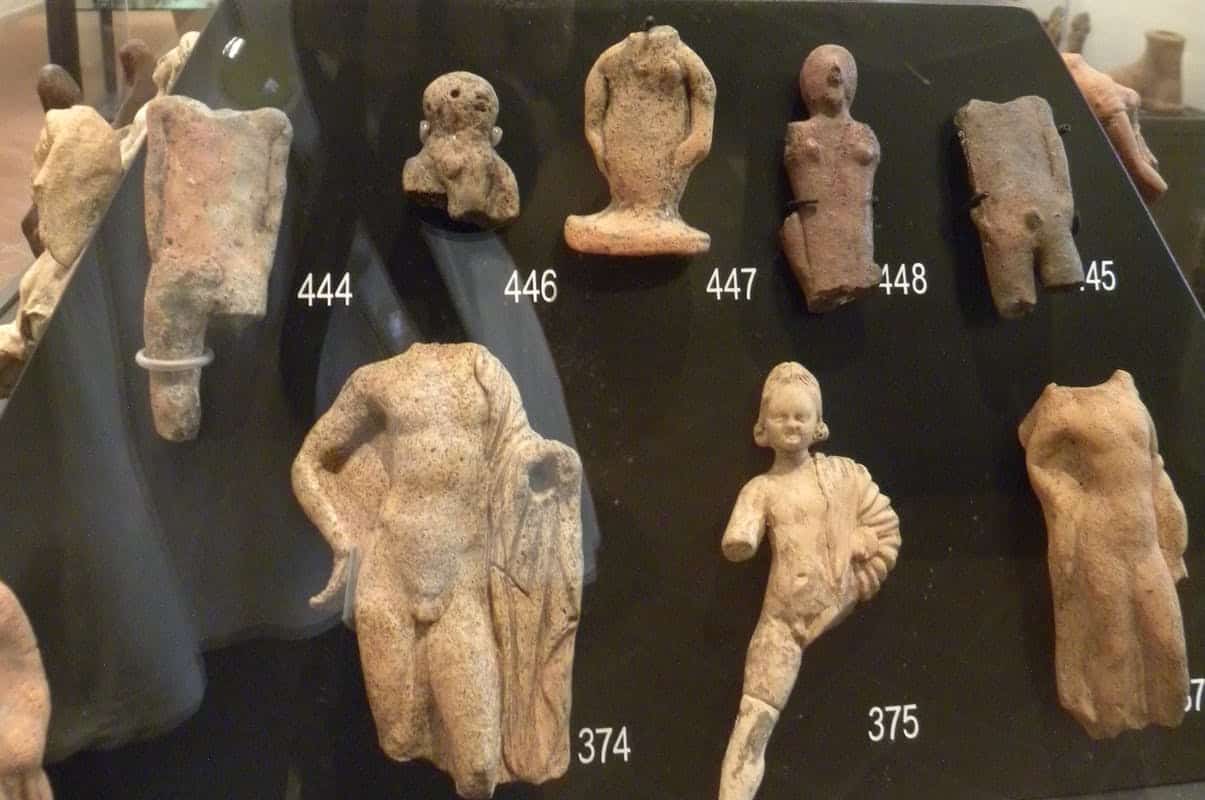
The permanent exhibition in the former paper mill gathers about 700 objects and arranges them along a chronological thread that runs from the origins to the decline of the city. What follows is the thematic route of the materials: when the exhibition reopens to the public, the sequence of the display cases may vary, but these are the cores.
The topography of the ancient city
The first section serves to understand where you are. Plans, sections, aerial photographs, reconstructions of the acropolis and the plateau, the line of the embankment, the relationship with the Astura. It seems like the boring part and is instead the one that makes everything else understandable: without the shape of the city in your head, the following display cases become a catalog of potsherds. Take a good 10 minutes here.
The votive deposits of the acropolis
Three votive deposits have been identified on the acropolis, that is, three stores of sacred objects withdrawn from use and buried. Taken together they cover a span from the 8th to the 2nd century BC. Their value is twofold: quantitative, because the finds are very many, and chronological, because they have made it possible to anchor in time the different phases of settlement of the city. For the materials of the 7th century BC it is one of the richest finds in Italy, excluding contexts of Greek origin. Among the objects: aryballoi, kotylai, a particular type of cup, and oinochoai of the archaic Corinthian type. An Etruscan bucchero vase with a dedication to a person from Caere, present-day Cerveteri. Cut-out sheet-metal figurines of Latin production.
The archaic deposit
Discovered inside the first temple, it contained finds datable between the 8th and 6th centuries BC, of Italic and Etruscan origin. It is the deposit that documents the moment when the sanctuary passes from hut to architecture, and the offerings change accordingly: fewer objects of everyday use, more specifically votive material.
The Republican deposit
Identified by the Dutch archaeologists near the temple of Mater Matuta, it contains over 2,000 finds. 2,000 objects from a single deposit give the measure of how frequented this sanctuary was in the mid and late Republican age, that is, when the city as a political entity was already finished and the place of worship went on living on its own.
The Hellenistic deposit
It came to light during the 19th-century excavations. Originally it was a large cistern, reused from the 3rd century BC as a votive deposit. Many of the materials that come from it are displayed at Villa Giulia. The reuse of a cistern as a sacred store is a typical and revealing gesture: you stop collecting water and start collecting devotion.
The Latial, or archaic, necropolis
It was discovered during the first excavations of the late 19th century, northwest of the acropolis. The oldest tomb dates to the final phases of Latial period II A. The burials were chamber, trench and shaft types, with varied grave goods: Corinthian-type vases, shields, spearheads. And an object that always raises eyebrows on guided tours: a gold dental prosthesis. Latin dentistry of the Orientalizing period, in a country necropolis.
The Volscian necropolis of the Museo di Satricum
Identified in 1981 southwest of the acropolis, it yielded over 200 trench tombs datable between the 5th and 4th centuries BC, accompanied by a large quantity of finds of Greek, Etruscan and Italic production. The trenches were inhumation tombs, with grave goods consisting mainly of pottery. 200 tombs are a serious statistical sample: from them you get average age at death, diet, social differences, trade relations. It is the section I recommend to adult visitors who want to understand how an archaeologist really works.
The axe with the Volscian inscription
In 1983, in that same necropolis, a miniature axe came to light with a short text engraved in the Volscian language, dated to the first half of the 5th century BC. The translation remains uncertain. The find is today at the Archaeological Museum of Cassino, but its story belongs to Satricum and the Museo di Satricum tells it: proof that the Volscians had a language of their own, distinct from Latin, and were not only the lowland barbarians described by the Roman sources. Whoever wants to see the original has to plan a stop at Cassino.
The Lapis Satricanus and the inscriptions
The epigraphic section is small and dense. Besides the Lapis Satricanus, the site yielded inscriptions in Etruscan and archaic Latin, and the dedications that made it possible to recognize in the sanctuary the temple of Mater Matuta. For a non-specialist public it is the most difficult part, and precisely for this reason the museum explains it with educational panels: read them, they are well written.
The Roman villa and the end of the city
In the summer of 2019 the excavation campaigns brought to light, in an uncultivated area of the Casale del Giglio farm, the remains of a rural villa of the Roman age and three human skeletons: two laid side by side, a third a short distance away, together with the remains of two animals, a bovine and a dog. The villa, still under investigation, extends over about 2,000 square meters. It tells the final chapter: when the city stops being a city, the territory is not depopulated, it changes function and becomes productive countryside. It is exactly what the ancient sources let us infer and what the excavation has confirmed with its masonry.
Industrial archaeology in the Museo di Satricum
The museum park project provides that next to the ancient, the modern will also be told: the papal ironworks, the paper mill, the Pontine land reclamation and the birth of the villages. It is a choice I share without reservation. At Le Ferriere history has no holes: there is the 9th century before Christ and there is the 20th century of the workers, and the two extremes touch inside the same wall. Anyone who wants to look further into the reclamation era finds material on the page of the Museo della terra pontina.
Augmented reality on the acropolis
Among the equipment announced for the park there are augmented reality installations dedicated to the acropolis. On this I suspend judgment until I see them working: technology in Italian archaeological sites has a success rate that swings between the memorable and the embarrassing. If it is done well, here it is truly needed, because of three overlapping temples only foundations remain and an ordinary visitor cannot imagine them.

The advice I give you for visiting the Museo di Satricum
First piece of advice, and it is worth more than all the others put together: phone. This is a small civic museum, with hours that depend on the staff available and, at this stage, on the works under way on the building. Showing up without warning is the surest way to make a 120-kilometer round trip and find a closed door. The number of the archaeological site is 0773 458415, the municipal switchboard 0773 6521, the email urp@comune.latina.it. Ask two things: if the exhibition is accessible and if the archaeological area can be visited, because the two answers do not necessarily coincide.
Second piece of advice: come in the morning, and come in spring or autumn. The acropolis hill has no shade. Between June and September, from 11:00 on, the sun beats down on the remains and on the stubble with a violence that is not known in Rome, because here there are no buildings to act as a screen. April, May, October: green grass, long light, civilized temperature. In winter the clay ground turns to pure mud after rain, and city shoes are useless.
Third piece of advice: don't come here alone as the first archaeological visit of your life. Satricum is a site for people who have already seen something. The foundations are low, the walls are outcrops, the landscape doesn't give the scenic effect of a standing temple. You need either a guide, or an afternoon of reading beforehand, or the museum exhibition seen right before going up. The right order, when everything is open, is museum and then hill: the display cases give the keys, the hill gives the scale.
Fourth piece of advice, the most unpopular: combine the visit with something else. On its own the Museo di Satricum is a scant half day. Add the House of the Martyrdom of Santa Maria Goretti in the village, a stop at Torre Astura at the mouth of the river, and the day becomes one of the most beautiful and least crowded in Lazio. Add Nettuno for dinner and you have closed the circle.
Satricum in the ancient sources: what Livy and Pliny tell
The written history of Satricum is a history of wars. The Latin sources name it almost always on the occasion of a siege, a fire or a battle, which says a lot about how Rome saw this city and how much its position counted.
The legendary origins
Satricum appears in the list of the 18 Latin cities founded, according to tradition, by Silvius, son of Aeneas. It should be taken for what it is: a genealogy constructed after the fact to give Latium a Trojan ancestry. The historical value is nil, the cultural value is enormous, because it tells how the Latins of the historical age wanted to see their own past.
498 BC, the Latin League and Lake Regillus
During the second consulship of Titus Larcius, in 498 BC, after the defeat at Fidenae, 29 allied cities in an anti-Roman role, among them Satricum, met to decide how to continue the conflict in the attempt to put Tarquin the Proud back on the throne. They would be defeated in the battle of Lake Regillus. Satricum therefore appears from the start in the front opposing the young republic.
489 BC, Coriolanus
In 489 BC the city was attacked by the Volscians led by Gnaeus Marcius Coriolanus, the exiled Roman patrician who went over to the enemy. After taking Longula, the Volscians took Satricum too, sacked the city and destroyed the temple on the acropolis. It is the moment when the city changes master and begins its Volscian phase.
About 390 BC, the revolt
In 390 BC, or according to another tradition in 393, while the Romans were busy against the Aequi, Velitrae, present-day Velletri, and Satricum rebelled against Rome.
386 BC, Furius Camillus and the standard
In 386 BC Marcus Furius Camillus, elected consular tribune, led the soldiers against Anzio, which had taken up arms again against Rome with the support of young Latin and Hernican exiles. The clash took place in the countryside around Satricum, against an army of Volscians, Latins and Hernici that was numerically superior. To this campaign refers the most famous episode set in these parts, which Livy tells like this:
After sounding the charge, he dismounted and, taking the nearest standard-bearer by the hand, dragged him with him toward the enemy, shouting: Forward the standard, soldier! When the men saw Camillus himself, by now unfit for hardship because of his advanced age, advance toward the enemy, they raised the war cry and threw themselves into the assault all together, each shouting on his own account: Follow the general! It is also told that Camillus ordered a standard to be thrown among the enemy lines, and that the antesignani were urged to retrieve it.
The passage is in the sixth book of the Ab Urbe Condita, chapter eight. In the pitched battle the Romans got the better of it. The Volscians managed to withdraw within the walls of Satricum thanks to a storm that interrupted the fighting. The old general who dismounts and drags the standard-bearer is one of those pictures the Romans told one another to educate their children: it should be read as a moral example before it is read as a military chronicle.
385 and 384 BC, the Roman colony
The following year the Senate decided to establish a Roman colony at Satricum, sending 2,000 citizens there, each of whom received two and a half iugera of land. Two and a half iugera are a little over half a hectare: a modest allotment, typical of colonies for military settlement. The colony lasted a short time. In 384 BC it was attacked by Volscians and Praenestines, who retook the city. Rome relied once more on Furius Camillus, who won a hard-fought victory.
377 BC, the Latins' fire
In 377 BC Rome had to face the usual Volscian threat, this time with the Latins allied to the Volscians. Once the levy was organized, the army was divided into three parts: one to defend the city, one to defend the Roman countryside, and the bulk sent against the enemies under the orders of Lucius Aemilius and Publius Valerius. The pitched battle took place near Satricum and favored the Romans, despite the strong resistance of the Latins, who had learned battle techniques from the Romans. The Volscians withdrew to Anzio, where they negotiated surrender, handing over the city and the countryside. The Latins, furious at the defection of their allies and determined to continue the war, set fire to Satricum, which was destroyed. Only the temple of Mater Matuta was saved.
346 BC, the end
In 349 BC Satricum was rebuilt by the Volscians of Anzio, who founded a colony there. Three years later the city had been completely rebuilt. Rome, fearing the rebirth of Volscian power, made war on the city and defeated the Volscians once again: Satricum was put to the flames a second time, and once again only the temple of Mater Matuta was spared. Two fires and two temples saved: the ancients burned the houses of their enemies, not the houses of the gods.
Pliny the Elder and the vanished cities
In the 1st century AD Pliny the Elder, in the Naturalis Historia, lists Satricum among the Latin cities by then vanished. From the destruction of the 4th century BC to Pliny's notarial record 400 years pass: the sanctuary stays in operation for a long time still, but the city as a political organism no longer exists.
Another well-known fact, yet rarely cited
Everyone knows that Satricum was destroyed twice and that twice the temple of Mater Matuta was spared. It is written in all the textbooks, all the captions repeat it. What almost nobody explains is why, and the why is the most interesting thing in the whole affair.
In archaic Lazio, extra-urban sanctuaries and the great places of worship had a legal and religious status that made them untouchable even in war. They were federal spaces, frequented by peoples from different cities, often sites of periodic markets and of agreements between communities. Burning an enemy settlement was a normal military act. Burning the temple of a deity you also venerate was a sacrilege that would turn against whoever committed it. The Latins who in 377 BC set fire to Satricum to punish the Volscians' defection left the sanctuary standing, and the Romans did the same 30 years later. It was not piety. It was religious calculation.
There is an archaeological confirmation of this continuity, and this one really is rarely cited. Religious use of the hill continues until the 1st century BC, when the city has been gone for 300 years: the dedication by the duumvirs of Anzio is from that period. An urban center wiped off the map kept a working sanctuary, maintained by a neighboring city. It is proof that the sacredness of the place outlived the community that had created it, and it is the reason the Museo di Satricum has so many finds: nine centuries of uninterrupted offerings in a place that, politically, had been dead for a long time.
Let's add an observation. The votive deposits of the Museo di Satricum are not dumps of broken objects. They are burials of sacred things: when the space of the sanctuary filled up, the donated objects could be neither sold nor thrown away, because they belonged to the deity, and so they were buried with care. Archaeologists find orderly deposits precisely for this reason. Every display case you see is the result of an act of respect carried out 2,500 years ago.

130 years of excavations around the Museo di Satricum
The story of the research at Satricum is almost more adventurous than the ancient story, and knowing it helps explain why the museum displays what it displays.
1825, Antonio Nibby locates the city
The first to put his finger on the right spot on the map was Antonio Nibby, who in 1825 identified the site of Satricum in what had become the Casale di Conca, inside the vast estate of the same name, owned by the Holy Office of Rome since at least 1713. In the account of his field explorations Nibby notes that near the farmhouse there were ironworks driven by the Astura river: from that comes the name of today's locality. A 19th-century topographer who recognizes a vanished Latin city by reading Livy with a map in hand: that was the method, and it worked.
1896-1898, the first excavation
The first investigations on the ground date to 1885, but for systematic excavations you have to wait for 1896, when Hector Graillot, a lecturer at the University of Bordeaux, identified on the hill of Le Ferriere the remains of the temple dedicated to Mater Matuta. The French campaign lasted a few weeks and was suspended by order of the Italian government. The work resumed under the direction of Italian archaeologists, among them Felice Barnabei, Raniero Mengarelli and Adolfo Cozza, and continued until 1898. The materials took the road to Rome and in 1903 were bought by the National Etruscan Museum of Villa Giulia.
1907-1910 and the 20th-century test pits
A second season of excavations falls between 1907 and 1910. Then other test pits in 1934 and 1958, conducted discontinuously. For half a century Satricum was, in fact, a known and abandoned site: people knew where it was, and didn't dig.
1977, the Dutch arrive
The rediscovery begins in the 1970s, when the Committee for Latial Archaeology asked the Royal Netherlands Institute in Rome to take on the research at Satricum. The systematic campaigns resumed in 1977, with the later involvement of the universities of Groningen and Nijmegen, and since then they have never stopped. It was the first Dutch campaign, in 1977, that gave back the Lapis Satricanus. The sanctuary on the acropolis was re-excavated between 1978 and 1981, and in those same years the Volscian necropolis was identified.
From 1990, the University of Amsterdam
From the early 1990s the direction of the project passes to the University of Amsterdam, under the responsibility of Professor Marijke Gnade, supported by a research team that includes, among others, Barbara Heldring and Patricia Lulof. A contribution from the European Commission obtained in 2000 financed the creation of the archaeological park, with the protective structures over the temple remains and the documentation center carved out of the industrial building. Since 2014 that center has become the permanent exhibition. Scientific coordination returned to the Netherlands Institute in 2024. You can find the official project page on the University of Amsterdam site.
2019 and beyond, the Roman villa
In the summer of 2019 the excavations identified the rural villa of the Roman age and the three burials mentioned, in the fields of the Casale del Giglio farm, along the line of the ancient road that led to the sanctuary. The research continues. The summer campaigns bring Dutch and Italian students to the village every year: whoever happens to be at Le Ferriere in July may find an excavation site in action in front of them, which is the most instructive show an archaeological site can offer.
The embankment, the walls and the shape of Satricum
A chapter that in the Museo di Satricum you follow mostly on the plans, and that on the ground requires a trained eye. The line of the embankment that defended the city on the three sides facing north, west and south has been reconstructed, while the eastern side was protected naturally by the cliff and the Astura river. The embankment must have been accompanied by a ditch, traces of which have been found on the western side, and between the earthwork and the ditch a reinforcing wall had been placed. The defensive system thus composed reached five or six meters in height. A further work protected the acropolis on its southern side.
Five or six meters of rammed earth and masonry seem little to someone who has the Servian walls or those of Norba in mind, but for a Latin city of the 6th century BC they were a serious fortification, and above all an expensive one: an embankment of that caliber requires a community able to organize hundreds of people for a season. The defense of a city tells its wealth better than any grave goods.
The right photo to take at the Museo di Satricum
The photograph everyone tries to take, and that almost nobody brings home decent, is the one of the temple remains on the acropolis. It's hard because the foundations are low and the modern protective cover cuts the frame. The typical result is a rectangle of gray stones on a yellow lawn, with a shelter in one corner, which at home says nothing to anyone.
The right photo is made in two ways, and neither involves pointing the lens at the temple. The first: stand on the western edge of the acropolis in the first half hour after dawn or in the last hour before sunset, and photograph the plain toward the sea with the hill in the foreground. With raking light the 40-hectare plateau reads like a relief table, the undulations of the ground become visible and you understand, at a glance, where the city ended. It is the photograph that explains Satricum better than any caption.
The second way concerns the museum and the village. Frame the smokestack of the old factory from below, with the sky behind, and include a piece of industrial brick masonry. It seems like an off-topic photograph in an article on archaeology, and instead it is the exact synthesis of this place: the popes' iron, the 20th-century paper and the Corinthian vases under the same roof. If you happen to go in when the exhibition is open, look for the display case of the cut-out sheet-metal figurines and photograph them edge-on, with side light: they are very thin objects and head-on they flatten out.
Last recommendation, valid everywhere but here more than elsewhere: no flash on the display cases, and ask first if photographs are allowed. In a small civic museum the rule can change from one installation to another, and the staff are the only reliable source at the moment.
Some important events that happened here in history
On this hill and in this village, in no particular order and across centuries, some things happened that deserve to be told one by one.
The sack of 489 BC. Coriolanus, the Roman patrician banished from his city and gone over to the Volscians, took Satricum after Longula, sacked it and destroyed the temple on the acropolis. It is the first dated event that directly concerns this place, and it coincides with the city's passage under Volscian control.
The gesture of Furius Camillus in 386 BC. The old dictator who dismounts, grabs the standard-bearer and drags him toward the enemy is, in Roman memory, one of the founding scenes of military courage. Livy places it in the countryside around Satricum. That it happened exactly like this is a matter of historiographic faith. That the Romans believed it had happened here is a fact.
The fire of 377 BC. The Latins, betrayed by the Volscians who had surrendered at Anzio, burned the allied city in reprisal. The temple was spared. It is the event that marks the beginning of the end.
The second destruction of 346 BC. Rome, after the Volscians of Anzio had rebuilt the city and settled a colony there, burned it again. From that moment Satricum no longer rises as an urban center.
The dedication of the duumvirs of Anzio, 1st century BC. 300 years after the end of the city, the magistrates of Anzio finance a dedication to the temple of Mater Matuta. It is the last documented act of the sanctuary, and the proof that the hill stayed sacred well beyond the life of the community that had consecrated it.
The casting of the hoops for St. Peter's, 1740-1744. 40 tons of iron worked here to girdle the most famous dome in the world. In 1748 the marquis Poleni put it in writing in his report on the restorations.
July 5, 1902. In a farmhouse in the village, today the Sanctuary of the House of the Martyrdom, Maria Goretti, 12 years old, was struck down by Alessandro Serenelli as she resisted a sexual assault. She died the next day in Nettuno. She was proclaimed a saint by Pius XII on June 24, 1950 and her liturgical memorial falls on July 6. Her remains rest in the sanctuary of Nettuno, not at Le Ferriere.
The 1930s and the land reclamation. The Dominici family, who had acquired the estate and started the paper mill, saw most of their land expropriated by the Opera Nazionale Combattenti under the law on land reclamation. The village enters the geography of the reclaimed plain and takes on the look it still has today.
1977 and the Lapis Satricanus. The first Dutch campaign gives back the inscription with the name of Publius Valerius. A line of letters on a reused block reopens the dossier on the origins of the Roman republic.
June 2014. The permanent exhibition opens in the village: for the first time since the discovery of the site, the finds can be seen a few steps from the spot where they were found.
June 4, 2026. The city council of Latina unanimously approves the establishment of the Satricum Civic Museum Park and its regulation. On the following July 2, the public announcement in the village, in front of the temple of Mater Matuta.
Who has passed through the Museo di Satricum
The village of Le Ferriere is small and off the routes, and yet the list of those who have passed through is the kind that raises an eyebrow.
Marcus Furius Camillus, the general the Romans called the second founder of Rome, fought in the countryside around this hill in 386 and again in 384 BC. If there is a figure of Republican history tied to this landscape, it is him.
Gnaeus Marcius Coriolanus, the most famous turncoat of Roman antiquity, took and sacked the city in 489 BC. His figure, between history and legend, has crossed 24 centuries all the way to Shakespeare and Beethoven.
Publius Valerius, or an immediate member of his family, is named on the stone found in 1977. We don't know if he ever came in person, but his sodales did and left an inscription to Mars: it is the oldest documented presence of a figure of Roman history in this place.
Antonio Nibby, the topographer who in the early 19th century reconstructed the geography of the Roman countryside by walking over it, traveled these fields and recognized the ancient Satricum here. Without him the site would have remained a farmhouse with a few strange stones.
Hector Graillot, professor at the University of Bordeaux, opened the first excavation in 1896 and was stopped after a few weeks by the Italian government. He was succeeded by Felice Barnabei, founder of the Villa Giulia Museum and a central figure of post-unification Italian archaeology, Raniero Mengarelli, later excavator of Cerveteri, and Adolfo Cozza, sculptor and archaeologist.
Marijke Gnade, of the University of Amsterdam, has directed the research for over 30 years and is the person who more than anyone else has reconstructed the sequence of this city. Whoever has been lucky enough to hear her tell Satricum in the field, as happened at the public evening of July 2025 in front of the temple, knows that archaeological research can be a gripping story.
Pope John Paul II came to Le Ferriere on September 29, 1991, for the first Goretti centenary, and the visit was accompanied by a restoration of the house of the martyrdom. Before him, Cardinal Francis Spellman, archbishop of New York, supported the restoration of 1952 after the Passionist fathers bought the property in 1951.
Maria Goretti lived in this village with her family, who came from the Marche together with 21 other families called to work the estate at the end of the 19th century. Her story has brought pilgrims from all over the world to Le Ferriere, and for decades it was the only reason anyone knew this name.
Pope Sixtus V, who in 1588 wanted the modernization of the ironworks, does not appear to have ever come in person, but his decision gave the village its name and, indirectly, the museum its building.
What to see around the Museo di Satricum
The House of the Martyrdom of Santa Maria Goretti
It is in the village, at Via del Cavaliere 1, inside an 18th-century farmhouse that belonged to the Gori Mazzoleni family. The contacts given are 0773 458056 and 0773 458021. The sanctuary preserves the place where the girl was attacked on July 5, 1902. Her remains are instead in Nettuno. Even those who come for the archaeology should go in: it is a five-minute walk from the museum and it tells the agricultural 20th century of this plain with a rawness that no educational panel matches.
Casale del Giglio and the excavation fields
The Casale del Giglio farm, on the Cisterna-Nettuno road at kilometer 13, has in its fields a substantial part of the investigated areas, including the Roman villa of 2019 and the line of the road that led to the sanctuary. The farm supported the archaeological project for years together with the Soprintendenza and the Netherlands Institute, and on its site publishes a summary of the history of the excavations. In 2004 a skyphos of the 5th century BC was found in this area, considered the oldest find related to wine in central Italy: a detail that, on a winery, has something novelistic about it.
Torre Astura and the mouth of the river
Nine kilometers of river separate the acropolis from the sea. At the mouth is Torre Astura, with its Roman fishpond and the castle on the sea, and behind it the Torre Astura grove. Access is conditioned by the presence of the military range: find out first. It is the natural completion of a day at Satricum, because it shows where the waterway that made the city strategic ended.
Anzio, Nettuno and the coast
20 minutes by car away are Anzio, the Antium of the Volscians and the Romans, and Nettuno with its medieval village and the basilica where Maria Goretti rests. In Anzio the Museo dello sbarco di Anzio, which tells January 1944, deserves a stop. Three eras in 25 kilometers.
The rest of archaeological Lazio
Anyone who takes a liking to this kind of visit has, within an hour, a density of sites that few European territories can claim: the archaeological park of Privernum and the museums of Priverno, the archaeological museum of Palestrina with the sanctuary of Fortuna Primigenia, the area of Lanuvio, the village of Sermoneta and the garden of Ninfa, the Circeo national park. And, for the obligatory comparison with the Etruscan world that so influenced Satricum, Cerveteri.

How you really visit the Museo di Satricum
How long the visit to the Museo di Satricum lasts
The exhibition, when accessible, can be walked through calmly in 40 minutes or an hour. The archaeological area takes another good hour, more if you want to go around the plateau. With the House of the Martyrdom you reach a full half day. Adding Torre Astura or Nettuno fills the whole day without hurry.
The Museo di Satricum with children
Honestly: under age eight it's hard. The archaic ceramics display cases don't speak to a small child and the temple foundations even less. Over age 10, on the other hand, the place works well, on two conditions: tell the story of the Volscians and Coriolanus beforehand the way you tell an adventure, and let the kids walk on the plateau. Open space always saves the family archaeological visit. The real risk, in summer, is the heat: hat, water, morning hours.
Accessibility
The exhibition building is on the level of the village and this helps, but the usability of the routes should be checked directly with the municipality before leaving, all the more while works are under way. The archaeological area, on the other hand, is natural sloping ground, with grass, gravel and changes in level: for a wheelchair it is demanding and in some stretches impassable, and after rain it is for anyone who doesn't have suitable shoes.
When to go and when to avoid
Spring and autumn are the right seasons. July and August afternoons are to be avoided for the heat, and August in general is the month when small civic museums reduce their openings. The extraordinary opening days promoted by local associations and the spring initiatives of the Italian Environment Fund are the best occasions to find the site accompanied by those who study it.
How much it costs
Admission to the exhibition has so far been free. Guided tours organized by local associations and cooperatives may have a cost and require booking. No authorized online reseller is needed for a civic museum of this kind: you phone and you go.
Quick questions about the Museo di Satricum
Is the Museo di Satricum open?
At this time the display of finds in the former paper mill cannot be visited: works are planned for the fire-safety certification of the building, essential to reopening to the public. Before getting in the car it is best to phone 0773 458415 or the municipal switchboard 0773 6521.
Where exactly is the Museo di Satricum?
In Borgo Le Ferriere, a hamlet of the municipality of Latina, along the Nettunense road, on the border with Nettuno and a short distance from Aprilia. The archaeological area is on the hill immediately south of the village.
How much is the ticket for the Museo di Satricum?
Admission has so far been free. Since it is a civic museum in the middle of reorganization, it is best to ask the municipality of Latina for confirmation before the visit.
Do you need to book to visit the Museo di Satricum?
For the exhibition, when it is open, booking is not required, but a call in advance avoids unpleasant surprises. For guided tours of the excavation area booking is normally necessary and goes through the associations that organize them.
How long does it take to visit the Museo di Satricum?
From 40 minutes to an hour for the rooms. With the archaeological area it comes to two and a half hours.
Can you take photographs in the Museo di Satricum?
In civic museums the rule can change with the installation: ask the staff at the entrance. Outdoors, in the archaeological area, there are no particular restrictions on amateur photography.
Is the Museo di Satricum accessible to people with disabilities?
The exhibition building is at village level, but usability should be checked with the municipality, especially during the works. The archaeological area, being natural sloping ground, presents serious difficulties for those who use a wheelchair.
Is the Museo di Satricum suitable for children?
From age 10 up it works, especially if you tell the story of the city first and devote time to the walk on the plateau. For the youngest it is a demanding visit.
How do you get to the Museo di Satricum from Rome?
By car, from the Pontina toward Aprilia and then in the direction of Le Ferriere and Nettuno. About an hour and a quarter without traffic. Direct public transport does not exist: the stations of the Nettuno line are far away and have to be completed with a bus or a taxi.
Is there parking at the Museo di Satricum?
Yes, you park freely along the village streets. There are no paid areas.
What can you see in the Museo di Satricum?
About 700 finds from the excavations of the city: Greek, Etruscan and Italic ceramics, materials from the votive deposits of the sanctuary, grave goods from the Latial and Volscian necropolises, architectural terracottas, topographic documentation and materials from the Roman villa. The route is chronological, from the huts of the 9th century BC to the Roman countryside.
Why is the museum called Satricum and the village Le Ferriere?
Satricum is the name of the ancient city buried on the hill. Le Ferriere is the modern name of the village and comes from the iron workshops active here from the Middle Ages until 1865.
Where are the most famous finds from Satricum?
The great architectural terracottas from the 19th-century excavations are in the National Etruscan Museum of Villa Giulia in Rome, bought in 1903. The axe with the Volscian inscription is in the Archaeological Museum of Cassino. At Le Ferriere you see the materials from the later campaigns.
What is the Lapis Satricanus?
A block of tuff with an inscription in archaic Latin, found in 1977 reused in the foundations of the last temple. It cites the sodales of Publius Valerius who dedicate to Mars, and it is datable between the end of the 6th and the beginning of the 5th century BC.
Who was Mater Matuta?
The Latin goddess of the morning and the dawn, protector of birth. The sanctuary of Satricum was dedicated to her, and her identification rests on inscriptions found in the area.
Can you visit the archaeological area together with the Museo di Satricum?
When both are open, yes, and the best order is rooms first and then the hill. The two openings do not always coincide, though: ask for confirmation for both.
Are there guided tours of the Museo di Satricum?
Local associations and groups that collaborate with the park organize periodic tours, often on the occasion of events and special days. There is no continuous accompaniment service guaranteed every day.
Does the Museo di Satricum have a bookshop or a bar?
No. In the village there is a village bar and nothing more. Bring your own water, especially in summer.
How big is the ancient city of Satricum?
The acropolis occupies about four hectares, the plateau to the west about 40. Overall the archaeological area covers a surface a little over 40 hectares.
What is the difference between Satricum and Satrico?
None: Satricum is the Latin form, Satrico the Italian one. Both indicate the same ancient city.
Why was Satricum destroyed?
Twice for military reasons: in 377 BC by the Latins, as reprisal against the Volscians who had surrendered to the Romans, and in 346 BC by the Romans, who feared the rebirth of Volscian power after the rebuilding of the city.
Is the temple of Mater Matuta visible today?
You see the foundations and the protective structures built starting in the 2000s. The elevation no longer exists: you have to read the plans and rely on the reconstruction.
Who is digging at Satricum today?
The research is conducted by the Dutch archaeological school, with scientific direction headed by Professor Marijke Gnade and the Netherlands Institute in Rome, in agreement with the Soprintendenza and the municipality of Latina.
Can the Museo di Satricum be combined with a religious visit?
Yes. The House of the Martyrdom of Santa Maria Goretti is in the same village and the basilica that holds her remains is in Nettuno, half an hour by car. It is a pairing many groups have done for decades.
What is there to see near the Museo di Satricum within an hour by car?
Anzio and Nettuno on the sea, Torre Astura at the mouth of the Astura, Sermoneta and Ninfa toward the Lepini mountains, Priverno and its archaeological park, Palestrina for the great sanctuary of Fortuna Primigenia.
Where do I find official information on the archaeological site of Satricum?
On the portal of the Municipality of Latina, which publishes the page for the place and the contacts, and on the pages of the research project of the University of Amsterdam.
The value of this place lies not in a single masterpiece to photograph, but in density. Nine centuries of ancient history, four peoples, two fires, two temples spared, a stone that rewrites the origins of the Roman republic, then the popes' iron, paper, the land reclamation, a 12-year-old saint and a vineyard. All inside one square kilometer of plain that nobody looks at while running to the sea. If the Civic Museum Park does what it promises, in a few years we will talk about the Museo di Satricum the way we talk today about a provincial museum that has stopped being provincial. In the meantime, phone, take the car and go as soon as it reopens: you will find yourself almost alone in front of one of the densest stories in Lazio.
National Etruscan Museum - Villa Giulia and Villa Poniatowski - buy your ticket online here
Article written by the editorial team of TourLeaderPro, contact them for Private/Corporate/V.I.P. Tours and Experiences.
Planning a trip to Rome? The English guides to visiting the city are on ItalyPlanner.com.