Lavinium Archaeological Museum
In short. The Lavinium Archaeological Museum is open and can be visited freely during regular hours, but the archaeological area of the 13 Altars and the Heroon of Aeneas, which are outside the building, can be seen only with a guided visit and…
The Lavinium Archaeological Museum is open and can be visited freely during regular hours, but the archaeological area of the 13 Altars and the Heroon of Aeneas, which are outside the building, can be seen only with a guided visit and only by reservation: whoever arrives without having phoned gets into the museum and stays outside the altars. Address: Via Pratica di Mare 4, locality Borgo di Pratica, 00071 Pomezia (RM), about 30 kilometers from Rome. Phone 06 91984744, email museo.lavinium@comune.pomezia.rm.it. The museum is municipal, run by the City of Pomezia, and has its own website, museolavinium.it, where you find the updated ticket office and calendar.
Summer hours, from April 1 to September 30: Tuesday and Thursday 9-13 and 15-18, Wednesday and Friday 9-13, Saturday, Sunday and holidays 10-13 and 16-19. Winter hours, from October 1 to March 31: Tuesday and Thursday 9-13 and 15-18, Wednesday and Friday 9-13, Saturday, Sunday and holidays 10-13 and 15-18. Closed Monday, December 25, January 1 and on the day of the patron saint's feast. The ticket office closes 45 minutes before the hall. The ticket price is set by the municipality and it is best to ask for it at the museum's number before leaving, along with the discounts: since it is a civic museum and not a state one, neither the Ministry's free Sunday nor the passes of the Roman circuits are valid here.
The guided visits to the archaeological area follow their own calendar: from October to March on Sunday and holidays at 11. From April to September on Saturday, Sunday and holidays, at 16 in April, May and September, at 18 from June to August. Reservation required at the museum. The building has no architectural barriers and there is a tactile route with braille captions for blind and low-vision visitors, also to be arranged in advance. If you want a wider picture of what there is to visit in archaeological Lazio, the page on tourist attractions holds the pieces together.
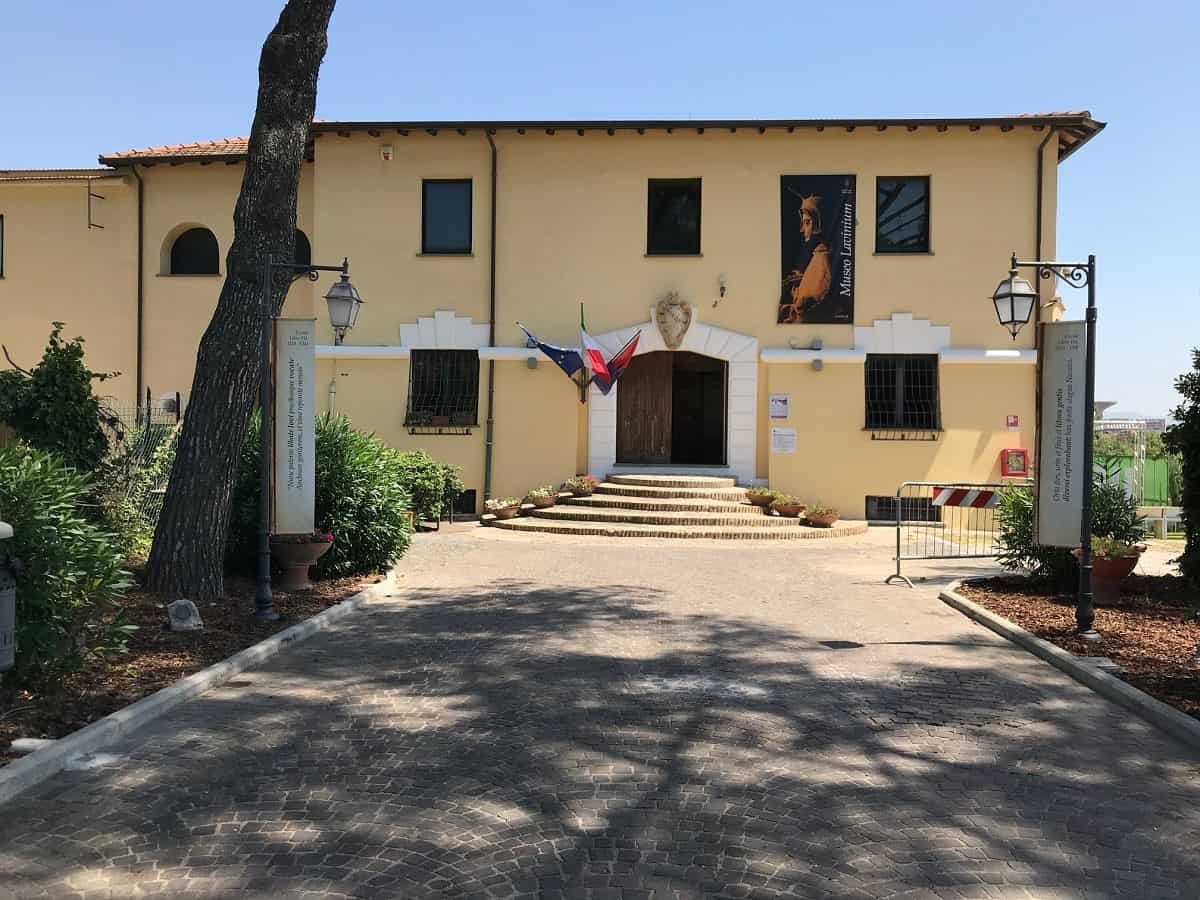
How to Get to the Lavinium Archaeological Museum Without Losing Your Morning
By car it is simple: you leave Rome on the Pontina, the SS148, take the service road and then Via del Mare in the direction of Pratica di Mare. You meet the museum about 150 meters before the village, on the right, in a low building that nobody would mistake for a monument. Parking is not paid in the surroundings, which in Rome is already news.
By public transport the matter requires patience. The most common combination is metro line B to Laurentina and then the Cotral regional bus in the direction of Torvaianica, getting off at Via del Mare stop for Pratica di Mare. From the coast there is line 261 that leaves from the Ostia Cristoforo Colombo station. By train you get off at Pomezia-Santa Palomba, on the regional lines FL7 and FL8, and from there continue with city bus 1. The runs are not frequent, especially on Sunday: check the carrier's hours the day before and work out the return, because staying in Pratica di Mare at seven in the evening without a car is an experience I recommend to no one.
When It Is Best to Go to the Lavinium Archaeological Museum
The best window is Saturday or Sunday afternoon from April to September, because the 16-19 afternoon opening coincides with the guided visit to the archaeological area and in a single outing you see both the rooms and the altars. In winter the visit to the altars is Sunday only and at 11, so the day has to be built in reverse: first the field, then the museum. Avoid early Wednesday and Friday afternoons, when the museum closes at 13 and you find yourself in front of a barred door with the sun still high.
What Lavinium Was Before Becoming the Lavinium Archaeological Museum
Lavinium stood on an elongated plateau that ends in an isolated hill, connected to the rest by a narrow isthmus: that hill, today occupied by the village of Pratica di Mare, was the acropolis and the oldest core of the settlement. The ancient sources place it 17 miles south of Rome, between Ostia and Ardea, and describe it not as a military power but as something more delicate and rarer: a religious center recognized by all the Latins.
Human presence at the site goes back to the Bronze Age, with material of the 13th and 12th centuries BC. Stable occupation is documented from the 10th-9th century BC, with oval huts and pit tombs. In the Archaic age the settlement takes on a regular layout, with masonry buildings and tiled roofs, and surrounds itself with walls in cappellaccio ashlar dated shortly before the middle of the 6th century BC, built over older defensive structures of the 7th century BC and reworked in the 6th and 4th. The eastern gate looked toward the landing on the sea: Lavinium lived on transit, exchange and worship.
Myth did the rest. Aeneas, according to the Roman literary tradition, landed in Latium and founded his city here, naming it after Lavinia, daughter of King Latinus. 30 years later Ascanius left to found Alba Longa, and Lavinium remained a small, sacred city, the place where Rome went to recognize its own origin. In the 4th century AD Symmachus still called it a civitas religiosa. The museum tells this double nature, archaeological and mythical, without pretending that the two coincide.
The Room-by-Room Visit of the Lavinium Archaeological Museum
The museum was born in 2005 as a permanent exhibition titled Hic Domus Aeneae and is organized in five thematic rooms, with finds ranging from the 10th century BC to the Roman age. The display mixes traditional cases and multimedia apparatus, and the mixture works better than usually happens in Italy: the videos don't cover the objects, they explain them. The route takes a little over an hour if you read everything, 40 minutes if you're in a hurry. Go slowly: the rooms are few and each has a piece worth the trip.
The Tritonia Virgo Room of the Lavinium Archaeological Museum
You enter and meet her right away: the great statue of Minerva Tritonia, in terracotta, dated to the 5th century BC, coming from the goddess's eastern sanctuary. Around it, the votive statues of almost life size, for the most part female, made of terracotta with the mold technique and dated between the 5th and 3rd century BC. They were gifts deposited in the sanctuary by the Lavinian aristocracy. Look at the hairstyles and the jewelry: they are social portraits, not individual portraits, and they served to declare the rank of the family making the offering.
This room also holds the device that most strikes visitors, the so-called talking statues: a video animates the figures and gives back the voice of boys and girls of the local aristocracy at the moment of passage from adolescence to adulthood, which is the ritual context in which those statues were donated. The risk of the genre is the fairy-tale. Here the tone stays dry and the reconstruction rests on the excavation data. Better to look at the terracottas first in silence and then start the video: the reverse order would leave you with the television image instead of the object.
The Mundus Muliebris Room
Here the museum leaves myth behind and becomes pure archaeology, and for me it is the best room. It displays the funerary goods of the protohistoric necropolis, with tombs dated between the 10th and 7th century BC: jewelry, fibulae, and above all the tools of women's work, spindles, spindle whorls, loom weights, bobbins. They are tiny objects and they are the most eloquent thing in the museum. A spindle in a tomb is not a forgotten utensil: it is a statement about who that woman was and what the community recognized in her.
Next to the grave goods are votive heads and busts that illustrate the rites practiced in the sanctuary. The name of the room, Mundus Muliebris, is a Latin term indicating the whole of the ornaments and tools of the female sphere, and the display choice makes it a chapter of social history of Latium vetus. If you have little time, give this case five more minutes: the rest of the museum can be told, this you understand only by looking at it.
The Hic Domus Aeneae Room and the Bronze Age Ship
The section devoted to Aeneas's voyage is what the museum calls the blue room. Two videos carry it: Il viaggio reconstructs with images and computer graphics the route followed by the Trojan hero before landing in Latium, near present-day Torvaianica. La nave offers a three-dimensional reconstruction of the fitting out of a Bronze Age vessel, that is, of the era to which tradition assigns Aeneas.
Let's be clear about the degree of certainty, because this is where so many museums cheat. Aeneas's route is literary material, not an archaeological document: the reconstruction shows where the ancient texts make him pass, not where anyone has found his traces. The ship, on the other hand, is a technical reconstruction based on the knowledge of naval archaeology for that period. They are two different statuses and the museum, it must be said, keeps them distinct. Young audiences leave this room more curious than they came in, and for a provincial museum that is a notable result.
The Civitas Religiosa Room and the Virtual Priest
The fourth room concerns the sanctuaries and in particular the sacred area of the 13 Altars, one of the most important places of worship in archaic Latium. The cases display the votive material returned by the excavations: Greek imported pottery, black-figure ritual vases, bucchero, common pottery, very many krateriskoi, that is, small miniature kraters deposited as offerings, bronze figurines and anatomical ex votos. Among the most cited pieces is the cup of the Dioscuri of the 6th century BC, which links the material in the case to the cult of the divine twins attested at the site.
A digital reconstruction illustrates the history of the sanctuary and a virtual priest addresses visitors directly, explaining the meaning of the cult toward the god of the altars, identified with good probability as Aeneas Indiges, the founding progenitor of the sacred city. The conditional is a must: the identification is a hypothesis of scholars, not an inscription read on stone. The room works well with kids and works very well if you visit it after walking among the real altars, which are a few hundred meters away.
The Aeneas Indiges Room and the Tuff Doors of the Heroon
The last room of the Lavinium Archaeological Museum is devoted to Aeneas and gathers the funerary goods found in the so-called Heroon of Aeneas, the sepulchral monument in which the ancients believed the figure was laid. There are the sword, the spears, the sacrificial knife. The vases decorated with incision for keeping and drinking wine. The big spits with iron firedogs used to roast the meat of the ritual banquet. And then the object I prefer of the whole museum: the bronze grater of the 7th century BC, which served to flavor wine with goat cheese according to a fashion of Greek origin. A grater in a princely tomb says more than 10 pages of treatise on the Hellenization of Latium.
In the center of the room are placed the tuff doors of the 4th century BC that closed the cella of the Heroon in its last reconstruction. They are enormous, rough, and have a visual weight that no video can match. A three-dimensional documentary summarizes what studies have reconstructed of the story of Aeneas and his disappearance after the battle against Mezentius, and the route closes with a video in which the hero, with his doubts, addresses his father Anchises. It is a sentimental ending. I like it, but I warn you that the main attraction remains the tuff.
The Sanctuary of the 13 Altars, the Real Reason to Come All the Way Here
South of the hill of the settlement, along the road that led to the sea landing and near a spring, a row of tuff altars painted red lines up, oriented to the east and arranged north-south over about 50 meters. They are of different periods: the oldest go back to the middle of the 6th century BC, the last four to the end of the 4th century BC, and the complex remains in use throughout the 5th and 4th century before being abandoned, according to the current dating, in the 3rd century BC. Beside the altars the investigations have recognized an Archaic building of the 6th-5th century BC intended for the priests and for those arriving on pilgrimage.
The number 13, which gives the sanctuary its name, is no longer exact: the investigations carried out between 2004 and 2009 identified what is in all probability a 14th altar, re-examined in 2019. The traditional name remained, as the names of things remain when science overtakes them.
What was celebrated here we do not know entirely. We know that the sanctuary was open-air, that it did not serve a single city and that collective sacrifices were practiced there. We know that the excavations returned Laconian, Attic and Ionian pottery, bucchero, and an impressive quantity of krateriskoi. In the sanctuary an Archaic bronze plaque was also found, datable between the 6th and 5th century BC, with a dedication to the Dioscuri: it is one of the earliest attestations of the cult of the twins in the Latium area, and precedes the official entry of Castor and Pollux into Roman religion. Seeing it after having walked among the altars changes the meaning of the case.
The Heroon of Aeneas and the Three Lives of a Tumulus
About 200 meters from the altars there is a tumulus tomb 18 meters in diameter, of the Orientalizing age, with the main burial dated to the 7th century BC. It was, evidently, the sepulcher of a person of rank in Archaic Lavinium. In the 4th century BC the tumulus was restructured: a cella and a monumental facade were added against it, and from that moment the monument ceased to be a family tomb and became a place of public worship, dedicated to a heroized ancestor.
This is the most misunderstood point. Archaeology has not found the tomb of Aeneas: it has found a tomb of the 7th century BC that four centuries later the Lavinians decided to identify with the tomb of Aeneas, monumentalizing it accordingly. It is an enormous historical fact, and it concerns the 4th century BC, not the Bronze Age. In that period Rome was building its own Trojan genealogy, the relationship with Lavinium had just been refounded with the treaty of 338 BC, and a common ancestor suited everyone. The Heroon is the material document of that political and religious operation. The tuff doors displayed in the last room of the museum belong precisely to this phase.
The Eastern Sanctuary of Minerva and the Statues of the Lavinium Archaeological Museum
The second extra-urban sanctuary stood on a small rise east of the city and in the 5th century BC presented itself as an area laid out in terraces. The votive deposit shows two phases: the first between the end of the 7th and the middle of the 6th century BC, the second from the middle of the 6th to the 3rd century BC. It is from the second phase that the large terracotta statues displayed in the first room of the museum come: images of the goddess and of the worshippers, mostly female, together with anatomical ex votos and figurines of swaddled babies.
Those figurines are the interpretive key. A cult that receives swaddled children as gifts is a kourotrophos cult, that is, a cult directed to the protection of growth and of the passage of age. The Minerva of Lavinium, then, is not the warrior goddess one expects: she is the divinity who watches over the moment when a girl stops being a child and a community recognizes her as an adult. The epithet Tritonia refers to the Greek tradition on the birth of the goddess by the waters of Triton and confirms how permeable archaic Latium was to Hellenic models. The terracotta statue of Minerva Tritonia of the 5th century BC that welcomes visitors at the entrance comes from here.
The Excavations of Ancient Lavinium and Who Carried Them Out
The first identification of the site is owed to Pirro Ligorio, the 16th-century Neapolitan antiquarian and architect, who recognized in Pratica di Mare the ancient city of the Latins on the basis of the literary sources. Confirmation on the ground came four centuries later. Between 1955 and 1957 Ferdinando Castagnoli and Lucos Cozza, for the Istituto di Topografia antica of the University of Rome, began the systematic research that led in 1959 to the discovery of the sanctuary of the 13 Altars. In the 1960s the great votive deposit was identified, then the eastern sanctuary, then the Heroon.
The work has continued for over half a century with Paolo Sommella and Maria Fenelli, and more recently with Alessandro Maria Jaia, who has also investigated the coastal sanctuary of Sol Indiges. The Lavinium Archaeological Museum is the result of this continuous chain of campaigns: not a collection formed by buying antiquities, but an excavation deposit turned into a museum. You can see it, and in the best way: almost everything you look at in the cases was found within a few kilometers of the building where you are standing.
A Curiosity About the Lavinium Archaeological Museum
The curiosity to keep for last concerns a custom of Roman public law, not an object. The supreme magistrates of Rome, consuls, praetors and dictators, were required to go to Lavinium to sacrifice to the Penates and to Vesta when taking office and again when laying it down. It was not an optional devotional pilgrimage: it was a fulfillment of the official calendar, and it concerned the men who commanded the Mediterranean.
Stop for a moment on what this means. For centuries, twice a year, the carriage of Roman power left the city and traveled the 17 miles to a tiny center, without walls worthy of the name, without significant trade, without an army, to perform a rite before household gods. Rome thus acknowledged that its own legitimacy came from elsewhere: from the place where its Trojan ancestors had set down the Penates brought from Troy. A superpower going to bow in the home country of its own family.
In the museum this story has no dedicated case, and for me it is the only real flaw of the display. You reconstruct it by reading the panels of the Civitas Religiosa room and adding them to what the ancient authors hand down. Whoever visits the Lavinium Archaeological Museum knowing this looks at the altars with different eyes: it is not a country sanctuary, it is the place where the Roman State went to be reminded of where it came from. To the reader who arrives by car from Rome I recommend mentally measuring the travel time: in the Republican age it was a day's journey, every time, for every consul.
Something Nobody Tells You About the Lavinium Archaeological Museum
That the museum and the archaeological area are two separate visits, with two different calendars, and that nobody explains it to you until you are on site. The Lavinium Archaeological Museum has its daily hours and is visited independently. The sanctuary of the 13 Altars and the Heroon of Aeneas, on the other hand, are a few hundred meters away, in open countryside, and are seen only accompanied by a guide, on fixed days and hours, with reservation required at the museum. Whoever leaves Rome thinking of finding a single route buys the ticket, comes out after an hour and leaves without having seen the monument for which the museum exists.
The second thing nobody will tell you concerns the status of the institution. The Lavinium Archaeological Museum is municipal, owned by the City of Pomezia: it does not belong to the state museums and does not belong to the system of the civic museums of Roma Capitale. It follows that neither the Ministry of Culture's free Sunday, nor the annual card of the state museums, nor the cards and passes valid in the capital work here. The fare is set by the municipal administration and it is best to ask for it by phone along with the discounts for schools, families and residents.
Third thing, less administrative and more concrete: the village of Pratica di Mare that you see 150 meters from the museum, with the castle, is not a public asset. It is private property of the Borghese family and you don't cross it at will as you would a municipal historic center. If you plan to combine museum and village in the same day, find out beforehand about the access conditions: it is the difference between a successful trip and a closed gate.
The Advice I Give You for Visiting the Lavinium Archaeological Museum
Build the day the opposite way from what comes instinctively. Phone the museum at least a few days ahead and book the guided visit to the archaeological area. Then work out the museum's hours around that appointment, not the other way around. From April to September the guide to the 13 Altars leaves on Saturday, Sunday and holidays at 16 in April, May and September and at 18 in the central months of summer, while the museum on those days opens 10-13 and 16-19: the combination that works is morning at the museum, slow lunch, field in the afternoon. From October to March the guide is on Sunday at 11 and then you do the opposite, first the altars and then the rooms.
Second advice, banal and constantly ignored: closed, sturdy shoes. The area of the altars is a meadow with uneven ground, in spring it is damp and in summer it is dry and full of sharp grass. Flip-flops are seen, and it is also seen how they end up. Bring water, because along the route there is nothing, and a hat: shade, in that field, does not exist.
Third, and it concerns the way of looking. The Lavinium Archaeological Museum is small and the temptation to cross it in half an hour is strong. Resist and do the experiment I always propose: in each room choose a single object and look at it for two full minutes, watch in hand. The bronze grater of the last room, or a loom weight from the Mundus Muliebris. It is worth more than 10 cases skimmed in a hurry. And if you travel with kids, let them decide the object: they come out telling the museum instead of enduring it.
Another Well-Known Fact, Yet Rarely Cited
That Lavinium was the stage of bloody episodes of the early history of Rome you read in any handbook, but almost nobody links those events to the meadow you cross today. The annalistic tradition places here, in 745 BC, the murder of Titus Tatius, the Sabine king who had reigned together with Romulus: he was killed during a religious ceremony, according to the ancients' account, just while taking part in the Lavinian rites. The same tradition reports that in 509 BC Lucius Tarquinius Collatinus, the consul forced to abdicate for the sole fact of bearing the name of the Tarquins, chose Lavinium as the place of his retirement from public life.
In 489 BC the city was besieged by the Volsci in the framework of the war that Roman memory tied to the name of Coriolanus. And in 338 BC, after the Latin war, the treaty that reorganized relations between Rome and the Latins was renewed with Lavinium on particular terms: the city became a Roman municipium but kept its own rites and its sacral role, and the Roman magistrates continued to come here to sacrifice.
It must be said honestly on what basis these reports are given. They are traditions handed down by authors such as Livy, Dionysius of Halicarnassus, Strabo and Florus, written centuries after the events. The treaty of 338 BC has far greater historical solidity than the royal episodes, which belong to the legendary memory of Rome. Archaeology, for its part, confirms what matters: that at Lavinium, in those centuries, public cults of supra-civic importance were practiced. The rest should be kept for what it is, precious narrative material and not chronicle.
The Right Photo to Take at the Lavinium Archaeological Museum
Inside the museum the best photograph is only one and it is not the Minerva. It is the tuff doors of the Heroon, at the center of the last room. Stand at three-quarters, crouch a hand's breadth below the midline and bring into the frame a human figure for scale, even just an arm or a shoulder: without a size reference those slabs in a photograph look like any low wall, with the reference they become what they are, the closure of a monumentalized sepulcher. Ambient light, no flash: tuff gives the flash back like a concrete wall and loses all its grain.
The statue of Minerva Tritonia, on the other hand, asks for the frontal portrait and slightly from below, as the person entering the sanctuary saw it. If you photograph it from the side a flat profile comes out. The female votive statues work better in a group than singly: a wide frame on the row gives back the overall effect they must have had in the sanctuary.
But the photograph you will take home you make outside, at the altars. Go in the last hour before sunset, stand at the north end of the row and shoot the altars in perspective receding toward the south, with the raking light entering from the east and cutting the tuff. The original red is almost entirely lost, yet the low light makes the edges stand out and the tuff takes on a warm color that at noon it doesn't have. In the time slot of the summer visits at 18 you find this condition almost served up. One last technical suggestion: bring a moderately wide-angle lens, around 24 or 28 millimeters equivalent, because with a telephoto the row compresses and the most interesting thing disappears, namely the empty space between one altar and the next. Always ask the guide before shooting, and ask the museum staff for the interior rooms: the rules change and must be respected.
Some Important Events That Happened Here in History
The first event is archaeological and has a precise date: 1959, the discovery of the sanctuary of the 13 Altars. Within a few excavation campaigns, a field in Pratica di Mare yielded a row of tuff altars that no one expected to find, and the religious history of archaic Latium had to be rewritten. It was the confirmation on the ground of what Pirro Ligorio had intuited in the 1500s from reading the ancient authors, and the premise for everything you see today in the display cases.
The second event is the last reconstruction of the Heroon, in the 4th century BC. A tumulus from the 7th century BC is reopened, given a cella and a monumental facade, and turned into the tomb of Aeneas. It is the moment when a community decides who its ancestor is and writes it in stone: a political act carried out with the tools of sacred architecture. The tuff doors displayed in the museum are the surviving piece of that decision.
The third is the treaty of 338 BC, which ends the Latin War and redefines the relationship between Rome and Lavinium: a municipium, yes, but with its cults safe and its religious rank intact. From that pact comes the custom of Roman magistrates coming here to sacrifice, which lasts for centuries and makes Lavinium a kind of state sanctuary outside the state.
The fourth is the long decline. The sanctuaries stay active well beyond the Republican age, and in the 4th century AD Symmachus still speaks of Lavinium as a civitas religiosa: a city that no longer produces anything except memory, and lives on that. The fifth event is recent and concerns us: the opening of the museum in 2005 as the permanent exhibition Hic Domus Aeneae, and then the agreement between the Soprintendenza and the Municipality of Pomezia that made the altar area open to guided visits, when before it could be reached only by scholars. These are administrative decisions, not battles. Still, they gave back to the public a piece of Latium that had stayed closed for half a century.
Who has passed through the Lavinium Archaeological Museum
The first name is the one everyone expects, and it has to be handled with care: Aeneas. No archaeological document attests to him and no serious scholar claims otherwise. What is documented is that the Lavinates of the 4th century BC believed he had passed through here, and they built a monument to say so. In this sense Aeneas absolutely did pass through Lavinium, as a founding idea and as a cult practice.
Then come the figures of the historical tradition. Titus Tatius, the Sabine king and colleague of Romulus, who according to the annalists was killed here during a ceremony in 745 BC. Lucius Tarquinius Collatinus, who withdrew here in 509 BC after being forced to leave the consulship. The Volsci, who laid siege to the city in 489 BC. And above all the unbroken line of Roman consuls, praetors and dictators who for centuries came to sacrifice to the Penates and to Vesta at the beginning and end of their terms: not a visit in passing, but an institutional commute.
In the 1500s came Pirro Ligorio, antiquarian, architect and draftsman, who was the first to recognize the site of Pratica di Mare as ancient Lavinium. In the 1900s came the archaeologists who made the museum you visit. Ferdinando Castagnoli and Lucos Cozza opened systematic research in the mid-1950s for the University of Rome. Paolo Sommella and Maria Fenelli continued it for decades. Alessandro Maria Jaia also worked on the coastal sanctuary of Sol Indiges. I add a discreet and unbroken presence, that of the Borghese, owners of the castle of Pratica di Mare since 1617. Without the continuity of that ownership, the village on the acropolis would not have come down to us with this look. The Lavinium Archaeological Museum tells all of these passages, even if not all of them have a caption.
How long the visit to the Lavinium Archaeological Museum takes and how to organize the day
The museum alone takes between 40 minutes and an hour and a half, depending on how much you read and how many videos you watch in full. The guided visit to the archaeological area adds about an hour, walking included. Add the two together, with the transfer between the museum and the field, and the outing fills a full half day. From Rome the drive takes around 40 minutes in normal traffic, decidedly more on summer weekends when the Pontina fills up with people headed to the sea.
The Lavinium Archaeological Museum with kids
It works, and it works better than many prestigious archaeological museums, precisely thanks to its multimedia displays. The talking statues hold the attention of the little ones, the reconstruction of the Bronze Age ship captures the 6 to 12 age group, and the virtual priest in the Civitas Religiosa room is the kind of device kids remember. The museum also organizes educational workshops and school projects: you ask for them at the museum's number. The altar area, outdoors, is the part kids like best, as long as you go with the right shoes and not in the middle hours of July.
Accessibility at the Lavinium Archaeological Museum
The building has no architectural barriers and can therefore be used in a wheelchair. There is a tactile path designed for blind and low-vision visitors, with captions in Braille, which must be arranged with the museum in advance. The outdoor archaeological area, by contrast, is natural terrain with uneven surfaces: if you have mobility difficulties, mention your condition when you book, so the staff can point out the easiest route or advise against going out.
The village of Pratica di Mare and the Borghese castle
The hill that the museum presents as the acropolis of ancient Lavinium is now occupied by the village of Pratica di Mare, a small rural settlement that has remained surprisingly intact despite the nearby industrial areas of Pomezia. The heart of it is the castle, built between the 12th and 14th centuries, with an irregular pentagonal plan and forms of medieval origin. The property passed through several noble families before being bought by the Borghese in 1617. The Borghese still own it, and the complex operates as a historic residence with hospitality activities and ceremonies.
This means only one thing for anyone coming on a day trip: the village is not a public space, and visiting the interiors, with their period-furnished rooms, requires direct contact with the owners. It is the reason many visitors are left puzzled in front of a historic center that looks deserted, unsure if it can be visited. The landscape from the outside, with the low houses and the view toward the sea, can be seen anyway and is worth a 10-minute stop between one leg of the day and the next.
What to see around the Lavinium Archaeological Museum
The area is richer than the Pontina suggests. A few kilometers away is Ardea, the ancient capital of the Rutuli and the city of King Turnus, Aeneas's opponent in the last book of the Aeneid: closing the circle of Virgil's story on the same day is an idea that works. In Ardea you also find the Giacomo Manzù museum, which has nothing to do with archaeology and for that very reason rebalances the day. Heading down the coast you reach Anzio, with its imperial villa and the landing museum, and Nettuno with its medieval village. Even farther south stretches the promontory of Torre Astura, one of the most intact stretches of coastline in Latium.
Staying within the municipal territory, the Pomezia solfatara is a geological curiosity that few Romans know. Toward Rome, on the way back, are Ostia Antica and its village, which offer a comparison between a Roman city preserved in its entirety and a Latin city of which only the sanctuaries remain.
Anyone who wants to understand the cultural picture Lavinium fits into has other useful stops. The Etruscan museum of Villa Giulia and the Banditaccia necropolis tell the Etruscan side of the same age. The archaeological museum of Palestrina shows what a great Latian sanctuary becomes in the Hellenistic age. The archaeological park of Privernum and the museums of Priverno complete the Pontine picture. In Rome, the museum of archaeology for Rome and the Palatine close the discussion on the city's Trojan origins, while the museum of Etruscan and Italic antiquities at Sapienza is the right place for anyone who wants to see how these materials are studied.
Quick questions about the Lavinium Archaeological Museum
Where exactly is the Lavinium Archaeological Museum
At Via Pratica di Mare 4, in the Borgo di Pratica area, in the municipality of Pomezia, province of Rome, postal code 00071. You come to the building about 150 meters before the entrance to the village, around 30 kilometers from the center of Rome.
What are the opening hours of the Lavinium Archaeological Museum
From April 1 to September 30: Tuesday and Thursday 9-13 and 15-18, Wednesday and Friday 9-13, Saturday, Sunday and holidays 10-13 and 16-19. From October 1 to March 31 only the holiday afternoon changes, which becomes 15-18. The ticket office closes 45 minutes before.
Is the Lavinium Archaeological Museum closed on Monday
Yes. Monday is the weekly closing day. The museum also stays closed on December 25, January 1 and on the day of the patron saint's feast.
How much does a ticket to the Lavinium Archaeological Museum cost
The fee is set by the Municipality of Pomezia and can vary with municipal resolutions: it is best to ask for the current price and discounts at 06 91984744 or check the ticket office page on the museum's website before leaving.
Is admission free on the first Sunday of the month at the Lavinium Archaeological Museum
No. Free-admission Sunday applies to the state museums of the Ministry of Culture, while this is a civic museum of the Municipality of Pomezia and follows its own fee rules.
Do you need to book to visit the Lavinium Archaeological Museum
For the museum rooms, no, you enter during opening hours. For the archaeological area of the 13 Altars and for the tactile path, booking is mandatory and is made at the museum.
How do you visit the archaeological area of the 13 Altars
Only with a guided visit by reservation. From October to March on Sundays and holidays at 11:00. From April to September on Saturdays, Sundays and holidays, at 16:00 in April, May and September and at 18:00 from June to August.
How long does a visit to the Lavinium Archaeological Museum take
Between 40 minutes and an hour and a half for the five rooms, depending on how much you read and how many videos you watch. The guided visit to the archaeological area adds roughly another hour.
How many rooms does the Lavinium Archaeological Museum have
Five themed rooms: Tritonia Virgo, Mundus Muliebris, Hic Domus Aeneae, Civitas Religiosa and Aeneas Indiges. The route is linear and should be followed in order.
What are the most important things to see at the Lavinium Archaeological Museum
The terracotta statue of Minerva Tritonia from the 5th century BC, the large votive statues from the eastern sanctuary, the female grave goods from the protohistoric necropolis, the grave goods of the Heroon of Aeneas and the tuff doors of the 4th century BC that closed its cella.
Is the Lavinium Archaeological Museum suitable for children
Yes, and it is one of its strong points. The talking statues, the three-dimensional reconstruction of the Bronze Age ship and the virtual priest hold the attention of the little ones. The museum also organizes educational workshops and activities for schools.
Is the Lavinium Archaeological Museum wheelchair accessible
The building has no architectural barriers. The outdoor archaeological area, however, has natural, uneven terrain: tell the staff your needs when you book.
Is there a path for blind visitors
Yes, the museum has a tactile path with Braille captions for blind and low-vision visitors. It must be booked in advance so that staff are available.
Can you take photographs inside the Lavinium Archaeological Museum
The rules on filming may change and should be asked of the staff at the entrance. In general flash is discouraged, and on the tuff of the Heroon it is counterproductive from a photographic point of view too.
How do you get to the Lavinium Archaeological Museum by public transportation
Metro line B to Laurentina and the Cotral regional bus toward Torvaianica, stop Via del Mare for Pratica di Mare. Or line 261 from Ostia Cristoforo Colombo station. Or the FL7 or FL8 regional train to Pomezia-Santa Palomba and city bus 1. Check the runs, especially on holidays.
How do you get to the Lavinium Archaeological Museum by car
From Rome you take the Pontina SS148, then the service road and then Via del Mare toward Pratica di Mare. The trip takes about 40 minutes without traffic, a lot more on summer weekends.
Can the village of Pratica di Mare be visited
The village and the castle are private property of the Borghese family, who have owned them since 1617. Visiting the interiors requires direct contact with the owners: it is not a historic center with free access.
What is the difference between the Lavinium Archaeological Museum and Ostia Antica
Ostia Antica is a Roman city preserved in its urban fabric, with streets, houses and baths still standing. Here, instead, you visit the museum that collects the materials of a Latin city of which mostly the sanctuaries and the walls remain: you look at objects and walk among altars, not among buildings.
Is the tomb of Aeneas really the one in the Heroon
No. It is a tumulus of the Orientalizing age with a burial of the 7th century BC, which in the 4th century BC the Lavinates gave monumental form by identifying it with the tomb of Aeneas. The monument is authentic, the identification is ancient, but it is not the burial of the figure from the myth.
How many altars does the sanctuary really have
The traditional name speaks of 13 altars, which are the ones lined up and visible. Investigations between 2004 and 2009 identified, in all likelihood, a 14th altar, re-examined in 2019.
When was the Lavinium Archaeological Museum opened
In 2005, as a permanent exhibition titled Hic Domus Aeneae, as the crowning of half a century of excavations begun between 1955 and 1957 by the University of Rome.
Is there parking at the Lavinium Archaeological Museum
Yes, you park along the street near the museum without paying an hourly fee. On summer weekends it is still a good idea to arrive a little early.
Can the Lavinium Archaeological Museum be combined with a beach day
Yes, the Torvaianica coast is a few kilometers away and the combination of museum in the morning and beach in the afternoon works well, as long as the guided visit to the altars doesn't fall right in the middle hours.
Is the Lavinium Archaeological Museum part of a wider itinerary
Lavinium is included in the Route of Aeneas, recognized as a Cultural Route of the Council of Europe, which links the Mediterranean places tied to the Trojan hero's journey.
What number do you call for information about the Lavinium Archaeological Museum
The museum's number is 06 91984744. The email address is museo.lavinium@comune.pomezia.rm.it. These are the same contacts to use to book the guided visit to the archaeological area.
One last thing. The Lavinium Archaeological Museum is not a museum that defends itself: it is small, it is out of the way, it has no postcard masterpiece, and anyone who arrives knowing nothing risks leaving after half an hour thinking they have seen four display cases. Anyone who arrives knowing it was the place where the consuls of Rome went to account for their origins, on the other hand, leaves with one of the strongest ideas Latian archaeology can give: that a city can count not for what it produces, but for what it remembers. Book the altars. Without the field, the museum remains a premise.
Article written by the editorial team of TourLeaderPro, contact them for Private/Corporate/V.I.P. Tours and Experiences.
Planning a trip to Rome? The guides in English for visiting the city are on ItalyPlanner.com.