Capocotta (RM)
In short. Capocotta is the stretch of the Roman coast between the Castel Porziano presidential estate and Torvaianica, along Via Litoranea, roughly from kilometer 7.600 to kilometer 10.100: 45 hectares of beach and dunes that belong to the Roman…
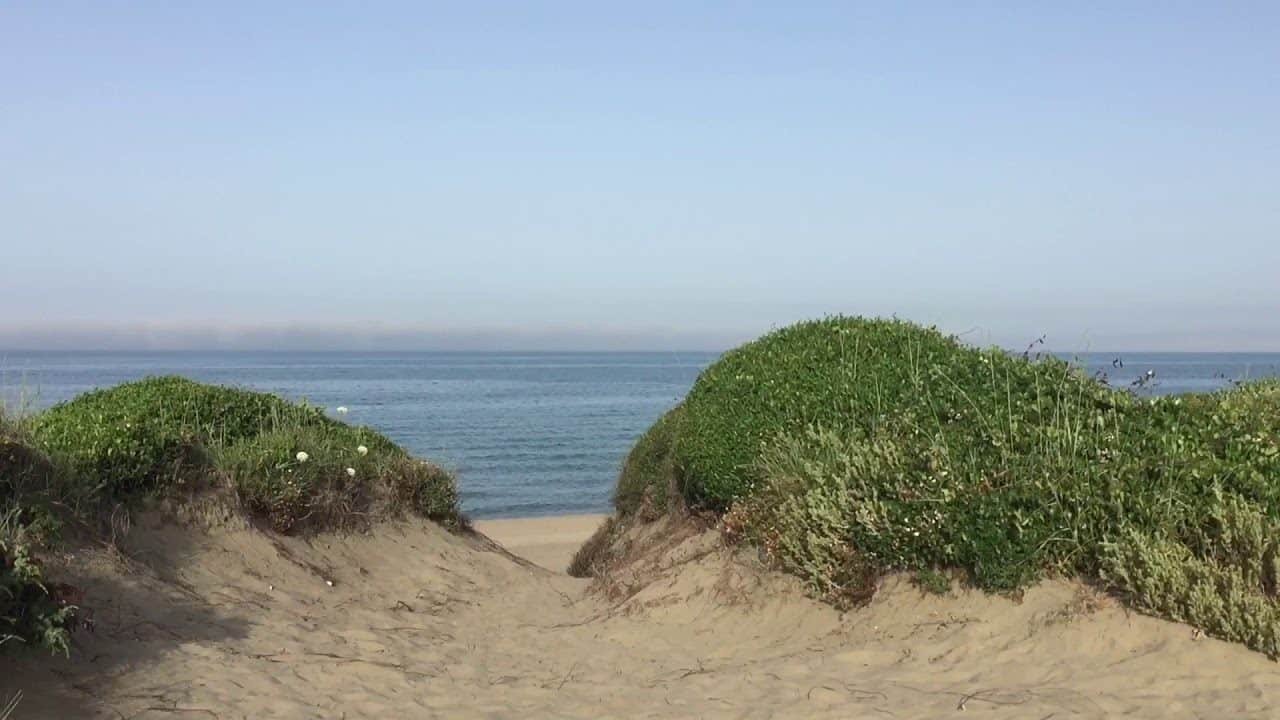

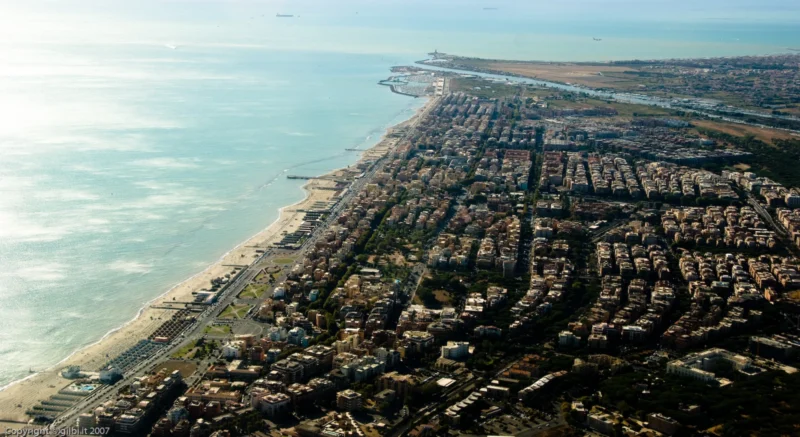
Capocotta is the stretch of the Roman coast between the Castel Porziano presidential estate and Torvaianica, along Via Litoranea, roughly from kilometer 7.600 to kilometer 10.100: 45 hectares of beach and dunes that belong to the Roman Coast State Nature Reserve, established by decree of the Minister of the Environment of March 29, 1996. Entry is free of charge: there is no ticket, no reservation, no closing time for the waterline. By car you get there from Via Cristoforo Colombo as far as Ostia and then take the Litoranea toward Torvaianica. Parking is on open ground along the road, near the access points. By public transport you take the Roma Lido railway to the Cristoforo Colombo terminus and from there bus 07, which runs along the Litoranea to Torvaianica and Campo Ascolano and is included in the Metrebus zone A fare. A second line, the 062, connects the Porto Turistico di Roma to Castel Porziano via Lido Centro and Colombo. The summer runs are generally activated from May 1, with Colombo terminus between 06:30 and 21:30 on weekdays: the schedules for the current season should be checked on the transport company's website. The kiosks with services, bar and lifeguards number five, spread along the beach and identified in the city tenders as lots A, B, C, D and E. Everything else is free beach: you set up wherever you want, with your own towel, and nobody can send you away.
To frame the environmental context and the other protected stretches of the Rome coast, it's best to start from the page on the Roman coast, which holds together pine woods, river mouths and beaches from the Tiber to the border with the province of Latina.
Where Capocotta (RM) Is and How to Really Get There
The geography here is simple and you only have to learn it once, because it has been the same for 60 years. From Ostia Lido you head south along Via Litoranea, the road that runs next to the sea, separated from the waterline only by the dune strip. The first stretch, the one Romans call the Cancelli, belongs to the Castelporziano Estate: seven numbered passages opened in 1966 in the fence of the presidential estate. Past the last gate Capocotta begins, and you continue until you almost touch Torvaianica, where the beach goes back to being occupied by beach clubs.
Capocotta by Car: the Litoranea, the Access Points and the Parking Problem
The fastest route from the center of Rome is Via Cristoforo Colombo to the sea, then the Lido roundabout and the Litoranea to the left. It's about 25 kilometers from the Circus Maximus. Parking is allowed only in the lay-bys and open-ground areas marked along the road: curbs, fences and the sand beyond the fence are not parking, and for exactly this reason the Rome city executive in November 2020 approved a protection project of over €250,000 that included restoring about three kilometers of perimeter fence along the Litoranea, damaged over the years by cars left on the dune. A blunt opinion: on weekends in July and August, arriving after 10 in the morning means walking two kilometers on scorching asphalt. Leave early or give up the car.
Capocotta by Public Transit: Roma Lido, the 07 and the 062
The combination that works is metro line B to Piramide, the Roma Lido railway to the Cristoforo Colombo terminus, bus 07 along the Litoranea. The ticket is the integrated urban one: line 07 stays valid with Metrebus zone A tickets even on the sections that enter the territory of Pomezia. The stops have no shelters or electronic boards: they are simple posts along a country road, and the real reference is the kilometer marker. If you're heading for the central beach, get off around kilometer 9. If you want the part closest to the Cancelli, get off earlier. Alternatively, line 062 from the Porto Turistico di Roma gets to Castel Porziano, useful for those staying on the Ostia seafront. Schedules change every season, and the website of the public transport company is the only place to read them up to date.
By Bike Along the Litoranea to Capocotta
The Litoranea is flat and for the most part straight, and many Roman cyclists ride it at dawn. There is, however, no continuous protected bike path along the whole Capocotta stretch: you ride on the roadway, with cars that speed in summer. Practical advice: lights on even in daytime, and be back before 11, when beach traffic gets serious.
Capocotta (RM) Inside the Roman Coast State Nature Reserve
The reserve was created by ministerial decree of March 29, 1996, in implementation of the 1991 framework law on protected areas. It extends for about 15,800 hectares between the municipalities of Rome and Fiumicino, with an almost equal split: a little over half falls in the territory of Rome, the rest in Fiumicino's. The perimeter runs from Marina di Palidoro, to the north, right down to the Capocotta beach, to the south, excluding the airport and the urban centers. Inside this boundary live side by side things that are usually studied separately: the ruins of Ostia Antica, the imperial harbors of Claudius and Trajan, the Isola Sacra necropolis, the Castel Fusano pine forest, the wetlands of Macchiagrande and the dune system we are describing.
Why the Capocotta Dunes Matter More Than They Seem
The Capocotta dune system is recognized as a Site of Community Importance and Special Protection Area in the European Natura 2000 network. The reason is not aesthetic. The natural coastal dunes of the central Tyrrhenian have almost disappeared: paved over, leveled to make parking lots, erased by the mechanical cleaning of beaches. What survives between kilometer 7.600 and kilometer 10.100 of the Litoranea is one of the last intact dune ridges in Lazio, and it works as a hydraulic defense: it holds the sand, absorbs storm surges, feeds the beach in the following season. A destroyed dune doesn't come back. It can be rebuilt only with decades of work and with the right vegetation, and in the meantime the sea eats the beach.

The Dunes of Capocotta (RM), Band by Band
Anyone walking from the road toward the sea crosses four different environments within 100 meters, with different species and different survival rules. It's dune zonation, and at Capocotta you can read it with the naked eye better than in any manual. On the ridge live about 20 plant species, all adapted to an environment that would be lethal for a normal plant: salt, constant wind, shifting sand, ground temperatures that in summer exceed 50 degrees.
The Waterline and the Foredune: the Annuals Nobody Notices
The first band, the one right above the tide line, hosts annual plants with a life of a few weeks, which germinate among the washed-up debris and finish their cycle before August. They look like weeds. They are instead the first link in the chain: they hold the first grains and start the accumulation. Mechanical cleaning of the beach, the kind done with a tractor and rake, wipes them out along with the plastic, and it's the reason this band no longer exists on the equipped beaches.
The Mobile Dune and the Marram Grass
Going up you meet the mobile dune, dominated by marram grass, a grass with a deep root system that grows vertically as the sand buries it. It's the engineer of the system: the more sand arrives, the higher the marram climbs, the more the dune grows. Here in May the sea bindweed also blooms, with its pale pink little bells, and the white cushions of sea chamomile appear, along with yellow patches of restharrow and sea medick. In midsummer the star is the sea lily, with big fragrant white flowers that open at sunset and last briefly: picking it is forbidden, photographing it is not.
The Back-Dune Depression, the Most Fragile Environment at Capocotta
Behind the first ridge the sand dips and creates a hollow where moisture lasts longer and in winter water can stagnate. It is the least showy environment and the most delicate of all Capocotta, because it hosts species that have disappeared elsewhere on the Lazio coast. Cutting through it in flip-flops to shorten the way costs the walker almost nothing and the dune a great deal.
The Fixed Dune and the Mediterranean Scrub
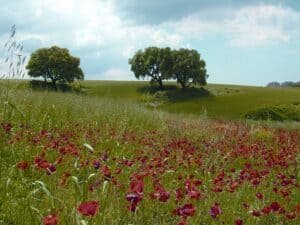
The last band, toward the Litoranea, is stabilized by shrubs: large-berry juniper, mock privet, strawberry tree, myrtle, rockrose, tree heath. It's a low scrub, bent by the mistral, that smells intensely in April. The juniper here is the flagship species: it grows very slowly, and a bush one meter tall can be decades old. Every time someone forces a passage through it, that passage becomes a permanent erosion channel.
The Animals of the Capocotta Dunes
The wildlife isn't spectacular, and that's exactly why it gets overlooked. Small mammals, wild rabbits and foxes live on the dunes, and warblers and nightingales nest in the scrub. On the waterline, in spring, waders pass through. The Roman coast also hosts, in the cold season, a community of birds that the reserve's ornithologists have been counting for years. The easiest tracks to recognize are the fox's at dawn, before the first people come down to the beach.
The Bans on the Capocotta (RM) Dunes and the Authorized Access Points
Here there is only one rule and it allows no interpretation: you go down to the beach through the marked passages, never cutting across the dune. The access points are physically recognizable, because they are wooden walkways and paths that start from the Litoranea and cross the ridge. The project approved by the city executive in November 2020 included replacing the eco-compatible fence facing the beach, rebuilding the access paths and installing signage, with a total cost of over €250,000, of which about €192,000 was labor cost.
On the dunes the following are forbidden: trampling outside the walkways, vehicle transit and parking, camping and overnight stays, lighting fires, removal of sand and picking of vegetation, including sea lily flowers. Planting umbrellas inside the dune band is also forbidden: the umbrella goes on the beach, in front of the dune, not on top of it. The reserve is a state protected area, so violations are punished administratively and, in the most serious cases, criminally. Behavior on the beach is also regulated every year by the bathing ordinance of Roma Capitale, which sets, among other things, the rules on animals, fires, games and equipment: the text in force for the season can be found on the city's official website.
A blunt opinion: the sign is never enough. What works is showing people the difference between an intact stretch of dune and a stretch crossed by a wild path. 50 meters of distance is enough and the lesson is clear to everyone, children included.
The Kiosks of Capocotta (RM) and the Meaning of the Free Beach
Capocotta isn't a coast of beach clubs. The kiosks on the beach are five and they hold the concession for the services, not the beach: this means they offer bar, food service, showers, toilets, rental of sunbeds and umbrellas and, above all, lifeguarding, but can't stop anyone from laying out a towel wherever they prefer. It's a substantial difference from the fenced beach clubs of Ostia, and it explains why for many Romans Capocotta remains the first choice even for just an hour at sunset.
The Five Lots of Capocotta
The concessions were reorganized after more than 20 years of extensions. The facilities are identified in the city tenders as lots A, B, C, D and E, corresponding to the businesses historically known to regulars as Dar Zagaia, Mediterranea, Settimo Cielo, Porto di Enea and Mecs. In May 2024 Roma Capitale awarded the first three concessions by tender, for six-year terms, while for the other two lots it proceeded later with a dedicated tender. Fees and holders have changed over time: to know which kiosk is open in the current season it's best to look at the public acts published by the City of Rome, because the situation has moved several times.
What You Find and What You Don't
Drinking water, toilets and showers are only at the kiosks. In the rest of the two and a half kilometers of beach there's nothing: no natural shade, no fountains, no trash cans except those at the access points. Bringing water, a hat and a bag for your own trash isn't a courtesy, it's the minimum condition for being on a free beach inside a nature reserve.

The Capocotta (RM) Naturist Oasis: The Facts, Without Adjectives
A portion of the Capocotta beach, on the order of 250 meters, is recognized as an authorized naturist beach by the Rome administration. The founding act dates to the late 1990s and is considered the first measure of its kind in Italy: from that precedent followed the other recognized naturist beaches on national territory, about 20, in addition to a larger number of beaches where the practice is tolerated without a formal act. The page dedicated to the Capocotta Naturist Oasis collects the details on access and services.
On the legal side, the reference is two rulings of the Court of Cassation from 2000, number 3557 and number 1765, according to which full nudity practiced in a place habitually frequented by naturists constitutes neither the offense of acts contrary to public decency under article 726 of the penal code nor that of obscene acts then provided for by article 527. The principle stated is one of context: the same behavior takes on different significance depending on the place and the situation in which it occurs. This is the regulatory framework, and it should be said for what it is, without emphasis and without embarrassment.
In practice, the boundary of the authorized area has shifted over the years with the changing of concessions and structures on the beach, and the surface actually available shrinks considerably on August weekends. Outside the recognized stretch the ordinary rules apply. The operational advice is trivial and works: look at the signs at the access point and adjust accordingly, without assuming that last year's boundary is this year's.
History of the Capocotta (RM) Estate
The name appears in the records as an independent landholding unit in the 15th century, perhaps earlier indicated as Capocorso, when it belonged to Camillo Capranica, a member of a Roman family of weight in the curia of that century. In the 17th century the estate passed to the Borghese, the house that in the meantime had built in a few generations one of the largest landed estates of the Roman countryside. The Catasto Annonario of 1803 assigns it an area of about 760 hectares: a latifundium of pasture and scrub, with very few permanent residents, like almost all the territory south of the city before the land reclamations.
Capocotta, the Savoys and the 20th Century
At the start of the 20th century Capocotta became private property of the Royal House, with the declared aim of enlarging the neighboring Castelporziano Estate, which the reigning family used as a hunting reserve although it was owned by the State. After the 1946 referendum the estate followed the fate of the private assets of the Savoys and ended up, three quarters of it, with the heirs of Victor Emmanuel III. It is in this condition, private and semi-abandoned land, that Capocotta enters Italian news reports and then Roman legend.
The Building Project and the 1967 No
In the 1960s a subdivision plan of considerable size was submitted for the area, providing for about 1,900 villas and accommodation facilities overlooking the sea. Environmentalist mobilization and public debate led the Higher Council of Public Works to reject the project in 1967. It's a watershed: had that plan gone through, the dune ridge we're talking about today would simply not exist, and the coast south of Ostia would be a second Torvaianica.
1985: The Expropriation and Pertini's Signature
The matter was settled in 1985, when 1,000 hectares of the area were taken into public ownership and annexed to Castel Porziano, pushed by the environmentalist movements and with the support of the then President of the Republic Sandro Pertini. The operation restored the historical unity of the ancient Laurentine territory. What we call Capocotta beach today corresponds, strictly speaking, to the coastal strip of the old latifundium left outside the presidential Estate: hence the use, still alive in the official documents and among regulars, of the expression ex Tenuta di Capocotta.
The Cancelli, the Beach Given to the Romans
The earlier chapter is that of the Cancelli. In the mid-1960s, by will of the President of the Republic Giuseppe Saragat, a portion of the beach of the presidential estate was opened to public use and entrusted to the City of Rome: seven numbered passages were opened in the fence, the Cancelli indeed, and the first public bathing season started in June 1966. Sources waver between 1965 and 1966 in giving the year of the act and that of the opening: the prudent fact is that the decision matured in the middle of the decade and the beach went into operation in the summer of 1966. Since then the Cancelli and Capocotta have formed a continuum of public beach that has no equal on the central Tyrrhenian.
In the meantime, on the border between the estate and the free beach, popular habit had already done its work: the passages opened in the netting earned Capocotta the nickname of buco, and it was precisely that clandestine quality that made it a place of freedom for those seeking discretion, starting with gay people and the naturists of the 1970s. In 1977 the first refreshment point on the beach opened there, tied to the figure of an innkeeper nicknamed Zagaia, who for half a century was the reference point for Roman cinema, literature and politics on the beach.

The Sea in Front of Capocotta (RM)
The seabed is sandy and slopes gently for about 20 meters, then deepens with a step that on days of backwash produces a return current. On water quality the data are public: in the regional bathing water classification published on April 27, 2026, ARPA Lazio counted 221 bathing waters, 93 percent of them in excellent class, with the coastal municipalities of the province of Rome, Rome included, at 100 percent excellent ratings and no water in poor class. Controls continue with sampling from April to September, over 1,600 in the season, and the results for each sampling point can be consulted on the regional agency's portal.
The Secche di Tor Paterno, Off Capocotta
A few miles from this stretch of coast is the only Italian marine protected area entirely offshore, without any stretch of coast: the Secche di Tor Paterno, a submerged rocky rise of over 1,000 hectares, with the summit at about 18 meters' depth and walls that drop below 60. On top grow posidonia meadows, lower down red gorgonians and black coral. Among the fish you see groupers and dentex. It isn't a place for mask and snorkel: you reach it by boat with authorized centers, and diving is regulated by the managing body.
Winds, Weather and the Moment of Flat Sea
The wind regime here is clear-cut. The mistral from the northwest raises a short chop and makes the day cool but windy. The libeccio muddies the water and brings washed-up posidonia to shore, which isn't dirt but organic material and should be left where it is. The August scirocco brings humid heat and rough sea. The calm mornings, from May to June, are when the water at Capocotta becomes transparent for a couple of hours. If you want a mirror-flat sea, get up at six.
When to Go to Capocotta (RM) and When to Stay Away
Mid-May to mid-June is the best season by far: the scrub is still in bloom, the water is cold but clear, the parking is free, the wind is mild. July and August on weekdays remain manageable if you arrive early. On weekends the Litoranea becomes a line of cars and the central beach fills up to the dune. September is the month I recommend to anyone who wants to really swim: water at the highest temperature of the year, long light, beach half empty after the 15th. In winter Capocotta is something else and worth the trip: two hours of walking on the waterline with the wind from the north, the profile of the Circeo to the south and the gulls, without a single kiosk open.
The time of day to avoid, for anyone with fair skin, is the window between 12:00 and 16:00, simply because at Capocotta there is no natural shade on the beach. The people who get burned here are the ones convinced that wind means cool.
Capocotta (RM) with Children
The beach works well with children for a technical reason: the sandy seabed deepens slowly and the first stretch stays shallow for a long way. It works less well for logistics, because you walk from the parking to your towel, there are no changing cabins and the showers are only at the kiosks. Strollers on the sand are useless, a backpack is better. The dune, though, is the best thing you can show a child on this coast: in half an hour you can recognize marram grass, juniper, sea lily and animal tracks, and the lesson on why you don't trample it takes care of itself. To round out the day with something organized, a few kilometers to the south you find Zoomarine, in Torvaianica.
Accessibility at Capocotta (RM)
The situation has to be stated without softening it: access to the sea on a free beach inside a reserve is complicated for people with mobility difficulties. The dedicated services, when there are any, are tied to the kiosks and their seasonal equipment, which changes from year to year with the concessions. Walkways and Job chairs are not guaranteed along the whole length of the beach. Before planning a day with a person with a disability it's best to call the kiosk of the chosen lot and check what is actually active in the current season, and which access point has the best path.
What to See Around Capocotta (RM)
Within a radius of a few kilometers there is a concentration of things almost nobody plans together with the sea. To the north, the Castel Fusano pine forest with its trails, and a little further the excavations of Ostia Antica, which deserve a whole day and not a stopgap hour. Next to the excavations, the village of Ostia Antica with the castle of Julius II. To the south you enter the Pontine coast: Ardea, then Anzio and Nettuno, with the coastal reserve of Tor Caldara and its sulfur springs. Anyone looking for other free beaches with dunes in good condition can look at the Torre Paola beach, in the Circeo National Park, or stay north of the Tiber between the Fregene beach and the Lido di Maccarese. The complete survey of the beaches of Lazio is in the beaches section.
A Curiosity About Capocotta (RM)
The curiosity is all in one word: buco. For at least a decade, before the area was regularized, Romans didn't say Capocotta, they said il buco. The term had nothing allusive about it: it literally indicated the gaps that people cut in the boundary fence of the presidential estate to get down to a beach nobody was watching. It was a clandestine place-naming, handed down by word of mouth, that served to arrange meetings in a place that on the maps didn't exist as a beach. The identity of the place was born from that cut fence.
There is a second layer, older and almost forgotten, in the actual name. In 15th-century records the estate appears as an independent unit when it belonged to Camillo Capranica, and a local scholarly tradition links it to the form Capocorso, which would later have slid into today's Capocotta. It's a hypothesis of toponymic philology, not a documented fact: it should be taken as such. What is documented, instead, is the cadastral continuity of the property, from the Capranica to the Borghese, down to the 760 hectares recorded by the Catasto Annonario of 1803.
The third curiosity is statistical and concerns the vegetation. On a dune like this live about 20 plant species: very few if you think of a forest, a great many if you consider that the substrate is shifting sand, salty and scorching. Each of those 20 species occupies a precise band and doesn't spill over. Walking from the sea to the Litoranea means crossing, in 100 meters, four distinct plant communities that follow one another in an order that is always the same, from the waterline to the scrub. Few things in nature are so orderly and so fragile at the same time.
Something Nobody Tells You About Capocotta (RM)
That the sand you're lying on doesn't come from here. The sediment that forms the beach and the dunes between Ostia and Torvaianica comes largely from the Tiber basin and from the other watercourses of the coast: the river carries it to the sea, the currents distribute it along the shore, the wind pushes it inland, the vegetation blocks it. Capocotta is, strictly speaking, a piece of the Apennines ground up and handed back in the form of a beach. From this follows a consequence that no sign explains: every intervention upstream, from river dams to works in the riverbed, reduces the sediment that reaches the coast. The erosion of the Roman coast doesn't begin on the beach, it begins 150 kilometers away.
The second thing nobody says concerns the washed-up posidonia. The brown leaves piled on the waterline after storms are not garbage and are not algae: they are the remains of a higher marine plant, and that pile, which technicians call banquette, physically protects the beach from winter erosion and returns nutrients to the dune system. On the equipped beaches it is removed with bulldozers for aesthetic reasons. At Capocotta, where the beach is free and inside a reserve, for the most part it stays where the sea put it. If you find the waterline covered in leaves, it isn't neglect: it's the correct functioning of a natural beach.
The third, the most practical: when the dune appears crossed by wide, light paths, those paths are not authorized routes. They are scars. The wind funnels into the illegally opened gaps, digs, and in a few years opens a breach that breaks the ridge. It is exactly the reason why, in November 2020, the Rome city executive allocated over €250,000 to redo fences, palisades and access paths along about three kilometers of the Litoranea.
Frequently Asked Questions About Capocotta (RM)
How much does it cost to get into Capocotta?
Getting into Capocotta costs nothing, because the beach is free beach and access through the access points is free of charge, with no ticket and no reservation. You only pay for what you consume or rent at the five kiosks on the beach, such as sunbeds, umbrellas, bar, food service and showers.
Where exactly is Capocotta?
Capocotta is on Via Litoranea, between the Castel Porziano Estate and Torvaianica, roughly from kilometer 7.600 onward, inside the perimeter of the Roman Coast State Nature Reserve. From Ostia Lido you head south along the road that runs next to the sea, separated from the waterline only by the dune strip.
Does Capocotta have a naturist beach?
Yes, a portion of the Capocotta beach, on the order of 250 meters, has been recognized as an authorized naturist beach by the Rome administration since the late 1990s, the first measure of its kind in Italy. From that precedent followed the other recognized naturist beaches on national territory.
Is Capocotta suitable for children?
In part. Capocotta works well with children thanks to the sandy seabed, which deepens slowly and stays shallow for a long way, but the logistics are more awkward because you walk from the parking to your towel, there are no changing cabins and the showers are only at the kiosks. The dune, though, is an excellent educational opportunity to show a child on this coast.
Is Capocotta wheelchair accessible?
Access to the sea on a free beach inside a reserve like Capocotta is complicated for people with mobility difficulties: the dedicated services, where present, depend on the kiosks and their seasonal equipment, which changes from year to year with the concessions, and walkways or Job chairs are not guaranteed along the whole length of the beach.
When is the best time to go to Capocotta?
The best period by far for Capocotta runs from mid-May to mid-June, when the scrub is still in bloom, the water is cold but clear, the parking is free and the wind is mild. September is recommended for anyone who wants to really swim, while on July and August weekends the Litoranea becomes a line of cars and the beach fills up to the dune.
Can you walk freely on the Capocotta dunes?
No, you go down to the Capocotta beach through the marked passages, never cutting across the dune: the access points are recognizable as wooden walkways and paths that start from Via Litoranea and cross the dune ridge. The rule protects the roughly 20 plant species that live on the ridge, adapted to an environment otherwise lethal for a normal plant.
What is there to see around Capocotta?
To the north, near Capocotta, is the Castel Fusano pine forest with its trails and a little further the excavations of Ostia Antica, which deserve a whole day, along with the village of Ostia Antica with the castle of Julius II. To the south you enter the Pontine coast, with Ardea, Anzio and Nettuno as the next stops.
The Advice I Give You for Visiting Capocotta (RM)
Go off-hours and off-season. The perfect day at Capocotta starts at 7 in the morning on a Thursday in June: you park without circling, you go down through the access point, the sea is flat for two hours, and the low sun draws the crests of the dunes with a long shadow that disappears at noon. At 11 you head back up, eat something at the kiosk and go back to Rome while the others are arriving. The opposite of what almost everyone does, and the reason almost everyone describes Capocotta as a crowded beach.
Second piece of advice, against the grain: don't treat it as a simple swim. Two and a half kilometers of beach with an intact dune ridge are a lesson in coastal ecology that you walk in an hour, starting from the southernmost access point and going back up toward the Cancelli along the waterline. Anyone who wants to do it with someone who can tell the story can rely on a guide or a licensed tour leader: the professional network of TourLeaderPro for Rome works on exactly this kind of itinerary, and for small groups there are tailor-made formulas among the personalized experiences for small groups. Anyone instead preparing a trip to Italy and thinking in English will find a general overview in the guide to the best beaches in Italy.
Third: bring light closed shoes. It sounds like a detail from a scout manual, but the sand at noon here comfortably exceeds 50 degrees and the 100 meters between parking and towel, done barefoot, are paid for over three days. And bring water for twice the time you think you'll stay: on the free beach there is not a single fountain.
Another Well-Known Fact, Yet Rarely Cited
That Capocotta is not a city park but a piece of a state reserve as big as a municipality. The Roman Coast State Nature Reserve, established by ministerial decree of March 29, 1996, covers about 15,800 hectares between Rome and Fiumicino, with an almost exact half-and-half split between the two municipal territories. Inside that perimeter are an intercontinental airport excluded from the restriction, one of the best-preserved archaeological cities in the Mediterranean, two imperial harbors, a necropolis, historic pine woods, wetlands and this ridge of dunes. Few reserves in Europe contain such an overlap of archaeology and nature, and almost nobody tells it as a single whole.
The second rarely cited aspect is the European status. The dunes between Castel Porziano and Capocotta are classified as a Site of Community Importance and as a Special Protection Area in the Natura 2000 network. This means their protection doesn't depend on a municipal choice that can be revised every season, but on conservation obligations that Italy has taken on at the European level. When you discuss concessions, kiosks, parking and walkways, the perimeter of what is up for debate is much narrower than the summer debate lets on.
Third, on the management side: the neighboring beaches have different administrative histories. The Cancelli belong to the presidential Estate of Castel Porziano, also recognized as a state nature reserve in 1999, which according to data released by the General Secretariat of the Presidency of the Republic extends over more than 6,000 hectares with about 750 hectares of pine forest and a biodiversity on the order of a thousand plant species. Capocotta is instead managed by Roma Capitale. Two regimes, a single continuous strip of sand: it's the reason the rules change when you pass a gate.
The Right Photo to Take at Capocotta (RM)
The photograph that tells this place isn't the sea. It's the dune backlit at sunset, shot from the waterline with the lens low, almost resting on the sand, so that the ridge fills the lower band of the frame and the sky the rest. You need the sun already below 10 degrees on the horizon: at that hour the raking light carves out the crests, the tufts of marram grass cast long thin shadows, and the sand goes from white to orange in a few minutes. With the sun high that same dune looks flat and insignificant, and in fact almost all the photographs of Capocotta in circulation are disappointing for this reason.
The second photo to bring home is the detail of the sea lily in bloom, between July and August, first thing in the morning or in the evening. White flower, large corolla, intense fragrance: you shoot it from the walkway or from the beach, with a telephoto lens or simply by bringing the phone closer without stepping off the walkway. Going into the dune to take a macro is the fastest way to ruin exactly the thing you wanted to photograph.
Third framing, the one nobody tries: the horizon line to the south with the profile of the Circeo promontory on clear days, usually after a front passes with wind from the north. From here the Circeo stands out sharply against the sea and gives the measure of how long and uninterrupted this coast is. Horizontal format, exposure on the clouds, horizon at a third from the bottom. One last recommendation from a professional: in the naturist stretch and its vicinity, the camera stays off and pointed at the sea. It isn't modesty, it's basic manners and, in many circumstances, it's also the law.
Some Important Events That Happened Here in History
The first is a news story that changed Italian politics. On April 11, 1953, on the beach of Torvaianica, a few kilometers from here, the body of Wilma Montesi, 21 years old, who had disappeared from home on April 9, was found. The case, which remained without a judicial truth on the cause of death, got entangled with rumors about parties on a hunting estate in the area and swept up prominent names: Piero Piccioni, a musician and the son of deputy prime minister Attilio Piccioni, and Ugo Montagna were implicated by the press and later acquitted of all charges. It was the first great media scandal of the Republic, and it tied the name of Capocotta forever to a season of suspicion. For decades, after that spring, the area remained semi-abandoned.
The second is from 1967, and it didn't make as much noise as it deserved: the rejection, by the Higher Council of Public Works, of the plan that envisioned about 1,900 villas and hotel facilities on this land. It's the moment when the coast south of Ostia stops becoming a second seaside city and stays sand. 18 years later, in 1985, 1,000 hectares pass into public hands and are annexed to Castel Porziano with the support of President Sandro Pertini. In 1996 comes the decree establishing the Roman Coast State Nature Reserve, and at the end of the 1990s the naturist oasis, the first in Italy to be authorized.
The third is cultural and is the most cited by Romans of a certain generation: the International Poets Festival of Castel Porziano, from June 28 to 30, 1979, organized by Simone Carella, Franco Cordelli and Ulisse Benedetti within the cultural season championed by councillor Renato Nicolini. About 30,000 people showed up on the beach to hear, among others, Allen Ginsberg, William Burroughs, Gregory Corso, Lawrence Ferlinghetti, Diane di Prima, Amiri Baraka, Yevgeny Yevtushenko, and on the Italian side Dario Bellezza, Milo De Angelis, Antonio Porta, Corrado Costa. On the last night the crowd climbed onto the stage, which collapsed onto the sand. That crushed structure became the symbolic image of the end of a season: after Castelporziano Italian poetry stopped looking for the square and went back to the page.
Who Passed Through Capocotta (RM)
Before anyone else, the ancient Romans. The stretch of coast between Ostia and Torvaianica is the litus Laurentinum of the sources, the band of seaside villas that senators reached from Rome in half a day. Pliny the Younger describes in a famous letter his own Laurentine villa and the pleasure of working in front of the sea in winter: its exact location remains debated, but the landscape he describes, dunes, low scrub, open beach and absence of harbors, is this one. In the Castel Porziano Estate the excavations have yielded imperial-era structures and mosaics now restored.
Then the kings. At the start of the 20th century Capocotta entered the private properties of the House of Savoy, as an extension of the Castelporziano hunting reserve: Victor Emmanuel III and the court passed through here, in a use of the territory that had nothing to do with bathing. In 1965 and 1966 the baton passes ideally to Giuseppe Saragat, the President of the Republic who opens part of that beach to the use of citizens, and 20 years later to Sandro Pertini, who supports the public acquisition of the 1,000 hectares left in private hands. Two presidents, two signatures, and the beach that exists today.
Then the artists. Sergio Citti shot his directorial debut around here, Ostia, released on March 11, 1970, written with Pier Paolo Pasolini and starring Laurent Terzieff, Franco Citti, Anita Sanders and Ninetto Davoli: a film that uses the Roman coast as a moral landscape before using it as a backdrop. In June 1979 Ginsberg, Burroughs and Corso passed through for the poets' festival. And for 50 years, from 1977, the refreshment point opened on the beach by the innkeeper nicknamed Zagaia was a place of passage for Roman cinema, literature and politics, the kind that appears in no guide but that everyone in the city knew. If you are interested in the thread that links these stories to the rest of the city, the curated selection of the best things to do in Rome, in English, is a good starting point for those arriving from outside.

Quick Questions About Capocotta (RM)
How much does it cost to get into Capocotta (RM)?
Nothing. The beach is free beach and access through the access points is free of charge, with no ticket and no reservation. You only pay for what you consume or rent at the kiosks: sunbeds, umbrellas, bar, food service, showers.
Where exactly is Capocotta (RM)?
On Via Litoranea, between the Castel Porziano Estate and Torvaianica, roughly from kilometer 7.600 to kilometer 10.100, in the territory of Roma Capitale. The naturist oasis is indicated by industry sources at around kilometer 9.300.
How do you get to Capocotta (RM) by public transport?
Metro line B to Piramide, the Roma Lido railway to the Cristoforo Colombo terminus, then bus 07 along the Litoranea toward Torvaianica and Campo Ascolano. Metrebus zone A tickets are valid. Alternatively, line 062 connects the Porto Turistico di Roma to Castel Porziano.
Can you park at Capocotta (RM)?
Yes, in the open-ground areas and lay-bys along Via Litoranea, at the access points. Parking on the dune or beyond the fence is forbidden and is one of the main causes of the degradation of the dune ridge.
How far is Capocotta (RM) from the center of Rome?
About 25 kilometers from the historic center. By car, with flowing traffic, it takes about 40 minutes along Via Cristoforo Colombo. By public transport allow between an hour and an hour and a half, transfers included.
Is Capocotta (RM) a free beach or are there beach clubs?
It's a free beach. The five kiosks on the beach hold the concession for services, not the beach: they can rent sunbeds and umbrellas and run bar and lifeguarding, but anyone can lay out their own towel wherever they prefer.
How many kiosks are there at Capocotta (RM)?
Five, identified in the city documents as lots A, B, C, D and E. In May 2024 Roma Capitale awarded the first three concessions by tender, for six-year terms. For the other two a later tender was held. Which ones are actually open in the current season is checked in the acts published by the City.
Can you practice naturism at Capocotta (RM)?
Yes, in a stretch on the order of 250 meters recognized as a naturist oasis by the Rome administration at the end of the 1990s, the first measure of its kind in Italy. On the criminal side the reference is Court of Cassation rulings number 3557 and number 1765 of 2000. Outside the authorized stretch the ordinary rules apply: the boundaries are read on the signs at the access point.
Can you bring dogs to Capocotta (RM)?
It depends on the bathing ordinance in force for the season, which Roma Capitale publishes every year and which also governs the presence of animals on free beaches. The updated text can be consulted on the City's official website before leaving.
Are there restrooms and showers at Capocotta (RM)?
Only at the kiosks. On the stretches of beach between one kiosk and the next there are no toilets, showers or fountains: anyone who sets up far from the facilities has to organize with their own water.
Is there a lifeguard service at Capocotta (RM)?
Lifeguarding is among the services tied to the kiosk concessions and covers the stretches of beach in front of them. In the more distant free portions supervision is not guaranteed: the seabed slopes gently, but with rough sea a return current forms that should be taken seriously.
Is the water at Capocotta (RM) clean?
In the bathing water classification published on April 27, 2026, ARPA Lazio assigned an excellent rating to 93 percent of the 221 waters monitored in Lazio, with the coastal municipalities of the province of Rome at 100 percent excellent ratings and no water in poor class. The data for each individual sampling point can be consulted on the agency's portal.
Can you walk on the Capocotta (RM) dunes?
No. You go down to the beach only through the walkways and paths of the authorized access points. On the dune band the following are forbidden: trampling off the path, vehicle transit, camping, fires, removal of sand and picking of vegetation.
When is the best time to go to Capocotta (RM)?
From mid-May to mid-June for the scrub in bloom and the clear water, and the second half of September for the sea temperature and the half-empty beach. July and August work on weekdays if you arrive by 9 in the morning.
Is Capocotta (RM) suitable for children?
The shallow sandy seabed is ideal for children, but the logistics require organization: you walk from the parking, there are no changing cabins and the showers are only at the kiosks. On the other hand the dune is a perfect outdoor lab to explain how a natural coast works.
Is Capocotta (RM) accessible to people with mobility disabilities?
The aids for access to the sea, where present, depend on the seasonal equipment of the kiosks and don't cover the whole beach. It's best to call ahead to the facility of the chosen lot to find out which services are active and which access point has the most practicable path.
What is the difference between Capocotta (RM) and the Cancelli of Castel Porziano?
The Cancelli are the seven passages opened in the mid-1960s in the fence of the presidential Castel Porziano Estate, and the beach in front belongs to the estate, recognized as a state nature reserve in 1999. Capocotta begins further south and is managed by Roma Capitale. The sand is the same, the administrative regimes are not.
Can you smoke or light fires on the Capocotta (RM) beach?
Fires are forbidden, since it is a protected area with highly flammable vegetation. For smoking and other behavior on the beach, the municipal bathing ordinance of the current season applies, which in recent years has introduced limits on several beaches of the Rome coast.
Are there umbrellas and sunbeds for rent at Capocotta (RM)?
Yes, at the kiosks, with rates that vary from year to year and from facility to facility. On the whole rest of the beach you bring your own umbrella, keeping it on the sand in front of the dune and never inside the dune band.
Can you dive or snorkel off Capocotta (RM)?
The seabed close to shore is sandy and of little interest for snorkeling. Diving is done farther out, at the Secche di Tor Paterno, a marine protected area entirely in open sea, with the summit at about 18 meters' depth: you reach it by boat with authorized centers and the activity is regulated by the managing body.
Is Capocotta (RM) open in winter too?
The beach is always accessible, all year round, because it isn't fenced. The kiosks follow the bathing season and are closed in winter: anyone who arrives in December finds two and a half kilometers of empty beach, wind and no services.
How long does it take to visit Capocotta (RM)?
For a day at the sea, as long as you like. To understand the place two hours is enough: an hour of walking on the waterline from one access point to another and half an hour observing the dune zonation from the walkway, with the return along the Litoranea.
One last thing. Capocotta is not a comfortable beach and never will be: there's no shade, no services, you walk and in August you suffer. It is still worth more than any equipped beach club on the Roman coast, because it is one of the last places near Rome where the coast still works the way it did before it was built on. Anyone who goes with this awareness comes home with something. Anyone who goes looking for an organized lido comes home unhappy and with sand in the car. Choose in advance which of the two you want to be, and always go through the access point.
Article written by the editorial team of TourLeaderPro, contact them for Private/Corporate/V.I.P. Tours and Experiences.
Planning a trip to Rome? The English guides to visiting the city are on ItalyPlanner.com.