Villa Mondragone
In short. Villa Mondragone is at via Frascati 51, in Monte Porzio Catone, and can be visited only on the dates that the University of Rome Tor Vergata puts on its calendar: €10 full price, €5 reduced for the 11-17 age band, free under 10, payment…
Villa Mondragone is at via Frascati 51, in Monte Porzio Catone, and can be visited only on the dates that the University of Rome Tor Vergata puts on its calendar: €10 full price, €5 reduced for the 11-17 age band, free under 10, payment by POS terminal only, booking through the secretariat. It isn't a museum with a ticket office open every day. It's a university ceremonial venue that opens at intervals.
The draw the villa uses to make itself known is the calendar. Tradition ties to this villa the bull of February 24, 1582 with which Pope Gregory XIII removed 10 days from the month of October and gave the West the calendar we still use. The second draw, more recent and more talked about, is the Voynich manuscript, the illustrated book that no one has ever managed to read, which came out of these walls in 1912.
Data current as of the check of September 28, 2026 on the villa's website, on the university's portal and on the other institutional sources cited later in the text. Hours, fares and dates of the university openings change from month to month and depend on the academic and conference calendar: before getting in the car or buying the train ticket, call the secretariat and have everything confirmed.
Where it is and what you actually see
The villa occupies the ridge that separates Frascati from Monte Porzio Catone, at a little over 400 meters of elevation, inside a park that the official sheets give as around 18 hectares. The formal address is via Frascati 51, but there is a second entrance at via Mondragone 4 that is often used on opening days: when you book, ask which gate will be open, because between the two there are several hundred meters of uphill road.
The building is enormous and reads poorly up close. Anyone arriving by car first sees a long, severe flank, then the inner courtyard, which alone exceeds 1,700 square meters. The facade toward Rome, the one that matters, opens onto the 17th-century terrazzone and looks over the plain as far as the dome of St. Peter's on clear days. After five centuries that view remains the villa's best argument.
The interiors open to visits are the ceremonial rooms: the Sala degli Svizzeri in the 16th-century core, the Sala del Teatro that houses a Foucault pendulum, the Sala Gregorio XIII, the Sala Rossa with 19th-century decorations, the Sala Verde, the Sala del Giardino with the painted map of the Tusculan villas, the Sala del Mosaico with Roman finds, the Sala delle Cariatidi and the chapel dedicated to San Gregorio Magno with its grotesques.
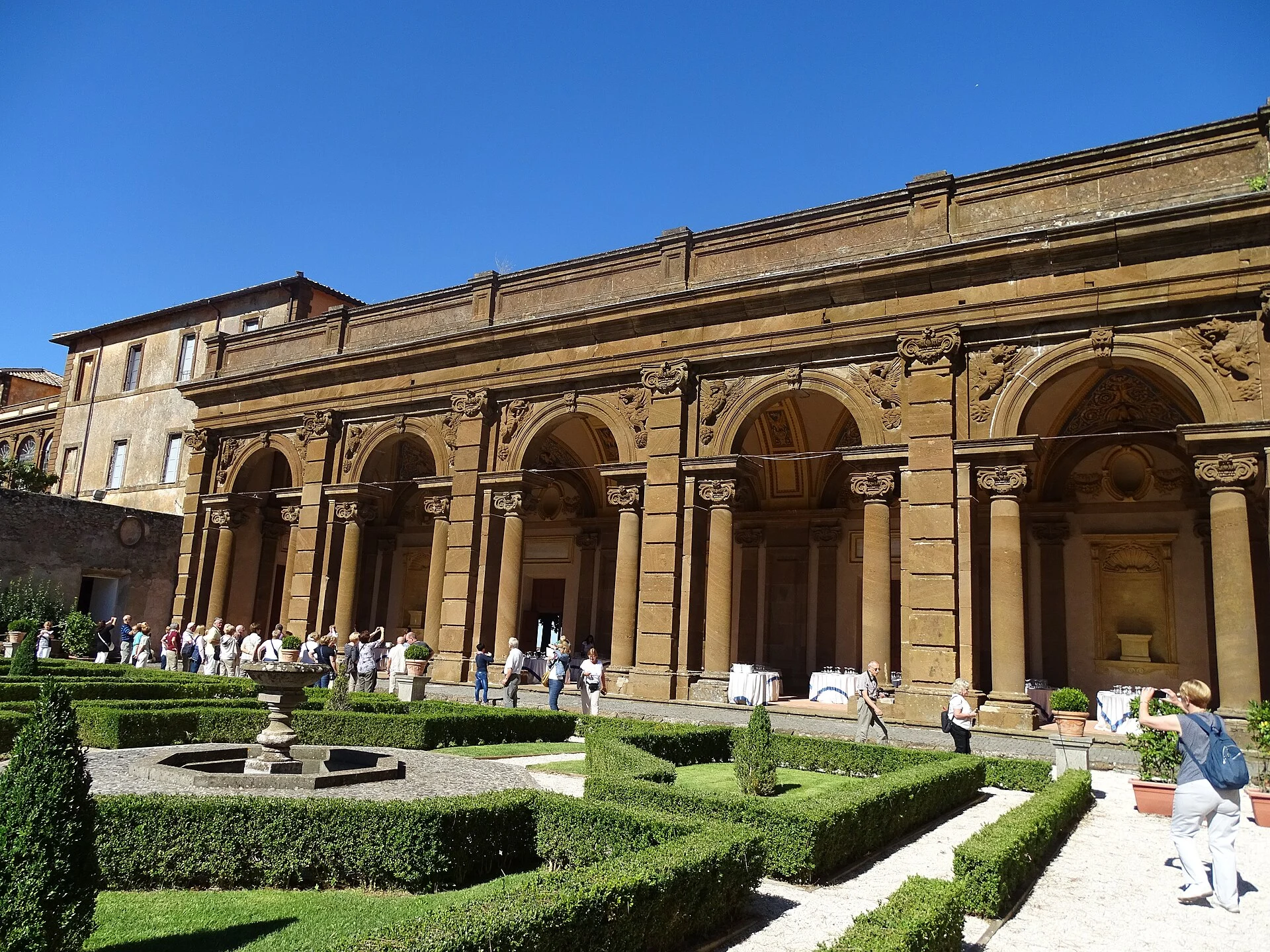
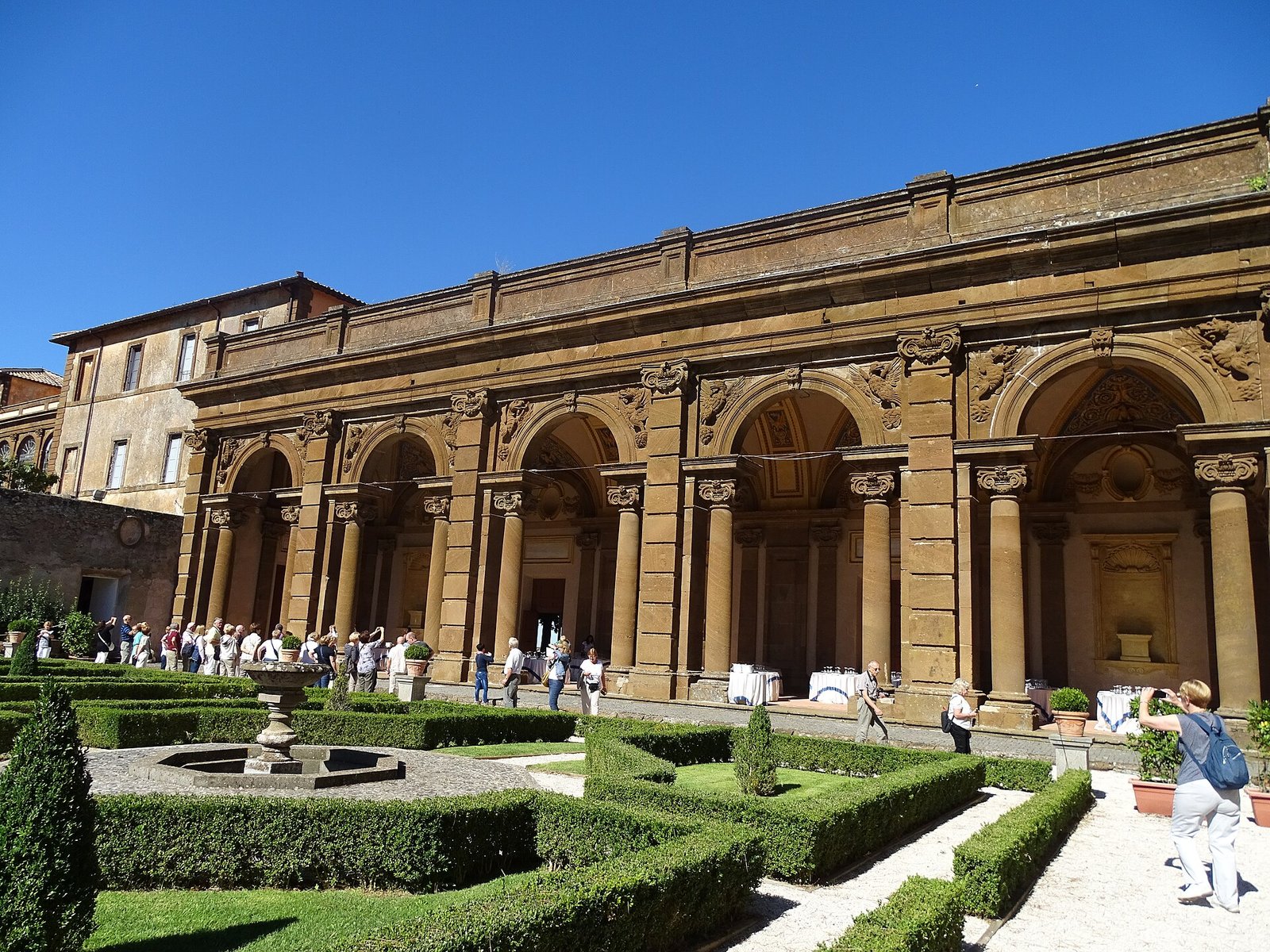
Outside the route touches the portico attributed to Giovanni Vasanzio, the Giardino della Girandola closed at the far end by the Teatro delle Acque, the 16th-century Giardino Segreto and the terrace with the Fontana dei Draghi. The dominant species are holm oak and boxwood, with a few 20th-century exotic presences: palms of the genus Trachycarpus, magnolias, camellias. The park isn't an English-style manicured garden. It's a university park with intermittent maintenance.
What you don't see: the service areas, the upper floors of the Jesuit college, most of the so-called Retirata frescoed rooms, which are awaiting restoration, and the hanging garden during the periods when it is closed for works. If anyone promises you the full visit of the villa, they are selling something that doesn't exist. The route is an hour and a bit, ceremonial rooms and formal gardens.
A curiosity about Villa Mondragone
The name comes from a dragon. Not from a sign or an ancient place name: the winged dragon is the coat of arms of the Boncompagni, the family of Gregory XIII, and Cardinal Marco Sittico Altemps highlighted it when he christened the villa he had built to host the pontiff. Mons Draconis, the mountain of the dragon. A heraldic tribute turned into a postal address, which is something that happens in Rome more often than you'd think.
The dragon returns everywhere in the complex, and the best-known piece is the fountain on the terrace. Today that fountain is in bad shape: the fundraising sheets published on Art Bonus report missing sculptural elements, among them a dragon's head and portions of the upper basin, widespread cracking and biodeterioration. The restoration project is priced at 60,000 euros. As of the last public update available, the fundraising stood at zero.
Alongside the fountain there are two other interventions seeking funding on the same platform: 40,000 euros for the frescoed rooms of the Retirata, where the plaster is turning to powder and water infiltration has left its mark on the vaults, and another 40,000 to restore exhibition use to the gallery with seven paintings from the Baroque age. These are small figures for a monument of this size, and that says a lot about the state of the heritage of the Castelli.
On this point the judgment is blunt. A villa that hosts medical conferences and master's degrees should be able to cover 60,000 euros for a fountain without waiting for charity. The fact that it can't says that the model of the self-financing university monument, in Italy, works for the conference side and not for the conservation side.
One thing nobody tells you about Villa Mondragone
The bull doesn't name Mondragone. The Latin text of Inter gravissimas closes with the dating formula: Datum Tusculi, anno Incarnationis dominicae MDLXXXI, sexto Kalendas Martii, pontificatus nostri anno X. That is: given at Tusculum, the sixth day before the calends of March, in the tenth year of the pontificate. Tusculum, not Mondragone. The villa doesn't appear in the document, and whoever claims otherwise hasn't read the source.
The detail of the year confuses quite a few visitors. The bull is written MDLXXXI, that is 1581, while all the manuals date the reform to 1582. It isn't an error: the papal chancery calculated the year according to the Incarnation style, which started the year on March 25. February 24 therefore still fell in 1581 by that reckoning, and in 1582 by ours. A bull about time dated with a system that was about to retire.
The problem of the place remains. Tusculum indicates the Tusculan area, not a building: the territory where Frascati, Monte Porzio and the cardinals' villas stand. That Gregory XIII was a guest of Altemps at Mondragone in those days is established tradition, taken up by the villa and by local literature, and the villa indicates the Sala degli Svizzeri as the place of the signing. Strong tradition, generic document: they are two different things and it's best to keep them distinct.
I'll add a common-sense observation that no guide ever makes. February is not papal vacation season. The Tusculan villas were for spending the summer away from the bad air of the city, and a pontiff in his seventies in the dead of winter on a windy ridge at 400 meters is an image that should at least be discussed. Whoever tells the scene with snow outside the window is reconstructing, not documenting.
This takes nothing away from the place. It shifts the question: from where the bull was signed to why it was chosen to set it here. The Tusculan territory was the summer court of the 16th-century papacy, and attributing to it the most lasting act of that pontificate was coherent. The commemorative plaque comes centuries later. Local historiography, moreover, doesn't quarrel over this: it takes Mondragone as certain and moves on.
The calendar reform, in concrete terms
The bull solved a problem of practical astronomy. The Julian calendar made the year 365 days and six hours, a bit longer than the true solar year, and accumulated an error of about three days every four centuries. By the 16th century the spring equinox had slipped to March 11, and with it the date of Easter, which the Council of Nicaea had anchored to the equinox. The liturgy was going out of phase with the sky.
The solution was surgical and brutal. Thursday, October 4, 1582 was followed directly by Friday, October 15: 10 days erased, never existing for the registries and for the contracts of the countries that adopted it right away. The week was not interrupted, which was essential so as not to touch the liturgical sequence. From then on century years not divisible by 400 stopped being leap years, and the residual error dropped to a few seconds a year.
Behind the calculation is a commission, not a papal intuition. The technical work carries above all the names of the Calabrian physician Luigi Lilio, author of the correction scheme, who died before the promulgation, and of the Jesuit Christopher Clavius, who defended it and explained it for 30 years against the objections of European astronomers. Gregory XIII signed and imposed. The intellectual paternity lies elsewhere, and the villa says little about it.
Adoption was anything but immediate. Spain, Portugal and a large part of Italy followed in October 1582, France in December, the German Protestant countries much later, Great Britain in 1752, Greece only in the 20th century. For centuries Europe had two simultaneous dates for the same day, and diplomatic correspondence reported both. A mess worth imagining when you look at that room.
Those who want the local astronomical context can pair the visit with the Museum of the Monte Porzio Catone Observatory, a few minutes from here, which preserves historic instruments, or look to the Roman side with the Monte Mario Observatory. These are two stops that make sense of the reform better than any panel in the villa.
My advice for visiting Villa Mondragone
Book the late-afternoon visit, not the morning one. The evening openings that the villa puts on the calendar in the warm months, typically between 18:30 and 19:00, catch the facade toward Rome in raking light and give back the reason this ridge was chosen in the 16th century. The 10 a.m. visit has the sun behind the panorama and flattens everything.
Call the secretariat's number instead of writing. The dates appear on the website with little notice, places are limited, and the phone answers during office hours while email can take a few days. The published number is 06 72598950 and the address is info@villamondragone.it. Have them confirm the entrance gate, the exact meeting time and the duration, because they change from one opening to the next.
Bring your card, not cash. The villa declares payment by POS terminal only, which for an Italian monument is a rarity and in practice means that at the register nobody will change your 50 euros. The published fares for the 2026 openings are €10 for adults, €5 for the 11-17 age band, free under 10. The guide is included in the price.
Dress for being outside. The gardens are at altitude, the air of the Castelli in spring and autumn is several degrees below that of the center of Rome, and the wind on the terrazzone cuts. City shoes on the gravel paths and on the ramps of the Teatro delle Acque don't work. More than one visit has been ruined by a heel stuck in a gap in the paving.
If you come by car, the internal parking lot is free, large and supervised, and it's one of the few cases in Lazio where this part isn't a problem. Anyone arriving by public transport has to count on one change and a final climb: there is no stop in front of the gate. I cover it in detail in the chapter on connections.
One last thing on photography and filming. In the ordinary openings no published bans appear, but the villa also works as a conference and ceremonial venue: if you find a setup in progress in a room, the visit skips that room without notice and without partial refund. Ask when you book if you have a specific interest in one room.
How you really book the visit
The operator is the University of Rome Tor Vergata, which bought the complex in 1981 and runs it as a Conference and Ceremonial Center. This explains everything else: there is no permanent ticket office, no museum circuit, no presale on third-party portals. The visits are an activity of opening to the public, not the main business of the facility.
The only channel is the direct one: telephone 06 72598950, email info@villamondragone.it, or the contact form on the villa's website. There's no toll-free number, no regional portal that sells places, and whoever offers you a priority ticket for Mondragone is reselling at a markup a place worth €10. If a different institutional channel isn't published in plain view, it doesn't exist.
The dates are found in the events section and in the website calendar, updated a few weeks in advance. In 2026 the openings followed a rhythm of one or two a month, with a few themed visits: one dedicated to the Voynich manuscript in July, at 17:30, and a sunset trek linking the villa to the Tusculum archaeological area. The themed visits sell out quickly.
Organized groups are a separate matter and must be agreed case by case with the secretariat. The villa doesn't publish a group fare or a minimum number of participants, so any figure circulating elsewhere should be verified at the source. With parties of 40 people the answer comes, but you need to move at least three weeks ahead and accept the date they propose.
Last point on the guides. The visits are led by university students trained on the complex, and this gives an uneven result: you may get the kid who knows the building history better than a superintendency official and you may get someone repeating a script. It's the price of a €10 service run by a university. Knowing this, you arrive with the right questions and take home a lot.
Another well-known fact, yet rarely cited
Mondragone was not born on virgin ground. The foundations rest on the remains of a Roman villa of the late Republican and imperial age, and the Sala del Mosaico displays materials dated to the 1st century BC found on the site. Local tradition assigns that villa to the family of the Quintili, the same whose name remains tied to the complex on the Appian Way: plausible attribution, not proven.
To understand what a residence of the Quintili was, it's worth seeing the Villa of the Quintilii along the Appian Way, inside the Appian Way Regional Park. There the scale of 2nd-century senatorial luxury can be read in the plan. At Mondragone only fragments reused in the foundations survive, and it's a reuse typical of the whole Tusculan area, where every cardinal's villa sits on top of something ancient.
The second rarely cited fact concerns books. In the 17th century the library formed at Mondragone under the Borghese took the road to the papal collections, and in the 19th century the villa became a book depository again when the Jesuits moved part of the holdings of the Collegio Romano there. Two movements of books two and a half centuries apart, and the second produced the story of the Voynich.
Third: the villa had a long period of semi-abandonment. After Urban VIII, from the 1620s, moved the papal vacation to Castel Gandolfo and the Palazzo Pontificio, Mondragone lost its function as a summer court. It remained with the Borghese, who used it little, and reached the 19th century in mediocre condition. The Jesuit college saved it by filling it with boys.
The right photo to take at Villa Mondragone
There's only one photo and you take it at the Teatro delle Acque. You stand at the far end of the Giardino della Girandola, on the central axis, and shoot the exedra vertically, taking the full height of the architectural front with its niches. Vertical, not horizontal: that 17th-century stage machine is built to be looked at with your head tilted back, and the panoramic format deflates it.
The second framing is from the terrazzone toward Rome, with the balustrade in the foreground at a third of the height and the plain slipping away. It works in late afternoon with low haze, when the dome of St. Peter's stands out like a silhouette. With the high sun and the clean air of January you see everything but the photo is flat, because the depth given by the layers of haze is missing.
Inside, the best image is the portico attributed to Vasanzio: a row of arches, light coming in sideways, a floor that pulls the perspective. Stand in a corner and let the vanishing line of the columns carry the eye. The frescoed rooms, with their small windows and high ceilings, require long exposures and a tripod, and on a group visit a tripod is not practical.
Avoid the frontal photo of the facade from the arrival square. It's the image everybody takes, the front is too long for a normal focal length and the result is a yellowish wall with windows. If you really want the whole thing, move away along the avenue of cypresses and use the vegetation as a natural frame, accepting that you'll lose the ends of the building.
A technical note that saves time: the white of the exterior walls, in full sun, fools almost all automatic modes and blows out your highlights. Compensate by a third of a stop down and recover afterward. On the surfaces of the dragons' fountain, covered in dark biological patinas, the opposite holds.
How to get there from Rome
By train you leave from Roma Termini on the regional line FL4 toward Frascati and get off at the terminus. The stated trip is around half an hour, the runs are at regular intervals and the ticket is the one of the metropolitan system. From Frascati to Mondragone there are about three kilometers uphill: you take a suburban line bus toward Monte Porzio or a taxi, which on weekdays can be found at the station.
By bus you leave from the Anagnina terminal, the end of metro line A, with the direct suburban runs toward Monte Porzio Catone and Rocca Priora. It's the solution the villa itself indicates to those arriving from Ciampino airport. Total time from the center of Rome, with the change, around an hour: check the schedules the day before, because on holidays frequencies thin out a lot.
By car you leave the Grande Raccordo toward the highway to Naples and take the exit for Monte Porzio Catone, then follow via Fontana Candida and the signs for via Frascati. From south Rome it's 30 or 40 minutes without traffic. The final roundabouts are poorly signed and the navigator sometimes proposes via Mondragone: if the gate given in your booking is the via Frascati one, ignore it.
There is no dedicated public shuttle, and that goes for the whole upper Tuscolano area, including the archaeological zone of Tusculum. Anyone planning to get around the Tusculan villas on foot in a day should know that the climbs are serious and the roads are narrow, with no sidewalk and blind curves. The trek the villa organizes to Tusculum exists precisely because that route is awkward to do on your own.
If you're building a day in the Castelli, you can pair Mondragone with Grottaferrata and the Greek Abbey of San Nilo, which keeps far more regular hours, or head up to Rocca di Papa and the Geophysical Museum. The whole area lies inside the Castelli Romani Park, and the marked trails are the least exploited part of what's on offer.
Some important events that happened here in history
Work on the site began in 1573 at the wish of Cardinal Marco Sittico Altemps, nephew of Pius IV, to a design by Martino Longhi the Elder. The patron built it to house the court of Gregory XIII, and that explains the scale of the building: not a private residence, a borrowed palace. The Altemps family also left Rome the palace that is now a museum, Palazzo Altemps.
February 24, 1582 is the date the villa carries on its shoulders. The bull Inter gravissimas is dated at Tusculum, and tradition places it in the Sala degli Svizzeri, the great hall of the 16th-century core. Eight months later, in October, Catholic Europe skips 10 days. No other act signed in the Castelli Romani has had a comparable reach.
In 1613 Cardinal Scipione Borghese acquired the property, and between 1616 and 1618 he began the expansion that gave the villa its present form: the great courtyard, the portico, the connecting gallery and the Teatro delle Acque. The architect of reference is the Fleming Jan van Santen, Italianized as Giovanni Vasanzio. On who authored the water machine, the sources are split between Vasanzio and the Fontana workshop, specialists in hydraulics.
The decline begins in the 1620s: the papal court shifts to the Colli Albani and Mondragone becomes an underused showpiece property. The Borghese family kept it for over two centuries, alternating periods of care with long seasons of neglect. Comparing it with the fortunes of Galleria Borghese in the city shows how little the Tusculan villa counted by then.
In 1865, according to some sources 1866, the Society of Jesus bought the complex and opened the Nobile Collegio Mondragone there, a boarding school for the sons of the Italian aristocracy. The school ran until 1953 and left a heavy imprint on the building: dormitories, classrooms, chapels, playing fields. In the Second World War the villa housed displaced people. The one-year discrepancy on the purchase date is unresolved, and you should know about it.
In 1912 the antiquarian Wilfrid Michael Voynich bought a lot of manuscripts from the Jesuits, and among them was the cipher codex that would take his name. In 1981 the Order sold the complex to the University of Rome Tor Vergata, which began the restorations and made it its ceremonial venue. Since then the villa has lived on conferences, academic ceremonies, weddings and the public openings we talk about here.
Who passed through Villa Mondragone
Gregory XIII, born Ugo Boncompagni, from Bologna, a jurist, pope from 1572 to 1585. He gave the villa its heraldic name and the act that made it famous. He's the same pontiff who founded colleges across half of Europe and put money into Jesuit science: the calendar reform is the culmination of that policy, not an isolated episode.
Marco Sittico Altemps, the building cardinal, a curia man of South Tyrolean and German origin, related to the Medici and the Borromeo. He built to make himself indispensable to the pope, which is how careers were made in 16th-century Rome. His family left the city a collection of antiquities that can be seen today in the museum on Piazza Sant’Apollinare.
Scipione Borghese, nephew of Paul V, the great collector who assembled Rome's most famous collection of sculpture and painting. At Mondragone he brought the same taste for stage machinery that you recognize in the Secret Gardens and all of Villa Borghese. The Teatro delle Acque is a Baroque patron's idea applied to a provincial hill.
The Jesuits, as a body, for almost a century. The Nobile Collegio put generations of boys from Italian aristocratic families through here, with a strict educational method and a network of connections that weighed on the ruling class of the Kingdom. If you want to grasp the weight of the Order in Rome, look at the Church of the Gesù and the Chiesa di Sant’Ignazio, and then come back up here.
Wilfrid Michael Voynich, born in what was then Russian Lithuania, a revolutionary, an exile in London, a dealer in antique books with an international network. He arrives here in 1912, negotiates with the fathers and carries off a lot of codices. What he wrote in his catalogs and letters has served as the basis for everything we know about the provenance, and this is both the strength and the weakness of the reconstruction.
Christopher Clavius, who probably never slept at Mondragone, but without whom the bull wouldn't exist. A Bavarian Jesuit, professor at the Collegio Romano, a mathematician, the public defender of the reform against the astronomers who contested it. His name appears in every serious history of the calendar and on not one panel in the villa. Fixing that would be easy and would cost little.
The Voynich manuscript: facts and legends
The manuscript exists, its official name is Beinecke MS 408, and it's kept at Yale University's rare book library. It's a little over 200 pages of parchment covered in an unknown script, with drawings of unidentifiable plants, circular diagrams that look astronomical, and female figures immersed in pools connected by piping. Nobody has ever read it. Proposed decipherments keep coming and keep falling, regularly.
The material dating is the most solid element. Radiocarbon analyses of the parchment, carried out at the University of Arizona and made public in 2009, place the support in the first half of the 15th century. Mind what that means: they date the skin, not the ink or the writing. A 15th-century support rewritten later is technically possible, even though ink tests have so far shown no anomalies.
The chain of owners before the 19th century is reconstructed mostly on the basis of one letter. In 1666 the Bohemian physician Johannes Marcus Marci sent the codex to the Jesuit Athanasius Kircher in Rome, enclosing a letter in which he reported what he'd been told: that the book had belonged to Emperor Rudolf II, who supposedly paid 600 gold ducats for it, and that it was thought to be the work of Roger Bacon. Reported, not documented.
That figure of 600 ducats goes around everywhere as an archive fact. It isn't one. It's the content of a hearsay item reported in a private letter 80 years after the events, and the attribution to Bacon was abandoned long ago. On the first page, on the other hand, you can read, showing through under ultraviolet light, a signature traceable to Jacobus Horcicky de Tepenec, an apothecary at the court of Prague: that is a material clue.
The Roman passage is the link that concerns Mondragone. The codex entered the library of the Collegio Romano through Kircher. After 1870, when the Italian state took over church property, the Jesuits rescued a substantial part of those books by transferring them to private or protected ownership. Mondragone, formally still tied to the Borghese, was a safe destination.
Here the ground gets slippery and it's best to say so. The scholars who have worked on the papers note that direct proof of the transfer of those volumes to Mondragone has not been produced: there are strong clues, the protected position of the college, the absence of seizures, and above all the letters between Voynich and the fathers kept at Yale. The American library's own record speaks of a purchase at the Jesuit college of Frascati.
Frascati or Monte Porzio is a distinction that American archivists didn't care about and we do. The Nobile Collegio Mondragone was administratively in Monte Porzio Catone but was referred to as being in Frascati for convenience, because that was the reference center of the area. It's not a contradiction. It's the reason you find both versions and they seem incompatible.
What remains certain for the visitor. That a lot of Jesuit manuscripts changed hands in 1912, that Voynich was the buyer, that the negotiation took place with the fathers of this college, and that the most famous codex in the world was in that lot. That it was opened and bargained over in one specific room of the villa, and which one, is storytelling. Nice, but storytelling.
The themed visit the villa organizes plays on this, and it works better than I feared. It doesn't promise solutions, it lines up the sources and leaves the doubt where it is. If you have to choose just one opening in the year, choose that one: it costs the same and you take home a method, not an anecdote. Anyone who wants to dig deeper will find material in Rome's great historic libraries, for example the Biblioteca Casanatense.
The villa within the system of the Tusculan villas
Mondragone is not an isolated episode. Between the 16th and 17th centuries the Tusculan ridge fills up with cardinals' residences competing for views, water and architects, and the result is a system of villas comparable to the one at Tivoli. There the model is Villa d’Este, with its fountains. Here the logic is the same and the results are more fragmented.
The Sala del Giardino preserves a painted map of the Tusculan villas, and it's one of the most useful pieces of the whole tour: at a glance you grasp the density of that landscape of patronage. Many of those villas are private today, some have been turned into hotels and guesthouses, others have lost their gardens. Mondragone is the largest and, paradoxically, the most visitable.
Comparison with the rest of Lazio helps place it. In architectural scale it sits next to Palazzo Farnese at Caprarola, for the relationship between building and landscape it looks to Hadrian's Villa without holding up to the comparison, and for the arrangement of its waters it recalls the Parco di Villa Gregoriana. It's a node in the network, not an isolated masterpiece.
The Teatro delle Acque deserves one more line. Historical sources describe water displays and hydraulic tricks that don't work today: the machine has been silent for a long time and is viewed as architecture, not as a fountain. Anyone who arrives expecting jets and cascades goes away disappointed. Anyone who looks at the proportions of the front and the way it closes off the garden understands why that project mattered.
Here's the contrarian verdict: Mondragone is sold as the place of the Gregorian calendar, but the calendar is the most fragile part of what it offers, because the document says Tusculum and the hall preserves nothing of that day. The real reasons to come up here are the Teatro delle Acque, the portico and the view. Anyone who books for the bull leaves disappointed.
When it's closed and what not to expect
The villa is closed to the public on every day without a scheduled opening, and those are the great majority. There are no continuous hours, no fixed day of the week, and showing up at the gate without a reservation means finding a barrier and a custodian who sends you back to the phone. It's the opposite of how a civic museum works and you have to accept it for what it is.
During conference periods and graduation sessions the openings thin out. August is almost always empty, January and February have few dates, and the concentration is between April and October. National heritage days and special openings promoted by regional bodies bring a few more dates, always by reservation and with limited places.
Don't expect services. There's no bookshop, no café open to the ordinary visitor, and the restrooms are those of the conference facility. There are no audio guides, no foreign-language tours on ordinary openings, and few explanatory panels. All the information comes through the guide's voice, which is a fragile model but an honest one.
On accessibility the situation is patchy. The courtyard and the portico are level, the gardens have gravel and a few ramps, and the connection between levels goes through historic stairs. Wheelchair users should ask at booking which rooms can be reached, because no overall accessibility statement for the visit route appears to have been published.
Eating in the area
Monte Porzio and Frascati live on wine and fraschette, and this is both the good fortune and the trap of the area. The historic fraschetta was a place where you drank the cellar's wine and brought your own food from home. Today many have menus, cover charges and restaurant price lists, and some do serious work. The problem is telling them apart, and there are signals.
First signal: photographs of the dishes on the displayed menu. A place that needs to show you the picture of the carbonara is talking to someone who doesn't know what it is, and that someone isn't you, living here. Laminated menus with photos, translated into five languages, with the portions photographed under yellow light, are the sign of a kitchen built for passing trade.
Second signal: the lady rolling out pasta dough in the window or right on the sidewalk. It's theater, not an indicator of quality. Well-made fresh pasta is prepared in the kitchen, in the morning, away from street dust. When you find it staged in front of the entrance, what's working is a visual lure designed to stop the passerby, and the bill takes that into account.
Third signal: the person at the door inviting you in. A place that has to get customers by stopping them in the street has no regulars, and regulars are the only guarantee there is. The same goes for places that stay open without a break from morning until late at night: a real kitchen takes a pause, because it has a crew that needs to rest and prep.
Fourth signal, which you see less in the Castelli than in Rome but which exists at the scenic points: pricing fitted to the customer. Places set in front of a view or at the exit of a tourist parking lot tend to have menu items with no price, vague labels like catch of the day, and sometimes different price lists for the inside room and the tables outside. Always ask the price before ordering.
On the repeated chain signs of central Rome, the ones you find identical in five different piazzas, I'll say one thing without malice: they work as attractions, not as restaurants. They're convenient, predictable, always open, and people traveling with tired kids choose them for good reasons. It's simply that Romans don't go there, and in the Castelli that model hasn't taken root because the competition from the wine cellars is too strong.
The one criterion is to look at who's sitting and in what language they order. If at 3 in the afternoon on a Tuesday there are workmen, municipal clerks and local families speaking Romanesco, you've found it. If there are only tables of visitors with backpacks and the waiter switches to English at first glance, it's not a moral judgment, it's just information about the kind of cooking waiting for you.
To find your way without trial and error, I keep a public list of addresses I actually go to, in Rome and the surrounding area: Daniele's selection on Google Maps. It isn't sponsored and it changes when the places change. In the Castelli it's still best to phone first: many cellars open only on weekends and for tight hours.
One last practical note tied to the visit. Inside the villa you find nothing to eat, and the area around the gate is residential. If you have a visit at 18:30 and want to have dinner afterward, book before you come up, because at 20:00 in the Castelli towns the good tables are already taken and at 22:00 many kitchens close. Lunch is easier than dinner.
What to combine in a day
The most sensible combination is Mondragone in the afternoon and the morning devoted to a nearby town. Monte Compatri is a few kilometers away and keeps a compact historic center, Marino has its 17th-century layout, Albano Laziale lines up notable Roman remains. They're all half days, not full days, and they pair well with a visit at a fixed time.
If you're traveling by car you can finish at the lake. Lake Albano is 20 minutes away, Lake Nemi a little farther, and Nemi remains the most photogenic village in the area even though it's congested on spring weekends. The best time for that loop is October, with the grape harvest over and the roads clear.
For those who prefer the archaeological side, Palestrina is worth the trip with the Sanctuary of Fortuna Primigenia and the National Archaeological Museum. It's half an hour farther, but the terracing of the sanctuary is one of the great spectacles of ancient Lazio and holds up against anything you see at Mondragone.
On the noble residences front, the natural loop takes you to Ariccia and Palazzo Chigi, which has the rare merit of original furnishings and not just walls, and to Genzano with Palazzo Sforza Cesarini. Anyone who makes it as far as Velletri closes the circle of the Castelli on the southern side.
For families with kids who get bored in front of frescoed vaults, two alternatives work well a short distance away: the Boschetto delle Faete for staying outdoors and the Museum of Mathematics in the city for anyone who wants to stay on the theme of calculation and time. The Gregorian reform, told to a 12-year-old in front of a pendulum, goes in better than in front of a plaque.
Frequently asked questions
Can you visit Villa Mondragone freely?
Villa Mondragone has no free opening. You can enter only on the guided visit dates that Tor Vergata University publishes on the villa's website, by reservation through the secretariat at 06 72598950 or at info@villamondragone.it. On all other days the complex works as a conference and university ceremonial center, closed to outside visitors.
How much does the guided visit cost?
The published rates for the 2026 openings are €10 for adults, €5 for ages 11 to 17, and free admission for children under 10. Payment is by card terminal only, so you need a card. The guide is included in the price and the interior parking is free.
Was the Gregorian calendar bull really signed here?
The bull Inter gravissimas bears the date February 24, 1582 and the Latin formula Datum Tusculi, that is, given at Tusculum, without naming the villa. Local tradition and the villa itself point to the Sala degli Svizzeri as the place of promulgation. The attribution is well established but the document remains generic about the exact place.
What does the visit route include?
The route touches the state rooms of the main building, including the Sala degli Svizzeri, the Sala del Teatro with the Foucault pendulum, and the frescoed chapel, and continues into the outdoor spaces: the courtyard, the portico attributed to Vasanzio, the Giardino della Girandola with the Teatro delle Acque, and the panoramic terrace. Rooms under restoration are excluded.
Is the Voynich manuscript still at Villa Mondragone?
The manuscript left Italy in 1912 with Wilfrid Voynich's purchase and is now kept at the Beinecke Rare Book and Manuscript Library of Yale University, shelfmark MS 408. At Mondragone there is no original and no permanently displayed copy. The link is historical and concerns the change of ownership.
How long does the visit last, and do you need to book far ahead?
The typical duration is about an hour and a half across interiors and gardens, varying with the guide and the number of participants. Places are limited and dates come out a few weeks ahead: for ordinary openings a few days are enough, while for themed visits and groups it's best to move two or three weeks ahead.
How do you get there without a car?
Take the FL4 regional train from Roma Termini to Frascati, about half an hour, and from there continue by suburban bus toward Monte Porzio Catone or by taxi for the last three kilometers uphill. Alternatively, suburban runs leave from the Anagnina terminal, the end of Metro line A. There is no shuttle dedicated to the villa.
Is Villa Mondragone suitable for children?
The gardens and the courtyard give room to walk and admission is free under 10, but the story the visit tells is demanding and there are no educational routes or dedicated activities. It works better from age 10 up, better still if you arrive having already explained the story of the 10 days erased in October 1582.
Can you rent the villa for a private event?
The complex works permanently as the university's conference and ceremonial venue and hosts conventions, academic ceremonies and receptions. Financial terms and availability are not published openly and must be requested from the secretariat. That's also why some rooms may turn out to be closed on a given public opening.
Who wrote this page
This page comes from the editorial team of Tour Leader Pro, the Rome-based outfit that designs itineraries, visits and cultural events across Rome and Lazio. Rates, hours and booking arrangements given here come from the official sources cited in the text as of the date stated at the top. Since this is a university monument with a variable calendar, double-check them before you leave. Tell us what you find changed.
Putting together a day in the Castelli Romani means fitting together openings that depend on the academic calendar, wine cellars that raise the shutter only on weekends, climbs that don't show on the map, and public connections that are halved on holidays, for yourself or for a group of 40 people. If you're facing this kind of puzzle, you'll find working materials on Tour Leader Pro designed for people who guide and for people who organize on their own.
For the wide picture, meaning regional trains and seasonal schedules, rentals, airports, moves between one province and another and Lazio destinations outside central Rome, from the Castelli to the volcanic lakes of the north and on to the Tyrrhenian coast and the inland villages, a useful resource for putting together a multi-day itinerary is Italy Planner.