San Salvatore in Onda
In short. San Salvatore in Onda is at Via dei Pettinari 51, in the Regola district, a few meters from the start of Ponte Sisto, according to the tourist portal of Roma Capitale.
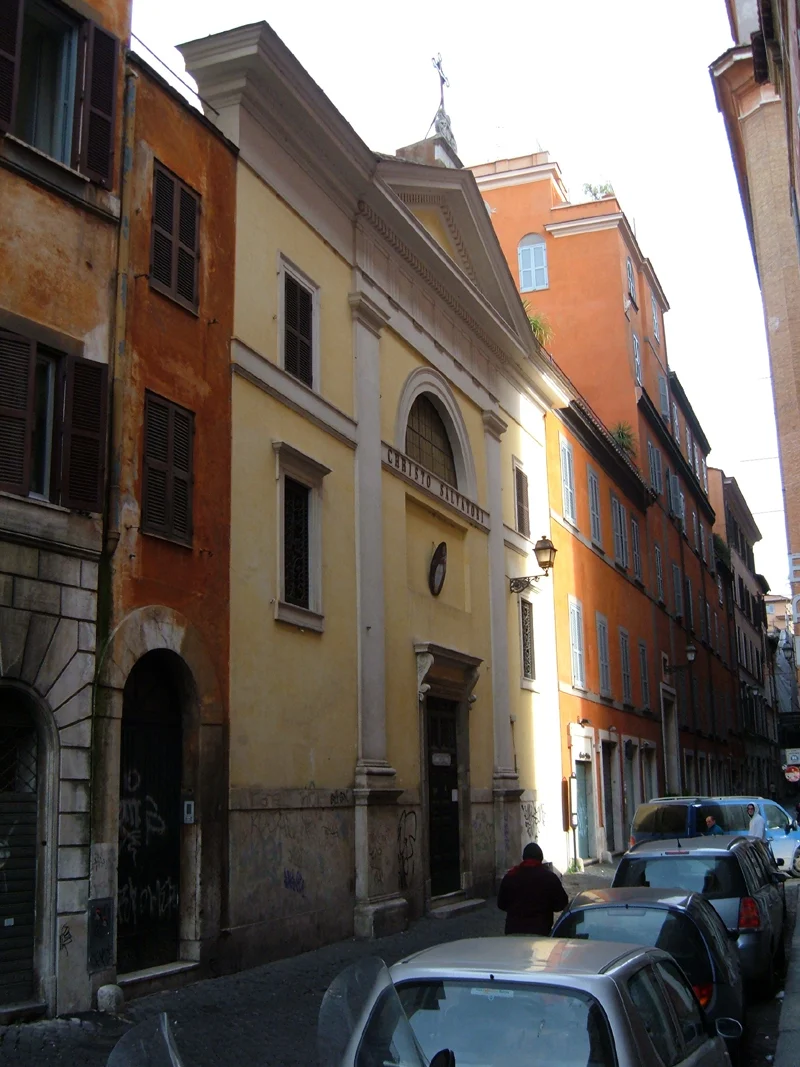
San Salvatore in Onda is at Via dei Pettinari 51, in the Regola district, a few meters from the start of Ponte Sisto, according to the tourist portal of Roma Capitale. It is a church entrusted to the Pallottine Fathers, the Society of the Catholic Apostolate, who have their generalate in the building next door. Entry is free, there is no ticket and nothing needs to be booked. The operator does not publish opening hours on a page that can be consulted: the phone number given is 06 68194601.
There are two reasons to go in. Under the high altar, in an urn, lies the body of Saint Vincent Pallotti, the Roman priest who died in 1850 and was canonized in 1963, founder of the congregation that runs the church. Around the urn is a medieval basilica with three naves on 12 ancient columns, all different, restored at the end of the 19th century, with a 12th-century crypt under the presbytery and the remains of a Roman warehouse even lower down.
The hours, Masses and contacts given in these lines correspond to the check of September 28, 2026 on the sources cited later in the text: the tourist portal of Roma Capitale, the sites linked to the Pallottine family, the Vatican and diocesan press, the liturgical directories. It is a church run by religious, and the hours change with the seasons, with the congregation's feasts and with the commitments of the generalate. Before crossing the city on purpose, phone.
Where it is and what you see
Via dei Pettinari is the street that runs from the head of Ponte Sisto into the Regola toward Campo de’ Fiori. It takes its name from the craftsmen who made and sold combs, of ivory and ebony for the hair or of wood for carding fibers. In the 16th century it was called Via della Trinità, after the nearby Santissima Trinità dei Pellegrini, which is one block away to the northeast.
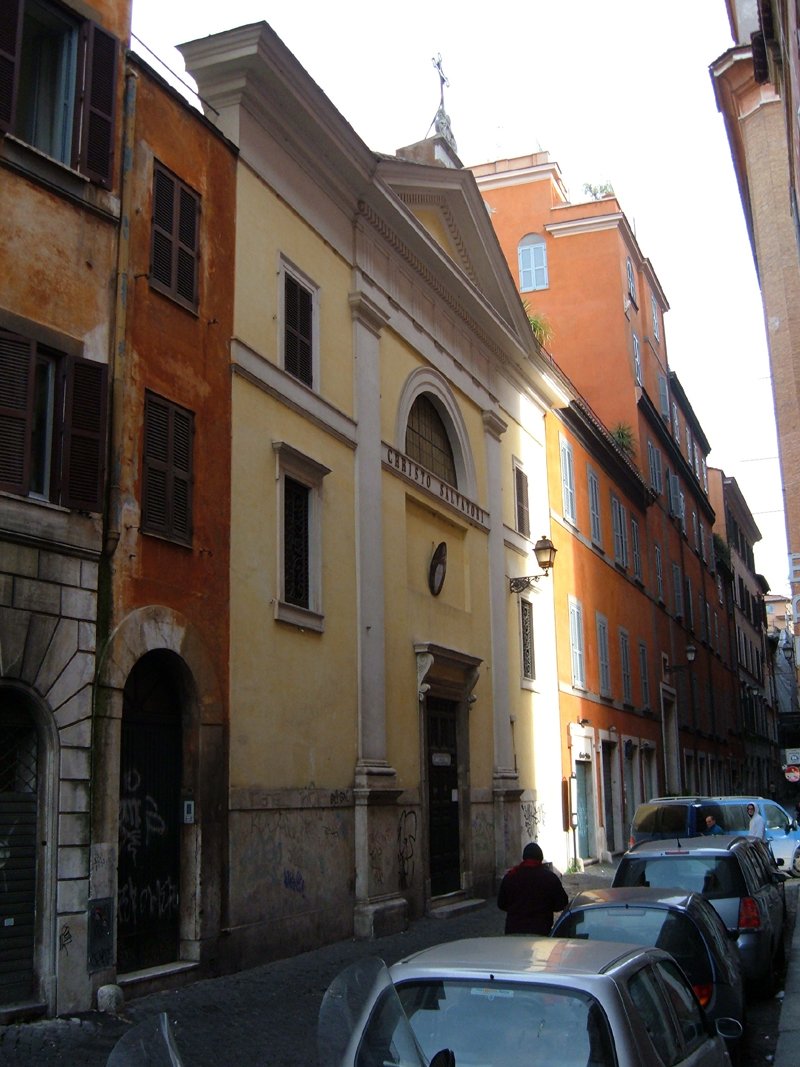
The church has no square in front of it. It presents a pale yellow 19th-century facade, in three parts, with barely raised Doric pilasters, a portal with scroll brackets, an empty panel above the door, a large lunette window and a pediment. On the architrave you read the dedication Christo Salvatori. In so narrow a street the facade is better seen at an angle, from the corner with the Lungotevere, than head-on.
Inside the layout is that of a basilica: a central nave of seven bays, two side aisles, a semicircular apse, an outer chapel on the right side. The 12 columns that support the arcades come from different ancient buildings and do not resemble one another. The nave ceiling is coffered with rosettes on a red ground, the aisles have cross vaults painted blue. It is a colorful, orderly, silent interior, visited almost only by those who come to pray.
Under the high altar, inside a sarcophagus with a glass urn, is the body of Saint Vincent Pallotti. In the chapel of the right aisle, called the Virgo Potens chapel, a slab in the floor commemorates the blessed Elisabetta Sanna, the Sardinian tertiary who was his spiritual daughter. Under the presbytery is the medieval crypt. The generalate next door keeps the saint's rooms with a small museum, which can be visited under different arrangements from the church.
A curiosity about San Salvatore in Onda
The organ is not where you look for it. It does not sit over the door in a single choir gallery, as in most Roman churches, but is divided between two platforms hung in the corners of the inner facade wall, on either side of the lunette window. The pipes seem hung on the wall. The effect is strange the first time, then you understand it was the only way not to block the nave's only source of natural light.
Along the gallery runs an inscription taken from Psalm 150, Laudate Dominum in tympano et choro, chordis et organo: praise the Lord with timbrels and dance, with strings and organ. The current instrument, according to the available entries, is a Tamburini opus 280 built in 1949, with electric action, with 23 stops on two manuals and pedal. A serious organ for a church of this size, and you hear it at the sung Masses.
The second curiosity concerns the columns. Count them and look at them one by one: four of gray granite, three of white marble, two of bigio lumachellato, one of greco fasciato, one of cipollino, one of pavonazzetto. Of the 11 ancient capitals none is a twin, and the twelfth is medieval, redone when the original was missing. It is the complete sample book of Roman reuse, and it is rarely seen so clean, without Baroque plaster covering it.
Those columns were hidden for almost two centuries. The Baroque restoration of 1684 had enclosed them inside masonry piers, following the taste of the time, which preferred smooth, uniform surfaces. They were freed by the architect Luca Carimini in the work begun after the precautionary closure of 1865. What you see today, therefore, is a Middle Ages restored in the 19th century: authentic in materials, rebuilt in overall appearance.
Hours, Masses and how to get in
Entry to the church is free, as in every Catholic place of worship in Rome. The tourist portal of Roma Capitale gives no hours and refers to direct contact with the church, at 06 68194601. The Pallottines do not publish opening hours on a page that can be consulted. City guides and liturgical directories indicate mostly morning opening, roughly between 8:00 and noon, but the data do not agree with one another.
There is no ticket and there is no sales channel, official or affiliate: whoever offers you priority entry for this church is selling something that doesn't exist. The underground spaces are a different matter, and are not part of the ordinary visit. Guided visits to the crypt and the Roman remains are organized by the association Sotterranei di Roma, reserved for members, by reservation at info@sotterraneidiroma.it or 347 381 1874.
On Masses the same caution applies. The liturgical directories consulted report a weekday Mass early in the morning and more celebrations on Sunday, with times that however change from one source to another and from one season to another. The operator indicates no public calendar. During services you come in to take part, not to wander among the aisles: if you arrive after Mass has started, sit at the back and wait until the end before approaching the altar.
The rooms where Saint Vincent Pallotti lived in his last years, with the chapel and the museum dedicated to him, are in the generalate of the Society of the Catholic Apostolate, at Piazza San Vincenzo Pallotti 204. Their custody is entrusted to the Istituto San Vincenzo Pallotti, which declares over 400 visitors a year and information sheets in five languages. Visiting hours are not published: they must be asked of the Institute.
A detail that saves a wasted trip: the street number. The portal of Roma Capitale and several guides give 51, other sources 56 or 56-58, the diocesan press of 2012 gives 57. The sources do not agree, but there is only one church and it is recognized by the yellow facade with the inscription Christo Salvatori. If you use a navigator, search for the name of the church and not the number, and arrive from the Ponte Sisto side.
One thing nobody tells you about San Salvatore in Onda
This is not the church where Pallotti worked for most of his life. When Gregory XVI assigned it to him, the Roman priest was almost 50, and he had few years left to live. His activity had taken place elsewhere: in the Roman Seminary, where he was confessor from 1827 to 1840, in the Urban College of Propaganda Fide, in the conferences for the Roman clergy, in the streets of the poor districts.
The weekly conferences for the priests of Rome, for example, he held at Spirito Santo dei Napoletani, on Via Giulia, starting June 6, 1839, every Thursday afternoon. He had been ordained a priest on May 16, 1818 in the Basilica of St. John Lateran. The Pallottine map of Rome is wide, and San Salvatore in Onda is its point of arrival, not its center.
This changes the way you look at the church. Here Pallotti gave a stable home to his community, and here he was buried and then brought back after the beatification. But the church, as a building, owes very little to him: the great restoration that gave it its present appearance begins 15 years after his death, with the money of two benefactor brothers and the design of an architect who had not known him.
For the Pallottine family this remains the central place. On April 9, 2026 the church hosted the presentation of three new volumes of the Complete Works, edited by Father Jan Kupka, with 881 letters addressed to Pallotti by nobles and peasants, cardinals and workers, religious and mothers of families. Whoever wants to understand who this man was finds it in those volumes more than in any panel.
The name “in Onda”: documents, tradition, legend
What the documents say. The first sure mention is in a bull of Pope Honorius II of 1127, which names a presbiter Crescentius Salvatoris in Unda, that is the priest Crescentius of the Salvatore in Unda. The name was therefore already formed in the 12th century, and the church is probably older than that document. Unda in Latin is the wave of the sea, and by extension the water that invades, the flood.
What tradition says, accepted by almost all the guides. The name would come from the floods of the Tiber, which on this stretch of the left bank entered houses and churches at every serious overflow, until the construction of the embankment walls at the end of the 19th century. It is an explanation consistent with the position, a few steps from the river, and with the building history of the church, which in the 18th century had to raise its floor.
What is legend, or a hypothesis without support. Some reconstructions report that the name derives from an ancient painting, now lost, of the Savior walking on the waters. Nobody has ever pointed to that painting in an inventory or a pastoral visit. It is an elegant hypothesis, which ties the name to devotion instead of disaster, and for that reason it is liked. But it remains a rumor.
There is another detail about the origins, rarely laid out. According to some sources the church was originally dedicated to the Savior and to San Cesareo together, and only the first title survived. Others link it to the Transfiguration, the theme that in fact returns in the apse semi-dome painted in the 19th century. The two things are not mutually exclusive, because the Transfiguration is a feast of the Savior, but the sources do not agree on the original title.
In our judgment the name is worth more as a memory of the place than as proof. On the bank of the Tiber, before the embankment walls, all the low churches were churches in onda. This one kept the nickname in its official title, and the nickname became history. The same happened at Santa Maria in Monticelli, a little farther on.
My advice for visiting San Salvatore in Onda
Go on a weekday morning, shortly after the end of the first Mass, and stay at least 20 minutes. It is a church you don't understand in five. The first thing to do is walk along the left aisle looking at the columns, then come back along the right, and only at the end approach the high altar. This way the eye gets used to the light, which is scarce, and the marbles can be told apart.
Phone ahead. The number 06 68194601 is the one given by the portal of Roma Capitale, and a call tells you if the church is open that day, if there is a particular celebration, if the saint's rooms in the generalate can be visited. In the weeks around January 22, the feast of Saint Vincent Pallotti, the church fills with Pallottine groups from half the world: it is the worst moment for a quiet visit and the best for seeing it alive.
If the underground part interests you, book with the association that opens it and don't count on chance. The crypt is under the presbytery and is not accessible on the ordinary visit, and the Roman level is reached through a trapdoor: it is not a place you go down into without an escort. Put the two things together on different days, if needed. The church above is worth a visit by itself.
Dress as you would for church, shoulders covered and no shorts, and keep your voice low near the urn. In front of the saint's body there is almost always someone praying, often religious and faithful who have come on purpose from abroad. It is not an attraction, it is a venerated tomb, and the right behavior is understood by watching others. Ask before photographing, if a priest or a sacristan is around.
One last piece of advice on method. Read two lines on Pallotti first, even just the dates: born in Rome on April 21, 1795, priest from 1818, founder of the Union of the Catholic Apostolate in 1835, died January 22, 1850, blessed in 1950, saint in 1963. Without this frame the visit remains an urn in a beautiful church. With the frame it becomes the story of a neighborhood priest who ended up on the altars.
The three levels: church, crypt, Roman warehouse
San Salvatore in Onda is built in layers, like almost everything near the Tiber. The level you walk on is that of the floor raised in the 18th century, under Pope Benedict XIII, when the floods had made the medieval church too low and damp. Carimini, in the 19th century, worked at this height, restoring the basilican layout without going back to the original floor.
The second level is the crypt, under the presbytery. It is a small rectangular space, with three small aisles divided by Roman columns, with cross vaults. Two fluted Ionic columns of reuse support the vault, other column fragments are walled into the walls, and the altar is made from a large Corinthian capital. The sources date it mostly to the early 12th century, but one reconstruction traces it back to the 8th: the sources do not agree.
Originally the crypt had an access on both sides of the presbytery. It is the typical scheme of pilgrimage crypts, designed to let a line of faithful enter on one side and exit on the other in front of a relic. Which relic was venerated here, however, no source says. The fact is not documented, and every name that circulates on this point should be taken as a hypothesis.
The third level is Roman. From a trapdoor in the floor of the crypt you descend about 3.7 meters and enter spaces of the imperial age, dated to the period of Trajan thanks to the brick stamps, between 98 and 117. They were warehouses and shops of the left bank of the Tiber, the horrea that served the river traffic. The complex extends for about 20 meters in length.
Those who have documented these spaces describe double relieving arches, a sign of originally higher ceilings, large basalt paving blocks from a road, probably moved in the medieval period, and openings with hooded vaults. The prevailing reading is that of a taberna with direct access from the street and a back room. Above, on the side of the church, ran an ancient road that connected the bridge with the Theater of Pompey, about six meters below the present street level.
For a comparison with other Roman undergrounds, the clearest cases remain the Basilica of San Clemente, where the levels are visited in sequence, and the spaces under Piazza Navona. An overview of what can be seen under the city is on the page about Underground Rome. Here the scale is minimal, but the sequence is complete.
The tomb of Saint Vincent Pallotti
The saint's body is under the high altar, in a sarcophagus made by Arnoldo Brandizzi, which has held it since 1950, the year of the beatification. The sarcophagus has a glass front: you see the reclining figure, the face and the hands. Above, the canopy on four columns of red and white marble, with the dove of the Holy Spirit at the center of the small dome and eight roundels with the apostles around it.
Here too it is best to keep the levels separate. The documents reported by Catholic sources speak of two examinations of the body, in 1906 and 1950, and of the state of preservation found on those occasions. Devout tradition speaks of an incorrupt body, and religious guides present it so. What the visitor sees is a body laid out behind glass. The rest is a matter of faith, and should be respected as such.
The date of the beatification has a symbolic weight. Pius XII proclaimed Pallotti blessed on January 22, 1950, exactly 100 years after his death. The canonization came on January 20, 1963, in the Vatican Basilica, with John XXIII, during the first months of the Second Vatican Council. In the homily the pope called him a Roman priest, glory of the clergy of Rome. The liturgical feast is January 22.
The other important tomb in the church is that of Elisabetta Sanna, born in Codrongianos, in Sardinia, in 1788, who came to Rome on pilgrimage and stayed in the city, where Pallotti was her spiritual director for almost 20 years. She died on February 17, 1857 and was buried here. Pope Francis declared her venerable in 2014, and on September 17, 2016 she was proclaimed blessed in Codrongianos, with Cardinal Angelo Amato.
The image of the Virgo Potens, the powerful Virgin, found on the altar of the right chapel, was donated to the church by Elisabetta Sanna herself. The available entries recall also buried in the church the physician Cesare Macchiati and the man of letters Malatesta Strinati, known in Arcadia as Licida Orcomenio. These are names that mean little today, but they tell of a neighborhood church that had its families and its intellectuals.
Another well-known fact, yet rarely cited
Before the Pallottines, for four centuries, the church was Franciscan. In 1445 Pope Eugene IV granted it with the convent to the Conventual Friars Minor, tied to the community of Santa Maria in Aracoeli. One source gives 1435, the others 1445. The Conventuals held it until 1844, and in the chapel of the Virgo Potens a trace of them remains in a fresco of the Immaculate Conception with Saint Anthony and a Franciscan friar.
Even earlier, between the 13th and 15th centuries, the monks of Saint Paul the First Hermit, the Paulines, an order of Hungarian origin, had their seat here. This is said to have been their first Roman house. The dates of their arrival waver between 1260, the end of the 13th century and the pontificate of Innocent VII, at the beginning of the 15th century: the sources do not agree. Their passage is almost forgotten, and is one of the most unusual in the district.
The second little-cited fact concerns the parish. San Salvatore in Onda was a real parish, dependent in the 12th century on San Lorenzo in Damaso. The apostolic visit of 1566 counted only about 40 families there, a number that without the friars would perhaps have decreed its closure. The parish title was suppressed in 1824 by Leo XII with the bull Super universam, which redrew the parishes of Rome.
Third fact: in 1848, in the months of the revolution that led to the Roman Republic, the bell tower's bells were requisitioned. Two new bells were cast in 1850, the year of Pallotti's death. It is a tiny detail, but it says well how much this church, facing the river that the Janiculum dominates from the other bank, was inside the events of those years.
The right photo to take at San Salvatore in Onda
The photo to take is inside, from the door, along the central nave toward the canopy. Stand just past the inner door, shifted a bit toward a row of columns, and frame vertically so as to catch the red coffered ceiling above and the gilded apse at the back. The play of colors, red above, blue in the aisles, gold in the apse semi-dome, works only if all of it is there.
The second photo is a detail, and it is the best: two neighboring columns of different materials, for example the gray granite next to the green-veined cipollino, shot from the side with the light coming from the large window. It takes patience and a normal lens, no wide angle. That pair of columns tells the story of Roman reuse better than any caption, and nobody photographs it.
Outside, the facade is not shot head-on: the street is narrow and the front ends up squashed. Move away toward the Lungotevere and take it at an angle, with the street closing in perspective toward the interior of the district. In the late afternoon the raking light brings out the yellow of the plaster. In the morning the facade is in shade, and for a photo it's best to come back later.
Avoid close-up photos of the urn, especially if someone is praying. If you want a memento of the saint, photograph the whole presbytery from the nave, with the canopy and the altar, without approaching. The flash should always be off: the painted surfaces gain nothing from it and the image flattens. During services, out of respect, the camera stays in your pocket.
For the photo from the bridge, cross Ponte Sisto and turn around halfway: the church can't be seen, hidden by the buildings, but you understand the position, low on the bank, and you see the level of the embankment walls. It is the photo that explains the name. Whoever looks at the Tiber from the embankment walls today has trouble imagining the water inside the houses of Via dei Pettinari.
The interior and the works, up close
The apse semi-dome shows the Transfiguration, with Christ between Moses and Elijah, painted by Filippo Prosperi, the same painter who frescoed on the dark red walls of the nave the panels with saints and patriarchs of the Old Testament. Eight figures in round-arched roundels: David, Samson, Joseph, Noah, Isaac, Aaron, Joshua, Ezekiel. Below the semi-dome, Saints Peter and Paul flank a neoclassical aedicule.
Inside that aedicule is the Madonna and Child by Cesare Mariani, dated 1878, the year of the reopening. Below the image, above the tabernacle, a relief in gilded silver with the pelican feeding its young with its own blood, an ancient symbol of the sacrifice of Christ. The Way of the Cross is by Domenico Cassarotti, while a previous image of the Queen of the Apostles was by Serafino Cesaretti.
The Virgo Potens chapel, in the right aisle, is the richest. It has a semicircular plan, a coffered semi-dome with gilded rosettes on a blue ground, an altar of polychrome marbles with composite columns and a frieze of verde antico. On the walls, four frescoes by Mariani: Judith with the head of Holofernes, Queen Esther before Ahasuerus, the Annunciation, the Immaculate Conception with Saint Anthony and a Franciscan friar.
At the end of the right aisle is the chapel of Saints Cosmas and Damian, with an altarpiece showing a vision of Christ in glory. In the left aisle the chapel of the Madonna degli Angeli preserves a relief with two saints whom the sources do not identify. The floor of the presbytery, instead, is a sample book of Tuscan and French marbles: breccia di Seravezza, bardiglio, rosso di Francia, chosen by Carimini with a stonecutter's eye.
Carimini had started from exactly there. He began as a boy as a stonecutter and came to architecture only as an adult, and this building site bears the mark: the care for marbles, for the profiles of cornices, for the joints between different materials. The entablature of the nave has a very projecting dentilled cornice, with festoons and angels between the archivolts. It is workshop work, before it is design.
The judgment against the current is this. Many dismiss the interior as a fake 19th-century Middle Ages, to be looked at with condescension next to the bare bricks of other Roman churches. The opposite is true: the Roman Middle Ages loved colorful frescoes and painted surfaces, not rough plaster. Carimini's restoration is closer to the original spirit than many 20th-century restorations that stripped churches to show their skeleton.
Some important events that happened here in history
1127 is the date of the first mention, in a bull of Honorius II. In 1186 the church appears among the dependencies of San Lorenzo in Damaso. In 1260, according to the sources, Cesario Cesarini has it rebuilt, leaving the crypt intact. This is the start of the phase in which the church passes into the hands of religious orders, first the Paulines, then the Franciscans, who will make it their seat for four centuries.
In 1445 the Friars Minor Conventual arrive, by concession of Eugene IV. In 1684 a Baroque restoration transforms the interior: columns enclosed in the piers, Gothic windows reduced to round arches. Under Benedict XIII, between 1724 and 1730, the shops built against the facade are removed and the floor is raised, to protect the church from the waters of the Tiber that flooded it at every high water.
On August 14, 1844 Gregory XVI entrusts church and convent to Vincenzo Pallotti and his community, the Pious Society of the Catholic Apostolate. Some sources give 1846, which matches the years when the saint began living in the rooms of the house next door. In 1848 the Roman Republic requisitions the bells. On January 22, 1850 Pallotti dies, and two new bells are cast the same year.
In 1865 the church is closed as a precaution, because of structural problems. The work site of Luca Carimini, with the craftsman Domenico D’Amico, is financed by the brothers Antonio and Pietro Cassetta: one source sets its start at 1867, another puts it around 1877. The reopening is certain: August 6, 1878, the feast of the Transfiguration, with a Mass presided over by Monsignor Francesco di Paola Cassetta.
The 20th century is Pallotti’s century. In 1906 and 1950 the examinations of the body, on January 22, 1950 the beatification, on January 20, 1963 the canonization in St. Peter’s. On June 22, 1986 John Paul II visits the church: as a student, in 1946, he had stayed in the generalate house next door. On April 9, 2026 the volumes with the letters addressed to the saint are presented here.
Who Passed Through San Salvatore in Onda
Vincenzo Pallotti, a Roman, born on April 21, 1795, a priest from 1818. Confessor of seminarians and students of the missions, organizer of conferences for the clergy, founder in 1835 of the Union of the Catholic Apostolate, which called the laity to an active responsibility in the Church a century ahead of the Council. He spent his last years here and rests here. It is the reason the church is known around the world and almost unknown to Romans.
Elisabetta Sanna, a peasant woman from Codrongianos, widowed in 1830 and arrived in Rome on pilgrimage. Ill, she was never able to leave again, and Pallotti became her spiritual guide. A Franciscan tertiary, a member of the Union from the very beginning, she financed works for the poor and for orphans with her knitting and the offerings she received. For many Sardinian pilgrims this church is worth the trip because of her.
Karol Wojtyła, first as a young priest studying in Rome in 1946, a guest of the Pallottines’ generalate house, then as pope, on June 22, 1986, visiting the church. The sources report only these two passages, with no details on the first stay. They are enough, though, to tie a 20th-century pontiff to a religious house on via dei Pettinari, and to explain why his name recurs in the community’s stories.
Luca Carimini, the architect who gave the church its present look, and the brothers Antonio and Pietro Cassetta, who paid for the work. Carimini is the same man who worked on other Roman churches of the 19th century, and here he left perhaps his most coherent intervention. The Cassettas are a name you read only in the chronicles of the restoration, but without them the church would have stayed closed.
Cesare Mariani and Filippo Prosperi, the two painters of the 19th-century work site. Mariani signed the Madonna of the apse and the four frescoes of the Virgo Potens chapel, Prosperi the Transfiguration and the patriarchs of the nave. Anyone who wants to see how Roman churches were painted in the 19th century, between academy and medieval revival, finds here a complete and readable case, with no later overlays.
The families of the Regola, finally, the ones who in the 1566 visit numbered around 40 and who for centuries made San Salvatore in Onda their parish. Comb makers, boatmen, small river traders, like those you meet in the chronicles of San Paolo alla Regola, not far away. None of these people left a name in the guidebooks, but the church is still standing for them.
How to Get There
On foot is the right way. From Campo de’ Fiori you go down via dei Pettinari toward the river in a few minutes, passing in front of Santissima Trinità dei Pellegrini. From Trastevere you cross Ponte Sisto and the church is right there on the left, at the beginning of the street. From the Jewish Ghetto you go along via Arenula and enter the rione by the side streets toward the Tiber.
By public transport, the surface lines that run along via Arenula, corso Vittorio Emanuele and the Lungotevere serve the whole area. Routes and stops change often because of roadworks and detours, especially in the historic center, so it’s best to check them the same day on the ATAC website or with the company’s app. From Largo Argentina, a hub for many lines, it’s a 10-minute walk.
By car it’s not worth it. Via dei Pettinari is inside the limited traffic zone of the historic center, and parking on the Lungotevere is rare and expensive. If you’re coming from outside Rome, you’re better off leaving the car in a park-and-ride lot and continuing by metro to the center. For people with mobility difficulties, a taxi to the start of Ponte Sisto is the simplest solution.
On accessibility, the information is not published. The church has an entrance at street level, but the presbytery is raised and the crypt is reached by a staircase. Wheelchair users should call to ask which spaces can be reached. The Roman rooms below the crypt, as described by those who have explored them, are not accessible to people with mobility problems.
When It’s Closed and What Not to Expect
Outside opening hours, which the manager doesn’t publish, the church is closed, and the afternoon is when it’s easiest to find it that way. City guides indicate a morning opening, and in the early afternoon many churches run by religious orders in the center close. Showing up at three on an August afternoon without having called means, in all likelihood, finding the door barred.
Don’t expect services. There is no bookshop, there are no audioguides, there are no explanatory panels in several languages inside the church. The information sheets in five languages that the Istituto San Vincenzo Pallotti talks about concern the saint’s rooms in the generalate house. In the church the information comes through people, from the sacristan or an available father, and from the preparation you bring from home.
Don’t expect the crypt to be open. On the ordinary visit you stay at the church floor, and whoever goes down below the presbytery does so on an organized visit. Don’t expect a large monumental church either: the dimensions are modest, the visit takes a quarter of an hour, and anyone coming from the nearby Trinità dei Pellegrini has just seen a much bigger interior.
On the congregation’s feast days, in particular January 22 and the days around it, and February 17 for the memorial of Elisabetta Sanna, the church can be full of groups and celebrations. In 2012, for the 50 years since the canonization, the diocesan weekly Roma Sette published a program of Masses spread across several churches in the center, this one included. On those days the tourist visit takes second place.
Eating Nearby
The church is a few minutes from Campo de’ Fiori, that is, from one of the squares in Rome where you eat worst for what you spend. Not the fault of the square, but of the public that crosses it: people passing through, who won’t come back, and whom nobody has any interest in keeping as customers. The signs for recognizing the places to avoid are always the same, and they hold across the whole center.
First sign: the menu with photographs of the dishes, laminated, translated into five languages. A restaurant that has to show you the picture of carbonara is speaking to someone who doesn’t know what it is. Second sign: the lady rolling fresh pasta in the window or on the sidewalk. It’s theater, not a guarantee. Well-made pasta is prepared in the kitchen, in the morning, away from the dust of the street.
Third sign: the person at the door who stops you and invites you in. A place that has to get customers by stopping them in the street has no regulars, and regulars are the only guarantee there is. The same goes for places open without a break from morning until late at night: a real kitchen stops in the afternoon, because it has to prepare for the evening service.
Fourth sign: the price that adapts to the customer. Places set in front of monuments and on the most photographed squares tend to have items without a price, like the fish of the day, and sometimes a different menu between the indoor room and the outdoor tables. Always ask the price before ordering, especially for fish and for wine by the glass.
Romans don’t go there, and not out of snobbery. They simply know that a few streets away, in the inner streets of the Regola and across the bridge, there are kitchens that work for the neighborhood. The test is to look at who is sitting there: if at lunch there are office workers, laborers and families speaking Romanesco, you’ve found it. If there are only backpacks and maps, you’re in the wrong place.
So you don’t have to go by trial and error, we keep an updated public list of addresses we really go to, in the center and beyond: our list of the places where we eat. It isn’t sponsored and it changes when the places change. For a coffee on the theme of historic venues, there’s our guide to the historic cafés and shops of Rome.
What to Combine in a Day
The first pairing is a must: Santissima Trinità dei Pellegrini, a block away, and then Santa Maria in Monticelli and San Paolo alla Regola. Three small churches of the Regola, three different stories, a walk of one hour. If you want a common thread, you can follow the theme of the riverbank churches, all marked by the river.
The second pairing is the Baroque of the Farnese and the Spada. The Galleria Spada, with Borromini’s perspective, is five minutes away, and Piazza Farnese a little farther. From there you enter via Giulia, with Santa Maria dell’Orazione e Morte and, at the end, the Basilica di San Giovanni dei Fiorentini.
The third is a Pallottine tour, for those who come for the saint. The churches where the 50 years of the canonization were celebrated in 2012 are San Carlo ai Catinari, San Lorenzo in Damaso inside the Palazzo della Cancelleria, and Santa Maria in Vallicella. You can add the Basilica di Sant’Andrea della Valle, on the same axis.
The fourth crosses the river. From Ponte Sisto you go down into Trastevere, with Piazza di Santa Maria in Trastevere, Santa Maria della Scala and the Museo di Roma in Trastevere. If you have the legs, climb to the Janiculum and the Acqua Paola Fountain, from where you look over the whole Regola.
The fifth is the river itself. Along the Tiber downstream you reach the Tiber Island, the Portico of Octavia and the Turtle Fountain. To stay on the theme of the underground layers, the Crypta Balbi explains better than any other museum how the city grew on top of itself.
Frequently Asked Questions
Is San Salvatore in Onda free to visit?
Yes, entry to the church is open and free, with no ticket and no reservation. The church is run by the Pallottine Fathers, the Society of the Catholic Apostolate. The manager doesn’t publish opening hours, and city guides mostly indicate the morning: it’s best to call first on 06 68194601, the number listed by the Roma Capitale tourist portal.
Where exactly is the church?
On via dei Pettinari, in the Regola rione, at the beginning of the street that climbs from Ponte Sisto toward Campo de’ Fiori, a block from Santissima Trinità dei Pellegrini. The Roma Capitale portal gives number 51, other sources 56 or 57. The yellow facade with the inscription Christo Salvatori is unmistakable, so it’s best to search for the name of the church.
Who is buried in San Salvatore in Onda?
Under the high altar lies the body of Saint Vincenzo Pallotti, who died on January 22, 1850 and was canonized in 1963, in a sarcophagus with a glass front made by Arnoldo Brandizzi. Also buried in the church is the blessed Elisabetta Sanna, who died in 1857, and the sources mention the physician Cesare Macchiati and the man of letters Malatesta Strinati.
Why is the church called “in Onda”?
The name is documented from 1127 in the Latin form Salvatoris in Unda. The explanation accepted by most of the sources links it to the floods of the Tiber, which inundated this stretch of the bank before the embankment walls. A minority hypothesis, with no documentary evidence, ties it to a lost painting of the Savior walking on the waters.
Can you visit the crypt?
The medieval crypt under the presbytery and the Roman rooms of the Trajanic era under the crypt are not part of the ordinary visit. Guided visits to the underground rooms are organized by the association Sotterranei di Roma, reserved for members and by reservation, at info@sotterraneidiroma.it or on 347 381 1874, according to the association’s page.
Can you see the rooms of Saint Vincenzo Pallotti?
The saint’s rooms, with a chapel and a museum, are in the Pallottines’ generalate house, at piazza San Vincenzo Pallotti 204, and are run by the Istituto San Vincenzo Pallotti, which declares more than 400 visitors a year. Visiting hours are not published and must be requested directly from the Institute, possibly a few days in advance.
When is the best time to go?
For a quiet visit, the morning of a weekday, after the first Mass. To see the church at its most crowded, January 22, the liturgical feast of Saint Vincenzo Pallotti, when Pallottine groups arrive from many countries. In any case it’s best to call first, because the hours change with the seasons and with the congregation’s celebrations.
Who was here before the Pallottines?
From 1445, by concession of Pope Eugene IV, the church belonged to the Friars Minor Conventual, who held it until 1844, when Gregory XVI entrusted it to Vincenzo Pallotti. Before them the monks of Saint Paul the First Hermit, the Paulines, had their seat there, with arrival dates that the sources place between the 13th century and the early 15th.
Who Wrote This Page
The page comes from the editorial team of Tour Leader Pro, the Roman organization that designs itineraries, visits and cultural events across Rome and Lazio. Hours, contacts and access arrangements reported here come from the sources cited in the text, as of the date indicated at the top. Since this is a church run by religious, with hours the manager doesn’t publish, check again before you leave and tell us what you find changed.
Lining up a morning in the historic center means fitting together churches that open only a few hours, celebrations that close the naves to visitors, underground visits by reservation, and distances that look like nothing on the map and on foot, with a group, become half an hour. Anyone facing this kind of puzzle, for themselves or for 40 people, will find on Tour Leader Pro working materials designed for those who guide and for those who organize on their own.
For the wider picture, meaning regional trains and seasonal schedules, airports, trips between one city and another, and Italian destinations outside Rome, from the villages of Lazio to the art cities of the center and north, a useful resource for putting together a multi-day itinerary is Italy Planner.