Santa Maria dell’Anima
In short. Santa Maria dell’Anima is the national church of German-speaking Catholics in Rome and stands less than 100 meters from Piazza Navona, in the Ponte district, with its facade on Via di Santa Maria dell’Anima at number 64 and the college…
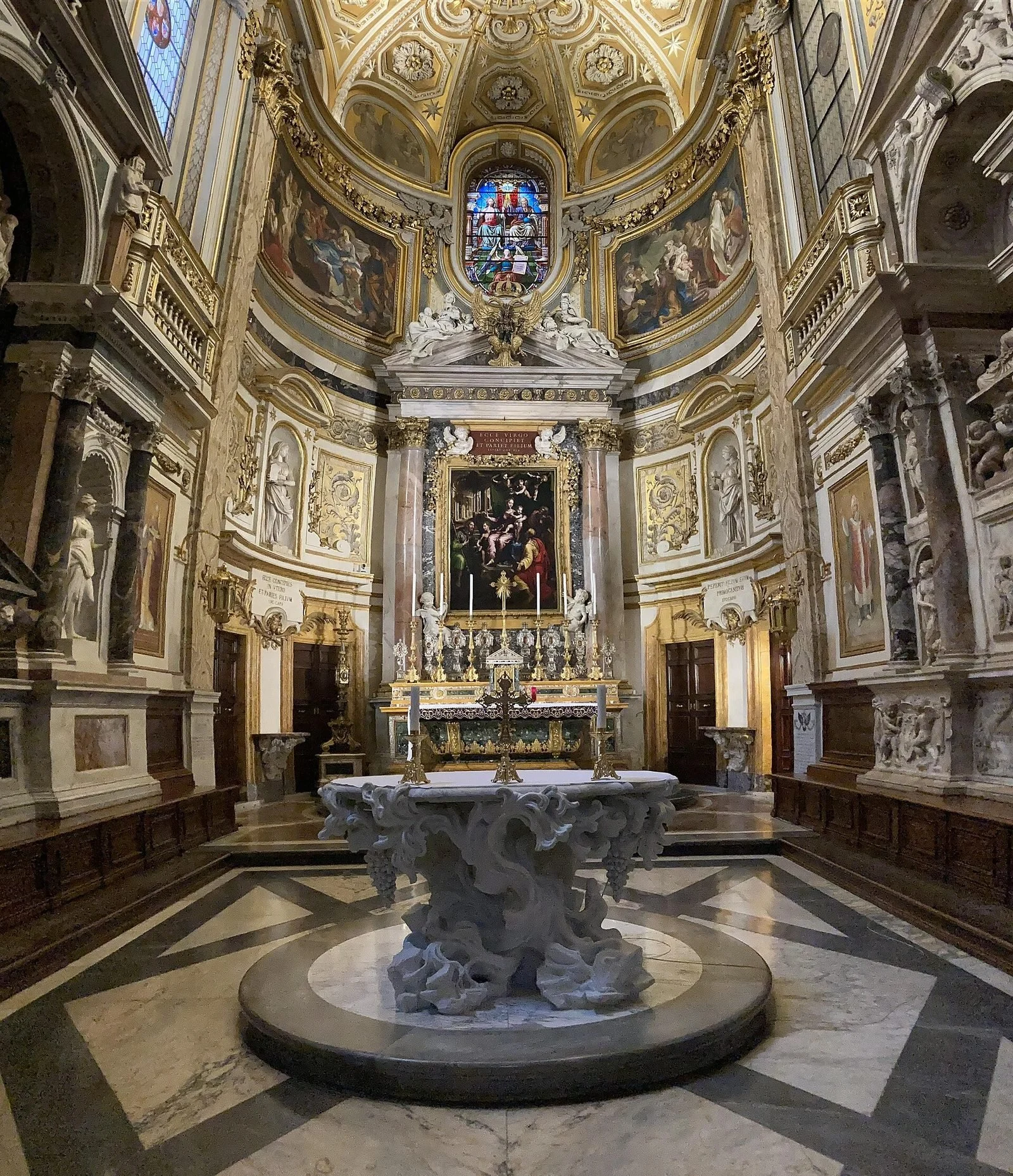
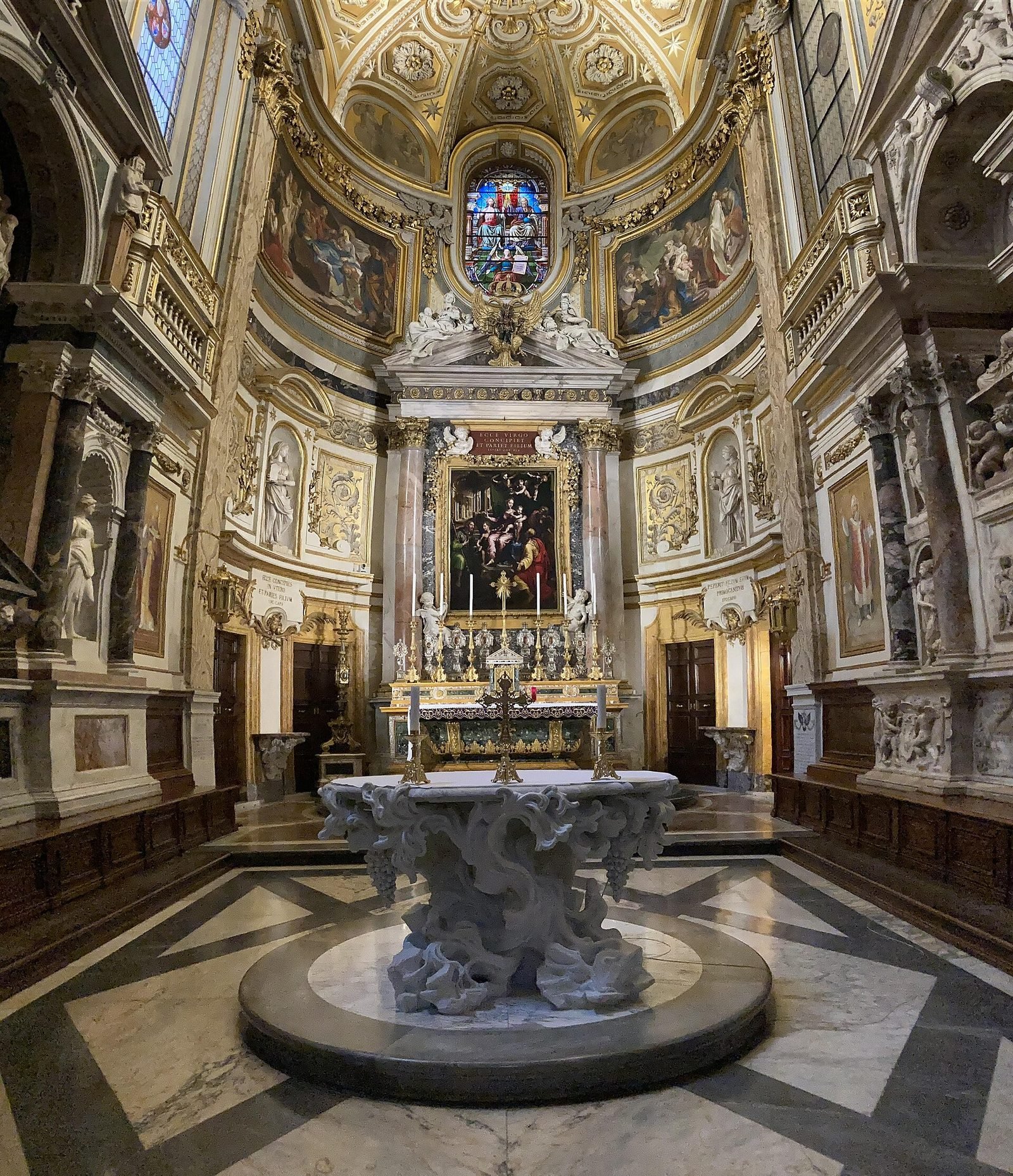
Santa Maria dell’Anima is the national church of German-speaking Catholics in Rome and stands less than 100 meters from Piazza Navona, in the Ponte district, with its facade on Via di Santa Maria dell’Anima at number 64 and the college complex facing Via della Pace at number 20. It is one of the buildings in the historic center most often visited by mistake: thousands of people walk past it every day going from the square toward the Tiber, and almost none go in. The street is narrow, the facade is brick and doesn't project, and the central portal is the only element that asks for attention. Anyone who stops finds a church that inside looks like no other in Rome, three aisles of the same height following the German model of the Hallenkirche, and above all finds the tomb of Adrian VI, who died in 1523, the last non-Italian pope before John Paul II. The lines that follow explain what this complex is, where it comes from, what it keeps, what you can actually see when you go in and how to organize the visit without counting on hours that change here more often than elsewhere.
Where Santa Maria dell’Anima Is and How to Get There
The church opens onto Via di Santa Maria dell’Anima, the street running parallel to the western side of Piazza Navona, between the square itself and Via dei Coronari. The parish address is Via di Santa Maria dell’Anima 64, while the attached priests' college is based at Via della Pace 20: two different numbers for two different functions of the same block. The complex occupies almost the whole frontage between the two streets, and this explains why many visitors say they looked for it “behind Navona” without finding it. It isn't hidden. It is simply wedged into an urban fabric where no facade has the space to be seen from far away.
On Foot from Nearby Squares
From the center of Piazza Navona, at the Fountain of the Four Rivers, it takes two minutes. You leave the square by one of the passages on the western long side, the one of the church of Sant’Agnese in Agone, cross Via di Santa Maria dell’Anima and find yourself in front of the portal. From the Pantheon the walk takes seven or eight minutes via Piazza di Sant’Eustachio and past the side of San Luigi dei Francesi. From Campo de’ Fiori it is 10 minutes going up Via del Governo Vecchio or along Corso Vittorio Emanuele II and then Via della Cuccagna. From Castel Sant'Angelo, after crossing Ponte Sant’Angelo, the route along Via dei Coronari takes about 12 minutes and is probably the clearest way to get there, because Via dei Coronari comes out a few steps from the side of the complex.
By Public Transport
There is no metro stop nearby: Rome's metro network does not serve this sector of the historic center, and anyone who claims otherwise is describing another city. The most convenient surface stops are those on Corso Vittorio Emanuele II, at Corso del Rinascimento or Piazza della Chiesa Nuova, served by the bus lines crossing the historic center east to west, including 46, 62, 64, 190F and 916. From there you walk five or six minutes north. Coming from Termini you can take the 64 to Corso Vittorio and finish on foot. Coming from Trastevere or the Janiculum, it is easier to use the lines that pass along the Lungotevere or through Piazza Venezia. Lines change route fairly often because of construction sites and detours, so check the updated route before leaving.
What Santa Maria dell’Anima Is: A National Church, Not Just Any Roman Parish
Santa Maria dell’Anima is the national church of German-speaking Catholics in Rome, that is, the religious and institutional reference point for Germans, Austrians, German-speaking Swiss and, historically, also for Flemings and Dutch. National churches are a typically Roman institution: born as chapels of the hospices that took in pilgrims of a given origin, they became over time true representative centers of a foreign community inside the city of the pope. San Luigi dei Francesi plays the same role for the French, Santa Maria in Monserrato for the Spanish, San Giovanni dei Fiorentini for the Tuscans. Understanding this mechanism changes the way you look at the building: the works of art it holds are not there by chance, they are the result of commissions by a community that wanted to be seen in Rome.
Why It's Called “dell’Anima”
The name comes from the image that decorated the original hospice, a Madonna of Mercy with two souls from purgatory at her sides, the so-called Beatae Mariae Animarum. The sculpted group above the central portal of the facade repeats the same subject and is the element that lets you recognize the building even if you haven't read the sign. It has nothing to do with the term “soul” in a generic devotional sense, and nothing to do with any ghost legend: the etymology is documented and concerns the original dedication of the 14th-century hospice.
From the Hospice of 1350 to the Church Consecrated in 1542
The history of Santa Maria dell’Anima begins in 1350, a jubilee year, when a married Dutch couple from Dordrecht, Johannes and Katharina Peters, bought some houses in this area to make a hospice for German- and Flemish-speaking pilgrims. Rome was full of pilgrims and lacked facilities to receive them, and charitable foundations of this kind multiplied precisely around jubilee years. The hospice took its name from the Marian image venerated there and grew quickly thanks to bequests and donations from the German-speaking community living in Rome, which in the 15th century was numerically significant and included curia officials, printers, artisans and bankers.
Who Built What: A Point on Which the Sources Diverge
On the attribution of the Renaissance building the sources disagree, and it is better to say so clearly than to pick a name at random. One part of the literature attributes the design and the facade to Giuliano da Sangallo. Another part assigns the direction of the works to Andrea Sansovino, to whom the sculptural group of the Madonna above the central portal is more consistently credited. The bell tower is traditionally associated with Bramante's circle, but this is a debated attribution not documented by contracts. Anyone looking for a single answer will be disappointed. The honest thing to report is that this was a long building site, with several hands, at a moment when all the architects who counted were working in Rome at once, and that assigning it to a single author is a modern simplification.
The Three-Portal Facade and the Bell Tower with the Majolica Spire
The facade of Santa Maria dell’Anima is exposed brick, articulated in superimposed orders marked by pilasters, with three aligned portals and a large circular window in the upper part, and it was built in the second decade of the 16th century, roughly between 1514 and 1523. Three portals on a church facade are not a decorative choice: they correspond to the three aisles of the interior, and from the outside they already announce a plan different from that of contemporary Roman churches, which as a rule have a dominant central nave and a single monumental entrance.
The Bell Tower and the Polychrome Spire
The bell tower rises on the right side of the church, is dated to the early 16th century (the sources give 1502) and combines elements that in Rome you almost never see together anywhere else: mullioned windows of Renaissance design in the bell chamber, pinnacles of still Gothic flavor at the corners, and above all a spire covered in polychrome majolica. It is the most unusual element of the whole complex. Colored ceramic cladding on a spire roof belongs to a Central European and Alpine tradition, not to Roman building practice, and its presence here is the visible signature of the German-speaking patronage. We checked this description against several sources, including the institutional ones of the City of Rome, and it is consistent.
The Hall Interior: Why It Doesn't Look Like a Roman Church
The interior of Santa Maria dell’Anima follows the model of the Hallenkirche, the hall church of late Gothic German tradition, in which the three aisles have the same height and the space is perceived as a single wide environment rather than as a central nave flanked by two corridors. In Rome this solution is extremely rare, and the effect on the visitor is immediate even without knowing its name: the light is distributed differently, the gaze is not channeled toward the altar with the same force, and the pillars look taller and slimmer because they rest on very developed bases.
What Changes for the Viewer
The practical consequence concerns light and proportions. In Roman basilicas the high windows of the central nave light the center and leave the sides in half-light. Here the light enters at the same height on all three aisles, and the side chapels, which rise to the vault, remain as readable as the central body. The chapels are eight by the current count and each corresponds to a specific commission: that is the reason the decorative whole looks heterogeneous. Artificial lighting remains scarce, so anyone who wants to really see the paintings should come on a clear day in the middle hours.
The Tomb of Adrian VI, the Last Non-Italian Pope Before John Paul II
In the presbytery of Santa Maria dell’Anima, to the right of the high altar, stands the funerary monument of Adrian VI, pope from January 9, 1522 to September 14, 1523, the last non-Italian pontiff before the election of John Paul II in 1978, that is, for 455 years. It is the main reason this church appears in history books, and the reason it is worth going in even with little time. The monument was commissioned by Cardinal Willem van Enckenvoirt, a countryman and friend of the pope, and made between 1524 and 1527 or so to a design by Baldassarre Peruzzi, with the sculptures carried out by Angelo di Mariano da Siena, known as Michelangelo Senese.
Who Adriaan Floriszoon Boeyens Was
He was born in Utrecht on March 2, 1459, the son of a woodworker. He studied at Leuven, where he became a leading theologian and then rector of the university. In 1507 he was called to be tutor to the young Charles of Habsburg, the future emperor Charles V: this is the fact that explains his entire later career. He became bishop of Tortosa in 1516, was inquisitor general and regent of Spain during Charles's absences, and received the red hat from Leo X on July 1, 1517. When Leo X died suddenly, in December 1521, the conclave found itself deadlocked between opposing factions and ended up electing, on January 9, 1522, a cardinal absent from Rome, who had never set foot in the city and whom none of his electors knew in person.
A Pontificate of 20 Months
Adrian VI entered Rome on August 29, 1522 and was crowned on August 31. He died on September 14, 1523: a little over a year of effective pontificate. He found a curia used to the lavish patronage of the Medici, a ruined treasury, the Lutheran question by now exploded in Germany and the Turks conquering Rhodes in that same 1522. He set his government on a line of austerity and moral reform, cut expenses, reduced offices, and in the famous instruction to the nuncio Chieregati for the Diet of Nuremberg he openly admitted that the corruption of the Roman curia was at the origin of the Church's ills. It was an admission without precedent for a Renaissance pope, and it cost him the hostility of almost everyone in Rome.
Why the Romans Detested Him
The Roman reaction was almost immediate rejection, and the reasons are documented. He was a foreigner in a curia that for decades had been an Italian machine. He spoke Latin and did not know Italian. He did not associate with artists or men of letters, and the interruption of art commissions left out of work a whole supply chain that had prospered under Leo X. He cut curia posts, which were a source of income for hundreds of Roman families. He brought very few collaborators with him, and entrusted the running of his household to a Flemish housekeeper, which was told around the city as proof of his alienness to local customs. On top of this came a plague epidemic in 1522 and a scorching summer, and the combination produced a climate of resentment that contemporary sources describe at length.
The Pasquinades: What Can Be Said and What Is Tradition
The discontent took the literary form that in Rome already had a precise address: the talking statue of Pasquino, a few steps from here, behind Palazzo Braschi. In the early 16th century the practice of posting satirical verses at night at the foot of that ancient torso was at its height, and Adrian VI's pontificate was one of its most heavily hit targets. On this the documentation is solid. On two specific episodes, however, caution is needed, because they belong to the Pasquino tradition more than to verified chronicle.
The first says that the pope, exasperated, planned to have the statue thrown into the Tiber, and that he was talked out of it by someone who pointed out that the verses would keep circulating anyway, perhaps multiplying like the frogs of the river. The second holds that at his death someone posted on the house of his physician an ironic dedication to the “liberator of the fatherland.” Both anecdotes have circulated for centuries in the literature on Rome, both are consistent with the climate of the time, and neither is confirmed by a single unambiguous contemporary source. We report them for what they are, Pasquino tradition, and not as established facts. Anyone who wants to understand how that mechanism of anonymous satire worked will find the context in the page dedicated to Pasquino, which remains the stone witness of those nights.
The Monument: How It's Made
The tomb is set against the right wall of the presbytery and is organized as an aedicule architecture, with columns framing the central opening and an upper entablature. At the center, above the sarcophagus, the figure of the pope lies stretched out, with his head resting and the crozier, following the gisant scheme which in the Italian Renaissance was already giving way to more dynamic solutions. At the sides and in the niches appear personifications of the virtues, four by the current count, and reliefs recalling episodes of the pontificate, including the entry into Rome in 1522. The architectural structure is attributed to Baldassarre Peruzzi, from Siena, who in the same years was working on the most important building sites in the city, and the sculptures to Michelangelo Senese.
A Clarification on the Sculptor's Name
Michelangelo Senese has nothing to do with Michelangelo Buonarroti. His name was Angelo di Mariano and he came from Siena, and the nickname has generated for centuries misunderstandings that are still repeated in guidebooks today. Anyone looking for Buonarroti in Rome finds him elsewhere, and the stops on that route are collected in the page on Michelangelo in Rome. Here we stand before a work of high 16th-century sculptural craftsmanship, of sure quality, which however does not belong to that catalog.
The Inscription
On the monument runs a Latin epigraph that has become more famous than the tomb itself, and which in the current transcription reads: PROH DOLOR QUANTUM REFERT IN QUAE TEMPORA VEL OPTIMI CUIUSQUE VIRTUS INCIDAT. The sense is that how much even the best man's virtue is worth depends on the times he happens to live in. It is the epitaph of a failed pontificate written by someone who loved him, and it is at the same time one of the most lucid formulations the Renaissance produced on the relation between personal qualities and the historical moment. Anyone who reads Latin should look for it on the spot, because the transcriptions circulating online show small variants of spelling and punctuation, and the inscribed text remains the only sure reference.
The Artworks: Giulio Romano, Saraceni, Duquesnoy
Santa Maria dell’Anima holds a core of 16th- and 17th-century paintings and sculptures that would be enough on its own to justify the visit, and which is almost unknown compared with the masterpieces of the nearby churches. The reason is banal: 200 meters away are the Caravaggios of the Contarelli Chapel, and anyone with half an hour in the area goes there. Our judgment is that it is a wrong choice only for those who have already seen the Caravaggios, and perfectly understandable for those who haven't.
Giulio Romano's Altarpiece on the High Altar
On the high altar is the Holy Family with Saints, painted by Giulio Romano in 1521 or 1522, commissioned by the Fugger family, the bankers of Augsburg who in those years financed emperors and popes. Giulio Romano was the most gifted of Raphael's pupils and took over the workshop after the master's death in 1520: the altarpiece sits exactly at that passage, and shows a painter still working within the Raphaelesque language while beginning to stiffen its forms toward the Mannerism he would later develop in Mantua. Some sources list it among his best Roman works. The context of that season is reconstructed in the page on Raphael in Rome.
Carlo Saraceni
Carlo Saraceni also worked on the church, a Venetian active in Rome in the early 17th century and among the most intelligent painters of the generation that absorbed Caravaggio's lesson without limiting itself to imitating it. Works dated 1618 are attributed to him, including a Martyrdom of Saint Lambert and episodes relating to Saint Benno, bishop of Meissen. The choice of subjects confirms the national function of the building: these are saints of the Germanic world, little or not at all venerated in Rome, brought here by the community that recognized them as its own. Anyone interested in Roman Caravaggesque painting will find the overall picture in the page on Caravaggio in Rome.
François Duquesnoy's Slabs
Among the less known and most refined works of the complex are two funerary monuments made by François Duquesnoy, a Flemish sculptor active in Rome in the 17th century, for Adriaen Vryburch, dated 1629, and for Ferdinand van den Eynde, dated 1633. Duquesnoy is the author of the Saint Andrew in the crossing of Saint Peter's and was one of the few voices able to stand up to Bernini's language with a different proposal, more classicist and more restrained. The marble putti of these two monuments are considered among the best things he did, and can be looked at up close without crowds and without barriers. For the comparison with Bernini's language, the page on Bernini in Rome remains useful.
The Priests' College and the Institute: What Is Next to the Church
Next to the church, with its entrance at Via della Pace 20, stands the Pontifical Institute Santa Maria dell’Anima, the institution that brings together the priests' college, the offices of the German-speaking community and the related cultural activities. The college was founded in 1859 as a seminary for German-speaking priests continuing their studies in Rome, under Habsburg patronage, a condition that remained in force until 1918. Today the institute is pontifical and hosts priests from Germany, Austria and Switzerland, with residence and training functions.
It Can't Be Visited Like a Museum
The college is a residential and study facility, with offices open to the public during administrative hours, not a place to visit. Anyone who tries to enter expecting to find cloisters or exhibition rooms will be politely sent back to the church. The college offices, according to what the official website reported as of September 19, 2026, receive from Monday to Friday in the morning and early afternoon, and the parish secretariat has its own contact at Via di Santa Maria dell’Anima 64.
A Curiosity About Santa Maria dell’Anima
The curiosity that most strikes anyone who knows Rome is that Santa Maria dell’Anima has three aisles of the same height, a solution that has almost no comparison in the city and that comes directly from German religious architecture of the late Middle Ages. Roman churches work another way: tall central nave, low side aisles, high windows that light the center and leave the sides in half-light. Not here. Here the space is a single hall, and the result is that the eye is not pushed toward the altar but spreads over the whole environment.
What It Concretely Means to Enter a Hallenkirche
The German term Hallenkirche means precisely the hall church. The practical consequence for the visitor concerns the perception of proportions: people entering often describe the interior as bigger than it is, because the hierarchical reference that in Roman basilicas lets you gauge the space at a glance is missing. The side chapels, rising to the vault, reinforce the effect. Anyone who wants to check it should do a simple test: go first into Sant’Andrea della Valle, five minutes away, where the central nave crushes everything else, and then come here. You feel the difference without needing to know anything about architecture.
One Thing Nobody Tells You About Santa Maria dell’Anima
The thing nobody says is that Santa Maria dell’Anima is the church of a pope the Romans hated, and that his tomb is here precisely because at Saint Peter's, among the popes Rome had loved, that tomb would have been a foreign body. The transfer of Adrian VI's body from the Vatican basilica to the church of his linguistic community, in the 1530s, was wanted by Cardinal van Enckenvoirt out of personal affection. But the historical result is that the only non-Italian pope of four and a half centuries rests not among the pontiffs but among his countrymen, in a side church on an alley behind Piazza Navona.
A Tomb That Is Also a Political Document
The epigraph on the monument doesn't celebrate victories or list works. It declares that a man's worth depends on the era in which he happens to act. For a Renaissance papal tomb it is an almost subversive choice: the monuments of the popes of that century speak of triumphs, of peace restored, of heresies defeated. Here is the admission of a defeat, carved in marble by his executor. Anyone who has seen the papal tombs of Saint Peter's Basilica measures the distance at once.
The Other Thing Nobody Looks At: The Floor and the Slabs
Anyone walking toward the altar with eyes lowered finds under their feet a quantity of tomb slabs with Latin inscriptions and German, Flemish and Dutch surnames, many worn down by passing feet. It is a horizontal archive of the German-speaking community in Rome between the 15th and 19th centuries: merchants, clerics, officials, people who had come here for business or for a curial career and never went home. No guidebook points them out. They are, from our point of view, the most interesting part of the building after Adrian's tomb.
Hours, Admission and Visiting Rules: What Can Honestly Be Said
Admission to Santa Maria dell’Anima is free, as in all parish churches in Rome, and there is no ticket office or reservation. On hours, though, a premise matters more than any table: this is an active parish with an attached college, and opening depends on celebrations, available staff and internal events. We will not publish a schedule presenting it as guaranteed, because it isn't.
What Appears as of the Publication Date
Some tourist information sources give a daily opening in two bands, roughly from 9:00 to 12:45 and from 15:00 to 19:00. Checking the official website of the Pontifical Institute on September 19, 2026, what appears published is mostly the times of celebrations: weekday and Saturday-evening Mass at 18:00, Sunday parish Mass at 10:00. The two data points do not match and do not contradict each other, because they describe different things: opening to the public and the liturgical calendar. We report both, stating the date, and recommend checking the official website or phoning before setting out. An hour of walking wasted on a closed door is an experience you avoid with one phone call.
My Advice for Visiting Santa Maria dell’Anima
The practical advice is just one and is worth more than all the others put together: come in the late morning of a weekday, roughly between 10:30 and noon, and not in the afternoon. The reason is the light. The large circular window of the facade faces west, so in the middle hours of the morning the interior receives a diffuse, even light that lets you read the side chapels. In the late afternoon the light enters low and direct from the back, creates a backlight on the high altar and makes Giulio Romano's altarpiece almost unreadable from the center of the nave.
The Order of Visit That Works
Enter, walk the right aisle to the presbytery, look at Adrian VI's monument up close and then from 6 or 7 meters away, because the architectural structure can only be understood by stepping back. Then the high altar and the altarpiece. Then the left aisle on the way back, with the chapels and Duquesnoy's monuments. The floor slabs are looked at while walking, without giving them a stop of their own. On the way out, before returning to the street, turn toward the inner facade: it is the point from which you best grasp the uniform height of the three aisles.
How to Combine It with What's Around
The combination we recommend takes two and a half hours and is done on foot without ever taking a vehicle. You start from Piazza Navona early, when the square is still passable, look at the Moro Fountain on the south side and the Fountain of Neptune on the north side, which almost everyone photographs without knowing they are two interventions of different eras, go into Sant’Agnese in Agone, leave from the western side and arrive here. After the Anima, Via della Pace with Santa Maria della Pace and the Bramante Cloister, then Via dei Coronari to Ponte Sant’Angelo. Anyone who prefers to finish with painting should head instead toward San Luigi dei Francesi and the Contarelli Chapel, or toward Sant’Agostino, where there is another Caravaggio with a much shorter line.
The Verdict, Without Beating Around the Bush
Santa Maria dell’Anima doesn't hold up against the nearby churches on painting: if time is short and you have never seen the Caravaggios of San Luigi dei Francesi, the right choice is San Luigi, without hesitation. The Anima is worth the detour for two precise reasons, the hall architecture and the tomb of Adrian VI, which have no equivalent elsewhere in the city. Anyone who goes in looking for a pictorial masterpiece will stay cold. Anyone who goes in knowing what they are looking at comes out with a story in hand.

Eating Around Santa Maria dell’Anima: How Not to Get Ripped Off
The area between Via della Pace, Piazza Navona and Via dei Coronari is among the most exposed in Rome to passing tourism, and the density of places built to intercept absent-minded walkers is very high. We don't name signs, as an editorial choice: a list of names goes stale in a few months and moves the problem instead of solving it. We teach you to read the street, which lasts longer.
The Five Signals That Point to a Trap
The first signal is the lady rolling out fresh pasta in the window or at a little table on the street. It is a scenic lure aimed at passersby, not a sign of the kitchen: whoever really makes fresh pasta for service does it in a workshop, in the morning, out of sight. The second is the menu with photographs of the dishes, inside or outside: it serves people who don't speak the language and have no intention of asking anything, and signals a place that doesn't expect regular customers. The third is the barker on the threshold, the person assigned to invite passersby to sit: no place that does good business needs to stop people on the street. The fourth is continuous hours from morning to night with no kitchen break, which is incompatible with a crew that prepares and rests. The fifth is places set in front of the most photographed monuments, where the price list changes between inside and outside and unpriced items appear, with the cover charge and service calculated according to who is in front of them.
The Places with a Repeated Sign
In the historic center, outlets of chains with the same sign at several addresses, identical menu, orderly lines and a number ticket have multiplied in recent years. We don't name them and we don't recommend them. The useful observation is another: Romans don't go there. Anyone who lives in this quadrant and has to eat in 20 minutes heads for other kinds of places, often off the main streets, and that distinction between where residents go and where passersby go is the most informative thing you can observe in the area.
The Criterion That Always Works
Look at who is sitting and in what language they order. If at the tables there are people speaking Italian with a Roman accent, who don't consult the menu because they already know it and who call the server without raising a hand, you are in the right place. If instead the tables are occupied only by people with backpacks and an open map, the place lives off passing trade and the bill will say so. It's worth 30 seconds of observation from the street. For anyone who wants a selection already made, there is Daniele Dezi's personal list on Google Maps, curated in the field and not sponsored: none of the places on it paid to be there.
Another Well-Known Fact, Yet Rarely Cited
It is well known that Adrian VI was the last non-Italian pope before John Paul II, and the sentence appears in any sheet on this church. What is cited far less is that he was also the pope under whose pontificate the Lutheran question moved from the theological plane to the political one, and that his response to the crisis remains the most self-critical document produced by the papacy in the 16th century. In the instruction delivered to the nuncio Francesco Chieregati for the Diet of Nuremberg of 1522 and 1523, Adrian had it publicly admitted that the disorder of the Church had begun with the Roman curia and that reform had to start there.
Why That Text Produced No Effects
Because it arrived late and from a position of weakness. The German princes who heard that document had already chosen which side to be on, and the admission of guilt was read as confirmation of the accusations rather than as an opening to dialogue. Inside Rome, the effect was the opposite and equally negative: the curia felt abandoned by its own head. Adrian died a few months later, Clement VII de’ Medici succeeded him, and four years later Rome was sacked by imperial troops. The Sack of 1527 materially closed the season of the Roman Renaissance and also hit this building site, which was being completed in just those years.
The Right Photo to Take at Santa Maria dell’Anima
The right photo to take at Santa Maria dell’Anima is the polychrome majolica spire of the bell tower, and it's hard because the street in front of the church is too narrow to frame it. The best spot we have found is the western side of Piazza Navona, at the mouth of Via di Santa Maria dell’Anima: from there, with a telephoto lens or the phone's zoom, the upper part of the bell tower emerges above the roofs and the colors of the covering can be read. The second spot is the intersection of Via della Pace and Via dei Coronari, which offers a more lateral angle but a greater distance.
The Light and the Hour
The majolica gives back its color in direct sun, so the useful window runs from late morning to early afternoon, when the sun lights the roof from above. With overcast skies the spire looks dull and the photo has no reason to exist. At dawn and at sunset the bell tower stays in shadow relative to the surrounding buildings. Anyone shooting in summer has the widest window, anyone coming in winter must reckon with the low sun and the long shadows of the buildings on Piazza Navona.
The Interior Photo
Inside, the framing that works best is from the back of the nave toward the altar, holding the phone low and centered: it is the only way to make clear in a single image that the three aisles have the same height. You need a steady hand, because the light is low and the exposure time gets longer. Flash is useless at that distance and should be avoided anyway. Adrian VI's monument is photographed from below looking up and slightly from the side, never head-on, because the relief of the white marble flattens in diffuse light and without a lateral shadow the reclining figure disappears.
Some Important Events That Happened Here in History
The chronology of Santa Maria dell’Anima covers almost 7 centuries and crosses some of the decisive passages of Rome's history, from the Jubilee of 1350 to the Reformation, from the Sack of 1527 to the two world wars. Below are the facts we were able to verify, with dates as they appear in the sources consulted.
1350: The Founding of the Hospice
In the year of the Jubilee proclaimed by Clement VI, the couple Johannes and Katharina Peters, from Dordrecht, bought some houses in this area to make a shelter for German- and Flemish-speaking pilgrims. Rome in those years was a half-depopulated city without a pope, because the curia was in Avignon, and the jubilee influx overwhelmed every existing form of hospitality.
1399 and 1406: Papal Recognition
On November 9, 1399 Boniface IX confirmed the foundation with a bull granting indulgences to benefactors. On May 21, 1406 Innocent VII placed the hospice under papal protection, turning it into a recognized national institution. These are the two acts that move the Anima from the category of private initiatives to that of the German-speaking community's bodies.
1499 and 1522: The Renaissance Building Site
The reconstruction was begun close to the Jubilee of 1500 and continued for over 20 years. The bell tower dates to 1502, the facade to the second decade of the century. The building site spanned the pontificates of Alexander VI, Julius II and Leo X, that is, the season when Bramante, Raphael and Michelangelo were working in Rome at the same time.
1527: The Sack of Rome
The imperial troops of Charles V, largely German-speaking Landsknechts and in good part Lutheran, sacked Rome in May 1527. It is the most paradoxical passage in the history of this church: the German-speaking community of Rome found itself identified with the aggressors while being as much a victim as the other inhabitants of the city. The Anima building site suffered a halt and the consecration slipped by 15 years.
1937: The Memory of the Austro-Hungarian Fallen
A chapel was set up linked to the memory of about 450 soldiers of the Austro-Hungarian army who died during the First World War, mostly unidentified. It is the last major intervention that ties the church to the political history of Central Europe.
Who Passed Through Santa Maria dell’Anima
Through Santa Maria dell’Anima have passed, as patrons, artists, people buried or regulars, some of the names that defined the Roman 16th century and the history of relations between Rome and the Germanic world. We list the documented ones, distinguishing the role of each.
Adrian VI
The pope from Utrecht is the central figure of the place, and has been buried here since the 1530s. He reigned from January 9, 1522 to September 14, 1523, was tutor to Charles V and regent of Spain, and remains the last non-Italian pontiff before 1978.
Baldassarre Peruzzi
Architect and painter from Siena, among the protagonists of the mature Roman Renaissance, author of the design of Adrian VI's monument. In the same years he was working on the city's great building sites, and his language is recognizable in the aedicule layout of the tomb.
Giulio Romano
A pupil and the main heir of Raphael's workshop, he painted the high altar altarpiece for the Fuggers in 1521 or 1522, before moving to Mantua in the service of the Gonzaga. He is the direct link between this church and the Raphaelesque season told in the page on Raphael in Rome.
François Duquesnoy
A Flemish sculptor, one of the names who in the Roman 17th century kept alive a classicist alternative to Bernini's language, he made here the Vryburch monument in 1629 and the van den Eynde one in 1633. Anyone who knows his Saint Andrew in Saint Peter's recognizes the same hand on a completely different scale.
Johannes Burckardt
Master of papal ceremonies between the 15th and 16th centuries, an Alsatian, author of a diary that is one of the most cited sources on the court of Alexander VI, he was a member and then provost of the Anima confraternity from 1489. His name comes up in almost every reconstruction of the Rome of the Borgias.
What to See Nearby in Half a Day
Santa Maria dell’Anima stands in the densest point of Rome's historic center, and within a 10-minute walk there is a concentration of visitable places with no equal in the city. Here is how to structure the tour without wasting steps.
Toward the Tiber and Toward the Corso
To the west, Via dei Coronari leads to Ponte Sant’Angelo and Castel Sant'Angelo, from which you reach the border of Vatican City and the entrance of the Vatican Museums. To the south in a few minutes you reach the Palazzo della Cancelleria, Campo de’ Fiori and the Museo Barracco. To the east, passing through the Pantheon, you go down toward Largo Argentina or up toward the Trevi Fountain and the Mausoleum of Augustus. Anyone with a full day should finish with Raphael at the Villa Farnesina, across the river.
Frequently Asked Questions About Santa Maria dell’Anima
How much does it cost to enter Santa Maria dell’Anima?
Admission to Santa Maria dell’Anima is free, because it is an active parish church and not a museum. There is no ticket office, no need to book and no paid guided visits organized by the church itself. Voluntary offerings are accepted as in any parish. Anyone looking for a guided visit with historical commentary has to turn to outside operators, who as a rule include the church in a broader route through the Ponte district and Piazza Navona.
What are the opening hours of Santa Maria dell’Anima?
The opening hours of Santa Maria dell’Anima are variable and should be checked before going, because they depend on celebrations and staff availability. Some tourist sources give a daily opening between 9:00 and 12:45 and between 15:00 and 19:00, while the official website of the Pontifical Institute, consulted on September 19, 2026, mostly publishes Mass times: weekday and Saturday-evening at 18:00, Sunday at 10:00. It's best to phone the parish the same day.
Where exactly is Santa Maria dell’Anima and how do you get there?
Santa Maria dell’Anima is at Via di Santa Maria dell’Anima 64, in the Ponte district, two minutes on foot from the western side of Piazza Navona, with the college offices at Via della Pace 20. There is no metro nearby: the most convenient bus stops are on Corso Vittorio Emanuele II, served among others by lines 46, 62, 64, 190F and 916, five or six minutes on foot away. The area is entirely within the limited traffic zone.
Why is Adrian VI buried at Santa Maria dell’Anima and not in Saint Peter's?
Adrian VI is buried at Santa Maria dell’Anima because Cardinal Willem van Enckenvoirt, his countryman and executor, wanted to transfer his body from the Vatican basilica to the national church of the German-speaking community, where he too would later be buried. The transfer took place in the 1530s, while the monument had already been made between 1524 and 1527 to a design by Baldassarre Peruzzi, with sculptures by Michelangelo Senese.
Can you take photos inside Santa Maria dell’Anima?
Inside Santa Maria dell’Anima, photography without flash is normally tolerated during ordinary opening hours, but there is no posted regulation and the decision rests with whoever looks after the church. During celebrations, in particular the 18:00 Mass, no photos. Tripods and professional equipment require an authorization to be requested in advance from the college offices. The interior light is poor, so you need a steady hand and long exposure times.
Is Santa Maria dell’Anima accessible to wheelchair users?
Santa Maria dell’Anima has an interior on a single level, with no steps between the nave and the side chapels, and a modest level difference at the main entrance, which makes it manageable in a wheelchair. The greater difficulty is outside: Via di Santa Maria dell’Anima is paved in sampietrini cobblestones and in several stretches has no sidewalk. It's best to approach from the Corso del Rinascimento side and from Piazza Navona, where the paving is more regular, and to contact the parish first.
What is the difference between Santa Maria dell’Anima and Santa Maria della Pace?
Santa Maria dell’Anima and Santa Maria della Pace are two distinct churches on the same block behind Piazza Navona, 50 meters from each other, and they are constantly confused. The Anima is the German-language national church, with a hall interior and the tomb of Adrian VI. The Pace has Pietro da Cortona's curved portico facade, the Sibyl frescoed by Raphael and the attached Bramante Cloister, now a venue for ticketed exhibitions.
Who Wrote This Page
This page is edited by the team of Tour Leader Pro, the Rome-based project office that designs and coordinates visits, itineraries and cultural events in Rome and Lazio. Hours, fares and access conditions reported here are verified as of the publication date on the official sources named in the text. Before you leave it's best to check them again, because they change often. If you find an outdated detail, let us know.
Santa Maria dell’Anima is part of the fabric of places we cover on estateromana.com together with the churches, squares and museums of the historic center, and anyone organizing a day behind Piazza Navona will find here the linked pages from which to build a coherent route. For groups, schools, delegations and visits with professional accompaniment the operational reference remains Tour Leader Pro, which coordinates licensed guides, permits and logistics for people moving around Rome with needs that go beyond the individual visit.
Anyone instead building a longer trip, with Rome as a stop among other Italian cities, will find at ItalyPlanner the planning tools on a national scale: how many days to give each city, how to fit together train transfers and which months to avoid. The two tools work at different scales and complement each other, one on the detail of the single Roman place and the other on the overall architecture of the itinerary.