San Nicola dei Lorenesi
In short. San Nicola dei Lorenesi occupies a corner of Largo Febo, behind Piazza Navona, about 50 steps from the side of Santa Maria dell’Anima.
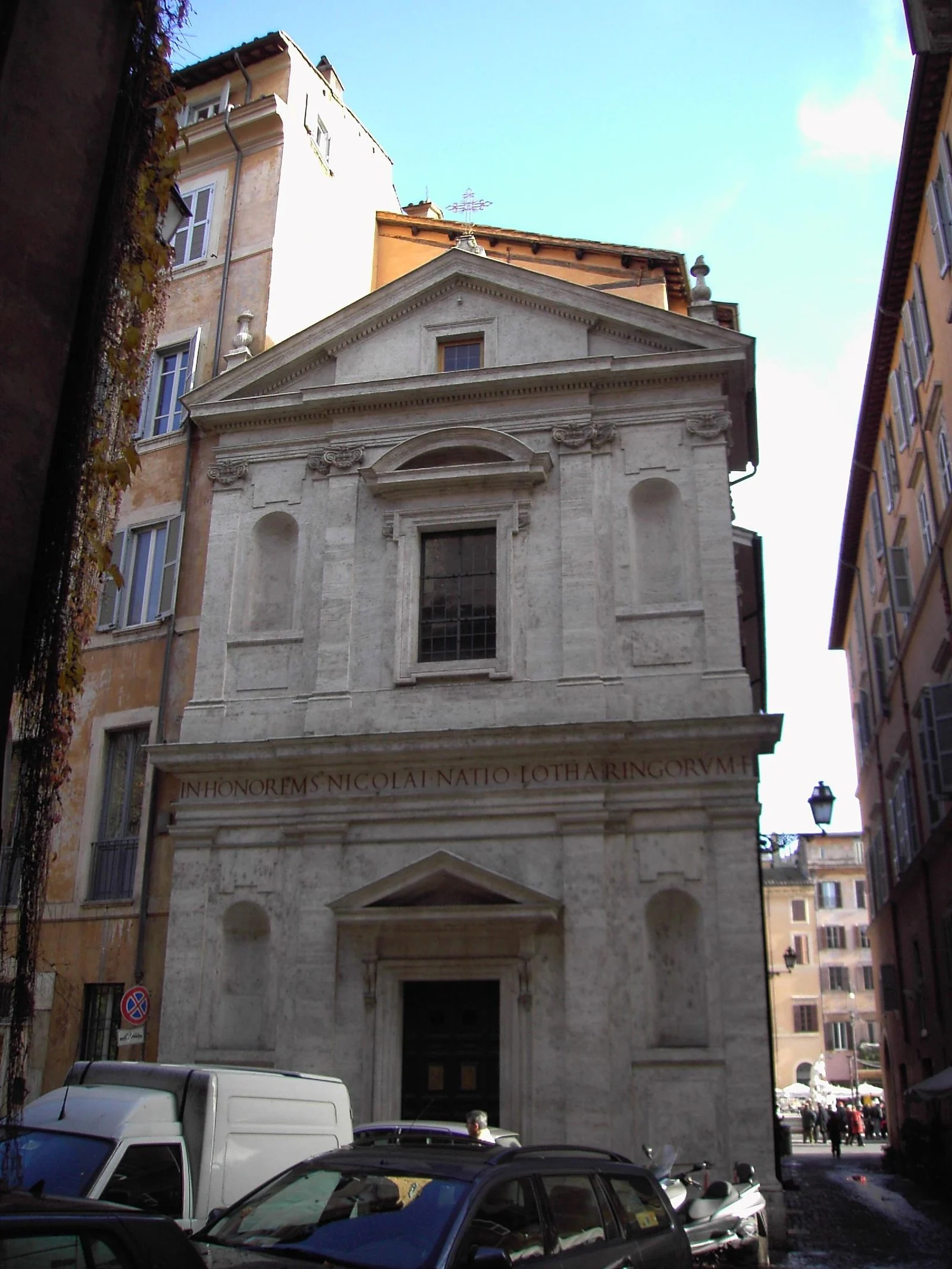
San Nicola dei Lorenesi occupies a corner of Largo Febo, behind Piazza Navona, about 50 steps from the side of Santa Maria dell’Anima. It is the national church of the Lorrainers, that is the subjects of the duchies of Lorraine and Bar, and today it is one of the five Francophone churches of Rome. From the outside it promises nothing: a two-tier facade, a portal, empty niches, one window. Passersby mistake it for a palace with a pediment. Inside is one of the most important frescoed vaults of the early 1700s in Rome, signed by Corrado Giaquinto, and a painted false apse that fools the eye from three meters away. The problem is getting in: the church doesn't keep museum hours, it opens mainly for liturgical services, and the community that serves it lives by its own rhythms. This page explains what is inside, which dates hold up and which don't, and how to plan so you find the door open instead of photographing the facade and leaving.
Where San Nicola dei Lorenesi is and how to get there
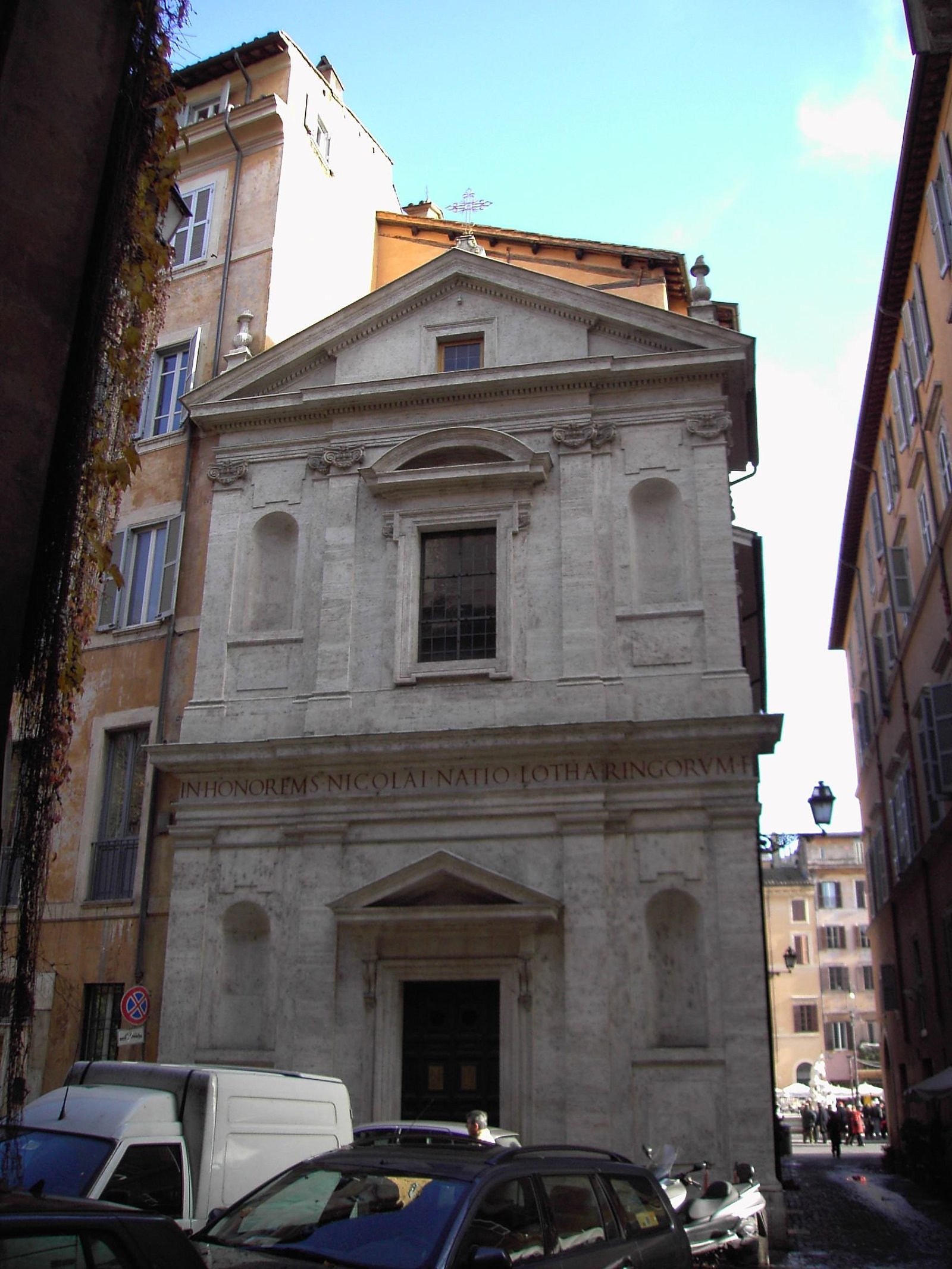
The address is Largo Febo 17, in the Parione district. Largo Febo is the small square that opens just north of Piazza Navona, between the apse of Santa Maria dell’Anima and Via di Santa Maria dell’Anima, at a point where Roman topography becomes confusing because the streets change name every 30 meters. Some listings give number 9 instead of 17: there is only one door and it is on the short side of the square, with the Latin dedication carved on the facade.
By public transport
No metro line serves this area, and that is no minor detail: Piazza Navona is one of the points of the historic center farthest from a metro stop. There are two realistic options, and both are on foot for the last stretch. The first is to get off at Barberini on Line A and walk a good 20 minutes through the Tridente. The second is to arrive by bus on Corso Vittorio Emanuele II or on Corso del Rinascimento and finish on foot in five minutes.
The surface lines that run along Corso Vittorio Emanuele II drop you a few hundred meters away, at the level of Sant’Andrea della Valle or the Cancelleria. From there you go up Via della Cuccagna or along the side of Palazzo Braschi and come out in Piazza Navona. Roman bus routes change often because of construction sites, demonstrations and closures in the center, so check the same day on the transport company's app. The general picture of Roman public transport, with tickets and the recurring traps, is in our page on how to get around Rome.
On foot, which is the right way
This part of Rome is crossed on foot, period. From the Pantheon it is seven minutes, passing in front of San Luigi dei Francesi and Sant’Agostino. From Campo de’ Fiori it is eight, crossing Corso Vittorio. From Castel Sant'Angelo it is 12, along Via dei Coronari, which is the most beautiful street on the route and also the one with the most expensive shop windows.
By car, taxi and bicycle
A private car is no use here and in most cases can't get through: the area is inside the limited traffic zone of the historic center, with electronic gates active over wide time bands and automatic fines. The nearest garage parking lots are along the Lungotevere and toward the Janiculum, and they cost as much as a lunch. The taxi drops you on Corso del Rinascimento or on Via di Tor Millina and the last stretch is on foot anyway. By bicycle the historic center is easy to get around early in the morning and badly in the middle hours, when the pedestrian flow turns every alley into a queue: our honest assessment of Roman bike routes is on the page about Rome by bike.
What you see on entering, and what you don't
The church is a single rectangular hall covered by a barrel vault, with two shallow side chapels that form a barely suggested kind of transept, topped by a dome on pendentives. There is no side aisle, no ambulatory, no crypt open to visitors. In four steps you reach the high altar. The scale is that of a large noble chapel, and this throws off those who arrive expecting a national church on the model of San Luigi dei Francesi.
The vault
The vault of the nave carries the fresco of Saint Nicholas making water gush from the rock. It is the highlight, and it is also the reason art historians know this church while tourists don't. Looking at it requires standing in the middle of the hall and tilting your head back for a few minutes, with the right light, which here is never abundant.
The false apse
Behind the high altar a perspective painting simulates a circular apse that doesn't exist in reality. The wall is flat. A second perspective exercise adorns the dome. They are two Baroque optical illusion devices, of the same kind as those that make the vault of Sant’Ignazio di Loyola famous, applied here on a tiny scale and for that reason almost never cited in popular manuals.
The marbles
The interior cladding is in polychrome marbles, with green and pink dominant, and belongs to a decorative campaign of the mid-1700s. It is inlay work that comes across little in a photograph and a lot in person, because the color changes with the light coming in through the window above the portal. The sobriety of the exterior and the richness of the interior stand in inverse relation, and this is the first thing that strikes those who open the door.
What you don't see
The crypt is not visitable, where according to French sources several Lorrainers who died in Rome are buried. The rooms of the annexed building are not visited, as they belong to the complex and are not open. There is no marked visitor route, no ticket office, no bookshop, no panels. The church can be seen entirely in 10 minutes and understood in 40, if someone explains it.
Why there is a Lorrainer church in Rome
The logic of Rome's national churches is administrative before it is devotional. In the Rome of the popes every stable foreign community, that is merchants, artisans, writers of papal documents, students, artists, organized itself into a confraternity, and the confraternity needed a church of its own for masses, burials, assistance to poor compatriots and political representation. The Lorrainers were in Rome in considerable numbers: the reconstructions by the association that now looks after the church indicate for the early 1600s an order of magnitude of a few thousand people in a city that counted about 100,000.
First there was San Luigi
Until the end of the 1500s the French and the Lorrainers were together in the same congregation, that of San Luigi, which built San Luigi dei Francesi. Part of the cost was covered by Duke Charles III of Lorraine, brother-in-law of Henry III of France, precisely to guarantee the Lorraine state representation at the Holy See. The problem is that inside San Luigi the Lorrainers were guests, and a chapel is not the same as a church.
The independent confraternity
The date of the separation is disputed. The Italian and French encyclopedia entries place in 1587 the birth of an independent Lorrainer confraternity, dedicated to Saint Nicholas and Saint Catherine, with the name Confraternité de Saint-Nicolas et de Sainte-Catherine de la Nation de Lorraine et de Barrois. The association that looks after the church today and the survey of national churches published by the Giornale dell’Arte instead date the founding of a Lorrainer confraternity of its own back to 1508. The two dates are not necessarily incompatible, because a devotional fellowship is one thing and a recognized body with the right to own a chapel is another, but none of the popular sources clarifies the transition. Those who want to go deeper must turn to the specialist bibliography.
San Nicola in Agone
The church granted to the Lorrainers was not new. It was called San Nicola in Agone, where in agone refers to the area of the Stadium of Domitian, the circus agonalis from which the very name of Navona derives by corruption. The ancient sources already say it was also dedicated to Saint Catherine. The pope who granted it was Gregory XV Ludovisi, with a bull that the sources date to 1622 or 1623 depending on which one you read.
What national church means, in concrete terms
It means that ownership and upkeep do not depend on the Diocese of Rome but on a body tied to the state of origin. After 1766, when the duchies of Lorraine and Bar passed to France, San Nicola came under the Pieux Établissements de la France à Rome et Lorette, the body that still administers French church property in Italy. That is why a church in Largo Febo is restored with funds from the French ministry of culture and not with Italian funds.
François Desjardins's Building Project, and the Dates That Don't Add Up
The architect who rebuilt the church was a Lorrainer, François Desjardins, whose name also appears as du Jardin and in the Italianized form Francesco Giardini. Popular literature says very little about him, and the entries in circulation just repeat the name. In the history of 17th-century Roman architecture he remains a marginal figure, a professional serving his own national community, working on a tight lot with a confraternity's budget.
The Three Dates in Circulation
The sources do not agree on the chronology of the building work, and the discrepancy should be stated rather than hidden. The Italian entry gives the consecration in 1632 and the completion in 1636. The French entry treats the reconstruction as finished in 1632 and then, in its architecture section, places the work between 1635 and 1636. The Giornale dell’Arte survey has the work start in 1623, after the demolition of the previous building, and end in 1635. The French association of friends of the church gives a start in 1635 and a facade dated 1636.
How to Read Them Without Going Wrong
The most economical reconstruction is that the work was long and discontinuous, like almost all confraternity building projects: demolition and start in the 1620s, consecration in 1632 with the structural work done, finishing touches and facade up to 1636. Anyone who gives a single date is simplifying. We report all the ones we found, with the source, and leave the reader free to see that the date is not fixed.
The Plan and the Cross of Lorraine
The French description of the church notes that the combination of nave, two barely sketched chapels and a transept that projects only slightly draws a shape in plan that recalls the Cross of Lorraine, the two-armed cross that is the emblem of the duchy. It is a fascinating symbolic reading and should be taken for what it is: an interpretation proposed by those who tell the story of the church from the Lorraine point of view, not a design fact documented by an archive drawing. Whoever walks in and looks at the plan sees what they want to see.
The Relationship with the Gesù
The two-story facade with a central portal, side niches and an upper window belongs to the family of models descending from the Gesù, the Counter-Reformation prototype that imposed the scheme of the Roman church facade for a century and a half. Here the model is pared down to the bone, with no showy scrolls and no sculptural apparatus. Anyone who wants to see what happens when the same scheme is instead pushed to the limit can compare it with Sant’Andrea della Valle, five minutes away on foot.
Corrado Giaquinto, the Vault and Why This Church Matters
Corrado Giaquinto was born in Molfetta in 1703 and died in Naples in 1766. His career took him to Rome, then to Turin, then to Madrid as first court painter to Ferdinand VI, and finally back to Naples. In the middle comes the San Nicola dei Lorenesi project, which the reconstructions identify as his first major public undertaking in Rome and therefore as the point where a painter trained in Naples enters the circuit of international commissions.
Why They Called Him
The occasion was the beatification of Peter Fourier, the Lorraine canon regular who founded the congregation of Our Lady, proclaimed blessed in 1730 under Clement XII. For the Lorrainer community of Rome it was the defining event of the century, and the confraternity decided to redo the decorative scheme of its church. The painting campaign is placed between 1731 and 1733.
What He Painted
The sources list, with some variation among them, the fresco of the nave vault with Saint Nicholas making water gush from the rock, the four cardinal virtues on the pendentives of the dome, the three theological virtues, a Trinity with Saint Nicholas and, on the inner facade, the angel freeing a prisoner. The decoration of the dome is described as a scene of paradise. On the exact division between apse, pendentives and cap the descriptions diverge in the details, and anyone looking for a precise map has to turn to the specialist literature.
The Return in 1750
For the jubilee of 1750 Giaquinto came back to this church and painted two altarpieces, Saint Nicholas before Constantine's officers and Saint Nicholas calming the storm. The second, reduced to a poor state of conservation, was replaced by a copy in 1827. Anyone looking at that canvas today is looking at a 19th-century copy, and almost no entry says so.
The Other Names
Before Giaquinto the church had been decorated by Lorraine artists active in Rome. The main one is François Nicolas de Bar, whom the Roman sources also call Nicolò Lorense: the high altar altarpiece with Saint Nicholas, the three boys and a prisoner is his, placed between 1676 and 1686, and so is the panel of the mystic marriage of Saint Catherine of Alexandria, between 1660 and 1670. In 1730 the Chapel of the Visitation was rededicated to the new blessed, and the altarpiece with Saint Peter Fourier and the Virgin, by Francesco Antonozzi of Ancona, took the place of a Visitation painted in 1680 by an anonymous Lorrainer. The marble inlay of 1748 is attributed to Giovanni Andrea Volponi and Giuseppe Maria Bay.
A Curiosity About San Nicola dei Lorenesi
The facade of this church is clad with material that comes from the Stadium of Domitian. Mariano Armellini writes this in his 1891 survey of Roman churches, and it is a piece of news that closes a precise topographical circle: Piazza Navona has the shape it has because it follows the arena of the stadium, and the churches built around it used the ancient structures as a stone quarry for centuries. The national church of a community that came from the north of France is physically made, in part, of a first-century entertainment building.
The Confirmation in the Foundations
A chronicler contemporary with the building work, Pompilio Totti, recorded that enormous stones from the old agonal circus were used in the foundations of the new church. The Giornale dell’Arte survey of the Roman national churches repeats the news. It is the kind of detail that can only be verified with an excavation, but the consistency between the 17th-century source and the 19th-century description of the facade gives the story a solidity above average.
Where You Can See the Stadium Today
Anyone who wants to understand what we are talking about can go down into the underground of the Stadium of Domitian, visited from an entrance on Via di Tor Sanguigna, two minutes from Largo Febo. There you see the brick and travertine arches of the original structure, at the ancient level, below the height of the modern city. Doing the two things in sequence, the underground first and then the church, is the best way to give sense to a note that otherwise remains information without a body.
Something Nobody Tells You About San Nicola dei Lorenesi
The apse you see behind the high altar is not there. It is painted. The back wall of the church is flat, and a trompe-l’oeil built in perspective simulates an apsidal basin with its projection, its shadows and its depth. It works so well that most of the people who walk in leave without having noticed, and this is the real reason nobody talks about it: those who don't know don't see it, and those who write entries in 300 words copy from those who didn't know.
How to Spot the Trick
The practical way to unmask it is to move sideways. The painted perspective is calibrated on a single viewpoint, usually the center of the nave at the height of the entrance. Walking toward the right or left side wall, the fake basin starts to distort, the shadows stop making sense and the volume collapses onto the wall. 30 seconds of lateral movement are worth more than any explanation.
The Same Trick on a Grand Scale
Perspective quadratura painting is a Roman specialty of the 17th and 18th centuries, and the most famous case is the fake dome of Sant’Ignazio di Loyola, a flat canvas that simulates a drum that was never built. Here the mechanism is the same but the scale is domestic, and the result is harder to catch because the space is small and the eye has less room to compare. A second quadratura adorns the dome.
Why They Did It
The reason is banal and holds for half the Roman churches: there was no money and there was no space. Building a real apse would have required breaking through toward the neighboring building, impossible in an urban fabric as saturated as that of Parione. Painting it cost a fraction and produced the same scenic effect during the liturgy, when the nave was lit by candles and the eye had no way to check. Baroque fiction almost always comes from a constraint, not a whim.
The Comparison That Helps
Anyone who wants to understand the difference between real space and painted space can line up three stops in the same afternoon: the fake apse here, the real Borrominian curvature of Sant’Ivo alla Sapienza, and the architectural perspective that closes the choir of Santa Maria della Pace. They are three different ways of solving the same problem, making a place that isn't big look big, and all three lie within a radius of 600 meters. The overall picture of the Roman Baroque language is on our page on Baroque Rome.
My Advice for Visiting San Nicola dei Lorenesi
The advice is one: arrive at the time of a liturgical service, or write ahead. San Nicola dei Lorenesi is not a parish church with continuous hours and it is not a museum. In ecclesiastical classifications it is listed as a rectory church, that is, a place of worship without a parish territory of its own, linked for pastoral care to the parish of Sant’Agostino in Campo Marzio. The door opens when someone is there to open it.
The Published Hours
The information published by Rome's French-language channels gives Mass on Sunday at 11:00 and Monday to Friday at 19:00, with a vigil Mass on Saturday evening. Eucharistic adoration is listed Monday to Friday in the late afternoon and on Sunday before dinner, and vespers are celebrated every day in the evening. The same sources add that the church can be opened at other times on request. The precise hours vary between sources by half an hour more or less, so take them as an indication and not as a train timetable.
The Practical Window
The most reliable time to find it open is the late afternoon on weekdays, when adoration, vespers and the evening Mass follow one another. Showing up an hour before the evening Mass is usually enough. Sunday morning works, with the warning that during the celebration you don't walk around the church and don't take photos: you attend or you wait outside.
What to Avoid
Avoid planning the visit for mid-morning or mid-afternoon on weekdays, which is exactly the time when tourists pass through Piazza Navona and when this church is most likely to be closed. Avoid the middle of August too, when Roman religious communities cut back their activities. Anyone with only one day in Rome who wants to be sure of getting in somewhere in the area would do better to aim for San Luigi dei Francesi, which has published, stable hours, and keep San Nicola as a bonus.
How to Ask to Get In
The request is made by email to the association that looks after the church, or by phone to the number published by the municipal tourist listings. A precise request, with date, number of people and reason, gets an answer much more often than a generic message. The website of the association of friends of the church, Les Amis de Saint-Nicolas-des-Lorrains à Rome, is the most direct channel and answers in French and Italian.
How Much Time to Allow
20 minutes is enough to see the church carefully, vault included. 40 are needed if you want to study the fake apse and compare the two painting campaigns. Included in a route that takes in Santa Maria dell’Anima, Santa Maria della Pace with the Bramante cloister and San Luigi dei Francesi, the stop takes up half a day.
Another Well-Known Fact, Yet Rarely Cited
Rome has five French Catholic churches and almost nobody can list them. They are San Luigi dei Francesi, which everyone knows for the Caravaggios, Trinità dei Monti at the top of the Spanish Steps, Sant’Ivo dei Bretoni, Santi Claudio e Andrea dei Borgognoni and San Nicola dei Lorenesi. Four out of five come from distinct regional communities, Bretons, Burgundians, Lorrainers, who in the Rome of the ancien régime considered themselves nations separate from the France of the king.
Political Geography Inside Urban Geography
The map of these churches is the map of a Europe that no longer exists. The Duchy of Lorraine was a sovereign state wedged between France and the Empire, with a foreign policy of its own and its own representation to the Holy See. Having a church in Rome was a diplomatic act as much as a devotional one. The merger with France comes only in 1766, at the death of Stanisław Leszczyński, and from that moment the Lorraine church becomes, administratively, a French property.
The Pieux Établissements
The body that manages the property today is called Pieux Établissements de la France à Rome et Lorette, is based in Rome and is linked to the French embassy to the Holy See. This is why the restorations of this church are financed by French administrations, by the Lorraine region and by an association of private individuals based in Nancy, and not by the Italian superintendency. A piece of Rome's historic center is, in terms of upkeep, French territory.
The German Parallel, 50 Meters Away
The same mechanism produced, a few steps away, Santa Maria dell’Anima, the national church of the Germans, and the area north of Piazza Navona thus ends up with two national churches facing almost the same small square. Anyone walking from Largo Febo toward Via della Pace crosses, in 100 meters, the sphere of influence of two states that in the 17th century were often at war with each other. The phenomenon continues a little farther on with Sant’Antonio dei Portoghesi.
The Right Photo to Take at San Nicola dei Lorenesi
The photograph that works is not the facade. The facade is modest, it sits on a narrow small square and there is not enough distance to frame it without distorting it. The photograph that counts is the vault, shot from below standing in the center of the nave, with the camera held level and a frame that includes at least a stretch of the architectural cornice, so that the fresco has an edge and does not float in empty space.
The Technical Conditions
The interior light is poor and comes from few openings, so you need a high sensitivity setting and a steady hand, or a support. A tripod is not allowed without authorization in most Roman churches, and in a small space like this it is also physically cumbersome. Flash is forbidden wherever there are wall paintings, and here in particular it is useless because the vault is several meters away. If you shoot with a phone, you get acceptable results by resting your elbows against your chest and shooting in night mode.
The Photo of the Fake Apse
The second image to take away is the comparison between two shots of the back wall, one from the center of the nave and one from the side. Placed side by side they show how the perspective quadratura works better than any caption, because in the second the fake basin visibly flattens. It is a two-minute exercise and produces the only truly original documentation you can make in this church.
The Rules of Behavior
You don't take photos during celebrations. Outside celebrations, photography without flash is generally tolerated, but it is at the discretion of whoever looks after the place and must stop at the first reprimand. If Eucharistic adoration is under way, that is, the Blessed Sacrament exposed on the altar, the camera stays in the bag: it is the condition in which the community that officiates in this church spends a good part of the afternoon, and it is not the moment to walk around with a phone raised.
Outside, in the Evening
Anyone looking for an atmospheric photograph finds it more easily outside after sunset, when Largo Febo empties and the facade takes the warm light of the street lamps while at the back you can glimpse the foot traffic of Piazza Navona. It is an image of contrast between the crowded piazza and the empty small square 20 meters away. For the general picture of what works in Rome after dark we have a page on Rome at night.
Some Important Events That Happened Here in History
The chronology of this church is that of a foreign community that builds, decorates, loses its home state and survives inside a different administration. What follows is the skeleton, with explicit mention of the points on which the sources diverge.
1587: The Lorrainer Confraternity Is Born
The Lorrainers living in Rome separate from the congregation of San Luigi and form a sodality of their own, named for Saint Nicholas and Saint Catherine, with the right to own a chapel inside San Luigi dei Francesi. Some French sources push back to 1508 the existence of a Lorrainer confraternity, and the question remains open.
1622 or 1623: The Grant of Gregory XV
Pope Gregory XV grants the Lorrainers by bull the church of San Nicola in Agone, near Piazza Navona, already dedicated also to Saint Catherine. The French entry gives 1622 and the reign of Duke Henry II, the Italian one and the Giornale dell’Arte survey give 1623.
1623 to 1636: The Reconstruction
The existing church is demolished and rebuilt to a design by François Desjardins. The consecration under the new name of San Nicola dei Lorenesi is placed in 1632, the completion in 1635 or 1636 depending on the source. According to a contemporary chronicler, blocks from the Stadium of Domitian end up in the foundations.
1649: The Burial of Charles Mellin
The Lorraine painter Charles Mellin, active in Rome and Naples, dies and is buried in this church. An English-language encyclopedia entry calls him Nicolas Mellin: that is an error, the name is Charles.
1730: The Beatification of Peter Fourier
Clement XII proclaims Peter Fourier blessed, and the Chapel of the Visitation is rededicated to him. Francesco Antonozzi's altarpiece replaces a Visitation of 1680 by an anonymous Lorrainer author. It is the event that triggers the redoing of the decoration.
1731 to 1733: Giaquinto's Project
Corrado Giaquinto frescoes the nave vault, the dome, the pendentives and the inner facade. It is his first major public commission in Rome and the work that takes him into the European circuit.
1748 and 1750: Marbles and Altarpieces
The polychrome marble inlay is carried out, attributed to Giovanni Andrea Volponi and Giuseppe Maria Bay. For the jubilee of 1750 Giaquinto paints two altarpieces with episodes from the life of Saint Nicholas.
1766: Lorraine Passes to France
With the union of the duchies of Lorraine and Bar to the French crown, the church comes under the Pieux Établissements de la France à Rome et Lorette. From this moment the management is French.
From the 1990s to 2006: The Restoration
A long restoration campaign, conducted under the responsibility of the Pieux Établissements with the contribution of the French ministry of culture, the Lorraine region, the association of friends and the Fondation du patrimoine, brings the church and the frescoes back into condition. At the conclusion of the work, pastoral care passes to a religious community of French origin.
Who Passed Through San Nicola dei Lorenesi
The people linked to this church are not popes and are not great Roman families. They are a community of foreigners, a painter from Apulia at the start of his career and a Lorraine saint who never set foot in it. It is a short and very distinctive list.
Corrado Giaquinto
The painter from Molfetta arrives here at around 28 years old and leaves with the reputation that will open Turin and then the court of Spain to him. The vault of San Nicola is his Roman calling card. Anyone who knows his Spanish work and then walks into this church recognizes the same hand at a fresher and less ceremonial stage.
François Nicolas de Bar
Lorraine painter active in Rome in the second half of the 17th century, known in the Roman sources as Nicolò Lorense. His two altarpieces are what remains of the first decorative season, the one made by the community's artists for the community. He is the typical case of the foreign artist who works in Rome for his own compatriots and whom general historiography ignores.
Charles Mellin
Born in Nancy, died in Rome in 1649, Mellin is the most important Lorrainer among those buried here. He worked in Rome and Naples, and for a long time part of his output was confused with that of Nicolas Poussin, with whom he shared the Roman circle of the French. His burial in this church is consistent with the function of the national churches, which were also community cemeteries.
Peter Fourier
The Lorraine canon regular, founder of the congregation of Our Lady and reformer of girls' education, never came to this church. His beatification in 1730 is however the reason the church looks the way it does, because that event made the confraternity open its purse. It is an indirect and decisive step.
Charles III of Lorraine
The duke who financed part of San Luigi dei Francesi to guarantee Lorraine a representation in Rome is the starting point of the whole story. Without that choice, and without the Lorrainers' discomfort at being guests in a French house, this church would not have come into being.
Gregory XV
The Ludovisi pope, pontiff for just over two years, signed the bull that handed San Nicola in Agone to the Lorrainers. It is the same pontificate that canonizes Ignatius of Loyola, Francis Xavier, Teresa of Avila and Philip Neri, and that therefore sets in motion again a season of Roman building projects tied to the new cults.
The Nameless Lorrainers
The craftsmen, merchants, writers of papal documents and students who paid for this church share by share remain anonymous. They are the true patron. Anyone who walks in today looks at Giaquinto's work, but the money that paid for it came from the shops of a foreign community of middling size, not from a cardinal.
The Church Today: Who Keeps It Open
After the conclusion of the restoration, in 2006, the pastoral care of the church was entrusted to a religious community of French origin, the Community of Saint John. The fact appears both in the French encyclopedia entry and on the pages of the French-language welcome services in Rome, and it is consistent with the published liturgical rhythm, made of daily Mass, adoration and vespers.
What It Means for the Visitor
It means that the church works as a place of prayer before it works as a monument. There is no welcome staff, there are no captions, there is no paper guide being handed out. Anyone who arrives during adoration enters a silent room where someone is praying, and behaves accordingly. Anyone who expects a managed site is left disoriented, and the disappointment comes from the wrong expectation more than from the place.
The Restoration and Who Paid for It
The restoration campaign was conducted under the responsibility of the Pieux Établissements, under the direction of a French architect of historic monuments and with mixed public and private funding. The French ministry of culture, the Lorraine region, the association of friends and the Fondation du patrimoine contributed. The reference scientific documentation on the decoration is the study published by the École française de Rome in the volume on national foundations in papal Rome, available on Persée.
What to See Nearby, in Order of Distance
The area between Piazza Navona, the Pantheon and the Tiber embankment holds the highest concentration of churches and palaces in Rome, and it can all be covered on foot in half a day. The criterion for organizing yourself is real distance, not fame, because here everything is less than 10 minutes from everything.
Under Two Minutes
Santa Maria dell’Anima is practically attached, the German national church with the tomb of Adrian VI. Santa Maria della Pace is around the corner, with Raphael's sibyls and Pietro da Cortona's portico, and it has very limited hours that need checking beforehand. The Bramante cloister opens onto the same complex and is today an exhibition space. Piazza Navona is 20 meters away, with the Fountain of the Four Rivers.
Five Minutes Away
San Luigi dei Francesi with the Contarelli Chapel, which is the most crowded stop in the area and requires patience. Sant’Agostino in Campo Marzio, with the Madonna of the Pilgrims, another Caravaggio, and far fewer people. Palazzo Altemps, home of the National Roman Museum, with the Ludovisi collection. Pasquino, the talking statue, on the opposite corner of the square. The Museo di Roma at Palazzo Braschi, which tells the story of the city from the 18th century on.
10 Minutes Away
The Pantheon, with everything that implies in terms of lines and reservations. Santa Maria sopra Minerva, the only Gothic church in Rome, with Bernini's little elephant in front. Sant’Ivo alla Sapienza, a Borromini masterpiece with very limited opening. Sant’Eustachio. Santa Maria Maddalena, with its Rococo facade. Campo de’ Fiori and, a little farther, the Galleria Spada with the Borrominian perspective, which is the famous relative of the fake apse we are discussing here.
A Little Farther
Castel Sant'Angelo along Via dei Coronari. Ponte Sisto toward Trastevere. Palazzo della Cancelleria and Sant’Andrea della Valle on Corso Vittorio. The Fountain of the Tureen, which Romans call the soup tureen, in front of the Chiesa Nuova, where you also find the famous motorized Rubens painting. For anyone who wants to line up the building projects of the two great rivals of 17th-century Rome there are our pages on Bernini in Rome and Borromini in Rome, and for the paintings the one on Caravaggio in Rome.
If the Budget Is Zero
Almost everything we listed above can be visited without a ticket, because they are churches. It is one of the few areas of Rome where you can spend six hours looking at masterpieces without spending anything, apart from water. The complete census of what you don't pay for in Rome is on our page on Rome for free, and for the periods when the area changes face there is the page on Estate Romana.
Accessibility and Services
The entrance of the church is preceded by a few steps, as in almost all historic buildings in the center, and no alternative accessible route is declared. The interior nave is flat and free of level changes, so anyone who can get over the threshold moves around without difficulty. No restrooms are listed as available to visitors.
The Context of the Area
Largo Febo and the alleys around it are paved with cobblestones, which are the worst surface for a wheelchair, a cane or a stroller. The sidewalks, where they exist, are narrow and interrupted. Anyone with mobility difficulties would do well to plan routes that use the wider streets, like Corso del Rinascimento and Corso Vittorio Emanuele II, and to accept that some alleys stay out. The full picture for the city is on our page on Accessible Rome.
Eating in the Area: Piazza Navona Is the Minefield
Around Piazza Navona the density of restaurants aimed at passing trade is the highest in Rome together with that of Trevi Fountain. That doesn't mean it is impossible to eat well: it means that the percentage of places built on the tourist who passes once is very high, and the margin of error for anyone who doesn't know the area is enormous. You need a method, not a recommendation.
The Signs That Say to Steer Clear
The first sign is the menu with photographs of the dishes. A place that has to show the picture of a carbonara is talking to people who will never come back, and no Roman orders by looking at a picture. The second is the lady rolling fresh pasta in the window or right on the sidewalk: it is a staged lure designed to stop the passerby, not a clue about the cooking inside, and in many cases that pasta doesn't end up on the plates served. The third is the person stationed at the entrance who invites you to sit, calls out in three languages and holds out the laminated menu: a place with its own clientele has no need to recruit on the street.
Opening Hours as a Giveaway
The fourth sign is continuous opening hours. A place open without a break from 10 in the morning to midnight doesn't have a brigade working in defined services, with prep in the morning and a pause between lunch and dinner. It has a line that heats up portions in a continuous cycle to intercept the flow. In Rome real cooking closes between three and seven, and that closing is information, not poor service.
Position and Price
The fifth sign concerns the tables looking directly onto the monumental piazza. Whoever pays rent for a view of a Bernini fountain recovers that cost on the bill, and often does it with opaque tools: items without a price on the menu, the cover charge and service counted separately and added up, fish sold by weight without the weight being declared beforehand, different price lists between the indoor room and the outdoor seating. On Piazza Navona this mechanism is systematic and has been for decades. Asking the price before ordering is not rudeness: it is the only defense.
Chains With a Repeated Sign
In the center of Rome a kind of restaurant with a repeated sign has consolidated, with the same menu in five or six points of the city, the queue managed with a number ticket and staff in uniform. It works as a tourist attraction, with its own photographed line and its own word of mouth, and Romans don't go there. It isn't snobbery, it's a matter of product: that model sells a standardized, predictable experience, which is exactly what people who live in the city are not looking for when they go out to dinner. Whoever goes knowing what they are buying doesn't go wrong. Whoever goes thinking they will eat the way people eat in Rome is aiming at the wrong target.
The Criterion, Just One
Look at who is sitting and in what language they order. If the tables hold people who speak Italian, who don't have the menu in hand because they already know, and who are there at a quarter to two instead of half past noon, the place holds up. If the room is made only of backpacks, maps and strollers, move on. The criterion works across Rome and counts double within 200 meters of a monumental piazza.
Where to Walk for Better Eating
Moving away almost always works. Five minutes toward the Pantheon changes little, because the flow is the same. 10 minutes toward Campo de’ Fiori and the streets to the south improves the average. Crossing the river on Ponte Sisto and eating in Trastevere away from the main streets is a strategy that works, as long as you avoid the most beaten axis there too. For a reference that is already filtered you can consult the personal list of Daniele Dezi on Google Maps, a curated and unsponsored collection.
Coffee and Breakfast
For coffee, different and simpler rules apply: at the counter you pay the municipal rate, at the table you pay for service, and the difference in a monumental piazza can be five times. Having coffee standing at the bar is the Roman norm and costs little everywhere, even 100 meters from Piazza Navona. The full reasoning on how to choose where to eat in Rome is on our page on where to eat in Rome, and for the historic places on the one about cafés and historic shops of Rome.
Frequently Asked Questions About San Nicola dei Lorenesi
Where exactly is San Nicola dei Lorenesi?
San Nicola dei Lorenesi is at Largo Febo 17, in the Parione district, just north of Piazza Navona and next to the apse of Santa Maria dell’Anima. Some listings give number 9, but there is only one door and it carries the Latin dedication to the Lorraine nation on the facade. The simplest way to get there is to leave Piazza Navona from the side of the Neptune fountain.
How much does it cost to enter San Nicola dei Lorenesi?
Entry to San Nicola dei Lorenesi is free, as in all Roman churches open for worship, and there is no ticket office or paid reservation. The problem is not the cost but the hours, because the church does not have continuous opening. If you find a price online referring to this church, it is a guided visit sold by a third-party operator, not an official ticket.
What are the opening hours of San Nicola dei Lorenesi?
The hours of San Nicola dei Lorenesi do not follow a museum pattern: the church opens at the time of liturgical services. The French-language sources give Mass on Sunday at 11:00, Monday to Friday at 19:00 and a vigil Mass on Saturday evening, with Eucharistic adoration in the late afternoon and daily vespers. The same sources specify that the church can be opened at other times on request.
Who frescoed the vault of San Nicola dei Lorenesi?
The vault of San Nicola dei Lorenesi is the work of Corrado Giaquinto, a painter born in Molfetta in 1703, who worked there between 1731 and 1733 painting the nave, the dome, the pendentives and the inner facade. It was his first major Roman public commission and the springboard to Turin and the court of Spain. In 1750 he came back to paint two altarpieces for the jubilee.
Why is there a church of the Lorrainers in Rome?
In the Rome of the popes every stable foreign community had its own confraternity and its own national church, which served for Masses, burials and political representation to the Holy See. The Lorrainers, subjects of a sovereign duchy between France and the Empire, separated from the French of San Luigi and obtained from Gregory XV the church of San Nicola in Agone. Since 1766 the building has been administered by a French body.
Is the apse of San Nicola dei Lorenesi real?
The apse you see behind the high altar of San Nicola dei Lorenesi does not exist: it is a painting in perspective that simulates an apsidal basin on a flat wall, and a second illusionistic exercise adorns the dome. The way to notice is to move sideways a few meters and watch the fake depth flatten. It is the same principle as the fake dome of Sant’Ignazio, on a reduced scale.
Who runs San Nicola dei Lorenesi today?
Ownership and upkeep of San Nicola dei Lorenesi depend on the Pieux Établissements de la France à Rome et Lorette, the body that administers French church property in Italy, assisted by an association of private individuals based in Nancy founded in 1956. After the restoration concluded in 2006, pastoral care is entrusted to a French religious community and the celebrations are in French.
How long does it take to visit San Nicola dei Lorenesi?
To visit San Nicola dei Lorenesi 20 minutes is enough, because the church is a single nave with two side chapels and can be covered in a few steps. 40 minutes are needed by anyone who wants to study Giaquinto's vault and check how the fake apse works by moving sideways. Included in a route with Santa Maria dell’Anima, Santa Maria della Pace and San Luigi dei Francesi, it takes up half a day.
Is San Nicola dei Lorenesi suitable for children?
San Nicola dei Lorenesi offers little to small children, because there are no educational paths, panels or activities, and the space is small. The only thing that really works is the fake apse game: ask a child to walk from one side to the other and say when the niche stops looking real. Outside, Piazza Navona, 20 meters away, offers room to move around.
Who Wrote This Page
The page is edited by the staff of Tour Leader Pro, the Roman project office that designs and coordinates visits, itineraries and cultural events in Rome and Lazio. Hours, contacts and access conditions given here were checked at the date of publication against the sources indicated in the text, which for this church are largely French: it is worth rechecking them before you go, because churches run by religious communities change rhythm without notice. If you find a detail out of place, let us know.
Building a Roman itinerary means making things fit together: churches that open only for Mass, foreign bodies that answer in another language, short distances on difficult paving and piazzas where the price of lunch depends on where you sit. Anyone taking on this work for themselves or for a group will find planning tools on Tour Leader Pro, which gathers materials designed both for those who lead visits professionally and for those who organize on their own and want to avoid arriving in front of a closed door.
For the overall picture of rail connections, airports, rentals and destinations in Lazio outside the center of Rome, from the Castelli to the lakes to the coast and the Tuscia, Italy Planner is a good resource.