Sant’Atanasio dei Greci
In short. Sant’Atanasio dei Greci is at Via del Babuino 149, on the street that connects Piazza del Popolo to Piazza di Spagna, and it is the church of the Pontifical Greek College, which celebrates in the Byzantine rite and in the Greek language.
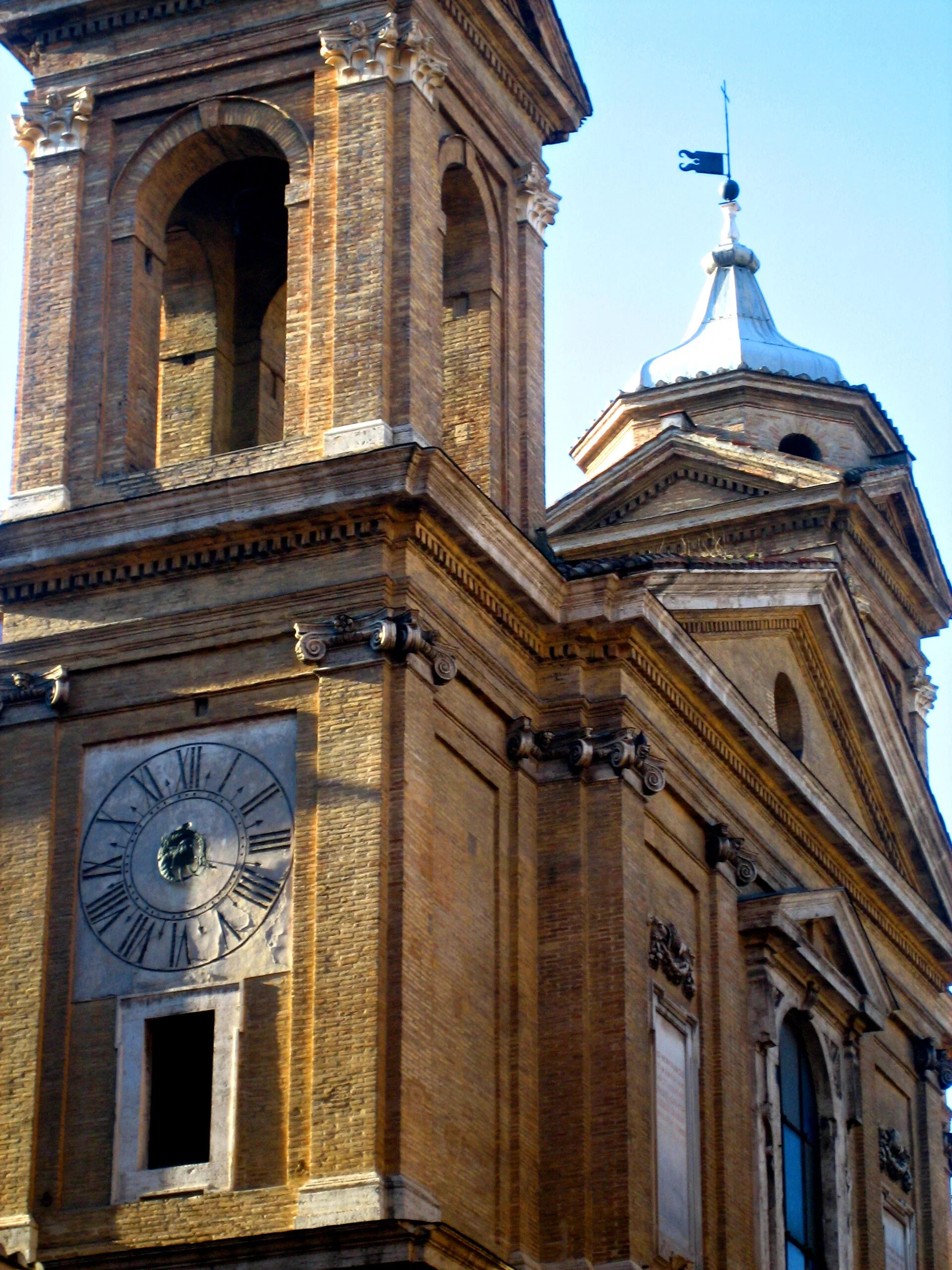
Sant’Atanasio dei Greci is at Via del Babuino 149, on the street that connects Piazza del Popolo to Piazza di Spagna, and it is the church of the Pontifical Greek College, which celebrates in the Byzantine rite and in the Greek language. Entrance is free, no ticket. The operator, however, doesn't publish visiting hours: the door opens as a rule for the Sunday morning divine liturgy, and for everything else you ask the College, by phone at 06 36001261 or by writing to rettore@collegiogreco.com.
It is a Catholic church, not an Orthodox one, and that's the first misunderstanding to clear away. Gregory XIII wanted it for the college he had founded in 1577 to train Catholic clergy of the Eastern rite, Giacomo Della Porta designed it and it was consecrated on May 2, 1583. From outside you recognize it by the two twin bell towers on either side of the pediment, inside by the iconostasis that closes off the presbytery, a wall of images that you see very rarely in the center of Rome.
The practical information given here was checked on September 28, 2026 on the tourist portal of Roma Capitale, on the history page of the Pontifical Greek College and on the other sources cited in the text. The College doesn't put a stable calendar online and the hours change with the liturgical year, with Lent and with feast days: before crossing the city for the Sunday liturgy, call and have them confirm the time.

Where it is and what you really see
The church occupies a stretch of Via del Babuino where the street, straight and narrow, runs between antique shops and fashion windows. Next to the facade, on the left, is the talking statue of the Babuino with its fountain, and the building of the Greek College stretches alongside the sacred building, with the facade renewed in 1769 under Clement XIII. Almost across the street is the Atelier Canova Tadolini.
The facade is on two levels, with Doric pilasters below and Ionic ones above, a single portal with a triangular pediment and above it a large arched window. On either side of the window run the dedication inscriptions to Athanasius, in Latin and in Greek, which already from the street declare who the church was built for. The two bell towers close the composition, and on the left one is the clock donated by Clement XIV in 1771.
Inside, the surprise is the plan. A rectangular nave from which three semicircular apses open, at the back and on the sides, an arrangement that the City's tourist portal describes as one of the rare Roman examples of direct Eastern inspiration. It is not a three-aisle basilica and not the usual Counter-Reformation hall with chapels in a row. It's a compact space, designed for a rite that takes place in front of a wall of icons.
What you see if you stop in the nave: the iconostasis of 1876, a work by Andrea Busiri Vici with decorations by Pietro Gagliardi and gilding by Anselmo Coacci, the two canvases by Francesco Trabaldese from 1584 in the side chapels, an Annunciation and a Jesus among the Doctors, and in the apses of the transept the Crucifixion and the Assumption attributed to the Cavalier d'Arpino, painted between 1585 and 1590. Few works, of good hand, in a space you read in 10 minutes.
What you don't see: the rooms of the College, the inner chapel dedicated to Saint Benedict with the iconostasis completed in 1921 by the painter Aristide Varaclas, the refectory where fragments of the old sixteenth-century iconostasis are kept. It's a house of formation for seminarians and monks, not a museum, and no visiting route for those spaces appears to be published. Anyone who promises you entry into the College during a stroll on Via del Babuino is selling you air.
How to get in: hours, liturgy and contacts
Entrance is free and the church is run by the Pontifical Greek College of Sant'Atanasio, a pontifical institution that since 1897 has been entrusted to the Benedictines and since 1956 to the monks of the Belgian monastery of Chevetogne, a community known for its work on unity between the Churches of East and West. The tourist portal of Roma Capitale gives no hours and refers directly to the College for the times of celebrations and the conditions of visit. It's the typical situation of college churches.
From the point of view of the Diocese of Rome the church is a rectory, not a parish: it has no territory of its own and lives in function of the College community and the faithful of the Byzantine rite who attend it. Church yearbooks link it, for diocesan organization, to the nearby parish of San Giacomo in Augusta. It's an administrative detail that explains a lot: no parish priest, no hours designed for the neighborhood, a calendar decided by the College.
There is no ticket and no presale channel, so there's nothing to buy in advance. The only official channel is the College: phone 06 36001261, email rettore@collegiogreco.com, website collegiogreco.com, plus a Facebook page of the institution. No tour platform sells an entrance to Sant'Atanasio, and if you find one you are paying for a neighborhood walk with a stop in front of the facade.
On the Sunday liturgy the available data converge on 10:30. It is the time the College gave for the Sunday divine liturgy in the calendars published on its blog, and the same time appears in the aggregators of Mass times, which list the church as open on Sunday between 9:30 and about 12:15. The operator doesn't currently publish an official schedule on the site, and for this reason the Saturday phone call remains mandatory.
On weekdays the church opens mainly for the celebrations of the major seasons. In the calendars of the Great Lent circulated by the College in past years there appeared the Liturgy of the Presanctified on Wednesday and Friday evenings at 19:00, the Akathistos Office, and on Sunday the divine liturgy of Saint Basil in place of that of Saint John Chrysostom. The times change from one year to the next and must be asked every time.
On languages, the City's portal lists celebrations in Greek, Albanian, Romanian, Hungarian and Arabic, which is a snapshot of the community that revolves around the College: seminarians and priests of the Eastern Catholic Churches, Italo-Albanians, Melkites, Romanians, Ukrainians, Hungarians. The base language of the main liturgy remains Greek. Whoever enters doesn't need to understand the words to follow the structure, which you learn by watching.
A curiosity about Sant’Atanasio dei Greci
The clock on the left bell tower is a papal gift: Clement XIV donated it in 1771. For a house of seminarians who lived by fixed hours of study and prayer, a dial on the bell tower was at once a tribute and a practical tool, very Roman. For a college of boys who had come from the Levant, the time was Rome's.
The second curiosity concerns the date of the consecration. The church was consecrated on May 2, 1583, the day the Latin calendar dedicates precisely to Saint Athanasius, the bishop of Alexandria who in the fourth century had fought Arianism and had spent years of exile in the West too, Rome included. The patron wasn't chosen at random: he is the Greek Father most loved by the Latins, the ideal bridge for a college born to bring the two Churches closer.
It was consecrated not by a curial cardinal but by a Greek bishop, Germanos Kuskonaris, bishop of Amathus on the island of Cyprus. The choice had a precise meaning: the church was to be born with an Eastern rite and an Eastern clergy, and the presence of a Cypriot bishop declared that Gregory XIII's project wanted to be credible in the eyes of the Greeks, not only of the Romans.
Finally there is the matter of the stone. The first was laid on November 23, 1580 by Cardinal Giulio Antonio Santori, the man who had inspired the founding of the College, a month after the pope had authorized the works on October 20. In two and a half years the church was consecrated. For the Rome of the late sixteenth century, where building sites lasted decades, it's a pace that says how much political urgency lay behind it.
Who Athanasius was, for those who don't remember: bishop of Alexandria in Egypt in the fourth century, present at the Council of Nicaea as a young deacon and then defender of that formula of faith against the Arians all his life, at the price of five exiles. He is venerated as a Father of the Church by Catholics and Orthodox, and for this reason his figure worked as the banner of a college that wanted to speak to both.
Something nobody tells you about Sant’Atanasio dei Greci
The iconostasis that everyone photographs is not old. It dates from 1876, built in brick and stucco to a design by Andrea Busiri Vici, and to make room for it the original wooden one that Francesco Trabaldese had painted around 1584 was demolished. Whoever enters convinced they are facing a Byzantine piece, or at least a sixteenth-century one, is actually looking at a work of nineteenth-century Rome, well done, but from a completely different era and taste.
The old iconostasis had a precise program. The sources that describe it speak of the 12 apostles in roundels, of the Virgin and the Baptist, of four Fathers of the Greek Church. The historical plaque placed on the church recalls that fragments of that work are still kept in the College refectory, where the public doesn't enter. It's the oldest and most interesting part of the liturgical furnishings, and it's also the one no visitor will see.
Then there is the level of the story. According to a tradition reported by studies on the church, among the faces painted by Trabaldese there would also have been the features of Gregory XIII, lent to one of the figures on the wall. The documents say the iconostasis existed, who painted it and when. The tradition adds the portrait of the pope. If the pontiff could be recognized among the Greek Fathers, that is today impossible to check, because the wall is no longer there.
The contrarian judgment is this: the iconostasis is the most overrated part of the church, and whoever passes in front of it with a phone in hand misses the essential. The rare thing is the three-apse plan designed by Della Porta, a Roman architecture that agrees to bend to a foreign rite. Look at the apses, count the steps from the door to the presbytery, and you'll understand why this building looks like no other church in the Tridente.
A second thing that is rarely said concerns the authorship of the building. The sources converge on Giacomo Della Porta for the design, but some put Martino Longhi the Elder alongside him in different roles: executing architect for some, a mere expert in charge of estimating the works for others. The sources don't agree and the plaque on the church cites only Della Porta. It's enough for you to know that behind the building site were the two most sought-after names of Gregory XIII's Rome.
The Byzantine rite, explained to first-time visitors
Whoever comes from a Latin Mass must forget almost everything. The altar isn't seen, or is seen in glimpses, because it stands behind the iconostasis and the priest celebrates beyond the wall, opening and closing the central doors at set moments. The choir sings almost without pause, the celebrant and the deacon alternate with the people, and incense accompanies the whole celebration. There is no organ: the Byzantine liturgy is sung unaccompanied.
The iconostasis, in this picture, is not a wall but a threshold. The central doors, called royal, open for the Gospel, for the procession with the gifts and for communion, and then close again. The icons normally follow a fixed order: Christ to the right of the door, the Mother of God to the left, then the Baptist, the patron saint and, on the side doors, archangels or deacons. Recognizing that order is the first step to reading any Byzantine church.
The ordinary liturgy is that of Saint John Chrysostom, the most widespread in the Churches of Byzantine tradition. On some Sundays of the year, in particular those of Lent, that of Saint Basil is celebrated, longer in the priest's prayers. The College's calendars have over the years also listed the Liturgy of the Presanctified, celebrated on weekdays in Lent, when in the Byzantine tradition the full liturgy is not celebrated.
Allow more time than for a Latin Sunday Mass, and take into account that people move around: candles are lit, icons are kissed, people come in during the chants. It isn't disorder, it's the way the rite involves the space. The practical advice is to stay standing at the sides of the nave for the first minutes, watch what the others do and adapt without hurry. Nobody will ask you anything.
On communion there's a simple rule of respect. The celebration is Catholic, and in the Byzantine tradition communion is received under both kinds. Those who aren't used to it, or aren't Catholic, can stay in their place and come forward at the end, when in many Eastern communities the blessed bread is distributed. If you don't know how to behave, ask one of the seminarians after the liturgy: they're used to explaining it, and often do so gladly.
My advice for visiting Sant’Atanasio dei Greci
Go on Sunday morning for the liturgy and stay until the end. It's the only time the church is certainly open, and it's also the only time it makes sense: a building designed for a rite is understood only with the rite inside. Arrive 10 minutes early, sit or stand at the back on the side, and let the structure of the celebration show you what the three apses and the wall of icons are for.
Call on Saturday. The number published by the City is 06 36001261, and the question to ask is simple: what time is tomorrow's liturgy and does the church stay open afterward. During the College's vacation periods, on Eastern feasts that fall on different dates from the Latin calendar and in the weeks of the Orthodox Easter, the times can shift, and the website doesn't flag it.
During the liturgy, no photographs and no phone in sight. It isn't a written rule that I found published by the operator, it's common sense, and in a small community you immediately notice who uses the celebration as a backdrop. If you want photos of the interior, wait for the church to empty and ask whoever is left if it's allowed. The answer depends on who you find, but asking is the only correct way.
Dress as for a church, shoulders and legs covered, and keep your voice down even before the start, because the cantors often rehearse. Bring a few coins if you want to light a candle in front of an icon. There is no ticket office and no bookshop: the offering is free, and the College lives partly on those. It's a place of prayer that welcomes passersby, not a monument with a public service.
If you can't manage Sunday, you have a second chance: the evening celebrations of the major seasons, in particular in Lent, when the College's calendars have over the years planned weekday services at 19:00. The dates must be asked every time. Don't stop by Via del Babuino on just any Tuesday afternoon hoping to find it open: most of the time you'll see only the doorway, and disappointment is guaranteed.
After the liturgy stay a few minutes on the sidewalk in front of the doorway. It's the moment when the community gathers, you hear Greek, Romanian, Ukrainian, Arabic, and you understand that this church isn't a relic but the meeting point of people who have come from half the Christian East to study in Rome. It's the most instructive part of the morning, more than the canvases of the Cavalier d'Arpino.
Another well-known fact, yet rarely cited
The street takes its name from a statue that stands next to the church. The fountain of the Babuino was built around 1576 by Alessandro Grandi, a merchant from Ferrara, as a semi-public fountain, financed by a private individual but open to everyone's use. On top, a Silenus lying on a rock, in stone, so ugly according to the Romans that he looks like a monkey. The nickname became so common that it replaced the official name of the street.
The rarely cited detail is the coincidence of dates. The fountain dates to around 1576, the Greek College opens its doors in November of the same year and moves to the street in 1577. The Babuino and the Greeks arrived almost together, and since then they have lived on the same sidewalk. The Sovrintendenza Capitolina recalls that the street was previously called Clementina, and the College calls it Strada Paolina.
The statue's present position is recent. In 1877 the fountain was dismantled for sewer works and the Silenus ended up in the courtyard of Palazzo Boncompagni. It returned to the street only in 1957, reassembled near the original spot but on the opposite side of the street, to the left of the church of Sant'Atanasio dei Greci. For 80 years the street bore the name of a statue that was no longer there.
The Babuino was one of the city's talking statues, together with Pasquino and the others, and on its wall Romans pasted anonymous satirical verses against those in power. The wall behind the statue, still today, gets covered in graffiti and cleaned at intervals. That the coarsest voice in the neighborhood should be the next-door neighbor of a church of Eastern seminarians is a pairing that Rome produces without any effort.
The right photo to take at Sant’Atanasio dei Greci
The photo to take is from the opposite side of the street, vertical, with the two bell towers in the frame and the Babuino at lower left. Via del Babuino is narrow, so a wide angle is needed, but don't overdo it: the lines of the facade fall backward right away and the result looks like a church tipping over. Better to lose a piece of sidewalk and keep the pilasters straight, correcting afterward if needed.
The good light is late morning, when the sun enters the street and takes the facade out of the shadow of the buildings opposite. In the afternoon the street is almost always in shadow and the travertine turns gray. On Sunday at 9:30, before the liturgy, you have the street half empty: shops closed, few cars, no vans unloading in front of the doorway. It's the moment for the clean image.
The detail not to leave out is the clock of Clement XIV on the left bell tower. Go up with the zoom to the dial and take it together with the Greek inscriptions of the large window: two elements that in a single image tell whose church it is and who wanted to protect it. On the Babuino, instead, avoid flash and the last light, because the dark stone gives back nothing.
Inside, if you are allowed when the church is empty, the right photo is from the door toward the iconostasis, centered, with the two side apses opening at the edges. It's the only framing that makes the plan understandable. Close-up photos of the icons all come out the same and say nothing about the building. During the liturgy, I repeat, no shots: the church is small and the shutter noise is heard.
The iconostasis, the paintings and the three-apse plan
The plan is the most important document. A single rectangular nave, a transept, three semicircular apses, one at the back and two at the ends of the transept. In Byzantine churches the side apses house the spaces for preparing the gifts and for service, and here Della Porta builds something compatible with that function without giving up the Roman language. It's an architectural compromise that you rarely find explained, and it is worth the visit by itself.
The sixteenth-century decorations continued until 1591. Francesco Trabaldese, a painter of the second half of the century, signs in 1584 the canvases of the two side chapels: on the right the Annunciation, on the left Jesus among the Doctors. To Giuseppe Cesari, the Cavalier d'Arpino, are attributed the scenes in the apses of the transept, the Crucifixion and the Assumption, executed between 1585 and 1590, in the years when he was becoming one of the most sought-after painters in Rome.
The present iconostasis dates from 1876. Andrea Busiri Vici, a Roman architect who worked a great deal on religious buildings in the second half of the nineteenth century, builds it in masonry and stucco, Pietro Gagliardi oversees the painted decorations and Anselmo Coacci the gilding. It's a work consistent with the taste of the time, rich and composed. Whoever knows the iconostases of Greek churches will notice the difference in language: here the approach remains academic, Italian.
The useful comparison, if you want to understand the difference between a Roman space adapted to the Greek rite and a place that has belonged to the Greek rite for a thousand years, is with the Greek Abbey of San Nilo at Grottaferrata, where the monks have celebrated in the Byzantine rite for centuries. Sant'Atanasio is the East seen from Rome in the sixteenth century. Grottaferrata is Greek Italy that stayed so. Put side by side, they explain each other.
Some important events that happened here in history
In 1573 Gregory XIII establishes a Congregation for the Greeks, at the urging of Cardinal Giulio Antonio Santori, protector of the Basilian monks, to deal with the communities of the Byzantine rite in Italy and the Mediterranean. The context is that of the aftermath of Lepanto: the Ottoman advance had dispersed the Eastern clergy and Rome wants to train its own, Catholic, able to return to the territories of origin and to keep dialogue open with the separated Churches.
The political sense of the foundation must be stated clearly. The College speaks of welcoming and training the clergy of the Eastern communities after the Ottoman conquest, and other reconstructions add the aim of stemming the spread of the Protestant Reformation among Eastern Christians and of encouraging the return of the Eastern Churches to communion with Rome. It was not a work of neutral charity: it was a school of religious diplomacy, and its students knew it well.
In November 1576 the College opens in a few small houses on Via di Ripetta. On January 13, 1577 the bull In Apostolicae Sedis Specula officially establishes it, and in the same year it moves to Strada Paolina, the present Via del Babuino, where it still is. In October 1580 the pope authorizes the construction of the church, on November 23 Santori lays the first stone, and on May 2, 1583 the building is consecrated.
The College's leadership changes many times. According to the College itself the Jesuits run it from 1591 to 1602, then Cardinal Benedetto Giustiniani until 1622, again the Jesuits until the suppression of the Society in 1773. Other reconstructions assign the years between 1591 and 1604 to the Dominicans: the sources don't agree. From 1773 to 1886 the College depends on the Congregation of Propaganda Fide, then passes briefly to the Resurrectionists and again to the Jesuits.
In the eighteenth century come the two external marks we see today: the College building receives the facade renewed in 1769 under Clement XIII, and in 1771 Clement XIV donates the bell tower clock. In 1876 Busiri Vici replaces Trabaldese's wooden iconostasis with the present one in masonry, and the church takes on the interior look we know. The later transformations mostly concern the life of the College.
From 1897 the direction passes to the Benedictines, and from 1956 to the monastery of Chevetogne, in Belgium, a community that celebrates in the Latin and Byzantine rites. On February 22, 1962 John XXIII makes the church a cardinalatial title. In the meantime the College has welcomed Greek, Italo-Albanian, Melkite, Romanian, Bulgarian, Serbian, Hungarian, Ukrainian and Ruthenian students and, in recent decades, also Orthodox students and those from the diaspora.
Who has passed through Sant’Atanasio dei Greci
Gregory XIII, born Ugo Boncompagni, the pope of the calendar and of the colleges. Besides the Greek College he founded or supported many others in Rome, for the English, Germans, Hungarians, Maronites, with a precise idea: to train in the city the clergy who were to return to the border countries of Catholicism. Sant'Atanasio is a tile in that mosaic, and perhaps the one that best shows its ambition.
Giulio Antonio Santori, the cardinal who inspired the project, laid the church's first stone and dictated the College's rules in 1583 and 1584. A rigid man of the curia, an inquisitor, a great organizer. Beside him the builders: Giacomo Della Porta, the architect who in the same years was working on St. Peter's Basilica, and the painters Francesco Trabaldese and Cavalier d'Arpino.
Pietro Arcudio, born in Corfu around 1563, entered the College in 1578 and stayed 12 years. He was the first student to earn a doctorate, on January 24, 1591, and was sent right away to the Polish-Lithuanian lands to work for the union of the Ukrainian and Belarusian Churches with Rome. He wrote the seven books on the concord between the Church of the West and that of the East. He died in 1633 and is buried in this church.
Leone Allacci, born in Chios in 1586, was admitted to the College at the end of 1599 and graduated there in philosophy and theology in 1610. He taught rhetoric to the students, worked at the Vatican Library as a Greek copyist until becoming its first custodian in 1661, and in 1622 he was the one who organized the transfer to Rome of the Palatine Library of Heidelberg. He died in Rome on January 19, 1669.
In the church also rest Professor Demetrio Falareo, who died in 1764, and Cardinal Acacio Coussa, who died in 1962, a figure of the curia for the Eastern Churches. Andrea Busiri Vici, Pietro Gagliardi and Anselmo Coacci left their nineteenth-century iconostasis here. And then generations of seminarians who came from the Levant, from the Balkans, from Ukraine, who saw Rome for the first time from this stretch of Via del Babuino.
Finally the Benedictines, who have led the College since 1897 and since 1956 do so through the monks of Chevetogne. It's a choice that says a lot about the twentieth-century Church: entrusting the formation of Eastern Catholic clergy to a community born for dialogue with Orthodoxy, rather than to a missionary order, meant giving up the idea of converting and betting on that of meeting. Today's church reflects that choice.
Rome and the Greeks: the other churches to link up
The Greek presence in Rome is a thousand years older than Sant'Atanasio. In the Middle Ages the Greek community had its center around Santa Maria in Cosmedin, in the area that the sources call Schola Graeca, near the river port. The name itself, Cosmedin, comes from Greek and means ornament. Whoever wants to reconstruct the history of the Greeks in the city must start there and arrive here, five centuries later.
For the Byzantine centuries of Rome the stop not to skip is Santa Maria Antiqua in the Forum, with the frescoes of the era when the city looked to Constantinople. For mosaics of Eastern tradition the Basilica of Santa Prassede works. These are places that show the artistic link with the East far more directly than the church on Via del Babuino does, which is a sixteenth-century political operation.
Then there is the network of the community churches, which is the real thread of this visit. San Biagio degli Armeni for the Armenian liturgy, Santo Stefano degli Abissini in the Vatican for the Ethiopians, the Russian Orthodox church of Santa Caterina for those who want to compare an Orthodox Byzantine rite with the Catholic one of Sant'Atanasio. Three different Eastern liturgies, all reachable in one Roman week.
On the side of the Catholic nations the tour widens: San Girolamo dei Croati, Sant'Antonio dei Portoghesi, San Luigi dei Francesi, Santa Maria dell'Anima for the Germans, Santa Maria in Monserrato for the Spaniards. And for Italians from the other regions, Santo Spirito dei Napoletani and Santa Maria Odigitria, the church of the Sicilians with a Marian title of Byzantine origin.
How to get there
The most convenient subway stop is Spagna, on Line A. Once out on Piazza di Spagna you take Via del Babuino toward Piazza del Popolo and in a few minutes on foot you find the church, recognizable by the bell towers and the statue of the Babuino. Alternatively you get off at Flaminio, also Line A, pass under the Porta del Popolo and take the street from the side of the piazza.
On the surface several bus lines touch Via del Corso, Piazzale Flaminio and the streets around the Tridente, but the routes change often because of works and detours: check the route on the public transport company's site before heading out. On Sunday morning, with reduced frequencies, the subway remains the safest choice to arrive on time for the 10:30 liturgy.
Don't even think about the car. Via del Babuino is inside the limited traffic zone of the historic center, parking in the area is scarce and expensive, and the electronic gates are unforgiving. If you are coming from outside Rome leave the car at a Line A park-and-ride and do the last stretch underground. It's faster and costs less than a fine.
On foot the church is a natural stop on any walk in the Tridente, the system of three streets that fan out from Piazza del Popolo: Via del Corso in the center, Via di Ripetta toward the river, Via del Babuino toward Spagna. In half an hour of easy walking you connect the church, Piazza di Spagna and Piazza del Popolo, and stop wherever you like.
When it's closed and what not to expect
The church is closed for most of the week outside the celebrations, and the operator doesn't publish an opening time for tourist visits. Showing up on a weekday afternoon and finding the doorway barred is the most common experience of those who pass by without having checked. It isn't neglect: it's a college church, run by a community that has its own rhythms of study and prayer.
The feasts of the Eastern calendar may not coincide with the Latin ones. Easter celebrated according to the Julian calendar falls in some years on a different date from Latin Catholic Easter, and the weeks around the major feasts have their own hours. Over the years the College has circulated specific calendars for Lent and for the feast of the patron. Ask first, always, even if you have already seen the church open.
In summer the College follows the academic rhythm of the pontifical universities, and in the months when many seminarians return to their home countries the celebrations may be reduced. The summer calendar is not published. If you plan to go between July and September the phone call becomes even more necessary, and it's worth asking explicitly if in the central weeks of August the church stays open on Sunday morning.
Don't expect services. There are no explanatory panels, no audio guides, no custodian in charge of welcoming visitors, no restrooms open to the public. The operator doesn't list guided visits of its own. Everything you understand will depend on what you've read beforehand and on what an available seminarian may tell you at the end of the liturgy.
On accessibility the operator says nothing. The church opens directly onto the sidewalk, but the presence of steps at the entrance and the interior layout need to be checked by phone before you set out. Anyone who gets around in a wheelchair or with a stroller must ask the College if access is possible and through which door, because no public statement on the church's accessibility appears to be published.
Eating in the area
The Tridente is one of the areas of Rome where you eat worst for what you spend, and I say it without snobbery: it's the consequence of an enormous tourist flow, very high commercial rents and a clientele that passes through only once. There are serious places here too, but you have to know how to recognize them, and the signs that tell a trap from an honest kitchen are always the same.
First sign: the menu with photographs of the dishes, laminated, translated into five languages and set on a stand on the sidewalk. A place that has to show you the picture of the carbonara is addressing people who don't know what it is, and builds its cooking on passing trade. When the menu out front differs from the one they bring to your table, get up and leave.
Second sign: the lady rolling out the pasta in the window, under the eyes of passersby. It's a stage set, not a sign of quality. Fresh pasta done well is prepared in the kitchen, in the morning, and doesn't need an audience. Third sign: the barker at the door who stops you to invite you to sit. Whoever has to find customers on the street has no regular customers, and regular customers are the only guarantee.
Fourth sign: kitchens open without a break from morning to midnight. A real kitchen crew has a pause, because it has to prep and rest. Fifth: items without a price, like the fish of the day or the house wine, and places in front of monuments that adapt the price to the customer. Always ask the price before ordering. Romans on these streets go to work, and at lunch they eat elsewhere.
The criterion is to look at who is sitting. If at one o'clock on a weekday there are office workers, clerks from the nearby shops and people speaking Romanesco, you've found it. So you don't have to go by trial and error you can consult our list of the places where we eat ourselves, which isn't sponsored and changes when the places change. On Sunday, after the liturgy, book before you leave the house.
What to combine in a day
The most natural combination is a Sunday morning done like this: 10:30 liturgy at Sant'Atanasio, then Piazza di Spagna with the Barcaccia Fountain, the staircase and Trinità dei Monti at the top. At the foot of the stairs are the Keats-Shelley House and the historic tea room of Babington's, two English presences that tell of another foreign community of the neighborhood.
Whoever goes in the opposite direction reaches Piazza del Popolo, with the basilica of Santa Maria del Popolo and its Caravaggios, the twin churches at the mouth of the Tridente and the Flaminian Obelisk in the center. From there you climb to the Pincio, one of the public terraces you find on our page on Rome's scenic viewpoints.
From the Pincio you enter Villa Borghese, or continue along the avenue to Villa Medici, seat of the French Academy, another foreign institution that has lived in the city for centuries. On the river side, a short distance away, the Ara Pacis, the Mausoleum of Augustus and the church of San Rocco all'Augusteo close the ancient circuit.
On the same stretch of Via del Babuino, a few steps from the church, is the Anglican church of All Saints: two denominations and two rites that have lived together on the same street for more than a century. If you like churches you can add Sant'Andrea delle Fratte and the Basilica of San Lorenzo in Lucina, both a quarter of an hour's walk away.
For shop windows there is Via dei Condotti, which cuts across the Tridente toward Via del Corso, and for a historic cafe the Antico Caffè Greco, which despite the name has nothing to do with the College. The advice is not to put everything in the same morning: the Tridente is done well in three hours, beyond that it becomes a parade of shop windows.
Frequently asked questions
Can Sant’Atanasio dei Greci be visited freely?
Entrance is free and without a ticket, but the operator, the Pontifical Greek College, doesn't publish an opening time for visits. The church opens as a rule on Sunday morning for the divine liturgy and on the occasion of the College's celebrations. To know when to find it open it's best to call 06 36001261 or write to rettore@collegiogreco.com.
What time is the Sunday liturgy?
The calendars published by the College over the years and the Mass-time aggregators give the Sunday divine liturgy at 10:30, with the church open roughly between 9:30 and noon. The operator doesn't currently publish an official schedule on its site, and in Lent and on feast days the times change. It's always best to ask for confirmation the day before.
Is it an Orthodox church?
No. Sant'Atanasio dei Greci is a Catholic church of the Byzantine rite, run by the Pontifical Greek College, which trains the clergy of the Eastern Catholic Churches. The liturgy follows the Byzantine tradition, mainly that of Saint John Chrysostom, in the Greek language, but the community is in full communion with Rome. The confusion comes from the iconostasis and the language.
Who designed the church?
The design is attributed to Giacomo Della Porta, and the historical plaque on the church cites him. Some sources put Martino Longhi the Elder alongside him, in a role that according to some was executing architect and according to others a mere expert for the estimates of the works. The first stone was laid on November 23, 1580 and the consecration took place on May 2, 1583.
Is the iconostasis old?
The present iconostasis dates from 1876, built in masonry and stucco to a design by Andrea Busiri Vici, with decorations by Pietro Gagliardi and gilding by Anselmo Coacci. It replaced the original wooden one painted by Francesco Trabaldese around 1584, of which fragments remain in the College refectory, a room not open to the public.
Can you take photographs inside?
The operator doesn't publish rules on photography. During the liturgy it's good manners not to photograph and not to use your phone, also because the church is small and every noise is heard. When the church is empty, after the celebration, it's best to ask permission from whoever is there before shooting. The facade can be photographed freely from the street.
How do you get there by public transport?
The simplest solution is the Line A subway to the Spagna stop, then a few minutes on foot along Via del Babuino toward Piazza del Popolo. Alternatively you get off at Flaminio and enter through the Porta del Popolo. The area is a limited traffic zone, so a private car is not recommended and parking is scarce.
What does the statue of the Babuino have to do with the church?
The fountain of the Babuino, built around 1576 by the merchant Alessandro Grandi, stands today to the left of the church, where it was reassembled in 1957 after 80 years in the courtyard of Palazzo Boncompagni. The reclining Silenus, judged so ugly that he looks like a monkey, gave the street its name and was one of Rome's talking statues.
Who wrote this page
This page comes from the editorial team of Tour Leader Pro, the Rome-based company that designs itineraries, tours and cultural events in Rome and Lazio. The times of the celebrations, contacts and access arrangements given here come from the sources cited in the text, as of the date stated at the top. Since this is a college church with a variable liturgical calendar, double-check them before you set out. Let us know what you find has changed.
Building a Roman morning around an Eastern liturgy means fitting together times that aren't published, churches that open only for services, limited traffic zones and museums with booked entry slots, for yourself or for a group of 40 people. If you face this kind of puzzle, on Tour Leader Pro you'll find working materials designed for people who guide and for people who organize on their own.
For the bigger picture, meaning regional trains and seasonal schedules, airports, trips between Rome and other cities, multi-day itineraries that join the historic center with the Castelli, the coast and the art cities of the rest of Italy, a useful resource for putting together a complex trip is Italy Planner.