San Rocco all’Augusteo
In short. San Rocco all’Augusteo is the church at the end of Via di Ripetta, wedged between the flank of the Mausoleum of Augustus and the Lungotevere, with its white facade facing a square that bears its name and that almost nobody calls by it.
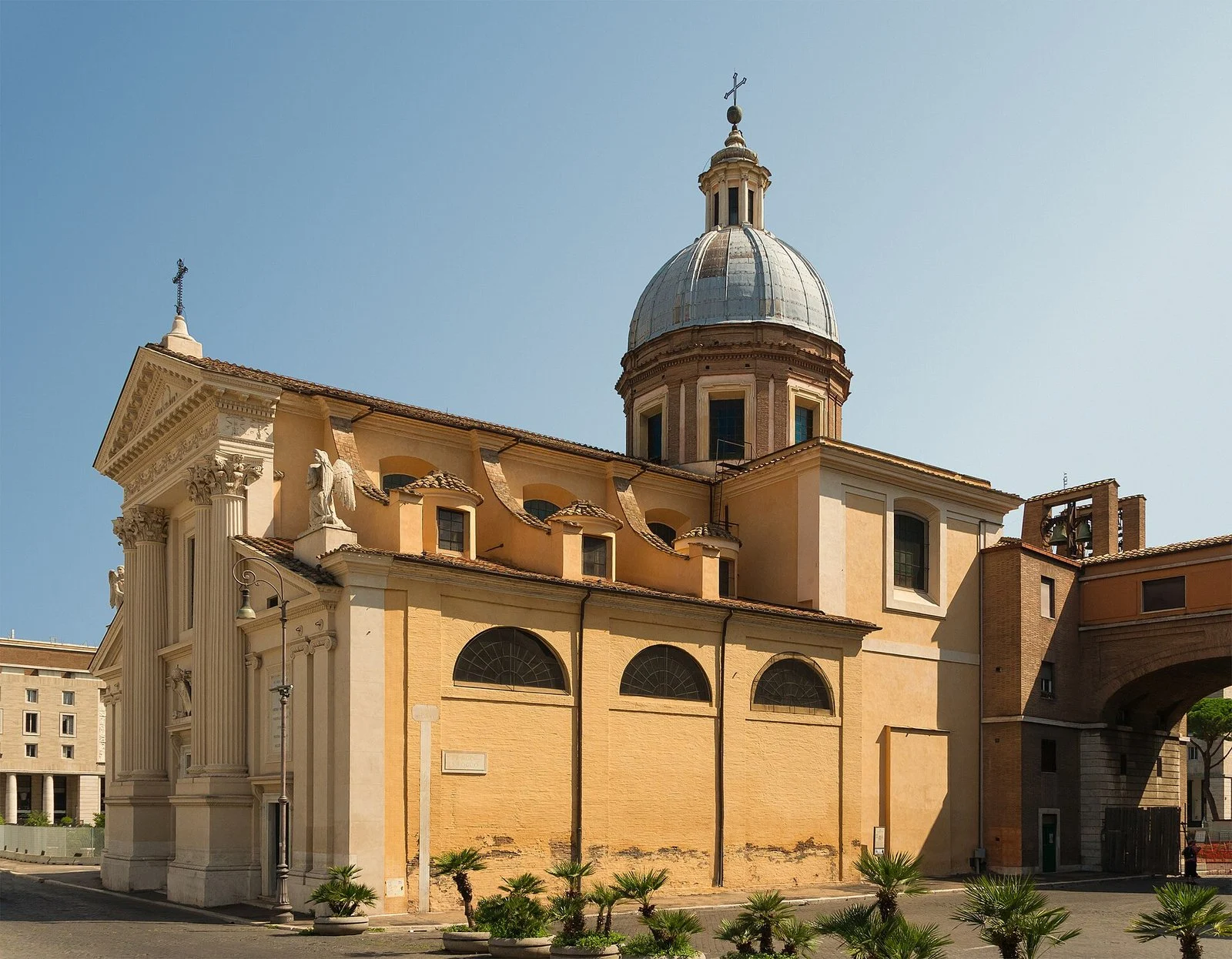
San Rocco all’Augusteo is the church at the end of Via di Ripetta, wedged between the flank of the Mausoleum of Augustus and the Lungotevere, with its white facade facing a square that bears its name and that almost nobody calls by it. Those passing by take it for one of the many closed churches of the center and keep going toward the Ara Pacis. It's a mistake, but an understandable one: the neoclassical facade promises nothing, the square in front was a construction site for years, and no sign explains that behind that side wall, until the 1930s, there was a hospital that for more than a century guaranteed women the right to give birth without giving their name. This page tells what remains of that story, what you see when you go in, where the sources disagree and why the context around the church has nothing left to do with what the church was built for.
Where San Rocco is and how to get there
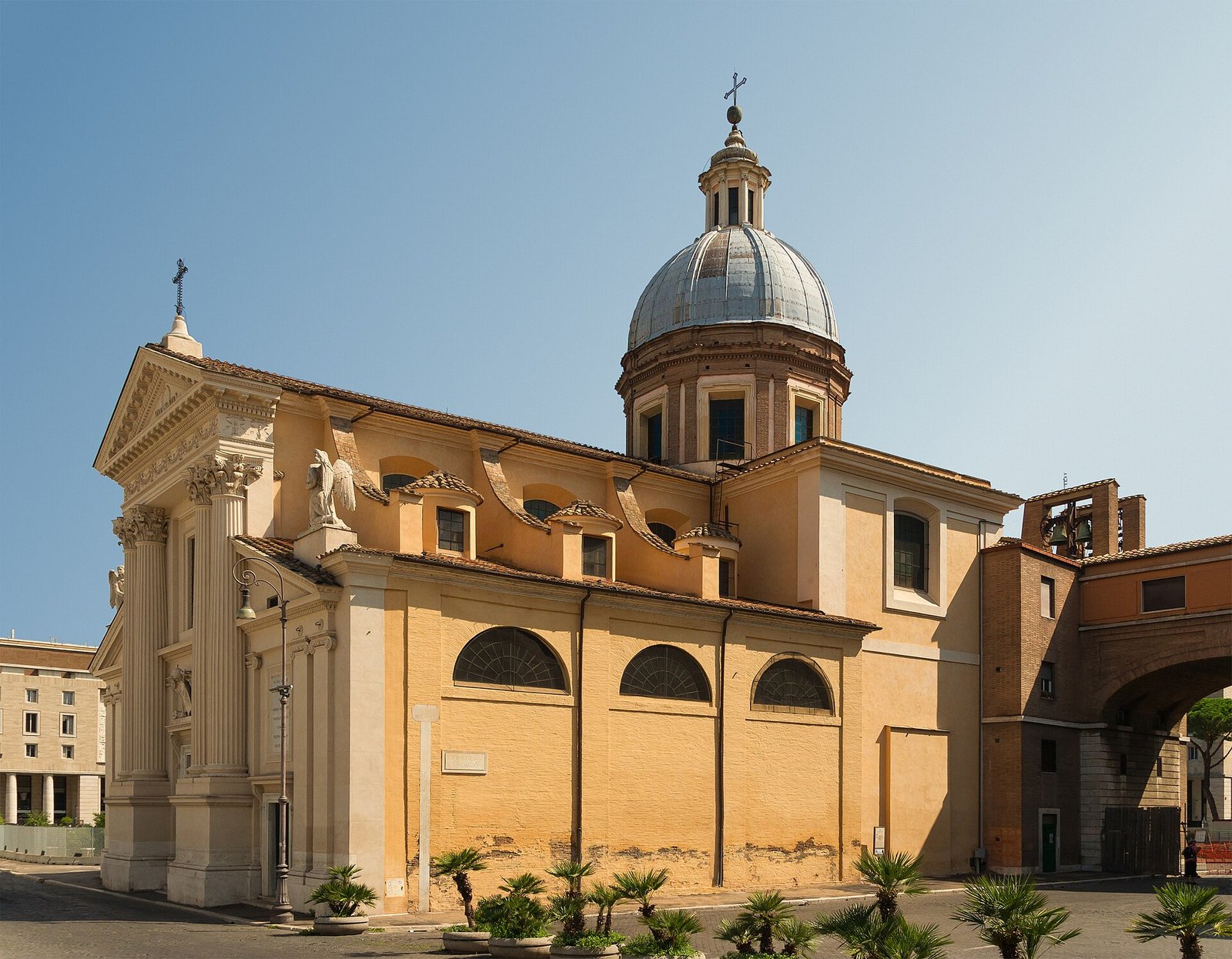
The address is Largo San Rocco 1, rione Campo Marzio, and the simplest way to understand where it is, is to start from Piazza del Popolo and go down Via di Ripetta for 700 meters. The church appears on the right, just before the street opens onto the Lungotevere, with its right flank facing the river and its facade looking at the Mausoleum area. Those coming instead from the Corso have to cut through Via Tomacelli or Via dei Pontefici, and in that case the church presents itself from the side, which is the worst way to meet it.
By metro
The useful stop is Flaminio, on line A, which comes out just outside Porta del Popolo. From there you cross Piazza del Popolo diagonally, take Via di Ripetta, the rightmost of the three streets of the Tridente looking south, and walk 10 minutes on a narrow sidewalk. The alternative is Spagna, also line A, with a longer route, downhill from Piazza di Spagna via Via dei Condotti and Via Tomacelli: it is a good 15 minutes and you cross the most crowded part of the luxury shopping district.
Those arriving from Termini take line A in the direction of Battistini and get off at the fifth stop. The full picture of Roman transit, with the things that work and those that don't, is on the page on getting around Rome. For those arriving by air, the chain of connections is explained on the page on airports and ways to reach the center.
By bus and on foot
The surface lines that serve the area run along the Lungotevere and Via Tomacelli, with stops two or three minutes from the church. The routes change often because of construction sites, detours and demonstrations, and checking must be done the same day on the transport company's app. On foot San Rocco is reachable from almost the whole historic center within a quarter of an hour: from the Pantheon it's 12 minutes, from Piazza Navona 15, from Castel Sant'Angelo 20 passing by Ponte Sant'Angelo and going up the Lungotevere.
By car and bike
Arriving by car is not advisable and is largely forbidden. The whole area falls within the historic center's limited traffic zone, with electronic gates active in time slots that change between weekdays and holidays: the updated rules and how to avoid the fine are on the page on the Rome ZTL. The parking spaces around the square are reserved for residents. By bicycle the Lungotevere has a bike path that runs on the embankment, lower than the street, and the climb back up to Via di Ripetta is made from one of the ramps: the honest assessment of Roman bike lanes is on the page on Rome by bike.
What you really see when you go in
San Rocco is a rectory church, that is, it has no parish of its own and depends on the parish of San Giacomo in Augusta, a little further along the Corso. This has a practical consequence: the openings follow the availability of the rector and the confraternity, not a museum schedule, and finding the door closed in the middle of a weekday afternoon is normal. Entrance is free, there is no ticket office, no custodian, no marked route.
The nave
The interior is a single nave, with three chapels per side communicating with one another, a barrel vault and a dome over the presbytery. The light comes in high and the overall effect is of a medium-sized 1600s Roman church, orderly and without excess, with marble decorations added in the early 1700s. Those who go in expecting the Baroque machine of the big churches of the Corso are thrown by the restrained proportions. The helpful comparison is with San Lorenzo in Lucina, five minutes away, which has a different plan and larger dimensions.
The altarpiece of the high altar
Above the high altar is the canvas by Giacinto Brandi with San Rocco in Glory, dated by the sources to 1674 or to 1678 depending on which entry you consult. Brandi is a Roman painter of the second half of the 1600s, prolific and present in half the city, who worked a lot for confraternities. The difference in dating between the sources probably concerns commission and delivery, and neither version is absurd: whoever is looking for a single date will not find it.
The fresco by Baldassarre Peruzzi
In one of the chapels there is a fresco attributed to Baldassarre Peruzzi, with the Madonna between Saint Roch and Saint Anthony Abbot, heavily restored in the 1600s by Giovan Battista Gaulli, the Genoese painter known as Baciccia who frescoed the vault of the Church of the Gesù. A 1500s fresco repainted by a Baroque artist is a hybrid object, and it should be read knowing that: what you see today is not the surface that came from Peruzzi's hand.
The things you don't see
Much of what made San Rocco a recognizable place in the urban fabric no longer exists. The bell tower was torn down in the 1930s. The attached hospital, which occupied the flank toward the Mausoleum, was demolished in the same works. The river port that gave meaning to the church's position had already vanished 40 years earlier. Those who look at San Rocco today look at a surviving building inside an entirely rewritten context, and without knowing this you don't understand why the church seems out of place.
The foundation: boatmen, innkeepers and the plague
The origin of San Rocco is both corporate and sanitary. On June 11, 1499 Pope Alexander VI issued the brief Cogitantes humanae conditionis, which recognized the confraternity of innkeepers and boatmen's right to build a church, an oratory and a hospital in the Mausoleum area. The confraternity brought together two trades of the river: those who steered the boats that came up the Tiber to the landing of Ripetta and those who ran the inns that gave those people drink and a place to sleep.
Why Saint Roch in particular
Saint Roch of Montpellier is the saint invoked against the plague, and it is a choice of patron that says everything about the context. The end of the 1400s in Rome was marked by recurring epidemics, and the guilds tied to the river were among the most exposed, because contagion arrived with the goods and with the people who disembarked. A hospital for plague victims built next to the landing was not abstract devotion: it was a defensive measure built by the trade that risked the most.
The church that was there before
On the site there already stood a medieval church, San Martino de Pila, which the confraternity readapted. For a certain period the title was double, San Rocco and San Martino, and some furnishings of the old church passed to the new one. The dedication to Saint Martin has not disappeared entirely: in the 1800s Cesare Mariani painted for the church a fresco with Saint Martin Sharing His Cloak with the Poor Man, dated 1885, which keeps alive the memory of the earlier title.
The hospital of the 1500s
The construction of the hospital followed shortly after the papal brief, and the sources oscillate between 1500 and 1524 for the entry into operation of the actual structure. At the beginning it was intended for men, sailors and boatmen struck by epidemic diseases, and it served a poor and densely populated neighborhood. The obstetric specialization, the one that made the name famous, came later and arose from reasons that had nothing to do with the plague.
The 1600s reconstruction and the Madonna delle Grazie
The construction work that gave the church its present form started in the mid-1600s. The dates in circulation are 1645 or 1646 for the start and 1654 or 1657 for the conclusion, with funding from Cardinals Odoardo Vecchiarelli and Francesco Barberini. The architect is Giovanni Antonio De Rossi, a Roman, author of palaces and churches all over the city, to whom are owed the dome, the sacristy and the elliptical chapel meant to house a Marian image.
The image that started the construction
The driver of the reconstruction was the discovery of a fresco of the Virgin considered miraculous, later known as Madonna delle Grazie. It is a recurring mechanism in 1600s Rome: an image gains fame, offerings arrive, the offerings fund the construction, and the chapel that houses the image becomes the devotional center of the church. The elliptical chapel with small dome designed by De Rossi was born for this reason.
De Rossi and his trade
Giovanni Antonio De Rossi worked a great deal for confraternities and for families of middling nobility, in a Rome where the big commissions went to Bernini, Borromini and Pietro da Cortona. His is a measured Baroque, attentive to cost and function, which solves difficult spaces well. Those who want to see Roman Baroque in its major versions will find a reasoned route on the page on Baroque Rome and in the itinerary devoted to Bernini, while the architecture of his rival is gathered on the page on Borromini.
Valadier's facade, and the date that wavers
The neoclassical facade you see today is the work of Giuseppe Valadier and is much later than the body of the church. The sources indicate 1832 or 1834, and the divergence is real: the Italian encyclopedia entry gives 1832, the municipal tourist portal and several specialist entries give 1834. The most likely explanation is that one date is that of the design and the other that of completion, but no consultable source says so explicitly, so the divergence should be flagged and not settled at a desk.
What a Palladian facade is doing on Ripetta
Valadier built a front with double columns with Corinthian capitals in the center, flanked by pilasters with Ionic capitals, with a layout that recalls Palladio's Venetian churches. The reference is not accidental: the Roman neoclassicism of the early 1800s looked to the Veneto of the 1500s as a model of clarity. Above the main portal appears the coat of arms of Pope Gregory XVI, who reigned from 1831 to 1846 and who funded the operation.
Valadier and the neighborhood
Giuseppe Valadier is the same architect who redesigned Piazza del Popolo in the elliptical form it has today and who arranged the ramps of the Pincio. The facade of San Rocco is part of the same program of reorganization of the Tridente, carried out over 50 years between the Napoleonic age and the papal restoration. Whoever walks from Porta del Popolo to Largo San Rocco walks a piece of city designed largely by the same hand.
The angels of 1984
Two candelabra-bearing angels were added to the facade in 1984. It is a recent addition, and whoever photographs the church believing they are capturing an intact 1800s front is capturing a 1800s front with late 20th-century elements. The detail is minor, but it serves as a reminder that Roman buildings keep changing even when they seem unchanged for centuries.
The hospital of the concealed women: how it really worked
The chapter that makes San Rocco a place different from any other church in the center concerns the building that is no longer there. The attached hospital, which occupied the strip between the church and the Mausoleum of Augustus, transformed over three centuries from a plague lazaretto into a specialized obstetric institute, and in its final form guaranteed women in labor total anonymity. The story is often told in a romanticized way, and it's worth separating what emerges from the sources from what was added later.
The shift from lazaretto to maternity
The first transformation depended on the geography of the neighborhood. In the strip between the Mausoleum and the Muro Torto were the so-called Ortacci, lands assigned to prostitutes, and the presence of that population gradually steered the hospital's function toward assistance for pregnancies. Between 1605 and 1612 Carlo Maderno designed a complete reconstruction of the structure, at a documented cost of just under 5,600 scudi. By the 1600s the use for unmarried women in labor was already established.
The brief of Clement XIV
The legal turning point came in 1770, when Pope Clement XIV limited the hospital to women in labor only, closing off every other function. Between 1772 and 1776 the architect Nicola Forti built a new structure, with a hall 34 meters long and nine wide, 10 large windows, a second hall for the inmates to stroll in and about 20 beds. The rooms reserved for the concealed women were separate from the rest and access was forbidden to everyone.
The rules of secrecy
The institution's rules stated that women could come without being asked their name or their condition, and that they could cover their faces so no one would see them. In the registers they appeared only as a progressive number. Confidentiality held even in front of relatives, bystanders, and religious and judicial authorities, and not even the death of the patient authorized revealing her identity. The people who knew the face were the midwife and, in difficult cases, the surgeon.
What happened to the babies
Newborns were transferred within the second day to the foundling hospital of Santo Spirito in Sassia, on the other bank of the Tiber, accompanied by a sheet with the hour and date of birth. Women who wanted to leave themselves a chance of future recognition attached a token: half a cut coin, a ribbon, a scroll. The other half of the coin stayed with the mother. The sources speak of about 200 births a year at San Rocco, equal to a fifth of the children who entered the Roman foundling hospital.
The costs, which did exist
The free care was not absolute, and the sources differ on the details. The brief of Clement XIV distinguished between legitimate women in labor, admitted at no cost, and illegitimate ones, who had to pay for their own board and some fees, except for the period of childbirth and the postpartum. Other reconstructions speak of free admission for eight days and a daily fee for those who wanted to keep even the pregnancy hidden, given as three scudi and risen to 32 in the nineteenth century. The two schemes don't match and probably belong to different phases.
Where the documented ends and the novel begins
What the sources support is the regime of anonymity, registration by number, the permitted veil, the separate rooms and the transfer of the newborns. What the sources don't support, and which circulates anyway, is the cinematic version with night carriages of noblewomen, secret passages and hidden entrances on the river. The hospital served mostly poor women, unmarried or in irregular family situations, and secrecy was a health policy meant to reduce infanticides and clandestine births, not a luxury service for the aristocracy.
The chair of obstetrics
In 1786 the University of Rome established the chair of Obstetrics and placed it right at San Rocco. The first holder was Francesco Asdrubali, who lived between 1756 and 1832 and was also chief surgeon of the hospital. This turned the institution into a place of clinical teaching, and explains why a small facility left a mark on the history of Italian medicine well beyond its size.
The closure and the concert hall
In 1892 the hospital was suppressed and the patients transferred to San Giovanni. The ground floor of the building was converted into a concert hall, in an area that was already becoming the city's music hub. The building stood until the works of the 1930s, when it was torn down along with all the building fabric around the Mausoleum. The most substantial document on this history is an academic study by Barbara Tetti from 2018 titled La maternità segregata. L’Ospedale di S. Rocco a Roma per le partorienti celate, available in the institutional archive of Sapienza University.
The port of Ripetta, which explains why the church is here
Without the port, the position of San Rocco has no explanation. For centuries the Tiber was Rome's supply route, and Ripetta was the upstream landing, the one where everything coming down from the upper course of the river and from the Sabina arrived: timber, wine, coal, oil, building materials. The downstream port was Ripa Grande, in Testaccio. The confraternity of innkeepers and boatmen was born exactly at this spot because that's where it worked.
The staircase of Alessandro Specchi
In 1704 the architect Alessandro Specchi built the monumental port, a double curved staircase that descended from street level to the water's edge, with symmetrical ramps and a fountain. It was one of the few Roman architectures designed to be looked at from the water, and it is documented by engravings, drawings and nineteenth-century photographs. Anyone who wants an idea of it has to look for the views kept in the municipal collections, because on the spot practically nothing remains.
The demolition
The port was dismantled at the end of the nineteenth century during the construction of the Tiber embankment walls, the embanking work decided after the flood of 1870 and designed by Raffaele Canevari. The opening of Ponte Cavour, in 1901, completed the erasure of the landing. The walls solved the problem of the floods and separated the city from its river: anyone walking on the lungotevere today doesn't see the water unless they lean over.
What remains
Of Specchi's port the idea remains, taken up in simplified form by the De Pinedo landing built later a little farther upstream. The views in the graphic collections remain. And the hydrometer remains, the graduated column that marked the level of the waters, placed on the side of the church. For the complicated relationship between Rome and its river, it's worth looking at the historic bridges too, from Milvian Bridge upstream to Ponte Sisto and Ponte Fabricio downstream.
The hydrometer on the side of the church
On the right side of San Rocco stands a marble column with a graduated scale and plaques recording the levels reached by the Tiber's floods. The descriptions date it to 1821 and link it to the port of Ripetta, where several instruments of the same type existed. It is the most overlooked object in the square and one of the few that speaks of the Rome before the embankment walls, when water entered the city regularly.
How to read it
The plaques mark the dates of the floods and the height the water reached at that point. Anyone who stands in front of the column and looks up understands in three seconds something that no panel explains: the level of the major floods came well above the head of the person looking. The flood of December 1870, the most severe documented in the modern era, is the one that convinced the newborn Italian State to build the embankments.
Why nobody looks at it
The hydrometer is in the least trodden part of Largo San Rocco, around the corner from the facade, in a stretch where tourists have no reason to turn. Anyone coming from the Ara Pacis and heading toward Via di Ripetta passes 10 meters from it without seeing it. It's worth the 30-second detour, and it's free.
The demolitions of the 1930s and the city that vanished
The context around San Rocco was destroyed and rebuilt in five years. Between 1934 and 1938 the late Renaissance district that surrounded the Mausoleum of Augustus was demolished to isolate the monument, on a design by Vittorio Ballio Morpurgo. The figures that circulate speak of about 120 buildings torn down over 28,000 square meters. The square was inaugurated on October 28, 1938, a date chosen for the anniversary of the March on Rome.
The Mausoleum before 1934
The Mausoleum of Augustus was not an archaeological ruin but a building in use. From 1780 an amphitheater operated inside it, the Correa Amphitheater, with animal shows, jousts and fireworks for an audience that the sources put between 1,000 and 3,000 people. In 1908 the Accademia di Santa Cecilia renovated it and opened it as a concert hall, the Teatro Augusteo, inaugurated on February 16 of that year with a concert conducted by Giuseppe Martucci.
Where the church's name comes from
The adjective that distinguishes this church from all the other San Roccos in Italy comes from right there. Augusteo was the popular name of the Mausoleum turned into a performance hall, and the church took its nickname from its bulkiest neighbor. When the hall was dismantled, between 1936 and 1937, the name stayed attached to the church and has remained. Anyone who reads San Rocco all’Augusteo today is reading the memory of a theater demolished 90 years ago.
What was torn down
Gone were the hospital of San Rocco, the church's bell tower, the Teatro Augusteo and the entire block of houses between the Mausoleum and the river. The church was spared for its artistic value, along with a few other historic presences, and found itself facing an empty space much larger than the one it had in front of it before. The result is that today San Rocco seems too small for the square it opens onto, because that square wasn't designed for it.
The relocation of the Ara Pacis
In the same building site Morpurgo designed the glass and concrete case meant to house the Ara Pacis, reassembled for the bimillennium of Augustus's birth in 1938. The altar hadn't originated there: it came from under Palazzo Peretti, in Via in Lucina, and was moved. Morpurgo's case was replaced in 2006 by the museum designed by Richard Meier, which divided Roman public opinion like few other buildings of the postwar period.
The works of today
Piazza Augusto Imperatore became a construction site again in the 2020s, with a redevelopment project signed by Francesco Cellini that includes inclined planes, descent ramps toward the archaeological level and a continuous pedestrian path. The full opening of the public space is announced by the end of 2026. The Mausoleum itself became visitable again on March 1, 2021, after 14 years of closure, with access by reservation.
A curiosity about San Rocco all’Augusteo
The boatmen's church holds a French organ. The instrument is signed Cavaillé-Coll, the Parisian house that built the organs of half of nineteenth-century France, and the descriptions date it to 1910. It's an anomalous object in a Roman confraternity church, where you would expect an Italian workshop, and it bears witness to the moment when this area had become the music district because of the Teatro Augusteo 50 meters away.
The eighteenth-century case
Above the entrance remains the carved organ case with the choir loft, attributed to the first half of the eighteenth century. Case and instrument therefore belong to two different eras, as happens very often with the organs of Roman churches: the cabinet survives, the sound material inside gets replaced. Anyone who enters and looks only toward the altar never looks up and misses the most elaborate part of the wooden decoration.
The pulpit of Benedict XV
The preaching pulpit is reported as donated by Pope Benedict XV, who reigned from 1914 to 1922. It's a piece of information that appears in the descriptions dedicated to the church and that we have no way to check against an archive source: we report it as we find it, noting that it is second-level news.
The confraternity that is still there
The church continues to be looked after by the confraternity of San Rocco, heir to that association of innkeepers and boatmen recognized in 1499. Five centuries of institutional continuity in a Roman religious building are not exceptional, but here they stand out because the trade that had founded the confraternity, river transport, disappeared 120 years ago. The association has outlived its own work.
One thing nobody tells you about San Rocco all’Augusteo
The official name of the church contains a reference to a building that no longer exists, and this creates documentary confusion. The Diocese of Rome, the municipal tourist portal and the ecclesiastical directories all list it as Chiesa di San Rocco all’Augusteo, with the full formula. Many printed guides and many maps instead give it as just San Rocco, or as San Rocco a Ripetta, which is not an official name.
Why it matters
Anyone searching for the church on a search engine with the wrong formula risks ending up at one of the dozens of San Rocco churches scattered across Italy, from Venice to Viterbo. Anyone who calls a number found online without checking the name risks calling a different parish. The correct form to use when writing to someone or looking up a schedule is the one with Augusteo.
The forgotten double title
A second layer of confusion comes from the old title. For a period the church was called San Rocco and San Martino, because it had absorbed the earlier San Martino de Pila. The double dedication has lapsed, but traces of Martin remain in the church, starting with the nineteenth-century fresco by Cesare Mariani. Anyone who finds in old documents a reference to San Martino in this location is not reading about another building.
It is not a titular church
One last frequent misunderstanding: San Rocco all’Augusteo is not the seat of a cardinal title and is not a parish. It is a rectory that depends on the parish of San Giacomo in Augusta. The difference is not formal, because it determines who opens the door and how consistently, and explains why the hours are less stable than those of a parish.
The advice I give you for visiting San Rocco all’Augusteo
The practical advice is one, and it changes everything: don't come here on its own. San Rocco holds up poorly as an isolated destination, because the visit inside lasts 10 minutes and the risk of finding it closed is high. It holds up very well as a stop within a walk that starts from Piazza del Popolo and ends at the Corso, where each piece adds meaning to the previous one and a closed door doesn't ruin the day.
The route that works
You start from Piazza del Popolo with a visit to Santa Maria del Popolo, which holds Caravaggio and Raphael and is worth the trip by itself. You look at the twin churches at the mouth of the Tridente, go down Via di Ripetta, arrive at San Rocco, continue toward the Ara Pacis and finish with the Mausoleum of Augustus if it's booked. It's barely two kilometers and a full half day.
The hours, with the necessary caution
The hours that circulate indicate an early morning opening, from 07:00 to 09:00, and an afternoon reopening from 16:30 to 20:00 on weekdays, with a wider window on Sunday. None of these indications comes from a first-level institutional source, and all of them should be confirmed by phoning the number published by the diocesan directories, 06 6896416. The practical rule for Roman rectories is simple: open around the Masses, closed the rest of the time.
When to avoid
In August many rectories in the center cut their opening to the minimum and staff is reduced: the general question of what closes in the city is covered in the page on Rome in August. During the weeks of construction work on the square, pedestrian access changes without notice. On August 16, the feast of Saint Roch, the church is instead at the center of celebrations and opening is guaranteed, but there are crowds.
How much time to allow
10 minutes inside, five outside for the hydrometer and for the side toward the Mausoleum, and you're done. If you want an order of magnitude to plan a whole Roman day, you'll find a reasoned itinerary in the page on Rome in a day, where San Rocco appears as a short detour and not as a main stop. If you move with mobility difficulties, you'll find background information in the page on Accessible Rome.
Another well-known fact, yet rarely cited
Everyone knows that Fascism isolated the Mausoleum of Augustus, few connect that choice to the disappearance of an entire system of neighborhood health care. The hospital of San Rocco had been closed in 1892, so it wasn't the pickax that killed it, but the demolition of 1934 also erased the physical memory of that function: without the building, the story of the hidden women became an anecdote with no material support.
The general mechanism
The Roman demolitions of the 1930s produced the same effect everywhere. You isolate an ancient monument, you demolish the fabric that had grown around it over the centuries, and you get a legible archaeological object inside an illegible void. The best-known case is Via dei Fori Imperiali, but the logic is identical at Piazza Venezia and here at Ripetta: the medieval and modern layers were worth less than the imperial ones.
What was lost in terms of neighborhood
Before 1934 the area around the Mausoleum was inhabited, with houses, shops, taverns and a working-class social fabric a couple of steps from the noble residences of the Corso. After 1938 it became a representative square surrounded by office buildings in Fascist style. The resident population was moved elsewhere, largely to the outlying borgate, following a practice applied in all the demolition sites of the period.
The reading that remains possible
Anyone who wants to understand what the neighborhood was like has to work from historical photographs and nineteenth-century maps, because on the ground there are no footholds. The municipal photographic collections document Largo San Rocco before the intervention, with the bell tower still in place and the hospital leaning against the side of the church. It's an exercise that applies to the whole strip between the Tridente and the river.
The right photo to take at San Rocco all’Augusteo
The photograph that tells the story of this church is not the frontal one. Valadier's front shot head-on gives a clean, mute image, good for a catalog and useless for understanding anything. The photo that works is taken from the corner, putting in the same frame the white neoclassical facade and, behind or beside it, the brick mass of the Mausoleum of Augustus.
How to set it up
You step back toward the side of the square that faces the river and look for the point where the Corinthian columns of the facade overlap the profile of the ancient mound. The contrast between the light marble of the nineteenth century and the brick of the first century BC is the real subject.
The light
The facade faces northwest and gets sun in the late afternoon. The best light is that of the two hours before sunset, when the marble warms up and the brick of the Mausoleum goes from dull red to orange. In the morning the facade is in flat shade and the photo comes out gray.
The second photo, the one nobody takes
The hydrometer on the side deserves a close vertical shot, with the flood plaques legible and a person in the same frame for scale. It's the image that explains in one stroke why Rome built the embankment walls. It also works as a counter-shot to a photo taken from the lungotevere, where the water is barely visible.
Inside
Inside, photography is hard because of the lack of light and the presence of worshippers. If the door is open and the church is empty, the best framing is from the back toward the presbytery, with the eighteenth-century organ case out of frame behind you. Flash is useless and rude. If you want more photographic exercises in the area, you'll find more generous subjects at the Pincio obelisk and on the terrace of the Pincio, a 10-minute climb away.
Some important events that happened here in history
The chronology of this corner of the city reads better as a sequence of administrative decisions than as a chain of memorable events. No battles were fought here and no treaties were signed. What passed through instead were a papal brief, a Baroque building site, a health reform, a facade of the papal regime, a Fascist demolition and a contemporary restoration, and each of these passages left a visible mark.
June 11, 1499
Alexander VI grants the confraternity of innkeepers and boatmen the right to erect a church, oratory and hospital. It's the birth certificate of the complex and the date the confraternity considers foundational. The context is that of the year before the Jubilee of 1500, with Rome preparing to receive an extraordinary influx of pilgrims and therefore of diseases as well.
Between 1605 and 1612
Carlo Maderno rebuilds the hospital. Maderno is the architect of the facade of St. Peter's, and finding him engaged on a confraternity hospital gives the measure of how much the institution counted. The documented expense exceeds 5,500 scudi, a significant figure for a facility of that kind.
Mid-1600s
The discovery of the Marian image later called Madonna delle Grazie triggers the rebuilding of the church, entrusted to Giovanni Antonio De Rossi and completed by 1657. This is where the church visited today comes from.
1770 and 1776
Clement XIV limits the hospital to women in labor only. A few years later Nicola Forti delivers the new building. These are the two dates that turn a generic facility into the best-known obstetric institution of the Papal State.
1786
The chair of Obstetrics of the University of Rome is established and placed at San Rocco, with Francesco Asdrubali as its first holder. The hospital becomes a place of clinical teaching.
1832 or 1834
Giuseppe Valadier signs the neoclassical facade under the pontificate of Gregory XVI, whose coat of arms appears on the portal. The date varies between sources and the discrepancy remains open.
1892
The hospital closes, the patients go to San Giovanni, the ground floor becomes a concert hall. The health cycle begun almost four centuries earlier ends.
February 16, 1908
The Mausoleum, renovated by the Accademia di Santa Cecilia, reopens as the Teatro Augusteo with a concert conducted by Giuseppe Martucci. For 30 years the church will have the city's main symphonic hall next door.
Between 1934 and 1938
Demolition of the district, the hospital, the bell tower and the Teatro Augusteo. The square wanted by Morpurgo is inaugurated on October 28, 1938. The church stays standing but completely changes neighbors.
March 1, 2021
The Mausoleum of Augustus reopens to the public after 14 years of closure, with visits by reservation. The square around it is still being worked on, with completion announced by the end of 2026.
Who passed through San Rocco all’Augusteo
The people tied to this place are not the ones you expect from a Roman church. Here the important names are architects, popes, doctors and thousands of women whose names we don't know by design, because the system was made precisely not to record them.
The architects
Carlo Maderno on the hospital in the early 1600s, Giovanni Antonio De Rossi on the church in the middle of the century, Nicola Forti on the new obstetric institute in the 1700s, Giuseppe Valadier on the facade in the 1800s. Four generations of Roman professionals on the same block, in four different languages, and the result is still legible as a whole. Valadier is also the author of the layout of Piazza del Popolo, and this ties San Rocco to the overall design of the district.
The painters
Baldassarre Peruzzi, from Siena, in the 1500s. Giacinto Brandi with the high altarpiece in 1674 or 1678. Giovan Battista Gaulli, il Baciccia, who restored and repainted Peruzzi's fresco. Cesare Mariani with the San Martino of 1885. If you want to follow the traces of the other greats of the Roman 1500s, you'll find a route in the page on Raphael in Rome, which includes the Chigi chapel in Santa Maria del Popolo a few minutes from here.
The popes
Alexander VI grants the foundation in 1499. Clement XIV reforms the hospital in 1770. Gregory XVI finances the facade and puts his coat of arms on it. Benedict XV donates the pulpit. Four pontificates spread over four centuries, all with a specific and concrete intervention on this building.
Francesco Asdrubali
The doctor who left the most lasting mark is Francesco Asdrubali, first holder of the chair of Obstetrics and chief surgeon of the hospital, active between the end of the 1700s and the first decades of the 1800s. Through his teaching San Rocco trained generations of midwives and surgeons, and exported elsewhere a model of childbirth care.
The nameless women
About 200 a year, for more than a century. In the registers they were numbers, and the ban on identifying them held even after death. They are the largest population that ever passed through this block and the only one of which no named trace remains. Any reconstruction that claims to tell individual stories of the hidden women with first and last names is making things up, because the system was built precisely to make that reconstruction impossible.
The musicians, in passing
For 30 years, between 1908 and 1936, the great conductors and guest soloists of the Accademia di Santa Cecilia played 50 meters from this church, inside Augustus's mound. The first evening was conducted by Giuseppe Martucci. The hall was later dismantled and the Accademia moved, first to Via della Conciliazione and finally to the Auditorium Parco della Musica.
Eating in the area: the picture without discounts
The area between Largo San Rocco, Via di Ripetta and Via Tomacelli is one of the hardest in Rome for eating well at an honest price, and it's best to know it before sitting down. Thousands of people pass through here every day headed to the Ara Pacis, the Mausoleum, the shop windows of the Corso and Piazza del Popolo, and the restaurant trade has been shaped on that flow. The result is an offer built for people who pass once and will never come back to complain.
The signs that tell you to steer clear
The first sign is the menu with photographs of the dishes, often laminated and translated into six languages: it's for people who don't know what to order, and a place that works with regular customers doesn't need one. The second is the lady rolling out fresh pasta behind the window or at a little table on the sidewalk: it's a scene built for the passerby, not a clue to what comes out of the kitchen. The third is the person stationed on the threshold inviting you to come in and sit: whoever has full tables doesn't send anyone out hunting.
The fourth sign is non-stop hours from morning to night without the kitchen ever closing. A kitchen crew that works defined services, lunch and dinner, shows itself by the fact that between three and seven it won't serve you a first course. Whoever stays open all the time is reheating. The fifth concerns places facing the monuments directly, and between the Ara Pacis and the Mausoleum there are some: look for items with no price on the menu and the undeclared cover charge, and check that the price list displayed outside matches what they bring to your table. Often it doesn't, and you find out the difference at the bill.
The chains with a repeated sign
In the center of Rome a single-brand food business with several outlets close together, identical furnishings, the same menu and an organized line at the entrance has taken hold. It works as a tourist attraction in every respect, with the line becoming part of the experience, and Romans don't set foot in them. It has nothing to do with snobbery. That model sells predictability to people who visit the city for three days, while those who live here look instead for the cooking of a specific person in a specific place. Between Via Tomacelli and the Corso this type of offer is particularly dense, because foot traffic is continuous all day.
The criterion, which is only one
Look at who is sitting and in what language they order. If the tables hold people who speak Italian and order without opening the menu, the place holds up. If the tables hold only backpacks, guidebooks and maps, you move on without regrets. It applies at noon as at nine in the evening, and it applies in every neighborhood of the center. It's the only criterion that doesn't require already knowing the city.
Where to move
The density of good places goes up as soon as you move away from the tourist axis. Going up toward the Babuino and the side streets toward Piazza di Spagna, prices rise but quality becomes more reliable. Going down toward San Lorenzo in Lucina and the streets behind Montecitorio, you enter the area that serves office workers and journalists, where the weekday lunch still has its own price logic.
References
If you want to start from an already filtered selection, you can consult Daniele Dezi's personal list on Google Maps, a curated and unsponsored collection. The full reasoning on how to choose a place in Rome, with the extended criteria and the typical mistakes, is in the page on where to eat in Rome without falling into the tourist trap. For the historic places, which are a chapter apart and have their own rules, there's the page on the historic cafes and shops of Rome.
Frequently asked questions about San Rocco all’Augusteo
How much does it cost to enter San Rocco all’Augusteo?
Entry to San Rocco all’Augusteo is free, as in all Roman churches open for worship. There is no ticket office, no reservation, no audio guide. If you find a price associated with it online, it's a tour by a third-party operator that includes the church inside a wider package, not a ticket for the church. The Mausoleum of Augustus next door, on the other hand, is paid and requires a reservation.
What are the opening hours of San Rocco all’Augusteo?
The hours that circulate for San Rocco all’Augusteo indicate an early morning opening and an afternoon reopening until evening, with a wider window on Sunday, but they don't come from a first-level institutional source and aren't stable. Since it's a rectory and not a parish, the door follows the Masses and the rector's availability. The phone number published by the diocesan directories is 06 6896416.
What does the Augusteo have to do with this church?
Augusteo was the name Romans used for the Mausoleum of Augustus when, between 1908 and 1936, it housed the concert hall of the Accademia di Santa Cecilia inside it. The church took its nickname from the neighbor, and when the hall was dismantled the name stayed attached to it. Today the official name used by the Diocese of Rome and by the municipal tourist portal remains Chiesa di San Rocco all’Augusteo.
Can you still see the hospital of the hidden women?
The hospital of San Rocco no longer exists. It was closed in 1892, partly converted into a concert hall and demolished between 1934 and 1938 during the works to isolate the Mausoleum of Augustus. Nothing visible remains on the spot, and reconstruction is possible only through historical photographs, nineteenth-century maps and the specialist bibliography. Anyone looking for a secret entrance or a crypt won't find anything.
Is the story of the secret childbirth at San Rocco true?
The regime of anonymity is documented. The institution's rules provided that women didn't have to declare name and condition, that they could cover their faces, that they were registered with a progressive number and that confidentiality held even in front of relatives and authorities, even in case of death. What doesn't hold up to verification is the novelized version with noblewomen in carriages and hidden passages: the clientele was mostly poor and the measure served to reduce clandestine births and infanticides.
Who made the facade of San Rocco and in what year?
The neoclassical facade is by Giuseppe Valadier, the same architect who redesigned Piazza del Popolo and the Pincio. On the year the sources diverge: the Italian encyclopedia entry gives 1832, while the municipal tourist portal and several specialist descriptions give 1834. The most plausible explanation is that the two dates correspond to design and completion, but no consultable source states it, so the divergence has to be reported as it is.
Is San Rocco all’Augusteo suitable for children?
The visit inside lasts a few minutes and offers nothing designed for children: no educational path, no panels, no activities. It works better as a short stop within a wider stroll among Piazza del Popolo, the Pincio and the lungotevere, where there's no lack of space to walk. The square in front of the church is pedestrian in stretches but borders the traffic of the lungotevere: watch the crossing.
Is San Rocco all’Augusteo accessible for people with mobility difficulties?
Access has a few steps on the main front and no equipped alternative route appears to be declared. The interior is on a single level and the nave is wide enough to move around, but the outside area has long been affected by the redevelopment works on the square, with temporary paths that change. If you use a wheelchair, you do well to phone beforehand and ask about the state of the construction site.
Is it worth combining San Rocco with the Mausoleum of Augustus?
Yes, and it's the pairing that gives the visit the most sense, because the history of the two buildings is intertwined. The Mausoleum, however, requires a reservation and has its own hours, so it has to be organized first and the church fitted in as a side stop. If you can't book the Mausoleum, you can still walk around it and read the square from the outside, which with the new paths has become easier.
Who wrote this page
The editorial team that looks after these pages is that of Tour Leader Pro, a Roman project office that designs and coordinates visits, itineraries and cultural events in Rome and Lazio. The dates, attributions and access conditions reported here were compared with the institutional sources available at the time of publication, and where the sources contradict each other we wrote it down instead of choosing arbitrarily. Hours and contact details change often: it's best to recheck them before you go.
Lining up a Roman day that includes a rectory with openings tied to Masses, an archaeological monument visitable only by reservation, a square under construction with temporary paths, and walking distances that look ridiculous on paper and aren't on the cobblestones takes method, and method is built with the right tools. If you organize for yourself or lead a group, you'll find planning materials, operational sheets and working criteria on Tour Leader Pro.
For the wide picture, the one that goes beyond the center of Rome and includes trains, rentals, airports and the destinations of Lazio from the Castelli to the lakes to the coast, the reference is Italy Planner, which holds together the logistics of a complete Italian trip.