Rome Viewpoints
In short. The Rome viewpoints that are really worth it are almost all free and outdoors: the Pincio terrace above Piazza del Popolo, which the Sovrintendenza Capitolina lists as always open, Piazzale Garibaldi on the Janiculum, the Giardino degli…
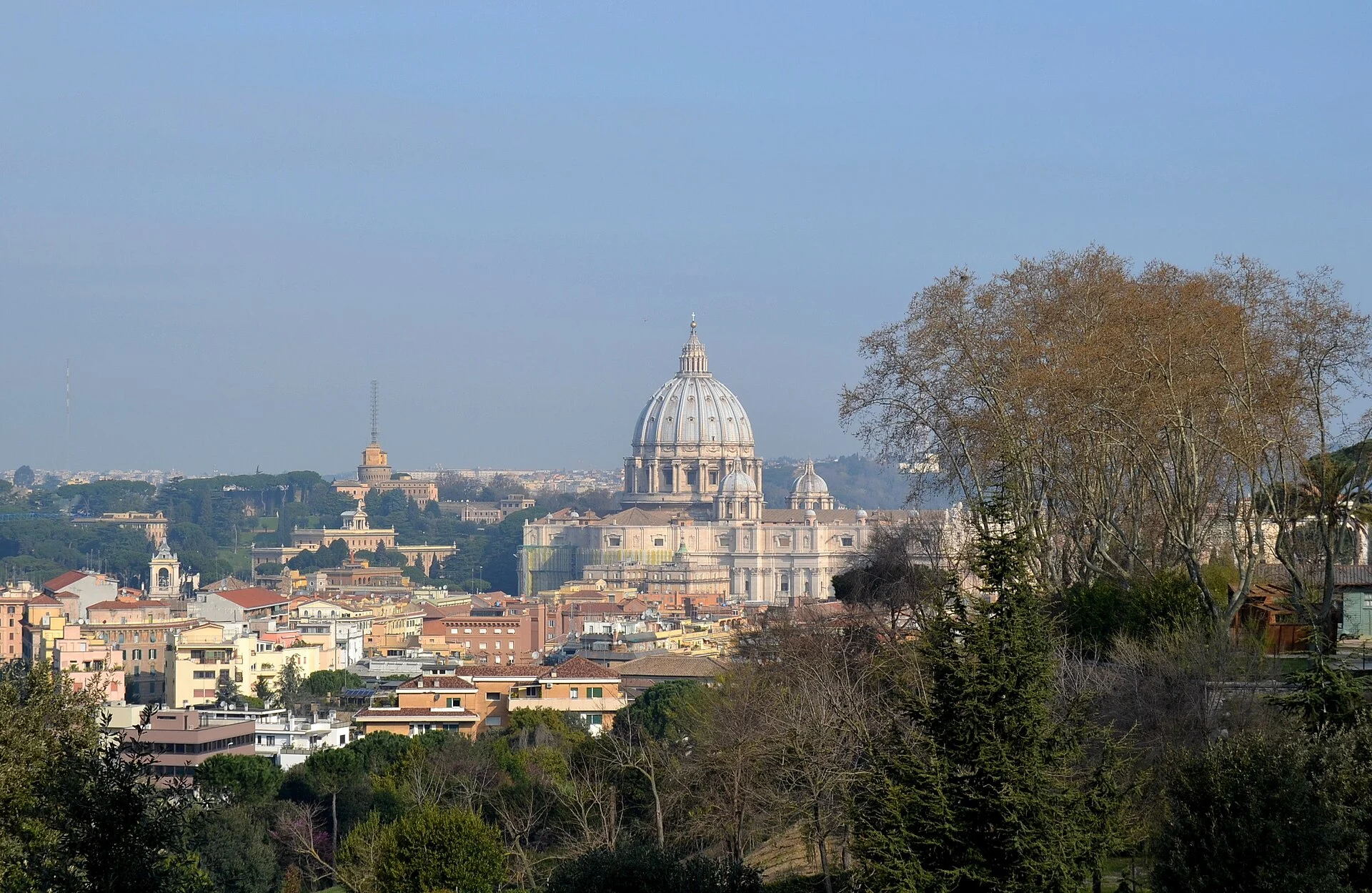
The Rome viewpoints that are really worth it are almost all free and outdoors: the Pincio terrace above Piazza del Popolo, which the Sovrintendenza Capitolina lists as always open, Piazzale Garibaldi on the Janiculum, the Giardino degli Aranci on the Aventine, open from 7:00 to 18:00 from October to February. You pay to climb the monuments: 18 euros for the Quadrighe terrace of the Vittoriano, 18 for Castel Sant'Angelo, online booking on the Vatican portal for the dome of St. Peter's.
We lined up 12 public places with three simple criteria. You must be able to reach them without buying anything, the view must be real and not a slit between two pines, and whoever runs them must publish hours and conditions. No terraces of bars, restaurants or hotels: there are quite a few, all paid, and we don't recommend them by name. There is no objective ranking. There are right hours and wrong hours for each place.
The hours, prices and access conditions reported here correspond to the check of September 29, 2026 on the operators' sites: Sovrintendenza Capitolina, VIVE for the Vittoriano, Fabbrica di San Pietro, the National Museums Directorate of the city of Rome, Musei Capitolini, RomaNatura. There is an upcoming change to keep in mind: from October 26 the dome of St. Peter's switches to winter hours and closes an hour earlier. Before climbing, a check on the operator's site saves you the surprise.
Where they are and what you really see
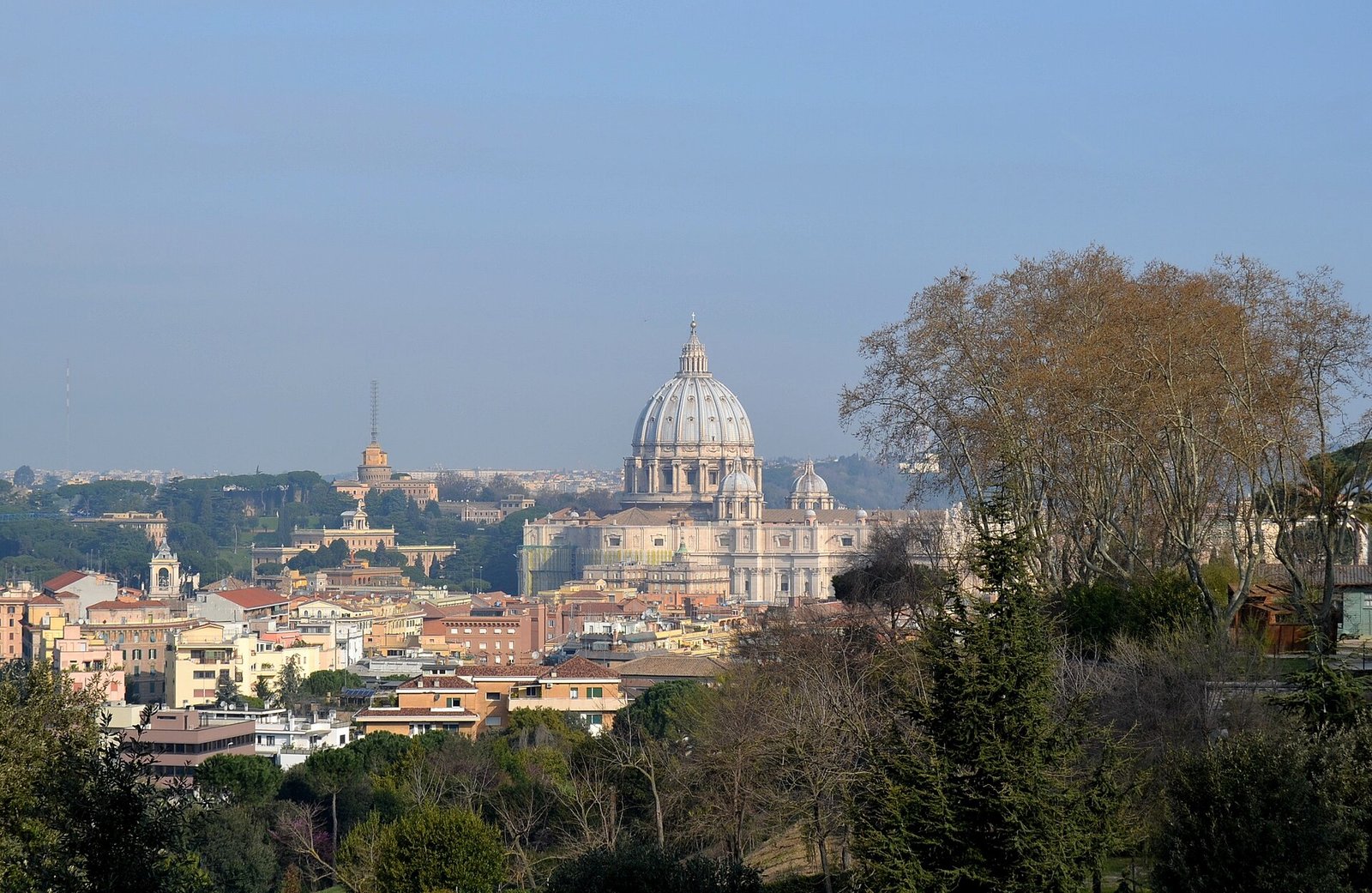
Rome is looked at from two banks. On the right of the Tiber are the Janiculum and the hill of Monte Mario, which face east and take the city head-on. On the left are the Pincio, the Aventine, the Capitoline and the Colle Oppio, which face west or sideways. This geography decides the light, the photo and the hour when it's best to climb, much more than the fame of the place.
The 12 places are these. Free and outdoors: the Pincio terrace, the staircase of Trinità dei Monti, Piazzale Garibaldi, the Orange Garden, Piazza dei Cavalieri di Malta with its keyhole, the square of the Capitoline Hill, the Monte Mario belvedere, the Colle Oppio, Villa Celimontana. Paid: the Vittoriano, the dome of St. Peter's, Castel Sant'Angelo.
What you recognize, concretely. The domes first of all: St. Peter's, which dominates from almost every point, then Sant'Andrea della Valle, the low cap of the Pantheon, the square dome of the Synagogue near the Tiber. The white of the Vittoriano, which is seen from everywhere and has divided Romans for a century. The Quirinale with its little tower. In the background, on clear days, the Colli Albani to the southeast and the Sabine mountains to the northeast.
Rome has a low, horizontal skyline, without skyscrapers until EUR, and this throws off people arriving from Paris or London. There is no point from which the whole city opens up like a postcard. There are different cuts, each with its own monuments in the foreground. Whoever sees three in a day understands the shape of the city better than with a week spent walking in the alleys of the center.
We state the limits right away. Pines grow and close the views, and at some city-run belvederes pruning doesn't keep pace. The paid terraces have lines, security checks and glass that reflects. The free belvederes at sunset are crowded, with street vendors and amplified musicians. None of these defects is enough to give up, but they change the hour to go, and we discuss it place by place.
The Pincio, the terrace over Piazza del Popolo, and Trinità dei Monti
The Pincio terrace is Piazzale Napoleone I, on the western edge of Villa Borghese, above Piazza del Popolo. The Sovrintendenza Capitolina lists the promenade as always open and entrance is free. The published accesses are Via Gabriele d'Annunzio, that is the ramp that climbs from the square, Viale di Villa Medici and Viale delle Magnolie. From the square on foot it's 10 minutes of gentle climb.
The view goes west. The dome of St. Peter's dominates the horizon, Monte Mario closes it on the right, the Quirinale stays on the left, and in the distance you recognize the Janiculum with the equestrian monument to Garibaldi. Below, Piazza del Popolo with the obelisk and the twin churches works like a theater seen from the gallery. It's the most orderly panorama in Rome, because it was designed on purpose to be looked at from here.
The history is told by the Sovrintendenza itself. The promenade was born with the Napoleonic administration, installed in Rome from 1810, which wanted to arrange Piazza del Popolo as the gate of the city and give Romans a public space to walk. The initial project by Louis Martin Berthault was taken up by Giuseppe Valadier after 1814, with works that continued until 1834. In 1849 the first 50 busts of illustrious men arrived, today there are 229.
Along the avenues you meet the Pincio obelisk and the hydrochronometer, the water clock built between 1873 and 1880, which children adore. Whoever continues south arrives at Villa Medici and then at the top of the staircase. Whoever instead goes into the park finds the least frequented part, with the little lake and its romantic-garden architecture.
The best moment is not sunset, even though everyone goes at that hour. Looking west, with the sun dropping behind St. Peter's, you see silhouettes in backlight and little else. Better early in the morning, when the light comes from behind you and hits the facades, or the blue hour after sunset, when the lampposts of the square turn on. In mid-afternoon in summer the terrace is an oven with no shade.
The staircase of Trinità dei Monti is a public street, with no ticket and no hours. It connects Piazza di Spagna, with the Barcaccia, to the church that gives it its name. It was built in the 1720s on a design by Francesco De Sanctis, financed with a French bequest, and since then it has been a place where Rome goes to be seen more than to see.
From the top, next to the obelisk, the view is middling and it has to be said. You see the axis of Via Condotti, the roofs of the Tridente, a few bell towers and, in the background, the dome of St. Peter's. It's not a 360-degree belvedere. The value is the scene below you, the square and the fountain. Remember that the urban police regulation forbids sitting on the steps: the fine comes, and the traffic police really do give it.
At the foot of the staircase, on the right going up, is the Keats-Shelley House, the house where the English poet died. From the top, walking along Viale della Trinità dei Monti, in 10 minutes you are back at the Pincio on a walk that has the city on your left the whole time. It's the simplest way to join two viewpoints without transport and without effort.
A curiosity about the viewpoints of Rome
The best views of Rome don't come from the seven hills. The Janiculum, on the right bank, is not one of the seven. Neither is Monte Mario, and it is the highest point of the city, around 139 meters according to RomaNatura. The Pincio, which the ancients called Hill of the Gardens for the gardens of the rich families, was outside the traditional count. The three most frequented belvederes are therefore second-tier hills in classical geography.
Of the canonical seven hills, few offer a worthy panorama. The Aventine has the Giardino degli Aranci. The Capitoline has the balconies over the Forum and the terrace of Palazzo Caffarelli. The Esquiline has the Colle Oppio, which looks at the Colosseum. The Palatine has stupendous views over the Forum and over the Circus Maximus, but it is inside an archaeological park with a ticket. The Quirinal and Viminal, densely built, have no significant public belvederes.
The reason is simple and is understood with a hand on the map. The seven hills are modest, eroded by 3,000 years of city built on top, and the valleys between them were filled with rubble and buildings. The Janiculum and Monte Mario, on the contrary, are true ridges, steep, partly still green, and they look at the city from across the river.
The practical consequence is that the visitor who wants to climb the seven hills to see Rome from above is disappointed, while the one who crosses the Tiber finds the wide views. It should be said before departure: the sacred hill does not coincide with the panoramic hill. Ancient Rome looked inward, among the hills. Modern Rome discovered the panorama from the heights that the ancients left to gardens and tombs.
The Janiculum, from Piazzale Garibaldi to the lighthouse
The Janiculum is a public promenade, with no gates, no ticket and no closing hours. The central point is Piazzale Giuseppe Garibaldi, with the equestrian monument to the hero of two worlds, and the road continues north to Sant'Onofrio. Whoever climbs from Trastevere on foot should allow about 20 minutes of ramps and little staircases, with your breath making itself felt in the last stretch.
The view looks east and takes in the whole historic center head-on. From left to right you recognize the Quirinale, the dome of Sant'Andrea della Valle, the cap of the Pantheon, the white Vittoriano, the dome of the Synagogue, and on clear days the Colli Albani closing the horizon. It's the most complete view of Rome at roof level, because the distance allows you to take in the city without crushing it.
Below the square, on the city side, at noon the cannon fires. The shot happens every day, blanks, and it's the time signal that for almost two centuries has regulated the bell towers of Rome. Arrive at 11:45 and stand on the parapet above the emplacement: the noise is loud, children are scared the first time and want to come back the second. We tell the story of the cannon further on.
Going down toward Trastevere you meet the Acqua Paola Fountain, which Romans call the Fontanone, with a square in front from which the view is almost the same as from Piazzale Garibaldi but lower and closer to the roofs. A little below are San Pietro in Montorio and the Tempietto del Bramante, which is a sufficient reason to climb even without the panorama.
Along the promenade are the busts of the Garibaldians, the monument to Anita Garibaldi, the lighthouse donated by the Italians of Argentina, which lights up in the evening with the colors of the flag. Further down, toward Porta San Pancrazio, the Janiculum Ossuary Mausoleum holds the remains of those who fell for Rome as capital. The whole hill is a story of the Risorgimento, and the panorama is its scenery.
The best moment is late afternoon until sunset, because the sun drops behind you and lights up the facades and domes in front. On summer evenings the square fills up, with vendors and cars parked everywhere. Early morning is empty but the light is against you. Whoever has only an hour and wants the best view of the city free and without a line chooses the Janiculum at six in the afternoon.
Something nobody tells you about the viewpoints of Rome
Orientation matters more than height. The Janiculum and Monte Mario face east: at sunset the sun is behind you and the city lights up gold in front. The Pincio, the Giardino degli Aranci, the Caffarelli terrace face west or northwest: at sunset you have the sun in your face and see dark silhouettes against the orange sky. They are two different spectacles. The trouble is that almost everyone picks the wrong place for what they want to see.
If you want to recognize the monuments, read the facades, count the domes, at sunset go to the right bank. If you want the sky changing color and the silhouette of St. Peter's, go to the left bank, knowing that you'll see little else. And the morning works the opposite way: the Pincio and the Aventine have the light behind you and become the right places for sharp photos, with the city lit in front.
The second thing that is said little: the declared heights don't match. For the Quadrighe terrace of the Vittoriano the operator, VIVE, writes 70 meters, while the tourist portal of Roma Capitale gives 80. The sources don't agree, and the difference probably depends on the point from which it's measured, the square or the base of the monument. For the visitor nothing changes, but it's a good example of how numbers circulate uncontrolled.
Third thing, the most useful. Wind counts as much as light. On tramontana days, the cold wind from the north that often follows rain, the air of Rome gets cleaned and from any belvedere you see the Colli Albani, the Monti Lucretili and sometimes the snow-capped peaks in winter. With the scirocco, on the contrary, a yellow haze flattens everything. Check the wind before paying for a climb.
The Aventine: the Giardino degli Aranci and the keyhole
The Giardino degli Aranci is the common name of Parco Savello, on the Aventine. The entrances indicated by the Sovrintendenza are Piazza Pietro d'Illiria, Via di Santa Sabina and the Clivo di Rocca Savella. Entrance is free. The published hours are 7:00 to 18:00 from October to February, 7:00 to 20:00 in March and September, 7:00 to 21:00 from April to August. The garden measures about 7,800 square meters.
The Sovrintendenza reconstructs the history of the place. The park occupies the area of the small fortress that the Savelli family built between 1285 and 1287 next to the basilica of Santa Sabina. The area was for a long time the vegetable garden of the Dominican fathers and the current garden was designed in 1932 by Raffaele De Vico, with a symmetrical layout and a central avenue that points straight to the belvedere. The orange trees recall the Dominican tradition of the convent.
From the overlook you see the city from the bend of the Tiber to St. Peter's. In the foreground are the rooftops of Trastevere and the Tiber Island just to the right, and in the background the Janiculum and the Vatican dome. The terrace faces northwest, so at sunset you're looking straight into the light. In the morning, with the park just open and the light behind you, the colors are sharp and the visitors few.
200 meters farther on, along Via di Santa Sabina, past the church of Santi Bonifacio e Alessio, you come to Piazza dei Cavalieri di Malta, designed by Giovan Battista Piranesi in 1765. The green door of the Villa del Priorato di Malta has a keyhole through which you see the dome of St. Peter's framed by the garden hedges. It's free and it's a public square.
On the keyhole, it's best to separate the levels. Documented is Piranesi's design for the square and for the church of the Priory. Local tradition is the idea that the alignment of keyhole, avenue and dome was sought on purpose. Tourist legend is the line about three states in one glance: the villa is property of the Order of Malta with a special status, but it is not a state, and the garden is in Rome.
Now the opposing view, which I defend with any group. The keyhole is overrated. On weekends you wait 20 or 30 minutes in line for five seconds of a small dome at the end of a green tunnel, and the phone photo almost always comes out blurry. If there's a line, move on: the Giardino degli Aranci, 200 meters back, gives you the same dome 10 times bigger and with no wait.
Anyone going down from the garden along the Clivo di Rocca Savella, a sloping medieval staircase, reaches the Tiber embankment in five minutes. Anyone staying up top can finish the loop of the Aventine with Santa Balbina, or head down toward the Circus Maximus. The hill is residential and quiet, and for walking it's the most restful neighborhood in the center.
My advice for visiting the viewpoints of Rome
Don't try to do everything at sunset. It's the most common mistake of first-time visitors. Build the day around orientation: in the morning the overlooks that face west, meaning the Pincio, the Giardino degli Aranci and the Capitoline terrace, with the sun behind you. In the late afternoon the ones that face east, meaning the Janiculum and Monte Mario. The paid terraces in between, when the light is flat and the height is what counts.
For the paid climbs, check the closing times first of all. The dome of St. Peter's closes at 18:00 until October 25 and at 17:00 from the next day, according to the Basilica's website: you almost never see the sunset from up there. The Vittoriano closes at 19:30 with last entry at 19:00. Castel Sant'Angelo closes at 19:30 with last entry at 18:30 and is closed on Mondays.
Buy paid tickets only on the official sites, and do it for a specific time. The Basilica sells the dome online with a QR code and does not refund tickets, except for cancellations due to liturgical needs. The Vittoriano has a ticket that's valid for seven days for all areas of the complex. Castel Sant'Angelo and the Vittoriano are free on the first Sunday of the month, with long lines and little chance to enjoy the terrace.
Bring water, closed shoes and a light jacket even in summer. On the dome there are 551 steps in all, 320 if you take the elevator up to the terraces, and the Basilica advises against the climb for people with heart problems, vertigo or claustrophobia and for pregnant women. On the high terraces of the Vittoriano and Castel Sant'Angelo the wind picks up suddenly, and October evenings up there feel almost cold.
One last piece of advice, the most important for groups. Don't put more than three viewpoints in the same day. After the third, the city seen from above starts to look the same and the tiredness from the climbs adds up. Better two views at the right times, with time to recognize what you're looking at, than five terraces done in a rush with the phone held up. You understand a panorama by standing still for 10 minutes.
The Vittoriano and the Quadrigas terrace
The panoramic terrace of the Vittoriano is at the top of the monument to Vittorio Emanuele II, on Piazza Venezia, and you reach it by a glass elevator. The operator is VIVE, the Ministry of Culture institute that runs the Vittoriano and Palazzo Venezia. Published hours: every day from 09:30 to 19:30, last entry at 19:00, ticket office until 18:45. Full price €18, reduced €5 for European citizens between 18 and 25.
The ticket is bought on the official site of VIVE, on the terrace information and hours page, or at the ticket office. The operator lists free entry for under 18s, for people with disabilities and for other categories by law, and free entry for everyone on the first Sunday of the month, with tickets valid only on the day of issue. The full ticket includes the temporary exhibition currently on and is valid for seven days for all areas of the complex.
From the top the view is 360 degrees, and this is the real advantage of the Vittoriano over all the other overlooks. On one side the Colosseum and the Imperial Forums along the axis of the street, on the other the Capitoline Hill and the rooftops of the Ghetto, to the north the Quirinal, and in the distance the EUR district. No other point in Rome puts the ancient city and the Baroque one in front of your eyes together.
The two bronze quadrigas that give the terrace its name celebrate the Unity and the Liberty of Italy and were placed on the propylaea in 1927, 16 years after the monument's inauguration. The operator describes an elevator that seems suspended in the void and takes about a minute. Rome's city tourism portal notes that the elevators were inaugurated in 2007. Below you is the Brasini Wing, which hosts the exhibitions.
The joke Romans have repeated for decades is that the Vittoriano has the best view in Rome because it's the only place from which you can't see the Vittoriano. It's a joke, but it says something true. The monument is enormous, bright white, out of scale with the rest of the center, and from up there it disappears. What's left is the city as it was before they built it, with Michelangelo's Capitoline Hill becoming the protagonist again.
The limits. The line for the elevator in the middle hours of weekends can exceed half an hour. The terrace has glass parapets that reflect the afternoon lights and ruin photos. The security check at the entrance slows everything down. The best time is the last hour before closing: in summer the light is warm and from the side, and the early-afternoon crowd has already gone.
The dome of St. Peter's
The dome sits above St. Peter's Basilica and is run by the Fabbrica di San Pietro. The official site lists summer hours from 07:00 to 18:00 until October 25, 2026 and winter hours from 07:30 to 17:00 starting October 26, with possible changes for celebrations. There are 551 steps in all. With the elevator, which only goes up to the level of the terraces, 320 remain.
The climb can only be booked online on the official website of St. Peter's Basilica, with two options, elevator or on foot, both including access to the basilica with a digital audio guide. The fares appear in the purchase portal and not on the information pages. The operator states that tickets are non-refundable and cannot be changed, and that for clergy, schools and groups, reductions must be requested directly from the Visits Office.
The published procedure includes a security check in Piazza San Pietro and assignment to one of the two access routes, called Sobieski and Lambertini, with the QR code. Large backpacks, trolleys and animals are not allowed, and shoulders and knees must be covered. The visit lasts an hour on average. The basilica time is assigned an hour before or an hour after the dome time, depending on expected attendance.
The view from the lantern is the highest in Rome open to the public. Below opens the square with Bernini's colonnade and the Vatican obelisk, straight ahead the axis of Via della Conciliazione to Castel Sant'Angelo, and behind, the Vatican Gardens with their little villas. The city is far away and reads like a map. The panorama over the Vatican, instead, is unique: from no other point do you understand how the smallest state in the world is laid out.
Before the lantern there's the inner ring, overlooking the nave. It's the moment almost everyone forgets to mention and the one I like best: the mosaics of the drum seen up close, with tesserae as big as a thumb, and below, the baldachin reduced to a toy. Then the last stretch, narrow, with slanted walls that follow the curve of the dome. Anyone who suffers in enclosed spaces needs to know this beforehand.
The right moment depends on what you want. Starting the day at 07:00 means short lines and an empty square, but the light comes from the east and hits you in the face when you look toward the city. In the afternoon the light is better on the square and on Rome, but the line gets longer. For a group I always pick the first slot. For a photographer, the second to last, knowing you pay in waiting what you gain in color.
A note of history for those who climb. The design of the dome is Michelangelo's, who died in 1564 with the drum completed. The dome shell was vaulted between 1588 and 1590 by Giacomo Della Porta with Domenico Fontana, with a more slender profile than Michelangelo's. Anyone who wants to complete the visit of the underground complex will find the information in the page on the Vatican Necropolis.
Another well-known fact, yet rarely mentioned
That the Janiculum cannon fires at noon, everyone knows. That it has moved house several times, few know. The reconstructions published by the Roman press date the beginning to December 1, 1847, at the wish of Pius IX, who wanted a single signal to bring the city's bell towers into agreement, each until then with its own time. The first cannon fired from Castel Sant'Angelo, then it was moved to Monte Mario.
The definitive transfer to the Janiculum dates to January 24, 1904. The shot stopped with the Second World War and resumed on April 21, 1959, on the day of the Birth of Rome. The piece of today, according to the same sources, is an assemblage: a 105/22 gun barrel mounted on an 88/27 carriage, both used during the war. The firing is done by Army personnel.
The most interesting detail concerns the signal. Today the order arrives by telephone. Originally it arrived by an optical system from the observatory of the Collegio Romano, which measured true noon with astronomical instruments and transmitted it to the post. A cannon shot as the terminal of an observatory: papal Rome used its panoramas also to synchronize time, and this explains why the post has always been up high.
There's a second well-known and little-told fact, and it concerns all the paid terraces. Castel Sant'Angelo and the Vittoriano are free on the first Sunday of the month, both operators say so. Almost nobody adds that on that very day the terraces are the most crowded of the year. If you care about the view and not about saving money, the first Sunday is the day to avoid.
Castel Sant'Angelo and the Angel terrace
Castel Sant'Angelo is at Lungotevere Castello 50 and is run by the Direzione Musei nazionali della città di Roma. Published hours: Tuesday to Sunday from 09:00 to 19:30, last entry at 18:30, closed Monday, January 1 and December 25. From July 1, 2026 the full ticket costs €18, the reduced ticket for European citizens between 18 and 25 €2. On the first Sunday of the month entry is free without reservation.
The ticket is purchased through the website of the Direzione Musei nazionali della città di Roma or at the castle ticket office. Until December 31, 2026, according to the operator, the same ticket gives the right to one free entry to the Casa Museo Hendrik Christian Andersen and the Casa Museo Boncompagni Ludovisi, on the day of the visit or the two following. For information the published phone number is 06 6819111.
The terrace is at the top of the route and hosts the bronze angel by Pietro van Verschaffelt, from 1752, which recalls the vision of the archangel Michael reported of Pope Gregory the Great. To get there you cross the whole monument: the circular ambulatory, the ramp of the dromos that rises inside Hadrian's mausoleum, the Courtyard of the Angel, the Renaissance rooms. Allow at least an hour and a half. There is no direct access to the terrace.
The view is the closest to St. Peter's among the paid ones, and the most tied to the river. Below you see Ponte Sant'Angelo with its statues of angels, the Tiber as it bends, the Prati district with the Palace of Justice, and to the east the domes of the historic center. St. Peter's presents itself from the side, along Via della Conciliazione, with a perspective you don't get from the square.
The light works the opposite way from the Janiculum. In the morning the sun lights the facade and the Vatican dome from the front, in the afternoon it puts them against the light but lights up the historic center on the other side of the terrace. For anyone with only one choice I recommend late morning, when the school groups have already left the upper rooms. In the late summer afternoon the terrace fills up and it becomes hard to get near the parapet.
On Monday the castle is closed under the ordinary hours. The operator has however published an initiative dedicated to Mondays, with its own fare, between August and December 2026: the dates and the open route must be checked on the site before showing up. Another occasion tied to the castle is the Girandola, the historic fireworks show, watched from below, along the river.
The Capitoline Hill and the Caffarelli terrace
Piazza del Campidoglio is public and always accessible, and you reach it from the Cordonata that climbs from Piazza d'Aracoeli. The free overlooks are at the sides of the Palazzo Senatorio: going down to the right or left of the building you reach the balconies facing the Roman Forum, with the Arch of Septimius Severus in the foreground and the Colosseum in the background. It's the most famous view of the Forum, and it costs nothing.
The terrace of Palazzo Caffarelli is instead part of the complex of the Capitoline Museums. The museum presents it on its website as the panorama from the terrace of Palazzo Caffarelli and makes it available also for private events, but on the information pages it does not specify the conditions of access for visitors. Before counting on that view, ask the Roma Capitale contact center, 060608, if the terrace is open on the day you choose.
The Capitoline Museums ticket is bought on the official website of the Capitoline Museums. Ordinary fare €15 full and €9.50 reduced for non-residents, €16.50 and €11 with the exhibition running until November 1. Residents of Rome and the metropolitan city enter free with ID. Open every day from 09:30 to 19:30, last entry one hour earlier, closed May 1 and December 25.
Inside the museum, the view worth the ticket is the one from the Tabularium, the underground gallery that connects the Palazzo dei Conservatori to the Palazzo Nuovo passing under the Senatorio. From the openings you see the Forum from above, framed by the ancient arches, with a perspective the outside balconies don't give. For me it's the most thrilling viewpoint in Rome, and almost nobody gets there because it's halfway through the route.
From the Caffarelli terrace, when it's open, the view goes west: the domes of Sant'Andrea della Valle and St. Peter's, the rooftops of the Ghetto, the Janiculum on the horizon. At sunset it's full backlight. Next to the Capitoline, the staircase of Santa Maria in Aracoeli offers another free view over Piazza Venezia, from the church door, at the top of a steep staircase that discourages almost everyone.
The right photo to take at the viewpoints of Rome
The right photo is taken from the Janiculum, in the last hour of light, with a medium telephoto lens or with the phone zoom at maximum optical quality, not digital. Aim at the domes of the center: the distance squashes them one onto the other and the result looks like a stone nativity scene. The wide angle, on the contrary, pushes everything away and turns St. Peter's into a pin on the horizon. Rome from above is told in overlapping planes.
From the Vittoriano the photo to take home is the axis of the Imperial Forums with the Colosseum at the end, taken from the side of the terrace that faces southeast. Rest the lens against the glass, with your hand cupped around it, to eliminate reflections. Avoid the middle hours, when the sun falls from above and flattens the travertine. The last hour before closing, in summer, gives long shadows inside the forums.
From the keyhole the photo only works with a few tricks. The phone has to rest against the plate, the focus has to be tapped on the dome and the exposure lowered, otherwise the sky burns out and the hedges turn black. If there's a line, give up and don't make the others wait. The keyhole photo already exists in millions of copies, and yours won't improve on it.
From the Pincio the best photo is not the dome but the square. Stand at the corner of the balustrade and shoot Piazza del Popolo from above, with the obelisk in the center and the two twin churches that open the Tridente. At blue hour, with the streetlamps on and the sky still light, the geometry of Valadier's square reads better than at any other hour.
The photo not to take, or at least not to take only, is the horizontal panorama in the phone's automatic mode. The result is a strip of rooftops that's the same from any overlook. Pick a subject in the foreground, a pine, a statue, the balustrade, and put the city behind it. It's the principle the painters of the Grand Tour applied two centuries ago, and it still works.
Monte Mario, Colle Oppio and Villa Celimontana: the overlooks of the Romans
Monte Mario is the highest point of the city, around 139 meters according to RomaNatura, the regional body that manages the Monte Mario Nature Reserve. The published entrances are Piazzale Maresciallo Giardino, Via dei Casali di Santo Spirito, Via del Parco della Vittoria and Viale del Parco Mellini. Access is free. The operator gives no hours on the trails page: the published reference is the office at Via dei Casali di Santo Spirito 40, phone 06 35491587.
The overlook Romans have known for generations is along Viale del Parco Mellini, at the top of the hill. The view goes east and southeast and takes in the city from the north: the Foro Italico and the stadium below, then the dome of St. Peter's, the historic center and, on clear days, the Alban Hills. At sunset the light comes from the west and lights it from the front. There are private terraces in the surroundings, we don't recommend them by name.
Anyone who prefers to get there on foot can use the paths of the reserve. RomaNatura describes three routes, including the trail toward the hill of the Monte Mario Observatory, one kilometer in about 40 minutes, with openings onto the city, the Foro Italico and Villa Madama. It's the only overlook in Rome you earn with a real walk in the woods, and on summer evenings it's frequented almost only by Romans.
The Colle Oppio is part of the Esquiline and today is a public park open from 07:00 to sunset, according to the Sovrintendenza, with entrances from Viale del Monte Oppio, Via delle Terme di Traiano, Via Mecenate, Via Labicana, Via Nicola Salvi and Via delle Terme di Tito. The park measures about 11 hectares. Raffaele De Vico designed the first part between 1928 and 1932, Antonio Muñoz the upper archaeological sector between 1935 and 1936.
The view from the Colle Oppio is not wide but it's the closest to the Colosseum. From the edge of the park toward Via delle Terme di Tito the amphitheater appears three-quarter on, from above, with the arches that you can count one by one. Under the lawns are the Domus Aurea and the Baths of Trajan. In the morning, with the light from the east, the travertine is warm and golden.
Villa Celimontana opens from 07:00 to sunset, according to the Sovrintendenza, with entrances from Via della Navicella and from Piazza dei Santi Giovanni e Paolo. Born as the garden of the Mattei family at the end of the 1500s, it has been open to the public since 1928 and keeps an Egyptian obelisk. We put it on the list with a reservation: it's not a real overlook, and among the trees the openings onto the city are brief.
What you see, from the southern side, are glimpses toward the Baths of Caracalla and toward the Aventine, more an impression of green than a panorama. It's worth it as a break between one climb and another, in the shade, after the basilica of Santi Giovanni e Paolo and before Santo Stefano Rotondo. Anyone who arrives on the Caelian looking for the wide view is disappointed, anyone looking for a quiet hour finds it.
Some important events that happened here in history
In 590, according to the handed-down account, Pope Gregory the Great was leading a procession against the plague when he saw the archangel Michael sheathing his sword on top of Hadrian's mausoleum. The documents attest the plague and the pontificate. Tradition attests the procession. The vision is devout legend, and it's what gave the castle its name and the terrace its statue, rebuilt several times up to the bronze of 1752.
In May 1527 the imperial troops sacked Rome and Pope Clement VII took refuge in Castel Sant'Angelo, reaching it from the Vatican through the Passetto di Borgo, the fortified corridor above the walls. From the terrace the pope saw the devastated city. It's the moment when the castle proved its function as a papal fortress, the one it had been transformed for in the previous centuries.
Between 1588 and 1590 the shell of the dome of St. Peter's was closed, and since then Rome's profile has had a center. All the overlooks described here orient themselves in relation to that silhouette. In 1765 Piranesi redesigned Piazza dei Cavalieri di Malta on the Aventine. Between 1811 and 1834 Valadier built the Pincio promenade, the first overlook conceived for the city's public and not for a private patron.
In 1849 the Janiculum was the theater of the defense of the Roman Republic against the French troops, with fighting around Porta San Pancrazio and the nearby villas. The busts of the defenders along the promenade, the monument to Garibaldi and the Mausoleo Ossario recall those days. Anyone who wants to understand the battle will find the story in the Museum of the Roman Republic, inside Porta San Pancrazio.
In 1911 the Vittoriano was inaugurated for the 50th anniversary of Unity, still incomplete. On November 4, 1921 the Unknown Soldier was entombed there. In 1927 the quadrigas arrived. In 1932 De Vico designed the Giardino degli Aranci, and in the same years the Colle Oppio became a public park. In a little over 20 years Rome gave itself almost all the public overlooks we use today, with a precise political design.
Who has passed through the viewpoints of Rome
Michelangelo, first of all, because he designed two of the places from which you look at Rome: Piazza del Campidoglio, with the Cordonata and the design of the pavement, and the dome of St. Peter's, which he didn't see finished. Giacomo Della Porta carried both building sites forward after him. Anyone who climbs the dome and then goes down to the Capitoline Hill on the same day walks inside two ideas of the same man.
Giuseppe Valadier, Roman architect, who gave the Pincio the form we know and worked for years on Piazza del Popolo. Giovan Battista Piranesi, Venetian engraver and architect, who signed Piazza dei Cavalieri di Malta and the church of the Priory, where he is buried. Raffaele De Vico, architect of the municipal gardens between the two wars, author of the Giardino degli Aranci and of the first part of the Colle Oppio.
Giuseppe and Anita Garibaldi, who in 1849 defended the Roman Republic on the Janiculum and today have two monuments there, facing each other. Torquato Tasso, the poet of Jerusalem Delivered, who died in 1595 in the convent of Sant'Onofrio, on the same promenade. What remains of the oak under which, according to tradition, he liked to sit is still pointed out to visitors.
John Keats, who died in 1821 in the house at the foot of the Spanish Steps, at 25. And a woman who never existed: Floria Tosca, the protagonist of Giacomo Puccini's opera, who in the last act throws herself from the ramparts of Castel Sant'Angelo. The opera debuted in Rome in 1900, and many visitors go up on the terrace looking for the exact point of the leap.
And the Romans themselves, who have always used the overlooks as open-air living rooms. Couples on the Janiculum in the evening, families at the Pincio on Sunday, students on the Colle Oppio after school. This is the difference between a tourist viewpoint and a city one: in the second you find people who aren't looking at the view, because they know it by heart and go there to be together.
How to line them up in one day
First version, for anyone with a full day and good legs. At 07:00 the dome of St. Peter's, first slot, with the square empty. At 09:30 Castel Sant'Angelo, a quarter of an hour on foot along Via della Conciliazione. Then the climb to the Janiculum from Sant'Onofrio, to be at Piazzale Garibaldi at 11:45 and hear the cannon. Lunch in Trastevere, coming down from the Fontanone.
In the afternoon you move to the left bank. Cross the Tiber at the Tiber Island and climb the Aventine to the Giardino degli Aranci, better after 16:00 when the heat drops. Then the Capitoline Hill with the balconies over the Forum, and at 18:30 the Vittoriano, for the last hour before closing. It's a full, tiring day, and it works only if you accept not entering any museum besides the castle.
Second version, slower and more Roman. In the morning the Pincio, with the light behind you, then the descent by Trinità dei Monti and Piazza di Spagna. Late morning at the Colle Oppio, in front of the Colosseum. Free afternoon, indoors or resting. At 18:00 the Janiculum, for the sunset from the right side, and dinner in Trastevere. Three panoramas, zero tickets, no lines.
For anyone short on time with only one panorama to choose, the rule is this. If it's your first time in Rome, the Vittoriano, because it gives you the ancient city and the modern one together and orients you for the rest of the trip. If you've already been to Rome, the Janiculum at sunset. If you're traveling with small children, the Pincio, which has a whole park around it and no mandatory steps.
Anyone who wants to widen the loop can add the view from Piazza del Quirinale, with the balustrade toward St. Peter's, free and always accessible, or climb the Monte dei Cocci in Testaccio on the days when it's open with a visit. Among our pages you'll also find the neighborhood of Tor Marancia, which you look at from below, facade by facade.
What not to expect, and what to eat nearby
Don't expect services at the free overlooks. At the Janiculum, the Pincio, the Giardino degli Aranci there are no reliable public restrooms, and the drinking fountains are the only free water. The benches are few and taken at sunset. The paid terraces have restrooms and cloakrooms, but the waiting times add up. Anyone traveling with elderly people has to count in the breaks, because every panorama costs a climb.
Don't expect the view promised in social media photos either. Many images are shot with long telephoto lenses and in rare light conditions, or retouched. From the keyhole the dome is small. From the Pincio the city is half visible. Villa Celimontana has glimpses, not panoramas. Knowing this beforehand avoids disappointment, and makes you appreciate more what's really there.
On eating, the rule holds especially near the viewpoints. Places in front of monuments and facing a view tend to adjust the price to the customer, with items without a price on the menu, dishes of the day at a variable amount and sometimes different price lists between the outside tables and the room inside. Always ask the price before ordering, and have them give you the written menu.
Other signs Romans know. Menus with laminated photographs of the dishes, translated into five languages. The person at the door who stops you to invite you in. The lady rolling out pasta in the window, which is theater and not a guarantee. Places open from morning to night with no break in the kitchen. None of these is a crime, but they are the reasons why people who live here don't sit at those tables.
The criterion is to look at who's sitting. If at lunch, on a weekday, you find office workers, laborers and local families speaking Romanesco, the kitchen works for customers who come back. If you find only visitors with backpacks, it's not a judgment, it's information. To avoid trial and error, here is our list of the places where we eat.
Frequently asked questions
What are the free viewpoints in Rome?
Free and open to the public are the terrace of the Pincio, listed as always open by the Sovrintendenza Capitolina, the Janiculum promenade with Piazzale Garibaldi, the Giardino degli Aranci on the Aventine, Piazza dei Cavalieri di Malta, the Trinità dei Monti staircase, the Capitoline balconies over the Roman Forum, the Monte Mario overlook, the Colle Oppio and Villa Celimontana, these last two from 07:00 to sunset.
How much does it cost to go up on the Vittoriano terrace?
The operator VIVE lists €18 for the full ticket and €5 for the reduced ticket for European citizens between 18 and 25, with free entry under 18 and for people with disabilities. The ticket includes the panoramic elevator and is valid for seven days for all areas of the complex. On the first Sunday of the month entry is free for everyone.
What time does the dome of St. Peter's close?
According to the Basilica's official website, the dome is open from 07:00 to 18:00 on summer hours, valid until October 25, 2026, and from 07:30 to 17:00 on winter hours, from October 26. Hours may change for religious celebrations. Booking is online, with a QR code, and tickets are non-refundable.
How many steps are there to climb the dome of St. Peter's?
The Basilica's website lists 551 steps for those who climb entirely on foot and 320 for those who take the elevator, which only goes up to the level of the terraces. The last stretch is narrow, with slanted walls. The operator advises against the climb for people with heart or breathing problems, vertigo, claustrophobia or mobility difficulties, and for pregnant women.
What is the best viewpoint for sunset?
To see the city lit at sunset the Janiculum is best, because it faces east and has the sun behind you. The Monte Mario overlook works the same way. The Pincio, the Giardino degli Aranci and the Capitoline terrace face west instead: at sunset they offer a colored sky with the silhouette of St. Peter's against the light, but little readable city.
Is the Aventine keyhole free?
Yes, the keyhole is in the door of the Villa del Priorato di Malta, in Piazza dei Cavalieri di Malta, which is a public square with no ticket and no hours. Through the keyhole you see the dome of St. Peter's framed by the garden hedges. On weekends a line forms that can take half an hour. Early in the morning you almost always get through right away.
Is Castel Sant'Angelo open on Monday?
Under the ordinary hours published by the Direzione Musei nazionali della città di Roma, Castel Sant'Angelo is open Tuesday to Sunday from 09:00 to 19:30, with last entry at 18:30, and is closed on Monday. For the period between August and December 2026 the operator has announced an initiative dedicated to Mondays with its own fare, to be checked on the site before the visit.
Where can you best see the Colosseum from above?
From above and free, the closest point is the edge of the Colle Oppio park, toward Via delle Terme di Tito, open from 07:00 to sunset. Paid, the Quadrigas terrace of the Vittoriano shows the Colosseum at the end of the axis of the Imperial Forums. The Palatine also offers views over the Colosseum and the Forum, within the route of the archaeological park with a ticket.
Who wrote this page
The page comes from the editorial team of Tour Leader Pro, the Roman outfit that designs itineraries, visits and cultural events between Rome and Lazio. Hours, fares and access conditions reported here come from the operators' official sources as of the date indicated at the top. Dome, terraces and gardens change hours with the seasons and with celebrations: check them again before you climb, and tell us what you find changed.
Building a day of panoramas in Rome means fitting together different closing times, light that changes direction, unpredictable lines on the free Sundays and climbs that add up in the legs, for yourself or for a group of 40 people of different ages. Anyone facing this kind of puzzle will find on Tour Leader Pro working materials made for those who guide and for those who organize on their own.
For the wide picture, meaning regional trains and seasonal timetables, rentals, airports, trips from one province to another and destinations in Lazio outside the center of Rome, from the Castelli to the volcanic lakes of the north to the Tyrrhenian coast and the villages of the interior, a useful resource for putting together a multi-day itinerary is Italy Planner.