Colle Oppio and the Baths of Trajan
In short. Colle Oppio is a public park of 11 hectares above the Colosseum, and under that lawn there are three different things that almost everyone confuses: the Baths of Trajan, the Baths of Titus and the Domus Aurea.
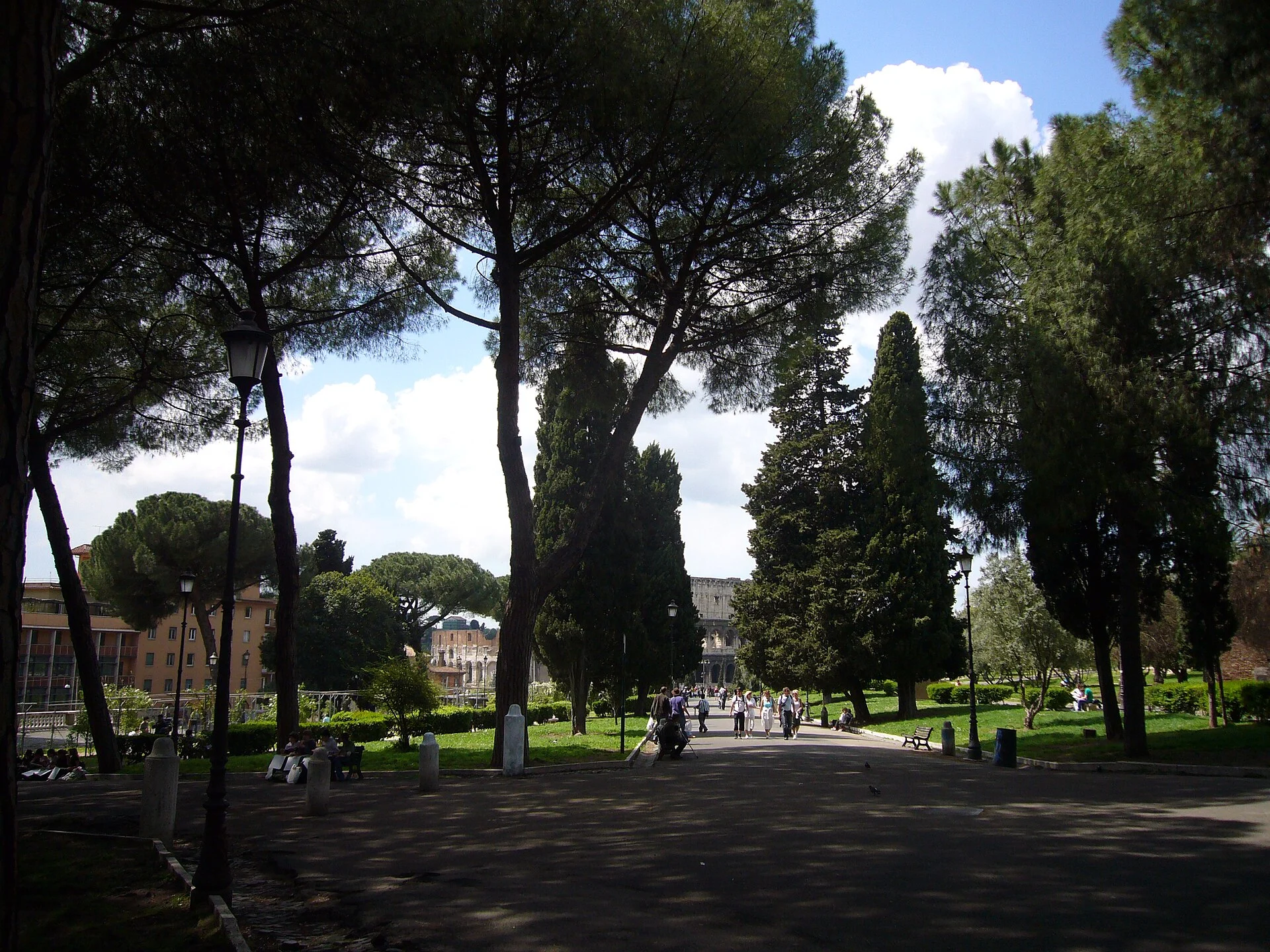
Colle Oppio is a public park of 11 hectares above the Colosseum, and under that lawn there are three different things that almost everyone confuses: the Baths of Trajan, the Baths of Titus and the Domus Aurea. The park can be crossed for free from 7:00 to sunset. The Baths of Trajan, since September 12, 2026, can be visited with a ticket and fixed slots. The Domus Aurea has a ticket office all its own.
People who come here generally have one thing in mind, Nero's house, and walk past the right ruins without looking at them. It's a shame, because the free part of this place is the biggest and the least trodden. The advice is always the same: the park first, the underground after.
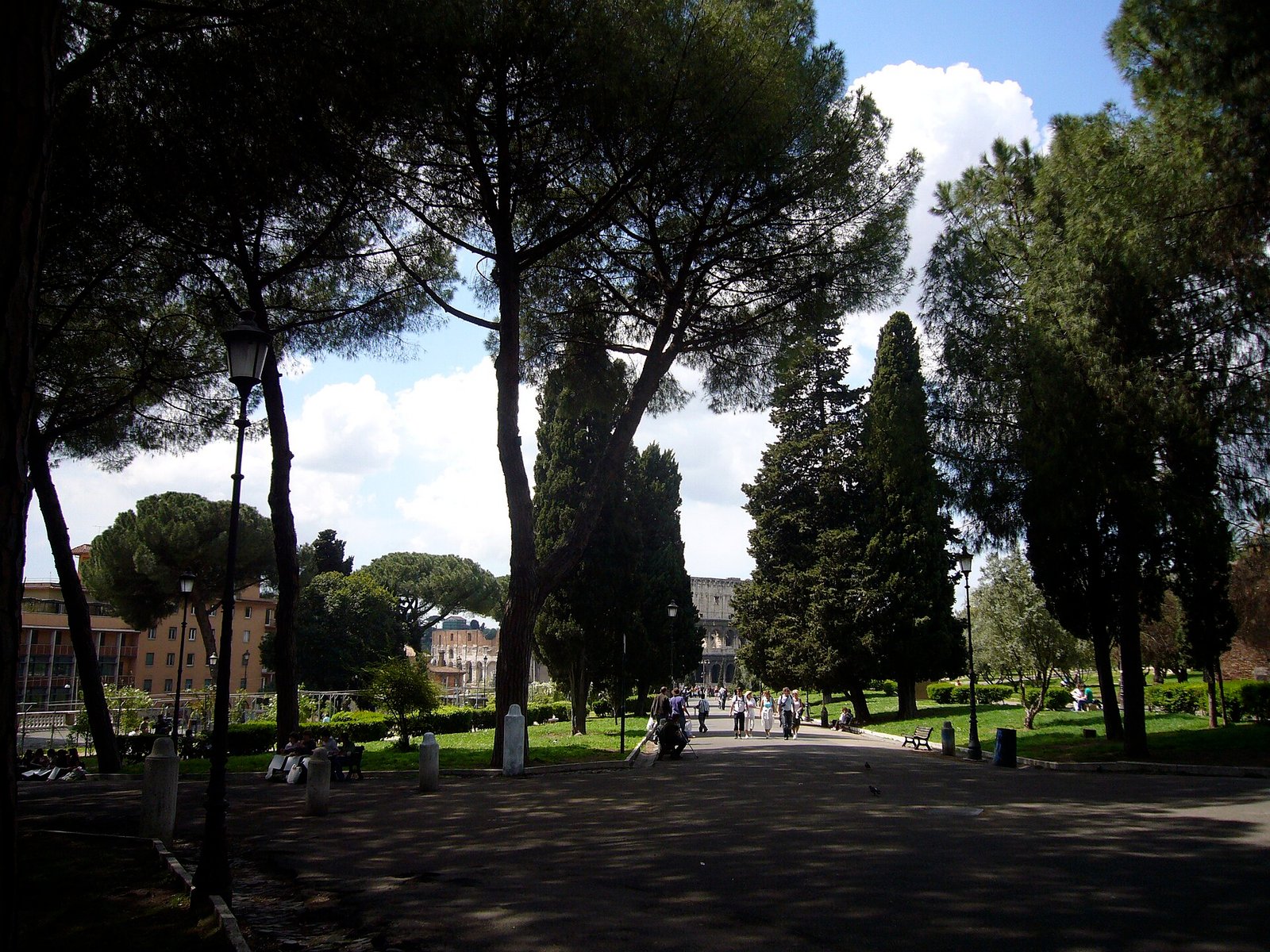
What you see today at Colle Oppio, free and paid
The free part is the park and its open-air ruins. You enter from Viale del Monte Oppio, Via delle Terme di Traiano, Via Mecenate, Via Labicana, Via Nicola Salvi and Via delle Terme di Tito: six gates, no ticket, no checks. Inside the enclosure substantial pieces of the Baths of Trajan are still standing, and you can touch them without paying anything.
The paid part is double and should be kept separate in your head. On one side the underground gallery of the Baths of Trajan with the exedra above it, run by the Sovrintendenza Capitolina. On the other the Domus Aurea, which sits under the same park but depends on the Colosseum Archaeological Park and has completely different prices, days and sales portal. Two ticket offices, two administrative worlds.
The Sette Sale, the great cistern that supplied the baths, are the third thing you'd like to see and today you can't. The address is Via delle Terme di Traiano 5b, and the Sovrintendenza Capitolina declares it temporarily closed to the public. Anyone who promises you a visit to the cistern without citing an official channel is selling you something that isn't open.
Then there are the remains nobody points out. The exedra of the eastern palaestra still keeps the semi-dome with its square coffers and a black and white mosaic floor. Next to it is the apse of a hall on the south side. A little farther, ancient masonry absorbed into a small anonymous building, which was the Brancaccio hunting lodge. No panel tells you about it properly.
Baths of Trajan, Baths of Titus, Domus Aurea: three distinct things
The Domus Aurea is the oldest of the three. Nero had it built after the fire of AD 64, and the Esquiline pavilion, the one that survives, is the private wing: more than 150 decorated rooms, arranged in two blocks, with the famous octagonal hall at the center. Of kitchens and latrines, in the whole excavated sector, no trace has been found. It lies under the park, not in the park.
The Baths of Titus come right after, in AD 80, more or less together with the inauguration of the Flavian amphitheater. They extended over an area of about 125 by 120 meters, between today's Via Nicola Salvi, Via delle Terme di Tito and Viale del Monte Oppio, and more than half was palaestra terrace. They were completed under Domitian. Very little remains today: a front of brick half-columns and stretches of masonry.
The Baths of Trajan are the last and by far the largest. Inaugurated on June 22, AD 109 on a design by Apollodorus of Damascus, they covered about 60,000 square meters. They arise after the fire of AD 104, which finished ruining what was left of Nero's palace. Apollodorus shaves off the upper floors of the Domus Aurea, fills the low rooms and keeps them as foundation.
The detail that clarifies everything is the orientation. The earlier structures, Domus Aurea and Baths of Titus, run on a north-south axis. The Trajanic complex rotates by about 36 degrees and sets itself on a northeast-southwest axis, to give the caldarium more sun and for longer. Walking in the park that double alignment can still be read, if you know where to look.
Anyone who confuses the three names isn't ignorant, they're in good historical company. In the 16th century Romans called all the ruins of the Oppio the Baths of Titus, the Trajanic ones included, and the artists who lowered themselves into the grottoes believed they were in the baths and not in a house. The confusion is 400 years old, and in part it's still on the signs.
A curiosity about Colle Oppio and the Baths of Trajan
The park's rose bushes draw the plan of what lies beneath. In 2015 and 2016, for the Jubilee of Mercy, the rose beds were restored following the layout of the buried Domus Aurea. In practice you walk over an imperial palace and its floor plan is marked on the surface by a garden plant. Very few visitors know it, and nobody tells them.
The thing has a practical logic, as well as a symbolic one. Over the vaulted rooms of the Domus Aurea you cannot plant tall trees: the roots break through, the water seeps in, the frescoes go. Roses have a contained root system. So what looks like an ornamental choice is a conservation choice, made by the archaeologists and not by the gardeners.
The rest of the vegetation tells instead of three seasons of different taste. There are the pines, holm oaks, cypresses and oleanders of the Mediterranean scrub. There are the palms, which were in fashion in the landscape garden of the early 20th century. And there are roses, myrtle and laurel, the species that really belonged in ancient gardens. Three ideas of a park in the same enclosure.
The underground gallery, the Painted City and the Great Mosaic
The gallery is about 70 meters long and it's not an ordinary service corridor. It was built to support the portico above, the one onto which the southwest exedra opens, the hemicycle about 30 meters in diameter traditionally read as a library. The two rows of niches probably served as cabinets for books and documents, the steps for those attending readings and meetings.
Inside the gallery is the room of the Painted City. The fresco measures about 10 square meters and shows, in a bird's-eye view, a port city girded by walls and towers: the main gate, the harbor, the street axes, a theater, a temple, a quadriporticus, whole neighborhoods of houses. It is a painted perspective plan, which in Roman archaeology is a true rarity.
What strikes you is the date. The building the plaster belongs to is earlier than the baths and dates to the 1st century AD, so to the Neronian-Flavian period. The Baths of Trajan were built over it, sealing it. What you look at is not bath decoration: it is a piece of an earlier city, cut and buried to make room for Apollodorus's construction site.
Next to it is the Great Mosaic, also called the mosaic of the Muse and the Philosopher. It is a wall covering, not a floor, and the walls have been brought to light to a height of about five meters. The design is an architectural elevation in two registers imitating a theatrical scaenae frons, with architraves, capitals, garlanded columns, plant scrolls, Dionysian symbols, statues and figures.
One figure in particular doesn't look like a generic type. The seated male statue at the center of the composition, from the way the facial features are treated, resembles a portrait of a real person. Who it is, nobody knows, and the official sources stop there without venturing names. Be wary of anyone who gives you a sure identification on a visit: there isn't one.
The PNRR excavation concluded in 2026 added unpublished material. A further decorated mosaic band emerged with a view of a port city, buildings facing the sea that go back to the motif of maritime villas. Under the mosaic decoration appeared the remains of a facing of large marble slabs and, at the center of the wall, a marble niche about 2.20 meters high.
From those data an enormous room is reconstructed. The richly decorated walls must have reached around 12 meters in height, and the hall faced a nymphaeum. This complex is also dated to the second half of the 1st century AD. Translated: under the baths there is no cellar, there is a monumental neighborhood crushed and preserved by the weight of what came after.
One thing nobody tells you about Colle Oppio and the Baths of Trajan
Before the archaeologists, gunpowder was made down here. The investigations of 1990 and 1992 brought to light the remains of the Polveriera Camerale, the papal plant devoted to the production of saltpeter. The imperial ruins, over the centuries, have been quarries, vegetable gardens, storerooms and workshops, and this industrial layer occupies the stratigraphy exactly like the others.
The sequence of the excavations is worth telling in full, because it explains why it opens only now. After 1990 and 1992 the work resumes between 1997 and 1999, with the removal of the ancient fill. Then two campaigns, in 2010 and 2011 and in 2013 and 2014, widen knowledge of the decorated hall. The PNRR funding closes the circle 30 years later.
Another little-cited fact concerns water. In a triangular room of the route the lead fistulae are preserved, the pipes of the baths' ancient supply network. These are objects that usually end up in storage and here instead remain where they help to understand how the system worked. For anyone with a minimum of technical curiosity, that room is worth the rest of the gallery.
Finally there is a portion of the Great Mosaic hall that you literally step over. The project built a connecting walkway between the two parts of the gallery, built above the mosaic room. You walk suspended over the excavation. It is not a scenic gimmick: it served to stitch together a route that was previously interrupted by the construction site itself.
Reservations and tickets: which channel for what
This is where people go wrong more than anywhere else, so I'll write it bluntly. The Baths of Trajan are not part of the Monumenti del Territorio circuit, the one you reserve at 060608 with a ticket of four euros paid in cash on site. They have a channel of their own, with online sales and electronic payment. Applying the wrong rule means showing up with cash and staying outside.
The meeting point is Viale del Monte Oppio, at the corner with Via delle Terme di Tito. The visit is in Italian, lasts the length of one slot and includes the underground gallery plus the exedra above, which is outdoors. Comfortable shoes are recommended: to reach the entrance you cross a short stretch of gravel, and with smooth soles you slip.
In September 2026 the arrangement was experimental and free. Saturday and Sunday, six slots a day at 10:00, 11:00, 12:00, 13:00, 14:00 and 15:00, a maximum of 15 participants per time slot, reservation mandatory at 060608. As of the verification date of September 28, 2026 the Sovrintendenza declares the month sold out: no remaining places, no published waiting list.
From October to December 2026 everything changes. Friday is reserved: at 10:00, 11:00 and 12:00 schools, with capacity up to 30 people per slot. At 13:00, 14:00 and 15:00 groups with their own guide, 15 participants plus the guide. Both channels are booked at 060608, active every day from 9:00 to 19:00, and are already sold out.
Saturday and Sunday remain for individual visitors. Again six slots, from 10:00 to 15:00, again 15 people per time slot. The guided visit in Italian is free, but from October the entrance ticket is paid: full price non-resident €7.50, reduced non-resident €6.00 under the categories set by resolution, free for those entitled and for MIC Card holders.
On the MIC Card there is a bureaucratic trap to know about. The card must be valid and must be renewed or activated before you show up: on site it is neither renewed nor activated. Anyone who arrives with an expired card thinking they'll fix it at the entrance doesn't get in and loses the slot, because the 15 places are named and cannot be recovered.
Cash payment is not accepted. Advance online purchase is strongly recommended by the Sovrintendenza and is done on the Musei in Comune portal: you buy both the paid and the free tickets, with one euro of presale fee on the paid tickets only. For the first Sunday of the month, purchase is online only, and availability appears on the Thursday before.
For the Domus Aurea the matter is another body and another portal. The channel is that of the Colosseum Archaeological Park, with sales on ticketing.colosseo.it or at the ticket office in Piazza del Colosseo. Visits take place on Friday, Saturday and Sunday. The entrance is from Via Labicana, inside the park, on Viale della Domus Aurea.
On Domus Aurea prices and hours the official pages don't say the same thing. The standard formula with educational route and virtual reality is listed at €26.00, with a reduced €2.00 for European Union citizens aged 18 to 25 and an entry-only formula at €18.00 in some time bands. On hours, one page gives 9:15 and 17:15, another slots every quarter of an hour from 9:00 to 16:30 with last entry at 15:30. Check the day before.
The advice I give you for visiting Colle Oppio and the Baths of Trajan
Do the park first, and do it calmly. Enter from Via Labicana, climb toward the upper sector, and spend 20 minutes just on the southwest exedra and the hemicycle on the south side. From there you understand the scale of the complex much better than from underground, because on the surface you see the emptiness: the green porticoed area that surrounded the bath block on three sides.
Take the underground slot at 10:00 or 15:00, not at noon. At 10:00 the group is awake and the guide has a voice. At 15:00 the park above is already less crowded and the light on the exedra is better for the outdoor part. At noon in July the climb from Via Labicana with 15 people is an exercise I advise against.
If you have only one day, don't do the Domus Aurea and the baths gallery together. They are two underground visits at fixed times, with two ticket offices, and fitting them together means rushing. Better to pair the baths gallery with something on the surface and at free hours: San Pietro in Vincoli is five minutes on foot and Michelangelo's Moses requires no reservation.
Bring water. In the park there are drinking fountains but not all of them work, and there's only one refreshment point, toward Via Mecenate entrance. On the high side, where the best ruins are, the shade is patchy and in August at 14:00 the lawn reflects heat. The break should be taken before climbing, never after.
One last thing, banal and systematically ignored. Check the weather and the ordinances: with a wind alert the Campidoglio closes parks and historic villas by mayoral order, and when the gates of Colle Oppio don't open neither does the Domus Aurea, which sits inside. It happened on January 6, 2026, with refunds of tickets already issued.
The park: hours, gates, maintenance and safety
The official hours are from 7:00 to sunset. That means in summer you leave after 21:00 and in December at 16:30 you're invited out. It isn't a small detail for anyone counting on photographing the ruins in low winter light: the good light arrives when the gates are about to close.
There are six gates and they are not equivalent. Via Labicana is the one almost everyone uses because it's on the line of the Colosseum, but it's also the busiest and the steepest. From Via Mecenate you enter on the flat and reach the refreshment point right away. From Via delle Terme di Traiano you enter near the children's play area.
Maintenance, said without beating around the bush
The park is big, urban and very busy, and it shows. The condition of the flower beds and furnishings varies quite a bit from one sector to another and from one season to another, and any Roman will confirm that. The upper sector, the archaeological one redeveloped with PNRR funds, is today in clearly better condition than the rest: new pedestrian paths, panoramic rest areas, redone lighting.
I won't write you judgments on decay and safety that I can't anchor to a public document. What is documented is that the Campidoglio intervenes with closure orders when weather conditions require, that the gates exist and are closed, and that the Sovrintendenza has had to strictly limit access to the underground to measure the impact of human presence on the decorated surfaces.
On this last point it's worth being explicit. The 2026 opening is declared experimental precisely to monitor how much the breathing and passage of 15 people at a time affect the conservation of fresco and mosaic. Before opening they carried out a preventive biocide treatment, removed surface deposits, consolidated and filled. The limited number is not snobbery, it's chemistry.
Real accessibility
The park is walked on significant slopes and mixed surfaces. The Sovrintendenza warns that to reach the archaeological site you must cross a short stretch of gravel, and that alone tells you the level of accessibility. In the enhancement project a mechanized vertical link was built between the upper and lower levels: check that it works on the day, before counting on it.
Another well-known fact, yet rarely cited
The park you see is a work of the 1930s, not an ancient remnant. The first core was designed by Raffaele De Vico between 1928 and 1932, set on the crossing of two axes, Viale Mizzi and Viale della Domus Aurea, with fountains that exploit the natural slope. Between 1935 and 1936 Antonio Muñoz arranges the upper sector and turns it into an archaeological park.
The fountains deserve a tour on purpose. There is the fountain of the amphorae, there is a large nymphaeum with tuff decorations made by A. Giorgiutti, and there are two twin fountains facing Via Labicana, the ones tourists photograph without knowing what they are. They are all pieces of garden architecture of the Fascist era, consistent with one another and designed together with the avenues.
Along Viale della Domus Aurea there is also a bronze statue nobody looks at. It portrays Alfredo Oriani, a writer from Romagna who died in 1909, and Ercole Drei made it in 1935. The placement of a writer much loved by the regime inside an archaeological park of those same years says quite a lot about how Rome used the imperial past in that decade.
One last thing well known among insiders and never told to visitors: the plan of the baths can also be reconstructed thanks to the Forma Urbis, the great marble plan of Rome of the early 3rd century AD. Some surviving fragments represent precisely a part of this complex. The park, the Renaissance drawings and the Severan marble say the same thing.
Getting there: metro, bus, tram and the two climbs
The right stop is Colosseo. Metro B arrives there and, since December 16, 2025, so does metro C with the Colosseo Fori Imperiali station, which connects with B. From there you cross toward Via Labicana and climb. It's five or six minutes on foot to the first gate, steadily uphill but not demanding.
On the surface, bus lines 51, 85 and 87 and tram 3 run along Via Labicana. These are the lines indicated by the Colosseum Archaeological Park for reaching the Domus Aurea, so for the park they are identical. Tram 3 is the most convenient, because it comes from St. John Lateran without changes.
If you're coming from Termini you have two ways. The first is on foot along Via Cavour, passing in front of Santa Maria Maggiore and then going down toward San Pietro in Vincoli: a good 20 minutes, all downhill at the end. The second is metro B to Cavour and then the climb up the Borgia staircase, which is shorter and much more tiring.
If you're coming from the Esquilino proper you arrive from behind. From Piazza Vittorio and the Esquilino market you go down Via Merulana, pass by Palazzo Merulana and enter the park from Via Mecenate side. It's the least trodden route and the most interesting, because it crosses a piece of city that has nothing to do with monuments.
By car, forget it. The park has no parking, parking along the internal avenues is regulated and the surrounding streets are narrow, sloping and occupied by residents. If you come by taxi, have it drop you at the intersection of Via Labicana and Via delle Terme di Tito, which is the point closest to both the gate and the meeting point for the visits.
The right photo to take at Colle Oppio and the Baths of Trajan
The photo everyone takes is the Colosseum seen from above, from the west side of the park. It's a nice shot and there are millions of them. If you want that one, come before 9:00 in the morning, when the sun comes from behind you and the amphitheater is not backlit: after noon the same spot returns a black silhouette.
The photo that is actually worth it is another and is taken in the upper sector. It's the exedra of the eastern palaestra with the semi-dome still covered with square coffers. Stand frontally, far enough back to take in the whole curve, and shoot in diffused light: on cloudy days the coffers read much better than in direct sun, which flattens them.
If you have the gallery slot, the good photo is the one from the walkway. From the walkway over the Great Mosaic room you take the mosaic wall vertically, that is as it was meant to be looked at. Ask the guide first if filming is allowed at that point: in experimental openings the rules can change from slot to slot.
On Via Labicana side there are the two twin fountains, and it's the photo nobody takes. Frame them with the traffic behind you, from the side, with the asphalt rising: you get an image of 1930s Rome that never appears on postcards. The best moment is the first hour after opening, when heavy vehicles are not yet on the road.
Some important events that happened here in history
AD 64 is the zero date. After the fire that devastates Rome, Nero takes an enormous slice of the city between the Palatine, the Caelian and the Oppio and builds the Domus Aurea there. The Esquiline pavilion, the one you visit today under the park, is the private wing of that project: the part where the emperor really lived.
In AD 80 Titus inaugurates his baths on the Oppio, more or less together with the Flavian amphitheater. It is a political operation before a building one: giving back to the Roman people a space that Nero had taken. Domitian completes the work. That almost nothing remains of those baths today is one of the most glaring archaeological injustices in the center of Rome.
In AD 104 a second fire finishes the job on Nero's palace. Trajan seizes the opportunity: the area is already imperial property, the ground is free, Apollodorus of Damascus has a free hand. The construction site lasts five years and on June 22, AD 109 the baths are inaugurated. In the same period the same architect is working on the Forum of Trajan and the Markets of Trajan.
AD 537 is the date of the end. With the siege of the Goths the aqueducts are cut and a plant that depended on a cistern of 8 million liters simply stops working. The baths are not destroyed: they empty. Then come the medieval abandonment, the vegetable gardens, the quarrying and the reuses, which preserve the structures more than they ruin them.
At the end of the 15th century comes the episode that changes the history of European art. Some young painters lower themselves through an opening in the ground and find themselves in painted rooms that they take for grottoes. From there the name grottesche, and from there a decorative repertoire that spreads across all of Italy. They believed they were inside the Baths of Titus: they were inside Nero's house.
The modern transformation arrives between 1928 and 1936. De Vico first and Muñoz afterward build the park we see, with a choice that we debate today but that was explicit then: staging the imperial ruins inside a public garden. 1936 is the official date of the archaeological park. The demolitions of those years around the Colosseum are part of the same design.
2026 closes the last chapter for now. On September 8 the Sovrintendenza Capitolina announces the conclusion of the PNRR Caput Mundi work on the exedra and underground gallery, with the restoration of the Painted City and the Great Mosaic. From September 12 the public goes in, 15 at a time. 36 years after the excavations began, the hall can be seen up close.
Who has passed through Colle Oppio and the Baths of Trajan
Nero lived here, and this is the name that weighs the most. Trajan put his largest civic monument here after the forum. Apollodorus of Damascus, the architect who made the bridge over the Danube and the forum for him, solved a remarkable engineering problem here: building 60,000 square meters over the filled-in ruins of a palace, without the ground giving way.
Then there are the Renaissance painters, who are the most famous visitors. The sources agree on a group of young artists lowered into the buried rooms between the 15th and 16th centuries, and the signatures scratched into the plaster of the Domus Aurea preserve the names of illustrious visitors, among them Ghirlandaio. Raphael and Pinturicchio are constantly cited by the literature for the spread of the grotesques.
On this point I urge caution. The attributions of the individual scratched signatures are a specialist matter and the readings diverge among scholars, so be wary of guides who point out with certainty the signature of this or that master. That Renaissance artists came down here is certain. Which hand left which mark, much less so.
Andrea Palladio passed through in the 16th century with a measuring stick in hand. He surveyed the plan of the Baths of Titus when the remains were still substantial, and that drawing is today one of the bases on which a building is reconstructed that on the surface almost no longer exists. Without the Renaissance surveyors, we would know a fraction of what we know about this hill.
Finally the ordinary Romans, who are the least told story. The medieval market gardeners, the workers of the Polveriera Camerale who made saltpeter inside the ruins, the Governorate's gardeners in the 1930s, the regulars of the senior center on Via degli Orti di Mecenate. This park was a workplace for much longer than it was a monument.
A contrarian position on the visit
A position that divides: the Domus Aurea is overrated for what it costs. €26 for a fixed-time route with virtual reality, in a construction site that remains a construction site, is a lot. The octagonal hall is extraordinary, the rest is dark, cold at around 10 degrees and largely to be imagined with the headset.
The best archaeologist at Colle Oppio is the park itself. The southwest exedra, the hemicycle on the south side, the apse of the eastern palaestra and the remains of the northeast exedra can be seen for free, in sunlight, with no slots and no headset, and they tell the scale of the complex better than any digital reconstruction.
Anyone with half a day and €120 for a family of four does better to spend two hours in the park with a plan in hand and to pay for the €7.50 gallery ticket, when they manage to find a free one. The ratio between what you see and what you pay, there, has no equal in the whole area.
I'll add a second unpopular thing. The fact that the September slots were free and sold out in a few days doesn't prove that the place is hotly contested. It proves that 15 places per slot, multiplied by six slots and two days, make 180 people a week in a city that receives millions. The scarcity is one of supply, not demand.
What to see around, on foot
From Via Labicana gate you go down to the Colosseum in four minutes, and on the same axis you meet the Arch of Constantine and, on the other side, the Ludus Magnus, the gladiators' barracks that you look at from the top of the street without paying anything. From there to the Roman Forum and the Palatine it's a short step.
Climbing toward Monti, instead, you enter a neighborhood. San Pietro in Vincoli with the Moses is the obvious stop, but a short distance away are Santi Silvestro e Martino ai Monti and the guide to Rione Monti, which explains the network of alleys much better than any sign.
Toward the Esquilino the register changes. Santa Prassede has the most intense Byzantine mosaics in Rome, Santa Pudenziana the oldest apse, and farther up there are Santa Maria Maggiore, the Esquiline Obelisk and the Porta Alchemica at Piazza Vittorio. It's the side of the hill that tourists almost never do, and that instead tells how the Esquilino became a working-class neighborhood between the 19th and 20th centuries, with the Umbertine city built over the ancient villas.
East of the park, beyond Via Merulana, is the Auditorium of Maecenas, which belongs to the municipal Monumenti del Territorio circuit and is among the sites temporarily closed for the PNRR works. Check before going. On the opposite side, going down toward the Celio, are the Santi Quattro Coronati and San Clemente with its three levels.
Anyone who wants to understand how Roman baths really worked, though, has to go elsewhere. The Baths of Caracalla keep the standing walls that are missing here, and the Baths of Diocletian with the Aula Ottagona show how large a single hall could be. Colle Oppio gives the plan, Caracalla gives the volume.
For ancient sculpture and painting detached from the walls, the right sequence is Palazzo Massimo alle Terme and the Capitoline Museums. Whoever has become passionate about the underground sites should add the Palatine Museum, the Domus Transitoria with the Neronian cryptoporticus and the Roman Houses of the Celian Hill.
If time is left over and you want real greenery, Villa Celimontana is on the other side of Via Labicana and has plenty of shade. Whoever still looks for underground archaeology can look toward the Barberini Mithraeum, Santa Prisca with its mithraeum and the Tomb of the Scipios, all by reservation.
Finally there remain the monuments of the area that you see in passing. The Arch of Titus on the Velia, the Basilica of Maxentius along Via dei Fori, Santo Stefano Rotondo and Santi Giovanni e Paolo al Celio, plus the Aurelian Walls that close the whole picture to the east.
Eating in the area
The area around Colle Oppio is one of the trickiest in Rome for anyone hungry. We are a step from the most visited amphitheater on the planet, and this generates a band of businesses that live exclusively on passing trade: no customer comes back a second time, so nobody has a reason to do a good job. The first signal is yours to give, in choosing where to stop.
The most reliable signal remains the menu with photographs of the dishes. If you have to see the picture of a carbonara to understand what it is, you are not that kitchen's customer: you are a passerby to be intercepted. Same for menus translated into six or seven languages with little flags, and for the chalkboards promising a complete fixed-price lunch in 20 minutes.
Then there is the woman rolling out the pasta sheet in the window or right on the sidewalk. It's a staging, not a sign of quality: it serves to stop you, and in the vast majority of cases that pasta is not what will reach your plate. A real workshop works behind the scenes, in a hygienically equipped space, and has no need for an audience.
The person on the doorstep who invites you in is the third alarm bell. No place that does well needs someone to stop passersby at lunchtime: whoever has full tables sends nobody into the street. If they approach you with a menu in hand before you've even slowed down, you already have the information you need.
The hours say more than the menu
Look at when the kitchen stops. A business that serves hot dishes non-stop from 9:00 in the morning to midnight doesn't have a kitchen, it has a microwave oven and a refrigerated counter. In Rome the afternoon break between 15:00 and 19:00 is the norm for those who really cook, because in those hours they prep for the evening. The absence of a break is a data point.
Then beware of places set up in front of monuments, which here means the whole stretch facing the amphitheater and Via dei Fori. There the price adjusts to the customer: unpriced items on the menu, cover charges and service fees that appear only on the bill, different price lists between the outside window and what they give you at the table. Ask the price before ordering, always.
On the repeated chains of the center, the ones you find identical in five different points of the city, the judgment is relaxed. They work exactly like a tourist attraction: standard product, certain timing, no surprises. If that's what you're looking for, it's perfectly fine. Romans don't go, but not out of snobbery: the ones who go are those with a flight in three hours and those who don't want to take risks.
The criterion is just one and requires no expertise. Look at who is sitting at the tables and in what language they order. If at 14:00 inside there are people speaking Italian, with the jacket hung on the chair and the bill already asked for out loud, you are in the right place. If you hear only foreign languages, you are paying for the view.
Climb toward Monti and toward Via Merulana and the ratio changes fast. 300 meters uphill is enough to leave the passing-trade band and enter the one where those who work in the area eat. Make your stops there, never below. Anyone who wants precise directions finds them in Daniele's list on Google Maps, updated in the field.
Frequently asked questions
Does it cost to enter the Colle Oppio park?
Entering the park is free. The green enclosure of 11 hectares, with the ruins of the Baths of Trajan visible on the surface, the fountains and the avenues, is a public garden of Roma Capitale open from 7:00 to sunset, without ticket and without reservation. You pay only to go down into the underground gallery of the baths and to enter the Domus Aurea.
What is the difference between the Baths of Trajan and the Domus Aurea?
They are two different monuments, of two different periods, run by two different bodies. The Domus Aurea is Nero's palace, built after AD 64 and today buried under the hill: it depends on the Colosseum Archaeological Park. The Baths of Trajan were inaugurated in AD 109 over those ruins and are run by the Sovrintendenza Capitolina of Roma Capitale.
Can the Baths of Titus be visited?
Of the Baths of Titus practically nothing visitable remains today. The complex of AD 80 occupied the area between Via Nicola Salvi, Via delle Terme di Tito and Viale del Monte Oppio, but on the surface only a front of brick half-columns and some stretches of masonry survive. We know the plan mostly thanks to Palladio's 16th-century surveys.
How do you reserve the visit to the Baths of Trajan gallery?
The channel depends on who you are. Schools and groups with their own guide book at 060608, active every day from 9:00 to 19:00, for the Friday slots. Individual visitors go on Saturday and Sunday and must buy in advance online on the Musei in Comune portal, because on site cash isn't taken and there are 15 places per slot.
How much does the visit to the Baths of Trajan cost?
From October 2026 the entrance ticket costs €7.50 full price non-resident and €6.00 reduced non-resident, under the categories set by resolution. The guided visit in Italian is included and free. MIC Card holders get in free, but the card must already be active and valid: on site it can be neither renewed nor activated.
Can the Painted City room really be seen?
The Painted City fresco was restored with PNRR funds and since September 12, 2026 the public sees it up close during the guided visit to the underground gallery. The Sovrintendenza specifies, though, that the opening is experimental, with few days and small groups, precisely to measure the impact of human presence on the conservation of the decorated surfaces.
Is the Sette Sale cistern open?
The Sette Sale cistern, at Via delle Terme di Traiano 5b, is listed as temporarily closed to the public according to the Sovrintendenza Capitolina. It is the great water reservoir that fed the baths: two levels, nine rooms each, a capacity of more than 8 million liters. To find out if and when it reopens it's best to contact the Sovrintendenza directly, because there is no published calendar.
Is Colle Oppio suitable for children?
The park works well with small children. There's a play area near Via delle Terme di Traiano entrance, there are lawns, wide avenues and a refreshment point toward Via Mecenate. The underground gallery instead is a guided group visit with limited numbers, with no dedicated educational route, and for a child under 10 it turns out long.
Does the park ever close suddenly?
Yes, and it happens more often than you'd think. In case of a weather alert the mayor of Roma Capitale issues orders forbidding access to green areas, gardens, parks and historic villas. When the Colle Oppio gates stay closed the Domus Aurea doesn't open either, since it's inside the park: it happened on January 6, 2026, with ticket refunds.
Sources and verification date
All the data on hours, fares and reservation channel given on this page were checked on September 28, 2026 against institutional sources. For the Baths of Trajan, the underground gallery and the park: Sovrintendenza Capitolina ai Beni Culturali. For the Domus Aurea: Parco archeologico del Colosseo.
The information on slots, capacities and availability changes on a weekly basis, because the opening is declared experimental. Before setting out, check the guided visits page on the Sovrintendenza's website and, for the Domus Aurea, the ticketing portal of the Colosseum Archaeological Park. The two opening dates don't coincide and neither body warns about the other.
Who wrote this page
This page comes from the editorial team of Tour Leader Pro, the Rome-based project office that designs and coordinates visits, itineraries and cultural events in Rome and Lazio. The hours, fares and access conditions given here were checked as of the date indicated against the official sources cited in the text. They change often: recheck them before leaving. If you find an outdated piece of information, let us know.
Building a Roman itinerary means making experimental openings, limited groups of 15 people, two different ticket offices for two monuments in the same park, gates that follow sunset and distances that look short on paper and are not when uphill fit together. Whoever does this for work or on their own finds planning tools on Tour Leader Pro.
For the wider picture, the one that includes rail connections, rentals, airports and the destinations in Lazio outside central Rome, from the Castelli to the lakes to the coast, a useful resource is Italy Planner, which gathers planning materials designed for people organizing a trip to Italy on their own.