Babington’s Tea Room
In short. Babington’s Tea Room is at Piazza di Spagna 23-25, on the left side of the stairway as you look at it from below, and it is a private tea room run today by the heirs of the founding family: the house website names Chiara and Rory, whom…
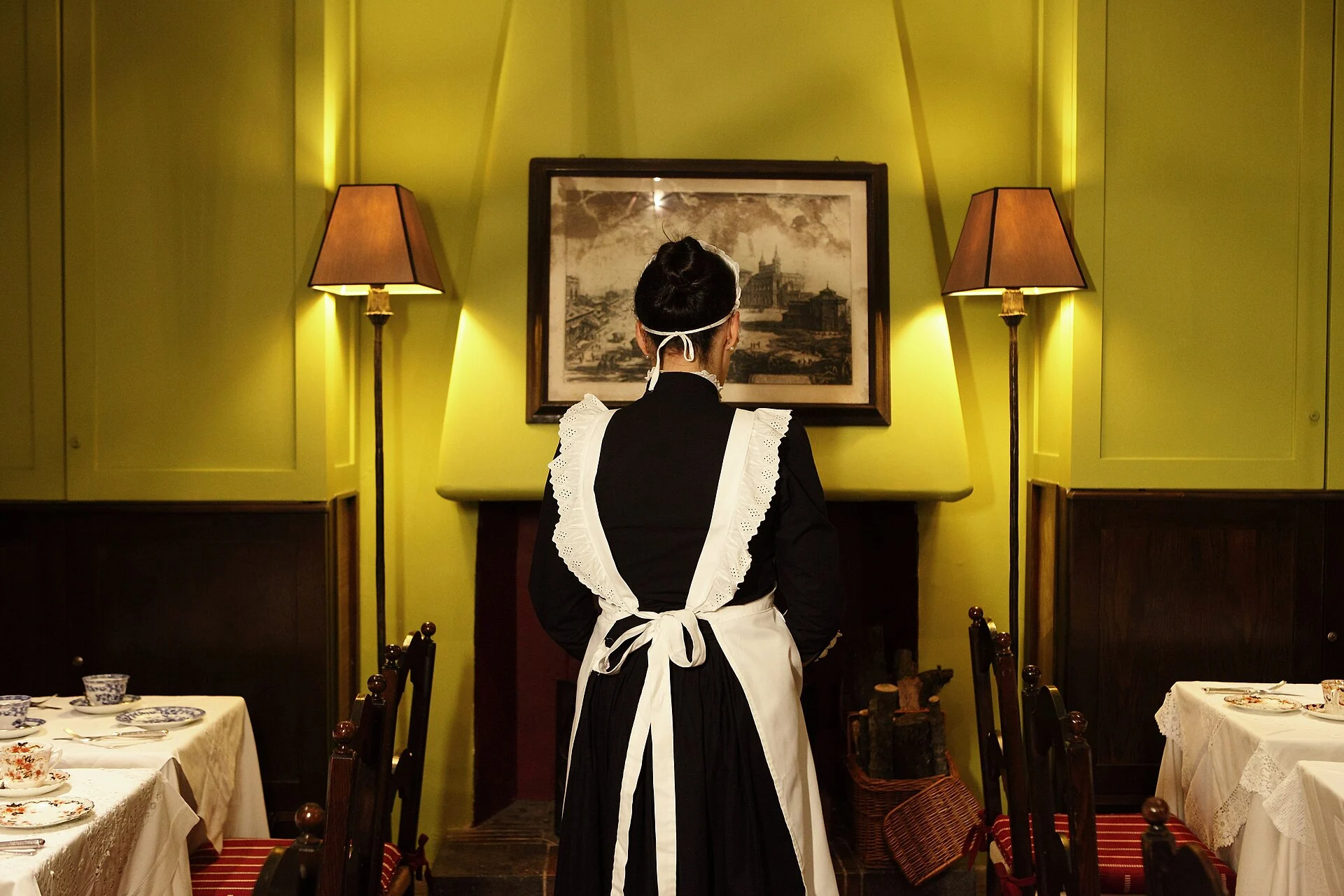
Babington’s Tea Room is at Piazza di Spagna 23-25, on the left side of the stairway as you look at it from below, and it is a private tea room run today by the heirs of the founding family: the house website names Chiara and Rory, whom the Roman press identifies as Chiara Bedini and Rory Bruce. There is no entrance fee but at least one order per seated person is required. You book a table by phone at 06 6786027, and the venue's email is tea@babingtons.com.
Opened in 1893 by two women who came from far away, a New Zealander and an Englishwoman, it is the oldest tea room in Rome still operating with the same family in charge. The reason to come is not a cup of tea, which costs less at home. It is to sit in two rooms that have come through two world wars, Fascism and the Dolce Vita without changing trade, with the Trinità dei Monti stairway outside the door.
Hours, prices and booking channels reported here correspond to the check of September 28, 2026 on the venue's official website, on the menus the venue itself publishes and on the other sources named later in the text. Price lists change with the seasons and the venue updates them in the menu files, so if you come with a precise budget open the menu on the website the same morning, or ask for it by phone before sitting down.

Where it is and what you see
The entrance is on the ground floor of an orange 1700s building that closes the left side of Piazza di Spagna, right where the first steps of the Trinità dei Monti begin. On the other side of the stairway, on the opposite side, is the Keats-Shelley House, the house where the poet John Keats died. In front, at the center of the square, the Barcaccia Fountain.
From outside you recognize it by the sign in English letters and the low windows on the square. Inside, there are two rooms, one in front of the other, linked by a few steps. The venue tells that those spaces were the stables of the building, renovated by Francesco De Sanctis, the same architect to whom the stairway is owed. It is an attribution the operator reports in its own history and it is best taken for what it is, that is, the house's account.
The furnishings are what you expect from a late 1800s British drawing room transplanted to Rome: dark wood tables, upholstered chairs, cushions, heavy curtains, porcelain, silver-plated teapots. The English-language Roman press, for example Wanted in Rome in 2019, describes precisely the service with silver teapots. The founders wanted everything to be British, from the food to the furnishings, and many objects arrived by sea from England, according to what the specialized tea press reports.
Next to the room is a small shop with the house blends, teapots, accessories and gift packs. The venue also sells online and declares shipping worldwide, and on the website you find the lines of white, green, black, oolong, iced tea and herbal infusions, plus a collection the operator calls The Seven Teas of Rome. Those with no time to sit can stop at the shop counter and that's it.
What you don't see: there are no guided tours, no internal museum, no panels telling the history. The venue is a business that works all day, from breakfast to dinner, and you find the history in the walls and in the staff's stories, if you find a quiet moment to ask. At peak hours nobody has time to act as a guide, and that's as it should be.
Hours, prices and how to book
The official website gives these hours: Monday to Thursday from 9 to 22:30, Friday and Saturday from 9 to 23, Sunday from 9 to 22:30. For holidays the venue publishes precise closures: on December 24 it closes early at 18:00, on December 25 it stays closed, on December 31 it closes early at 18:00, while on December 26 and January 1 it is open. Other extraordinary closing days do not appear to be published.
There is no ticket and no advance sale. Table booking is done by phone at 06 6786027, which the website shows next to the words book a table. The venue does not publish an online booking system, nor rules for groups or private rooms: whoever arrives with a party must call and arrange. The published email address is tea@babingtons.com, useful for requests that are not urgent.
I take the prices from the two menus the venue publishes on its website, in the summer 2026 files uploaded in June of this year. A teapot of the classic blends runs from 13.50 to 14.50 euro. Two scones with their accompaniments cost 16 euro, the cream tea for two people 52 euro. The high tea costs 41 euro for one person and 74 euro for two. Cakes and tarts run from 11 to 15.50 euro.
On the food and drinks menu the espresso is 5.50 euro, the cappuccino 9 euro, the hot chocolate at 80 percent 14 euro. The full English breakfast costs 33 euro, the eggs Benedict 29, the french toast 16.50. The club sandwiches run from 20.50 to 26.50 euro. A three-quarter liter bottle of mineral water costs 5.50 euro. On the published menus there are no cover or service charge items.
One rule must be read carefully, because the venue writes it plainly on both menus: at least one order is required for each seated person. Translated, you don't walk in as four to order two teapots. If someone in the group isn't hungry, they should order something anyway, even just a water. On how long you can stay at the table, the operator gives no limits, and in practice nobody rushes you in the quiet hours.
A curiosity about Babington’s Tea Room
The name on the sign carries a story of betrayal. Anna Maria Babington, the English co-founder, is presented by the venue as a descendant of Anthony Babington, the young Catholic gentleman executed in 1586 for the plot against Elizabeth I. It was precisely that plot, uncovered through the coded letters intercepted by the queen's services, that led to the condemnation of Mary Stuart the following year. A heavy surname for a tea room.
The paradox closes three centuries later. Among the house blends is a Royal Blend that Turismo Roma, the city's tourist portal, describes as given to Queen Elizabeth II. On the documentary level there is only the presence of the blend in the venue's catalog. The gift to the sovereign is a story that circulates and that the portal reports with caution, and it should be kept on the same level: house tradition, not proven fact.
A second curiosity concerns Isabel Cargill, the other founder. Born in Dunedin, New Zealand, in 1864, granddaughter of the founder of that city, for years she wrote a column titled Letters from Rome for a New Zealand newspaper, the Otago Witness. While she served tea to the English in Piazza di Spagna, she told Rome to readers on the other side of the world. A correspondent from Italy before being an entrepreneur.
Third and last. The venue says that in 1893 in Italy tea was sold only in pharmacies. It is a detail that shows the risk of the enterprise: two foreign women, 100 pounds of savings, a product that Italians considered a remedy. The initial public was the Anglo-Saxon community of the city, not Romans, and it took decades for afternoon tea to become a habit for local families too.
The two founders and the 100 pounds
Isabel Cargill and Anna Maria Babington were two young women, a New Zealander and an Englishwoman, who arrived in Rome in the years when the city was becoming the capital of a young kingdom and filling up with foreigners. The venue's website says they put together 100 pounds of savings to open a tea and reading room meant for the Anglo-Saxon community. The word reading matters: it was also a place to find the newspapers from home.
The first venue opened on Via dei Due Macelli, the street that runs down from the square toward the Tritone. The operator tells that success was quick and that after about a year the room moved to Piazza di Spagna, into the building next to the stairway. The press and the encyclopedia link that first success to the Roman celebrations of 1893 and 1894, between the episcopal jubilee of Leo XIII and the silver wedding of the sovereigns Umberto and Margherita.
On the division of tasks between the two women the sources say little. An account reported by World Tea News in 2020 describes the founders sitting in turn behind the counter at the top of the three steps that separate the first room from the second, with their little dog at their feet, in a position from which they controlled both rooms and the kitchen. It is a family snapshot, not a document, but it explains the layout of the venue well.
The two paths then separated. Isabel married the painter Giuseppe da Pozzo in 1902 and in 1904 their daughter Dorothy was born. Anna Maria, according to the venue's account, moved to Switzerland for health reasons and died there in 1929. In those difficult years it was Annie, Isabel's sister, who saved the business by investing her own capital and renewing furnishings, curtains and cushions. Without her the story would have stopped there.
Something nobody tells you about Babington’s Tea Room
Almost everyone walks in, sits in the first room and doesn't notice there is a second. The venue is made of two rooms separated by a few steps, and the second room is more intimate, less exposed to the comings and goings of the door and to the light of the square. If you ask for a table by phone, also ask which room. It won't always be possible to choose, but the question costs nothing.
The second thing concerns the flagship blend. The venue says its Special Blend was designed to measure for the water of the Barcaccia, that is, the water that arrives in Piazza di Spagna. It is a sensible technical detail, because the hardness of water changes the taste of tea noticeably, and a tea calibrated for soft water in Rome comes out different in Milan or London. It remains, however, a house story, with no published analysis.
The third thing is that the tea room is not a bar. Those arriving used to the Roman coffee at the counter are thrown off: here you sit, order at the table, wait for the teapot, stay seated. The waiter won't bring you the bill after five minutes. It is exactly the opposite of the quick coffee, and whoever understands that before walking in enjoys the hour that passes without looking at the clock.
Last thing the guides don't tell you. The cat drawn on the logo has a name and a story. He was called Mascherino, a stray from the square adopted by the waitresses, who according to the venue's account roamed Piazza di Spagna at night and slept on the cushions of the rooms by day. It was Valerio, grandson of the founder, who drew him. Since then the kitten has appeared on teapots, boxes and bags.
The advice I give you for visiting Babington’s Tea Room
Come early in the morning, as soon as it opens at 9, or in the late afternoon of a weekday out of season. The square at that hour is still livable, the room is quiet and the staff has time to explain the blends to you. In the middle of a Saturday afternoon in spring the experience changes completely, and the same teapot, at the same price, is worth half as much because you enjoy it half as much.
Order the tea, not the coffee. It seems obvious, but it is the choice that separates those who leave happy from those who leave angry. An espresso at 5.50 euro standing in front of the stairway is a bad deal anywhere, while a teapot to share, with scones and cream, seated for an hour, makes sense. If you want Roman coffee, the city's historic counters are there for that.
Read the menu on the website before walking in. The venue publishes the two complete price lists in downloadable form and this is a sign of transparency that in the area is not a given. With the menu already read you have no surprises at the bill, you know the minimum order is mandatory for every seated person and you can decide if the cream tea for two at 52 euro is worth your day.
Call to book if you come on a weekend, on holidays or during long weekends. The published number is 06 6786027. It doesn't promise a sure table, but it reduces the chances of standing outside the door. On weekdays in low season, in the morning, you usually get in without problems, but the venue publishes no attendance data and it's best not to count on exact figures.
One last piece of advice. Don't walk in with the shopping bags from Via dei Condotti piled under the table and the backpack on the next chair. The rooms are small, the tables close, and the clutter spoils the experience for you and your neighbors. Do the tea break first and the shopping after, or leave the bags at the hotel.
What to order: tea, scones and English cooking
The offer follows the calendar of a British day. In the morning there are the English breakfast, eggs in different preparations, Irish bacon, french toast, brioche with butter and jams. The venue states that the desserts are made in-house every morning and that the recipes are handed down in the family. At lunch come club sandwiches, dishes with Scottish smoked salmon, and depending on the season some hot dish.
The afternoon is the moment for which the venue was born. The Scottish scones arrive in a pair with cream and jam, the cream tea puts together tea and scones, the high tea adds finger sandwiches and sweets on several tiers. Those who don't want a meal can limit themselves to a slice of cake, for example the Victoria sponge that the press often cites, and a teapot. It is the most balanced order between spend and return.
On tea the catalog is wide. There are the classic English blends, like English Breakfast and Earl Grey, green teas, oolongs, whites, herbal infusions, and above all the house blends, the Special Blend and the Royal Blend. If you don't know what to choose, ask for the house blend: it is the reason the venue is still open, and the only thing you don't find the same elsewhere.
A note for those with special dietary needs. The published menus carry indications on ingredients, but for allergies and intolerances the serious thing is to ask the staff before ordering, as in any venue. The operator does not publish a specific policy on separate kitchens, so whoever has a serious celiac condition must ask for detailed information and decide accordingly, without relying on a single word of the menu.
A couple of words on the ritual, for those who didn't grow up with the teapot on the table. Loose-leaf tea must be left to steep for the right time, and the right time depends on the blend: a few minutes for blacks, less for greens, which turn bitter if forgotten. If the staff bring you the teapot with the strainer, ask how long to leave it. It's a normal question and nobody will look at you sideways for asking it.
Milk or lemon? British tradition puts milk in strong black teas, like the English breakfast, and lemon or nothing in the more delicate teas. Milk in green tea or oolong is a mistake that covers the flavor you are paying for. Sugar is a personal choice, but taste first without. A blend built for the water of Rome deserves at least a first sip as it is.
On scones there is a small war that divides England: first the cream and then the jam, or the other way around? The two counties of the southwest have contested the answer for generations, and the debate has no winner. At the table at Babington's nobody checks on you. Cut the scone in half with your hands or with the knife, spread as you prefer and eat it in pieces, not like a sandwich.
The high tea, finally, is not a light snack. With finger sandwiches, scones and sweets on several levels, for many people it replaces lunch or dinner. If you take it at 5 in the afternoon, give up dinner, or split it in two. It is the most sensible way to use those 74 euro: a single well-chosen order in place of three scattered orders during the day.
Another well-known fact, yet rarely cited
Piazza di Spagna was the English quarter well before Babington's arrived. Between the 1700s and 1800s the Tridente area hosted Grand Tour travelers, artists, writers and British residents, so much that Romans called it the English ghetto. The venue's website uses precisely this expression to describe the context in which the two founders chose to open. It was no accident, it was a market choice.
The traces of that community are all still around here. The house of Keats on the other side of the stairway, the Anglican church of All Saints at the end of Via del Babuino, the Casa di Goethe on the Corso for the German side. And farther away the Non-Catholic Cemetery, where Keats and Shelley are buried.
The second known and little told fact concerns public recognition. Turismo Roma, the city's portal, includes the venue among the city's historic shops of excellence, the category devoted to businesses with a long continuity of activity and furnishings. For a picture of all the historic venues of the center, with their merits and their limits, you can start from our page on historic cafes and shops of Rome.
The third fact: a few meters away is the Antico Caffè Greco on Via dei Condotti, the other great historic venue of the area, frequented by Grand Tour foreigners long before the tea room was born. Babington's arrived more than a century later and took a different clientele, those who didn't drink coffee or couldn't digest it. Two parallel worlds in the same handful of streets.
The square outside the door
Leaving the room you have in front of you one of the most famous spaces in Rome, and it helps to know what you are looking at. The stairway was built between 1723 and 1726 on a design by Francesco De Sanctis to link the square to the church of the Trinità at the top of the hill. The steps open and close in ramps and terraces, and from every landing the view of the square changes. It is architecture designed to be walked slowly.
The fountain at the center is the Barcaccia, attributed to Pietro Bernini with the intervention of his son Gian Lorenzo, in the shape of a sinking boat. It is fed by the Acqua Vergine, the same that reaches the Trevi Fountain, and the low pressure of the aqueduct explains the basin almost at ground level. The house's Special Blend, according to the family's account, is calibrated precisely on this water.
At the far end of the square, opposite the stairway, begins Via dei Condotti, the street of fashion shops that points straight toward the Corso. On the right, looking at the stairway, opens the side of the square that leads toward the palace of the Spanish embassy to the Holy See, from which the square takes its name. Toward the southeast you reach Piazza Barberini, with the Triton Fountain, and the Palazzo Barberini.
An observation. The square is beautiful in the early hours of the morning and after sunset, and almost impassable in mid-afternoon in the high-season months. Those who come for the tea room can use this: walk in when the crowd outside is at its peak, and leave when the square empties. An hour seated at the table is also the best way to let the peak of organized groups pass.
The right photo to take at Babington’s Tea Room
The photo to take is that of the sign, from outside. Stand on the first step of the stairway, shifted to the left, and frame the entrance with the English letters on top and the corner of the stairway entering the frame. That composition tells everything at once: the English tea room, the Roman travertine, the steps of Trinità dei Monti. Early in the morning, before 9, the square is almost empty and the light is soft.
The second shot is from the fountain. From the Barcaccia look toward the stairway and keep the orange building on the left: the venue becomes a detail of the square's landscape, with the church at the top. It works vertically, with the bell tower of the Trinità closing the frame at the top. In the afternoon the sun comes from the west and lights the facades edge-on.
Inside, the right photo is the set table: the teapot, the cup, the scones with cream, the kitten on the porcelain. Shoot it from above, as soon as they serve you, and then put the phone away. Avoid photographing the other seated people, who are customers like you and not part of the furnishings. If you want to capture the empty rooms, ask the staff if it is possible at a quiet moment.
Avoid the frontal photo with flash in the second room. The light is low, the dark woods absorb everything and the flash flattens the space, returning an ordinary drawing room. Better to raise the sensitivity and accept some grain, or look for the light coming in from the windows on the square. In a tea room the half-light is part of the story and should not be erased.
The war years: documents, tradition, legend
What the most solid sources say. The venue writes in its own history that the room stayed open during the First World War, despite an abrupt halt in business, and that it stayed open also during Fascism and the Second World War, despite the regime's anti-English policy, with the English sign clearly visible. Isabel Cargill died in 1944 at Stra, in the Veneto, and management passed to her daughter Dorothy.
On the month of Isabel's death the sources do not agree. The encyclopedia places it in April, the history published years ago by the venue speaks of January. Little changes in substance: in 1944, the year of the liberation of Rome, the tea room passed to the second generation. Whoever wants to fix the date precisely has to look in the civil registry records, and the sources open to the public are not enough.
What tradition says. The house's account has it that in the rooms there sat, in separate rooms, both Fascist leaders and exponents of the antifascist intelligentsia. An article from 2018 adds that during the war the staff ran the room on their own, bringing their own rations to prepare food. World Tea News in 2020 writes that the venue closed only for a short period in the days of the Liberation.
What is legend, or at least an unverifiable story. The image of the Fascist and the antifascist drinking tea a few meters apart is perfect for a novel, and for that reason should be taken with caution. No public source gives names, dates or precise episodes. It may be true, it may be a family story rounded off by the years. I leave it where it is: pleasant to hear, fragile as proof.
Some important events that happened here in history
In 1893 Isabel Cargill and Anna Maria Babington open the room on Via dei Due Macelli. About a year later they move to Piazza di Spagna 23, on the ground floor of the 1700s building next to the stairway. In 1899, the venue tells, the Guida Monaci, the city's commercial yearbook, already lists the room as the fashionable address for a select clientele. In six years the bet was won.
In 1914 the war stops business but not the room. In 1929 Anna Maria Babington dies in Switzerland, and Isabel's sister, Annie, puts the venue back on its feet with her own savings. In 1944 Isabel dies and her daughter Dorothy takes over management. In the same year, in June, Rome is liberated, and according to the trade press the room closes for only a few days.
In the 1950s, with the success of Cinecittà and the season of the Dolce Vita, Piazza di Spagna becomes an international showcase and the tea room takes advantage. At the end of the 1950s the cat Mascherino is adopted. Valerio, Dorothy's son, draws the logo with the kitten and creates in London the Special Blend that is still the house blend today.
In 1993 the room turns 100 and the journalist Beniamino Placido writes its history, which the venue still cites today. In 2018 comes the 125th anniversary, celebrated with articles in the international press. In 2020, during the pandemic, the room closes temporarily and bets on online sales, with new lines of herbal infusions. Today it is run by Chiara Bedini and Rory Bruce, whom the press describes as the fourth generation starting from Isabel.
Who has passed through Babington’s Tea Room
The founders, first of all. Isabel Cargill, born in New Zealand in 1864, granddaughter of the founder of Dunedin, wife of a painter, mother of Dorothy, correspondent from Rome for a newspaper of her country. Anna Maria Babington, English, whom the house's account links to the family of Anthony Babington, executed for the plot against Elizabeth I. Two women on their own who in 1893 opened a business in a foreign city, something nobody took for granted then.
Then the generations of the family. Annie, Isabel's sister, who saved the business in the years of the crisis. Dorothy, who led it from 1944. Valerio, Dorothy's son, who according to the house's account invented the logo and the flagship blend. Finally Chiara Bedini and Rory Bruce, whom the website simply presents as Chiara and Rory and whom the Roman press names as the current managers and heirs of the family.
On famous customers I distinguish three levels. Documented: the venue writes that it has welcomed royal families and figures from culture and entertainment, without naming names, and Turismo Roma adds politicians, journalists and businesspeople. Tradition reported by the press: in the years of American cinema in Rome, stars like Audrey Hepburn, Charlton Heston, Peter Ustinov and directors like Federico Fellini passed through here.
Legend: the most repeated story has it that Richard Burton and Elizabeth Taylor met in secret in these rooms during the filming of Cleopatra, at Cinecittà, in the early 1960s. A travel blog writes it in 2018, many others repeat it, but no source brings a date, a photograph or a firsthand account. It is a story the place deserves and that cannot be proven.
And then there is Mascherino, the stray cat of the square who at the end of the 1950s became the venue's mascot. He didn't sign autographs, but he is the only regular customer whose name the house knows for certain and who ended up on every cup. Whoever passes through Babington's today takes him home printed on a box of tea, and he is perhaps the best documented presence of all.
The price and the experience: the team's judgment
The contrarian position is this: Babington's is expensive, and for many visitors the ratio between what you spend and what you take home doesn't add up. A cappuccino at 9 euro and an espresso at 5.50 are prices no Roman pays willingly. Whoever walks in for a quick breakfast before climbing the stairway leaves with a restaurant bill and the feeling of having been fleeced.
I don't say it to discourage, I say it to direct. The price here doesn't pay for the drink, it pays for the room, the location, the history and the time. If you sit an hour, with a teapot to share and scones, the bill has its own logic, as does the ticket of a small museum. If you stay 10 minutes, you pay the same frame without enjoying it, and that is where the disappointment is born.
I add a criticism I make as a professional. The room lives in part on the account of famous customers and the years of the Dolce Vita, which however almost all remain at the level of tradition. Whoever walks in expecting photos with the divas on the walls or a small museum of memory is disappointed. It is a family venue that works, not a staged place of memory, and should be judged for what it offers today.
That said, one point in its favor must be acknowledged. The venue publishes the complete menus with prices on its website, states the minimum order plainly and does not appear to apply cover or service charges in its price lists. In the most touristy square in Rome, where surprises at the bill are frequent, this transparency is rare. You pay a lot, but you know beforehand how much you pay. It is already a form of respect.
When to go and what not to expect
The busiest months in Piazza di Spagna are those of spring and early summer, plus long weekends and holidays. The venue publishes no attendance data, but the crowd on the stairway is a good thermometer: if it's full outside, inside too it will be hard to find a place without a booking. November, January and February, on weekdays, are the periods when the tea room goes back to being a drawing room and not a waiting room.
Don't expect a quick bar. The service is at the table, the timing is that of a sit-down room, and whoever has a train in half an hour must choose another place. Nor should you expect a silent place in the full hours: the rooms are small, the tables close, and the voices add up. The operator publishes no dress code, and in practice you walk in dressed as for a stroll in the center.
Don't expect neighborhood pastry shop prices. The published price lists are those of a historic venue in the most expensive square of the city, and should be read before sitting down. Don't expect a museum either: the history of the house is told in the menus, on the website and in the words of those who work there, not on panels or display cases. Those who arrive knowing these things usually leave happy, those who don't leave perplexed.
Expect instead a place that has stayed true to itself for more than 130 years. Same square, same family, same trade, same cat on the logo. In Rome many historic venues have changed owners, name or function, or have closed. This one has held its course with a stubbornness you can feel the moment you walk in, and that is the real reason it is worth a stop, price included.
How to get there
The metro stop is Spagna, on line A. ATAC opened the restyled station in December 2024, and the published exits are the one on Piazza di Spagna, Vicolo del Bottino corridor and the connection to Villa Borghese. From Vicolo del Bottino exit to the tea room it's a few minutes on foot. To get your bearings with metro, tickets and apps, you can read the guide on how to get around Rome.
On foot, the tea room can be reached from almost the whole historic center. From the Trevi Fountain you cross Via del Tritone and walk up Via dei Due Macelli, the street of the first location. From Piazza del Popolo you walk down Via del Babuino. From Via del Corso just turn onto Via dei Condotti and go straight to the square.
From above, that is from Trinità dei Monti and the Pincio, you walk straight down the steps and find yourself in front of the entrance, on the right as you look at the square from above. It's the most pleasant route if you're coming from Villa Borghese or Villa Medici. If you have trouble with steps, you're better off arriving from below, from the metro or from Via dei Condotti.
By car it makes no sense. The square is inside the city center's limited traffic zone, parking is rare and expensive, and a taxi can only drop you on the nearby streets. If you're coming from outside, leave the car in a park-and-ride lot on the outskirts and take metro line A. As for internal accessibility, the operator doesn't publish any information, and the steps between the two rooms should be taken into account.
What to pair it with in the Tridente
The most natural combination is a morning of art and the tea break in the afternoon. You can start from Santa Maria del Popolo, with the Caravaggios of the Cerasi Chapel, or from the twin churches of the square, climb up to the Pincio, cross the avenue to Trinità dei Monti and go down the steps for the teapot. All on foot, without hurry, in half a day.
If you love English literature, there's a route already written: the Keats-Shelley House across the way, the church of All Saints on Via del Babuino, and then the tea room to finish. If you prefer architecture, you can go up Via Gregoriana to the Casa dei Mostri, with its gaping-mouth doorway, and stop at Sant'Andrea delle Fratte with Bernini's angels.
Among the other historic venues, the most instructive comparison is with the Antico Caffè Greco, not far away, and with the two great coffee bars behind the Pantheon, Caffè Sant'Eustachio and Caffè Tazza d'Oro. They are opposite models: coffee standing at the bar and in a hurry, the tea room seated and unhurried. Seeing them all in the same day explains Rome better than many books.
If you have time, near the square there are two churches tied to foreign communities that few people visit. Sant'Atanasio dei Greci, on Via del Babuino, is the Byzantine-rite church of the Greek community, and it makes an eastern counterpoint to the Anglican church on the same street. Farther down, toward the Corso, there's the Basilica of San Lorenzo in Lucina, with its quiet square.
If you're after views from above, from the terrace of the Pincio, from the churchyard of Trinità dei Monti and from the Pincio obelisk, Rome opens out as far as St. Peter's. Our page on the viewpoints of Rome collects them with hours and limits. In the opposite direction, toward the Tiber, the Ara Pacis and the Mausoleum of Augustus are a quarter of an hour on foot.
Where to eat nearby
Piazza di Spagna and the streets around it are one of the places in Rome where it's easiest to eat badly and pay a lot. Not because of the area, but because of the kind of customer: millions of passing visitors, who won't come back and who don't know the city's prices. For someone who lives in Rome the rule is simple: the closer you get to a famous monument, the more careful you have to be about what you order.
The first sign is the menu with photographs of the dishes, often laminated and translated into five languages. A place that has to show the picture of a carbonara is talking to people who don't know what it is, and it is building its kitchen on customers who won't return. The second sign is the person at the door inviting you in. A place with regular customers doesn't need to stop passersby on the sidewalk.
The third sign is the lady rolling out pasta dough in the window, or even on the sidewalk. It's a scene staged to catch the eye, not a guarantee. Fresh pasta done well is prepared in the kitchen, in the morning, away from the dust of the street. The fourth sign is places that are open nonstop, from morning to night, with no break in the kitchen: a real kitchen crew needs to rest and to prep.
The fifth sign is about prices. Places set up in front of monuments tend to adjust the bill to the customer: items with no price on the menu, fish of the day by weight with no indication, different menus between the one displayed outside and the one they bring you at the table. Always ask the price before ordering, and if the answer is vague, get up. It isn't rude, it's the only way to avoid paying for surprises.
Why don't Romans eat in these places? Not out of snobbery. They simply know the city's prices and know that 10 minutes on foot away you eat better and spend less. The criterion is to look at who is sitting there: if at lunch on a weekday there are office workers, shopkeepers and families speaking Romanesco, you can go in. If there are only tourists with a map in hand, better to keep walking.
So you don't have to go by trial and error, I keep a public list up to date of the addresses I really go to, in Rome and around it: our list of the places where we eat. It isn't sponsored and it changes when the places change. If you want to stay at the tea room for lunch too, the venue's menu offers savory dishes and club sandwiches, with prices published on the site.
Frequently asked questions
Where exactly is Babington's Tea Room?
Babington's Tea Room is at Piazza di Spagna 23-25, 00187 Rome, on the ground floor of the 18th-century building on the left side of the Trinità dei Monti steps as you look at them from the square. On the other side of the steps is the Keats-Shelley House. The nearest metro stop is Spagna, on line A, a few minutes on foot from the entrance of the venue.
What are the opening hours?
According to the official website the venue opens every day at 9:00. It closes at 22:30 from Monday to Thursday and on Sunday, at 23:00 on Friday and Saturday. On December 24 and 31 it closes early at 18:00, on December 25 it stays closed, on December 26 and January 1 it is open. Other extraordinary closures don't appear to be published by the operator.
Do I need to book?
It isn't mandatory, but the venue accepts reservations by phone at 06 6786027. On weekends, holidays and in high season, calling ahead reduces the risk of waiting outside. The operator doesn't publish an online booking system or specific rules for groups, which must be arranged directly by phone or by email.
How much does a tea cost at Babington's?
In the summer 2026 menu published by the venue on its own site, a teapot of the classic blends costs between €13.50 and €14.50. Two scones with accompaniments cost €16, the cream tea for two €52, the high tea €41 for one person and €74 for two. At least one order is required for each person seated, and neither cover charge nor service charge appears in the price lists.
Who founded the tea room and who runs it today?
The tea room was founded in 1893 by Isabel Cargill, a New Zealander, and Anna Maria Babington, an Englishwoman, with 100 pounds of savings. The first location opened on Via dei Due Macelli, and about a year later it moved to Piazza di Spagna. Today it is run by Chiara Bedini and Rory Bruce, whom the press identifies as heirs of the founding family.
Is it true that it stayed open during the war?
The venue writes in its own history that it stayed open during both world wars and during Fascism, with the English-language sign clearly visible despite the regime's anti-English policy. The trade press adds that it closed only for a short period in the days of the Liberation of Rome, in June 1944. The stories about customers in those years remain at the level of tradition.
Can I buy tea without sitting down?
Yes. Next to the tea room there's a shop with the house blends, teapots and accessories, where you can buy without consuming at a table. The venue also sells online on its own site and states that it ships worldwide. The most requested blends are the Special Blend and the Royal Blend, along with a collection dedicated to the seven teas of Rome.
Can I come with children?
The venue doesn't publish any restrictions on the age of customers. The rooms are small, though, the tables are close together and the atmosphere is quiet, so it works better with children who can sit still for the length of an afternoon snack. Scones and cakes are generally popular with the little ones. Remember that the minimum order rule also applies to children who are seated.
Who wrote this page
The page comes from the editorial team of Tour Leader Pro, the Rome-based outfit that designs itineraries, visits and cultural events across Rome and Lazio. Hours, prices and booking arrangements reported here come from the official sources cited in the text, as of the date given at the top. Since this is a commercial business that updates its price lists with the seasons, check them again before you go, and let us know what you find changed.
Building a day in the Tridente means fitting together museums with changing hours, churches that close at lunch, the crowd on the steps in the middle of the day, and a break that won't wreck your budget, for yourself or for a group of 40 people. If you're facing this kind of puzzle, on Tour Leader Pro you'll find working materials designed for those who guide and for those who organize on their own.
For the wider picture, that is regional trains and seasonal timetables, rentals, airports, travel between one province and another and destinations in Lazio outside central Rome, from the Castelli to the volcanic lakes of the north, the Tyrrhenian coast and the villages of the interior, a useful resource for putting together a multi-day itinerary is Italy Planner.