Oratorio dei Filippini
In short. At the Oratorio dei Filippini today you go in at three different points and for three different reasons, and none of the three is the oratory hall itself.
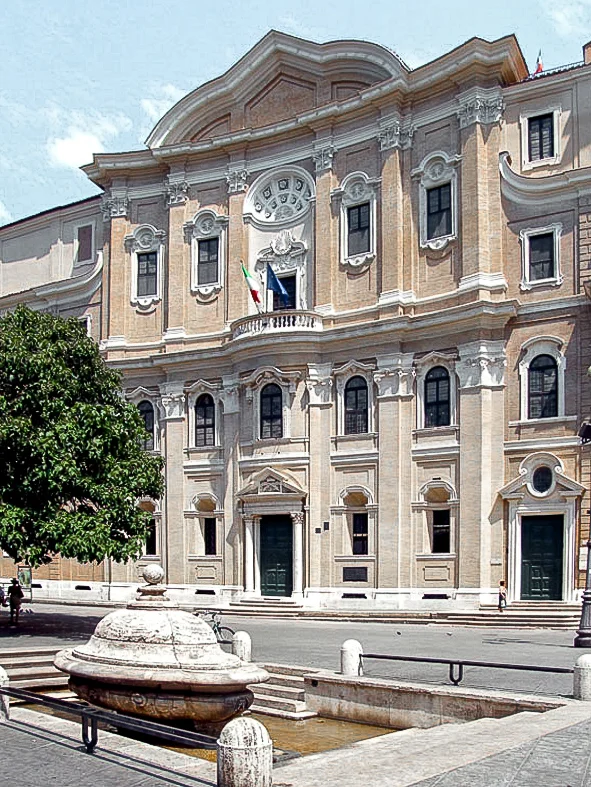
At the Oratorio dei Filippini today you go in at three different points and for three different reasons, and none of the three is the oratory hall itself. You visit the Salone Borromini of the Biblioteca Vallicelliana, at Piazza della Chiesa Nuova 18. You enter the Archivio Storico Capitolino, at Piazza dell’Orologio 4. You consult the Casa delle Letterature, at Piazza dell’Orologio 3. The oratory hall, the one behind the curved facade, is closed for works.
The facade everyone photographs belongs to a building that for the most part isn't open to visitors. Inside are offices, storerooms, study rooms and a construction site. Anyone who arrives thinking of buying a ticket and touring the complex is left empty-handed. There is no ticket: the entrances that work are free, have library hours and library rules, and have to be taken for what they are.
What you really visit today, room by room
The Filippini complex houses four different institutions under the same roof: the Biblioteca Vallicelliana, which falls under the Ministry of Culture, the Archivio Storico Capitolino of Roma Capitale, the Istituto Storico Italiano per il Medio Evo and the Casa delle Letterature of the Biblioteche di Roma system. Each has its own entrance, its own hours and its own rules. Whoever doesn't know that walks around the block for 20 minutes.
The Salone Borromini is the old library of the Oratorian fathers and remains the most beautiful room open to the public. The Biblioteca Vallicelliana states it can be visited Monday, Tuesday and Friday from 10:00 to 13:00 with free entry, Wednesday and Thursday from 15:00 to 18:00 by reservation only, closed on holidays. Groups of more than 15 people must always book, at least 48 hours ahead. Hours read on the official website on September 28, 2026.
Booking for the Salone is done by writing to b-vall.didattica@cultura.gov.it. On Tuesday morning, always by reservation, the library staff accompany visitors with a guided welcome. The library's number is 06 68802671. None of this goes through 060608, which is the Roma Capitale channel and doesn't touch the Ministry's institutes: confusing the two channels is the most common mistake at this address.
The Archivio Storico Capitolino opens its study room Monday to Friday from 9:00 to 16:00, free entry, with an identity document, being at least 18, and a card to request with a form. Bags and personal books go in the lockers, phones off. Material is brought out at 9:45, 11:15 and 13:00, two pieces at a time. Phone 06 67 10 81 00, email archivio.capitolino@comune.roma.it.
Guided visits to the Archivio exist and are the most direct way to see the Borromini rooms without being a researcher. For the non-school public, booking is mandatory by email at archivio.capitolino@comune.roma.it, for individuals or groups of up to 20 people, on Tuesday and Wednesday afternoons in three shifts: 15:30, 16:00, 16:30. In the morning, Monday to Thursday between 9:00 and 12:00, groups of up to five people are accepted.
School groups follow a different channel: for educational visits by school groups the Archivio gives the number 060608, so here the city channel comes back into play. During the visit you can take photographs without flash, you don't touch the documentation, and you don't enter with food and drinks. The contact person named by the Archivio is Dr. Rosalia Raineri, at 06 67 01 08 132.
The Casa delle Letterature occupies Piazza dell’Orologio 3, phone 06 45460581, email casadelleletterature@bibliotechediroma.it, and the catalog of the Biblioteche di Roma lists it as fully accessible for people with mobility difficulties. The service's hours change often and have to be checked on the library system's website: I don't give them here because they don't appear to be published in a stable form.
The oratory hall, the one that today bears the name Sala Borromini, is a case apart. The Archivio Storico Capitolino's website lists it as under renovation to become again a venue for conferences, shows and concerts. The name creates constant confusion with the Vallicelliana's Salone Borromini, which is the library on the upper floor and has nothing to do with the hall below. Two rooms, two bodies, one name.
Where it is and how to get there
The complex occupies the block between Piazza della Chiesa Nuova, Piazza dell’Orologio, Via dei Filippini and Via del Governo Vecchio, in the Parione district, right up against Corso Vittorio Emanuele II. The two street numbers you need are Piazza della Chiesa Nuova 18 for the Biblioteca Vallicelliana and Piazza dell’Orologio 4 for the Archivio Storico Capitolino. The postal code for both is 00186.
By bus you arrive on Corso Vittorio Emanuele II with lines 40, 46, 62 and 64. The useful stops are the one named Chiesa Nuova and the one on Corso Vittorio Emanuele at Via Tassoni, both a few steps from the piazza. The lines are those found in the schedule services on September 28, 2026: in Rome they change because of works and detours, so recheck the same morning.
The metro doesn't come here and won't anytime soon. If you get off at Largo di Torre Argentina you walk a good 10 minutes along Corso Vittorio, narrow sidewalks and noisy traffic. From Ponte Sant’Angelo you arrive in 8 minutes via Via dei Banchi Nuovi and Via del Governo Vecchio, which is the prettiest street and the most useful for understanding where you are.
You don't come by car. The area is a limited traffic zone for much of the day, there is no surface parking, and the private garages around Corso Vittorio charge hourly rates that make a taxi cheaper. Anyone accompanying a group unloads at the far end of Corso Vittorio, at Piazza San Pantaleo, and does the last 200 meters on foot.
The best meeting point for a group is the churchyard of Santa Maria in Vallicella, the Chiesa Nuova, which is next door and has a raised level where there's room to spread out. The piazza in front of the Oratorio's facade, by contrast, is a funnel for passersby: tour buses unload on the Corso and people cut across on the diagonal. Stopping there with 20 people means blocking pedestrian traffic.
The concave facade, the bricks and the mistake everyone makes
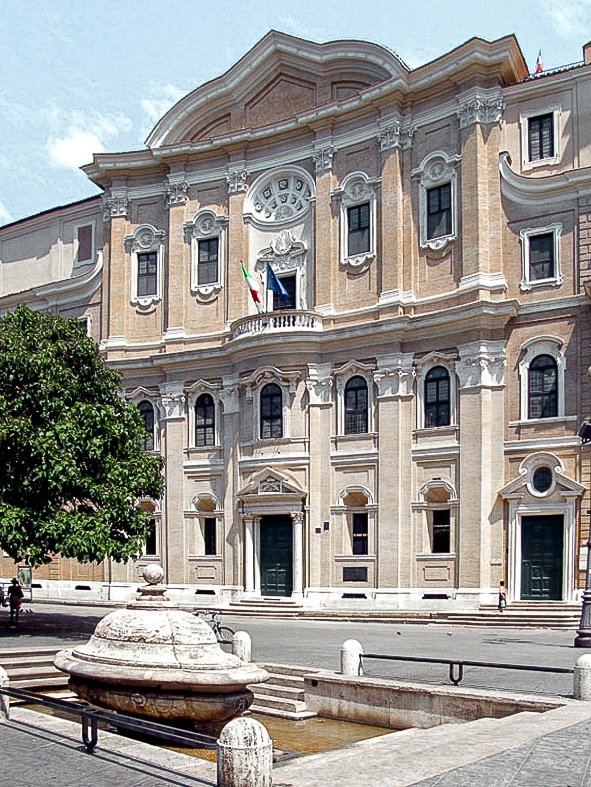
The Oratorio's facade is brick, not travertine, and the choice was deliberate. Borromini wanted a poor material so the oratory's front wouldn't compete with that of the church next door, and the Dizionario Biografico degli Italiani records exactly this point: brick in place of stone, with a molding obtained by firing bricks shaped specially. Baroque Rome has no other fronts like this.
The most frequent mistake concerns what is behind that curve. The facade looks like the front of a church and isn't: behind it is the oratory hall, that is, an auditorium for sung prayer and preaching, and the axis of the facade doesn't coincide with the axis of the hall. Borromini bent the wall to make two different buildings talk to each other on a crooked piazza, not to center a nave.
The anthropomorphic reading of the facade, the human body with open arms, circulates in every guide and is not a tourist invention: the concept of a front that embraces whoever enters goes back to the 17th-century documentation on the work. It remains, however, a design metaphor, not a geometric description. Anyone who tells it as if Borromini had drawn shoulders and arms in plan is exaggerating quite a lot.
The upper register of the facade corresponds to the old library. This detail explains why a balcony looks out from the Salone Borromini onto Piazza della Chiesa Nuova: the front, divided into five concave bays and closed at the sides by two lower wings with volutes, was calibrated to the original width of the book hall. Then the hall was lengthened and the correspondence broke.
Looking at the facade up close is no use. The design can be read only by standing on the other side of the piazza, toward Corso Vittorio, with the afternoon sun cutting in from the side and bringing out the curve. In the morning the facade is in flat shade and the brick becomes a gray surface with no depth. Anyone who goes with a tour group at 9 in the morning loses half the reason for being there.
Who did what: Maruscelli, Borromini, Arcucci
The building site doesn't begin with Borromini. Paolo Maruscelli had already laid out the complex's plan and built the sacristy when, in 1637, the Congregation of the Filippini called a competition for the buildings of the new seat, and Borromini won it. It's the Archivio Storico Capitolino, based in the complex since 1922, that summarizes the succession of the two architects this way on its institutional website.
To Borromini go the facade of the oratory, the first and second courtyards, the refectory, the recreation room, the library, the clock tower and the rooms on the service courtyard. 13 years of work, with Virgilio Spada as his interlocutor inside the Congregation. Spada wasn't just any patron: he was the one who put in writing, together with the architect, the report that explains the project.
On the name of who takes over, the sources diverge, and it's worth saying so instead of picking one. The Archivio Storico Capitolino's website writes Camillo Artucci. The Biblioteca Vallicelliana's website, speaking of the enlargement of the Salone starting in October 1665, writes Camillo Arcucci. It's the same person with two spellings, and the current form in architectural bibliography is Arcucci.
The dates of Borromini's exit and of the library's completion diverge too. The Archivio Capitolino places the break with the Congregation after 1650. The standard popular reference entries give 1650 as the end of his work, 1640 for the oratory coming into use and 1643 for the library. The Vallicelliana, on the other hand, states the library was inaugurated by Borromini in 1644.
A one-year gap on the library is not a pedant's detail. It signals that the room had multiple successive handovers and that the date depends on which act you take as the inauguration. The Vallicelliana itself specifies that the Salone acquired its definitive look only in 1667, after Arcucci's enlargement. Anyone looking for a single date on this building is looking for something that doesn't exist.
The phases of the project are known because they were written down. The four-handed report by Borromini and Spada, with 67 plates, is the Opus Architectonicum, drawn up in the second half of the 1640s and in the following decade and printed in 1725. The Biblioteca Vallicelliana holds two copies of the printed edition. Few Baroque building sites have comparable documentation by the authors themselves.
The Salone Borromini, that is, the fathers' old library
The Salone Borromini is a rectangular hall with a coffered wooden ceiling covered in travertine-colored stucco and a two-tone terracotta floor. 16 windows, including the balcony on Piazza della Chiesa Nuova, make it unusually bright for an old library. The description is the one the Biblioteca Vallicelliana publishes on its page devoted to the building.
The shelving is walnut, arranged on two levels, with slender columns holding up the gallery and balustrades carved with stars, lilies and flaming hearts, symbols of Filippine devotion. At the four corners are spiral staircases hidden behind semi-hexagonal shelves covered with fake spines in white goatskin, put there so the row of books would never be interrupted to the eye.
The ceiling is worth a crick in the neck. Originally the coffers were 15, becoming 21 after the enlargement, decorated alternating eight-pointed stars, which refer to the Evangelists and the Doctors of the Church, and grisaille canvases with pairs of little angels inside circular frames with festoons. In the two larger panels, with oval frames, are two monochrome allegorical canvases.
The two allegories have a name, an author and a date: the Divina Sapienza by Giovanni Francesco Romanelli, 1643, and the Mediocritas by Lazzaro Baldi, 1667. The dates alone tell the story of the hall: 24 years between the first and the second painting, that is, between Borromini's library and the library lengthened by Arcucci. A ceiling with two eras inside, if you know where to look.
The 1665 enlargement sacrificed the original symmetry. Arcucci absorbed into the Salone the small rooms toward today's Via dei Filippini, aligning the west wall with that of the oratory hall below, to solve structural problems and make room for the books that kept arriving. The hall gained in square meters and lost in proportions: the facade's register no longer corresponds to it.
The Biblioteca Vallicelliana counts about 130,000 volumes, 3,000 manuscripts, incunabula, engravings and photographs. The reading room has its own hours, different from those of the Salone: since August 23, 2026 the website states Monday, Tuesday and Friday from 8:15 to 15:00, Wednesday and Thursday from 8:15 to 19:00, closed Saturday and Sunday. A valid identity document is required, and you must be at least 16.
The Archivio Storico Capitolino and the Sala Ovale
The Archivio Storico Capitolino preserves the documentation produced by Rome's municipal administration, plus the notarial archives, the archives of Roman families, the Biblioteca Romana and the Emeroteca. It arrived here in 1922, after the complex, expropriated by the State Property Office in 1873 and passed to the City, had housed for some 30 years the Court of Assizes and judicial offices.
The Sala Ovale is the showpiece, and it's open to the public as a consultation room after the conservation restorations of the 2000s. It has a monumental marble fireplace and a geometry you only understand by walking into it. It isn't an exhibition hall: whoever enters finds people studying, so you keep quiet and look, as in any reading room in the world.
Anyone doing building research should know one thing before showing up. The Archivio holds the files of projects carried out in Rome between 1848 and 1930, extended to 1931 for occupancy permits and for the minutes of the Building Commission. To find them you need the year, the historic address and, if possible, the builder or owner of the time: cadastral sheet and parcel numbers are no use at all.
The website of the Archivio Storico Capitolino also gives the real times of its services, a rare thing for a public body. Photoreproduction takes around 30 working days, longer for large formats. The Emeroteca Romana is under review and doesn't guarantee the availability of all the titles in the catalog. Better to read that before taking a plane to come consult a newspaper.
The Torre dell’Orologio, the bell tower that isn't a bell tower
The Torre dell’Orologio closes the corner of the complex toward Via dei Banchi Nuovi and gives its name to the little piazza. Borromini built it between 1647 and 1649, and the Rome city tourism portal reports this range of dates. Under the clock face is a mosaic of the Madonna della Vallicella after a design by Pietro da Cortona.
The tower is crowned by an iron frame with volutes that holds the bells and imitates the silhouette of a bell tower without being one. An oratory has no right to a bell tower: that belongs to the church. Borromini got around the rule by building a civic machine, a public clock for the neighborhood, which from below reads as a bell tower and on the canonical level is not one.
The clock's original mechanism is no longer up there. It's kept at the Museo di Roma in Palazzo Braschi, five minutes on foot from here, and it's a fun game: you look at the tower from outside and then go see its belly inside a display case, in a palace that looks onto Piazza Navona.
Piazza dell’Orologio is the place to stop with a group, not the big piazza. Few people pass through, there's room for 20 people to stand without getting in the way, and the whole tower can be seen by looking up. From there start two streets that tell the story of the Rome of the bankers, Via dei Banchi Nuovi and Via del Governo Vecchio, and neither takes buses.
One word that means two things: oratory as a hall and oratorio as music
The word oratorio indicates both this hall and a musical form, and the two things were born in the same setting. Filippo Neri had made music a tool of attraction, and considered singing a way of bringing people to prayer. From the gatherings with laude and sung dialogues held in these rooms came a genre that went on to conquer half of Europe.
The Congregation of the Oratory was established in 1565 and recognized by Gregory XIII in 1575 with the bull Copiosus in misericordia. The rule required meals to be accompanied by the reading and discussion of a religious text: hence the fathers' obsessive attention to books, and hence a library that in the 17th century was among the richest in Rome.
The book collection starts from Filippo Neri's volumes, passed to the Congregation at his death in 1595, and grows with the bequest of Achille Stazio, documented as early as 1581: 1,700 printed volumes and 300 manuscripts. Then come the collections of Cesare Baronio in 1607, of Virgilio Spada in 1662, the manuscripts of Leone Allacci in 1669. A library built through successive donations.
The Oratorian 17th century did not produce only music. From this house came the Annales Ecclesiastici of Cesare Baronio and the Roma sotterranea of Antonio Bosio, the book that invents Christian archaeology. Anyone who goes down into a Roman catacomb today is walking inside a discipline born in these rooms, and nobody ever tells them at the ticket office.
A curiosity about the Oratorio dei Filippini
The Salone's shelving hides four spiral staircases. They're in the corners and lead to the upper gallery, but from the hall you don't see them: the semi-hexagonal shelves that mask them are covered with fake spines in white goatskin, an imitation of old book covers, so the row of volumes along the walls would have no interruptions. A trompe l’oeil made of fake books.
The trick says everything about how Borromini thought about interiors. He didn't decorate a room: he solved a functional problem, the climb to the gallery, by making it vanish inside the furnishings. In the same complex there are similar solutions in the courtyards, where the loggias are designed to correct the perception of depth. Anyone who knows Sant’Ivo alla Sapienza will recognize the same mind at work.
The fathers' book collection also took in things that have little to do with books. The Virgilio Spada collection, which arrived in 1662, included coins, minerals, majolica and natural curiosities, and in the side cabinets of the old library there was room for collections of antiquities and naturalia. The Filippini's library was also a small museum, following an idea of knowledge that the 17th century took for granted.
One thing nobody tells you about the Oratorio dei Filippini
The name Sala Borromini designates two different rooms run by two different bodies, and nobody spells that out at the entrance. The Vallicelliana calls the old library on the upper floor the Salone Borromini. The Archivio Capitolino calls the interior of the oratory on the ground floor the Sala Borromini, now under renovation. Two doors, two sets of hours, two booking channels, one name.
The practical result shows up right away. People arrive who read about a concert in the Sala Borromini and turn up at the library on the first floor, or the reverse: people who wanted to see the library and end up in line at an entrance that day serving a conference. Always ask which of the two is meant before setting out.
The second misunderstanding concerns the published hours. On the Vallicelliana's website pages from different eras coexist: an old 2021 notice, tied to the reopenings after the health closures, gives reading room hours that don't match the current ones in force since August 23, 2026. The most recent notices are the authority, not the first page that comes out of the search engine.
The Salone also closes for construction reasons. In August 2026 the library announced the suspension of visits for one day, September 14, to allow surveys as part of the works in progress. Suspensions of this kind come out with a few days' notice and don't end up on tourism portals: anyone organizing a group visit should look at the library's home page the day before.
The advice I give you for visiting the Oratorio dei Filippini
The right day is Tuesday morning, and the reason is precise. The Salone Borromini opens with free entry from 10:00 to 13:00, and on Tuesday morning, by reservation, the Vallicelliana staff offer the guided welcome. The same afternoon the Archivio Capitolino has its visit shifts at 15:30, 16:00 and 16:30. In one day you see everything there is to see.
The two bookings have to be made separately and with different lead times. At the Vallicelliana you write to b-vall.didattica@cultura.gov.it with at least 48 hours' margin, and for groups above 15 people booking is mandatory. At the Archivio you write to archivio.capitolino@comune.roma.it and the cap is 20 people. Two emails, two bodies, no single portal that collects them.
Whoever accompanies a school group uses a third channel, the Roma Capitale number 060608, which applies to the Archivio's educational visits and not to the ministerial library. The fact that three offices in the same building have three different channels seems absurd, and it is, but that's how it works and there's no point getting angry at the counter.
Allow 40 minutes for the Salone and an hour for the Archivio visit. Adding the Chiesa Nuova next door, with the motorized Rubens painting on the high altar, you reach a good two and a half hours. That's enough for a whole morning, not enough to squeeze in Piazza Navona and the Pantheon as well without rushing.
Bring an identity document, always. It's needed at the Vallicelliana for the reading room, it's needed at the Archivio for the card, and at the counter they make no exceptions. Large bags and backpacks go in the lockers. Phones in the study room must be turned off, not silenced. These are library rules applied seriously, not formulas printed on a sign.
Another well-known fact, yet rarely cited
The complex was expropriated by the State in 1873, after the annexation of Rome to the Kingdom of Italy, and assigned to the City. For some 30 years the Court of Assizes and court offices were inside it. The house of the Oratorian fathers became a courthouse, and only in 1922 did the Archivio Storico Capitolino find its permanent home there.
The Vallicelliana followed a parallel path. In 1874, with the law suppressing religious corporations, it became a public law library. In 1876 the liquidating board of Church assets split the Congregation's documents among the Archivio di Stato di Roma, the Congregation itself and the library. In 1883 the Società Romana di Storia Patria moved into the same premises.
The gravest losses are older. During the French occupation of Rome, between 1797 and 1799, the library suffered heavy plundering. In 1810, 49 treasures are recorded as lost, partly recovered between 1837 and 1838. A book collection of this age bears on it the scars of every change of regime Rome has gone through.
The outcome is a building unique from the administrative standpoint. Under the same roof live an institute of the Ministry of Culture, an archive of Roma Capitale, a national historical body and a municipal library. None of the four answers to the others, and the maintenance of the monument goes through different tables. Many of the access oddities you run into in there come from this.
The right photo to take at the Oratorio dei Filippini
The photo of the facade is taken from the north sidewalk of Corso Vittorio Emanuele II, at the street number opposite, in the afternoon. The raking light brings out the curve of the brick and the two low wings with volutes, which in the morning disappear into a uniform gray. You need a moderate wide angle, around 24 millimeters on full frame: the piazza gives no room to step back.
The second photo is the balcony above the portal, the one that looks out from the Salone. Frame it from below on the diagonal, not head-on, so the curve of the facade enters the frame and you can see that the balcony belongs to the library and not to a church. It's the only image that explains in one go the relationship between inside and outside.
Inside the Salone you photograph the ceiling, not the shelving. The 16 windows create a backlight that burns out the walls and flattens the walnut, while the light stucco covering of the coffers holds up well and gives back the eight-pointed stars and the grisaille roundels. Hold the camera against your chest, point it up, and don't raise your arms in the hall.
At the Archivio Storico Capitolino photographs during visits are allowed without flash, and the regulations say so in writing. It applies to the Sala Ovale and the rooms on the route. In the study room, on the other hand, you photograph the documentation only with the archivist's permission: the rule is not a formality, it concerns material that has protection restrictions.
The photo of the Torre dell’Orologio is taken from Piazza dell’Orologio looking toward Via dei Banchi Nuovi, keeping in the mosaic by Pietro da Cortona under the clock face. With a short telephoto, around 100 millimeters, you isolate the iron crown with volutes and the bells. It's the detail that distinguishes this tower from a true bell tower, and in a wide shot it can't be read.
A contrarian position: this is a building to read from outside
I maintain something Borromini fans don't like: at the Oratorio dei Filippini the best part is seen without going in. The guides push the Salone, which is beautiful and must be seen, but the masterpiece is urban. It's the facade bent onto a crooked piazza, the relationship with the front of the church next door, the tower that turns the corner and stitches the block back together.
The practical consequence is that half an hour spent walking around the block, from Piazza della Chiesa Nuova to Via dei Filippini to Piazza dell’Orologio and down Via dei Banchi Nuovi, is worth more than 20 minutes inside a room with a group of 15 people and a lowered voice.
The second part of the contrarian position concerns comparisons. Whoever arrives here after San Carlo alle Quattro Fontane is often disappointed, because they look for the same kind of geometric vertigo and don't find it. It's a mistake of expectation: here Borromini works on a whole block and on poor materials, and the effect doesn't arrive in 10 seconds. It takes patience and it takes walking.
Third claim, the most unpopular. If you have only one morning in Rome and Baroque really interests you, Sant’Ivo alla Sapienza gives more, because it's a compact hall, understood in 15 minutes, and requires no crossed bookings. The Filippini is a building for those who come back to Rome a second time, not for those seeing it the first.
Some important events that happened here in history
In 1637 the Congregation of the Filippini called a competition for the buildings of the new seat and Borromini won it. The Congregation was leaving its original arrangement along today's Via della Chiesa Nuova and wanted a unified complex. The choice of the architect marked the building site for 13 years and produced the first great Baroque conventual block conceived as an urban organism.
In 1640 the oratory came into use as a hall, and the life of the Congregation moved inside the new building. The gatherings with laude and sung dialogues, which had given its name to the musical form of the oratorio, moved into a room designed for that function. Few Roman halls of the 17th century have so explicit an intended use built into the design.
Between 1643 and 1644 the library was delivered, with the date gap the sources don't resolve. In 1643 Giovanni Francesco Romanelli signed the Divina Sapienza for the ceiling. Between 1647 and 1649 the Torre dell’Orologio went up. Around 1650 Borromini left the scene after friction with the Congregation and the work passed to Arcucci.
In October 1665 the enlargement of the Salone began, concluded in 1667, the year of Lazzaro Baldi's Mediocritas. In 1725 the Opus Architectonicum came out in print with its 67 plates. In 1873 came the state expropriation and the passage to the City, with the installation of the Court of Assizes. In 1922 the Archivio Storico Capitolino moved in, and has not left since.
In the 2000s a campaign of conservation restorations put several rooms back in use, among them the Sala Ovale, opened as a consultation room. The work on the oratory hall, meant to return as a venue for conferences, shows and concerts, is the chapter still open: until it closes, the most famous part of the complex remains the least visitable.
Who passed through the Oratorio dei Filippini
Filippo Neri is the starting point, even though he died in 1595 and never saw this building. A Florentine born in 1515, arrived in Rome a little past 20, he founded a community that made conversation, music and reading the tools of its preaching. His books, passed to the Congregation at his death, are the first core of the Vallicelliana.
Cesare Baronio is the other heavy name. An Oratorian, a cardinal, author of the Annales Ecclesiastici, at his death in 1607 he left part of his book collection to the Congregation's library. With him the Filippini house stopped being only a place of devotion and became a center of historical research with European ambitions, quite a rare thing for a religious order.
Virgilio Spada was the man who held the building site together. An Oratorian, adviser and friend of Borromini, he put in writing with him the report that became the Opus Architectonicum. His collection of coins, minerals and majolica reached the library in 1662. Without Spada, of the Borromini project we would have the walls and not the reasons, which in 17th-century architecture is an enormous difference.
Achille Stazio, a Portuguese humanist, left in 1581 1,700 printed volumes and 300 manuscripts to Filippo Neri and the Congregation, and the Biblioteca Vallicelliana has named a valorization project after him. Leone Allacci, a Greek scholar and custodian of the Vatican Library, had about 237 Latin and Greek manuscripts brought here in 1669. Antonio Gallonio, Filippo Neri's first biographer, brought his collection in 1605.
Pietro da Cortona and Giovanni Francesco Romanelli passed through as painters, the first for the tower's mosaic, the second for the Divina Sapienza on the ceiling. Camillo Arcucci worked here as an architect after 1650. Paolo Maruscelli had worked here before anyone. The Filippini building site runs across half a century of Roman art history without a break.
What to see nearby, without taking transport
The first stop is next door and is called Santa Maria in Vallicella, the Chiesa Nuova, with three Rubens canvases on the high altar and the mechanism that uncovers the Marian image during services. From there you go down in five minutes to Campo de’Fiori or climb back up toward Piazza Navona through the lane of Governo Vecchio.
Via del Governo Vecchio leads straight to Pasquino and the piazza. On the way you meet the Museo di Roma in Palazzo Braschi, where the original mechanism of the Torre dell’Orologio is kept, and the underground remains of the Stadium of Domitian beneath Piazza Navona, which explain why the piazza has that elongated shape and no straight building around it.
On the opposite side, toward the Tiber, you reach Via Giulia and the Oratorio del Gonfalone, which is the other Roman oratory to see and has first-rate 16th-century cycles. A little farther down are the Santissima Trinità dei Pellegrini and Ponte Sisto, which takes you to Trastevere in a four-minute walk.
Anyone who wants to stay with the Baroque has Sant’Andrea della Valle and the Church of the Gesù on Corso Vittorio, plus Santa Maria della Pace with the Chiostro del Bramante 100 meters from Piazza Navona. For a reasoned route there's the itinerary on Borromini in Rome and the one on Baroque Rome.
Anyone chasing Caravaggio goes to San Luigi dei Francesi for the Contarelli Chapel, eight minutes on foot, and finds the complete map on the page Caravaggio in Rome. For Bernini the reference is the Fountain of the Four Rivers in Piazza Navona and the itinerary on Bernini in Rome.
Anyone with a passion for historic libraries does the full circuit. The Biblioteca Vallicelliana is here, the Biblioteca Angelica is at Sant’Agostino, the Biblioteca Casanatense is behind the Pantheon, and the Biblioteca Nazionale Centrale is at Castro Pretorio. Four reading rooms, four eras, all with free entry with an ID.
Three framing stops complete the day. Palazzo Altemps and Palazzo Madama close off Piazza Navona side. Palazzo della Cancelleria and San Salvatore in Lauro close the opposite side of the block. The cat sanctuary of Largo Argentina is the stop that always works with children.
If the day stretches toward the Quirinal, the Borromini and Bernini reference points are San Carlo alle Quattro Fontane and Sant’Andrea al Quirinale, with the Quattro Fontane at the crossing. On the way are Palazzo Barberini and, heading down toward the center, Palazzo Doria Pamphilj with its gallery.
Eating around Piazza della Chiesa Nuova without getting fleeced
The area between Corso Vittorio, Via del Governo Vecchio and Piazza Navona is one of the hardest in Rome for eating well. Not because serious kitchens are missing, but because the ratio between places that work the passing trade and places that work the neighborhood is tilted the wrong way. Whoever sits at the first free table pays double and eats half.
The first warning signal is the menu with photographs of the dishes. When the kitchen trusts what it sends out to the dining room, it has no need to show the picture of the carbonara next to the price. The second signal is the lady rolling out pasta dough in the window or right on the sidewalk: it's a lure act designed for passersby, not an indicator of what then arrives on the plate.
The third signal is the person at the entrance inviting you to sit. A place that has to stop passersby at the door is a place with no regulars, and here the math is simple. The fourth signal is the kitchen open nonstop from morning to late at night: no crew holds up for 14 hours, so either ready-made preparations get reheated or staff change in the middle of the day.
The fifth signal concerns the price lists. In front of the most photographed monuments you sometimes find items with no price, the wording that refers to the weight, and different prices between the menu displayed outside and the one that arrives at the table. Always ask the cost of fish, the cover charge and the service charge before ordering, and if the answer is vague, get up. It isn't rudeness, it's the bare minimum.
The chains with a repeated sign, the ones you find three times in the same kilometer in the historic center, work as tourist attractions in their own right. They serve a standard product, often decent, to a public that recognizes them by the brand. I don't demonize them: they have a role and they perform it. I only say that Romans don't go there, and that whoever comes to Rome to eat Roman has other options 200 meters away.
The criterion is just one and it almost never fails: look at who's sitting and in what language they order. If at 2 in the afternoon the tables hold employees from the offices in the area speaking Italian, you're in the right place. If there are only suitcases and backpacks, walk another five minutes toward the Tiber or toward Via dei Banchi Nuovi.
The streets that pay off most here are the side ones, where tourist traffic suddenly drops: Via dei Banchi Nuovi, Via dei Cappellari, the cross streets toward Via Giulia. At lunch in these blocks you can still eat a first course at a human price. Our list of places in Rome and Lazio, updated over the years, is this collection on Google Maps.
One last thing about coffee. At the bar, standing, it costs a fraction of what you pay seated at a little table with a view of Borromini's facade, and the difference on the final bill of a Roman day is considerable. The little table makes sense if you want to spend half an hour looking at the piazza. Knowing that you're paying for the piazza, not the coffee.
Frequently asked questions about the Oratorio dei Filippini
Can you enter Borromini's oratory hall?
The oratory hall, now called the Sala Borromini, is under renovation according to what the Archivio Storico Capitolino states on its page devoted to the building, in view of a return to the function of a venue for conferences, shows and concerts. At the moment there is no ordinary tourist access to that room. What you visit is the Salone Borromini of the Biblioteca Vallicelliana, which is the old library on the upper floor.
How much does it cost to visit the Oratorio dei Filippini?
The Salone Borromini of the Biblioteca Vallicelliana has free entry during morning opening hours, and the library publishes no fee for the visit. The Archivio Storico Capitolino states public opening with free entry. There is no single ticket for the complex and no price list appears to be published: anyone who asks you for payment to enter does not represent the institutes.
How do you book the visit to the Salone Borromini?
Booking is done by writing to b-vall.didattica@cultura.gov.it, at least 48 hours ahead. It is mandatory for groups larger than 15 people, for Wednesday and Thursday afternoon visits from 15:00 to 18:00 and for the guided welcome on Tuesday morning. Monday, Tuesday and Friday from 10:00 to 13:00 entry is free. Data read on the official website on September 28, 2026.
What is the exact address and which bus goes there?
There are two addresses: Piazza della Chiesa Nuova 18, 00186 Rome, for the Biblioteca Vallicelliana, and Piazza dell’Orologio 4, 00186 Rome, for the Archivio Storico Capitolino. The bus lines serving Corso Vittorio Emanuele II on this stretch are 40, 46, 62 and 64, with stops at Chiesa Nuova and at Corso Vittorio Emanuele at Via Tassoni. The metro does not serve the Parione district.
What's the difference between Sala Borromini and Salone Borromini?
They are two distinct rooms with nearly identical names. The Salone Borromini is the ancient library of the Oratorian fathers, on the upper floor, run by the Biblioteca Vallicelliana and open to visit. The Sala Borromini is the interior of the oratory on the ground floor, under the curved facade, and is the room under renovation. The confusion between the two names produces the largest number of wasted trips at this address.
Who built the Oratorio dei Filippini?
Francesco Borromini won in 1637 the competition called by the Congregation of the Filippini, after Paolo Maruscelli had already laid out the plan and built the sacristy. Borromini signed the facade, courtyards, refectory, recreation room, library and clock tower. After 1650, following friction with the Congregation, the work passed to Camillo Arcucci, a name that some institutional sources give in the spelling Artucci.
Is the visit suitable for children?
The Salone Borromini and the Archivio Capitolino are study environments with no educational routes for little ones, so they give little under age 10. Educational visits for school groups exist and are booked at the Roma Capitale number 060608. For a family the best solution is the facade from outside, the clock tower and then Piazza Navona five minutes away.
Is the complex accessible to people with mobility difficulties?
The Biblioteca Vallicelliana reports the availability of a stair lift on request starting from April 2026, so access to the Salone should be arranged at booking. The Casa delle Letterature, at Piazza dell’Orologio 3, is listed as fully accessible in the Biblioteche di Roma catalog. For the Archivio Capitolino it's best to flag your needs when you write to book the visit.
How much time does the visit take?
For the Salone Borromini alone 40 minutes are enough, including time to look at the ceiling at leisure. Adding the guided visit to the Archivio Storico Capitolino, which lasts about an hour, you reach half a day. With the Chiesa Nuova next door and the walk around the block to the clock tower you comfortably fill a whole morning.
Who wrote this page
The page is edited by the team at Tour Leader Pro, a Rome-based outfit that designs and coordinates visits, itineraries and cultural events in Rome and Lazio. Hours, addresses, booking channels and access conditions given here come from the institutional sources cited in the text and were checked on September 28, 2026. They change often: recheck them before you leave, and if you find an outdated detail let us know.
Building an itinerary on this block means crossing four different bodies with four different regulations, library hours that don't match those of museums, work sites that suspend visits with a few days' notice, and bookings that travel by email and not through a portal. Whoever organizes for themselves or for a group will find planning tools and working materials on Tour Leader Pro.
For the wide picture on getting around Italy you need another kind of tool: rail connections between cities, rentals, airports, real transfer times and Lazio destinations outside central Rome, from the Castelli to the volcanic lakes and on to the coast. Anyone building a multi-day trip, and not a morning in the historic center, finds that kind of planning on Italy Planner.