San Salvatore in Lauro
In short. San Salvatore in Lauro is the church that closes off the long side of Piazza San Salvatore in Lauro, in the rione Ponte, halfway between Via dei Coronari and the Lungotevere Tor di Nona, a few hundred meters from Ponte Sant’Angelo and Piazza Navona.
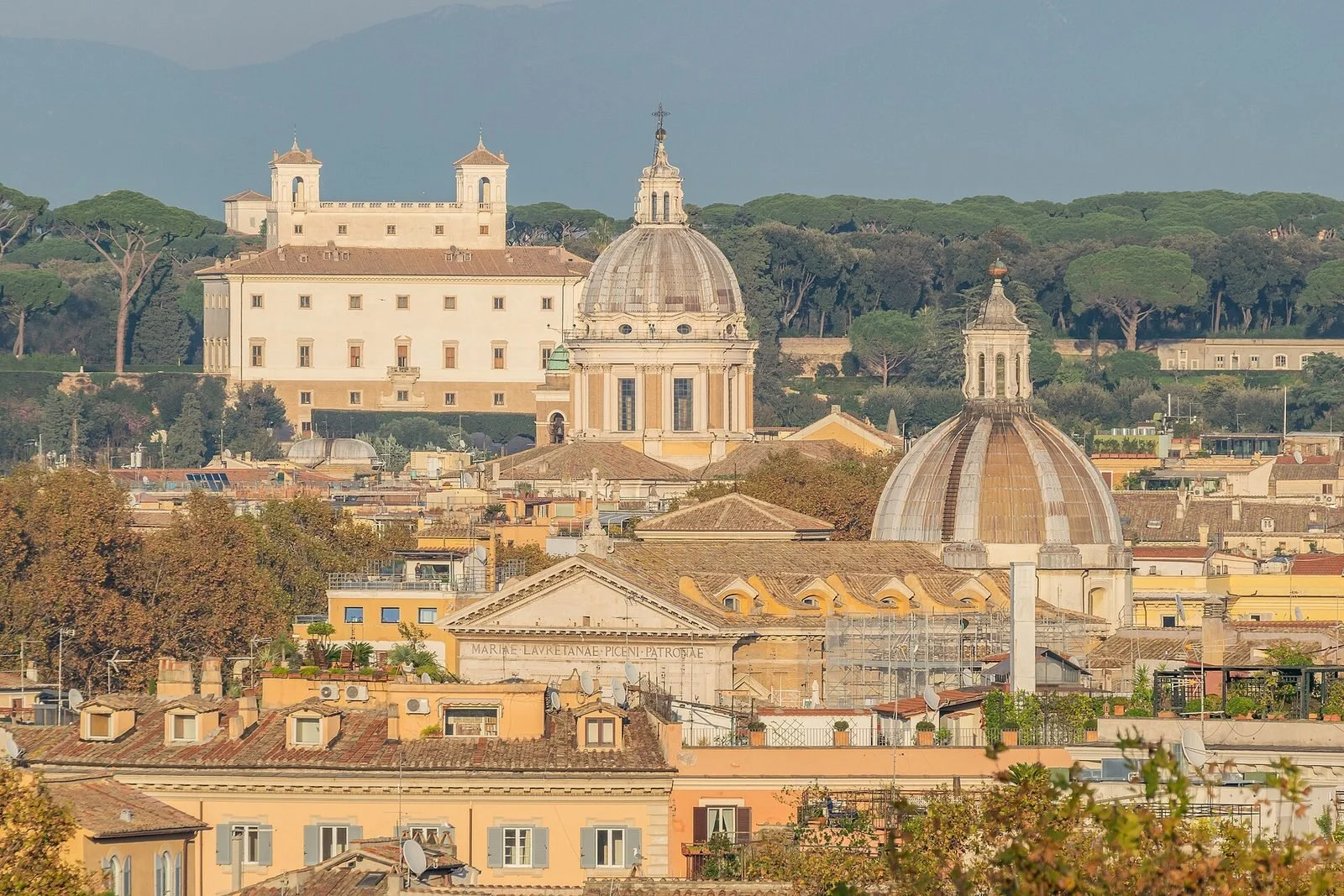
San Salvatore in Lauro is the church that closes off the long side of Piazza San Salvatore in Lauro, in the rione Ponte, halfway between Via dei Coronari and the Lungotevere Tor di Nona, a few hundred meters from Ponte Sant’Angelo and Piazza Navona. It is the national church of the people from the Marche in Rome, home to the association that brings together the Piceni in the capital, and behind the church it keeps a complex that almost none of the passersby imagine: a 15th-century cloister with a refectory, and inside the refectory the funerary monument of a pope, Eugene IV, which came here from St. Peter's. The neoclassical facade, pale and severe, promises nothing of all this. Anyone walking along the square on a shortcut to the river takes it for one of the many second-rank churches of the center and keeps going.
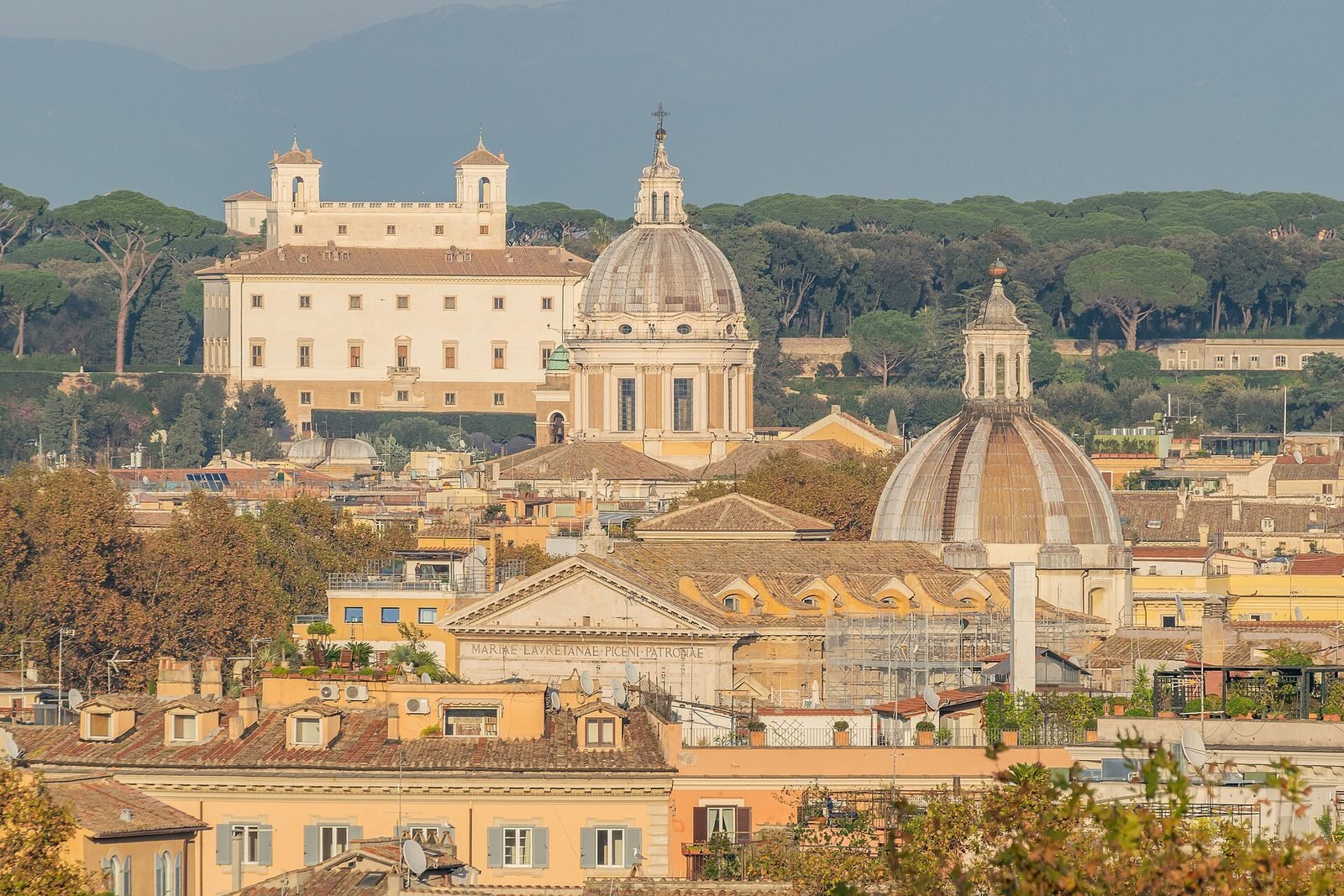
The text that follows lays out what can be said with reasonable certainty about the origin of the name, the history of the complex, the handover to the people from the Marche and the devotion to the Madonna of Loreto, and it separates clearly the points on which the sources diverge or stay vague. On one point it is best to be explicit right away, before anything else: the opening hours of San Salvatore in Lauro vary, the cloister and the refectory are not always open to visitors when the church is open, and the complex often hosts temporary exhibitions and concerts that change the access. If you want to see the cloister, check first with the official channels of the association that runs the complex. There are no fixed hours to report here, and making them up would be the quickest way to make a reader lose an afternoon.
Where San Salvatore in Lauro is and how to get there
San Salvatore in Lauro is in Piazza San Salvatore in Lauro, in the rione Ponte, in the part of Rome between the Tiber and Corso del Rinascimento, about 200 meters from Via dei Coronari and less than 10 minutes on foot from Castel Sant'Angelo. The square is small and irregular, closed on one side by the flank of the church and on the other by buildings of different eras, and it has the distinction of being almost always emptier than the streets around it.
The position within the rione Ponte
The rione Ponte takes its name from the very bridge that for centuries was the only pedestrian crossing toward the Vatican, the one now called Ponte Sant’Angelo. The whole area took shape around the flow of pilgrims headed for St. Peter's: Via dei Coronari, which runs a few steps from the church, gets its name from the sellers of rosary beads who had shops there along the route of those going to and from the basilica. San Salvatore in Lauro stands right inside this system of streets, at a spot that in the 1400s and 1500s was a required passage and that today sits about 30 meters off the main tourist currents.
30 meters, in the center of Rome, make an enormous difference. On spring weekends Via dei Coronari is a solid line of people. Piazza San Salvatore in Lauro, which opens off to the side, is often half empty at the same hour of the same day.
By public transport
There is no metro stop nearby. The whole area between Piazza Navona, the Pantheon and the Tiber has no metro, and that is the first practical fact to keep in mind. The surface lines that leave you closest are those running along Corso Vittorio Emanuele II (from the stop you walk north along Via del Governo Vecchio or Via dei Banchi Nuovi, seven or eight minutes at a normal pace) and those that pass on Corso del Rinascimento, on the side of Piazza Navona. The buses that run along the Lungotevere also stop at a useful distance, on the river side. Roman bus routes change fairly often because of roadworks and detours: we advise checking the updated route on the official Rome public transport app on the same day, instead of trusting a bus number read on a page written months earlier.
On foot, which is the right way
The sensible way to get here is on foot, and more precisely from Ponte Sant’Angelo: you cross the river with Castel Sant'Angelo behind you, turn right along the river, and in three minutes you are in the square. The alternative is to start from Piazza Navona and take Via dei Coronari at the level of Santa Maria dell’Anima: the street runs straight west and the square opens on the right, recognizable because it is one of the few tree-lined open spaces in the area.
By car: not worth it
The rione Ponte is inside the limited traffic zone of the historic center, with electronic gates active at times set by the City of Rome, and the surface parking in the area is very scarce and reserved for residents. Arriving by car almost always means leaving the car far away and walking anyway. If you come from outside Rome, it's quicker to leave the car in a park-and-ride lot and take public transport.
The name: the laurel grove, and why it's a tradition
The current explanation of the name San Salvatore in Lauro is that a grove of laurels, a lauretum, once stood here, hence the addition in Lauro to the Savior's title. It needs to be said precisely what this explanation is: it is a tradition, handed down by the scholarly literature of Rome and taken up by later guidebooks, not a fact documented by an ancient source describing the grove.
What we know and what we don't
Did the grove really exist, and when? That is another matter. There is no archaeological documentation attesting to it, and the memory may have formed after the fact to explain a name already in use. It is the mechanism that in philology is called folk etymology, and in Rome it has produced dozens of fascinating and unprovable explanations. Here we report it for what it is: tradition, not document.
A clarification that avoids a frequent mix-up
More than one visitor links the laurel of the name to the Madonna of Loreto, because of the similar sound of Lauro and Loreto. It is a connection that doesn't hold up: the title in Lauro is attested for the church well before the complex became the center of Loreto devotion in Rome, and the two things have separate origins. The similarity in sound has probably helped consolidate the link in common use, though, and it is the kind of overlap that makes it hard to reconstruct Roman devotions with clarity.
The 15th-century foundation and the Venetian convent
The complex of San Salvatore in Lauro as we see it today was born in the 1400s on the initiative of Cardinal Latino Orsini, who in the second half of the century had the church rebuilt and added a convent entrusted to the canons regular of San Giorgio in Alga, a congregation of Venetian origin. This is the core from which everything else descends: the cloister, the refectory, and also, indirectly, the arrival of the monument of a Venetian pope.
The canons of San Giorgio in Alga and the link with Venice
The congregation of San Giorgio in Alga took its name from the island in the Venetian lagoon where it had its mother house. Its settlement in Rome, in a rione crossed by pilgrims headed to the Vatican, made the complex of San Salvatore in Lauro a point of reference for the Venetians living in the city of the popes. This fact explains a lot about this place, including the reason why the tomb of Eugene IV, a Venetian pope, ends up right here and not elsewhere.
The congregation was suppressed in the second half of the 1600s. The sources place the suppression in 1668, by decision of Clement IX, as part of the general reduction of the minor religious orders decided in those years. It is a date to be taken as widely accepted but not as gospel truth: anyone who works on these chronologies knows that suppressions take a long time to carry out and that the physical transfer of property can happen years after the formal act.
The church of the people from the Marche in Rome and the Madonna of Loreto
San Salvatore in Lauro is the national church of the people from the Marche in Rome: the complex belongs to the association that since the 1600s has brought together the Piceni living in the capital, that is, the Romans originally from the Marche, and it hosts the Roman devotion to the Madonna of Loreto, the most important Marian shrine of the region. This is the identity-defining fact of the place, the one that explains its present life far more than its architecture.
When the handover happened: the chronology, with the necessary caution
The most widespread reconstruction is this: with the Venetian congregation suppressed in 1668, the complex passes the following year, in 1669, to the confraternity of the Piceni, the association of the people from the Marche in Rome from which the present Pio Sodalizio dei Piceni descends. We checked the internal consistency of this chronology and it holds: the sequence of suppression and assignment a few months apart is normal in the curial practice of the period. It should be noted, however, that some reconstructions give slightly different dates for the completion of the handover and that the stable settlement of the Piceni in the complex is a process, not an instant. Anyone who needs the exact date for research must go back to the association's documents, not stop at popular pages, this one included.
Who the Piceni are
Piceno is the ancient name of the region that today corresponds in large part to the Marche, from the Italic people of the Piceni. For centuries the regional communities in Rome organized themselves into national confraternities, each with its own church: the Florentines at San Giovanni dei Fiorentini, the Portuguese at Sant’Antonio dei Portoghesi, the Germans and Flemings at Santa Maria dell’Anima, the French at San Luigi dei Francesi. The rione Ponte and the Campo Marzio are full of these national churches, often a few dozen meters from one another, and walking among them is one of the most instructive routes in the center of Rome: it tells how the city worked when being from Florence or Ancona in Rome meant belonging to a network of assistance, credit and burial.
The Loreto devotion
Loreto, in the province of Ancona, is home to the Holy House, one of the main Marian shrines of Italy. The presence of the people from the Marche at San Salvatore in Lauro brought the devotion to the Madonna of Loreto here, and it is the Marian reference point of the Piceni community in Rome. Anyone who enters the church on an ordinary day finds signs of this devotion, and anyone who happens by during celebrations tied to the Loreto calendar finds a church full of people who are not there as tourists.
Watch out for a point that often confuses visitors: Rome also has a church dedicated to the Madonna of Loreto, the one near Trajan's Column. They are distinct places, with separate histories. San Salvatore in Lauro is not the church of Santa Maria di Loreto, and looking for one in place of the other is a mistake made more often than you would think.
The fire of the late 1500s and the church we see today
The 15th-century church of the Orsini was devastated by a fire at the end of the 1500s, and the sources agree on 1591 as the year of the blaze. The reconstruction that followed produced the present building, carried forward in phases through the 1600s and completed in its exterior appearance only in a much later era.
The design and the attributions
The 17th-century reconstruction is commonly attributed to Ottaviano Mascarino, an architect from the Marche active in Rome between the 1500s and 1600s. The attribution is accepted by the current literature, and it has an internal consistency that is striking: an architect from the Marche for a church that would become the church of the people from the Marche, even if the two things fall at different moments and the link is by chance. As with almost all Roman attributions of this period, the building site dragged on beyond the designer's life and saw the intervention of other hands: anyone looking at the interior in search of a unified design won't quite find it, and that is normal.
The facade, which is 19th-century
The facade you see today is not 17th-century. It is a work of the 1800s, built when the church had already been in the hands of the Piceni for two centuries, and this explains its look: linear, pale, with an order of columns and a pediment, a neoclassical language that has little dialogue with the interior. The sources attribute the design to Camillo Guglielmetti and place the completion around the 1860s, with 1862 as the date most often cited. We report this as the prevailing view in the literature, not as verified against an archive document.
The interior
The interior has a single nave with side chapels, following the Counter-Reformation scheme common in Rome after the Council of Trent, the same layout found, in very different proportions, in chiesa del Gesù and in Sant’Andrea della Valle. The chapels keep paintings and furnishings of different eras, the result of successive commissions and internal moves over time.
On individual attributions of the paintings it is wise to be cautious. The literature on this church reports names that in some cases are debated, and the captions on site don't always match the most recent bibliography. If you visit for study, refer to the official catalog entries. If you visit out of curiosity, look at the works without expecting every label to be the last word.
The Renaissance cloister and the refectory: the main attraction
The most interesting part of San Salvatore in Lauro is not the church: it is the 15th-century cloister with the adjoining refectory, which survived the fire of the late 1500s that destroyed the place of worship. This is where the complex keeps its Renaissance, and it is also the reason why the visit deserves to be planned rather than improvised.
What you see
The cloister has a double order of arches on piers and columns, with the sober breadth of Roman conventual architecture of the second half of the 1400s. It doesn't have the fame of the Chiostro del Bramante, five minutes away, today a much-visited exhibition venue. But anyone who compares the two cloisters in the same afternoon understands both better, because they belong to two different moments of the same idea of cloistral space. The passage from the cloister of San Salvatore, still 15th-century in sensibility, to the Bramante one, measured on openly classical proportions, is a lesson in architectural history that you do with your legs.
The refectory is the room where the canons ate together. A rectangular hall, tall, with the functional sobriety that these spaces had by purpose. Today it is one of the rooms the complex also uses for cultural initiatives, and it is in there that you find the monument that makes this place unusual.
Access to the cloister: read carefully
The cloister and the refectory are not always accessible when the church is open. It regularly happens that the church can be visited and the convent part cannot, because the complex is the seat of an organization that uses those spaces, because an installation is underway, or simply because there is no staff available. Anyone who arrives counting on seeing the cloister without having checked first has a good chance of finding a closed door. There are no stable published hours to report here: the only serious way is to contact the Pio Sodalizio dei Piceni or consult its official channels before setting out.
The funerary monument of Eugene IV, which came here from St. Peter's
Inside the refectory of San Salvatore in Lauro stands the funerary monument of Pope Eugene IV, moved here from the Vatican basilica. It is the most unusual fact about this place, and it is also the one that almost nobody knows: a 15th-century papal tomb doesn't end up in a church of middling importance by chance, and the story of how it got there explains quite a lot about how Rome has treated its own monuments.
Who Eugene IV was
Eugene IV, born Gabriele Condulmer, a Venetian, was pope from 1431 to 1447. His pontificate runs through the tensest moment in the relationship between papacy and councils, with the long standoff of the Council of Basel, and includes the Council of Ferrara and Florence and the attempt at union between the Latin and Greek Churches. He died in Rome in 1447 and was buried in St. Peter's, in the old basilica, the Constantinian one that still stood and would be demolished to make room for the present building.
Why the tomb ended up at San Salvatore in Lauro
The demolition of the old Vatican basilica and the construction of the new St. Peter's set dozens of tombs, altars, mosaics and furnishings in motion over the 1500s and 1600s. Not everything found a place in the new building: many monuments were taken apart and relocated elsewhere, in Roman churches that had a claim to receive them. In the case of Eugene IV the claim was there, and it was the Venetian link: the pope was Venetian and the complex of San Salvatore in Lauro was, at that time, in the hands of the canons of San Giorgio in Alga, a Venetian congregation.
The sources place the transfer in the 1600s and the date most often reported is 1624. Let's treat it as the prevailing indication and not as a definitive fact: relocations of this kind often happen in several phases, and the date of dismantling doesn't necessarily coincide with that of reassembly in the new location. Anyone who needs the exact chronology must go to the specialist bibliography on the Vatican building site.
The work and its author
The monument is attributed to Isaia da Pisa, a sculptor active in Rome in the 1400s and present at several Roman building sites of the period. The attribution is the current one in the literature. As often happens with Roman sculpture of the mid-1400s, the role of the workshop and the assistants is debated among scholars, and some parts of the monumental complex have been linked to different hands. What stands in front of you is a monumental 15th-century tomb with the figure of the pontiff lying down, following the established scheme of the papal tomb of the period.
Why almost nobody knows about it
The monument is not in the church, where anyone who comes in would see it. It is in the refectory, that is, in a room of the convent that is accessible only when the complex is open and when that part can be visited. The consequence is that a 15th-century papal tomb, the work of a known sculptor, moved from St. Peter's, stays off the tourist routes and off many general guidebooks too. It is one of those cases where a work's obscurity depends on logistics, not on its worth.
Before going there on purpose, though, the recommendation is the same as above, and it should be taken seriously: check the accessibility of the refectory before setting out. Seeing the church and finding the cloister door closed is the most likely outcome of an improvised visit.
A curiosity about San Salvatore in Lauro
The most solid curiosity about San Salvatore in Lauro concerns its relationship with the river: until the 1880s the church faced an urban fabric that reached down to the bank of the Tiber, and the opening of the Lungotevere and the construction of the embankment walls after the great flood of 1870 demolished an entire front of buildings, changing forever the way this square looks toward the river.
What this means in practice
Rome, before the embankment walls, touched the water. The houses of the rione Ponte went down to the bank, with landing stages, little stairways, warehouses and cellars that flooded regularly. The flood of 1870, one of the most serious on record, sped up the decision to embank the river: the works of the following decades cut away the buildings closest to the water and created the raised streets we now call the Lungotevere.
For anyone looking at Piazza San Salvatore in Lauro today, the result is this: the distance that now separates the church from the river is in large part the product of a demolition, and the side of the rione facing the water is an urban wound healed with late 19th-century buildings and streets. If you want to see it for yourself, look at the facades as you walk toward the river and notice where the rhythm of the buildings changes: the jump is sharp.
Something nobody tells you about San Salvatore in Lauro
What is almost never said is that San Salvatore in Lauro works, in practice, as an exhibition and concert venue, and that a substantial share of the people who go in every year don't do it for the church: they go in for a temporary exhibition or for a concert hosted in the rooms of the complex.
How it really works
What makes sense to say is the practical rule. Before coming here, check if an event is going on, because the event changes everything: it can open rooms that are normally closed, it can close others, it can mean an admission fee for one part of the complex while the church stays freely accessible, it can create lines in a square that is usually deserted. We advise consulting the official channels of the Pio Sodalizio dei Piceni and the notices posted at the entrance.
The flip side
This exhibition role has a cost for the visitor looking for the 1400s. When the cloister hosts an installation, the architecture is partly covered by panels, tarps, temporary structures and stage lighting. Anyone who comes to see the cloister as architecture may find it masked by an exhibition. And anyone who comes for the exhibition often doesn't even notice what is behind the panels.
It is a judgment, and we say it openly: the exhibition function has kept alive and maintained a complex that would otherwise have stayed closed almost all the time, and that is worth more than the discomfort of a partly covered visit. But if you have a specific interest in 15th-century architecture, do your homework before coming.
Contemporary devotion
A second element little talked about concerns modern devotion. The complex is also tied to the cult of Saint Pio of Pietrelcina, with a devotional presence that on certain days brings sizable groups of the faithful into the church. Anyone who arrives at those times finds a church in operation, with lines and celebrations, and an art-focused visit becomes impractical out of respect as well as for practical reasons. It is not an inconvenience: it is the place doing its job.

The advice I give you for visiting San Salvatore in Lauro
The practical advice for visiting San Salvatore in Lauro is not to come here as your only destination: fit it into a walking route through the rione Ponte, with a phone call or an online check beforehand to find out if the cloister and refectory are accessible that day. The risk of finding it closed is real and should be factored in.
How to build the route
An itinerary that works starts from Castel Sant'Angelo, crosses Ponte Sant’Angelo, enters the rione along the river, touches San Salvatore in Lauro, goes back up Via dei Coronari toward the east and comes out at Santa Maria della Pace and the Chiostro del Bramante, to end at Piazza Navona with Sant’Agnese in Agone and the Fountain of the Four Rivers. It is less than two kilometers in all and you walk always on narrow, shaded streets, which in summer is not a minor detail.
The right time of day
Roman churches of this kind generally follow a morning opening and a reopening in the late afternoon, closing in the middle hours. We don't publish hours for San Salvatore in Lauro because there is no stable, published schedule that we can guarantee. The practical rule is simple: midmorning or late afternoon, avoiding lunchtime, and always with a check beforehand. If you also want to see the cloister, treat the visit as subject to the organization's confirmation.
How much time you need
For the church alone 15 or 20 minutes is enough, which become 40 or 50 if the cloister and refectory are open and if you really stop to look at the monument of Eugene IV. If an exhibition is on, the time depends on the installation and can easily double. When working out a half-day itinerary, we advise keeping 40 minutes of margin and counting them as lost if the cloister is closed.
The verdict, no beating around the bush
If you have two days in Rome and have never seen the city, you shouldn't come here: you should see other things, and we say so with the same frankness we use in person. San Salvatore in Lauro is a stop for a second or third visit to Rome, or for the first visit of someone with a specific interest in the Roman Renaissance, in national churches or in the history of the papacy. In that case the refectory with the tomb of Eugene IV is well worth the detour, and it is one of the places where you can look at a work of that level with nobody around.
Another well-known fact, yet rarely cited
The well-known fact that almost nobody cites is that San Salvatore in Lauro belongs to a system: the national churches of Rome, dozens of buildings managed for centuries by the regional and foreign communities living in the city of the popes, which make up a precise and readable network inside the historic center.
How a national church worked
A community of outsiders in Rome organized itself into a confraternity. The confraternity bought or received a church, attached to it a hospice for the pilgrims from its own homeland, often a small hospital, almost always a system of burials reserved for its members, sometimes a fund for the dowries of the community's poor girls. The church was the visible center of a system of assistance and identity, and the national title counted far more than the beauty of the building.
This explains why, within a 10-minute walk from here, you find so many churches of different communities: the Florentines at the head of Via Giulia, the Portuguese a step from Piazza Navona, the Germans and Flemings at Santa Maria dell’Anima, the French at San Luigi dei Francesi, the Spanish, the Lombards, the people from Bergamo, the Sienese, each with its own seat. The center of Rome, read this way, is a map of the internal and European migrations of five centuries.
Why it's a little-visited subject
National churches are hard to tell about in a short visit because their interest is historical and social before it is artistic. A guide with two hours takes you to the Pantheon and Piazza Navona, not to explain how the confraternity of the Piceni worked. The result is that an enormous piece of Roman social history stays invisible to almost all visitors.
The right photo to take at San Salvatore in Lauro
The photo worth taking at San Salvatore in Lauro is the one of the cloister from the shaded side, with the double order of arches cutting the frame horizontally and the light coming in from above on the opposite side: it is the only image that really tells you what is behind that anonymous facade. It can only be taken when the cloister is accessible, and for this reason it should be counted as a possibility and not a certainty.
The light conditions
A cloister is a well of light: at noon the contrast between the lit quadrangle and the shaded porticoes is too harsh for a single exposure, and the photo comes out burned on one side and shut on the other. The hours that work are midmorning and late afternoon, when the light comes in at an angle and the portico brightens. On an overcast day the cloister looks better than in full sun, and this is one of the few Roman situations where gray helps.
The framing we recommend
Stand under the portico, put your back against a pier and shoot diagonally across the courtyard, so that the arches on the opposite side read in full and those in the foreground act as a dark frame. The diagonal gives the depth that a frontal shot flattens. With a phone it's best to avoid the extreme wide angle, which curves the arches and distorts the proportions of an architecture built entirely on the relationship between solids and voids.
The rules to follow inside
In the church, photography is normally tolerated without flash and without a tripod, but it is not a right: during services you don't take photos, and in the rooms of the complex the organization's rules apply, which can be stricter. If an exhibition is on, the works on display almost always have their own reproduction rules, set by the lenders, and the ban on photography also covers the spaces taken up by the installation. It's best to ask before pointing the camera, and to accept the no if it comes.
Some important events that happened here in history
The history of San Salvatore in Lauro rests on a few dated and clearly identifiable passages: the 15th-century foundation by the Orsini, the fire of 1591, the transfer of the monument of Eugene IV in the 1600s, the suppression of the Venetian congregation in 1668 with the handover to the Piceni the following year, the 19th-century facade and the urban transformations of the rione after 1870.
The 1400s of the Orsini
The reconstruction promoted by Cardinal Latino Orsini places this complex within the season when the great Roman families and cardinals built churches and convents as acts at once religious, political and familial. The cloister and refectory we see today are the material legacy of that season, and they are also the part that withstood everything else.
The fire of 1591
The fire destroyed the church and forced the reconstruction that produced the present building. Fires in Roman churches were frequent, helped along by wooden roofs, candles, and ephemeral decorations of paper and cloth set up for feast days. Few churches in the center haven't had at least one fire in their history, and in many cases it is the fire, not taste, that determined the look we know.
The 1600s: a papal tomb changes home
The arrival of the monument of Eugene IV, placed by the sources in the 1600s with 1624 as the most cited date, is the event that gives this complex a piece of Vatican history. It is also a testimony to the way the building site of the new basilica of St. Peter's redistributed around the city works that had previously been concentrated in a single building.
1668 and 1669: the change of ownership
The suppression of the congregation of San Giorgio in Alga and the handover of the complex to the confraternity of the Piceni mark the birth of the church of the people from the Marche in Rome, that is, of the identity the place still keeps. From that moment the history of the complex coincides in large part with the history of the Marche community in the capital.
The 1800s: the facade and the river
The completion of the facade in the 1860s and, soon after, the great flood of 1870 with the works on the embankment walls are two events that change the exterior look and urban context of the complex within about 20 years. The Rome of the capital being born in that period redraws the whole river front, and the rione Ponte is one of the districts that came out of it most transformed.
Who passed through San Salvatore in Lauro
Through San Salvatore in Lauro have passed, in different ways, Cardinal Latino Orsini who had it built, the Venetian canons of San Giorgio in Alga who lived there for two centuries, the sculptor Isaia da Pisa through his work, the Marche architect Ottaviano Mascarino to whom the reconstruction is attributed, and a pope, Eugene IV, who arrived almost two centuries after his death.
Latino Orsini
A cardinal from one of the great Roman baronial families, the Orsini, active in the second half of the 1400s. His building initiative is at the origin of the complex. The Orsini name runs through the whole topography of Rome, from the Theater of Marcellus turned into a baronial palace to the castles of Lazio, and it is one of the threads that lets you read the city as a map of family powers.
Eugene IV
The Venetian pope originally buried in the old Vatican basilica and today present here with his funerary monument. His pontificate, from 1431 to 1447, is one of the most contested in the history of the Church. The fact that his tomb is in a refectory, and not in a basilica, is one of those circumstances that say a lot about how Rome has handled its own heritage over the centuries.
The people from the Marche in Rome
They are, more than any single illustrious name, the continuous presence of this place for over three centuries. Generations of immigrants from the Marche to Rome have used this church for baptisms, weddings, funerals, patron saint festivals and mutual aid. It is the least showy and most concrete story of the complex.
What to see nearby: the rione Ponte and the Campo Marzio on foot
Around San Salvatore in Lauro, within a kilometer, there is a density of monuments that few other areas of Rome reach: from the river to Campo de’ Fiori it is barely a quarter of an hour's walk, touching a dozen buildings that elsewhere would each be the destination of a whole day.
Toward the river and the Vatican
Going out onto the Lungotevere you reach in a few minutes Ponte Sant’Angelo and Castel Sant'Angelo, from which Via della Conciliazione leads to St. Peter's, the Vatican obelisk and the entrance to Vatican City. On the same side, a little farther upstream, Santo Spirito in Sassia and the hospital complex that for centuries received pilgrims. In the opposite direction, the river front leads to the Palace of Justice and, farther on, to the Tiber Island and the Ponte Rotto.
The quadrilateral of Via Giulia and Monserrato
South of the church, beyond Corso Vittorio Emanuele II, opens the area of Via Giulia with San Giovanni dei Fiorentini, Santa Maria dell’Orazione e Morte, the Oratorio del Gonfalone and Sant’Eligio degli Orefici. A little beyond, Palazzo della Cancelleria, the Galleria Spada and Campo de’ Fiori.
Toward Piazza Navona and the Pantheon
To the east, the axis of Via dei Coronari comes out into the system of Piazza Navona, with Sant’Agnese in Agone, the Fountain of the Four Rivers and, below street level, the Stadium of Domitian. Around the square: Palazzo Altemps, the Museo di Roma at Palazzo Braschi, Santa Maria della Pace with the Chiostro del Bramante, Sant’Ivo alla Sapienza, Sant’Agostino, San Luigi dei Francesi, Palazzo Madama and Sant’Eustachio. Farther on you reach the Pantheon, Santa Maria sopra Minerva, Santa Maria Maddalena and Sant’Ignazio.
Eating around Via dei Coronari without falling into a trap
Via dei Coronari and the streets between Piazza Navona and the river are among the most trodden areas of Rome, and the density of places built on tourist traffic is high: here we don't point to signs, because a list of names goes stale in a few months, and we teach instead how to recognize what to avoid.
The five signals that tell you to steer clear
The first is the woman rolling fresh pasta in the window or right out on the street: it's an advertising hook, not a kitchen. The second is the menu with photographs of the dishes, which serves to sell to people who don't read the language and don't ask for explanations. The third is the barker at the door inviting you to sit: a place with its own clientele doesn't need to stop people in the street. The fourth is non-stop hours from morning to night, with no kitchen break, which is possible only if nothing is being cooked in the kitchen. The fifth is a position directly in front of a famous monument, where the price often adapts to the tourist in front of them, with items not priced on the menu or different price lists between the table inside and the one outside.
The chains in the center
In the center of Rome, places with repeated signs have multiplied, with the same menu at several points in the city and the line with a numbered ticket at the entrance. We don't name them. The plain observation is enough: Romans don't go, and the line you see is made up almost entirely of people who are in Rome for three days.
The simplest criterion, the one that always works
Look at who is sitting at the tables and in what language they order. If at two in the afternoon there are people inside who work in the area and order in Italian without looking at the menu, the place holds up. If the tables are occupied only by groups with backpacks and the waiter goes straight to English, the bill will be higher and the dish worse. It works in Rome as in any other tourist city, and it requires no specialist knowledge.
A practical tip about the area
Moving two or three streets away from the main route almost always changes the quality and the price. The inner streets of the rione Ponte and those toward Monserrato still have places that work on neighborhood clientele. If you want a selection already made, you can consult Daniele Dezi's personal list on Google Maps, a collection curated over time and not sponsored by any of the places listed.
Frequently asked questions about San Salvatore in Lauro
Where is San Salvatore in Lauro?
San Salvatore in Lauro is in Piazza San Salvatore in Lauro, in the rione Ponte, between Via dei Coronari and the Lungotevere, in the historic center of Rome. It is about three minutes on foot from Ponte Sant’Angelo and less than 10 from Piazza Navona. There is no metro stop nearby: you get there on foot or with the surface lines that pass on Corso Vittorio Emanuele II, on Corso del Rinascimento and on the Lungotevere.
How much does it cost to enter San Salvatore in Lauro?
Entry to the church at San Salvatore in Lauro, as in all churches of worship in Rome, is free. The case is different for the temporary exhibitions hosted in the rooms of the complex, which may charge a ticket set each time by the organizers. We don't publish prices because they change with every initiative: it's best to check the official channels of the Pio Sodalizio dei Piceni before going.
What are the opening hours of San Salvatore in Lauro?
The hours of San Salvatore in Lauro vary and there is no stable published schedule that can be guaranteed months out. The church generally follows a morning opening and one in the late afternoon, closing in the middle hours, but services, cultural initiatives and installations change the access. We advise contacting the organization that runs the complex the day before your visit.
Can you visit the cloister of San Salvatore in Lauro?
The 15th-century cloister of San Salvatore in Lauro is not always accessible, and it often happens that the church is open while the cloister and refectory stay closed. Access depends on the activities of the organization that occupies the rooms and on the presence of exhibition installations. If you want to see the cloister, find out beforehand: arriving without checking means accepting a real risk of finding it closed.
Where is the tomb of Eugene IV?
The funerary monument of Pope Eugene IV is in the refectory of the complex of San Salvatore in Lauro, in Rome, and not inside the church. It was moved here from the old Vatican basilica during the 1600s, with 1624 as the date most often reported by the sources. The work is attributed to the sculptor Isaia da Pisa. You can see it only when the refectory is accessible, so check in advance.
Why is San Salvatore in Lauro the church of the people from the Marche?
San Salvatore in Lauro is the national church of the people from the Marche in Rome because the complex passed in the 1600s to the confraternity of the Piceni, that is, of the Romans originally from the Marche, after the suppression of the Venetian congregation that had lived there until then. The sources place the suppression in 1668 and the handover in 1669. Since then the church has hosted the Marche community and the devotion to the Madonna of Loreto.
How long does it take to visit San Salvatore in Lauro?
To visit San Salvatore in Lauro, 15 or 20 minutes is enough if you see the church alone, rising to 40 or 50 minutes when the cloister and refectory are accessible and you stop in front of the monument of Eugene IV. If an exhibition is on, the time depends on the installation. In a half-day plan in the rione Ponte we advise allowing 40 minutes of margin.
Is San Salvatore in Lauro accessible to people with mobility disabilities?
The main entrance of San Salvatore in Lauro opens onto the square and the nave is on a single level, a condition that generally makes the church usable with a wheelchair. The rooms of the complex, cloister and refectory included, may however have changes of level and thresholds. We don't have official data on the accessibility of every room: anyone who needs it should ask the organization directly before the visit.
Who wrote this page
This page is edited by the team at Tour Leader Pro, the Roman project office that designs and coordinates visits, itineraries and cultural events in Rome and Lazio. Hours, prices and access conditions reported here are verified as of the publication date against the official sources named in the text: it's best to recheck them before leaving, because they change often. If you find outdated information, let us know.
If you're building a walking itinerary in the historic center of Rome, combining San Salvatore in Lauro with the other stops of the rione Ponte and the Campo Marzio, you can find planning tools and operational support at Tour Leader Pro, which works on visits and cultural events in Rome and Lazio with groups of every size.
For the bigger picture, meaning travel between Italian cities, transport, travel times and organizing a trip that includes Rome along with other destinations, a useful resource is Italy Planner, which covers trip planning as a whole and not the single visit.