Santi Celso e Giuliano
In short. The basilica of Santi Celso e Giuliano is at Via del Banco di Santo Spirito 5, with a postal address at Vicolo del Curato 12, in the Ponte district, and is closed to the public for a restoration site financed by the PNRR Caput Mundi program.
The basilica of Santi Celso e Giuliano is at Via del Banco di Santo Spirito 5, with a postal address at Vicolo del Curato 12, in the Ponte district, and is closed to the public for a restoration site financed by the PNRR Caput Mundi program. It is a rectory of the parish of San Giovanni Battista dei Fiorentini, entrusted since 2019 to the Institute of Christ the King Sovereign Priest. Entry, once the work is finished, is free of charge. Nothing needs booking.
In the meantime the Institute’s services are held elsewhere: the Institute’s Roman site gives as temporary seat the church of the Immacolata dei Miracoli, at Via Sebastiano Veniero 3, with Mass in the old Roman rite. Anyone arriving at Via del Banco di Santo Spirito today finds the facade, the bankers’ street, the old Mint and Ponte Sant’Angelo 100 steps away. They are already a good reason to make a detour, even with the door closed.
The state of the site and the times of the services were checked on September 29, 2026 on the pages of the Institute of Christ the King, the parish of San Giovanni Battista dei Fiorentini, the Cantieri Narranti program and Turismo Roma. The end-of-works date given by the site was June 2026, and at the end of September the pages consulted do not yet announce the reopening. Before setting out, phone the rectory or write to the Institute.
Where it is and what you see from outside
Via del Banco di Santo Spirito is the street that starts at the head of Ponte Sant’Angelo, on the historic center side, and descends toward the Arco dei Banchi and Corso Vittorio. The church opens on the side of the street a few meters from the river, with its travertine facade squeezed between the houses. Anyone coming from Castel Sant'Angelo crosses the bridge, leaves the statues of the angels behind and has it in front of them in a minute.
The facade is late Baroque, on two orders, and guides describe it as Borromini-style in taste for its moving surfaces and cherub heads. Below, a single portal between two pairs of columns, above an oval window, at the sides two empty niches meant for statues that never arrived. Higher up, a large arched window. The street is narrow and the facade is read at an angle: you will never see it whole from the front.
Above the roofs the bell tower pokes out, which historical descriptions note for the spire with a profile unusual for Rome, closer to the Baroque of Austrian areas than to the Roman one. Inside the tower, according to local sources, is kept a bell dated 1268, among the oldest in the city. It’s a detail you can’t verify from the sidewalk, but it explains how old this parish is compared to the building you see.
What you see in these months: facade, street, and if the scaffolding is still up, the site sheeting. The interior cannot be visited until the reopening. Anyone who wants to understand the plan can still walk around the block: Vicolo del Curato and Vicolo di San Celso follow the perimeter of the church, which outside is an irregular octagon in brick built around an ellipse, and there you also find the entrance of the attached oratory of San Celsino.
The oratory of San Celsino, at Vicolo di San Celso 31, was born in 1571 for the confraternity of the Blessed Sacrament of the parish and today the parish of San Giovanni Battista dei Fiorentini lists it as an attached church. It is a small space, made for the meetings and devotions of the confreres, and its opening times are not published. Anyone passing along the alley should at least look at the portal: it tells of the neighborhood life that turned around the parish.
Current status: site, reopening and where it is celebrated today
The site is listed by the Cantieri Narranti portal, linked to the Ministry of Culture, among the interventions of the Caput Mundi program. The total financing indicated is €2,400,000 of PNRR funds, of which €1,667,000 for the works. The declared interventions are the seismic check with structural consolidation, the conservative restoration of the 18th-century colorings and the removal of whitewash from the stuccoes, that is the removal of the whitewashes that over time covered them.
The dates published by the portal give the start of works in September 2024 and the end in June 2026, with the site status shown as active. Other consulted sources place the church’s closure from October 14, 2024 until autumn 2026. As of September 29, 2026 the Roman site of the Institute of Christ the King continues to describe the basilica as under restoration. A reopening date is not published, and it’s wise to distrust anyone who announces one.
The services have moved. The Institute’s site gives as temporary seat the church of the Immacolata dei Miracoli, Via Sebastiano Veniero 3, in the Trionfale district, with these Masses: Sunday and holidays at 11:00, sung, and at 18:00, Monday to Friday at 18:00, Saturday at 11:00. Eucharistic adoration is listed Monday to Friday at 17:00, confessions Tuesday to Friday from 15:00 to 16:00 and from 17:00 to 18:30.
The times you still find around, with the church open in the morning from 7:00 and in the afternoon until 19:00, are those from before the site and concern the venue on Via del Banco di Santo Spirito. Today they don’t apply. To ask about the state of the works, the published contacts are the rectory phone, 06 68892283, the parish of San Giovanni Battista dei Fiorentini, 06 68892059, and the Institute’s email, italia@icrsp.org.
A curiosity about Santi Celso e Giuliano
The church you see is not the one the pope wanted. In 1509 Julius II entrusted Donato Bramante with the design of a new church, part of the great urban plan that in those same years was laying out Via Giulia. The old basilica was partly demolished to make room, the site started and then stopped with the pope’s death in 1513. For more than two centuries the parish lived in a mutilated building.
Bramante’s project was centrally planned, the same reasoning the architect was applying to the new St. Peter’s Basilica. Nothing came of it, for lack of funds according to the most cited sources. The curious result is that the 18th-century reconstruction, which came 200 years later, takes up in its own way the idea of a space gathered around the center: Carlo De Dominicis’s transverse ellipse is the Baroque version of a Renaissance dream.
The second curious detail concerns the saints. Celsus and Julian are not the best-known saints of the calendar, and in the altarpiece of the high altar they appear together with Basilissa and Marcionilla, figures tied to the same tradition of martyrs. What the documents say is little: an ancient dedication, attested with certainty by a bull of Honorius II of 1127 that names a priest of San Celso. What the tradition says is much more, and should be taken for what it is.
The local tradition, also reported by Wikipedia, places the consecration of the church in 432, under Pope Celestine I. The first mention that scholars consider certain is precisely that of 1127, while an attestation of 1008 in a Subiaco register is debated as to its location. Three dates, three levels of certainty. Anyone telling you about a fifth-century church is treating as fact what is tradition, and it’s worth keeping in mind even in front of the plaques.
Something nobody tells you about Santi Celso e Giuliano
This was a parish of power. In 1198 Innocent III declared it a papal chapel, and for centuries its chapter of canons, an archpriest and seven canons, had close ties with the papal court. The reason is the position: the church stood at the start of Via Papale, the solemn route by which the newly elected pope went from St. Peter’s to St. John Lateran to take possession of his cathedral.
Two archpriests of the early 1500s say it better than any argument. Paride de Grassis was master of papal ceremonies under Julius II and Leo X and at the same time archpriest of this small parish, according to Turismo Roma. Biagio da Cesena, appointed archpriest in 1518, was in turn master of ceremonies. Whoever organized the pope’s rites had his church right at the start of the ceremonial route. It’s not a coincidence.
Then the parish disappeared. In 1906 the chapter of canons and the parochial rights were transferred to San Giovanni Battista dei Fiorentini, as the same parish recalls on its site. Since then Santi Celso e Giuliano has been a rectory, that is a church open for worship without a territory of its own. The census of 1625 attributed to it more than 3,000 parishioners. The district meanwhile has emptied, and the church has lost its original function.
The third step, the most recent, is the old Mass. Since Christmas Eve 2019 the church has been entrusted to the Institute of Christ the King Sovereign Priest, a society of apostolic life that celebrates with the 1962 missal. Anyone entering here before the site found canons in traditional dress, Gregorian chant on Sunday and an international audience very different from that of the other churches of the district. It’s a character the church will regain at reopening.
There is also a detail about the name. In guides you find the church as Santi Celso e Giuliano in Banchi, with the name of the bankers’ quarter added to distinguish it, and with the title of minor basilica. The chapter of canons, which lasted into the 20th century, obtained honorary curial titles from Benedict XV and Pius XII. They are formal honors, but they confirm how long this little church remained in the orbit of the apostolic palace.
The elliptical interior and the 18th-century altarpieces
The reconstruction was decided by Pope Clement XII, the Florentine Lorenzo Corsini, the same who in the early 1730s put his hand to the facade of the Lateran and the Trevi Fountain. The project was entrusted to Carlo De Dominicis and the site closed in 1735, according to the most cited date. 1868 brings a second major restoration, wanted by Pius IX and carried out by Andrea Busiri Vici. The current site is the first intervention of this scale since then.
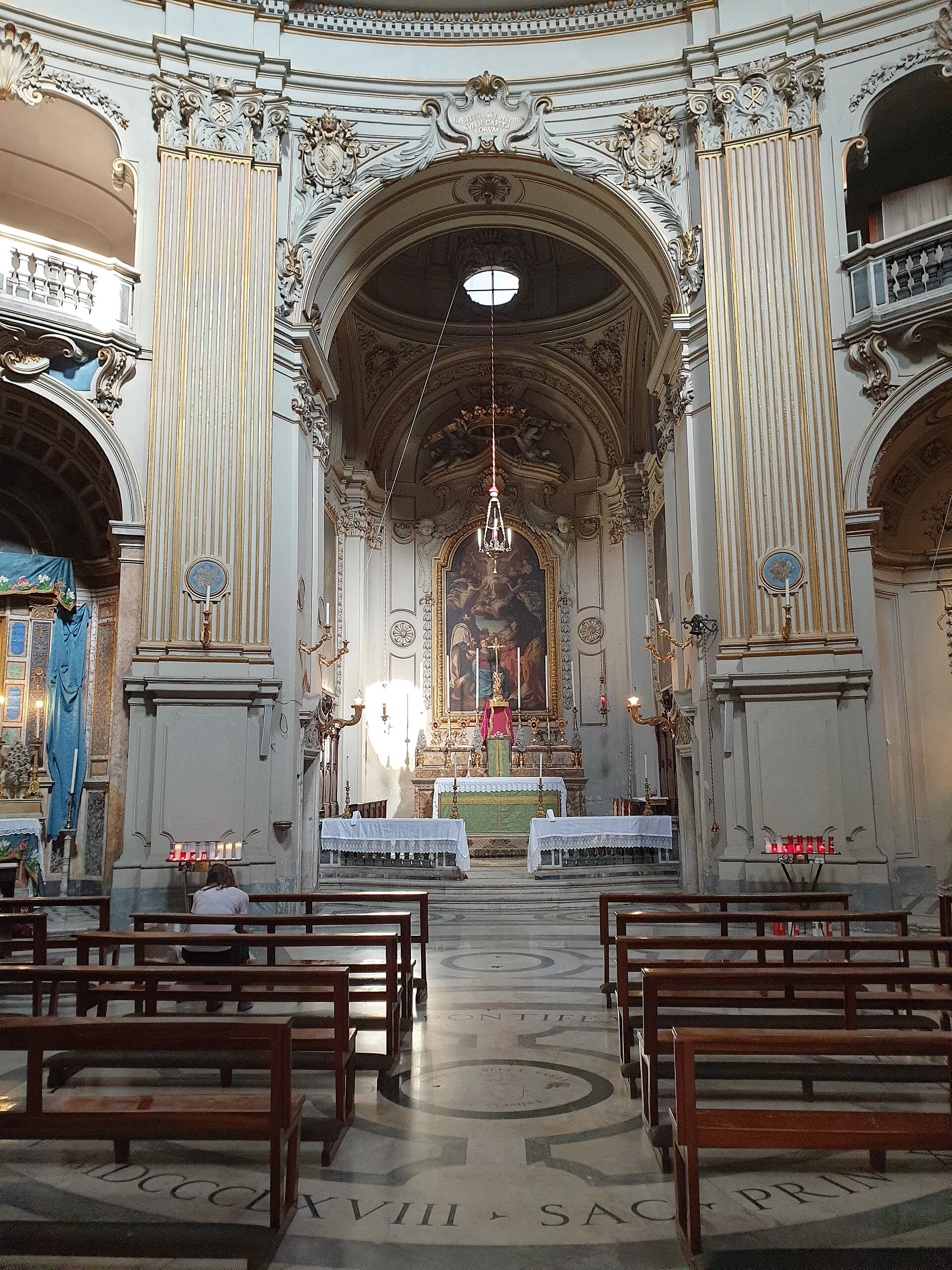
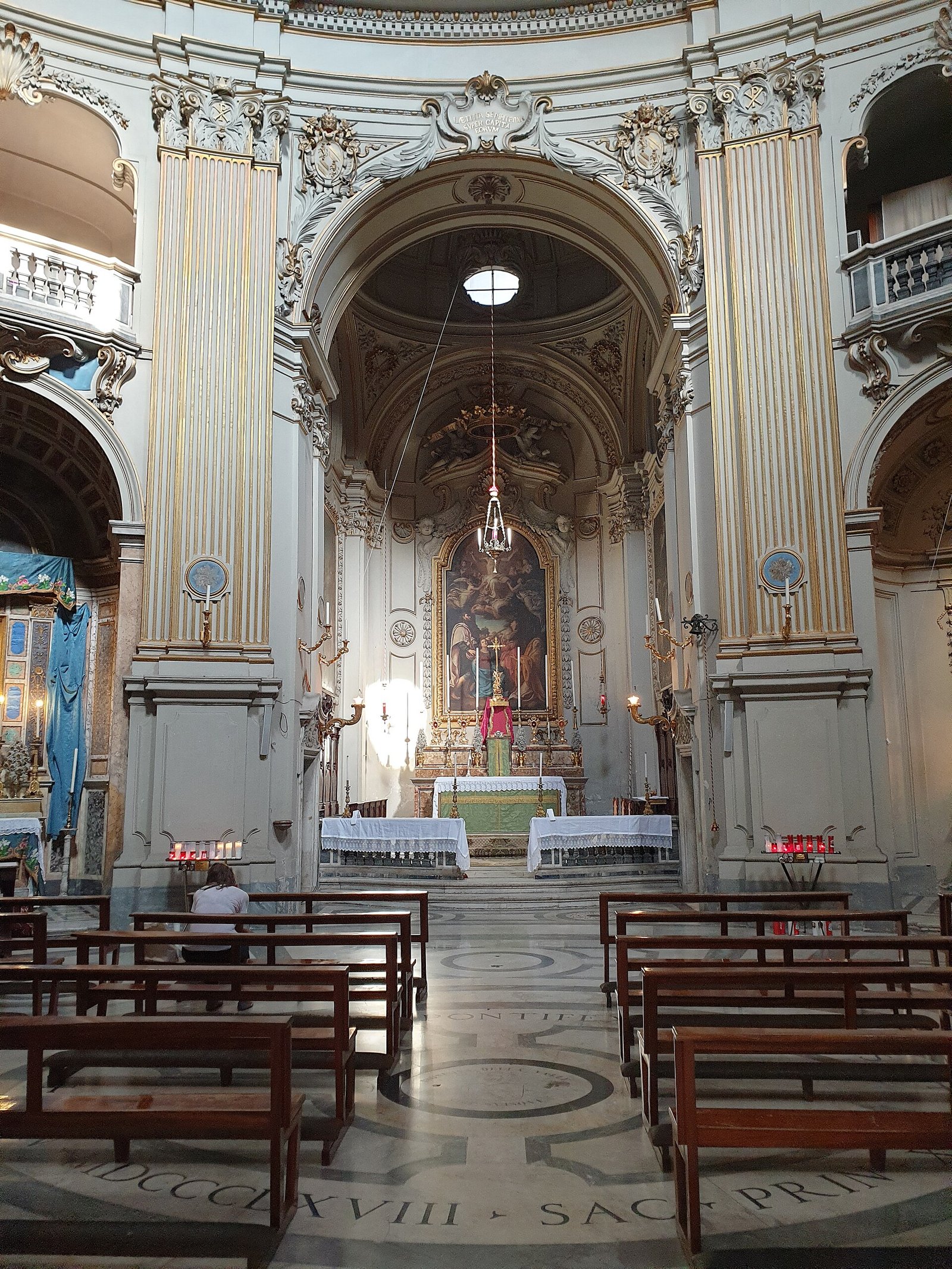
The plan is an ellipse laid across, with the long axis parallel to the facade, three chapels per side and a rectangular presbytery. Between one chapel and the next rise giant pilasters, and above the smaller chapels open the choir lofts, the little boxes for musicians with bulging balustrades. The vault is a lowered elliptical dome without a lantern, with the dove of the Holy Spirit at the center. White, gold, stuccoes of leaves and shells.
The work that justifies the visit is the altarpiece of the high altar by Pompeo Batoni, the Lucca painter who would become the favorite portraitist of Grand Tour travelers. It depicts Christ in glory with Saints Celsus, Julian, Basilissa and Marcionilla. On the date the sources disagree: some give 1736, others 1738 for the altar that holds it. At the sides of the presbytery two canvases by Francesco Caccianiga and Giacomo Triga tell episodes from the lives of the two saints.
In the side chapels the altarpieces are almost all from the years 1736 and 1737, a single decorative site. The first on the right, dedicated to San Cornelio, preserves the only altar that survived from the earlier building, with relics of Pope Cornelius and of the saints Artemia and Gianuaria and a canvas by Gaetano Lapis. To the left of the high altar the chapel of the Madonna delle Grazie keeps the copy of a venerated image, which I discuss further on.
The whitewash removal planned by the restoration concerns precisely these stuccoes. Later repaintings and whitewashes have flattened their design, and the project aims to restore the 18th-century colorings. It means that at reopening the church might look different from the photographs circulating today, perhaps less white and warmer. For anyone who saw it before 2024 it will be a reason to go back.
Two details of the furnishings are worth looking for at reopening. The wooden choir of the presbytery dates from the years of the reconstruction and bears the coat of arms of Clement XII, the signature of the commissioning pope placed where the canons see it every day. The other is the choir lofts above the diagonal chapels, which recall how much music mattered in a chapter church. When you go in, look up before you look at the altarpieces.
My advice for visiting Santi Celso e Giuliano
As long as the site is open, don’t organize a visit to the church. Organize a walk around the bridgehead, with the church as the first stop seen from outside. The sensible route starts from Ponte Sant’Angelo, takes Via del Banco di Santo Spirito, passes under the Arco dei Banchi, enters Via dei Banchi Nuovi and arrives at Santa Maria della Pace. One hour at a slow pace, all free, and you understand the district.
If you want to see the interior as soon as it reopens, don’t rely on generic information portals: they are precisely the ones that today still report the times from before the closure. Look at the Roman page of the Institute of Christ the King, which signals the return of the services, or call the rectory at the number published by the parish. The best day will be a Sunday morning, when the sung Mass gives back to the church the function for which it was designed.
A rule of behavior that holds here more than elsewhere. It is a church where they celebrate with the traditional liturgy, and part of the faithful are used to a silence and a dress code more formal than in a tourist basilica. Shoulders covered, no shorts, phone muted, no photographs during services. Nobody will throw you out for a pair of bermudas, but they’ll look at you badly, and they’ll be right.
If your interest is the old Mass and not the building, go straight to the Immacolata dei Miracoli on Via Sebastiano Veniero, where the Institute celebrates in the meantime with the same published times. If instead your interest is the Roman 18th century and Batoni, wait for the reopening and in the meantime see other churches of the district from the same century. They are two different visits and it’s best not to confuse them, because the temporary seat is in another neighborhood.
Last piece of advice: look at the facade with binoculars or with your phone’s zoom. The cherub heads on the upper capitals, the olive fronds in a ribbon on the sides of the pediment, the shells in the empty niches are details that get lost from below. The restoration also covers the exterior, and with the scaffolding removed the cleaned stone will make readable what is today covered by the patina of traffic.
Another well-known fact, yet rarely cited
Pius XII was baptized here. Eugenio Pacelli, born in the district on March 2, 1876, received baptism in this parish on March 4, two days later. A plaque in the first chapel on the left, set in place on March 2, 1939, the day of his election, recalls it. In 2020 a painting by Giorgio Esposito with the pope’s portrait was added alongside. It’s a fact known to Church historians and almost never told to those crossing the bridge.
The baptismal font, however, is no longer there. In 1930 it was moved to the basilica of San Pancrazio on the Janiculum, according to Wikipedia. The chapel of the Baptism of Christ remains, with the altarpiece by Giuseppe Ranucci of 1736. Anyone looking for the physical place of the sacrament should therefore go to the other hill. It’s the kind of move that happens constantly in Rome and that plaques don’t mention.
The second well-known and rarely cited fact concerns the Madonna delle Grazie. The venerated image in the chapel to the left of the high altar is the copy of an icon kept at Santa Maria della Consolazione, below the Capitoline Hill. The chapter of St. Peter’s crowned it in 1665. According to tradition, Ignatius of Loyola, Philip Neri and Pope Alexander VII prayed there. The documents attest the coronation. The saints’ visits are devout storytelling.
Third fact: the relic of Mary Magdalene. Turismo Roma reports that from the mid-1400s the church kept a relic of the saint’s left foot, and in the present church a chapel is dedicated to the Magdalene with an altarpiece by Emmanuele Alfani of 1736. On the fate of the relic after the reconstruction the operator says nothing. I note it because it explains a devotion that in the Ponte district, among pilgrims and bankers, made precise sense.
The right photo to take at Santi Celso e Giuliano
The right photo is vertical and at an angle. Stand on the opposite sidewalk, a few meters beyond the portal, and shoot the facade tilting the phone slightly upward, so that the arched window of the second order closes the frame. The street is too narrow for a frontal shot, and a strong wide angle distorts the columns. Better to lose a piece of facade than to bend it.
The best light is early morning, when the street isn’t yet full of scooters and taxis and the stone takes an even reflection. In the afternoon the houses opposite put the facade half in shadow, and the contrast between the two zones is hard to manage. On Sunday morning, before 9:00, Via del Banco di Santo Spirito is almost empty and you can work with nobody in the frame.
The second photo, the one that tells the place, is taken from the bridge. Go up on Ponte Sant’Angelo toward the middle, turn toward the center and shoot the bridgehead with the statues of St. Peter and St. Paul in the foreground and the mouth of the street behind. It’s the image of the Ponte trivium, the junction from which the three roads toward the city started, and it explains better than any words why this church was important.
If you still find the scaffolding, don’t give up. A photo of the wrapped facade, dated, has documentary value, and in a few years you’ll use it for comparison with the cleaned stone. Avoid instead photos from the Lungotevere toward the church: the buildings on the bank cover it completely and the result is an ordinary building. The church shows itself only from its own street.
The bankers’ street, the Mint and the Banco di Santo Spirito
The name of the street tells the trade of the district. In the 1400s and 1500s this street, then called Canale di Ponte, and the nearby streets were the financial square of papal Rome: here the Tuscan, Sienese and Genoese companies had their counters, lending money to the Apostolic Chamber and changing pilgrims’ coins. Via dei Banchi Nuovi and Via dei Banchi Vecchi, a few blocks away, still carry that memory.
At the end of the street, where it widens toward Via dei Banchi Nuovi, stands the palace of the Banco di Santo Spirito, with a curved facade attributed to Antonio da Sangallo the Younger and dated to the 1520s. It began as the papal Mint: the pope’s coins were struck here. Anyone who wants to see what came out of those presses will find the history of Roman coinage at the Museo della Zecca di Roma.
In 1605 Paul V founded the Banco di Santo Spirito, tied to the Ospedale di Santo Spirito in Sassia and considered among the first public banks in Europe. The palace of the old Mint became its seat and gave the street its name. The institution lasted almost four centuries before merging into the big banking groups of the 20th century. The church of Santo Spirito in Sassia, on the other side of the river, closes the circle.
A few meters from the church opens the Arco dei Banchi, a covered passage that connects the street to Via Paola. Under the arch is set the plaque that commemorates the Tiber flood of 1277, often cited as the oldest flood marker in the city. Look at it closely: the water-level mark is much higher than your head. The bankers’ district was also the district most exposed to floods.
The reason the bankers had concentrated here is geography. At the head of the bridge three routes converged: Via Papale toward the Capitoline and the Lateran, Via dei Pellegrini toward Campo de’ Fiori and Via Retta toward the Campo Marzio. Anyone going to St. Peter’s or coming back passed through this funnel, with money to change, offerings to deposit and letters of credit to collect. The church was the first altar they met.
Piazza di Ponte and the executions
The open space in front of the bridge, Piazza di Ponte Sant’Angelo, was for centuries one of the places of public executions in the Rome of the popes. The best known is that of September 11, 1599, when Beatrice Cenci, her stepmother Lucrezia Petroni and her brother Giacomo were executed here, condemned for the killing of their father Francesco. The trial is documented. Beatrice was buried at San Pietro in Montorio, on the Janiculum.
What tradition says has settled on top of the documents. The Cenci case became a romantic tale, with tragedies, novels and a portrait long attributed to Guido Reni, and popular legend has it that her ghost returns to the bridge every year on the night between September 10 and 11. It is legend, and should be told as such. The trial, the sentences and the execution are instead documented history.
The other name tied to this square is that of Giovanni Battista Bugatti, known as Mastro Titta, executioner of the Papal State between the late 1700s and the mid-1800s. He lived in Borgo, on the other bank, and according to the popular saying when Mastro Titta crossed the bridge it meant there was an execution in the city. The saying is tradition. The list of his executions is a document, while the memoirs attributed to him and published in the late 1800s should be read as a fictionalized account.
I speak of it with restraint, because real people died here. In this square there is a tendency to load the story with macabre details that serve no purpose. What you need to know is that the pope’s justice wanted to be seen, and that the bridgehead, an obligatory passage between the city and the Vatican, was the busiest stage in Rome. The church of Santi Celso e Giuliano stood watching, literally.
Some important events that happened here in history
In 1198 Innocent III declares the church a papal chapel. In 1218 Honorius III places under it three dependent chapels of the district, San Salvatore de Inversis, Santi Angeli de Miccinello and San Pantaleo iuxta Flumen, now vanished. The medieval church had a portico that sources compare to that of Santa Maria in Trastevere. It is the period when the bridgehead becomes the main access for pilgrims to St. Peter’s.
On December 19, 1450, during the Jubilee proclaimed by Nicholas V, the crowd of pilgrims returning from St. Peter’s was crushed on the bridge and many people died trampled or fallen into the Tiber. On the number of victims the sources disagree, and the chronicles give figures that run from just under 200 upward. After the tragedy the pope had the bridgehead cleared of the buildings that cluttered it. The church was right next to it.
In 1509 Julius II starts with Bramante the reconstruction project, which is interrupted in 1513. In 1571 the oratory of San Celsino is born alongside for the confraternity of the Blessed Sacrament, today an attached church at Vicolo di San Celso 31. In 1625 the census counts over 3,000 parishioners in more than 700 families. In 1665 the chapter of St. Peter’s crowns the image of the Madonna delle Grazie. The 1600s are the century of the populous parish.
In the 1730s Clement XII has the church rebuilt by Carlo De Dominicis, with works closed in 1735, and Pompeo Batoni paints the altarpiece of the high altar. In 1868 Pius IX promotes the restoration entrusted to Andrea Busiri Vici. In 1876 Eugenio Pacelli is baptized. In 1906 the parish is suppressed and its rights pass to San Giovanni Battista dei Fiorentini. In 1939 the plaque of Pius XII’s baptism.
Since Christmas Eve 2019 the church has been entrusted to the Institute of Christ the King Sovereign Priest. In September 2024 the site financed by the Caput Mundi program opens, with seismic check and restoration of the surfaces, and the church closes to the public. The end of works was planned for June 2026. At the end of September 2026 the official sources consulted do not yet record the reopening, and the next event to mark in the calendar is precisely that.
Who has passed through Santi Celso e Giuliano
Donato Bramante, who drew here a church that stayed on paper. In the same years he was working on St. Peter’s and on the Palazzo dei Tribunali on Via Giulia, also never finished. His name is tied to the church for a project, not for a wall. It’s worth remembering when someone presents the facade to you as Bramante’s work: the facade you see is 18th-century and bears the signature of Carlo De Dominicis.
Biagio da Cesena, archpriest from 1518 and master of papal ceremonies. Giorgio Vasari tells that he criticized the nudes of the Last Judgment and that Michelangelo portrayed him as Minos, the infernal judge with donkey ears, in the lower right corner of the fresco. It is an account from a 16th-century source, not a late legend, and it is the reason a curia official became one of the best-known faces of the Vatican Museums.
Paride de Grassis, master of ceremonies of Julius II and Leo X and archpriest of the church. His ceremonial diaries are one of the main sources for the life of the papal court in the early 1500s. For him this parish was a base a few minutes from the Vatican, and his presence explains the link between the church and ceremonial power better than any list of privileges granted by the popes.
Pompeo Batoni, from Lucca, who arrived in Rome young and with this altarpiece signed one of his first big public commissions. Afterward he would become the painter of portraits of English gentlemen on tour, with ruins in the background. Anyone who knows only those portraits will find here the religious Batoni, more composed and less worldly. For Roman 18th-century painting the Galleria Corsini is the natural comparison.
Eugenio Pacelli, baptized here in 1876 and become Pope Pius XII in 1939. Then, all together, the Tuscan bankers who had their counters in the street, the pilgrims of seven centuries of jubilees headed to St. Peter’s, the condemned brought to Piazza di Ponte. According to tradition, Ignatius of Loyola and Philip Neri prayed before the Madonna delle Grazie. Philip Neri had his home at the Chiesa Nuova, a few minutes’ walk away.
How to get there
On foot is the right way. From Piazza Navona you take Via dei Coronari or Via di Tor Millina and in 10 minutes you reach the bridgehead. From Piazza San Pietro you go along Via della Conciliazione, pass in front of Castel Sant’Angelo and cross the bridge: a good quarter of an hour. From Campo de’ Fiori you go up Via dei Banchi Vecchi, and it’s the most interesting route.
By metro the area is not well served. Line A passes through the Prati district, on the other bank, and from the Lepanto and Ottaviano stops you have to allow a walk of at least 20 minutes to reach the bridge. The bus lines that pass on Corso Vittorio Emanuele and on the Lungotevere change route with roadworks and big events: check the same day with ATAC’s route calculator.
By car it makes no sense. The street is inside the limited traffic zone of the historic center, parking is scarce and expensive, and the Lungotevere at rush hour is blocked. Anyone arriving by taxi can be dropped at Piazza di Ponte Sant’Angelo or on the Lungotevere at the bridge. With a group on a coach the drop-off is usually on the Castel Sant’Angelo side, then you cross on foot.
For the temporary seat of the services, the church of the Immacolata dei Miracoli at Via Sebastiano Veniero 3, the story changes: it is in the Trionfale district, on the Vatican Museums side, and is easier by line A than on foot from the center. Allow at least half an hour of walking from Ponte Sant’Angelo. For anyone who wants to attend the Sunday Mass at 11:00 it’s a choice to make beforehand, not at the last moment.
On accessibility the operator indicates nothing specific, neither for Via del Banco di Santo Spirito venue nor for the temporary one. The sidewalks of the street are narrow and car and scooter traffic is continuous, so with a stroller or a wheelchair it’s best to arrive from the bridge side, where the pedestrian space is wider. For the services at the Immacolata dei Miracoli ask the Institute before setting out.
When it is closed and what not to expect
Today it is always closed, until the end of the site. Don’t expect improvised special openings, site visits on request or custodians willing to open the door: site openings, if there are any, will be communicated through the official channels. Don’t expect either that the stated end-of-works date will be met, because in restorations with a seismic check structural surprises almost always lengthen the schedule.
When it reopens, the church will probably return to a rectory regime with daily services, that is open during the hours of services and prayer, not on continuous museum hours. The times will be the ones the Institute publishes, not those you find today on tourist information portals. Don’t expect a ticket office, a bookshop, explanatory panels or audio guides. Everything there is to understand has to be understood before going in.
Don’t expect a big church either. The ellipse is compact, the chapels are shallow, and in 10 minutes you’ve done the round. It’s a church to look at calmly in relation to its street, not a great container of masterpieces like the basilicas of the center. Anyone arriving expecting the scale of Sant’Agnese in Agone is disappointed. Anyone arriving with the right curiosity finds the Roman 18th century in pocket format.
The contrarian position: the bridgehead is overrated on the Castel Sant’Angelo side and underrated on the city side. Most visitors reach the castle, photograph the angels of the bridge and turn back without crossing. It’s an error of perspective. The piece of Rome that explains why that bridge mattered is on the opposite bank, between this church, the Mint and the Arco dei Banchi.
Eating in the area
The bridgehead and the stretch of Borgo toward St. Peter’s are among the areas of Rome where you eat worst for what you spend. The reason is simple: the flow of visitors is continuous, most will never come back, and some places operate accordingly. The Ponte district, moving toward Via dei Coronari and Via del Governo Vecchio, improves. But you have to know how to read the signals, which are always the same.
First signal: the menu with photographs of the dishes, often in five languages and laminated. A place that has to show you the picture of a carbonara is addressing people who don’t know what it is, and cooks for that audience. Second signal: the lady rolling out the dough in the window or on the sidewalk. It’s a scene staged to stop the passerby, not a sign of quality. Serious fresh pasta is made in the kitchen, in the morning, away from the street.
Third signal: the tout, the person at the door who stops you with the menu in hand. A place that has to get customers from the street has no regulars, and regulars are the only guarantee. Fourth signal: the kitchen open without a break from morning to night. A real kitchen has a pause between lunch and dinner, because the crew has to rest and prepare. Continuous hours usually mean reheated dishes.
Fifth signal, typical of places set in front of monuments: the price that adapts to the customer. Items without a price on the menu, catch of the day without a per-kilo indication, different price lists between the inside room and the outdoor tables, or a menu displayed outside that doesn’t match what they bring to your table. Always ask the price before ordering, and if the answer is vague, get up. Nobody is truly offended.
Romans don’t go to these places, and not out of snobbery. They go little because they know the alternative 10 minutes’ walk away, because they can’t stand paying for the view on the bill, and because they want to sit where the waiter recognizes them. The criterion is to look at who is sitting: if at 14:00 on a weekday there are office workers and craftspeople from the neighborhood, you’re in the right place.
So you don’t have to go by trial and error, I keep up to date a public list of addresses I really frequent, in the center and outside: our list of the places where we eat. It is not sponsored and changes when the places change. In the Ponte and Banchi area it’s best to book for dinner, especially on weekends, because the good tables in the district are few and everybody knows them.
What to combine in a day
The first pairing is the opposite bank. Castel Sant’Angelo with the Passetto di Borgo, then the Borgo district as far as St. Peter’s. Anyone who wants an overall picture of the area will find the guide to Prati and Borgo, useful for building a half day. On the evening of June 29, the feast of the patron saints, there is the Girandola over the castle, and the bridgehead is the spot from which to watch it.
The second pairing is Via Giulia, a few minutes away. You start from San Giovanni dei Fiorentini, the parish on which the church now depends, and go down toward San Biagio degli Armeni, Santa Maria del Suffragio, Santo Spirito dei Napoletani and the Oratorio del Gonfalone. They are all churches of the same parish or the same street, with short hours to verify.
The third pairing is the Baroque of the Parione district. Santa Maria della Pace with the cloister, Santa Maria dell’Anima, the Chiesa Nuova with the Oratorio dei Filippini and the Biblioteca Vallicelliana. Inside the Chiesa Nuova don’t lose sight of the motorized painting by Rubens. From there you reach Pasquino and the Museo di Roma.
Anyone who prefers to stay in the Ponte district will find San Salvatore in Lauro, a little north of the street, and going down toward the river to the south Campo de’ Fiori, the Palazzo della Cancelleria and Piazza Farnese. To stay on the theme of community churches, Santa Brigida and San Girolamo della Carità are on the same line.
Anyone going to the Sunday Mass at the Immacolata dei Miracoli can combine the morning with a visit to the Mercato Trionfale, in the same quadrant, and to the Vatican Museums if they are open. For the rest of the day, and for a rainy afternoon in the area, the choice is long. The Caravaggio route starts from San Luigi dei Francesi, a quarter of an hour’s walk away.
Frequently asked questions
Is the basilica of Santi Celso e Giuliano open?
No. The basilica is closed for a restoration and seismic check site financed by the PNRR Caput Mundi program, started in September 2024 with the end planned for June 2026. As of September 29, 2026 the official pages of the Institute of Christ the King still describe it as under restoration and a reopening date is not published. It’s best to phone the rectory, at 06 68892283, before going.
Where is Mass celebrated during the works?
The Institute of Christ the King Sovereign Priest gives as temporary seat the church of the Immacolata dei Miracoli, at Via Sebastiano Veniero 3. The published Masses are on Sunday and holidays at 11:00, sung, and at 18:00, Monday to Friday at 18:00, Saturday at 11:00. Adoration is at 17:00 Monday to Friday, confessions Tuesday to Friday in the afternoon.
Do you pay to get in?
No. Like any church open for worship, Santi Celso e Giuliano has free entry at no charge, with no reservation, during the opening hours the Institute will publish at reopening. There are no tickets, official paid guided visits or presale circuits. Be wary of any offer proposing paid or priority access to this church, because the operator provides none.
Who runs the church today?
The church is a rectory of the parish of San Giovanni Battista dei Fiorentini, which inherited its parochial rights in 1906. Since Christmas Eve 2019 it has been entrusted to the Institute of Christ the King Sovereign Priest, a society of apostolic life that celebrates with the old Roman liturgy. The published contacts are the rectory phone, 06 68892283, and the email italia@icrsp.org.
What is there to see inside?
The interior is an 18th-century transverse ellipse, designed by Carlo De Dominicis and finished in 1735, with three chapels per side and an elliptical dome. The main work is the altarpiece of the high altar by Pompeo Batoni with Christ in glory and Saints Celsus, Julian, Basilissa and Marcionilla. There are also altarpieces by Gaetano Lapis, Giuseppe Ranucci and Emmanuele Alfani and the chapel of the Madonna delle Grazie.
Is it true that Pius XII was baptized here?
Yes. Eugenio Pacelli, born on March 2, 1876, was baptized in this church, then a parish, on March 4, 1876. A plaque in the first chapel on the left recalls it and was set in place on March 2, 1939, the day of his election to the papacy. The original baptismal font, however, was moved in 1930 to the basilica of San Pancrazio on the Janiculum, according to the sources consulted.
Did the executions at Piazza di Ponte take place in front of the church?
Public executions took place in the open space at the head of Ponte Sant’Angelo, on the city-center side, a few steps from the mouth of Via del Banco di Santo Spirito where the church stands. The best documented case is that of Beatrice Cenci and her relatives, executed on September 11, 1599. The legend of her ghost on the bridge belongs instead to popular tradition, not to the documents.
Can you photograph the interior?
The operator gives no published rule on photographs. In the practice of churches where they celebrate with the traditional liturgy, photos are tolerated outside services, without flash and without a tripod, and banned during Masses. At reopening ask in the sacristy, especially if you want to shoot the restored chapels. Today the interior can’t be visited, so the question only concerns the time after the site.
Who wrote the page
The page comes from the team at Tour Leader Pro, the Roman structure that designs itineraries, visits and cultural events across Rome and Lazio. The state of the site, the venues and the times of the services reported here come from the official sources cited in the text as of the date indicated at the opening. Since this is a church under restoration with a reopening not yet announced, recheck before setting out and let us know what you find changed.
Lining up a morning among the churches of the Ponte district means fitting together rectories that open only during services, sites that close without notice, temporary venues in another neighborhood and special openings announced at the last minute, for yourself or for a group of 40 people. Anyone facing this kind of puzzle will find at Tour Leader Pro working materials designed for those who lead groups and for those who organize on their own.
For the wide picture, that is regional trains and seasonal timetables, rentals, airports, moves between one province and another and destinations in Lazio outside central Rome, from the Castelli to the volcanic lakes of the north to the Tyrrhenian coast and the villages of the interior, a useful resource for building a multi-day itinerary is Italy Planner.