The Girandola of Castel Sant’Angelo
In short. The Girandola was the fireworks show fired from the terrace of Castel Sant’Angelo on the great occasions of the Rome of the popes, and it is documented from 1481.
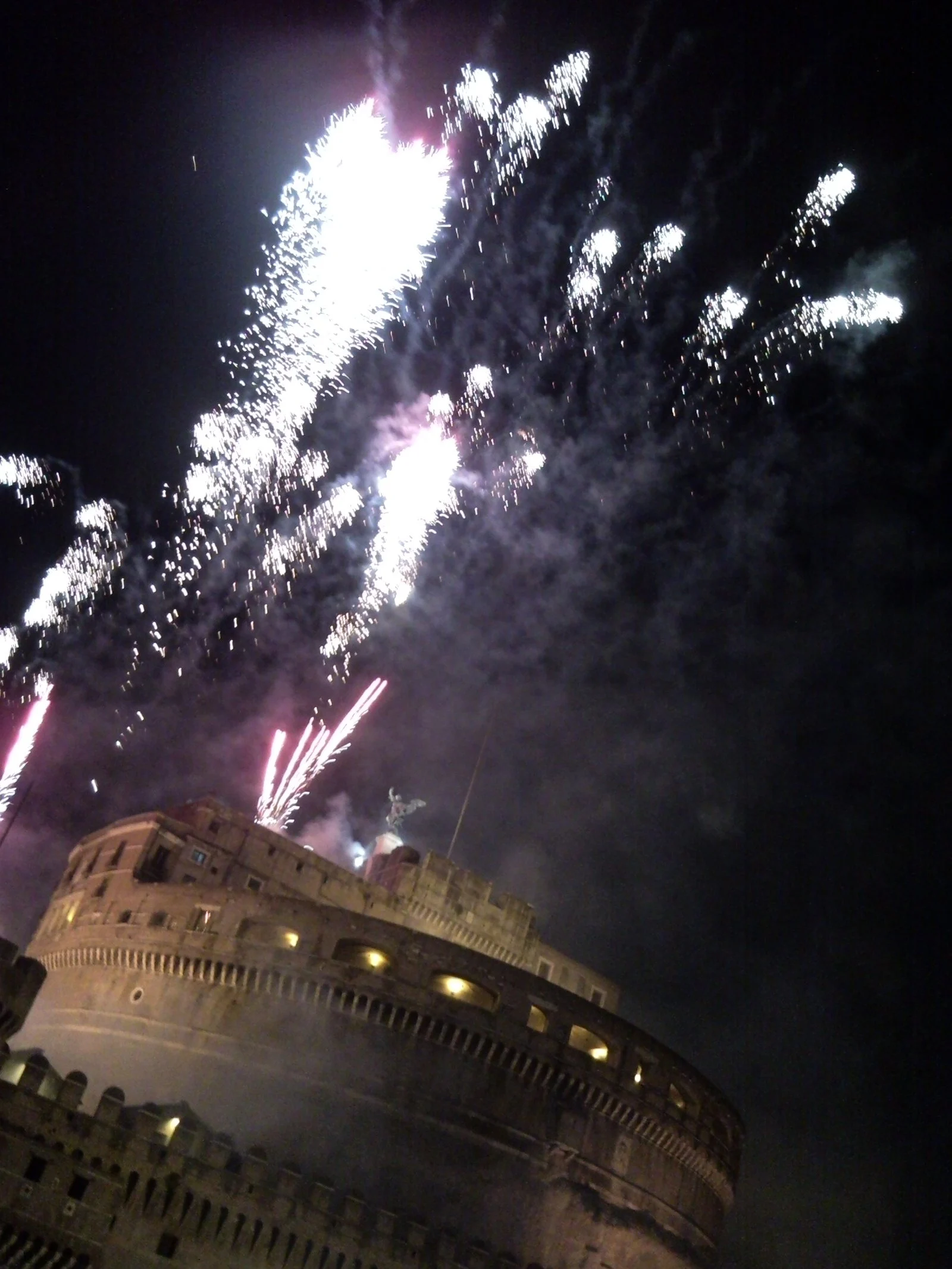
The Girandola was the fireworks show fired from the terrace of Castel Sant’Angelo on the great occasions of the Rome of the popes, and it is documented from 1481. For four centuries it was the thing foreign travelers came to see in Rome along with the ancient ruins, described by Goethe, by Dickens, by the English diarists of the 17th century and in the sonnets of Belli. Then it disappeared, in a year on which the sources do not agree, and returned in 2008 as an annual reenactment on June 29.
This page lines up what it really was, how much of the attribution to Michelangelo and Bernini holds up (little, and it's worth knowing), how it worked technically, and what the other great festivals of papal Rome were: the possesso, the Chinea, the ephemeral machines, the Quarantore.
What the Girandola Was and Where the Name Comes From
The Girandola was a fireworks display set up on top of Hadrian's mausoleum, that is, on the terrace where the bronze statue of the archangel stands today, and it lasted about half an hour. It was not just any launch of rockets: it was a constructed sequence, with a beginning, a central body made of wheels and fountains of fire, and a final discharge that the Romans called precisely the girandola. The rest of the evening, illuminations included, revolved around that finale.
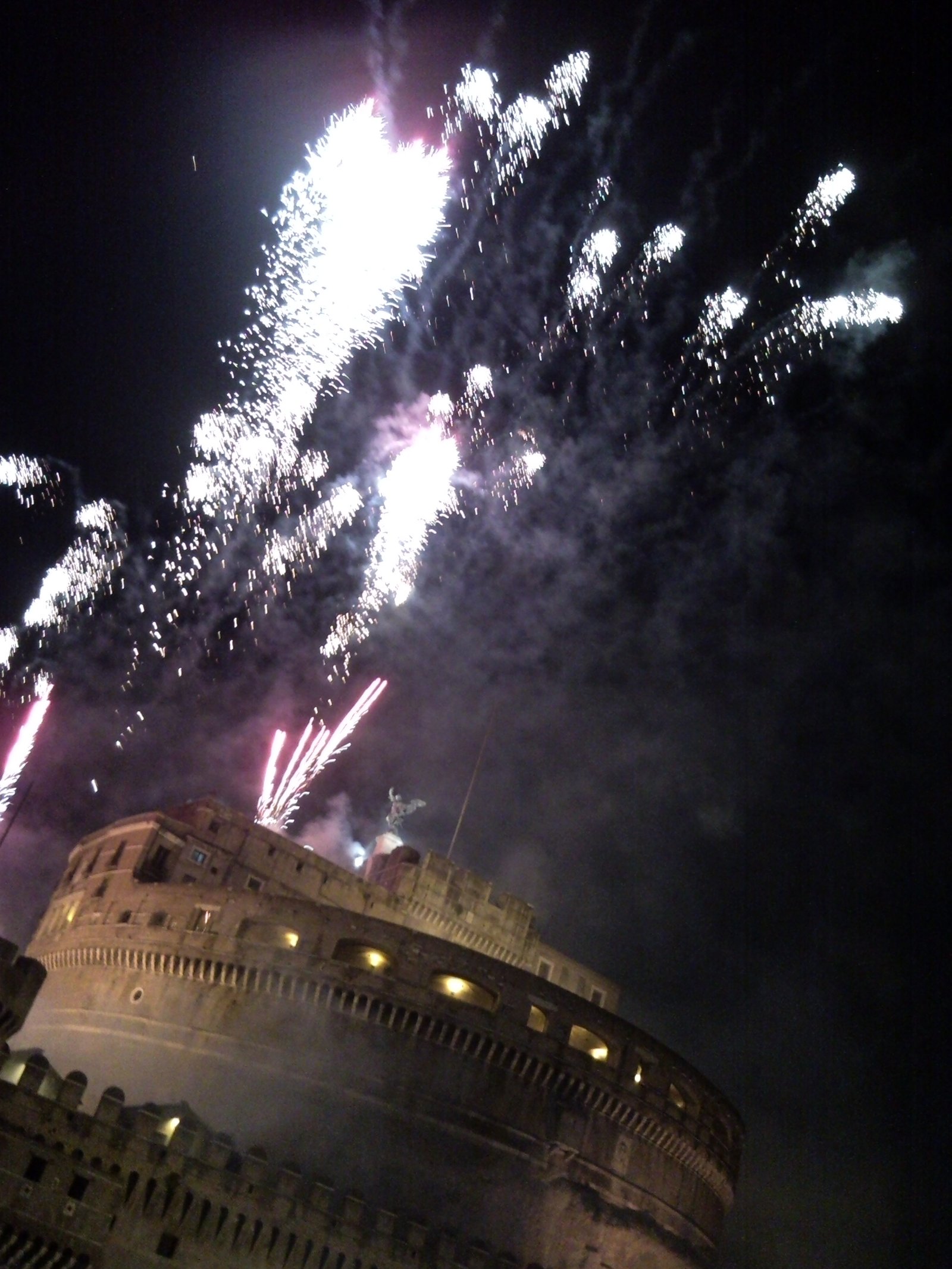
The name misleads anyone reading it today. In current Italian a girandola is the wheel that spins, and in fireworks there really is a piece like that. Here, however, the term comes from the shape the closing discharge took: thousands of rockets launched together that opened out high up like a sheaf, like the spray of a girandola fountain. The wheel has nothing to do with it, and anyone who translates the name as wheel is going down the wrong road.
Rome did not invent fireworks, which had been circulating in Europe since the 14th century. What Rome built was the context: an isolated, round, tall fortress on the bank of a river, with a city pressed up in front of it and a bridge full of people in between. The shape of the castle did half the work, because it made the sequence readable from the whole rione and gave back the reflection on the water. For those watching from Ponte Sant’Angelo the show was doubled.
Why From There
Castel Sant’Angelo was the fortress of the popes, not a monument. They took refuge there in bad times, kept the treasure and the prisons there, and reached it from the Vatican through the fortified corridor of the Passetto di Borgo. Firing the fireworks from there meant showing the people and the ambassadors that the armed side of papal power was working and that the gunpowder, that evening, served to celebrate. The full entry on the monument is the one on Castel Sant'Angelo.
Since When It Was Fired and on Which Occasions
The date that all the institutional sources report is 1481. The Istituto Pantheon e Castel Sant’Angelo, which is the state body that now manages the monument, writes that the Girandola is documented from that year and ties it to the pontificate of Sixtus IV, Francesco della Rovere, the pope of the Sistine Chapel. Reconstructions of the modern event link that first fire to the 10th anniversary of his election.
Sixtus IV had a precise political reason. Rome in the 15th century was competing with Florence and Venice for prestige and for the ability to stage itself, and a fireworks display visible from half the city was a relatively low-cost argument. The art historian Elizabeth Lev, in a reconstruction published by the American Catholic agency CNA, sums up the operation in these terms: give the Romans a show of lights and sounds that could stand comparison with the other great Italian cities.
The Fixed Occasions
Three were the occasions that brought the Girandola to the castle. The first was Easter. The second was June 29, the feast of Saints Peter and Paul, patrons of Rome, which is the one that survived in memory and in today's reenactment. The third was the election and coronation of a new pope, which by definition had no regular schedule: it came when it came, and then the city stayed lit for several days.
The guide Rome Ancient and Modern, published in 1842 by the Reverend Jeremiah Donovan, lists exactly these three occasions: Easter Sunday, the feast of Saints Peter and Paul, and, exceptionally, the coronation of a new pontiff. Donovan was a supporter of the papal government and his guide must be read knowing that, but on the ceremonial he is a direct and detailed witness.
The Extraordinary Occasions
Outside the fixed calendar, the fireworks came for the visits of sovereigns, for weddings and births in the great Catholic houses, for military victories. The English diarist John Evelyn, on November 22, 1644, describes Rome lit up for the election of Innocent X: lanterns of colored oiled paper at the windows, 20 fire displays in front of the palaces of ambassadors and cardinals, and on the castle a pyramid of lights fixed to the ropes of the flagpole. The festival, in short, was not only the final quarter hour of fireworks but an illumination of the whole city.
A Curiosity About the Girandola of Castel Sant’Angelo
The count of rockets in the historic Girandola is always the same in all the sources: 4,500. Donovan in 1842 writes that the first and the last schiappata were each made up of 4,500 rockets fired simultaneously, and the figure reappears identical in modern reconstructions. When such a specific number crosses two centuries without varying, it usually means everyone is copying the same source, and in this case the oldest source that can be found is precisely the 19th-century guide.
The term is interesting. Schiappata is a trade word and indicates the simultaneous discharge. The technical vocabulary of the papal fireworks was Roman and artisanal, and the castle's bombardiers handed it down within the guild. Once the guild was dissolved and the festival interrupted, that vocabulary fell out of use along with the recipes for the mixtures, which were the real secret of the trade.
The Attribution to Michelangelo and Bernini: What Really Holds Up
Every text on the Girandola, the official ones included, says that the original design is by Michelangelo and that Bernini perfected it. It is the piece of information the visitor takes home, and it is also the one that holds up least under checking. It's worth looking closely at what it rests on, because the way the sentence circulates is a small case study in how traditions are born.
What the Sources Say
The recurring formula in 19th-century sources is cautious. Donovan, in 1842, writes that the original design is ascribed to Michelangelo: he uses a verb that signals a current attribution, not a document. No 16th-century source records a commission to Michelangelo for the fireworks, and the collections of his drawings contain no pyrotechnic designs.
Elizabeth Lev, questioned by CNA, is explicit on this point: she says the theories on the extent and dates of Michelangelo's participation compete with one another, and adds that we have neither words from him on the subject nor drawings of planned displays. Her hypothesis, declared as such, is that in the years when Paul III lived in the castle and Michelangelo was working on the Last Judgment it was natural to associate the artist with the chromatic part of the show. It is a plausible reconstruction, and it remains a reconstruction.
One circumstance makes the conjecture less far-fetched than usual. In 1540 De la pirotechnia by Vannoccio Biringuccio came out in Venice, the first European printed treatise to deal systematically with metals, castings and fireworks, and its last book is devoted precisely to pyrotechnic displays. Biringuccio in the 1530s was working for the apostolic foundry and the papal artillery. The technician and the artist were therefore on the spot in the same decade: which proves nothing, but explains why the legend took root.
The Bernini Case, Which Is More Tangled
On Bernini the matter gets complicated and has to be told in full. The official Turismo Roma page presenting the reenactment attributes the refinement of the design to a certain Giovan Battista Bernini, who supposedly regulated the flumina lucis, the rivers of light, establishing that there should be no fewer than 60 nor more than 80 so that the eye could distinguish them. The problem is that a Giovan Battista Bernini does not exist: the father was called Pietro, the son Gian Lorenzo.
That Gian Lorenzo Bernini dealt with fireworks is instead documented. Lev recalls a display from 1641 inspired by the eruptions of Stromboli, with an indication of the number of rockets and the colors to use to get the effect. Bernini was a man of the theater as well as a sculptor and architect, he wrote comedies, he designed stage machines, and the idea that he liked commanding fire, water and light needs no defense. His Roman repertoire can be read on the page on Bernini in Rome.
The logical leap happens in the passage from Bernini designed fireworks to Bernini perfected the Girandola. The chain leading to this second claim passes, in the documentation of the reenactment's own organizers, through a learned citation from the early 19th century whose text it was not possible to check directly. Anyone telling the story of the Girandola should say this and no more, because the rest is oral tradition dressed up as bibliography.
How It Should Be Said
The honest formulation is at hand and takes nothing away from the story. The Girandola was born under Sixtus IV in 1481, consolidated in the 16th century when the greatest artists of Europe and the first theorists of pyrotechnics were working in Rome at the same time, and was for centuries designed by architects specialized in ephemeral displays. The names of Michelangelo and Bernini were attached to it by tradition, presumably because they were the names that in Rome explained everything.
Something Nobody Tells You About the Girandola of Castel Sant’Angelo
The show did not belong to the pope and did not belong to the city: it belonged to an armed guild. In 1594 Cardinal Pietro Aldobrandini, nephew of Clement VIII, founded the Compagnia dei Bombardieri di Castel Sant’Angelo, that is, the confraternity of the fortress's artillerymen, and from then on they were the ones who physically carried out the Girandola. The design was supplied by an architect, the powder was handled by professional gunners.
Anyone reconstructing the Girandola today works from indirect sources, because the technical knowledge lived inside a closed structure and not in a manual. Travelers' accounts say what was seen, prints say how the fire was distributed over the architecture, architects' notes say something about the sequences. None of these materials says which substances were put together and in what proportions. The chemical part was reinvented, not recovered, and the authors of the reenactment themselves say so.
How It Worked Technically
The historical sequence can be reconstructed with good precision because three independent witnesses describe it in the same years. Donovan in 1842, the American painter Rembrandt Peale in his travel notes of 1829 and 1830, and Dickens in 1845 describe the same structure, with differences only in the details. The picture that emerges is that of a show lasting about half an hour and divided into three clear parts.
The Opening
It began two hours after dark with a cannon shot. Right after, the first schiappata went off, the simultaneous discharge of thousands of rockets that rose together and fell back as rain. Dickens notes that the rockets did not go off two by two or in tens, but by the hundreds at a time. The opening effect served to silence the square and to fix attention on the castle, which until that moment was a dark silhouette on the river.
The Central Body
The long part was a repertoire of figures that replaced one another without pauses. Wheels spinning at high speed throwing out what the texts of the period call serpents of fire and hissing dragons. Fountains and jets sending up burning cascades. Architectural designs traced in fire on the walls, which appeared and disappeared within the flares. Peale also describes a mock musket fire from the bastions, alternating with real cannon shots.
The flumina lucis, the rivers of light, belong to this phase. According to the reconstruction of the modern organizers there had to be between 60 and 80, a number calculated so that the eye could follow them without confusing the tones. The rule is attributed to Bernini in the tradition, and the caution already stated applies to it. As a design criterion, however, it is sensible and contemporary pyrotechnicians recognize it.
The Finale
After a short pause came the second schiappata, which was the Girandola proper: thousands more rockets launched together from the center, the front and the flanks of the castle, with all the artillery firing blanks. Dickens describes it as if the whole castle were flying into the air, without smoke and without dust. Donovan compares it to a volcanic eruption. On the reflection in the Tiber everyone agrees.
The Illumination of St. Peter's Dome
The Girandola did not go alone. The same evening the dome of the Basilica of St. Peter was lit, with a technique that amazed travelers more than the fireworks. Columns, cornices, ribs, lantern, cross and the sweep of the colonnade were drawn with lamps placed along all the architectural profiles. At a signal, a second series of much stronger lights came on and erased the first.
The numbers diverge among the witnesses, and it's worth reporting them as they stand. Peale speaks of 4,400 smaller lights and 800 larger ones. Donovan speaks of 4,400 transparent lamps for the first design and 1,000 large lamps, loaded with pitch and resin, for the surprise, lit by 360 men lowered on ropes onto the surface of the dome and onto the cross. On one point they agree: the second lighting lasted a few minutes and seemed like magic.
Goethe, who was in Rome in June 1787, noted that the fireworks of Castel Sant’Angelo were beautiful thanks to their setting, and he appeared more struck by the illuminated dome than by the rockets. It is the judgment of a man who looked at architecture before effects, and it is also the first warning for anyone who today expects an overwhelming experience from the reenactment: the strength of the Girandola lay in the place.
My Advice for Visiting the Girandola of Castel Sant’Angelo
The main advice is banal and nobody follows it: arrive early. The reenactment lasts 20 minutes and starts at 21:30, but the Tiber embankments and the bridges fill up two hours earlier and from 20:30 on the local police progressively close the access points. Anyone arriving at 9 p.m. gets the spot that is left over, that is, the one from which the castle is seen at an angle. It's also worth deciding beforehand which way you will leave, because at the end of the show the bridges become funnels.
When the Girandola Stopped, and Why the Dates Don't Add Up
On the end of the historic Girandola the sources openly contradict one another, and anyone who writes a flat date is choosing a version without saying so. Here is what they say, because the disagreement is itself a useful piece of information.
The Versions in Circulation
The most detailed reconstruction, that of Roberto Piperno on his site dedicated to the Rome of travelers, says that Dickens in 1845 witnessed one of the last editions, that in 1851 Pius IX moved the Girandola to the terrace of the Pincio, probably because Piazza del Popolo allowed many more people to watch without being crushed, and that the fireworks occasionally returned to the castle until 1887.
The same reconstruction points to the cause of the end: after that year the construction of the embankment walls along the Tiber wiped out Piazza di Ponte, the open space in front of Ponte Sant’Angelo where the Romans crowded together, replacing it with the tree-lined road along the river. Once the place from which people watched disappeared, so did the reason to fire from there.
The institutional pages for the modern event give a different cause instead: the suspension is said to have been due to the heavy damage the fireworks caused to the decorations of the rooms below the Terrazzo dell’Angelo. The reconstruction published by the CNA agency also follows this line and places the suspension at the end of the 19th century.
The dates proposed elsewhere are still others. The authors of the reenactment indicate 1834, explaining it with the death of the person who kept the tradition without leaving instructions. ACI Stampa reports that scholars are divided between 1861 and 1870. The Italian Wikipedia entry indicates 1886 and admits not knowing why.
What Can Be Said With Reasonable Certainty
1834 as the final date does not hold up, because Donovan in 1842 describes the Girandola in the present tense and Dickens saw it in 1845. What does hold up is the idea of a long decline, begun in the mid-19th century and concluded between the end of temporal power in 1870 and the embankment wall works of the 1880s. The two explanations, damage to the monument and the disappearance of the place from which people watched, do not exclude each other.
The Modern Revivals: Which Years, and How Things Stand Today
The Girandola returned in 2008. The historical reenactment project is by Giuseppe Passeri, of the Gruppo IX Invicta, who on his own site dates the first performance to May 24, 2008, at the group's expense, with the support of the then Soprintendenza per il Polo Museale di Roma and under the patronage of the Pontifical Council for Culture. Only from the following editions did the city administration come into play.
Since then the date has been June 29. In 2024 the official Turismo Roma page spoke of the 17th edition, a count that works out with an uninterrupted annual series starting from 2008. Other reconstructions claim that in some years the show was moved to the terrace of the Pincio and only afterward returned permanently to the castle, and on this point the sources do not coincide.
The Most Recent Edition and What to Expect From the Next Ones
The latest edition took place on June 29, 2026, starting at 21:30 and lasting about 20 minutes, organized by the Istituto Pantheon e Castel Sant’Angelo of the Direzione Musei nazionali della città di Roma, with Roma Capitale, the local police, civil protection, the Prefettura, the Questura and the fire department. The viewing points indicated by the organizers were Lungotevere Tor di Nona and the bridges Vittorio Emanuele II, Sant’Angelo and Umberto I.
On future editions it's best to be precise and not very promising. The event is not an appointment guaranteed by law: it is decided and announced year by year, usually in the weeks before June 29, and the official press release itself warns that the program may change. The date to keep an eye on is June 29, the source to check is the website of the Direzione Musei nazionali della città di Roma, and no third-party site can take an edition for certain before that announcement.
Between June 27 and September 29, 2024 Castel Sant’Angelo hosted the exhibition La maraviglia del tempo. La Girandola e l’arte pirotecnica a Castel Sant’Angelo, conceived by Eva M. Antulov with a scientific committee chaired by Claudio Strinati and made up of Michele Rak and Sandro Bari. It was the first attempt to bring together paintings, prints, manuscripts and fire machines on this theme.
Another Well-Known Fact, Yet Rarely Cited
The Girandola had a European nickname that almost nobody uses anymore: la maraviglia del tempo, the wonder of the age. The phrase circulated above all thanks to the French astronomer and traveler Joseph Jérôme de Lalande, who in the account of his trip to Italy in 1765 and 1766 called it among the most beautiful things he had ever seen of its kind. From there it entered the literature of the Grand Tour and stayed there for a century.
The consequence shows in the iconography. No other European fireworks display has been painted and engraved as much as this one, and the works are scattered today among the British Museum, the Metropolitan in New York, the Walker Art Gallery in Liverpool and the Museo di Roma. A fireworks display is the most ephemeral thing there is, and this is one of the very few to have an art history of its own.
The Girandola in Paintings and Prints
The images are the main source for understanding how the fire was distributed over the architecture. The oldest are from the 16th century: a view by Hendrick van Cleve III at the British Museum and the etching by Giovanni Ambrogio Brambilla from 1579, now at the Metropolitan, which shows the castle lit on every level and the crowd watching from the opposite bank.
Brambilla did not just engrave. In the caption of his sheet he describes the rockets bursting in the air in the shape of stars, says that it seems the sky has opened and that all the stars are falling to earth, and closes with a formula of wonder. That text is cited in the main academic study of the European history of pyrotechnics, Fireworks: Pyrotechnic Arts and Sciences in European History by Simon Werrett, published by the University of Chicago Press in 2010.
From the 17th century there remains an oil painting from 1620 by the Flemish artist Willem van Nieulandt II, called in Rome Guglielmo Terranova, with the frontal view of the castle during the Girandola, shown in the 2024 exhibition, and a sketch by Giovanni Francesco Grimaldi, also at the Metropolitan. The 18th century is the century of the view painters: Adrien Manglard around 1750, Jakob Philipp Hackert in 1775, Joseph Wright of Derby in the same years, with a canvas now at the Walker Art Gallery.
From the 19th century there remain two names useful to anyone in Rome. Ippolito Caffi, who was the quintessential view painter of nocturnal light effects, painted the Girandola several times. Franz Theodor Aerni left an oil painting datable between 1874 and 1880, 40 by 80 centimeters, which belongs to the collections of the Museo di Roma and is catalogued among the materials on Roman popular life kept at the Museo di Roma in Trastevere.
The Other Great Festivals of Papal Rome
The Girandola was one entry in a much fuller calendar. Papal Rome had a repertoire of public ceremonies that marked the year and physically occupied the city, and knowing them helps in reading spaces that today are crossed absentmindedly. Four deserve to be told.
The Possesso, the Ride From the Vatican to the Lateran
The possesso was the taking possession of the Roman see. After the election and the coronation at St. Peter's, the new pope crossed all of Rome on horseback, or on a white mule, to be installed in the Basilica of San Giovanni in Laterano, which is the cathedral of the diocese of Rome. It was his first public act, and the city saw his face for the first time.
On the origin the sources diverge. Vatican News attributes the first ride to Nicholas I and dates it to April 27, 854. The Italian Wikipedia entry indicates April 858. Others trace it back to Leo III in 795. The ancient descriptions are instead precise and preserved: the Liber Censuum compiled by Cencio Camerario in 1192 and the Gesta Innocentii III, a biography of Innocent III written during his pontificate, contain the order of the procession.
The Route, Which You Can Still Retrace on Foot
The route is known and is worth a walk of about an hour and a half. The pope left the Vatican, crossed the rione Borgo and crossed the Tiber on Ponte Sant’Angelo, under the castle. On the other side he took Via Papale, which today corresponds to Via dei Banchi Nuovi, Via del Governo Vecchio, Piazza Pasquino, Piazza San Pantaleo and Piazza d’Aracoeli.
Arriving at the foot of the Capitoline Hill he went up to Palazzo Senatorio, where the city authorities paid homage to him: that moment was called the adscensus. The descent, descensio, led into the Roman Forum along Via Sacra, among the ruins, and the procession passed under the arches of Septimius Severus, of Titus and of Constantine, as well as a wooden arch built for the occasion at the level of the Orti Farnesiani.
Past the Colosseum the procession continued toward the Santi Quattro Coronati and then along the Stradone di San Giovanni to the Lateran basilica, where the introitus and the installation on the cathedra took place. The route of Via Papale was widened and paved only in 1588 under Sixtus V: before that it was narrow, muddy and dark, and it was traveled in conditions that the celebratory prints do not show.
How and When the Ride Ended
The last possesso on horseback was that of Clement XIV, on November 26, 1769. The reconstructions tell that the mule, frightened by the acclamations, threw the pontiff, and that from then on they switched to the litter and then to the carriage. After 1870 the ceremony was suspended altogether, to resume in 1939 with Pius XII in an automobile. In its current, more sober form, it took place on May 25, 2025 for the installation of Leo XIV.
The Festival of the Chinea
The Chinea was the feudal tribute that the king of Naples owed the pope. The origin is from the 13th century: Charles of Anjou, in the agreements with Clement IV for the conquest of the kingdom, committed to paying the Holy See a tribute in gold every year and to present, on the feast of Saints Peter and Paul, a fine white horse. The delivery took place by the hand of Prince Colonna, grand constable of the Kingdom, who acted in the name of the sovereign.
On the animal the sources waver between the white palfrey of the medieval documents and the white mule of the modern descriptions, and the word itself explains it: chinea comes from the Old French haquenée and originally indicated the horse that goes at an amble, that is, with a comfortable gait. On the date, Treccani places the ride on June 28, the eve of the feast, while other sources move it to the 29th.
The Chinea Machines, the Architectures to Be Burned
The part worth seeing was not the horse but the machine. In the 18th century the Colonna had built at their own expense, in front of their palace in Piazza dei Santi Apostoli, an ephemeral architecture of wood, canvas, plaster and stucco, painted and adorned with statues, which was set on fire at the end of the festival. After 1738 the machine also moved to the front of Palazzo Farnese.
The architects were of the first rank and the themes changed every year, following political news and the tastes of the moment. Alessandro Specchi built a Temple of Virtue in 1724 and a Parnassus in 1733. Gabriele Valvassori in 1729 staged a maritime trading expedition. Louis-Joseph Le Lorrain, from 1745, passed from painted canvases to real buildings to burn, and with him the machine stopped being a backdrop.
Of those machines nothing remains, by definition, but the engravings remain. Every year a plate was engraved from the author's drawing, and today two main collections are kept in Rome, at the Museo di Roma and at the Istituto Nazionale di Archeologia e Storia dell’Arte. Among the engravers appear Giuseppe Vasi, Filippo Vasconi, Giovanni Battista Sintes and Francesco Barbazza. The family palace and its picture gallery can still be visited: it is the Galleria Colonna.
How the Chinea Ended, With a 70-Year Controversy
The break was political. In 1776 the minister Bernardo Tanucci, taking advantage of a precedence dispute that broke out during the ride, abolished the public ceremony and reduced the homage to a payment of money through an agent. Tanucci fell three months later, the Roman court obtained the restoration and on June 21, 1777 the function was held again as before.
The real end came in 1788, when the minister Domenico Caracciolo ordered that only the tribute be delivered. The pope protested with an allocution and with a letter to the king, obtaining nothing. From then on Naples deposited the money at the Monte di Pietà and Rome refused it, in a controversy that lasted decades. It closed only in 1855, when Ferdinand II offered 10,000 scudi for the monument to the Immaculate Conception in Piazza Mignanelli in exchange for definitive exemption, and Pius IX accepted on June 25.
On this chronology the sources diverge, and the divergence is sharp. The Wikipedia entry dedicated to the Chinea machine places the interruption in 1776 and does not record the restoration. The Enciclopedia Italiana, in the entry written by Michelangelo Schipa in 1931, instead reconstructs the sequence 1776, 1777, 1788 with the dates of the acts. Of the two the second is better documented, and here it takes precedence.
The Quarantore
The Quarantore were an altogether different kind of spectacle, and perhaps the most impressive. The devotion, of medieval origin, called for 40 hours of continuous adoration of the Blessed Sacrament, in memory of the time between the death and the resurrection of Christ. In the Baroque age those 40 hours became a stage machine: the church was darkened, and the host displayed inside an apparatus lit by dozens upon dozens of lights.
Among the authors of apparatuses for the Quarantore was Gian Lorenzo Bernini too, and it is not surprising. Of all that production very little remains, because they were structures of wood and canvas assembled and dismantled every year. An altar machine in gilded wood, made of 13 pieces and known by oral tradition as the Macchina delle Quarantore, was restored by the Vatican Museums and shown in 2024 in the Pinacoteca. The taste of that Rome is found in the churches described on the page on Baroque Rome, from the Church of the Gesù to San Lorenzo in Damaso.
Fireworks Outside the Castle
Pyrotechnic displays were not limited to the Girandola and the Chinea. Rembrandt Peale tells of an extraordinary show set up in Piazza Navona to show a Russian grand duchess the skill of the Roman pyrotechnicians, with rockets, wheels, serpents, fire bees, garlands, crowns, inscriptions, little temples and fountains, and with 20,000 straw-seated chairs rented for the evening along the perimeter of the square.
The Feast of Saints Peter and Paul Today
June 29 remains the patron saints' feast of Rome and a holiday for the city, with offices closed, reduced transport hours and many activities stopped. It is not a minor detail for anyone planning a day: museums and shops may have different hours than usual, and it's best to check rather than take it for granted. The rules on transport are on the page on how to get around Rome.
The religious part is concentrated in the morning in the Vatican, with the solemn Mass in the basilica, and continues in other churches tied to the two apostles. The tradition of the pallia, the white wool stoles intended for the metropolitan archbishops appointed during the year, is linked to this date. Celebrations are also held at the Basilica of San Paolo fuori le Mura, the second pole of the feast.
The secular part changes from year to year: floral compositions in the St. Peter's area in the morning, walking routes to the places of the two apostles, from the Mamertine Prison to the basilicas, concerts and evening screenings around the city. The overview of what happens in Rome in the warm months is on the page on Estate Romana.
The comparison with the ancient festivals is instructive for anyone who wants to understand the continuity of Roman calendars. Rome has always organized the year around fixed occasions that occupied public space: first the games and processions described on the page on the festivals of ancient Rome, then with papal ceremonial, today with events that last one evening. The scale has changed, the habit has not. The Natale di Roma on April 21 works in the same way.
The Right Photo to Take at the Girandola of Castel Sant’Angelo
The difficult photograph is not the one of the fireworks, which anyone can get with a tripod and an exposure of two or three seconds. The one that is worth it keeps in the frame the castle, the fire and the reflection on the water, that is, the triple register that 18th-century view painters sought and that no close-up framing delivers. You need distance and you need a low point, close to the river level.
A tripod on the bridges on the evening of June 29 is impracticable, because the crowd is packed and the deck vibrates. Anyone who cares should choose a spot on the embankment upstream or downstream, arrive two hours early and accept staying put there. Anyone without a tripod should forget the fire and photograph the crowd: thousands of heads raised and lit intermittently are a more honest image of the evening.
On ordinary evenings, that is, 364 days a year, the best photograph of the castle is taken from Ponte Umberto I or from the parapet opposite, in the blue hour, when the artificial lighting comes on and the sky is not yet black. The round bulk with the angel on top and the bridge in the foreground is the same framing that Vasi and Piranesi engraved, and it still works. Other nighttime ideas are on the page on Rome at night.
Where People Watched From Then and Where They Watch From Today
The historic place for viewing was Piazza di Ponte, the open space in front of the entrance to Ponte Sant’Angelo on the left bank. There the common people crowded together, and there capital executions were also held, which says something about how that square worked. The well-off instead rented windows and rooms in the houses facing the castle: Dickens tells of having taken a room in a house opposite.
That geography is gone. The embankment walls built after 1870 raised the banks by several meters, erased the direct relationship between the houses and the river and replaced the square with the tree-lined road along the Tiber. Anyone looking today for the ancient point of view will not find it, because the level from which people watched no longer exists. The river has moved away from the city vertically.
Today's Spots, in Order of Crowding
The three bridges indicated by the organizers, Vittorio Emanuele II, Sant’Angelo and Umberto I, together with Lungotevere Tor di Nona, are the places from which you see best and also the ones that fill up first. Ponte Umberto I gives the cleanest framing of the castle front. Ponte Vittorio is wider and holds the crowd better, but it is off to the side. The embankment between the two is the compromise.
The fallback alternatives are higher up and farther away. From the Janiculum you see the upper part of the fireworks above the roofline, without detail but without the crush. From the panoramic terraces in the center you get the same result: anyone looking for an accessible one can start from the Terrazza Aurora. From the Pincio, which was the 19th-century seat of the relocated Girandola, you see little because the castle stays low and hidden.
Anyone arriving by metro should get off at Lepanto or Ottaviano and walk: the stop closest to the castle is in any case 10 or 15 minutes away on foot and on the evening of June 29 the buses in the area are rerouted. The bridges downstream, toward the Tiber Island and Ponte Sisto, are too far that evening, but remain the right walk for the other evenings.
Some Important Events That Happened Here in History
1481 is the founding date of the tradition, under Sixtus IV. It is the year in which the firework stops being an episode and becomes a Roman institution with a fixed venue, a calendar and a patron. The same pontiff in those years was having the walls of the chapel that bears his name painted: the two operations belong to the same visibility program.
On November 22, 1644 Rome lights up for the election of Innocent X, and John Evelyn describes it in his diary: the pyramid of lights hoisted on the ropes of the castle's flagpole, the 20 displays in front of the palaces, the streets bright as day. It is one of the oldest direct testimonies we have of the nighttime look of the city in festival.
In 1788 the Kingdom of Naples stops delivering the Chinea. With it disappears the annual festival of the ephemeral machines of Piazza dei Santi Apostoli and of Piazza Farnese, which for 60 years had given work to architects, set designers and engravers. The diplomatic controversy that follows lasts until 1855.
Who Passed Through the Girandola of Castel Sant’Angelo
The direct testimonies are few and must be cited for what they are, because on this subject many secondhand quotations circulate. What follows is the list of those that can be verified, with an indication of the source and, where needed, of the margin of uncertainty that accompanies them.
Johann Wolfgang Goethe, 1787
In the Italian Journey, at the date of June 1787, Goethe dismisses the fireworks of Castel Sant’Angelo with a dry formula: they were beautiful because of their setting. He was struck instead by the illumination of the dome of St. Peter's. The judgment is useful as an antidote to enthusiasm, and it comes from someone who stayed in Rome a long time.
Rembrandt Peale, 1829 and 1830
The American painter, in the Notes on Italy written during his trip, leaves the most minute technical description we have: the sequence of the figures, the crossed keys and the tiara drawn in fire on the front of the castle, the mock musket fire from the bastions, the cannon shots synchronized with the bursts, the finale from the center and the flanks. He says it lasted about half an hour.
Jeremiah Donovan, 1842
The Irish reverend, in his guide Rome Ancient and Modern, supplies the numbers and the ceremonial: the start two hours after dark, the two schiappate of 4,500 rockets, the occasions on which the Girandola was fired, and the description of the dome illumination with the 360 men hanging from ropes. He is a partisan witness, and also the best informed on operational details.
Charles Dickens, 1845
Dickens saw the Girandola during the Roman stay that led to Pictures from Italy, published in 1846. He tells of having rented a room in a house opposite, of the crowd that loaded the bridge to the point of seeming about to sink it, and of the braziers lit among the statues. He closes with the image of the moon reflected in the river half an hour later, when the square has already emptied.
One detail needs flagging, for honesty's sake. Dickens places the show on Easter Monday, while Donovan, three years earlier, speaks of Sunday. It may be a variation from one year to the next or an imprecise memory: anyone who cites one or the other as proof of the exact day goes beyond what the sources allow.
Giuseppe Gioachino Belli
The Roman poet is the only popular witness. In the sonnet La ggirannola der 34, two Romans tell each other about the evening in thick dialect, with the enthusiasm of people who watched from below. It is also proof that the Girandola was not an affair for foreigners alone: the city felt it was its own.
Eating nearby: Borgo, Prati and the riverbank by the castle
The area around Castel Sant'Angelo is one of the most exposed in Rome, and it has to be said plainly. Between St. Peter's, the castle and the buses unloading on Via della Conciliazione, a number of people pass through every day that no neighborhood could absorb with local restaurants, and the result is a food scene built on passing trade. Anyone who eats there by chance almost always eats badly and pays a lot.
The signs to recognize
The menu with photographs of the dishes is the first. Photographing food is for people who can't read the language, meaning a customer who won't come back, and no restaurant that lives on regulars needs it. The same goes for menus translated into 6 or 7 languages and displayed on the sidewalk: they are an investment in foot traffic, not in cooking.
The second sign is the theatrical one. The woman rolling out fresh pasta behind the window or at a little table on the sidewalk is a visual lure, built to stop passersby, and it says nothing about what comes out of the kitchen afterward. The same goes for the person stationed at the door inviting you to sit down: someone who has to convince people to come in is working the flow, not the returning customer.
The third sign is the opening hours. A place open without a break from morning to night, with the kitchen always on, has no defined services and no staff organized in two shifts: it serves whoever turns up at any hour, with whatever it can keep ready. In the neighborhoods around the Vatican this model is extremely common, precisely because the flow has no hours.
The fourth and most expensive is the price that adapts to the customer. In front of the most visited monuments you find items without a price on the menu, cover and service charges that appear only on the bill, different price lists inside and outside. The bill in these places doesn't depend on what you ate but on how you walked in, and disputing it afterward does little good.
The chains with repeated signs
In central Rome and around the big visitor hubs, a kind of dining with repeated signs has grown in recent years, with the same decor and the same menu in several points of the city, often with a line at the door. It works well as an attraction in itself, it has a uniform and predictable product, and Romans don't go there. There is no snobbery in saying this: people who eat out near their home are looking for the exact opposite of predictability, and that model sells exactly that.
The criterion, which is only one
Look at who is sitting there and in what language they order. If the tables hold people who speak Roman dialect, who order without opening the menu and who argue with the waiter about things that have nothing to do with food, the place stands on its own. If there are only backpacks, maps and cameras, keep walking. The criterion doesn't require knowing anything about cooking.
Applying it in this area calls for one warning, though: you have to move away. The 200-meter radius around the castle and the square contains almost nothing that passes the test, and you need to walk toward the inside of Prati, toward the streets behind Piazza Cavour and toward the long sides of the 19th-century grid, where there are offices, courthouses and homes, and so people who eat there every day.
The evening of June 29
On the evening of the Girandola every rule goes out the window. Restaurants work at full capacity, many apply fixed menus, and anyone who hasn't booked finds no table. It's best to eat early and far away, or afterward, when the crowd has dispersed: eating well and watching the fireworks from the best spot on the same evening is not a realistic combination.
If you want a reference that is already filtered, you can consult Daniele Dezi's personal list on Google Maps, which is a curated, non-sponsored collection. The whole method is on the page about where to eat in Rome. For places with a long history behind them there is the one on historic cafés and shops, and for a neighborhood where local dining has held up better, the page on Trastevere.
Costs, hours and things you can't see
The Girandola has no ticket. You watch it from the street, from the bridges and from the riverbank roads, and nobody can sell privileged access to an event that takes place in the sky above a public monument. Anyone who promises reserved spots is selling a table with a partial view.
Castel Sant'Angelo, on the other hand, is visited for a fee, with its own hours and a closing day, and on the evening of the Girandola it is closed to the public. Anyone who wants both the festival and the visit has to separate them into different days. Free admissions to state museums are listed on the page about free museums in Rome.
What you can't see
Nothing remains of the historic Girandola, because nothing remains of a firework by definition. Rome has no permanent museum dedicated to it: the 2024 exhibition was temporary and closed at the end of September. The works that depict it are scattered among storage rooms and collections.
Frequently asked questions about the Girandola of Castel Sant'Angelo
Was the Girandola really designed by Michelangelo?
No documents exist to prove it. 19th-century sources use cautious wording, writing that the original design is ascribed to Michelangelo, and the art historian Elizabeth Lev, who has studied the question, states explicitly that of Michelangelo we have neither writings on the subject nor drawings of pyrotechnic apparatus. The attribution is traditional and should be presented as such, not as an established fact.
And what does Bernini have to do with it?
Gian Lorenzo Bernini did design fireworks, and an apparatus of his from 1641, inspired by the eruptions of Stromboli, is remembered. That he had a hand in the Girandola of Castel Sant'Angelo itself is instead a traditional attribution, and its chain of citations is fragile. Add that the official page of the reenactment attributes the refinement to a nonexistent Giovan Battista Bernini, which gives the measure of how much the information has been copied without checking.
When did the historic Girandola end?
The sources disagree and propose 1834, 1861, 1870, 1886 and 1887. The most detailed reconstruction says that Pius IX moved it to the Pincio in 1851, that it returned occasionally to the castle until 1887 and that the construction of the Tiber embankment walls, by erasing Piazza di Ponte, removed the place from which it was watched. The official pages of today's event instead give as the cause the damage caused to the rooms under the terrace.
When can you see the Girandola today and how long does it last?
The reenactment takes place on June 29, the feast of the patron saints of Rome, starting at 21:30 and lasting about 20 minutes. The latest edition took place on June 29, 2026. Later editions are decided and announced year by year by the Pantheon and Castel Sant'Angelo institute, and the press releases warn that the program may change: before organizing a trip it is best to check the official announcement.
Where can you see it best from?
The organizers indicate Lungotevere Tor di Nona and the bridges Ponte Vittorio Emanuele II, Ponte Sant'Angelo and Ponte Umberto I. Ponte Umberto I gives the most frontal view of the castle, Ponte Vittorio is more to the side but handles the crowd better. Anyone who wants to avoid the crush can watch from high points like the Janiculum, giving up the low details. You have to arrive at least 2 hours early, because access is closed progressively.
What was the possesso and where did it go?
The possesso was the procession in which the new pope went to take his seat on the chair of the cathedral of Rome, that is St. John Lateran, after the coronation at St. Peter's. It left the Vatican, crossed Borgo and Ponte Sant'Angelo, ran along Via Papale up to the Capitoline Hill, went down into the Forum along Via Sacra passing under the ancient arches, skirted the Colosseum and reached the Lateran. The last pope to ride on horseback was Clement XIV in 1769.
What was the Chinea?
The Chinea was the annual feudal tribute that the king of Naples owed the pope: a payment in money and a white horse, delivered on the eve of the feast of Saints Peter and Paul by Prince Colonna as grand constable of the Kingdom. The delivery was accompanied by a large pyrotechnic machine of wood and canvas, built at the Colonna family's expense in front of their palace and burned at the end of the festival. The homage ended in 1788.
What were the Quarantore?
The Quarantore were 40 hours of continuous adoration of the Blessed Sacrament, in memory of the time between the death and the resurrection of Christ. In the Baroque age the church was darkened and the host displayed inside an ephemeral apparatus lit by dozens of lamps, with music and preaching. Among the authors of these apparatuses was Gian Lorenzo Bernini as well, but of those structures, made of wood and canvas, very little remains.
Who wrote this page
This page is edited by the team at Tour Leader Pro, the Roman project office that designs and coordinates visits, itineraries and cultural events in Rome and Lazio. The dates, hours and conditions given here are checked, as of the publication date, against the official sources cited in the text, starting with the national Museums Directorate of the city of Rome. Since this is an event decided year by year, the most recent announcement must always be rechecked before leaving.
Building a Roman day around a mass event means making fit together things that fit badly: bridge closures decided a few hours earlier, detours of surface transport, holiday hours that change without notice, walking distances that look short on paper and are not in the middle of a crowd, and monuments closed on exactly the day when everyone would like to go in. Anyone organizing for themselves or for a group will find planning materials on Tour Leader Pro, designed for people who lead visits and for people who get around on their own.
For the wider picture on rail connections, rentals, airports and destinations in Lazio outside central Rome, from the Castelli to the lakes to the coast, a useful resource is Italy Planner.