Birthday of Rome: April 21 and How It Is Celebrated
In short. Rome's Birthday is celebrated on April 21 and commemorates the founding of the city, which ancient tradition fixes at 753 BC: in 2026 the occasion marked 2779 years of the Urbe.
Rome's Birthday is celebrated on April 21 and commemorates the founding of the city, which ancient tradition fixes at 753 BC: in 2026 the occasion marked 2779 years of the Urbe. It is the date that appears on the posters of historical reenactments, on the city's notices and in every article that in mid April tells of the capital's birthday. It is also, it must be said right away, a conventional date: no ancient document records the birth of Rome, no excavation has returned the day of a founding act, and 753 BC is the result of a calculation made at a desk by a Roman scholar of the 1st century BC, seven centuries after the events he claimed to date. This takes nothing away from the festival, quite the contrary: understanding where the date comes from makes both the myth and what archaeology has actually found on the Palatine much more interesting. The lines that follow explain who chose April 21 and why, what was celebrated on that day before it became the birthday of Rome, what the excavations really say about the origins of the city, and how the occasion is celebrated today among the Circus Maximus, the Imperial Forums and the civic museums.
What Rome's Birthday is and why it falls on April 21
Rome's Birthday is the civic observance that on April 21 celebrates the traditional founding of the city in 753 BC, with public events, historical reenactments and special openings of the municipal museums. The Italian name, Natale di Roma, translates the Latin expression dies natalis urbis Romae, the birth day of the city of Rome, with which ancient sources indicated exactly the same date.
An observance, not a documented anniversary
The difference between the two words matters more than it seems. A documented anniversary is the recurrence of a fact whose date is known because someone recorded it: the signing of a treaty, the inauguration of a building, the death of a person. A conventional observance is instead a date chosen, sometimes much later, to fix at one point of the calendar something that in reality did not happen in a single day. Rome's Birthday belongs unambiguously to the second category, and the ancients already knew it well: the Roman scholars who discussed the founding proposed dates different from each other, as much as 60 years apart, and none of them could lean on a document contemporary with the events.
How old Rome turns
The count is done by adding the current year to the 753 years before Christ of the traditional date: in 2026 the city turned 2779, in 2027 it will turn 2780. It is the number that appears on the city's official communications and on the materials of the reenactment associations, which update it every year in the title of their events.
A note on the calendar
April 21 of the archaic Roman calendar does not correspond exactly to our April 21: the calendar in use before the reform of Julius Caesar in 46 BC was lunisolar, corrected with intercalary months inserted irregularly, and in the decades before the reform it had drifted out of phase with the seasons. The correspondence between the Roman festival day and our date is therefore a convention within a convention.
Where 753 BC comes from: Varro's calculation
The date of 753 BC is owed to Marcus Terentius Varro, the Roman scholar who lived between 116 and 27 BC and who is the main source of almost everything we know about Latin antiquarian studies. Varro did not find the date in an archive: he calculated it, also leaning on the work of an astrologer contemporary of his, Lucius Taruntius Firmanus, and the result of that calculation is the chronology that we still call Varronian today.
Who Varro was and why he needed a date
Varro was the most prolific intellectual of the late republic, author of hundreds of books of which only a minimal part has come down to us, and above all the great systematizer of Roman antiquities: religion, institutions, language, calendar. In the 1st century BC Rome was a Mediterranean power that dealt daily with Greek culture, and Greek culture had orderly chronologies, founded on the counting of the Olympiads. Rome did not. Having a fixed founding date meant being able to align the history of the city with that of the Greek world, being able to say in which Olympiad it had been founded, being able to build an orderly succession of kings and consuls. It was a cultural and political operation before a historiographical one, and it should be read that way.
Lucius Taruntius and the horoscope of Romulus
The most curious passage of the story is told by Plutarch in the Life of Romulus. Varro, Plutarch writes, asked his friend Lucius Taruntius, an expert in astrology, to work out the date of birth of Romulus and that of the founding of the city starting from the known events of the founder's life and death, proceeding as one does when trying to trace a person's date of birth from the events that marked them. Taruntius carried out the task and produced dates precise to the hour, complete with solar eclipses as celestial signs. Plutarch himself reports that the undertaking was considered extravagant, and Cicero, who knew Taruntius, did not take it much more seriously.
The point of interest here is not astrology in itself, but the method: the date of the founding of Rome arises from a horoscopic calculation on a figure whose historical existence is, at best, unprovable. It is not a fact drawn from sources, it is a constructed fact. Anyone who writes that Rome "was founded on April 21, 753 BC" as if reporting a fact is repeating in good faith the result of a divinatory exercise of the 1st century BC.
A detail the sources don't make add up
It is worth pointing out an inconsistency that scholars have long discussed. In the same chapter in which he reports Taruntius's calculation, Plutarch writes that the city was founded on the 21st day of April and that the Romans celebrate that day as the festival of the city. But the date he attributes to the astrologer's calculation is expressed in the Egyptian calendar, the 9th day of the month of Pharmuthi, and the conversion does not give April 21. The explanations proposed are many, from corruption of the text in manuscript transmission to the use of different conversion systems, and none is definitive. It is a small example of how fragile is the scaffolding on which rests a date that everyone cites as if it were certain.
The other dates proposed by the ancients
Varro was neither the first nor the only one to date the founding, and the alternative proposals are enough on their own to dismantle the idea of a handed-down fact. Timaeus of Tauromenium, a Sicilian Greek historian of the 4th century BC, placed the founding around 814 BC, essentially contemporary with the founding of Carthage. Quintus Fabius Pictor, the first Roman annalist, put it in 748 or 747. Lucius Cincius Alimentus, almost his contemporary, went down to 729 or 728. Cato the Censor, followed later by Diodorus Siculus, indicated 751 or 750. Polybius proposed 750 or 749. Varro, with 754 or 753 depending on how the starting year is counted, was among the highest.
The overall range exceeds 80 years. It is not the variation you expect among witnesses to the same event: it is the variation you get when several authors do the same type of calculation with different parameters. And that is exactly what was happening.
Why the dates don't match: they counted the kings backward
The mechanism can be reconstructed. For the republican age the ancients had lists of eponymous magistrates that were relatively reliable, which allowed them to go back year by year to the expulsion of the kings, traditionally fixed at the end of the 6th century BC. From there on there were no more lists: there was the succession of the seven kings, with reign lengths handed down by tradition and different from author to author. Whoever assigned the seven kings a longer average length arrived at a higher founding date, whoever assigned a shorter one arrived at a lower date. The differences among Timaeus, Fabius Pictor, Cato and Varro are explained almost entirely this way.
There is then a problem of arithmetic that modern historians have long pointed out: seven kings over about two and a half centuries means an average reign length of around 35 years, a very high and implausible value for any monarchy, all the more so for a non-hereditary one. The succession of the seven kings is probably a late schematization covering a longer and more confused period.
The ab Urbe condita era and its real use
Once fixed, the Varronian date provided the basis for counting the years ab Urbe condita, from the founding of the city. It should however be clarified that the Romans did not use that system in daily life as we use the Christian era: to date documents, contracts and official inscriptions they indicated the names of the consuls in office, and later the regnal years of the emperor. The count from the founding appeared above all on celebratory occasions, when they wanted to stress the antiquity of the city and the continuity of its destiny: the great secular anniversaries, the games, the commemorative coins. Its function was rhetorical more than practical, and this too says something about what the date of April 21 really was for those who used it.
The Parilia: the festival that comes before the founding
On April 21, long before anyone thought of a birthday for the city, Rome celebrated a pastoral festival called Parilia, or Palilia, dedicated to the deity Pales, protector of flocks and shepherds. This is the decisive point of the whole question, and in most popular accounts it gets turned upside down: the festival was not established to commemorate the founding, the founding was placed on the day when the festival was already being held.
What Plutarch says, explicitly
The most direct testimony is once again Plutarch, in the Life of Romulus: the writer states that even before the founding of the city the Romans celebrated a pastoral festival on that day, which they called Parilia. This is not a modern deduction, it is what an ancient source writes, one who had Varro's scholarship in front of him and knew it well. The logical sequence that follows is simple: there was a very ancient festival, rural in character, fixed on April 21. When it came time to assign a day to the birth of the city, that day was the natural candidate, because it was already the day on which the community purified and renewed itself.
Who Pales was
Pales is an archaic deity of the Latin world, tied to the protection of livestock and pastures. Even the gender is uncertain: the ancient sources waver between a female Pales and a male Pales, and some texts speak of two deities with that name. This uncertainty is not a flaw in the documentation, it is a sign of how old the cult is. This is a figure who belonged to a religious layer older than the literary arrangement of the Roman pantheon, when deities were closer to functions than to individuals. A world of shepherds, not of citizens.
How the Parilia were celebrated in the countryside
The richest description is the one Ovid gives of the festival in the fourth book of the Fasti, the poem on the Roman calendar. At dawn the shepherd purified the sheep and the pen, swept the stable, decorated the sheepfold with green branches, and sprinkled the animals with water. Then he lit fires of straw, olive branches, laurel and sulfur, and led the flock through the smoke. He offered Pales millet, cakes and milk, recited a prayer four times facing east, drank a beverage of milk and boiled must, and finished by jumping three times over the flames. No blood was shed: the festival had to stay pure, and at least originally it did not include bloody sacrifices.
Everything in this rite speaks of purification and passage. The fire you cross without being burned, the smoke that cleanses, the jump that marks a boundary between a before and an after: these are gestures found all over the Mediterranean, and they belong to the agricultural cycle, not to political history. The season is the one when the flocks return to the high pastures and the shepherd's year begins.
The urban version: the suffimen of the Vestals
In the city, the rite took on a more complicated and bloodier form, which incorporated materials from other festivals in the calendar. The Vestals prepared a purifying mixture, the suffimen, made with the ashes of the calf fetuses burned during the Fordicidia of April 15, the festival dedicated to Tellus, the earth, and with the blood from the tail of the horse sacrificed in the Equus October race of the previous October 15, kept for months for exactly this use. The mixture was added to the fires of the Parilia.
This detail is more significant than it seems, because it shows that in historical Rome the Parilia were not an isolated festival but the knot of a ritual network that ran through the whole year, linking the fertility of the land in April to the sacrifice of October and to the purification of the flocks. A farmers' festival transplanted into the city and reconnected to the civic identity of the entire community.
When the festival becomes the birthday of the city
The link between the Parilia and the founding is clearly attested in the late Republican period and then in the Augustan age, when Ovid in the Fasti tells how Romulus drew the furrow of the pomerium on the very day of the Parilia, invoking Jupiter, Mars and Vesta. This is exactly the period when Varro fixes the chronology and when the Augustan regime builds a public discourse on the refounding of the city. It is no coincidence: the pastoral festival is reread as a civic commemoration at the moment when Rome needs a narrative of its origins, and whoever writes it has a public and a political program in front of him.
Caesar, Caligula, Hadrian: the festival becomes political
From then on the anniversary enters the repertoire of power for good. In 45 BC Julius Caesar added games to it, after the victory at Munda fought in the days immediately before. Caligula introduced processions of priests and of young men of the aristocracy. In AD 121 Hadrian founded the Temple of Venus and Roma, the largest temple of the ancient city, and the festival also took the name Romaia, a celebration of eternal Rome: the shepherds' rite had by now become the festival of the empire. Anyone who walks past the remains of that temple between the Colosseum and the Roman Forum today is looking at the monumental outcome of this transformation.
The founding myth: what it tells and why it deserves attention
The story of the founding of Rome is not a historical account in disguise, and it is a mistake to read it trying to separate true from false line by line. It is a layered narrative construction, composed in different centuries and for different reasons, and for that very reason it says a great deal about the Romans who told it.
From Troy to Alba Longa: a genealogy built at the drawing board
Tying the history of Rome to that of Troy, through the figure of Aeneas, does not belong to the oldest layer of the tradition: it appears in the Greek world between the fourth and third century BC and serves to place Rome in the genealogical system of Greek myth, giving it ancestors recognizable throughout the Mediterranean. But the fall of Troy was placed around the 12th century BC and the founding of Rome in the eighth: that left four centuries uncovered. The solution was to invent a dynasty of kings of Alba Longa, descendants of Aeneas, to fill the gap up to the birth of the twins. It is a chronological seam, visible to the naked eye, and none of the ancients tried very hard to hide it.
Rhea Silvia, the Tiber, the Velabrum
The core of the story is instead older and more local: the Vestal Rhea Silvia, daughter of the deposed king Numitor, gives birth to two twins conceived by Mars. Her usurper uncle Amulius orders them exposed. The basket with the babies is entrusted to the Tiber and runs aground, according to the most common version, in the marshy hollow of the Velabrum, at the foot of the Palatine, where the flood stops. It is the universal theme of the hero exposed and saved by the waters, found in dozens of cultures, but set here on a precise and recognizable Roman topography. Anyone walking today between the Arch of Janus and Santa Maria in Cosmedin is in exactly the area the myth points to.
The she-wolf and the Lupercal
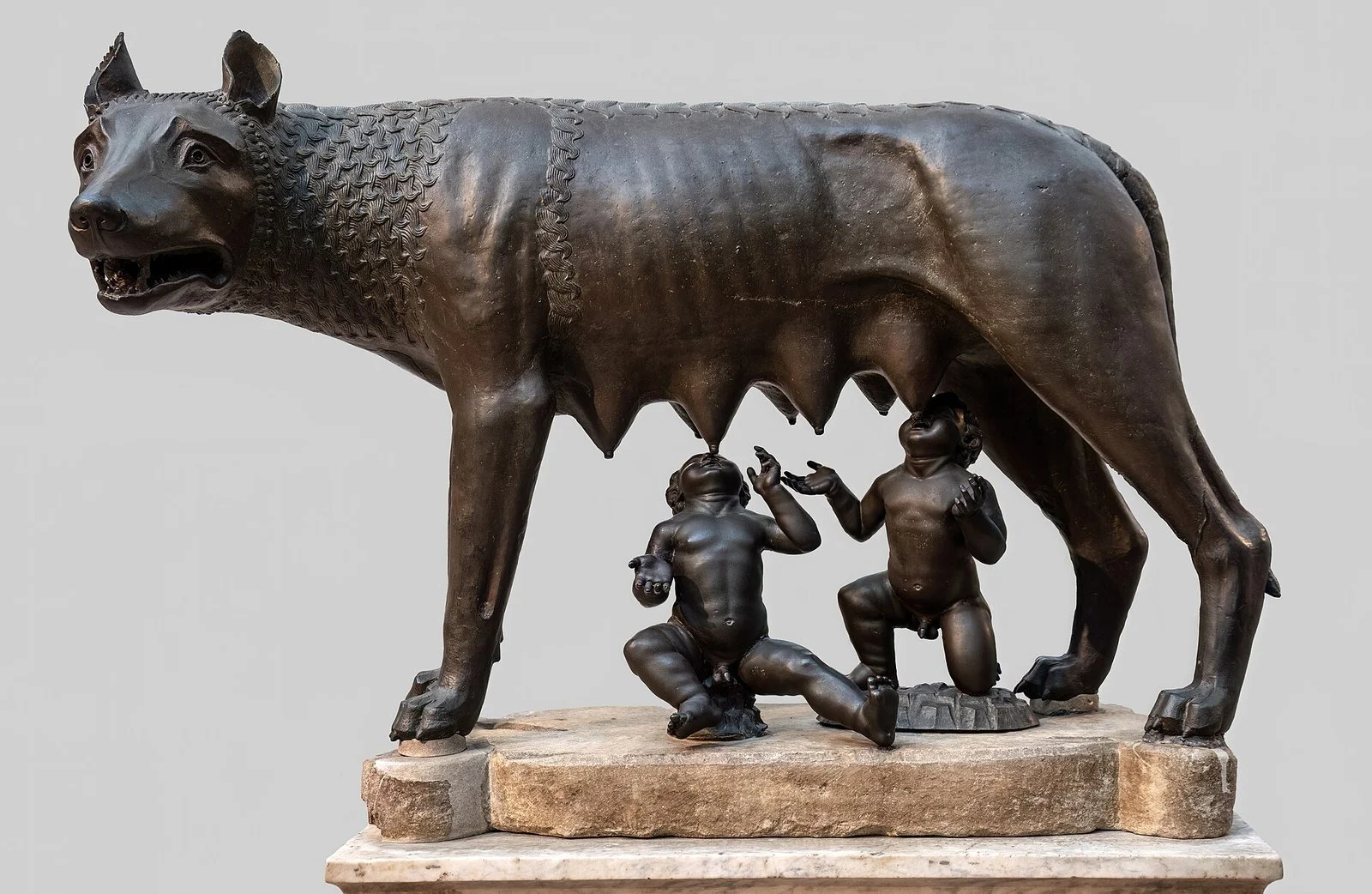
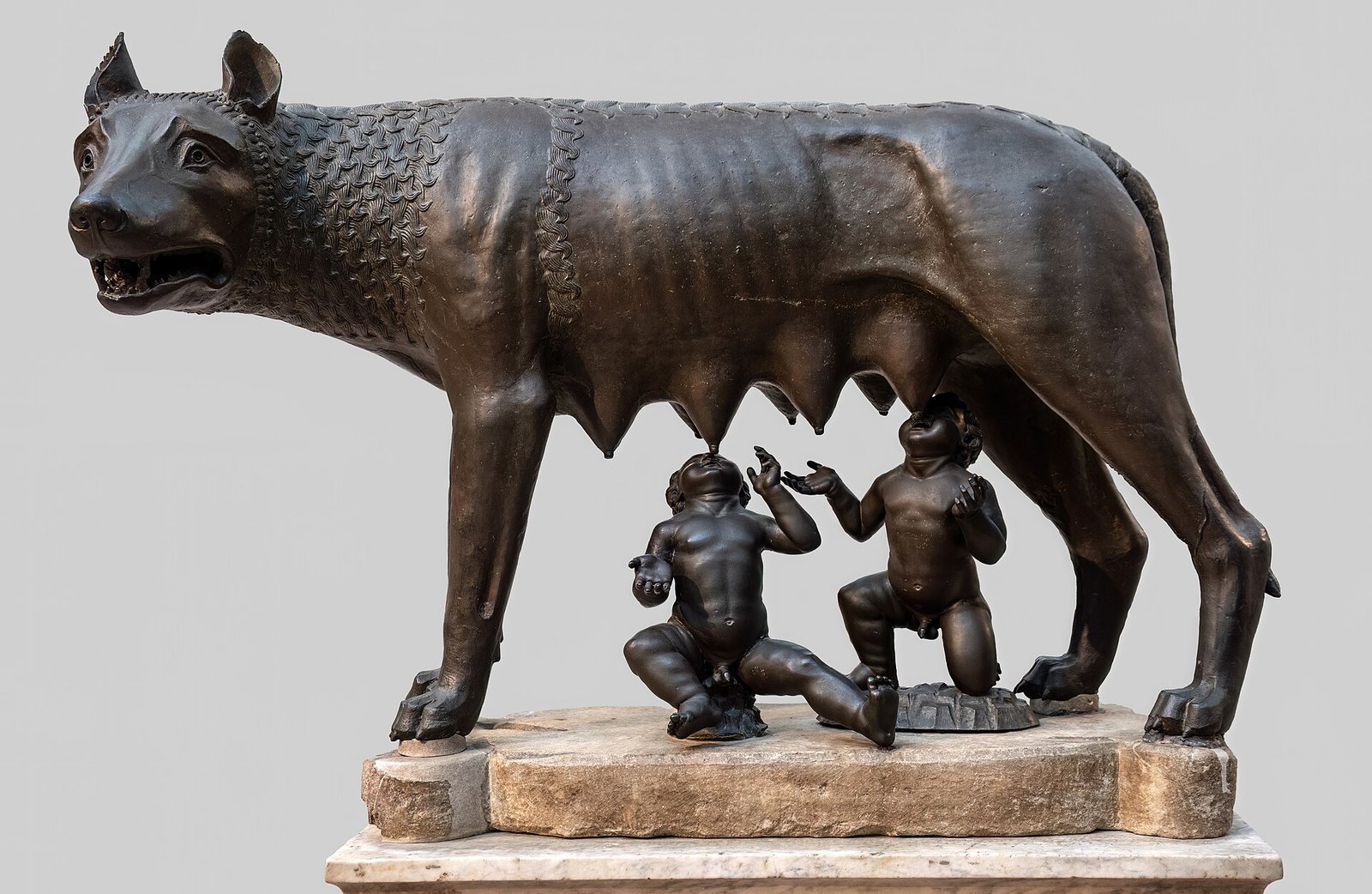
The she-wolf nursing the twins is the image that has crossed the centuries, and the place where, according to tradition, she found them is the Lupercal, a cave on the southwestern slopes of the Palatine. The Lupercal was a real sanctuary, not only a literary one: the Lupercalia of February 15 were celebrated there, one of the most archaic and most violent festivals in the Roman calendar, and Augustus claimed its restoration in the account of his own works. Its exact position is still debated, though, and the section on the cave and its history is in our page on the Palatine, where the topic is taken up at length along with the story of the cavity identified in 2007 under the House of Augustus.
The furrow, the pomerium and the death of Remus
The final part of the story is the one that interests historians of religion most. Romulus draws, with a plow pulled by a white bull and a white cow, the furrow that marks out the city, lifting the plow where the future gates will stand. The furrow defines the pomerium, the sacred boundary within which the urban auspices are valid and outside of which another religious jurisdiction begins. Remus jumps over it in mockery and is killed. The fratricide is not a shameful detail to be hidden: it is the ritual foundation of the inviolability of the boundary, and the Romans told it for centuries without embarrassment because it served to say that the limit of the city is sacred and whoever violates it dies.
What the myth tells us about the Romans
Laid out in order, the founding story says that Rome is born from an exposure and a crime, that it is founded by a man raised among shepherds and not in a palace, that from the start it welcomes fugitives and the stateless in the open asylum between the two peaks of the Capitoline, and that it gets its women through an abduction. It is not an edifying story, and that is exactly the point: the Romans chose to portray themselves as a community born from irregularity and mixture, able to turn anyone into a citizen. It was a precise identity claim, the opposite of the autochthony claimed by so many Greek cities, and it explains a lot about how Rome handled the integration of conquered peoples.
What archaeology really says about the origins of Rome
Archaeology documents stable settlements on the Palatine and in the neighboring areas already between the 10th and the eighth century BC, but it records no act of founding: research describes a process of aggregation that lasted generations, not the birth of a city in a day. This is the sentence to hold on to, because it is the point where popular accounts go wrong most often, frequently in good faith.
The Palatine before Rome: the Iron Age huts
On the southwestern side of the Palatine, in the area in front of the Temple of the Magna Mater, excavations carried out since 1948 have identified traces of several Iron Age huts: not walls, but postholes cut into the tuff bedrock, drainage channels and floor levels. From those traces archaeologists reconstruct dwellings with an oval or rectangular plan with rounded corners, with a load-bearing structure of wooden posts, walls of reeds and clay and a thatched roof, a central hearth and a smoke hole in the roof. The shape is independently confirmed by the hut-shaped cinerary urns of the Latial culture, miniature reproductions of the house of the deceased, which can be seen in the protohistoric sections of the archaeological museums of Rome.
In historical times the casa Romuli, the hut of Romulus, stood on that area, which the sources describe as a building of straw and reeds deliberately kept in its primitive form and rebuilt every time fire or time damaged it. It is a fascinating case of constructed memory: the Romans preserved an archaic hut as a relic of the origins, at a point on the hill where there really had been archaic huts. That it was truly the house of the founder cannot be proven and, historically, is almost certainly false. That the place was inhabited in the eighth century BC is, on the other hand, certain. Anyone who visits the Palatine Museum today finds the materials from this phase on display, which is the least spectacular and most important part of the whole hill.
The necropolises and the Forum as a marshy area
A second block of data comes from the area of the Forum. Below the level of the monumental square, excavations have identified an archaic burial ground with cremation and inhumation tombs datable between the 10th and the eighth century BC. It is a decisive discovery, because necropolises are by definition placed outside settlements: the presence of tombs in the valley between the Palatine and the Capitoline shows that in that phase the area was not inhabited but was the cemetery of the communities settled on the surrounding heights. The valley was low, damp, prone to standing water, and it would become the political center of the city only after an imposing job of land reclamation and raising of the ground level, traditionally linked to the drainage of the Cloaca Maxima and placed by the excavations around the end of the seventh century BC.
The data tell the process by themselves: first separate villages on the hills, with their cemeteries in the valley, then the valley reclaimed and turned into a common space. The Roman Forum was not born with the city, it was born when the villages became a single city. Walking in the Roman Forum today means crossing the place where this passage took place, even if what you see on the surface belongs almost entirely to much later phases.
The wall on the slopes of the Palatine and the debate it set off
The most discussed chapter of recent decades concerns the excavations led by Andrea Carandini on the northern slopes of the Palatine, which brought to light a defensive structure, a wall and ditch with traces of a palisade, dated by the excavator to around the middle or second quarter of the eighth century BC. Carandini proposed recognizing in it an archaeological counterpart of the tradition about the wall of Romulus and the moment when the settlement gives itself a boundary, that is, becomes a city.
The proposal has deeply divided the scholarly community. The objections concern both the dating, which according to some should be lowered, and above all the interpretation: an earthwork and enclosure does not prove the existence of an act of founding or of a founder, and the coincidence with Varro's date could be exactly what it looks like, a coincidence. One methodological problem that several scholars have pointed out should be added: Varro's date was calculated backward, so finding a structure that comes close to it does not confirm the tradition, because the tradition is not independent of the data used to test it.
The honest picture is this: on the slopes of the Palatine in the eighth century BC a work was built that delimited the space. The archaeological evidence exists and is solid, while its interpretation as the wall of Romulus remains a minority and contested reading. Anyone who presents the question as closed, in one direction or the other, is oversimplifying.
The 2007 Lupercal: a contested discovery
In January 2007 the news went around the world: under the House of Augustus on the Palatine, a probe had located a cavity about 16 meters deep, decorated with mosaic, pumice and shells, with a white eagle at the center of the vault. The archaeologist who directed the area proposed it as the Lupercal, the cave of the she-wolf. The criticism came immediately and from leading scholars, who observed that the decoration and the type pointed rather to a nymphaeum or an underground room of the imperial age, and that the position did not match the one the sources give for the sanctuary. Today the identification with the Lupercal is not accepted by the majority of specialists.
Not a founding, a process
Putting the data together, the reconstruction that prevails today describes something very different from a founding act. During the Final Bronze Age and the early Iron Age, the heights overlooking the bend of the Tiber, the Palatine first of all but also the Capitoline, Esquiline, Quirinal and Caelian, host independent villages of huts, with their own necropolises. In the eighth century these nuclei begin to coordinate: collective works appear, space is structured, areas are delimited. In the seventh and sixth centuries the process speeds up, the valley of the Forum is reclaimed and paved, the first great sanctuaries are built, a political center is organized. Around 600 BC Rome is a city in every sense of the word, with institutions, public cults, monumental architecture and a continuous built-up area.
Scholars call this passage synoecism, the coalescing of distinct communities into a single political entity. It is a process that lasts at least a century and a half and that has no starting day any more than the formation of a language does. The role of the Tiber was probably decisive: the area was the farthest upstream point where the river could easily be forded, at the Tiber Island, and at the same time the farthest downstream point reachable by river navigation, a hub of trade between Campania, Etruria and the interior. A city is born there for geographical reasons, not because someone draws a furrow.
What remains standing of the tradition
It would be wrong, though, to conclude that the ancient story has no correspondence at all. Some elements hold up well. The eighth century BC is indeed the period when the settlement on the Palatine takes shape and is delimited, so the general chronological placement of the tradition is not arbitrary. The centrality of the Palatine in the sources matches the centrality of the Palatine in the excavation data. The composite character of the population, which the myth expresses with the asylum and the abduction of the Sabine women, matches an archaeological picture of intense exchange among Latins, Sabines and Etruscans. The tradition, in short, preserves the memory of a structure of process, not of individual events: it remembers that Rome was born from the meeting of different groups at a strategic point on the Tiber, and on this archaeology proves it right. On everything else, that is, names, days and individual acts, it does not.
Where to see the origins of Rome today
April 21 is the best occasion of the year to devote a day to the places of the origins, which the rest of the year are crossed in a hurry by people heading somewhere else. Here is where, concretely, you find what we have talked about so far.
The Palatine and the Palatine Museum
The Palatine is the place of the origins par excellence: here you find the area of the Iron Age huts in front of the Temple of the Magna Mater, the slopes excavated in recent decades, the House of Augustus and the House of Livia, and the Palatine Museum, which collects the materials from the hill and includes a section on the protohistoric phases. Access to the Palatine is with the integrated ticket of the archaeological park, which also includes the Roman Forum and the Colosseum. Check the current conditions on the park's official website before your visit, because the ticket structure and the length of validity have changed several times in recent years.
The Roman Forum and the reclaimed valley
In the Roman Forum the phase of the origins is almost entirely below walking level, but a few points remain readable: the area of the archaic burial ground near the Temple of Antoninus and Faustina, now the church of San Lorenzo in Miranda, the Lapis Niger near the Comitium, with its archaic inscription among the oldest known in the Latin language, and the course of the Cloaca Maxima, which testifies to the drainage work on the valley. The Temple of Antoninus and Faustina is a good landmark for getting your bearings in that part of the archaeological area.
The Capitoline and the Capitoline Museums
The Capitoline Hill is the other pole of the origins: the seat of the city's main sanctuary, the Temple of Jupiter Capitolinus, and the place where tradition situates the asylum opened by Romulus to fugitives, in the hollow between the two peaks of the hill where the Michelangelo square now stands. In the Capitoline Museums, and in particular in the Palazzo dei Conservatori, you can see the Capitoline She-Wolf, the bronze statue that has become the symbol of the city.
Here too an honest clarification is needed, because this is one of the most debated points in the history of Roman art. The statue was long considered an Etruscan work of the fifth century BC. Analyses carried out since the 2000s, based on casting technique and radiometric dating, have proposed a medieval date, between the 11th and 13th century. The question is not closed and is still debated among specialists. On one point, however, there is no discussion: the twins the she-wolf is nursing are a Renaissance addition, traditionally attributed to Antonio del Pollaiolo, and are not part of the original group. The statue everyone recognizes as the image of the founding is therefore, in whole or in part, much more recent than the founding itself.
The Circus Maximus and the Murcia valley
The Circus Maximus, today a large grassy hollow between the Palatine and the Aventine, is according to tradition the place of the abduction of the Sabine women, which in the story took place during the games Romulus had organized in honor of Consus. It is also where today's April 21 celebrations are concentrated, which closes a rather elegant circle. The archaeological part of the area, with the remains of the circus structures at the curved end, can be visited for a fee at set hours, while the central esplanade is a public space freely accessible and used for large events.
The protohistoric collections of the museums
To see the objects, and not only the places, the references are the sections on Latial protohistory in the city's major archaeological museums. The hut urns, the grave goods and the impasto pottery from the Latial necropolises are in the collections of the Museo Nazionale Romano, spread between Palazzo Massimo alle Terme and the Baths of Diocletian, the latter the home of the protohistoric and epigraphic section. The Centrale Montemartini holds materials from urban excavations, including archaic contexts, in a display among the machines of the old thermoelectric power plant that remains one of the most successful in the city.
Outside Rome: the Alban Hills and Lake Nemi
The tradition about Alba Longa and the Latin League leads out of the city, toward the Alban Hills. Lake Nemi, with the sanctuary of Diana Nemorensis on its shores, is one of the federal cult sites of ancient Latium and lets you understand that Rome was born inside a system of Latin communities and not in a vacuum. They are half-day destinations, reachable from the Castelli Romani, and they add depth to any discussion of the origins.
How the Natale di Roma is celebrated today
The Natale di Roma is celebrated today with historical reenactments organized by private associations, a costumed parade along the Imperial Forums, band concerts and special openings promoted by Roma Capitale, concentrated between the Circus Maximus and the historic center in the days around April 21. The program is not fixed, though: it changes every year, in venues, dates and content, and in some editions it has been reduced or reshaped. This is the part of the article where it pays to be more cautious than elsewhere, because nothing gets old faster than a calendar.
The reenactments of the Gruppo Storico Romano
The organization that has run the main core of the events for more than 20 years is the Gruppo Storico Romano, a historical reenactment association based in Rome that coordinates the participation of dozens of Italian and foreign groups. The 2026 edition, the 26th, took place between April 18 and 21 and saw the participation, according to figures released by the organizers, of more than 1,300 reenactors from 16 countries. The announced activities included educational demonstrations, gladiator fights, ancient athletic contests including harpastum, historical costume parades, the ceremony of lighting the sacred fire and the ritual tracing of the furrow.
The events of the Gruppo Storico Romano were free of charge. This is a fact declared by the organizers for recent editions and should not be automatically taken for granted for the future, all the more so since some side initiatives hosted in museum venues follow the admission rules of the venue that hosts them.
The historical parade at the Imperial Forums
The most photographed event is the big costumed parade, which the organizers present as the largest historical reenactment parade in Europe. It traditionally takes place on a Sunday morning, so not necessarily on April 21, and runs along Via dei Fori Imperiali, passing by the Forum of Trajan and the Markets of Trajan, home of the Imperial Forums Museum. The passage of the parade brings road closures and detours of surface lines, announced by the transit company in the preceding days.
The Circus Maximus: a usual venue but not a guaranteed one
The Circus Maximus is the historic home of the reenactment camp, with the rebuilt encampments, the educational areas and the demonstrations. It must be said clearly, though, that the availability of the space is not automatic: the esplanade of the circus is one of the city's main areas for large events and concerts, and on at least one recent occasion its assignment for the Natale di Roma was called into question by the scheduling of a music event on the same day, with a public debate reported by the city press. Anyone planning a visit around this anniversary will do well to check the actual venue of the current edition instead of taking it for granted.
The initiatives of Roma Capitale
Alongside the reenactments, the city government promotes its own program every year. For the 2779th Natale di Roma, in 2026, the institutional calendar ran between April 19 and 22 and included, on April 21 at 17:30, simultaneous performances by military band ensembles in seven squares of the historic center, among them Piazza del Campidoglio and Piazza San Silvestro. It also included free guided visits to the Aula Giulio Cesare of the Palazzo Senatorio in four afternoon shifts, with mandatory booking through the city's single phone number and limited groups, themed itineraries, among them a street art route in the Quadraro neighborhood, and initiatives in several civic museums, from the Museo di Roma in Trastevere to the Markets of Trajan.
These are data for one specific edition and should be read as an example of what the city puts on, not as a recurring program. Times, places and booking arrangements change every year and are usually published in the two weeks before the anniversary.
Civic museums on April 21: free, but for whom
On the point that matters most to anyone planning a visit it pays to be precise, because it has changed over time. For several years, on the day of the Natale di Roma, the city's civic museums were free for all visitors. In the most recent editions, free admission on April 21 has instead been reserved for residents of Rome and the Metropolitan City, while non-residents pay the regular ticket, including the special guided visits organized for the occasion. The rule applied in 2026 was the latter.
For completeness, residents also have the annual civic museums card, which allows free entry to the city circuit all year and makes free admission on April 21 of little relevance for those who already hold it. For anyone coming from outside, the practical conclusion is simple: on April 21 the civic museums of Rome, from the Capitoline Museums to the Centrale Montemartini, are open and often have special initiatives, but they are not necessarily free. The conditions for the current year are on the Roma Capitale museums portal.
Watch out for one further distinction that causes confusion: the sites run by the State, such as the Colosseum, the Roman Forum and the Palatine, do not follow the civic museums' calendar and do not apply free admission tied to the Natale di Roma. Their free-entry days are the ones set at the national level, which fall on other dates.
Editions are not all alike
One last warning, which is worth more than any list. In the years marked by health restrictions the public events of April 21 were canceled or turned into remote initiatives, and even in ordinary years the program has seen reductions, venue changes and date changes compared with what was first announced. No source, this page included, can guarantee in advance what will happen in a given edition. The only reliable information is what is published by the official channels of Roma Capitale and by the association that organizes the reenactments, in the weeks immediately before.
Practical tips for visiting Rome on April 21
April 21 is not a national holiday and is not the feast day of Rome's patron saint either, which falls on June 29. Offices, schools and shops work normally and the city moves as on any ordinary weekday, with a few extra road closures in the areas of the events.
Getting around and what to expect from traffic
The two areas affected by closures are Via dei Fori Imperiali, on the days and at the hours of the parade, and the perimeter of the Circus Maximus. Both are served by Metro Line B, with the Colosseo and Circo Massimo stations, which on high-turnout days is by far the most efficient way to get there. The surface lines crossing the area are detoured, and it is best to check the transit company's notices on the same day. Forget about reaching the area by car: it is largely a limited traffic zone and on event days it becomes impassable.
With kids
The reenactments are one of the few Roman events that work really well with kids, because everything is visible, loud and concrete: encampments, weapons, demonstrations, and educational areas designed for exactly that audience. The things to watch out for are the crowd in the middle hours, the lack of shade on the esplanade of the Circus Maximus, and the distances between one point of the program and another.
Combining the day with a visit
If you want to build a coherent day, you can pair the morning of the events with an afternoon at the places of the origins: the Palatine and the Palatine Museum, or the Capitoline Hill and the Capitoline Museums, a few minutes' walk from the Circus Maximus and the Forums. A less crowded alternative is to spend the afternoon on the protohistoric collections at the Baths of Diocletian, close to Termini and therefore convenient if you are leaving the same day. If you have more time, you can extend toward the Appian Way Regional Park, which on April 21 is particularly pleasant and much less crowded than the center.
What not to expect
It is worth spelling out the flip side too. On April 21 there is no authentic ancient religious ceremony: the reenactments are contemporary reconstructions, done with philological seriousness but still popular spectacle. There is no general free admission to the city's monuments. There are no guaranteed fireworks and no single big central event. Anyone who arrives in Rome on April 21 expecting something like a city New Year's Eve will be disappointed. Anyone who arrives knowing they will find an afternoon of well-made reenactments and a city telling its own story will not.
Frequently asked questions about the Natale di Roma
When is the Natale di Roma celebrated?
The Natale di Roma is celebrated every year on April 21, the traditional date of the founding of the city in 753 BC. The events are usually concentrated in the days immediately before and after, from the weekend before through April 22, with the historical parade usually held on a Sunday and therefore not always on the exact day of the anniversary.
Why does the Natale di Roma fall on April 21?
The Natale di Roma falls on April 21 because on that day the Parilia were celebrated, a very ancient pastoral festival dedicated to the deity Pales, and the date of the founding was attached to that already existing festival. Plutarch says so explicitly, noting that the Romans celebrated the Parilia even before the founding of the city. The festival came first, the date of the founding after.
Was Rome really founded on April 21, 753 BC?
No: April 21, 753 BC is a conventional date, not an established historical fact. It was calculated backward in the first century BC by the scholar Varro, who also relied on an astrological calculation by Lucius Tarutius. Other ancient authors proposed different dates, from 814 to 728 BC, and no document contemporary with the events records the birth of the city.
How old is Rome in 2026 and in 2027?
Rome turned 2779 on April 21, 2026 and will turn 2780 on April 21, 2027, according to the count that starts from the traditional date of 753 BC. It is the number that appears every year in the official title of the celebrations and in Roma Capitale's communications, updated by adding the current year to the 753 years of the Varronian chronology.
What does archaeology say about the origins of Rome?
Archaeology documents on the Palatine Iron Age huts datable between the 10th and the eighth century BC and a formation of the city by progressive aggregation of distinct villages, not by an act of founding. In the Forum, under the monumental square, archaic necropolises have been found: a sign that the valley was a cemetery and not inhabited before the land reclamation.
Where is the Natale di Roma celebrated and how much does it cost?
The Natale di Roma is celebrated above all at the Circus Maximus, where the historical reenactment camp is set up, and along Via dei Fori Imperiali, where the costumed parade passes. The events of the reenactment associations were free of charge in recent editions, but venues and program change every year: it is best to check them on the channels of Roma Capitale and the organizers.
Are museums free on April 21 in Rome?
On April 21 the civic museums of Roma Capitale are open with special initiatives, but in recent editions free admission has been reserved for residents of Rome and the Metropolitan City, while non-residents pay the regular ticket. State sites such as the Colosseum, the Roman Forum and the Palatine follow a different calendar and do not apply free admission tied to this anniversary.
What were the Parilia?
The Parilia, also called Palilia, were the Roman festival of April 21 dedicated to Pales, deity protector of flocks and shepherds. The rite included the purification of the animals and pens with water and branches, fires of straw and sulfur that the flock passed through, offerings of milk, millet and cakes, and a triple jump over the flames. In the city the Vestals prepared a purifying mixture to add to the fires.
Is the Natale di Roma a public holiday?
No, the Natale di Roma is not a public holiday: on April 21 offices, shops, schools and transport run normally. The feast of Rome's patron saint, which is a city holiday, is June 29, dedicated to Saints Peter and Paul. On April 21 there are only temporary traffic closures in the areas affected by the events.
One last tip for planning the day
The best way to experience April 21 in Rome is to hold together the two things this page has tried to keep apart: the spectacle of the reenactment, which is fun and well done, and the awareness that you are celebrating a date invented by a scholar 2,000 years ago on top of a shepherds' festival that is even older. Knowing that 753 BC is a convention does not spoil the festival: it makes it more interesting, because it shifts attention from a day that never existed to a process that lasted centuries and that you can still read in the postholes of the Palatine and in the tombs under the Forum.
If you are building a Roman itinerary around this anniversary, combining the archaeological areas of the center with the civic museums and with destinations in the Alban Hills, you may find useful planning tools on Tour Leader Pro, while for a broader picture of transport and destinations in Lazio, Italy Planner is a good resource.