Santa Maria della Consolazione
In short. Santa Maria della Consolazione occupies the back of a square that almost nobody crosses, behind the Capitoline Hill and a short walk from the southern edge of the Roman Forum.
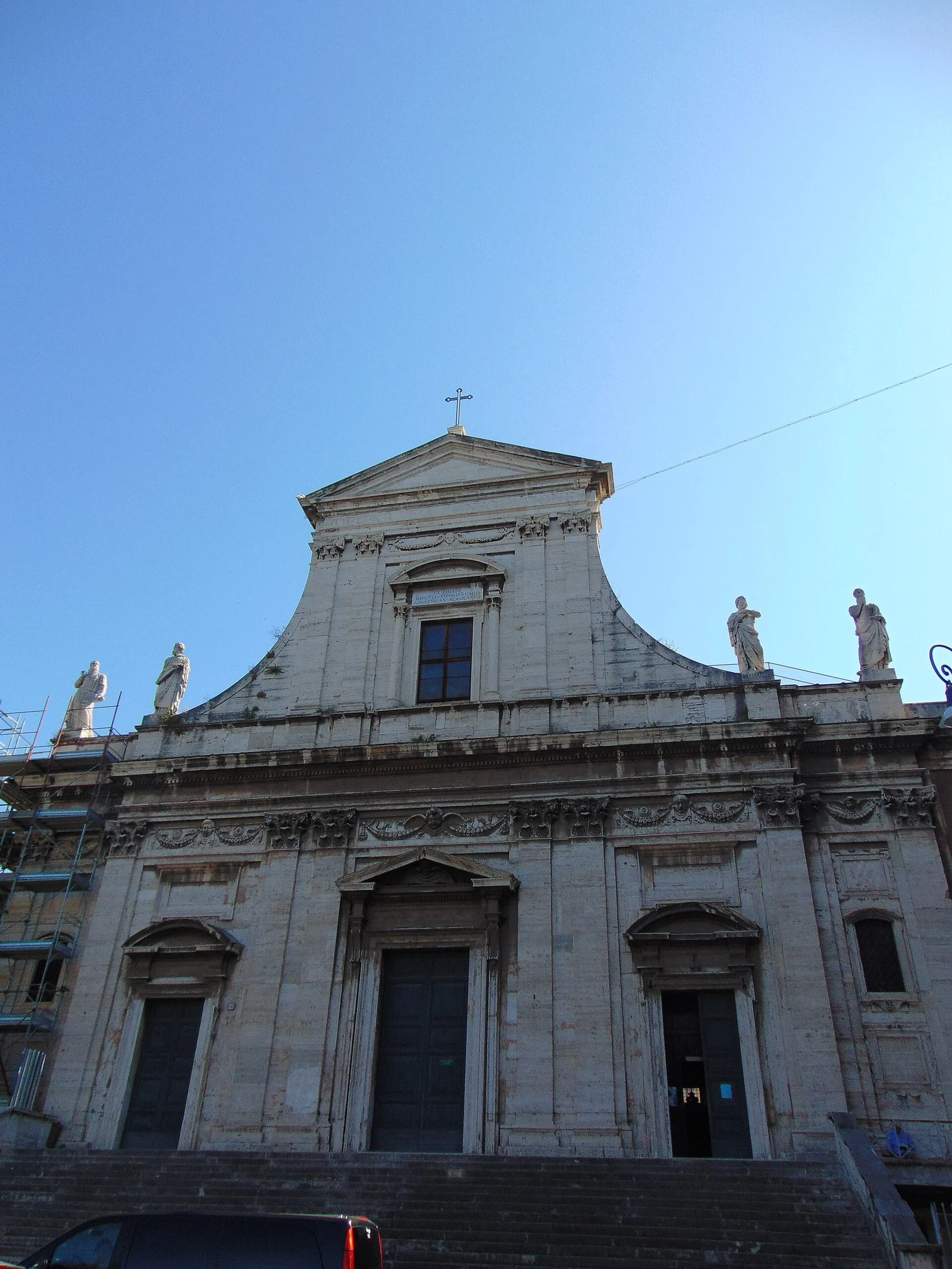
Santa Maria della Consolazione occupies the back of a square that almost nobody crosses, behind the Capitoline Hill and a short walk from the southern edge of the Roman Forum. The travertine facade rises at the top of a long flight of steps and the church stays invisible from the routes tourism follows: from Via del Teatro di Marcello you see the side, from the Capitoline Cordonata you don't see it at all. Yet inside there is a cycle of frescoes that art history considers one of the turning points of the Roman 1500s, and next door for more than four centuries ran the hospital where anyone in Rome who broke something ended up. This page lines up what the sources say, where they disagree, what you see on entering and what was instead demolished.
Where Santa Maria della Consolazione Is and How to Get There
The address is Piazza della Consolazione, in the Campitelli district, on the southern side of the Capitoline Hill. The street number appears in the sources in two versions, 84 and 94, and the discrepancy has no practical consequences because on the square the only place of worship is this one: you arrive in front of the steps and can't go wrong. The square is a dead end for through traffic and is walked almost only by those who work in the city offices that occupy the block.
On Foot from the Capitoline Hill
From Piazza del Capitoline Hill you go down Via del Campidoglio and then turn right onto Via di Monte Tarpeo, or take the descent that runs along the Palazzo dei Conservatori toward Via della Consolazione. It's barely five minutes. Anyone leaving the Capitoline Museums at the end of the visit has the church practically under their feet and almost nobody knows it, because no museum sign points to it.
On Foot from the Roman Forum and the Velabrum
From the exit of the Roman Forum on Via dei Fori Imperiali you follow the side of the hill and in 10 minutes you're there. Anyone coming instead from the Forum Boarium and the Arch of Janus goes up Via della Consolazione from below, and it's the route that works best: the church appears at the end of the street, wedged under the rock, exactly in the relationship it had with the city when it was built.
By Public Transport
The useful public transport stop is Piazza Venezia or the stretch of Via del Teatro di Marcello served by the surface lines that go down toward the Lungotevere and toward Trastevere. The metro doesn't reach the area: the nearest station is Colosseo on Line B, from which you need 12 or 15 minutes on foot along Via dei Fori Imperiali. The routes of Roman surface lines change often because of roadworks and closures, and the check has to be done the same day on the transport company's app. The general picture is on our page on how to get around Rome.
By Car, and Why It's Better to Forget It
The area falls within the limited traffic zone of the historic center and free parking doesn't exist. Anyone arriving by car from outside Rome loses more time circling than visiting. The rules and hours of the access windows are collected on the page on Rome's ZTL, which is best read before leaving and not in front of the gate. By bicycle the bottom of the square is in uneven sampietrini and the descent from Via di Monte Tarpeo is steep: anyone cycling in Rome will find an honest assessment of the routes on the page on Rome by bike.
At the Foot of the Tarpeian Rock: What It Means
The tuff wall looming over the square is the southern slope of the Capitoline Hill, the one tradition identifies with the Tarpeian Rock. The name weighs more than the place: in Republican Rome, those condemned for treason and crimes against the state were thrown from that wall, and ancient sources record some famous names, from Spurius Cassius to Marcus Manlius Capitolinus in 384 BC. The exact point of the throwing is not indicated unambiguously by the available sources, and the topography of the hill has been reworked too many times for the question to be settled.
Why a Church Right Here
Building a church under that wall was not a scenic choice. The valley floor between the hill and the Forum Boarium was, in the late Middle Ages, an area of warehouses, gardens, granaries and service structures, and its closeness to the traditional place of capital executions made it an obligatory passage point for a very concrete kind of piety: accompanying those who were about to die. The church was born from that function and not from a monumental commission.
The Rock Today
The rock wall became visitable again in September 2021, after a restoration and redevelopment project financed by a private sponsor with a donation of about 1,600,000 euros. Access is from above, from the garden that occupies the top of the slope, and not from the square. Anyone looking at the rock from below sees modern retaining walls, vegetation and the back of Capitoline buildings: the dramatic image the name evokes doesn't match what is in front of you.
The Difference in Level, and How It Changed
The walking level of the square is not the original one. Between the 1930s and 1940s the demolitions to free the slopes of the Capitoline Hill lowered the churchyard by about three meters, and to connect the church to the new level the staircase was extended in 1943 with the addition of 16 steps. Anyone looking at the facade today therefore sees it higher and more detached than it was for those who attended it in the 1800s, when the main door was almost at street level.
A Curiosity About Santa Maria della Consolazione
The name of the church does not come from a generic Marian title but from a sentence, and the sentence is the part nobody tells well. According to the tradition reported by the parish and by historical sheets, in 1470 a young man condemned for murder survived the execution and attributed his salvation to the Virgin painted next to the place, reporting that he had heard the words “Go, for you are consoled.” The church was built in a few months to gather the devotion born from that episode and is recorded as dedicated on November 3, 1470.
What Is Documented and What Is Tradition
The distinction has to be made clearly. The episode of 1470 belongs to the devotional account and is presented as such even by church sources: no document certifies it. What is documented instead is the context: that at that spot there had been for decades a Marian image intended for those led to execution, and that in 1470 a church arose on that image with the approval of Pope Paul II. The first building was small, with a single altar, and the design is attributed to Baccio Pontelli.
The Image and the Date of 1385
The background is from 1385 and concerns a Roman nobleman, Giordanello degli Alberini. The sources agree on the sum, two gold florins meant to have an image of the Virgin painted near the rock, and diverge on the rest. Some sheets describe him as a patron who left the sum in his will, others as a condemned man who paid out of his own pocket so that the image would be placed there. The two versions cannot be reconciled and neither carries a verifiable archival reference in the popular sheets.
The Dating of the Venerated Image
The fresco of the Madonna and Child seen today at the high altar is attributed to Antoniazzo Romano and dated between 1465 and 1470, and the more analytical sheets specify that it is a reworking of a pre-existing 1300s image. The city's tourism portal instead speaks of a Marian icon of the 13th century. The divergence is real and concerns two different things: the date of the paint layer you see and the date of the original image that painting covered. Anyone looking for a single answer is left unsatisfied.
The Church of the Condemned, and the Network of Institutions Around It
Rome between the 1400s and the 1800s had a structured system of assistance for those being executed, and Santa Maria della Consolazione is one of its nodes. The subject should be treated for what it is, that is, a chapter of institutional history and not a macabre anecdote: around executions, confraternities, churches, burial places and codified procedures had been organized, and these structures left buildings that are visited today without knowing what they were for.
The Relationship with San Giovanni Decollato
A few hundred meters away, heading down toward the Velabrum, stands San Giovanni Decollato, seat of the Florentine archconfraternity that from 1488 had the task of assisting those condemned to death in Rome, accompanying them and providing for burial. The two churches worked on the same ground with distinct roles: here the image of comfort born from a spontaneous devotion, there a recognized institution with an oratory, an archive and a cemetery. Visiting them on the same afternoon, when both are open, gives a picture that neither gives alone.
Where Sentences Were Carried Out
The use of the Capitoline area as a place of execution ended in the modern era. One of the available sheets gives 1550 as the end point, after which Roman executions were concentrated elsewhere, in particular in the area of Ponte Sant’Angelo and then in Piazza del Popolo. The date appears in only one line of sources and we report it with this reservation. What is certain is that the church outlived its original function by more than three centuries, turning into a Marian sanctuary and a hospital church.
The Neighboring Prisons
The same strip of the city preserves two other places linked to detention: the Mamertine Prison on the opposite slopes of the hill, with San Pietro in Carcere above it, and farther down San Nicola in Carcere, whose name preserves the memory of a similar function in the Middle Ages. Walking from one to the other takes a quarter of an hour and lines up a geography of punishment that precedes modern prisons by centuries.
Something Nobody Tells You About Santa Maria della Consolazione
Behind the church, in the building that today houses the headquarters of the Roma Capitale local police, the hospital where anyone in Rome who suffered trauma was brought operated until 1936. It was not a general hospital: historical sources describe it as the facility devoted to wounds, fractures and accidents, and this specialization made it for centuries the city's emergency room. The name “Consolazione” in Roman speech meant the hospital before it meant the church.
How the Archhospital Began
The attached hospital appears shortly after the church, with dates that oscillate between 1470, 1473 and 1475 depending on the source. The turning point is 1506, when three distinct charitable institutions, the hospital of the Consolazione, that of Santa Maria delle Grazie and that of Santa Maria in Portico, merge into a single body, with a statute approved on December 25 of that year. Management stayed in the hands of a confraternity made up of families of the Roman patriciate, among them Mattei, Colonna, Savelli and Frangipane.
The Specialization in Trauma
The reason for the specialization is mundane and says a lot about how the city worked. The hospital stood in an area of building sites, warehouses, heavy transport and manual labor, between the river port, the markets of the Forum Boarium and the quarries of the hill. Whoever fell from a scaffold, whoever was caught under a cart, whoever was hurt in a brawl ended up here because here was the nearest place. The facility organized itself accordingly and developed surgical skills that other Roman hospitals lacked.
The Anatomical School
The least predictable consequence of that specialization concerns the study of anatomy. Bartolomeo Eustachi worked in the hospital, one of the founders of modern anatomy, and sources record that the facility was sought out by anatomists precisely for the availability of bodies of young people who had died of trauma and not been consumed by disease. Between the 1600s and the 1700s a surgical school and an anatomical theater operated there. It is a chapter of the history of medicine that appears on no panel and no plaque.
The End, and the Building
The chronology of the closure is precise and the whole sequence is worth giving. In 1896 the hospital enters the unified administration of Roman hospitals and the following year the activity of the confraternity that had run it for four centuries ends by law. In 1931 it takes the name Ospedale Littorio. In 1936 it is closed for good, by then reduced to an emergency room, as part of the work to isolate the Capitoline Hill. In 1941 the women's ward is demolished. Since 1943 the building has housed the municipal police, and that use has remained.
What Is Left to See
Little, and not open to the public. The building behind the church is a service seat of the local police, with access regulated like any office, and the historic part that survived the demolitions is not a visitable route. The hospital's library merged into the Biblioteca Lancisiana, and the historical archive is kept at the State Archive of Rome, where it has been inventoried and is available for research. Anyone expecting a museum of medicine comes away empty-handed.
My Advice for Visiting Santa Maria della Consolazione
The practical advice is to go in early in the morning and bring two coins for the light. The first chapel on the right, the one with the frescoes that justify the trip, is deep and receives very little natural light: without the artificial lighting you can make out the figures and read nothing. In Roman churches with painted cycles in side chapels this is the single mistake that ruins the most visits, and it is solved with a one-euro coin.
Opening Hours, and the Divergence Between Sources
The church's official website publishes a very wide opening schedule: Monday to Friday from 06:45 to 21:00, Saturday from 07:15 to 21:00, Sundays and holidays from 09:00 to 21:00. The city tourism portal publishes no opening hours and reports only the times of services, with the warning that they may vary. The two pieces of information do not match and the difference matters: a church open 14 hours a day is one thing, a church that opens around services is another.
What to Really Expect
Santa Maria della Consolazione is a rectory served by a community of Capuchin Friars Minor, not a parish with welcome staff and not a museum site. It is recorded as a subsidiary place of worship of the parish of Santa Maria in Campitelli. This means that opening depends on the availability of the friars and that a closed door in mid-afternoon is not an anomaly to report: it is the normal functioning of a church run by a few friars. Anyone who has only one day in Rome and wants to be sure of getting in should phone first at the published number, 06 6784654, or write to the email address given on the site.
The Time Windows That Work
Early morning, between 07:00 and 09:00, is the window with the greatest chance of finding it open, because it coincides with the weekday conventual Mass. Late Friday afternoon works for a specific reason: the community celebrates the rosary and then a Mass dedicated to cancer patients, tied to the devotion to St. Leopold Mandić, of whom the church keeps a relic. On Sunday morning around 11:00 there is the festive Mass. In all these windows you can get in, but you enter a church where a service is being held, and the visit must be conducted accordingly.
How Much Time You Need
20 minutes is enough for a full loop if you look at nothing in detail. 40 minutes are needed to do the 10 chapels with attention. One hour is the right measure if you stop at the Mattei chapel, which on its own holds half an hour of observation. Anyone who fits the stop into a day that includes the Capitoline Hill and the Roman Forum should allow 40 minutes and won't regret it.
The Facade by Martino Longhi the Elder and the Chronology of the Building Site
The church you see today is not the one of 1470. At the end of the 1500s the 15th-century building was insufficient for the flow of devotion and for the needs of the archhospital, and Cardinal Alessandro Riario entrusted Martino Longhi the Elder with the complete reconstruction. The building site is the passage that turns a devotional chapel into a three-aisle church with 10 side chapels, and the travertine facade is its most visible outcome.
The Dates, and Where They Don't Add Up
The sources diverge on the chronological extremes of the building site. One line gives the commission in 1583 and completion in 1606. Another places the work between 1585 and 1600. A third speaks generically of work straddling the two centuries. The divergence is probably explained by the difference between the start of the site, the completion of the structure and the arrangement of the presbytery, which were distinct moments, but none of the sheets consulted makes clear which phase it is dating.
What Longhi Did and What He Left Half Done
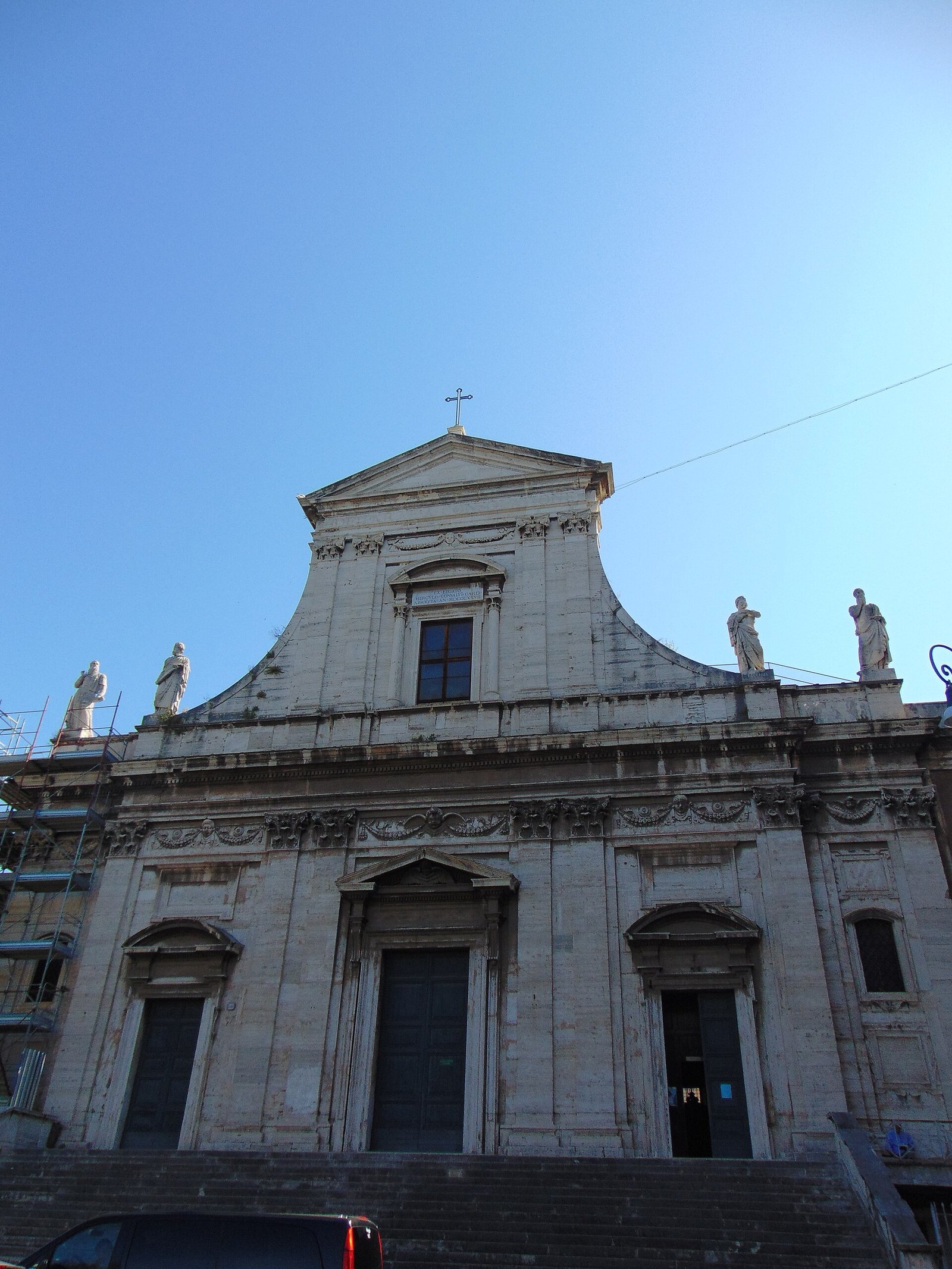
The front is marked by Corinthian pilasters in five bays, with three portals on the lower level and the central one topped by a triangular pediment. Longhi brought the facade up to the height of the entablature and there the work stopped. For more than two centuries the church stayed with its upper part unfinished, a condition anything but rare in Rome and still visible in other buildings today. The upper order, with the large window and the pairs of pilasters, was added only in 1827 by Pasquale Belli.
The Four Statues on the Balustrade
On the balustrade, four figures of prophets crown the facade, identified as Isaiah, Zechariah, Ezekiel and Jeremiah. They are 19th-century works, contemporary with Belli's completion, and not 16th-century as one tends to assume looking at the facade from below. The detail is useful because it explains the slight discontinuity of language between the two orders, which is not a misreading but the sign of two building sites separated by two and a half centuries.
The Presbytery and Giacomo Della Porta
The arrangement of the apse area, made necessary by the Tridentine prescriptions on liturgical layout, is attributed to Giacomo Della Porta and was completed by Longhi at the wish of Cardinal Riario himself. The venerated image was placed at the center within a display of polychrome marbles with Corinthian columns, dated 1585. Here you can see well the logic of the building site: the whole building is built around a mural painting that could not be moved.
Inside: The 10 Chapels, One by One
The interior has three aisles divided by five arches per side on piers, with a lunetted barrel vault and no transept. The side chapels are five on the right and five on the left and belong in large part to trade guilds, which explains the dedications: the fishermen, the innkeepers' apprentices, the vine growers. It is one of the Roman cases where the internal division of a church tells the social makeup of the neighborhood better than any document.
The Mattei Chapel and Taddeo Zuccari
The first chapel of the right aisle, dedicated to the Most Holy Crucifix and known as the Mattei chapel, contains the cycle that makes this church a case study. The Stories of the Passion were frescoed by Taddeo Zuccari, born in 1529 and died in 1566, on commission from Jacopo Mattei. The Dizionario Biografico degli Italiani places the execution between 1553 and 1556, while the church's sheets and local popular writing give 1556 only: the difference concerns the span of the work and not the attribution, which has never been questioned.
What Is Painted, Wall by Wall
On the altar is the Crucifixion, flanked by two figures of prophets within stucco frames. On the side walls develop Christ before Pilate, the Flagellation and the Ecce Homo. On the vault, divided into four sections, are the Last Supper, the Washing of the Feet, the Agony in the Garden and the Arrest of Christ. In the pendentives appear the four Evangelists. Reading it requires raising your head and taking your time, because the organization of the scenes is anything but linear.
Why Art Historians Consider It a Watershed
The critical assessment is clear and worth reporting. This cycle was Zuccari's first great Roman undertaking, carried out when he was a little over 20, and it earned him immediate fame: Vasari records that the very young author was judged by the artists an excellent painter. Studies point to it as a stylistic turning point of the mid-1500s in Rome, for the way it pushes the main episodes back into the background, guiding the eye upward, and for grafting Michelangelo's lesson onto a painting practice of Tuscan-Roman derivation. Federico Zuccari, the younger brother and better known to the general public, did not take part in this work.
State of Conservation
On the current state of the frescoes the popular sources say nothing precise and no restoration sheet is accessible online. What you observe on entering is a legible but dark cycle, penalized by the depth of the chapel and by the lighting, with the high areas of the vault harder to make out. Anyone who needs data on the state of conservation should turn to the specialist literature on Roman Mannerism and to the documentation of the Superintendency, not to popular sheets, this one included.
The Other Chapels of the Right Aisle
The second chapel, called Pelucchi, holds an altarpiece with the Madonna and Child enthroned, St. Joseph and the patron Andrea Pelucchi, a work by Livio Agresti known as il Ricciutino, dated between 1570 and 1575. The third, dedicated to the Nativity and known as the chapel of the Affidati or of the Shepherds, was built in 1583 to a design by Antonio Ferreri and houses three canvases by Giovanni Baglione with the Adoration of the Magi, the Adoration of the Shepherds and the Presentation at the Temple.
The Chapels of the Left Aisle
The first, called Dondoli, keeps a marble relief of the Mystic Marriage of St. Catherine of Alexandria attributed to Raffaello da Montelupo, dated around 1530 by some sources and around 1539 by others. The third, of the innkeepers' apprentices, has a cycle by Francesco Nappi. The fourth, dedicated to St. Andrew and once belonging to the fishermen, was designed by Longhi himself and frescoed by Marzio Ganassini between 1601 and 1607. The fifth, of the vine growers, keeps frescoes by Antonio Circignani known as il Pomarancio.
A Divergence on the Dates of Nappi and Baglione
On the chapels of Francesco Nappi and Giovanni Baglione the sources are half a century apart. One encyclopedic sheet gives 1575 for both. An analytical sheet places Nappi between 1620 and 1630 and Baglione between 1632 and 1633. The second dating is more consistent with the biographies of the two painters, both active in Rome in the early 1600s, but we are not able to settle the question and we point out the alternative.
The Sacristy and the 19th-Century Chapels
In the vestibule of the sacristy is a polychrome wooden Crucifix of the early 1500s. In the sacristy is a marble relief of the Crucifixion dated 1496 and attributed to Luigi Capponi. In the second half of the 1800s two chapels were added dedicated to Santa Maria in Portico and Santa Maria delle Grazie, a memory of the institutions that merged into the archhospital in 1506. The latter keeps a copy of the icon of the Madonna delle Grazie, because the original was stolen in 1970 and has not been recovered.
Another Well-Known Fact, Yet Rarely Cited
Some figures later canonized by the Church served in the hospital of the Consolazione, and the fact appears in all the sheets without anyone drawing the consequence: for a long stretch of the 1500s this was the place where you went to do medical volunteer work in Rome. The sources name Ignatius of Loyola, Camillus de Lellis and Aloysius Gonzaga, three names usually met in completely different churches and contexts.
The Case of Aloysius Gonzaga, and a Clarification
In 1591 Rome was struck by an epidemic and the young Jesuit Aloysius Gonzaga cared for the sick and caught the disease. The sources on the hospital record his service here. Some popular pages add that he died here, and this part doesn't hold up: the saint's biography places his death at the Collegio Romano, in June of the same year. The confusion probably arises from the fact that the contagion was caught while caring for patients in the hospital, and it needs correcting because it circulates quite a lot.
The Right Photo to Take at Santa Maria della Consolazione
The photograph that works is the facade shot from below, from Via della Consolazione, so as to have the steps in the foreground, the travertine in the center and the tuff wall of the hill closing the frame at upper left. It's the only image that conveys the relationship between the church and the rock, that is, the very reason this building exists. From any other position the church looks like an isolated facade in any square.
The Light and the Hour
The facade is exposed so as to receive direct light in the second part of the day. Early afternoon produces contrasts that are too harsh between the travertine and the shadow of the rock. The two hours before sunset give a raking light that separates the pilasters and makes the relief of the portals legible. Early morning the square is in full shade and the rendering is flat, but it's the only moment when there are no cars parked in front of the steps.
The Technical Mistake to Avoid
Shooting a facade from below with the camera tilted upward gives converging vertical lines and the building seems to fall backward. The solution is to keep the sensor parallel to the facade and step back, cropping out the lower part of the steps, or to correct the perspective in post-production, accepting the loss of a few pixels at the edges. A lens of around 28 millimeters equivalent covers the whole facade from the middle of the street.
Inside, and the Rules
Inside, photography without flash and without a tripod is generally tolerated when no services are going on, as in most Roman churches, and must be stopped at the first reminder. The frescoes of the Mattei chapel are a difficult subject: little light, dark surface, shallow depth of field. Anyone who wants to bring home something legible should raise the sensitivity, rest the camera on the balustrade and give up the flash, which on frescoes produces only reflections.
Some Important Events That Happened Here in History
The chronology of this complex reads as the overlap of two parallel histories, that of the church and that of the hospital, which run together for four centuries and then part abruptly in the 1900s. The dates that follow are those found in several sources, with explicit indication of the points where the sources disagree.
1385: The Image at the Rock
Giordanello degli Alberini sets aside two gold florins to have an image of the Virgin painted at the foot of the rock, to comfort those led there. The sources diverge on whether it was a bequest in a will or a direct payment, and on whether the patron was himself a condemned man.
1470: The Dedication of the Church
A church rises on the image, with the approval of Pope Paul II and the support of Roman families. The dedication is placed on November 3, 1470. The first building, attributed to Baccio Pontelli, is small and has a single altar.
1506: The Birth of the Archhospital
Three charitable institutions merge into a single body and the statute is approved on December 25. It is the date that turns a small shelter attached to the church into one of the major health facilities of early modern Rome.
1553-1556: Zuccari's Frescoes
Taddeo Zuccari frescoes the Mattei chapel with the Stories of the Passion. The cycle immediately becomes a reference for Roman painting and marks the artist's entry among the protagonists of the city scene.
1583-1606: Longhi's Reconstruction
Cardinal Alessandro Riario entrusts Martino Longhi the Elder with the construction of the present church. The presbytery is arranged according to the Tridentine prescriptions with the intervention of Giacomo Della Porta. The facade stays unfinished in the upper order.
1585: Elevation to Archconfraternity
Sixtus V raises the sodality that runs church and hospital to the rank of archconfraternity, recognizing its weight in the Roman system of assistance. In the same year the marble display of the high altar is dated.
1827: Completion of the Facade
Pasquale Belli adds the upper order with the large window and the Corinthian pilasters. The four statues of prophets on the balustrade belong to this 19th-century season and not to the 16th-century building site.
1896-1897: The End of Confraternity Management
The hospital enters the unified administration of Roman hospitals and the activity of the confraternity ceases by law. The complex passes under other responsibility and the church is entrusted to the Capuchin Friars Minor, with the sources giving different dates for this passage, 1897 and 1948.
1936-1943: The Closure and the Demolitions
The hospital, reduced to an emergency room, closes in 1936 as part of the work to isolate the Capitoline Hill. In 1941 the women's ward is demolished. The churchyard is lowered by about three meters and in 1943 the staircase is extended by 16 steps. Since 1943 the hospital building has housed the municipal police.
Who Has Passed Through Santa Maria della Consolazione
The list of people linked to this complex is unusual, because it mixes artists, doctors and saints in a proportion hardly ever found in Roman churches. The reason is the double nature of the place: sanctuary and hospital, with two distinct circuits of visitors that coexisted for four centuries in the same block.
Taddeo Zuccari
The painter from the Marche arrived in Rome very young and here obtained the commission that changed his career. He was a little over 20 when he frescoed the Mattei chapel and came out of it as one of the most sought-after artists in the city. He died at 37 in 1566 and is buried in the Pantheon, next to Raphael, a burial that in itself measures the esteem he enjoyed.
Martino Longhi the Elder
Founder of a dynasty of architects active in Rome for three generations, Longhi worked here in the years when the city was being redrawn by post-Tridentine patronage. The church of the Consolazione is one of his major works and shows a sober language, far from the theatricality that the 1600s would bring shortly afterward to the same neighborhoods.
Giacomo Della Porta
The architect who in Rome signed the dome of St. Peter's in its built version and a quantity of public fountains worked here on the presbytery. His presence indicates the level of the patronage: Cardinal Riario called the two most sought-after professionals on the Roman market of those years.
Antoniazzo Romano
The greatest Roman painter of the 1400s is responsible for the venerated image at the high altar, which according to the sheets is the reworking of a pre-existing 1300s painting. It's a fact that says a lot about how devotional images were treated: they were not replaced, they were rewritten over, keeping the title and the function.
Bartolomeo Eustachi
The anatomist from the Marche, one of the founders of the modern discipline, worked in the hospital of the Consolazione. His name survives in the anatomical terminology still studied today. That he operated in this building, behind a church that almost nobody visits, is one of those details that reorient the perception of a place.
Ignatius of Loyola, Camillus de Lellis, Aloysius Gonzaga
Three figures of the 16th-century Catholic reform are recorded as linked to service in this hospital. Camillus de Lellis is the founder of the order devoted to caring for the sick, and his presence here is no surprise. That of Ignatius and the young Gonzaga instead documents how central work in hospitals was to the spirituality of that moment.
The Mattei
The family that commissioned the frescoes of the first chapel on the right was one of the most powerful in the district and left its name on an entire portion of the city, from the palaces in the area between the Portico of Octavia and Largo Argentina to the properties under the Capitoline Hill. Finding them as patrons in this church is consistent with their presence in the confraternity that ran the church and hospital.
What to See Nearby, Within a 10-Minute Walk
Piazza della Consolazione sits in the middle of one of the densest monumental concentrations in Europe, and the paradox is that it stays empty while 200 meters away people walk in single file. Any itinerary built around this church works, because everything is reachable on foot without ever taking a vehicle.
The Hill Overhead
Going up you reach Piazza del Capitoline Hill, the Capitoline Museums split between Palazzo dei Conservatori and Palazzo Nuovo, and the stairway of Santa Maria in Aracoeli, which is the historic church of the Roman Senate. On the other slope the Capitoline Cordonata goes down toward Piazza Venezia, with the Altar of the Fatherland and the Brasini Wing of the Vittoriano.
The Roman Forum and Its Pieces
The Roman Forum begins around the corner, and anyone visiting it with a minimum of method should know what to look for: the Arch of Septimius Severus, the columns of the Temple of Saturn, the Curia Iulia, the Rostra, the Lapis Niger and the Temple of Antoninus and Faustina. At the far end, toward the Colosseum, is the Arch of Titus and above it opens the Palatine.
Going Down Toward the Velabrum and the Forum Boarium
To the south you enter a quadrant that stays strangely quiet: San Giorgio in Velabro with the Arch of the Argentarii leaning against its side, the Arch of Janus, the two Republican temples of the Forum Boarium, that is, the Temple of Portunus and the Temple of Hercules Victor, and Santa Maria in Cosmedin with the Mouth of Truth under the portico. A little farther on opens the Circus Maximus.
Toward the Theater of Marcellus and the Ghetto
Taking Via del Teatro di Marcello you pass along the Theater of Marcellus, with San Nicola in Carcere beside it, and in a few minutes you reach the Jewish Ghetto, the Portico of Octavia, the Synagogue and the Jewish Museum. On the Lungotevere you pass in front of San Gregorio della Divina Pietà and cross on Ponte Fabricio toward the Tiber Island, with the Ponte Rotto visible downstream.
The Nearby Churches Worth the Detour
Besides San Giovanni Decollato, which is the stop logically linked to this one, within 10 minutes there are Santa Maria in Campitelli, San Marco Evangelista al Campidoglio and, toward the Imperial Forums, San Giuseppe dei Falegnami above the Mamertine Prison and the two churches of Trajan's Forum next to the Forum of Trajan.
If Time Is Short
Anyone with 24 hours in the city who wants to understand how to fit this area in without rushing will find a reasoned itinerary on the page on Rome in One Day. Anyone coming in August, when many churches cut their hours and the temperature makes any route at midday unthinkable, should refer to the page on Rome in August. For the calendar of summer outdoor events, which in this area concerns above all the Lungotevere and the forums, there is the page on Estate Romana.
Eating in the Area: The Strict Chapter
The strip between the Capitoline Hill, Via del Teatro di Marcello, the edge of the Roman Forum and the descent toward the Ghetto is one of the areas with the most tourist traffic in Rome and one of the poorest in real dining. This combination produces a distorted market: demand is enormous, the customers are passing through and don't come back, and nobody has an interest in defending a reputation with people they will never see again. Anyone who expects so much traffic to generate so much quality has in mind an economic mechanism that doesn't work here.
The Signs That Say Steer Clear
The menu with photographs of the dishes is the first. Photographs are for people who can't read the language, so they declare who the kitchen is aimed at. The second is the person at the entrance inviting you to sit: a place that has to stop passersby to fill its tables doesn't have a clientele of its own. The third is non-stop hours from morning to night with no kitchen break, which implies the absence of a crew organized around defined services and the presence of dishes kept ready.
Pasta Made in the Window
The lady rolling out the dough behind the glass or on the sidewalk deserves a paragraph of her own because she has become the emblem of the Roman historic center. It's a scenic lure, not a sign of a real kitchen: the fact that someone rolls out pasta in front of the door says nothing about the quality of the sauce, the service or the ingredients, and in most cases that work serves to justify a price. You find it exactly where foot traffic is heaviest, and never where Romans eat.
The Price That Changes Depending on Who Sits Down
In places facing the most photographed monuments, and there are several here between the Vittoriano and the Theater of Marcellus, the bill can vary according to the customer. The signs are two and can be checked before sitting down: items with no price indicated on the menu, especially fish and cuts of meat, and different price lists between the version displayed outside and the one handed to you at the table. Photographing the menu displayed at the entrance before going in is a trivial precaution that settles almost all arguments at the end of the meal.
The Chains with Repeated Signs
In the center of Rome a kind of dining under repeated signs has taken hold, with the same menu in several parts of the city, a line at the entrance and a format designed to be recognizable. It works as a tourist attraction in every respect, with its lines and its photographs, and Romans don't go. It isn't snobbery: that model sells a standardized, predictable product, which is exactly the opposite of what you look for when eating close to home. Anyone who wants to try it should do so knowing what they are buying.
The Only Criterion
Look at who is seated and in what language they order. It's the only indicator that can't be faked: if the tables hold people who order in Italian without opening the menu, the place holds up. If there are only customers with backpacks and a phone open to the map, keep walking. Applied in this area the criterion is merciless and almost always leads to walking, toward the Ghetto or toward Trastevere, and walking is the right answer.
Where It Really Gets Solved
There are three sensible directions: go down toward the Ghetto, where dining has a recognizable tradition even if the most exposed part suffers the same problems as the center. Cross the river toward Trastevere, moving away from the main squares though. Or move toward the working neighborhoods behind Piazza Venezia. For the full reasoning on how to choose in Rome there is the page on where to eat in Rome, for places with a real story the one on historic cafes and shops and for grocery shopping the one on Rome's markets. Anyone who prefers an already filtered reference can consult Daniele Dezi's personal list on Google Maps, a curated, non-sponsored collection.
Accessibility and Services
The main entrance is preceded by a long flight of steps, extended in 1943 with 16 additional steps, and this makes frontal access impracticable for anyone in a wheelchair or with significant mobility difficulties. No alternative accessible route is published, and anyone who needs one should ask the friars directly before showing up, because the answer cannot be deduced from the information available online.
Services and Facilities
There is no ticket office, no bookshop, no cloakroom, no multilingual explanatory panels and no audio guides. Entry is free, as in all Roman churches open for worship. Anyone looking for support in reading the works should arrive prepared or download something beforehand, because inside there is nothing beyond essential captions. A general picture of accessible services in the city is on the page on Accessible Rome.
With Children
The church offers little to small children: no educational path, no activities, dark interiors. It works as a short stop within a day that includes open spaces, from the Circus Maximus to the Roman Forum. The square in front is quiet and traffic is scarce, which makes it one of the few stops in the center where you don't need to hold the children by the hand every second.
Frequently Asked Questions About Santa Maria della Consolazione
How much does it cost to enter Santa Maria della Consolazione?
Entry to Santa Maria della Consolazione is free, as in all Roman churches open for worship, and there is no ticket office. The only possible expense is the coin for the timed lighting of the chapels, which is worth having in your pocket because without artificial light the frescoes of the Mattei chapel can't be read. If you find a price online attached to the church, it is a package from a third-party operator.
What are the opening hours of Santa Maria della Consolazione?
The hours of Santa Maria della Consolazione published by the church's official website indicate Monday to Friday from 06:45 to 21:00, Saturday from 07:15 to 21:00, Sundays and holidays from 09:00 to 21:00. The city tourism portal instead reports only the times of services, warning that they may vary. The church is run by a small religious community, so it's best to phone the published number before making a special trip.
Why is the church called della Consolazione?
The name comes from the Marian image placed at the foot of the Tarpeian Rock to comfort those led to execution, and from the tradition that in 1470 a condemned man who escaped execution reported having received words of consolation from the Virgin. The episode belongs to the devotional account and not to a document. What is documented instead is the presence at that spot of an image of comfort already from the late 1300s.
Where are Taddeo Zuccari's frescoes in the church?
Taddeo Zuccari's frescoes are in the first chapel of the right aisle, dedicated to the Most Holy Crucifix and known as the Mattei chapel. The cycle with the Stories of the Passion is dated by the Dizionario Biografico degli Italiani between 1553 and 1556, while other sheets give only 1556. The chapel is deep and dimly lit: without turning on the artificial light, reading it is impossible.
Does the Consolazione hospital still exist?
The Consolazione hospital no longer exists as a health facility. It was closed in 1936, by then reduced to an emergency room, as part of the work to isolate the Capitoline Hill, and in 1941 the women's ward was demolished. Since 1943 the building behind the church has housed the municipal police and is today the headquarters of the Roma Capitale local police. It can't be visited and does not host a museum.
Can you visit the Tarpeian Rock from the church?
The Tarpeian Rock can't be visited from Piazza della Consolazione. Access is from above, from the Capitoline side, and it was reopened in September 2021 after a restoration financed by a private sponsor. From the square you see the tuff wall from below, with the modern retaining walls and the vegetation. The exact spot of the ancient executions is not identified unambiguously by the sources.
How much time do you need to visit Santa Maria della Consolazione?
To visit Santa Maria della Consolazione 20 minutes at a brisk pace is enough, 40 to look carefully at all 10 side chapels, an hour if you stop at the Mattei chapel as it deserves. Fitted into a day that includes the Capitoline Hill, the Capitoline Museums and the Roman Forum, the stop takes a good half hour without upsetting the program.
What is the relationship with the church of San Giovanni Decollato?
San Giovanni Decollato, a few hundred meters away toward the Velabrum, is the seat of the Florentine archconfraternity that from 1488 assisted those condemned to death in Rome. The two churches belong to the same chapter of the city's history with different roles: here a devotion born spontaneously around an image, there a recognized institution with an oratory, an archive and burials. Seeing them on the same outing makes sense, when the hours coincide.
Is the church accessible to people with mobility difficulties?
Access to Santa Maria della Consolazione is by a long flight of steps, extended in 1943 with 16 steps after the lowering of the churchyard, and no alternative accessible entrance is published. Anyone in a wheelchair should contact the religious community before showing up, because the information can't be deduced from the available sources and the answer depends on the interior layout of the building.
Who Wrote This Page
The team that edits this page is that of Tour Leader Pro, a Rome-based project office that designs and coordinates visits, itineraries and cultural events in Rome and Lazio. Hours, contact details and access conditions given above were checked as of the publication date on the official sources cited in the text, and they change more often than people think: a check before leaving remains the most useful move. Let us know of any information that no longer matches.
Building a Roman itinerary means making fit together churches run by religious communities and not by tourism bodies, hours that nobody guarantees, differences in level that don't show on paper and distances that seem short until you walk them. Anyone organizing for themselves or for a group will find materials and planning tools at Tour Leader Pro, designed both for those who lead visits as a profession and for those who travel on their own.
For the wider scale, that is, rail connections, airports, rentals and destinations in Lazio outside the center of Rome, from the Castelli to the lakes to the coast and the Etruscan cities, a useful reference is Italy Planner.