San Giuseppe dei Falegnami
In short. San Giuseppe dei Falegnami is the church almost nobody looks at: it stands at the top of the little staircase you see from the Roman Forum, at Clivo Argentario 1, and the vast majority of people who climb those steps do not go into the…
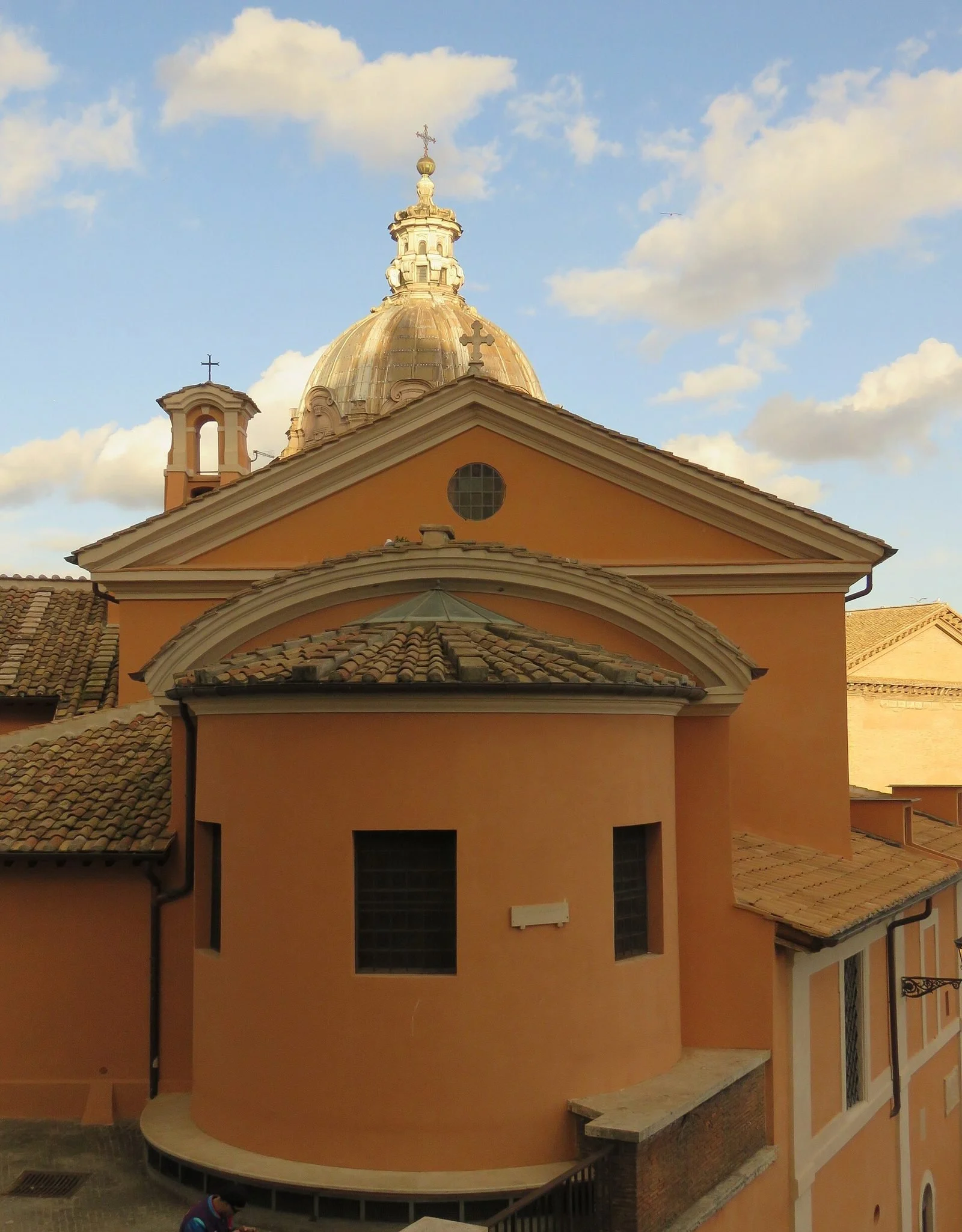
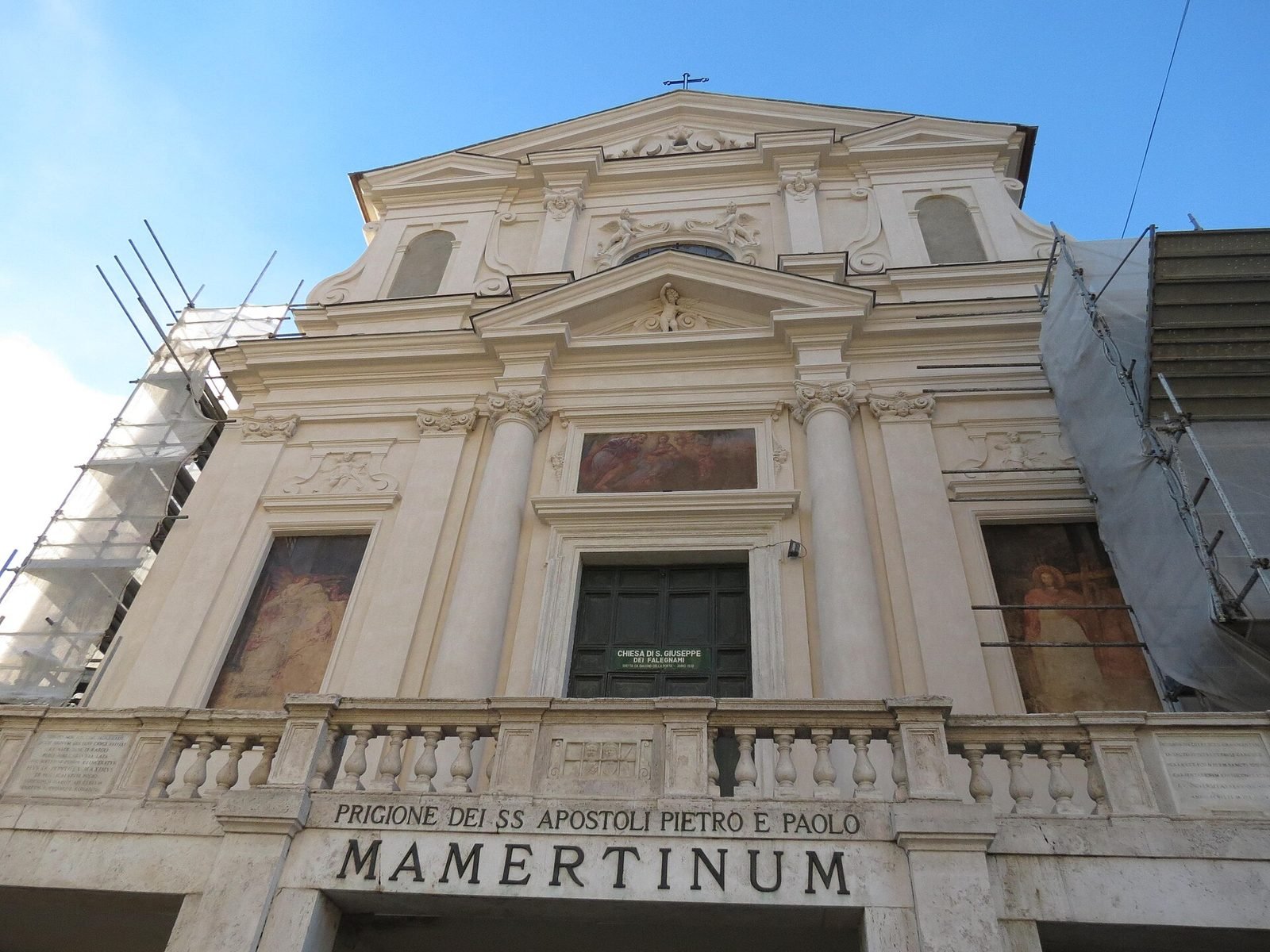
San Giuseppe dei Falegnami is the church almost nobody looks at: it stands at the top of the little staircase you see from the Roman Forum, at Clivo Argentario 1, and the vast majority of people who climb those steps do not go into the church, because they are headed downstairs, to the underground of the Mamertine Prison. The complex is a vertical stratigraphy of three stacked levels: at the bottom the ancient cell of the Tullianum, above it the medieval oratory of San Pietro in Carcere, and at the top, at street level, the 16th-century church of the archconfraternity of the carpenters of Rome, with a carved and gilded wooden ceiling of which two thirds came down on August 30, 2018. This page tells about the top floor: who built it, why a guild of woodworking craftsmen wanted its own church right there, what it contains, what happened in 2018 and what, honestly, is the access situation today.

Three stacked levels, three different pages: how to find your way
Beneath the church of San Giuseppe dei Falegnami there are two older spaces, and on the site they have pages of their own: the Mamertine Prison covers the Roman prison complex, that is, the Tullianum and the upper chamber, with the archaeological museum route that interprets it today. San Pietro in Carcere covers the place of worship carved inside the prison, tied to the tradition of the imprisonment of the apostles Peter and Paul. This page, instead, covers only the upper church, the one facing Clivo Argentario: an independent building, from the late 1500s, built over the ancient structures and consecrated in 1663.
The distinction matters in practical terms too, because the ticket for the underground archaeological route and access to the upper church are two separate things, run by different bodies, with different calendars. Whoever buys the Carcer Tullianum ticket does not automatically buy entry to the church, and whoever finds the church open for a service has no right on that account to go down into the underground. We go into detail on this further on.
Why the confusion is so widespread
The confusion comes from an urban planning choice of the 1930s. When Via dell'Impero, today Via dei Fori Imperiali, was opened and the whole front toward the Forum was rearranged, access to the ancient prison was reorganized so as to work as an entrance of its own, independent of the church. From then on the flow of visitors separated from the flow of worshippers: those who come for archaeology go down, those who come for Mass go up. In between there is an intermediate chapel that almost none of either group sees in full.
Where San Giuseppe dei Falegnami is and how to get there
The address is Clivo Argentario 1, rione Campitelli, and it corresponds to the lowest step of the climb that leads from the Roman Forum toward the Capitoline Arx. The Clivo Argentario is the ancient road that climbed between the prison and the Tabularium to link the Forum square to the summit of the Capitoline Hill: today it is a short uphill stretch, partly in steps, that passes exactly in front of the church facade. If you look at the Forum from the top of Via dei Fori Imperiali you see the church on the right, set against the rock, with the staircase that descends toward the archaeological area.
By metro
The nearest stop is Colosseo, on Line B, from which you walk along Via dei Fori Imperiali for about 700 meters on a gentle uphill, 10 or 12 minutes of walking counting the traffic lights. It is the same route that leads to the Arch of Constantine and to the entrance of the Palatine, so anyone already planning the central archaeological area adds no travel. The alternative is to get off at Cavour, also Line B, and cross the Monti district passing by San Pietro in Vincoli: the trip is a few minutes longer, but it avoids the tourist parade of the Forums in the peak hours.
By bus
The reference hub is Piazza Venezia, less than 400 meters from Clivo Argentario: from there you head up Via dei Fori Imperiali keeping to the right. The lines serving Piazza Venezia and Via dei Fori Imperiali change fairly often because of roadworks and detours, especially since the Line C construction site has affected the area between Piazza Venezia and the Colosseum, so we recommend checking the updated route on the transit company's app the same day, instead of trusting a number read in a printed guide. The stable fact, the one you can count on, is the distance: from Piazza Venezia stop it is a five-minute walk.
On foot, and where it pays to come from
The best way to get there is from above, coming down from the Capitoline Hill. You climb the Capitoline Cordonata, cross the square, pass behind Palazzo Senatorio and go down Via di San Pietro in Carcere: the church appears on the left, after the lookout over the Forum. The advantage is twofold, because you avoid the climb back up and because you arrive with the Roman Forum already before your eyes, which is the right way to understand where you are. If you come from below instead, from the archaeological area, you leave the Forum toward Santi Cosma e Damiano or toward the Curia Iulia and climb the clivo.
Parking and traffic
In the immediate vicinity there is no usable parking: the whole area is a limited traffic zone of the historic center and Via dei Fori Imperiali is closed to private cars. Arriving by car makes no sense. If you come from outside Rome, it is quicker to leave the car in one of the park-and-ride lots on metro Line B and finish the trip by metro. Taxis can get as far as Piazza Venezia or Largo Corrado Ricci, no farther.
The archconfraternity of the carpenters: who built this church and why
The congregation of the carpenters obtained the use of the place of worship above the prison in 1540, and from that concession everything else follows. It was a trade guild, like the dozens that existed in 16th-century Rome: carpenters, joiners, makers of chests and frames, people who worked wood for the building sites of the basilicas, for the ephemeral apparatus of festivals, for carriages and scaffolding. Every guild needed three things: a patron saint, a seat where it could meet and an altar where Masses could be said for deceased members. Saint Joseph, whom the gospels describe as a craftsman, was the obvious choice.
Why right here, above the prison
The choice of the site was no accident. Above the ancient prison there had existed since the 11th century a place of worship dedicated to Saints Peter and Paul, tied to the tradition that holds the two apostles to have been prisoners in the Tullianum. For a Roman confraternity of the 1500s, placing its seat above a place with that memory meant inheriting a prestige that no newly founded church on the outskirts could have given. It also meant, in concrete terms, being at the center: the Capitoline Hill was the seat of civic government, and Clivo Argentario was a through road between the lower city and the administrative city.
What the confraternity actually did
The Roman trade confraternities were not devotional circles. They ran an internal pawnbroking fund for members in difficulty, paid dowries to the daughters of poor members, cared for the sick, buried the dead and regulated entry to the trade, that is, they decided who could open a shop. The church was the physical place where all this was decided: the adjoining oratory was used for meetings, the wooden stalls for assemblies, the archive kept the statutes. The brotherhood still exists, with its administrative seat at Piazza di San Giovanni in Laterano 6, and owns the church.
The feast of March 19
March 19, the feast of Saint Joseph, is the day of the year when this church has its public moment. In Rome the occasion coincides with Father's Day and with the bignè di San Giuseppe that appear in pastry shops for a few weeks, and for the church on Clivo Argentario it is traditionally the date of special openings and blessings. Anyone who wants to see the interior with a reasonable chance of finding it accessible has on that day the best opportunity of the year, though you should check the program in advance, because it is not guaranteed from year to year.
The construction site: 66 years and four architects
The present church was begun in 1597 and consecrated on November 11, 1663, that is, it took 66 years and passed through the hands of at least four architects. It is not an isolated case in Baroque Rome, where confraternity building sites moved at the pace of the members' offerings, but here the fact is particularly visible because you can still read it in the building: the plan and layout belong to the late 1500s, the facade to the early 1600s, the completion to the middle of the century.
Giacomo Della Porta, 1597 and 1602
The start of the building site is tied to Giacomo Della Porta, the architect who in Rome had already closed the dome of Saint Peter's with Domenico Fontana and signed dozens of public fountains. Della Porta oversaw the work until his death in 1602. The layout is attributed to him: a single nave with side chapels, the solution that confraternities preferred because it concentrates attention on the high altar and lets every important family of the brotherhood have its own chapel without breaking up the space.
Giovan Battista Montano, from 1602
On Della Porta's death Giovan Battista Montano took over, and here the choice becomes interesting, because Montano was not only an architect. He was a wood carver, a designer of models, a man who knew the trade from the workshop side, and for a church of carpenters this meant speaking the same language as the patrons. Montano designed the two-order facade and, around 1611 and 1612, the carved wooden ceiling that has become the best-known element of the building.
Giovanni Battista Soria and Antonio Del Grande
After 1621 the building site was taken up by Giovanni Battista Soria, a pupil of Montano, to whom we owe the enlargement of the oratory and the sacristy. The completion falls to Antonio Del Grande, active from 1657, the architect who in Rome would later work on the gallery of Palazzo Colonna and on the Carceri Nuove on Via Giulia. The consecration of November 11, 1663 formally closes the long building site, although significant work continued throughout the 19th century.
The 19th-century work
In 1853 the Chapel of the Crucifix was carved out between the floor of the church and the vault of the prison below, the intermediate space that today represents the middle floor of the stratigraphy. On this date the sources do not fully agree: some list the chapel as 16th century, others date it to the 19th-century work, and the difference probably depends on the fact that a pre-existing space was then rearranged and made accessible. In 1886 a restoration added a new apse. In the 1930s, with the rearrangement of the Forums area, the facade was raised and access to the prison below was reorganized independently.
The coffered ceiling: the signature of the trade
The coffered wooden ceiling of San Giuseppe dei Falegnami was made around 1611 and 1612 to a design by Giovan Battista Montano, carved and covered with gold leaf, with a relief of the Nativity dated 1612 at the center. It is the object that explains the church: a guild of woodworkers building its own seat does not put its calling card on the facade, where it would be marble and travertine like anyone else's. It puts it up high, in wood, where the trade shows.
What you see, technically
A coffered ceiling of this type is a supported structure, hung from the roof trusses, made of a grid of beams and crosspieces that creates recessed panels. Inside the panels go the carved rosettes, on the frames the molding, on the surfaces the gold leaf over a ground of bole and gesso. The figurative cycle includes, besides the central Nativity, figures of Saints Peter and Paul, angels and decorative elements: the reference to the apostles explicitly ties the upper church to the memory of the prison below, and it is one of the few points where the three levels of the complex speak to each other.
Why it is rare
Rome keeps quite a few gilded wooden ceilings from the 1600s and 1700s, but almost always in churches of great religious orders or foreign nations, that is, very rich commissions. A carved and gilded coffered ceiling of this quality in a craft guild church is a different case: here the wealth did not come from a cardinal protector but from the members' dues and, above all, from donated labor. The workforce was that of the brothers themselves. When a confraternity of carpenters makes its own ceiling, it does not put it out to contract.
The works: Maratta, Le Blanc, Maccari and the others
The best-known work kept in San Giuseppe dei Falegnami is a Nativity by Carlo Maratta from 1651, placed in the second chapel on the left. Maratta was just over 20 when he painted it and was still in the workshop of Andrea Sacchi: it is therefore a debut work by one of the painters who would dominate the Roman scene in the second half of the 1600s, which makes it historically more interesting than its size would suggest.
In the presbytery
On the high altar is a Marriage of the Virgin by Horace Le Blanc, dated 1605, a painter from Lyon trained in Italy and little represented in Rome: that alone is enough to justify a stop. In the lunette above is an Eternal Father by Antonio Viviani known as il Sordo, from 1610. On either side of the presbytery, two large canvases by Cesare Maccari from 1883 depict the Journey to Bethlehem, on the right side, and the Workshop of Saint Joseph, on the left side.
Maccari's Workshop of Saint Joseph
The subject of the canvas on the left deserves an extra line, because it is the point where the iconographic program declares its raison d'être. Maccari, who shortly afterward would paint the celebrated Roman stories in Palazzo Madama, shows the saint at work among the tools of the trade. For the brothers who commissioned that canvas in 1883 it was not a gospel episode: it was the portrait of their working day, projected back 18 centuries. It is a type of commission that in Rome is also found in other churches of arts and trades, for example in Sant'Eligio degli Orefici, the goldsmiths' church designed by Raphael.
In the side chapels
In the first chapel on the right is kept a Holy Family with Saint Anne by Giuseppe Ghezzi, a painter and secretary of the Accademia di San Luca, the same institution that has its seat a few meters farther on, at Santi Luca e Martina. His son, Pier Leone Ghezzi, is represented in the adjoining oratory. Two generations of the same family in the same complex are a clue to how close the ties were between the Roman confraternities and the academic milieu that gravitated around the Forum.
The Chapel of the Crucifix
Between the floor of the church and the vault of the prison lies the Chapel of the Crucifix, which holds a 16th-century wooden crucifix anciently venerated at the prison below. It is the hinge space between the levels, and also the object that closes the circle of the theme: in a church of carpenters, the crucifix of greatest devotion is of carved wood.
The oratory, the stalls and the furnishings of the trade
Beside the place of worship stands a rectangular oratory, enlarged in 1569 and therefore earlier than the present church, decorated between 1631 and 1637 with frescoes by Marco Tullio Montagna devoted to the stories of the Holy Family. It is the meeting hall of the confraternity, and its furnishings tell its function better than any description: walnut stalls from 1643 along the walls, a carved lectern from the 1700s, and a Conception with Saints Joachim and Joseph by Pier Leone Ghezzi dated 1716.
The stalls of 1643
The wooden stalls are the furnishing to look at most carefully, because they are both furniture and self-portrait. In a chapter hall of a religious order, stalls serve the choir. In a confraternity oratory they serve the assembly that votes. Here the material, walnut, and the carved workmanship were the very product of the patrons: whoever sat on those stalls, in all likelihood, had made them or had seen them made in the workshop by their own master.
The problem of access to the oratory
The oratory is not part of the ordinary visit route and is generally accessible only on organized openings, celebrations or guided visits arranged with the archconfraternity. If you care about it, write or call ahead, and do it with weeks to spare: it is a space in use, not a museum room, and opening depends on the availability of those who manage it.
The collapse of August 30, 2018 and the restoration
On August 30, 2018, around 14:59, a large portion of the roof of San Giuseppe dei Falegnami collapsed inside the church, dragging down with it a good part of the carved wooden ceiling. There was no one in the building at that moment and no one was injured. The cause identified is the structural failure of two of the four roof trusses. Reconstructions agree on the order of magnitude of the damage, around two thirds of the coffered ceiling, and the church was immediately closed, with the area seized for the investigations.
What was saved
The recovery work was described by the superintendent Daniela Porro as the reassembly of an enormous puzzle: the fallen fragments were collected, cataloged and put back one by one. The figure stated at the end of the work speaks of the recovery of about 90 percent of the figurative portions, that is, the parts with reliefs and figures, which are the hardest to redo and the most precious. The missing parts were filled in, and in that phase a problem emerged that is worth reporting for what it is: on the historical techniques for building coffered ceilings the available documentation turned out to be less complete than expected, and part of the work was research before it was restoration.
The chronology, verified
On March 19, 2019, a little over six months after the collapse, the church was opened for a single day, from 9:00 to 20:00, on the occasion of the feast of Saint Joseph: it was a special opening with the building made safe and the work site still open, not a reopening. The restoration was then declared complete around March 20, 2020, and the reopening planned for March 19 of that year fell through because of the health measures of the COVID-19 emergency. In January 2021 the archconfraternity announced that the reconstruction of the roof had come to an end.
How to visit today: what we know and what needs checking
On the current opening status of San Giuseppe dei Falegnami the official sources do not give a clear picture, and we consider it incorrect to describe the church as reliably visitable. On one hand, the owning archconfraternity has declared the reconstruction of the roof complete. On the other, the listing on the tourist portal of Roma Capitale has continued to show the church as closed to the public for restoration work, specifying that the Mamertine Prison below remains visitable. The two pieces of information can coexist, because a restored building may not yet have regular opening to the public, but for anyone planning a visit the practical consequence is only one: check before you go.
Who to ask, in concrete terms
The direct reference is the church itself, at 06.69886245, and the archconfraternity's website, sangiuseppedeifalegnami.org, where celebrations and openings are announced. The published email address is sangiuseppedeifalegnami at diocesidiroma.it. For the archaeological route below, the reference is instead the operator of the Carcer Tullianum, which has its own ticket office and its own calendar. We recommend calling, not writing: on the openings of a church run by a lay brotherhood, the answer by phone comes in two minutes, while the email can sit for days.
Tickets: two separate things
As far as we know, and it should not be taken for granted, the ticket for the underground archaeological route does not include entry to the upper church. They are separate managements: the underground has a paid museum route with museum hours, while the church is a place of worship owned by the archconfraternity, which opens according to its own needs and with no ticket office. For the same reason we give neither fares nor hours for the church on this page: those of the underground should be read on the operator's site the day before, those of the church should be asked for by phone.
How much time you need
For the upper church alone, if you find it open, 20 minutes are enough, which become 40 if you also manage to see the oratory. The archaeological route below, with the museum, generally takes between 40 minutes and an hour. If you want to do both, allow a good hour and a half, and do it in the same outing in which you visit the Roman Forum: coming back on purpose another day, much as the church deserves it, does not make much sense from the point of view of someone with few days in Rome.
Accessibility
The location of the complex makes access difficult for people with mobility problems: Clivo Argentario is uphill and partly in steps, and the route toward the lower spaces involves steep stairs. The upper church, once you reach street level, is the most practicable of the three parts, while the ancient spaces remain in practice off limits to wheelchair users. Anyone with specific needs should mention it by phone before setting out, and consider as an alternative sites in the central area with equipped routes, such as the Capitoline Museums or the Markets of Trajan.
A curiosity about San Giuseppe dei Falegnami
The most solid curiosity concerns the man who designed the ceiling: Giovan Battista Montano, who took over from Giacomo Della Porta in 1602, was himself a wood carver before he was an architect. A confraternity of carpenters, that is, entrusted its church to a colleague, someone who knew how a crosspiece fits and how much a gilded frame weighs when hung at a height of 12 meters. It is a coincidence that does not happen often in Rome and that explains the quality of the coffered ceiling far better than any consideration about the taste of the era.
A second, minor curiosity
Since February 18, 2012, San Giuseppe dei Falegnami has been the seat of a cardinal deaconry, that is, it is one of the Roman churches assigned as a title to a cardinal: the first titular has been Francesco Coccopalmerio. A craft guild church entering the list of cardinal titles in the full 21st century is a recent fact, not an ancient inheritance, and it concerns an ecclesiastical geography that is updated much more than people believe.
One thing nobody tells you about San Giuseppe dei Falegnami
What nobody says is that the flow of visitors to the Mamertine Prison, counted in hundreds of thousands of people a year, passes a few meters from the upper church and in the vast majority does not know it exists. We observed it on several visits: groups stop in front of the entrance to the underground, go down, come back up and continue toward the Forum without raising their heads. The church above appears in almost no commercial itinerary, and not because it is secret: because it occupies a spot in the city where everyone is looking elsewhere.
The practical consequence
This means that, on the rare occasions when the church is open, there is almost no one inside. 200 meters from the Curia Iulia and the Arch of Septimius Severus, in an area that is packed in summer, you step into an empty space. It is one of the few conditions of this kind left in the central area, along with Santi Cosma e Damiano and the Church of San Giovanni Decollato, also the seat of a confraternity and also almost always closed.
The advice I give you for visiting San Giuseppe dei Falegnami
There is only one operational piece of advice and it should be followed to the letter: call 06.69886245 before setting out, and if no answer comes, do not build your day around this stop. It is a church privately owned by a brotherhood, with no museum hours and no ticket office staff: opening depends on the celebrations and commitments of the archconfraternity. Anyone who leaves the hotel convinced of getting in risks finding the door closed and taking it out on the city.
The right way to fit it into the day
The solution we recommend is to treat it as a conditional stop within a route that holds up anyway. You enter the Roman Forum from Via dei Fori Imperiali entrance, do the archaeological route as far as the Rostra and the Temple of Saturn, climb back toward Clivo Argentario and try the church door. If it is open you go in, if it is closed you continue toward the Capitoline Hill having lost nothing. Building the itinerary so that no uncertain stop is indispensable is the basic rule when working with places run by confraternities.
The best time
If the church is open, the time slot to prefer is the morning between 9:00 and 11:00. It holds for two concrete reasons. The first is that special openings and celebrations are generally concentrated in that slot. The second concerns Clivo Argentario: toward noon the climb takes the full sun and the steps become tiring, while at 9:00 they are still in the shade of the Capitoline rock. Anyone visiting in July or August finds a notable difference in perception between the two hours.
What to look at first, if you have 20 minutes
On entering, the temptation is to go straight toward the high altar. We recommend doing the opposite: stop under the first field of the ceiling, look up for a good minute and let your eye adjust to the dim light before moving. The coffered ceiling is the object you came up for, and if you look at it after seeing the canvases you look at it in a rush. Then you walk down the nave, see Maratta's Nativity in the second chapel on the left, and reach the presbytery with Le Blanc's Marriage of the Virgin and the two canvases by Maccari.
What not to expect
Do not expect a museum setup: no panels, no audioguide, no bookshop, no one to ask for explanations. The church should be seen already knowing what you are looking at, and this page serves exactly that purpose. If you want a structured archaeological context, you find it downstairs, in the route of the Mamertine Prison, which is instead set up as a museum.
Another well-known fact, yet rarely cited
The well-known fact is that beneath this church is the prison where tradition places the imprisonment of Peter and Paul. What is rarely cited is that the whole complex stands on one of the rare areas of Rome where uninterrupted phases of use are documented from the Republican period to today. The Tullianum as a detention structure, the medieval place of worship dedicated to the two apostles already in the 11th century, the guild church of the 1500s and 1600s, the 20th-century rearrangement: four phases that did not erase one another but stacked up.
Why it matters for anyone visiting the Forum
It matters because the Roman Forum you walk through today is a cleaned-up landscape. The excavations of the 1800s and 1900s removed almost everywhere the medieval and modern phases to bring the ancient ones back to light, and the result is an archaeological square that no Roman ever saw in that form. The complex on Clivo Argentario is one of the few exceptions: here the later phases stayed standing because they were churches, and churches are not demolished. The same goes for Santa Maria Antiqua, for Santi Luca e Martina above the Forum of Caesar and for Santa Francesca Romana next to the Basilica of Maxentius.
The comparison that makes the point
Anyone who has seen the Basilica of San Clemente already knows the mechanism: three stacked levels, each built over the previous one without destroying it. Clivo Argentario works the same way, with one important difference. At San Clemente the descent is unified, guided, with a single route and a single ticket. Here the three levels are in the hands of different parties and are visited under different rules, and this fragmentation is the reason the complex is perceived as two or three distinct places instead of one.
A fact that cuts a commonplace down to size
It must be said bluntly that the tradition of the imprisonment of Peter and Paul in the Tullianum is popular and devotional tradition, attested from the Middle Ages on, and not a historically documented fact. The ancient sources on the prison speak of other famous prisoners, not of the apostles. Anyone entering the underground expecting archaeological confirmation of a gospel episode is disappointed, and rightly so. The value of the place is elsewhere: in the ancient structure, in the stratigraphy and in the way devotion built on top of the stone.
The right photo to take at San Giuseppe dei Falegnami
The right photo at San Giuseppe dei Falegnami is not the one of the interior, which requires the church to be open and difficult light conditions, but the one of the facade framed from below, from the bottom of Clivo Argentario, with the staircase in the foreground and the Capitoline rock behind. It is the image that explains the place in a single stroke: a church leaning on a rock, with an ancient road passing beneath it. You take it from the Forum, with no need to enter anywhere.
Light and time
The facade faces toward the Forum, so it catches light in the second part of the day. In the late afternoon, with the low sun, the travertine turns warm and the staircase gains long shadows that give depth. Early in the morning, by contrast, the facade is in shadow and the background too contrasty: you get a blown-out sky and a black church. If you have only one pass and want a good photograph, come in the afternoon, if you want to go in, come in the morning, and the two do not coincide.
The second framing
The alternative is from above, from the lookout behind Palazzo Senatorio, on the Capitoline Hill: from there you capture the roof of the church in the foreground with the Forum opening up behind, as far as the Arch of Titus and the Colosseum in the background. It is the only point in the city from which you understand visually that the church is set into the rock, and after the collapse of 2018 it is also the framing that shows the rebuilt roof.
Some important events that happened here in history
The verifiable chronology of San Giuseppe dei Falegnami begins in 1540, when the congregation of the carpenters obtains the use of the place of worship above the prison, and reaches 2021, when the reconstruction of the roof that collapsed in 2018 is declared complete. In between are four and a half centuries of a history that is almost all building-site history, which is fitting for a church of builders.
1540: the concession
The congregation of the carpenters obtains permission to meet and celebrate in the place of worship above the prison. It is the birth certificate of the relationship between the guild and this place, and it precedes by more than half a century the start of the present church. Some sources date to 1546 the founding of a church dedicated to Saint Joseph on the site, others start directly from the building site of 1597: the difference probably concerns the passage from an adaptation of the existing building to a new construction.
1597: the building site opens
Work begins on the present church under the direction of Giacomo Della Porta, who follows it until his death in 1602. From that year Giovan Battista Montano takes over, author of the two-order facade.
1605, 1610, 1611 and 1612: the decoration
The works that still define the interior today are packed into a few years: the Marriage of the Virgin by Horace Le Blanc in 1605, the Eternal Father by Antonio Viviani in 1610, the carved and gilded wooden ceiling by Montano around 1611, with the Nativity relief dated 1612.
1643, 1651, 1663: the completion
The walnut stalls of the oratory date from 1643. Carlo Maratta's Nativity is from 1651. The consecration of the church takes place on November 11, 1663, with Antonio Del Grande in the final management of the building site, begun in 1657.
The 1930s: the rearrangement of the Forums
With the opening of Via dell'Impero and the reorganization of the whole area between Piazza Venezia and the Colosseum, the facade is raised and access to the prison below is reorganized independently of the church. It is the intervention that definitively separates the two routes and that explains today's situation.
February 18, 2012: the deaconry
The church is raised to the seat of a cardinal deaconry, with Francesco Coccopalmerio as first titular.
August 30, 2018 and the following years
At about 14:59 on August 30, 2018 the roof gives way and much of the wooden ceiling collapses. There follow the closure, the seizure of the area, the special one-day opening on March 19, 2019 with the building made safe, the conclusion of the restoration announced in March 2020 with the reopening postponed for the health emergency, and the announcement of the end of the reconstruction work in January 2021.
Who passed through San Giuseppe dei Falegnami
Through San Giuseppe dei Falegnami have passed, as designers or as authors of the preserved works, some of the names that made Roman architecture and painting between the 1500s and the 1800s: Giacomo Della Porta, Giovan Battista Montano, Giovanni Battista Soria, Antonio Del Grande, Carlo Maratta, Horace Le Blanc, Antonio Viviani, Giuseppe and Pier Leone Ghezzi, Marco Tullio Montagna, Cesare Maccari. It is not a list of illustrious visitors: it is the list of those who worked here, which for a church of builders is the right thing.
The architects
Giacomo Della Porta arrives here at the end of an enormous career, after the dome of Saint Peter's completed with Domenico Fontana and after a notable number of Roman fountains. Giovan Battista Montano is the carver who becomes an architect and whose drawings of antiquities would circulate for a century. Giovanni Battista Soria is the continuer who signs the enlargement of the oratory and the sacristy. Antonio Del Grande closes the building site and is the architect who in Rome would also work on the gallery of Palazzo Colonna.
The painters
Carlo Maratta leaves here a Nativity from 1651, an early work by the man who would become the reference painter of late Baroque Rome. Horace Le Blanc brings to Rome his training between Lyon and Italy. Giuseppe Ghezzi, secretary of the Accademia di San Luca, and his son Pier Leone, a caricaturist before the term existed, both appear in the complex. Cesare Maccari arrives in 1883 with the craft of great 19th-century decoration, the same he would apply to the Senate chamber at Palazzo Madama, a quarter of an hour's walk from here passing in front of Palazzo Venezia.
The brothers
The group that matters most has no known names. They are the Roman carpenters who for four centuries paid the dues, elected the priors, supplied the wood and, in all likelihood, physically carved part of what you see. The Roman trade confraternities were broad organizations, with hundreds of members, and the church is the largest document they left us.
Who passed through after 2018
In the restoration site a public role was played by Daniela Porro, special superintendent of Rome, who followed and described the recovery of the fragments and the figure of 90 percent of the figurative portions recovered. The restoration involved wood restorers, structural engineers and carpenters, which is a professional continuity not sought but perfectly consistent with the place.
Eating in the Forums area without getting burned
The strip between Piazza Venezia, Via dei Fori Imperiali and the Colosseum is one of the most exposed areas of Rome from the point of view of dining, and on this page we do not name venues: a list of signs ages in a few months and it is not our trade. We give instead the criteria, which stay valid even 10 years from now.
The trap signals, the concrete ones
The first signal is the lady rolling fresh pasta in the window or on the sidewalk: it is an advertising lure, not a sign of cooking. The second is the menu with photographs of the dishes, which is there to sell to people who do not read Italian. The third is the barker on the threshold inviting you to sit: a place with customers does not need to stop passersby. The fourth is the non-stop schedule from morning to night, with no break between services, which signals a reheating kitchen. The fifth concerns places set in front of famous monuments, where it happens that the price adapts to the tourist in front of them: items without prices on the menu, a different price list at the outdoor table and at the indoor counter, cover charge and service that appear only on the bill.
The chains in the center
In the central area in recent years a type of venue has multiplied with the same sign repeated at several points in the city, identical menu and a queue with a ticket number. We do not name them and we do not recommend them. The useful observation is only one, and we make it as Romans who work in the center: Romans do not go there. They work on passing trade that will not come back, and this determines everything else, from the raw materials to the service.
The simplest criterion
Before sitting down, look at who is seated and in what language they order. If at the tables there are people who speak Italian and seem to work in the area, the place holds up. If there are only tourists with backpacks, keep walking. For anyone who wants an already filtered reference, Daniele Dezi keeps a personal list by Daniele Dezi on Google Maps, curated and not sponsored, where the places are marked one by one.
Where to move
The operational advice is to move away by 10 minutes on foot. Heading up toward the Monti district, beyond Via Cavour, prices drop and the clientele changes. Heading down toward the Forum Boarium and Santa Maria in Cosmedin the tourist traffic thins out. They are two opposite directions and both work, for the same reason: a few hundred meters are enough to get out of the radius in which a venue can live on passersby alone.
Frequently asked questions about San Giuseppe dei Falegnami
Is San Giuseppe dei Falegnami open to the public?
San Giuseppe dei Falegnami does not have stable public opening hours and has to be checked case by case. The owning archconfraternity declared the reconstruction of the roof that collapsed in 2018 complete in January 2021, while the tourist portal of Roma Capitale has continued to list the church as closed for restoration. Before going, it is best to call 06.69886245 or check the website sangiuseppedeifalegnami.org.
What is the difference between San Giuseppe dei Falegnami and the Mamertine Prison?
San Giuseppe dei Falegnami is the 16th-century church built above the Mamertine Prison, which is instead the underground Roman prison complex with the Tullianum. They are three stacked levels: the ancient cell at the bottom, the place of worship of San Pietro in Carcere in the middle, the church of the carpenters' confraternity at the top, at street level. They are visited with separate tickets and managements.
How much does it cost to enter San Giuseppe dei Falegnami?
For the upper church of San Giuseppe dei Falegnami there is no ticket office: it is a place of worship owned by the archconfraternity of the carpenters and opens according to its own celebrations. The paid ticket concerns the archaeological route below, the Carcer Tullianum, which has its own operator and calendar. The two are separate and the fares of the underground should be checked on the operator's site.
How do you get to San Giuseppe dei Falegnami by public transport?
San Giuseppe dei Falegnami is at Clivo Argentario 1, about 700 meters from the Colosseo stop of metro Line B, 10 or 12 minutes on foot along Via dei Fori Imperiali. Alternatively you reach Piazza Venezia by bus and climb up in five minutes. The surface lines change often because of building sites: it is best to check the route the same day.
What is the ceiling of San Giuseppe dei Falegnami?
The ceiling of San Giuseppe dei Falegnami is a carved and gilded wooden coffered ceiling made around 1611 to a design by Giovan Battista Montano, with a Nativity relief dated 1612 at the center and figures of Saints Peter and Paul. On August 30, 2018 about two thirds of it collapsed because of the failure of two roof trusses: the restoration recovered about 90 percent of the figurative portions.
How long does it take to visit San Giuseppe dei Falegnami?
For the church of San Giuseppe dei Falegnami alone, 20 minutes are enough, rising to 40 if you also manage to see the oratory with the 1643 walnut stalls. The archaeological route below generally takes between 40 minutes and an hour. If you want to see both levels, allow an hour and a half and fit them into the same outing as the Roman Forum.
Is San Giuseppe dei Falegnami accessible to people with mobility difficulties?
Access to San Giuseppe dei Falegnami is difficult for people with mobility problems, because Clivo Argentario is uphill and partly in steps. The upper church, once you reach street level, remains the most practicable part of the complex, while the ancient spaces below are reached by steep stairs. Anyone with specific needs should mention it by phone before setting out.
Can you take photographs at San Giuseppe dei Falegnami?
Photographs at San Giuseppe dei Falegnami should be agreed with whoever opens the church, because it is a private place of worship without a published regulation. In general shots without flash and without a tripod cause no problems, but the rule is set by the archconfraternity. The best photograph is in any case taken from the outside, from the bottom of Clivo Argentario, with the staircase in the foreground and the Capitoline rock behind.
Who wrote this page
This page is edited by the editorial team of Tour Leader Pro, the Roman project office that designs and coordinates visits, itineraries and cultural events in Rome and Lazio. The hours, fares and access conditions reported here are verified as of the publication date against the official sources indicated in the text: it is best to recheck them before leaving, because they change often. If you find an outdated figure, let us know.
Anyone building an itinerary in the central area, combining this stop with the Roman Forum, the Capitoline Hill, the Capitoline Museums and the Domus Romane di Palazzo Valentini, will find on Tour Leader Pro the tools to keep together stops with different managements, which is exactly the problem posed by a complex like this one, split between a museum route, a confraternity church and a state archaeological area.
Anyone coming from elsewhere who has to fit Rome into a broader trip, among trains, distances and counted days, will find a general picture of transport, destinations and seasonality in Lazio and the rest of the country at Italy Planner, useful above all to understand how much time to really devote to the Forums area before booking the rest.