Santa Brigida
In short. Santa Brigida is at Piazza Farnese 96, at the corner with Via di Monserrato, and is entrusted to the sisters of the Order of the Most Holy Savior of Saint Bridget, the Brigidines.
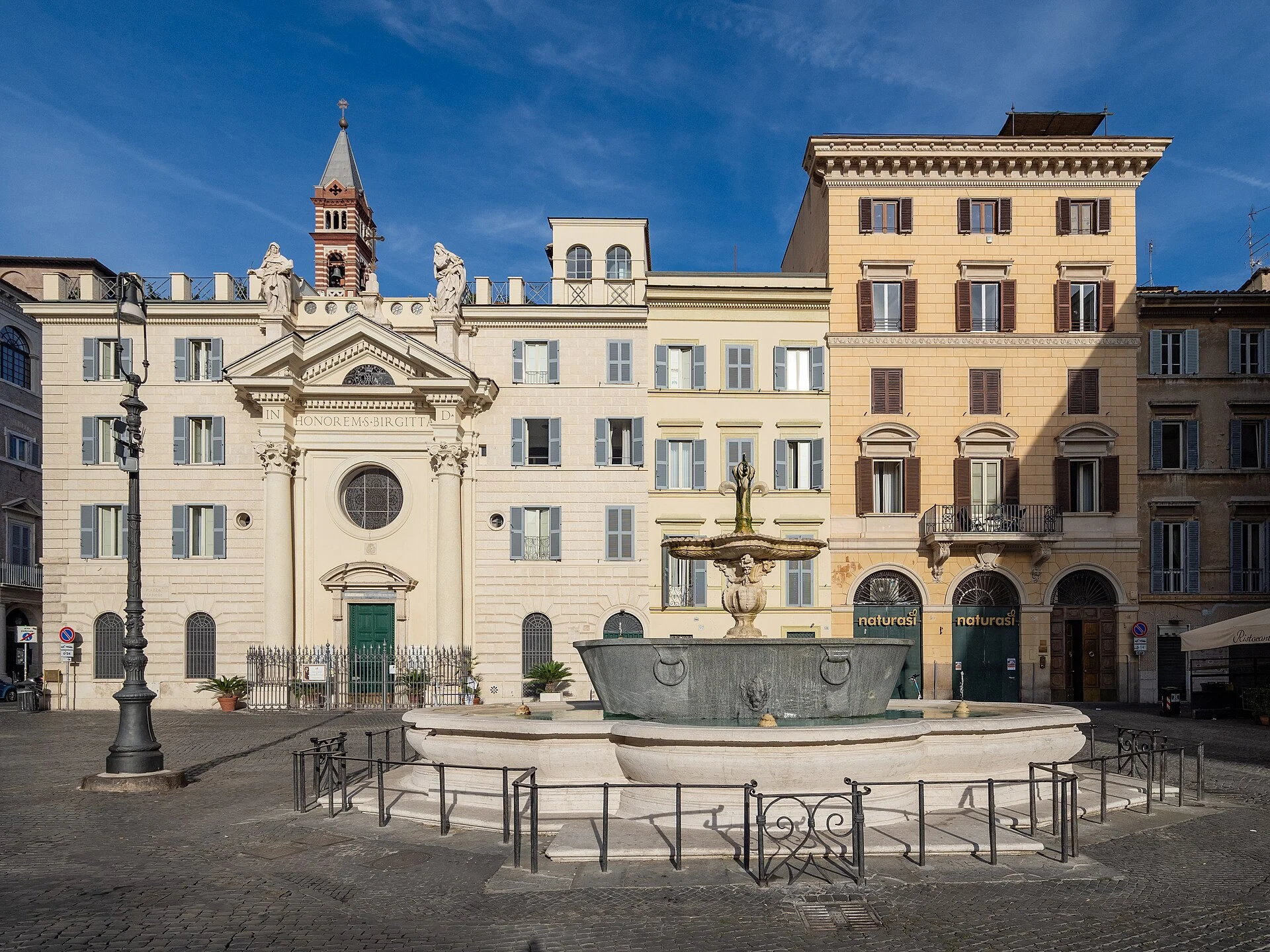
Santa Brigida is at Piazza Farnese 96, at the corner with Via di Monserrato, and is entrusted to the sisters of the Order of the Most Holy Savior of Saint Bridget, the Brigidines. You enter the church free of charge during Masses and the openings indicated by the sisters. The rooms where the saint lived and died are visited only by reservation, by phoning 06 68892596 or writing to santabrigida@brigidine.org. There is no ticket office.
It is the national church of the Swedes in Rome, and under its early 18th-century Baroque dress it preserves the house in which Bridget of Sweden lived from 1350 together with her daughter Catherine and in which she died on July 23, 1373. Since that day the complex has never ceased to be a point of reference for the Catholic North, even in the centuries when Sweden had become Lutheran.
The hours, contacts and visiting arrangements reported here come from the check of September 29, 2026 on the hours page published by the Brigidines and on the institutional pages of the City and the Jubilee. The sisters change their calendar between summer and winter, and on Wednesday the church follows reduced hours: before setting out, and above all before turning up for the rooms, phone and have the day and time confirmed.
Where it is and what you actually see
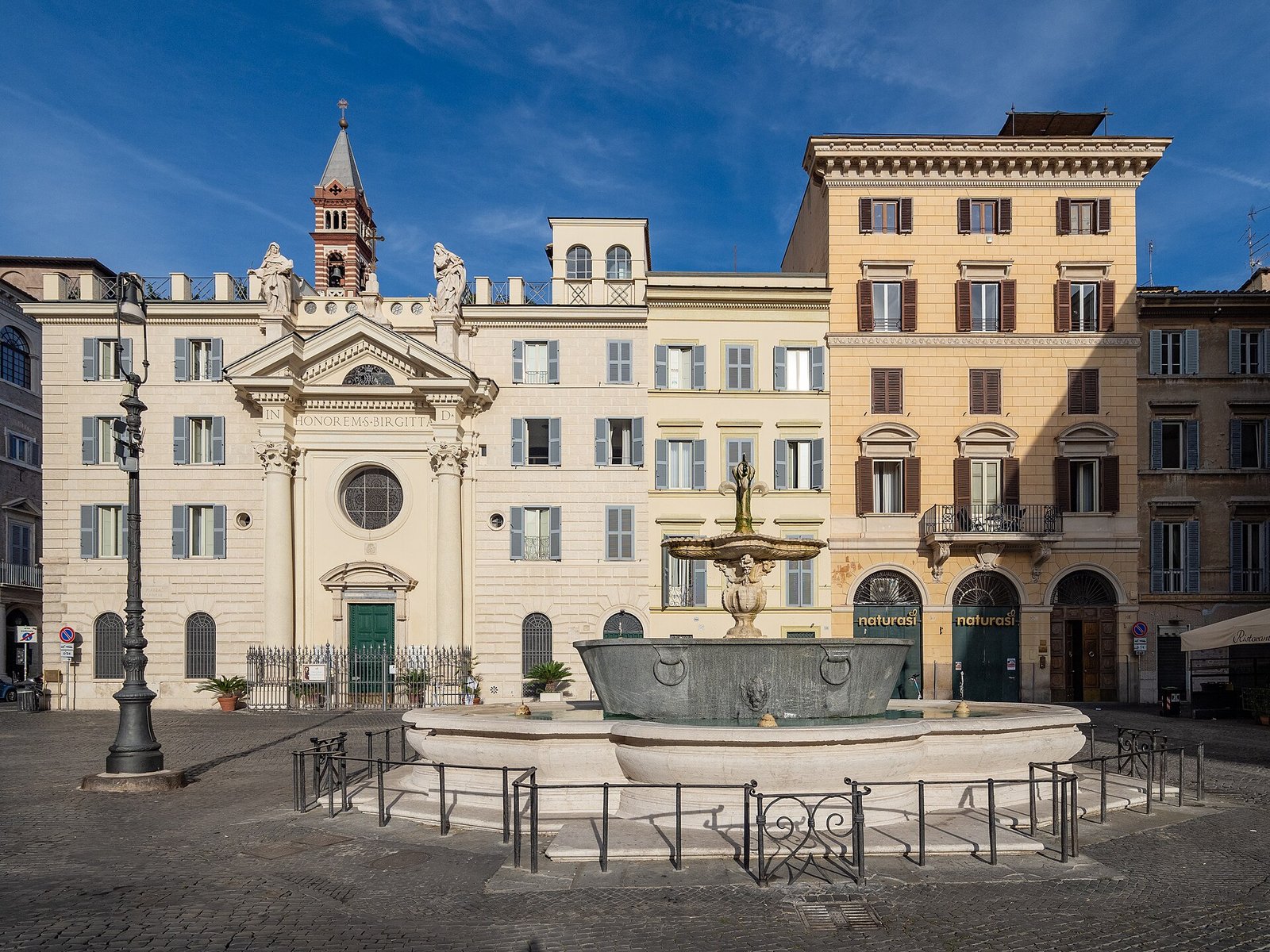
The church occupies one of the sides of Piazza Farnese, in the Regola district, the square dominated by the palazzo that now houses the French embassy. Behind it, a minute on foot away, is Campo de' Fiori with its market and its noise. Coming from the Campo you have the facade of Santa Brigida almost in front of you, squeezed between the buildings, and you often mistake it for a noble doorway.
The late Baroque facade was begun in 1705. The portal is framed by two columns detached from the wall, and above the pediment rise the statues of Saint Bridget and Saint Catherine sculpted by Andrea Fucigna. Beside it stands a red brick bell tower that has nothing to do with the Baroque: it dates from 1894, Neo-Romanesque, tied to the restorations directed by the architect Raffaele Ingami.
Inside you find a single nave with a barrel vault, two side altars in niches and the presbytery. The vault is by Biagio Puccini, who frescoed it between 1709 and 1711 with the Glory of Saint Bridget. The same painter signed the six canvases hung on the walls with episodes from the saint's life. It is a coherent decoration, made in a few years by a single hand, and it reads well even without a guide.
On the inner facade there is a wooden choir loft from 1705. At the right altar a late 17th-century copy of the Madonna and Child by Annibale Carracci, and beside it the funerary monument of the Swedish count Nils Bielke, dated 1768, the work of Tommaso Righi to a design by Pietro Camporese the Elder. It is the only marble sign, inside the church, of the Swedish nobility who converted to Catholicism in the 18th century.
On the left a diptych with Bridget and Catherine topped by a clipeus with Saint Joseph and the Child, work by Eugenio Cisterna from 1894. In the same year the high altar was rebuilt in polychrome marbles. English-language sources also mention a Neo-Gothic chapel from that year dedicated to Saint Richard, with eight paintings by Cisterna. The bulk of the present look, in short, comes from two building campaigns: early 18th century and late 19th century.
The setting matters. Piazza Farnese is one of the most orderly squares in the center, closed on the long side by the palazzo begun for Cardinal Alessandro Farnese and completed with Michelangelo's cornice. The two twin fountains use large granite basins of the Roman age. Santa Brigida, against this backdrop, is small and almost shy, and that is exactly why it escapes the notice of passersby.
The palazzo is visited through its own channel, by reservation, and has a history that deserves a separate day: you find it in the entry on Palazzo Farnese. Here it is enough to say that anyone who books the palazzo visit and has half an hour before the appointment can spend it well by crossing the square and going into the church, instead of waiting standing in front of the embassy's door.
What you don't see from the square is the most important part: the house. The rooms in which the two saints lived are in the building next to the church and are reached only with the booked visit. The community's rooms and the guest rooms are not open to the public. Anyone who enters the church without a reservation sees the nave and nothing more, and leaves convinced they have seen everything.
How to read the church in 10 minutes
Go in and stop right under the wooden choir loft. From there the nave can be read all at once: Puccini's vault above, the six canvases on the walls to right and left, the high altar at the back with the colored marbles of 1894. Before approaching any detail, raise your head and follow the Glory of Saint Bridget from the center toward the edges.
Then walk along the walls. The canvases tell episodes of the saint's life, and the useful thing is to read them in sequence like a Baroque comic strip: the vocation, the pilgrimages, the visions, the death. You don't need captions to understand that the protagonist is always the same woman dressed in dark clothes, with the veil, often accompanied by her daughter. They are narrative paintings, made for pilgrims.
On the right, stop in front of the Bielke monument. It is the most interesting piece of sculpture in the church, in the measured language of the later 18th-century Rome, and it tells a story that is all in the name: a Swedish nobleman buried in the church of his national saint, in Rome, when in his homeland Catholicism was a minority. Look at how the portrait is inserted into the composition.
On the left is the diptych of the two saints with Cisterna's clipeus, and here you can clearly see the hand of the 19th century: colder colors, sharper drawing, a taste that looks at the Middle Ages through the eyes of the Neo-Gothic century. The comparison with Puccini's canvases, a few meters away, is the quickest art history lesson you can get in this part of Rome.
A curiosity about Santa Brigida
In the mid-16th century this house was a Swedish print shop. With the Reformation Sweden had gone over to Lutheranism, and the last Catholic bishops of the kingdom found refuge in Rome. Johannes Magnus, the last Catholic archbishop of Uppsala, lived here. His brother Olaus Magnus arrived in 1549 and, according to historical reconstructions, installed a printing press in the house.
From that press, in 1557, came an edition of the Revelations of Saint Bridget. The book of the Swedish mystic was printed in the very house in which she had spent the last 23 years of her life and in which, according to tradition, she had dictated part of her visions to her confessors. An editorial and political operation at once: keeping a national saint alive while in the homeland the monasteries were closing.
Olaus Magnus is remembered in Scandinavia above all as the author of the Historia de gentibus septentrionalibus, the great description of the peoples of the North published in Rome in 1555, full of engravings of sleds, reindeer, ice fishing and sea monsters. Few of those who leaf through it in a Stockholm library know that the author conceived it as an exile, a few steps from Campo de' Fiori, surrounded by the Roman market.
I like this story more than many others tied to the place, because it explains well what Bridget's house was in the difficult centuries: not a closed shrine, but an informal embassy of Catholic Sweden, with its priests, its pilgrims, its books. If you're interested, ask about it during the visit to the rooms.
One thing nobody tells you about Santa Brigida
The body of Saint Bridget is not here. You visit the room where she died, not her tomb. After July 23, 1373 the body was buried provisionally in a Roman church and then taken back to Sweden, to the monastery of Vadstena, the mother house of the Order she herself had founded. According to tradition it was her daughter Catherine who accompanied the body on the long journey north.
On the first Roman burial the sources do not agree. Some of the biographies indicate San Lorenzo in Damaso, the church incorporated into the Palazzo della Cancelleria, a few minutes from here. Another tradition, very rooted in Rome, ties the saint instead to the monastery of the Poor Clares of San Lorenzo in Panisperna, on the Viminal, where her presence is remembered. Anyone who wants to follow the saint's traces in the city can visit both.
Catherine too did not die in this house, contrary to what you read in some hasty descriptions. Back in Sweden with her mother's remains, she led the community of Vadstena and ended her days there. Here remain the relics of the two saints kept in the rooms, and the place remains, which for Nordic pilgrims counts more than any urn. It is a simple distinction that almost nobody makes.
Then there is the chapter of the crucifixes, where it's best to keep three levels separate. The documents say that Bridget lived in Rome for more than 20 years and died here. Tradition says she prayed for a long time before the Crucifix of the Basilica of San Paolo fuori le Mura and that of Santa Maria in Monticelli. Legend adds that one of those crucifixes spoke to her. They are three different things.
If the subject interests you, remember that in Rome Bridget was a tireless pilgrim and frequented the great basilicas. For this reason her name appears in more churches of the city, often in the form of undocumented oral tradition. The rule is simple: the house on Piazza Farnese is the only Roman place where her presence is certain for more than 20 years.
The rooms of Saint Bridget, what they really are
The visit to the rooms is by reservation in three time slots published by the sisters: from 9:15 to 12, from 13 to 14:30 and from 17:30 to 19. They are the rooms where Bridget and Catherine lived, today turned into chapels. They hold relics of the two saints and are decorated with paintings that tell their lives. The visit is short and recollected, designed for those who pray before those who photograph.
Church and rooms were restored between 1857 and 1858, and a good part of the paintings you see date from that work. In Bridget's room the sources mention the work of Édouard Brandon, a French painter from a Jewish family. It is a detail that says a lot about the Rome of Pius IX, more open in its building sites than it is told to have been, and about the freedom with which patrons chose artists.
The contrarian view is this: anyone who enters the rooms looking for the intact 14th-century house is disappointed. What you see is a 19th-century devotional setup inside older walls, with altars, paintings and sacred furnishings that the 14th century never knew. Selling it as the saint's medieval bedroom is wrong. The value of the rooms is the continuity of the place, not the furnishings.
That said, go. Standing in the space where one of the patron saints of Europe died, a few meters from the din of Campo de' Fiori, has an effect that no reconstruction can give. The operator does not publish a fee for the visit: ask when booking if an offering is welcome.
My advice for visiting Santa Brigida
Book the rooms by phone, don't show up at the door hoping to get in. There are three visit slots, places depend on the community's work and the house's other activities, and a call to 06 68892596 or 06 68892497 saves you a wasted trip. Also ask which entrance you use, because the church door and the house door are not the same.
Choose the 9:15 slot. The square at that hour is still empty, the Campo market stalls are being set up and the noise arrives muffled. Leaving around 10 you find the light still soft on the facade and the square free of tables. The 17:30 afternoon slot is fine in summer, but in autumn it means coming out when it's already dark.
Avoid Wednesday if you want to see the church at leisure. In the winter calendar published by the Brigidines the church opens on Wednesday only from 15:30 to 17:30, with Mass at 17, and in summer that day has no morning opening. On other days the church opens early, with Mass at 7:30, and early risers find it full only of people praying.
Read two pages on the saint before going in. It sounds like a teacher's advice, but here it makes the difference: the rooms are small, the explanations quick, and anyone who already knows who Bridget was, why she came to Rome and what she did recognizes the details in the paintings at once. Anyone who arrives empty-handed sees beautiful, orderly chapels, and that's all. The chapter you find further down is for this.
Dress as for any Roman church: shoulders covered, no beach shorts, voice low. In the rooms it matters even more, because they are chapels to all effects and often someone is praying. Photographs must be asked of the sister who accompanies you, not taken for granted. During Mass, of course, no visits and no raised cameras.
Arrive with a precise question. Those who live in the house know its history from the inside, and the Order's website is published in Italian, Spanish, English and German. Ask about Olaus Magnus, about Mother Hesselblad, about the family hidden during the war. The visit changes tone completely when they realize you came for the house and not for the photo.
Hours, entry and booking
In the winter calendar, from October to June, the weekday Mass is at 7:30 from Monday to Saturday, on Sunday at 7:30 and 10:30. On Wednesday the church opens from 15:30 to 17:30 with the 17 o'clock Mass. On Monday, Tuesday, Thursday and Friday there is Eucharistic adoration in the morning. On the other days the opening is variable and does not go beyond late afternoon.
Entry to the church is free, as for all the Catholic churches of Rome, and there is no ticket to buy either online or on the spot. There are no authorized resellers and no tourist products dedicated to this place on booking portals: the only real channel is the sisters, reachable at the numbers published on the Brigidines' hours page. Be wary of anyone who offers you paid access.
In the summer calendar, from July 1 to September 1, the church opens at 6:15 every day except Wednesday, Mass is at 7:30 and at 16:10 there are the rosary and vespers. For the weeks between the end of the summer calendar and the start of the winter one the operator gives no distinct schedule, and it is exactly the period when it's best to phone before setting out.
For the visit to the rooms the contacts are those of the house: 06 68892596 and 06 68892497, email santabrigida@brigidine.org. The same sisters run in the building a guesthouse for pilgrims and travelers, with a dedicated email address for the rooms, but for the visit to the saint's rooms it is better to use the church's contacts. The operator does not publish a maximum number of participants per group.
Another well-known fact, yet rarely cited
In the winter of 1943, after the roundup of the ghetto on October 16, the Brigidines of Piazza Farnese hid in the house 13 people of the Piperno family: brothers, wives, children and an elderly grandmother. They stayed until June 4, 1944, the day of the liberation of Rome. The story is told by Piero Piperno, who was a child at the time, in an article published in September 2013 in Pagine Ebraiche and picked up by Avvenire.
Leading the community was Mother Maria Elisabetta Hesselblad, a Swede, a convert from Lutheranism, who arrived in this house in 1904 as a sick woman considered incurable. Working beside her was Mother Riccarda Beauchamp Hambrough. In 2005 Hesselblad was inscribed among the Righteous Among the Nations, the recognition by the State of Israel for those who saved Jews during the Shoah. In 2016 Pope Francis proclaimed her a saint.
The fact is known to historians and to Rome's Jewish community, but almost nobody tells it on the square. Anyone who visits the Jewish Ghetto of Rome and the Jewish Museum beneath the Synagogue is a quarter of an hour's walk from here, and the link between the two places makes the day far denser with meaning.
In the same season many Roman religious houses opened their doors to the persecuted, and the historiography on those months is still moving. The Brigidines' case has the advantage of being documented by a formal recognition and by the direct account of a survivor. For the sisters of Piazza Farnese Mother Hesselblad is the modern foundress, as well as a saint of the 20th century.
Who Bridget of Sweden was, in a few lines
Birgitta Birgersdotter was a Swedish noblewoman. She married Ulf Gudmarsson, judge of the province of Närke, and had eight children, among them Catherine, also later venerated as a saint. Widowed in 1344, she changed her life: pilgrimages, prayer, a project for a religious order. From that project was born the Order of the Most Holy Savior, with its mother house at Vadstena, on the shores of Lake Vättern.
She arrived in Rome in 1349, on the eve of the Jubilee of 1350, and never again lived in Sweden. From here her pilgrimages set out, as far as the Holy Land, and here her writings arrived. Her mystical revelations were collected by her confessors in eight books and circulated throughout Europe. The biographies also recall her letters to the popes of Avignon urging them to bring the seat back to Rome.
She was proclaimed a saint by Pope Boniface IX on October 7, 1391, less than 20 years after her death, and on October 1, 1999 John Paul II proclaimed her co-patroness of Europe. The liturgical feast falls on July 23, the day of her death, and is the date on which the church on Piazza Farnese has its most crowded moment.
Anyone who wants to grasp Bridget's weight in the Rome of the 14th century must think of her as a public figure, not as a cloistered nun. She spoke with cardinals and pontiffs, frequented the basilicas, founded an order, hosted fellow countrymen. The house on Piazza Farnese was her operational base. The rooms, with all their 19th-century furnishings, remain the point from which to look at that history.
One last note that helps in reading the visit. Bridget was not a popular saint in the Roman sense, tied to a district or a confraternity. She was an influential foreigner, respected and also feared, with a network of relations that ran from Stockholm to Naples. Rome adopted her late. That is why her church, though on one of the city's most beautiful squares, remains a niche place.
The right photo to take at Santa Brigida
The good photo is taken from the opposite side of the square, with one of the two large granite basins of the fountains in the foreground and the church facade in the background. Hold the camera vertically: only that way do the portal, the statues of the two saints on the pediment and the brick bell tower fit together. In landscape the church gets lost among the buildings and looks like a stage flat.
The sense of the framing is contrast. On one side the Baroque facade of 1705, light, with its columns and statues, on the other the red Neo-Romanesque bell tower of 1894. Two centuries of different taste in the same frame, and the curious thing is that the eye accepts them at once. Put the bell tower a third of the way from the edge and let the sky above breathe.
Go early. At eight in the morning the square is empty, the tables of the restaurants are not yet out and the fountains work for you. By mid-morning the groups heading to Campo de' Fiori and the embassy's cars pass, and the church side fills with parked bicycles and scooters. The light of early morning, besides, doesn't flatten the statues.
Inside, the right photo is Puccini's vault taken from the entrance, under the choir loft, with a wide-angle lens and no flash. The single nave helps: the perspective runs straight toward the high altar. In the saint's rooms always ask the sister before shooting, and if the answer is no accept it without arguing. They are chapels, not museum rooms.
The Swedes' national church, today
Santa Brigida is the national church of the Swedes, a title it keeps even though Sweden has been a majority Lutheran country for almost five centuries. The rite is the Roman rite of the Catholic Church: Masses, rosary, vespers, Eucharistic adoration. The operator does not publish a calendar of celebrations in Swedish, and anyone looking for a Mass in a specific language must ask the sisters.
The Brigidines who run it belong to the branch of the Order refounded by Mother Hesselblad, who formally dates the start of the new institute to September 8, 1911. Today the Order has houses in several countries and more than one in Rome. Pope Pius XI definitively entrusted Piazza Farnese complex to the sisters in 1931, after centuries in which it had passed through different hands.
In the district and the surrounding area the presence of national churches is very dense, and it is one of the most interesting ways of reading the Rome of pilgrims. A few steps away is Santa Maria in Monserrato, church of the Spanish, farther on San Biagio degli Armeni and Santo Spirito dei Napoletani along Via Giulia, then San Giovanni dei Fiorentini at the end.
Toward Piazza Navona you find Santa Maria dell'Anima, of the Germans, San Luigi dei Francesi and Sant'Antonio dei Portoghesi. Farther away, toward the Tiber at Ripetta, San Girolamo dei Croati. Anyone curious about the communities of the North and East can add the Russian church of Santa Caterina.
Some important events that happened here in history
From 1350 Bridget lives here with her daughter Catherine, and on July 23, 1373 she dies in this house. The property passes to the Swedish monastery of Vadstena, which administers it through a rector. After the canonization of 1391, under Boniface IX, a small chapel dedicated to the saint is built, and next to it an hospice runs for Swedish pilgrims arriving in Rome.
In 1513, according to historical reconstructions, the Swedish priest Peder Månsson has a new church built. A few years later Sweden embraces Lutheranism and the link with Vadstena is broken. The house becomes a refuge for the last Catholic bishops of the kingdom: Johannes Magnus, then his brother Olaus Magnus with his print shop. In 1557 Pope Paul IV entrusts the administration to the Convertite of Santa Maddalena.
In 1589 Pope Sixtus V gives the complex to Sigismund III Vasa, king of Poland and Catholic sovereign of Sweden, at a time when in Rome people still hoped to bring the North back to the Church. The gift has a clear political value. In the following centuries the house changes custodian several times, passing among Brigidine religious and other Roman ecclesiastical institutions.
The early 18th century is the moment of the great building campaign. Under Clement XI the church is enlarged with works directed by Pietro Giacomo Patriarca, the facade begins in 1705 and Biagio Puccini decorates the interior between 1709 and 1711. In 1768 the Nils Bielke monument arrives. It is the church you see today, in its main lines, with the updates of the 19th century.
In 1828 Leo XII assigns the complex to the canons of Santa Maria in Trastevere, in 1855 it passes to the Congregation of the Holy Cross, and between 1857 and 1858 church and rooms are restored. At the end of the 19th century the Carmelites of Mother Edwige Wielhorski arrive, who finance the works of Raffaele Ingami: bell tower, high altar, Cisterna's paintings, all in 1894.
In 1904 Mother Maria Elisabetta Hesselblad arrives sick in this house, in 1911 the new Brigidine institute begins and in 1931 Pius XI definitively hands church and house over to the sisters. Between the winter of 1943 and June 1944 the community hides the Piperno family. Mother Hesselblad dies in Rome on April 24, 1957, is beatified in 2000 and canonized in 2016.
The last chapter is recent. In 1991, for the sixth centenary of the canonization, the church's paintings were restored in view of the Brigidine jubilee. In 2025 Santa Brigida entered the official itineraries of the Roman Jubilee, as the Swedish stop on the path of the European nations. Six and a half centuries after the saint's death, the house continues to do the job for which it was born: welcoming pilgrims.
Who has passed through Santa Brigida
Bridget of Sweden, first of all, who lived here the last 23 years of her life. And with her Catherine, the daughter who had joined her in Rome and who chose to stay beside her instead of returning to a court life. Mother and daughter are depicted together everywhere in the complex, from the statues on the facade to the diptych of the left altar.
Johannes and Olaus Magnus, the two archbishop brothers without a diocese. The first, last Catholic archbishop of Uppsala, lived here in the years of the Reformation. The second arrived in 1549 and made it a publishing house in exile. They are little-known figures in Italy and very well known in Scandinavia, where their books remain firsthand sources on the history and life of the North in the 16th century.
Peder Månsson, the Swedish priest who according to reconstructions had the new church built in 1513, shortly before the Reformation changed everything. And Sigismund III Vasa, king of Poland and Sweden, to whom Sixtus V gave the complex in 1589. There is no record that the king ever came to see it: the gift served to tie the Catholic crown of the North to the house of the national saint.
Christina of Sweden, the queen who abdicated and converted, was according to some reconstructions a protectress of the house between 1673 and 1689, the last years of her Roman stay. She lived at Palazzo Riario, on the Lungara, on the other side of the Tiber. The link is of an institutional kind and the Italian sources say little about it: take it as an indication to explore further, not as an established fact.
Maria Elisabetta Hesselblad, the Swedish saint of the 20th century, who arrived here in 1904 to die and stayed instead for more than half a century. From this house she refounded the Order and from here she led the community in the war years. Beside her Mother Riccarda Beauchamp Hambrough, who shared with her the hosting of the Pipernos.
And the artists: Andrea Fucigna with the facade statues, Biagio Puccini with the vault and the canvases, Tommaso Righi with the Bielke monument, Édouard Brandon with the paintings of the rooms, Eugenio Cisterna with the paintings of 1894. None of them is a textbook name, and that is exactly why the church looks good: it is the Rome of the skilled professionals, not that of the geniuses.
With a group or on pilgrimage
Santa Brigida appears in the Roman itineraries of the 2025 Jubilee, both in the path devoted to women patron saints of Europe and doctors of the Church and in the one devoted to the European nations, where it represents Sweden. For this reason in recent years organized groups have increased, and the house has grown used to receiving pilgrims in several languages. The rhythm remains, however, that of a religious community.
With a group, phone at least a week ahead and say right away how many of you there are. The operator does not publish a maximum number for the rooms, but the spaces are small and with 20 or 30 people the visit has to be split into turns. With groups it is better to send half the group in while the other half waits in the church, and then swap.
If the group wants to take part in a service, ask in advance and respect the published hours: the morning Mass at 7:30 is the community's weekday Mass and should not be turned into a tourist stop. The feast of July 23 is the busiest day of the year. Avoid bringing large groups on that date unless you have a precise devotional reason.
How to get there
On foot is the natural solution. From Campo de' Fiori you arrive in a minute, from Largo Argentina in about 10, crossing the streets behind Sant'Andrea della Valle. From Piazza Navona you pass by Pasquino and descend toward the Campo, a quarter of an hour's walk with no climbs.
From Trastevere you cross Ponte Sisto, pedestrian, and go back up Via dei Pettinari to the height of Via Giulia: from there Piazza Farnese is a few minutes away. It is the most pleasant route in the area, especially in the evening, and it links the visit well with a dinner on the other side of the river. Anyone coming from the Trastevere district needs no transport.
By public transport the metro doesn't help you, because it doesn't pass through the district. The surface lines that run along Corso Vittorio Emanuele II and those that reach Largo Argentina leave you a few minutes' walk from the square. Line numbers and routes change with works in the center: check them on the day on the trip planner of Rome's transport company.
Don't come by car. Piazza Farnese is inside the limited traffic zone of the historic center, the parking is for residents and the surrounding streets are narrow and often closed for the market or for the embassy's services. A taxi can drop you on Corso Vittorio, at the height of Sant'Andrea della Valle or the Cancelleria, and from there in five minutes you are in front of the church.
When it is closed and what not to expect
The church does not have continuous monument hours. On Wednesday morning it is closed, in the winter months it closes early in the evening and on the days of major celebrations, starting with the saint's feast on July 23, visitor access is subordinate to the services. Showing up at six in the evening in winter means finding the door closed. The rooms open only in the scheduled slots and by reservation.
Don't expect the services of a museum. There is no bookshop, no audio guides, no extensive explanatory panels, and the information comes from the sisters' voices. Anyone who expects a route marked with captions is left disoriented. Anyone who arrives knowing that they are entering an inhabited religious house, with its own times and rules, leaves satisfied.
On accessibility the operator publishes no detailed information. The church faces directly onto the square, but the rooms are in a historic building and the route to reach them should be asked about when booking. The City refers to the accessibility section of Rome's tourism portal, which reports no specific data for this place. Phone and describe your needs.
Don't expect the saint's tomb either, as we have seen, or a collection of personal objects from the 14th century. The relics are kept in the chapels of the rooms, the furnishings are largely from the 19th century. And don't expect the church to be empty during Masses: it is a living place of worship, frequented by Romans, pilgrims and guests of the guesthouse.
Finally, don't expect to be able to combine the visit to the rooms with any hour of the day. The three published slots leave the early afternoon and late evening uncovered, and between 14:30 and 17:30 the rooms are not visitable on any day. If your schedule is rigid, build it around the booking for the rooms and not the other way around.
Eating in the area
Piazza Farnese and Campo de' Fiori are one of the places in Rome where it is easiest to eat badly while paying a lot. Not because serious kitchens are lacking in the district, but because the flow of visitors is such that part of the places work for people passing through once. Romans know it and adjust. You can do the same by looking for a few precise signs.
First sign: the menu with photos of the dishes, laminated and translated into five languages. A place that has to show you the picture of the carbonara to convince you is speaking to someone who doesn't know what it is. On the Campo you see quite a few. Second sign: the person at the door who stops you and invites you to sit. Someone with regular customers doesn't need to fetch them from the street.
Third sign: the woman rolling out the pasta sheet in the window or right in front of the entrance. It is staging, not a guarantee. Fresh pasta made well is prepared in the kitchen, in the morning, away from the dust of the street. Fourth sign: the kitchen open without a break from noon to midnight. A real crew has a pause between lunch and dinner, because it has to rest and prepare.
Fifth sign, typical of monumental squares: the price that adapts to the customer. Items without a price on the menu, fish of the day without a figure, different menus between the outside tables and the inner room. In front of a famous palazzo or a fountain the outdoor table is paid for, and you don't always find out before the bill. Ask the price before ordering, always, without embarrassment.
It isn't snobbery. Chains and places designed for passing trade work, are convenient, open at all hours, and anyone traveling with tired children does well to choose them when needed. It's simply that Romans don't go to them, because they know that moving two streets away from the main squares, toward Via Giulia or toward the Ghetto, is enough to find kitchens that live off the neighborhood's customers.
The rule is to look at who's sitting down. If at two on a weekday there are office workers, market vendors and families speaking Roman dialect, you're in the right place. To find your way without trial and error, here is our list of the places where we eat, in Rome and the surrounding area, not sponsored and updated when the places change.
What to combine in a day
The most natural pairing is Via Giulia, which starts two streets from here. Going down toward the Tiber you'll find Santa Maria dell'Orazione e Morte with its crypt, Santa Maria del Suffragio, Sant'Eligio degli Orefici and the Oratorio del Gonfalone. The whole street is covered in the page on Via Giulia.
If you'd rather stay on the theme of female sanctity and pilgrims, you can pair Santa Brigida with San Girolamo della Carità, where Saint Philip Neri lived, and with Santissima Trinità dei Pellegrini, founded precisely to welcome those who came to Rome for the Jubilees. They're all reachable in a few minutes and they tell the story of the same city of hospices and confraternities.
For art, the obligatory stop is the Galleria Spada, with Borromini's perspective, on the other side of Piazza Farnese. Then Palazzo della Cancelleria on Corso Vittorio and the Museo Barracco, small and free, with ancient sculpture. If you still have energy, go down to San Paolo alla Regola.
If you want to follow Brigid's traces in the city, the day can be built in three stops: the house in Piazza Farnese in the morning, the Basilica of Saint Peter that the saint visited as a pilgrim, and in the afternoon San Paolo fuori le Mura with its Crucifix. A little past the end of Via Giulia, toward Ponte Sant'Angelo, you'll find Santi Celso e Giuliano, closed for restoration: you can look at the facade from outside.
In the evening, once the church is closed, the simplest choice is to cross Ponte Sisto and get lost in the streets of Trastevere, or to head back up toward Piazza Navona by way of Campo de' Fiori, which after sunset completely changes its crowd and becomes one of the city's meeting points. If you prefer quiet, stay on Via Giulia, which empties out in the evening and is one of the most beautiful streets to walk.
Frequently asked questions
Do you pay to enter the church of Santa Brigida?
No, entry to the church is free. The church is at Piazza Farnese 96 and is run by the Bridgettine sisters, the Order of the Most Holy Savior of Saint Bridget. For the visit to the saint's rooms too, the operator doesn't publish a fee: you book by phone at 06 68892596 or 06 68892497, and when you book it's a good idea to ask if a donation is welcome.
When can you visit Saint Bridget's rooms?
The sisters give three time slots, always by reservation: from 9:15 to 12, from 13 to 14:30 and from 17:30 to 19. The rooms are the spaces where Bridget and her daughter Catherine lived, now turned into chapels with relics and 19th-century paintings. It's best to call a few days ahead and have them tell you the correct entrance.
What are the Mass times?
On the winter schedule, from October to June, Mass is at 7:30 Monday to Saturday and at 7:30 and 10:30 on Sunday, while on Wednesday the church opens from 15:30 to 17:30 with Mass at 17. On the summer schedule, from July 1 to September 1, Mass is at 7:30 and at 16:10 there are the rosary and vespers.
Is Saint Bridget buried in this church?
No. Bridget died in this house on July 23, 1373, was buried temporarily in Rome and then her body was brought back to Sweden, to the monastery of Vadstena. The sources don't agree on the site of the first Roman burial. In the rooms in Piazza Farnese, relics of the two saints, Bridget and her daughter Catherine, are kept.
Why is it called the national church of the Swedes?
Because it began as a reference point for Swedish pilgrims in Rome, next to the house of the country's most important saint, with a hospice for fellow countrymen. Even after Sweden's shift to Lutheranism, the complex remained tied to the Catholic North. Today the rite is the Roman Catholic one and the management is entrusted to the Bridgettine sisters.
Are the Masses celebrated in Swedish?
The operator doesn't publish a calendar of celebrations in Swedish or other foreign languages, and the services listed on the schedule page are Mass, rosary, vespers and Eucharistic adoration according to the Roman rite. If you're looking for a celebration in a specific language, you need to ask the sisters directly, by writing to santabrigida@brigidine.org or phoning the house's numbers.
How much time does the visit take?
For the church, 20 minutes is enough, the time to look at Puccini's vault, the canvases on the walls and the Bielke monument. The visit to the rooms adds a good half hour, depending on the group and the questions. With the square, the fountains and a stop at Campo de' Fiori, you easily reach an hour and a half.
Can you take photos?
In the church, outside service hours, you can photograph discreetly and without flash, as in almost all Roman churches. Not during Mass. In the saint's rooms, which are chapels, permission must be asked each time of the sister who accompanies the visit. From outside, the best photo is taken from the opposite side of the square, vertically, with a fountain in the foreground.
Can you sleep in the house of Saint Bridget?
The Bridgettine sisters run a guesthouse for pilgrims and travelers in the building in Piazza Farnese, with a dedicated email address for room reservations, casabrigidaroma@brigidine.org. Terms and availability must be asked directly of the operator. The guesthouse is a separate facility from the visit to the saint's rooms, which remains by separate reservation.
Who wrote this page
The page comes from the editorial team of Tour Leader Pro, the Roman outfit that designs itineraries, visits and cultural events across Rome and Lazio. The Mass times, the visiting slots for the rooms and the contacts given here come from the official sources cited in the text, as of the date given at the top: the sisters change their schedule with the seasons, so check again before you go. Tell us what you find changed.
Putting together a morning in the historic center means fitting together churches that open only for services, rooms that can be visited by reservation, markets that take over the squares and limited traffic zones that change with roadworks, for yourself or for a group of 40 people. If you face this kind of puzzle, on Tour Leader Pro you'll find working materials designed for those who guide and for those who organize on their own.
For the wider picture, meaning regional trains and seasonal schedules, airports, travel between one province and another and destinations in Lazio outside the center of Rome, from the Castelli to the volcanic lakes of the north, down to the Tyrrhenian coast and the villages of the interior, a useful resource for putting together a multi-day itinerary is Italy Planner.