San Lorenzo in Panisperna
In short. San Lorenzo in Panisperna is a church in the rione Monti, at Via Panisperna 90, reached by climbing a double-ramp stairway and crossing a tree-lined courtyard: people often walk along the street without noticing that up there, a few…
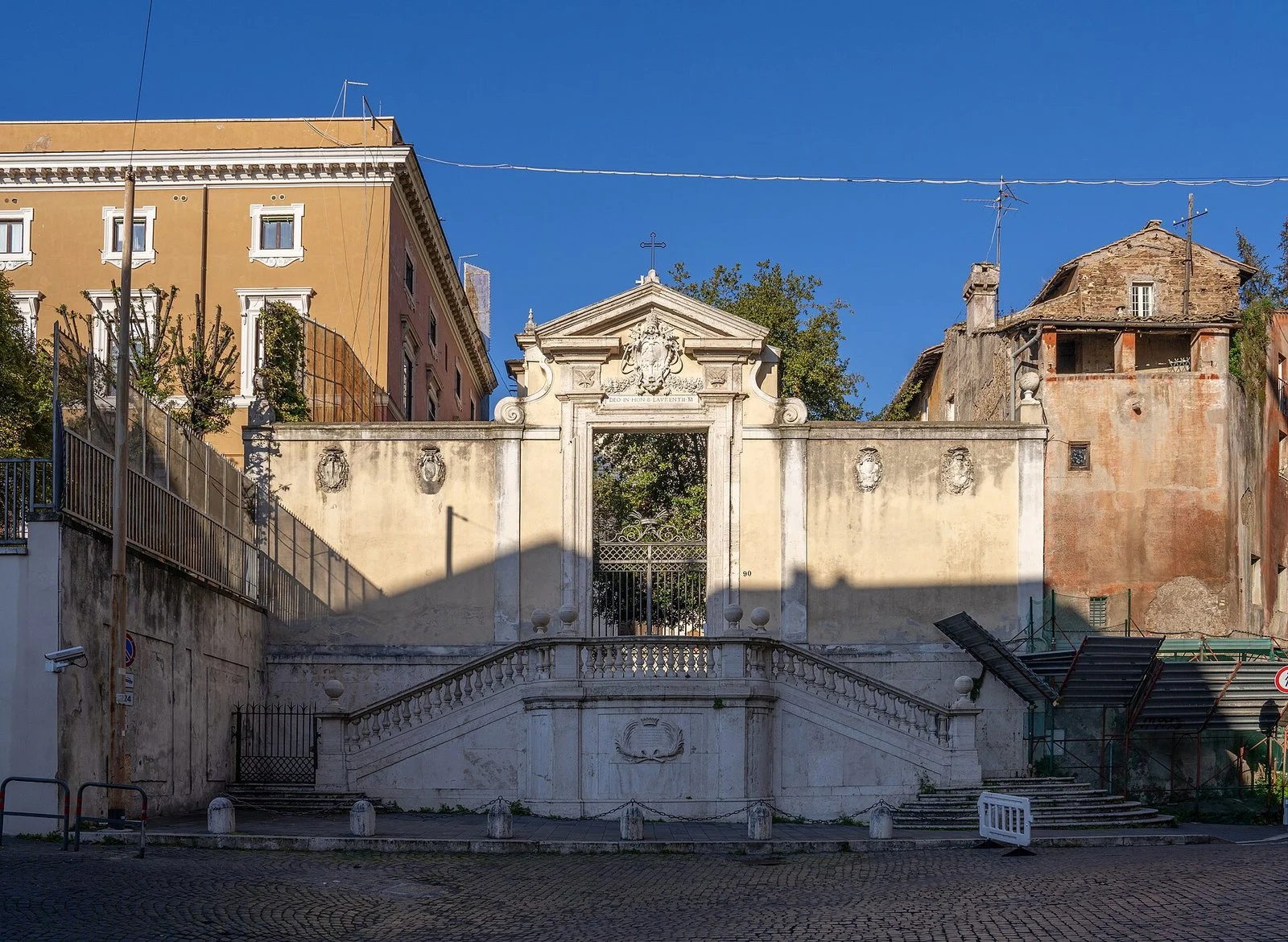
San Lorenzo in Panisperna is a church in the rione Monti, at Via Panisperna 90, reached by climbing a double-ramp stairway and crossing a tree-lined courtyard: people often walk along the street without noticing that up there, a few meters above sidewalk level, stands a place of worship with almost a thousand years of documentation behind it. Hagiographic tradition places it on the spot where Lawrence, deacon of the Church of Rome, was supposedly put to death on the gridiron in 258, during the persecution of Valerian: it is a story handed down by the liturgy and Roman devotion, not an archaeological fact, and in these lines it is treated as such. The reason this address deserves a stop also concerns the 20th century, though. In the adjacent building, built after the expropriation of the Poor Clares' monastery, the group gathered around Enrico Fermi worked, the so-called boys of Via Panisperna, who in October 1934 figured out how to slow down neutrons and multiply induced radioactivity. A church of early medieval foundation and one of the decisive laboratories of 20th-century physics share the same stretch of street, 200 meters from the rione Monti most trodden by tourists. The lines that follow tell what you really see inside the church, what holds up under checking and what remains legend, how to get there, when it's best to try, and why the hours are the most delicate point of the whole visit.
Where San Lorenzo in Panisperna is and how to get there
The church's address is Via Panisperna 90, in the rione Monti, just above the intersection with Via Milano and a short distance from the Viminale complex. Via Panisperna is one of the streets that climb from the valley floor of Via Cavour toward the ridge of the Quirinal and the Viminal: it runs more or less parallel to Via Nazionale, one block higher, and connects the area of Santa Maria Maggiore with Largo Magnanapoli and the overlook on the Imperial Forums. Anyone walking while looking at shop windows passes it without seeing it, because the front of the church is not aligned with the street but set back and raised.

On foot, starting from well-known points
From the Colosseum the climb takes 20 minutes: Via dei Fori Imperiali, then Via Cavour, then Via del Boschetto or the Salita dei Borgia, which leads to San Pietro in Vincoli and from there upward. From Santa Maria Maggiore 10 minutes downhill along Via Panisperna is enough, and it starts from the side of the basilica. From Piazza Venezia count a quarter of an hour going up from Largo Magnanapoli, with the Trajan's Markets on the right. If you come from Piazza della Repubblica you instead go down Via Torino and Via Milano in about 10 minutes, passing next to the Palazzo delle Esposizioni.
The climb counts for more than the distance in meters. Monti is a rione on a constant slope, with stairways and uneven cobblestones: anyone with walking difficulties should arrive from above, from Via Nazionale going down Via Milano, rather than from the bottom of Via Cavour.
By public transport
The most convenient metro stop is Cavour, on line B, from which you walk up in eight or 10 minutes. Alternatively Repubblica, on line A, is about 10 minutes downhill, and Termini is a little under 15 minutes' walk. On the surface, Via Nazionale is served by the bus lines connecting Termini with Piazza Venezia, including the 40 and the 64: you get off at Via Milano and climb one block. If you're getting around the city for several days, you'll find general information on tickets and lines on our page on getting around Rome.
The stairway and the courtyard: what you find on arrival
In front of the church there is a stairway that climbs from street level to a tree-lined courtyard, and only from the courtyard do you reach the portico and then the door. The current stairway is owed to Leo XIII, in the works of 1893 and 1894 that also had the outer portico decorated with images of Saint Lawrence and Saint Francis of Assisi. In the courtyard there is a bronze statue of Saint Bridget of Sweden. The difference in level explains why the church goes unnoticed: from the sidewalk you see the retaining wall and the gate, not the facade.
Hours, entry and access: what is certain and what needs checking
San Lorenzo in Panisperna doesn't have wide, published tourist opening hours like a major basilica: it is a rectory with openings tied to services, and this is the most important practical fact on the whole page. We checked the official sources available and none publishes a stable time slot valid all year. Anyone who wants to go in should be prepared to find the gate closed and should contact the rectory first.
Who runs the church today
The church is entrusted to the office for spiritual assistance to the personnel of the State Police, which has its rectory seat there: the rector is the national coordinating chaplain, a post assigned by decree in September 2003. The phone contact given by the official sources is 06 46535573 or 06 46535574, with the internal prefix of the Viminale complex, and the email address is that of the State Police chaplains' office. From the pastoral point of view the building is a subsidiary church of the parish of San Vitale, a little farther down on Via Nazionale.
The arrangement explains the rest. A church run by a chaplaincy office opens when there is a service, and a Saturday morning or a midweek afternoon guarantee nothing. Calling two or three days ahead is the only serious way to plan. Entry, when the church is open, is free: there is no ticket office, there are no fees and there is no online booking.
Why it's called Panisperna
The name Panisperna appears in documents from the late Middle Ages on and replaced the church's older name, tied to Pope Formosus. There is no single, definitive explanation of its origin, and anyone who tells the first version as if it were settled is doing something incorrect: there are at least four hypotheses and none is proven.
Panis et perna, the popular version
The most widespread explanation derives the place name from the Latin panis et perna, bread and ham, which the nuns of the adjoining monastery supposedly handed out to the poor on August 10, the feast of Saint Lawrence, in memory of the deacon who according to tradition had given the goods of the Church of Rome to the poor. It is a pleasant etymology, consistent with the hagiographic story and cited for centuries, but it remains a consolidated popular tradition, not a verified linguistic reconstruction.
The other hypotheses on the name
A second reading traces the name to two families who owned property in the area, the Pane and the Perna, following a mechanism of place-name formation that is very common in Rome. A third brings in documents of John XXII in which the church appears as San Lorenzo Parasperna, a compound that would join the Greek para, near, and the Latin sperno in the sense of boundary: the building did stand at the edge of the medieval built-up area, among gardens and vineyards. A fourth, more forced, brings in a corruption of Latin terms referring to the gridiron. Our judgment goes to the second or the third, which answer to documented place-name logic, but none has decisive proof.
History of San Lorenzo in Panisperna, from its origins to today
The first documentary attestation of a church at this spot dates to the early Middle Ages, while the Constantinian foundation of the fourth century, repeated by many guidebooks, has no confirmation and should be considered legendary. The historical sources link the building to the Carolingian and post-Carolingian age, with mentions in the Liber Pontificalis and an attribution to Pope Formosus, in office between 891 and 896, from which would derive the name in Formoso that the church bore until the 1500s. That the torture took place here is a devotional location consolidated from the Middle Ages onward, not an archaeological identification: no excavation has confirmed it.
Benedictines, then Poor Clares
Toward the end of the first millennium the complex passes to a Benedictine community, which builds a monastery of some weight there: around 1149 Eugene III assigns it to Abbot Marino of the abbey of Cava de' Tirreni. In the 1300s the monastery passes to the nuns of Saint Clare, the Poor Clares, and with them the architecture changes too: Cardinal Giacomo Colonna has the church reduced to a single nave and the nuns' choir built, according to the needs of enclosure. This is the reason why the interior still has a single-nave layout and a structure that looks entirely toward the altar.
The reconstruction of the 1500s
The remodeling that gave the church its present form takes place in the second half of the 1500s on the initiative of Cardinal Guglielmo Sirleto, through the pontificates of Pius IV, Pius V and Gregory XIII. The sources diverge on the dates: the most widespread Italian entries indicate a building site between 1565 and 1574, others a conclusion between 1575 and 1576. The difference is a few years, but it should be flagged instead of picking a date at random.
On the architect the situation is less clear. The attribution of the facade that circulates most often, even in municipal sources, is to Francesco da Volterra, with the cautious formula of a probable and undocumented proposal. Some English-language entries instead attribute the reconstruction to Carlo Rainaldi: the claim is untenable, because Rainaldi was born in 1611, decades after the building site. When you find this attribution online, it is an error that spreads by copying. The honest position is that the author of the 16th-century design is not established.
The expropriation of 1872 and what happened to the monastery
With the suppression laws of the unified State, the Poor Clares' monastery is expropriated: the sources indicate 1872 or 1873, and the community is sent away. Cardinal Giacomo Colonna, namesake of the 14th-century predecessor, favors their return in 1896, but on a reduced part of the complex. The main area goes to the State and then to the science faculties of the Regia Università di Roma. It is the decisive passage in this whole story, because this is how a physics laboratory ended up next to a medieval church.
The place of the martyrdom: what tradition says and what the sources support
Hagiographic tradition places at San Lorenzo in Panisperna the torture of the deacon Lawrence, who died according to the ancient sources on August 10, 258 during the persecution ordered by Valerian. On this point it is best to be precise, because the church presents itself precisely as the place of the martyrdom and many guidebooks repeat it as if it were documented.
What the ancient sources say
That Lawrence existed and was executed in Rome in 258 is accepted by scholars: the memory appears in the oldest Roman calendars and the cult is attested very early. The manner of the torture belongs instead to a later tradition. The oldest sources speak of beheading, as for the other clerics hit by the same imperial measure. The story of the gridiron is fixed later in hagiographic literature and from there passes into iconography, where it becomes the saint's identifying sign.
There is nothing to mock. A martyrdom story serves to convey a meaning to a community, and it has worked for 17 centuries. It only has to be labeled for what it is: hagiographic tradition, not chronicle.
The oven in the underground chapel
Under the portico, in an underground room, tradition points to the remains of the oven that supposedly was used for the torture. It is an element of devotion, which church sources flag with the conditional, and access is not guaranteed: it depends on the rectory and is not part of an ordinary visit. If you care about seeing it, ask explicitly on the phone. There are no public indications of scheduled openings of this room.
The Lawrence churches of Rome, or how not to get confused
Rome has several churches dedicated to Saint Lawrence and they are constantly mixed up. The main ones cover different moments in the saint's story, in opposite parts of the city. The basilica of San Lorenzo fuori le Mura, on Via Tiburtina, is the one of the burial, among the seven pilgrimage churches of Rome. The basilica of San Lorenzo in Lucina, in the Campo Marzio, keeps the relics tied to the torture and is where the gridiron is venerated. San Lorenzo in Damaso, inside the palace of the Cancelleria, is an ancient title tied to Pope Damasus, with no connection to the place of death. San Lorenzo in Panisperna claims the site of the execution.
The fresco by Pasquale Cati, the biggest thing inside
The Martyrdom of Saint Lawrence painted in fresco by Pasquale Cati occupies the back wall of the presbytery, behind the high altar, where it works as an altarpiece painted on the wall. We say so clearly because a placement on the inside of the entrance wall also circulates, which is not correct: the fresco is seen on entering, straight ahead, in line with the door, and it fills the whole end wall of the church.
Author and dating, with the discrepancy stated
The author is documented: Pasquale Cati, a Mannerist painter born in Iesi around 1550 and died in Rome in 1620, trained in the Michelangelo orbit and active at several Counter-Reformation building sites in Rome. On the date the sources don't agree. The general catalog of cultural heritage indicates 1585-1589. The entries of Roma Capitale and other church sources indicate 1591. We report both: the range places the work in the last 15 years of the 1500s anyway, that is, shortly after the reconstruction of the church promoted by Sirleto, which is consistent.
What you see in the scene
The composition follows the codified Lawrence iconography: the saint stretched on the gridiron, the executioners around him, the figures of those present on several planes, two side bands with heraldic coats of arms and symbols of the martyrdom. The layout is monumental and the rendering of the bodies betrays the lesson of Michelangelo, in Rome in 1585 a pull hard to avoid. Some entries describe the work as one of the largest wall paintings made in Rome after the Sistine Chapel: it is an indication of scale, not a ranking. The presbytery is poorly lit and the wall is tall: anyone staying at the back of the nave sees a dark mass, while going up to the first pews and waiting for the eye to adapt, the scene opens from bottom to top. The best time slot is midday, when light comes in from the high windows on the side. With an overcast sky the upper part stays unreadable.
What you see inside the church, chapel by chapel
The interior of San Lorenzo in Panisperna has a single nave with six side chapels and a raised presbytery, a layout that derives from the 14th-century reduction for the enclosure of the Poor Clares and from the 16th-century reconstruction. It is a recollected church of small size, and you walk through it in a few steps.
The nave and the decorative register
The single nave concentrates everything on the central axis and the back. The side walls are marked by the openings of the chapels, and the decoration belongs in large part to the restoration of 1757, which gave the interior its present look: the Saint Clare of Assisi by Antonio Nessi bears the date 1756, the Saint Bridget in prayer by Giuseppe Montesanti 1757, and alongside them are Giuseppe Ranucci, Niccolò Lapiccola and Giovanni Francesco Romano. On the vault, Antonio Bicchierai frescoed the Glory of Saint Lawrence, the heavenly counterpart to the martyrdom scene below. Anyone arriving from Santa Prassede or Santa Pudenziana, where the Middle Ages show in the mosaics, finds here another season: the second-rank Roman 18th century, well made and without famous names.
The crucifix and Saint Bridget of Sweden
On the high altar there is a 14th-century crucifix, before which, according to the tradition reported by church sources, Saint Bridget of Sweden used to pray when she came here dressed as a beggar to ask for alms for the poor. Bridget, who died in Rome in 1373, was buried in the church next to the monastery before her remains were moved to Sweden, to Vadstena. The bronze statue in the courtyard in front of the church recalls this link. It is the most interesting element of local devotion after the one for Lawrence, and almost nobody knows it.
The Physics Institute of Via Panisperna, a few meters from the church
A few dozen meters from the church, on the same side of the street, is the building that housed the Regio Istituto Fisico of the University of Rome, where between the late 1920s and 1938 Enrico Fermi's group worked: the postal address is Via Panisperna 89a, with the visitor entrance from Piazza del Viminale 1. They are two distinct buildings and two distinct stories, and anyone who enters the church does not enter the institute: the contiguity is geographic, not functional. But it is precisely the contiguity that is the reason this block deserves a stop.
How a monastery became a laboratory
The thread is the one told above. The expropriation of the Poor Clares' monastery in the 1870s frees a large area in a high, airy position near the center of administrative power of the new State. The State assigns it to the science faculties of the Regia Università, and on that land the scientific institutes rise, including the physics one. A cloister becomes a campus, and the campus becomes the place where a group of young people under 30 do experiments that nobody else in Europe is doing.
Who the boys of Via Panisperna were
The group forms around Enrico Fermi, who in 1926 obtained the first Italian chair of theoretical physics. The names that historiography steadily associates with the group are seven: Enrico Fermi, Franco Rasetti, Emilio Segrè, Edoardo Amaldi, Ettore Majorana, Bruno Pontecorvo and the chemist Oscar D'Agostino, the only non-physicist, indispensable for the chemical separations of the irradiation products. The expression boys of Via Panisperna is later and journalistic. The internal nicknames that the literature reports vary from memory to memory, and for this reason we don't attribute them to anyone in the form of a quotation.
They were very young. Amaldi and Segrè were born in 1908, Majorana in 1906, Pontecorvo in 1913: when the discovery of 1934 comes, the youngest of the group is 21 and the head is 33. That fact says more than any adjective about that laboratory.
Orso Mario Corbino, the director who made it all possible
Without Orso Mario Corbino, a Sicilian physicist, director of the institute and a man with connections inside the institutions of the Kingdom, the group would not have existed. It is Corbino who recognizes Fermi's stature when Fermi is little more than a brilliant student, who gets the chair of theoretical physics established in 1926, who gathers the best young people and brings them to Via Panisperna, who covers the group on the political and administrative side. Corbino dies in January 1937, and his passing takes away from the group the protection that had held it together.
October 22, 1934, the day that counts
The discovery of the properties of slow neutrons is dated by the most widespread reconstruction to October 22, 1934, with some popular sources indicating October 20 instead: we flag the discrepancy because it exists, though knowing that the 22nd is the date that appears in the popular material of the Istituto Nazionale di Fisica Nucleare and in the most cited historical reconstructions.
The group systematically bombarded the elements of the periodic table with neutrons, produced by a radon and beryllium source, and measured the induced radioactivity with counters. The results were irregular: the same measurement gave different values depending on the target sitting on a wooden table or on a marble top, and nobody understood why. That morning, instead of the lead wedge he was about to place between the source and the target, Fermi inserts a block of paraffin a few centimeters thick. The counters go wild: the induced radioactivity grows by orders of magnitude.
The explanation, worked out in the following days, is that paraffin is rich in hydrogen, and hydrogen nuclei have a mass similar to that of the neutron: the collisions slow the neutron down instead of barely deflecting it, and a slow neutron is much more likely to be captured by the target nucleus. Lead, made of heavy nuclei, produced nothing of the kind. From then on, slowing down neutrons becomes a technique, and that technique is the basis of everything that comes after, from the fission of 1938 to reactors.
The garden fountain and the goldfish
To confirm that the decisive factor was hydrogen, the group repeats the measurements by immersing source and target in the water of the institute's garden fountain: water contains hydrogen and should give the same effect as paraffin. The test in the fountain is reported by Italian science popularization, including that of the Istituto Nazionale di Fisica Nucleare, and it is the documented part of the episode.
The detail of the goldfish belongs instead to the handed-down story. In the most widespread versions the garden pond was a fishpond with goldfish, and the image of physicists lowering a neutron source into the water among the fish has become the emblem of the episode, repeated by books, articles and documentaries. We give it for what it is: a handed-down story, which has circulated for decades and which no primary source available for consultation fixes in its details. That the experiment was repeated in water is certain. How many fish there were is folklore.
The patent and the Nobel
On October 26, 1935 the group files a patent on the process of producing artificial radioactive substances by bombardment with slow neutrons. It is one of the few cases in which a European fundamental physics discovery of those years was formally protected, and the matter of recognition for the signatories dragged on for decades. In 1938 Enrico Fermi receives the Nobel Prize in physics for the identification of new radioactive elements and for the discovery of nuclear reactions brought about by slow neutrons.
What happened to the group
1938 closes the story. The racial laws of the Fascist regime directly hit several members of the group and their families: Fermi, whose wife Laura Capon came from a Jewish family, collects the Nobel in Stockholm in December 1938 and from there does not return to Italy, going on to the United States. Segrè settles in Berkeley and will receive the Nobel in turn in 1959. Rasetti goes to Canada. Pontecorvo goes to France, then to North America, and in 1950 to the Soviet Union. Ettore Majorana disappears in March 1938 during a ship voyage between Palermo and Naples, and the case has never had an established solution. Edoardo Amaldi stays in Italy and rebuilds postwar Italian physics, up to the birth of the Istituto Nazionale di Fisica Nucleare.
In the meantime the university's scientific institutes had moved to the new Città Universitaria and the building on Via Panisperna had stopped being an active laboratory. The complex then entered the area of the Ministry of the Interior.
The building today: can you visit it?
Since November 2019 the historic building has housed the Museo storico della fisica e Centro studi e ricerche Enrico Fermi, which on its official site gives the address of Via Panisperna 89a and the visitor entrance from Piazza del Viminale 1, with separate booking paths for schools, groups and individuals. Visits are therefore by reservation. Days, hours, duration and any fee are not published in a stable way and need to be checked with the museum before showing up: the building is inside the perimeter of a ministry and access may be subject to unannounced checks and restrictions. If you want to understand beforehand what it is about, you can read our page dedicated to the Centro Enrico Fermi and the Museo storico della fisica, which treats the museum as an institution and follows its openings, while this page stays focused on the church and the context of the rione.
Church and museum remain two separate things, with entrances and access conditions that have nothing in common. There is no combined ticket.
A curiosity about San Lorenzo in Panisperna
The curiosity that sums it all up is one of measurement: between the door of the church and the door of the building where the property of slow neutrons was discovered there are less than 100 meters of sidewalk. It is a distance covered in a minute walking slowly, and it separates a place that celebrates a martyr of 258 from a place where, in 1934, seven people put into the hands of the 20th century a tool that produced nuclear reactors, nuclear medicine and atomic weapons.
Why the coincidence is not random
There is nothing mystical about the proximity: it is urban planning. The suppression laws of the unified State expropriated the large monastic complexes of the center, and the freed land ended up with ministries and universities. The Poor Clares' monastery was one of those complexes, in a high and healthy position that 19th-century hygiene considered suited to laboratories. Italian physics was born there for the same reason the Ministry of the Interior settled at the Viminale: there was free space and the State had taken it.
Something nobody tells you about San Lorenzo in Panisperna
What is almost never written is that the church is not freely visitable like a basilica and that arriving without having phoned first means, most of the time, staying outside the gate looking at the stairway. The management explains why. It is a rectory entrusted to the spiritual assistance office of the State Police, and the openings follow the services and the presence of staff instead of a published calendar.
The hours problem, explained properly
The institutional information pages on this church all refer to direct contacts instead of publishing a time slot, and it is not an oversight: it means that no stable slot exists. The numbers to call are 06 46535573 and 06 46535574, and the question should be precise: on which days and hours of next week is the church open, and can the underground room under the portico be seen. Our judgment is that anyone who doesn't phone is making a bad bet.
The two seasonal windows that work best
Two moments of the year noticeably raise the chance of finding it open. The first is August 10, the feast of Saint Lawrence, a day when a church that claims the place of his martyrdom has excellent reasons to hold a service. The second is Lent: San Lorenzo in Panisperna is among the Roman stational churches and tradition places it on the Thursday of the first week, with a service in the late afternoon. The time changes from year to year and should be looked up on the diocese's stational calendar.
The advice I give you for visiting San Lorenzo in Panisperna
This advice is worth more than all the rest: phone the rectory two or three days ahead at 06 46535573 or 06 46535574, have them tell you the opening hours for the week and build the itinerary around that window, not the other way around. A church with irregular opening goes at the start of the tour, not the end, because if it is closed you make up for it with something else and haven't lost the afternoon.
How to fit the visit into half a day
The route we recommend starts from the top and goes down. You begin at Santa Maria Maggiore, take Via Panisperna from the side of the basilica and walk down: in 10 minutes you reach the church's stairway. From there you go down toward Largo Magnanapoli, look out over the Trajan's Markets and close on the Imperial Forums, or cut through Via dei Serpenti to Piazza della Madonna dei Monti, the social center of the rione. Three hours, stops included.
The alternative tour, if you find it closed
The rione also holds up well for plan B. Five minutes away is Sant’Agata dei Goti, of Arian origin, with a courtyard almost nobody knows. At 10 minutes the basilica of Santi Silvestro e Martino ai Monti, with an ancient underground. At 15, Santa Prassede, which has the finest Byzantine mosaics in the city in the Chapel of San Zeno. All three have more regular openings.
Another well-known fact, yet rarely cited
The well-known fact that almost no guidebook lays out is that the gridiron, the symbol by which everyone recognizes Saint Lawrence, does not appear in the oldest sources on his martyrdom, which speak of beheading as for the other Roman clerics hit in 258. The story of the torture by fire consolidates later, in hagiographic literature and in preaching, and from there takes over the iconography until it becomes inseparable from the saint.
Why the image won
A strong image beats a sober report. Beheading was the ordinary penalty for Roman citizens and did not set Lawrence apart from anyone else. The gridiron sets him apart, can be drawn, and is recognized from afar. On that story the Church of Rome built one of its most popular devotions, and Cati's fresco in the presbytery is a mature product of that construction, painted when the sacred image had to be readable and powerful.
The right photo to take at San Lorenzo in Panisperna
The photograph that works for this place is the one taken from street level on Via Panisperna, with the stairway in the foreground climbing toward the gate and the front of the church above: the framing tells the difference in level, which is the thing no frontal photo explains. You need a moderate wide angle and it's best to keep the verticals straight.
Light and time of day
The front of the church catches light in the second part of the day, while in the morning it stays in shadow with the bright sky behind it, an awkward condition for anyone shooting on auto. Late afternoon, with the low sun running down the axis of the street, is the best time slot and also gives the contrast between the pale stone of the stairway and the dark facades of the buildings alongside. In summer, with the sun high, the stairway loses depth: winter or the in-between seasons are better.
The photo almost nobody takes
The most interesting one is the hardest to explain to anyone who doesn't know the history: a framing that holds in the same frame the wall of the church and the facade of the former Physics Institute building, taken from the opposite sidewalk. It isn't beautiful. But it tells in a single image the leap of 17 centuries that makes this block different from all the others in Monti. Anyone who posts photos of Rome with a sensible caption should take it.
Some important events that happened here in history
The documented episodes that have left a mark on this block are few but weighty, and cover a span of over a thousand years. We lay them out in chronological order, separating what is attested from what belongs to devotional memory.
The Middle Ages and early modern period
Around 1149 Eugene III assigns the monastery to Abbot Marino of the abbey of Cava de' Tirreni. In the 1300s the passage to the Poor Clares changes the form of the church, reduced to a single nave with a choir for the enclosure at the will of Cardinal Giacomo Colonna. In 1300, the year of the first jubilee, Boniface VIII intervenes on the building. In the same century Saint Bridget of Sweden frequents this block and is buried there before her remains are moved to Sweden. On July 6, 1517 Leo X establishes the cardinal title.
The 1500s and 1700s
Between 1565 and 1574, with the 1575-1576 variant reported by other sources, Cardinal Guglielmo Sirleto has the church rebuilt from the foundations. Between 1585 and 1591, depending on the dating one accepts, Pasquale Cati frescoes the Martyrdom on the presbytery wall. In 1757 a restoration redefines the chapels and vault and gives the interior its present look.
The 1800s and 1900s
In 1872, according to other sources 1873, the Poor Clares' monastery is expropriated and the area passes to the State and to the science faculties of the Regia Università. The nuns return in 1896 on a reduced portion. Between 1893 and 1894 Leo XIII has the stairway built and the portico decorated. On October 22, 1934, in the physics institute built on the convent area, Enrico Fermi's group identifies the properties of slow neutrons. On October 26, 1935 the patent is filed and in 1938 Fermi receives the Nobel. In 1938 the racial laws scatter the group. Since November 2019 the building has housed the museum dedicated to Fermi.
Who passed through San Lorenzo in Panisperna
The documented people who had to do with this address make up an unusual list, because it puts together medieval saints, Counter-Reformation cardinals and 20th-century physicists without any of the three groups knowing much about the others.
Saints, popes and cardinals
Saint Bridget of Sweden, who died in Rome in 1373, is the strongest name: church tradition describes her asking for alms for the poor in front of this church and praying before the 14th-century crucifix on the altar. Among the popes, Boniface VIII intervenes in 1300, Leo X establishes the cardinal title in 1517, Leo XIII builds the stairway in the late 1800s. Among the cardinals, Giacomo Colonna in the 1300s and Guglielmo Sirleto in the 1500s are the two names who materially changed the building. Among the nuns of the community, the sources recall Francesca Farnese.
Artists
Pasquale Cati, a pupil of the Michelangelo culture, signs the fresco in the presbytery. The Roman 1700s leave Antonio Bicchierai on the vault, and Antonio Nessi, Giuseppe Ranucci, Niccolò Lapiccola, Giuseppe Montesanti and Giovanni Francesco Romano in the chapels. The name of Francesco da Volterra is associated with the 16th-century facade, with an attribution that the sources give as probable and not certain.
The physicists
In the building next door passed Enrico Fermi, Franco Rasetti, Emilio Segrè, Edoardo Amaldi, Ettore Majorana, Bruno Pontecorvo and Oscar D’Agostino, with Orso Mario Corbino as director. Two of them, Fermi and Segrè, received the Nobel Prize in physics. One, Majorana, disappeared in 1938 without the case finding a solution. We don't report sentences attributed to any of them: the quotations circulating about this episode come from memoirs written decades later and vary from version to version.
Eating in the area: how to choose in Monti without getting it wrong
Monti is a heavily trodden area, with Via del Boschetto, Via dei Serpenti and Piazza della Madonna dei Monti a few hundred meters from the church, and for this very reason it mixes serious places with places that live off passing trade. We don't name places: a list of names goes stale in a few months and helps nobody. We give the criteria, which stay valid.
The signs that point to a trap
The first is the woman rolling fresh pasta in the window or on the sidewalk: it's a stage-set hook, not a clue to a kitchen. The second is the menu with photographs of the dishes, which serves those who don't read Italian and says exactly which audience the place is aiming at. The third is the barker at the door inviting you to sit. The fourth is non-stop hours from morning to night with no kitchen break, incompatible with a real kitchen. The fifth holds across the whole city: places set in front of famous monuments, where the price often adapts to the tourist in front of them, with items not priced on the menu or different price lists inside and outside.
A separate discussion is deserved by the chains that replicate the same sign at several points in the center, with an identical menu and the line with a numbered ticket: they are a commercial phenomenon, not a gastronomic offering, and Romans don't go. There's no need to name names.
The criterion that always works
Before sitting down, look at who is sitting and in what language they order: it is the only indicator that can't be faked. If you want a starting point already filtered, you can consult Daniele Dezi's personal list on Google Maps, which is a curated, unsponsored collection. For a broader picture, our pages on where to eat in Rome, on the markets of Rome, including the new Mercato Esquilino 10 minutes' walk away, and on historic cafes and shops remain useful.
What's around, within half an hour's walk
The church is within a 20-minute walk of a density of monuments that few cities can match. Going down toward the Forums you meet the Forum of Trajan, the Trajan's Markets, the Imperial Forums Museum and the churches of the Forum of Trajan, while farther down are the Colosseum and the Domus Aurea. Going up toward the Esquiline you reach Santa Maria Maggiore, the Esquiline obelisk and Palazzo Merulana. Toward the Quirinal there are the Quirinal Palace with its obelisk, the Scuderie, Sant’Andrea al Quirinale, San Silvestro al Quirinale and Palazzo Barberini. Toward Termini open the Baths of Diocletian with the Octagonal Hall, Santa Maria degli Angeli and Palazzo Massimo. In the opposite direction, toward the center, you reach in a quarter of an hour the Trevi Fountain, the Santi XII Apostoli, the Crypta Balbi and Santa Maria sopra Minerva. Farther away, but on the same Lawrence axis, the basilica of San Giovanni in Laterano.
Frequently asked questions about San Lorenzo in Panisperna
How much does it cost to enter San Lorenzo in Panisperna?
Entry to San Lorenzo in Panisperna is free, because it is a place of worship with no ticket office or paid museum circuits. There are no official fees, online reservations or combined tickets with other sites. A price that shows up online refers to a third-party guided visit, a service different from access to the place.
What are the opening hours of San Lorenzo in Panisperna?
San Lorenzo in Panisperna doesn't publish a stable time slot: it is a rectory and opens depending on services and the presence of staff, so the hours must be asked of the rectory directly at 06 46535573 and 06 46535574. The institutional pages all refer to direct contacts instead of giving an hour, which confirms that a fixed slot does not exist: it's best to phone two or three days ahead.
How do you get to San Lorenzo in Panisperna by public transport?
San Lorenzo in Panisperna is at Via Panisperna 90 and the most convenient metro stop is Cavour, on line B, eight or 10 minutes' walk uphill. Alternatively you get off at Repubblica, on line A, and walk about 10 minutes downhill. On the surface the bus lines running along Via Nazionale, including the 40 and the 64, drop you at Via Milano.
Is San Lorenzo in Panisperna really the place of Saint Lawrence's martyrdom?
San Lorenzo in Panisperna is indicated by hagiographic tradition as the place of Saint Lawrence's martyrdom, which happened according to the ancient sources in 258, but this location is devotional and has no archaeological confirmation. No excavation has produced elements that prove it. The torture on the gridiron too belongs to a story consolidated later, while the oldest sources speak of beheading.
Who painted the martyrdom fresco inside San Lorenzo in Panisperna?
The fresco of the Martyrdom of Saint Lawrence inside San Lorenzo in Panisperna is the work of the Mannerist painter Pasquale Cati, born around 1550 and died in Rome in 1620, and it occupies the back wall of the presbytery behind the high altar. On the date the sources diverge: the general catalog of cultural heritage indicates 1585-1589, other official entries 1591. On the vault, the Glory of Saint Lawrence is by Antonio Bicchierai, from the 1700s.
Can you visit the Physics Institute on Via Panisperna where Enrico Fermi worked?
The building of the former Physics Institute at Via Panisperna 89a, next to San Lorenzo in Panisperna, has housed since November 2019 the Museo storico della fisica e Centro studi e ricerche Enrico Fermi, with the visitor entrance from Piazza del Viminale 1 and visits by reservation. Days, hours, duration and any fee are not published in a stable way and need to be checked with the museum, also because the building is within the perimeter of a ministry.
How long does it take to visit San Lorenzo in Panisperna?
To visit San Lorenzo in Panisperna 20 minutes is enough, because the church has a single nave, six side chapels and a presbytery with Pasquale Cati's large fresco. With a stop in the tree-lined courtyard and a walk around the block to the former Physics Institute you get to 40 minutes: it is a stop to slot into an itinerary of the rione Monti.
Is San Lorenzo in Panisperna accessible to people with mobility difficulties?
Access to San Lorenzo in Panisperna is by a stairway that climbs from street level to the courtyard in front of the portico, and this is the main obstacle for wheelchair users. We know of no alternative route advertised by the rectory. Anyone with specific needs should ask the chaplaincy if a usable side entrance exists: it is information that doesn't appear online.
Can you take photographs inside San Lorenzo in Panisperna?
Inside San Lorenzo in Panisperna photography is possible when the church is open and no service is going on, always asking whoever is present instead of taking permission for granted. Flash should be ruled out, both out of respect for the place and because on a fresco it produces no useful result. A tripod is normally not allowed: for the fresco it's best to brace yourself against a pew.
Who wrote this page
This page is edited by the team at Tour Leader Pro, the Roman project office that designs and coordinates visits, itineraries and cultural events in Rome and Lazio. Hours, prices and access conditions reported here are verified as of the publication date against the official sources named in the text: it's best to recheck them before leaving, because they change often. If you find outdated information, let us know.
If you're building an itinerary in the rione Monti and need to fit a church with irregular opening like this one together with more predictable stops, from the basilicas of the Esquiline to the routes of the rione, you'll find tools for planning and coordinating visits at Tour Leader Pro, which works in Rome and Lazio with local guides and operators.
For a wider picture, one that includes rail and air connections, travel times between cities and a trip touching several regions, a useful resource is Italy Planner, which covers the planning of a trip to Italy as a whole.